Los Mandatos Informales Informal Tú commands
What is a command? Commands are used to tell someone what to do or NOT to do. Tú commands are informal and used with friends and family.
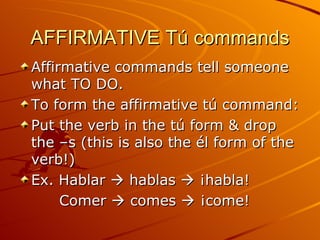
AFFIRMATIVE Tú commands Affirmative commands tell someone what TO DO. To form the affirmative tú command: Put the verb in the tú form & drop the –s (this is also the él form of the verb!) Ex. Hablar    hablas    ¡habla! Comer    comes    ¡come!
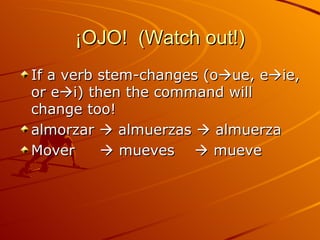
¡OJO!  (Watch out!) If a verb stem-changes (o  ue, e  ie, or e  i) then the command will change too! almorzar    almuerzas    almuerza Mover    mueves    mueve
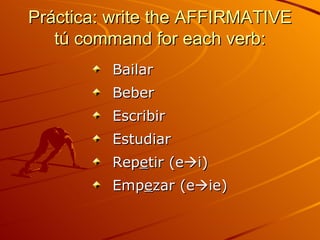
Práctica: write the AFFIRMATIVE tú command for each verb: Bailar Beber Escribir Estudiar Rep e tir (e  i) Emp e zar (e  ie)
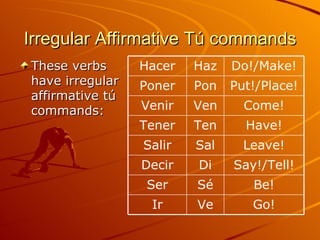
Irregular Affirmative Tú commands These verbs have irregular affirmative tú commands: Go! Ve Ir Be! Sé Ser Say!/Tell! Di Decir Leave! Sal Salir Have! Ten Tener Come! Ven Venir Put!/Place! Pon Poner Do!/Make! Haz Hacer
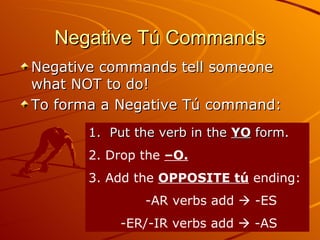
Negative Tú Commands Negative commands tell someone what NOT to do! To forma a Negative Tú command: 1.  Put the verb in the  YO  form. 2. Drop the  –O. 3. Add the  OPPOSITE tú  ending:  -AR verbs add    -ES -ER/-IR verbs add    -AS
Examples of Negative tú commands: Hablar    hablo    no hables Comer    como    no comas Escribir    escribo    no escribas  !OJO! If a verb has an irregular YO form, the Negative tú command will be irregular also! Ex. hacer    hago    no hagas Poner    pongo    no pongas
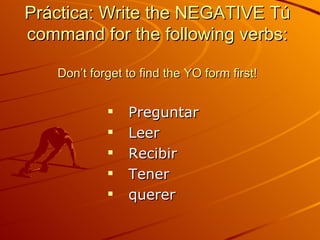
Práctica: Write the NEGATIVE Tú command for the following verbs: Don’t forget to find the YO form first! Preguntar Leer Recibir Tener querer
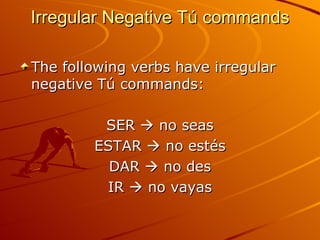
Irregular Negative Tú commands The following verbs have irregular negative Tú commands: SER    no seas ESTAR    no estés DAR    no des IR    no vayas
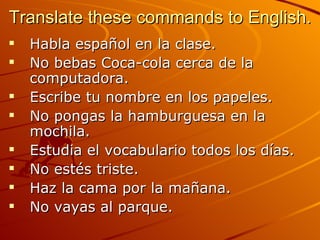
Translate these commands to English. Habla español en la clase. No bebas Coca-cola cerca de la computadora. Escribe tu nombre en los papeles. No pongas la hamburguesa en la mochila. Estudia el vocabulario todos los días. No estés triste. Haz la cama por la mañana. No vayas al parque.

Los mandatos informales

  • 1.
    Los Mandatos InformalesInformal Tú commands
  • 2.
    What is acommand? Commands are used to tell someone what to do or NOT to do. Tú commands are informal and used with friends and family.
  • 3.
    AFFIRMATIVE Tú commandsAffirmative commands tell someone what TO DO. To form the affirmative tú command: Put the verb in the tú form & drop the –s (this is also the él form of the verb!) Ex. Hablar  hablas  ¡habla! Comer  comes  ¡come!
  • 4.
    ¡OJO! (Watchout!) If a verb stem-changes (o  ue, e  ie, or e  i) then the command will change too! almorzar  almuerzas  almuerza Mover  mueves  mueve
  • 5.
    Práctica: write theAFFIRMATIVE tú command for each verb: Bailar Beber Escribir Estudiar Rep e tir (e  i) Emp e zar (e  ie)
  • 6.
    Irregular Affirmative Túcommands These verbs have irregular affirmative tú commands: Go! Ve Ir Be! Sé Ser Say!/Tell! Di Decir Leave! Sal Salir Have! Ten Tener Come! Ven Venir Put!/Place! Pon Poner Do!/Make! Haz Hacer
  • 7.
    Negative Tú CommandsNegative commands tell someone what NOT to do! To forma a Negative Tú command: 1. Put the verb in the YO form. 2. Drop the –O. 3. Add the OPPOSITE tú ending: -AR verbs add  -ES -ER/-IR verbs add  -AS
  • 8.
    Examples of Negativetú commands: Hablar  hablo  no hables Comer  como  no comas Escribir  escribo  no escribas !OJO! If a verb has an irregular YO form, the Negative tú command will be irregular also! Ex. hacer  hago  no hagas Poner  pongo  no pongas
  • 9.
    Práctica: Write theNEGATIVE Tú command for the following verbs: Don’t forget to find the YO form first! Preguntar Leer Recibir Tener querer
  • 10.
    Irregular Negative Túcommands The following verbs have irregular negative Tú commands: SER  no seas ESTAR  no estés DAR  no des IR  no vayas
  • 11.
    Translate these commandsto English. Habla español en la clase. No bebas Coca-cola cerca de la computadora. Escribe tu nombre en los papeles. No pongas la hamburguesa en la mochila. Estudia el vocabulario todos los días. No estés triste. Haz la cama por la mañana. No vayas al parque.