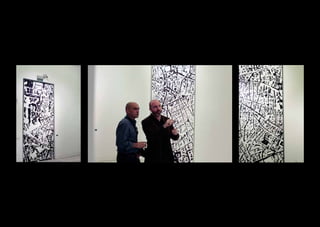
Vídeo sobre la exposición
Mapping Madrid, IED Madrid
¡Pincha en la imagen y disfruta del vídeo!
E                                                                                                T
            l Istituto Europeo di Design celebra con Mapping Madrid su participación en                      he Istituto Europeo di Design has taken part in PhotoEspaña for the third consecutive
            PHotoEspaña por tercer año consecutivo. De esta forma, junto a otras actividades                 year, with Mapping Madrid. In this way, along with other activities, such as La mirada
            como La mirada mágica, confirma y refuerza su apuesta por las artes visuales y                   mágica [The Magical Gaze], it confirmed and strengthened its commitment to the
     muy especialmente por la fotografía –máxime en este año académico en el que nuestro              visual arts and more especially to photography –particularly in this academic year, which saw
     curso de fotografía ha iniciado su andadura–, puesto que este medio es, sin duda, uno de         the beginning of our photography course–, given that this medium is, undoubtedly, one of
     los modos privilegiados de comunicación en el mundo contemporáneo, dominado clara-               the principal means of communication in the modern world, which is clearly dominated by
     mente por la imagen como forma más poderosa de construir los relatos de nuestros días.           the image as the most powerful way of constructing the stories of our times.

     Si el primer año dentro de PHotoEspaña la exposición de Alberto Corazón permitió que             The first year in which PHotoEspaña took place, the exhibition of the work by Alberto
     nos acercásemos a piezas míticas de la Transición política de la España democrática, al          Corazón allowed us to get nearer to mythical pieces from the political transition of demo-
     tiempo que permitía observar el paso de conductas conceptuales a procesos editoriales            cratic Spain, while also enabling us to observe the change from conceptual behaviours to
     que hoy día son corrientes; el año pasado se vio confirmada esa necesidad de reivindicar         editorial processes which are common today. Last year, on the other hand, saw the confirma-
     una tradición del diseño, las artes y la comunicación a través de una muestra que contó          tion of the need to claim a tradition in design, the arts and communication by way of an ex-
     con protagonistas tan conocidos como Nobuyoshi Araki, Joseph Beuys, Daniele Buetti,              hibition featuring such well-known artists as Nobuyoshi Araki, Joseph Beuys, Daniele Buetti,
     Cabello/Carceller, Alfredo Jaar, Thomas Ruff, Montserrat Soto o Erwin Wurm.                      Cabello/Carceller, Alfredo Jaar, Thomas Ruff, Montserrat Soto and Erwin Wurm.

     En 2009 el IED ha querido dar un paso más, en sintonía con la propia evolución de la insti-      In 2009 the IED wanted to go a step further, in harmony with the evolution of the institution
     tución, tras consolidar un programa cultural continuo y concebir su propuesta didáctica y        itself, following the consolidation of a continuous cultural programme, and planned its di-
     cultural como un gran laboratorio, que crece gracias a la aportación de todos aquellos que       dactic and cultural proposal as a great laboratory, which would grow thanks to the contribu-
     demuestran su pasión por la creatividad. El Palacio de Altamira e IED Master se ofrecen,         tion of all those who could demonstrate their passion for creativity. The Palacio de Altamira
     pues, como puntos de encuentro y qué mejor manera de demostrarlo que idear un proyec-            and IED Master are therefore acting as meeting points, and what better way to demonstrate
     to que reflexiona sobre el propio festival en el que se encuentra la exposición, invitando a     this than by devising a project that reflects on the very festival in which the exhibition is on
     ofrecer distintos puntos de vista sobre el mismo.                                                display, welcoming different points of view on the subject.

     En este caso, gracias a Mapping Madrid se activa un proceso cuyo mayor interés reside            In this case, thanks to Mapping Madrid, we activated a process whose greatest interest lay precise-
     precisamente en la colaboración de todas aquellas personas que han decidido participar           ly in the collaboration of all those who had decided to take part in a common project. As a whole,
     en un proyecto común. En su conjunto, el resultado ha sido muy satisfactorio, puesto que         the result was very satisfactory, given that it has permitted an examination of the ways of repre-
     ha permitido reflexionar sobre formas de representación del mundo, como es el mapa,              senting the world, such as the map, in order to discover the subjectivities which lie behind them
     para descubrir las subjetividades que hay detrás de todas ellas, pero sobre todo, las distin-    all, but above all, of the different perspectives that exist to make the place where we live visible.
     tas perspectivas que existen para hacer visible el lugar donde vivimos.
                                                                                                      And all this has been possible thanks to a firm and appropriate commitment to the new
     Y todo ello ha sido posible gracias a una fuerte y pertinente apuesta por nuevos medios y        media and formats, which enable us to promote one of the key features of the IED: whoever
     formatos, que permiten potenciar una característica clave del IED: quien está dentro de él       comes across the show should not be a mere spectator, but an active part of what is happen-
     no debe ser un mero espectador, sino una parte activa de lo que ocurre en su interior. Así,      ing. In this way, a project takes shape, which has managed, with today’s resources, to con-
     cobra forma un proyecto que ha logrado construir con medios actuales una nueva visión            struct a new vision of what it means to make a map, in this case, of the city which has been
     de lo que significa hacer un mapa, en este caso de la ciudad que acoge al IED desde hace         home to the IED for fifteen years, and from which it is possible to offer other ways of learning
     quince años y desde la que es posible ofrecer otras formas de conocer la cultura del proyecto.   about the culture of the project.

                                                                        Riccardo Marzullo                                                                                   Riccardo Marzullo
                                                                        Director del IED Madrid                                                                             Director of the IED Madrid


10                                                                                                                                                                                                            11
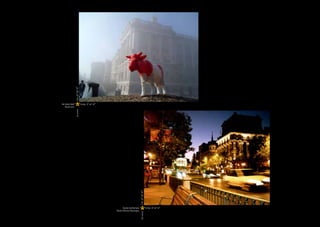
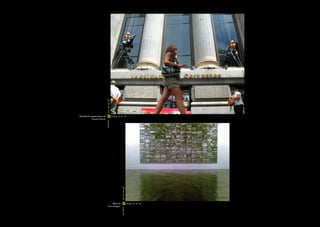
1. Ciudades líquidas. Madrid y Transurbancia de Tete Álvarez   3. Ciudades líquidas. Madrid de Tete Álvarez
Foto: Tete Álvarez                                             Foto: Marta Orozco


2. Transurbancia de Tete Álvarez                               4. Ciudades líquidas. Madrid de Tete Álvarez
Foto: Marta Orozco                                             Foto: Marta Orozco
¿Para qué un mapa?
                                                                                                                I. Todo empezó el día en que un hombre decidió
                                                                                                                observar los alrededores. Empeñado en recono-
                                                                                                                cer su entorno más inmediato, este observador
Pablo Jarauta                                                                                                   antediluviano escogió un punto elevado y co-
                                                                                                                menzó a girar sobre sí mismo. En primer lugar,
                                                                                                                divisó los cobertizos de su aldea. Luego, el huer-
                                                                                                                to, con sus hortalizas y sus endebles frutales.
                                                                                                                Más allá, pudo ver el río, y un poco más lejos, las
                                                                                                                robustas cabezas del ganado. Siguió el obser-
                                                                                                                vador con los ojos bien abiertos hasta que topó
                                                                                                                con una gran montaña. Cegado por esta impo-
                                                                                                                nente imagen, decidió dar el día por terminado.
                                                                                                                A la mañana siguiente, el observador regresó al
                                                                                                                punto elevado y reinició el examen visual de sus
                                                                                                                alrededores. Primero, contempló a los niños de
                                                                                                                la aldea corriendo desbocados tras un conejo.
                                                                                                                Después, una charca plagada de ranas. Se abrió
                                                                                                                entonces ante sus ojos una llanura que no tenía
                                                                                                                fin. El observador se sorprendió: una delgada
                                                                                                                línea unía el cielo con la tierra, impidiéndole
                                                                                                                ver más allá. Había dado con el horizonte. Ex-
                                                                                                                trañado, regresó a la aldea, encendió un fuego
                                                                                                                y reflexionó durante horas. Había identificado
                                                                                                                todos los elementos de su entorno, pero aquella
                                                                                                                reverberada línea le ocultaba las cosas más leja-
                                                                                                                nas. El observador había encontrado el límite de
                                                                                                                su visión: al igual que una montaña, el horizonte
                                                                                                                también velaba su mirada.

                                                                                                                En el intento por formarse una imagen del mun-
                                                                                                                do, el observador había descubierto que sus al-
                                                                                                                rededores abundaban en misterios y enigmas,
                                                                                                                que existían límites y zonas incógnitas. Los
                                                                                                                elementos de su entorno no bastaban para re-
“El mapa ha entrado en la época de la sospecha, ha perdido su                                                   presentar el mundo en el que vivía, hacían falta
inocencia. Ya no podemos, hoy en día, contemplar una historia de la                                             nuevos lugares regidos por nuevas lógicas. De
cartografía sin una dimensión antropológica, atenta a la especificidad                                          tal modo, el observador decidió que si bien no
de los contextos culturales, y teórica, que refleje la naturaleza misma                                         podía ver más allá del horizonte, sí que podía
del objeto, sus poderes intelectuales e imaginarios”                                                            nombrarlo. Regresó nuevamente al punto eleva-
                                         (Christian Jacob, L’Empire des cartes,)                                do y de frente a la llanura fue señalando con el


14                                                                        Mapping Madrid · IED Madrid & PHE09                                                    15
dedo diferentes puntos en el horizonte, asignan-      de su aldea ya tenía utopías: en su cabeza dor-       dos por meros nombres de lugares inexisten-         damente por todo el orbe, podría parecer que
do un nombre a cada uno de ellos. Estos nom-          mían despiertos incontables nombres que seña-         tes, por mares sin orillas, por objetos y seres     los mapas han perdido su componente utópico
bres señalaban lugares que no existían pero que       laban la existencia de lugares imaginarios. Mien-     prodigiosos… incluso por una proyección de          entregándose enteramente a una lógica de la
explicaban el entorno del observador: paraísos,       tras dibujaba frágiles diagramas de las murallas      nosotros mismos. Estos elementos tan propios        objetividad, que los mapas solo sirven para
avernos, islas, dioses, monstruos, abismos... que     de su ciudad, de sus ríos y sus campos, el mundo      de la utopía como de la cartografía hacen del       orientarnos, para desplazarnos sin riesgos de
daban cuenta del curso de los ríos, de los ciclos     se llenó de nombres que anunciaban por doquier        mapa un proyecto sobre el mundo. No se trata        un lugar a otro, para encontrar una calle, una
del día y la noche, de la relación con la naturale-   lugares de luces y sombras. Estos nombres no          ya de representar fielmente un territorio, sino     tienda o un hospital.
za, del origen y el destino. El observador había      tardaron en saltar del lenguaje al mapa, pues se      de cómo queremos que sea. En el mapa se ci-
completado su imagen del mundo: a los ele-            habían consolidado como piezas fundamentales          tan ciencia y literatura, observación e imagina-
                                                                                                                                                                “Los mapas son un reflejo
mentos de su entorno había sumado una inter-          en el proceso de la elaboración de una imago          ción, se dan por igual distintos procedimientos     de la cultura que los ha
minable lista de nombres, de lugares inexisten-       mundi. Las utopías, esa construcción del afuera       que lo encaminan hacia una voluntad de com-         realizado, en ellos pueden
tes que terminaron por configurar sus creencias,      cartográfico, forman parte del mundo tanto como       pletar el gran mosaico del mundo, de compren-
                                                                                                                                                                encontrarse, aunque sea
sus costumbres, su relación con el mundo.             la tierra y el mar. Recordemos brevemente lo que      der nuestras formas de vida, de aprender a re-
                                                      de la Atlántida nos cuenta Platón: “Hubo terribles    lacionarnos con la alteridad a partir de nuestro
                                                                                                                                                                en los espacios en blanco,
II. Esta pequeña historia sobre cómo un obser-        temblores de tierra y cataclismos. Durante un día     entorno. En un mapa la representación se torna      en sus silencios, los
vador cualquiera construyó su mapa del mun-           y una noche horribles, todo nuestro ejército fue      proyecto, va más allá del objeto y se sumerge       diferentes proyectos de
do esconde un esquema que podría sernos de            tragado de golpe por la Tierra, y del mismo modo      en la inmensidad de la superficie terrestre, en
                                                                                                                                                                cada época”
gran utilidad a la hora de comprender el papel        la Atlántida se abismó en el mar y desapareció.       la curva sin fin del horizonte, en lo inagotable
que juegan las producciones cartográficas hoy         He ahí por qué todavía hoy ese mar de allí es difí-   de nuestros sueños. Recordando de nuevo las         Sin embargo, es precisamente este exceso de
en día. Se trata de un esquema muy simple que         cil e inexplorable, debido a sus fondos limosos y     palabras de C. Jacob, la condición necesaria        precisión y objetividad de nuestros días el que
ha estado presente a lo largo de toda la his-         muy bajos que la isla, al hundirse, ha dejado” (Ti-   para el nacimiento de la cartografía no es tanto    nos exige un retorno a los inicios de la carto-
toria de la cartografía y que atiende al hecho        meo 24c-25a). Las utopías construyen el mundo,        la convicción de su materialidad, sino la con-      grafía, a nuestro observador, a los tiempos en
de habitar una esfera y a la imposibilidad de         se hunden dejando fondos limosos, huella geoló-       vicción de la posibilidad de su materialización.    los que poco o nada se conocía, al momento
una imagen total y directa de nuestro mundo.          gica de un lugar inexistente.                         Los mapas nacieron como proyecto, nacieron          utópico de la construcción del mundo. Como
Ciertamente, el hecho de habitar una superfi-                                                               como el lugar natural de las utopías, pues éstas    señalara en su día John B. Harley, la cartogra-
cie curva privó a nuestro observador de una           “Observar los alrededores,                            solamente existen en su representación.             fía raras veces es lo que los cartógrafos dicen
imagen de su mundo, esférico e inaprensible.
Para salvar esta dificultad y ante la necesidad
                                                       construir el afuera: he ahí                          V. Ahora bien, podríamos pensar que actual-
                                                                                                                                                                que es. Los mapas no son objetivos, precisos
                                                                                                                                                                o neutrales, esconden poderes intelectuales e
de una imagen total que explicara el funciona-         el fundamento de todo                                mente estas historias han quedado desfasadas        imaginarios que los sitúan como una valiosa
miento de su entorno y, en definitiva, de todo        mapa, sus entrañas,                                   por una pretensión cartográfica encaminada          producción cultural. Los mapas son un reflejo
el universo, el observador tuvo que construir          su razón última”                                     hacia la objetividad, la precisión o la neutrali-   de la cultura que los ha realizado, en ellos pue-
la imagen que quedaba más allá del horizonte,                                                               dad, que ya no queda sitio en este mundo para       den encontrarse, aunque sea en los espacios en
la primera frontera. Observar los alrededores,        IV. En este sentido, la construcción del afue-        las utopías, pues no hay rincón de la Tierra que    blanco, en sus silencios, los diferentes proyec-
construir el afuera: he ahí el fundamento de          ra transforma por completo la naturaleza de           no haya sido descubierto, clasificado o explo-      tos de cada época. Hoy en día nos vemos ante
todo mapa, sus entrañas, su razón última.             la producción cartográfica. En este esquema           tado. Vivimos en un mundo conocido, hemos           la imperiosa necesidad de crear nuevos pro-
                                                      o proceso los instrumentos necesarios para el         dispuesto en el cielo ojos electrónicos que es-     yectos sobre el mundo, nuevas representacio-
III. Podría decirse que la tarea de representar el    establecimiento de una imagen del mundo no            crutan el territorio, que nos localizan, que ha-    nes que den cuenta de las fracturas existentes
espacio es tan antigua como la de imaginarlo. En      coinciden con los utilizados en la representa-        cen de la representación del mundo un asunto        en este mundo pretendidamente homogéneo.
otras palabras, los mapas son tan antiguos como       ción de nuestro entorno. La escala, los cálculos,     aséptico, casi funcional. Ahora que lo conoce-      En esta dirección, los mapas seguirán siendo
las utopías. El primer hombre que trazó un dibujo     el cartabón o el cuadrante quedan ensombreci-         mos todo, que podemos viajar rápida y cómo-         el mejor lugar para nuestras utopías.


16                                                                  Mapping Madrid · IED Madrid & PHE09     Mapping Madrid · IED Madrid & PHE09                                                                17
Why a Map?                                                                                                       I. It all began the day man decided to observe
                                                                                                                 his surroundings. Determined to recognise his
Pablo Jarauta                                                                                                    most immediate environment, this antediluvian
                                                                                                                 observer chose an elevated place and began to
                                                                                                                 turn around. Initially, he saw the huts in his vil-
                                                                                                                 lage. Then he saw the vegetable plot, with its
                                                                                                                 feeble fruit trees. In the distance he could see the
                                                                                                                 river, and, a bit further, the robust heads of cattle.
                                                                                                                 The observer kept his eyes open and continued
                                                                                                                 to look into the far-off distance, where he could
                                                                                                                 see a huge mountain. Unable to see beyond this
                                                                                                                 overwhelming view, he decided to stop for the
                                                                                                                 day. On the next morning, the observer returned
                                                                                                                 to the elevated spot and continued to examine
                                                                                                                 his surroundings. First, he contemplated the
                                                                                                                 children in the village, running excitedly after a
                                                                                                                 rabbit. Next, he noticed a pond full of frogs, and
                                                                                                                 it was at this point that an endless plain opened
                                                                                                                 up before his eyes. The observer was surprised:
                                                                                                                 a thin line connected the sky and the earth, mak-
                                                                                                                 ing it impossible for him to see beyond it. He
                                                                                                                 had found the horizon. Puzzled, he returned to
                                                                                                                 the village, lit a fire, and thought about it for
                                                                                                                 hours. He had identified all of the elements in
                                                                                                                 his surroundings, but that shimmering line con-
                                                                                                                 cealed the most distant things. The observer
                                                                                                                 had found the limits of his vision: like a moun-
                                                                                                                 tain, the horizon veiled his gaze.

                                                                                                                 In his attempt to build an image of the world, the
                                                                                                                 observer had discovered that his surroundings
                                                                                                                 were full of mysteries and enigmas, that there
                                                                                                                 were limits and unknown areas. The elements
“The map has entered a phase of suspicion; it has lost its innocence.                                            around him were not enough to represent the
Today, we can no longer contemplate a history of cartography without                                             world in which he lived; it was necessary to
taking into account its anthropological dimension, subject to its                                                find new places ruled by new propositions. So
specific cultural contexts, and its theoretical dimension, which reflects                                        the observer decided that, whilst he could not
the nature of the object itself, its intellectual and imaginary powers”                                          see beyond the horizon, he could at least name
                                           (Christian Jacob, L’Empire des cartes)                                it. He returned to the elevated place and, fac-


18                                                                         Mapping Madrid · IED Madrid & PHE09                                                      19
ing the plain, he pointed his finger at different     it. In other words, maps are as old as Utopias.      cess, the instruments needed for the creation of       representation of the world an aseptic, almost
parts of the horizon, giving each a name. These       The first man to draw his village was display-       a view of the world do not coincide with those         functional, task. Now that we know everything,
names referred to places that did not exist but       ing Utopian behaviour: in his mind countless         used to represent our surroundings. The scale,         and that we can travel easily and comfortably
which explained the observer’s surroundings:          names that pointed at the existence of imagi-        the calculations, the triangle and the quad-           all over the world, it would seem that maps
paradises, underworlds, islands, gods, mon-           nary places lay in slumber. As he drew fragile       rant are overshadowed by names of inexistent           have lost their Utopian component, giving
sters, abysses..., all of which revealed the course   diagrams of his village’s walls, of its rivers and   places, by shoreless seas, by prodigious beings        themselves over entirely to a logic of objectiv-
of the rivers, the day and night cycle, the rela-     fields, the world was filled with names which        and objects … even by a projection of ourselves.       ity; that maps only serve to show us the way, to
tionship with nature, and its origin and destiny.     heralded places of light and shadow. These           These elements, as representative of Utopia            furnish us with safe directions from one place
The observer had completed his picture of the         names soon went beyond language to the map,          as of cartography, render the map a project on         to another, to find a street, a shop or a hospital.
world: to each element of his surroundings he         becoming essential pieces in the creation of         the world. It is no longer a case of faithfully
had attached an endless list of names, of non-        an imago mundi. Utopia, that building of the         representing a territory, but of thinking about        “Maps are the reflection
existent places which eventually defined his
beliefs, his customs and his relationship with
                                                      cartographic outside, is as much a part of the
                                                      earth as the land and the sea. Let us briefly re-
                                                                                                           what we want it be like. In the map, science and
                                                                                                           literature, observation and imagination, come
                                                                                                                                                                  of the culture which
the world.                                            member what Plato told us about Atlantis: “But       together; it pools together a range of proce-          produces them, and
                                                      afterwards there occurred violent earthquakes        dures that lead it toward a desire to complete         show, even in their
II. This tale, about how a random observer built
his own map of the world, conceals a pattern
                                                      and floods; and in a single day and night of
                                                      misfortune all your warlike men in a body sank
                                                                                                           the great mosaic of the world, of understanding
                                                                                                           our forms of life, of learning how to relate with
                                                                                                                                                                  blank spaces, in their
that could be very useful to us in our attempt        into the earth, and the island of Atlantis in like   the otherness of our surroundings. In a map,           silences, the various
to understand the role played by cartographic         manner disappeared in the depths of the sea.         representation turns into project; it goes be-         projects of each time”
productions today. It is a very simple pattern        For which reason the sea in those parts is im-       yond the object and sinks into the immensity of
which has existed since the early days of car-        passable and impenetrable, because there is a        the surface of the earth, into the endless curve       However, it is not precisely our time’s excess
tography, and which is connected to the fact          shoal of mud in the way; and this was caused         of the horizon, into our inexhaustible dreams.         of precision and objectivity that demands a
of inhabiting a sphere, and the impossibil-           by the subsidence of the island” (Timaeus 24c-       Returning again to the words of C. Jacob, the          return to the early days of cartography, to our
ity of obtaining a total and direct view of our       25a). The world is built on Utopias, which sink,     necessary condition for the birth of cartogra-         observer, to the time when little or nothing was
world. Undoubtedly, the fact that our observer        leaving limestone beds, the geological trace of      phy was not so much the certainty of its mate-         known to the Utopian moment when the world
lived on a curved surface prevented him from          an inexistent place.                                 riality, but the certainty of the possibility of its   was constructed. As John B. Harley pointed
obtaining a complete view of his world; its                                                                materialisation. Maps emerged as a project, as         out, cartography is rarely what cartographers
spherical nature made it impossible to grasp.         “To observe his                                      the natural place for Utopias, as these only exist     say it is. Maps are not precise and neutral ob-
To overcome this difficulty, and, in the face of                                                           in their representation.                               jectives: they hide intellectual and imaginary
a need for a total view which could explain the
                                                      surroundings, to build                                                                                      powers which lend them the status of valuable
workings of his surroundings, of the universe,        the outsider world: here                             V. We could think that, nowadays, these stories        cultural products. Maps are the reflection of
ultimately, the observer had to build the image       lie the foundations of                               have been rendered obsolete by a cartographic          the culture which produces them, and show,
which lay beyond the horizon, the first frontier.                                                          desire which aims for objectivity, precision and       even in their blank spaces, in their silences, the
To observe his surroundings, to build the out-
                                                      any map, its core, its                               neutrality; or that there is no space left for Uto-    various projects of each time. Today, we find
side world: here lie the foundations of any map,      ultimate raison d’être”                              pias in this world, as there is no corner of the       ourselves facing a pressing need to create new
its core, its ultimate raison d’être.                                                                      Earth which has not been discovered, classified        projects about the world, new representations
                                                      IV. In this sense, the building of the outside       and exploited. We live in a known world; we            which reflect the fractures of our supposedly
III. It could be said that the task of represent-     completely transforms the nature of carto-           have dotted the sky with electronic eyes that          homogeneous world. In this sense, maps will
ing space is as old as the task of imagining          graphical production. In this pattern of pro-        scrutinise the land, locating us, rendering the        continue to be the best place for our Utopias.


20                                                                  Mapping Madrid · IED Madrid & PHE09    Mapping Madrid · IED Madrid & PHE09                                                                     21
22   Mapping Madrid · IED Madrid & PHE09   Mapping Madrid · IED Madrid & PHE09   23
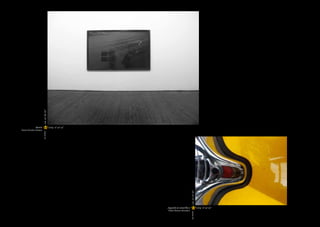
3. Salida
1. Mala noche               Carlos López Mariña
Zlaten del Castillo López


2. VS                       4. Entrada
Javier Ramos                Carlos López Mariña
Objetividad y representación
Cartografías de la realidad
                                                                                                                                                             portamientos fotográficos”, procedentes de
                                                                                                          Realizar un mapa no ha sido históricamente         prácticas artísticas alejadas del uso purista del
                                                                                                          una tarea neutra, siempre conlleva una mira-       medio en las vanguardias artísticas –como es

Mirada, fotografía y mapa                                                                                 da. Todo mapa ha surgido como consecuencia
                                                                                                          de una determinada ideología o bajo criterios
                                                                                                                                                             el caso de Man Ray–, pero sobre todo en aque-
                                                                                                                                                             llas manifestaciones conceptuales de los años
Pedro Medina                                                                                              con frecuencia arbitrarios que condicionan         sesenta, que suponían un paso más dentro de
                                                                                                          las formas de representar el mundo.                esa polémica en torno al estatuto artístico de la
                                                                                                                                                             fotografía latente prácticamente desde sus orí-
                                                                                                          En esta ocasión, el diseño de una cartografía      genes, debido a su carácter no aurático, deriva-
                                                                                                          se liga a un medio: la fotografía, tan subjetiva   do de su reproductibilidad, y de esa supuesta
                                                                                                          como cualquier otro lenguaje artístico, pero       objetividad mayor que otros medios privilegia-
                                                                                                          que popularmente se identifica con un medio        dos todavía por creencias de tipo romántico.
                                                                                                          que documenta el mundo como mayor obje-
                                                                                                          tividad que otros. Al hacerlo, pronto surge la     Su uso documental para registrar obras de
                                                                                                          tradicional cuestión de fondo sobre la rela-       arte efímeras, junto con las expresiones
                                                                                                          ción entre objetividad y realidad.                 conceptuales, transformó a la fotografía en
                                                                                                                                                             un medio para la experimentación que daba
                                                                                                           Estas consideraciones aún lastran diagnós-        lugar a nuevas formas y prácticas, así como
                                                                                                           ticos sobre un lenguaje que era emergente,        a una reflexión sobre la misma fotografía y
                                                                                                           como aquellos maravillosos textos de Walter       su rol respecto a la sociedad y el arte, con-
                                                                                                           Benjamin en los que reflexionaba sobre cómo       virtiéndose en el camino para alzar la idea a
                                                                                                           duplicar el mundo, retratándolo con mayor         la categoría de objeto, al tiempo que el lugar
                                                                                                           fidedignidad. Benjamin llegó a hablar de un       idóneo para prácticas escenográficas nue-
                                                                                                          “museo imaginario” basado en la afirmación         vas, aunque su principal papel seguía siendo
                                                                                                           de Godard a propósito de Le Carabiniers: “co-     como medio.
                                                                                                           leccionar fotografías es coleccionar el mundo”.
                                                                                                           Sin embargo, los nuevos comportamientos           Pero dejando de lado la relevante aparición
                                                                                                           artísticos han transformado esta función, pa-     de una “nueva forma artística”, que procede
                                                                                                           sando a reflejar irónicamente el mundo o a        de la crisis de los géneros artísticos tradicio-
                                                                                                           constatar “la irrealidad de la realidad” –como    nales, y que encuentra precisamente en la
                                                                                                           afirmaba Kate Linker–. Obviamente, estas nue-     fotografía un campo idóneo para desarrollar
                                                                                                           vas prácticas encuentran cabida en evidentes      las potencialidades icónicas de la imagen, en
                                                                                                           revisiones del problema de la representación.     el contexto de esta exposición se privilegia
                                                                                                                                                             su dimensión como documento o archivo de
                                                                                                          Un muy breve balance de lo ocurrido desde el       la realidad.
                                                                                                          asentamiento de la fotografía dentro del siste-
“El mapa es abierto, es conectable en todas sus dimensiones,                                              ma del arte a mediados de los ochenta, destaca     La propuesta de Mapping Madrid enlazaría
desmontable, reversible, susceptible de recibir constantemente                                            principalmente la reivindicación “artística” de    con posturas que fomentan la procesualidad
modificaciones […] Haced mapas y no fotos ni dibujos”                                                     la fotografía documental y el asentimiento         misma, como fenómeno de representación
                        (Gilles Deleuze y Felix Guattari, Rizoma)                                         de lo que podría denominarse “nuevos com-          y como constancia de aquellas manifesta-


26                                                                  Mapping Madrid · IED Madrid & PHE09   Mapping Madrid · IED Madrid & PHE09                                                              27
ciones de carácter temporal condenadas a         propio espacio físico. Ante este hecho, cabe      mapas desata potencialidades, rehace el terri-   muestra suficientemente contrastada, no obs-
desaparecer o que se conciben precisamente       preguntarse ¿cómo representar entonces            torio una y otra vez, cada vez con nuevas y      tante, sí parece coincidir con buena parte de
en su estar in progress. Es, pues, el lenguaje   esta realidad?                                    diferentes consecuencias”.                       reconocidos diagnósticos de nuestra época.
fundamental y el instrumento que constata                                                                                                           Remontándonos un poco en el tiempo, po-
lo ocurrido.                                     “Realizar un mapa no                              ¿Y cómo se produce esto hoy día? Quizás con      dríamos hablar de la sentencia de Nietzsche
                                                 ha sido históricamente                            los nuevos medios se pueda dar esa feliz co-     en su paradigmático Der Fall Wagner, donde
A la consustancial reproducción mecánica
implícita en el propio concepto de fotogra-
                                                 una tarea neutra,                                 incidencia de mapa e imperio –diría Borges
                                                                                                   en el famoso relato sobre el Arte de la Carto-
                                                                                                                                                    toda décadence literaria está caracterizada
                                                                                                                                                    por una condición: “la vida ya no habita en el
fía, lo que facilita la recepción masiva de la   siempre conlleva una                              grafía–, de georrepresentación y cosmovisión     todo”. Extraemos de Nietzsche y de todos sus
obra y la democratización de su producción,      mirada. Todo mapa                                 podríamos decir nosotros.                        epígonos que la realidad se vuelve fragmen-
ahora aparece la posibilidad de la utilización   ha surgido como                                                                                    taria, constatando que no hay un valor central
de nuevos medios, más proclives a la interac-
ción y la creación de piezas colectivas, donde
                                                 consecuencia de una                               Esta situación debería llevarnos a un posicio-
                                                                                                   namiento que impida que sucumbamos a la
                                                                                                                                                    en la época que le dé sentido, como ocurría,
                                                                                                                                                    por ejemplo, en la Edad Media, donde el dios
la participación se vuelve algo natural en esa   determinada ideología                             fascinación por la forma expresiva, estable-     cristiano era medida de todas las cosas y el
transformación del espectador en usuario, lo     o bajo criterios con                              ciendo un mínimo análisis sobre el mundo en      gótico o el románico eran las formas que ha-
que aporta un enriquecedor poliperspectivis-     frecuencia arbitrarios                            el que vivimos para preguntarnos ¿por qué        cían visible una relación homogénea y unívo-
mo. De esta forma, esa característica de ima-
gen multiplicable adquiere ahora una dimen-
                                                 que condicionan las                               acudimos a este tipo de representación?, ¿es
                                                                                                   pertinente para poder hablar sobre la expe-
                                                                                                                                                    ca con el mundo.

sión mayor, al mismo tiempo que se potencia      formas de representar                             riencia de nuestra época? Parece coherente       “La propuesta de
una relación de pertenencia con la obra que      el mundo”                                         con los tiempos que corren alejarse de postu-    Mapping Madrid
tiene más que ver con la colaboración en el                                                        ras que adopten el autoritarismo que profesa
proceso y la emoción activada en el mismo        Jean Baudrillard parte precisamente de            quien cree en una verdad y pensar más bien
                                                                                                                                                    enlazaría con posturas
que con la posesión física de la obra.           la cartografía como paradigma de una re-          en un mundo lábil, donde todo se vuelve po-      que fomentan la
                                                 ferencialidad perdida, llegando incluso a         sibilidad y no necesidad.                        procesualidad misma,
 Por otro lado, nos encontramos con el mapa      afirmar en Cultura y simulacro que “el terri-                                                      como fenómeno
 como un formato que también se percibe          torio ya no precede al mapa ni le sobrevive.      A pie de calle, enseguida aparecen términos
 ingenuamente como algo objetivo, pero que       En adelante será el mapa el que preceda al        coincidentes como “global, tecnificado, acele-
                                                                                                                                                    de representación y
–como aparece al inicio de este texto y sobre    territorio –precisión de los simulacros– y el     rado, injusto, en el que nada permanece, sin     como constancia de
 todo en ¿Para qué un mapa? de Pablo Jarau-      que lo engendre”.                                 valores…”, aunque se puede resumir como un       aquellas manifestaciones
 ta– conviene observar como otro medio más                                                         mundo marcado por la comunicación plane-         de carácter temporal
 para contar una historia y hacer evidentes      Al respecto, conviene recordar las matiza-        taria, más que sin valores, en construcción
 formas de ver el mundo.                         ciones que realizaba André Corboz en El te-       hacia otros nuevos (sostenibilidad, igualdad
                                                                                                                                                    condenadas a
                                                 rritorio como palimpsesto, al comparar dos        de géneros y razas…) y, sobre todo, un mun-      desaparecer”
Al margen del relato construido por Pablo        maneras de relacionarse con el territorio (la     do que ha devenido moda, es decir, donde ni
Jarauta, quisiera aportar un par de notas,       contemplación del paisaje y el mapa): “El         convicciones, ni instituciones, ni productos      Por otro lado, partiendo del análisis de la ciu-
sobre todo para establecer su relación con       mapa se diferencia del territorio precisamen-     están dados de una vez para siempre, siendo       dad como la gran forma de rastrear la vida
el ámbito de la ciudad, un contexto en el        te a través de actos de selección. Como prác-     el reino de lo efímero.                          –en la línea de Georg Simmel–, destaca un
que se generan relaciones y donde se acu-        tica creativa el mapa no reproduce sino que                                                         autor como Marshall Berman, quien constata
mulan formas de habitar, pero que induda-        descubre realidades previamente invisibles        Este primer acercamiento al universo que nos      que “todo lo sólido se desvanece en el aire”;
blemente hoy debe ampliarse más allá del         o inimaginables […] La construcción de los        rodea no tiene valor de prueba, por no ser una    por tanto, no hay certezas ni puntos de refe-


28                                                           Mapping Madrid · IED Madrid & PHE09   Mapping Madrid · IED Madrid & PHE09                                                            29
rencia a los que poder aferrarnos con seguri-      en la confluencia de puntos de vista se pue-       esta forma es capaz de configurar un paisaje        de un proyecto que destaca por su carácter
dad. La vida así ha ganado en incertidumbre,       da encontrar un nuevo atractivo en el mundo        diferente de nuestro entorno.                       participativo y, por tanto, por una autoría que
pero también en posibilidad.                       gracias a la curiosidad.                                                                               finalmente es colectiva.
                                                                                                      Mapping Madrid
“Hay que desentrañar                               Éste es el panorama y, por tanto, habrá que        ¿Qué significa, pues, representar hoy el            El siguiente paso era convertir esta web en
una maraña confusa                                 atender al sistema de formas que determinan        mundo? Mapping Madrid se concibió con               una instalación en el Palacio de Altamira, es-
de hechos cuya                                     el proyecto para averiguar el conjunto de          la intención de crear una nueva manera de           tableciéndose como premisa que el visitan-
                                                   ideas al que atañen, estudiando si lenguaje y      generar un mapa, donde lo participativo se          te se sintiera parte de la obra y no un mero
complejidad creciente                              época se corresponden al ofrecer aquello que       alza sobre lo impuesto como supuestamen-            espectador de la misma. La instalación, rea-
reclama diversos relatos                           debería ser su última finalidad: proporcionar      te objetivo, entendiendo la fotografía como         lizada junto a Jarl Einar Ottestad y Anders
que hagan visibles las                             un espacio que habitar.                            un medio privilegiado y democrático para            Restad, consiste en una proyección cenital
rápidas metamorfosis                                                                                  acercarnos a nuestra realidad. Además, co-          de la ciudad de Madrid sobre la que aparecen
                                                   De vuelta una vez más sobre el lenguaje, po-       bra también relevancia cierta idea de deriva,       indicadores con los lugares que han sido foto-
de nuestro tiempo”                                 dríamos acudir a un término que reciente-          como concepto de transición entre la geogra-        grafiados. El visitante interactúa con esta pro-
Pero para no extendernos en este punto, con-       mente utilizó Juan A. Álvarez Reyes para una       fía física de la urbe y una topología interior      yección convertido en un ratón de ordenador
cluiré con la sentencia de Zygmunt Bauman,         exposición sobre animación contemporánea.          e intersubjetiva, con el fin de hacer posibles      humano, que activa el mapa de Madrid para
quien ha enunciado, con extraordinaria for-        Se trata de “fantasmagoría”, que no solo es        nuevos espacios creativos.                          adentrarse en el mismo y acercarse entonces
tuna mediática, que habitamos en un mundo          el título de la primera pieza de animación                                                             a las fotografías presentes en la web. De esta
caracterizado por una “modernidad líquida”.        de la historia del cine, realizada en 1908 por     La idea original y desarrollo se debe a Javier      manera, el espectador no siente que esté fren-
A través de varios textos ha definido el espa-     Emil Cohl, probablemente inspirado por el          Maseda, quien propuso un proyecto que               te a la exposición, como si le fuera ajena, sino
cio actual como una “sociedad de la incerti-       fantasmagore Étienne Gaspar Robertson. La          consistía en construir el mapa de PHotoEspaña y     dentro de la misma, continuando así el carác-
dumbre”, donde todo es “líquido”, inconsis-        ilusión óptica avanzaba como espectáculo en        de Madrid a través de la colaboración ciudadana     ter participativo de la web.
tente, evanescente, no hay tiempo ya para          un París cuyo origen moderno describió Ben-        en una web bajo el lema “Danos tu visión de
que unas condiciones de vida y de acción           jamin a través de las sugerentes luces de la       PHotoEspaña 2009”, reflexionando así sobre
lleguen a convertirse en costumbre, siendo         metrópoli, sus pasajes, los flâneurs, la prensa,   el evento y la ciudad que acogen la exposición.     “Mapping Madrid
la precariedad el signo de nuestro tiempo.         la aparición de la fotografía… es decir, “fan-     De esta forma, en www.mappingmadrid.com,            se concibió con la
Y ante esta realidad, Bauman aboga por un          tasmagorías” –como las denominó Benjamin–          web desarrollada por Blogestudio, se empieza
espacio público global, donde se realice un        que servían para sintetizar los imaginarios de     a construir un escenario colectivo e in progress
                                                                                                                                                          intención de crear
análisis general de los problemas a escala         la segunda mitad del siglo xix.                    con las imágenes tomadas por cualquier              una nueva manera de
mundial y donde se haga presente una res-                                                             persona, debiendo estar todas geolocalizadas,       generar un mapa, donde
ponsabilidad planetaria.                           Igual que entonces, ahora hay que desentra-        es decir, el usuario que participa en la web sube   lo participativo se
                                                   ñar una maraña confusa de hechos cuya com-         su fotografía y la dirección del lugar en el que
 La reconstrucción de esta historia permite        plejidad creciente reclama diversos relatos        ha sido tomada.
                                                                                                                                                          alza sobre lo impuesto
 repensar algunos conceptos y uno que se           que hagan visibles las rápidas metamorfosis                                                            como supuestamente
 vuelve necesario en este contexto es el de        de nuestro tiempo. De esta forma, podríamos        El resultado es una cartografía visible online      objetivo, entendiendo la
“habitar”, entendiendo por el mismo las con-       considerar la imagen (fotográfica) definida        en la que se pueden apreciar distintos puntos       fotografía como un medio
 diciones en las que se desarrolla la vida coti-                                                      de vista sobre un mismo espacio, convirtien-
 diana y la acción colectiva construida simul-
                                                   no por su permanencia sino por su condición
                                                   de elemento en continua transformación, te-        do Madrid en un collage de imágenes y accio-
                                                                                                                                                          privilegiado y democrático
 táneamente por distintos ciudadanos. Ya no        niendo muy en cuenta la superposición de           nes. Pero lo principal es la relación entre mi-     para acercarnos
 es posible un habitar armonioso, pero quizás      planos y miradas, para preguntarnos si de          rada y lugar fotografiado, construida a través      a nuestra realidad”

30                                                              Mapping Madrid · IED Madrid & PHE09   Mapping Madrid · IED Madrid & PHE09                                                              31
Asimismo, la visualización de las piezas fo-    teorías comunicacionales en red de Manuel          en aspectos de mercado de la obra de arte,          des líquidas. Madrid amplían el mapa a una
tográficas sobre el mapa viene completada       Castells a esa vuelta a lo ciudadano aunque        como puede ser actualmente el grupo sueco           dimensión que envuelve al espectador. Esta
por otra proyección. En ella se pueden con-     entendido como ciberespacio, es decir, un ám-      Pirate Bay, pasando evidentemente por otras         fragmentación y cambio de escala procede
templar las fotos de forma más inmediata        bito metaurbano universalizado, tal y como lo      en las que se atienden las razones comunicati-      de un plano de Madrid de los años cincuenta;
por medio de una galería en la que se po-       postula Paul Virilio.                              va y poiética del arte, cuyas referencias pueden    que puede contemplarse en su totalidad preci-
tencia la percepción de “recorrido” a la hora                                                      ser nombres clásicos como Kant, Habermas o          samente en la esquina superior izquierda de la
de seleccionar las fotografías presentes en     Sobre esta unión de cartografía y represen-        Danto y su concepto de “mundo del arte”.            Transurbancia presente en la misma sala.
la web.                                         tación física de la imagen generada por los
                                                usuarios-fotógrafos, vuelve a actuar el espec-     Pero más allá de esta dimensión orientada a la      Lo primero que impresiona de estas obras es su
El resultado es obvio: la propia dinámica ex-   tador-usuario, generando un flujo de ida y         praxis, en Mapping Madrid se da un paso más         majestuosidad que, no obstante, tiene algo de fa-
positiva genera la sensación de pertenencia     vuelta desde el que entender el funcionamien-      dentro del terreno de la representación y de la     miliar. Los contornos de estos mapas son aún re-
a una obra colectiva en la que el espectador-   to de los nuevos medios unido a la percepción      idea de construcción de un mapa. Ello se debe       conocibles y cubren las paredes como si fueran
usuario es quien la crea y la activa, constru-  de un entorno que es nuestro, porque vivimos       a la última parte de la exposición dentro del Ga-   un antiguo tapiz que se ajusta perfectamente
yendo un mapa personal y compartido en el       en él y también lo construimos.                    binete de Exposiciones del Palacio de Altamira,     al espacio, pero que nos descubre otra realidad
que podemos contemplar distintas visiones                                                          que consiste en los tres fragmentos de la ciudad    cuando nos acercamos a él: todos los elementos
de Madrid y de PHotoEspaña, por lo general Algunas de estas consideraciones estaban                líquida de Madrid y la Transurbancia, realizadas    se vuelven líquidos; experiencia que incluso se
alejadas de visiones más institucionalizadas, presentes en el ciclo de conferencias cele-          por Tete Álvarez, un conjunto de fragmentos de      asemeja a aquellas superficies de agua poco pro-
demostrando una frescura muy atractiva.        brado el pasado mayo, poco antes de inau-           ciudades con la capacidad de construir un nue-      fundas que podemos ver en Google Earth.
                                               gurar Mapping Madrid, titulado La ciudad            vo relato sobre el mapa y la realidad global.
“La propia dinámica                            híbrida, que congregó a varios expertos,                                                                Empiezan a relacionarse entonces términos
expositiva genera la                           bajo la dirección de José Luis de Vicente,          “Densidad y fluidez                                 como mirada cenital, planimetría urbana,
sensación de pertenencia                       para reflexionar sobre “visualización urbana        hacen posible tomar                                 fragmento o labilidad, puesto que el punto de

a una obra colectiva en la                     y mapeado colaborativo”. Como afirma J.L.           el mapa como base                                   partida va a ser –igual que en la Transurban-

que el espectador-usuario
                                               de Vicente: “ha nacido la ciudad en tiempo
                                               real, donde los ciudadanos modifican sobre
                                                                                                   cartográfica para                                   cia–, las imágenes satelitales y procesos que
                                                                                                                                                       las transforman, en este caso en un líquido
es quien la crea y la activa,                  la marcha sus patrones de comportamiento,           iniciar una exploración                             denso, que diluye ya no la foto sino el antiguo
construyendo un mapa                           y la función y significado de los lugares se        de la ciudad, un                                    mapa del casco histórico de Madrid.

personal y compartido                          reconfigura constantemente”. Parece que             itinerario en el que el
en el que podemos
                                               estuviera hablando de la exposición de la
                                               que nos ocupamos, y es que algunos de los
                                                                                                   ejercicio de perderse,                          Como cuenta Tete Álvarez: “Densidad y flui-
                                                                                                                                                   dez hacen posible tomar el mapa como base
contemplar distintas                           contenidos impartidos fueron precisamen-            la desorientación, sea                          cartográfica para iniciar una exploración de la
visiones de Madrid y                           te: mapeado colaborativo (la ciudad sub-            una nueva forma de                              ciudad, un itinerario en el que el ejercicio de

de PHotoEspaña”                                jetiva representada por sus ciudadanos) o           reencuentro ante                                perderse, la desorientación, sea una nueva for-
                                               gobernanza 2.0 (democracia participativa y
De esta manera, se entrelazan conceptos tecnologías digitales).
                                                                                                   lo desconocido”                                 ma de reencuentro ante lo desconocido”. Pero,
                                                                                                                                                   sin duda, esta metamorfosis del mapa en algo
como los de ciudad, cartografía y mirada, una                                                      La vinculación entre lugar y fotografía es una líquido enlaza directamente con diagnósticos
percepción cuya importancia puede recorrer- Sin duda, desde aquí podríamos sacar muchas            constante en la obra de Tete Álvarez, como sobre esta época, como aquella metáfora del
se en la historia, pero que sigue estando de derivas sobre los actuales sistemas políticos y       puede comprobarse en series como Confines mundo contemporáneo que ha popularizado
gran actualidad, como demuestra buena par- la necesidad de participación ciudadana, des-           o Desterritorios. En este caso, las piezas com- Zygmunt Bauman, que ya comentábamos con
te de la producción teórica actual, desde las de las teorías de Toni Negri a otras centradas       prendidas bajo el título genérico de Ciuda- anterioridad; estableciéndose esta relación no


32                                                           Mapping Madrid · IED Madrid & PHE09   Mapping Madrid · IED Madrid & PHE09                                                               33
solo literalmente, sino sobre todo gracias a que surbancia se convierte en un crisol de fotogra-     ver la península de la India rodeada de agua,   transformaciones y discutir sobre las mismas
comparten aquel sentimiento de incertidum- fías satelitales que configuran una imagen                y otra, mucho más cercana, que desencadena      desde diversos puntos de vista.
bre y fugacidad que impera entre nosotros.         más compleja. Como explica Tete Álvarez: “La      procesos de identificación y nuevas formas de
                                                   mirada cenital no es una mirada actuante en       concepción de un espacio al aparecer ahora      Esto abre las posibilidades de lo que se po-
Como confiesa Óscar Fernández: “La metáfo- el espacio que intenta dominar, sino que se               relacionado con otras realidades.               dría denominar “estéticas migratorias” o
ra de lo líquido y del fluir define la experiencia circunscribe a un ámbito simbólico. La “tran-                                                     centradas en la idea de viaje, precisamente
urbana actual. Tanto es así que está minando surbancia” es el método que propone Stalker             Podemos reconocer las planimetrías regula- porque el hombre contemporáneo es viajero
todos los resortes de la ciudad, haciendo que (colectivo de investigación urbana) para atra-         res de metrópolis europeas junto a la trama por antonomasia, un sujeto desarraigado, sin
la propia idea de urbe se desmorone y sea sus- vesar, recorrer y mapear los terrain vague”. Se       urbana difusa de otras grandes ciudades “no destino, condenado a vagabundear sin cesar
tituida por núcleos de población más o menos trata de cartografiar una (otra) configuración          racionalizadas” y entregadas a un tipo de en busca de unas certezas que este mundo
informes. Lo más interesante de este proceso urbana construida a partir de lo que Manuel             extensión más natural y caótica. Distintas no le puede dar. Quizás solamente nos queda
hacia lo líquido es que está afectando incluso Castells llama una nueva lógica espacial ba-          escalas y épocas se entrelazan, pudiendo re- asumir el tránsito que aporta imprevisibili-
a las viejas ciudades. Mientras la memoria de sada en flujos de información, frente a la ló-         conocer El Vaticano, Caracas o Madrid, entre dad, la dispersión de los caminos, la asime-
los lugares se fija cada vez más gracias al fe- gica de la organización social arraigada en          otros muchos lugares, pero cobra mayor signi- tría de todos los recorridos y el mestizaje de
nómeno turístico, la realidad de estos lugares la historia de los lugares y territorios locales      ficación en aquellos momentos en los que se costumbres y lenguajes.
se diluye cada vez más rápido. Resulta de ello inmediatos. Otra cartografía que permita rea-         cruzan elementos inesperados o con un aire
una nueva forma de turismo-nostalgia que lizar una deriva, entendida como “técnica de                de familia, como ocurre cuando coinciden un En conjunto esperamos que Mapping Madrid
visita el recuerdo de lugares históricos. Sola- paso ininterrumpido a través de ambientes            río y una autopista “reales” junto a la gráfica haya colaborado a reflexionar sobre el len-
mente su recuerdo porque, en realidad, éstos diversos” y que gracias a los flujos nos des-           de los trenes de cercanías de Madrid.           guaje elegido para narrar esta realidad, des-
nunca existieron o, como mucho, hace mucho place de un lugar a otro.                                                                                 cubriendo que todas estas representaciones
tiempo que han dejado de ser lo que nos cuen-                                                        Como es obvio, la construcción de nuevas co- hacen evidente la riqueza que albergan mu-
tan de ellos”.                                     En un mundo de homogeneización de com-            rrespondencias y significados se multiplica chos fragmentos de subjetividad, ofreciendo
                                                   portamientos culturales y estructuras arqui-      a medida que nos sumergimos en la imagen, una breve muestra de cómo la idea de mapa
Ésta es una reflexión que se complementa per- tectónicas, como plantea Marc Augé con sus             teniendo como principales protagonistas la puede redefinirse a través de nuevos medios y
fectamente con la otra obra presente. Como “no-lugares” o Rem Koolhaas con su “ciudad                India (como forma y por el mapa de ferroca- acciones colaborativas.
decíamos, también reclama dos distancias o genérica”, lo que queda es un interesante labo-           rriles de la misma) y Madrid (presente como
formas de acercamiento a la misma, activando ratorio donde no se desprecia el movimiento             plano histórico, en fotos satelitales y con el Se ha apostado, pues, por la imagen elec-
cada una de ellas procesos de reconocimiento hacia la similitud a través de un tapiz de di-          protagonismo de la red de sus trenes de cerca- trónica como el medio capaz de reflejar la
diferentes. En el caso de la Transurbancia, se ferencias que pueda establecer una visión de          nías), pero esencialmente lo que surge en esta fugacidad de este momento, aprehendiendo
hace más evidente aquel acercamiento cenital conjunto sin perder una identidad que ahora             confluencia de flujos y espacios es la metáfora por un instante el discurrir indefinido de la
que entroncaría con sentencias como la de Mi- cobra significado en su relación con las demás.        del viaje como gran imagen.                     vida y el naufragio de un sujeto que busca
chel de Certeau en La invención de lo cotidiano,                                                                                                     un discurso que plasme la experiencia de un
según la cual la mirada ha dejado de ser humana Partiendo de este contexto, la propuesta de          Parece coherente, al considerar la realidad universo que ya no es refugio. La metáfora
para ser como el ojo de Dios que todo lo ve, aho- Tete Álvarez consiste en la visión que se cons-    como algo fugaz y “en tránsito”. Aparece una del viaje se torna entonces un mecanismo
ra, situados en el piso 110 del World Trade Cen- truye a través de un cúmulo de superposicio-        vez más una forma de representar acorde con idóneo con el que percibir la experiencia
ter, toda la ciudad se convierte en un panóptico. nes donde gráfica y fotografías satelitales de     el análisis que hicimos de las características contemporánea, y esta exposición vuelve
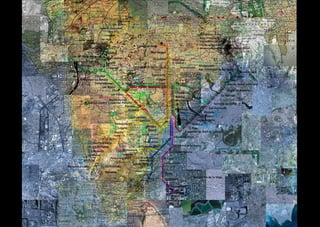
                                                   grandes ciudades del mundo se unen, siendo        esenciales del momento actual, un universo a ella para reposar por un momento en un
Esta mirada cenital es la que experimenta en su eje el recorrido de los trenes de cercanías          que está redefiniendo continuamente las re- lugar: Madrid, en el que permanecer bajo su
primera persona el visitante a Mapping Ma- de Madrid. Este collage plantea dos visiones:             laciones entre colectivos e identidades, para condición de obra abierta, susceptible a más
drid en la primera instalación y que en la Tran- una, primera, de conjunto, que nos permitiría       establecer un foro donde experimentar estas miradas e interpretaciones.


34                                                             Mapping Madrid · IED Madrid & PHE09   Mapping Madrid · IED Madrid & PHE09                                                       35
Cartographies of Reality                                                                                  Objectivity and Representation                      documentary photography and the consolida-


Gaze, Photography and Map
                                                                                                          Historically, producing a map has not been          tion of what could be defined as “new photo-
                                                                                                          a neutral task; it always entailed a gaze. All      graphic behaviours”, originating from artistic
                                                                                                          maps have emerged as a consequence of a             practices which had little to do with the pur-
Pedro Medina                                                                                              certain ideology, or by following often arbi-       ist use of the medium in artistic Avant-Garde
                                                                                                          trary criteria, which condition the means of        trends –as is the case of Man Ray-, and, more
                                                                                                          representing the world.                             strikingly, in the conceptual expression of
                                                                                                                                                              the 1960s. These disciplines took the contro-
                                                                                                          On this occasion, the design of a map is            versy regarding photography’s art status to
                                                                                                          linked to a specific medium: photography.           another level, which had been undermining
                                                                                                          This format is as subjective as any other artis-    the medium almost since its origins, given its
                                                                                                          tic language, but has generally been seen as        non-auratic nature, its susceptibility to repro-
                                                                                                          a medium capable of documenting the world           duction and its alleged greater objectivity in
                                                                                                          with greater objectivity than others. In doing      comparison with other media which still enjoy
                                                                                                          so, it is never long before we come up against      the advantages of the romantic notions that
                                                                                                          the eternal background issue regarding the          surround them.
                                                                                                          relationship between objectivity and reality.
                                                                                                                                                              Its documentary role in capturing ephemeral
                                                                                                          These considerations are still weighed down         works of art, along with conceptual expres-
                                                                                                          with diagnoses on a language which was still        sion, transformed photography into a me-
                                                                                                          emerging, as could be seen in those wonderful       dium for experimentation, giving rise to new
                                                                                                          texts by Walter Benjamin in which he reflect-       forms and practices, as well as the ability to
                                                                                                          ed on a way to duplicate the world, in order        reflect upon itself; it also has a role pertain-
                                                                                                          to portray it more accurately. Benjamin went        ing to society and art, paving the way to grant
                                                                                                          as far as speaking of an “imaginary museum”,        ideas the status of objects, at the same time as
                                                                                                          based on Godard’s claim regarding Le Carabi-        it became the ideal setting for new scenogra-
                                                                                                          niers: “collecting photographs is to collect the    phies, although its main function continued to
                                                                                                          world”. However, new artistic behaviours have       be as a medium.
                                                                                                          transformed this role, and have moved on to
                                                                                                          presenting an ironic view of the world, or on to    However, leaving aside the relevant emergence
                                                                                                          establishing “the irreality of reality” –in words   of a “new art form”, which had its origins in the
                                                                                                          of Kate Linker. Obviously, these new practices      crisis suffered by traditional art genres, reveal-
                                                                                                          are reflected in the clear revisions to the theme   ing photography to be an ideal field for the de-
                                                                                                          of representation.                                  velopment of the iconic potential of the image,
                                                                                                                                                              in this exhibition it is its dimension as document
“The map is open; it is connectable in all of its dimensions; it is                                       A very brief outline of what has happened           or archive of reality that is most examined.
detachable, reversible, and susceptible to constant modifications […]                                     since photography became an established dis-
make maps, not photographs and drawings”                                                                  cipline within the art system, in the mid-1980s,    The proposal contained in Mapping Ma-
                         (Gilles Deleuze and Felix Guattari, Rhizome)                                     reveals, mainly, the “artistic” reividincation of   drid is linked to positions which encourage


36                                                                  Mapping Madrid · IED Madrid & PHE09   Mapping Madrid · IED Madrid & PHE09                                                                37
processuality itself, as a representation phe- out a doubt, expand beyond the physical space           And how is this produced today? Perhaps the       of the accepted diagnoses of our era. If we go
nomenon and as proof of those temporary ex- itself. In the face of this, one could wonder how          new media will make it possible to arrive at      back in time, we could speak of Nietzsche’s
pressions which are doomed to disappear, or are we, then, to represent this reality?                   that happy coincidence of map and empire –as      statement in his paradigmatic Der Fall Wag-
which have actually been conceived as being                                                            Borges said in his famous story on the Art of     ner, where all literary décadence is character-
in progress. It is, therefore, the essential lan-  “Historically, producing                            Cartography– and, as we could say, of geo-rep-    ised by the condition: “life no longer inhabits
guage, and the instrument which documents          a map has not been a                                resentation and cosmovision.                      the whole”. Thanks to Nietzsche and all his
what has taken place.
                                                   neutral task; it always                                                                               epigones, we realise that reality has become
                                                                                                       This situation should lead us to a position fragmented, that there is no central value
In addition to the mechanical reproduction         entailed a gaze. All                                which prevents us from succumbing to the which lends meaning to our era, as it did, for
that is inherent to photography, and which         maps have emerged                                   fascination for the expressive form, estab- example, in the Middle Ages, where the Chris-
facilitates mass reception of the work and the     as a consequence of                                 lishing a minimum analysis on the world in tian God was the measure for everything, and
democratisation of its production, we are now
seeing new media that are better suited to in-
                                                   a certain ideology, or                              which we live, in order to ask ourselves why where Gothic and Romanic styles were the
                                                                                                       did we resort to this sort of representation? forms which lent visibility to a homogeneous
teraction and to the creation of group pieces,     by following often                                  Is it necessary in order to speak about the and univocal relationship with the world.
in which participation is the most natural ele-    arbitrary criteria,which                            experience of our time? It would seem con-
ment in our transformation from viewers into       condition the means of                              sistent with the times we live in to distance On the other hand, starting from the analysis
users, which lends the process an enriching
sense of polyperspectivism. In this way, the
                                                   representing the world”                             ourselves from attitudes which adopt the au- of the city as the most important way of tracing
                                                                                                       thoritarianism professed by those who believe life –according to Georg Simmel’s arguments–
idea of reproducible images acquires a greater     Jean Baudrillard took cartography as his start-     in a single truth, and instead think about a it is worth noting an author such as Marshall
dimension, whilst, simultaneously, the sense       ing point, seeing it as a paradigm of lost refer-   fluid world, where everything becomes pos- Berman who stated that “all that is solid melts
of ownership toward the work is increased in       entiality, even going as far as to claim, in Cul-   sibility instead of necessity.                    into air”; therefore, there are no certainties
a way which has more to do with taking part in     ture and Simulacrum, that “territory no longer                                                        or reference points which we can safely hold
the process and the emotion it activates, than     precedes, nor survives, the map. Henceforth         It was not long before words such as “global, onto. Consequently, life has increased in un-
with the physical possession of the work.          it will be the map that precedes territory –the     technified, accelerated, unjust, where nothing certainty, but also in possibility.
                                                   precision of simulacra– and that engenders it”.     stays the same, lacking in values”, etc. entered
On the other hand, we find that the map is an-                                                         everyday language, although they can be sum-     “The proposal contained
other format which is seen, naively, as some-      In this respect, it is worth remembering the        marised by the idea of a world defined through
                                                                                                                                                        in Mapping Madrid is
thing objective, but which –as is stated at the    clarifications made by André Corboz in The          planetary communication which, rather than
beginning of this text, and, above all, in Pablo   Territory as Palimpsest when he compared            lacking values, is building new ones (sustain-   linked to positions which
Jarauta’s Why a Map?– it is worth observing as     two ways of relating to territory (the contem-      ability, equality between the sexes and the rac- encourage processuality
just another way of telling a story and reveal-    plation of landscape and the map): “The map         es, etc.), and, above all, a world which has beenitself, as a representation
ing different views of the world.                  is differentiated from the territory precisely by   taken over by trends, i.e., where no conviction,
                                                                                                                                                        phenomenon and as
                                                   means of acts of selection. As a creative prac-     institution or product can be around forever,
Leaving aside the Pablo Jarauta’s narrative,       tice the map does not reproduce, and instead        in what is a sort of kingdom of the ephemeral.   proof of those temporary
I would like to contribute a couple of notes,      discovers realities which were previously in-                                                        expressions which are
mainly to establish the map’s connection with      visible or unimaginable […] The construction        This first view of the universe around us does   doomed to disappear”
the realm of the city, a context where relation-   of maps unleashes potentials; it rebuilds the       not have any value as proof, as it is not suffi-
ships are constructed and where ways of living     territory again and again, with new and differ-     ciently measured against any other evidence, In order not to expand too much on this point,
are accumulated, but which today must, with-       ent consequences each time”.                        but it does seem to coincide with a great many I will conclude with the words of Zygmunt


38                                                               Mapping Madrid · IED Madrid & PHE09   Mapping Madrid · IED Madrid & PHE09                                                           39
Bauman, who stated, with excellent timing,         that define the project, in order to discover the     with the aim of finding a new way of creating     The next step was to turn this website into
that we inhabit a world defined by a “liquid       group of ideas to which they refer, determining       a map, in which the action of the participants    an installation at the Palacio de Altamira,
modernity”. In his works he has labelled the       whether or not language and era are matched           is more important than supposedly objective       following the premise that visitors should
current space a “society of uncertainty”, where    with regards to what should be their ultimate         approaches, in an interpretation of photogra-     be made to feel as part of the work, not just
everything is “liquid”, inconsistent, evanes-      purpose: to provide a space to be inhabited.          phy as a privileged and democratic medium,        mere spectators. The installation, produced
cent, and where there is no longer time for                                                              capable of bringing us closer to our reality.     along with Jarl Einar Ottestad and Anders
conditions of life and action to become estab-     Returning to language, we could resort to a           In addition, the idea of being adrift becomes     Restad, consists of an azimuthal projection of
lished; precariousness, ultimately, is the sign    term recently used by Juan A. Álvarez Reyes in        more relevant, as a concept for the transition    Madrid, on which the places that have been
of our time. In the face of this reality, Bauman   reference to an exhibition on contemporary an-        between the physical geography of the city        photographed are highlighted. Visitors inter-
advocates a global public space in which to        imation. The term is “phantasmagoria”, which          and an interior and inter-subjective topology,    act with this projection, as if they had been
analyse the problems that affect us all, driven    was the title of the first piece of animation in      with the aim of opening the way to new cre-       transformed into human computer mice, ac-
by a sense of planetary responsibility.            the history of cinema, produced in 1908 by Emil       ative spaces.                                     tivating the map of Madrid to delve deeper
                                                   Cohl –who was probably inspired by the fantas-                                                          into the city and to discover the photographs
“We face the need to                               magore Étienne Gaspar Robertson. Optical illu-        The original idea for the project, as well as submitted to the website. In this way, viewers

untangle the confusing                             sions had become a spectacle in a Paris whose         its development, comes from Javier Maseda, do not feel as though they are seeing an ex-
                                                   modern origins were described by Benjamin             who suggested the creation of a map of PHo- hibition, something outside their realm, and
mass of facts whose                                through the suggestive lights of the metropolis,      toEspaña and Madrid by means of citizen par- instead have a sense that they belong to the
increasing complexity                              its landscapes, its flâneurs, the press, the advent   ticipation, through a website headed: “Send us show, in a way which reflects the website’s
demands a range of                                 of photography, etc. In other words, its “phan-       your view of PHotoEspaña 2009”. He wanted collaborative spirit.
narratives which will                              tasmagoria” –as Benjamin called them–, which          to give rise to a reflection on the event and the
                                                   concentrated the collective imagination of the        city which hosts this widespread exhibition. In
lend visibility to the                             second half of the 19th century.                      this way, at www.mappingmadrid.com, a site
                                                                                                                                                            “Mapping Madrid was
swift metamorphoses                                                                                      developed by Blogestudio, a collective stage       conceived with the
of our time”                                      Now, the same as before, we face the need to           was gradually built, using the photographs         aim of finding a new
                                                  untangle the confusing mass of facts whose             submitted by the participants. All the snap-       way of creating a map,
The reconstruction of this history allows us to increasing complexity demands a range of                 shots had to be geo-located, i.e., the users who
rethink a series of concepts, one of which, the narratives which will lend visibility to the swift       contributed to the website had to upload their
                                                                                                                                                            in which the action
notion of “inhabiting”, is particularly impor- metamorphoses of our time. In this way, we                photographs, accompanied by the address of         of the participants
tant in this context. It refers to the conditions could consider the (photographic) image to be          the place where they were taken.                   is more important
in which daily life takes place, and to the col- defined not by its permanence but by its nature                                                            than supposedly
lective action constructed simultaneously by a as an element undergoing constant transfor-               The result is a visible, online map which shows
variety of citizens. It is no longer possible to mation, keeping in mind the superposition of            different perspectives on a single space, turn-
                                                                                                                                                            objective approaches,
aspire to harmonious inhabiting, but it is pos- perspectives and approaches, in order to ask             ing Madrid into a collage of images and ac-        in an interpretation
sible that the confluence of opinions will help ourselves whether this medium is capable of              tions. Its main characteristic, however, is the    of photography as
us find a new desirability in the world, driven configuring a different view of our surroundings.        relationship established between the gaze          a privileged and
by curiosity.                                                                                            and the photographed space, constructed by
                                                   Mapping Madrid                                        means of a project which stands out for its col-
                                                                                                                                                            democratic medium,
This is the present situation, and, therefore, it What does it mean, then, to represent the              laborative nature, and, therefore, for what is     capable of bringing us
is necessary to deal with the network of forms world today? Mapping Madrid was conceived                 ultimately a collective authorship.                closer to our reality”

40                                                               Mapping Madrid · IED Madrid & PHE09     Mapping Madrid · IED Madrid & PHE09                                                          41
In the same way, the visualisation of the pho-   online communicational theories of Manuel           collaboration, ranging from the theories pos-       were an old tapestry which fits the space per-
tographic pieces against the map is rounded      Castells to that return to the notion of citizen-   tulated by Toni Negri, to others focusing on        fectly, but under closer scrutiny seems to re-
off by another projection. Here, it is pos-      ship, although it is now seen from the perspec-     the market aspects of artworks, such as those       veal a new reality: all of the elements become
sible to contemplate the photographs with        tive of cyberspace, which, ultimately, is an uni-   by the Swedish group Pirate Bay, as well as         liquid, in a way which is reminiscent of those
a greater sense of immediacy, by means of a      versalised meta-urban realm, as postulated by       those which deal with the communicative and         shallow water surfaces we see on Google Earth.
gallery which has sought to promote the idea     Paul Virilio.                                       poiesis elements of art, with classic exponents
of a “journey” when selecting the photographs                                                        such as Kant, Habermas and Danto and their        At this point, terms such as azimuthal perspec-
from the website.                                This combination of cartography and physi-          concept of the “art world”.                       tive, urban planimetry, fragment and lability
                                                 cal representation of the images generated by                                                         begin to come together, given that the start-
“The very dynamics of                            users-photographers is also open to interven-       However, beyond this dimension aimed at art ing point –as in Transurbancia– in this project
the exhibition creates a                         tion by the spectator-user, generating an ex-       practices, Mapping Madrid has gone one step are satellite images and the processes which
sense of belonging to a                          change flow with which to understand the way        further in the field of representation and the transform them, in this case, into a dense liq-
                                                 new media functions when combined with the          idea of the construction of a map. This is due uid that dilutes not only the photo but also the
collective work, with the                        perception of a landscape which belongs to          to the last part of the exhibition held at the historic centre of Madrid.
spectator-user creating                          us, given that we built it and we are the ones      Gabinete de Exposiciones of the Palacio de
and activating the show,                         living in it.                                       Altamira, which consists of three fragments         “Density and fluidity
constructing a personal                                                                              from the liquid city of Madrid and the piece
                                                                                                                                                         make it possible to
                                                Some of these considerations were present            Transurbancia, produced by Tete Álvarez,
and shared map in which                         at a series of lectures that took place last         which is made up of a number of fragments of        take the map as a
we can contemplate                              May, shortly before the inauguration of Map-         cities which have the ability to build a new nar-   cartographic basis from
different views of Madrid                       ping Madrid, entitled The Hybrid City, which         rative on the map and on global reality.
                                                                                                                                                         which to initiate an
and PHotoEspaña”                                brought together several experts, led by José
                                                                                                                                                         exploration of the city,
                                                Luis de Vicente, to reflect on “urban visualisa-     The connection between place and photog-
The result is as expected: the very dynamics of tion and collaborative mapping”. As de Vicen-        raphy is a recurring element in the work by         an itinerary in which
the exhibition creates a sense of belonging to te points out, “we have seen the emergence of
a collective work, with the spectator-user cre- the real-time city, where citizens modify their
                                                                                                     Tete Álvarez, as can be seen in pieces such
                                                                                                     as Confines [Borders] or Desterritorios [Un-
                                                                                                                                                         the act of getting lost
ating and activating the show, constructing behaviour patterns as they go, and where the             territories]. In this case, the pieces shown        becomes a new way of
a personal and shared map in which we can function and meaning of places are constant-               under the generic title of Ciudades líquidas.       returning to
contemplate different views of Madrid and ly being reconfigured”. He could almost be
PHotoEspaña, which are generally far from speaking about the exhibition we are examin-
                                                                                                     Madrid [Liquid Cities. Madrid] lend the map
                                                                                                     a dimension which envelops the viewer. This
                                                                                                                                                         the unknown”
the usual institutionalised images, displaying ing here, as some of the lecture contents were        fragmenting and change in scale comes from    According to Tete Álvarez, “Density and fluid-
a very attractive sense of freshness.           in fact collaborative mapping (the subjective        a Madrid street map from the 1950s, which can ity make it possible to take the map as a carto-
                                                city represented by its citizens) and gover-         be seen in its entirety on the top left corner of
                                                                                                                                                   graphic basis from which to initiate an explora-
In this way, the show interweaves concepts nance 2.0 (collaborative democracy and digi-              Transurbancia, on display in the same room.   tion of the city, an itinerary in which the act of
such as the city, the map and the gaze, an ap- tal technologies).                                                                                  getting lost becomes a new way of returning to
proach whose significance can be observed                                                            The first outstanding element of these works the unknown”. However, this metamorphosis of
throughout history, and which continues to We could undoubtedly obtain many conclu-                  is their majesty, which, however, is somewhat the map into something liquid is directly linked
be highly relevant today, as proven by a large sions from this with regard to the current            familiar. The contours of the maps are still to the diagnoses of our time, like that metaphor
part of current theoretical practices, from the political systems and the need for citizen           recognisable and cover the walls as if they of the contemporary world popularised by Zyg-


42                                                             Mapping Madrid · IED Madrid & PHE09   Mapping Madrid · IED Madrid & PHE09                                                            43
munt Bauman, mentioned above; this relation-       reach the first installation, and which, in Trans-   hand, allowing us to see the Indian peninsula    ence these transformations and discuss them
ship is established not only in a literal sense,   urbancia, becomes a melting pot of satellite         surrounded by water, and, on the other hand, a   from a range of points of view.
particularly thanks to those who share that pre-   photographs which configure a more com-              much more approachable perspective, which
vailing sense of uncertainty and fleetingness.     plex image. As Tete Álvarez explains, “The           triggers recognition processes and new ways     This opens up a whole gamut of possibilities
                                                   azimuthal gaze is not a trying to dominate           of understanding a space which is now seen as   for what could be described as “migratory
As the author himself confesses, “the metaphor the space, and is instead circumscribed to a             connected to other realities.                   aesthetics” or those centred on the idea of
of flowing and liquid defines today’s urban ex- symbolic realm. “Transurbance” is the method                                                            the journey, precisely because contemporary
perience, to the extent that it is undermining proposed by Stalker (an urban research collec-           We can recognise the regular planimetries of man is the ultimate traveller; a rootless, fate-
all of the city’s resources, causing the very idea tive) to cross, travel through and map the ter-      European cities next to the diffuse urban maze less, individual, doomed to wandering the
of the metropolis to fall apart and be replaced rain vague”. The aim is to map an(other) urban          of other large “non-rationalised” metropolis, world in search of certainties which cannot
by population nuclei characterised by varying configuration built on the basis of what Man-             which have been taken over by a more natural be attained. Perhaps all we can do is adopt
degrees of shapelessness. The most interest- uel Castells terms a new spatial logic based               and chaotic expansion. Different scales and the form of transit which offers unpredict-
ing thing about this process toward the liquid on information flows, in the face of the logic           eras are intertwined, and we can identify the ability, the dispersion of paths, the asymme-
is that it is even affecting old cities. While the of social organisation, which is deeply rooted       Vatican, Caracas and Madrid, among many try of all journeys and the mixing of customs
memory of places is increasingly fixed thanks in the history of places and local territories. A         other places, but it is most meaningful when and languages.
to the tourism phenomenon, the reality of these new cartography would allow us to launch a              it combines unexpected, or somewhat familiar,
places is being diluted at a frenzied pace. This new process, conceived as an “uninterrupted            elements, as happens when a “real” river and a All in all, we hope that Mapping Madrid has
has given rise to a new form of tourism-nostal- way of going though a range of environments”,           motorway come across the graphics showing contributed to the reflection on the language
gia which visits only the memory of historic which would also help move us from one place               the Madrid short-distance trains.               chosen to narrate this reality, discovering that
places. We say only the memory because, in to another, thanks to a variety of flows.                                                                    these representations reveal the richness con-
fact, these places never existed, or, at the very                                                       As one would expect, the construction of new tained in many fragments of subjectivity, and
least, it has been a long time since they were In a world in which cultural behaviours and              connections and meanings is multiplied as offering a brief example of how the idea of the
what we are told about them”.                      architectural structures are becoming ho-            we delve deeper into the image, focusing on map can be redefined through the new media
                                                   mogenised, as described by Marc Augé with            India (as a shape, and as a consequence of its and collaborative actions.
This reflection is perfectly complemented with his “non-places”, and by Rem Koolhaas with               railway map) and Madrid (which appears as
the present piece. As we mentioned above, it his “generic city”, what is left is an interesting         a historic map, through satellite photos and Therefore, we have chosen the electronic
also demands two approaches, each of which laboratory which does not reject a trend toward              its short-distance railway network). However, image as the format which is best suited to
activates different recognition processes. In similarity by means of a tapestry of differenc-           the main result of this confluence of flows reflecting the fleetingness of that moment,
the case of Transurbancia, we can clearly es which may offer a full view, without losing                and spaces is a metaphor of the journey as capturing for an instant the undefined flow-
observe the azimuthal view, which is linked that sense of identity that acquires meaning                a huge image.                                   ing of life and the way individuals who seek
to theories such as that of Michel de Certeau through its relationship with others.                                                                     a discourse that expresses the experience of
in The Invention of the Quotidian, according                                                            This would seem consistent, when consider- a universe which is no longer a shelter are
to which the gaze has stopped being human, Starting from this context, Tete Álvarez’s pro-              ing reality as something fleeting and “in tran- cast adrift. The metaphor of the journey thus
to become that of an all-seeing god, now that, posal consists of a vision constructed by means          sit”. A form of representation emerges once becomes an ideal mechanism with which to
from the 110th floor of the World Trade Center, of a cumulus of superpositions where graphic            again, in accordance with our analysis of the perceive the contemporary experience, and
the whole city becomes a panoptic.                 elements and satellite images of large cities are    essential characteristics of the current mo- this exhibition returns to it in order to rest for
                                                   joined together, revolving around the routes of      ment, a universe which is constantly redefin- a moment in a setting, Madrid, where it can
This azimuthal gaze is experienced first-hand short-distance trains in Madrid. This collage             ing collective relationships and identities, in remain open and susceptible to new views
by visitors of Mapping Madrid when they presents two views: a general one on the one                    order to establish a forum in which to experi- and interpretations.


44                                                                Mapping Madrid · IED Madrid & PHE09   Mapping Madrid · IED Madrid & PHE09                                                          45
1. Monumento al plan E   3. Hoch oben
Piero Reggio             Raquel García


2. Bolas                 4. No ve
Pablo Rivero Serrador    Javier Ramos
Ciudad líquida. Madrid
Tete Álvarez
Transurbancia
Tete Álvarez
mappingmadrid.com
Javier Maseda
Lat. 40° 25’ 12”


Homenaje a Muntadas 9,2 Long. -3° 41’ 32”
       Javier Ramos
                       84 votos


                                            Richter en la Gran Vía   Lat. 40° 23’ 59”
                                                                             9          Long. -3° 42’ 11”
                                                      Empire 1964
                                                                      69 votos
Lat. 40° 25’ 02”


Niebla en Madrid         9            Long. -3° 42’ 52”
        Runa Leo
                    88 votos
Lat. 40° 25’ 004”


    Deriva             9          Long. -3° 42’ 11”
Empire 1964
              62 votos


                                                                                   Lat. 40° 25’ 05”


                                                               David Claerbout             9          Long. -3° 41’ 47”
                                                      Endika Portillo Berasaluce
                                                                                   56 votos
Lat. 40° 23’ 59”


    Nocturno           9          Long. -3° 41’ 31”
Javier Ramos
                54 votos
Lat. 40° 25’ 07”


La vaca real 8,8 Long. -3° 42’ 47”
   Runa Leo
              75 votos


                                                            Lat. 40° 25’ 00”


                                           Luces nocturnas 8,8 Long. -3° 42’ 11”
                                     Paola Palomo Bojorges
                                                             62 votos
Lat. 40° 24’ 44”


       Juego 8,8 Long. -3° 41’ 31”
Javier Ramos
              58 votos
Lat. 40° 25’ 05”


Sándwich arquiectónico II 8,8 Long. -3° 41’ 47”
           Raquel García
                          55 votos


                                              Lat. 41° 24’ 36”


                                     Años 70 8,8 Long. -3° 42’ 45”
                                Piero Reggio
                                              54 votos
Lat. 40° 14’ 53”


            Resiliencia 8,8 Long. -3° 37’ 33”
Javier Sánchez Navarro
                         52 votos
Lat. 40° 12’ 56”


 Quebranto I 8,8 Long. -3° 40’ 49”
Raquel García
              49 votos


                                                           Lat. 40° 25’ 07”


                                     Guardián del Círculo 8,8 Long. -3° 41’ 47”
                                     Pablo Rivero Serrador
                                                           42 votos
Lat. 40° 35’ 12”


       Formato vertical 8,8 Long. -3° 43’ 02”
Rocío Martín Ruiz-Jarabo
                         35 votos
Lat. 40° 26’ 03”


             Sonríe 8,8 Long. -3° 42’ 44”
Sonia Pueche Gómez
                    31 votos


                                                                   Lat. 40° 27’ 02”


                                            Jugando en amarillo 2 8,6 Long. -3° 43’ 45”
                                             Pablo Rivero Serrador
                                                                  34 votos
Lat. 40° 24’ 04”


      Libros que vuelan 8,8 Long. -3° 40’ 46”
Elena Velasco Sampedro
                        26 votos
Lat. 40° 27’ 02”


      Paseo de verano 8,6 Long. -3° 43’ 45”
Paola Palomo Bojorges
                      25 votos


                                          Lat. 40° 27’ 02”


                              Arauna 8,6 Long. -3° 43’ 45”
                Pablo Rivero Serrador
                                          25 votos
Lat. 40° 25’ 09”


                Phe 09 8,4 Long. -3° 41’ 43”
Javier Sánchez Navarro
                         89 votos
Lat. 40° 29’ 17”


                                                               Lat. 40° 26’ 02”
Después del PHotomaratón 8,4 Long. -3° 53’ 27”
 Javier González González
                           59 votos


                                                   Libros PHE 8,4 Long. -3° 43’ 41”
                                                 Javier Ramos


                                                              25 votos
Palacio de Altamira
Calle Flor Alta, 8
28004 Madrid
Telf. +34 91 448 04 44
info@madrid.ied.es


iedmadrid.com

CATÁLOGO DE MAPPING MADRID

  • 5.
    Vídeo sobre laexposición Mapping Madrid, IED Madrid ¡Pincha en la imagen y disfruta del vídeo!
  • 6.
    E T l Istituto Europeo di Design celebra con Mapping Madrid su participación en he Istituto Europeo di Design has taken part in PhotoEspaña for the third consecutive PHotoEspaña por tercer año consecutivo. De esta forma, junto a otras actividades year, with Mapping Madrid. In this way, along with other activities, such as La mirada como La mirada mágica, confirma y refuerza su apuesta por las artes visuales y mágica [The Magical Gaze], it confirmed and strengthened its commitment to the muy especialmente por la fotografía –máxime en este año académico en el que nuestro visual arts and more especially to photography –particularly in this academic year, which saw curso de fotografía ha iniciado su andadura–, puesto que este medio es, sin duda, uno de the beginning of our photography course–, given that this medium is, undoubtedly, one of los modos privilegiados de comunicación en el mundo contemporáneo, dominado clara- the principal means of communication in the modern world, which is clearly dominated by mente por la imagen como forma más poderosa de construir los relatos de nuestros días. the image as the most powerful way of constructing the stories of our times. Si el primer año dentro de PHotoEspaña la exposición de Alberto Corazón permitió que The first year in which PHotoEspaña took place, the exhibition of the work by Alberto nos acercásemos a piezas míticas de la Transición política de la España democrática, al Corazón allowed us to get nearer to mythical pieces from the political transition of demo- tiempo que permitía observar el paso de conductas conceptuales a procesos editoriales cratic Spain, while also enabling us to observe the change from conceptual behaviours to que hoy día son corrientes; el año pasado se vio confirmada esa necesidad de reivindicar editorial processes which are common today. Last year, on the other hand, saw the confirma- una tradición del diseño, las artes y la comunicación a través de una muestra que contó tion of the need to claim a tradition in design, the arts and communication by way of an ex- con protagonistas tan conocidos como Nobuyoshi Araki, Joseph Beuys, Daniele Buetti, hibition featuring such well-known artists as Nobuyoshi Araki, Joseph Beuys, Daniele Buetti, Cabello/Carceller, Alfredo Jaar, Thomas Ruff, Montserrat Soto o Erwin Wurm. Cabello/Carceller, Alfredo Jaar, Thomas Ruff, Montserrat Soto and Erwin Wurm. En 2009 el IED ha querido dar un paso más, en sintonía con la propia evolución de la insti- In 2009 the IED wanted to go a step further, in harmony with the evolution of the institution tución, tras consolidar un programa cultural continuo y concebir su propuesta didáctica y itself, following the consolidation of a continuous cultural programme, and planned its di- cultural como un gran laboratorio, que crece gracias a la aportación de todos aquellos que dactic and cultural proposal as a great laboratory, which would grow thanks to the contribu- demuestran su pasión por la creatividad. El Palacio de Altamira e IED Master se ofrecen, tion of all those who could demonstrate their passion for creativity. The Palacio de Altamira pues, como puntos de encuentro y qué mejor manera de demostrarlo que idear un proyec- and IED Master are therefore acting as meeting points, and what better way to demonstrate to que reflexiona sobre el propio festival en el que se encuentra la exposición, invitando a this than by devising a project that reflects on the very festival in which the exhibition is on ofrecer distintos puntos de vista sobre el mismo. display, welcoming different points of view on the subject. En este caso, gracias a Mapping Madrid se activa un proceso cuyo mayor interés reside In this case, thanks to Mapping Madrid, we activated a process whose greatest interest lay precise- precisamente en la colaboración de todas aquellas personas que han decidido participar ly in the collaboration of all those who had decided to take part in a common project. As a whole, en un proyecto común. En su conjunto, el resultado ha sido muy satisfactorio, puesto que the result was very satisfactory, given that it has permitted an examination of the ways of repre- ha permitido reflexionar sobre formas de representación del mundo, como es el mapa, senting the world, such as the map, in order to discover the subjectivities which lie behind them para descubrir las subjetividades que hay detrás de todas ellas, pero sobre todo, las distin- all, but above all, of the different perspectives that exist to make the place where we live visible. tas perspectivas que existen para hacer visible el lugar donde vivimos. And all this has been possible thanks to a firm and appropriate commitment to the new Y todo ello ha sido posible gracias a una fuerte y pertinente apuesta por nuevos medios y media and formats, which enable us to promote one of the key features of the IED: whoever formatos, que permiten potenciar una característica clave del IED: quien está dentro de él comes across the show should not be a mere spectator, but an active part of what is happen- no debe ser un mero espectador, sino una parte activa de lo que ocurre en su interior. Así, ing. In this way, a project takes shape, which has managed, with today’s resources, to con- cobra forma un proyecto que ha logrado construir con medios actuales una nueva visión struct a new vision of what it means to make a map, in this case, of the city which has been de lo que significa hacer un mapa, en este caso de la ciudad que acoge al IED desde hace home to the IED for fifteen years, and from which it is possible to offer other ways of learning quince años y desde la que es posible ofrecer otras formas de conocer la cultura del proyecto. about the culture of the project. Riccardo Marzullo Riccardo Marzullo Director del IED Madrid Director of the IED Madrid 10 11
  • 7.
    1. Ciudades líquidas.Madrid y Transurbancia de Tete Álvarez 3. Ciudades líquidas. Madrid de Tete Álvarez Foto: Tete Álvarez Foto: Marta Orozco 2. Transurbancia de Tete Álvarez 4. Ciudades líquidas. Madrid de Tete Álvarez Foto: Marta Orozco Foto: Marta Orozco
  • 8.
    ¿Para qué unmapa? I. Todo empezó el día en que un hombre decidió observar los alrededores. Empeñado en recono- cer su entorno más inmediato, este observador Pablo Jarauta antediluviano escogió un punto elevado y co- menzó a girar sobre sí mismo. En primer lugar, divisó los cobertizos de su aldea. Luego, el huer- to, con sus hortalizas y sus endebles frutales. Más allá, pudo ver el río, y un poco más lejos, las robustas cabezas del ganado. Siguió el obser- vador con los ojos bien abiertos hasta que topó con una gran montaña. Cegado por esta impo- nente imagen, decidió dar el día por terminado. A la mañana siguiente, el observador regresó al punto elevado y reinició el examen visual de sus alrededores. Primero, contempló a los niños de la aldea corriendo desbocados tras un conejo. Después, una charca plagada de ranas. Se abrió entonces ante sus ojos una llanura que no tenía fin. El observador se sorprendió: una delgada línea unía el cielo con la tierra, impidiéndole ver más allá. Había dado con el horizonte. Ex- trañado, regresó a la aldea, encendió un fuego y reflexionó durante horas. Había identificado todos los elementos de su entorno, pero aquella reverberada línea le ocultaba las cosas más leja- nas. El observador había encontrado el límite de su visión: al igual que una montaña, el horizonte también velaba su mirada. En el intento por formarse una imagen del mun- do, el observador había descubierto que sus al- rededores abundaban en misterios y enigmas, que existían límites y zonas incógnitas. Los elementos de su entorno no bastaban para re- “El mapa ha entrado en la época de la sospecha, ha perdido su presentar el mundo en el que vivía, hacían falta inocencia. Ya no podemos, hoy en día, contemplar una historia de la nuevos lugares regidos por nuevas lógicas. De cartografía sin una dimensión antropológica, atenta a la especificidad tal modo, el observador decidió que si bien no de los contextos culturales, y teórica, que refleje la naturaleza misma podía ver más allá del horizonte, sí que podía del objeto, sus poderes intelectuales e imaginarios” nombrarlo. Regresó nuevamente al punto eleva- (Christian Jacob, L’Empire des cartes,) do y de frente a la llanura fue señalando con el 14 Mapping Madrid · IED Madrid & PHE09 15
  • 9.
    dedo diferentes puntosen el horizonte, asignan- de su aldea ya tenía utopías: en su cabeza dor- dos por meros nombres de lugares inexisten- damente por todo el orbe, podría parecer que do un nombre a cada uno de ellos. Estos nom- mían despiertos incontables nombres que seña- tes, por mares sin orillas, por objetos y seres los mapas han perdido su componente utópico bres señalaban lugares que no existían pero que laban la existencia de lugares imaginarios. Mien- prodigiosos… incluso por una proyección de entregándose enteramente a una lógica de la explicaban el entorno del observador: paraísos, tras dibujaba frágiles diagramas de las murallas nosotros mismos. Estos elementos tan propios objetividad, que los mapas solo sirven para avernos, islas, dioses, monstruos, abismos... que de su ciudad, de sus ríos y sus campos, el mundo de la utopía como de la cartografía hacen del orientarnos, para desplazarnos sin riesgos de daban cuenta del curso de los ríos, de los ciclos se llenó de nombres que anunciaban por doquier mapa un proyecto sobre el mundo. No se trata un lugar a otro, para encontrar una calle, una del día y la noche, de la relación con la naturale- lugares de luces y sombras. Estos nombres no ya de representar fielmente un territorio, sino tienda o un hospital. za, del origen y el destino. El observador había tardaron en saltar del lenguaje al mapa, pues se de cómo queremos que sea. En el mapa se ci- completado su imagen del mundo: a los ele- habían consolidado como piezas fundamentales tan ciencia y literatura, observación e imagina- “Los mapas son un reflejo mentos de su entorno había sumado una inter- en el proceso de la elaboración de una imago ción, se dan por igual distintos procedimientos de la cultura que los ha minable lista de nombres, de lugares inexisten- mundi. Las utopías, esa construcción del afuera que lo encaminan hacia una voluntad de com- realizado, en ellos pueden tes que terminaron por configurar sus creencias, cartográfico, forman parte del mundo tanto como pletar el gran mosaico del mundo, de compren- encontrarse, aunque sea sus costumbres, su relación con el mundo. la tierra y el mar. Recordemos brevemente lo que der nuestras formas de vida, de aprender a re- de la Atlántida nos cuenta Platón: “Hubo terribles lacionarnos con la alteridad a partir de nuestro en los espacios en blanco, II. Esta pequeña historia sobre cómo un obser- temblores de tierra y cataclismos. Durante un día entorno. En un mapa la representación se torna en sus silencios, los vador cualquiera construyó su mapa del mun- y una noche horribles, todo nuestro ejército fue proyecto, va más allá del objeto y se sumerge diferentes proyectos de do esconde un esquema que podría sernos de tragado de golpe por la Tierra, y del mismo modo en la inmensidad de la superficie terrestre, en cada época” gran utilidad a la hora de comprender el papel la Atlántida se abismó en el mar y desapareció. la curva sin fin del horizonte, en lo inagotable que juegan las producciones cartográficas hoy He ahí por qué todavía hoy ese mar de allí es difí- de nuestros sueños. Recordando de nuevo las Sin embargo, es precisamente este exceso de en día. Se trata de un esquema muy simple que cil e inexplorable, debido a sus fondos limosos y palabras de C. Jacob, la condición necesaria precisión y objetividad de nuestros días el que ha estado presente a lo largo de toda la his- muy bajos que la isla, al hundirse, ha dejado” (Ti- para el nacimiento de la cartografía no es tanto nos exige un retorno a los inicios de la carto- toria de la cartografía y que atiende al hecho meo 24c-25a). Las utopías construyen el mundo, la convicción de su materialidad, sino la con- grafía, a nuestro observador, a los tiempos en de habitar una esfera y a la imposibilidad de se hunden dejando fondos limosos, huella geoló- vicción de la posibilidad de su materialización. los que poco o nada se conocía, al momento una imagen total y directa de nuestro mundo. gica de un lugar inexistente. Los mapas nacieron como proyecto, nacieron utópico de la construcción del mundo. Como Ciertamente, el hecho de habitar una superfi- como el lugar natural de las utopías, pues éstas señalara en su día John B. Harley, la cartogra- cie curva privó a nuestro observador de una “Observar los alrededores, solamente existen en su representación. fía raras veces es lo que los cartógrafos dicen imagen de su mundo, esférico e inaprensible. Para salvar esta dificultad y ante la necesidad construir el afuera: he ahí V. Ahora bien, podríamos pensar que actual- que es. Los mapas no son objetivos, precisos o neutrales, esconden poderes intelectuales e de una imagen total que explicara el funciona- el fundamento de todo mente estas historias han quedado desfasadas imaginarios que los sitúan como una valiosa miento de su entorno y, en definitiva, de todo mapa, sus entrañas, por una pretensión cartográfica encaminada producción cultural. Los mapas son un reflejo el universo, el observador tuvo que construir su razón última” hacia la objetividad, la precisión o la neutrali- de la cultura que los ha realizado, en ellos pue- la imagen que quedaba más allá del horizonte, dad, que ya no queda sitio en este mundo para den encontrarse, aunque sea en los espacios en la primera frontera. Observar los alrededores, IV. En este sentido, la construcción del afue- las utopías, pues no hay rincón de la Tierra que blanco, en sus silencios, los diferentes proyec- construir el afuera: he ahí el fundamento de ra transforma por completo la naturaleza de no haya sido descubierto, clasificado o explo- tos de cada época. Hoy en día nos vemos ante todo mapa, sus entrañas, su razón última. la producción cartográfica. En este esquema tado. Vivimos en un mundo conocido, hemos la imperiosa necesidad de crear nuevos pro- o proceso los instrumentos necesarios para el dispuesto en el cielo ojos electrónicos que es- yectos sobre el mundo, nuevas representacio- III. Podría decirse que la tarea de representar el establecimiento de una imagen del mundo no crutan el territorio, que nos localizan, que ha- nes que den cuenta de las fracturas existentes espacio es tan antigua como la de imaginarlo. En coinciden con los utilizados en la representa- cen de la representación del mundo un asunto en este mundo pretendidamente homogéneo. otras palabras, los mapas son tan antiguos como ción de nuestro entorno. La escala, los cálculos, aséptico, casi funcional. Ahora que lo conoce- En esta dirección, los mapas seguirán siendo las utopías. El primer hombre que trazó un dibujo el cartabón o el cuadrante quedan ensombreci- mos todo, que podemos viajar rápida y cómo- el mejor lugar para nuestras utopías. 16 Mapping Madrid · IED Madrid & PHE09 Mapping Madrid · IED Madrid & PHE09 17
  • 10.
    Why a Map? I. It all began the day man decided to observe his surroundings. Determined to recognise his Pablo Jarauta most immediate environment, this antediluvian observer chose an elevated place and began to turn around. Initially, he saw the huts in his vil- lage. Then he saw the vegetable plot, with its feeble fruit trees. In the distance he could see the river, and, a bit further, the robust heads of cattle. The observer kept his eyes open and continued to look into the far-off distance, where he could see a huge mountain. Unable to see beyond this overwhelming view, he decided to stop for the day. On the next morning, the observer returned to the elevated spot and continued to examine his surroundings. First, he contemplated the children in the village, running excitedly after a rabbit. Next, he noticed a pond full of frogs, and it was at this point that an endless plain opened up before his eyes. The observer was surprised: a thin line connected the sky and the earth, mak- ing it impossible for him to see beyond it. He had found the horizon. Puzzled, he returned to the village, lit a fire, and thought about it for hours. He had identified all of the elements in his surroundings, but that shimmering line con- cealed the most distant things. The observer had found the limits of his vision: like a moun- tain, the horizon veiled his gaze. In his attempt to build an image of the world, the observer had discovered that his surroundings were full of mysteries and enigmas, that there were limits and unknown areas. The elements “The map has entered a phase of suspicion; it has lost its innocence. around him were not enough to represent the Today, we can no longer contemplate a history of cartography without world in which he lived; it was necessary to taking into account its anthropological dimension, subject to its find new places ruled by new propositions. So specific cultural contexts, and its theoretical dimension, which reflects the observer decided that, whilst he could not the nature of the object itself, its intellectual and imaginary powers” see beyond the horizon, he could at least name (Christian Jacob, L’Empire des cartes) it. He returned to the elevated place and, fac- 18 Mapping Madrid · IED Madrid & PHE09 19
  • 11.
    ing the plain,he pointed his finger at different it. In other words, maps are as old as Utopias. cess, the instruments needed for the creation of representation of the world an aseptic, almost parts of the horizon, giving each a name. These The first man to draw his village was display- a view of the world do not coincide with those functional, task. Now that we know everything, names referred to places that did not exist but ing Utopian behaviour: in his mind countless used to represent our surroundings. The scale, and that we can travel easily and comfortably which explained the observer’s surroundings: names that pointed at the existence of imagi- the calculations, the triangle and the quad- all over the world, it would seem that maps paradises, underworlds, islands, gods, mon- nary places lay in slumber. As he drew fragile rant are overshadowed by names of inexistent have lost their Utopian component, giving sters, abysses..., all of which revealed the course diagrams of his village’s walls, of its rivers and places, by shoreless seas, by prodigious beings themselves over entirely to a logic of objectiv- of the rivers, the day and night cycle, the rela- fields, the world was filled with names which and objects … even by a projection of ourselves. ity; that maps only serve to show us the way, to tionship with nature, and its origin and destiny. heralded places of light and shadow. These These elements, as representative of Utopia furnish us with safe directions from one place The observer had completed his picture of the names soon went beyond language to the map, as of cartography, render the map a project on to another, to find a street, a shop or a hospital. world: to each element of his surroundings he becoming essential pieces in the creation of the world. It is no longer a case of faithfully had attached an endless list of names, of non- an imago mundi. Utopia, that building of the representing a territory, but of thinking about “Maps are the reflection existent places which eventually defined his beliefs, his customs and his relationship with cartographic outside, is as much a part of the earth as the land and the sea. Let us briefly re- what we want it be like. In the map, science and literature, observation and imagination, come of the culture which the world. member what Plato told us about Atlantis: “But together; it pools together a range of proce- produces them, and afterwards there occurred violent earthquakes dures that lead it toward a desire to complete show, even in their II. This tale, about how a random observer built his own map of the world, conceals a pattern and floods; and in a single day and night of misfortune all your warlike men in a body sank the great mosaic of the world, of understanding our forms of life, of learning how to relate with blank spaces, in their that could be very useful to us in our attempt into the earth, and the island of Atlantis in like the otherness of our surroundings. In a map, silences, the various to understand the role played by cartographic manner disappeared in the depths of the sea. representation turns into project; it goes be- projects of each time” productions today. It is a very simple pattern For which reason the sea in those parts is im- yond the object and sinks into the immensity of which has existed since the early days of car- passable and impenetrable, because there is a the surface of the earth, into the endless curve However, it is not precisely our time’s excess tography, and which is connected to the fact shoal of mud in the way; and this was caused of the horizon, into our inexhaustible dreams. of precision and objectivity that demands a of inhabiting a sphere, and the impossibil- by the subsidence of the island” (Timaeus 24c- Returning again to the words of C. Jacob, the return to the early days of cartography, to our ity of obtaining a total and direct view of our 25a). The world is built on Utopias, which sink, necessary condition for the birth of cartogra- observer, to the time when little or nothing was world. Undoubtedly, the fact that our observer leaving limestone beds, the geological trace of phy was not so much the certainty of its mate- known to the Utopian moment when the world lived on a curved surface prevented him from an inexistent place. riality, but the certainty of the possibility of its was constructed. As John B. Harley pointed obtaining a complete view of his world; its materialisation. Maps emerged as a project, as out, cartography is rarely what cartographers spherical nature made it impossible to grasp. “To observe his the natural place for Utopias, as these only exist say it is. Maps are not precise and neutral ob- To overcome this difficulty, and, in the face of in their representation. jectives: they hide intellectual and imaginary a need for a total view which could explain the surroundings, to build powers which lend them the status of valuable workings of his surroundings, of the universe, the outsider world: here V. We could think that, nowadays, these stories cultural products. Maps are the reflection of ultimately, the observer had to build the image lie the foundations of have been rendered obsolete by a cartographic the culture which produces them, and show, which lay beyond the horizon, the first frontier. desire which aims for objectivity, precision and even in their blank spaces, in their silences, the To observe his surroundings, to build the out- any map, its core, its neutrality; or that there is no space left for Uto- various projects of each time. Today, we find side world: here lie the foundations of any map, ultimate raison d’être” pias in this world, as there is no corner of the ourselves facing a pressing need to create new its core, its ultimate raison d’être. Earth which has not been discovered, classified projects about the world, new representations IV. In this sense, the building of the outside and exploited. We live in a known world; we which reflect the fractures of our supposedly III. It could be said that the task of represent- completely transforms the nature of carto- have dotted the sky with electronic eyes that homogeneous world. In this sense, maps will ing space is as old as the task of imagining graphical production. In this pattern of pro- scrutinise the land, locating us, rendering the continue to be the best place for our Utopias. 20 Mapping Madrid · IED Madrid & PHE09 Mapping Madrid · IED Madrid & PHE09 21
  • 12.
    22 Mapping Madrid · IED Madrid & PHE09 Mapping Madrid · IED Madrid & PHE09 23
  • 13.
    3. Salida 1. Malanoche Carlos López Mariña Zlaten del Castillo López 2. VS 4. Entrada Javier Ramos Carlos López Mariña
  • 14.
    Objetividad y representación Cartografíasde la realidad portamientos fotográficos”, procedentes de Realizar un mapa no ha sido históricamente prácticas artísticas alejadas del uso purista del una tarea neutra, siempre conlleva una mira- medio en las vanguardias artísticas –como es Mirada, fotografía y mapa da. Todo mapa ha surgido como consecuencia de una determinada ideología o bajo criterios el caso de Man Ray–, pero sobre todo en aque- llas manifestaciones conceptuales de los años Pedro Medina con frecuencia arbitrarios que condicionan sesenta, que suponían un paso más dentro de las formas de representar el mundo. esa polémica en torno al estatuto artístico de la fotografía latente prácticamente desde sus orí- En esta ocasión, el diseño de una cartografía genes, debido a su carácter no aurático, deriva- se liga a un medio: la fotografía, tan subjetiva do de su reproductibilidad, y de esa supuesta como cualquier otro lenguaje artístico, pero objetividad mayor que otros medios privilegia- que popularmente se identifica con un medio dos todavía por creencias de tipo romántico. que documenta el mundo como mayor obje- tividad que otros. Al hacerlo, pronto surge la Su uso documental para registrar obras de tradicional cuestión de fondo sobre la rela- arte efímeras, junto con las expresiones ción entre objetividad y realidad. conceptuales, transformó a la fotografía en un medio para la experimentación que daba Estas consideraciones aún lastran diagnós- lugar a nuevas formas y prácticas, así como ticos sobre un lenguaje que era emergente, a una reflexión sobre la misma fotografía y como aquellos maravillosos textos de Walter su rol respecto a la sociedad y el arte, con- Benjamin en los que reflexionaba sobre cómo virtiéndose en el camino para alzar la idea a duplicar el mundo, retratándolo con mayor la categoría de objeto, al tiempo que el lugar fidedignidad. Benjamin llegó a hablar de un idóneo para prácticas escenográficas nue- “museo imaginario” basado en la afirmación vas, aunque su principal papel seguía siendo de Godard a propósito de Le Carabiniers: “co- como medio. leccionar fotografías es coleccionar el mundo”. Sin embargo, los nuevos comportamientos Pero dejando de lado la relevante aparición artísticos han transformado esta función, pa- de una “nueva forma artística”, que procede sando a reflejar irónicamente el mundo o a de la crisis de los géneros artísticos tradicio- constatar “la irrealidad de la realidad” –como nales, y que encuentra precisamente en la afirmaba Kate Linker–. Obviamente, estas nue- fotografía un campo idóneo para desarrollar vas prácticas encuentran cabida en evidentes las potencialidades icónicas de la imagen, en revisiones del problema de la representación. el contexto de esta exposición se privilegia su dimensión como documento o archivo de Un muy breve balance de lo ocurrido desde el la realidad. asentamiento de la fotografía dentro del siste- “El mapa es abierto, es conectable en todas sus dimensiones, ma del arte a mediados de los ochenta, destaca La propuesta de Mapping Madrid enlazaría desmontable, reversible, susceptible de recibir constantemente principalmente la reivindicación “artística” de con posturas que fomentan la procesualidad modificaciones […] Haced mapas y no fotos ni dibujos” la fotografía documental y el asentimiento misma, como fenómeno de representación (Gilles Deleuze y Felix Guattari, Rizoma) de lo que podría denominarse “nuevos com- y como constancia de aquellas manifesta- 26 Mapping Madrid · IED Madrid & PHE09 Mapping Madrid · IED Madrid & PHE09 27
  • 15.
    ciones de caráctertemporal condenadas a propio espacio físico. Ante este hecho, cabe mapas desata potencialidades, rehace el terri- muestra suficientemente contrastada, no obs- desaparecer o que se conciben precisamente preguntarse ¿cómo representar entonces torio una y otra vez, cada vez con nuevas y tante, sí parece coincidir con buena parte de en su estar in progress. Es, pues, el lenguaje esta realidad? diferentes consecuencias”. reconocidos diagnósticos de nuestra época. fundamental y el instrumento que constata Remontándonos un poco en el tiempo, po- lo ocurrido. “Realizar un mapa no ¿Y cómo se produce esto hoy día? Quizás con dríamos hablar de la sentencia de Nietzsche ha sido históricamente los nuevos medios se pueda dar esa feliz co- en su paradigmático Der Fall Wagner, donde A la consustancial reproducción mecánica implícita en el propio concepto de fotogra- una tarea neutra, incidencia de mapa e imperio –diría Borges en el famoso relato sobre el Arte de la Carto- toda décadence literaria está caracterizada por una condición: “la vida ya no habita en el fía, lo que facilita la recepción masiva de la siempre conlleva una grafía–, de georrepresentación y cosmovisión todo”. Extraemos de Nietzsche y de todos sus obra y la democratización de su producción, mirada. Todo mapa podríamos decir nosotros. epígonos que la realidad se vuelve fragmen- ahora aparece la posibilidad de la utilización ha surgido como taria, constatando que no hay un valor central de nuevos medios, más proclives a la interac- ción y la creación de piezas colectivas, donde consecuencia de una Esta situación debería llevarnos a un posicio- namiento que impida que sucumbamos a la en la época que le dé sentido, como ocurría, por ejemplo, en la Edad Media, donde el dios la participación se vuelve algo natural en esa determinada ideología fascinación por la forma expresiva, estable- cristiano era medida de todas las cosas y el transformación del espectador en usuario, lo o bajo criterios con ciendo un mínimo análisis sobre el mundo en gótico o el románico eran las formas que ha- que aporta un enriquecedor poliperspectivis- frecuencia arbitrarios el que vivimos para preguntarnos ¿por qué cían visible una relación homogénea y unívo- mo. De esta forma, esa característica de ima- gen multiplicable adquiere ahora una dimen- que condicionan las acudimos a este tipo de representación?, ¿es pertinente para poder hablar sobre la expe- ca con el mundo. sión mayor, al mismo tiempo que se potencia formas de representar riencia de nuestra época? Parece coherente “La propuesta de una relación de pertenencia con la obra que el mundo” con los tiempos que corren alejarse de postu- Mapping Madrid tiene más que ver con la colaboración en el ras que adopten el autoritarismo que profesa proceso y la emoción activada en el mismo Jean Baudrillard parte precisamente de quien cree en una verdad y pensar más bien enlazaría con posturas que con la posesión física de la obra. la cartografía como paradigma de una re- en un mundo lábil, donde todo se vuelve po- que fomentan la ferencialidad perdida, llegando incluso a sibilidad y no necesidad. procesualidad misma, Por otro lado, nos encontramos con el mapa afirmar en Cultura y simulacro que “el terri- como fenómeno como un formato que también se percibe torio ya no precede al mapa ni le sobrevive. A pie de calle, enseguida aparecen términos ingenuamente como algo objetivo, pero que En adelante será el mapa el que preceda al coincidentes como “global, tecnificado, acele- de representación y –como aparece al inicio de este texto y sobre territorio –precisión de los simulacros– y el rado, injusto, en el que nada permanece, sin como constancia de todo en ¿Para qué un mapa? de Pablo Jarau- que lo engendre”. valores…”, aunque se puede resumir como un aquellas manifestaciones ta– conviene observar como otro medio más mundo marcado por la comunicación plane- de carácter temporal para contar una historia y hacer evidentes Al respecto, conviene recordar las matiza- taria, más que sin valores, en construcción formas de ver el mundo. ciones que realizaba André Corboz en El te- hacia otros nuevos (sostenibilidad, igualdad condenadas a rritorio como palimpsesto, al comparar dos de géneros y razas…) y, sobre todo, un mun- desaparecer” Al margen del relato construido por Pablo maneras de relacionarse con el territorio (la do que ha devenido moda, es decir, donde ni Jarauta, quisiera aportar un par de notas, contemplación del paisaje y el mapa): “El convicciones, ni instituciones, ni productos Por otro lado, partiendo del análisis de la ciu- sobre todo para establecer su relación con mapa se diferencia del territorio precisamen- están dados de una vez para siempre, siendo dad como la gran forma de rastrear la vida el ámbito de la ciudad, un contexto en el te a través de actos de selección. Como prác- el reino de lo efímero. –en la línea de Georg Simmel–, destaca un que se generan relaciones y donde se acu- tica creativa el mapa no reproduce sino que autor como Marshall Berman, quien constata mulan formas de habitar, pero que induda- descubre realidades previamente invisibles Este primer acercamiento al universo que nos que “todo lo sólido se desvanece en el aire”; blemente hoy debe ampliarse más allá del o inimaginables […] La construcción de los rodea no tiene valor de prueba, por no ser una por tanto, no hay certezas ni puntos de refe- 28 Mapping Madrid · IED Madrid & PHE09 Mapping Madrid · IED Madrid & PHE09 29
  • 16.
    rencia a losque poder aferrarnos con seguri- en la confluencia de puntos de vista se pue- esta forma es capaz de configurar un paisaje de un proyecto que destaca por su carácter dad. La vida así ha ganado en incertidumbre, da encontrar un nuevo atractivo en el mundo diferente de nuestro entorno. participativo y, por tanto, por una autoría que pero también en posibilidad. gracias a la curiosidad. finalmente es colectiva. Mapping Madrid “Hay que desentrañar Éste es el panorama y, por tanto, habrá que ¿Qué significa, pues, representar hoy el El siguiente paso era convertir esta web en una maraña confusa atender al sistema de formas que determinan mundo? Mapping Madrid se concibió con una instalación en el Palacio de Altamira, es- de hechos cuya el proyecto para averiguar el conjunto de la intención de crear una nueva manera de tableciéndose como premisa que el visitan- ideas al que atañen, estudiando si lenguaje y generar un mapa, donde lo participativo se te se sintiera parte de la obra y no un mero complejidad creciente época se corresponden al ofrecer aquello que alza sobre lo impuesto como supuestamen- espectador de la misma. La instalación, rea- reclama diversos relatos debería ser su última finalidad: proporcionar te objetivo, entendiendo la fotografía como lizada junto a Jarl Einar Ottestad y Anders que hagan visibles las un espacio que habitar. un medio privilegiado y democrático para Restad, consiste en una proyección cenital rápidas metamorfosis acercarnos a nuestra realidad. Además, co- de la ciudad de Madrid sobre la que aparecen De vuelta una vez más sobre el lenguaje, po- bra también relevancia cierta idea de deriva, indicadores con los lugares que han sido foto- de nuestro tiempo” dríamos acudir a un término que reciente- como concepto de transición entre la geogra- grafiados. El visitante interactúa con esta pro- Pero para no extendernos en este punto, con- mente utilizó Juan A. Álvarez Reyes para una fía física de la urbe y una topología interior yección convertido en un ratón de ordenador cluiré con la sentencia de Zygmunt Bauman, exposición sobre animación contemporánea. e intersubjetiva, con el fin de hacer posibles humano, que activa el mapa de Madrid para quien ha enunciado, con extraordinaria for- Se trata de “fantasmagoría”, que no solo es nuevos espacios creativos. adentrarse en el mismo y acercarse entonces tuna mediática, que habitamos en un mundo el título de la primera pieza de animación a las fotografías presentes en la web. De esta caracterizado por una “modernidad líquida”. de la historia del cine, realizada en 1908 por La idea original y desarrollo se debe a Javier manera, el espectador no siente que esté fren- A través de varios textos ha definido el espa- Emil Cohl, probablemente inspirado por el Maseda, quien propuso un proyecto que te a la exposición, como si le fuera ajena, sino cio actual como una “sociedad de la incerti- fantasmagore Étienne Gaspar Robertson. La consistía en construir el mapa de PHotoEspaña y dentro de la misma, continuando así el carác- dumbre”, donde todo es “líquido”, inconsis- ilusión óptica avanzaba como espectáculo en de Madrid a través de la colaboración ciudadana ter participativo de la web. tente, evanescente, no hay tiempo ya para un París cuyo origen moderno describió Ben- en una web bajo el lema “Danos tu visión de que unas condiciones de vida y de acción jamin a través de las sugerentes luces de la PHotoEspaña 2009”, reflexionando así sobre lleguen a convertirse en costumbre, siendo metrópoli, sus pasajes, los flâneurs, la prensa, el evento y la ciudad que acogen la exposición. “Mapping Madrid la precariedad el signo de nuestro tiempo. la aparición de la fotografía… es decir, “fan- De esta forma, en www.mappingmadrid.com, se concibió con la Y ante esta realidad, Bauman aboga por un tasmagorías” –como las denominó Benjamin– web desarrollada por Blogestudio, se empieza espacio público global, donde se realice un que servían para sintetizar los imaginarios de a construir un escenario colectivo e in progress intención de crear análisis general de los problemas a escala la segunda mitad del siglo xix. con las imágenes tomadas por cualquier una nueva manera de mundial y donde se haga presente una res- persona, debiendo estar todas geolocalizadas, generar un mapa, donde ponsabilidad planetaria. Igual que entonces, ahora hay que desentra- es decir, el usuario que participa en la web sube lo participativo se ñar una maraña confusa de hechos cuya com- su fotografía y la dirección del lugar en el que La reconstrucción de esta historia permite plejidad creciente reclama diversos relatos ha sido tomada. alza sobre lo impuesto repensar algunos conceptos y uno que se que hagan visibles las rápidas metamorfosis como supuestamente vuelve necesario en este contexto es el de de nuestro tiempo. De esta forma, podríamos El resultado es una cartografía visible online objetivo, entendiendo la “habitar”, entendiendo por el mismo las con- considerar la imagen (fotográfica) definida en la que se pueden apreciar distintos puntos fotografía como un medio diciones en las que se desarrolla la vida coti- de vista sobre un mismo espacio, convirtien- diana y la acción colectiva construida simul- no por su permanencia sino por su condición de elemento en continua transformación, te- do Madrid en un collage de imágenes y accio- privilegiado y democrático táneamente por distintos ciudadanos. Ya no niendo muy en cuenta la superposición de nes. Pero lo principal es la relación entre mi- para acercarnos es posible un habitar armonioso, pero quizás planos y miradas, para preguntarnos si de rada y lugar fotografiado, construida a través a nuestra realidad” 30 Mapping Madrid · IED Madrid & PHE09 Mapping Madrid · IED Madrid & PHE09 31
  • 17.
    Asimismo, la visualizaciónde las piezas fo- teorías comunicacionales en red de Manuel en aspectos de mercado de la obra de arte, des líquidas. Madrid amplían el mapa a una tográficas sobre el mapa viene completada Castells a esa vuelta a lo ciudadano aunque como puede ser actualmente el grupo sueco dimensión que envuelve al espectador. Esta por otra proyección. En ella se pueden con- entendido como ciberespacio, es decir, un ám- Pirate Bay, pasando evidentemente por otras fragmentación y cambio de escala procede templar las fotos de forma más inmediata bito metaurbano universalizado, tal y como lo en las que se atienden las razones comunicati- de un plano de Madrid de los años cincuenta; por medio de una galería en la que se po- postula Paul Virilio. va y poiética del arte, cuyas referencias pueden que puede contemplarse en su totalidad preci- tencia la percepción de “recorrido” a la hora ser nombres clásicos como Kant, Habermas o samente en la esquina superior izquierda de la de seleccionar las fotografías presentes en Sobre esta unión de cartografía y represen- Danto y su concepto de “mundo del arte”. Transurbancia presente en la misma sala. la web. tación física de la imagen generada por los usuarios-fotógrafos, vuelve a actuar el espec- Pero más allá de esta dimensión orientada a la Lo primero que impresiona de estas obras es su El resultado es obvio: la propia dinámica ex- tador-usuario, generando un flujo de ida y praxis, en Mapping Madrid se da un paso más majestuosidad que, no obstante, tiene algo de fa- positiva genera la sensación de pertenencia vuelta desde el que entender el funcionamien- dentro del terreno de la representación y de la miliar. Los contornos de estos mapas son aún re- a una obra colectiva en la que el espectador- to de los nuevos medios unido a la percepción idea de construcción de un mapa. Ello se debe conocibles y cubren las paredes como si fueran usuario es quien la crea y la activa, constru- de un entorno que es nuestro, porque vivimos a la última parte de la exposición dentro del Ga- un antiguo tapiz que se ajusta perfectamente yendo un mapa personal y compartido en el en él y también lo construimos. binete de Exposiciones del Palacio de Altamira, al espacio, pero que nos descubre otra realidad que podemos contemplar distintas visiones que consiste en los tres fragmentos de la ciudad cuando nos acercamos a él: todos los elementos de Madrid y de PHotoEspaña, por lo general Algunas de estas consideraciones estaban líquida de Madrid y la Transurbancia, realizadas se vuelven líquidos; experiencia que incluso se alejadas de visiones más institucionalizadas, presentes en el ciclo de conferencias cele- por Tete Álvarez, un conjunto de fragmentos de asemeja a aquellas superficies de agua poco pro- demostrando una frescura muy atractiva. brado el pasado mayo, poco antes de inau- ciudades con la capacidad de construir un nue- fundas que podemos ver en Google Earth. gurar Mapping Madrid, titulado La ciudad vo relato sobre el mapa y la realidad global. “La propia dinámica híbrida, que congregó a varios expertos, Empiezan a relacionarse entonces términos expositiva genera la bajo la dirección de José Luis de Vicente, “Densidad y fluidez como mirada cenital, planimetría urbana, sensación de pertenencia para reflexionar sobre “visualización urbana hacen posible tomar fragmento o labilidad, puesto que el punto de a una obra colectiva en la y mapeado colaborativo”. Como afirma J.L. el mapa como base partida va a ser –igual que en la Transurban- que el espectador-usuario de Vicente: “ha nacido la ciudad en tiempo real, donde los ciudadanos modifican sobre cartográfica para cia–, las imágenes satelitales y procesos que las transforman, en este caso en un líquido es quien la crea y la activa, la marcha sus patrones de comportamiento, iniciar una exploración denso, que diluye ya no la foto sino el antiguo construyendo un mapa y la función y significado de los lugares se de la ciudad, un mapa del casco histórico de Madrid. personal y compartido reconfigura constantemente”. Parece que itinerario en el que el en el que podemos estuviera hablando de la exposición de la que nos ocupamos, y es que algunos de los ejercicio de perderse, Como cuenta Tete Álvarez: “Densidad y flui- dez hacen posible tomar el mapa como base contemplar distintas contenidos impartidos fueron precisamen- la desorientación, sea cartográfica para iniciar una exploración de la visiones de Madrid y te: mapeado colaborativo (la ciudad sub- una nueva forma de ciudad, un itinerario en el que el ejercicio de de PHotoEspaña” jetiva representada por sus ciudadanos) o reencuentro ante perderse, la desorientación, sea una nueva for- gobernanza 2.0 (democracia participativa y De esta manera, se entrelazan conceptos tecnologías digitales). lo desconocido” ma de reencuentro ante lo desconocido”. Pero, sin duda, esta metamorfosis del mapa en algo como los de ciudad, cartografía y mirada, una La vinculación entre lugar y fotografía es una líquido enlaza directamente con diagnósticos percepción cuya importancia puede recorrer- Sin duda, desde aquí podríamos sacar muchas constante en la obra de Tete Álvarez, como sobre esta época, como aquella metáfora del se en la historia, pero que sigue estando de derivas sobre los actuales sistemas políticos y puede comprobarse en series como Confines mundo contemporáneo que ha popularizado gran actualidad, como demuestra buena par- la necesidad de participación ciudadana, des- o Desterritorios. En este caso, las piezas com- Zygmunt Bauman, que ya comentábamos con te de la producción teórica actual, desde las de las teorías de Toni Negri a otras centradas prendidas bajo el título genérico de Ciuda- anterioridad; estableciéndose esta relación no 32 Mapping Madrid · IED Madrid & PHE09 Mapping Madrid · IED Madrid & PHE09 33
  • 18.
    solo literalmente, sinosobre todo gracias a que surbancia se convierte en un crisol de fotogra- ver la península de la India rodeada de agua, transformaciones y discutir sobre las mismas comparten aquel sentimiento de incertidum- fías satelitales que configuran una imagen y otra, mucho más cercana, que desencadena desde diversos puntos de vista. bre y fugacidad que impera entre nosotros. más compleja. Como explica Tete Álvarez: “La procesos de identificación y nuevas formas de mirada cenital no es una mirada actuante en concepción de un espacio al aparecer ahora Esto abre las posibilidades de lo que se po- Como confiesa Óscar Fernández: “La metáfo- el espacio que intenta dominar, sino que se relacionado con otras realidades. dría denominar “estéticas migratorias” o ra de lo líquido y del fluir define la experiencia circunscribe a un ámbito simbólico. La “tran- centradas en la idea de viaje, precisamente urbana actual. Tanto es así que está minando surbancia” es el método que propone Stalker Podemos reconocer las planimetrías regula- porque el hombre contemporáneo es viajero todos los resortes de la ciudad, haciendo que (colectivo de investigación urbana) para atra- res de metrópolis europeas junto a la trama por antonomasia, un sujeto desarraigado, sin la propia idea de urbe se desmorone y sea sus- vesar, recorrer y mapear los terrain vague”. Se urbana difusa de otras grandes ciudades “no destino, condenado a vagabundear sin cesar tituida por núcleos de población más o menos trata de cartografiar una (otra) configuración racionalizadas” y entregadas a un tipo de en busca de unas certezas que este mundo informes. Lo más interesante de este proceso urbana construida a partir de lo que Manuel extensión más natural y caótica. Distintas no le puede dar. Quizás solamente nos queda hacia lo líquido es que está afectando incluso Castells llama una nueva lógica espacial ba- escalas y épocas se entrelazan, pudiendo re- asumir el tránsito que aporta imprevisibili- a las viejas ciudades. Mientras la memoria de sada en flujos de información, frente a la ló- conocer El Vaticano, Caracas o Madrid, entre dad, la dispersión de los caminos, la asime- los lugares se fija cada vez más gracias al fe- gica de la organización social arraigada en otros muchos lugares, pero cobra mayor signi- tría de todos los recorridos y el mestizaje de nómeno turístico, la realidad de estos lugares la historia de los lugares y territorios locales ficación en aquellos momentos en los que se costumbres y lenguajes. se diluye cada vez más rápido. Resulta de ello inmediatos. Otra cartografía que permita rea- cruzan elementos inesperados o con un aire una nueva forma de turismo-nostalgia que lizar una deriva, entendida como “técnica de de familia, como ocurre cuando coinciden un En conjunto esperamos que Mapping Madrid visita el recuerdo de lugares históricos. Sola- paso ininterrumpido a través de ambientes río y una autopista “reales” junto a la gráfica haya colaborado a reflexionar sobre el len- mente su recuerdo porque, en realidad, éstos diversos” y que gracias a los flujos nos des- de los trenes de cercanías de Madrid. guaje elegido para narrar esta realidad, des- nunca existieron o, como mucho, hace mucho place de un lugar a otro. cubriendo que todas estas representaciones tiempo que han dejado de ser lo que nos cuen- Como es obvio, la construcción de nuevas co- hacen evidente la riqueza que albergan mu- tan de ellos”. En un mundo de homogeneización de com- rrespondencias y significados se multiplica chos fragmentos de subjetividad, ofreciendo portamientos culturales y estructuras arqui- a medida que nos sumergimos en la imagen, una breve muestra de cómo la idea de mapa Ésta es una reflexión que se complementa per- tectónicas, como plantea Marc Augé con sus teniendo como principales protagonistas la puede redefinirse a través de nuevos medios y fectamente con la otra obra presente. Como “no-lugares” o Rem Koolhaas con su “ciudad India (como forma y por el mapa de ferroca- acciones colaborativas. decíamos, también reclama dos distancias o genérica”, lo que queda es un interesante labo- rriles de la misma) y Madrid (presente como formas de acercamiento a la misma, activando ratorio donde no se desprecia el movimiento plano histórico, en fotos satelitales y con el Se ha apostado, pues, por la imagen elec- cada una de ellas procesos de reconocimiento hacia la similitud a través de un tapiz de di- protagonismo de la red de sus trenes de cerca- trónica como el medio capaz de reflejar la diferentes. En el caso de la Transurbancia, se ferencias que pueda establecer una visión de nías), pero esencialmente lo que surge en esta fugacidad de este momento, aprehendiendo hace más evidente aquel acercamiento cenital conjunto sin perder una identidad que ahora confluencia de flujos y espacios es la metáfora por un instante el discurrir indefinido de la que entroncaría con sentencias como la de Mi- cobra significado en su relación con las demás. del viaje como gran imagen. vida y el naufragio de un sujeto que busca chel de Certeau en La invención de lo cotidiano, un discurso que plasme la experiencia de un según la cual la mirada ha dejado de ser humana Partiendo de este contexto, la propuesta de Parece coherente, al considerar la realidad universo que ya no es refugio. La metáfora para ser como el ojo de Dios que todo lo ve, aho- Tete Álvarez consiste en la visión que se cons- como algo fugaz y “en tránsito”. Aparece una del viaje se torna entonces un mecanismo ra, situados en el piso 110 del World Trade Cen- truye a través de un cúmulo de superposicio- vez más una forma de representar acorde con idóneo con el que percibir la experiencia ter, toda la ciudad se convierte en un panóptico. nes donde gráfica y fotografías satelitales de el análisis que hicimos de las características contemporánea, y esta exposición vuelve grandes ciudades del mundo se unen, siendo esenciales del momento actual, un universo a ella para reposar por un momento en un Esta mirada cenital es la que experimenta en su eje el recorrido de los trenes de cercanías que está redefiniendo continuamente las re- lugar: Madrid, en el que permanecer bajo su primera persona el visitante a Mapping Ma- de Madrid. Este collage plantea dos visiones: laciones entre colectivos e identidades, para condición de obra abierta, susceptible a más drid en la primera instalación y que en la Tran- una, primera, de conjunto, que nos permitiría establecer un foro donde experimentar estas miradas e interpretaciones. 34 Mapping Madrid · IED Madrid & PHE09 Mapping Madrid · IED Madrid & PHE09 35
  • 19.
    Cartographies of Reality Objectivity and Representation documentary photography and the consolida- Gaze, Photography and Map Historically, producing a map has not been tion of what could be defined as “new photo- a neutral task; it always entailed a gaze. All graphic behaviours”, originating from artistic maps have emerged as a consequence of a practices which had little to do with the pur- Pedro Medina certain ideology, or by following often arbi- ist use of the medium in artistic Avant-Garde trary criteria, which condition the means of trends –as is the case of Man Ray-, and, more representing the world. strikingly, in the conceptual expression of the 1960s. These disciplines took the contro- On this occasion, the design of a map is versy regarding photography’s art status to linked to a specific medium: photography. another level, which had been undermining This format is as subjective as any other artis- the medium almost since its origins, given its tic language, but has generally been seen as non-auratic nature, its susceptibility to repro- a medium capable of documenting the world duction and its alleged greater objectivity in with greater objectivity than others. In doing comparison with other media which still enjoy so, it is never long before we come up against the advantages of the romantic notions that the eternal background issue regarding the surround them. relationship between objectivity and reality. Its documentary role in capturing ephemeral These considerations are still weighed down works of art, along with conceptual expres- with diagnoses on a language which was still sion, transformed photography into a me- emerging, as could be seen in those wonderful dium for experimentation, giving rise to new texts by Walter Benjamin in which he reflect- forms and practices, as well as the ability to ed on a way to duplicate the world, in order reflect upon itself; it also has a role pertain- to portray it more accurately. Benjamin went ing to society and art, paving the way to grant as far as speaking of an “imaginary museum”, ideas the status of objects, at the same time as based on Godard’s claim regarding Le Carabi- it became the ideal setting for new scenogra- niers: “collecting photographs is to collect the phies, although its main function continued to world”. However, new artistic behaviours have be as a medium. transformed this role, and have moved on to presenting an ironic view of the world, or on to However, leaving aside the relevant emergence establishing “the irreality of reality” –in words of a “new art form”, which had its origins in the of Kate Linker. Obviously, these new practices crisis suffered by traditional art genres, reveal- are reflected in the clear revisions to the theme ing photography to be an ideal field for the de- of representation. velopment of the iconic potential of the image, in this exhibition it is its dimension as document “The map is open; it is connectable in all of its dimensions; it is A very brief outline of what has happened or archive of reality that is most examined. detachable, reversible, and susceptible to constant modifications […] since photography became an established dis- make maps, not photographs and drawings” cipline within the art system, in the mid-1980s, The proposal contained in Mapping Ma- (Gilles Deleuze and Felix Guattari, Rhizome) reveals, mainly, the “artistic” reividincation of drid is linked to positions which encourage 36 Mapping Madrid · IED Madrid & PHE09 Mapping Madrid · IED Madrid & PHE09 37
  • 20.
    processuality itself, asa representation phe- out a doubt, expand beyond the physical space And how is this produced today? Perhaps the of the accepted diagnoses of our era. If we go nomenon and as proof of those temporary ex- itself. In the face of this, one could wonder how new media will make it possible to arrive at back in time, we could speak of Nietzsche’s pressions which are doomed to disappear, or are we, then, to represent this reality? that happy coincidence of map and empire –as statement in his paradigmatic Der Fall Wag- which have actually been conceived as being Borges said in his famous story on the Art of ner, where all literary décadence is character- in progress. It is, therefore, the essential lan- “Historically, producing Cartography– and, as we could say, of geo-rep- ised by the condition: “life no longer inhabits guage, and the instrument which documents a map has not been a resentation and cosmovision. the whole”. Thanks to Nietzsche and all his what has taken place. neutral task; it always epigones, we realise that reality has become This situation should lead us to a position fragmented, that there is no central value In addition to the mechanical reproduction entailed a gaze. All which prevents us from succumbing to the which lends meaning to our era, as it did, for that is inherent to photography, and which maps have emerged fascination for the expressive form, estab- example, in the Middle Ages, where the Chris- facilitates mass reception of the work and the as a consequence of lishing a minimum analysis on the world in tian God was the measure for everything, and democratisation of its production, we are now seeing new media that are better suited to in- a certain ideology, or which we live, in order to ask ourselves why where Gothic and Romanic styles were the did we resort to this sort of representation? forms which lent visibility to a homogeneous teraction and to the creation of group pieces, by following often Is it necessary in order to speak about the and univocal relationship with the world. in which participation is the most natural ele- arbitrary criteria,which experience of our time? It would seem con- ment in our transformation from viewers into condition the means of sistent with the times we live in to distance On the other hand, starting from the analysis users, which lends the process an enriching sense of polyperspectivism. In this way, the representing the world” ourselves from attitudes which adopt the au- of the city as the most important way of tracing thoritarianism professed by those who believe life –according to Georg Simmel’s arguments– idea of reproducible images acquires a greater Jean Baudrillard took cartography as his start- in a single truth, and instead think about a it is worth noting an author such as Marshall dimension, whilst, simultaneously, the sense ing point, seeing it as a paradigm of lost refer- fluid world, where everything becomes pos- Berman who stated that “all that is solid melts of ownership toward the work is increased in entiality, even going as far as to claim, in Cul- sibility instead of necessity. into air”; therefore, there are no certainties a way which has more to do with taking part in ture and Simulacrum, that “territory no longer or reference points which we can safely hold the process and the emotion it activates, than precedes, nor survives, the map. Henceforth It was not long before words such as “global, onto. Consequently, life has increased in un- with the physical possession of the work. it will be the map that precedes territory –the technified, accelerated, unjust, where nothing certainty, but also in possibility. precision of simulacra– and that engenders it”. stays the same, lacking in values”, etc. entered On the other hand, we find that the map is an- everyday language, although they can be sum- “The proposal contained other format which is seen, naively, as some- In this respect, it is worth remembering the marised by the idea of a world defined through in Mapping Madrid is thing objective, but which –as is stated at the clarifications made by André Corboz in The planetary communication which, rather than beginning of this text, and, above all, in Pablo Territory as Palimpsest when he compared lacking values, is building new ones (sustain- linked to positions which Jarauta’s Why a Map?– it is worth observing as two ways of relating to territory (the contem- ability, equality between the sexes and the rac- encourage processuality just another way of telling a story and reveal- plation of landscape and the map): “The map es, etc.), and, above all, a world which has beenitself, as a representation ing different views of the world. is differentiated from the territory precisely by taken over by trends, i.e., where no conviction, phenomenon and as means of acts of selection. As a creative prac- institution or product can be around forever, Leaving aside the Pablo Jarauta’s narrative, tice the map does not reproduce, and instead in what is a sort of kingdom of the ephemeral. proof of those temporary I would like to contribute a couple of notes, discovers realities which were previously in- expressions which are mainly to establish the map’s connection with visible or unimaginable […] The construction This first view of the universe around us does doomed to disappear” the realm of the city, a context where relation- of maps unleashes potentials; it rebuilds the not have any value as proof, as it is not suffi- ships are constructed and where ways of living territory again and again, with new and differ- ciently measured against any other evidence, In order not to expand too much on this point, are accumulated, but which today must, with- ent consequences each time”. but it does seem to coincide with a great many I will conclude with the words of Zygmunt 38 Mapping Madrid · IED Madrid & PHE09 Mapping Madrid · IED Madrid & PHE09 39
  • 21.
    Bauman, who stated,with excellent timing, that define the project, in order to discover the with the aim of finding a new way of creating The next step was to turn this website into that we inhabit a world defined by a “liquid group of ideas to which they refer, determining a map, in which the action of the participants an installation at the Palacio de Altamira, modernity”. In his works he has labelled the whether or not language and era are matched is more important than supposedly objective following the premise that visitors should current space a “society of uncertainty”, where with regards to what should be their ultimate approaches, in an interpretation of photogra- be made to feel as part of the work, not just everything is “liquid”, inconsistent, evanes- purpose: to provide a space to be inhabited. phy as a privileged and democratic medium, mere spectators. The installation, produced cent, and where there is no longer time for capable of bringing us closer to our reality. along with Jarl Einar Ottestad and Anders conditions of life and action to become estab- Returning to language, we could resort to a In addition, the idea of being adrift becomes Restad, consists of an azimuthal projection of lished; precariousness, ultimately, is the sign term recently used by Juan A. Álvarez Reyes in more relevant, as a concept for the transition Madrid, on which the places that have been of our time. In the face of this reality, Bauman reference to an exhibition on contemporary an- between the physical geography of the city photographed are highlighted. Visitors inter- advocates a global public space in which to imation. The term is “phantasmagoria”, which and an interior and inter-subjective topology, act with this projection, as if they had been analyse the problems that affect us all, driven was the title of the first piece of animation in with the aim of opening the way to new cre- transformed into human computer mice, ac- by a sense of planetary responsibility. the history of cinema, produced in 1908 by Emil ative spaces. tivating the map of Madrid to delve deeper Cohl –who was probably inspired by the fantas- into the city and to discover the photographs “We face the need to magore Étienne Gaspar Robertson. Optical illu- The original idea for the project, as well as submitted to the website. In this way, viewers untangle the confusing sions had become a spectacle in a Paris whose its development, comes from Javier Maseda, do not feel as though they are seeing an ex- modern origins were described by Benjamin who suggested the creation of a map of PHo- hibition, something outside their realm, and mass of facts whose through the suggestive lights of the metropolis, toEspaña and Madrid by means of citizen par- instead have a sense that they belong to the increasing complexity its landscapes, its flâneurs, the press, the advent ticipation, through a website headed: “Send us show, in a way which reflects the website’s demands a range of of photography, etc. In other words, its “phan- your view of PHotoEspaña 2009”. He wanted collaborative spirit. narratives which will tasmagoria” –as Benjamin called them–, which to give rise to a reflection on the event and the concentrated the collective imagination of the city which hosts this widespread exhibition. In lend visibility to the second half of the 19th century. this way, at www.mappingmadrid.com, a site “Mapping Madrid was swift metamorphoses developed by Blogestudio, a collective stage conceived with the of our time” Now, the same as before, we face the need to was gradually built, using the photographs aim of finding a new untangle the confusing mass of facts whose submitted by the participants. All the snap- way of creating a map, The reconstruction of this history allows us to increasing complexity demands a range of shots had to be geo-located, i.e., the users who rethink a series of concepts, one of which, the narratives which will lend visibility to the swift contributed to the website had to upload their in which the action notion of “inhabiting”, is particularly impor- metamorphoses of our time. In this way, we photographs, accompanied by the address of of the participants tant in this context. It refers to the conditions could consider the (photographic) image to be the place where they were taken. is more important in which daily life takes place, and to the col- defined not by its permanence but by its nature than supposedly lective action constructed simultaneously by a as an element undergoing constant transfor- The result is a visible, online map which shows variety of citizens. It is no longer possible to mation, keeping in mind the superposition of different perspectives on a single space, turn- objective approaches, aspire to harmonious inhabiting, but it is pos- perspectives and approaches, in order to ask ing Madrid into a collage of images and ac- in an interpretation sible that the confluence of opinions will help ourselves whether this medium is capable of tions. Its main characteristic, however, is the of photography as us find a new desirability in the world, driven configuring a different view of our surroundings. relationship established between the gaze a privileged and by curiosity. and the photographed space, constructed by Mapping Madrid means of a project which stands out for its col- democratic medium, This is the present situation, and, therefore, it What does it mean, then, to represent the laborative nature, and, therefore, for what is capable of bringing us is necessary to deal with the network of forms world today? Mapping Madrid was conceived ultimately a collective authorship. closer to our reality” 40 Mapping Madrid · IED Madrid & PHE09 Mapping Madrid · IED Madrid & PHE09 41
  • 22.
    In the sameway, the visualisation of the pho- online communicational theories of Manuel collaboration, ranging from the theories pos- were an old tapestry which fits the space per- tographic pieces against the map is rounded Castells to that return to the notion of citizen- tulated by Toni Negri, to others focusing on fectly, but under closer scrutiny seems to re- off by another projection. Here, it is pos- ship, although it is now seen from the perspec- the market aspects of artworks, such as those veal a new reality: all of the elements become sible to contemplate the photographs with tive of cyberspace, which, ultimately, is an uni- by the Swedish group Pirate Bay, as well as liquid, in a way which is reminiscent of those a greater sense of immediacy, by means of a versalised meta-urban realm, as postulated by those which deal with the communicative and shallow water surfaces we see on Google Earth. gallery which has sought to promote the idea Paul Virilio. poiesis elements of art, with classic exponents of a “journey” when selecting the photographs such as Kant, Habermas and Danto and their At this point, terms such as azimuthal perspec- from the website. This combination of cartography and physi- concept of the “art world”. tive, urban planimetry, fragment and lability cal representation of the images generated by begin to come together, given that the start- “The very dynamics of users-photographers is also open to interven- However, beyond this dimension aimed at art ing point –as in Transurbancia– in this project the exhibition creates a tion by the spectator-user, generating an ex- practices, Mapping Madrid has gone one step are satellite images and the processes which sense of belonging to a change flow with which to understand the way further in the field of representation and the transform them, in this case, into a dense liq- new media functions when combined with the idea of the construction of a map. This is due uid that dilutes not only the photo but also the collective work, with the perception of a landscape which belongs to to the last part of the exhibition held at the historic centre of Madrid. spectator-user creating us, given that we built it and we are the ones Gabinete de Exposiciones of the Palacio de and activating the show, living in it. Altamira, which consists of three fragments “Density and fluidity constructing a personal from the liquid city of Madrid and the piece make it possible to Some of these considerations were present Transurbancia, produced by Tete Álvarez, and shared map in which at a series of lectures that took place last which is made up of a number of fragments of take the map as a we can contemplate May, shortly before the inauguration of Map- cities which have the ability to build a new nar- cartographic basis from different views of Madrid ping Madrid, entitled The Hybrid City, which rative on the map and on global reality. which to initiate an and PHotoEspaña” brought together several experts, led by José exploration of the city, Luis de Vicente, to reflect on “urban visualisa- The connection between place and photog- The result is as expected: the very dynamics of tion and collaborative mapping”. As de Vicen- raphy is a recurring element in the work by an itinerary in which the exhibition creates a sense of belonging to te points out, “we have seen the emergence of a collective work, with the spectator-user cre- the real-time city, where citizens modify their Tete Álvarez, as can be seen in pieces such as Confines [Borders] or Desterritorios [Un- the act of getting lost ating and activating the show, constructing behaviour patterns as they go, and where the territories]. In this case, the pieces shown becomes a new way of a personal and shared map in which we can function and meaning of places are constant- under the generic title of Ciudades líquidas. returning to contemplate different views of Madrid and ly being reconfigured”. He could almost be PHotoEspaña, which are generally far from speaking about the exhibition we are examin- Madrid [Liquid Cities. Madrid] lend the map a dimension which envelops the viewer. This the unknown” the usual institutionalised images, displaying ing here, as some of the lecture contents were fragmenting and change in scale comes from According to Tete Álvarez, “Density and fluid- a very attractive sense of freshness. in fact collaborative mapping (the subjective a Madrid street map from the 1950s, which can ity make it possible to take the map as a carto- city represented by its citizens) and gover- be seen in its entirety on the top left corner of graphic basis from which to initiate an explora- In this way, the show interweaves concepts nance 2.0 (collaborative democracy and digi- Transurbancia, on display in the same room. tion of the city, an itinerary in which the act of such as the city, the map and the gaze, an ap- tal technologies). getting lost becomes a new way of returning to proach whose significance can be observed The first outstanding element of these works the unknown”. However, this metamorphosis of throughout history, and which continues to We could undoubtedly obtain many conclu- is their majesty, which, however, is somewhat the map into something liquid is directly linked be highly relevant today, as proven by a large sions from this with regard to the current familiar. The contours of the maps are still to the diagnoses of our time, like that metaphor part of current theoretical practices, from the political systems and the need for citizen recognisable and cover the walls as if they of the contemporary world popularised by Zyg- 42 Mapping Madrid · IED Madrid & PHE09 Mapping Madrid · IED Madrid & PHE09 43
  • 23.
    munt Bauman, mentionedabove; this relation- reach the first installation, and which, in Trans- hand, allowing us to see the Indian peninsula ence these transformations and discuss them ship is established not only in a literal sense, urbancia, becomes a melting pot of satellite surrounded by water, and, on the other hand, a from a range of points of view. particularly thanks to those who share that pre- photographs which configure a more com- much more approachable perspective, which vailing sense of uncertainty and fleetingness. plex image. As Tete Álvarez explains, “The triggers recognition processes and new ways This opens up a whole gamut of possibilities azimuthal gaze is not a trying to dominate of understanding a space which is now seen as for what could be described as “migratory As the author himself confesses, “the metaphor the space, and is instead circumscribed to a connected to other realities. aesthetics” or those centred on the idea of of flowing and liquid defines today’s urban ex- symbolic realm. “Transurbance” is the method the journey, precisely because contemporary perience, to the extent that it is undermining proposed by Stalker (an urban research collec- We can recognise the regular planimetries of man is the ultimate traveller; a rootless, fate- all of the city’s resources, causing the very idea tive) to cross, travel through and map the ter- European cities next to the diffuse urban maze less, individual, doomed to wandering the of the metropolis to fall apart and be replaced rain vague”. The aim is to map an(other) urban of other large “non-rationalised” metropolis, world in search of certainties which cannot by population nuclei characterised by varying configuration built on the basis of what Man- which have been taken over by a more natural be attained. Perhaps all we can do is adopt degrees of shapelessness. The most interest- uel Castells terms a new spatial logic based and chaotic expansion. Different scales and the form of transit which offers unpredict- ing thing about this process toward the liquid on information flows, in the face of the logic eras are intertwined, and we can identify the ability, the dispersion of paths, the asymme- is that it is even affecting old cities. While the of social organisation, which is deeply rooted Vatican, Caracas and Madrid, among many try of all journeys and the mixing of customs memory of places is increasingly fixed thanks in the history of places and local territories. A other places, but it is most meaningful when and languages. to the tourism phenomenon, the reality of these new cartography would allow us to launch a it combines unexpected, or somewhat familiar, places is being diluted at a frenzied pace. This new process, conceived as an “uninterrupted elements, as happens when a “real” river and a All in all, we hope that Mapping Madrid has has given rise to a new form of tourism-nostal- way of going though a range of environments”, motorway come across the graphics showing contributed to the reflection on the language gia which visits only the memory of historic which would also help move us from one place the Madrid short-distance trains. chosen to narrate this reality, discovering that places. We say only the memory because, in to another, thanks to a variety of flows. these representations reveal the richness con- fact, these places never existed, or, at the very As one would expect, the construction of new tained in many fragments of subjectivity, and least, it has been a long time since they were In a world in which cultural behaviours and connections and meanings is multiplied as offering a brief example of how the idea of the what we are told about them”. architectural structures are becoming ho- we delve deeper into the image, focusing on map can be redefined through the new media mogenised, as described by Marc Augé with India (as a shape, and as a consequence of its and collaborative actions. This reflection is perfectly complemented with his “non-places”, and by Rem Koolhaas with railway map) and Madrid (which appears as the present piece. As we mentioned above, it his “generic city”, what is left is an interesting a historic map, through satellite photos and Therefore, we have chosen the electronic also demands two approaches, each of which laboratory which does not reject a trend toward its short-distance railway network). However, image as the format which is best suited to activates different recognition processes. In similarity by means of a tapestry of differenc- the main result of this confluence of flows reflecting the fleetingness of that moment, the case of Transurbancia, we can clearly es which may offer a full view, without losing and spaces is a metaphor of the journey as capturing for an instant the undefined flow- observe the azimuthal view, which is linked that sense of identity that acquires meaning a huge image. ing of life and the way individuals who seek to theories such as that of Michel de Certeau through its relationship with others. a discourse that expresses the experience of in The Invention of the Quotidian, according This would seem consistent, when consider- a universe which is no longer a shelter are to which the gaze has stopped being human, Starting from this context, Tete Álvarez’s pro- ing reality as something fleeting and “in tran- cast adrift. The metaphor of the journey thus to become that of an all-seeing god, now that, posal consists of a vision constructed by means sit”. A form of representation emerges once becomes an ideal mechanism with which to from the 110th floor of the World Trade Center, of a cumulus of superpositions where graphic again, in accordance with our analysis of the perceive the contemporary experience, and the whole city becomes a panoptic. elements and satellite images of large cities are essential characteristics of the current mo- this exhibition returns to it in order to rest for joined together, revolving around the routes of ment, a universe which is constantly redefin- a moment in a setting, Madrid, where it can This azimuthal gaze is experienced first-hand short-distance trains in Madrid. This collage ing collective relationships and identities, in remain open and susceptible to new views by visitors of Mapping Madrid when they presents two views: a general one on the one order to establish a forum in which to experi- and interpretations. 44 Mapping Madrid · IED Madrid & PHE09 Mapping Madrid · IED Madrid & PHE09 45
  • 24.
    1. Monumento alplan E 3. Hoch oben Piero Reggio Raquel García 2. Bolas 4. No ve Pablo Rivero Serrador Javier Ramos
  • 25.
  • 29.
  • 34.
  • 37.
    Lat. 40° 25’12” Homenaje a Muntadas 9,2 Long. -3° 41’ 32” Javier Ramos 84 votos Richter en la Gran Vía Lat. 40° 23’ 59” 9 Long. -3° 42’ 11” Empire 1964 69 votos
  • 38.
    Lat. 40° 25’02” Niebla en Madrid 9 Long. -3° 42’ 52” Runa Leo 88 votos
  • 39.
    Lat. 40° 25’004” Deriva 9 Long. -3° 42’ 11” Empire 1964 62 votos Lat. 40° 25’ 05” David Claerbout 9 Long. -3° 41’ 47” Endika Portillo Berasaluce 56 votos
  • 40.
    Lat. 40° 23’59” Nocturno 9 Long. -3° 41’ 31” Javier Ramos 54 votos
  • 41.
    Lat. 40° 25’07” La vaca real 8,8 Long. -3° 42’ 47” Runa Leo 75 votos Lat. 40° 25’ 00” Luces nocturnas 8,8 Long. -3° 42’ 11” Paola Palomo Bojorges 62 votos
  • 42.
    Lat. 40° 24’44” Juego 8,8 Long. -3° 41’ 31” Javier Ramos 58 votos
  • 43.
    Lat. 40° 25’05” Sándwich arquiectónico II 8,8 Long. -3° 41’ 47” Raquel García 55 votos Lat. 41° 24’ 36” Años 70 8,8 Long. -3° 42’ 45” Piero Reggio 54 votos
  • 44.
    Lat. 40° 14’53” Resiliencia 8,8 Long. -3° 37’ 33” Javier Sánchez Navarro 52 votos
  • 45.
    Lat. 40° 12’56” Quebranto I 8,8 Long. -3° 40’ 49” Raquel García 49 votos Lat. 40° 25’ 07” Guardián del Círculo 8,8 Long. -3° 41’ 47” Pablo Rivero Serrador 42 votos
  • 46.
    Lat. 40° 35’12” Formato vertical 8,8 Long. -3° 43’ 02” Rocío Martín Ruiz-Jarabo 35 votos
  • 47.
    Lat. 40° 26’03” Sonríe 8,8 Long. -3° 42’ 44” Sonia Pueche Gómez 31 votos Lat. 40° 27’ 02” Jugando en amarillo 2 8,6 Long. -3° 43’ 45” Pablo Rivero Serrador 34 votos
  • 48.
    Lat. 40° 24’04” Libros que vuelan 8,8 Long. -3° 40’ 46” Elena Velasco Sampedro 26 votos
  • 49.
    Lat. 40° 27’02” Paseo de verano 8,6 Long. -3° 43’ 45” Paola Palomo Bojorges 25 votos Lat. 40° 27’ 02” Arauna 8,6 Long. -3° 43’ 45” Pablo Rivero Serrador 25 votos
  • 50.
    Lat. 40° 25’09” Phe 09 8,4 Long. -3° 41’ 43” Javier Sánchez Navarro 89 votos
  • 51.
    Lat. 40° 29’17” Lat. 40° 26’ 02” Después del PHotomaratón 8,4 Long. -3° 53’ 27” Javier González González 59 votos Libros PHE 8,4 Long. -3° 43’ 41” Javier Ramos 25 votos
  • 52.
    Palacio de Altamira CalleFlor Alta, 8 28004 Madrid Telf. +34 91 448 04 44 info@madrid.ied.es iedmadrid.com