Ing. Ricky Rivero
Conditionals by Ing. Ricky Rivero is licensed under a Creative Commons
Reconocimiento-CompartirIgual 3.0 Venezuela License.
Indican bajo qué condiciones se realiza, puede, pudiese
o hubiese hecho ciertas acciones.
Tipos:
 Zero (0) -> Verdad o
Lógica
 First (I) -> Posibilidades
futuras
 Second (II) -> Hipótesis
 Third (III) ->
Lamentaciones o
arrepentimientos
Trabaja con diferentes conectores o nexos que pueden cambiar según
la condición que se desea expresar. Los más utilizados:
 If (si)
 Unless (a menos que)
Acciones lógicas o verdaderas bajo condiciones PRESENTES
If I freeze the water, It turns into ice
 Subject + Verb(present) + Complement + IF + Subject + Verb(present) + Complement
 IF + Subject + Verb(present) + Complement, Subject + Verb(present) + Complement
Martha gets fat if she eats a lot
You buy that house now if you have
the money
If they put the money, we make the
party today
I run faster than a cheetah if a dog
begins to chase me
 Regla de Pluralización o de la «S» cuando el sujeto es la 3ra Persona del Singular
Martha gets fat if she eats a lot
Acciones lógicas o verdaderas bajo condiciones PRESENTES
 Subject + Verb(present) + Complement + IF + Subject + Verb(present) + Complement
 IF + Subject + Verb(present) + Complement, Subject + Verb(present) + Complement
 Todas las acciones y condiciones son en Simple Present
If I freeze the water, turn into ice
Verbo en
Presente
Verbo en
Presente
 Uso de la coma si el IF está al inicio (indica dónde termina la condición)
If they put the money we make the party today
A considerar:
 Regla de Pluralización o de la «S» cuando el sujeto es la 3ra Persona del Singular
Martha gets fat if she eats a lot
 Todas las acciones y condiciones son en Simple Present
If I freeze the water, It turns into ice
Acciones posibles (futuras) bajo condiciones PRESENTES
If Carlos buys the tickets now, his family
can arrive to Rome tomorrow
 Subject + will / shall / can + Verb(base form) + Complement + IF + Subject + Verb(base form) + Complement
 IF + Subject + Verb(base form) + Complement, Subject + will / shall / can + Verb(base form) + Complement
Students will get a good grade in their
finals if they start to study from now
We shall win the Championship League
next year if we begin training today
I’ll close the store if there is no more
customers
 Solo la oración que contiene la condición (IF) debe seguir la Regla de la «S»
 Uso de la coma si el IF está al inicio (indica dónde termina la condición)
If buy the tickets now his family can arrive to Rome tomorrow
Acciones posibles (futuras) bajo condiciones PRESENTES
 Subject + will / shall / can + Verb(base form) + Complement + IF + Subject + Verb(base form) + Complement
 IF + Subject + Verb(base form) + Complement, Subject + will / shall / can + Verb(base form) + Complement
 Todas las acciones posibles llevan el modal WILL/SHAL o CAN, según su contexto
Students will get a good grade in their finals if they start to study from now
 Por lo general el modal Shall se usa cuando el sujeto es «We»
We win the Championship League next year if we begin training today
Simple Present
A considerar:
 Solo la oración que contiene la condición (IF) debe seguir la Regla de la «S»
 Uso de la coma si el IF está al inicio (indica dónde termina la condición)
If Carlos buys the tickets now his family can arrive to Rome tomorrow
 Todas las acciones posibles llevan el modal WILL/SHAL o CAN, según su contexto
Students get a good grade in their finals if they start to study from now
 Por lo general el modal Shall se usa cuando el sujeto es «We»
We shall win the Championship League next year if we begin training today
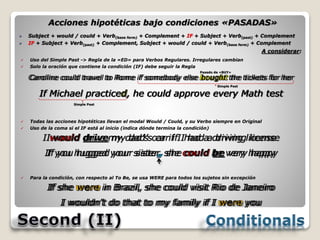
Acciones hipotéticas bajo condiciones «PASADAS»
If Michael practiced, he could approve
every Math test
 Subject + would / could + Verb(base form) + Complement + IF + Subject + Verb(past) + Complement
 IF + Subject + Verb(past) + Complement, Subject + would / could + Verb(base form) + Complement
I would drive my dad’s car if I had a
driving license
If she were not sick now, we could watch
Avengers at the cinema
I wouldn’t do that to my family if I were
you
Acciones hipotéticas bajo condiciones «PASADAS»
 Subject + would / could + Verb(base form) + Complement + IF + Subject + Verb(past) + Complement
 IF + Subject + Verb(past) + Complement, Subject + would / could + Verb(base form) + Complement
 Todas las acciones hipotéticas llevan el modal Would / Could, y su Verbo siempre en Original
 Uso de la coma si el IF está al inicio (indica dónde termina la condición)
I drive my dad’s car if I had a driving license
If you hugged your sister she be very happy
 Para la condición, con respecto al To Be, se usa WERE para todos los sujetos sin excepción
If she in Brazil, she could visit Rio de Janeiro
I wouldn’t do that to my family if I you
 Uso del Simple Past -> Regla de la «ED» para Verbos Regulares. Irregulares cambian
 Solo la oración que contiene la condición (IF) debe seguir la Regla
Caroline could travel to Rome if somebody else the tickets for her
If Michael practice , he could approve every Math test
Simple Past
Simple Past
Pasado de «BUY»
A considerar:
 Uso del Simple Past -> Regla de la «ED» para Verbos Regulares. Irregulares cambian
 Solo la oración que contiene la condición (IF) debe seguir la Regla
Caroline could travel to Rome if somebody else bought the tickets for her
If Michael practiced, he could approve every Math test
 Todas las acciones hipotéticas llevan el modal Would / Could, y su Verbo siempre en Original
 Uso de la coma si el IF está al inicio (indica dónde termina la condición)
I would drive my dad’s car if I had a driving license
If you hugged your sister she could be very happy
 Para la condición, con respecto al To Be, se usa WERE para todos los sujetos sin excepción
If she were in Brazil, she could visit Rio de Janeiro
I wouldn’t do that to my family if I were you
Acciones imposibles de realizar nuevamente (arrepentimientos pasados) bajo
condiciones «PASADAS»
If Sarah and Peter had studied better yesterday, they would
have approved that easy Physics test
 Subject + would / could + have + Verb(past participle) + Complement + IF + Subject + had + Verb(past participle) + Complement
 IF + Subject + had + Verb(past participle) + Complement, Subject + would / could + have + Verb(past participle) + Complement
Tomas couldn’t have paid dinner if his credit card hadn’t
passed
If she had gotten her passport at time, she would have
begun to travel around the world from now
I could have travelled to Mexico if somebody had sent me
some money
Acciones imposibles de realizar nuevamente (arrepentimientos pasados) bajo
condiciones «PASADAS»
 Subject + would / could + have + Verb(past participle) + Complement + IF + Subject + had + Verb(past participle) + Complement
 IF + Subject + had + Verb(past participle) + Complement, Subject + would / could + have + Verb(past participle) + Complement
A considerar:
 Uso de Perfect Tense->Verbos en Participios Pasados–>Regla de «ED» Verbos Regulares. Irregulares cambian
 Todas las acciones «imposibles…» llevan el modal Would have/ Could have
 Para la condición (IF), solo se trabaja el Past Perfect (Auxiliar –> HAD)
If Sarah and Peter had stud better, they approve that easy Physics test
I travel to Mexico if somebody had me some money
Past Perfect
Past Perfect
 Uso de la coma si el IF está al inicio (indica dónde termina la condición)
 No confundir con el Second Conditional (II -> acción con , condición con
/ III -> acción y condición con
Tomas fence if he sick
Tomas the fence if he sick
 Uso de Perfect Tense->Verbos en Participios Pasados–>Regla de «ED» Verbos Regulares. Irregulares cambian
 Todas las acciones «imposibles…» llevan el modal Would have/ Could have
 Para la condición (IF), solo se trabaja el Past Perfect (Auxiliar –> HAD)
If Sarah and Peter had studied better, they would have approved that easy Physics test
I could have travelled to Mexico if somebody had sent me some money
 Uso de la coma si el IF está al inicio (indica dónde termina la condición)
 No confundir con el Second Conditional (II -> acción con , condición con
/ III -> acción y condición con
Tomas couldn’t paint fence if he were sick
Conditional
Tipo
Oración Independiente Nexo
Oración
Subordinada
A considerar
ZERO
(0)
Simple Present
IF
Simple
Present
•Regla de la S
•Auxiliar Do/Does
FIRST
(I)
S + will / shall / can + V+ C
Simple
Present
•Regla de la S
•Auxiliar Do/Does
SECOND
(II)
S + would / could + V + C Simple Past
•Regla de la “-ed”
•Pasado de Irreg.
•Auxiliar Did
THIRD
(III)
Modal Perfect
(would have / could
have)
Past Perfect
•Verbos en Pasado
Participio
•Auxiliar Have/Had
Conditionals - Condicionales

Conditionals - Condicionales

  • 1.
    Ing. Ricky Rivero Conditionalsby Ing. Ricky Rivero is licensed under a Creative Commons Reconocimiento-CompartirIgual 3.0 Venezuela License.
  • 2.
    Indican bajo quécondiciones se realiza, puede, pudiese o hubiese hecho ciertas acciones. Tipos:  Zero (0) -> Verdad o Lógica  First (I) -> Posibilidades futuras  Second (II) -> Hipótesis  Third (III) -> Lamentaciones o arrepentimientos Trabaja con diferentes conectores o nexos que pueden cambiar según la condición que se desea expresar. Los más utilizados:  If (si)  Unless (a menos que)
  • 3.
    Acciones lógicas overdaderas bajo condiciones PRESENTES If I freeze the water, It turns into ice  Subject + Verb(present) + Complement + IF + Subject + Verb(present) + Complement  IF + Subject + Verb(present) + Complement, Subject + Verb(present) + Complement Martha gets fat if she eats a lot You buy that house now if you have the money If they put the money, we make the party today I run faster than a cheetah if a dog begins to chase me
  • 4.
     Regla dePluralización o de la «S» cuando el sujeto es la 3ra Persona del Singular Martha gets fat if she eats a lot Acciones lógicas o verdaderas bajo condiciones PRESENTES  Subject + Verb(present) + Complement + IF + Subject + Verb(present) + Complement  IF + Subject + Verb(present) + Complement, Subject + Verb(present) + Complement  Todas las acciones y condiciones son en Simple Present If I freeze the water, turn into ice Verbo en Presente Verbo en Presente  Uso de la coma si el IF está al inicio (indica dónde termina la condición) If they put the money we make the party today A considerar:  Regla de Pluralización o de la «S» cuando el sujeto es la 3ra Persona del Singular Martha gets fat if she eats a lot  Todas las acciones y condiciones son en Simple Present If I freeze the water, It turns into ice
  • 5.
    Acciones posibles (futuras)bajo condiciones PRESENTES If Carlos buys the tickets now, his family can arrive to Rome tomorrow  Subject + will / shall / can + Verb(base form) + Complement + IF + Subject + Verb(base form) + Complement  IF + Subject + Verb(base form) + Complement, Subject + will / shall / can + Verb(base form) + Complement Students will get a good grade in their finals if they start to study from now We shall win the Championship League next year if we begin training today I’ll close the store if there is no more customers
  • 6.
     Solo laoración que contiene la condición (IF) debe seguir la Regla de la «S»  Uso de la coma si el IF está al inicio (indica dónde termina la condición) If buy the tickets now his family can arrive to Rome tomorrow Acciones posibles (futuras) bajo condiciones PRESENTES  Subject + will / shall / can + Verb(base form) + Complement + IF + Subject + Verb(base form) + Complement  IF + Subject + Verb(base form) + Complement, Subject + will / shall / can + Verb(base form) + Complement  Todas las acciones posibles llevan el modal WILL/SHAL o CAN, según su contexto Students will get a good grade in their finals if they start to study from now  Por lo general el modal Shall se usa cuando el sujeto es «We» We win the Championship League next year if we begin training today Simple Present A considerar:  Solo la oración que contiene la condición (IF) debe seguir la Regla de la «S»  Uso de la coma si el IF está al inicio (indica dónde termina la condición) If Carlos buys the tickets now his family can arrive to Rome tomorrow  Todas las acciones posibles llevan el modal WILL/SHAL o CAN, según su contexto Students get a good grade in their finals if they start to study from now  Por lo general el modal Shall se usa cuando el sujeto es «We» We shall win the Championship League next year if we begin training today
  • 7.
    Acciones hipotéticas bajocondiciones «PASADAS» If Michael practiced, he could approve every Math test  Subject + would / could + Verb(base form) + Complement + IF + Subject + Verb(past) + Complement  IF + Subject + Verb(past) + Complement, Subject + would / could + Verb(base form) + Complement I would drive my dad’s car if I had a driving license If she were not sick now, we could watch Avengers at the cinema I wouldn’t do that to my family if I were you
  • 8.
    Acciones hipotéticas bajocondiciones «PASADAS»  Subject + would / could + Verb(base form) + Complement + IF + Subject + Verb(past) + Complement  IF + Subject + Verb(past) + Complement, Subject + would / could + Verb(base form) + Complement  Todas las acciones hipotéticas llevan el modal Would / Could, y su Verbo siempre en Original  Uso de la coma si el IF está al inicio (indica dónde termina la condición) I drive my dad’s car if I had a driving license If you hugged your sister she be very happy  Para la condición, con respecto al To Be, se usa WERE para todos los sujetos sin excepción If she in Brazil, she could visit Rio de Janeiro I wouldn’t do that to my family if I you  Uso del Simple Past -> Regla de la «ED» para Verbos Regulares. Irregulares cambian  Solo la oración que contiene la condición (IF) debe seguir la Regla Caroline could travel to Rome if somebody else the tickets for her If Michael practice , he could approve every Math test Simple Past Simple Past Pasado de «BUY» A considerar:  Uso del Simple Past -> Regla de la «ED» para Verbos Regulares. Irregulares cambian  Solo la oración que contiene la condición (IF) debe seguir la Regla Caroline could travel to Rome if somebody else bought the tickets for her If Michael practiced, he could approve every Math test  Todas las acciones hipotéticas llevan el modal Would / Could, y su Verbo siempre en Original  Uso de la coma si el IF está al inicio (indica dónde termina la condición) I would drive my dad’s car if I had a driving license If you hugged your sister she could be very happy  Para la condición, con respecto al To Be, se usa WERE para todos los sujetos sin excepción If she were in Brazil, she could visit Rio de Janeiro I wouldn’t do that to my family if I were you
  • 9.
    Acciones imposibles derealizar nuevamente (arrepentimientos pasados) bajo condiciones «PASADAS» If Sarah and Peter had studied better yesterday, they would have approved that easy Physics test  Subject + would / could + have + Verb(past participle) + Complement + IF + Subject + had + Verb(past participle) + Complement  IF + Subject + had + Verb(past participle) + Complement, Subject + would / could + have + Verb(past participle) + Complement Tomas couldn’t have paid dinner if his credit card hadn’t passed If she had gotten her passport at time, she would have begun to travel around the world from now I could have travelled to Mexico if somebody had sent me some money
  • 10.
    Acciones imposibles derealizar nuevamente (arrepentimientos pasados) bajo condiciones «PASADAS»  Subject + would / could + have + Verb(past participle) + Complement + IF + Subject + had + Verb(past participle) + Complement  IF + Subject + had + Verb(past participle) + Complement, Subject + would / could + have + Verb(past participle) + Complement A considerar:  Uso de Perfect Tense->Verbos en Participios Pasados–>Regla de «ED» Verbos Regulares. Irregulares cambian  Todas las acciones «imposibles…» llevan el modal Would have/ Could have  Para la condición (IF), solo se trabaja el Past Perfect (Auxiliar –> HAD) If Sarah and Peter had stud better, they approve that easy Physics test I travel to Mexico if somebody had me some money Past Perfect Past Perfect  Uso de la coma si el IF está al inicio (indica dónde termina la condición)  No confundir con el Second Conditional (II -> acción con , condición con / III -> acción y condición con Tomas fence if he sick Tomas the fence if he sick  Uso de Perfect Tense->Verbos en Participios Pasados–>Regla de «ED» Verbos Regulares. Irregulares cambian  Todas las acciones «imposibles…» llevan el modal Would have/ Could have  Para la condición (IF), solo se trabaja el Past Perfect (Auxiliar –> HAD) If Sarah and Peter had studied better, they would have approved that easy Physics test I could have travelled to Mexico if somebody had sent me some money  Uso de la coma si el IF está al inicio (indica dónde termina la condición)  No confundir con el Second Conditional (II -> acción con , condición con / III -> acción y condición con Tomas couldn’t paint fence if he were sick
  • 11.
    Conditional Tipo Oración Independiente Nexo Oración Subordinada Aconsiderar ZERO (0) Simple Present IF Simple Present •Regla de la S •Auxiliar Do/Does FIRST (I) S + will / shall / can + V+ C Simple Present •Regla de la S •Auxiliar Do/Does SECOND (II) S + would / could + V + C Simple Past •Regla de la “-ed” •Pasado de Irreg. •Auxiliar Did THIRD (III) Modal Perfect (would have / could have) Past Perfect •Verbos en Pasado Participio •Auxiliar Have/Had