Ver para creerUna introducción a la manipulación de imágenes científicas
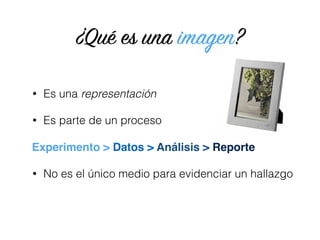
• Es una representación
• Es parte de un proceso


• No es el único medio para evidenciar un hallazgo
¿Qué es una imagen?
Experimento > Datos > Análisis > Reporte
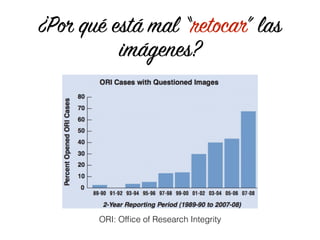
¿Por qué está mal “retocar” las
imágenes?
• Honestidad cientifica
• Representación fiel a la realidad
• Perder información en el proceso
• Potencial engaño a audiencia y pares
¿Por qué está mal “retocar” las
imágenes?
ORI: Office of Research Integrity
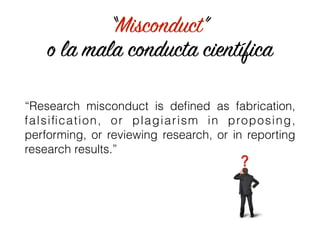
“Misconduct”
o la mala conducta científica
“Research misconduct is defined as fabrication,
falsification, or plagiarism in proposing,
performing, or reviewing research, or in reporting
research results.”
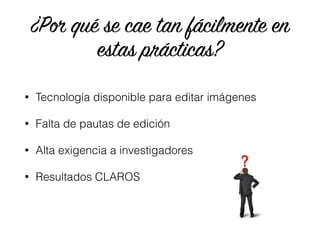
¿Por qué se cae tan fácilmente en
estas prácticas?
• Tecnología disponible para editar imágenes
• Falta de pautas de edición
• Alta exigencia a investigadores
• Resultados CLAROS
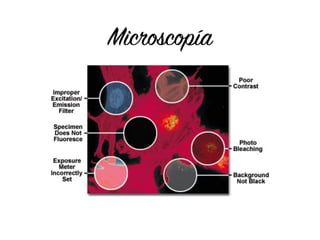
Microscopía
“A certain degree of image processing is
acceptable for publication, but the final image
must correctly represent the original data.”
Edición permitida
• The use of touch-up tools or any feature that deliberately obscures
manipulations is to be avoided (Nature).
• Processing (such as changing brightness and contrast) is appropriate only
when applied equally across the entire image and also to controls.
• Contrast should not be adjusted so that data disappear (Nature).
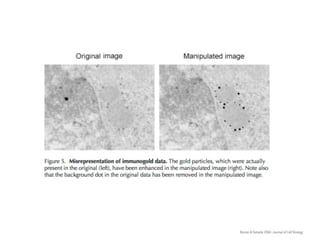
• No specific feature within the image must be enhanced, obscured, moved,
removed or introduced (JCB).
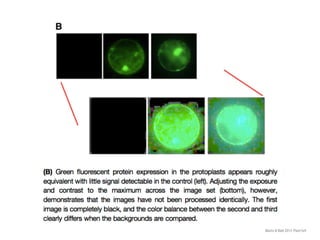
Martin & Blatt 2013. Plant Cell
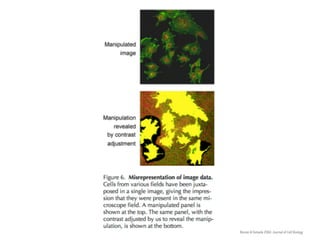
Rosner & Yamada 2004. Journal of Cell Biology
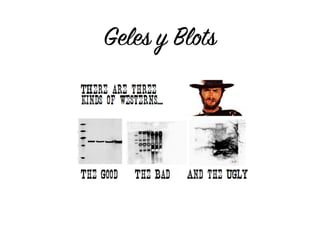
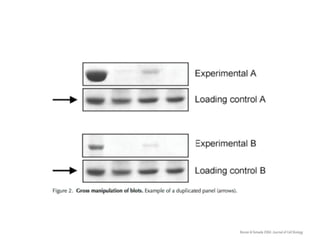
Geles y Blots
“A certain degree of image processing is
acceptable for publication, but the final image
must correctly represent the original data.”
Edición permitida
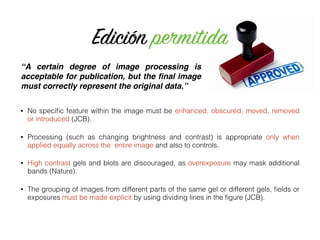
• No specific feature within the image must be enhanced, obscured, moved, removed
or introduced (JCB).
• Processing (such as changing brightness and contrast) is appropriate only when
applied equally across the entire image and also to controls.
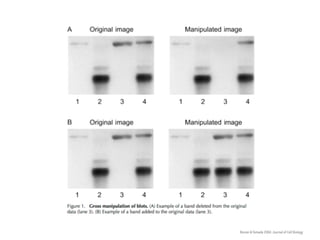
• High contrast gels and blots are discouraged, as overexposure may mask additional
bands (Nature).
• The grouping of images from different parts of the same gel or different gels, fields or
exposures must be made explicit by using dividing lines in the figure (JCB).
Martin & Blatt 2013. Plant Cell
Rosner & Yamada 2004. Journal of Cell Biology
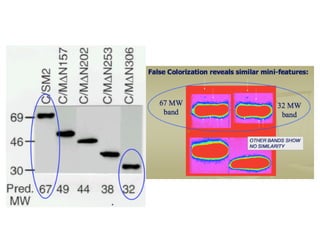
¿Cómo detectar la manipulación
de imágenes?
• Aplicación de gradientes
• Saturación y contraste
• Coloración Falsa
¿Qué hacer en caso de detectar
anomalías?
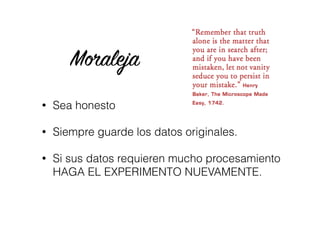
Moraleja
• Sea honesto
• Siempre guarde los datos originales.
• Si sus datos requieren mucho procesamiento
HAGA EL EXPERIMENTO NUEVAMENTE.

Etica de imagenes cientificas

  • 1.
    Ver para creerUnaintroducción a la manipulación de imágenes científicas
  • 2.
    • Es unarepresentación • Es parte de un proceso
 
 • No es el único medio para evidenciar un hallazgo ¿Qué es una imagen? Experimento > Datos > Análisis > Reporte
  • 3.
    ¿Por qué estámal “retocar” las imágenes? • Honestidad cientifica • Representación fiel a la realidad • Perder información en el proceso • Potencial engaño a audiencia y pares
  • 4.
    ¿Por qué estámal “retocar” las imágenes? ORI: Office of Research Integrity
  • 5.
    “Misconduct” o la malaconducta científica “Research misconduct is defined as fabrication, falsification, or plagiarism in proposing, performing, or reviewing research, or in reporting research results.”
  • 6.
    ¿Por qué secae tan fácilmente en estas prácticas? • Tecnología disponible para editar imágenes • Falta de pautas de edición • Alta exigencia a investigadores • Resultados CLAROS
  • 10.
  • 11.
    “A certain degreeof image processing is acceptable for publication, but the final image must correctly represent the original data.” Edición permitida • The use of touch-up tools or any feature that deliberately obscures manipulations is to be avoided (Nature). • Processing (such as changing brightness and contrast) is appropriate only when applied equally across the entire image and also to controls. • Contrast should not be adjusted so that data disappear (Nature). • No specific feature within the image must be enhanced, obscured, moved, removed or introduced (JCB).
  • 12.
    Martin & Blatt2013. Plant Cell
  • 13.
    Rosner & Yamada2004. Journal of Cell Biology
  • 14.
    Rosner & Yamada2004. Journal of Cell Biology
  • 15.
  • 16.
    “A certain degreeof image processing is acceptable for publication, but the final image must correctly represent the original data.” Edición permitida • No specific feature within the image must be enhanced, obscured, moved, removed or introduced (JCB). • Processing (such as changing brightness and contrast) is appropriate only when applied equally across the entire image and also to controls. • High contrast gels and blots are discouraged, as overexposure may mask additional bands (Nature). • The grouping of images from different parts of the same gel or different gels, fields or exposures must be made explicit by using dividing lines in the figure (JCB).
  • 17.
    Martin & Blatt2013. Plant Cell
  • 18.
    Rosner & Yamada2004. Journal of Cell Biology
  • 19.
    Rosner & Yamada2004. Journal of Cell Biology
  • 20.
    ¿Cómo detectar lamanipulación de imágenes? • Aplicación de gradientes • Saturación y contraste • Coloración Falsa
  • 22.
    ¿Qué hacer encaso de detectar anomalías?
  • 23.
    Moraleja • Sea honesto •Siempre guarde los datos originales. • Si sus datos requieren mucho procesamiento HAGA EL EXPERIMENTO NUEVAMENTE.