Grammar Book

  Andrés Paz
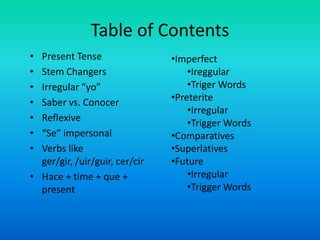
Table of Contents
• Present Tense                 •Imperfect
• Stem Changers                     •Ireggular
• Irregular “yo”                    •Triger Words
• Saber vs. Conocer             •Preterite
                                    •Irregular
• Reflexive                         •Trigger Words
• “Se” impersonal               •Comparatives
• Verbs like                    •Superlatives
  ger/gir, /uir/guir, cer/cir   •Future
• Hace + time + que +               •Irregular
  present                           •Trigger Words
Present Tense
                      -AR         -ER       -IR


Yo                    -o          -o        -o


Tu                    -as         -es       -es


El/Ella/Usted         -a          -e        -e


Nosotros              -amos       -emos     -imos


Ellos/Ellas/Ustedes   -an         -en       -en
Stem Changers
                      E – ie     O – ue    E–I


Yo                    Pienso     Puedo     Pido


Tu                    Piensas    Puedes    Pides


El/Ella/Usted         Piensa     Puede     Pide


Nosotros              Pensamos   Podemos   Pedimos


Ellos/Ellas/Ustedes   Piensan    Pueden    Piden
Irregular “yo”
Go Verbs                   C - ZC
Tener       Tengo          Conocer    Conozco
Decir       Digo
                           Producir   Produzco
Traer       Traigo
Caer        Caigo          Conducir   Conduzco

Los Demás

Ser                        Soy

Estar                      Estoy

Ir                         Voy

Dar                        Doy
Saber vs. Conocer
                         Saber – to know   Conocer – to be familiar
                         information       with

Yo                       Se                Conozco


Tu                       Sabes             Conoces


El/Ella/Usted            Sabe              Conoce


Nosotros                 Sabemos           Conocemos


Ellos/Ellas/Ustedes      Saben             Conocen
Reflexives
Me               Te                 Se                  Nos             Se

Myself           Yourself           Himself             Ourselves       Yourselves
                                    Herself                             Themselves
                                    Itself


                      Lavarse                 Caerse                Vestirse
Yo                    Me lavo                 Me caigo              Me visto
Tu                    Te lavas                Te caes               Te vistes
El/Ella/Usted         Se lava                 Se cae                Se viste
Nosotros              Nos lavamos             Nos caemos            Nos vestimos
Ellos/Ellas/Ustedes   Se lavan                Se caen               Se visten
“Se” impersonal
• “Se” is used like the passive voice in English.
Active                         Passive


Mi amigo vende la helado.      Se vende la helado.
My friend sells ice cream.     The ice cream is sold.


Ellos comen la hamburguesas.   Se comen la hamburguesas.
They eat hamburgers.           The hamburgers are eaten.
Verbs like ger/gir, /uir/guir, cer/cir

               Atribuir     Conseguir   Conocer   Decir     Coger     Exigir


Yo             Atribuyo     Consigo     Conozco   Digo      Cojo      Exijo


Tu             Atribuyes    Consigues   Conoces   Dices     Coges     Exiges


El/Ella/Ust    Atribuye     Consigue    Conoce    Dice      Coge      Exige
ed

Nosotros       Atribuimos   Conseguim   Conocemos Decimos   Cogemos   Exigimos
                            os

Ellos/Ellas/ Atribuyen      Consiguen   Conocen   Dicen     Cogen     Exigen
Ustedes
Hace + time + que + presente
• This formula is used to show how long an action
  took.
Hace +        Time +             Que +    Present tense verb

Hace +        Quince minutos +   Que +    Juego en el parque


     Hace quince minutos que juego en el parque.
  I have been playing at the park for fifteen minutes.
Imperfect
• This tense is used to express an event that took place in the past that was
  ongoing.
   – El bebía el jugo de naranja.
   – He was drinking orange juice.
• Trigger words:
   – Todos los
   – A menudo
   – Con frecuencia
   – Frecuentemente
   – De vez en cuando
   – Mucho
   – Mientras
   – Siempre
   – Muchas veces
Imperfect (conjugations)
                      -AR       -ER      -IR


Yo                    -aba      -ía      -ía


Tu                    -abas     -ías     -ías


El/Ella/Usted         -aba      -ía      -ía


Nosotros              -abamos   -íamos   -íamos


Ellos/Ellas/Ustedes   -aban     -ían     -ían
Imperfect (Irregular)
                      Ir       Ser      Ver


Yo                    Iba      Era      Veía


Tu                    Ibas     Eras     Veías


El/Ella/Usted         Iba      Era      Veía


Nosotros              Íbamos   Éramos   Veíamos


Ellos/Ellas/Ustedes   Iban     Eran     Veían
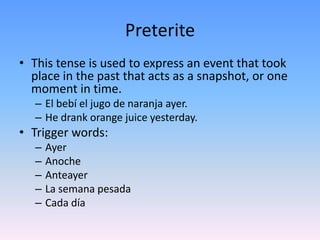
Preterite
• This tense is used to express an event that took
  place in the past that acts as a snapshot, or one
  moment in time.
   – El bebí el jugo de naranja ayer.
   – He drank orange juice yesterday.
• Trigger words:
   –   Ayer
   –   Anoche
   –   Anteayer
   –   La semana pesada
   –   Cada día
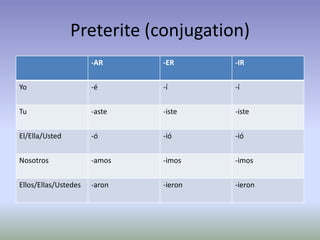
Preterite (conjugation)
                      -AR     -ER      -IR


Yo                    -é      -í       -í


Tu                    -aste   -iste    -iste


El/Ella/Usted         -ó      -ió      -ió


Nosotros              -amos   -imos    -imos


Ellos/Ellas/Ustedes   -aron   -ieron   -ieron
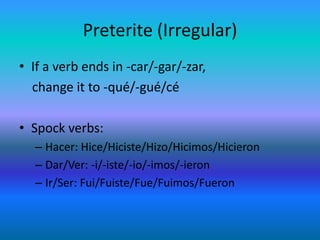
Preterite (Irregular)
• If a verb ends in -car/-gar/-zar,
  change it to -qué/-gué/cé

• Spock verbs:
   – Hacer: Hice/Hiciste/Hizo/Hicimos/Hicieron
   – Dar/Ver: -i/-iste/-io/-imos/-ieron
   – Ir/Ser: Fui/Fuiste/Fue/Fuimos/Fueron
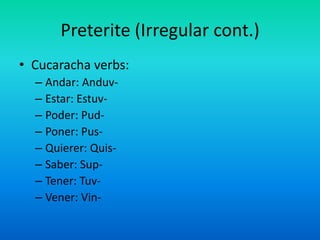
Preterite (Irregular cont.)
• Cucaracha verbs:
  – Andar: Anduv-
  – Estar: Estuv-
  – Poder: Pud-
  – Poner: Pus-
  – Quierer: Quis-
  – Saber: Sup-
  – Tener: Tuv-
  – Vener: Vin-
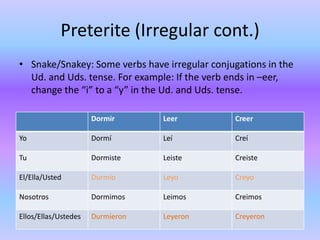
Preterite (Irregular cont.)
• Snake/Snakey: Some verbs have irregular conjugations in the
  Ud. and Uds. tense. For example: If the verb ends in –eer,
  change the “i” to a “y” in the Ud. and Uds. tense.

                      Dormir      Leer          Creer

Yo                    Dormí       Leí           Creí

Tu                    Dormiste    Leiste        Creiste

El/Ella/Usted         Durmío      Leyo          Creyo

Nosotros              Dormimos    Leimos        Creimos

Ellos/Ellas/Ustedes   Durmieron   Leyeron       Creyeron
Comparatives
• These words compare two things together.
• When comparing things with adjectives:
  – Thing 1 + comparative (mas/menos, mejor/peor,
    mayor/menor, tan) + adjective + (que, como) + thing 2
• When comparing things with an adverb
  – Thing 1 + verb + comparative (mas/menos,
    mejor/peor, mayor/menor, tanto(a) + (que, como) +
    thing 2
• When using numbers, use “de” instead of “que”.
Superlatives
• These words compare one thing to multiple
  other things.
  – Something is + superlative (mas/menos,
    mejor/peor, mayor/menor) + adjective + de +
    other stuff.
Future
• This tense is used to express an event that will happen in a
  time past now.
• In the future tense, you do not drop the ending. Instead,
  you add on a suffix to the entire verb, not just the root.
    – El leerá la libra mañana.
    – He will read a book tomorrow.
•   Trigger words:
•   En el futuro
•   La proximo ayer
•   La proximo dia
•   La proximo mes
Future (conjugations)
                           Verb + ___


Yo                         -é


Tu                         -ás


El/Ella/Usted              -á


Nosotros                   -emos


Ellos/Ellas/Ustedes        -án
Future (Irregular)
•   Decir: Dir-
•   Haber: Habr-
•   Hacer: Har-
•   Poder: Podr-
•   Poner: Pondr-
•   Querer: Querr-
•   Saber: Sabr-
•   Salir: Saldr-
•   Tener: Tendr-
•   Valer: Valdr-
•   Venir: Vendr-
EL FIN

Grammar book (complete)

  • 1.
    Grammar Book Andrés Paz
  • 2.
    Table of Contents •Present Tense •Imperfect • Stem Changers •Ireggular • Irregular “yo” •Triger Words • Saber vs. Conocer •Preterite •Irregular • Reflexive •Trigger Words • “Se” impersonal •Comparatives • Verbs like •Superlatives ger/gir, /uir/guir, cer/cir •Future • Hace + time + que + •Irregular present •Trigger Words
  • 3.
    Present Tense -AR -ER -IR Yo -o -o -o Tu -as -es -es El/Ella/Usted -a -e -e Nosotros -amos -emos -imos Ellos/Ellas/Ustedes -an -en -en
  • 4.
    Stem Changers E – ie O – ue E–I Yo Pienso Puedo Pido Tu Piensas Puedes Pides El/Ella/Usted Piensa Puede Pide Nosotros Pensamos Podemos Pedimos Ellos/Ellas/Ustedes Piensan Pueden Piden
  • 5.
    Irregular “yo” Go Verbs C - ZC Tener Tengo Conocer Conozco Decir Digo Producir Produzco Traer Traigo Caer Caigo Conducir Conduzco Los Demás Ser Soy Estar Estoy Ir Voy Dar Doy
  • 6.
    Saber vs. Conocer Saber – to know Conocer – to be familiar information with Yo Se Conozco Tu Sabes Conoces El/Ella/Usted Sabe Conoce Nosotros Sabemos Conocemos Ellos/Ellas/Ustedes Saben Conocen
  • 7.
    Reflexives Me Te Se Nos Se Myself Yourself Himself Ourselves Yourselves Herself Themselves Itself Lavarse Caerse Vestirse Yo Me lavo Me caigo Me visto Tu Te lavas Te caes Te vistes El/Ella/Usted Se lava Se cae Se viste Nosotros Nos lavamos Nos caemos Nos vestimos Ellos/Ellas/Ustedes Se lavan Se caen Se visten
  • 8.
    “Se” impersonal • “Se”is used like the passive voice in English. Active Passive Mi amigo vende la helado. Se vende la helado. My friend sells ice cream. The ice cream is sold. Ellos comen la hamburguesas. Se comen la hamburguesas. They eat hamburgers. The hamburgers are eaten.
  • 9.
    Verbs like ger/gir,/uir/guir, cer/cir Atribuir Conseguir Conocer Decir Coger Exigir Yo Atribuyo Consigo Conozco Digo Cojo Exijo Tu Atribuyes Consigues Conoces Dices Coges Exiges El/Ella/Ust Atribuye Consigue Conoce Dice Coge Exige ed Nosotros Atribuimos Conseguim Conocemos Decimos Cogemos Exigimos os Ellos/Ellas/ Atribuyen Consiguen Conocen Dicen Cogen Exigen Ustedes
  • 10.
    Hace + time+ que + presente • This formula is used to show how long an action took. Hace + Time + Que + Present tense verb Hace + Quince minutos + Que + Juego en el parque Hace quince minutos que juego en el parque. I have been playing at the park for fifteen minutes.
  • 11.
    Imperfect • This tenseis used to express an event that took place in the past that was ongoing. – El bebía el jugo de naranja. – He was drinking orange juice. • Trigger words: – Todos los – A menudo – Con frecuencia – Frecuentemente – De vez en cuando – Mucho – Mientras – Siempre – Muchas veces
  • 12.
    Imperfect (conjugations) -AR -ER -IR Yo -aba -ía -ía Tu -abas -ías -ías El/Ella/Usted -aba -ía -ía Nosotros -abamos -íamos -íamos Ellos/Ellas/Ustedes -aban -ían -ían
  • 13.
    Imperfect (Irregular) Ir Ser Ver Yo Iba Era Veía Tu Ibas Eras Veías El/Ella/Usted Iba Era Veía Nosotros Íbamos Éramos Veíamos Ellos/Ellas/Ustedes Iban Eran Veían
  • 14.
    Preterite • This tenseis used to express an event that took place in the past that acts as a snapshot, or one moment in time. – El bebí el jugo de naranja ayer. – He drank orange juice yesterday. • Trigger words: – Ayer – Anoche – Anteayer – La semana pesada – Cada día
  • 15.
    Preterite (conjugation) -AR -ER -IR Yo -é -í -í Tu -aste -iste -iste El/Ella/Usted -ó -ió -ió Nosotros -amos -imos -imos Ellos/Ellas/Ustedes -aron -ieron -ieron
  • 16.
    Preterite (Irregular) • Ifa verb ends in -car/-gar/-zar, change it to -qué/-gué/cé • Spock verbs: – Hacer: Hice/Hiciste/Hizo/Hicimos/Hicieron – Dar/Ver: -i/-iste/-io/-imos/-ieron – Ir/Ser: Fui/Fuiste/Fue/Fuimos/Fueron
  • 17.
    Preterite (Irregular cont.) •Cucaracha verbs: – Andar: Anduv- – Estar: Estuv- – Poder: Pud- – Poner: Pus- – Quierer: Quis- – Saber: Sup- – Tener: Tuv- – Vener: Vin-
  • 18.
    Preterite (Irregular cont.) •Snake/Snakey: Some verbs have irregular conjugations in the Ud. and Uds. tense. For example: If the verb ends in –eer, change the “i” to a “y” in the Ud. and Uds. tense. Dormir Leer Creer Yo Dormí Leí Creí Tu Dormiste Leiste Creiste El/Ella/Usted Durmío Leyo Creyo Nosotros Dormimos Leimos Creimos Ellos/Ellas/Ustedes Durmieron Leyeron Creyeron
  • 19.
    Comparatives • These wordscompare two things together. • When comparing things with adjectives: – Thing 1 + comparative (mas/menos, mejor/peor, mayor/menor, tan) + adjective + (que, como) + thing 2 • When comparing things with an adverb – Thing 1 + verb + comparative (mas/menos, mejor/peor, mayor/menor, tanto(a) + (que, como) + thing 2 • When using numbers, use “de” instead of “que”.
  • 20.
    Superlatives • These wordscompare one thing to multiple other things. – Something is + superlative (mas/menos, mejor/peor, mayor/menor) + adjective + de + other stuff.
  • 21.
    Future • This tenseis used to express an event that will happen in a time past now. • In the future tense, you do not drop the ending. Instead, you add on a suffix to the entire verb, not just the root. – El leerá la libra mañana. – He will read a book tomorrow. • Trigger words: • En el futuro • La proximo ayer • La proximo dia • La proximo mes
  • 22.
    Future (conjugations) Verb + ___ Yo -é Tu -ás El/Ella/Usted -á Nosotros -emos Ellos/Ellas/Ustedes -án
  • 23.
    Future (Irregular) • Decir: Dir- • Haber: Habr- • Hacer: Har- • Poder: Podr- • Poner: Pondr- • Querer: Querr- • Saber: Sabr- • Salir: Saldr- • Tener: Tendr- • Valer: Valdr- • Venir: Vendr-
  • 24.