By: Gustavo Smith
    6 th period
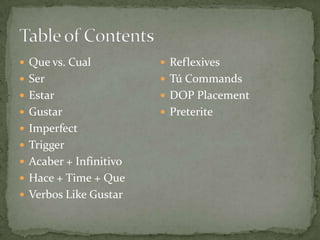
 Que vs. Cual           Reflexives
 Ser                    Tú Commands
 Estar                  DOP Placement
 Gustar                 Preterite
 Imperfect
 Trigger
 Acaber + Infinitivo
 Hace + Time + Que
 Verbos Like Gustar
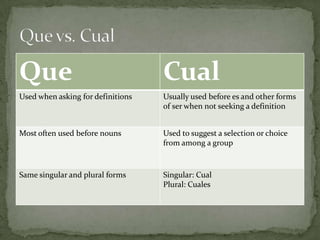
Que                                Cual
Used when asking for definitions   Usually used before es and other forms
                                   of ser when not seeking a definition


Most often used before nouns       Used to suggest a selection or choice
                                   from among a group


Same singular and plural forms     Singular: Cual
                                   Plural: Cuales
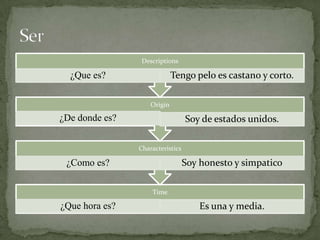
Descriptions

  ¿Que es?                   Tengo pelo es castano y corto.

                    Origin

¿De donde es?                     Soy de estados unidos.

                Characteristics

 ¿Como es?                        Soy honesto y simpatico

                    Time

¿Que hora es?                         Es una y media.
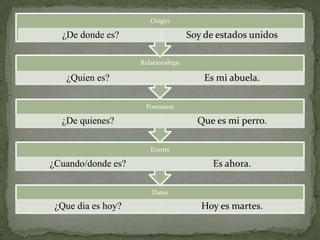
Origin

  ¿De donde es?                     Soy de estados unidos

                    Relationships

   ¿Quien es?                           Es mi abuela.

                     Posession

  ¿De quienes?                        Que es mi perro.

                       Events

¿Cuando/donde es?                         Es ahora.

                       Dates

 ¿Que dia es hoy?                      Hoy es martes.
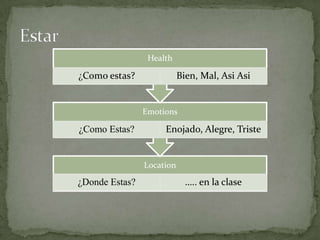
Health

¿Como estas?               Bien, Mal, Asi Asi


                Emotions

¿Como Estas?         Enojado, Alegre, Triste


                Location

¿Donde Estas?                ….. en la clase
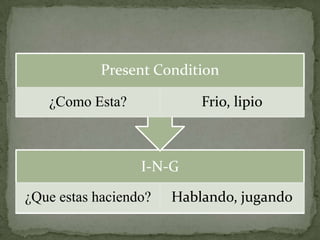
Present Condition

   ¿Como Esta?             Frio, lipio


                  I-N-G

¿Que estas haciendo?   Hablando, jugando
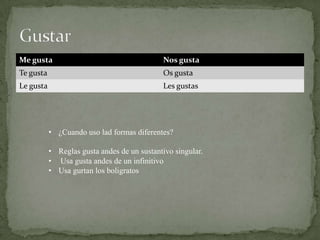
Me gusta                                     Nos gusta
Te gusta                                     Os gusta
Le gusta                                     Les gustas


           • ¿Cuando uso lad formas diferentes?

           • Reglas gusta andes de un sustantivo singular.
           • Usa gusta andes de un infinitivo
           • Usa gurtan los boligratos
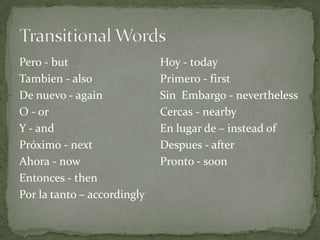
Pero - but                   Hoy - today
Tambien - also               Primero - first
De nuevo - again             Sin Embargo - nevertheless
O - or                       Cercas - nearby
Y - and                      En lugar de – instead of
Próximo - next               Despues - after
Ahora - now                  Pronto - soon
Entonces - then
Por la tanto – accordingly
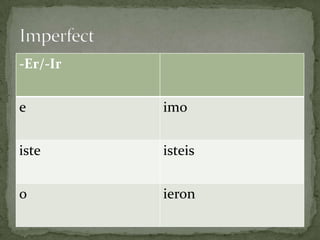
-Er/-Ir


e         imo


iste      isteis


o         ieron
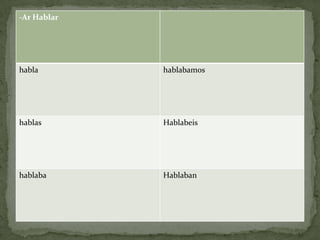
-Ar Hablar


habla        hablabamos


hablas       Hablabeis


hablaba      Hablaban
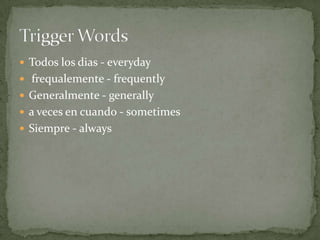
 Todos los dias - everyday
 frequalemente - frequently
 Generalmente - generally
 a veces en cuando - sometimes
 Siempre - always
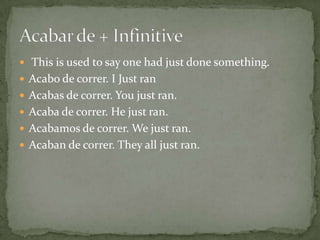
 This is used to say one had just done something.
 Acabo de correr. I Just ran
 Acabas de correr. You just ran.
 Acaba de correr. He just ran.
 Acabamos de correr. We just ran.
 Acaban de correr. They all just ran.
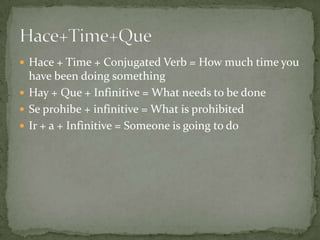
 Hace + Time + Conjugated Verb = How much time you
  have been doing something
 Hay + Que + Infinitive = What needs to be done
 Se prohibe + infinitive = What is prohibited
 Ir + a + Infinitive = Someone is going to do
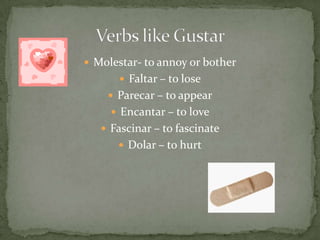
 Molestar- to annoy or bother
       Faltar – to lose
     Parecar – to appear
      Encantar – to love
    Fascinar – to fascinate
       Dolar – to hurt
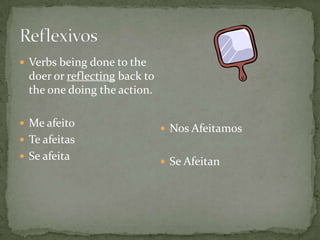
 Verbs being done to the
  doer or reflecting back to
  the one doing the action.

 Me afeito
                                Nos Afeitamos
 Te afeitas
 Se afeita
                                Se Afeitan
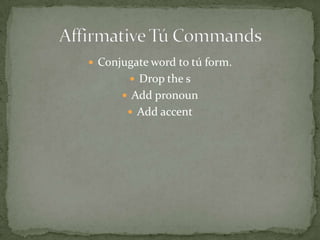
 Conjugate word to tú form.
         Drop the s
       Add pronoun
        Add accent
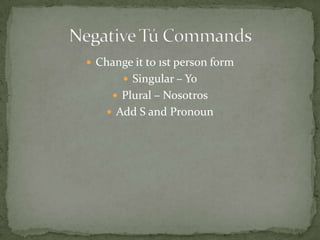
 Change it to 1st person form
        Singular – Yo
      Plural – Nosotros
     Add S and Pronoun
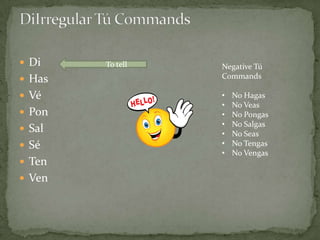
 Di    To tell   Negative Tú
 Has             Commands

 Vé              •   No Hagas
                  •   No Veas
 Pon             •   No Pongas
                  •   No Salgas
 Sal             •   No Seas
 Sé              •   No Tengas
                  •   No Vengas
 Ten
 Ven
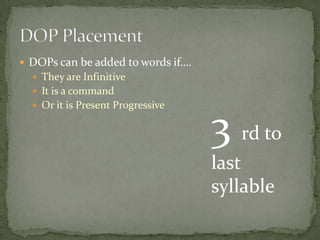
 DOPs can be added to words if….
   They are Infinitive
   It is a command
   Or it is Present Progressive


                                    3 rd to
                                    last
                                    syllable
 Perfect Action
        in the past……


    Ar Verbs            -er/ir

      E                     I
      Aste                  iste
      O                     io
      Amos                  imos
      Aron                  ieron

Gustavo grammar book

  • 1.
    By: Gustavo Smith 6 th period
  • 2.
     Que vs.Cual  Reflexives  Ser  Tú Commands  Estar  DOP Placement  Gustar  Preterite  Imperfect  Trigger  Acaber + Infinitivo  Hace + Time + Que  Verbos Like Gustar
  • 3.
    Que Cual Used when asking for definitions Usually used before es and other forms of ser when not seeking a definition Most often used before nouns Used to suggest a selection or choice from among a group Same singular and plural forms Singular: Cual Plural: Cuales
  • 4.
    Descriptions ¿Quees? Tengo pelo es castano y corto. Origin ¿De donde es? Soy de estados unidos. Characteristics ¿Como es? Soy honesto y simpatico Time ¿Que hora es? Es una y media.
  • 5.
    Origin ¿Dedonde es? Soy de estados unidos Relationships ¿Quien es? Es mi abuela. Posession ¿De quienes? Que es mi perro. Events ¿Cuando/donde es? Es ahora. Dates ¿Que dia es hoy? Hoy es martes.
  • 6.
    Health ¿Como estas? Bien, Mal, Asi Asi Emotions ¿Como Estas? Enojado, Alegre, Triste Location ¿Donde Estas? ….. en la clase
  • 7.
    Present Condition ¿Como Esta? Frio, lipio I-N-G ¿Que estas haciendo? Hablando, jugando
  • 8.
    Me gusta Nos gusta Te gusta Os gusta Le gusta Les gustas • ¿Cuando uso lad formas diferentes? • Reglas gusta andes de un sustantivo singular. • Usa gusta andes de un infinitivo • Usa gurtan los boligratos
  • 9.
    Pero - but Hoy - today Tambien - also Primero - first De nuevo - again Sin Embargo - nevertheless O - or Cercas - nearby Y - and En lugar de – instead of Próximo - next Despues - after Ahora - now Pronto - soon Entonces - then Por la tanto – accordingly
  • 10.
    -Er/-Ir e imo iste isteis o ieron
  • 11.
    -Ar Hablar habla hablabamos hablas Hablabeis hablaba Hablaban
  • 12.
     Todos losdias - everyday  frequalemente - frequently  Generalmente - generally  a veces en cuando - sometimes  Siempre - always
  • 13.
     This isused to say one had just done something.  Acabo de correr. I Just ran  Acabas de correr. You just ran.  Acaba de correr. He just ran.  Acabamos de correr. We just ran.  Acaban de correr. They all just ran.
  • 14.
     Hace +Time + Conjugated Verb = How much time you have been doing something  Hay + Que + Infinitive = What needs to be done  Se prohibe + infinitive = What is prohibited  Ir + a + Infinitive = Someone is going to do
  • 15.
     Molestar- toannoy or bother  Faltar – to lose  Parecar – to appear  Encantar – to love  Fascinar – to fascinate  Dolar – to hurt
  • 16.
     Verbs beingdone to the doer or reflecting back to the one doing the action.  Me afeito  Nos Afeitamos  Te afeitas  Se afeita  Se Afeitan
  • 17.
     Conjugate wordto tú form.  Drop the s  Add pronoun  Add accent
  • 18.
     Change itto 1st person form  Singular – Yo  Plural – Nosotros  Add S and Pronoun
  • 19.
     Di To tell Negative Tú  Has Commands  Vé • No Hagas • No Veas  Pon • No Pongas • No Salgas  Sal • No Seas  Sé • No Tengas • No Vengas  Ten  Ven
  • 20.
     DOPs canbe added to words if….  They are Infinitive  It is a command  Or it is Present Progressive 3 rd to last syllable
  • 21.
     Perfect Action in the past…… Ar Verbs -er/ir E I Aste iste O io Amos imos Aron ieron