Grammar Book

By: Gerardo Murphy
Table of Contents
•   Que vs. Cual
•   Ser – Doctor Ped
•   Estar – Helping
•   Gustar
•   Transitions
•   Imperfect
•   Trigger words
•   Acabar de + infinitive
•   Hace + time + que + pres.
•   Verbs like Gustar
•   Reflexives
•   Tu commands/Affirmitive, Negative, Irregular
•   D.O.P. Placement
•   Preterite
Que vs. Cual
             Que                      Cual
• Used when asking for a   • Used before es and ser
  definition               • Used when someone makes a
• Can mean “which”.          selection
• Used before nouns
Ser
•   Description – ¿Que es?
•   Origin – ¿De donde es?
•   Characteristics – ¿Como es?
•   Time – ¿Que hora es?
•   Occupation – ¿Que hace?
•   Relationships – ¿Quien es?
•   Possesion – ¿De quien es?
•   Events – ¿Cuando es la fiesta?
•   Dates – ¿Que dia es hoy?
• Estar
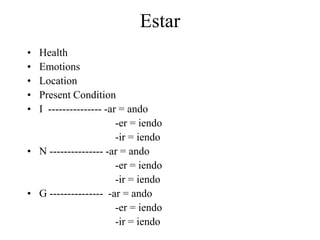
Estar
• Health
• Emotions
• Location
• Present Condition
• I --------------- -ar = ando
                       -er = iendo
                       -ir = iendo
• N --------------- -ar = ando
                       -er = iendo
                       -ir = iendo
• G --------------- -ar = ando
                       -er = iendo
                       -ir = iendo
Gustar
•   A mi – me gusta
•   A tu – te gusta
•   A usted – le gusta
•   A el – le gusta
•   A ella – le gusta
•   A nosotros – nos gusta
•   A vosotros – os gusta
•   A ustedes – les gusta
•   A ellos – les gusta
•   A ellas – les gusta
Transitions

•   Tambien
•   Ahora
•   Primero
•   Despues
•   Por eso
•   Asi que
•   Entonces
Imperfect
                   Hablar       Comer       Escribir
Yo                 hablaba      comia      escribia
Tu                 hablabas     comias     escribias
El/ella/ud.        hablaba      comia      escribia
Nosotros           hablabamos   comiamos   escribiamos
Vosotros           hablabais    comiais    escribiais
Ellos/ellas/Uds.   hablaban     comian     escribian
Triggers
•   Todos los dias
•   A menudo
•   A veces
•   Siempre
•   Coda dia
•   Loslunes
•   Generalmente
•   Mientras
•   De vez en cuando
•   Muchas veces
•   frecuentemente
Acabar de + infinitive
• Used to refer to something before
  doing something else
Hacer Expressions
Hace + Time + que + pres. Verb
   Used to tell how much time you’ve been
   doing something
Hay + que + infinitive
   Used to tell what is being talked about
Se prohibe + infinitive
   Tells what is prohibited
Ir + a + infinitive
Tells what someone is going to do
Verbos like gustar
•   Altar – To be missing
•   Fascinar – To be fascinated
•   Encantar – To love
•   Importar – To import
•   Interesar – To interest
•   Doler – To hurt
Reflexives
 - A reflexive verb is a verb used when the
   sub. and verb are the same.

    Subject        Reflexive Pronoun   -ar Endings   -ir/-er Endings

      Yo                  Me               -o              -o
      Tu                   Te              -as             -es
 El/Ella/Usted             Se              -a              -e
   Nosotros               Nos            -amos           -imos
Ellos/Ellas/Uds.           Se              -an            -en
Affirmative Commands
- Get your verb you want to conjugate = Escribir

- Conjugate to the tu form = Escribes

- Get rid of the –s = Escribe

- Add the DOP! Escribelo = Write It!
Negative
- Get your verb you want to conjugate = Comer
- Conjugate it to the he/she/formal you form. =
  Como
- Change the last letter to the opposite ending. =
     -ar  -er         -er/-ir  -ar
- Add a -s to the very end of your new word.
- Then use the form = ¡No lo/la/los/las Verb!
- ¡No lo Comes!
Irregular tú commands
   Di        No digas
  Haz       No hagas
  Ve        No vayas
  Pon       No pongas
  Sal       No salgas
   Se        No seas
  Ten       No tengas
  Ven       No vengas
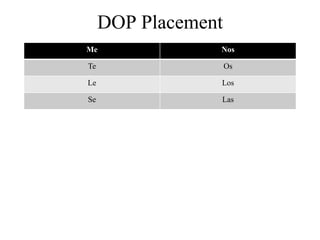
DOP Placement
Me               Nos

Te                   Os

Le               Los

Se               Las
Preterite
 - The preterite tense is an action that is done
   in the past. It’s like a snapshot of you doing
   the action.
 Pronoun      Endings            Pronoun      Endings
    Yo          -é                  Yo           -í
    Tu         -aste                Tu          -iste
El/Ella/Ud.     -ó              El/Ella/Ud.     -ió
 Nosotros      -amos             Nosotros      -imos
   Uds.        -aron                Uds.       -ieron


 Ar Endings                     Er/Ir Endings

Grammar book2

  • 1.
  • 2.
    Table of Contents • Que vs. Cual • Ser – Doctor Ped • Estar – Helping • Gustar • Transitions • Imperfect • Trigger words • Acabar de + infinitive • Hace + time + que + pres. • Verbs like Gustar • Reflexives • Tu commands/Affirmitive, Negative, Irregular • D.O.P. Placement • Preterite
  • 3.
    Que vs. Cual Que Cual • Used when asking for a • Used before es and ser definition • Used when someone makes a • Can mean “which”. selection • Used before nouns
  • 4.
    Ser • Description – ¿Que es? • Origin – ¿De donde es? • Characteristics – ¿Como es? • Time – ¿Que hora es? • Occupation – ¿Que hace? • Relationships – ¿Quien es? • Possesion – ¿De quien es? • Events – ¿Cuando es la fiesta? • Dates – ¿Que dia es hoy? • Estar
  • 5.
    Estar • Health • Emotions •Location • Present Condition • I --------------- -ar = ando -er = iendo -ir = iendo • N --------------- -ar = ando -er = iendo -ir = iendo • G --------------- -ar = ando -er = iendo -ir = iendo
  • 6.
    Gustar • A mi – me gusta • A tu – te gusta • A usted – le gusta • A el – le gusta • A ella – le gusta • A nosotros – nos gusta • A vosotros – os gusta • A ustedes – les gusta • A ellos – les gusta • A ellas – les gusta
  • 7.
    Transitions • Tambien • Ahora • Primero • Despues • Por eso • Asi que • Entonces
  • 8.
    Imperfect Hablar Comer Escribir Yo hablaba comia escribia Tu hablabas comias escribias El/ella/ud. hablaba comia escribia Nosotros hablabamos comiamos escribiamos Vosotros hablabais comiais escribiais Ellos/ellas/Uds. hablaban comian escribian
  • 9.
    Triggers • Todos los dias • A menudo • A veces • Siempre • Coda dia • Loslunes • Generalmente • Mientras • De vez en cuando • Muchas veces • frecuentemente
  • 10.
    Acabar de +infinitive • Used to refer to something before doing something else
  • 11.
    Hacer Expressions Hace +Time + que + pres. Verb Used to tell how much time you’ve been doing something Hay + que + infinitive Used to tell what is being talked about Se prohibe + infinitive Tells what is prohibited Ir + a + infinitive Tells what someone is going to do
  • 12.
    Verbos like gustar • Altar – To be missing • Fascinar – To be fascinated • Encantar – To love • Importar – To import • Interesar – To interest • Doler – To hurt
  • 13.
    Reflexives - Areflexive verb is a verb used when the sub. and verb are the same. Subject Reflexive Pronoun -ar Endings -ir/-er Endings Yo Me -o -o Tu Te -as -es El/Ella/Usted Se -a -e Nosotros Nos -amos -imos Ellos/Ellas/Uds. Se -an -en
  • 14.
    Affirmative Commands - Getyour verb you want to conjugate = Escribir - Conjugate to the tu form = Escribes - Get rid of the –s = Escribe - Add the DOP! Escribelo = Write It!
  • 15.
    Negative - Get yourverb you want to conjugate = Comer - Conjugate it to the he/she/formal you form. = Como - Change the last letter to the opposite ending. = -ar  -er -er/-ir  -ar - Add a -s to the very end of your new word. - Then use the form = ¡No lo/la/los/las Verb! - ¡No lo Comes!
  • 16.
    Irregular tú commands Di  No digas Haz  No hagas Ve  No vayas Pon  No pongas Sal  No salgas Se  No seas Ten  No tengas Ven  No vengas
  • 17.
    DOP Placement Me Nos Te Os Le Los Se Las
  • 18.
    Preterite - Thepreterite tense is an action that is done in the past. It’s like a snapshot of you doing the action. Pronoun Endings Pronoun Endings Yo -é Yo -í Tu -aste Tu -iste El/Ella/Ud. -ó El/Ella/Ud. -ió Nosotros -amos Nosotros -imos Uds. -aron Uds. -ieron Ar Endings Er/Ir Endings