Eva’s Grammar Book
Señora Linares
6th period
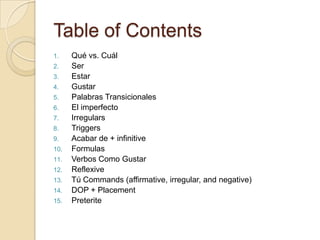
Table of Contents
1.    Qué vs. Cuál
2.    Ser
3.    Estar
4.    Gustar
5.    Palabras Transicionales
6.    El imperfecto
7.    Irregulars
8.    Triggers
9.    Acabar de + infinitive
10.   Formulas
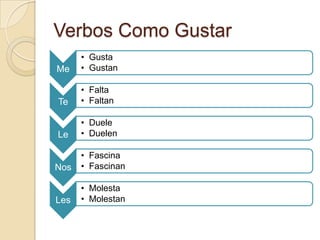
11.   Verbos Como Gustar
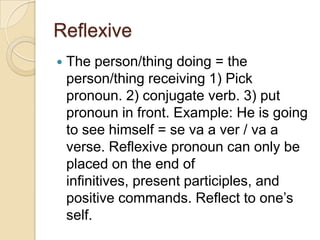
12.   Reflexive
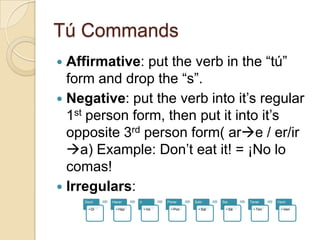
13.   Tú Commands (affirmative, irregular, and negative)
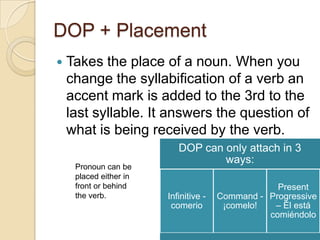
14.   DOP + Placement
15.   Preterite
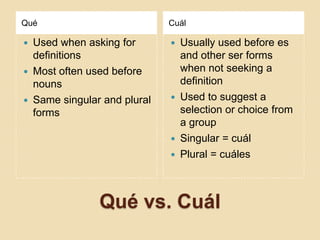
Qué                          Cuál

 Used when asking for          Usually used before es
  definitions                    and other ser forms
 Most often used before         when not seeking a
  nouns                          definition
 Same singular and plural      Used to suggest a
  forms                          selection or choice from
                                 a group
                                Singular = cuál
                                Plural = cuáles


               Qué vs. Cuál
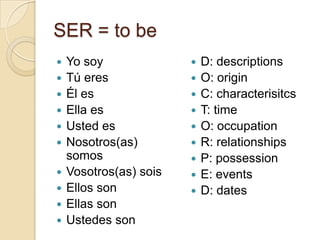
SER = to be
   Yo soy                 D: descriptions
   Tú eres                O: origin
   Él es                  C: characterisitcs
   Ella es                T: time
   Usted es               O: occupation
   Nosotros(as)           R: relationships
    somos                  P: possession
   Vosotros(as) sois      E: events
   Ellos son              D: dates
   Ellas son
   Ustedes son
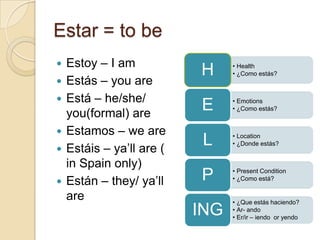
Estar = to be
   Estoy – I am                 • Health
                           H     • ¿Como estás?
   Estás – you are
   Está – he/she/               • Emotions

    you(formal) are
                           E     • ¿Como estás?


   Estamos – we are             • Location

   Estáis – ya’ll are (
                            L    • ¿Donde estás?


    in Spain only)               • Present Condition
   Están – they/ ya’ll    P     • ¿Como está?


    are                          • ¿Que estás haciendo?
                           ING   • Ar- ando
                                 • Er/ir – iendo or yendo
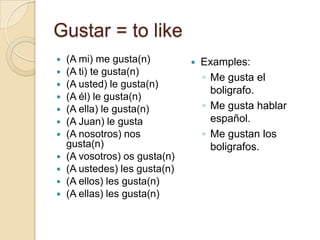
Gustar = to like
   (A mi) me gusta(n)            Examples:
   (A ti) te gusta(n)
                                   ◦ Me gusta el
   (A usted) le gusta(n)
                                     boligrafo.
   (A él) le gusta(n)
   (A ella) le gusta(n)           ◦ Me gusta hablar
   (A Juan) le gusta                español.
   (A nosotros) nos               ◦ Me gustan los
    gusta(n)                         boligrafos.
   (A vosotros) os gusta(n)
   (A ustedes) les gusta(n)
   (A ellos) les gusta(n)
   (A ellas) les gusta(n)
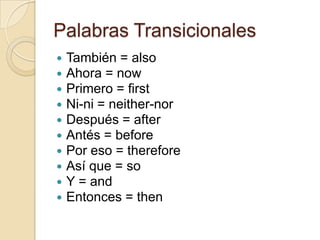
Palabras Transicionales
   También = also
   Ahora = now
   Primero = first
   Ni-ni = neither-nor
   Después = after
   Antés = before
   Por eso = therefore
   Así que = so
   Y = and
   Entonces = then
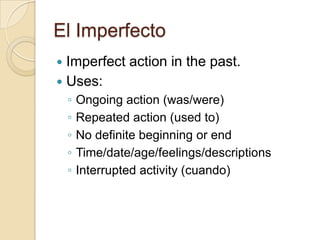
El Imperfecto
 Imperfect action in the past.
 Uses:
    ◦   Ongoing action (was/were)
    ◦   Repeated action (used to)
    ◦   No definite beginning or end
    ◦   Time/date/age/feelings/descriptions
    ◦   Interrupted activity (cuando)
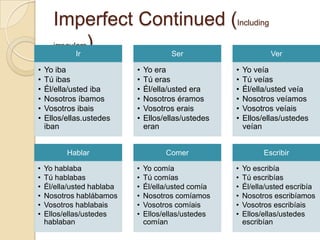
Imperfect Continued (Including
      irregulars)
             Ir                         Ser                       Ver

•   Yo iba                  •   Yo era                •   Yo veía
•   Tú ibas                 •   Tú eras               •   Tú veías
•   Él/ella/usted iba       •   Él/ella/usted era     •   Él/ella/usted veía
•   Nosotros íbamos         •   Nosotros éramos       •   Nosotros veíamos
•   Vosotros ibais          •   Vosotros erais        •   Vosotros veíais
•   Ellos/ellas.ustedes     •   Ellos/ellas/ustedes   •   Ellos/ellas/ustedes
    iban                        eran                      veían


          Hablar                      Comer                     Escribir

•   Yo hablaba              •   Yo comía              •   Yo escribía
•   Tú hablabas             •   Tú comías             •   Tú escribías
•   Él/ella/usted hablaba   •   Él/ella/usted comía   •   Él/ella/usted escribía
•   Nosotros hablábamos     •   Nosotros comíamos     •   Nosotros escribíamos
•   Vosotros hablabais      •   Vosotros comíais      •   Vosotros escribíais
•   Ellos/ellas/ustedes     •   Ellos/ellas/ustedes   •   Ellos/ellas/ustedes
    hablaban                    comían                    escribían
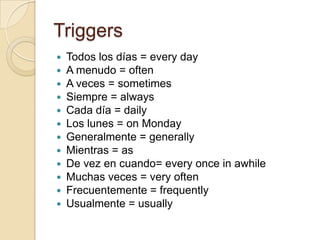
Triggers
   Todos los días = every day
   A menudo = often
   A veces = sometimes
   Siempre = always
   Cada día = daily
   Los lunes = on Monday
   Generalmente = generally
   Mientras = as
   De vez en cuando= every once in awhile
   Muchas veces = very often
   Frecuentemente = frequently
   Usualmente = usually
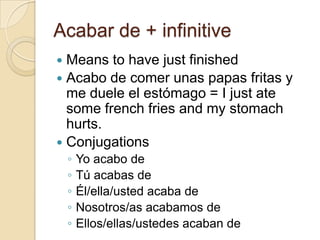
Acabar de + infinitive
 Means to have just finished
 Acabo de comer unas papas fritas y
  me duele el estómago = I just ate
  some french fries and my stomach
  hurts.
 Conjugations
    ◦   Yo acabo de
    ◦   Tú acabas de
    ◦   Él/ella/usted acaba de
    ◦   Nosotros/as acabamos de
    ◦   Ellos/ellas/ustedes acaban de
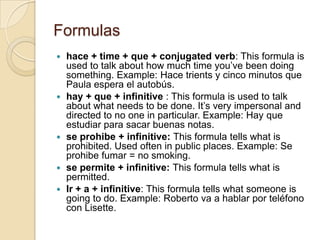
Formulas
   hace + time + que + conjugated verb: This formula is
    used to talk about how much time you’ve been doing
    something. Example: Hace trients y cinco minutos que
    Paula espera el autobús.
   hay + que + infinitive : This formula is used to talk
    about what needs to be done. It’s very impersonal and
    directed to no one in particular. Example: Hay que
    estudiar para sacar buenas notas.
   se prohibe + infinitive: This formula tells what is
    prohibited. Used often in public places. Example: Se
    prohibe fumar = no smoking.
   se permite + infinitive: This formula tells what is
    permitted.
   Ir + a + infinitive: This formula tells what someone is
    going to do. Example: Roberto va a hablar por teléfono
    con Lisette.
Verbos Como Gustar
      • Gusta
Me    • Gustan

      • Falta
Te    • Faltan

      • Duele
Le    • Duelen

      • Fascina
Nos   • Fascinan

      • Molesta
Les   • Molestan
Reflexive
   The person/thing doing = the
    person/thing receiving 1) Pick
    pronoun. 2) conjugate verb. 3) put
    pronoun in front. Example: He is going
    to see himself = se va a ver / va a
    verse. Reflexive pronoun can only be
    placed on the end of
    infinitives, present participles, and
    positive commands. Reflect to one’s
    self.
Tú Commands
 Affirmative: put the verb in the “tú”
  form and drop the “s”.
 Negative: put the verb into it’s regular
  1st person form, then put it into it’s
  opposite 3rd person form( are / er/ir
  a) Example: Don’t eat it! = ¡No lo
  comas!
 Irregulars:
    Decir    Hacer     Ir          Poner     Salir     Ser      Tener     Venir

      • Di     • Haz        • Ve     • Pon     • Sal     • Sé     • Ten     • Ven
DOP + Placement
   Takes the place of a noun. When you
    change the syllabification of a verb an
    accent mark is added to the 3rd to the
    last syllable. It answers the question of
    what is being received by the verb.
                           DOP can only attach in 3
                                   ways:
     Pronoun can be
     placed either in
     front or behind                               Present
     the verb.          Infinitive -   Command - Progressive
                         comerio        ¡comelo!  – Él está
                                                 comiéndolo
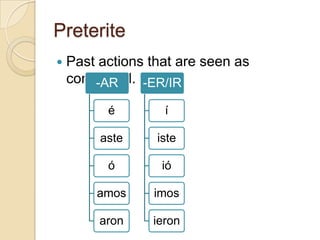
Preterite
   Past actions that are seen as
    completed. -ER/IR
        -AR

          é        í

         aste     iste

          ó        ió

        amos     imos

         aron    ieron

Eva’s grammar book

  • 1.
    Eva’s Grammar Book SeñoraLinares 6th period
  • 2.
    Table of Contents 1. Qué vs. Cuál 2. Ser 3. Estar 4. Gustar 5. Palabras Transicionales 6. El imperfecto 7. Irregulars 8. Triggers 9. Acabar de + infinitive 10. Formulas 11. Verbos Como Gustar 12. Reflexive 13. Tú Commands (affirmative, irregular, and negative) 14. DOP + Placement 15. Preterite
  • 3.
    Qué Cuál  Used when asking for  Usually used before es definitions and other ser forms  Most often used before when not seeking a nouns definition  Same singular and plural  Used to suggest a forms selection or choice from a group  Singular = cuál  Plural = cuáles Qué vs. Cuál
  • 4.
    SER = tobe  Yo soy  D: descriptions  Tú eres  O: origin  Él es  C: characterisitcs  Ella es  T: time  Usted es  O: occupation  Nosotros(as)  R: relationships somos  P: possession  Vosotros(as) sois  E: events  Ellos son  D: dates  Ellas son  Ustedes son
  • 5.
    Estar = tobe  Estoy – I am • Health H • ¿Como estás?  Estás – you are  Está – he/she/ • Emotions you(formal) are E • ¿Como estás?  Estamos – we are • Location  Estáis – ya’ll are ( L • ¿Donde estás? in Spain only) • Present Condition  Están – they/ ya’ll P • ¿Como está? are • ¿Que estás haciendo? ING • Ar- ando • Er/ir – iendo or yendo
  • 6.
    Gustar = tolike  (A mi) me gusta(n)  Examples:  (A ti) te gusta(n) ◦ Me gusta el  (A usted) le gusta(n) boligrafo.  (A él) le gusta(n)  (A ella) le gusta(n) ◦ Me gusta hablar  (A Juan) le gusta español.  (A nosotros) nos ◦ Me gustan los gusta(n) boligrafos.  (A vosotros) os gusta(n)  (A ustedes) les gusta(n)  (A ellos) les gusta(n)  (A ellas) les gusta(n)
  • 7.
    Palabras Transicionales  También = also  Ahora = now  Primero = first  Ni-ni = neither-nor  Después = after  Antés = before  Por eso = therefore  Así que = so  Y = and  Entonces = then
  • 8.
    El Imperfecto  Imperfectaction in the past.  Uses: ◦ Ongoing action (was/were) ◦ Repeated action (used to) ◦ No definite beginning or end ◦ Time/date/age/feelings/descriptions ◦ Interrupted activity (cuando)
  • 9.
    Imperfect Continued (Including irregulars) Ir Ser Ver • Yo iba • Yo era • Yo veía • Tú ibas • Tú eras • Tú veías • Él/ella/usted iba • Él/ella/usted era • Él/ella/usted veía • Nosotros íbamos • Nosotros éramos • Nosotros veíamos • Vosotros ibais • Vosotros erais • Vosotros veíais • Ellos/ellas.ustedes • Ellos/ellas/ustedes • Ellos/ellas/ustedes iban eran veían Hablar Comer Escribir • Yo hablaba • Yo comía • Yo escribía • Tú hablabas • Tú comías • Tú escribías • Él/ella/usted hablaba • Él/ella/usted comía • Él/ella/usted escribía • Nosotros hablábamos • Nosotros comíamos • Nosotros escribíamos • Vosotros hablabais • Vosotros comíais • Vosotros escribíais • Ellos/ellas/ustedes • Ellos/ellas/ustedes • Ellos/ellas/ustedes hablaban comían escribían
  • 10.
    Triggers  Todos los días = every day  A menudo = often  A veces = sometimes  Siempre = always  Cada día = daily  Los lunes = on Monday  Generalmente = generally  Mientras = as  De vez en cuando= every once in awhile  Muchas veces = very often  Frecuentemente = frequently  Usualmente = usually
  • 11.
    Acabar de +infinitive  Means to have just finished  Acabo de comer unas papas fritas y me duele el estómago = I just ate some french fries and my stomach hurts.  Conjugations ◦ Yo acabo de ◦ Tú acabas de ◦ Él/ella/usted acaba de ◦ Nosotros/as acabamos de ◦ Ellos/ellas/ustedes acaban de
  • 12.
    Formulas  hace + time + que + conjugated verb: This formula is used to talk about how much time you’ve been doing something. Example: Hace trients y cinco minutos que Paula espera el autobús.  hay + que + infinitive : This formula is used to talk about what needs to be done. It’s very impersonal and directed to no one in particular. Example: Hay que estudiar para sacar buenas notas.  se prohibe + infinitive: This formula tells what is prohibited. Used often in public places. Example: Se prohibe fumar = no smoking.  se permite + infinitive: This formula tells what is permitted.  Ir + a + infinitive: This formula tells what someone is going to do. Example: Roberto va a hablar por teléfono con Lisette.
  • 13.
    Verbos Como Gustar • Gusta Me • Gustan • Falta Te • Faltan • Duele Le • Duelen • Fascina Nos • Fascinan • Molesta Les • Molestan
  • 14.
    Reflexive  The person/thing doing = the person/thing receiving 1) Pick pronoun. 2) conjugate verb. 3) put pronoun in front. Example: He is going to see himself = se va a ver / va a verse. Reflexive pronoun can only be placed on the end of infinitives, present participles, and positive commands. Reflect to one’s self.
  • 15.
    Tú Commands  Affirmative:put the verb in the “tú” form and drop the “s”.  Negative: put the verb into it’s regular 1st person form, then put it into it’s opposite 3rd person form( are / er/ir a) Example: Don’t eat it! = ¡No lo comas!  Irregulars: Decir Hacer Ir Poner Salir Ser Tener Venir • Di • Haz • Ve • Pon • Sal • Sé • Ten • Ven
  • 16.
    DOP + Placement  Takes the place of a noun. When you change the syllabification of a verb an accent mark is added to the 3rd to the last syllable. It answers the question of what is being received by the verb. DOP can only attach in 3 ways: Pronoun can be placed either in front or behind Present the verb. Infinitive - Command - Progressive comerio ¡comelo! – Él está comiéndolo
  • 17.
    Preterite  Past actions that are seen as completed. -ER/IR -AR é í aste iste ó ió amos imos aron ieron