Grammar Book

  MARA O’BRIEN
Table of contents:

1.    Que vs. Cual               11. Formulas
2.    Ser-docorPed               12. Verbos con gustar
3.    Estar-helping              13.Reflexie
4.    Gustar                     14. Tu commands
5.    Transittiona               15. DOP+ placement
6.    Imperfect                  16. Preterite
7.    Triggers
8.    Acabar de + infinitives.
9.    Hace +time
10.   +que +pres.
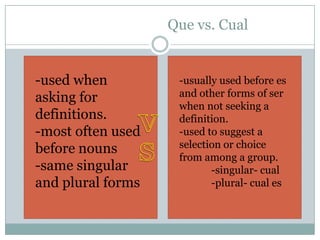
Que vs. Cual


-used when          -usually used before es
asking for          and other forms of ser
                    when not seeking a
definitions.        definition.
-most often used    -used to suggest a
before nouns        selection or choice
                    from among a group.
-same singular             -singular- cual
and plural forms           -plural- cual es
Descriptions- ¿Que es?
Origin de- ¿De donde es?
Characteristics- ¿como es?
Time- ¿Que hora es?
Occupation- ¿Que Hace?
Relationships- ¿quien es?
Possessions de- ¿ dEQuien es?
Events- ¿cuando/donde es?
Dates- ¿Que dia es hoy?/ ¿Cual es la fecha de hoy?/ ¿Cuando
es tu cumpleanos?
Estar:
           ealth: ¿Como estas?(Bien, mal, regular,

H
        enferno,etc.)
          motions: ¿Como estas?
        (triste,Cansado,nervioso, etc.)
          ocation en:¿Donde estas? (EN: la casa, la

E       oficina. etc.)
          resent condition: ¿Como esta? (verde,sucio,frio,
        etc.)

    L                                  ¿Que estas
                                       Haciendo? (juando,
                                       estudiando,

    P   I       N                      cantando,
                                       leyendo,escribiendo,
                           G           comiendo,hablando,
                                       etc.)
Gustar:


                                  A mi me Gusta(n)
                                  A ti Te Gusta(n)
Me Gusta(n)= it pleases me        A usted Le Gusta(n)
Te Gusta(n)= it pleases you       A Le Gusta(n)
Le Gusta(n)= it pleases him/her   A ella Le Gusta(n)
Nos Gusta(n)= it pleases us       A nosotros Nos Gusta(n)
Os Gusta(n)= it pleases y’all     A vosotros Os Gusta(n)
Les Gusta(n)= it pleases          A ustedes Les Gusta(n)
them/you                          A ellos Les Gusta(n)
                                  A ellas Les Gusta(n)


                                  Adds more emphasis.
Transitional words.


 También               por-eso
 Ahora                 Pero
 Primero               asi-que
 Despué               Y
 Ni-ni                 entonces
Imperfect words.

Verb               Hablar       Comer      Escribir

Yo                 Hablaba      Comía      Escribía

tu                 Hablabas     Comías     Escribías

 l/ella/Ud.        Hablaba      Comía      Escribía

Nosotros                bamos   Comíamos   Escribíamos

vosortos           Hablabais    Comíais    Escribía is

Ellos/ellas/Uds.   hablaban     Comían     Escribían
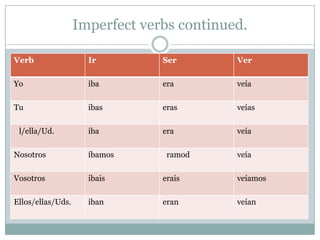
Imperfect verbs continued.

Verb                 Ir         Ser        Ver

Yo                   iba        era        veía

Tu                   ibas       eras       veías

 l/ella/Ud.          iba        era        veía

Nosotros             íbamos      ramod     veía

Vosotros             ibais      erais      veíamos

Ellos/ellas/Uds.     iban       eran       veían
Triggers.

 Todos los días      Generalmente
 A menudo            Mientras
 A veces             De vez en cuando
 Siempre             Muchas veces
 Cada día            Frecuentemente
 Los lunes
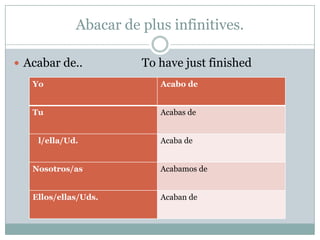
Abacar de plus infinitives.

 Acabar de..          To have just finished
   Yo                     Acabo de


   Tu                     Acabas de


    l/ella/Ud.            Acaba de


   Nosotros/as            Acabamos de


   Ellos/ellas/Uds.       Acaban de
Hacer Expressions.
Reflexive Verbs.

VERBOS       MEANING                    PRESENT/PRETERIT
                                        E
Acostarse    To lie down or go to bed   Me acuesto/ me acoste
Caerse       To fall down               Me caigo/ me caí
Cortarse     To cut oneself             Me corot/ me corte
Lastimarse   To hurt oneself            Me lastimo/ me lastime
Quejarse     To complain                Me quejo/ me queje
Relajarse    To relax                   Me relajo/ me relaje
Sentirse     To feel                    Me sienti/ me sentí
Formulas

 Hace + time+ que+ conjugated verb
   used to talk about how much time you’ve been doing
    something
 Hay+ Que +infinitive
   Used to talk about what needs to be done or what must be
    done. very impersonal and is directed to no one in particular.
 Se Prohibe +infinitive
   Tells what is prohibited, can also use se permite +infinitive to
    tell what is permitted.
 Ir +a +infinitive
   Used to tell what someone is going to do. Conjugate Ir and
    leave what they are going to do in the infinitive form.
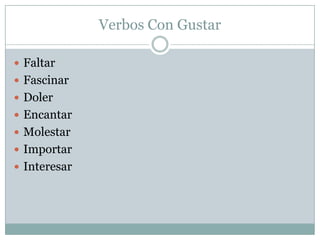
Verbos Con Gustar

 Faltar
 Fascinar
 Doler
 Encantar
 Molestar
 Importar
 Interesar
Reflexive

 A verb whose subject and object are one in the same.
   So the subject is both the “do-er” and the reciever of the action.


     Reflexive pronouns: pronouns that describe the speaker.
         Me, te se, os and nos.
Tú Commands
DOP+ placement
Dop + reflexive

 I am bathing. (banarse)
   Two ways to say this:
    1. Me estoy bañando.
    2. Estory     ndome.

Grammar book

  • 1.
    Grammar Book MARA O’BRIEN
  • 2.
    Table of contents: 1. Que vs. Cual 11. Formulas 2. Ser-docorPed 12. Verbos con gustar 3. Estar-helping 13.Reflexie 4. Gustar 14. Tu commands 5. Transittiona 15. DOP+ placement 6. Imperfect 16. Preterite 7. Triggers 8. Acabar de + infinitives. 9. Hace +time 10. +que +pres.
  • 3.
    Que vs. Cual -usedwhen -usually used before es asking for and other forms of ser when not seeking a definitions. definition. -most often used -used to suggest a before nouns selection or choice from among a group. -same singular -singular- cual and plural forms -plural- cual es
  • 4.
    Descriptions- ¿Que es? Originde- ¿De donde es? Characteristics- ¿como es? Time- ¿Que hora es? Occupation- ¿Que Hace? Relationships- ¿quien es? Possessions de- ¿ dEQuien es? Events- ¿cuando/donde es? Dates- ¿Que dia es hoy?/ ¿Cual es la fecha de hoy?/ ¿Cuando es tu cumpleanos?
  • 5.
    Estar: ealth: ¿Como estas?(Bien, mal, regular, H enferno,etc.) motions: ¿Como estas? (triste,Cansado,nervioso, etc.) ocation en:¿Donde estas? (EN: la casa, la E oficina. etc.) resent condition: ¿Como esta? (verde,sucio,frio, etc.) L ¿Que estas Haciendo? (juando, estudiando, P I N cantando, leyendo,escribiendo, G comiendo,hablando, etc.)
  • 6.
    Gustar: A mi me Gusta(n) A ti Te Gusta(n) Me Gusta(n)= it pleases me A usted Le Gusta(n) Te Gusta(n)= it pleases you A Le Gusta(n) Le Gusta(n)= it pleases him/her A ella Le Gusta(n) Nos Gusta(n)= it pleases us A nosotros Nos Gusta(n) Os Gusta(n)= it pleases y’all A vosotros Os Gusta(n) Les Gusta(n)= it pleases A ustedes Les Gusta(n) them/you A ellos Les Gusta(n) A ellas Les Gusta(n) Adds more emphasis.
  • 7.
    Transitional words.  También  por-eso  Ahora  Pero  Primero  asi-que  Despué Y  Ni-ni  entonces
  • 8.
    Imperfect words. Verb Hablar Comer Escribir Yo Hablaba Comía Escribía tu Hablabas Comías Escribías l/ella/Ud. Hablaba Comía Escribía Nosotros bamos Comíamos Escribíamos vosortos Hablabais Comíais Escribía is Ellos/ellas/Uds. hablaban Comían Escribían
  • 9.
    Imperfect verbs continued. Verb Ir Ser Ver Yo iba era veía Tu ibas eras veías l/ella/Ud. iba era veía Nosotros íbamos ramod veía Vosotros ibais erais veíamos Ellos/ellas/Uds. iban eran veían
  • 10.
    Triggers.  Todos losdías  Generalmente  A menudo  Mientras  A veces  De vez en cuando  Siempre  Muchas veces  Cada día  Frecuentemente  Los lunes
  • 11.
    Abacar de plusinfinitives.  Acabar de.. To have just finished Yo Acabo de Tu Acabas de l/ella/Ud. Acaba de Nosotros/as Acabamos de Ellos/ellas/Uds. Acaban de
  • 12.
  • 13.
    Reflexive Verbs. VERBOS MEANING PRESENT/PRETERIT E Acostarse To lie down or go to bed Me acuesto/ me acoste Caerse To fall down Me caigo/ me caí Cortarse To cut oneself Me corot/ me corte Lastimarse To hurt oneself Me lastimo/ me lastime Quejarse To complain Me quejo/ me queje Relajarse To relax Me relajo/ me relaje Sentirse To feel Me sienti/ me sentí
  • 14.
    Formulas  Hace +time+ que+ conjugated verb  used to talk about how much time you’ve been doing something  Hay+ Que +infinitive  Used to talk about what needs to be done or what must be done. very impersonal and is directed to no one in particular.  Se Prohibe +infinitive  Tells what is prohibited, can also use se permite +infinitive to tell what is permitted.  Ir +a +infinitive  Used to tell what someone is going to do. Conjugate Ir and leave what they are going to do in the infinitive form.
  • 15.
    Verbos Con Gustar Faltar  Fascinar  Doler  Encantar  Molestar  Importar  Interesar
  • 16.
    Reflexive  A verbwhose subject and object are one in the same.  So the subject is both the “do-er” and the reciever of the action.  Reflexive pronouns: pronouns that describe the speaker.  Me, te se, os and nos.
  • 17.
  • 18.
  • 19.
    Dop + reflexive I am bathing. (banarse)  Two ways to say this:  1. Me estoy bañando.  2. Estory ndome.