Table of Context
                                          Verbos Como
Qué vs. Cuàl       Acabar de inf.
                                             Gustar


    Ser               Triggers         Hacer Expressions


   Estar             Imperfect               Reflexive        Preterite


                                      Tu Command
                                      • Affirmative
  Gustar         Transitional Words   • Negative
                                                           DOP y Placement
                                      • Irregulars
Qué vs. Cuàl
        Qué                     Cuàl

0 Used when asking      0 Usually use before
  for definitions         es and other forms
0 Most often used         of ser when not
  before nouns            seeking for a
0 Same singular and
                          definition
  plural forms          0 Use to suggest a
                          selection or choice
                          from among a
                          group
                        0 Plural form: Cuàles
• ¿Que es?
      Description
S
o                        • ¿De dónde es?
          Origin
y
                         • ¿Como es?
      Characteristics


SER        Time         • ¿ Qué hora es?

                         • ¿Qué hace?
       Occupation

                         • ¿Quéin es?
       Relationship

                         • ¿De quiénes?
       Possession

                        • ¿Cuándo/Dónde es?
          Events

            • ¿ Qué día es hoy?/Cuál es la
      Dates   fecha?/Cuándo es tú cumpleaños?
H     • ealth
               • Como estas?


               E       • motions
                       • Como estas?


Estar              L      • ocation
                          • Donde estas?


                       • resent
               P         Condition
                       • Como Esta?

              • When you want
                to add -ing
        ING   • Ar: ando
              • Er/Ir: endo
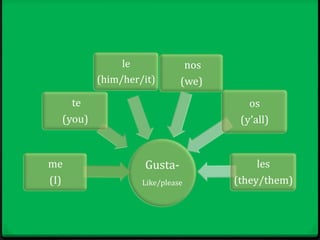
le             nos
          (him/her/it)       (we)
    te                                 os
  (you)                              (y’all)


me                 Gusta-                les
(I)                Like/please      (they/them)
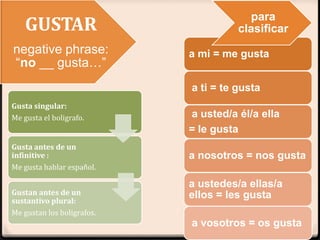
GUSTAR
                                        para
                                      clasificar
negative phrase:            a mi = me gusta
“no __ gusta…”
                            a ti = te gusta
Gusta singular:
Me gusta el boligrafo.      a usted/a él/a ella
                            = le gusta
Gusta antes de un
infinitive :                a nosotros = nos gusta
Me gusta hablar español.

                            a ustedes/a ellas/a
Gustan antes de un          ellos = les gusta
sustantivo plural:
Me gustan los boligrafos.
                            a vosotros = os gusta
Transitional Words
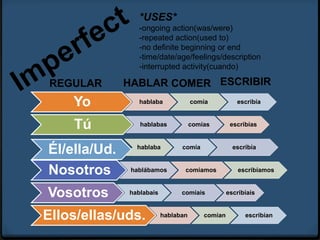
*USES*
                 -ongoing action(was/were)
                 -repeated action(used to)
                 -no definite beginning or end
                 -time/date/age/feelings/description
                 -interrupted activity(cuando)

 REGULAR      HABLAR COMER ESCRIBIR
    Yo           hablaba             comía           escribía


    Tú           hablabas            comías        escribías


Él/ella/Ud.     hablaba         comía               escribía


Nosotros       hablábamos        comíamos             escribíamos


Vosotros      hablabais         comíais           escribíais


Ellos/ellas/uds.          hablaban       comían         escribían
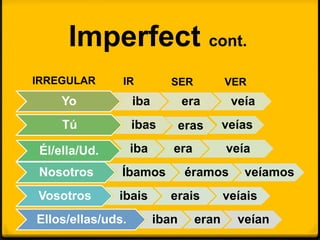
Imperfect cont.
IRREGULAR      IR          SER           VER
     Yo            iba          era       veía
     Tú            ibas         eras     veías

 Él/ella/Ud.       iba      era          veía
Nosotros       Íbamos            éramos     veíamos
Vosotros       ibais       erais         veíais
Ellos/ellas/uds.         iban     eran     veían
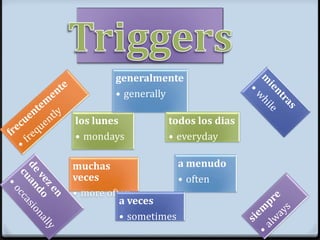
generalmente
        • generally

los lunes         todos los dias
• mondays         • everyday

muchas                a menudo
veces                 • often
• more often
          a veces
          • sometimes
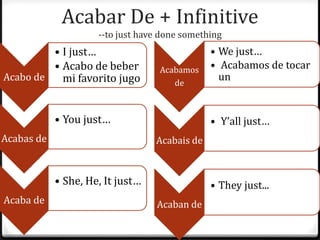
Acabar De + Infinitive
                     --to just have done something
         • I just…                             • We just…
         • Acabo de beber          Acabamos    • Acabamos de tocar
Acabo de   mi favorito jugo           de
                                                 un


            • You just…                        • Y’all just…
Acabas de                         Acabais de


            • She, He, It just…                • They just...
Acaba de                          Acaban de
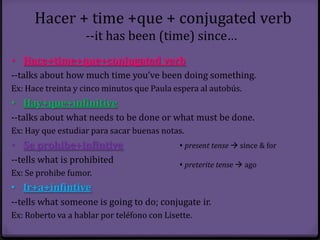
Hacer + time +que + conjugated verb
                    --it has been (time) since…
• Hace+time+que+conjugated verb
--talks about how much time you’ve been doing something.
Ex: Hace treinta y cinco minutos que Paula espera al autobús.
• Hay+que+infinitive
--talks about what needs to be done or what must be done.
Ex: Hay que estudiar para sacar buenas notas.
• Se prohibe+infintive                        present tense  since & for
--tells what is prohibited                    preterite tense  ago
Ex: Se prohibe fumor.
• Ir+a+infintive
--tells what someone is going to do; conjugate ir.
Ex: Roberto va a hablar por teléfono con Lisette.
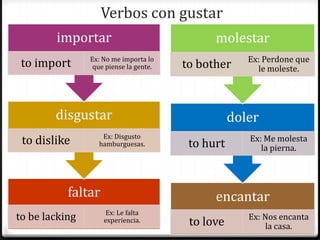
Verbos con gustar
        importar                              molestar
                Ex: No me importa lo                  Ex: Perdone que
 to import       que piense la gente.   to bother       le moleste.


        disgustar                                  doler
                   Ex: Disgusto
 to dislike       hamburguesas.          to hurt      Ex: Me molesta
                                                         la pierna.


           faltar                             encantar
                     Ex: Le falta
to be lacking       experiencia.         to love      Ex: Nos encanta
                                                          la casa.
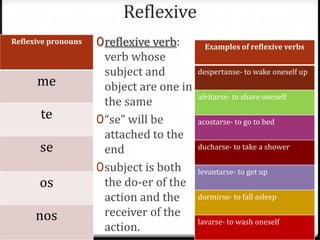
Reflexive
Reflexive pronouns   0 reflexive verb:       Examples of reflexive verbs
                       verb whose
                       subject and         despertanse- to wake oneself up
      me               object are one in
                                           afeitarse- to shave oneself
                       the same
       te            0 “se” will be        acostarse- to go to bed
                       attached to the
       se              end                 ducharse- to take a shower

                     0 subject is both     levantarse- to get up
       os              the do-er of the
                       action and the      dormirse- to fall asleep

      nos              receiver of the
                                           lavarse- to wash oneself
                       action.
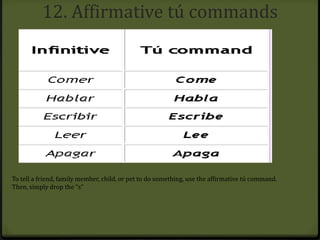
12. Affirmative tú commands


To tell a friend, family member, child, or pet to do something, use the affirmative tú command.
Then, simply drop the “s”
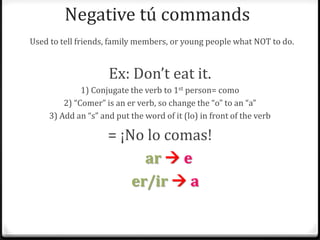
Negative tú commands
Used to tell friends, family members, or young people what NOT to do.


                     Ex: Don’t eat it.
              1) Conjugate the verb to 1st person= como
         2) “Comer” is an er verb, so change the “o” to an “a”
     3) Add an “s” and put the word of it (lo) in front of the verb

                     = ¡No lo comas!
                           ar  e
                         er/ir  a
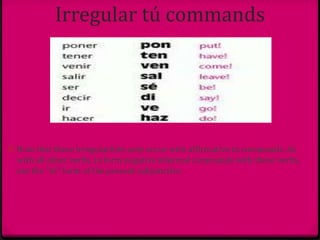
Irregular tú commands


0 Note that these irregularities only occur with affirmative tú commands. As
  with all other verbs, to form negative informal commands with these verbs,
  use the "tú" form of the present subjunctive.
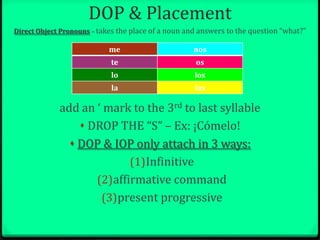
DOP & Placement
Direct Object Pronouns – takes the place of a noun and answers to the question “what?”

                           me                       nos
                            te                       os
                            lo                       los
                            la                       las

             add an ‘ mark to the 3rd to last syllable
                  DROP THE “S” – Ex: ¡Cómelo!
                DOP & IOP only attach in 3 ways:
                            (1) Infinitive
                    (2) affirmative command
                     (3) present progressive
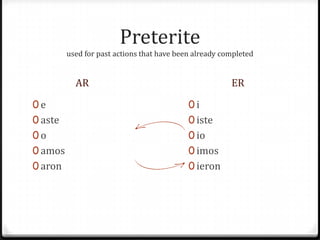
Preterite
         used for past actions that have been already completed


           AR                                           ER

0e                                          0i
0 aste                                      0 iste
0o                                          0 io
0 amos                                      0 imos
0 aron                                      0 ieron

Spanish grammar book

  • 2.
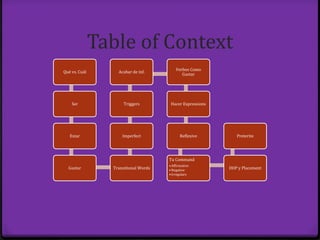
    Table of Context Verbos Como Qué vs. Cuàl Acabar de inf. Gustar Ser Triggers Hacer Expressions Estar Imperfect Reflexive Preterite Tu Command • Affirmative Gustar Transitional Words • Negative DOP y Placement • Irregulars
  • 3.
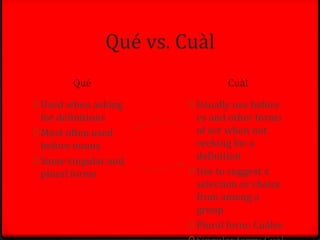
    Qué vs. Cuàl Qué Cuàl 0 Used when asking 0 Usually use before for definitions es and other forms 0 Most often used of ser when not before nouns seeking for a 0 Same singular and definition plural forms 0 Use to suggest a selection or choice from among a group 0 Plural form: Cuàles
  • 4.
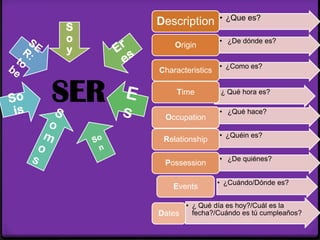
    • ¿Que es? Description S o • ¿De dónde es? Origin y • ¿Como es? Characteristics SER Time • ¿ Qué hora es? • ¿Qué hace? Occupation • ¿Quéin es? Relationship • ¿De quiénes? Possession • ¿Cuándo/Dónde es? Events • ¿ Qué día es hoy?/Cuál es la Dates fecha?/Cuándo es tú cumpleaños?
  • 5.
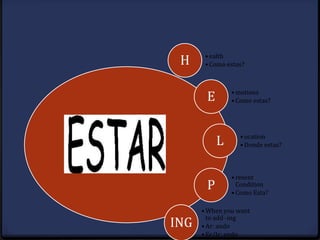
    H • ealth • Como estas? E • motions • Como estas? Estar L • ocation • Donde estas? • resent P Condition • Como Esta? • When you want to add -ing ING • Ar: ando • Er/Ir: endo
  • 6.
    le nos (him/her/it) (we) te os (you) (y’all) me Gusta- les (I) Like/please (they/them)
  • 7.
    GUSTAR para clasificar negative phrase: a mi = me gusta “no __ gusta…” a ti = te gusta Gusta singular: Me gusta el boligrafo. a usted/a él/a ella = le gusta Gusta antes de un infinitive : a nosotros = nos gusta Me gusta hablar español. a ustedes/a ellas/a Gustan antes de un ellos = les gusta sustantivo plural: Me gustan los boligrafos. a vosotros = os gusta
  • 8.
  • 9.
    *USES* -ongoing action(was/were) -repeated action(used to) -no definite beginning or end -time/date/age/feelings/description -interrupted activity(cuando) REGULAR HABLAR COMER ESCRIBIR Yo hablaba comía escribía Tú hablabas comías escribías Él/ella/Ud. hablaba comía escribía Nosotros hablábamos comíamos escribíamos Vosotros hablabais comíais escribíais Ellos/ellas/uds. hablaban comían escribían
  • 10.
    Imperfect cont. IRREGULAR IR SER VER Yo iba era veía Tú ibas eras veías Él/ella/Ud. iba era veía Nosotros Íbamos éramos veíamos Vosotros ibais erais veíais Ellos/ellas/uds. iban eran veían
  • 11.
    generalmente • generally los lunes todos los dias • mondays • everyday muchas a menudo veces • often • more often a veces • sometimes
  • 12.
    Acabar De +Infinitive --to just have done something • I just… • We just… • Acabo de beber Acabamos • Acabamos de tocar Acabo de mi favorito jugo de un • You just… • Y’all just… Acabas de Acabais de • She, He, It just… • They just... Acaba de Acaban de
  • 13.
    Hacer + time+que + conjugated verb --it has been (time) since… • Hace+time+que+conjugated verb --talks about how much time you’ve been doing something. Ex: Hace treinta y cinco minutos que Paula espera al autobús. • Hay+que+infinitive --talks about what needs to be done or what must be done. Ex: Hay que estudiar para sacar buenas notas. • Se prohibe+infintive  present tense  since & for --tells what is prohibited  preterite tense  ago Ex: Se prohibe fumor. • Ir+a+infintive --tells what someone is going to do; conjugate ir. Ex: Roberto va a hablar por teléfono con Lisette.
  • 14.
    Verbos con gustar importar molestar Ex: No me importa lo Ex: Perdone que to import que piense la gente. to bother le moleste. disgustar doler Ex: Disgusto to dislike hamburguesas. to hurt Ex: Me molesta la pierna. faltar encantar Ex: Le falta to be lacking experiencia. to love Ex: Nos encanta la casa.
  • 15.
    Reflexive Reflexive pronouns 0 reflexive verb: Examples of reflexive verbs verb whose subject and despertanse- to wake oneself up me object are one in afeitarse- to shave oneself the same te 0 “se” will be acostarse- to go to bed attached to the se end ducharse- to take a shower 0 subject is both levantarse- to get up os the do-er of the action and the dormirse- to fall asleep nos receiver of the lavarse- to wash oneself action.
  • 16.
    12. Affirmative túcommands To tell a friend, family member, child, or pet to do something, use the affirmative tú command. Then, simply drop the “s”
  • 17.
    Negative tú commands Usedto tell friends, family members, or young people what NOT to do. Ex: Don’t eat it. 1) Conjugate the verb to 1st person= como 2) “Comer” is an er verb, so change the “o” to an “a” 3) Add an “s” and put the word of it (lo) in front of the verb = ¡No lo comas! ar  e er/ir  a
  • 18.
    Irregular tú commands 0Note that these irregularities only occur with affirmative tú commands. As with all other verbs, to form negative informal commands with these verbs, use the "tú" form of the present subjunctive.
  • 19.
    DOP & Placement DirectObject Pronouns – takes the place of a noun and answers to the question “what?” me nos te os lo los la las add an ‘ mark to the 3rd to last syllable  DROP THE “S” – Ex: ¡Cómelo!  DOP & IOP only attach in 3 ways: (1) Infinitive (2) affirmative command (3) present progressive
  • 20.
    Preterite used for past actions that have been already completed AR ER 0e 0i 0 aste 0 iste 0o 0 io 0 amos 0 imos 0 aron 0 ieron