2013ko urria
Octubre 2013
October 2013
H E T E L - H E Z I K E T A T E K N I K O K O E L K A R T E A
Asociación de centros de formación profesional de iniciativa social de Euskadi
Association of Vocational Training Centres of the Basque Country
32 zk
Nº 32
Berrikuntza, Lanbide Heziketaren balio erantsia
Innovación, el valor añadido de la
Formación profesional
Innovation, the added value of Vocational Training
HEZIBI,Txandakako Prestakuntzaren
eredu berezia Euskadirentzat
Hezibi un modelo propio de Formación
en alternancia para Euskadi
HEZIBI, a work-linked Training model for the
Basque Coutry
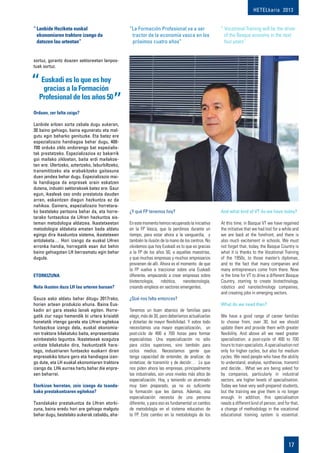
“Lanbide Heziketa euskal ekonomiaren traktore
izang da datozen lau urteetan” Jorge Arevalo
LHko Sailuruordearekin elkarrizketa
“La Formación Profesional va a ser tractor
de la economía vasca en los próximos años”
entrevista a Jorge Arévalo Viceconsejero de FP
“Vocational Training will be the driver of the Basque
economy in the next four years” Interview with
Jorge Arévalo, Deputy Minister for Vocational Training
Lanerako prestakuntza sustatu eta zabaltzeko
kanpainaren balantze ona
Balance positivo de la campaña de promoción
y difusión de la formación para el empleo
Positive outcome of training for employment
promotion and dissemination campaign
Berrikuntza teknologikoa kudeatzeko
beTEKu metodologia
Metodología beTEKu de gestión de la
innovación tecnológica
The beTEKu methodology for managing
technological innovation
Ikastetxeei buruzko berriak
NOVEDADES EN LOS CENTROS
NEWS FROM THE SCHOOLS
HETELkaria 2013
2
Ondorengo hauen kidea:
Asociado a: / Member of:
2013ko urria Octubre 2013 October 2013
Aurkibidea Índice
Ekoizpena
Produce
Produced by
HETEL
www.hetel.org
Koordinazioa
Coordinación
Coordinated by
Leire Belar
Diseinua eta
maketazioa
Diseño y maquetación
Designed by
Inprimaketa
Impresión
Printed by
Gráficas Lizarra
Index
Editoriala / Editorial / Editorial....................03
Berrikuntza, Lanbide Heziketaren
balio erantsia
Innovación, el valor añadido de la
Formación profesional
Innovation, the added value of
Vocational Training
Aitor Ruiz........................................................05
HETEL, beste urrats bat aurrera…
HETEL, un paso más adelante…
HETEL, a step further…
Iñaki Zabalo....................................................08
HEZIBI,Txandakako Prestakuntzaren
eredu berezia Euskadirentzat
Hezibi un modelo propio de Formación
en alternancia para Euskadi
HEZIBI, a work-linked Training model for
the Basque Coutry
Asier Aloria....................................................10
“Lanbide Heziketa euskal ekonomiaren
traktore izang da datozen lau urteetan”
Jorge Arevalo LHko Sailuruordearekin
elkarrizketa
“La Formación Profesional va a ser tractor
de la economía vasca en los próximos años”
entrevista a Jorge Arévalo Viceconsejero de FP
“Vocational Training will be the driver of
the Basque economy in the next four years”
Interview with Jorge Arévalo, Deputy
Minister for Vocational Training
Maite Gutierrez..............................................14
Lanerako prestakuntza sustatu eta
zabaltzeko kanpainaren balantze
positiboa
Balance positivo de la campaña de promoción
y difusión de la formación para el empleo
Positive outcome of training for emploiment
promotion and dissemination campaign
Mar Romo......................................................19
Soldatze lanen fabrikazioa eta
kontrola: Goierri Eskolaren Berrikuntza
teknologikoko proiektua
Fabricación y control de obra soldada: el
proyecto de innovación tecnológica de
Goierri Eskola
Welded construction manufacturing and
control: The technological innovation project
of Goierri Eskola
Javier Zunzunegi.........................................22
Metodología beTEKu (berrikuntza
TEKnologikoaren kudeaketa) de gestión
de la innovación tecnológica en los
centros HETEL
Berrikuntza teknologikoa kudeatzeko beTEKu
metodología (berrikuntza TEKnologikoaren
kudeaketa) HETELeko ikastetxeetan
The beTEKu (berrikuntza TEKnologikoaren
kudeaketa) methodology for managing
technological innovation in HETEL schools
Jon Iartza....................................................25
Prestakuntza bikaina eta
profesional bikainak
Formación excelente,
profesionales excelentes
Excellent training and excellent
professionals
Daniel Irazola..............................................28
Erradiazio elektromagetikoaren
arriskuak, arriskutsuak al dira wifi
konekzioak eta eskuko telefonoak?
Los peligros de la radiación
electromagnética ¿Son peligrosas las wifis y
los teléfonos móviles?
Los peligros de la radiación
electromagnética ¿Son peligrosas las wifis y
los teléfonos móviles?
Felix Elejoste...............................................31
Ez galdu aukera lan praktikak
atzerrian egiteko!
No te lo pierdas: ¡realiza tus prácticas
en empresas en el extranjero!
Don’t miss it: do your in-company
traineeship abroad!
Alazne Iribar................................................34
IKASTETXEEI BURUZKO BERRIAK
NOVEDADES EN LOS CENTROS
NEWS FROM THE SCHOOLS
....................................................................39
HETELkaria 2013
3
Editoriala
En HETEL este curso también apostamos por el futuro,
por asumir nuevos riesgos, por intentar innovar y por
ser solidarios con nuestro País.
Comenzamos el curso con la inauguración de una sede
reformada y en sintonía con una nueva forma de ges-
tión y con una ilusión renovada por conseguir los obje-
tivos que HETEL tiene marcados en su Estrategia Hetel
Berria 2020. De la misma manera, se abre una rama o
delegación en Gipuzkoa (ubicada en el Centro La Salle
Berrozpe de Andoain) con el objetivo de atender más
eficazmente las necesidades específicas territoriales
de nuestros Centros de Gipuzkoa.
Continuamos, pues, con esa Estrategia, donde se han
incluido nuevas acciones provenientes de las líneas
maestras de la Agenda Estratégica de la Viceconse-
jería de FP.
Durante estos años el ámbito de las redes sociales va
adquiriendo una mayor relevancia y presencia tanto en
el funcionamiento diario de la Asociación. Este sentido
se está fortaleciendo la estrategia comunicativa de
HETEL en su intento por colaborar en la generación de
una buena imagen social de la FP en nuestro País.
Para llevar adelante todo este Proyecto, es imprescin-
dible la cooperación externa en forma de ayudas de
financiación. Por ello, se está manteniendo una políti-
ca de búsqueda de colaboradores, ya iniciada el curso
anterior, que haga posible el desarrollo de los nuevos
servicios que HETEL tiene planificados en su Estrate-
gia. Cabe resaltar el servicio HETELenpresa, en mar-
cha desde Septiembre con el objetivo de responder
territorialmente (utilizando el plus que aporta nuestra
red de Centros de FP) a las necesidades de las em-
presas (formación, gestión, tecnología, proyectos,…).
En esta línea de nuevos servicios, también HETEL se
ocupa de la innovación en la FP. Para ello, se ha puesto
en marcha el I+D+i Txokoa, un espacio dedicado a la
reflexión y desarrollo de aspectos innovadores de la FP
y que pueden aportar un valor adicional a la calidad
de la FP de nuestro País. Uno de los ámbitos de in-
novación que se están tratando en este I+D+i Txokoa
es el relacionado con el curso de especialización o
postciclo. Para ello, se cuenta con la participación y
colaboración de diferentes actores de la Formación
Profesional así como otros agentes relacionados con
la innovación industrial como el AIC (Automotive Inte-
lligence Center) y, por supuesto, en total comunicación
con la Viceconsejería de FPormación Profesional.
Durante este curso se está intensificando la apuesta
por proporcionar a los centros una metodología de
gestión de la innovación tecnológica que resulte efi-
caz: BeTEKu. Unas tecnologías enmarcadas en lo que
en HETEL se ha identificado como red de entornos
estratégicos.
Cabe destacar por su importancia y por su aplica-
bilidad la apuesta de HETEL por la Formación Pro-
Editorial
HETELen, ikasturte honetan ere, etorkizunaren
alde egingo dugu, eta arrisku berriak hartu, be-
rritzen saiatu eta Euskadirekin solidarioak izango
gara.
Ikasturteari hasiera emateko, egoitza zaharbe-
rritua inauguratuko dugu. Zaharberritu ondoren,
gure egoitza bat dator beste kudeaketa modu
batekin eta HETEL Berria 2020 estrategian zehaz-
tutako helburuak lortzeko ilusio berrituarekin.
Halaber, adar edo ordezkaritza bat zabaldu da
Gipuzkoan (hain zuzen, Andoaingo La Salle Be-
rrozpe ikastetxean), bertako premia espezifikoei
eraginkortasun handiagoz erantzuteko.
Hortaz, Estrategia horri eutsi diogu, eta Lanbide
Heziketaren Sailburuordetzaren Agenda Estra-
tegikoaren ildo nagusiekin bat datozen ekintzak
gehitu ditugu.
Azken urte hauetan, sare sozialak gero eta ga-
rrantzitsuagoak dira, eta gero eta presentzia
handiagoa dute, bai Elkartearen eguneroko jar-
dueran. Ildo horretan, HETELen komunikazio
estrategia sendotzen ari da, Lanbide Heziketak
Euskadin duen irudi ona sortzeko ahaleginari ja-
rraituz.
Proiektu hau guztia aurrera eramateko, ezinbes-
tekoa da kanpoko kooperazioa izatea, finantzia-
zio laguntzen bidez. Horretarako, laguntzaileak
bilatzen hasi ginen iaz, eta aurten ere, politika
horrekin jarraituko dugu, HETELek bere Estrate-
gian planifikatu dituen zerbitzu berriak garatzeko.
Besteak beste, HETELenpresa zerbitzua da aipa-
tzekoa. Irailean jarriko dugu martxan, enpresen
premiei (prestakuntza, kudeaketa, teknologia,
proiektuak...) lurralde mailako erantzuna emate-
ko, gure LHko zentroen sareak ematen duen plusa
aprobetxatuz.
HETELen zerbitzu berri horien artean, beste hau
ere nabarmendu beharra dago: LHko berrikun-
tzaz arduratzea. Horretarako, I+G+B Txokoa jarri
dugu martxan. LHko alderdi berritzaileei buruz
hausnartzeko eta haiek garatzeko gunea da txoko
hori, eta Euskadiko LHaren kalitateari balio eran-
tsia emateko xedea du. I+G+B Txokoan, hainbat
berrikuntza esparru jorratuko dira, eta haietako
bat espezializazio ikastaroarekin edo ziklo ondo-
ko ikastaroarekin lotuta dago. Horretarako, Lan-
bide Heziketako zenbait eragilek parte hartu eta
lagunduko dute, bai eta industria berrikuntzare-
kin lotutako beste eragile batzuek ere, hala nola
AICek (Automotive Intelligence Center). Jakina,
LHko Sailburuordetza horren guztiaren jakinaren
gainean dago.
Ikasturte honetan, ikastetxeei berrikuntza tek-
nologikoa kudeatzeko metodologia eraginkorra
emateko apustua areagotzen ari gara. Metodo-
logia hori BeTEKu da. Ikastetxeek lantzen dituz-
At HETEL, we also made a commitment to the fu-
ture this year, in order to take on new risks, try
to innovate and show some solidarity with our
country.
We began the school year with the opening of
renovated headquarters, in tune with a new
management style and renewed enthusiasm in
achieving the goals which HETEL has set out in
its HETEL Berria 2020 Strategy. A branch was
also opened in Gipuzkoa (located in the La Salle
Berrozpe school in Andoain) in order to meet the
specific local needs more effectively.
We will therefore continue with this Strategy,
where we have included new actions derived
from the guidelines of the Strategic Agenda of
the Basque Government Department of Vocational
Training.
During the past few years, social media have
acquired increased importance and presence both
in the Association’s day-to-day operation. In this
sense, HETEL’s communication strategy has gai-
ned strength in an attempt to collaborate in provi-
ding VT with a positive social image.
To carry this project forward, external coopera-
tion in the form of financial aid is essential. For
this reason, we implemented a policy last year of
constantly seeking new partners to make it pos-
sible to develop the new services planned by HE-
TEL. Foremost of these is HETELenpresa, a service
that is in place since September and aims to pro-
vide a local response (leveraging our network of
VET schools) to the needs of companies (training,
management, technology, projects,...).
In this line of new services, HETEL is also focusing
on innovation in VT. To do this, it has launched
Txokoa R&D&I, a space dedicated to reflecting
and developing innovative aspects in Vocational
Training that can bring additional value to the
quality of VT in our country. One of the fields of
innovation being addressed in the Txokoa R&D&I
is related to specialist or post-cycle courses. Di-
fferent players are participating and collaborating,
including Vocational Training professionals and
institutions related to industrial innovation such as
the AIC (Automotive Intelligence Centre). Of cour-
se, there is permanent communication with the
Basque Government Department of VT.
This academic year we are reinforcing our com-
mitment to provide our schools with an efficient
HETELkaria 2013
4
Editoriala Editorial Editorial
Julen Elgeta
HETELen Lehendakaria
lehendakaria@hetel.org
Julen Elgeta
Presidente de HETEL
lehendakaria@hetel.org
Julen Elgeta
President of HETEL
lehendakaria@hetel.org
ten teknologiak HETELen ingurune estrategikoko
sarean sartu dira.
Azpimarratzekoa da HETELek Txandakako Lanbide
Heziketaren alde egiten duela, oso garrantzitsua eta
aplikagarria baita. Hain zuzen, HIRU+ proiektua ja-
rriko du martxan. Proiektu horren bidez, berrikuntza
txertatuko da Txandakako Lanbide Heziketan, balio
erantsi gisa, ikasle parte-hartzaileek lortzen dituz-
ten ezagutzez eta gaitasunez gain. Berrikuntza hori
I+G+B zentroek emango dute. Lan asko egin behar
da oraindik arlo horretan, eta Euskadiko aurrerabi-
de sozioekonomikoa lortzen laguntzeko xedearekin
bat etorriz, HETELek Txandakako Prestakuntza eta
berrikuntza uztartuko dituen formatu propioa sortu
nahi du.
Itun estrategikoak eratzeko ikuspegiarekin jarraituz,
gure helburuak lortzen lagunduko diguten lankide-
tza berriak sortzen dihardu HETELek. Beharrezkoa
da bidaideak izatea, elkarren esperientzien, lorpe-
nen eta porroten berri izatea, ezarritako helburuak
lortzen elkarri laguntzea. Euskadin, erakunde sare
apartak daude (klusterrak, enpresa erakundeak,
zentro teknologikoak, LHko ikastetxeak, etab.), bai-
na, agian, sare horietako erakundeen arteko lotura
egonkorrakezartzeafaltadugu.Loturahoriekezarriz
gero, Euskadiri balio erantsia emango lioketen zer-
bitzuak eta produktuak lortuko lirateke, une hauetan
hain beharrezkoak.
Bestalde, HETELek jauzi kualitatiboa egingo du Eu-
roparekin harremanetan jartzeko moduari dagokio-
nez. Gure iritziz, ez da nahikoa Europara irekitzeko
garrantzitsuak izan ziren ekintzak egiten jarraitzea.
Gaur egun, HETELen ustez, ekintza horiek ez dira
nahikoak, baldin eta Europako LHaren ospea eta
erreferentzia handitzeko helburua badugu. Hortaz,
asmo handiko internazionalizazio proiektu bat disei-
natzen ari gara.
Noski, pentsaezina da ekintza horiek aurrera era-
matea gure ikastetxeetako pertsonen parte-hartze
garrantzitsurik gabe. Hori dela eta, HETELek ikas-
tetxeen anbizioa sustatuko du, elkartea osatzen
duten 21 ikastetxeak bultzatzeko dinamikak sortuko
dira, batek ere balazta-sentsazioa izan ez dezan.
Izan ere, ikastetxeek kontrakoa sentitu behar dute.
Azken batean, HETELek ikastetxeei lagunduko die;
alde batetik, haien eguneroko eta benetako arazoak
konpontzen, eta beste batetik, haien plan estrategi-
koetanalderdiberritzaileaketahandiaksartzen.Ale-
gia,ikastetxeekElkartearenlaguntzaizangoduteeta
ondoan izango dute une onetan eta ez hain onetan.
Berriro hasiko gara?
fesional en Alternancia, y más concretamente,
con HIRU+, es decir, con la incorporación de la
innovación en la Alternancia como valor añadido
a la adquisición de conocimientos y competencias
de los alumnos/as participantes. Esta innovación
es suministrada por Centros de I+D+i. Hay mucho
trabajo por realizar en este campo y HETEL, cohe-
rente con su Misión de contribuir al progreso so-
cioeconómico de Euskadi, está dedicando tiempo,
conocimiento, colaboración y participación en la
construcción de un formato propio de Formación
en Alternancia unido a la innovación.
Siguiendo con el enfoque de establecer alianzas
estratégicas HETEL trabaja en conformar nuevas
colaboraciones que nos permitan alcanzar nues-
tros objetivos. Es absolutamente imprescindible
contar con compañeros de viaje con los que com-
partir experiencias, éxitos y fracasos, de forma
que nos apoyemos mutuamente para alcanzar las
metas que nos hemos marcado. Euskadi cuen-
ta con unas magníficas redes de organizaciones
(clusters, asociaciones empresariales, centros
tecnológicos, centros de FP,…) pero, tal vez, nos
falte concretar conexiones estables entre ellas
que proporcionen servicios y productos con mayor
valor añadido para Euskadi, tan necesarios en es-
tos momentos.
Por otra parte, en HETEL vamos a dar un salto
cualitativo en nuestra forma de relacionarnos con
Europa. Entendemos que no basta la ejecución de
acciones que, aunque en su momento, supusieron
un paso importante en la apertura a Europa, hoy
en día resultan del todo insuficientes para HETEL
si nuestro objetivo es aumentar la notoriedad y
referencia en la FP europea. Por tanto, se está
finalizando el diseño de un ambicioso Plan de In-
ternacionalización.
Evidentemente es impensable llevar adelante es-
tas acciones sin la participación clave de las per-
sonas de nuestros Centros. Por ello, desde HETEL
se va a potenciar la ambición de los Centros, se
van a generar dinámicas que traccionen a los 21
Centros que componen la Asociación, de forma
que ninguno sienta la percepción de freno, sino
todo lo contrario. En definitiva, a ayudar a los
centros, no solamente con su problemática diaria
y real sino a que sus planes estratégicos contem-
plen también aspectos innovadores y ambiciosos
puesto que van a contar con una Asociación que
va a estar ahí tanto en los buenos momentos como
en los no tan buenos.
¿Comenzamos de nuevo?
technological innovation management methodo-
logy —BeTEKu. The technologies fall within the
scope of what HETEL has identified as a network
of strategic environments.
Noteworthy for its importance and its applicability
is HETEL’s commitment to Work-linked Vocatio-
nal Training and, more specifically, HIRU+, which
brings innovation into work-linked training as an
added value on top of the acquisition of knowled-
ge and skills. This innovation is provided by
R&D&I Centres. There is much work to do in this
field and HETEL, consistent with its Mission of
contributing to the socio-economic progress of the
Basque Country, is devoting to the construction of
its own model of Work-linked Training linked to
innovation.
In keeping with its approach of establishing stra-
tegic alliances, HETEL is working on forming new
partnerships that will allow it to achieve its goals.
It is essential to have fellow travellers to share
experiences, successes and failures, so we can
support one other in achieving settled goals. The
Basque Country boasts a magnificent network of
organisations (clusters, business associations,
technology centres, VT schools,...) but, perhaps,
we still need to create stable connections among
them that provide products and services with
greater added value to the Basque Country —so
necessary in these moments.
At HETEL we are also planning a qualitative leap
in our relations with Europe. We understand that
it is not enough to carry out the actions that at one
point were a key step in opening up to Europe. To-
day they are insufficient for HETEL if our goal is
to increase our visibility and become a benchmark
European VET. We are concluding the design of an
ambitious Internationalisation Plan.
Obviously, it is unthinkable to carry out these ac-
tions without the key participation of people in
our schools. This is the reason why HETEL is going
to foster ambition in schools, to generate dyna-
mics that drive the 21 schools that make up the
Association, so that none can feel they are being
hindered, but rather quite the opposite. In short,
to help schools, not only with their real, daily pro-
blems, but also to make their strategic plans inclu-
de innovative and ambitious aspects as they can
rely on an Association that is going to be there
during the good times and also during those that
are not so good.
Shall we start again?
HETELkaria 2013
5
Duela pare bat urte, Euskadiko automozioaren
sektoreko prestakuntza beharren inguruan hi-
tzaldia ematea egokitu zitzaidan. Urte batzuen
buruan automozioaren sektoreak izango duen
egoera hizpide hartuta, horretara egokitu ahal
izatekoenpresarenbarrukoprofilekizanbehar
duten bilakaerari gainbegiratua eman genion;
ondoren, galdera deigarrienetako bat honako
hau izan zen: “Euskal Lanbide Heziketa behar
horietara egokituta al dago LHko teknikari
profilari dagokionez?” Deigarria ez zen galde-
ra bera izan, baizik eta horren atzean zegoen
Lanbide Heziketaren kontzeptua.
Tamalez, LHak produkzio lerroan diren per-
tsonak prestatzeko bakarrik balio duelako
kontzeptua hedatuegi dago gure gizartean.
Erakundeen eta ikastetxeen aldetik ahalegin
handia egiten da iritzi horri aurre egiteko, bai-
na halere, LH ikasten duenak “bigarren maila-
ko”lanaizangoduelakoideiakindarreandirau.
Haatik, errealitateak bestelako ikuspegia era-
kusten digu. Gaur egun eredugarria den Lan-
bide Heziketa dugu Euskadin, garai berrietara
egokitzen asmatu duena. Euskal Lanbide He-
ziketa berritzailea da berez. Horren erakusga-
rri da azken urteetan berritu egin dela ikaste-
txeen kudeaketan, ekipamenduetan, ikasleek
parte hartzen duten proiektuetan, material
didaktikoetan… Baina gainera, Lanbide He-
ziketaren beraren kontzeptua berritzen ari da,
enpresentzako eta ikasleentzako balio erantsi
handiagoa duten edukietara egokitzen ari dira
zikloak, puntako sektoreen egoerari errepara-
tzen diote.
Ikuspuntu horretarik, beharra bertute bilakatu
behar dugu, izan ere, industriari dagokionez,
LHko goi mailako titulazioen eta ingeniaritza-
ko ikasketen arteko arraila da hezkuntza ere-
duan antzematen den gabezia nagusietakoa.
Alde horretatik landu behar dira etorkizuneko
euskal Lanbide Heziketaren sendotasunak eta
hortik joan behar du poliki-poliki hasi dugun
bideak.
Berrituko ez duten enpresak merkatutik kanpo
geldituko direla kontuan hartuta, Lanbide He-
ziketak berritu egin behar du eta bere burua
berrasmatu, ikasleei pentsamolde berritzailea
transmititzeko eta enpresaren prozesu berri-
tzailera hurbil daitezen.
Berrikuntza, Lanbide Heziketaren balio erantsia
Innovación, el valor añadido de la Formación profesional
Hace un par de años me tocó dar una charla
sobre las necesidades formativas del sector
de automoción de Euskadi. Tras hacer un
repaso sobre cómo deben evolucionar los
diferentes perfiles dentro de una empresa
para adaptarse a lo que será el sector de
automoción dentro de unos años, una de
las preguntas que más me llamó la atención
fue “¿Está la Formación profesional vasca
adaptada a esas necesidades en el perfil
de técnico de FP?“ No por la pregunta
en sí, sino por el concepto de Formación
profesional que se escondía detrás de la
misma.
Desgraciadamente, el concepto de que la
FP sólo nos sirve para formar a personas
que están en la línea de producción está
demasiado asentado en nuestra realidad
social, donde, pese a los esfuerzos que se
hacen desde las instituciones y los centros
de formación, sigue persistiendo la idea
errónea de que si estudias FP estarás
relegado a un trabajo “de segunda”.
Sin embargo, la realidad nos dice algo di-
ferente. A día de hoy Euskadi cuenta con
una Formación profesional que es envidia
de muchos, y que ha sabido ir adaptándose
a los nuevos tiempos. La Formación profe-
sional vasca es innovadora en sí. Prueba
de ello es que en los últimos años se ha in-
novado en la gestión de los centros, en los
equipamientos, en los proyectos en los que
participan los alumnos, en los materiales di-
dácticos… Pero además, se está innovando
en el propio concepto de Formación profe-
sional, adaptando los ciclos a contenidos
de mayor valor añadido para las empresas y
para el alumno, más enfocados a la realidad
de los sectores punteros.
Desde este punto de vista, debemos saber
hacer virtud de la necesidad ya que, a nivel
industrial, una de las principales carencias
que se aprecian en el modelo educativo es
la brecha existente entre una titulación su-
perior de FP y una ingeniería. Ahí es donde
deben generarse las fortalezas de la For-
mación profesional vasca del futuro, y el
camino que, poco a poco, comenzamos a
recorrer.
A couple of years ago I had to give a talk
about the training needs of the Basque coun-
try automotive industry. After doing a review
on how different profiles within a company
should evolve in order to adapt to what
the automotive is to become within a few
years, one of the questions that most struck
me was “is the Basque Vocational Training
adapted to those needs in the technical pro-
file of VET?“ Not because of the question
itself, but because of the concept of voca-
tional training that hid behind it.
Unfortunately, the notion that VET only
serves to educate people who are on the
production line is too ensconced in our social
reality, where, despite the efforts of training
institutions and schools, there is a miscon-
ception still persisting that if you study VET,
you will be relegated to a “second-rate” job.
However, reality tells us something quite dif-
ferent. Today, the Basque country boasts a
Vocational Training that is envied by many
and has been able to adapt to the new times.
Basque Vocational Training is intrinsically in-
novative. Proof of this is that, in recent years,
it has innovated in the way it manages its
schools, in projects involving students, in
teaching materials... But in addition, it is in-
novating the very concept of vocational train-
ing, adapting the learning cycles to contents
of greater added value for both companies
and students, which are more focused on the
reality of the leading sectors.
From this point of view, we must learn how
to make a virtue of necessity as, at the indus-
trial level, one of the main deficiencies that
can be found in the educational model is the
gap between a higher VET degrees and engi-
neering degrees. That is where the strengths
of Basque Vocational Training and the path
that, little by little, we have tarted on should
grow in the future.
Based on the fact that those firms which do
not innovate will be left out of the market,
Vocational Training must innovate and rein-
vent to inculcate their students’ innovative
mentality and bring them to the innovative
process found in business.
Innovation, the added value of Vocational Training
HETELkaria 2013
6
Beste modu batera esanda, puntako enpre-
sak izaten jarraitu nahi badugu Lanbide He-
ziketak maila bat gora egin beharko du, eta
egun “LHko goi teknikariaren” eta “ingenia-
riaren” arteko tartea bete: “Lanbide Inge-
niaritza” moduko bat landu beharko litzate-
ke, eta agian, etorkizunean ikasketa gradu
hori onartu beharko litzateke. Ikuspuntu
horretatik, Euskadin abian jarri den txanda-
kako prestakuntzako HEZIBI programa abia-
puntu egokia izan daiteke, eta horrela izan
behar du.
Ildo horretan, AIC Automotive Intelligence
Center Fundazioak eta HETELek azken hila-
beteotan landu duten HIRU+ proiektua eta
antzekoak izan daitezke eman beharreko hu-
rrengo pausoak. Proiektu pilotu horren bidez,
balioa erantsi nahi zaio txandakako presta-
kuntzari, honako ezaugarri berritzaile hauek
kontuan hartuta:
•	 Enpresak protagonismo handiagoa izango
du, berak erabakiko du ikasleak curriculu-
Partiendo del hecho de que las empresas
que no innoven se irán quedando fuera del
mercado, la Formación profesional debe
innovar y reinventarse para inculcar a sus
alumnos mentalidad innovadora y acercarles
al proceso innovador de la empresa.
Dicho de otra forma, si queremos seguir
contando con empresas punteras la Forma-
ción Profesional debe subir un peldaño y
cubrir el hueco existente actualmente entre
el “técnico superior de FP” y el “ingeniero”,
acercándose a una especie de “Ingeniería
Profesional”, quien sabe si incluso a futuro
con grado reconocido. Desde esta óptica, el
programa HEZIBI de formación en alternan-
cia que se ha puesto en marcha en Euskadi
puede y debe ser un buen punto de partida.
Iniciativas como el proyecto HIRU+, en el
que desde la Fundación AIC – Automotive
Intelligence Center se ha venido trabajando
con HETEL en los últimos meses, pueden ser
los siguientes pasos a dar. Mediante este
Said in another way, if we want to continue
having cutting-edge companies, Vocational
Training must climb a rung and fill the gap
existing at present between the “higher-
level technician” and the “engineer”, ap-
proaching a kind of “vocational engineering”
degree which might be recognised in the fu-
ture. From this perspective, the HEZIBI Work-
linked Training programme that has been
recently implemented in the Basque Country
can and should be a good starting point.
Initiatives such as the HIRU+ project, on
which the AIC - Automotive Intelligence
Centre Foundation has been working to-
gether with HETEL in recent months, could
be among the next steps. This pilot project
aims to give a bonus to Work-linked Training
through a series of innovative features:
•	The company assumes a greater role, de-
cides which competences of the curricu-
lum it wishes the students to develop in
the company and which in the VT school.
Berrikuntza, Lanbide Heziketaren
balio erantsia
Innovación, el valor añadido de la
Formación profesional
Innovation, the added value of
Vocational Training
Eskuratutako ezagutzaren berehalako aplikazio praktiko
Aplicación práctica del conocimiento adquirido
Practical application of acquired knowledge
Balio erantsia sortzen duten ezagutzak eskuratzea
Adquisición de conocimientos generadores de valor añadido
Acquisition of added value generating knowledge
Lanbide Heziketa
Formación Profesional
Vocational Training
Ingeniaritza
Ingeniería
Engineering
EGUNGO EGOERA:
SITUACION ACTUAL:
CURRENT SITUATION:
Lanbide Heziketa
Formación Profesional
Vocational Training
Ingeniaritza
Ingeniería
Engineering
HIRU+
Lanbide Heziketa
Formación Profesional
Vocational Training
Ingeniaritza profesionala
Ingeniería profesional
Vocational Engineering
Ingeniaritza
Ingeniería
Engineering
EGOERA DESIAGARRIA:
SITUACIÓN DESEABLE:
DESIRABLE SITUATION:
LHaren eta Ingeniaritzaren arteko aldea Brecha entre FP e Ingeniería The Gap between VET and Engineering
HETELkaria 2013
7
meko zein gaitasun landuko dituen enpre-
san eta zein LHko ikastetxean.
•	 Enpresako prestakuntza aldian ikaslea be-
rrikuntza prozesura bideratuko da, ez pro-
dukziokora.
•	 Ikastetxeko prestakuntza aldia gaitasun
jakin horiek barneratzeko egokituko da,
ikuspegi praktikoagoa medio.
•	 Ikasleak, gainera, sektoreko prestakuntza
jasoko du bikaintasuneko erakunde baten
eskutik, kasu honetan AIC.
•	 Ikasturtea amaitzean, ikasleak urtebeteko
beka lor lezake enpresaren bidez atzerrian
egonaldia burutzeko, eta modu horretan
ikuspegi globalagoa bereganatzeko.
Proiektu pilotuaren helburua: ikasleak en-
presaren sortze prozesuan sartu eta ardurak
bereganatzeko gaitasunak barnera ditzan
lortzea. Modu horretan, duela gutxira arte
ingeniariek bakarrik burutzen zituzten zere-
ginak hartuko ditu bere gain.
Eta etorkizunera begira? Dagoeneko hasia
dugun bidean aurrera egin behar dugu. Hain-
bat gai ezinbestean izan behar ditugu gure
agendetan, hala nola, alternantziako presta-
kuntza goi mailako zikloko lehen ikasturtera
zabaltzea, enpresan ziklo ondorengoak bu-
rutzeko aukera, AIC eta antzeko bikaintasun
zentroek pisu handiagoa izatea sektoreko
prestakuntzan, edota Lanbide heziketako ti-
tulutik abiatuta ingeniaritzako gradu bat sor-
tzeko aukera.
Argi eta garbi dagoena zera da: berritu egin
behar dugu, eta etorkizuneko profesionalak
enpresaren prozesu berritzailera hurbildu
eta egokitu behar ditugu.
Aitor Ruiz
Ezagutza kudeatzeko zuzendaria
AIC – Automotive Intelligence Centre
a.ruiz@aicenter.eu
Argi eta garbi dagoena
zera da: berritu egin behar
dugu, eta etorkizuneko
profesionalak enpresaren
prozesu berritzailera hurbildu
eta egokitu behar ditugu
proyecto piloto se quiere dar un plus a la for-
mación en alternancia mediante una serie de
características innovadoras:
•	La empresa asume mayor protagonismo,
decide qué competencias del curriculum
desea que el alumno desarrolle en la em-
presa, y cuáles en el Centro de FP.
•	El periodo de formación en la empresa se
realiza asignando al alumno al proceso de
innovación, y no al productivo.
•	El periodo de formación en el centro se
adapta a la consecución de esas compe-
tencias concretas con un enfoque más
práctico.
•	El alumno recibe, además, una formación
de carácter sectorial impartida por un
centro de excelencia, que en este caso
es AIC.
•	Finalizado el curso, el alumno podría con-
tar con una beca de un año en la empresa
para realizar una estancia en el extranje-
ro, adquiriendo así una visión más global.
El objetivo de este proyecto piloto: con-
seguir que el alumno adquiera las compe-
tencias para integrarse y asumir respon-
sabilidades en el proceso creativo de la
empresa. De este modo asume funciones
que hasta no hace mucho tiempo eran cu-
biertas únicamente por ingenieros.
¿Y a futuro? Se debe seguir recorriendo
el camino ya iniciado. Temas como la
extensión de la formación en alternancia al
primer año del ciclo superior, la posibilidad
de incorporar post-ciclos llevados a
cabo en la empresa, el que centros de
excelencia como AIC adquieran más
protagonismo en la formación sectorial, e
incluso la posibilidad de generar un grado
de ingeniería partiendo de una titulación
de Formación profesional son temas que
deben estar en nuestras agendas.
Una cosa está clara: tenemos que
innovar y acercar y adaptar a los futuros
profesionales al proceso innovador de la
empresa.
•	The training period in the company in-
cludes assigning the student to the in-
novation process, and not to production.
•	The training period in the school is adapt-
ed to the achievement of these specific
skills with a more hands-on approach.
•	In addition, the student receives industry-
specific training provided by a centre of
excellence, which in this case is AIC.
•	Once the course is completed, the student
could have a one year scholarship for
placement abroad, thus gaining a more
global vision.
The goal of this pilot project: to get the
student to acquire the skills to become in-
tegrated and take on responsibilities in the
creative process of the company. This way
the student takes on functions that until not
long ago were only covered by engineers.
And in the future? We should continue on
the path that has already been started. Is-
sues such as the extension of work-linked
training in the first year of the higher cycle,
the possibility of incorporating post-cycles
carried out in the company, that centres of
excellence such as AIC acquire more promi-
nence in industry training, and even the pos-
sibility of generating an engineering degree
based on a vocational training degree are
issues that should be on our agendas.
One thing is clear: we have to innovate and
bring closer and adapt the future profession-
als to the companies’ innovation processes.
Berrikuntza, Lanbide Heziketaren
balio erantsia
Innovación, el valor añadido de la
Formación profesional
Innovation, the added value of
Vocational Training
Aitor Ruiz
Director de gestión del conocimiento
AIC – Automotive Intelligence Centre
a.ruiz@aicenter.eu
Aitor Ruiz
Director of knowledge management
AIC - Automotive Intelligence Centre
a.ruiz@aicenter.eu
HETELkaria 2013
8
Laster beteko da urte bat HETEL barruan
hausnarketa estrategiko zorrotza eta beha-
rrezkoa egin genuenetik. Elkartea osatzen
dugun ikastetxe guztioi eragiten diguten fun-
tsezko gaiei erantzuteko asmoarekin burutu
genuen prozesua.
Horrela, proposamen esanguratsu batzuk
aurkitu ditugula uste dugu, gure kudeatzeko
eta antolatzeko sistemak egokitzeko lagun-
garri izango ditugunak. Gure inguruan ger-
tatzen ari diren aldaketak azkar antzeman
nahi ditugu, modu horretan, erronka berriei
arintasunez eta eraginkortasunez erantzutea
ahalbideratuko duen kudeaketa egokia finka-
tu ahal izateko.
HETEL 2020 PLANGINTZA ESTRATEGIKOAN
jasotako ildoetako bat HETEL-Enpresentzako
Zerbitzuak (HETELenpresa) da, eta uste dugu
merezi duela ikasturte honetako HETELka-
rian aurkeztea.
Bat gatoz arlo horretan Eusko Jaurlaritzak
duen ikuspegiarekin eta ekintza planekin,
guri dagokigun eskumen eremuan. Jorge
Arevalo Hezkuntza sailburuordeak adiera-
zi zuenez, “Europan puntakoa den LH ere-
dua are gehiago hobetzeko helburua dugu,
ikasleen espezializazio maila hobetu behar
dugu, enpresetatik gero eta hurbilago lan
egin, bertatik bertara ezagutu zer premia
dituzten eta ondo aztertu zeintzuk diren es-
pezializazio handiena behar duten sektore
ekonomikoak”.
Ikastetxeek ildo horretan abiaraziko dituzten
ekimenek helburuok lortzen lagunduko dute-
lakoan gaude.
LHko ikastetxeok duela urte asko ari gara
enpresekin batera lanean, batez ere inguru-
koekin, besteak beste, langileen prestakun-
tzarekin edota ikasleen praktikekin lotutako
gaietan.
LHko ikastetxeen eta enpresen arteko harre-
mana bikaina bada ere, harreman horiek are
sendoagoak izatea lortu nahi dugu hainbat
ekimenen bidez.
HETEL, beste urrats bat aurrera…
Dentro de poco se cumplirá un año desde que
en el seno de HETEL se realizara una reflexión
estratégica, meticulosa y necesaria, con la
idea de intentar encontrar las respuestas
a muchas cuestiones clave que nos afec-
tan a todos los centros que componemos la
asociación.
En este proceso creemos haber encontrado
algunas propuestas significativas, que con-
sideramos, van a favorecer la adaptación de
nuestros sistemas de gestión y organización.
Es nuestro objetivo el captar con rapidez los
cambios que están sucediendo en nuestro al-
rededor y poder así, establecer una dirección
de gestión correcta para responder con agili-
dad y eficacia a los nuevos retos que se nos
plantean.
Una de las líneas incluidas en el PLAN ES-
TRATEGICO HETEL 2020, que entendemos
merece ser presentada en el HETELkaria de
este curso, es la línea HETEL-Servicios a Em-
presas (HETELenpresa).
Compartimos la visión y vamos alineados con
los planes de actuación del Gobierno Vasco
en esta materia, en el ámbito de competencia
que nos corresponde. Y de esta forma lo afir-
maba el propio ViceConsejero de educación,
Jorge Arévalo ” se ha marcado como objetivo
mejorar todavía más un modelo de FP que es
puntero en Europa, tenemos que mejorar el
nivel de especialización de los estudiantes,
trabajar cada vez más cerca de las em-
presas, conocer de primera mano cuáles son
sus necesidades y analizar bien cuáles son
los sectores económicos que necesitan más
especialización”.
Confiamos que cualquier iniciativa que tomen
los centros en este sentido contribuirá al lo-
gro de los objetivos planteados.
Es una realidad que los centros de FP, desde
hace muchos años, estamos colaborando es-
trechamente con las empresas, principalmente
ubicadas en su ámbito de influencia, en temas
relacionados con la formación de sus trabaja-
dores/as, las prácticas de alumnos/as, etc.
HETEL, un paso más adelante…
Soon a year will have gone by since HETEL
undertook a meticulous and necessary stra-
tegic reflection with the idea of trying to find
the answers to many key issues that affect
all the schools that make up the Association.
In this process we have found some signifi-
cant proposals which we believe will facili-
tate the adaptation of our management and
organization systems. It is our goal to cap-
ture the changes that are happening around
us quickly and, thus establish a proper man-
agement to respond readily and efficiency to
the new challenges facing us.
One of the lines included in the HETEL STRA-
TEGIC PLAN 2020 which we understand
deserves to be presented in the HETELkaria
this year is the HETEL-company services line
(HETELenpresa).
We share the vision and are aligned with the
action plans of the Basque Government in this
matter, within our own field of competence.
And this is what the Deputy Regional Minister
of Education, Jorge Arévalo had to say:”A goal
has been set to improve even more a VET
model that is considered cutting-edge in
Europe. We must improve the level of spe-
cialisation of students, work closer with
companies, learn first-hand what their
needs are and analyse which economic
sectors require more specialisation.”
We are confident that any initiative taken
by the schools in this regard will contribute
to the achievement of the goals that have
been set.
HETEL, a step further...
HETEL, enpresentzako zerbiztuak HETEL, servicios a empresa HETEL, company services
HETELkaria 2013
9
1.- 	Enpresekiko eta erakundeekiko harre-
manetan eskarmentua duten hiru lagu-
neko taldea osatu da HETELeko ikaste-
txeek 2013-14 ikasturtean abian jarriko
duten proiektua gidatzeko.
2.- 	Enpresekiko lankidetzari buruzko ekime-
na aurrera eramateko lan metodologia
ezaguna eta baliagarria erabiliko da, do-
kumentazio oinarri egokia eta beharrei
egokitutakoa lagun.
3.-	 Arlo horretan esperientzia duten elkar-
teko ikastetxeen “Know How” delakoa
aprobetxatuko dugu, HETELeko gainon-
tzeko kideen eskura jarrita.
Proiektua ikastetxeen kudeaketa planetan
txertatuta, zalantzarik gabe zerbitzu katalo-
go zabalagoa eskaini ahal izango zaie En-
presa Txiki eta Ertainei (ETE), gure zerbitzu
berrien bidez:
•	 Zerbitzu teknologikoak eskaintzea.
•	 Kudeaketa sistemak abian jartzeko ahol-
kularitza zerbitzuak: Kalitatea (ISO 9001),
Ingurumen kudeaketa (ISO 14001), Laneko
arriskuen prebentzioa (OHSAS 18001), ISO
3834, ISO 9100, etab.
•	 Ikastetxeetako instalazioak uztea jardu-
naldi teknikoetarako, produktu teknologiko
berriak aurkezteko, hausnarketa estrategi-
koak egiteko, etab.
•	 ETEen prestakuntza plana kudeatzea.
•	 Bestelakoak.
Si bien la relación Centros de FP-Empresa es excelente,
aspiramos a fortalecer aún más esta relación, con
algunas iniciativas
Si bien la relación Centros de FP-Empresa es
excelente, aspiramos a fortalecer aún más
esta relación, con algunas iniciativas.
1.-	Se ha creado un equipo de tres personas
con experiencia en la relación con empre-
sas e instituciones, para liderar este pro-
yecto, que va a ser desplegado el próximo
curso escolar 2013-14, por parte de los
centros HETEL.
2.-	Esta iniciativa de colaboración con empre-
sas está contemplada bajo una metodolo-
gía de trabajo contrastada y válida para la
ocasión, y apoyada con soporte documen-
tal adecuado y adaptado a las necesida-
des requeridas.
3.-	Aprovechamiento del “Know How”, que
disponen los centros de nuestra asocia-
ción que tienen experiencia en esta ma-
teria, para ponerlo a disposición de todos
los centros HETEL.
La implementación de este proyecto en los
planes de gestión de los centros, contribuirá
sin duda a ofrecer un catálogo de servicios
más amplio a las PYMES, a través de nuevos
servicios:
•	Prestación de servicios tecnológicos.
•	Servicios de asesoría en la implementa-
ción en sistemas de gestión como; Calidad
(ISO 9001), Gestión medio ambiental (ISO
14001), Prevención riesgos laborales (OH-
SAS 18001), ISO 3834, ISO 9100,… etc.
•	Cesión y uso de las instalaciones de los
centros para efectuar jornadas técnicas,
presentación de nuevos productos tecno-
lógicos, realización de reflexiones estraté-
gicas, etc.
•	Gestión de los planes de formación
de PYMES.
•	Otros.
It is a reality that the VET schools have been
working closely for many years with busi-
nesses —mainly those located in their
sphere of influence— on issues related
to training their workers, student traineeships,
etc.
Although relations between schools and
companies are excellent, we aspire to fur-
ther strengthen our relationship with some
initiatives.
1.- We have created a team of three people
with experience in relations with compa-
nies and institutions to lead this project
which is to be deployed next school year
(2013-14) by HETEL schools.
2.- This collaborative initiative with compa-
nies is covered under a proven method-
ology that is valid for the occasion, and
supported with suitable documentary
evidence and adapted to the required
needs.
3.- Use of the Association member schools’
know-how, as they have experience in
this matter, to put it at the disposal of all
HETEL schools.
The implementation of this project in the
management plans will contribute without a
doubt to offer a broader range of services to
SMEs, through new services:
•	Provision of technology services
•	Consulting services in implementing man-
agement systems such as; Quality (ISO
9001), Environmental Management (ISO
14001), Occupational Risk Prevention (OH-
SAS 18001), ISO 3834, ISO 9100,... etc.
•	Lending of school facilities to carry out
technical seminars, presentation of new
technological products, carrying out of
strategic reflections, etc.
•	Management of SME training plans.
•	Others.
Iñaki Zabalo
Goierri Eskolako Zuzendaria
izabalo@goierrieskola.org
Iñaki Zabalo
Director de Goierri Eskola
izabalo@goierrieskola.org
Iñaki Zabalo
Director of Goierri Eskola
izabalo@goierrieskola.org
HETEL, beste urrats bat aurrera… HETEL, un paso más adelante… HETEL, a step further...
HETELkaria 2013
10
Euskadin, enpresa handiek (Euskalduna, Ce-
rrajera, Babcock & Wilcox, La Naval, etab.)
sustatu zituzten Aprendizen Eskolak izan dira
txandakako prestakuntzaren aurretikoak. XX.
mendearen lehen erdian, enpresok kanpotik
ekarritako ekoizpen prozesu berriak aurrera
eramateko gai izango ziren teknikariak behar
zituzten, eta helburu horrekin, prestakuntza
eta ikaskuntza ikastaro propioak antolatu zi-
tuzten, euren teknikariak trebatze aldera.
Enpresaren lantegiak, ekipamenduak, balia-
bideak eta metodoak erabili zituzten zeregin
horretarako.
Horrela sortu zen aprendizaren figura, eta hori
da, nolabait, gaur egun txandakako presta-
kuntzak ekarri diguna.
Hezibi 2012. urtean sortu zen, enpresek Confe-
bask elkarteari helarazi zioten eskariari eran-
tzuteko. Izan ere, enpresan “aprendizaren”
figura berreskuratzea ahalbideratuko zuen
lanbide heziketako programa berria abian jarri
beharra ikusi baitzuten. Horrenbestez, Eusko
Jaurlaritza, Confebask, enpresak, Lanbide He-
ziketako ikastetxeak eta horien elkarteak lan-
kidetzan eta adostasunez aritu dira txandaka-
ko prestakuntzarako eredu berria finkatzeko.
Eredu propioa da, “Made in Euskadi”, na-
zioartean arrakasta izan duten beste eredu
batzuk eta geure esperientziak (Ikasi eta lan,
edo IMHren Txandakako Ingeniaritza) kon-
tuan hartu dituena, gure produkzio ehunaren
beharretara eta ezaugarrietara egokitutakoa.
Helburuak
2012-2013 ikasturtean 126 gazte kontratatu
zituzten Hezibi programaren bidez hainbat
sektore eta tamainako 106 enpresatan.
HEZIBI, Txandakako Prestakuntzaren
eredu berezia Euskadirentzat
HEZIBI un modelo propio de Formación en
Alternancia para Euskadi
En Euskadi, la Alternancia tiene sus raíces en
las Escuelas de Aprendices promovidas por
las grandes empresas (Euskalduna, Cerrajera,
Babcock & Wilcox, La Naval, etc.), que en la
primera mitad del siglo XX necesitaban téc-
nicos capaces de llevar adelante los nuevos
procesos productivos importados y que opta-
ron por auto-abastecerse de sus propios cua-
dros técnicos mediante cursos de formación
y aprendizaje propios, utilizando los talleres,
equipos, medios y métodos de la empresa.
Es de esa forma como nació la figura del
aprendiz que, de alguna manera, se traslada
hasta nuestros días gracias a la formación en
alternancia.
Hezibi nace en 2012 como respuesta a la
petición que las propias empresas trasla-
dan a Confebask, acerca de la necesidad de
In the Basque Country, the Work-linked
Training has its roots in the Apprentice
Schools promoted by large companies (Eu-
skalduna, Cerrajera, Babcock & Wilcox, La
Naval, etc.) during the first half of the 20th
century. They needed capable technicians to
carry out the new imported production pro-
cesses and they opted for training their own
technicians through courses that were given
at the company’s workshops, using their own
equipment, means and methods.
This is how the apprenticeships began which
today have become work-linked training.
Hezibi was created in 2012 in response to
a request made by companies to Confebask
(the Basque Business Association) about the
need to implement a new type of vocational
training that would allow for the return of
HEZIBI, a Work-linked Training model for
the Basque Country
HETELkaria 2013
11
Hasitako bideari esker, gero eta enpresa
gehiago dira epe laburrera beharko dituz-
ten profesionalak planifikatu eta prestatze-
ko HEZIBIk ematen dien aukera baliatu nahi
dutenak, egoera ekonomikoa aldekoa ez
bada ere.
Horrela, ikastetxeek, Confebaskek eta go-
bernuak berak egindako lanari esker, 2013-
2014 ikasturtean ia 300 ikasle kontratatu di-
tuzte euskal enpresek, eta datu hori oso ona
delakoan gaude.
Ereduaren abantailak
Enpresei, euren beharren eta prozesuen
arabera trebatutako langileak hartzeko au-
kera eskaintzen die HEZIBIk, eta ildo horre-
tan, produktibitatea eta langileen motibazioa
eta leialtzea areagotzeko aukera ere bada.
Txandakako prestakuntza, hein handi batean
enpresan gauzatzen denez, plataforma ezin
hobea da ikasleek enpresek eskatzen dituz-
ten zeharkako gaitasunak barnera ditzaten
(taldean lan egitea, arazoak ebaztea, alda-
ketara egokitzea, intraekintzailetza, etab.).
Bestalde, langileak egokitzeko eta hautatze-
ko gastuak murrizten ditu, eta aldi berean,
errazago egiten du belaunaldi aldaketa eta
ezagutzaren transferentzia lan merkatua uz-
tear direnen eta sartzen ari direnen artean.
Gainera, ez dugu ahaztu behar programak
enpleguaren hobetze kuantitatiboa eta kua-
litatiboa dakarrela. Ordaindutako enplegua
sortzen du, ikasleak kontratua baitu eta lan-
saria jasotzen du enpresaren aldetik.
implantar un nuevo programa de formación
profesional que posibilitara la recuperación
de la figura del “aprendiz” en la empresa. De
esta forma, y como fruto de la colaboración
y del consenso entre Gobierno Vasco, Confe-
bask, las empresas y los propios centros de
Formación profesional y sus asociaciones, se
define este nuevo modelo de formación en
alternancia.
Un modelo propio, “Made in Euskadi”, te-
niendo en cuenta tanto otros modelos de éxi-
to a nivel internacional, como nuestras pro-
pias experiencias (Ikasi eta lan o la Ingeniería
en Alternancia del IMH), y que necesariamen-
te se adapte a las necesidades y característi-
cas propias de nuestro tejido productivo.
Objetivos
Durante el curso 2012-2013, fueron 126 los
jóvenes contratados bajo el programa Hezi-
bi, en 106 empresas de diferentes sectores y
tamaños.
El camino iniciado, ha servido para que cada
vez sea mayor el número de empresas que, a
pesar de las circunstancias económicas actua-
les, ven la oportunidad a través de HEZIBI de
planificar e ir preparando a los profesionales
que van a necesitar a corto plazo.
Es por ello que en el actual curso 2013-2014,
gracias al trabajo llevado a cabo desde los
centros, Confebask y el propio gobierno, se
haya alcanzado prácticamente la cifra de 300
alumnos contratados por empresas vascas, lo
cual valoramos muy positivamente.
Ventajas del modelo
Para las empresas, HEZIBI supone lograr per-
sonas con una cualificación más ajustada a
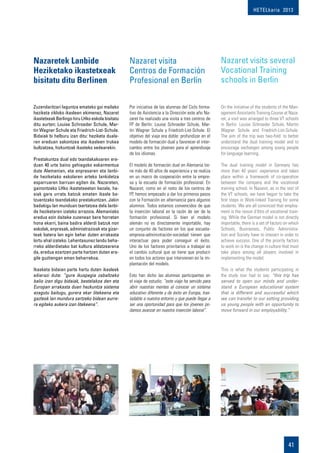
sus propias necesidades y procesos, además
de una mejora de la productividad, y de la mo-
tivación y fidelización de los trabajadores.
La alternancia, al desarrollarse en parte en
la propia empresa, se convierte en una mag-
nifica plataforma mediante la cual los estu-
diantes pueden adquirir las competencias y
capacidades transversales que demandan as
empresas (trabajo en equipo, resolución de
problemas, adaptación al cambio, intraem-
prendizaje, etc.)
Por otra parte, reduce los costes de adapta-
ción y selección de personal, al tiempo que
facilita el relevo generacional y la transfe-
apprenticeships in companies. This way,
thanks to the collaboration and consensus
of the Basque Government, Confebask, com-
panies and Vocational Training schools and
their associations, a new model of work-
linked training has been defined.
This “Made in Euskadi” model takes into ac-
count both other successful models at the
international level and our own experiences
(Ikasi eta lan or the IMH work-linked engi-
neering), while necessarily adapting to the
needs and characteristics of our production
fabric.
Objectives
During the 2012-2013 academic year, 126
young people were hired under the Hezibi
program in 106 companies from different
sectors and of different sizes.
The road started has helped increase the
number of companies that, despite the cur-
rent economic situation, thanks to HEZIBI
see an opportunity to plan and prepare the
professionals that they will need in the short
term.
This is why, thanks to the work carried by the
schools, Confebask and the Government, al-
most 300 students have been hired by busi-
nesses during the 2013-2014 school year,
something upon which we place great value.
Advantages of the model
For businesses, HEZIBI means being able
to get people with a qualification that is
closer to their needs and processes, as
well as improving productivity, and moti-
vating employees and earning their loyalty.
Since Work-linked Training takes place
in the company itself part of the time, it
becomes a magnificent platform through
which students can acquire the kind of di-
rect and horizontal skills that companies
are looking for (teamwork, problem solv-
ing, adapting to change, intrapreneurship,
etc.)
On the other hand, it reduces the costs of
adapting and selecting personnel, at the
same time as making it easier to under-
take the generational renewal and trans-
fer of knowledge between people who are
about to leave the labour market and have
access to it.
HEZIBI, Txandakako Prestakuntzaren
eredu berezia Euskadirentzat
HEZIBI un modelo propio de Formación
en Alternancia para Euskadi
HEZIBI, a Work-linked Training model
for the Basque Country
HETELkaria 2013
12
Era berean, gure erkidegoko jaiotze tasa
urrien arazoari aurre egiten laguntzen du,
izan ere, txandakako prestakuntzari esker
lan merkatura sartzeko adina aurreratu egi-
ten da eta gora egiten du gizarte seguran-
tzan kotizatzen dutenen kopuruak.
Halaber, prozesuan funtsezkoak diren ikas-
tetxeko tutorearen eta enpresako irakaslea-
ren bidez, areagotu egiten dira ikastetxeen
eta enpresen arteko harremanak. Tutorea-
ren eta irakaslearen arteko harreman estuak
elkar hobeto ezagutzea ekarriko du, lankide-
tzarako eremu berriak ahalbideratuko ditu
eta enpresek dituzten pertsonen beharrei
hobeto erantzuteko aukera eskainiko du.
HEZIBI programa gure lanbide heziketaren
ospea areagotzeko sortu da, baina beste
edozein prozesutan bezala, etengabe lan
egin behar dugu hobetzeko, egokituz, bila-
katuz eta berrituz. Guztion artean, Euskadiko
txandakako prestakuntzak gurea bezalako
ekonomia aurreratuari dagokion dimentsioa
har dezan lan egin behar dugu.
rencia de conocimiento entre las personas
que están cercanas a abandonar el mercado
laboral y las que acceden a él.
No debemos olvidar que este programa supo-
ne también una mejora cuantitativa y cualita-
tiva del empleo. Genera empleo retribuido, ya
que el alumno o alumna tiene un contrato y
recibe una remunerada de la empresa.
Además, responde a la problemática de bajas
tasas de natalidad de nuestra comunidad, ya
que la alternancia permite adelantar la edad
de incorporación al mercado laboral y se in-
crementa además el número de cotizantes a
la seguridad social.
Asimismo, posibilita que se intensifiquen más
las relaciones entre los centros de formación
y las empresas, gracias a dos figuras claves
en este proceso, el tutor del centro y el ins-
tructor de la empresa. Una relación fluida
entre tutor e instructor, generará un mejor co-
nocimiento mutuo y nuevos ámbitos de cola-
boración, así como una mejor respuesta a las
necesidades de personas de las empresas.
HEZIBI ha nacido para convertirse en un pro-
grama que ayude a prestigiar aún más nues-
tro sistema de formación profesional, pero,
como en cualquier proceso, debemos trabajar
permanentemente en su mejora, adaptán-
dolo, haciendo que evolucione e innovando.
Tenemos que tratar entre todos que la forma-
ción en alternancia en Euskadi adquiera una
dimensión adecuada a una economía avanza-
da como la nuestra.
We must not forget that this programme is
also a quantitative and qualitative improve-
ment of employment. It generates gainful
employment, as the student has a contract
and gets a paid by the company.
In addition, it answers to the problem of low
birth rates in our region, since the work-
linked training allows students to access the
labour market at an earlier age and it also
increases the number of contributors to so-
cial security.
It also makes it possible to intensify relations
between training schools and companies,
thanks to two key figures in this process, the
tutor in the school and the instructor of the
company. A fluid relationship between tutor
and instructor will result in a better mutual
understanding and new areas of cooperation,
as well as a better response to the needs of
the people.
HEZIBI was created to become a programme
to help enhance our vocational training sys-
tem, but, as in any process, we must work
permanently to improve it, adapt it, grow it
and innovate it. We must all make an effort
to get Work-linked Training in the Basque
Country to acquire an appropriate size for an
advanced economy such as ours.
HEZIBI, Txandakako Prestakuntzaren
eredu berezia Euskadirentzat
HEZIBI un modelo propio de Formación
en Alternancia para Euskadi
HEZIBI, a Work-linked Training model
for the Basque Country
Asier Aloria	
Confebaskeko Prestakuntza
saileko zuzendaria	
aaloria@confebask.es
Asier Aloria
Director del Departamento de Formación
de Confebask
aaloria@confebask.es
Asier Aloria
Director, Confebask Training
Department
aaloria@confebask.es
This model makes it possible to intensify relations
between training schools and companies thanks to two
key figures in this process, the tutor in the school and
the instructor of the company
HETELkaria 2013
13
EUSKADIKO TXANDAKAKO LANBIDE HEZIKETA ALEMANIAKO PRESTAKUNTZA DUALA
LHko ikastetxea arduratzen da parte hartuko duen
enpresa bilatzeaz.
Enpresak plaza bat eskaintzen du eta gehien komeni zaion ikaslea bila-
tzen du. Parte hartuko duen ikastetxea ere bilatzen du.
Ikaslearen Prestakuntza/Ikaskuntza Plana LHko ikaste-
txearen eta enpresaren artean diseinatzen da. Planaren
helburua ikasleak Lanbide Heziketako titulua lortzea da.
Hezkuntza/ Heziketa Plana kulturako ministerioaren konferentziak disei-
natzen du, eta Ikaskuntza/ Prestakuntza Plana, berriz, enpresek. Biak
osatu/ uztartu egiten dira.
Ikaslea egun guztietan egoten da LH ikastetxean eta
enpresan, esaterako, 4 ordu ikasgelan eta beste 4 ordu
enpresan.
Bi eredu daude (enpresen nahiaren arabera). 1. eredua: Ikasleek lehen
urtean 2 egun ikastetxean eta 3 egun enpresan igarotzen dute. Bigarren
eta hirugarren urteetan, egun bat ikastetxean eta 4 enpresan.
2. eredua: Ikasleek klaseak blokean hartzen dituzte.
FORMACION PROFESIONAL EN ALTERNANCIA
EN EUSKADI
FORMACION DUAL
EN ALEMANIA
El Centro de FP se encarga de buscar una empresa
participante.
La empresa ofrece una plaza y busca al alumno que le convenga. También se
busca el centro que participe.
El Plan de Formación/Aprendizaje del alumno lo diseñan con-
juntamente entre el Centro de FP y la empresa. Este Plan tie-
ne como referencia el Título Profesional que va a obtener el
alumno.
El plan educativo/ formativo está diseñado por la conferencia ministerial de cul-
tura y el plan de aprendizaje/ formación está diseñado por el conjunto de las
empresas. Los dos se complementan/ conjuntan.
El alumno está prácticamente todos los días tanto en el Cen-
tro de FP como en la empresa, por ejemplo, está 4 horas en el
aula y otras 4 horas en la empresa.
Existen dos modelos (a elección de las empresas). Modelo 1: Los alumnos están
en el primer año 2 días en el centro y tres en la empresa. En el segundo y tercer
año están 1 día en el centro y cuatro en la empresa.
Modelo 2: los alumnos reciben las clases en bloque.
HEZIBI, Txandakako Prestakuntzaren
eredu berezia Euskadirentzat
HEZIBI un modelo propio de Formación
en Alternancia para Euskadi
HEZIBI, a Work-linked Training model
for the Basque Country
WORK-LINKED VOCATIONAL TRAINING
IN THE BASQUE COUNTRY
DUAL TRAINING
IN GERMANY
The VT school is responsible for searching for a participating
company.
The company offers a position and seeks the student that best suits it. It also
looks for the school to participate.
The Training/Learning Plan for the student is designed jointly
by the VT school and the company. This Plan has as reference
the professional degree that the student will have.
The educational/training plan is designed by the ministerial culture conference
and the learning/training plan designed for the companies as a whole. The two
complement/combine each other.
The student is present practically everyday at both the com-
pany premises and the school —for example, 4 hours in the
classroom and another 4 hours in the company.
There are two models from which the companies can choose. Model 1: In the first
year, the students spend 2 days in the school and three in the company. In the
second and third year, they spend 1 day at the school and four in the company.
Model 2: the students get all the classes in a single block.
HETELkaria 2013
14
Bizitza osoa Euskal Lanbide Heziketari lo-
tua, hura bultzatzen, irakasle gisa edo Eusko
Jaurlaritzako ardura posturen batetik. Eusko
Jaurlaritzako lehen LHko sailburuordea izan
zen (2001-2005), eta 2012ko abendutik bere
esku dago berriro ere LHko sailburuordetza.
Euskal LHren historiaz hitz egiteaz gain, da-
tuak eskuan eta krisiak krisi, Jorge Arevalok
etorkizun oparoa aurreikusten dio Europako
LH onenetakoari, eta hurrengo hiru urteetan
euskal ekonomian funtsezko egitekoa izan-
go duela deritzo. HETELkariak elkarrizketa
egin dio.
1995ean, duela 18 urte, Lanbide Heziketa-
ko zuzendari zinen Ardanzaren gobernuan.
Abestiak dioen moduan, Nola aldatzen di-
ren gauzak.…
Ahaztuta dugu jada, baina 1995eko apirilean
% 24,5eko langabezia genuen Euskadin, in-
dustria egoera tamalgarrian zegoen. Sailen
arteko bilera egin genuen orduan, LHko zu-
zendari gisa izan nuen lehena, eta Hezkuntza,
Industria eta Lehendakaritzako ordezkariak
bildu ginen. 2000. urterako Euskadi moderni-
zatzea zen orduko helburua, eta hiru erabaki
estrategiko hartu ziren: gure industriaren eki-
pamenduak eta makinak berritzea, teknolo-
gia berrietan inbertituz produkzio ehuna ho-
betzea eta, azkenik, prestakuntza hobetzea,
hau da, giza baliabideak. Horretan, Lanbide
Heziketak zeregin estrategikoa izango zuen.
Bestelako LH bat behar genuen, ordukoa
ez baitzebilen ondo, izan ere, langile asko
(gehienak gainbehera zetorkigun industria
horretakoak) LHtik zetozen eta ez ziren euren
buruak birziklatzeko gai. Hortik atera ziren
lehen LHko Euskal Plana (1997) eta Estatuan
aitzindari izan zen Euskal Autonomia Erki-
degoko lehen Lanbide Kualifikazio Sistema.
“Lanbide Heziketa euskal ekonomiaren
traktore izango da datozen lau urteetan”
Toda una vida ligado a la Formación Profesio-
nal Vasca, dedicado a impulsarla, como profe-
sor o con algún cargo en el Gobierno Vasco.
Fue el primer viceconsejero de FP del Gobier-
no Vasco (2001- 2005), y desde diciembre de
2012 ocupa de nuevo la viceconsejería de FP.
Jorge Arévalo no sólo puede hablar de la his-
toria de la FP Vasca, sino que, con datos en la
mano, y a pesar de la crisis actual, vaticina
un futuro brillante para una de las mejores FP
de Europa, llamada a jugar un papel clave en
la economía vasca en los próximos tres años.
HETELkaria le ha entrevistado.
En 1995, hace 18 años, usted era director
de Formación Profesional en el Gobierno
de Ardanza. Como dice la canción, Cómo
hemos cambiado....
Ya se nos ha olvidado, pero en abril de
1995 el paro en Euskadi era de un 24,5%,
con una industria que se nos caía a tro-
zos. Entonces tuvimos una reunión –la
primera a la que asistí como director de
FP- interdepartamental de Educación,
Industria y Lehendakaritza. El objetivo
entonces era modernizar Euskadi para el
año 2000. Y se tomaron tres decisiones
estratégicas: modernizar los equipos y
maquinaria de nuestra industria, mejorar
el tejido productivo invirtiendo en nuevas
tecnologías y mejorar las cualificaciones,
los recursos humanos, donde la Forma-
ción Profesional iba a jugar un papel es-
tratégico. Necesitábamos tener otra FP
porque aquélla no funcionaba, porque
muchos de los trabajadores, la mayoría
de aquella industria que se nos estaba
desmoronando, provenían de la FP, y no
eran capaces de reciclarse. De allí salió
“LaFormaciónProfesionalvaasertractordela
economíavascaenlospróximoscuatroaños”
A life linked to Basque Vocational
Training, devoted to promoting it as a
teacher and as an officer in various
Basque Government positions. He was
the first Deputy Minister for VT in the
Basque Government (2001-2005) and,
from December 2012, he again leads the
Deputy Ministry for VT. Jorge Arévalo
can talk about more than just the history
of Basque VT. With figures at hand, he
predicts that, despite the financial crisis,
there is a bright future for one of the
best VT systems in Europe, destined to
play a key role in the Basque economy
over the next three years. HETELkaria
interviewed him.
In 1995 —18 years ago— you were
director of Vocational Training with
Ardanza’s Government. As the song
says, “How have we’ve changed...”
We have already forgotten but, in April
1995, the unemployment rate in the Basque
country was 24.5%, with an industry
that was falling to pieces. Then we had
a meeting of the Education, Industry and
Presidency departments —the first which
I attended as director of VT. The goal then
was to modernise the Basque Country by
the year 2000. And three strategic decisions
were made: to modernise equipment
and machinery in our industry, improving
the productive fabric by investing in new
technologies and improving qualifications
—human resources, where Vocational
Training was to play a strategic role. We
needed to have a different VT because the
one we had wasn’t working, as many of the
workers —most in that crumbling industry
we had— came from VT and were incapable
“Vocational Training will be the driver of the
Basque economy in the next four years”
HETELkaria 2013
15
Izan ere, Espainiako Kualifikazioen Sistema
gure Kualifikazio Sisteman dago oinarrituta.
Eta hori izan zen egun dugun LHren hasiera.
Gaur egun oraindik ere funtsezkoa dena lan-
tzen hasi ginen: ikastetxeen arteko lankide-
tza, publikoen eta itunpekoen artekoa. Euskal
LH bakarra izan behar zen, guztiok norabide
berean egin behar genuen aurrera. Horren-
bestez, LHko Euskal Plana sortu zen, lankide-
tzaren eta sare lanaren aitzindari.
Jarrai dezagun atzera begira gaur non gau-
den ulertzeko. 2001ean LHko sailburuorde
izendatu zintuzten. Euskadiko lehen LHko
sailburuordea izan zinen, beraz.
Herri honetako LHren bigarren unerik ga-
rrantzitsuena 2001ekoa izan zen. Lanbide He-
ziketako sailburuordetza sortu zen eta inoiz
izan ez zuen maila eman zitzaion. Horrek ba-
rrutik indartu gintuen, erabakitzeko ahalmen
handiagoa eman zigulako. Orduan hasi ginen
LHko bigarren Euskal Plana lantzen, 2004an
abiatu zena. Berrikuntza aplikatuaren alde
egin genuen, garai hartan erabat berritzai-
lea zena. Ondorioz, LHko ikastetxeen sarea
bultzatu behar zen haiek ere parte hartu eta
ekarpenak egin zitzaten. Izan ere, nire ustez,
ikastetxeok dira sistema osoaren muin es-
trategikoa. Aurreko planari esker, ekipamen-
duen eta IKTen aldetik industria moderniza-
tua genuen, eta baita ekipamenduetan eta
prestakuntzan eraberritutako ikastetxeak
ere. Urte horietan erein zen euskal LH siste-
el primer Plan Vasco de FP (1997) y el pri-
mer Sistema de Cualificación Profesional
del País Vasco, que fue el pionero en el
Estado. De hecho el Sistema Nacional de
Cualificaciones nace de la base de nues-
tro Sistema de Cualificaciones. Y eso fue
el inicio de la FP que tenemos hoy. Co-
menzamos a sembrar algo que hoy aún
es fundamental, la cooperación entre
centros, públicos o concertados, porque
la FP Vasca debía ser una, remando to-
dos en la misma dirección. Así, se crea
el Plan Vasco de FP, y se coloca como
abanderado la cooperación y el trabajo
en red.
Sigamos haciendo un poco de historia
para poder comprender dónde estamos
hoy. En 2001 usted es nombrado
viceconsejero de FP y se convierte en el
primer viceconsejero de FP de Euskadi.
El segundo momento importante de la
historia de la FP de este país es 2001.
Se crea la viceconsejería de Formación
Profesional y se le da un nivel que nunca
antes había tenido, y eso lo que significa
es que nos da más fuerza interna, porque
nos otorga mayor capacidad de decisión.
Comenzamos entonces a trabajar en el
segundo Plan Vasco de FP, que ve la luz
en 2004. Y entonces apostamos por algo
totalmente rupturista en aquella época,
of recycling themselves. From there came
the first Basque VT Plan (1997) and the first
System of Professional Qualifications in the
Basque country, which was the pioneer in
the State. In fact, the National System of
Professional Qualifications was based of our
own System of Professional Qualifications.
And that was the beginning of the VT we
have today. We started to plant something
that remains essential today, cooperation
between schools, be they public or private
—because there should only be one Basque
VT moving in the same direction. The Basque
VT Plan was therefore designed according to
cooperation and networking criteria.
Let’s continue doing a bit of history to
understand where we are today. In 2001
you were appointed Deputy Minister
for Vocational Training, the first in the
Basque Country.
The second milestone in the history of VT
in this country was 2001. By assigning a
deputy ministry to Vocational Training it
was attributed an importance it had never
had before, and that meant increased
internal strength with more decision-
making capability. We then started to work
on the second Basque VT Plan, which saw
the light in 2004. And then we made a
firm commitment to something that was
completely groundbreaking at the time
—applied innovation— which meant
“	Lanbide Heziketa euskal
ekonomiaren traktore izango da
datozen lau urteetan”
“La Formación Profesional va a ser
tractor de la economía vasca en los
próximos cuatro años”
“ Vocational Training will be the driver
of the Basque economy in the next
four years”
HETELkaria 2013
16
ma, nire iritziz gaur egun Europako LH onena
edo onenetarikoa dena.
Oraina
Eta orain Lanbide Heziketako III. Euskal
Plana burutzen ari gara.
Bai. 2010eko plana da. Euskal Lanbide Hezi-
ketaren azken aldiko historian, 1992tik gaur
egunera artekoan, LHk jarraipen bat izan du,
eta hori da bere arrakastaren gakoa, bila-
kaera hori gorabeheratsua eta erritmoaren
aldetik biziagoa edo motelagoa izan den
arren. Baina inork ez du aurrekoak eginda-
koa zapuztu, eta hori berebizikoa izan da,
egitura orokorra ez aldatzea, alegia. Eten-
gabe ari gara lehen landutakoaren gainean
berria eraikitzen, eta hori funtsezkoa izan da.
Etengabe ari gara mugitzen, ezin gara geldi-
tu. Uneotan Eusko Jaurlaritzak finkatutako
helburuak dituzte ikastetxeek, baina gakoa
horien autonomia da, lan egiten uztea.
Etengabe goraipatzen dute euskal LH. “Eus-
kal prestakuntzaren harribitxia”, “langabe-
ziaren aurreko salbamen ohola”, etab. Kon-
turatzen al gara zer nolako LH dugun?
Euskal gizarteak badaki, nire ustez, LH bi-
kaina dugula. Orientatzaileek ere badakite,
baina hortik aurrera, orientatzerako orduan,
gauzak ez doaz joan beharko luketen bidetik...
Agian, Unibertsitatea beharrean seme-a-
labek LH hautatzeak familiengan eragiten
duen ondorio morala errotik desagerraraztea
falta zaigu oraindik ere. Eta, bestalde, mal-
gutasun handiagoa egon beharko litzateke
LHtik Unibertsitaterako eta alderantzizko
igarobidean. Zerbait gaizki dabil unibertsita-
teko graduatuen % 10ek LHra jotzen duenean
lana bilatzeko. Pertsonarentzat kolpe morala
da, eta ekonomikoki ahalegina eskatzen dio
gizarteari. Zergatik ezin liteke alderantzizkoa
gertatu? Zergatik ez egin lehenengo LH ikas-
ketak, batez ere industria adarrekoak, eta
gero Unibertsitatera joan?
Eta zer nolako LH dugu gaur egun?
Uneotan euskal LHren ekimena berresku-
ratu dugu, aldi batez galdu genuena, eta
orain abangoardian gaude. Ikastetxeen es-
kutik ilusioa ere berreskuratu dugu. Ez dugu
ahaztu behar 50eko hamarkadako LHri es-
ker, lanbide maisutza haiei esker, iritsi dela
Euskadi gaur egun dena izatera. Enpresa eta
enpresari askoren jatorria izan da. Orain da
unea LH berriro ere bestelako Euskadi ba-
ten traktore izateko, bioteknologia, robotika,
nanoteknologia eta ildo horretako enpresak
la innovación aplicada, y que implicaba
potenciar la red de centros de FP -que
para mí son el núcleo estratégico de todo
el sistema- para que pudieran participar
y aportar. Contábamos ya, como conse-
cuencia del Plan anterior, de una indus-
tria modernizada, en cuanto a equipa-
mientos y TICS, y de una red de centros
modernizados en equipamientos y cua-
lificaciones. En esos años es cuando se
siembra el sistema de FP vasco, que hoy
es a mi juicio la mejor FP de Europa o una
de las mejores.
El presente
Y estamos ahora finalizando el Tercer
Plan de FP Vasco
Sí, es un Plan que data de 2010. De la histo-
ria reciente de la Formación Profesional Vas-
ca, desde el año 1992 hasta hoy podemos
decir que la FP Vasca, y esa es la clave de
su éxito, es que con mayor o menor acierto,
ha tenido continuidad, con menor o mayor
ritmo. Pero nadie ha dinamitado lo que hizo
el anterior y eso ha sido fundamental, que la
estructura global no ha cambiado. Estamos
continuamente construyendo lo nuevo sobre
lo ya trabajado, y eso ha sido clave. Estamos
en movimiento continuo, no podemos parar,
y en este momento los centros tienen los ob-
jetivos marcados por el Gobierno Vasco pero
la clave está en su autonomía para dejarles
trabajar.
No dejan de llegar halagos para la FP
Vasca. “La joya de la formación vasca”
“la tabla de salvación del paro”, etc.
¿Somos conscientes de la FP que
tenemos?
Creo que la sociedad vasca es consciente
de que tenemos una FP excelente, y los
orientadores también; pero a partir de ahí
las cosas no van como debieran a la hora
de orientar... Quizá lo que falta todavía es
erradicar de las familias el efecto moral de
que sus hijos se decanten por la FP en vez de
por la Universidad. Y, por otra parte, debería
haber mayor flexibilidad en el tránsito de
la FP a la Universidad, y viceversa. Algo
falla cuando vemos que más del 10% de
los graduados universitarios retorna a la FP
en busca de un empleo, moralmente es un
golpe para la persona y económicamente
un esfuerzo social, ¿por qué no podría ser al
revés? ¿Por qué no pasar primero por una FP,
principalmente industrial para luego ir a la
Universidad?
empowering the network of VT schools —for
me they are the strategic core of the whole
system— so that they could participate and
contribute. As a result of the previous Plan,
we had already modernised our industry
in terms of equipment and ICTs, and we
had a network of schools with up-to-date
equipment and qualifications. Those are the
years when the seeds were sown for today’s
Basque VT System, which in my opinion is
among the best in Europe if not the best.
The present
And we are now finalising the third
Basque VT Plan
Yes, it is a Plan that dates from 2010. In
the recent history of the Basque Vocational
Training —from 1992 until today— we can
see that it has always remained consistent,
with greater or lesser success, and at a
greater or lesser pace; and that is the key
to its success. But no one has blown up
what the previous Plan had done and that
has been fundamental in ensuring that the
overall structure does not change. We are
continually building on previous work, and
that is a key factor. We are in continuous
motion, we cannot stop, and right now
the schools have the objectives set by the
Basque Government; but the key lies in
allowing them their autonomy, so they can
get on with their work.
Basque VT is always receiving
praise. “The jewel of the Basque
education,” “the salvation of current
unemployment,” etc. Are we aware of
the VT that we have?
I believe that Basque society is aware that
we have a great VT, and so are guidance
counsellors; but from there things do not go
as they should when it comes to providing
guidance... What is still missing is perhaps
is eradicating the effect on the morale
of families when their children opt for
vocational training rather than University.
And, on the other hand, there should be
greater flexibility in the move from VT to
University, and vice versa. Something is
wrong when we see that more than 10% of
university graduates turn to VT in search of a
job. It is demoralising for the individual and a
social effort from a financial viewpoint. Why
could it not be the other way around? Why
not go first through a —mainly industrial—
VT course and then go to University?
“	Lanbide Heziketa euskal
ekonomiaren traktore izango da
datozen lau urteetan”
“La Formación Profesional va a ser
tractor de la economía vasca en los
próximos cuatro años”
“ Vocational Training will be the driver
of the Basque economy in the next
four years”
HETELkaria 2013
17
sortuz, gorantz doazen sektoreetan lanpos-
tuak sortuz.
Orduan, zer falta zaigu?
Lanbide arloen sorta zabala dugu aukeran,
30 baino gehiago, baina eguneratu eta mal-
gutu egin beharko genituzke. Eta batez ere
espezializazio handiagoa behar dugu, 400-
700 orduko ziklo ondorengo bat espezialis-
tak prestatzeko. Espezializazioa ez bakarrik
goi mailako zikloetan, baita erdi mailakoe-
tan ere. Ulertzeko, aztertzeko, laburbiltzeko,
transmititzeko eta erabakitzeko gaitasuna
duen jendea behar dugu. Espezializazio mai-
la handiagoa da enpresek orain eskatzen
dutena, industri sektorekoek batez ere. Gaur
egun, ikasleak oso ondo prestatuta dauden
arren, eskaintzen diegun hezkuntza ez da
nahikoa. Gainera, espezializazio horretara-
ko bestelako pertsona behar da, eta horre-
tarako funtsezkoa da LHren hezkuntza sis-
teman metodologia aldatzea. Ikastetxeetan
metodologia aldaketa ematen bada aldatu
egingo dira ikaskuntza sistema, ikastetxeen
antolaketa… Hori izango da euskal LHren
erronka handia, horregatik esan dut behin
baino gehiagotan LH berrasmatu egin behar
dugula.
Etorkizuna
Nola ikusten duzu LH lau urteren buruan?
Gauza asko aldatu behar ditugu 2017rako,
horien artean produkzio ehuna. Baina Eus-
kadin ari gara etxeko lanak egiten. Horre-
gatik ziur nago hemendik bi urtera krisialdi
honetatik irtengo garela eta LHren egitekoa
funtsezkoa izango dela, euskal ekonomia-
ren traktore bilakatuko baita, enpresentzako
ezinbesteko laguntza. Ikastetxeak ezagutza
unitate bilakatuko dira, hezkuntzatik hara-
tago, industriaren funtsezko euskarri diren
enpresekiko lotura gero eta handiagoa izan-
go dute, eta LH euskal ekonomiaren traktore
izango da. LHk aurrea hartu behar die enpre-
sen beharrei.
Etorkizun horretan, zein izango da txanda-
kako prestakuntzaren egitekoa?
Txandakako prestakuntza da LHren etorki-
zuna, baina eredu hori are gehiago malgutu
behar dugu, bestelako aukerak zabaldu, aha-
¿Y qué FP tenemos hoy?
Enestemomentohemosrecuperadolainiciativa
en la FP Vasca, que la perdimos durante un
tiempo, para estar ahora a la vanguardia, y
también la ilusión de la mano de los centros. No
olvidemos que hoy Euskadi es lo que es gracias
a la FP de los años 50, a aquellas maestrías,
y que muchas empresas y muchos empresarios
provienen de allí. Ahora es el momento de que
la FP vuelva a traccionar sobre una Euskadi
diferente, empezando a crear empresas sobre
biotecnología, robótica, nanotecnología,
creando empleos en sectores emergentes.
¿Qué nos falta entonces?
Tenemos un buen abanico de familias para
elegir, más de 30, pero deberíamos actualizarlas
y dotarlas de mayor flexibilidad. Y sobre todo
necesitamos una mayor especialización, un
post-ciclo de 400 a 700 horas para formar
especialistas. Una especialización no sólo
para ciclos superiores, sino también para
ciclos medios. Necesitamos gente que
tenga capacidad de entender, de analizar, de
sintetizar, de transmitir y de decidir… Lo que
nos piden ahora las empresas, principalmente
las industriales, son unos niveles más altos de
especialización. Hoy, y teniendo un alumnado
muy bien preparado, ya no es suficiente
la formación que les damos. Además, esa
especialización necesita de una persona
diferente, y para eso es fundamental un cambio
de metodología en el sistema educativo de
la FP. Este cambio en la metodología de los
And what kind of VT do we have today?
At this time, in Basque VT we have regained
the initiative that we had lost for a while and
we are back at the forefront, and there is
also much excitement in schools. We must
not forget that, today, the Basque Country is
what it is thanks to the Vocational Training
of the 1950s, to those master’s diplomas,
and to the fact that many companies and
many entrepreneurs come from there. Now
is the time for VT to drive a different Basque
Country, starting to create biotechnology,
robotics and nanotechnology companies,
and creating jobs in emerging sectors.
What do we need then?
We have a good range of career families
to choose from, over 30, but we should
update them and provide them with greater
flexibility. And above all we need greater
specialisation, a post-cycle of 400 to 700
hoursto trainspecialists.A specialisationnot
only for higher cycles, but also for medium
cycles. We need people who have the ability
to understand, analyse, synthesise, transmit
and decide... What we are being asked for
by companies, particularly in industrial
sectors, are higher levels of specialisation.
Today we have very well-prepared students,
but the training we give them is no longer
enough. In addition, this specialisation
needs a different kind of person, and for that,
a change of methodology in the vocational
educational training system is essential.
“	Lanbide Heziketa euskal
ekonomiaren traktore izango da
datozen lau urteetan”
“La Formación Profesional va a ser
tractor de la economía vasca en los
próximos cuatro años”
“ Vocational Training will be the driver
of the Basque economy in the next
four years”
Euskadi es lo que es hoy
gracias a la Formación
Profesional de los años 50
HETELkaria 2013
18
lik eta enpresa gehien hartzeko. Eredua oso
baliagarria da, gorantz doa. Gainera, txanda-
kako praktikak egiten dituztenen % 80 enpre-
san bertan gelditu ohi da. Baina ikastetxeen
konfigurazio berria behar dugu, autonomia
gehiago eta metodologia aldatzea ekarriko
dituena, eta horrekin batera gehiago inplika-
tuko diren enpresak.
Hizkuntzen ezagutza eta neskek betiko
lanbide arloen aldeko hautua egitea gain-
ditu gabeko ikasgaiak dira, ezta?
Profesionalek ez dute ingelesa bakarrik ika-
si behar, baita ere txinera, alemana,… Gure
enpresak mundu guztian daude kokatuta
edo mundu guztiko herrialdeekin egiten di-
tuzte negozioak, eta beraz, eleaniztasunaz
hitz egin behar dugu. Ildo horretan bide lu-
zea dugu egiteko, gure herrian hizkuntzen
arazoa oinarrizkoa baita. Eta neskei dago-
kienez, poliki-poliki rolak aldatu beharko dira
industri zikloen aldeko hautua egin dezaten;
agian hirugarren zikloarekin lortuko da hori,
etorkizuneko espezializazio horrekin.
centros cambiará el sistema de aprendizaje,
la organización de los propios centros… Ese
será el gran reto de la FP Vasca, de ahí que yo
haya dicho en más de una ocasión que debemos
reinventar de nuevo la FP.
El Futuro
¿Cómo ve la FP a cuatro años vista?
Tenemos que cambiar muchas cosas para
2017, entre ellas el tejido productivo. Pero en
Euskadi estamos haciendo los deberes. Por eso
estoy convencido de que de aquí a dos años
vamos a salir de esta crisis, y que la FP va a
jugar un papel fundamental, convirtiéndose
en tractora de la economía vasca, en apoyo
fundamental para las empresas. Los centros
de formación van a pasar a ser unidades de
conocimiento más allá de la formación, y van
a estar cada vez más pegados a las empresas,
el soporte fundamental de la industria, y la FP
va a ser tractora de la economía vasca. La FP
tiene que adelantarse a las necesidades de las
empresas.
Enesefuturo,¿quépapeltienelaformación
en alternancia?
La formación en alternancia es el futuro de la
FP, pero necesitamos todavía flexibilizar más
ese modelo, abriendo posibilidades diferentes
para abarcar el mayor número de empresas. Es
un modelo muy válido, en alza. Además, el 80%
de los que realizan prácticas en alternancia se
queda en esa empresa. Pero necesitamos una
nueva configuración de los centros, con mayor
autonomía, con un cambio metodológico y
empresas más implicadas.
Un par de asignaturas pendientes son
el conocimiento de idiomas y que las
chicas se siguen decantando por familias
tradicionales ¿no?
Los profesionales no sólo necesitan aprender
inglés, también chino, alemán,… nuestras
empresas se ubican o negocian con países de
todo el mundo, por lo que debemos hablar de
plurilingüismo, y ahí tenemos mucho recorrido
que realizar porque el problema de los idiomas
en este país es de base. Y en cuanto las chicas,
poco a poco habrá que ir cambiando roles
para que se decanten por ciclos industriales,
quizá con el tercer ciclo, con esa futura
especialización, se logre.
This change in methodology in schools will
change the learning system, how schools are
organised... That will be the great challenge
for Basque VT, and that is why I often say
that we must reinvent VT once more.
The Future
How do you see VT four years from now?
We need to change many things by 2017,
including the productive fabric. But in the
Basque country we are doing our homework.
That is why I am convinced that within two
years we will emerge from this crisis, and
that the VT will play a fundamental role,
becoming a driver of Basque economy,
providing fundamental support for
companies. Training schools will become
knowledge units going beyond training and
will be increasingly linked to companies, the
fundamental support of industry, and VT will
be the driver of the Basque economy. VT has
to stay ahead of the needs of companies.
What is the role of work-linked training
in that future?
Work-linked training is the future of VT,
but we need to make the model even more
flexible, opening up different possibilities
to cover the greatest possible number of
companies. It is a very valid model that is
on the rise. In addition, 80% of students
doing work-linked training internships
stay in the company. But we need a new
configuration for schools, with greater
autonomy, a methodological change and
more involvement from companies.
A couple of unresolved matters are
foreign language knowledge and that
girls are still opting for their traditional
career families, isn’t it?
Professionals not only need to learn English,
also Chinese, German,... our companies are
located in or negotiating with countries
around the world, so we must talk about
multilingualism, and hence have a long way
to go, because the language problem in this
country is basic. With regard to girls, they
will need to change roles little by little and
choose industrial cycles, perhaps in the third
cycle —with that future specialization, we
might achieve this.
Maite Gutierrez 	
VK Comunicacion
maite@vkcomunicacion.com
Maite Gutierrez 	
VK Comunicacion
maite@vkcomunicacion.com
Maite Gutierrez 	
VK Comunicacion
maite@vkcomunicacion.com
“	Lanbide Heziketa euskal
ekonomiaren traktore izango da
datozen lau urteetan”
“La Formación Profesional va a ser
tractor de la economía vasca en los
próximos cuatro años”
“ Vocational Training will be the driver
of the Basque economy in the next
four years”
Los centros de FP van a
pasar a ser unidades de
conocimiento más allá de la
formación
HETELkaria 2013
19
2012-2013 ikasturtean, lanerako prestakuntza
sustatzeko eta zabaltzeko kanpaina eraman
du aurrera HETELek, Lanbide eta Hobetuz
erakundeen lankidetzarekin. Prestakuntzak
profesionalki hobetzeko eta lehiakorragoak
izateko eskaintzen duen aukera nabarmen-
du dugu kanpaina horretan. Proiektuaren
barruan 3 jarduera nagusi burutu dira: pro-
fesionaltasun ziurtagiriek eskaintzen dituz-
ten aukeren berri eman zaie ikasleei/onu-
radunei, lanerako prestakuntzaren onurak
azaldu zaizkie enpresei eta eskualde maila-
ko jardunaldiak antolatu dira ikastetxeetan,
interesatuta daudenei informazioa emateko.
Jarduera horiek burutzeko ikastetxeetako
Lanerako prestakuntzako arduradunen la-
guntza izan dugu.
Proiektuaren barruan, www.hetelfpe.com
ataria jarri da abian. Bertan, orientazioa
eskatzen dutenei bideratutako oinarrizko
informazioa eskaintzen da, inprimatutako
bestelako materialez gain.
Guztira hamabost jardunaldi egin dira au-
tonomia erkidegoan, eta beraz, LHko ikas-
tetxeen bidez eskualde guztietara iritsi
gara. Jardunaldien inguruko balorazioa
ona izan da, bai hizlari batzuen nabar-
mentasunagatik eta baita administrazioko
teknikarien parte hartzeagatik ere. Oroko-
Lanerako prestakuntza sustatu eta
zabaltzeko kanpainaren balantze ona
Durante el curso escolar 2012-2013 HETEL,
con la colaboración de Lanbide y Hobetuz, ha
llevado a cabo una campaña de promoción y
difusión de la formación para el empleo. En
esta campaña hemos destacado la oportuni-
dad que ofrece la formación para la mejora
profesional y de la competitividad. Este pro-
yecto ha contado con 3 actuaciones princi-
pales: informar a los alumnos/ beneficiarios
de las oportunidades de los certificados de
profesionalidad, informar a las empresas de
los beneficios la formación para el empleo y
organizar jornadas comarcales en los centros
para informar a personas interesadas. Para
llevar a cabo todas estas actuaciones se ha
contado con el apoyo de los responsables de
Formación para el empleo de los centros.
En el marco de este proyecto se ha puesto
en marcha el portal www.hetelfpe.com que
incluye información básica para mostrar a las
personas que han solicitado orientación, junto
con otros materiales impresos.
En total se han realizado quince jornadas en
la comunidad autónoma, lo que nos ha permi-
tido llegar a todas las comarcas a través de
los distintos centros de FP. Las jornadas se
han valorado positivamente tanto por la noto-
riedad de algunos ponentes como por la par-
ticipación de técnicos de la administración.
Balance positivo delacampañadepromoción
y difusión de la formación para el empleo
During the 2012-2013 school year, HETEL
collaborated with Lanbide and Hobetuz
to carry out a campaign to promote and
disseminate Training for Employment. The
campaign highlighted the opportunity pro-
vided by training to help people improve
professionally and become more competi-
tive. The project had 3 main activities: in-
forming students/beneficiaries about the
opportunities provided by Vocational Cer-
tifications; informing businesses about
the benefits of Training for Employment
and organising regional conferences in
schools to inform interested people. All
these activities were carried out with the
support of the staff members in charge of
training for employment in the associated
schools.
As part of the project, a portal —
www.hetelfpe.com— was launched with
basic information for people seeking guid-
ance. There were also printed materials.
A total of fifteen conferences were organ-
ised in the autonomous region, allowing
us to reach all districts through the vari-
ous VT schools. The conferences received
positive feedback thanks to the renown of
some of the speakers and to the participa-
tion of public administration officials. In
general, they were very well attended.
It is difficult to deploy training and pro-
vide information to everyone during day-
to-day activities in schools. In this sense,
HETEL has made a major effort to take the
Hobetuz funded training and information
campaign right to the schools. In fact, de-
ployment in schools was one of the cor-
nerstones of the campaign.
Positive outcome of training for employment
promotion and dissemination campaign
LHko ikastetxeok jakin badakigu
beharrezkoa dela datozen urteetan ere informatzen
eta jendea orientatzen jarraitzea,
bizitza osoan zehar ikastearen garrantziaz
jendea kontzientziatzea
HETELkaria 2013
20
rrean, azpimarragarria izan da bertaratu
den jendetza.
Ikastetxe bakoitzaren egunerokotasunean
zaila da prestakuntza eta informazioa eskola-
ko kide guztiengana zabaltzea. Ildo horretan,
HETELetik ahalegin handia egin da Hobetu-
zek finantzatutako prestakuntza eta infor-
mazio kanpaina ikastetxeetara helarazteko.
Hain zuzen ere, ikastetxeetan zabaltzea izan
da kanpainaren zutabe nagusietakoa.
Bestalde, azpimarragarria da profesional-
tasun ziurtagirien garrantzia eta baliagarri-
tasuna; informazio hori azken erabiltzaileari
eta enpresei helaraztea izan da gure helbu-
rua, LHko ikastetxeak garen aldetik. Modu
horretan, hezkuntza sistemaren barruan
trazabilitatea bermatzen duen prestakuntza
sistema bultzatu nahi izan dugu eta bere ba-
lioa adierazi.
Hurrengo edizioei begira, LHko ikastetxe
garenez, beharrezkoa litzateke Lanerako
prestakuntzan dugun pisua areagotzea,
horren arduradun diren administrazioekin
lankidetzan.
Zenbakien aldetik kanpainaren balantzea
ona da, izan ere, informazioa eskaini zaie
10.000 lagun eta 900 enpresa ingururi, eta
ikastetxeetan egin diren jardunaldiek 800en
bat lagun bildu dituzte.
Azkenik, kanpainaren ebaluazioa egiteko jar-
dunaldia burutu da. Ekitaldia baliagarria izan
En general cabe destacar la gran afluencia
de público.
En el día a día de cada centro resulta com-
plicado realizar el despliegue de formación e
información a todas las personas del centro.
En este sentido, desde HETEL se ha realiza-
do un esfuerzo importante para trasladar a
los centros esta campaña de formación e in-
formación financiada por Hobetuz. De hecho
este despliegue en los centros ha sido uno de
los pilares básicos de la campaña.
Por otro lado, destacar la importancia de los
certificados de profesionalidad y su validez,
hacer llegar esta información al usuario final
y a las empresas ha sido nuestro objetivo
como centros de FP, para con ello potenciar y
poner en valor un sistema de formación que
garantiza la trazabilidad dentro del sistema
educativo.
De cara a futuras ediciones, como centros de
Formación Profesional, sería necesario poten-
ciar nuestra presencia en la Formación para el
empleo junto a las administraciones implica-
das en su ejecución.
El balance en cifras de esta campaña es po-
sitivo puesto que se ha informado a cerca de
10.000 personas, 1.200 empresas y 900 asis-
tentes a las diferentes jornadas realizadas en
los centros.
Finalmente se ha realizado una jornada para
la evaluación de la campaña, que nos ha ser-
Underscoring the importance of vocational
certifications and their validity and getting
this information across to end users and
businesses was our goal as VT schools.
The idea was to strengthen and emphasise
the value of a training system that guar-
antees traceability within the educational
system.
For future editions, as vocational training
schools, we should enhance our presence
in Training for Employment together with
the public administrations involved in its
implementation.
The outcome of the campaign in figures is
quite positive. About 10,000 people, 900
companies and 800 assistants attended
the conferences held in schools.
There was a final session to assess the
campaign which helped us to reflect on
everything that happened while carrying
out the planned actions, and that in one
way or another influenced the total or par-
tial achievement of the goals set out for
the campaign.
Finally, a conference titled “Training for
Employment in the Basque Country:
aid programme” was held in Bilbao on
11 June. The event was co-organised by
HETEL – Heziketa Teknikoko Elkartea along
with AVA, CECAP Euskadi and FOREM, and
coordinated by Hobetuz – Lanbide. During
the conference, Hobetuz and Lanbide of-
Lanerako prestakuntza sustatu
eta zabaltzeko kanpainaren
balantze ona
Balance positivo de la campaña de
promoción y difusión de la formación
para el empleo
Positive outcome of training
for employment promotion and
dissemination campaign
HETELkaria 2013
21
Lanerako prestakuntza sustatu
eta zabaltzeko kanpainaren
balantze ona
Balance positivo de la campaña de
promoción y difusión de la formación
para el empleo
Positive outcome of training
for employment promotion and
dissemination campaign
da aurreikusitako ekintzen alderdi guztien
inguruan hausnarketa egiteko, modu batean
edo bestean kanpainaren helburuak erabat
edo hein batean lortzeko bidean eragina izan
duten alderdiei buruz, alegia.
Bukatzeko, ekainaren 11n “Lanerako Pres-
takuntza Euskadin: laguntza programa”
jardunaldia burutu zen Bilbon, HETEL – He-
ziketa Teknikoko Elkarteak, eta AVA, CECAP
Euskadi eta FOREM erakundeek antolatuta,
Hobetuzen eta Lanbideren koordinaziopean.
Jardunaldi horretan, Hobetuz eta Lanbi-
de erakundeetako arduradunek Hobetuzen
deialdiak aurkeztu zituzten, Lanerako Pres-
takuntzarekin lotutako datu orokorrak azaldu
zituzten eta profesionaltasun ziurtagirien eta
LHko tituluen arteko harremanei buruzko ar-
gibide batzuk eskaini zituzten.
Ondorioz, LHko ikastetxeok jakin badakigu
beharrezkoa dela datozen urteetan ere in-
formatzen eta jendea orientatzen jarraitzea,
bizitza osoan zehar ikastearen garrantziaz
jendea kontzientziatzea eta ziurtagirien ba-
liagarritasuna azpimarratzea. Baina, batez
ere, garrantzitsua da gure mezua enpresetan
barneratzen joatea, Profesionaltasun ziurta-
girien balioa gero eta gehiago har dezaten
kontuan, pertsonek metatutako ezagutzen
eta gaitasunen berme direla konturatuta;
modu horretan, hezkuntzako tituluekin ba-
tera, ziurtagiriok enpresen eta pertsonen
arteko etorkizuneko kontratu harremanetan
erreferentzia baliagarria izan daitezen lortu
nahi dugu.
vido para reflexionar sobre todos los aspectos
acontecidos a la hora de realizar las acciones
previstas, y que de alguna u otra manera, han
influido en la consecución total o parcial de
los objetivos fijados en la campaña.
Por último, El 11 de junio se celebró en Bilbao
la jornada “La Formación para el Empleo
en Euskadi: programa de ayudas” co-
organizada por HETEL – Heziketa Teknikoko
Elkartea junto con AVA, CECAP Euskadi y 
FOREM, bajo la coordinación de Hobetuz –
Lanbide. En esta jornada los responsables de
Hobetuz y Lanbide presentaron las convoca-
torias de Hobetuz, otros datos generales re-
lacionados con la Formación para el Empleo
y algunas aclaraciones sobre las relaciones
de los certificados de profesionalidad y los
títulos de FP.
Como conclusión, en los centros de FP somos
conscientes de la necesidad de continuar
informando y orientando a las personas tam-
bién en los próximos años, concienciar a las
personas de la importancia del aprendizaje
a lo largo de la toda la vida, hacer hincapié
en la validez de los certificados. Pero, sobre
todo, que nuestro mensaje vaya calando en
las empresas para que estas sean cada vez
más sensibles al valor de los Certificados
de profesionalidad como aval de los conoci-
mientos y competencias atesoradas por las
personas y constituyan junto con los Títulos
educativos otra referencia válida para futuras
relaciones contractuales entre empresas y
personas.
ficers presented the Hobetuz enrolment
programme, other general information re-
lated to Training for Employment and the
relationship between the vocational cer-
tifications and FP diplomas was clarified.
In conclusion, at the FP schools we are
aware of the need to continue informing
and guiding people also in the coming
years, raising awareness among people
about the importance of life-long learning
and emphasising the validity of certifi-
cates. But, above all, our message should
permeate companies so they are increas-
ingly aware of the value of vocational
certifications as a guarantee of the know-
how and skills acquired by individuals and
so they become a valid reference for future
contractual relations between companies
and individuals just like other educational
degrees.
Mar Romo
Lanerako Prestakuntzako arduraduna
Irungo La Salle
mar@ilsalle.org
Mar Romo
Responsable de Formación
para el Empleo Irungo La Salle
mar@ilsalle.org
Mar Romo
Head of Training for Employment
Irungo La Salle
mar@ilsalle.org
HETELkaria 2013
22
CERET proiektua (Teknologiaren Esperimen-
tazio eta Berrikuntza Zentroak) 1995. urtean
jarri zen abian HETELen. Goierri Eskolak bere
egin ditu egitasmo horren filosofia eta helbu-
ruak, soldatze lanen fabrikazioaren eta kon-
trolaren arloan, hain zuzen. Sorreran, CERET
metodologia erabiltzea bultzada handia eta
lan egiteko modu berria izan zen guztiontzat.
Teknologian berritu nahi genuen, eta hori gure
ikasleen prestakuntzan isla zedin. Aldi berean,
gure inguruko enpresei begira prestakuntzako
ikastetxe erreferentearen izaera sendotu nahi
genuen.
Teknologia geureganatzeari dagokionez,
CPCERET jardunaldian azaldu genuenez, sol-
dadura simulagailuen bidez soldatzaileak tre-
batzekometodologiaberriakaztertzendihardu-
gu buru-belarri gaur egun. Tresna horiei esker
ikasleek ingurune birtualean bereganatu ahal
izango dituzte gaitasunak, ondoren eskolako
tailer geletan erabiltzeko.
Teknologiaz hornitzeko lan horren harira, per-
tsona batzuk teknologia berri hori barneratze-
kodedikazioahartudute.2012-2013ikasturtean
honako jarduera eremu hauetara bideratu da,
batez ere, ahalegin hori:
•	 EN 473 araudiaren araberako entsegu ez
suntsikorrei buruzko ikastaroak eskaintzeko
beharrezkoa den ziurtagiria lortzea.
•	 Bi lagunek ziurtagiria eskuratzea 3. mailako
ultrasoinuen entsegurako.
•	 Titulua duela 10 urte baino gehiago atera zu-
ten langileek ziurtagiria berriro eskuratzea.
•	 Presiopekodeposituakdiseinatuetafabrika-
tzea ASME kodearen arabera.
Soldatze lanen fabrikazioa eta kontrola: Goierri
EskolarenBerrikuntzateknologikokoproiektua
En 1995 inicia su andadura el proyecto CE-
RET (Centros de Experimentación y Renova-
ción tecnológica) en HETEL. Goierri Eskola
asume la filosofía y los objetivos de dicho
proyecto, en concreto dentro del área de fa-
bricación y control de obra soldada. El uso
de la metodología CERET supuso entonces
un gran impulso y una forma de trabajar
novedosa para todos. Queríamos innovar en
tecnología y que se reflejara en la formación
de nuestros alumnos. A su vez, potenciar
nuestro papel de centro referente en forma-
ción para las empresas de nuestro entorno.
En lo relativo a la captación de tecnología,
actualmente estamos inmersos, tal y como
expusimos en la jornada CPCERET, en el
estudio de las nuevas metodologías para
la formación de soldadores mediante simu-
ladores de soldadura. Estas herramientas
permitirán que los alumnos puedan adquirir
competencias en un entorno virtual para
posteriormente ponerlas en práctica en las
aulas-taller de la escuela.
Esa labor de captación se concreta posterior-
mente en la dedicación de algunas personas
a la asimilación de esta nueva tecnología.
En el curso 2012-2013 este esfuerzo se ha
centrado fundamentalmente en tres ámbitos
de actuación:
•	Obtener la certificación necesaria para im-
partir cursos de ensayos no destructivos
de acuerdo con la normativa EN 473.
•	Certificar a dos personas en el ensayo de
ultrasonidos nivel 3.
•	Recertificación del personal con un título
con más de 10 años.
Fabricaciónycontroldeobrasoldada:Elproyecto
deInnovacióntecnológicadeGoierriEskola
The CERET project (Technological Renewal
and Experimentation Centres) was launched
in 1995. Goierri Eskola has adopted the phi-
losophy and goals of the project, in particular
in the area of manufacturing and control of
welded construction. The use of the CERET
methodology was a great boost and a new
way of working for everyone. We wanted to
innovate in technology and that was reflected
in the training of our students. At the same
time, we wanted to enhance our role as
benchmark school for companies in our area.
As regards the acquisition of technology, we
are currently immersed (as we explained at
the CERET conference) in the study of new
methodologies for training welders with
welding simulators. These tools allow stu-
dents to acquire skills in a virtual environ-
ment which they can subsequently imple-
ment in the school workshops.
This acquisition work is then materialised
in the dedication of some people to the
assimilation of this new technology. In the
2012-2013 academic year this effort focused
primarily on this areas of action:
•	Getting the certification required to teach
courses on non-destructive tests in ac-
cordance with the EN-473 standard.
•	Certifying two people in level 3 ultrasonic
testing.
•	Re-certifying personnel with a degree
more than 10 years old.
•	Designing and manufacturing pressure
vessels to the ASME standard.
Welded construction manufacturing and control:
The technological innovation project of Goierri Eskola
HETELkaria 2013
23
•	 FANUC robota programatzea eta
ROBOGUIDE bidezko simulazioa.
Hedapenari dagokionez, 2012-2013 ikastur-
tea amaitzerako, prestakuntzako 3.000 ordu
eskaini zitzaizkien langile aktiboei eta langa-
beei hainbat modalitatetako soldatze lanen
fabrikazioaren eta kontrolaren arloan. Zer-
bitzu horretan eskariak gora egin du azken
urteetan. Horrela, ikastaro bereziak eta per-
tsonalizatuak eskaintzen dira, eskaera egin
duen enpresaren beharren arabera egoki-
tutakoak. Prestakuntza eskaintza bi ikastaro
berrirekin osatu da: bestelako soldadura pro-
zesuei buruzkoa eta soldaduren ikuskaritza
entsegu ez suntsikorretarako.
Bestalde, bi urtean behin egiten denez,
Goierri Eskolak teknologia horren garape-
nari buruzko jardunaldi teknikoa antolatu
du (CERET Komunikazio-Partaidetza jardu-
naldiak, HETELeko ikastetxe guztientzat eta
Fabrikazio Mekanikoko adarreko Sareko
ikastetxeen kideentzat). Aurten, CERET Ko-
munikazio-Partaidetza jardunaldia urtarrila-
ren 29an egin zen.
Bukatzeko, orain arte egindako ibilbidea
egungo ikuspuntutik aztertzen badugu, sol-
daduraren arloan izan dugun garapen tek-
nologikoan CERET metodologia funtsezkoa
izan dela ondoriozta dezakegu. Era berean,
baikor gaude etorkizunak ekarriko dizkigun
erronken aurrean. Hurbileko etorkizunera-
ko lan ildoak honako hauek izan litezkeela
uste dugu:
•	 Material berriak soldatzea (altzairua, tita-
nioa, manganesoa, material disimilatuak…)
•	 Soldadura prozesu berriak (marruskadura,
laserra,….)
•	Diseño y fabricación de depósitos a presión
bajo el código ASME.
•	Programación de robot FANUC y simulación
mediante ROBOGUIDE.
En relación a la difusión a finales del curso
2012-2013 se habían impartido más de 3.000
horas de formación, dentro del área de fabri-
cación y control de obra soldada en sus dife-
rentes modalidades, a trabajadores en activo y
desempleados. Un servicio que ha experimen-
tado un aumento de demanda en los últimos
años. Parte de esa demanda se traduce en
cursos específicos y personalizados adapta-
dos a la necesidad de la empresa solicitante.
Concretamente, se ha completado la oferta de
formación con dos cursos nuevos, relativos a
otros procesos de soldadura e inspección de
soldaduras para ensayos no destructivos.
Por otra parte, de forma bienal, Goierri Eskola
ha organizado una jornada técnica sobre el de-
sarrollo de esta tecnología (jornadas de comu-
nicación participación CERET, abiertas a todos
los centros HETEL y centros de la Red de la
Familia de Fabricación Mecánica), en las que
se han mostrado el trabajo desarrollado y se
ha puesto a disposición de otros centros. Este
año la jornada de Comunicación Participación
CERET se celebró el 29 de enero de 2013.
Para concluir, si analizamos desde la pers-
pectiva actual el camino recorrido, podemos
afirmar que la metodología CERET ha sido
una pieza clave en nuestro desarrollo tecno-
lógico en el ámbito de la soldadura. También
miramos con optimismo los retos que nos
plantea el futuro. Creemos que en un futuro
cercano las líneas de trabajo podrían ser las
siguientes:
•	Programming a FANUC robot and simula-
tion using ROBOGUIDE.
With regard to dissemination at the end of
the 2012-2013 academic year, more than
3,000 hours of training had been given within
the area of welded construction manufactur-
ing and control in its various forms, to em-
ployed and unemployed workers. This is a
service that has experienced an increase in
demand in recent years. Part of this demand
translates into specific and custom courses
adapted to the need of the company request-
ing them. More specifically, the training offer
has been completed with two new courses
relating to other processes involving welding
and welding inspection for non-destructive
tests.
Also, every two years, Goierri Eskola organ-
ises a technical seminar on the development
of this technology (CERET Communication
Participation conferences open to all HETEL
schools and another schools providing Vo-
cational Training in the Mechanical Manu-
facturing area) where the work developed is
shown and made available to other schools.
Soldatze lanen fabrikazioa eta
kontrola: Goierri Eskolaren Berrikuntza
teknologikoko proiektua
Fabricación y control de obra
soldada: El proyecto de Innovación
tecnológica de Goierri Eskola
Welded construction manufacturing and
control: The technological innovation
project of Goierri Eskola
HETELkaria 2013
24
•	 Entsegu ez suntsitzaileetarako teknika be-
rriak, besteak beste, korronte induzituak,….
•	 Hainbat soldadura prozesuren robotiza-
zioa eta automatizazioa (laserra, plasma,
etab.)
•	 Soldadurak ikuskatzea termografia akti-
boaren bidez.
•	Soldadura de nuevos materiales (alu-
minio, titanio, manganeso, materiales
disimilares…)
•	Nuevos procesos de soldadura (fricción,
láser,….)
•	Nuevas técnicas de ensayos no destructi-
vos como corrientes inducidas,….
•	Robotización y automatización de diferentes
procesos de soldadura (láser, plasma, etc…)
•	Inspección de soldaduras mediante termo-
grafía activa.
This year the CERET Communication Partici-
pation conference was held on 29 January
2013.
To conclude, if we look at the road travelled
from today’s perspective we can say that the
CERET methodology has been a key element in
our technological development in the field of
welding. We also look on at future challenges
with optimism. We believe that, the work lines
in the near future could be as follows:
•	Welding new materials (aluminium, titani-
um, manganese, dissimilar materials, etc.)
•	New welding processes (friction, laser,
etc.)
•	New testing techniques such as Eddy cur-
rent non-destructive testing.
•	Robotisation and automation of different
welding processes (laser, plasma, etc.)
•	Weld inspections using active thermog-
raphy.
Soldatze lanen fabrikazioa eta
kontrola: Goierri Eskolaren Berrikuntza
teknologikoko proiektua
Fabricación y control de obra
soldada: El proyecto de Innovación
tecnológica de Goierri Eskola
Welded construction manufacturing and
control: The technological innovation
project of Goierri Eskola
Javier Zunzunegi
CERET proiektuaren arduraduna
Goierri Eskola, Ordizia
jzunzunegi@goierrieskola.org
Javier Zunzunegi
Responsable del proyecto CERET
Goierri Eskola, Ordizia
jzunzunegi@goierrieskola.org
Javier Zunzunegi
Head of the CERET project
Goierri Eskola, Ordizia
jzunzunegi@goierrieskola.org
CERET methodology
has been a key element
in our technological
development in the field
of welding. We also look
on at future challenges
with optimism
HETELkaria 2013
25
Gure inguruan etengabe ematen ari diren al-
daketek eragin zuzena dute Lanbide Hezike-
tako ikastetxeen jarduera guztietan. Izan ere,
jarduera guztietan berrituz eta bikaintasuna-
ren ildoa landuz islatu behar dira aldaketok
ikastetxeetan, metodologia mailan, teknolo-
gikoan eta baita antolaketakoan ere.
Berrikuntza teknologikoari erreparatuta,
“beTEKu” (berrikuntza TEKnologikoaren ku-
deaketa) bultzatu du HETELek, HETELberria
estrategia abiapuntu hartuta. Ikastetxeetan
berrikuntza teknologikoa kudeatzeko meto-
dologia da eta funtsezko 4 prozesutan dago
oinarrituta: teknologiaz hornitzea, barnera-
tzea eta didaktikoki lantzea, teknologiaren
hedapena eta ebaluaketa.
beTEKu ikastetxea puntakoa da teknologia
jakin batean edo arlo hori lantzeko baldintza
guztiak betetzen ditu; gainera, teknologia arlo
hori irakasten duten beste ikastetxe batzuei
eta inguruko enpresei aholku emateko prest
dago. Beraz, beTEKu ikastetxeak besteekin
partekatzen ditu bere ezagutzak eta jarrera
proaktiboa du bere esperientziak eta garape-
nak transmititzerako orduan. beTEKu ikaste-
txe batek aitzindari izan behar du teknologia
edo teknologia arlo jakin bat garatzean eta
Euskal Herrian gainontzeko ikastetxeei eta
inguruko enpresei hedatzean, hori baita bere
misioa.
Berrikuntza teknologikoa kudeatzeko beTEKu
metodologia (berrikuntza TEKnologikoaren
kudeaketa) HETELeko ikastetxeetan
Metodología beTEKu (berrikuntza
TEKnologikoaren kudeaketa) de gestión de la
innovación tecnológica en los centros HETEL
The beTEKu (berrikuntza TEKnologikoaren
kudeaketa) methodology for managing
technological innovation in HETEL schools
Los constantes cambios que se están produ-
ciendo en nuestro entorno tienen un impacto
directo en todas las actividades de un centro
de Formación Profesional. Estos cambios de-
ben de tener su reflejo en los centros en for-
ma de innovaciones en todas y cada una de
sus actuaciones y en claves de excelencia,
tanto a nivel metodológico como tecnológico
y organizativo.
Pero centrándonos en la innovación tecno-
lógica, HETEL, partiendo de la estrategia
HETELberria, ha impulsado “beTEKu” (be-
rrikuntza TEKnologikoaren kudeaketa), una
metodología para gestionar la innovación tec-
nológica en los centros, basada en 4 procesos
clave: captación de la tecnología, asimilación
y desarrollo didáctico, difusión de la tecnolo-
gía y evaluación.
Un centro beTEKu está en punta en una deter-
minada tecnología o cuenta con condiciones
suficientes para poder desarrollarla y además
está dispuesto a asesorar a otros centros que
imparten formación en ese campo tecnológico
y a las empresas de su entorno. Por lo tanto
un centro beTEKu comparte con otros sus co-
nocimientos y toma una postura proactiva en
la transmisión a otros de sus experiencias y
desarrollos. La misión de un centro beTEKu es
liderar el desarrollo de una tecnología o área
tecnológica específica y su difusión en el País
The constant changes that are taking place
in our surroundings have a direct impact on
the activities of vocational training schools.
These changes should be reflected in schools
through innovations in each and every action
and in keys to excellence, both at the meth-
odological level and at the technological and
organisational level.
Focusing on technological innovation,
HETEL, leveraged the HETELberria strategy
in order to promote “beTEKu” (berrikuntza
TEKnologikoaren kudeaketa – technological
innovation management), a methodology
for managing technological innovation in
schools that is based on 4 key processes:
technology uptake; assimilation and educa-
tional development; dissemination of tech-
nology; and assessment.
HETELkaria 2013
26
Era berean, beTEKu metodologiari esker,
ikastetxeek euren berrikuntza proiektuekin
lotutako ingurune teknologiko estrategikoak
antzeman ditzakete.
beTEKu ikastetxeek aholkularitza batzordea
izan behar dute, inguruko enpresek eta gu-
txienez teknologi edo ikerketa zentro batek
eta unibertsitate batek osatutakoa.
Bestalde eta proiektua bultzatzeko asmoa-
rekin, HETEL elkarteak ikastetxeen artean
egitasmoaren logo lehiaketa antolatu du eta
Mondragon Goi Eskola Politeknikoko Igor
Jurado ikasleak proposatutako irudia izan
da irabazlea.
Gaur egun HETELeko honako ikastetxe haue-
tan ari dira beTEKu metodologia erabiltzen,
eta teknologia hauek lantzen dituzte:
Vasco al resto de centros y empresas de su
ámbito geográfico.
La metodología beTEKu sirve también a los
centros para identificar y actualizar los entor-
nos tecnológicos estratégicos asociados a sus
proyectos de innovación.
Todo centro beTEKu debe tener un comité
asesor formado por empresas de su entorno
y al menos un centro tecnológico o de investi-
gación y un centro universitario.
Por otra parte y para impulsar este nuevo pro-
yecto, HETEL ha realizado un concurso entre
sus Centros para la elección de un logotipo
cuyo ganador ha sido la imagen propuesta por
Igor Jurado alumno del centro Mondragon Goi
Eskola Politeknikoa:
Los centros de HETEL que están utilizando la
metodología beTEKu actualmente y las tecno-
logías que trabajan son los siguientes:
beTEKu schools are schools that either are
on the cutting edge of a given technology
or bring together sufficient conditions to be
able to develop it and, in addition, are will-
ing to offer advice to other schools that offer
training in that particular field of technology
and to companies in their area. A beTEKu
school therefore shares its knowledge with
others and takes a proactive stance in trans-
ferring its experiences and developments to
others. The mission of beTEKu schools is to
lead the development of a given technology
or specific technological area and dissemi-
nate it in the Basque country to other schools
and local companies.
The beTEKu methodology also helps schools
identify and update strategic technological
environments associated to innovation pro-
jects.
All beTEKu schools should have an advisory
committee consisting of companies in their
area and at least one technology or research
centre plus a university.
In addition, in order to promote this new
project, HETEL set up a competition among
schools to choose a logo. The winning logo
was submitted by Igor Jurado, a student at
Mondragon Goi Eskola Politeknikoa:
Following are the HETEL schools which are
currently using the beTEKu methodology and
the technologies on which they work:
Berrikuntza teknologikoa kudeatzeko
beTEKu metodologia
Metodología beTEKu de gestión de la
innovación tecnológica
The beTEKu methodology for managing
technological innovation
La misión de un centro beTEKu es liderar el desarrollo
de una tecnología o área tecnológica específica y su
difusión en el País Vasco al resto de centros y empresas
de su ámbito geográfico
HETELkaria 2013
27
Berrikuntza teknologikoa kudeatzeko
beTEKu metodologia
Metodología beTEKu de gestión de la
innovación tecnológica
The beTEKu methodology for managing
technological innovation
Jon Iartza
HETELen Lehendakariordea
gerentea@lasalleberrozpe.com
Jon Iartza
Vicepresidente de HETEL
gerentea@lasalleberrozpe.com
Jon Iartza
Vice-president of HETEL
gerentea@lasalleberrozpe.com
Goierri Eskola:		
Eraikuntza soldatuen fabrikazioa
Laudioko Udal Ikastegia		
Industri prozesuen automatizazioa
La Salle Berrozpe:		
Mikroelektronika	
Material berriztagarrien mekanizazioa
Egibide:		
Zuntz optikozko instalazioak konfiguratzea,
muntatzea eta mantentzea
Bizikleta elektrikoaren eta karga postuen
hastapenak
Oteitza Lizeo Politeknikoa:		
Abiadura handiko mekanizazioa
Modragon Goi Eskola	
Politeknikoa (MGEP):		
Mikrofresatzea eta mikromekanizatzea
Urnietako Salesiarrak:		
Arte Grafikoak, kolorearen erreprodukzioa
Etxebizitzetan eta eraikinetan
sistemak txertatzea
Maristak:		
Prototipogintza galdaketan
Salesianos Deusto:		
Standar IPC
San Viator:		
Ekotronika (automozioa)
UGLE:		
Energia eraginkortasuna
Nazaret ikastetxea:		
Dauden teknologiak eta berriak erabiltzea
Bussiness Intelligence lantzeko
Goierri eskola:
Fabricación de obra soldada
Centro Municipal de Llodio:
Automatización de procesos industriales
La Salle Berrozpe:
Microelectrónica
Mecanizado de materiales renovables
Egibide:
Configuración, montaje y mantenimiento
de instalaciones de fibra óptica
Introducción a la bicicleta eléctrica y
puestos de carga
Oteitza Lizeo Politeknikoa:
Mecanizado de alta velocidad
Modragon Goi Eskola
Politeknikoa (MGEP):
Microfresado y micromecanizado
Salesianos de Urnieta:
Artes Gráficas, reproducción del color
Integración de sistemas en viviendas
y edificios
Maristak:
Prototipado en fundición
Salesianos Deusto:
Standar IPC
San Viator:
Ecotrónica (automoción)
UGLE:
Eficiencia energética
Nazaret Zentroa:
Utilización de tecnologías existentes y
de nuevas tecnologías para la explota-
ción del Bussiness intelligence
Goierri Eskola:
Welded construction manufacturing
Llodio Municipal School: 	
Industrial process automation
La Salle Berrozpe:	
Microelectronics
Renewable materials machining
Egibide:
Fibre optics installation configuration, as-
sembly and maintenance
Introduction to electric bicycles and
charging stations
Oteitza Lizeo Politeknikoa:	
High speed machining
Modragon Goi Eskola
Politeknikoa (MGEP):
Micromachining and micromilling
Salesianos Urnieta:	
Graphic Arts, colour reproduction
Systems integration in homes
and buildings
Maristak:	
Die casting prototyping
Salesianos Deusto:	
IPC Standard
San Viator:	
Ecotronics (automotive)
UGLE:	
Energy efficiency
Nazaret Zentroa:	
Use of existing technologies and new
technologies for Business intelligence
HETELkaria 2013
28
Euskadin Lanbide Heziketari buruz hitz egitea
bikaintasunari buruz hitz egitea da. LHk bere
ibilbideari ekin zionetik, beti lan egin du es-
kualdeko, gizarteko eta industriaren inguru-
ko beharrei erantzuna emateko. Feedbackak
jasotzen eta aztertzen aritu da, eta feedback
bakoitzarekin, dekretu berri bakoitzarekin,
gizarte aldaketa bakoitzarekin, bidea eginez
joan da, beti hobetzeko asmoarekin, beti ika-
siz ( eta hor dago bikaintasunaren gakoa…).
2013a aurrera doala eta amaierarik ez duen
krisi honetan murgilduta, Lanbide Heziketak
erronka berriak ditu. Profesional bikainak
behar ditugu, eta orain behar ditugu. Sortu
den testuinguru berrian moldatuko diren pro-
fesionalak, alternatiba sortzaileak eta estra-
tegia berritzaileak proposatuko dituztenak,
parte hartu eta lankidetzan jardungo duten
profesionalak, feedback guztiak aintzat har-
tuko dituzten profesionalak, proiektu berri
eta aukera berri bakoitzean proposamen
berritzaileak egingo dutenak, ikasteko gai
diren profesionalak.
Ikastea hitza funtsezkoa izan da hezkuntzan.
Prestakuntza orokorrean, eta bereziki lanbi-
de heziketa, ikaskuntzan oinarriturik dago.
Historian zehar garrantzi handiko eraikinak
eta prozesuak eraiki ditugu. Baina garai
honetan hori ez da nahikoa. Arlo guztietan
beharrezkoa da ikaskuntzari balio handiagoa
ematea eta gure prozesuen ardatz bihurtzea.
Proposamenak erraza dirudien arren, errea-
litatea apur bat konplexuagoa da. 20 ikasle-
ko ikasgela bat erreferentziatzat erabiliz, ira-
kaskuntzaz hitz egitea bere kargu 20 ikasleko
taldea duen irakasle baten irakaskuntzako
jarduera planifikatzea da. Ikaskuntzaz hitz
egitea, berriz, ikuspegi desberdin batetik lan
egitea da. Talentu, abiadura eta interes ez-
Prestakuntza bikaina eta profesional bikainak
Hablar de Formación profesional en Euska-
di es hablar de excelencia. Desde que la FP
inició su andadura siempre ha estado traba-
jando para dar respuesta a las necesidades
comarcales, sociales e industriales. Ha esta-
do recibiendo y analizando feedback y ha es-
tado reinventándose, con cada feedback, con
cada nuevo decreto, con cada cambio social,
siempre cambiando hacía algo mejor, siem-
pre (y aquí está la clave de la excelencia …)
aprendiendo.
Con el 2013 avanzado y una crisis que no aca-
ba nunca, la Formación profesional vuelve a
tener nuevos retos, necesitamos profesiona-
les excelentes y los necesitamos ya. Profesio-
nales que se sitúen en el nuevo contexto que
se está generando, donde planteen alterna-
tivas creativas, estrategias innovadoras, pro-
fesionales que actúen y que colaboren, pro-
fesionales receptivos a todos los feedback,
profesionales que se reinventen en cada nue-
vo proyecto y con cada nueva oportunidad,
profesionales que aprendan.
La palabra aprender ha sido clave en el mun-
do educativo, la formación en general y la
profesional en particular está basada en el
aprendizaje. A lo largo de la historia hemos
Formación excelente y profesionales excelentes
To speak of vocational training in the Basque
Country is to speak of excellence. From its
very beginnings, Vocational Training has al-
ways sought to respond to regional, social
and industrial needs. It has been receiving
and studying feedback and been reinvent-
ing itself, with each piece of feedback, with
each new law, with each social change,
always changing into something better, al-
ways (and here is the key to excellence...)
learning.
With 2013 well under way and a financial
crisis that never ends, Vocational Training
is again facing new challenges. We need
excellent professionals and we need them
now. Professionals who fit into the new
context that is being generated, where
they have creative alternatives, innovative
strategies; professionals who act and work
together; professionals who are responsive
to feedback; professionals who will reinvent
themselves with each new project and with
every new opportunity, professionals who
learn.
The word ‘learning’ is the key in the edu-
cational world. Training in general and vo-
cational training in particular are based on
Excellent training and excellent professionals
Profesional bikainak behar
ditugu, eta orain behar
ditugu. Ikasteko gai diren
profesionalak
HETELkaria 2013
29
berdinak dituzten 20 pertsonaren prozesuaz
hitz egitea da. Azken 10 urteetan, konpara-
zio-azterlanetan, hala nola PISA azterketan,
beren emaitzengatik nabarmendu diren he-
rrialdeei begira egon gara. Ikasgelan nola lan
egiten duten ikusi dugu, eta euren metodo-
logiak ikasi, ekarri, egokitu eta probatu ditu-
gu. Kasu gehienetan ordutegi eta irakasgai
egitura berean integratzen genituen: gain-
dituak eta ez gaindituak, eta tresna-balioa
duen dokumentu bat, Oinarrizko Curriculum
Diseinua, erabiltzen genuen, lortu nahi zen
helburutzat eta hori oinarritzat hartuz ikus-
katzen gintuzten. Einsteinek zioenez, emaitza
desberdinak lortu nahi badituzu, egin gauzak
beste era batera.
Joera argi dago, LHko Sailburuordetzatik
proposaturiko 2015eko Agenda Estrategi-
koaren arabera, lankidetzazko ikaskuntza
eta arazoetan eta proiektuetan oinarrituriko
ikaskuntza uztartzea funtsezkoa da. Ikaskun-
tza horiekin esperientzia izan dugun guztiok
egiazta dezakegu ikaskuntza horiek erabil-
tzen dituzten metodologien ahala. Gainera,
hezkuntza jardueraren antolamendua dela
medio, oso zaila da bikaintasun irizpideak
(hobetzea eta eboluzionatzea) beharrean,
eskakizun irizpideetan oinarrituriko ebalua-
zio prozesuak (gainditzea edo ez gainditzea)
dituzten irakasgaien egituran metodologia
horiek integratzea.
Aurreko guztia proposamen batean sar-
tu ahal izateko, beste antolamendu bat
behar dugu.
•	 Antolamenduaren ardatza ikaslea izan
behar da. Trebetasunak garatzeko eta
construido edificios y procesos clave pero en
este momento no es suficiente. Desde todos
los ámbitos nos muestran la necesidad de dar
mayor valor al aprendizaje y situarlo como eje
central de nuestros procesos.
El planteamiento parece sencillo aunque la
realidad es un poco más compleja. Utilizando
como referencia una clase con 20 alumnos,
hablar de enseñanza es planificar la actividad
de enseñanza de un docente ante un grupo de
20 alumnos, hablar de aprendizaje es traba-
jar desde una perspectiva diferente, se trata
del proceso de 20 personas, con talentos di-
ferentes, velocidades diferentes e intereses
diferentes. Durante los últimos 10 años he-
mos estado mirando a países que destacaban
por sus resultados en estudios comparativos
como PISA. Hemos visto cómo trabajaban en
el aula y hemos aprendido de sus metodolo-
gías, importándolas, adaptándolas y probán-
dolas. Ahora bien, en la mayoría de los casos
las integrábamos en la misma estructura de
horarios y asignaturas, aprobados y suspen-
didos, donde utilizábamos un documento con
valor de herramienta, el Diseño Curricular de
Base (DCB), como un fin al que llegar y sobre
el que nos auditan. Ya lo decía Einstein, si
quieres obtener resultados diferentes haz las
cosas de manera diferente.
La tendencia está clara, la Agenda estratégica
2015 planteada desde la Viceconsejería de FP
nos marca como claves el aprendizaje colabo-
rativo combinado con el aprendizaje basado en
problemas o proyectos. Todos aquellos que he-
mos experimentado con estos aprendizajes po-
demos avalar el potencial de las metodologías
orientadas a estos aprendizajes. Asimismo
the learning. Throughout history we have
constructed buildings and key processes,
but at this time it is not enough. Everywhere
we see the need to assign greater value to
learning and position it as the central axis of
our processes.
The approach may seem simple but the re-
ality is a little more complex. Using a class
with 20 students as reference, to speak of
education is to plan a teacher’s activities in
the classroom with a group of 20 students,
to speak of learning is to work from a differ-
ent perspective, it’s the process of 20 people,
with different talents, different speeds and
different interests. During the past 10 years
we have been looking at countries that stood
out by their results in comparative stud-
ies such as PISA. We have seen how they
worked in the classroom and we learned
from their methodologies, importing them,
adapting them and testing them. Now, in the
majority of cases, we integrated them in the
same structure of timetables, subjects and
pass/fail systems, using a document —the
Basic Curriculum Design (DCB)— as an end
on which we were audited. Einstein used to
say that, if you want to get different results
you should do things differently.
The trend is clear. The 2015 strategic agenda
established by the deputy ministry of VT
identifies collaborative learning combined
with problem- or project-based learning as
key aspects. Those of us who have experi-
mented with these can endorse the poten-
tial of learning-oriented methodologies.
We can also see that, as it is an organised
educational activity, it is very complicated
Prestakuntza bikaina eta profesional
bikainak
Formación excelente y profesionales
excelentes
Excellent training and excellent
professionals
HETELkaria 2013
30
erronketan lan egiteko beharrean oinarri-
tuta antolatu behar da denbora, ikaskun-
tzan berariazko nahiz zeharkako emaitzak
lortzeko, Oinarrizko Curriculum Diseinua
tresna gisa eta ez helburu gisa erabiliz.
•	 Bikaintasunari loturiko ikaskuntza metak
hasieratik argi egon behar dira. Pertsona
guziek ezagutzen dituzte feedback eraiki-
tzaileen bitartez bikaintasunera heltzeko
gakoak. 360º-ko sistema horietan denek
denen lana baloratzen dute.
•	 Ikasle bakoitza bere prozesuaren protago-
nista da, bere ikaskuntzako emaitzak ku-
deatzen ditu, eta bere bilakaera neurtzen
eta gero eta emaitza hobeak lortzea ahal-
bidetuko duen mapa marrazten du.
podemos constatar que tal y como está organi-
zada la actividad educativa es muy complicado
integrar estas metodologías en una estructura
de asignaturas con procesos de evaluación
basados en criterios de exigencia (aprobar o
suspender) en lugar de criterios de excelencia
(mejorar y evolucionar).
Una propuesta donde podamos encajar todo lo
anterior necesita de una organización diferente.
•	El centro de la organización estaría en el
alumnado. El tiempo debería estar organi-
zado en base a la necesidad de desarrollar
habilidades y de trabajar en retos que su-
pongan resultados de aprendizaje, tanto
específicos como transversales, utilizando
el DCB como herramienta y no como fin.
•	Las metas de aprendizaje ligadas a la ex-
celencia deberían estar claras desde el
principio. Todas las personas conocen las
claves para llegar a la excelencia a través
de feedbacks constructivos donde todos
valoran a todos en sistemas 360º.
•	Cada alumno es protagonista de su pro-
pio proceso, gestionando sus resultados
de aprendizaje, midiendo su evolución y
trazando el mapa que le permita alcanzar
resultados cada vez mejores.
to incorporate these methods into a struc-
ture of subjects with assessment processes
based on the criteria of demand (pass/fail)
instead of standards of excellence (improve
and evolve).
A proposal which can fit all of the above re-
quires a different organisation.
•	The core of this organisation would be
the students. Time should be organised
in terms of the need to develop skills and
work out challenges involving learning
outcomes, both specific and transversal,
using the DCB as a tool and not as an end
in itself.
•	Learning goals linked to excellence should
be clear from the outset. Everyone knows
the keys to reach excellence through con-
structive feedback where all assess all in
360° systems.
•	Each student is the star of their own pro-
cess, managing their learning outcomes,
measuring their evolution, and mapping
what will allow them to achieve increas-
ingly better results.
Prestakuntza bikaina eta profesional
bikainak
Formación excelente y profesionales
excelentes
Excellent training and excellent
professionals
Daniel Irazola
Durangoko Maristak ikastetxeko LHko
irakaslea - TKNIKAKO ikertzailea
dirazola@maristak.com
Daniel Irazola
Profesor de FP de Maristak Durango
Investigador en TKNIKA
dirazola@maristak.com
Daniel Irazola
VT Teacher, Maristak Durango
TKNIKA Researcher
dirazola@maristak.com
LHko Sailburuordetzatik
proposaturiko 2015eko
Agenda Estrategikoaren
arabera, lankidetzazko
ikaskuntza
eta arazoetan eta
proiektuetan oinarrituriko
ikaskuntza uztartzea
funtsezkoa da
HETELkaria 2013
31
Ingurune naturaletik oso urrun bizi gara eta
gure organismoa ez dugu prest jasotzen ditu-
gun zenbait estimulu onartzeko. Pairatzen di-
tugun gaixotasunetako asko estimulu horien
erruz sortu edo indartzen dira: estresa, osa-
suntsua ez den elikadura, ohitura sedenta-
rioak, egurats kutsatuak arnastea, etab. Hori
jakinik, ezinbestekoa da berritasun guztien
aurrean zuhurtziaz jokatzea, komenigarria
ez bada, baztertuz. Baina, hori al da erradia-
zio elektromagnetikoaren kasua? Edo, zeha-
tzago, arriskutsuak al dira wifi konexioak eta
telefono mugikorrak? Erantzuna eman ahal
izateko bi kontzeptu zehaztu behar ditugu:
zer dira erradiazio elektromagnetikoak? Eta
zer-nolako elkarreragina dute materiarekin?
Elektrizitatea eta magnetismoa antzinatik
ezagutzen ditugu eta greziar klasikoek ere ai-
patzen zituzten. Beranduago (XIX. mendean),
fenomeno beraren adierazpenak direla uler-
tu genuen (elektromagnetismoa) eta sos-
tengatzeko bitartekorik gabe heda zitekeela
(irradiatu) jakin genuen. Are, hutsean ere
heda daiteke, horregatik eguzkia ikusi arren,
ez dugu entzuten.
Erradiazio elektromagnetikoa partikula-sor-
ta batek (fotoiak) osatzen du. Bakoitzak
duen energia proportzionala da bakoitzari
dagokion uhinaren luzerarekin. Horrek zera
esanahi du: erradiazio elektromagnetiko ba-
ten kasuan, intentsitate gehiagok partiku-
la gehiago suposatzen du, baina bakoitzak
energia kopuru bera izanik. Espektro elektro-
Erradiazio elektromagnetikoaren arriskuak,
arriskutsuak al dira wifi konexioak eta
eskuko telefonoak?
Los peligros de la radiación
electromagnética ¿Son peligrosas las wifis
y los teléfonos móviles?
Vivimos en un entorno muy alejado de lo
natural, que somete a nuestros organismos
a estímulos para los que no está preparado.
Muchas de las enfermedades que padece-
mos se originan, o se intensifican bajo esos
estímulos: stress, alimentación insana, cos-
tumbres sedentarias, respirar atmósferas
contaminadas, etc. Conscientes de todo esto,
es necesario un principio de precaución ante
lo nuevo, rechazándolo incluso si no nos con-
viene. Pero ¿Es este el caso de la radiación
electromagnética? o más concretamente ¿Son
peligrosas las wifis y los teléfonos móviles?
Para poder responder necesitaremos preci-
sar dos conceptos: qué son las radiaciones
electromagnéticas y cómo interactúan con
la materia.
Tanto la electricidad como el magnetismo son
conocidos de antiguo y ya los griegos clási-
cos hablaban de ello. Más recientemente (S.
XIX) comprendimos que son manifestaciones
de un mismo fenómeno (electromagnetismo)
y supimos que podía propagarse (radiar) sin
necesidad de ningún medio que lo soporte.
Incluso puede propagarse en el vacío, por eso
vemos el sol pero no lo oímos.
La radiación electromagnética está formada
por un haz de partículas (fotones), cada una
con una energía característica proporcional a
su longitud de onda asociada. Esto significa
que para un tipo de radiación electromagné-
tica más intensidad significa más partículas
pero cada una con la misma energía. Clasifi-
We live far removed from a natural environ-
ment, subjecting our bodies to stimuli for
which they are not prepared. Many of the
diseases we suffer are caused or intensified
by such stimuli: stress, unhealthy eating,
sedentary habits, breathing polluted air, etc.
Aware of all this, it is necessary to apply a
principle of caution against anything new,
rejecting it even if it doesn’t suit us to do
so. But is this the case of electromagnetic
radiation? Or more specifically, are wireless
networks and mobile phones dangerous? To
be able to answer, we need to clarify two
concepts: what electromagnetic radiation is
and how it interacts with matter.
Both electricity and magnetism are known of
old and already the ancient Greeks spoke of
it. More recently —in the 19th century— we
came to understand that they are manifesta-
tions of the same phenomenon (electromag-
The dangers of electromagnetic radiation. Are wire-
less networks and mobile phones dangerous?
HETELkaria 2013
32
magnetiko izendatzen da erradiazioa fotoien
energiaren arabera sailkatzea edo, bestela
esanda, uhinaren luzeraren arabera. Giza be-
giak espektro horren zati txiki bat baino ezin
du ikusi. Argia deritzogu zati horri:
Ikus dezagun orain zer-nolako elkarreragina
dagoen fotoien eta materiaren artean, zehaz-
ki esanez, fotoien eta gure organismoa osa-
tzen duten zelulen artean.
Fotoiak duen energiaren arabera, lau egoera
gerta daitezke:
1.	Energia handiko erradiazio ionizatzai-
leak. Molekulak hausten dituzte, zehazki
ADNarekin lotutakoak. Ondorioz, erredura
sakonak, minbiziak eta mutazioak sortzen
dituzte.
2.	Energia urriko erradiazio ionizatzaileak.
Nukleo atomikotik urrunago dauden geru-
zetako elektroiak erauzten dituzte, horien
portaera kimikoa aldatuz eta, ondorioz,
eragindako zelulen funtzionamendua al-
datzea eragiten dute.
3.	Energia handiko erradiazio ez-ionizatzai-
leak. Erreakzio kimikoen gertaera alda
dezakete baina ez haien izaera. Hots,
erreakzio kimiko beraiek gertatzen dira
baina beste abiadura batean, eta horrek
beroketa dakar.
4.	Energia urriko erradiazio ez-ionizatzai-
leak. Aurreko kasuan baino bero gutxiago
sortzen dute eta ez dute efektu ezagunik
sortzen.
Fotoi bakoitzaren energia ez ezik, kontuan
hartzekoa da sortaren intentsitatea ere. Ohi-
koa baino hainbat magnitude maila azpitik
gaude. Wifi bideratzaile batek 0.1W inguru
emititzen du, eguzkiaren argia 100w/cm2
ingurukoa izan daiteke. Etxeko luminariek
car la radiación en función de la energía de
sus fotones, o lo que es igual; en función
de su longitud de onda, es lo que se conoce
como espectro electromagnético. El ojo hu-
mano es sensible a una pequeña franja de
este espectro, a la que llamamos luz:
Pasemos ahora a ver cómo interactúan los
fotones con la materia, en particular con la
células que componen nuestro organismo.
En función de la energía que porta el fotón
pueden darse cuatro posibles situaciones:
1.	Radiaciones ionizantes de alta energía.
Rompen las moléculas, en particular las
de ADN, provocando quemaduras profun-
das, cánceres y mutaciones.
2.	Radiaciones ionizantes de baja energía.
Arrancan electrones de las capas más
alejadas del núcleo atómico, alteran-
do su comportamiento químico y, por
tanto, el funcionamiento de las células
afectadas.
3.	Radiaciones no ionizantes de alta ener-
gía. Pueden alterar el discurrir de las
reacciones químicas pero no su naturale-
za. Es decir; se producen las misma reac-
ciones químicas pero a otra velocidad y
esto se traduce en calentamiento.
4.	Radiaciones no ionizantes de baja ener-
gía. Producen calor en menor grado que
las anteriores y no tienen efectos que se
conozcan.
Además de la energía por cada fotón,
hemos de considerar la intensidad del haz.
Aquí estamos varios órdenes de magnitud
por debajo de lo habitual. Un router wifi
emite del orden de 0.1W, la luz solar puede
ser del orden de 100w/cm2 y las luminarias
domésticas, aún las novísimas led de
bajo consumo, no bajan de los 7w.
netism) and we learnt that it could spread
(radiate) without the need of a supporting
environment. It can even propagate in a
vacuum —that is why we can see the Sun
but we cannot hear it.
Electromagnetic radiation consists of a beam
of particles (photons), each with a charac-
teristic energy proportional to its associated
wavelength. This means that, for a given type
of electromagnetic radiation, intensity grows
with the number of particles and all have the
same energy. By classifying radiation based
on the energy of its photons, or what is the
same in terms of its wavelength, we obtain
what is known as the electromagnetic spec-
trum. The human eye is sensitive to a small
portion of this spectrum, which we call light.
Let us now see how photons interact with
matter, in particular with the cells that make
up our body.
Depending on the energy carried by the pho-
ton, four possible situations may arise:
1.	High energy ionizing radiation. It breaks
up molecules, particularly DNA molecules,
causing deep burns, cancer and mutations.
2.	Low energy ionising radiation. It pulls elec-
trons from the outer layers of atoms, alter-
ing their chemical behaviour and, therefore,
the operation of the affected cells.
3.	High energy non-ionising radiation. It can
alter the course of chemical reactions but
not their nature. So, the same chemical re-
actions occur but at another speed and this
translates into warming.
4.	Low energy non-ionising radiation. It pro-
duces heat to a lesser extent than the pre-
vious ones and has no known effects.
Erradiazio elektromagnetikoaren arris-
kuak, arriskutsuak al dira wifi konexioak
eta eskuko telefonoak?
Los peligros de la radiación
electromagnética ¿Son peligrosas
las wifis y los teléfonos móviles?
The dangers of electromagnetic
radiation. Are wireless networks and
mobile phones dangerous?
Luz/
argia/
light
HETELkaria 2013
33
Erradiazio elektromagnetikoaren arris-
kuak, arriskutsuak al dira wifi konexioak
eta eskuko telefonoak?
Los peligros de la radiación
electromagnética ¿Son peligrosas
las wifis y los teléfonos móviles?
The dangers of electromagnetic
radiation. Are wireless networks and
mobile phones dangerous?
7w baino gehiago emititzen dute, baita behe
-kontsumoko led berri-berriek ere.
Hori jakinda, zera ondoriozta dezakegu:
•	 Erradiazio ionizatzaileak (grafikoan ma-
rra bertikal gorria; ultramorea, X izpiak eta
gamma) arriskutsuak dira eta zuhurtziaz eta
kontrolpeko lekuetan erabili behar dira.
•	 Energia urriko ez-ionizatzaileak (gune ar-
gitsua, infragorria, mikrouhinak eta irra-
tia) ez dira arriskutsuak.
•	 Zonalde argitsuaren eta ionizazio zonal-
dera iritsi aurretik bada zonalde berezi
bat. Bertan ionizatzeko ahalmenik ez izan
arren, inplikaturiko energiak adierazga-
rriak dira. Hori dela eta, horiek erabiltze-
rakoan zuhurtasun printzipio bat aplikatu
beharko litzateke.
Grafiko honetan Wifi seinalearen kokapena
eta eskuko telefonoena adierazten da. Ikus
dezakegunez, energia urriko ez ionizatzai-
leen zonaldean daude. Gainera, eguzki erra-
diazioaren eremuak adierazten dira (zonalde
horietan eguratsak kanpotik datorren erra-
diazio elektromagnetikoa sartzea ahalbide-
tzen du). Biak eremu baten barnean daude.
Horrek adierazten du ez direla berriak, gure
gorputza beti egon izan da halako erradiazio
elektromagnetikoen eraginpean.
Eta bitxikeria bat, erradiazioak beroa eragi-
ten du. Kontrakoa ere egia da, gorputz be-
roek erradiazio elektromagnetikoa emititzen
dute. Grafikoan ikus daitekeenez, 37ºC gradu-
tara dagoen gorputz bat askoz gertuago dago
arrisku zonaldetik. Argia are gertuago dago.
Horrenbestez, zuhurtziaz eskuko telefonoa
gau-mahaian uzten ez dutenek, era berean
eta arrazoi gehiagoz, argia itzali, pertsianak
jaitsi eta bakar-bakarrik lo egin beharko dute.
A la vista de esto podemos concluir que:
•	Las radiaciones ionizantes (en el gráfico
la línea vertical roja; ultravioleta, rayos
x y gamma) son peligrosas y deben ma-
nejarse con precaución y en lugares con-
trolados.
•	Las no ionizantes de baja energía (re-
gión luminosa, infrarrojo, microondas
y radio) no son peligrosas.
•	Queda una zona de nadie entre el final
de la zona luminosa y antes de llegar a
la zona de ionización, donde, si bien no
hay capacidad de ionizar, las energías
implicadas son importantes. Por ello de-
bería regir un principio de precaución al
utilizarlas.
En el gráfico está señalada la posición de
la señal wifi y la de los móviles. Vemos que
se encuentran en la zona de no ionizantes
de baja energía. Además están marcadas
las ventanas de radiación solar (zonas don-
de la atmósfera permite el paso de la radia-
ción electromagnética procedente del exte-
rior). Ambas están dentro de una ventana,
esto significa que no son novedosas,
nuestro organismo ha estado siempre
expuesto a radiación electromagnética
de esta naturaleza.
Y una curiosidad, la radiación provoca calor. Lo
contrario también es cierto, los cuerpos calien-
tes emiten radiación electromagnética. En el
gráfico puede apreciarse que el punto corres-
pondiente a un cuerpo a 37 ºC se encuentran
mucho más cerca de la zona de peligro. La luz
está incluso más cerca. Así que aquellos que por
precaución no dejan su teléfono móvil en la me-
silla, deben también, y con mayor motivo, apa-
gar toda luz, bajar la persiana y... dormir solos.
In addition to the energy for each photon, the
intensity of the beam has to be taken into con-
sideration. There are several orders of mag-
nitude below the usual. A Wi-Fi router emits
about 0.1 W, sunlight can be around 100 W/
cm2 and domestic light bulbs, even the latest
low-energy models, are above 7 W.	
In view of this, one can conclude that:
•	Ionising radiation (in the graph the red
vertical line; UV, x-rays and gamma-rays)
are dangerous and should be handled
carefully and in controlled locations.
•	Low energy non-ionising radiation
(visible light, infra-red, microwaves
and radio) are not dangerous.
•	There is an area between the end of vis-
ible light and before reaching the ionisa-
tion zone, where, although there is no
ionising capacity, the energy involved is
significant. That is why care should be ap-
plied when handling such radiation.
The graph shows the position of the Wi-Fi
signal and that of mobile phones. We see
that they are in the area of low-energy non-
ionising radiation. The solar radiation win-
dows (areas where the atmosphere allows
the passage of the electromagnetic radiation
from outer space) are also marked. Both are
within a window. This means that they are
not new and our bodies have always
been exposed to electromagnetic radia-
tion of this nature.
And a curiosity, radiation causes heat. The
opposite is also true, hot bodies emit elec-
tromagnetic radiation. In the graph one can
see that the point corresponding to a body
at 37 °C is much closer to the danger zone.
Light is even closer. So those who do not
leave their mobile phone on the bedside ta-
ble because of its potential danger, should
also, with greater reason, turn off all lights,
lower the window shades and... sleep alone.
Aquellos que por precaución no dejan su teléfono
móvil en la mesilla, deben también, y con mayor motivo,
apagar toda luz, bajar la persiana y... dormir solos
Felix Elejoste
IKT arduraduna
La Salle Berrozpe, Andoain
felix@lasalleberrozpe.com
Felix Elejoste
Responsable de TIC
La Salle Berrozpe, Andoain
felix@lasalleberrozpe.com 	
Felix Elejoste
Responsible for ICT
La Salle Berrozpe, Andoain
felix@lasalleberrozpe.com
HETELkaria 2013
34
Alaine Iribar naiz 24 urte ditut eta, Zarauz-
ko Oteitza Lizeo Politeknikoan egin dut goi
mailako “Fabrikazio mekanikoko diseinua”
heziketa zikloa.
Lehenengo maila pasa ondoren pentsatzen
jarri nintzen ea ze etorkizun edukiko nuen
Euskal Herrian geratzen banintzen praktikak
egiten eta momentu horretan komentatu zi-
daten atzerrira baneukala joatea praktikak
egitera. Oso ideia ona iruditu zitzaidan, in-
guruko lagunak baita bere garaian joan ziren
eta aukera polita zela esaten zidaten eta ahal
banuen ez galtzeko.
Zikloa ikasten hasi nintzenetik neukan bu-
ruan praktikak egin ondoren lanean hasi nahi
nuela eta ze hobe atzerrian bazen.
Nire klasean ez nitzan bakarra atzerrira joan
nahi zuena baina niri eman zidaten aukera,
eskolak jarrita zeuzkan irizpideak ondoen
betetzen nituelako. Hasieran izena eman
nuenean zerrenda luze batetik zein hiru le-
kutara joan nahi nuen galdetu zidaten. Nik
Alemania, Finlandia eta Lituania jarri nituen
eta Alemania tokatu zitzaidan. Zorte onekoa
izan nintzen, ilusio handia egiten zidalako
Alemaniara joateak.
Ikastetxean Erasmus beken arduradunak,
informazio berriren bat zuen bakoitzean gu-
regana etorri eta esan egiten zigun urduri ez
egoteko eta pixka bat lasaitzeko, bai gu eta
baita gure gurasoak ere.
Alemaniara joan aurretik hegaldia eta 3 hi-
labeterako ostatua lortu genituen. Bizitokia
lortzeko HETEL elkarteak Alemanian daukan
arduradunaren laguntzaz lortu nuen etxe bat
beste 2 ikaslerekin batera.
Ez galdu aukera lan praktikak
atzerrian egiteko!
Me llamo Alaine Iribar, tengo 24 años y he
realizado el Ciclo formativo de grado supe-
rior de Diseño en Fabricación mecánica en
Oteitza Lizeo Politeknikoa, en Zarautz.
Tras finalizar el primer curso me puse a
pensar qué salidas tendría si me quedaba
en Euskadi para hacer las prácticas en em-
presa y justo en ese momento me comen-
taron que tenía la posibilidad de hacer las
prácticas en el extranjero. Me pareció una
idea estupenda, tenía amigas que en su
momento se habían ido y me dijeron que no
desaprovechara la oportunidad.
Desde que comencé a realizar el Ciclo for-
mativo tenía claro que tras las prácticas
quería empezar a trabajar, y qué bien si
además era en el extranjero.
No fui la única de clase que quiso reali-
zar las prácticas fuera, pero me dieron la
oportunidad a mí porque era quien cumplía
No te lo pierdas: ¡realiza tus prácticas
en empresa en el extranjero!
My name is Alaine Iribar, I am 24 years old
and I have done a Higher Level Training Cycle
in Design in Mechanical Manufacturing at
the Oteitza Lizeo Politeknikoa in Zarautz.
After finishing the first year I was wonder-
ing what job opportunities I would have
if I stayed in in the Basque Country for my
in-company work experience and just then
someone commented about opportunities
to do internships abroad. I thought it was a
great idea, I had friends who had done it and
they told me not pass up the opportunity.
Since I started studying in the training cycle
I had it quite clear that, after the traineeship,
I wanted to start working, and it would be
great if on top of that it could be abroad.
I was not the only one in my class who
wanted to do a traineeship abroad, but I got
the opportunity because I was the one who
best meet the school’s requirements. When I
Don’t miss it: do your in-company
traineeship abroad!
HETELkaria 2013
35
Alemaniara apirilak 5ean, ostirala, iritsi ginen
eta aste bukaera hori ingurua ezagutzeko
erabili genuen, tranbia, autobusa … zer har-
tu behar genuen praktiketara joateko.
Nik Darmstadt hirian egin ditut lan prakti-
kak, Frankfurt-etik 35 km-ra. Enpresa txikia
zen baina oso atsegina.
Nire etxea Darmstadt-etik 12km-tara zegoen,
horrenbestez egunero tranbia hartu eta en-
presaraino joaten nintzen. Gogorrena egin
zitzaidana goizean goiz jaikitzea zen nahiz
eta 12km-tara egon tranbia sarri gelditzen
zen eta 40 minutu ematen nuen lanera ai-
legatzeko.
Enpresan denak oso ondo portatu dira nire-
kin, eta laguntzarik behar banuen arazorik
gabe laguntzen zidaten. Langile batzuk ez
zekiten ingelesez baina nola edo hala uler-
tzen genion elkarri eta lan giro ona genuen.
Lanean, bulegoan egon nintzenean, ia inork
ez zuen besteekin hitz egiten, denak lanean
kontzentratuta, bakoitza bere lana egiten.
Tailerrean ere antzeko zerbait, baina beste
langileekin hitz egiteko aukera gehiago ego-
ten zen.
Enpresa txikia izan arren sukaldea neukan
nahi nuena prestatzeko edo berotzeko.
Alemana ikasteko aukera handirik ez dut izan
baina bai nire ingelesa hobetzeko eta hori
zen nire helburuetako bat. Beste helburua,
lan asko egin eta asko ikastea zen.
Nire inguruan beste 8 ikasle zeuden, ni beza-
la praktikak egiten eta horietako bi nire etxe
berean bizi ziren; beste 2 Darmstadt-en eta
mejor los requisitos que exigía el centro.
Cuando me apunté me preguntaron a qué
tres sitios quería ir de una lista larguísima
de países. Elegí Alemania, Finlandia y Li-
tuania y me tocó ir a Alemania. ¡Qué suer-
te! Me hacía mucha ilusión ir a Alemania.
El responsable de las becas Erasmus del
centro nos daba cualquier información en
cuanto disponía de ella. Venía y nos decía
que no nos pusieramos nerviosos ni noso-
tros ni nuestros padres.
Antes de salir compramos el vuelo y conse-
guimos alojamiento para 3 meses, el aloja-
miento gracias a la organización de apoyo
que tiene la Asociación HETEL en Alema-
nia: un piso para compartir con otros dos
estudiantes.
Llegamos a Alemania el 5 de abril, un
viernes y ese fin de semana lo pasamos
conociendo la zona, viendo cómo moverse
en tranvía, autobús y cómo llegar a donde
ibamos a hacer las prácticas.
Yo he hecho las prácticas en la ciudad de
Darmstadt, a 35 km de Frankfurt. Era una
empresa pequeña pero muy interesante.
Mi casa estaba solo a 12 km de Darmstadt
y cogía el tranvía todos los días para llegar
al trabajo. Lo que más me costó fué levan-
tarme tan pronto, porque aunque sólo ha-
bía 12 km de distancia el tranvía hacía un
montón de paradas y tardaba 40 minutos en
llegar.
En la empresa todos se han portado muy
bien conmigo, si necesitaba ayuda me ayu-
daban. Algunos compañeros no hablaban
signed up they asked me what three places I
wanted to go to from a long list of countries.
I chose Germany, Finland and Lithuania and
I went to Germany. Lucky me! I was really
excited about going to Germany.
The person in charge of the Erasmus grants
at our school passed on to us any informa-
tion he got as soon as it was available. He
would come and tell us that we should not
get nervous —nor our parents.
Before leaving, we bought the flight and got
accommodation for 3 months. We found the
accommodation thanks to the support or-
ganization that the HETEL Association has
in Germany: a flat to share with two other
students.
We arrived in Germany on 5 April. It was a
Friday and we spent the weekend getting to
know the area, learning how to get around
by tram and bus and learning how to get to
the place where we were going to do the
internship.
I did my traineeship in the city of Darmstadt,
35 km from Frankfurt. It was a small com-
pany but very interesting.
My house was only 12 km from Darmstadt
and I took the tram every day to get to work.
What I found most difficult was getting up
so early, because although I was only 12 km
away, the tram made a lot of stops and it
took me 40 minutes to arrive.
In the company they were all very good to
me, and helped whenever I needed a hand.
Some co-workers did not speak English but
we managed to understand each other and
Ez galdu aukera lan praktikak
atzerrian egiteko!
No te lo pierdas: ¡realiza tus prácticas
en empresa en el extranjero!
Don’t miss it: do your in-company
traineeship abroad!
HETELkaria 2013
36
azken laurak pixka bat urrutiago. Hala ere
pare bat aldiz elkartzeko aukera eduki ge-
nuen, zer moduz zeuden jakiteko eta lagun
berriak egiteko ez baikenuen elkar ezagu-
tzen.
Kultura pixka bat desberdina da gurearekin
alderaturik; gehien kostatu zitzaidana 12tan
bazkaltzea eta goiz afaltzea izan zen. Hala
ere ez nuen lortu 21:00etan baino lehen afal-
tzea, etxean bezala sentitzen nintzen.
Nire gomendioa, aukera baldin badaukazue,
atzerrira joan lan praktikak egitera, ez zare-
te damutuko. Nik berriro ere joateko aukera
edukiko banu ez nuke bi aldiz pentsatuko eta
berriro ere joango nintzateke.
inglés pero conseguíamos entendernos y
teníamos un buen ambiente de trabajo.
En la empresa, cuando estuve en oficina
casi nadie hablaba, todos estaban concen-
trados trabajando. En el taller también pa-
saba algo similar pero se hablaba un poco
más entre compañeros.
Aunque era una empresa pequeña, teníamos
una cocina y podíamos usarla para preparar
o calentar comida.
No he tenido mucha ocasión de aprender
alemán pero sí he mejorado mi inglés y ese
era uno de mis objetivos. El otro era trabajar
y aprender mucho.
A mi alrededor tenía otros 8 estudiantes, ha-
ciendo prácticas como yo. Dos de ellos vivían
en mi misma casa, otros dos en Darmstadt
y los cuatro últimos un poco más lejos. Nos
juntamos un par de veces para conocernos y
ver cómo nos iba.
La cultura que he conocido es un poco dis-
tinta a la nuestra. Lo que más me ha costado
ha sido comer a las 12 y cenar tan pronto.
Aunque lo intenté no conseguí cenar nunca
antes de las 21:00, me sentía como en casa.
Mi recomendación: si podéis, salid al extran-
jero a hacer las prácticas, no os arrepenti-
réis. Si tuviera de nuevo la oportunidad de
hacerlo volvería a hacer lo mismo sin pensar-
lo ni un momento.
we had a good work atmosphere.
At the company, when I was in the office,
almost no one spoke, everyone concentrated
on their work. The workshop was similar but
the co-workers spoke a little more among
themselves.
Although it was a small company, we had
a kitchen and we could use it to prepare or
warm up dishes.
I did not get much of a chance to learn Ger-
man, but I have definitely improved my Eng-
lish and that was one of my goals. The other
was to work and learn a lot.
Around me, I had another 8 students, doing
a traineeship like me. Two of them were liv-
ing in the same house as me, two others in
Darmstadt and the last four a little further.
We got together a couple of times to get to
know one another and see how things went
for us.
The culture I have come across is a little
different from ours. What cost me the most
was having lunch at noon and dinner so ear-
ly. Although I tried it I never managed to have
dinner before 9.00 pm. I felt at home.
My recommendation: if you can, go abroad
to do your traineeship. You will not regret it.
If I had the opportunity to do so I would do
the same thing without thinking about it for
a moment.
Ez galdu aukera lan praktikak
atzerrian egiteko!
No te lo pierdas: ¡realiza tus prácticas
en empresa en el extranjero!
Don’t miss it: do your in-company
traineeship abroad!
Alaine Iribar
Fabrikazio Mekanikoko
Goi teknikaria
Oteitza Lizeo Politeknikoa
iraral@oteitzalp.com
Alaine Iribar
Técnico superior de Diseño en
Fabricación mecánica
Oteitza Lizeo Politeknikoa
iraral@oteitzalp.com
Alaine Iribar
Senior Technician in Mechanical
Manufacturing Design
Oteitza Lizeo Politeknikoa
iraral@oteitzalp.com
My recommendation: if you can, go abroad to do
your traineeship. You will not regret it. If I had the
opportunity to do so I would do the same thing without
thinking about it for a moment
HETELkaria 2013
37
ERASMUS
Urtero, gure ikastetxeetako 200 ikasle inguruk Europako enpresetan egiten dituzte praktikak
(12 asteko egonaldiak)
GLOBAL TRAINING LHko 50 tituludun inguruk beka eskuratu dute 6 hilabetez atzerriko enpresetan lan egiteko
VETPRO
Urtero, HETELeko ikastetxeetako zuzendari / irakasle talde bat Europako herrialde batera joaten da arlo
jakinetako jardunbide egokiak ezagutzeko (2014an txandakako LH izango da gaia)
TOI LEONARDO DUAL
TRAINING SYSTEM
Euskal Herriko, Lituaniako, Herbehereetako, Portugalgo eta Alemaniako bazkideak partaide dituen TOI proiektu
baten buru da HETEL; ikastetxeetan LH duala abian jartzeko metodologia berriak lantzea du helburu egitasmoak
HEZKUNTEK
HETEL eta Ikaslan, Seaskarekin batera, hitzarmena lantzen ari dira Ipar Euskal Herriko ikasle batzuek
prestakuntza zikloak Euskal Autonomia Erkidegoan ikasteko aukera izan dezaten.
HETELen NAZIOARTEKO PROIEKTUAK
Ez galdu aukera lan praktikak
atzerrian egiteko!
No te lo pierdas: ¡realiza tus prácticas
en empresa en el extranjero!
Don’t miss it: do your in-company
traineeship abroad!
ERASMUS
Anualmente cerca de 200 alumnos de nuestros centros realizan sus prácticas en empresas europeas (estancias de 12
semanas)
GLOBAL TRAINING Alrededor de 50 titulados de FP han obtenido una beca para trabajar 6 meses en empresas extranjeras
VETPRO
Anualmente un grupo de Directores / profesores de los centros HETEL visita un país europeo para conocer Buenas prác-
ticas en ámbitos concretos (en 2014 el tema será la FP en alternancia).
TOI LEONARDO DUAL
TRAINING SYSTEM
HETEL lidera un proyecto TOI en el que participan socios del País Vasco, Lituanos, Holandeses, Portugueses y Alemanes
con el objetivo de desarrollar nuevas metodologías para la implantación de la FP dual en los centros
HEZKUNTEK
HETEL e Ikaslan junto con Sehaska desarrollan un acuerdo para que algunos alumnos de el país vasco francés estudien
ciclos formativos en el País Vasco
Proyectos Internacionales de HETEL
ERASMUS Annually about 200 students from our schools perform their traineeships in European companies (12 week placements)
GLOBAL TRAINING About 50 VT graduates have received a scholarship to work for 6 months in foreign companies
VETPRO
Each year, a group of managers/teachers from HETEL schools visit a European country to learn about best practices in
specific areas (in 2014, the theme will be the work-linked VET).
TOI LEONARDO
DUAL TRAINING
SYSTEM
HETEL is leading a TOI project involving Basque, Lithuanian, Dutch, Portuguese and German partners that aims to de-
velop new methodologies for implementing dual vocational training in schools
HEZKUNTEK
HETEL and Ikaslan along with Sehaska are developing an agreement so that some students of the French Basque Country
can study vocational training cycles in the Basque Country
HETEL´s international projects
News from
the Schools
Novedades
en los Centros
El Centro Formativo Otxarkoaga nuevo
centro asociado a HETEL
Politeknika Txorierri lidera el proyecto
europeo de Innovación EMPLOY
Nazaret visita Centros de Formación
Profesional en Berlín
Alumnos de San Viator participan en un
Raid solidario
Alumnos de Egibide crean una
aplicación con la oferta de FP del centro
Maristak participa en el concurso
internacional Formula Student
3 alumnos de La Salle Berrozpe de
Andoain, en los primeros puestos de las
Olimpiadas de FP estatales (Spainkills)
Nuevo método de formación en la
tecnología de coches eléctricos
e híbridos
The Centro Formativo Otxarkoaga is
the latest school to join HETEL
Politeknika Txorierri leads the EMPLOY
European innovation project
Nazaret visits several Vocational
Training schools in Berlin
Saint Viator students participate
in a charity adventure race
Egibide students create an application with
the VT courses offered by their school
Maristak takes part in the international
Formula Student competition
3 students at La Salle Berrozpe in
Andoain among the first places at the
Spanish VET Olympics (Spainskills)
A new method for training in hybrid
and electric car technology
Otxarkoaga Prestakuntza Zentroa,
HETELeko elkartekide berria
Txorierri Politeknikoa EMPLOY Europako
berrikuntza proiektuko buru
Nazaretek Lanbide Heziketako
ikastetxeak bisitatu ditu Berlinen
San Viator zentroko ikasleek Raid
solidario batean
Egibideko ikasleek ikastetxearen LHko
eskaintzari buruzko aplikazioa sortu dute
Maristak Formula Student nazioarteko
lehiaketako partaide
Andoaingo La Salle Berrozpeko 3 ikasle
lehen sailkatuen artean Estatuko LHko
Olinpiadetan (Spainkills)
Automobil elektrikoen eta hibridoen
teknologian prestatzeko metodo berria
Ikastetxeei
buruzko
berriak
HETELkaria 2013
39
Otxarkoaga Prestakuntza Zentroa 1962. ur-
tean sortu zuten Bilboko Otxarkoaga auzoan,
eta 1964an hasi ziren bertan industriako es-
pezialitateetako lanbide heziketa eskaintzen.
Bilboko Elizbarrutiaren eskola da, 12 urtetik
gorako ikasleei bideratutako irakaskuntza
darama aurrera eta arreta berezia eskain-
tzen die gizarte egoera ahulenean daudenei.
Zentroaren hezkuntza eskaintzak ikasleen
eta euren familien aurreikuspenei erantzutea
du xede, eta prestakuntza integrala eskain-
tzen du maila pertsonalean, sozialean eta er-
lijiozkoan. Ikasleak lan munduan ahalik eta
titulu maila handienarekin sartzea bultzatzen
du, edo ikasketekin aurrera jarrai dezaten
irakaskuntza pertsonalizatuaren bidez.
Eskolak honako hezkuntza eskaintza egiten du:
•	 Derrigorrezko bigarren hezkuntza, anizta-
suna kontuan hartzeko neurriekin
•	 Helduen hezkuntza (HHE)
•	 Hasierako Lanbide Prestakuntzako pro-
gramak (arotzeria, elektrizitatea, iturgin-
tza, soldadura, mekanika, txapa eta pintu-
ra, informatika, ile apainketa)
•	 Hasierako Lanbide Prestakuntza egokitu-
tako programak eta Zereginen ikaskuntza
•	 Erdimailakoheziketazikloak(zurgintzaetaal-
tzarigintza,elektrizitatea,produkziorakozerbi-
tzuak, automozioa eta metal eraikuntzak)
•	 Lanerako prestakuntza
Kudeaketa aurreratuaren alde egin du zen-
troak, EFQM ereduen arabera (Urrezko Q
2011n): ISO 9001, ISO 14001, OHSAS 18001 eta
efr 1000-1 (bateratzea). Hortaz, funtsezkoa da
erakundeko pertsonen inplikazioa.
Zentroak profesionaltasuna, inplikazioa, bo-
kazioa eta ilusioa eskaini nahi ditu Lanbide
Heziketa berriaren erronken aurrean, eta
HETELeko beste ikastetxeekin partekatu
nahi ditu hezkuntza berrikuntzako esperien-
tziak, enpresekiko harremanei buruzkoak eta
kudeaketa aurreratuaren ingurukoak.
Otxarkoaga Prestakuntza
Zentroa, HETELeko
elkartekide berria
El centro formativo Otxarkoaga surge en el
Barrio de Otxarkoaga en Bilbao en 1962 y
comienza a impartir formación profesional en
especialidades industriales en 1964.
Pertenece al Obispado de Bilbao, desarrolla
una actividad docente dirigida a alumnado
mayor de 12 años y presta una dedicación
especial a las personas más desfavorecidas.
Su oferta educativa pretende responder a las
expectativas del alumnado y sus familias y
ofrece una formación integral a nivel perso-
nal, social y religiosa. Favorece la inserción
de sus alumnos en el mundo laboral con la
mayor titulación posible o la continuación de
estudios posteriores a través de una enseñan-
za personalizada.
El centro tiene la siguiente oferta formativa:
•	 Educación secundaria obligatoria, con
las medidas de atención a la diversidad
•	 Enseñanza para adultos (EPA)
•	 Programas de Cualificación profesional
inicial (Carpintería, electricidad, fonta-
nería, soldadura, mecánica, chapa y pin-
tura, informática, peluquería).
•	 Programas de Cualificación profesional
inicial adaptada y Aprendizaje de tareas
•	 Ciclos formativos de grado medio (Ma-
dera y mueble, electricidad, servicios a
la producción, automoción y construc-
ciones metálicas)
•	 Formación para el empleo
El centro ha optado por una gestión avanzada
según los modelos EFQM (Q de Oro en 2011),
ISO 9001, ISO 14001, OHSAS 18001 y efr
1000-1 (conciliación), para lo cual la implica-
ción de las personas de la organización juega
un papel esencial.
El centro pretende aportar profesionalidad,
implicación, vocación e ilusión ante los retos
de la nueva Formación profesional y quiere
compartir con otros centros HETEL sus expe-
riencias de innovación educativas, de relación
con empresas y de gestión avanzada.
El Centro Formativo
Otxarkoaga nuevo
centro asociado a HETEL
The Centro Formativo
Otxarkoaga is the latest
school to join HETEL
The Otxarkoaga training centre was created
in Bilbao’s Otxarkoaga Quarter in 1962 and
began to provide Vocational Training in in-
dustrial subjects in 1964.
It belongs to the Diocese of Bilbao and
provides educational services for students
over 12 years old with special emphasis on
the underprivileged. Its educational offer is
intended to respond to the expectations of
students and their families and offers com-
prehensive training at the personal, social
and religious levels. It promotes the inclu-
sion of students in the working world with
the highest possible degree or the continua-
tion of further studies through a personalised
teaching.
The school offers the following courses:
•	Compulsory secondary education, with a
focus on diversity
•	Adult education
•	Initial Professional Qualification pro-
grammes (Carpentry, Electricity, Plumb-
ing, Welding, Mechanics, Bodywork and
Painting, Computing, Hairdressing).
•	Adapted Initial Professional Qualification
and Task learning
•	Medium level vocational training (Wood
and Furniture, Electricity, Production Ser-
vices, Automotive and Metal Construction)
•	Training for employment
The school has opted for an advanced man-
agement following EFQM models (Gold Q in
2011), ISO 9001, ISO 14001, OHSAS 18001
and EFR 1000-1 (conciliation), so the involve-
ment of individuals in the organisation plays
a vital role.
The school aims to instil professionalism,
involvement, vocation and enthusiasm in the
face of the challenges of the new Vocational
Training and wants to share its experiences
in educational innovation, relations with
companies and advanced management with
other HETEL schools.
HETELkaria 2013
40
EMPLOY proiektuan (2012 – 2014) metodolo-
gia berritzailea garatzen ari dira, gazte titulu-
dunek eta enplegu bila dabiltzan lagunek XXI.
mendeko lan merkatuan beharrezkoak diren
trebetasunak eta funtsezko gaitasunak iden-
tifikatu, landu eta aurkez ditzaten. Lehia itze-
la denez, lan bila dabiltzan lagunek bikainta-
suna erakutsi behar dute, ez bakarrik alderdi
teknikoan, baita pertsona arteko mailan eta
bestelako zeharkako gaitasunetan ere.
Metodologia berria garatu aurretik, EMPLOY
proiektuko taldeak ikerketa dokumentala eta
eremukoa eraman du aurrera, Italian, Her-
behereetan, Polonian, Espainian, Turkian eta
Erresuma Batuan enplegu emaileek bilatzen
dituzten gaitasunen berri jasotze aldera.
Gehien eskatzen den gaitasuna jarrera posi-
tiboa da, gainontzeko ia gaitasun guztien au-
rretik. Jarraian datoz arazoen ebazpena, ko-
munikaziorako trebetasunak eta presiopean
lan egiteko gaitasuna. Beharrak Aztertzeko
Nazioarteko Txostenean azaltzen da zerren-
da osoa, eta hori eskura dago proiektuaren
web orrialdean: www.employ-project.com
Emaitza horien arabera, EMPLOY proiektu-
ko bazkideak Metodologia garatzen ari dira,
DESIGN THINKIN G delakoaren printzipioe-
tan (www.designthinking.ideo.com) eta LIFE
egitasmoan (www.life-2.eu) oinarrituta. Ho-
rren bidez, hartzaileek gaitasun multzo sen-
doa eta praktikoa planifikatzeko eta lantzeko
aukera izango dute, etorkizuneko tokiko edo
atzerriko enplegu emaileei aurkezteko mo-
dukoa.
Proiektuaren aurrera pausoak ikusteko:
www.employ-project.com.
Txorierri Politeknikoa
EMPLOY Europako
berrikuntza proiektuko
buru
El proyecto, EMPLOY (2012 - 2014) está desa-
rrollando una metodología innovadora que
permitirá a los jóvenes titulados y personas
en busca de empleo identificar, practicar y
presentar las habilidades y competencias
clave necesarias en el mercado de trabajo del
siglo XXI. Dado que la competencia es feroz,
las personas que buscan empleo tienen que
demostrar la excelencia no sólo en su ámbito
técnico, sino también en clave interpersonal y
en otro tipo de habilidades transversales.
Antes de desarrollar la nueva metodología,
el equipo de EMPLOY ha llevado a cabo una
Investigación documental y de campo para
descubrir qué competencias están buscando
los empleadores en Italia, los Países Bajos,
Polonia, España, Turquía y el Reino Unido. La
competencia más demanda es de hecho una
actitud positiva, ya que esta competencia
precede a casi todas las demás. Es seguida
de cerca por la resolución de problemas,
habilidades de comunicación y capaci-
dad de trabajar bajo presión. Para ver la
lista completa se puede consultar el Informe
Internacional de Análisis de necesidades
que se encuentra en la web del proyecto
www.employ-project.com
En base a estos resultados, los socios de EM-
PLOY están desarrollando una Metodología
basada en los principios del DESIGN THINKING
(www.designthinking.ideo.com) y en el pro-
yecto LIFE (www.life-2.eu), que aportará ac-
tividades creativas para que los destinatarios
planifiquen, practiquen y presenten una cartera
de competencias consistente y práctica a los
futuros empleadores locales o extranjeros.
Se puede seguir los progresos del proyecto en
www.employ-project.com.
Politeknika Txorierri
lidera el proyecto
europeo de Innovación
EMPLOY
The EMPLOY project (2012-2014) is develop-
ing an innovative methodology that will
allow young graduates and people seek-
ing employment to identify, practice and
present skills and the key competences
needed in the 21st century labour market.
Given that competition is fierce, people
seeking employment must demonstrate ex-
cellence not only in their technical area, but
also in key interpersonal and other types of
horizontal skills.
Before developing the new methodology, the
EMPLOY team carried out a document and
field investigation to ascertain the compe-
tences being sought by employers in Italy,
the Netherlands, Poland, Spain, Turkey and
the United Kingdom. The competence that
is most in demand is actually a positive
attitude, since it is a prerequisite for al-
most all other competences. It is closely
followed by the problem-solving skills,
communication skills and ability to work
under pressure. For full list, see the In-
ternational Report of analysis of require-
ments found in the website of the project
www.employ-project.com.
Based on these results, the partners of EM-
PLOY are developing a methodology based
on the principles of the DESIGN THINKING
(www.designthinking.ideo.com) and the
LIFE project (www.life-2.eu), which will pro-
vide creative activities so that recipients can
plan, practice and present a consistent and
practical portfolio of skills to future local or
foreign employers.
You can follow the progress of the project at
www.employ-project.com.
Politeknika Txorierri
leads the EMPLOY
European innovation
project
HETELkaria 2013
41
Zuzendaritzari laguntza emateko goi mailako
heziketa zikloko ikasleen ekimenez, Nazaret
ikastetxeak Berlingo hiru LHko eskola bisitatu
ditu aurten: Louise Schroeder Schule, Mar-
tin Wagner Schule eta Friedrich-List-Schule.
Bidaiak bi helburu izan ditu: heziketa duala-
ren ereduan sakontzea eta ikasleen trukea
bultzatzea, hizkuntzak ikasteko xedearekin.
Prestakuntza dual edo txandakakoaren ere-
duan 40 urte baino gehiagoko eskarmentua
dute Alemanian, eta enpresaren eta lanbi-
de heziketako eskolaren arteko lankidetza
esparruaren barruan egiten da. Nazareten,
gainontzeko LHko ikastetxeetan bezala, ha-
siak gara urrats batzuk ematen ikasle ba-
tzuentzako txandakako prestakuntzan. Jakin
badakigu lan munduan txertatzea dela lanbi-
de heziketaren izateko arrazoia. Alemaniako
eredua ezin daiteke zuzenean bere horretan
hona ekarri, baina badira alderdi batzuk non
eskolak, enpresak, administrazioak eta gizar-
teak batera lan egin behar duten arrakasta
lortu ahal izateko. Lehentasunez landu beha-
rreko alderdietako bat kultura aldatzearena
da, eredua ezartzen parte hartzen duten era-
gile guztiengan eman beharrekoa.
Ikasketa bidaian parte hartu duten ikasleek
adierazi dute: “gure ikuspegia zabaltzeko
balio izan digu bidaiak, bestelakoa den eta
Europan arrakasta duen hezkuntza sistema
ezagutu baitugu, gurera ekar litekeena eta
gazteok lan mundura sartzeko bidean aurre-
ra egiteko aukera izan litekeena”.
Nazaretek Lanbide
Heziketako ikastetxeak
bisitatu ditu Berlinen
Por iniciativa de las alumnas del Ciclo forma-
tivo de Asistencia a la Dirección este año Na-
zaret ha realizado una visita a tres centros de
FP de Berlín: Louise Schroeder Schule, Mar-
tin Wagner Schule y Friedrich-List-Schule. El
objetivo del viaje era doble: profundizar en el
modelo de formación dual y favorecer el inter-
cambio entre los jóvenes para el aprendizaje
de los idiomas.
El modelo de formación dual en Alemania tie-
ne más de 40 años de experiencia y se realiza
en un marco de cooperación entre la empre-
sa y la escuela de formación profesional. En
Nazaret, como en el resto de los centros de
FP, hemos empezado a dar los primeros pasos
con la Formación en alternancia para algunos
alumnos. Todos estamos convencidos de que
la inserción laboral es la razón de ser de la
formación profesional. Si bien el modelo
alemán no es directamente importable, hay
un conjunto de factores en los que escuela-
empresa-administración-sociedad tienen que
interactuar para poder conseguir el éxito.
Uno de los factores prioritarios a trabajar es
el cambio cultural que se tiene que producir
en todos los actores que intervienen en la im-
plantación del modelo.
Esto han dicho las alumnas participantes en
el viaje de estudio: “este viaje ha servido para
abrir nuestras mentes al conocer un sistema
educativo diferente y de éxito en Europa, tras-
ladable a nuestra entorno y que puede llegar a
ser una oportunidad para que los jóvenes po-
damos avanzar en nuestra inserción laboral”.
Nazaret visita
Centros de Formación
Profesional en Berlín
On the initiative of the students of the Man-
agement Assistants Training Course at Naza-
ret, a visit was arranged to three VT schools
in Berlin: Louise Schroeder Schule, Martin
Wagner Schule and Friedrich-List-Schule.
The aim of the trip was two-fold: to better
understand the dual training model and to
encourage exchanges among young people
for language learning.
The dual training model in Germany has
more than 40 years’ experience and takes
place within a framework of co-operation
between the company and the vocational
training school. In Nazaret, as in the rest of
the VT schools, we have begun to take the
first steps in Work-linked Training for some
students. We are all convinced that employ-
ment is the raison d’être of vocational train-
ing. While the German model is not directly
importable, there is a set of factors on which
Schools, Businesses, Public Administra-
tion and Society have to interact in order to
achieve success. One of the priority factors
to work on is the change in culture that must
take place among all players involved in
implementing the model.
This is what the students participating in
the study tour had to say: “this trip has
served to open our minds and under-
stand a European educational system
that is different and successful which
we can transfer to our setting providing
us young people with an opportunity to
move forward in our employability.”
Nazaret visits several
Vocational Training
schools in Berlin
HETELkaria 2013
42
San Viator zentroa proiektu solidario bat gau-
zatzen ari da Marokoko haurrei ikasmateriala
eramateko asmoz.
Goi Mailako Automobilgintzako lau ikaslek
6.000 kilometro egingo dituzte Renault 4L ba-
tean. Raid 4L Trophy izena du Donibane Lohi-
zunen hasi eta Marraquech hiria jomuga duen
lehiaketak. Tartean Marokoko basamortua
igaroko dute. 2014ko otsailean murgilduko dira
bidean, Renault 4L klasikoan. Hori baita lehia-
ketan parte har dezakeen ibilgailu mota baka-
rra. Denera 6.000 kilometro egin eta bi helburu
beteko dituzte:
•	 Mekanikari gisa prestakuntza jasotzea: ikas-
leek bidaiara eramango duten autoa pres-
tatu behar dute eta matxurak ere konpondu
beharko dituzte, izan ere, Raid luze horretan
zehar ziurrenera hainbat matxura izango
dituzte.
•	 Pertsona gisa garatzea: Proiektu solidario
horretan zentroko ikasleek elikagaiak, ikas-
materiala eta kirol materiala jaso eta bana-
tzen lagunduko dute.
Proiektu horren antolaketan eta garapenean
Automobilgintza Ikastaroko 2. mailako hainbat
moduluk parte hartuko dute. Modu koordina-
tuan landu beharko dituzte modululuak, elkar-
lanean, Marrakechera iristeko xedez.
Aurreikuspenen arabera, 1.360 autok parte
hartuko dute. Barruan mundu osotik etorrita-
ko 3.000 ikasle izango dira. Maletategian 10
kilo elikagai (galkorrak ez direnak) eramango
dituzte. Gainera, beste horrenbeste kilo era-
mango dituzte ikasmateriala eta kirol materiala
aintzat hartuz.
San Viator zentroko
ikasleek Raid solidario
batean
El Centro San Viator está realizando un
proyecto solidario para llevar material
educativo a los niños marroquíes.
Cuatro estudiantes de grado superior de
Automoción recorrerán 6000 km en un Ren-
ault 4L. Raid 4L Trophy es una competición
con salida en San Juan de Luz que tiene que
llegar hasta la ciudad de Marraquech, tras
atravesar el desierto marroquí. Lo harán en el
mes de febrero de 2014, al volante del único
modelo de vehículo que puede participar en
la prueba; todo un clásico como el Renault
4L. Serán 6.000 km realizados con un doble
objetivo:
•	Formarse como mecánicos: Los alumnos
tienen que preparar el coche para el viaje
y tendrán que reparar las averías que, sin
duda surgirán a lo largo del Raid.
•	Formarse como personas: Este es un
proyecto solidario donde el alumnado
del Centro colaborará en la recogida y el
reparto de alimentos, material educativo y
material deportivo.
•	La organización y desarrollo de este
proyecto implica a varios módulos de 2º
Curso de Automoción, que deberán trabajar
de forma coordinada para conseguir el
objetivo de llegar a Marrakech.
Se prevé la participación de 1.360 coches en
los que viajarán unos 3.000 estudiantes de
distintos puntos del mundo. En el maletero se
incluirán 10 kilos de alimentos no perecederos
y otros tantos de material educativo y
deportivo.
Alumnos de San Viator
participan en un Raid
solidario
The San Viator School is conducting a charity
project to bring educational material to Mo-
roccan children.
Four High Degree Automotive Vocational
Training students will travel 6000 km in a
Renault 4L. Raid 4L Trophy is a competition
departing from San Juan de Luz. The partici-
pants have to reach the city of Marrakesh,
after crossing the Moroccan desert. They
will do this in February 2014, driving the only
vehicle model that can take part in the race
—a classic Renault 4L. The 6,000 km journey
has a double objective:
•	Training as mechanics: The students will
have to prepare the car for the trip and
will need to undertake the repairs that
will undoubtedly be required during the
race.
•	Training as individuals: This is a charity
project where the school’s students will
co-operate in collecting and distributing
food, educational materials and sports
equipment.
The organisation and development of this
project involves several modules of 2nd
Year Automotive Vocational Training, who
will have to work in a coordinated manner
to achieve the goal of arriving in Marrakesh.
1,360 cars are expected to participate with
some 3,000 students coming from different
locations across the world. In the boot the
car will carry 10 kg of non-perishable food
and another 10 kg of educational materials
and sports.
Saint Viator students
participate in a charity
adventure race
HETELkaria 2013
43
Gasteizko EGIBIDE (Diocesanas-Jesus
Obrero Fundazioa) ikastetxeko ikasleek
app bat garatu dute, EGIBIDEren Lanbide
Heziketako eskaintzari buruzko informazio
osoa biltzen duena. “Plataforma anitzeko
Aplikazioen Garapena” goi mailako ziklo-
ko ikasleek landu dute tresna, hain zuzen.
App horretan, (http://forge.diocesanas.org/
egibidefp), EGIBIDEren campus guztietako
(Arriaga, Jesus Obrero, Mendizorrotza, Mo-
linuevo eta Nieves Cano) eskaintza azaltzen
da. Katalogo zabala da, 2013-2014 ikastur-
tean eskainiko diren 32 Prestakuntza zikloei
eta 5 espezialitateren inguruko Hasierako
Lanbide Prestakuntzako Programei buruzko
informazioa biltzen duena.
“Lau aplikazio egin genituen, eta ikasleek An-
droiderako bi garatu ahal izan zituzten eta IO-
Serako (Apple) beste bat landu zuten”, azaldu
du Ion Jaureguialzo Informatikako irakas-
leak. “Multimedia programazioa eta gailu
mugikorrak” moduluaren barruan jarri dute
abian app-a. “Joan den ikasturtean ikasleek
telefonoetarako, tabletetarako eta abarretarako
aplikazioak sortzen ikasi zuten, besteak beste,
bai Android plataforman eta baita IOS delakoan
ere. Martxoan proiektu gisa proposatu zen app-a
sortzea, eta hilabete eta erdiz buru-belarri aritu
ziren lanean hori lortzeko. Guztiak pozik gelditu
ziren begien bistakoa den zerbait garatu zute-
lako, emaitza eta erabilgarritasuna agerikoak
direlako”, azpimarratu du Ionek.
Datorren ikasturtean beste proiektu batzuk
jarriko dituzte abian eta aplikazio berriak
landuko dituzte.
Egibideko ikasleek
ikastetxearen LHko
eskaintzari buruzko
aplikazioa sortu dute
Alumnado de EGIBIDE (Fundación Dioce-
sanas-Jesús Obrero Fundazioa) de Vitoria-
Gasteiz ha desarrollado una app en la que
se recoge toda la información sobre la oferta
de Formación profesional en EGIBIDE. Son
alumnos/as del Ciclo de grado superior “De-
sarrollo de Aplicaciones Multiplataforma”
quienes han desarrollado esta herramien-
ta.. En la app, (http://forge.diocesanas.org/
egibidefp), se encuentra recogida la oferta
de todos los campus de EGIBIDE (Arriaga,
Jesús Obrero, Mendizorrotza, Molinuevo y
Nieves Cano), un catálogo amplio con 32 Ci-
clos formativos distintos y 5 especialidades
de Programas de Cualificación Profesional
Inicial para este curso 2013-2014.
“Hicimos cuatro aplicaciones y los alum-
nos lograron desarrollar dos para Android y
se trabajó otra para IOS (Apple)”, indica el
profesor de Informática Ion Jaureguialzo.
El módulo en el que se puso en marcha esta
app era  “Programación Multimedia y para
Dispositivos Móviles”. “Durante el curso
pasado los alumnos/as aprendieron, entre
otras materias, a crear aplicaciones para te-
léfonos, tabletas... tanto en plataforma An-
droid como IOS. En marzo se propuso como
proyecto la app y durante un mes y medio
sudaron “tinta” para conseguirlo. Todos es-
taban contentos de haber desarrollado algo
tangible, con una resultado y una utilidad
visible”, reitera Ion.
En este curso se pondrán en marcha
otros proyectos y se desarrollarán nuevas
aplicaciones.
Alumnos de Egibide
crean una aplicación
con la oferta de FP
del centro
The students at EGIBIDE (Fundación Dioc-
esanas-Jesús Obrero Fundazioa) in Vitoria-
Gasteiz have developed an app that contains
detailed information about the vocational
training offer at EGIBIDE. They are students
of the “Multi-platform Application Develop-
ment” who have developed this tool... The app,
(http://forge.diocesanas.org/egibidefp),
brings together the offer of all the campuses
that are part of EGIBIDE (Arriaga, Jesús Obrero,
Mendizorrotza, Molinuevo and Nieves Cano),
a comprehensive catalogue with 32 different
training cycles and 5 specialities in Initial Pro-
fessional Qualification Programs for the 2013-
2014 academic year.
“We made four applications and the
students managed to develop two for
Android and worked on another for
iOS (Apple)”, says the Computer Science
teacher Ion Jaureguialzo. The module in
which the app was launched was “Multi-
media Programming for Mobile Devic-
es.” “During the last academic year, the
students learned, among other things, to
create applications for phones, tablets...
both for the Android and iOS platforms.
In March the app was proposed as a
project and for a month and half they
worked very hard to achieve it. They
were all happy to have developed some-
thing tangible, with a visible result and
usefulness,” says Ion.
This year, other projects will be launched and
new applications will be developed.
Egibide students create
an application with the
VT courses offered by
their school
HETELkaria 2013
44
Durangoko Maristak ikastetxeko Mekanika
adarretako ikasle talde batek, Iñaki Narbai-
za eta Iker Espilla irakasleak buru, Bilboko
Ingeniaritza Eskolarekin batera egin du lan
lehiaketako eserleku bakarreko ibilgailuaren
esekiduraren mekanizazioan.
Formula Student nazioarteko lehiaketa os-
petsuaren barruan landu zuten proiektua,
eta uztailaren 3tik 7ra Silverstonen egin zen
finalean ebaluatu zieten lana.
Data horretarako, Maristak ikastetxeko erdi
mailako eta goi mailako 30 ikasle partaideek
bukatuta zituzten etorkizuneko ingeniariek
diseinatutako 340 piezak. Eta osagai guztiak
muntatu ondoren Montmellóko zirkuituan
probatu zuten eserleku bakarreko ibilgailua.
Maristak ikastetxearentzat erronka garran-
tzitsua izan da, mekanikako gelak inplika-
zioz eta konpromisoz gainezka jarri dituena.
Irakasleen arabera, proiektuak aurreikuspen
guztiak gainditu ditu.
Lehiaketa amaitu eta emaitzak aztertu os-
tean, Maristak eta Ingeniaritza Eskolak hu-
rrengo edizioetan ere lankidetzan aritzea
erabaki dute.
Emaitzak honako web orrialde honetan dau-
de ikusgai: http://www.blogseitb.com/todo-
deportes/category/formula-student-bizkaia/
Maristak Formula
Student nazioarteko
lehiaketako partaide
Un equipo de alumnos/as de las especialida-
des Mecánicas de Maristak Durango, liderado
por los profesores Iñaki Narbaiza e Iker Espilla,
ha trabajado con la Escuela de Ingenieros de
Bilbao en la mecanización de la suspensión de
un vehículo monoplaza de competición.
El proyecto se enmarcaba en el prestigioso
concurso internacional Fórmula Student y fue
evaluado en la final que se celebró en Silvers-
tone del 3 al 7 de Julio.
Para esta fecha los 30 alumnos/as participan-
tes de ciclos medios y superiores de Maristak
habían finalizado la fabricación de las más de
340 piezas diseñadas por los futuros ingenie-
ros. Y una vez ensamblados todos los compo-
nentes del monoplaza lo habían probado en el
circuito de Montmelló.
Todo un reto para Maristak que ha llenado de
implicación y compromiso las aulas mecánicas
y que, según el equipo de profesores, ha supe-
rado todas las expectativas.
Tras finalizar el concurso y evaluar los resulta-
dos, los dos centros, Maristak y la Escuela de
ingenieros han decidido continuar colaborando
en futuras ediciones.
Se puede consultar la siguiente página web
para conocer los resultados http://www.blog-
seitb.com/tododeportes/category/formula-
student-bizkaia/
Maristak participa en el
concurso internacional
Formula Student
A team of Mechanical Manufacturing stu-
dents from Maristak Durango, led by their
teachers Iñaki Narbaiza and Iker Espilla, has
been working with the Bilbao Engineering
School in the machining of the suspension
system of a formula racing car.
The project was part of the renowned inter-
national competition Formula Student and
was evaluated in the finals which were held
at Silverstone from 3 to 7 July.
By that date the 30 participating Maristak
students of medium and higher courses had
completed the manufacturing of more than
340 pieces designed by the future engineers.
Once all the components were assembled,
the car was tested at the Montmelo circuit.
It was a true challenge for Maristak, which
has filled its mechanical classrooms with
involvement and commitment, exceeding all
expectations according to the teachers.
After finishing the competition and assess-
ing the results, the two schools, Maristak
and the School of Engineering have decided
to continue collaborating in future editions.
The following website can be checked for
the results http://www.blogseitb.com/to-
dodeportes/category/formula-student-
Maristak takes part in
the international Formula
Student competition
HETELkaria 2013
45
Andoaingo La Salle Berrozpeko hiru ikasle
nabarmendu dira Estatu mailako LHko Olin-
piadetan, Spainskills deritzotenetan. Lehia-
keta Madrilen egin zen joan den otsailean.
Horrela, Andoni Portillo Estatuko txapeldun
izan da –Urrezko domina– CAD Diseinuaren
modalitatean, eta Jokin Mujikak –elektroni-
ka adarra– eta Andoni Urdanpilletak –CNC
Fresa–, berriz, laugarren saria eskuratu dute.
Urrezko dominarekin, Portillo zuzenean sail-
katu da uztailean Alemanian egingo den
Worldskills munduko olinpiadetan parte
hartzeko. Ikasleok, Estatuko Olinpiadetako
finaletara iritsi aurretik, Euskal Autonomia
Erkidegoko lehiaketa irabazi zuten 2012an,
eta horrela Estatu mailako lehiaketarako
sailkatu ziren. Ikasleek euren prestakuntza
adarrari dagozkion benetako lanak burutze-
ko duten abilezia eta trebetasuna saritzen
dituzte LHko Olinpiadetan.
Olinpiadetan parte hartzearen garrantzia
azpimarratu dute La Salle Berrozpetik, ikas-
leei «ezagutza teknikoetan eta ekimenean,
autonomian, talde lanean, antolaketan eta
arduren ildoan aurrera egiteko aukera» es-
kaintzen diela adieraziz.
Andoaingo La Salle
Berrozpeko 3 ikasle
lehen sailkatuen
artean Estatuko LHko
Olinpiadetan (Spainkills)
3 alumnos de La Salle
Berrozpe de Andoain,
en los primeros puestos
de las Olimpiadas de FP
estatales (Spainkills)
Tres alumnos del la Salle Berrozpe de
Andoain han conseguido destacar en
las Olimpiadas de FP a nivel estatal, de-
nominadas también Spainskills, que se
celebraron en febrero en Madrid. En con-
creto, Andoni Portillo ha sido campeón
estatal –medalla de Oro- en la modalidad
de Diseño CAD, mientras que Jokin Mu-
jika –rama electrónica- y Andoni Urda-
pilleta –CNC Fresa- han conseguido un
cuarto premio.
Además, la medalla de Oro conseguida
por Portillo le otorga el acceso directo
a las olimpiadas mundiales WorldSkills,
que se celebran en Alemania en julio.
Estos alumnos, finalistas en las Olimpia-
das estatales, ganaron previamente la
competición en la Comunidad Autóno-
ma Vasca, celebrada en 2012, lo que les
valió el acceso a la competición estatal.
Las Olimpiadas de FP premian la habili-
dad y destreza del alumnado para eje-
cutar trabajos reales de su especialidad
formativa.
Desde La Salle Berrozpe se destaca la
importancia de participar en estas Olim-
piadas ya que ofrecen a los alumnos «la
oportunidad de avanzar en conocimien-
tos técnicos y en iniciativa, autonomía,
trabajo en equipo, organización o respon-
sabilidad».
Three students of the Salle Berrozpe school
in Andoain excelled at the Spanish Voca-
tional Training Olympics —known as Spain-
skills—, which were held in February in Ma-
drid. More specifically, Andoni Portillo was
the country champion —gold medal— in the
CAD category, while Jokin Mujika —elec-
tronics— and Andoni Urdapilleta —CNC
milling cutter— both got a fourth prize.
The gold medal achieved by Portillo gives him
direct access to the Worldskills competition,
to be held in Germany in July. These finalists
at the Spanish Olympics had previously won
the competition in the Basque Autonomous
Community, held in 2012, which earned them
the access to the national competition. The
VT Olympics reward the ability and capacity
of students when performing real work in
their speciality training.
La Salle Berrozpe stresses the importance
of participating in these Olympics, as they
offer students “the opportunity to ad-
vance in technical know-how, initiative,
autonomy, team work, organisation and
responsibility.”
3 students at La Salle
Berrozpe in Andoain
among the first places
at the Spanish VET
Olympics (Spainskills)
HETELkaria 2013
46
Automobil elektrikoen
eta hibridoen
teknologian prestatzeko
metodo berria
Somorrostro ikastetxeak erreferente izan
nahi du automozioaren arloan.
Industria Ministerioaren arabera, 2020. ur-
tean 250.000 automobil hibrido edo elektriko
gehiago izango dira Espainian, eta horrek
aldaketa tekniko oso garrantzitsuak ekarriko
ditu automobil parke berriaren diseinuari eta
mantentze lanei dagokienez. Horregatik, lan-
bide heziketaren arloak aurrea hartu behar
die aldaketa horiei eta kalitatez prestatu
etorkizuneko teknikariak.
Datozen ikasturteetan automozioan izango
den aldaketa handi horri aurrea hartze aldera,
Somorrostro ikastetxeak prestakuntza proze-
su berria jarriko du abian. Modelizazioak era-
mango ditu aurrera, motor hibridoen maketak
erabiliz. Maketak benetako motorren tamai-
nakoak dira, propio heziketarako eginak, eta
hainbat aukera eskaintzen dituzte:
•	 propultsio elektrikoko eta hibridoko (elek-
trikoaren eta ohiko barne errekuntzakoa-
ren arteko uztarketa) sistemetan eta tek-
nologietan ikasleek lehen urratsak ematea,
•	 ibilgailu motaren arabera hibridazioaren
konfigurazioa ezagutzea,
•	 motor elektrikoen eta energia gordetzeko
eta kargatzeko sistemen oinarri teknologi-
koak ikastea.
Inbertsio horren bidez, Somorrostro ikaste-
txeak lanbide heziketara bideratutako tek-
nologia berrien aldeko apustuari eusten dio,
berrikuntzaren bidetik eta lan merkatuaren
eskakizun berriei egokitzeko asmoarekin.
El centro de formación Somorrostro quiere ser
un referente en el mundo de la automoción.
Según el Ministerio de Industria, en el año
2020 se incorporarán en España 250.000 au-
tomóviles híbridos o eléctricos, que implica-
rán cambios técnicos muy importantes, tanto
en el diseño como en el  mantenimiento de
ese nuevo parque de automóviles. Por esta
razón el mundo de la Formación profesional
debe adelantarse a estos cambios y formar
con calidad a los técnicos del futuro.
Para anticiparse este gran cambio que va a
sufrir el mundo de la automoción en los próxi-
mos cursos, Somorrostro ha incorporado un
nuevo proceso de formación. Se trata de mo-
delizaciones, vía maquetas educativas a ta-
maño real, de motores híbridos que permiten:
•	 introducir al alumnado en los sistemas y
tecnologías de propulsión eléctrica e híbri-
da (combinación de eléctrica con la  tradi-
cional de combustión interna),
•	conocer la configuración de la hibridación
según el tipo de vehículo,
•	aprender los fundamentos técnicos de los
motores eléctricos y de los sistemas de al-
macenaje y carga de energía.
Con esta inversión el centro de formación
Somorrostro sigue apostando por las nuevas
tecnologías aplicadas a la Formación profe-
sional, innovando y tratando de adaptarse a
las nuevas exigencias del mercado de trabajo.
Nuevo método de
formación en la
tecnología de coches
eléctricos e híbridos
The Somorrostro School aims to become a
benchmark in the automotive world.
According to the Ministry of Industry, there
will be 250,000 hybrid or electric cars in
Spain by 2020. This will involve very signifi-
cant technical changes, both in the design
and in the maintenance of the new cars. For
this reason the world of vocational training
must anticipate these changes and educate
future technicians with quality.
In anticipation of this great change that will
take place in the automotive world in the
coming years, Somorrostro has incorporated
a new training process. It consists of model-
ling of hybrid engines with life-size educa-
tional models. This allows:
•	introducing students to electric and hybrid
propulsion (a combination of power with
the traditional internal combustion) sys-
tems and technologies,
•	learning how hybridization is configured
according to the type of vehicle,
•	learning the technical basics of electric
motors and storage and energy charging
systems.
With this investment, the Somorrostro
school is making a firm commitment to new
technologies applied to training by innovat-
ing and trying to adapt to the new demands
of the labour market.
A new method for
training in hybrid
and electric car
technology
ARABA
EGIBIDE
Fundación Diocesanas-Jesús Obrero
Fundazioa
C/Francia, 32 01002 Vitoria-Gasteiz
Tfno.: (34) 945.000.333
Fax: (34) 945.000.334
info@egibide.org
www.egibide.org
CENTRO MUNICIPAL DE FP
Virgen del Carmen, 17 01400 – LLODIO
Tfno.: (34) 94.672.05.05 ; Fax : 94.672.10.57
secretaria@cmfp-llodio.com
www.cmfp-llodio.com
BIZKAIA
COLEGIO ZABÁLBURU
La Esperanza, 12, 48005 – BILBAO
Tfno.: (34) 94.416.31.95 ; Fax : 94.415.38.55
info@zabalburu.net
www.zabalburu.net
CENTRO FORMATIVO OTXARKOAGA
Camino arbolantxa 57 • 48004 – Bilbao
Tfno.: (34) 944 124 992 ; Fax: (34) 944 598 035
www.otxarkoaga.net/www.otxarkoaga.org
info@otxarkoaga.net
POLITEKNIKA IKASTEGIA TXORIERRI
Untzaga Ibaia Kalea, 1 48160 – DERIO
Tfno.: (34) 94.403.40.60 ; Fax : 94.403.40.61
info@txorierri.net
www.txorierri.net
SAN JOSÉ – MARISTAK L. H.
IKASTEGIA
Abasolo, 6 48200 – DURANGO
Tfno.: (34) 94.681.00.58 ; Fax : 94.620.06.38
idazkaritza@maristak.com
www.maristak.com
LEA-ARTIBAI IKASTETXEA
Xemein Etorbidea, 19	
48270 – MARKINA-XEMEIN
Tfno.: (34) 94.616.90.02 ; Fax : 94.616.91.60
info@leartik.com
www.leartik.com
ZULAIBAR ARRATIAKO
LANBIDE IKASTEGIA
Bº. Zulaibar, 17 48144 – ZEANURI
Tfno.: (34) 94.673.91.16 ; Fax: 94.631.70.66
info@zulaibar.org
www.zulaibar.org
SALESIANOS DEUSTO
Avda Lehendakari Aguirre, 75
48014 - BILBAO
Tfno.: (34) 94.447.26.50 ; Fax : 94.447.26.58
salesianos@salesianosdeusto.com
www.salesianosdeusto.com
CENTRO SAN VIATOR
Bº San Cristóbal, 2
48190 – SOPUERTA
Tfno.: (34) 94.610.48.00 ; Fax : 94.610.47.20
secretaria@sanviator.com
www.sanviator.com
CENTRO FORMACIÓN SOMORROSTRO
San Juan, 10
48550 – MUSKIZ
Tfno.: (34) 94.670.60.45; Fax : 94.670.60.52
cfs@somorrostro.com
www.somorrostro.com
ESCUELA DE QUÍMICA Y ELECTRÓNICA
Doctor Areilza, 32
48010 – BILBAO
Tfno.: (34) 94.441.59.78; Fax : 94.427.35.59
equimica@jesuitasindautxu.com
www.jesuitasindautxu.com
GIPUZKOA
MONDRAGON GOI ESKOLA
POLITEKNIKOA
Loramendi, 4 20500 – MONDRAGON
Tfno.: (34) 943.79.47.00 ; Fax : 943.79.15.36
info.mgep@mondragon.edu
www.mondragon.edu/eps
OÑATI GESTIO HEZIKETA
Ibarra Zelaia 2
20560 – Oñati
Tfno.:(34) 943.71.80.09 ; Fax : 943.71.81.62
enpresagintza@mondragon.edu
www.mondragon.edu/enpresagintza
UROLA GARAIKO LANBIDE ESKOLA
Beloki Hiribidea, s/n
20700 – ZUMARRAGA
Tfno.: (34) 943.72.54.77 ; Fax : 943.72.60.03
ugle@ugleskola.org
www.ugleskola.org
OTEITZA LIZEO POLITEKNIKOA
Gipuzkoa Kalea, 5 20800 – ZARAUTZ
Tfno.: (34) 943.11.10.00 ; Fax : 943.11.09.90
informazioa@oteizalp.org
www.oteitzalp.org
IRUNGO LA SALLE
Elizatxoko Hiribidea, 14 20303 – IRUN
Tfno.: (34) 943.62.84.11 ; Fax : 943.62.84.32
irungolasalle@ilsalle.org
www.irungolasalle.org
GOIERRI ESKOLA
Bº La Granja, s/n
20240 – ORDIZIA
Tfno.: (34) 943.88.00.62 ; Fax : 943.88. 83.51
bulegoa@goierrieskola.org
www.goierrieskola.org
LA SALLE BERROZPE
La Salle Etorbidea, 5
20140 – ANDOAIN
Tfno.: (34) 943.59.05.57 ; Fax : 943.30.05.63
lsbandoain@lasalleberrozpe.com
www.lasalleberrozpe.com
SALESIANOS URNIETA
Ergoien, 6
20130 – URNIETA
Tfno.: (34) 943.55.17.89 ; Fax : 943.33.10.59
salesianos@salesianosurnieta.com
www.salesianosurnieta.com
NAZARET ZENTROA
Aldakoenea, 36-Bº Egia
20012 – DONOSTIA
Tfno.:(34) 943.32.66.66 ; Fax : 943.32.63.84
nazaret@nazaretzentroa.com
www.nazaretzentroa.com
HETEL zentroak Centros HETEL
HETEL 21 Gizarte-ekimenezko lanbide
heziketako ikastetxeen Elkartea da
eta Euskal Herriko eskualde guztietan
dago sustraiturik.
HETELen elkarturiko zentroek gazte-
entzako, langileentzako eta langabe-
entzako Lanbide Heziketa eskaintzen
dute. Honez gain, HETELeko zentroek
era askotako zerbitzuak eskaintzen
dizkiete enpresei, bai neurrira egi-
niko formazioa bai bestelako zerbitzu
teknikoak.
HETEL es una Asociación de 21 centros
de Formación Profesional de iniciativa
social con presencia y arraigo en todas
las comarcas del País Vasco.
Los centros de HETEL imparten forma-
ción profesional a jóvenes, trabajadores
y desempleados. Además, los centros de
HETEL ofrecen diversos servicios a las
empresas, desde el diseño e impartición
de formación a medida hasta la pres-
tación de servicios técnicos de diversa
índole.	
HETEL is an Association of 21 Vo-
cational Training Centres created
by social initiative which are pre-
sent in all regions of the Basque
Country.
HETEL centres provide vocational
training to young people, workers
and unemployed people. In addition
to it, HETEL centres offer different
services to enterprises, from taylor-
made- training to various kinds of
technical services.

Hetelkaria 2013

  • 1.
    2013ko urria Octubre 2013 October2013 H E T E L - H E Z I K E T A T E K N I K O K O E L K A R T E A Asociación de centros de formación profesional de iniciativa social de Euskadi Association of Vocational Training Centres of the Basque Country 32 zk Nº 32 Berrikuntza, Lanbide Heziketaren balio erantsia Innovación, el valor añadido de la Formación profesional Innovation, the added value of Vocational Training HEZIBI,Txandakako Prestakuntzaren eredu berezia Euskadirentzat Hezibi un modelo propio de Formación en alternancia para Euskadi HEZIBI, a work-linked Training model for the Basque Coutry “Lanbide Heziketa euskal ekonomiaren traktore izang da datozen lau urteetan” Jorge Arevalo LHko Sailuruordearekin elkarrizketa “La Formación Profesional va a ser tractor de la economía vasca en los próximos años” entrevista a Jorge Arévalo Viceconsejero de FP “Vocational Training will be the driver of the Basque economy in the next four years” Interview with Jorge Arévalo, Deputy Minister for Vocational Training Lanerako prestakuntza sustatu eta zabaltzeko kanpainaren balantze ona Balance positivo de la campaña de promoción y difusión de la formación para el empleo Positive outcome of training for employment promotion and dissemination campaign Berrikuntza teknologikoa kudeatzeko beTEKu metodologia Metodología beTEKu de gestión de la innovación tecnológica The beTEKu methodology for managing technological innovation Ikastetxeei buruzko berriak NOVEDADES EN LOS CENTROS NEWS FROM THE SCHOOLS
  • 2.
    HETELkaria 2013 2 Ondorengo hauenkidea: Asociado a: / Member of: 2013ko urria Octubre 2013 October 2013 Aurkibidea Índice Ekoizpena Produce Produced by HETEL www.hetel.org Koordinazioa Coordinación Coordinated by Leire Belar Diseinua eta maketazioa Diseño y maquetación Designed by Inprimaketa Impresión Printed by Gráficas Lizarra Index Editoriala / Editorial / Editorial....................03 Berrikuntza, Lanbide Heziketaren balio erantsia Innovación, el valor añadido de la Formación profesional Innovation, the added value of Vocational Training Aitor Ruiz........................................................05 HETEL, beste urrats bat aurrera… HETEL, un paso más adelante… HETEL, a step further… Iñaki Zabalo....................................................08 HEZIBI,Txandakako Prestakuntzaren eredu berezia Euskadirentzat Hezibi un modelo propio de Formación en alternancia para Euskadi HEZIBI, a work-linked Training model for the Basque Coutry Asier Aloria....................................................10 “Lanbide Heziketa euskal ekonomiaren traktore izang da datozen lau urteetan” Jorge Arevalo LHko Sailuruordearekin elkarrizketa “La Formación Profesional va a ser tractor de la economía vasca en los próximos años” entrevista a Jorge Arévalo Viceconsejero de FP “Vocational Training will be the driver of the Basque economy in the next four years” Interview with Jorge Arévalo, Deputy Minister for Vocational Training Maite Gutierrez..............................................14 Lanerako prestakuntza sustatu eta zabaltzeko kanpainaren balantze positiboa Balance positivo de la campaña de promoción y difusión de la formación para el empleo Positive outcome of training for emploiment promotion and dissemination campaign Mar Romo......................................................19 Soldatze lanen fabrikazioa eta kontrola: Goierri Eskolaren Berrikuntza teknologikoko proiektua Fabricación y control de obra soldada: el proyecto de innovación tecnológica de Goierri Eskola Welded construction manufacturing and control: The technological innovation project of Goierri Eskola Javier Zunzunegi.........................................22 Metodología beTEKu (berrikuntza TEKnologikoaren kudeaketa) de gestión de la innovación tecnológica en los centros HETEL Berrikuntza teknologikoa kudeatzeko beTEKu metodología (berrikuntza TEKnologikoaren kudeaketa) HETELeko ikastetxeetan The beTEKu (berrikuntza TEKnologikoaren kudeaketa) methodology for managing technological innovation in HETEL schools Jon Iartza....................................................25 Prestakuntza bikaina eta profesional bikainak Formación excelente, profesionales excelentes Excellent training and excellent professionals Daniel Irazola..............................................28 Erradiazio elektromagetikoaren arriskuak, arriskutsuak al dira wifi konekzioak eta eskuko telefonoak? Los peligros de la radiación electromagnética ¿Son peligrosas las wifis y los teléfonos móviles? Los peligros de la radiación electromagnética ¿Son peligrosas las wifis y los teléfonos móviles? Felix Elejoste...............................................31 Ez galdu aukera lan praktikak atzerrian egiteko! No te lo pierdas: ¡realiza tus prácticas en empresas en el extranjero! Don’t miss it: do your in-company traineeship abroad! Alazne Iribar................................................34 IKASTETXEEI BURUZKO BERRIAK NOVEDADES EN LOS CENTROS NEWS FROM THE SCHOOLS ....................................................................39
  • 3.
    HETELkaria 2013 3 Editoriala En HETELeste curso también apostamos por el futuro, por asumir nuevos riesgos, por intentar innovar y por ser solidarios con nuestro País. Comenzamos el curso con la inauguración de una sede reformada y en sintonía con una nueva forma de ges- tión y con una ilusión renovada por conseguir los obje- tivos que HETEL tiene marcados en su Estrategia Hetel Berria 2020. De la misma manera, se abre una rama o delegación en Gipuzkoa (ubicada en el Centro La Salle Berrozpe de Andoain) con el objetivo de atender más eficazmente las necesidades específicas territoriales de nuestros Centros de Gipuzkoa. Continuamos, pues, con esa Estrategia, donde se han incluido nuevas acciones provenientes de las líneas maestras de la Agenda Estratégica de la Viceconse- jería de FP. Durante estos años el ámbito de las redes sociales va adquiriendo una mayor relevancia y presencia tanto en el funcionamiento diario de la Asociación. Este sentido se está fortaleciendo la estrategia comunicativa de HETEL en su intento por colaborar en la generación de una buena imagen social de la FP en nuestro País. Para llevar adelante todo este Proyecto, es imprescin- dible la cooperación externa en forma de ayudas de financiación. Por ello, se está manteniendo una políti- ca de búsqueda de colaboradores, ya iniciada el curso anterior, que haga posible el desarrollo de los nuevos servicios que HETEL tiene planificados en su Estrate- gia. Cabe resaltar el servicio HETELenpresa, en mar- cha desde Septiembre con el objetivo de responder territorialmente (utilizando el plus que aporta nuestra red de Centros de FP) a las necesidades de las em- presas (formación, gestión, tecnología, proyectos,…). En esta línea de nuevos servicios, también HETEL se ocupa de la innovación en la FP. Para ello, se ha puesto en marcha el I+D+i Txokoa, un espacio dedicado a la reflexión y desarrollo de aspectos innovadores de la FP y que pueden aportar un valor adicional a la calidad de la FP de nuestro País. Uno de los ámbitos de in- novación que se están tratando en este I+D+i Txokoa es el relacionado con el curso de especialización o postciclo. Para ello, se cuenta con la participación y colaboración de diferentes actores de la Formación Profesional así como otros agentes relacionados con la innovación industrial como el AIC (Automotive Inte- lligence Center) y, por supuesto, en total comunicación con la Viceconsejería de FPormación Profesional. Durante este curso se está intensificando la apuesta por proporcionar a los centros una metodología de gestión de la innovación tecnológica que resulte efi- caz: BeTEKu. Unas tecnologías enmarcadas en lo que en HETEL se ha identificado como red de entornos estratégicos. Cabe destacar por su importancia y por su aplica- bilidad la apuesta de HETEL por la Formación Pro- Editorial HETELen, ikasturte honetan ere, etorkizunaren alde egingo dugu, eta arrisku berriak hartu, be- rritzen saiatu eta Euskadirekin solidarioak izango gara. Ikasturteari hasiera emateko, egoitza zaharbe- rritua inauguratuko dugu. Zaharberritu ondoren, gure egoitza bat dator beste kudeaketa modu batekin eta HETEL Berria 2020 estrategian zehaz- tutako helburuak lortzeko ilusio berrituarekin. Halaber, adar edo ordezkaritza bat zabaldu da Gipuzkoan (hain zuzen, Andoaingo La Salle Be- rrozpe ikastetxean), bertako premia espezifikoei eraginkortasun handiagoz erantzuteko. Hortaz, Estrategia horri eutsi diogu, eta Lanbide Heziketaren Sailburuordetzaren Agenda Estra- tegikoaren ildo nagusiekin bat datozen ekintzak gehitu ditugu. Azken urte hauetan, sare sozialak gero eta ga- rrantzitsuagoak dira, eta gero eta presentzia handiagoa dute, bai Elkartearen eguneroko jar- dueran. Ildo horretan, HETELen komunikazio estrategia sendotzen ari da, Lanbide Heziketak Euskadin duen irudi ona sortzeko ahaleginari ja- rraituz. Proiektu hau guztia aurrera eramateko, ezinbes- tekoa da kanpoko kooperazioa izatea, finantzia- zio laguntzen bidez. Horretarako, laguntzaileak bilatzen hasi ginen iaz, eta aurten ere, politika horrekin jarraituko dugu, HETELek bere Estrate- gian planifikatu dituen zerbitzu berriak garatzeko. Besteak beste, HETELenpresa zerbitzua da aipa- tzekoa. Irailean jarriko dugu martxan, enpresen premiei (prestakuntza, kudeaketa, teknologia, proiektuak...) lurralde mailako erantzuna emate- ko, gure LHko zentroen sareak ematen duen plusa aprobetxatuz. HETELen zerbitzu berri horien artean, beste hau ere nabarmendu beharra dago: LHko berrikun- tzaz arduratzea. Horretarako, I+G+B Txokoa jarri dugu martxan. LHko alderdi berritzaileei buruz hausnartzeko eta haiek garatzeko gunea da txoko hori, eta Euskadiko LHaren kalitateari balio eran- tsia emateko xedea du. I+G+B Txokoan, hainbat berrikuntza esparru jorratuko dira, eta haietako bat espezializazio ikastaroarekin edo ziklo ondo- ko ikastaroarekin lotuta dago. Horretarako, Lan- bide Heziketako zenbait eragilek parte hartu eta lagunduko dute, bai eta industria berrikuntzare- kin lotutako beste eragile batzuek ere, hala nola AICek (Automotive Intelligence Center). Jakina, LHko Sailburuordetza horren guztiaren jakinaren gainean dago. Ikasturte honetan, ikastetxeei berrikuntza tek- nologikoa kudeatzeko metodologia eraginkorra emateko apustua areagotzen ari gara. Metodo- logia hori BeTEKu da. Ikastetxeek lantzen dituz- At HETEL, we also made a commitment to the fu- ture this year, in order to take on new risks, try to innovate and show some solidarity with our country. We began the school year with the opening of renovated headquarters, in tune with a new management style and renewed enthusiasm in achieving the goals which HETEL has set out in its HETEL Berria 2020 Strategy. A branch was also opened in Gipuzkoa (located in the La Salle Berrozpe school in Andoain) in order to meet the specific local needs more effectively. We will therefore continue with this Strategy, where we have included new actions derived from the guidelines of the Strategic Agenda of the Basque Government Department of Vocational Training. During the past few years, social media have acquired increased importance and presence both in the Association’s day-to-day operation. In this sense, HETEL’s communication strategy has gai- ned strength in an attempt to collaborate in provi- ding VT with a positive social image. To carry this project forward, external coopera- tion in the form of financial aid is essential. For this reason, we implemented a policy last year of constantly seeking new partners to make it pos- sible to develop the new services planned by HE- TEL. Foremost of these is HETELenpresa, a service that is in place since September and aims to pro- vide a local response (leveraging our network of VET schools) to the needs of companies (training, management, technology, projects,...). In this line of new services, HETEL is also focusing on innovation in VT. To do this, it has launched Txokoa R&D&I, a space dedicated to reflecting and developing innovative aspects in Vocational Training that can bring additional value to the quality of VT in our country. One of the fields of innovation being addressed in the Txokoa R&D&I is related to specialist or post-cycle courses. Di- fferent players are participating and collaborating, including Vocational Training professionals and institutions related to industrial innovation such as the AIC (Automotive Intelligence Centre). Of cour- se, there is permanent communication with the Basque Government Department of VT. This academic year we are reinforcing our com- mitment to provide our schools with an efficient
  • 4.
    HETELkaria 2013 4 Editoriala EditorialEditorial Julen Elgeta HETELen Lehendakaria lehendakaria@hetel.org Julen Elgeta Presidente de HETEL lehendakaria@hetel.org Julen Elgeta President of HETEL lehendakaria@hetel.org ten teknologiak HETELen ingurune estrategikoko sarean sartu dira. Azpimarratzekoa da HETELek Txandakako Lanbide Heziketaren alde egiten duela, oso garrantzitsua eta aplikagarria baita. Hain zuzen, HIRU+ proiektua ja- rriko du martxan. Proiektu horren bidez, berrikuntza txertatuko da Txandakako Lanbide Heziketan, balio erantsi gisa, ikasle parte-hartzaileek lortzen dituz- ten ezagutzez eta gaitasunez gain. Berrikuntza hori I+G+B zentroek emango dute. Lan asko egin behar da oraindik arlo horretan, eta Euskadiko aurrerabi- de sozioekonomikoa lortzen laguntzeko xedearekin bat etorriz, HETELek Txandakako Prestakuntza eta berrikuntza uztartuko dituen formatu propioa sortu nahi du. Itun estrategikoak eratzeko ikuspegiarekin jarraituz, gure helburuak lortzen lagunduko diguten lankide- tza berriak sortzen dihardu HETELek. Beharrezkoa da bidaideak izatea, elkarren esperientzien, lorpe- nen eta porroten berri izatea, ezarritako helburuak lortzen elkarri laguntzea. Euskadin, erakunde sare apartak daude (klusterrak, enpresa erakundeak, zentro teknologikoak, LHko ikastetxeak, etab.), bai- na, agian, sare horietako erakundeen arteko lotura egonkorrakezartzeafaltadugu.Loturahoriekezarriz gero, Euskadiri balio erantsia emango lioketen zer- bitzuak eta produktuak lortuko lirateke, une hauetan hain beharrezkoak. Bestalde, HETELek jauzi kualitatiboa egingo du Eu- roparekin harremanetan jartzeko moduari dagokio- nez. Gure iritziz, ez da nahikoa Europara irekitzeko garrantzitsuak izan ziren ekintzak egiten jarraitzea. Gaur egun, HETELen ustez, ekintza horiek ez dira nahikoak, baldin eta Europako LHaren ospea eta erreferentzia handitzeko helburua badugu. Hortaz, asmo handiko internazionalizazio proiektu bat disei- natzen ari gara. Noski, pentsaezina da ekintza horiek aurrera era- matea gure ikastetxeetako pertsonen parte-hartze garrantzitsurik gabe. Hori dela eta, HETELek ikas- tetxeen anbizioa sustatuko du, elkartea osatzen duten 21 ikastetxeak bultzatzeko dinamikak sortuko dira, batek ere balazta-sentsazioa izan ez dezan. Izan ere, ikastetxeek kontrakoa sentitu behar dute. Azken batean, HETELek ikastetxeei lagunduko die; alde batetik, haien eguneroko eta benetako arazoak konpontzen, eta beste batetik, haien plan estrategi- koetanalderdiberritzaileaketahandiaksartzen.Ale- gia,ikastetxeekElkartearenlaguntzaizangoduteeta ondoan izango dute une onetan eta ez hain onetan. Berriro hasiko gara? fesional en Alternancia, y más concretamente, con HIRU+, es decir, con la incorporación de la innovación en la Alternancia como valor añadido a la adquisición de conocimientos y competencias de los alumnos/as participantes. Esta innovación es suministrada por Centros de I+D+i. Hay mucho trabajo por realizar en este campo y HETEL, cohe- rente con su Misión de contribuir al progreso so- cioeconómico de Euskadi, está dedicando tiempo, conocimiento, colaboración y participación en la construcción de un formato propio de Formación en Alternancia unido a la innovación. Siguiendo con el enfoque de establecer alianzas estratégicas HETEL trabaja en conformar nuevas colaboraciones que nos permitan alcanzar nues- tros objetivos. Es absolutamente imprescindible contar con compañeros de viaje con los que com- partir experiencias, éxitos y fracasos, de forma que nos apoyemos mutuamente para alcanzar las metas que nos hemos marcado. Euskadi cuen- ta con unas magníficas redes de organizaciones (clusters, asociaciones empresariales, centros tecnológicos, centros de FP,…) pero, tal vez, nos falte concretar conexiones estables entre ellas que proporcionen servicios y productos con mayor valor añadido para Euskadi, tan necesarios en es- tos momentos. Por otra parte, en HETEL vamos a dar un salto cualitativo en nuestra forma de relacionarnos con Europa. Entendemos que no basta la ejecución de acciones que, aunque en su momento, supusieron un paso importante en la apertura a Europa, hoy en día resultan del todo insuficientes para HETEL si nuestro objetivo es aumentar la notoriedad y referencia en la FP europea. Por tanto, se está finalizando el diseño de un ambicioso Plan de In- ternacionalización. Evidentemente es impensable llevar adelante es- tas acciones sin la participación clave de las per- sonas de nuestros Centros. Por ello, desde HETEL se va a potenciar la ambición de los Centros, se van a generar dinámicas que traccionen a los 21 Centros que componen la Asociación, de forma que ninguno sienta la percepción de freno, sino todo lo contrario. En definitiva, a ayudar a los centros, no solamente con su problemática diaria y real sino a que sus planes estratégicos contem- plen también aspectos innovadores y ambiciosos puesto que van a contar con una Asociación que va a estar ahí tanto en los buenos momentos como en los no tan buenos. ¿Comenzamos de nuevo? technological innovation management methodo- logy —BeTEKu. The technologies fall within the scope of what HETEL has identified as a network of strategic environments. Noteworthy for its importance and its applicability is HETEL’s commitment to Work-linked Vocatio- nal Training and, more specifically, HIRU+, which brings innovation into work-linked training as an added value on top of the acquisition of knowled- ge and skills. This innovation is provided by R&D&I Centres. There is much work to do in this field and HETEL, consistent with its Mission of contributing to the socio-economic progress of the Basque Country, is devoting to the construction of its own model of Work-linked Training linked to innovation. In keeping with its approach of establishing stra- tegic alliances, HETEL is working on forming new partnerships that will allow it to achieve its goals. It is essential to have fellow travellers to share experiences, successes and failures, so we can support one other in achieving settled goals. The Basque Country boasts a magnificent network of organisations (clusters, business associations, technology centres, VT schools,...) but, perhaps, we still need to create stable connections among them that provide products and services with greater added value to the Basque Country —so necessary in these moments. At HETEL we are also planning a qualitative leap in our relations with Europe. We understand that it is not enough to carry out the actions that at one point were a key step in opening up to Europe. To- day they are insufficient for HETEL if our goal is to increase our visibility and become a benchmark European VET. We are concluding the design of an ambitious Internationalisation Plan. Obviously, it is unthinkable to carry out these ac- tions without the key participation of people in our schools. This is the reason why HETEL is going to foster ambition in schools, to generate dyna- mics that drive the 21 schools that make up the Association, so that none can feel they are being hindered, but rather quite the opposite. In short, to help schools, not only with their real, daily pro- blems, but also to make their strategic plans inclu- de innovative and ambitious aspects as they can rely on an Association that is going to be there during the good times and also during those that are not so good. Shall we start again?
  • 5.
    HETELkaria 2013 5 Duela parebat urte, Euskadiko automozioaren sektoreko prestakuntza beharren inguruan hi- tzaldia ematea egokitu zitzaidan. Urte batzuen buruan automozioaren sektoreak izango duen egoera hizpide hartuta, horretara egokitu ahal izatekoenpresarenbarrukoprofilekizanbehar duten bilakaerari gainbegiratua eman genion; ondoren, galdera deigarrienetako bat honako hau izan zen: “Euskal Lanbide Heziketa behar horietara egokituta al dago LHko teknikari profilari dagokionez?” Deigarria ez zen galde- ra bera izan, baizik eta horren atzean zegoen Lanbide Heziketaren kontzeptua. Tamalez, LHak produkzio lerroan diren per- tsonak prestatzeko bakarrik balio duelako kontzeptua hedatuegi dago gure gizartean. Erakundeen eta ikastetxeen aldetik ahalegin handia egiten da iritzi horri aurre egiteko, bai- na halere, LH ikasten duenak “bigarren maila- ko”lanaizangoduelakoideiakindarreandirau. Haatik, errealitateak bestelako ikuspegia era- kusten digu. Gaur egun eredugarria den Lan- bide Heziketa dugu Euskadin, garai berrietara egokitzen asmatu duena. Euskal Lanbide He- ziketa berritzailea da berez. Horren erakusga- rri da azken urteetan berritu egin dela ikaste- txeen kudeaketan, ekipamenduetan, ikasleek parte hartzen duten proiektuetan, material didaktikoetan… Baina gainera, Lanbide He- ziketaren beraren kontzeptua berritzen ari da, enpresentzako eta ikasleentzako balio erantsi handiagoa duten edukietara egokitzen ari dira zikloak, puntako sektoreen egoerari errepara- tzen diote. Ikuspuntu horretarik, beharra bertute bilakatu behar dugu, izan ere, industriari dagokionez, LHko goi mailako titulazioen eta ingeniaritza- ko ikasketen arteko arraila da hezkuntza ere- duan antzematen den gabezia nagusietakoa. Alde horretatik landu behar dira etorkizuneko euskal Lanbide Heziketaren sendotasunak eta hortik joan behar du poliki-poliki hasi dugun bideak. Berrituko ez duten enpresak merkatutik kanpo geldituko direla kontuan hartuta, Lanbide He- ziketak berritu egin behar du eta bere burua berrasmatu, ikasleei pentsamolde berritzailea transmititzeko eta enpresaren prozesu berri- tzailera hurbil daitezen. Berrikuntza, Lanbide Heziketaren balio erantsia Innovación, el valor añadido de la Formación profesional Hace un par de años me tocó dar una charla sobre las necesidades formativas del sector de automoción de Euskadi. Tras hacer un repaso sobre cómo deben evolucionar los diferentes perfiles dentro de una empresa para adaptarse a lo que será el sector de automoción dentro de unos años, una de las preguntas que más me llamó la atención fue “¿Está la Formación profesional vasca adaptada a esas necesidades en el perfil de técnico de FP?“ No por la pregunta en sí, sino por el concepto de Formación profesional que se escondía detrás de la misma. Desgraciadamente, el concepto de que la FP sólo nos sirve para formar a personas que están en la línea de producción está demasiado asentado en nuestra realidad social, donde, pese a los esfuerzos que se hacen desde las instituciones y los centros de formación, sigue persistiendo la idea errónea de que si estudias FP estarás relegado a un trabajo “de segunda”. Sin embargo, la realidad nos dice algo di- ferente. A día de hoy Euskadi cuenta con una Formación profesional que es envidia de muchos, y que ha sabido ir adaptándose a los nuevos tiempos. La Formación profe- sional vasca es innovadora en sí. Prueba de ello es que en los últimos años se ha in- novado en la gestión de los centros, en los equipamientos, en los proyectos en los que participan los alumnos, en los materiales di- dácticos… Pero además, se está innovando en el propio concepto de Formación profe- sional, adaptando los ciclos a contenidos de mayor valor añadido para las empresas y para el alumno, más enfocados a la realidad de los sectores punteros. Desde este punto de vista, debemos saber hacer virtud de la necesidad ya que, a nivel industrial, una de las principales carencias que se aprecian en el modelo educativo es la brecha existente entre una titulación su- perior de FP y una ingeniería. Ahí es donde deben generarse las fortalezas de la For- mación profesional vasca del futuro, y el camino que, poco a poco, comenzamos a recorrer. A couple of years ago I had to give a talk about the training needs of the Basque coun- try automotive industry. After doing a review on how different profiles within a company should evolve in order to adapt to what the automotive is to become within a few years, one of the questions that most struck me was “is the Basque Vocational Training adapted to those needs in the technical pro- file of VET?“ Not because of the question itself, but because of the concept of voca- tional training that hid behind it. Unfortunately, the notion that VET only serves to educate people who are on the production line is too ensconced in our social reality, where, despite the efforts of training institutions and schools, there is a miscon- ception still persisting that if you study VET, you will be relegated to a “second-rate” job. However, reality tells us something quite dif- ferent. Today, the Basque country boasts a Vocational Training that is envied by many and has been able to adapt to the new times. Basque Vocational Training is intrinsically in- novative. Proof of this is that, in recent years, it has innovated in the way it manages its schools, in projects involving students, in teaching materials... But in addition, it is in- novating the very concept of vocational train- ing, adapting the learning cycles to contents of greater added value for both companies and students, which are more focused on the reality of the leading sectors. From this point of view, we must learn how to make a virtue of necessity as, at the indus- trial level, one of the main deficiencies that can be found in the educational model is the gap between a higher VET degrees and engi- neering degrees. That is where the strengths of Basque Vocational Training and the path that, little by little, we have tarted on should grow in the future. Based on the fact that those firms which do not innovate will be left out of the market, Vocational Training must innovate and rein- vent to inculcate their students’ innovative mentality and bring them to the innovative process found in business. Innovation, the added value of Vocational Training
  • 6.
    HETELkaria 2013 6 Beste modubatera esanda, puntako enpre- sak izaten jarraitu nahi badugu Lanbide He- ziketak maila bat gora egin beharko du, eta egun “LHko goi teknikariaren” eta “ingenia- riaren” arteko tartea bete: “Lanbide Inge- niaritza” moduko bat landu beharko litzate- ke, eta agian, etorkizunean ikasketa gradu hori onartu beharko litzateke. Ikuspuntu horretatik, Euskadin abian jarri den txanda- kako prestakuntzako HEZIBI programa abia- puntu egokia izan daiteke, eta horrela izan behar du. Ildo horretan, AIC Automotive Intelligence Center Fundazioak eta HETELek azken hila- beteotan landu duten HIRU+ proiektua eta antzekoak izan daitezke eman beharreko hu- rrengo pausoak. Proiektu pilotu horren bidez, balioa erantsi nahi zaio txandakako presta- kuntzari, honako ezaugarri berritzaile hauek kontuan hartuta: • Enpresak protagonismo handiagoa izango du, berak erabakiko du ikasleak curriculu- Partiendo del hecho de que las empresas que no innoven se irán quedando fuera del mercado, la Formación profesional debe innovar y reinventarse para inculcar a sus alumnos mentalidad innovadora y acercarles al proceso innovador de la empresa. Dicho de otra forma, si queremos seguir contando con empresas punteras la Forma- ción Profesional debe subir un peldaño y cubrir el hueco existente actualmente entre el “técnico superior de FP” y el “ingeniero”, acercándose a una especie de “Ingeniería Profesional”, quien sabe si incluso a futuro con grado reconocido. Desde esta óptica, el programa HEZIBI de formación en alternan- cia que se ha puesto en marcha en Euskadi puede y debe ser un buen punto de partida. Iniciativas como el proyecto HIRU+, en el que desde la Fundación AIC – Automotive Intelligence Center se ha venido trabajando con HETEL en los últimos meses, pueden ser los siguientes pasos a dar. Mediante este Said in another way, if we want to continue having cutting-edge companies, Vocational Training must climb a rung and fill the gap existing at present between the “higher- level technician” and the “engineer”, ap- proaching a kind of “vocational engineering” degree which might be recognised in the fu- ture. From this perspective, the HEZIBI Work- linked Training programme that has been recently implemented in the Basque Country can and should be a good starting point. Initiatives such as the HIRU+ project, on which the AIC - Automotive Intelligence Centre Foundation has been working to- gether with HETEL in recent months, could be among the next steps. This pilot project aims to give a bonus to Work-linked Training through a series of innovative features: • The company assumes a greater role, de- cides which competences of the curricu- lum it wishes the students to develop in the company and which in the VT school. Berrikuntza, Lanbide Heziketaren balio erantsia Innovación, el valor añadido de la Formación profesional Innovation, the added value of Vocational Training Eskuratutako ezagutzaren berehalako aplikazio praktiko Aplicación práctica del conocimiento adquirido Practical application of acquired knowledge Balio erantsia sortzen duten ezagutzak eskuratzea Adquisición de conocimientos generadores de valor añadido Acquisition of added value generating knowledge Lanbide Heziketa Formación Profesional Vocational Training Ingeniaritza Ingeniería Engineering EGUNGO EGOERA: SITUACION ACTUAL: CURRENT SITUATION: Lanbide Heziketa Formación Profesional Vocational Training Ingeniaritza Ingeniería Engineering HIRU+ Lanbide Heziketa Formación Profesional Vocational Training Ingeniaritza profesionala Ingeniería profesional Vocational Engineering Ingeniaritza Ingeniería Engineering EGOERA DESIAGARRIA: SITUACIÓN DESEABLE: DESIRABLE SITUATION: LHaren eta Ingeniaritzaren arteko aldea Brecha entre FP e Ingeniería The Gap between VET and Engineering
  • 7.
    HETELkaria 2013 7 meko zeingaitasun landuko dituen enpre- san eta zein LHko ikastetxean. • Enpresako prestakuntza aldian ikaslea be- rrikuntza prozesura bideratuko da, ez pro- dukziokora. • Ikastetxeko prestakuntza aldia gaitasun jakin horiek barneratzeko egokituko da, ikuspegi praktikoagoa medio. • Ikasleak, gainera, sektoreko prestakuntza jasoko du bikaintasuneko erakunde baten eskutik, kasu honetan AIC. • Ikasturtea amaitzean, ikasleak urtebeteko beka lor lezake enpresaren bidez atzerrian egonaldia burutzeko, eta modu horretan ikuspegi globalagoa bereganatzeko. Proiektu pilotuaren helburua: ikasleak en- presaren sortze prozesuan sartu eta ardurak bereganatzeko gaitasunak barnera ditzan lortzea. Modu horretan, duela gutxira arte ingeniariek bakarrik burutzen zituzten zere- ginak hartuko ditu bere gain. Eta etorkizunera begira? Dagoeneko hasia dugun bidean aurrera egin behar dugu. Hain- bat gai ezinbestean izan behar ditugu gure agendetan, hala nola, alternantziako presta- kuntza goi mailako zikloko lehen ikasturtera zabaltzea, enpresan ziklo ondorengoak bu- rutzeko aukera, AIC eta antzeko bikaintasun zentroek pisu handiagoa izatea sektoreko prestakuntzan, edota Lanbide heziketako ti- tulutik abiatuta ingeniaritzako gradu bat sor- tzeko aukera. Argi eta garbi dagoena zera da: berritu egin behar dugu, eta etorkizuneko profesionalak enpresaren prozesu berritzailera hurbildu eta egokitu behar ditugu. Aitor Ruiz Ezagutza kudeatzeko zuzendaria AIC – Automotive Intelligence Centre a.ruiz@aicenter.eu Argi eta garbi dagoena zera da: berritu egin behar dugu, eta etorkizuneko profesionalak enpresaren prozesu berritzailera hurbildu eta egokitu behar ditugu proyecto piloto se quiere dar un plus a la for- mación en alternancia mediante una serie de características innovadoras: • La empresa asume mayor protagonismo, decide qué competencias del curriculum desea que el alumno desarrolle en la em- presa, y cuáles en el Centro de FP. • El periodo de formación en la empresa se realiza asignando al alumno al proceso de innovación, y no al productivo. • El periodo de formación en el centro se adapta a la consecución de esas compe- tencias concretas con un enfoque más práctico. • El alumno recibe, además, una formación de carácter sectorial impartida por un centro de excelencia, que en este caso es AIC. • Finalizado el curso, el alumno podría con- tar con una beca de un año en la empresa para realizar una estancia en el extranje- ro, adquiriendo así una visión más global. El objetivo de este proyecto piloto: con- seguir que el alumno adquiera las compe- tencias para integrarse y asumir respon- sabilidades en el proceso creativo de la empresa. De este modo asume funciones que hasta no hace mucho tiempo eran cu- biertas únicamente por ingenieros. ¿Y a futuro? Se debe seguir recorriendo el camino ya iniciado. Temas como la extensión de la formación en alternancia al primer año del ciclo superior, la posibilidad de incorporar post-ciclos llevados a cabo en la empresa, el que centros de excelencia como AIC adquieran más protagonismo en la formación sectorial, e incluso la posibilidad de generar un grado de ingeniería partiendo de una titulación de Formación profesional son temas que deben estar en nuestras agendas. Una cosa está clara: tenemos que innovar y acercar y adaptar a los futuros profesionales al proceso innovador de la empresa. • The training period in the company in- cludes assigning the student to the in- novation process, and not to production. • The training period in the school is adapt- ed to the achievement of these specific skills with a more hands-on approach. • In addition, the student receives industry- specific training provided by a centre of excellence, which in this case is AIC. • Once the course is completed, the student could have a one year scholarship for placement abroad, thus gaining a more global vision. The goal of this pilot project: to get the student to acquire the skills to become in- tegrated and take on responsibilities in the creative process of the company. This way the student takes on functions that until not long ago were only covered by engineers. And in the future? We should continue on the path that has already been started. Is- sues such as the extension of work-linked training in the first year of the higher cycle, the possibility of incorporating post-cycles carried out in the company, that centres of excellence such as AIC acquire more promi- nence in industry training, and even the pos- sibility of generating an engineering degree based on a vocational training degree are issues that should be on our agendas. One thing is clear: we have to innovate and bring closer and adapt the future profession- als to the companies’ innovation processes. Berrikuntza, Lanbide Heziketaren balio erantsia Innovación, el valor añadido de la Formación profesional Innovation, the added value of Vocational Training Aitor Ruiz Director de gestión del conocimiento AIC – Automotive Intelligence Centre a.ruiz@aicenter.eu Aitor Ruiz Director of knowledge management AIC - Automotive Intelligence Centre a.ruiz@aicenter.eu
  • 8.
    HETELkaria 2013 8 Laster betekoda urte bat HETEL barruan hausnarketa estrategiko zorrotza eta beha- rrezkoa egin genuenetik. Elkartea osatzen dugun ikastetxe guztioi eragiten diguten fun- tsezko gaiei erantzuteko asmoarekin burutu genuen prozesua. Horrela, proposamen esanguratsu batzuk aurkitu ditugula uste dugu, gure kudeatzeko eta antolatzeko sistemak egokitzeko lagun- garri izango ditugunak. Gure inguruan ger- tatzen ari diren aldaketak azkar antzeman nahi ditugu, modu horretan, erronka berriei arintasunez eta eraginkortasunez erantzutea ahalbideratuko duen kudeaketa egokia finka- tu ahal izateko. HETEL 2020 PLANGINTZA ESTRATEGIKOAN jasotako ildoetako bat HETEL-Enpresentzako Zerbitzuak (HETELenpresa) da, eta uste dugu merezi duela ikasturte honetako HETELka- rian aurkeztea. Bat gatoz arlo horretan Eusko Jaurlaritzak duen ikuspegiarekin eta ekintza planekin, guri dagokigun eskumen eremuan. Jorge Arevalo Hezkuntza sailburuordeak adiera- zi zuenez, “Europan puntakoa den LH ere- dua are gehiago hobetzeko helburua dugu, ikasleen espezializazio maila hobetu behar dugu, enpresetatik gero eta hurbilago lan egin, bertatik bertara ezagutu zer premia dituzten eta ondo aztertu zeintzuk diren es- pezializazio handiena behar duten sektore ekonomikoak”. Ikastetxeek ildo horretan abiaraziko dituzten ekimenek helburuok lortzen lagunduko dute- lakoan gaude. LHko ikastetxeok duela urte asko ari gara enpresekin batera lanean, batez ere inguru- koekin, besteak beste, langileen prestakun- tzarekin edota ikasleen praktikekin lotutako gaietan. LHko ikastetxeen eta enpresen arteko harre- mana bikaina bada ere, harreman horiek are sendoagoak izatea lortu nahi dugu hainbat ekimenen bidez. HETEL, beste urrats bat aurrera… Dentro de poco se cumplirá un año desde que en el seno de HETEL se realizara una reflexión estratégica, meticulosa y necesaria, con la idea de intentar encontrar las respuestas a muchas cuestiones clave que nos afec- tan a todos los centros que componemos la asociación. En este proceso creemos haber encontrado algunas propuestas significativas, que con- sideramos, van a favorecer la adaptación de nuestros sistemas de gestión y organización. Es nuestro objetivo el captar con rapidez los cambios que están sucediendo en nuestro al- rededor y poder así, establecer una dirección de gestión correcta para responder con agili- dad y eficacia a los nuevos retos que se nos plantean. Una de las líneas incluidas en el PLAN ES- TRATEGICO HETEL 2020, que entendemos merece ser presentada en el HETELkaria de este curso, es la línea HETEL-Servicios a Em- presas (HETELenpresa). Compartimos la visión y vamos alineados con los planes de actuación del Gobierno Vasco en esta materia, en el ámbito de competencia que nos corresponde. Y de esta forma lo afir- maba el propio ViceConsejero de educación, Jorge Arévalo ” se ha marcado como objetivo mejorar todavía más un modelo de FP que es puntero en Europa, tenemos que mejorar el nivel de especialización de los estudiantes, trabajar cada vez más cerca de las em- presas, conocer de primera mano cuáles son sus necesidades y analizar bien cuáles son los sectores económicos que necesitan más especialización”. Confiamos que cualquier iniciativa que tomen los centros en este sentido contribuirá al lo- gro de los objetivos planteados. Es una realidad que los centros de FP, desde hace muchos años, estamos colaborando es- trechamente con las empresas, principalmente ubicadas en su ámbito de influencia, en temas relacionados con la formación de sus trabaja- dores/as, las prácticas de alumnos/as, etc. HETEL, un paso más adelante… Soon a year will have gone by since HETEL undertook a meticulous and necessary stra- tegic reflection with the idea of trying to find the answers to many key issues that affect all the schools that make up the Association. In this process we have found some signifi- cant proposals which we believe will facili- tate the adaptation of our management and organization systems. It is our goal to cap- ture the changes that are happening around us quickly and, thus establish a proper man- agement to respond readily and efficiency to the new challenges facing us. One of the lines included in the HETEL STRA- TEGIC PLAN 2020 which we understand deserves to be presented in the HETELkaria this year is the HETEL-company services line (HETELenpresa). We share the vision and are aligned with the action plans of the Basque Government in this matter, within our own field of competence. And this is what the Deputy Regional Minister of Education, Jorge Arévalo had to say:”A goal has been set to improve even more a VET model that is considered cutting-edge in Europe. We must improve the level of spe- cialisation of students, work closer with companies, learn first-hand what their needs are and analyse which economic sectors require more specialisation.” We are confident that any initiative taken by the schools in this regard will contribute to the achievement of the goals that have been set. HETEL, a step further... HETEL, enpresentzako zerbiztuak HETEL, servicios a empresa HETEL, company services
  • 9.
    HETELkaria 2013 9 1.- Enpresekikoeta erakundeekiko harre- manetan eskarmentua duten hiru lagu- neko taldea osatu da HETELeko ikaste- txeek 2013-14 ikasturtean abian jarriko duten proiektua gidatzeko. 2.- Enpresekiko lankidetzari buruzko ekime- na aurrera eramateko lan metodologia ezaguna eta baliagarria erabiliko da, do- kumentazio oinarri egokia eta beharrei egokitutakoa lagun. 3.- Arlo horretan esperientzia duten elkar- teko ikastetxeen “Know How” delakoa aprobetxatuko dugu, HETELeko gainon- tzeko kideen eskura jarrita. Proiektua ikastetxeen kudeaketa planetan txertatuta, zalantzarik gabe zerbitzu katalo- go zabalagoa eskaini ahal izango zaie En- presa Txiki eta Ertainei (ETE), gure zerbitzu berrien bidez: • Zerbitzu teknologikoak eskaintzea. • Kudeaketa sistemak abian jartzeko ahol- kularitza zerbitzuak: Kalitatea (ISO 9001), Ingurumen kudeaketa (ISO 14001), Laneko arriskuen prebentzioa (OHSAS 18001), ISO 3834, ISO 9100, etab. • Ikastetxeetako instalazioak uztea jardu- naldi teknikoetarako, produktu teknologiko berriak aurkezteko, hausnarketa estrategi- koak egiteko, etab. • ETEen prestakuntza plana kudeatzea. • Bestelakoak. Si bien la relación Centros de FP-Empresa es excelente, aspiramos a fortalecer aún más esta relación, con algunas iniciativas Si bien la relación Centros de FP-Empresa es excelente, aspiramos a fortalecer aún más esta relación, con algunas iniciativas. 1.- Se ha creado un equipo de tres personas con experiencia en la relación con empre- sas e instituciones, para liderar este pro- yecto, que va a ser desplegado el próximo curso escolar 2013-14, por parte de los centros HETEL. 2.- Esta iniciativa de colaboración con empre- sas está contemplada bajo una metodolo- gía de trabajo contrastada y válida para la ocasión, y apoyada con soporte documen- tal adecuado y adaptado a las necesida- des requeridas. 3.- Aprovechamiento del “Know How”, que disponen los centros de nuestra asocia- ción que tienen experiencia en esta ma- teria, para ponerlo a disposición de todos los centros HETEL. La implementación de este proyecto en los planes de gestión de los centros, contribuirá sin duda a ofrecer un catálogo de servicios más amplio a las PYMES, a través de nuevos servicios: • Prestación de servicios tecnológicos. • Servicios de asesoría en la implementa- ción en sistemas de gestión como; Calidad (ISO 9001), Gestión medio ambiental (ISO 14001), Prevención riesgos laborales (OH- SAS 18001), ISO 3834, ISO 9100,… etc. • Cesión y uso de las instalaciones de los centros para efectuar jornadas técnicas, presentación de nuevos productos tecno- lógicos, realización de reflexiones estraté- gicas, etc. • Gestión de los planes de formación de PYMES. • Otros. It is a reality that the VET schools have been working closely for many years with busi- nesses —mainly those located in their sphere of influence— on issues related to training their workers, student traineeships, etc. Although relations between schools and companies are excellent, we aspire to fur- ther strengthen our relationship with some initiatives. 1.- We have created a team of three people with experience in relations with compa- nies and institutions to lead this project which is to be deployed next school year (2013-14) by HETEL schools. 2.- This collaborative initiative with compa- nies is covered under a proven method- ology that is valid for the occasion, and supported with suitable documentary evidence and adapted to the required needs. 3.- Use of the Association member schools’ know-how, as they have experience in this matter, to put it at the disposal of all HETEL schools. The implementation of this project in the management plans will contribute without a doubt to offer a broader range of services to SMEs, through new services: • Provision of technology services • Consulting services in implementing man- agement systems such as; Quality (ISO 9001), Environmental Management (ISO 14001), Occupational Risk Prevention (OH- SAS 18001), ISO 3834, ISO 9100,... etc. • Lending of school facilities to carry out technical seminars, presentation of new technological products, carrying out of strategic reflections, etc. • Management of SME training plans. • Others. Iñaki Zabalo Goierri Eskolako Zuzendaria izabalo@goierrieskola.org Iñaki Zabalo Director de Goierri Eskola izabalo@goierrieskola.org Iñaki Zabalo Director of Goierri Eskola izabalo@goierrieskola.org HETEL, beste urrats bat aurrera… HETEL, un paso más adelante… HETEL, a step further...
  • 10.
    HETELkaria 2013 10 Euskadin, enpresahandiek (Euskalduna, Ce- rrajera, Babcock & Wilcox, La Naval, etab.) sustatu zituzten Aprendizen Eskolak izan dira txandakako prestakuntzaren aurretikoak. XX. mendearen lehen erdian, enpresok kanpotik ekarritako ekoizpen prozesu berriak aurrera eramateko gai izango ziren teknikariak behar zituzten, eta helburu horrekin, prestakuntza eta ikaskuntza ikastaro propioak antolatu zi- tuzten, euren teknikariak trebatze aldera. Enpresaren lantegiak, ekipamenduak, balia- bideak eta metodoak erabili zituzten zeregin horretarako. Horrela sortu zen aprendizaren figura, eta hori da, nolabait, gaur egun txandakako presta- kuntzak ekarri diguna. Hezibi 2012. urtean sortu zen, enpresek Confe- bask elkarteari helarazi zioten eskariari eran- tzuteko. Izan ere, enpresan “aprendizaren” figura berreskuratzea ahalbideratuko zuen lanbide heziketako programa berria abian jarri beharra ikusi baitzuten. Horrenbestez, Eusko Jaurlaritza, Confebask, enpresak, Lanbide He- ziketako ikastetxeak eta horien elkarteak lan- kidetzan eta adostasunez aritu dira txandaka- ko prestakuntzarako eredu berria finkatzeko. Eredu propioa da, “Made in Euskadi”, na- zioartean arrakasta izan duten beste eredu batzuk eta geure esperientziak (Ikasi eta lan, edo IMHren Txandakako Ingeniaritza) kon- tuan hartu dituena, gure produkzio ehunaren beharretara eta ezaugarrietara egokitutakoa. Helburuak 2012-2013 ikasturtean 126 gazte kontratatu zituzten Hezibi programaren bidez hainbat sektore eta tamainako 106 enpresatan. HEZIBI, Txandakako Prestakuntzaren eredu berezia Euskadirentzat HEZIBI un modelo propio de Formación en Alternancia para Euskadi En Euskadi, la Alternancia tiene sus raíces en las Escuelas de Aprendices promovidas por las grandes empresas (Euskalduna, Cerrajera, Babcock & Wilcox, La Naval, etc.), que en la primera mitad del siglo XX necesitaban téc- nicos capaces de llevar adelante los nuevos procesos productivos importados y que opta- ron por auto-abastecerse de sus propios cua- dros técnicos mediante cursos de formación y aprendizaje propios, utilizando los talleres, equipos, medios y métodos de la empresa. Es de esa forma como nació la figura del aprendiz que, de alguna manera, se traslada hasta nuestros días gracias a la formación en alternancia. Hezibi nace en 2012 como respuesta a la petición que las propias empresas trasla- dan a Confebask, acerca de la necesidad de In the Basque Country, the Work-linked Training has its roots in the Apprentice Schools promoted by large companies (Eu- skalduna, Cerrajera, Babcock & Wilcox, La Naval, etc.) during the first half of the 20th century. They needed capable technicians to carry out the new imported production pro- cesses and they opted for training their own technicians through courses that were given at the company’s workshops, using their own equipment, means and methods. This is how the apprenticeships began which today have become work-linked training. Hezibi was created in 2012 in response to a request made by companies to Confebask (the Basque Business Association) about the need to implement a new type of vocational training that would allow for the return of HEZIBI, a Work-linked Training model for the Basque Country
  • 11.
    HETELkaria 2013 11 Hasitako bideariesker, gero eta enpresa gehiago dira epe laburrera beharko dituz- ten profesionalak planifikatu eta prestatze- ko HEZIBIk ematen dien aukera baliatu nahi dutenak, egoera ekonomikoa aldekoa ez bada ere. Horrela, ikastetxeek, Confebaskek eta go- bernuak berak egindako lanari esker, 2013- 2014 ikasturtean ia 300 ikasle kontratatu di- tuzte euskal enpresek, eta datu hori oso ona delakoan gaude. Ereduaren abantailak Enpresei, euren beharren eta prozesuen arabera trebatutako langileak hartzeko au- kera eskaintzen die HEZIBIk, eta ildo horre- tan, produktibitatea eta langileen motibazioa eta leialtzea areagotzeko aukera ere bada. Txandakako prestakuntza, hein handi batean enpresan gauzatzen denez, plataforma ezin hobea da ikasleek enpresek eskatzen dituz- ten zeharkako gaitasunak barnera ditzaten (taldean lan egitea, arazoak ebaztea, alda- ketara egokitzea, intraekintzailetza, etab.). Bestalde, langileak egokitzeko eta hautatze- ko gastuak murrizten ditu, eta aldi berean, errazago egiten du belaunaldi aldaketa eta ezagutzaren transferentzia lan merkatua uz- tear direnen eta sartzen ari direnen artean. Gainera, ez dugu ahaztu behar programak enpleguaren hobetze kuantitatiboa eta kua- litatiboa dakarrela. Ordaindutako enplegua sortzen du, ikasleak kontratua baitu eta lan- saria jasotzen du enpresaren aldetik. implantar un nuevo programa de formación profesional que posibilitara la recuperación de la figura del “aprendiz” en la empresa. De esta forma, y como fruto de la colaboración y del consenso entre Gobierno Vasco, Confe- bask, las empresas y los propios centros de Formación profesional y sus asociaciones, se define este nuevo modelo de formación en alternancia. Un modelo propio, “Made in Euskadi”, te- niendo en cuenta tanto otros modelos de éxi- to a nivel internacional, como nuestras pro- pias experiencias (Ikasi eta lan o la Ingeniería en Alternancia del IMH), y que necesariamen- te se adapte a las necesidades y característi- cas propias de nuestro tejido productivo. Objetivos Durante el curso 2012-2013, fueron 126 los jóvenes contratados bajo el programa Hezi- bi, en 106 empresas de diferentes sectores y tamaños. El camino iniciado, ha servido para que cada vez sea mayor el número de empresas que, a pesar de las circunstancias económicas actua- les, ven la oportunidad a través de HEZIBI de planificar e ir preparando a los profesionales que van a necesitar a corto plazo. Es por ello que en el actual curso 2013-2014, gracias al trabajo llevado a cabo desde los centros, Confebask y el propio gobierno, se haya alcanzado prácticamente la cifra de 300 alumnos contratados por empresas vascas, lo cual valoramos muy positivamente. Ventajas del modelo Para las empresas, HEZIBI supone lograr per- sonas con una cualificación más ajustada a sus propias necesidades y procesos, además de una mejora de la productividad, y de la mo- tivación y fidelización de los trabajadores. La alternancia, al desarrollarse en parte en la propia empresa, se convierte en una mag- nifica plataforma mediante la cual los estu- diantes pueden adquirir las competencias y capacidades transversales que demandan as empresas (trabajo en equipo, resolución de problemas, adaptación al cambio, intraem- prendizaje, etc.) Por otra parte, reduce los costes de adapta- ción y selección de personal, al tiempo que facilita el relevo generacional y la transfe- apprenticeships in companies. This way, thanks to the collaboration and consensus of the Basque Government, Confebask, com- panies and Vocational Training schools and their associations, a new model of work- linked training has been defined. This “Made in Euskadi” model takes into ac- count both other successful models at the international level and our own experiences (Ikasi eta lan or the IMH work-linked engi- neering), while necessarily adapting to the needs and characteristics of our production fabric. Objectives During the 2012-2013 academic year, 126 young people were hired under the Hezibi program in 106 companies from different sectors and of different sizes. The road started has helped increase the number of companies that, despite the cur- rent economic situation, thanks to HEZIBI see an opportunity to plan and prepare the professionals that they will need in the short term. This is why, thanks to the work carried by the schools, Confebask and the Government, al- most 300 students have been hired by busi- nesses during the 2013-2014 school year, something upon which we place great value. Advantages of the model For businesses, HEZIBI means being able to get people with a qualification that is closer to their needs and processes, as well as improving productivity, and moti- vating employees and earning their loyalty. Since Work-linked Training takes place in the company itself part of the time, it becomes a magnificent platform through which students can acquire the kind of di- rect and horizontal skills that companies are looking for (teamwork, problem solv- ing, adapting to change, intrapreneurship, etc.) On the other hand, it reduces the costs of adapting and selecting personnel, at the same time as making it easier to under- take the generational renewal and trans- fer of knowledge between people who are about to leave the labour market and have access to it. HEZIBI, Txandakako Prestakuntzaren eredu berezia Euskadirentzat HEZIBI un modelo propio de Formación en Alternancia para Euskadi HEZIBI, a Work-linked Training model for the Basque Country
  • 12.
    HETELkaria 2013 12 Era berean,gure erkidegoko jaiotze tasa urrien arazoari aurre egiten laguntzen du, izan ere, txandakako prestakuntzari esker lan merkatura sartzeko adina aurreratu egi- ten da eta gora egiten du gizarte seguran- tzan kotizatzen dutenen kopuruak. Halaber, prozesuan funtsezkoak diren ikas- tetxeko tutorearen eta enpresako irakaslea- ren bidez, areagotu egiten dira ikastetxeen eta enpresen arteko harremanak. Tutorea- ren eta irakaslearen arteko harreman estuak elkar hobeto ezagutzea ekarriko du, lankide- tzarako eremu berriak ahalbideratuko ditu eta enpresek dituzten pertsonen beharrei hobeto erantzuteko aukera eskainiko du. HEZIBI programa gure lanbide heziketaren ospea areagotzeko sortu da, baina beste edozein prozesutan bezala, etengabe lan egin behar dugu hobetzeko, egokituz, bila- katuz eta berrituz. Guztion artean, Euskadiko txandakako prestakuntzak gurea bezalako ekonomia aurreratuari dagokion dimentsioa har dezan lan egin behar dugu. rencia de conocimiento entre las personas que están cercanas a abandonar el mercado laboral y las que acceden a él. No debemos olvidar que este programa supo- ne también una mejora cuantitativa y cualita- tiva del empleo. Genera empleo retribuido, ya que el alumno o alumna tiene un contrato y recibe una remunerada de la empresa. Además, responde a la problemática de bajas tasas de natalidad de nuestra comunidad, ya que la alternancia permite adelantar la edad de incorporación al mercado laboral y se in- crementa además el número de cotizantes a la seguridad social. Asimismo, posibilita que se intensifiquen más las relaciones entre los centros de formación y las empresas, gracias a dos figuras claves en este proceso, el tutor del centro y el ins- tructor de la empresa. Una relación fluida entre tutor e instructor, generará un mejor co- nocimiento mutuo y nuevos ámbitos de cola- boración, así como una mejor respuesta a las necesidades de personas de las empresas. HEZIBI ha nacido para convertirse en un pro- grama que ayude a prestigiar aún más nues- tro sistema de formación profesional, pero, como en cualquier proceso, debemos trabajar permanentemente en su mejora, adaptán- dolo, haciendo que evolucione e innovando. Tenemos que tratar entre todos que la forma- ción en alternancia en Euskadi adquiera una dimensión adecuada a una economía avanza- da como la nuestra. We must not forget that this programme is also a quantitative and qualitative improve- ment of employment. It generates gainful employment, as the student has a contract and gets a paid by the company. In addition, it answers to the problem of low birth rates in our region, since the work- linked training allows students to access the labour market at an earlier age and it also increases the number of contributors to so- cial security. It also makes it possible to intensify relations between training schools and companies, thanks to two key figures in this process, the tutor in the school and the instructor of the company. A fluid relationship between tutor and instructor will result in a better mutual understanding and new areas of cooperation, as well as a better response to the needs of the people. HEZIBI was created to become a programme to help enhance our vocational training sys- tem, but, as in any process, we must work permanently to improve it, adapt it, grow it and innovate it. We must all make an effort to get Work-linked Training in the Basque Country to acquire an appropriate size for an advanced economy such as ours. HEZIBI, Txandakako Prestakuntzaren eredu berezia Euskadirentzat HEZIBI un modelo propio de Formación en Alternancia para Euskadi HEZIBI, a Work-linked Training model for the Basque Country Asier Aloria Confebaskeko Prestakuntza saileko zuzendaria aaloria@confebask.es Asier Aloria Director del Departamento de Formación de Confebask aaloria@confebask.es Asier Aloria Director, Confebask Training Department aaloria@confebask.es This model makes it possible to intensify relations between training schools and companies thanks to two key figures in this process, the tutor in the school and the instructor of the company
  • 13.
    HETELkaria 2013 13 EUSKADIKO TXANDAKAKOLANBIDE HEZIKETA ALEMANIAKO PRESTAKUNTZA DUALA LHko ikastetxea arduratzen da parte hartuko duen enpresa bilatzeaz. Enpresak plaza bat eskaintzen du eta gehien komeni zaion ikaslea bila- tzen du. Parte hartuko duen ikastetxea ere bilatzen du. Ikaslearen Prestakuntza/Ikaskuntza Plana LHko ikaste- txearen eta enpresaren artean diseinatzen da. Planaren helburua ikasleak Lanbide Heziketako titulua lortzea da. Hezkuntza/ Heziketa Plana kulturako ministerioaren konferentziak disei- natzen du, eta Ikaskuntza/ Prestakuntza Plana, berriz, enpresek. Biak osatu/ uztartu egiten dira. Ikaslea egun guztietan egoten da LH ikastetxean eta enpresan, esaterako, 4 ordu ikasgelan eta beste 4 ordu enpresan. Bi eredu daude (enpresen nahiaren arabera). 1. eredua: Ikasleek lehen urtean 2 egun ikastetxean eta 3 egun enpresan igarotzen dute. Bigarren eta hirugarren urteetan, egun bat ikastetxean eta 4 enpresan. 2. eredua: Ikasleek klaseak blokean hartzen dituzte. FORMACION PROFESIONAL EN ALTERNANCIA EN EUSKADI FORMACION DUAL EN ALEMANIA El Centro de FP se encarga de buscar una empresa participante. La empresa ofrece una plaza y busca al alumno que le convenga. También se busca el centro que participe. El Plan de Formación/Aprendizaje del alumno lo diseñan con- juntamente entre el Centro de FP y la empresa. Este Plan tie- ne como referencia el Título Profesional que va a obtener el alumno. El plan educativo/ formativo está diseñado por la conferencia ministerial de cul- tura y el plan de aprendizaje/ formación está diseñado por el conjunto de las empresas. Los dos se complementan/ conjuntan. El alumno está prácticamente todos los días tanto en el Cen- tro de FP como en la empresa, por ejemplo, está 4 horas en el aula y otras 4 horas en la empresa. Existen dos modelos (a elección de las empresas). Modelo 1: Los alumnos están en el primer año 2 días en el centro y tres en la empresa. En el segundo y tercer año están 1 día en el centro y cuatro en la empresa. Modelo 2: los alumnos reciben las clases en bloque. HEZIBI, Txandakako Prestakuntzaren eredu berezia Euskadirentzat HEZIBI un modelo propio de Formación en Alternancia para Euskadi HEZIBI, a Work-linked Training model for the Basque Country WORK-LINKED VOCATIONAL TRAINING IN THE BASQUE COUNTRY DUAL TRAINING IN GERMANY The VT school is responsible for searching for a participating company. The company offers a position and seeks the student that best suits it. It also looks for the school to participate. The Training/Learning Plan for the student is designed jointly by the VT school and the company. This Plan has as reference the professional degree that the student will have. The educational/training plan is designed by the ministerial culture conference and the learning/training plan designed for the companies as a whole. The two complement/combine each other. The student is present practically everyday at both the com- pany premises and the school —for example, 4 hours in the classroom and another 4 hours in the company. There are two models from which the companies can choose. Model 1: In the first year, the students spend 2 days in the school and three in the company. In the second and third year, they spend 1 day at the school and four in the company. Model 2: the students get all the classes in a single block.
  • 14.
    HETELkaria 2013 14 Bizitza osoaEuskal Lanbide Heziketari lo- tua, hura bultzatzen, irakasle gisa edo Eusko Jaurlaritzako ardura posturen batetik. Eusko Jaurlaritzako lehen LHko sailburuordea izan zen (2001-2005), eta 2012ko abendutik bere esku dago berriro ere LHko sailburuordetza. Euskal LHren historiaz hitz egiteaz gain, da- tuak eskuan eta krisiak krisi, Jorge Arevalok etorkizun oparoa aurreikusten dio Europako LH onenetakoari, eta hurrengo hiru urteetan euskal ekonomian funtsezko egitekoa izan- go duela deritzo. HETELkariak elkarrizketa egin dio. 1995ean, duela 18 urte, Lanbide Heziketa- ko zuzendari zinen Ardanzaren gobernuan. Abestiak dioen moduan, Nola aldatzen di- ren gauzak.… Ahaztuta dugu jada, baina 1995eko apirilean % 24,5eko langabezia genuen Euskadin, in- dustria egoera tamalgarrian zegoen. Sailen arteko bilera egin genuen orduan, LHko zu- zendari gisa izan nuen lehena, eta Hezkuntza, Industria eta Lehendakaritzako ordezkariak bildu ginen. 2000. urterako Euskadi moderni- zatzea zen orduko helburua, eta hiru erabaki estrategiko hartu ziren: gure industriaren eki- pamenduak eta makinak berritzea, teknolo- gia berrietan inbertituz produkzio ehuna ho- betzea eta, azkenik, prestakuntza hobetzea, hau da, giza baliabideak. Horretan, Lanbide Heziketak zeregin estrategikoa izango zuen. Bestelako LH bat behar genuen, ordukoa ez baitzebilen ondo, izan ere, langile asko (gehienak gainbehera zetorkigun industria horretakoak) LHtik zetozen eta ez ziren euren buruak birziklatzeko gai. Hortik atera ziren lehen LHko Euskal Plana (1997) eta Estatuan aitzindari izan zen Euskal Autonomia Erki- degoko lehen Lanbide Kualifikazio Sistema. “Lanbide Heziketa euskal ekonomiaren traktore izango da datozen lau urteetan” Toda una vida ligado a la Formación Profesio- nal Vasca, dedicado a impulsarla, como profe- sor o con algún cargo en el Gobierno Vasco. Fue el primer viceconsejero de FP del Gobier- no Vasco (2001- 2005), y desde diciembre de 2012 ocupa de nuevo la viceconsejería de FP. Jorge Arévalo no sólo puede hablar de la his- toria de la FP Vasca, sino que, con datos en la mano, y a pesar de la crisis actual, vaticina un futuro brillante para una de las mejores FP de Europa, llamada a jugar un papel clave en la economía vasca en los próximos tres años. HETELkaria le ha entrevistado. En 1995, hace 18 años, usted era director de Formación Profesional en el Gobierno de Ardanza. Como dice la canción, Cómo hemos cambiado.... Ya se nos ha olvidado, pero en abril de 1995 el paro en Euskadi era de un 24,5%, con una industria que se nos caía a tro- zos. Entonces tuvimos una reunión –la primera a la que asistí como director de FP- interdepartamental de Educación, Industria y Lehendakaritza. El objetivo entonces era modernizar Euskadi para el año 2000. Y se tomaron tres decisiones estratégicas: modernizar los equipos y maquinaria de nuestra industria, mejorar el tejido productivo invirtiendo en nuevas tecnologías y mejorar las cualificaciones, los recursos humanos, donde la Forma- ción Profesional iba a jugar un papel es- tratégico. Necesitábamos tener otra FP porque aquélla no funcionaba, porque muchos de los trabajadores, la mayoría de aquella industria que se nos estaba desmoronando, provenían de la FP, y no eran capaces de reciclarse. De allí salió “LaFormaciónProfesionalvaasertractordela economíavascaenlospróximoscuatroaños” A life linked to Basque Vocational Training, devoted to promoting it as a teacher and as an officer in various Basque Government positions. He was the first Deputy Minister for VT in the Basque Government (2001-2005) and, from December 2012, he again leads the Deputy Ministry for VT. Jorge Arévalo can talk about more than just the history of Basque VT. With figures at hand, he predicts that, despite the financial crisis, there is a bright future for one of the best VT systems in Europe, destined to play a key role in the Basque economy over the next three years. HETELkaria interviewed him. In 1995 —18 years ago— you were director of Vocational Training with Ardanza’s Government. As the song says, “How have we’ve changed...” We have already forgotten but, in April 1995, the unemployment rate in the Basque country was 24.5%, with an industry that was falling to pieces. Then we had a meeting of the Education, Industry and Presidency departments —the first which I attended as director of VT. The goal then was to modernise the Basque Country by the year 2000. And three strategic decisions were made: to modernise equipment and machinery in our industry, improving the productive fabric by investing in new technologies and improving qualifications —human resources, where Vocational Training was to play a strategic role. We needed to have a different VT because the one we had wasn’t working, as many of the workers —most in that crumbling industry we had— came from VT and were incapable “Vocational Training will be the driver of the Basque economy in the next four years”
  • 15.
    HETELkaria 2013 15 Izan ere,Espainiako Kualifikazioen Sistema gure Kualifikazio Sisteman dago oinarrituta. Eta hori izan zen egun dugun LHren hasiera. Gaur egun oraindik ere funtsezkoa dena lan- tzen hasi ginen: ikastetxeen arteko lankide- tza, publikoen eta itunpekoen artekoa. Euskal LH bakarra izan behar zen, guztiok norabide berean egin behar genuen aurrera. Horren- bestez, LHko Euskal Plana sortu zen, lankide- tzaren eta sare lanaren aitzindari. Jarrai dezagun atzera begira gaur non gau- den ulertzeko. 2001ean LHko sailburuorde izendatu zintuzten. Euskadiko lehen LHko sailburuordea izan zinen, beraz. Herri honetako LHren bigarren unerik ga- rrantzitsuena 2001ekoa izan zen. Lanbide He- ziketako sailburuordetza sortu zen eta inoiz izan ez zuen maila eman zitzaion. Horrek ba- rrutik indartu gintuen, erabakitzeko ahalmen handiagoa eman zigulako. Orduan hasi ginen LHko bigarren Euskal Plana lantzen, 2004an abiatu zena. Berrikuntza aplikatuaren alde egin genuen, garai hartan erabat berritzai- lea zena. Ondorioz, LHko ikastetxeen sarea bultzatu behar zen haiek ere parte hartu eta ekarpenak egin zitzaten. Izan ere, nire ustez, ikastetxeok dira sistema osoaren muin es- trategikoa. Aurreko planari esker, ekipamen- duen eta IKTen aldetik industria moderniza- tua genuen, eta baita ekipamenduetan eta prestakuntzan eraberritutako ikastetxeak ere. Urte horietan erein zen euskal LH siste- el primer Plan Vasco de FP (1997) y el pri- mer Sistema de Cualificación Profesional del País Vasco, que fue el pionero en el Estado. De hecho el Sistema Nacional de Cualificaciones nace de la base de nues- tro Sistema de Cualificaciones. Y eso fue el inicio de la FP que tenemos hoy. Co- menzamos a sembrar algo que hoy aún es fundamental, la cooperación entre centros, públicos o concertados, porque la FP Vasca debía ser una, remando to- dos en la misma dirección. Así, se crea el Plan Vasco de FP, y se coloca como abanderado la cooperación y el trabajo en red. Sigamos haciendo un poco de historia para poder comprender dónde estamos hoy. En 2001 usted es nombrado viceconsejero de FP y se convierte en el primer viceconsejero de FP de Euskadi. El segundo momento importante de la historia de la FP de este país es 2001. Se crea la viceconsejería de Formación Profesional y se le da un nivel que nunca antes había tenido, y eso lo que significa es que nos da más fuerza interna, porque nos otorga mayor capacidad de decisión. Comenzamos entonces a trabajar en el segundo Plan Vasco de FP, que ve la luz en 2004. Y entonces apostamos por algo totalmente rupturista en aquella época, of recycling themselves. From there came the first Basque VT Plan (1997) and the first System of Professional Qualifications in the Basque country, which was the pioneer in the State. In fact, the National System of Professional Qualifications was based of our own System of Professional Qualifications. And that was the beginning of the VT we have today. We started to plant something that remains essential today, cooperation between schools, be they public or private —because there should only be one Basque VT moving in the same direction. The Basque VT Plan was therefore designed according to cooperation and networking criteria. Let’s continue doing a bit of history to understand where we are today. In 2001 you were appointed Deputy Minister for Vocational Training, the first in the Basque Country. The second milestone in the history of VT in this country was 2001. By assigning a deputy ministry to Vocational Training it was attributed an importance it had never had before, and that meant increased internal strength with more decision- making capability. We then started to work on the second Basque VT Plan, which saw the light in 2004. And then we made a firm commitment to something that was completely groundbreaking at the time —applied innovation— which meant “ Lanbide Heziketa euskal ekonomiaren traktore izango da datozen lau urteetan” “La Formación Profesional va a ser tractor de la economía vasca en los próximos cuatro años” “ Vocational Training will be the driver of the Basque economy in the next four years”
  • 16.
    HETELkaria 2013 16 ma, nireiritziz gaur egun Europako LH onena edo onenetarikoa dena. Oraina Eta orain Lanbide Heziketako III. Euskal Plana burutzen ari gara. Bai. 2010eko plana da. Euskal Lanbide Hezi- ketaren azken aldiko historian, 1992tik gaur egunera artekoan, LHk jarraipen bat izan du, eta hori da bere arrakastaren gakoa, bila- kaera hori gorabeheratsua eta erritmoaren aldetik biziagoa edo motelagoa izan den arren. Baina inork ez du aurrekoak eginda- koa zapuztu, eta hori berebizikoa izan da, egitura orokorra ez aldatzea, alegia. Eten- gabe ari gara lehen landutakoaren gainean berria eraikitzen, eta hori funtsezkoa izan da. Etengabe ari gara mugitzen, ezin gara geldi- tu. Uneotan Eusko Jaurlaritzak finkatutako helburuak dituzte ikastetxeek, baina gakoa horien autonomia da, lan egiten uztea. Etengabe goraipatzen dute euskal LH. “Eus- kal prestakuntzaren harribitxia”, “langabe- ziaren aurreko salbamen ohola”, etab. Kon- turatzen al gara zer nolako LH dugun? Euskal gizarteak badaki, nire ustez, LH bi- kaina dugula. Orientatzaileek ere badakite, baina hortik aurrera, orientatzerako orduan, gauzak ez doaz joan beharko luketen bidetik... Agian, Unibertsitatea beharrean seme-a- labek LH hautatzeak familiengan eragiten duen ondorio morala errotik desagerraraztea falta zaigu oraindik ere. Eta, bestalde, mal- gutasun handiagoa egon beharko litzateke LHtik Unibertsitaterako eta alderantzizko igarobidean. Zerbait gaizki dabil unibertsita- teko graduatuen % 10ek LHra jotzen duenean lana bilatzeko. Pertsonarentzat kolpe morala da, eta ekonomikoki ahalegina eskatzen dio gizarteari. Zergatik ezin liteke alderantzizkoa gertatu? Zergatik ez egin lehenengo LH ikas- ketak, batez ere industria adarrekoak, eta gero Unibertsitatera joan? Eta zer nolako LH dugu gaur egun? Uneotan euskal LHren ekimena berresku- ratu dugu, aldi batez galdu genuena, eta orain abangoardian gaude. Ikastetxeen es- kutik ilusioa ere berreskuratu dugu. Ez dugu ahaztu behar 50eko hamarkadako LHri es- ker, lanbide maisutza haiei esker, iritsi dela Euskadi gaur egun dena izatera. Enpresa eta enpresari askoren jatorria izan da. Orain da unea LH berriro ere bestelako Euskadi ba- ten traktore izateko, bioteknologia, robotika, nanoteknologia eta ildo horretako enpresak la innovación aplicada, y que implicaba potenciar la red de centros de FP -que para mí son el núcleo estratégico de todo el sistema- para que pudieran participar y aportar. Contábamos ya, como conse- cuencia del Plan anterior, de una indus- tria modernizada, en cuanto a equipa- mientos y TICS, y de una red de centros modernizados en equipamientos y cua- lificaciones. En esos años es cuando se siembra el sistema de FP vasco, que hoy es a mi juicio la mejor FP de Europa o una de las mejores. El presente Y estamos ahora finalizando el Tercer Plan de FP Vasco Sí, es un Plan que data de 2010. De la histo- ria reciente de la Formación Profesional Vas- ca, desde el año 1992 hasta hoy podemos decir que la FP Vasca, y esa es la clave de su éxito, es que con mayor o menor acierto, ha tenido continuidad, con menor o mayor ritmo. Pero nadie ha dinamitado lo que hizo el anterior y eso ha sido fundamental, que la estructura global no ha cambiado. Estamos continuamente construyendo lo nuevo sobre lo ya trabajado, y eso ha sido clave. Estamos en movimiento continuo, no podemos parar, y en este momento los centros tienen los ob- jetivos marcados por el Gobierno Vasco pero la clave está en su autonomía para dejarles trabajar. No dejan de llegar halagos para la FP Vasca. “La joya de la formación vasca” “la tabla de salvación del paro”, etc. ¿Somos conscientes de la FP que tenemos? Creo que la sociedad vasca es consciente de que tenemos una FP excelente, y los orientadores también; pero a partir de ahí las cosas no van como debieran a la hora de orientar... Quizá lo que falta todavía es erradicar de las familias el efecto moral de que sus hijos se decanten por la FP en vez de por la Universidad. Y, por otra parte, debería haber mayor flexibilidad en el tránsito de la FP a la Universidad, y viceversa. Algo falla cuando vemos que más del 10% de los graduados universitarios retorna a la FP en busca de un empleo, moralmente es un golpe para la persona y económicamente un esfuerzo social, ¿por qué no podría ser al revés? ¿Por qué no pasar primero por una FP, principalmente industrial para luego ir a la Universidad? empowering the network of VT schools —for me they are the strategic core of the whole system— so that they could participate and contribute. As a result of the previous Plan, we had already modernised our industry in terms of equipment and ICTs, and we had a network of schools with up-to-date equipment and qualifications. Those are the years when the seeds were sown for today’s Basque VT System, which in my opinion is among the best in Europe if not the best. The present And we are now finalising the third Basque VT Plan Yes, it is a Plan that dates from 2010. In the recent history of the Basque Vocational Training —from 1992 until today— we can see that it has always remained consistent, with greater or lesser success, and at a greater or lesser pace; and that is the key to its success. But no one has blown up what the previous Plan had done and that has been fundamental in ensuring that the overall structure does not change. We are continually building on previous work, and that is a key factor. We are in continuous motion, we cannot stop, and right now the schools have the objectives set by the Basque Government; but the key lies in allowing them their autonomy, so they can get on with their work. Basque VT is always receiving praise. “The jewel of the Basque education,” “the salvation of current unemployment,” etc. Are we aware of the VT that we have? I believe that Basque society is aware that we have a great VT, and so are guidance counsellors; but from there things do not go as they should when it comes to providing guidance... What is still missing is perhaps is eradicating the effect on the morale of families when their children opt for vocational training rather than University. And, on the other hand, there should be greater flexibility in the move from VT to University, and vice versa. Something is wrong when we see that more than 10% of university graduates turn to VT in search of a job. It is demoralising for the individual and a social effort from a financial viewpoint. Why could it not be the other way around? Why not go first through a —mainly industrial— VT course and then go to University? “ Lanbide Heziketa euskal ekonomiaren traktore izango da datozen lau urteetan” “La Formación Profesional va a ser tractor de la economía vasca en los próximos cuatro años” “ Vocational Training will be the driver of the Basque economy in the next four years”
  • 17.
    HETELkaria 2013 17 sortuz, gorantzdoazen sektoreetan lanpos- tuak sortuz. Orduan, zer falta zaigu? Lanbide arloen sorta zabala dugu aukeran, 30 baino gehiago, baina eguneratu eta mal- gutu egin beharko genituzke. Eta batez ere espezializazio handiagoa behar dugu, 400- 700 orduko ziklo ondorengo bat espezialis- tak prestatzeko. Espezializazioa ez bakarrik goi mailako zikloetan, baita erdi mailakoe- tan ere. Ulertzeko, aztertzeko, laburbiltzeko, transmititzeko eta erabakitzeko gaitasuna duen jendea behar dugu. Espezializazio mai- la handiagoa da enpresek orain eskatzen dutena, industri sektorekoek batez ere. Gaur egun, ikasleak oso ondo prestatuta dauden arren, eskaintzen diegun hezkuntza ez da nahikoa. Gainera, espezializazio horretara- ko bestelako pertsona behar da, eta horre- tarako funtsezkoa da LHren hezkuntza sis- teman metodologia aldatzea. Ikastetxeetan metodologia aldaketa ematen bada aldatu egingo dira ikaskuntza sistema, ikastetxeen antolaketa… Hori izango da euskal LHren erronka handia, horregatik esan dut behin baino gehiagotan LH berrasmatu egin behar dugula. Etorkizuna Nola ikusten duzu LH lau urteren buruan? Gauza asko aldatu behar ditugu 2017rako, horien artean produkzio ehuna. Baina Eus- kadin ari gara etxeko lanak egiten. Horre- gatik ziur nago hemendik bi urtera krisialdi honetatik irtengo garela eta LHren egitekoa funtsezkoa izango dela, euskal ekonomia- ren traktore bilakatuko baita, enpresentzako ezinbesteko laguntza. Ikastetxeak ezagutza unitate bilakatuko dira, hezkuntzatik hara- tago, industriaren funtsezko euskarri diren enpresekiko lotura gero eta handiagoa izan- go dute, eta LH euskal ekonomiaren traktore izango da. LHk aurrea hartu behar die enpre- sen beharrei. Etorkizun horretan, zein izango da txanda- kako prestakuntzaren egitekoa? Txandakako prestakuntza da LHren etorki- zuna, baina eredu hori are gehiago malgutu behar dugu, bestelako aukerak zabaldu, aha- ¿Y qué FP tenemos hoy? Enestemomentohemosrecuperadolainiciativa en la FP Vasca, que la perdimos durante un tiempo, para estar ahora a la vanguardia, y también la ilusión de la mano de los centros. No olvidemos que hoy Euskadi es lo que es gracias a la FP de los años 50, a aquellas maestrías, y que muchas empresas y muchos empresarios provienen de allí. Ahora es el momento de que la FP vuelva a traccionar sobre una Euskadi diferente, empezando a crear empresas sobre biotecnología, robótica, nanotecnología, creando empleos en sectores emergentes. ¿Qué nos falta entonces? Tenemos un buen abanico de familias para elegir, más de 30, pero deberíamos actualizarlas y dotarlas de mayor flexibilidad. Y sobre todo necesitamos una mayor especialización, un post-ciclo de 400 a 700 horas para formar especialistas. Una especialización no sólo para ciclos superiores, sino también para ciclos medios. Necesitamos gente que tenga capacidad de entender, de analizar, de sintetizar, de transmitir y de decidir… Lo que nos piden ahora las empresas, principalmente las industriales, son unos niveles más altos de especialización. Hoy, y teniendo un alumnado muy bien preparado, ya no es suficiente la formación que les damos. Además, esa especialización necesita de una persona diferente, y para eso es fundamental un cambio de metodología en el sistema educativo de la FP. Este cambio en la metodología de los And what kind of VT do we have today? At this time, in Basque VT we have regained the initiative that we had lost for a while and we are back at the forefront, and there is also much excitement in schools. We must not forget that, today, the Basque Country is what it is thanks to the Vocational Training of the 1950s, to those master’s diplomas, and to the fact that many companies and many entrepreneurs come from there. Now is the time for VT to drive a different Basque Country, starting to create biotechnology, robotics and nanotechnology companies, and creating jobs in emerging sectors. What do we need then? We have a good range of career families to choose from, over 30, but we should update them and provide them with greater flexibility. And above all we need greater specialisation, a post-cycle of 400 to 700 hoursto trainspecialists.A specialisationnot only for higher cycles, but also for medium cycles. We need people who have the ability to understand, analyse, synthesise, transmit and decide... What we are being asked for by companies, particularly in industrial sectors, are higher levels of specialisation. Today we have very well-prepared students, but the training we give them is no longer enough. In addition, this specialisation needs a different kind of person, and for that, a change of methodology in the vocational educational training system is essential. “ Lanbide Heziketa euskal ekonomiaren traktore izango da datozen lau urteetan” “La Formación Profesional va a ser tractor de la economía vasca en los próximos cuatro años” “ Vocational Training will be the driver of the Basque economy in the next four years” Euskadi es lo que es hoy gracias a la Formación Profesional de los años 50
  • 18.
    HETELkaria 2013 18 lik etaenpresa gehien hartzeko. Eredua oso baliagarria da, gorantz doa. Gainera, txanda- kako praktikak egiten dituztenen % 80 enpre- san bertan gelditu ohi da. Baina ikastetxeen konfigurazio berria behar dugu, autonomia gehiago eta metodologia aldatzea ekarriko dituena, eta horrekin batera gehiago inplika- tuko diren enpresak. Hizkuntzen ezagutza eta neskek betiko lanbide arloen aldeko hautua egitea gain- ditu gabeko ikasgaiak dira, ezta? Profesionalek ez dute ingelesa bakarrik ika- si behar, baita ere txinera, alemana,… Gure enpresak mundu guztian daude kokatuta edo mundu guztiko herrialdeekin egiten di- tuzte negozioak, eta beraz, eleaniztasunaz hitz egin behar dugu. Ildo horretan bide lu- zea dugu egiteko, gure herrian hizkuntzen arazoa oinarrizkoa baita. Eta neskei dago- kienez, poliki-poliki rolak aldatu beharko dira industri zikloen aldeko hautua egin dezaten; agian hirugarren zikloarekin lortuko da hori, etorkizuneko espezializazio horrekin. centros cambiará el sistema de aprendizaje, la organización de los propios centros… Ese será el gran reto de la FP Vasca, de ahí que yo haya dicho en más de una ocasión que debemos reinventar de nuevo la FP. El Futuro ¿Cómo ve la FP a cuatro años vista? Tenemos que cambiar muchas cosas para 2017, entre ellas el tejido productivo. Pero en Euskadi estamos haciendo los deberes. Por eso estoy convencido de que de aquí a dos años vamos a salir de esta crisis, y que la FP va a jugar un papel fundamental, convirtiéndose en tractora de la economía vasca, en apoyo fundamental para las empresas. Los centros de formación van a pasar a ser unidades de conocimiento más allá de la formación, y van a estar cada vez más pegados a las empresas, el soporte fundamental de la industria, y la FP va a ser tractora de la economía vasca. La FP tiene que adelantarse a las necesidades de las empresas. Enesefuturo,¿quépapeltienelaformación en alternancia? La formación en alternancia es el futuro de la FP, pero necesitamos todavía flexibilizar más ese modelo, abriendo posibilidades diferentes para abarcar el mayor número de empresas. Es un modelo muy válido, en alza. Además, el 80% de los que realizan prácticas en alternancia se queda en esa empresa. Pero necesitamos una nueva configuración de los centros, con mayor autonomía, con un cambio metodológico y empresas más implicadas. Un par de asignaturas pendientes son el conocimiento de idiomas y que las chicas se siguen decantando por familias tradicionales ¿no? Los profesionales no sólo necesitan aprender inglés, también chino, alemán,… nuestras empresas se ubican o negocian con países de todo el mundo, por lo que debemos hablar de plurilingüismo, y ahí tenemos mucho recorrido que realizar porque el problema de los idiomas en este país es de base. Y en cuanto las chicas, poco a poco habrá que ir cambiando roles para que se decanten por ciclos industriales, quizá con el tercer ciclo, con esa futura especialización, se logre. This change in methodology in schools will change the learning system, how schools are organised... That will be the great challenge for Basque VT, and that is why I often say that we must reinvent VT once more. The Future How do you see VT four years from now? We need to change many things by 2017, including the productive fabric. But in the Basque country we are doing our homework. That is why I am convinced that within two years we will emerge from this crisis, and that the VT will play a fundamental role, becoming a driver of Basque economy, providing fundamental support for companies. Training schools will become knowledge units going beyond training and will be increasingly linked to companies, the fundamental support of industry, and VT will be the driver of the Basque economy. VT has to stay ahead of the needs of companies. What is the role of work-linked training in that future? Work-linked training is the future of VT, but we need to make the model even more flexible, opening up different possibilities to cover the greatest possible number of companies. It is a very valid model that is on the rise. In addition, 80% of students doing work-linked training internships stay in the company. But we need a new configuration for schools, with greater autonomy, a methodological change and more involvement from companies. A couple of unresolved matters are foreign language knowledge and that girls are still opting for their traditional career families, isn’t it? Professionals not only need to learn English, also Chinese, German,... our companies are located in or negotiating with countries around the world, so we must talk about multilingualism, and hence have a long way to go, because the language problem in this country is basic. With regard to girls, they will need to change roles little by little and choose industrial cycles, perhaps in the third cycle —with that future specialization, we might achieve this. Maite Gutierrez VK Comunicacion maite@vkcomunicacion.com Maite Gutierrez VK Comunicacion maite@vkcomunicacion.com Maite Gutierrez VK Comunicacion maite@vkcomunicacion.com “ Lanbide Heziketa euskal ekonomiaren traktore izango da datozen lau urteetan” “La Formación Profesional va a ser tractor de la economía vasca en los próximos cuatro años” “ Vocational Training will be the driver of the Basque economy in the next four years” Los centros de FP van a pasar a ser unidades de conocimiento más allá de la formación
  • 19.
    HETELkaria 2013 19 2012-2013 ikasturtean,lanerako prestakuntza sustatzeko eta zabaltzeko kanpaina eraman du aurrera HETELek, Lanbide eta Hobetuz erakundeen lankidetzarekin. Prestakuntzak profesionalki hobetzeko eta lehiakorragoak izateko eskaintzen duen aukera nabarmen- du dugu kanpaina horretan. Proiektuaren barruan 3 jarduera nagusi burutu dira: pro- fesionaltasun ziurtagiriek eskaintzen dituz- ten aukeren berri eman zaie ikasleei/onu- radunei, lanerako prestakuntzaren onurak azaldu zaizkie enpresei eta eskualde maila- ko jardunaldiak antolatu dira ikastetxeetan, interesatuta daudenei informazioa emateko. Jarduera horiek burutzeko ikastetxeetako Lanerako prestakuntzako arduradunen la- guntza izan dugu. Proiektuaren barruan, www.hetelfpe.com ataria jarri da abian. Bertan, orientazioa eskatzen dutenei bideratutako oinarrizko informazioa eskaintzen da, inprimatutako bestelako materialez gain. Guztira hamabost jardunaldi egin dira au- tonomia erkidegoan, eta beraz, LHko ikas- tetxeen bidez eskualde guztietara iritsi gara. Jardunaldien inguruko balorazioa ona izan da, bai hizlari batzuen nabar- mentasunagatik eta baita administrazioko teknikarien parte hartzeagatik ere. Oroko- Lanerako prestakuntza sustatu eta zabaltzeko kanpainaren balantze ona Durante el curso escolar 2012-2013 HETEL, con la colaboración de Lanbide y Hobetuz, ha llevado a cabo una campaña de promoción y difusión de la formación para el empleo. En esta campaña hemos destacado la oportuni- dad que ofrece la formación para la mejora profesional y de la competitividad. Este pro- yecto ha contado con 3 actuaciones princi- pales: informar a los alumnos/ beneficiarios de las oportunidades de los certificados de profesionalidad, informar a las empresas de los beneficios la formación para el empleo y organizar jornadas comarcales en los centros para informar a personas interesadas. Para llevar a cabo todas estas actuaciones se ha contado con el apoyo de los responsables de Formación para el empleo de los centros. En el marco de este proyecto se ha puesto en marcha el portal www.hetelfpe.com que incluye información básica para mostrar a las personas que han solicitado orientación, junto con otros materiales impresos. En total se han realizado quince jornadas en la comunidad autónoma, lo que nos ha permi- tido llegar a todas las comarcas a través de los distintos centros de FP. Las jornadas se han valorado positivamente tanto por la noto- riedad de algunos ponentes como por la par- ticipación de técnicos de la administración. Balance positivo delacampañadepromoción y difusión de la formación para el empleo During the 2012-2013 school year, HETEL collaborated with Lanbide and Hobetuz to carry out a campaign to promote and disseminate Training for Employment. The campaign highlighted the opportunity pro- vided by training to help people improve professionally and become more competi- tive. The project had 3 main activities: in- forming students/beneficiaries about the opportunities provided by Vocational Cer- tifications; informing businesses about the benefits of Training for Employment and organising regional conferences in schools to inform interested people. All these activities were carried out with the support of the staff members in charge of training for employment in the associated schools. As part of the project, a portal — www.hetelfpe.com— was launched with basic information for people seeking guid- ance. There were also printed materials. A total of fifteen conferences were organ- ised in the autonomous region, allowing us to reach all districts through the vari- ous VT schools. The conferences received positive feedback thanks to the renown of some of the speakers and to the participa- tion of public administration officials. In general, they were very well attended. It is difficult to deploy training and pro- vide information to everyone during day- to-day activities in schools. In this sense, HETEL has made a major effort to take the Hobetuz funded training and information campaign right to the schools. In fact, de- ployment in schools was one of the cor- nerstones of the campaign. Positive outcome of training for employment promotion and dissemination campaign LHko ikastetxeok jakin badakigu beharrezkoa dela datozen urteetan ere informatzen eta jendea orientatzen jarraitzea, bizitza osoan zehar ikastearen garrantziaz jendea kontzientziatzea
  • 20.
    HETELkaria 2013 20 rrean, azpimarragarriaizan da bertaratu den jendetza. Ikastetxe bakoitzaren egunerokotasunean zaila da prestakuntza eta informazioa eskola- ko kide guztiengana zabaltzea. Ildo horretan, HETELetik ahalegin handia egin da Hobetu- zek finantzatutako prestakuntza eta infor- mazio kanpaina ikastetxeetara helarazteko. Hain zuzen ere, ikastetxeetan zabaltzea izan da kanpainaren zutabe nagusietakoa. Bestalde, azpimarragarria da profesional- tasun ziurtagirien garrantzia eta baliagarri- tasuna; informazio hori azken erabiltzaileari eta enpresei helaraztea izan da gure helbu- rua, LHko ikastetxeak garen aldetik. Modu horretan, hezkuntza sistemaren barruan trazabilitatea bermatzen duen prestakuntza sistema bultzatu nahi izan dugu eta bere ba- lioa adierazi. Hurrengo edizioei begira, LHko ikastetxe garenez, beharrezkoa litzateke Lanerako prestakuntzan dugun pisua areagotzea, horren arduradun diren administrazioekin lankidetzan. Zenbakien aldetik kanpainaren balantzea ona da, izan ere, informazioa eskaini zaie 10.000 lagun eta 900 enpresa ingururi, eta ikastetxeetan egin diren jardunaldiek 800en bat lagun bildu dituzte. Azkenik, kanpainaren ebaluazioa egiteko jar- dunaldia burutu da. Ekitaldia baliagarria izan En general cabe destacar la gran afluencia de público. En el día a día de cada centro resulta com- plicado realizar el despliegue de formación e información a todas las personas del centro. En este sentido, desde HETEL se ha realiza- do un esfuerzo importante para trasladar a los centros esta campaña de formación e in- formación financiada por Hobetuz. De hecho este despliegue en los centros ha sido uno de los pilares básicos de la campaña. Por otro lado, destacar la importancia de los certificados de profesionalidad y su validez, hacer llegar esta información al usuario final y a las empresas ha sido nuestro objetivo como centros de FP, para con ello potenciar y poner en valor un sistema de formación que garantiza la trazabilidad dentro del sistema educativo. De cara a futuras ediciones, como centros de Formación Profesional, sería necesario poten- ciar nuestra presencia en la Formación para el empleo junto a las administraciones implica- das en su ejecución. El balance en cifras de esta campaña es po- sitivo puesto que se ha informado a cerca de 10.000 personas, 1.200 empresas y 900 asis- tentes a las diferentes jornadas realizadas en los centros. Finalmente se ha realizado una jornada para la evaluación de la campaña, que nos ha ser- Underscoring the importance of vocational certifications and their validity and getting this information across to end users and businesses was our goal as VT schools. The idea was to strengthen and emphasise the value of a training system that guar- antees traceability within the educational system. For future editions, as vocational training schools, we should enhance our presence in Training for Employment together with the public administrations involved in its implementation. The outcome of the campaign in figures is quite positive. About 10,000 people, 900 companies and 800 assistants attended the conferences held in schools. There was a final session to assess the campaign which helped us to reflect on everything that happened while carrying out the planned actions, and that in one way or another influenced the total or par- tial achievement of the goals set out for the campaign. Finally, a conference titled “Training for Employment in the Basque Country: aid programme” was held in Bilbao on 11 June. The event was co-organised by HETEL – Heziketa Teknikoko Elkartea along with AVA, CECAP Euskadi and FOREM, and coordinated by Hobetuz – Lanbide. During the conference, Hobetuz and Lanbide of- Lanerako prestakuntza sustatu eta zabaltzeko kanpainaren balantze ona Balance positivo de la campaña de promoción y difusión de la formación para el empleo Positive outcome of training for employment promotion and dissemination campaign
  • 21.
    HETELkaria 2013 21 Lanerako prestakuntzasustatu eta zabaltzeko kanpainaren balantze ona Balance positivo de la campaña de promoción y difusión de la formación para el empleo Positive outcome of training for employment promotion and dissemination campaign da aurreikusitako ekintzen alderdi guztien inguruan hausnarketa egiteko, modu batean edo bestean kanpainaren helburuak erabat edo hein batean lortzeko bidean eragina izan duten alderdiei buruz, alegia. Bukatzeko, ekainaren 11n “Lanerako Pres- takuntza Euskadin: laguntza programa” jardunaldia burutu zen Bilbon, HETEL – He- ziketa Teknikoko Elkarteak, eta AVA, CECAP Euskadi eta FOREM erakundeek antolatuta, Hobetuzen eta Lanbideren koordinaziopean. Jardunaldi horretan, Hobetuz eta Lanbi- de erakundeetako arduradunek Hobetuzen deialdiak aurkeztu zituzten, Lanerako Pres- takuntzarekin lotutako datu orokorrak azaldu zituzten eta profesionaltasun ziurtagirien eta LHko tituluen arteko harremanei buruzko ar- gibide batzuk eskaini zituzten. Ondorioz, LHko ikastetxeok jakin badakigu beharrezkoa dela datozen urteetan ere in- formatzen eta jendea orientatzen jarraitzea, bizitza osoan zehar ikastearen garrantziaz jendea kontzientziatzea eta ziurtagirien ba- liagarritasuna azpimarratzea. Baina, batez ere, garrantzitsua da gure mezua enpresetan barneratzen joatea, Profesionaltasun ziurta- girien balioa gero eta gehiago har dezaten kontuan, pertsonek metatutako ezagutzen eta gaitasunen berme direla konturatuta; modu horretan, hezkuntzako tituluekin ba- tera, ziurtagiriok enpresen eta pertsonen arteko etorkizuneko kontratu harremanetan erreferentzia baliagarria izan daitezen lortu nahi dugu. vido para reflexionar sobre todos los aspectos acontecidos a la hora de realizar las acciones previstas, y que de alguna u otra manera, han influido en la consecución total o parcial de los objetivos fijados en la campaña. Por último, El 11 de junio se celebró en Bilbao la jornada “La Formación para el Empleo en Euskadi: programa de ayudas” co- organizada por HETEL – Heziketa Teknikoko Elkartea junto con AVA, CECAP Euskadi y  FOREM, bajo la coordinación de Hobetuz – Lanbide. En esta jornada los responsables de Hobetuz y Lanbide presentaron las convoca- torias de Hobetuz, otros datos generales re- lacionados con la Formación para el Empleo y algunas aclaraciones sobre las relaciones de los certificados de profesionalidad y los títulos de FP. Como conclusión, en los centros de FP somos conscientes de la necesidad de continuar informando y orientando a las personas tam- bién en los próximos años, concienciar a las personas de la importancia del aprendizaje a lo largo de la toda la vida, hacer hincapié en la validez de los certificados. Pero, sobre todo, que nuestro mensaje vaya calando en las empresas para que estas sean cada vez más sensibles al valor de los Certificados de profesionalidad como aval de los conoci- mientos y competencias atesoradas por las personas y constituyan junto con los Títulos educativos otra referencia válida para futuras relaciones contractuales entre empresas y personas. ficers presented the Hobetuz enrolment programme, other general information re- lated to Training for Employment and the relationship between the vocational cer- tifications and FP diplomas was clarified. In conclusion, at the FP schools we are aware of the need to continue informing and guiding people also in the coming years, raising awareness among people about the importance of life-long learning and emphasising the validity of certifi- cates. But, above all, our message should permeate companies so they are increas- ingly aware of the value of vocational certifications as a guarantee of the know- how and skills acquired by individuals and so they become a valid reference for future contractual relations between companies and individuals just like other educational degrees. Mar Romo Lanerako Prestakuntzako arduraduna Irungo La Salle mar@ilsalle.org Mar Romo Responsable de Formación para el Empleo Irungo La Salle mar@ilsalle.org Mar Romo Head of Training for Employment Irungo La Salle mar@ilsalle.org
  • 22.
    HETELkaria 2013 22 CERET proiektua(Teknologiaren Esperimen- tazio eta Berrikuntza Zentroak) 1995. urtean jarri zen abian HETELen. Goierri Eskolak bere egin ditu egitasmo horren filosofia eta helbu- ruak, soldatze lanen fabrikazioaren eta kon- trolaren arloan, hain zuzen. Sorreran, CERET metodologia erabiltzea bultzada handia eta lan egiteko modu berria izan zen guztiontzat. Teknologian berritu nahi genuen, eta hori gure ikasleen prestakuntzan isla zedin. Aldi berean, gure inguruko enpresei begira prestakuntzako ikastetxe erreferentearen izaera sendotu nahi genuen. Teknologia geureganatzeari dagokionez, CPCERET jardunaldian azaldu genuenez, sol- dadura simulagailuen bidez soldatzaileak tre- batzekometodologiaberriakaztertzendihardu- gu buru-belarri gaur egun. Tresna horiei esker ikasleek ingurune birtualean bereganatu ahal izango dituzte gaitasunak, ondoren eskolako tailer geletan erabiltzeko. Teknologiaz hornitzeko lan horren harira, per- tsona batzuk teknologia berri hori barneratze- kodedikazioahartudute.2012-2013ikasturtean honako jarduera eremu hauetara bideratu da, batez ere, ahalegin hori: • EN 473 araudiaren araberako entsegu ez suntsikorrei buruzko ikastaroak eskaintzeko beharrezkoa den ziurtagiria lortzea. • Bi lagunek ziurtagiria eskuratzea 3. mailako ultrasoinuen entsegurako. • Titulua duela 10 urte baino gehiago atera zu- ten langileek ziurtagiria berriro eskuratzea. • Presiopekodeposituakdiseinatuetafabrika- tzea ASME kodearen arabera. Soldatze lanen fabrikazioa eta kontrola: Goierri EskolarenBerrikuntzateknologikokoproiektua En 1995 inicia su andadura el proyecto CE- RET (Centros de Experimentación y Renova- ción tecnológica) en HETEL. Goierri Eskola asume la filosofía y los objetivos de dicho proyecto, en concreto dentro del área de fa- bricación y control de obra soldada. El uso de la metodología CERET supuso entonces un gran impulso y una forma de trabajar novedosa para todos. Queríamos innovar en tecnología y que se reflejara en la formación de nuestros alumnos. A su vez, potenciar nuestro papel de centro referente en forma- ción para las empresas de nuestro entorno. En lo relativo a la captación de tecnología, actualmente estamos inmersos, tal y como expusimos en la jornada CPCERET, en el estudio de las nuevas metodologías para la formación de soldadores mediante simu- ladores de soldadura. Estas herramientas permitirán que los alumnos puedan adquirir competencias en un entorno virtual para posteriormente ponerlas en práctica en las aulas-taller de la escuela. Esa labor de captación se concreta posterior- mente en la dedicación de algunas personas a la asimilación de esta nueva tecnología. En el curso 2012-2013 este esfuerzo se ha centrado fundamentalmente en tres ámbitos de actuación: • Obtener la certificación necesaria para im- partir cursos de ensayos no destructivos de acuerdo con la normativa EN 473. • Certificar a dos personas en el ensayo de ultrasonidos nivel 3. • Recertificación del personal con un título con más de 10 años. Fabricaciónycontroldeobrasoldada:Elproyecto deInnovacióntecnológicadeGoierriEskola The CERET project (Technological Renewal and Experimentation Centres) was launched in 1995. Goierri Eskola has adopted the phi- losophy and goals of the project, in particular in the area of manufacturing and control of welded construction. The use of the CERET methodology was a great boost and a new way of working for everyone. We wanted to innovate in technology and that was reflected in the training of our students. At the same time, we wanted to enhance our role as benchmark school for companies in our area. As regards the acquisition of technology, we are currently immersed (as we explained at the CERET conference) in the study of new methodologies for training welders with welding simulators. These tools allow stu- dents to acquire skills in a virtual environ- ment which they can subsequently imple- ment in the school workshops. This acquisition work is then materialised in the dedication of some people to the assimilation of this new technology. In the 2012-2013 academic year this effort focused primarily on this areas of action: • Getting the certification required to teach courses on non-destructive tests in ac- cordance with the EN-473 standard. • Certifying two people in level 3 ultrasonic testing. • Re-certifying personnel with a degree more than 10 years old. • Designing and manufacturing pressure vessels to the ASME standard. Welded construction manufacturing and control: The technological innovation project of Goierri Eskola
  • 23.
    HETELkaria 2013 23 • FANUCrobota programatzea eta ROBOGUIDE bidezko simulazioa. Hedapenari dagokionez, 2012-2013 ikastur- tea amaitzerako, prestakuntzako 3.000 ordu eskaini zitzaizkien langile aktiboei eta langa- beei hainbat modalitatetako soldatze lanen fabrikazioaren eta kontrolaren arloan. Zer- bitzu horretan eskariak gora egin du azken urteetan. Horrela, ikastaro bereziak eta per- tsonalizatuak eskaintzen dira, eskaera egin duen enpresaren beharren arabera egoki- tutakoak. Prestakuntza eskaintza bi ikastaro berrirekin osatu da: bestelako soldadura pro- zesuei buruzkoa eta soldaduren ikuskaritza entsegu ez suntsikorretarako. Bestalde, bi urtean behin egiten denez, Goierri Eskolak teknologia horren garape- nari buruzko jardunaldi teknikoa antolatu du (CERET Komunikazio-Partaidetza jardu- naldiak, HETELeko ikastetxe guztientzat eta Fabrikazio Mekanikoko adarreko Sareko ikastetxeen kideentzat). Aurten, CERET Ko- munikazio-Partaidetza jardunaldia urtarrila- ren 29an egin zen. Bukatzeko, orain arte egindako ibilbidea egungo ikuspuntutik aztertzen badugu, sol- daduraren arloan izan dugun garapen tek- nologikoan CERET metodologia funtsezkoa izan dela ondoriozta dezakegu. Era berean, baikor gaude etorkizunak ekarriko dizkigun erronken aurrean. Hurbileko etorkizunera- ko lan ildoak honako hauek izan litezkeela uste dugu: • Material berriak soldatzea (altzairua, tita- nioa, manganesoa, material disimilatuak…) • Soldadura prozesu berriak (marruskadura, laserra,….) • Diseño y fabricación de depósitos a presión bajo el código ASME. • Programación de robot FANUC y simulación mediante ROBOGUIDE. En relación a la difusión a finales del curso 2012-2013 se habían impartido más de 3.000 horas de formación, dentro del área de fabri- cación y control de obra soldada en sus dife- rentes modalidades, a trabajadores en activo y desempleados. Un servicio que ha experimen- tado un aumento de demanda en los últimos años. Parte de esa demanda se traduce en cursos específicos y personalizados adapta- dos a la necesidad de la empresa solicitante. Concretamente, se ha completado la oferta de formación con dos cursos nuevos, relativos a otros procesos de soldadura e inspección de soldaduras para ensayos no destructivos. Por otra parte, de forma bienal, Goierri Eskola ha organizado una jornada técnica sobre el de- sarrollo de esta tecnología (jornadas de comu- nicación participación CERET, abiertas a todos los centros HETEL y centros de la Red de la Familia de Fabricación Mecánica), en las que se han mostrado el trabajo desarrollado y se ha puesto a disposición de otros centros. Este año la jornada de Comunicación Participación CERET se celebró el 29 de enero de 2013. Para concluir, si analizamos desde la pers- pectiva actual el camino recorrido, podemos afirmar que la metodología CERET ha sido una pieza clave en nuestro desarrollo tecno- lógico en el ámbito de la soldadura. También miramos con optimismo los retos que nos plantea el futuro. Creemos que en un futuro cercano las líneas de trabajo podrían ser las siguientes: • Programming a FANUC robot and simula- tion using ROBOGUIDE. With regard to dissemination at the end of the 2012-2013 academic year, more than 3,000 hours of training had been given within the area of welded construction manufactur- ing and control in its various forms, to em- ployed and unemployed workers. This is a service that has experienced an increase in demand in recent years. Part of this demand translates into specific and custom courses adapted to the need of the company request- ing them. More specifically, the training offer has been completed with two new courses relating to other processes involving welding and welding inspection for non-destructive tests. Also, every two years, Goierri Eskola organ- ises a technical seminar on the development of this technology (CERET Communication Participation conferences open to all HETEL schools and another schools providing Vo- cational Training in the Mechanical Manu- facturing area) where the work developed is shown and made available to other schools. Soldatze lanen fabrikazioa eta kontrola: Goierri Eskolaren Berrikuntza teknologikoko proiektua Fabricación y control de obra soldada: El proyecto de Innovación tecnológica de Goierri Eskola Welded construction manufacturing and control: The technological innovation project of Goierri Eskola
  • 24.
    HETELkaria 2013 24 • Entseguez suntsitzaileetarako teknika be- rriak, besteak beste, korronte induzituak,…. • Hainbat soldadura prozesuren robotiza- zioa eta automatizazioa (laserra, plasma, etab.) • Soldadurak ikuskatzea termografia akti- boaren bidez. • Soldadura de nuevos materiales (alu- minio, titanio, manganeso, materiales disimilares…) • Nuevos procesos de soldadura (fricción, láser,….) • Nuevas técnicas de ensayos no destructi- vos como corrientes inducidas,…. • Robotización y automatización de diferentes procesos de soldadura (láser, plasma, etc…) • Inspección de soldaduras mediante termo- grafía activa. This year the CERET Communication Partici- pation conference was held on 29 January 2013. To conclude, if we look at the road travelled from today’s perspective we can say that the CERET methodology has been a key element in our technological development in the field of welding. We also look on at future challenges with optimism. We believe that, the work lines in the near future could be as follows: • Welding new materials (aluminium, titani- um, manganese, dissimilar materials, etc.) • New welding processes (friction, laser, etc.) • New testing techniques such as Eddy cur- rent non-destructive testing. • Robotisation and automation of different welding processes (laser, plasma, etc.) • Weld inspections using active thermog- raphy. Soldatze lanen fabrikazioa eta kontrola: Goierri Eskolaren Berrikuntza teknologikoko proiektua Fabricación y control de obra soldada: El proyecto de Innovación tecnológica de Goierri Eskola Welded construction manufacturing and control: The technological innovation project of Goierri Eskola Javier Zunzunegi CERET proiektuaren arduraduna Goierri Eskola, Ordizia jzunzunegi@goierrieskola.org Javier Zunzunegi Responsable del proyecto CERET Goierri Eskola, Ordizia jzunzunegi@goierrieskola.org Javier Zunzunegi Head of the CERET project Goierri Eskola, Ordizia jzunzunegi@goierrieskola.org CERET methodology has been a key element in our technological development in the field of welding. We also look on at future challenges with optimism
  • 25.
    HETELkaria 2013 25 Gure inguruanetengabe ematen ari diren al- daketek eragin zuzena dute Lanbide Hezike- tako ikastetxeen jarduera guztietan. Izan ere, jarduera guztietan berrituz eta bikaintasuna- ren ildoa landuz islatu behar dira aldaketok ikastetxeetan, metodologia mailan, teknolo- gikoan eta baita antolaketakoan ere. Berrikuntza teknologikoari erreparatuta, “beTEKu” (berrikuntza TEKnologikoaren ku- deaketa) bultzatu du HETELek, HETELberria estrategia abiapuntu hartuta. Ikastetxeetan berrikuntza teknologikoa kudeatzeko meto- dologia da eta funtsezko 4 prozesutan dago oinarrituta: teknologiaz hornitzea, barnera- tzea eta didaktikoki lantzea, teknologiaren hedapena eta ebaluaketa. beTEKu ikastetxea puntakoa da teknologia jakin batean edo arlo hori lantzeko baldintza guztiak betetzen ditu; gainera, teknologia arlo hori irakasten duten beste ikastetxe batzuei eta inguruko enpresei aholku emateko prest dago. Beraz, beTEKu ikastetxeak besteekin partekatzen ditu bere ezagutzak eta jarrera proaktiboa du bere esperientziak eta garape- nak transmititzerako orduan. beTEKu ikaste- txe batek aitzindari izan behar du teknologia edo teknologia arlo jakin bat garatzean eta Euskal Herrian gainontzeko ikastetxeei eta inguruko enpresei hedatzean, hori baita bere misioa. Berrikuntza teknologikoa kudeatzeko beTEKu metodologia (berrikuntza TEKnologikoaren kudeaketa) HETELeko ikastetxeetan Metodología beTEKu (berrikuntza TEKnologikoaren kudeaketa) de gestión de la innovación tecnológica en los centros HETEL The beTEKu (berrikuntza TEKnologikoaren kudeaketa) methodology for managing technological innovation in HETEL schools Los constantes cambios que se están produ- ciendo en nuestro entorno tienen un impacto directo en todas las actividades de un centro de Formación Profesional. Estos cambios de- ben de tener su reflejo en los centros en for- ma de innovaciones en todas y cada una de sus actuaciones y en claves de excelencia, tanto a nivel metodológico como tecnológico y organizativo. Pero centrándonos en la innovación tecno- lógica, HETEL, partiendo de la estrategia HETELberria, ha impulsado “beTEKu” (be- rrikuntza TEKnologikoaren kudeaketa), una metodología para gestionar la innovación tec- nológica en los centros, basada en 4 procesos clave: captación de la tecnología, asimilación y desarrollo didáctico, difusión de la tecnolo- gía y evaluación. Un centro beTEKu está en punta en una deter- minada tecnología o cuenta con condiciones suficientes para poder desarrollarla y además está dispuesto a asesorar a otros centros que imparten formación en ese campo tecnológico y a las empresas de su entorno. Por lo tanto un centro beTEKu comparte con otros sus co- nocimientos y toma una postura proactiva en la transmisión a otros de sus experiencias y desarrollos. La misión de un centro beTEKu es liderar el desarrollo de una tecnología o área tecnológica específica y su difusión en el País The constant changes that are taking place in our surroundings have a direct impact on the activities of vocational training schools. These changes should be reflected in schools through innovations in each and every action and in keys to excellence, both at the meth- odological level and at the technological and organisational level. Focusing on technological innovation, HETEL, leveraged the HETELberria strategy in order to promote “beTEKu” (berrikuntza TEKnologikoaren kudeaketa – technological innovation management), a methodology for managing technological innovation in schools that is based on 4 key processes: technology uptake; assimilation and educa- tional development; dissemination of tech- nology; and assessment.
  • 26.
    HETELkaria 2013 26 Era berean,beTEKu metodologiari esker, ikastetxeek euren berrikuntza proiektuekin lotutako ingurune teknologiko estrategikoak antzeman ditzakete. beTEKu ikastetxeek aholkularitza batzordea izan behar dute, inguruko enpresek eta gu- txienez teknologi edo ikerketa zentro batek eta unibertsitate batek osatutakoa. Bestalde eta proiektua bultzatzeko asmoa- rekin, HETEL elkarteak ikastetxeen artean egitasmoaren logo lehiaketa antolatu du eta Mondragon Goi Eskola Politeknikoko Igor Jurado ikasleak proposatutako irudia izan da irabazlea. Gaur egun HETELeko honako ikastetxe haue- tan ari dira beTEKu metodologia erabiltzen, eta teknologia hauek lantzen dituzte: Vasco al resto de centros y empresas de su ámbito geográfico. La metodología beTEKu sirve también a los centros para identificar y actualizar los entor- nos tecnológicos estratégicos asociados a sus proyectos de innovación. Todo centro beTEKu debe tener un comité asesor formado por empresas de su entorno y al menos un centro tecnológico o de investi- gación y un centro universitario. Por otra parte y para impulsar este nuevo pro- yecto, HETEL ha realizado un concurso entre sus Centros para la elección de un logotipo cuyo ganador ha sido la imagen propuesta por Igor Jurado alumno del centro Mondragon Goi Eskola Politeknikoa: Los centros de HETEL que están utilizando la metodología beTEKu actualmente y las tecno- logías que trabajan son los siguientes: beTEKu schools are schools that either are on the cutting edge of a given technology or bring together sufficient conditions to be able to develop it and, in addition, are will- ing to offer advice to other schools that offer training in that particular field of technology and to companies in their area. A beTEKu school therefore shares its knowledge with others and takes a proactive stance in trans- ferring its experiences and developments to others. The mission of beTEKu schools is to lead the development of a given technology or specific technological area and dissemi- nate it in the Basque country to other schools and local companies. The beTEKu methodology also helps schools identify and update strategic technological environments associated to innovation pro- jects. All beTEKu schools should have an advisory committee consisting of companies in their area and at least one technology or research centre plus a university. In addition, in order to promote this new project, HETEL set up a competition among schools to choose a logo. The winning logo was submitted by Igor Jurado, a student at Mondragon Goi Eskola Politeknikoa: Following are the HETEL schools which are currently using the beTEKu methodology and the technologies on which they work: Berrikuntza teknologikoa kudeatzeko beTEKu metodologia Metodología beTEKu de gestión de la innovación tecnológica The beTEKu methodology for managing technological innovation La misión de un centro beTEKu es liderar el desarrollo de una tecnología o área tecnológica específica y su difusión en el País Vasco al resto de centros y empresas de su ámbito geográfico
  • 27.
    HETELkaria 2013 27 Berrikuntza teknologikoakudeatzeko beTEKu metodologia Metodología beTEKu de gestión de la innovación tecnológica The beTEKu methodology for managing technological innovation Jon Iartza HETELen Lehendakariordea gerentea@lasalleberrozpe.com Jon Iartza Vicepresidente de HETEL gerentea@lasalleberrozpe.com Jon Iartza Vice-president of HETEL gerentea@lasalleberrozpe.com Goierri Eskola: Eraikuntza soldatuen fabrikazioa Laudioko Udal Ikastegia Industri prozesuen automatizazioa La Salle Berrozpe: Mikroelektronika Material berriztagarrien mekanizazioa Egibide: Zuntz optikozko instalazioak konfiguratzea, muntatzea eta mantentzea Bizikleta elektrikoaren eta karga postuen hastapenak Oteitza Lizeo Politeknikoa: Abiadura handiko mekanizazioa Modragon Goi Eskola Politeknikoa (MGEP): Mikrofresatzea eta mikromekanizatzea Urnietako Salesiarrak: Arte Grafikoak, kolorearen erreprodukzioa Etxebizitzetan eta eraikinetan sistemak txertatzea Maristak: Prototipogintza galdaketan Salesianos Deusto: Standar IPC San Viator: Ekotronika (automozioa) UGLE: Energia eraginkortasuna Nazaret ikastetxea: Dauden teknologiak eta berriak erabiltzea Bussiness Intelligence lantzeko Goierri eskola: Fabricación de obra soldada Centro Municipal de Llodio: Automatización de procesos industriales La Salle Berrozpe: Microelectrónica Mecanizado de materiales renovables Egibide: Configuración, montaje y mantenimiento de instalaciones de fibra óptica Introducción a la bicicleta eléctrica y puestos de carga Oteitza Lizeo Politeknikoa: Mecanizado de alta velocidad Modragon Goi Eskola Politeknikoa (MGEP): Microfresado y micromecanizado Salesianos de Urnieta: Artes Gráficas, reproducción del color Integración de sistemas en viviendas y edificios Maristak: Prototipado en fundición Salesianos Deusto: Standar IPC San Viator: Ecotrónica (automoción) UGLE: Eficiencia energética Nazaret Zentroa: Utilización de tecnologías existentes y de nuevas tecnologías para la explota- ción del Bussiness intelligence Goierri Eskola: Welded construction manufacturing Llodio Municipal School: Industrial process automation La Salle Berrozpe: Microelectronics Renewable materials machining Egibide: Fibre optics installation configuration, as- sembly and maintenance Introduction to electric bicycles and charging stations Oteitza Lizeo Politeknikoa: High speed machining Modragon Goi Eskola Politeknikoa (MGEP): Micromachining and micromilling Salesianos Urnieta: Graphic Arts, colour reproduction Systems integration in homes and buildings Maristak: Die casting prototyping Salesianos Deusto: IPC Standard San Viator: Ecotronics (automotive) UGLE: Energy efficiency Nazaret Zentroa: Use of existing technologies and new technologies for Business intelligence
  • 28.
    HETELkaria 2013 28 Euskadin LanbideHeziketari buruz hitz egitea bikaintasunari buruz hitz egitea da. LHk bere ibilbideari ekin zionetik, beti lan egin du es- kualdeko, gizarteko eta industriaren inguru- ko beharrei erantzuna emateko. Feedbackak jasotzen eta aztertzen aritu da, eta feedback bakoitzarekin, dekretu berri bakoitzarekin, gizarte aldaketa bakoitzarekin, bidea eginez joan da, beti hobetzeko asmoarekin, beti ika- siz ( eta hor dago bikaintasunaren gakoa…). 2013a aurrera doala eta amaierarik ez duen krisi honetan murgilduta, Lanbide Heziketak erronka berriak ditu. Profesional bikainak behar ditugu, eta orain behar ditugu. Sortu den testuinguru berrian moldatuko diren pro- fesionalak, alternatiba sortzaileak eta estra- tegia berritzaileak proposatuko dituztenak, parte hartu eta lankidetzan jardungo duten profesionalak, feedback guztiak aintzat har- tuko dituzten profesionalak, proiektu berri eta aukera berri bakoitzean proposamen berritzaileak egingo dutenak, ikasteko gai diren profesionalak. Ikastea hitza funtsezkoa izan da hezkuntzan. Prestakuntza orokorrean, eta bereziki lanbi- de heziketa, ikaskuntzan oinarriturik dago. Historian zehar garrantzi handiko eraikinak eta prozesuak eraiki ditugu. Baina garai honetan hori ez da nahikoa. Arlo guztietan beharrezkoa da ikaskuntzari balio handiagoa ematea eta gure prozesuen ardatz bihurtzea. Proposamenak erraza dirudien arren, errea- litatea apur bat konplexuagoa da. 20 ikasle- ko ikasgela bat erreferentziatzat erabiliz, ira- kaskuntzaz hitz egitea bere kargu 20 ikasleko taldea duen irakasle baten irakaskuntzako jarduera planifikatzea da. Ikaskuntzaz hitz egitea, berriz, ikuspegi desberdin batetik lan egitea da. Talentu, abiadura eta interes ez- Prestakuntza bikaina eta profesional bikainak Hablar de Formación profesional en Euska- di es hablar de excelencia. Desde que la FP inició su andadura siempre ha estado traba- jando para dar respuesta a las necesidades comarcales, sociales e industriales. Ha esta- do recibiendo y analizando feedback y ha es- tado reinventándose, con cada feedback, con cada nuevo decreto, con cada cambio social, siempre cambiando hacía algo mejor, siem- pre (y aquí está la clave de la excelencia …) aprendiendo. Con el 2013 avanzado y una crisis que no aca- ba nunca, la Formación profesional vuelve a tener nuevos retos, necesitamos profesiona- les excelentes y los necesitamos ya. Profesio- nales que se sitúen en el nuevo contexto que se está generando, donde planteen alterna- tivas creativas, estrategias innovadoras, pro- fesionales que actúen y que colaboren, pro- fesionales receptivos a todos los feedback, profesionales que se reinventen en cada nue- vo proyecto y con cada nueva oportunidad, profesionales que aprendan. La palabra aprender ha sido clave en el mun- do educativo, la formación en general y la profesional en particular está basada en el aprendizaje. A lo largo de la historia hemos Formación excelente y profesionales excelentes To speak of vocational training in the Basque Country is to speak of excellence. From its very beginnings, Vocational Training has al- ways sought to respond to regional, social and industrial needs. It has been receiving and studying feedback and been reinvent- ing itself, with each piece of feedback, with each new law, with each social change, always changing into something better, al- ways (and here is the key to excellence...) learning. With 2013 well under way and a financial crisis that never ends, Vocational Training is again facing new challenges. We need excellent professionals and we need them now. Professionals who fit into the new context that is being generated, where they have creative alternatives, innovative strategies; professionals who act and work together; professionals who are responsive to feedback; professionals who will reinvent themselves with each new project and with every new opportunity, professionals who learn. The word ‘learning’ is the key in the edu- cational world. Training in general and vo- cational training in particular are based on Excellent training and excellent professionals Profesional bikainak behar ditugu, eta orain behar ditugu. Ikasteko gai diren profesionalak
  • 29.
    HETELkaria 2013 29 berdinak dituzten20 pertsonaren prozesuaz hitz egitea da. Azken 10 urteetan, konpara- zio-azterlanetan, hala nola PISA azterketan, beren emaitzengatik nabarmendu diren he- rrialdeei begira egon gara. Ikasgelan nola lan egiten duten ikusi dugu, eta euren metodo- logiak ikasi, ekarri, egokitu eta probatu ditu- gu. Kasu gehienetan ordutegi eta irakasgai egitura berean integratzen genituen: gain- dituak eta ez gaindituak, eta tresna-balioa duen dokumentu bat, Oinarrizko Curriculum Diseinua, erabiltzen genuen, lortu nahi zen helburutzat eta hori oinarritzat hartuz ikus- katzen gintuzten. Einsteinek zioenez, emaitza desberdinak lortu nahi badituzu, egin gauzak beste era batera. Joera argi dago, LHko Sailburuordetzatik proposaturiko 2015eko Agenda Estrategi- koaren arabera, lankidetzazko ikaskuntza eta arazoetan eta proiektuetan oinarrituriko ikaskuntza uztartzea funtsezkoa da. Ikaskun- tza horiekin esperientzia izan dugun guztiok egiazta dezakegu ikaskuntza horiek erabil- tzen dituzten metodologien ahala. Gainera, hezkuntza jardueraren antolamendua dela medio, oso zaila da bikaintasun irizpideak (hobetzea eta eboluzionatzea) beharrean, eskakizun irizpideetan oinarrituriko ebalua- zio prozesuak (gainditzea edo ez gainditzea) dituzten irakasgaien egituran metodologia horiek integratzea. Aurreko guztia proposamen batean sar- tu ahal izateko, beste antolamendu bat behar dugu. • Antolamenduaren ardatza ikaslea izan behar da. Trebetasunak garatzeko eta construido edificios y procesos clave pero en este momento no es suficiente. Desde todos los ámbitos nos muestran la necesidad de dar mayor valor al aprendizaje y situarlo como eje central de nuestros procesos. El planteamiento parece sencillo aunque la realidad es un poco más compleja. Utilizando como referencia una clase con 20 alumnos, hablar de enseñanza es planificar la actividad de enseñanza de un docente ante un grupo de 20 alumnos, hablar de aprendizaje es traba- jar desde una perspectiva diferente, se trata del proceso de 20 personas, con talentos di- ferentes, velocidades diferentes e intereses diferentes. Durante los últimos 10 años he- mos estado mirando a países que destacaban por sus resultados en estudios comparativos como PISA. Hemos visto cómo trabajaban en el aula y hemos aprendido de sus metodolo- gías, importándolas, adaptándolas y probán- dolas. Ahora bien, en la mayoría de los casos las integrábamos en la misma estructura de horarios y asignaturas, aprobados y suspen- didos, donde utilizábamos un documento con valor de herramienta, el Diseño Curricular de Base (DCB), como un fin al que llegar y sobre el que nos auditan. Ya lo decía Einstein, si quieres obtener resultados diferentes haz las cosas de manera diferente. La tendencia está clara, la Agenda estratégica 2015 planteada desde la Viceconsejería de FP nos marca como claves el aprendizaje colabo- rativo combinado con el aprendizaje basado en problemas o proyectos. Todos aquellos que he- mos experimentado con estos aprendizajes po- demos avalar el potencial de las metodologías orientadas a estos aprendizajes. Asimismo the learning. Throughout history we have constructed buildings and key processes, but at this time it is not enough. Everywhere we see the need to assign greater value to learning and position it as the central axis of our processes. The approach may seem simple but the re- ality is a little more complex. Using a class with 20 students as reference, to speak of education is to plan a teacher’s activities in the classroom with a group of 20 students, to speak of learning is to work from a differ- ent perspective, it’s the process of 20 people, with different talents, different speeds and different interests. During the past 10 years we have been looking at countries that stood out by their results in comparative stud- ies such as PISA. We have seen how they worked in the classroom and we learned from their methodologies, importing them, adapting them and testing them. Now, in the majority of cases, we integrated them in the same structure of timetables, subjects and pass/fail systems, using a document —the Basic Curriculum Design (DCB)— as an end on which we were audited. Einstein used to say that, if you want to get different results you should do things differently. The trend is clear. The 2015 strategic agenda established by the deputy ministry of VT identifies collaborative learning combined with problem- or project-based learning as key aspects. Those of us who have experi- mented with these can endorse the poten- tial of learning-oriented methodologies. We can also see that, as it is an organised educational activity, it is very complicated Prestakuntza bikaina eta profesional bikainak Formación excelente y profesionales excelentes Excellent training and excellent professionals
  • 30.
    HETELkaria 2013 30 erronketan lanegiteko beharrean oinarri- tuta antolatu behar da denbora, ikaskun- tzan berariazko nahiz zeharkako emaitzak lortzeko, Oinarrizko Curriculum Diseinua tresna gisa eta ez helburu gisa erabiliz. • Bikaintasunari loturiko ikaskuntza metak hasieratik argi egon behar dira. Pertsona guziek ezagutzen dituzte feedback eraiki- tzaileen bitartez bikaintasunera heltzeko gakoak. 360º-ko sistema horietan denek denen lana baloratzen dute. • Ikasle bakoitza bere prozesuaren protago- nista da, bere ikaskuntzako emaitzak ku- deatzen ditu, eta bere bilakaera neurtzen eta gero eta emaitza hobeak lortzea ahal- bidetuko duen mapa marrazten du. podemos constatar que tal y como está organi- zada la actividad educativa es muy complicado integrar estas metodologías en una estructura de asignaturas con procesos de evaluación basados en criterios de exigencia (aprobar o suspender) en lugar de criterios de excelencia (mejorar y evolucionar). Una propuesta donde podamos encajar todo lo anterior necesita de una organización diferente. • El centro de la organización estaría en el alumnado. El tiempo debería estar organi- zado en base a la necesidad de desarrollar habilidades y de trabajar en retos que su- pongan resultados de aprendizaje, tanto específicos como transversales, utilizando el DCB como herramienta y no como fin. • Las metas de aprendizaje ligadas a la ex- celencia deberían estar claras desde el principio. Todas las personas conocen las claves para llegar a la excelencia a través de feedbacks constructivos donde todos valoran a todos en sistemas 360º. • Cada alumno es protagonista de su pro- pio proceso, gestionando sus resultados de aprendizaje, midiendo su evolución y trazando el mapa que le permita alcanzar resultados cada vez mejores. to incorporate these methods into a struc- ture of subjects with assessment processes based on the criteria of demand (pass/fail) instead of standards of excellence (improve and evolve). A proposal which can fit all of the above re- quires a different organisation. • The core of this organisation would be the students. Time should be organised in terms of the need to develop skills and work out challenges involving learning outcomes, both specific and transversal, using the DCB as a tool and not as an end in itself. • Learning goals linked to excellence should be clear from the outset. Everyone knows the keys to reach excellence through con- structive feedback where all assess all in 360° systems. • Each student is the star of their own pro- cess, managing their learning outcomes, measuring their evolution, and mapping what will allow them to achieve increas- ingly better results. Prestakuntza bikaina eta profesional bikainak Formación excelente y profesionales excelentes Excellent training and excellent professionals Daniel Irazola Durangoko Maristak ikastetxeko LHko irakaslea - TKNIKAKO ikertzailea dirazola@maristak.com Daniel Irazola Profesor de FP de Maristak Durango Investigador en TKNIKA dirazola@maristak.com Daniel Irazola VT Teacher, Maristak Durango TKNIKA Researcher dirazola@maristak.com LHko Sailburuordetzatik proposaturiko 2015eko Agenda Estrategikoaren arabera, lankidetzazko ikaskuntza eta arazoetan eta proiektuetan oinarrituriko ikaskuntza uztartzea funtsezkoa da
  • 31.
    HETELkaria 2013 31 Ingurune naturaletikoso urrun bizi gara eta gure organismoa ez dugu prest jasotzen ditu- gun zenbait estimulu onartzeko. Pairatzen di- tugun gaixotasunetako asko estimulu horien erruz sortu edo indartzen dira: estresa, osa- suntsua ez den elikadura, ohitura sedenta- rioak, egurats kutsatuak arnastea, etab. Hori jakinik, ezinbestekoa da berritasun guztien aurrean zuhurtziaz jokatzea, komenigarria ez bada, baztertuz. Baina, hori al da erradia- zio elektromagnetikoaren kasua? Edo, zeha- tzago, arriskutsuak al dira wifi konexioak eta telefono mugikorrak? Erantzuna eman ahal izateko bi kontzeptu zehaztu behar ditugu: zer dira erradiazio elektromagnetikoak? Eta zer-nolako elkarreragina dute materiarekin? Elektrizitatea eta magnetismoa antzinatik ezagutzen ditugu eta greziar klasikoek ere ai- patzen zituzten. Beranduago (XIX. mendean), fenomeno beraren adierazpenak direla uler- tu genuen (elektromagnetismoa) eta sos- tengatzeko bitartekorik gabe heda zitekeela (irradiatu) jakin genuen. Are, hutsean ere heda daiteke, horregatik eguzkia ikusi arren, ez dugu entzuten. Erradiazio elektromagnetikoa partikula-sor- ta batek (fotoiak) osatzen du. Bakoitzak duen energia proportzionala da bakoitzari dagokion uhinaren luzerarekin. Horrek zera esanahi du: erradiazio elektromagnetiko ba- ten kasuan, intentsitate gehiagok partiku- la gehiago suposatzen du, baina bakoitzak energia kopuru bera izanik. Espektro elektro- Erradiazio elektromagnetikoaren arriskuak, arriskutsuak al dira wifi konexioak eta eskuko telefonoak? Los peligros de la radiación electromagnética ¿Son peligrosas las wifis y los teléfonos móviles? Vivimos en un entorno muy alejado de lo natural, que somete a nuestros organismos a estímulos para los que no está preparado. Muchas de las enfermedades que padece- mos se originan, o se intensifican bajo esos estímulos: stress, alimentación insana, cos- tumbres sedentarias, respirar atmósferas contaminadas, etc. Conscientes de todo esto, es necesario un principio de precaución ante lo nuevo, rechazándolo incluso si no nos con- viene. Pero ¿Es este el caso de la radiación electromagnética? o más concretamente ¿Son peligrosas las wifis y los teléfonos móviles? Para poder responder necesitaremos preci- sar dos conceptos: qué son las radiaciones electromagnéticas y cómo interactúan con la materia. Tanto la electricidad como el magnetismo son conocidos de antiguo y ya los griegos clási- cos hablaban de ello. Más recientemente (S. XIX) comprendimos que son manifestaciones de un mismo fenómeno (electromagnetismo) y supimos que podía propagarse (radiar) sin necesidad de ningún medio que lo soporte. Incluso puede propagarse en el vacío, por eso vemos el sol pero no lo oímos. La radiación electromagnética está formada por un haz de partículas (fotones), cada una con una energía característica proporcional a su longitud de onda asociada. Esto significa que para un tipo de radiación electromagné- tica más intensidad significa más partículas pero cada una con la misma energía. Clasifi- We live far removed from a natural environ- ment, subjecting our bodies to stimuli for which they are not prepared. Many of the diseases we suffer are caused or intensified by such stimuli: stress, unhealthy eating, sedentary habits, breathing polluted air, etc. Aware of all this, it is necessary to apply a principle of caution against anything new, rejecting it even if it doesn’t suit us to do so. But is this the case of electromagnetic radiation? Or more specifically, are wireless networks and mobile phones dangerous? To be able to answer, we need to clarify two concepts: what electromagnetic radiation is and how it interacts with matter. Both electricity and magnetism are known of old and already the ancient Greeks spoke of it. More recently —in the 19th century— we came to understand that they are manifesta- tions of the same phenomenon (electromag- The dangers of electromagnetic radiation. Are wire- less networks and mobile phones dangerous?
  • 32.
    HETELkaria 2013 32 magnetiko izendatzenda erradiazioa fotoien energiaren arabera sailkatzea edo, bestela esanda, uhinaren luzeraren arabera. Giza be- giak espektro horren zati txiki bat baino ezin du ikusi. Argia deritzogu zati horri: Ikus dezagun orain zer-nolako elkarreragina dagoen fotoien eta materiaren artean, zehaz- ki esanez, fotoien eta gure organismoa osa- tzen duten zelulen artean. Fotoiak duen energiaren arabera, lau egoera gerta daitezke: 1. Energia handiko erradiazio ionizatzai- leak. Molekulak hausten dituzte, zehazki ADNarekin lotutakoak. Ondorioz, erredura sakonak, minbiziak eta mutazioak sortzen dituzte. 2. Energia urriko erradiazio ionizatzaileak. Nukleo atomikotik urrunago dauden geru- zetako elektroiak erauzten dituzte, horien portaera kimikoa aldatuz eta, ondorioz, eragindako zelulen funtzionamendua al- datzea eragiten dute. 3. Energia handiko erradiazio ez-ionizatzai- leak. Erreakzio kimikoen gertaera alda dezakete baina ez haien izaera. Hots, erreakzio kimiko beraiek gertatzen dira baina beste abiadura batean, eta horrek beroketa dakar. 4. Energia urriko erradiazio ez-ionizatzai- leak. Aurreko kasuan baino bero gutxiago sortzen dute eta ez dute efektu ezagunik sortzen. Fotoi bakoitzaren energia ez ezik, kontuan hartzekoa da sortaren intentsitatea ere. Ohi- koa baino hainbat magnitude maila azpitik gaude. Wifi bideratzaile batek 0.1W inguru emititzen du, eguzkiaren argia 100w/cm2 ingurukoa izan daiteke. Etxeko luminariek car la radiación en función de la energía de sus fotones, o lo que es igual; en función de su longitud de onda, es lo que se conoce como espectro electromagnético. El ojo hu- mano es sensible a una pequeña franja de este espectro, a la que llamamos luz: Pasemos ahora a ver cómo interactúan los fotones con la materia, en particular con la células que componen nuestro organismo. En función de la energía que porta el fotón pueden darse cuatro posibles situaciones: 1. Radiaciones ionizantes de alta energía. Rompen las moléculas, en particular las de ADN, provocando quemaduras profun- das, cánceres y mutaciones. 2. Radiaciones ionizantes de baja energía. Arrancan electrones de las capas más alejadas del núcleo atómico, alteran- do su comportamiento químico y, por tanto, el funcionamiento de las células afectadas. 3. Radiaciones no ionizantes de alta ener- gía. Pueden alterar el discurrir de las reacciones químicas pero no su naturale- za. Es decir; se producen las misma reac- ciones químicas pero a otra velocidad y esto se traduce en calentamiento. 4. Radiaciones no ionizantes de baja ener- gía. Producen calor en menor grado que las anteriores y no tienen efectos que se conozcan. Además de la energía por cada fotón, hemos de considerar la intensidad del haz. Aquí estamos varios órdenes de magnitud por debajo de lo habitual. Un router wifi emite del orden de 0.1W, la luz solar puede ser del orden de 100w/cm2 y las luminarias domésticas, aún las novísimas led de bajo consumo, no bajan de los 7w. netism) and we learnt that it could spread (radiate) without the need of a supporting environment. It can even propagate in a vacuum —that is why we can see the Sun but we cannot hear it. Electromagnetic radiation consists of a beam of particles (photons), each with a charac- teristic energy proportional to its associated wavelength. This means that, for a given type of electromagnetic radiation, intensity grows with the number of particles and all have the same energy. By classifying radiation based on the energy of its photons, or what is the same in terms of its wavelength, we obtain what is known as the electromagnetic spec- trum. The human eye is sensitive to a small portion of this spectrum, which we call light. Let us now see how photons interact with matter, in particular with the cells that make up our body. Depending on the energy carried by the pho- ton, four possible situations may arise: 1. High energy ionizing radiation. It breaks up molecules, particularly DNA molecules, causing deep burns, cancer and mutations. 2. Low energy ionising radiation. It pulls elec- trons from the outer layers of atoms, alter- ing their chemical behaviour and, therefore, the operation of the affected cells. 3. High energy non-ionising radiation. It can alter the course of chemical reactions but not their nature. So, the same chemical re- actions occur but at another speed and this translates into warming. 4. Low energy non-ionising radiation. It pro- duces heat to a lesser extent than the pre- vious ones and has no known effects. Erradiazio elektromagnetikoaren arris- kuak, arriskutsuak al dira wifi konexioak eta eskuko telefonoak? Los peligros de la radiación electromagnética ¿Son peligrosas las wifis y los teléfonos móviles? The dangers of electromagnetic radiation. Are wireless networks and mobile phones dangerous? Luz/ argia/ light
  • 33.
    HETELkaria 2013 33 Erradiazio elektromagnetikoarenarris- kuak, arriskutsuak al dira wifi konexioak eta eskuko telefonoak? Los peligros de la radiación electromagnética ¿Son peligrosas las wifis y los teléfonos móviles? The dangers of electromagnetic radiation. Are wireless networks and mobile phones dangerous? 7w baino gehiago emititzen dute, baita behe -kontsumoko led berri-berriek ere. Hori jakinda, zera ondoriozta dezakegu: • Erradiazio ionizatzaileak (grafikoan ma- rra bertikal gorria; ultramorea, X izpiak eta gamma) arriskutsuak dira eta zuhurtziaz eta kontrolpeko lekuetan erabili behar dira. • Energia urriko ez-ionizatzaileak (gune ar- gitsua, infragorria, mikrouhinak eta irra- tia) ez dira arriskutsuak. • Zonalde argitsuaren eta ionizazio zonal- dera iritsi aurretik bada zonalde berezi bat. Bertan ionizatzeko ahalmenik ez izan arren, inplikaturiko energiak adierazga- rriak dira. Hori dela eta, horiek erabiltze- rakoan zuhurtasun printzipio bat aplikatu beharko litzateke. Grafiko honetan Wifi seinalearen kokapena eta eskuko telefonoena adierazten da. Ikus dezakegunez, energia urriko ez ionizatzai- leen zonaldean daude. Gainera, eguzki erra- diazioaren eremuak adierazten dira (zonalde horietan eguratsak kanpotik datorren erra- diazio elektromagnetikoa sartzea ahalbide- tzen du). Biak eremu baten barnean daude. Horrek adierazten du ez direla berriak, gure gorputza beti egon izan da halako erradiazio elektromagnetikoen eraginpean. Eta bitxikeria bat, erradiazioak beroa eragi- ten du. Kontrakoa ere egia da, gorputz be- roek erradiazio elektromagnetikoa emititzen dute. Grafikoan ikus daitekeenez, 37ºC gradu- tara dagoen gorputz bat askoz gertuago dago arrisku zonaldetik. Argia are gertuago dago. Horrenbestez, zuhurtziaz eskuko telefonoa gau-mahaian uzten ez dutenek, era berean eta arrazoi gehiagoz, argia itzali, pertsianak jaitsi eta bakar-bakarrik lo egin beharko dute. A la vista de esto podemos concluir que: • Las radiaciones ionizantes (en el gráfico la línea vertical roja; ultravioleta, rayos x y gamma) son peligrosas y deben ma- nejarse con precaución y en lugares con- trolados. • Las no ionizantes de baja energía (re- gión luminosa, infrarrojo, microondas y radio) no son peligrosas. • Queda una zona de nadie entre el final de la zona luminosa y antes de llegar a la zona de ionización, donde, si bien no hay capacidad de ionizar, las energías implicadas son importantes. Por ello de- bería regir un principio de precaución al utilizarlas. En el gráfico está señalada la posición de la señal wifi y la de los móviles. Vemos que se encuentran en la zona de no ionizantes de baja energía. Además están marcadas las ventanas de radiación solar (zonas don- de la atmósfera permite el paso de la radia- ción electromagnética procedente del exte- rior). Ambas están dentro de una ventana, esto significa que no son novedosas, nuestro organismo ha estado siempre expuesto a radiación electromagnética de esta naturaleza. Y una curiosidad, la radiación provoca calor. Lo contrario también es cierto, los cuerpos calien- tes emiten radiación electromagnética. En el gráfico puede apreciarse que el punto corres- pondiente a un cuerpo a 37 ºC se encuentran mucho más cerca de la zona de peligro. La luz está incluso más cerca. Así que aquellos que por precaución no dejan su teléfono móvil en la me- silla, deben también, y con mayor motivo, apa- gar toda luz, bajar la persiana y... dormir solos. In addition to the energy for each photon, the intensity of the beam has to be taken into con- sideration. There are several orders of mag- nitude below the usual. A Wi-Fi router emits about 0.1 W, sunlight can be around 100 W/ cm2 and domestic light bulbs, even the latest low-energy models, are above 7 W. In view of this, one can conclude that: • Ionising radiation (in the graph the red vertical line; UV, x-rays and gamma-rays) are dangerous and should be handled carefully and in controlled locations. • Low energy non-ionising radiation (visible light, infra-red, microwaves and radio) are not dangerous. • There is an area between the end of vis- ible light and before reaching the ionisa- tion zone, where, although there is no ionising capacity, the energy involved is significant. That is why care should be ap- plied when handling such radiation. The graph shows the position of the Wi-Fi signal and that of mobile phones. We see that they are in the area of low-energy non- ionising radiation. The solar radiation win- dows (areas where the atmosphere allows the passage of the electromagnetic radiation from outer space) are also marked. Both are within a window. This means that they are not new and our bodies have always been exposed to electromagnetic radia- tion of this nature. And a curiosity, radiation causes heat. The opposite is also true, hot bodies emit elec- tromagnetic radiation. In the graph one can see that the point corresponding to a body at 37 °C is much closer to the danger zone. Light is even closer. So those who do not leave their mobile phone on the bedside ta- ble because of its potential danger, should also, with greater reason, turn off all lights, lower the window shades and... sleep alone. Aquellos que por precaución no dejan su teléfono móvil en la mesilla, deben también, y con mayor motivo, apagar toda luz, bajar la persiana y... dormir solos Felix Elejoste IKT arduraduna La Salle Berrozpe, Andoain felix@lasalleberrozpe.com Felix Elejoste Responsable de TIC La Salle Berrozpe, Andoain felix@lasalleberrozpe.com Felix Elejoste Responsible for ICT La Salle Berrozpe, Andoain felix@lasalleberrozpe.com
  • 34.
    HETELkaria 2013 34 Alaine Iribarnaiz 24 urte ditut eta, Zarauz- ko Oteitza Lizeo Politeknikoan egin dut goi mailako “Fabrikazio mekanikoko diseinua” heziketa zikloa. Lehenengo maila pasa ondoren pentsatzen jarri nintzen ea ze etorkizun edukiko nuen Euskal Herrian geratzen banintzen praktikak egiten eta momentu horretan komentatu zi- daten atzerrira baneukala joatea praktikak egitera. Oso ideia ona iruditu zitzaidan, in- guruko lagunak baita bere garaian joan ziren eta aukera polita zela esaten zidaten eta ahal banuen ez galtzeko. Zikloa ikasten hasi nintzenetik neukan bu- ruan praktikak egin ondoren lanean hasi nahi nuela eta ze hobe atzerrian bazen. Nire klasean ez nitzan bakarra atzerrira joan nahi zuena baina niri eman zidaten aukera, eskolak jarrita zeuzkan irizpideak ondoen betetzen nituelako. Hasieran izena eman nuenean zerrenda luze batetik zein hiru le- kutara joan nahi nuen galdetu zidaten. Nik Alemania, Finlandia eta Lituania jarri nituen eta Alemania tokatu zitzaidan. Zorte onekoa izan nintzen, ilusio handia egiten zidalako Alemaniara joateak. Ikastetxean Erasmus beken arduradunak, informazio berriren bat zuen bakoitzean gu- regana etorri eta esan egiten zigun urduri ez egoteko eta pixka bat lasaitzeko, bai gu eta baita gure gurasoak ere. Alemaniara joan aurretik hegaldia eta 3 hi- labeterako ostatua lortu genituen. Bizitokia lortzeko HETEL elkarteak Alemanian daukan arduradunaren laguntzaz lortu nuen etxe bat beste 2 ikaslerekin batera. Ez galdu aukera lan praktikak atzerrian egiteko! Me llamo Alaine Iribar, tengo 24 años y he realizado el Ciclo formativo de grado supe- rior de Diseño en Fabricación mecánica en Oteitza Lizeo Politeknikoa, en Zarautz. Tras finalizar el primer curso me puse a pensar qué salidas tendría si me quedaba en Euskadi para hacer las prácticas en em- presa y justo en ese momento me comen- taron que tenía la posibilidad de hacer las prácticas en el extranjero. Me pareció una idea estupenda, tenía amigas que en su momento se habían ido y me dijeron que no desaprovechara la oportunidad. Desde que comencé a realizar el Ciclo for- mativo tenía claro que tras las prácticas quería empezar a trabajar, y qué bien si además era en el extranjero. No fui la única de clase que quiso reali- zar las prácticas fuera, pero me dieron la oportunidad a mí porque era quien cumplía No te lo pierdas: ¡realiza tus prácticas en empresa en el extranjero! My name is Alaine Iribar, I am 24 years old and I have done a Higher Level Training Cycle in Design in Mechanical Manufacturing at the Oteitza Lizeo Politeknikoa in Zarautz. After finishing the first year I was wonder- ing what job opportunities I would have if I stayed in in the Basque Country for my in-company work experience and just then someone commented about opportunities to do internships abroad. I thought it was a great idea, I had friends who had done it and they told me not pass up the opportunity. Since I started studying in the training cycle I had it quite clear that, after the traineeship, I wanted to start working, and it would be great if on top of that it could be abroad. I was not the only one in my class who wanted to do a traineeship abroad, but I got the opportunity because I was the one who best meet the school’s requirements. When I Don’t miss it: do your in-company traineeship abroad!
  • 35.
    HETELkaria 2013 35 Alemaniara apirilak5ean, ostirala, iritsi ginen eta aste bukaera hori ingurua ezagutzeko erabili genuen, tranbia, autobusa … zer har- tu behar genuen praktiketara joateko. Nik Darmstadt hirian egin ditut lan prakti- kak, Frankfurt-etik 35 km-ra. Enpresa txikia zen baina oso atsegina. Nire etxea Darmstadt-etik 12km-tara zegoen, horrenbestez egunero tranbia hartu eta en- presaraino joaten nintzen. Gogorrena egin zitzaidana goizean goiz jaikitzea zen nahiz eta 12km-tara egon tranbia sarri gelditzen zen eta 40 minutu ematen nuen lanera ai- legatzeko. Enpresan denak oso ondo portatu dira nire- kin, eta laguntzarik behar banuen arazorik gabe laguntzen zidaten. Langile batzuk ez zekiten ingelesez baina nola edo hala uler- tzen genion elkarri eta lan giro ona genuen. Lanean, bulegoan egon nintzenean, ia inork ez zuen besteekin hitz egiten, denak lanean kontzentratuta, bakoitza bere lana egiten. Tailerrean ere antzeko zerbait, baina beste langileekin hitz egiteko aukera gehiago ego- ten zen. Enpresa txikia izan arren sukaldea neukan nahi nuena prestatzeko edo berotzeko. Alemana ikasteko aukera handirik ez dut izan baina bai nire ingelesa hobetzeko eta hori zen nire helburuetako bat. Beste helburua, lan asko egin eta asko ikastea zen. Nire inguruan beste 8 ikasle zeuden, ni beza- la praktikak egiten eta horietako bi nire etxe berean bizi ziren; beste 2 Darmstadt-en eta mejor los requisitos que exigía el centro. Cuando me apunté me preguntaron a qué tres sitios quería ir de una lista larguísima de países. Elegí Alemania, Finlandia y Li- tuania y me tocó ir a Alemania. ¡Qué suer- te! Me hacía mucha ilusión ir a Alemania. El responsable de las becas Erasmus del centro nos daba cualquier información en cuanto disponía de ella. Venía y nos decía que no nos pusieramos nerviosos ni noso- tros ni nuestros padres. Antes de salir compramos el vuelo y conse- guimos alojamiento para 3 meses, el aloja- miento gracias a la organización de apoyo que tiene la Asociación HETEL en Alema- nia: un piso para compartir con otros dos estudiantes. Llegamos a Alemania el 5 de abril, un viernes y ese fin de semana lo pasamos conociendo la zona, viendo cómo moverse en tranvía, autobús y cómo llegar a donde ibamos a hacer las prácticas. Yo he hecho las prácticas en la ciudad de Darmstadt, a 35 km de Frankfurt. Era una empresa pequeña pero muy interesante. Mi casa estaba solo a 12 km de Darmstadt y cogía el tranvía todos los días para llegar al trabajo. Lo que más me costó fué levan- tarme tan pronto, porque aunque sólo ha- bía 12 km de distancia el tranvía hacía un montón de paradas y tardaba 40 minutos en llegar. En la empresa todos se han portado muy bien conmigo, si necesitaba ayuda me ayu- daban. Algunos compañeros no hablaban signed up they asked me what three places I wanted to go to from a long list of countries. I chose Germany, Finland and Lithuania and I went to Germany. Lucky me! I was really excited about going to Germany. The person in charge of the Erasmus grants at our school passed on to us any informa- tion he got as soon as it was available. He would come and tell us that we should not get nervous —nor our parents. Before leaving, we bought the flight and got accommodation for 3 months. We found the accommodation thanks to the support or- ganization that the HETEL Association has in Germany: a flat to share with two other students. We arrived in Germany on 5 April. It was a Friday and we spent the weekend getting to know the area, learning how to get around by tram and bus and learning how to get to the place where we were going to do the internship. I did my traineeship in the city of Darmstadt, 35 km from Frankfurt. It was a small com- pany but very interesting. My house was only 12 km from Darmstadt and I took the tram every day to get to work. What I found most difficult was getting up so early, because although I was only 12 km away, the tram made a lot of stops and it took me 40 minutes to arrive. In the company they were all very good to me, and helped whenever I needed a hand. Some co-workers did not speak English but we managed to understand each other and Ez galdu aukera lan praktikak atzerrian egiteko! No te lo pierdas: ¡realiza tus prácticas en empresa en el extranjero! Don’t miss it: do your in-company traineeship abroad!
  • 36.
    HETELkaria 2013 36 azken laurakpixka bat urrutiago. Hala ere pare bat aldiz elkartzeko aukera eduki ge- nuen, zer moduz zeuden jakiteko eta lagun berriak egiteko ez baikenuen elkar ezagu- tzen. Kultura pixka bat desberdina da gurearekin alderaturik; gehien kostatu zitzaidana 12tan bazkaltzea eta goiz afaltzea izan zen. Hala ere ez nuen lortu 21:00etan baino lehen afal- tzea, etxean bezala sentitzen nintzen. Nire gomendioa, aukera baldin badaukazue, atzerrira joan lan praktikak egitera, ez zare- te damutuko. Nik berriro ere joateko aukera edukiko banu ez nuke bi aldiz pentsatuko eta berriro ere joango nintzateke. inglés pero conseguíamos entendernos y teníamos un buen ambiente de trabajo. En la empresa, cuando estuve en oficina casi nadie hablaba, todos estaban concen- trados trabajando. En el taller también pa- saba algo similar pero se hablaba un poco más entre compañeros. Aunque era una empresa pequeña, teníamos una cocina y podíamos usarla para preparar o calentar comida. No he tenido mucha ocasión de aprender alemán pero sí he mejorado mi inglés y ese era uno de mis objetivos. El otro era trabajar y aprender mucho. A mi alrededor tenía otros 8 estudiantes, ha- ciendo prácticas como yo. Dos de ellos vivían en mi misma casa, otros dos en Darmstadt y los cuatro últimos un poco más lejos. Nos juntamos un par de veces para conocernos y ver cómo nos iba. La cultura que he conocido es un poco dis- tinta a la nuestra. Lo que más me ha costado ha sido comer a las 12 y cenar tan pronto. Aunque lo intenté no conseguí cenar nunca antes de las 21:00, me sentía como en casa. Mi recomendación: si podéis, salid al extran- jero a hacer las prácticas, no os arrepenti- réis. Si tuviera de nuevo la oportunidad de hacerlo volvería a hacer lo mismo sin pensar- lo ni un momento. we had a good work atmosphere. At the company, when I was in the office, almost no one spoke, everyone concentrated on their work. The workshop was similar but the co-workers spoke a little more among themselves. Although it was a small company, we had a kitchen and we could use it to prepare or warm up dishes. I did not get much of a chance to learn Ger- man, but I have definitely improved my Eng- lish and that was one of my goals. The other was to work and learn a lot. Around me, I had another 8 students, doing a traineeship like me. Two of them were liv- ing in the same house as me, two others in Darmstadt and the last four a little further. We got together a couple of times to get to know one another and see how things went for us. The culture I have come across is a little different from ours. What cost me the most was having lunch at noon and dinner so ear- ly. Although I tried it I never managed to have dinner before 9.00 pm. I felt at home. My recommendation: if you can, go abroad to do your traineeship. You will not regret it. If I had the opportunity to do so I would do the same thing without thinking about it for a moment. Ez galdu aukera lan praktikak atzerrian egiteko! No te lo pierdas: ¡realiza tus prácticas en empresa en el extranjero! Don’t miss it: do your in-company traineeship abroad! Alaine Iribar Fabrikazio Mekanikoko Goi teknikaria Oteitza Lizeo Politeknikoa iraral@oteitzalp.com Alaine Iribar Técnico superior de Diseño en Fabricación mecánica Oteitza Lizeo Politeknikoa iraral@oteitzalp.com Alaine Iribar Senior Technician in Mechanical Manufacturing Design Oteitza Lizeo Politeknikoa iraral@oteitzalp.com My recommendation: if you can, go abroad to do your traineeship. You will not regret it. If I had the opportunity to do so I would do the same thing without thinking about it for a moment
  • 37.
    HETELkaria 2013 37 ERASMUS Urtero, gureikastetxeetako 200 ikasle inguruk Europako enpresetan egiten dituzte praktikak (12 asteko egonaldiak) GLOBAL TRAINING LHko 50 tituludun inguruk beka eskuratu dute 6 hilabetez atzerriko enpresetan lan egiteko VETPRO Urtero, HETELeko ikastetxeetako zuzendari / irakasle talde bat Europako herrialde batera joaten da arlo jakinetako jardunbide egokiak ezagutzeko (2014an txandakako LH izango da gaia) TOI LEONARDO DUAL TRAINING SYSTEM Euskal Herriko, Lituaniako, Herbehereetako, Portugalgo eta Alemaniako bazkideak partaide dituen TOI proiektu baten buru da HETEL; ikastetxeetan LH duala abian jartzeko metodologia berriak lantzea du helburu egitasmoak HEZKUNTEK HETEL eta Ikaslan, Seaskarekin batera, hitzarmena lantzen ari dira Ipar Euskal Herriko ikasle batzuek prestakuntza zikloak Euskal Autonomia Erkidegoan ikasteko aukera izan dezaten. HETELen NAZIOARTEKO PROIEKTUAK Ez galdu aukera lan praktikak atzerrian egiteko! No te lo pierdas: ¡realiza tus prácticas en empresa en el extranjero! Don’t miss it: do your in-company traineeship abroad! ERASMUS Anualmente cerca de 200 alumnos de nuestros centros realizan sus prácticas en empresas europeas (estancias de 12 semanas) GLOBAL TRAINING Alrededor de 50 titulados de FP han obtenido una beca para trabajar 6 meses en empresas extranjeras VETPRO Anualmente un grupo de Directores / profesores de los centros HETEL visita un país europeo para conocer Buenas prác- ticas en ámbitos concretos (en 2014 el tema será la FP en alternancia). TOI LEONARDO DUAL TRAINING SYSTEM HETEL lidera un proyecto TOI en el que participan socios del País Vasco, Lituanos, Holandeses, Portugueses y Alemanes con el objetivo de desarrollar nuevas metodologías para la implantación de la FP dual en los centros HEZKUNTEK HETEL e Ikaslan junto con Sehaska desarrollan un acuerdo para que algunos alumnos de el país vasco francés estudien ciclos formativos en el País Vasco Proyectos Internacionales de HETEL ERASMUS Annually about 200 students from our schools perform their traineeships in European companies (12 week placements) GLOBAL TRAINING About 50 VT graduates have received a scholarship to work for 6 months in foreign companies VETPRO Each year, a group of managers/teachers from HETEL schools visit a European country to learn about best practices in specific areas (in 2014, the theme will be the work-linked VET). TOI LEONARDO DUAL TRAINING SYSTEM HETEL is leading a TOI project involving Basque, Lithuanian, Dutch, Portuguese and German partners that aims to de- velop new methodologies for implementing dual vocational training in schools HEZKUNTEK HETEL and Ikaslan along with Sehaska are developing an agreement so that some students of the French Basque Country can study vocational training cycles in the Basque Country HETEL´s international projects
  • 38.
    News from the Schools Novedades enlos Centros El Centro Formativo Otxarkoaga nuevo centro asociado a HETEL Politeknika Txorierri lidera el proyecto europeo de Innovación EMPLOY Nazaret visita Centros de Formación Profesional en Berlín Alumnos de San Viator participan en un Raid solidario Alumnos de Egibide crean una aplicación con la oferta de FP del centro Maristak participa en el concurso internacional Formula Student 3 alumnos de La Salle Berrozpe de Andoain, en los primeros puestos de las Olimpiadas de FP estatales (Spainkills) Nuevo método de formación en la tecnología de coches eléctricos e híbridos The Centro Formativo Otxarkoaga is the latest school to join HETEL Politeknika Txorierri leads the EMPLOY European innovation project Nazaret visits several Vocational Training schools in Berlin Saint Viator students participate in a charity adventure race Egibide students create an application with the VT courses offered by their school Maristak takes part in the international Formula Student competition 3 students at La Salle Berrozpe in Andoain among the first places at the Spanish VET Olympics (Spainskills) A new method for training in hybrid and electric car technology Otxarkoaga Prestakuntza Zentroa, HETELeko elkartekide berria Txorierri Politeknikoa EMPLOY Europako berrikuntza proiektuko buru Nazaretek Lanbide Heziketako ikastetxeak bisitatu ditu Berlinen San Viator zentroko ikasleek Raid solidario batean Egibideko ikasleek ikastetxearen LHko eskaintzari buruzko aplikazioa sortu dute Maristak Formula Student nazioarteko lehiaketako partaide Andoaingo La Salle Berrozpeko 3 ikasle lehen sailkatuen artean Estatuko LHko Olinpiadetan (Spainkills) Automobil elektrikoen eta hibridoen teknologian prestatzeko metodo berria Ikastetxeei buruzko berriak
  • 39.
    HETELkaria 2013 39 Otxarkoaga PrestakuntzaZentroa 1962. ur- tean sortu zuten Bilboko Otxarkoaga auzoan, eta 1964an hasi ziren bertan industriako es- pezialitateetako lanbide heziketa eskaintzen. Bilboko Elizbarrutiaren eskola da, 12 urtetik gorako ikasleei bideratutako irakaskuntza darama aurrera eta arreta berezia eskain- tzen die gizarte egoera ahulenean daudenei. Zentroaren hezkuntza eskaintzak ikasleen eta euren familien aurreikuspenei erantzutea du xede, eta prestakuntza integrala eskain- tzen du maila pertsonalean, sozialean eta er- lijiozkoan. Ikasleak lan munduan ahalik eta titulu maila handienarekin sartzea bultzatzen du, edo ikasketekin aurrera jarrai dezaten irakaskuntza pertsonalizatuaren bidez. Eskolak honako hezkuntza eskaintza egiten du: • Derrigorrezko bigarren hezkuntza, anizta- suna kontuan hartzeko neurriekin • Helduen hezkuntza (HHE) • Hasierako Lanbide Prestakuntzako pro- gramak (arotzeria, elektrizitatea, iturgin- tza, soldadura, mekanika, txapa eta pintu- ra, informatika, ile apainketa) • Hasierako Lanbide Prestakuntza egokitu- tako programak eta Zereginen ikaskuntza • Erdimailakoheziketazikloak(zurgintzaetaal- tzarigintza,elektrizitatea,produkziorakozerbi- tzuak, automozioa eta metal eraikuntzak) • Lanerako prestakuntza Kudeaketa aurreratuaren alde egin du zen- troak, EFQM ereduen arabera (Urrezko Q 2011n): ISO 9001, ISO 14001, OHSAS 18001 eta efr 1000-1 (bateratzea). Hortaz, funtsezkoa da erakundeko pertsonen inplikazioa. Zentroak profesionaltasuna, inplikazioa, bo- kazioa eta ilusioa eskaini nahi ditu Lanbide Heziketa berriaren erronken aurrean, eta HETELeko beste ikastetxeekin partekatu nahi ditu hezkuntza berrikuntzako esperien- tziak, enpresekiko harremanei buruzkoak eta kudeaketa aurreratuaren ingurukoak. Otxarkoaga Prestakuntza Zentroa, HETELeko elkartekide berria El centro formativo Otxarkoaga surge en el Barrio de Otxarkoaga en Bilbao en 1962 y comienza a impartir formación profesional en especialidades industriales en 1964. Pertenece al Obispado de Bilbao, desarrolla una actividad docente dirigida a alumnado mayor de 12 años y presta una dedicación especial a las personas más desfavorecidas. Su oferta educativa pretende responder a las expectativas del alumnado y sus familias y ofrece una formación integral a nivel perso- nal, social y religiosa. Favorece la inserción de sus alumnos en el mundo laboral con la mayor titulación posible o la continuación de estudios posteriores a través de una enseñan- za personalizada. El centro tiene la siguiente oferta formativa: • Educación secundaria obligatoria, con las medidas de atención a la diversidad • Enseñanza para adultos (EPA) • Programas de Cualificación profesional inicial (Carpintería, electricidad, fonta- nería, soldadura, mecánica, chapa y pin- tura, informática, peluquería). • Programas de Cualificación profesional inicial adaptada y Aprendizaje de tareas • Ciclos formativos de grado medio (Ma- dera y mueble, electricidad, servicios a la producción, automoción y construc- ciones metálicas) • Formación para el empleo El centro ha optado por una gestión avanzada según los modelos EFQM (Q de Oro en 2011), ISO 9001, ISO 14001, OHSAS 18001 y efr 1000-1 (conciliación), para lo cual la implica- ción de las personas de la organización juega un papel esencial. El centro pretende aportar profesionalidad, implicación, vocación e ilusión ante los retos de la nueva Formación profesional y quiere compartir con otros centros HETEL sus expe- riencias de innovación educativas, de relación con empresas y de gestión avanzada. El Centro Formativo Otxarkoaga nuevo centro asociado a HETEL The Centro Formativo Otxarkoaga is the latest school to join HETEL The Otxarkoaga training centre was created in Bilbao’s Otxarkoaga Quarter in 1962 and began to provide Vocational Training in in- dustrial subjects in 1964. It belongs to the Diocese of Bilbao and provides educational services for students over 12 years old with special emphasis on the underprivileged. Its educational offer is intended to respond to the expectations of students and their families and offers com- prehensive training at the personal, social and religious levels. It promotes the inclu- sion of students in the working world with the highest possible degree or the continua- tion of further studies through a personalised teaching. The school offers the following courses: • Compulsory secondary education, with a focus on diversity • Adult education • Initial Professional Qualification pro- grammes (Carpentry, Electricity, Plumb- ing, Welding, Mechanics, Bodywork and Painting, Computing, Hairdressing). • Adapted Initial Professional Qualification and Task learning • Medium level vocational training (Wood and Furniture, Electricity, Production Ser- vices, Automotive and Metal Construction) • Training for employment The school has opted for an advanced man- agement following EFQM models (Gold Q in 2011), ISO 9001, ISO 14001, OHSAS 18001 and EFR 1000-1 (conciliation), so the involve- ment of individuals in the organisation plays a vital role. The school aims to instil professionalism, involvement, vocation and enthusiasm in the face of the challenges of the new Vocational Training and wants to share its experiences in educational innovation, relations with companies and advanced management with other HETEL schools.
  • 40.
    HETELkaria 2013 40 EMPLOY proiektuan(2012 – 2014) metodolo- gia berritzailea garatzen ari dira, gazte titulu- dunek eta enplegu bila dabiltzan lagunek XXI. mendeko lan merkatuan beharrezkoak diren trebetasunak eta funtsezko gaitasunak iden- tifikatu, landu eta aurkez ditzaten. Lehia itze- la denez, lan bila dabiltzan lagunek bikainta- suna erakutsi behar dute, ez bakarrik alderdi teknikoan, baita pertsona arteko mailan eta bestelako zeharkako gaitasunetan ere. Metodologia berria garatu aurretik, EMPLOY proiektuko taldeak ikerketa dokumentala eta eremukoa eraman du aurrera, Italian, Her- behereetan, Polonian, Espainian, Turkian eta Erresuma Batuan enplegu emaileek bilatzen dituzten gaitasunen berri jasotze aldera. Gehien eskatzen den gaitasuna jarrera posi- tiboa da, gainontzeko ia gaitasun guztien au- rretik. Jarraian datoz arazoen ebazpena, ko- munikaziorako trebetasunak eta presiopean lan egiteko gaitasuna. Beharrak Aztertzeko Nazioarteko Txostenean azaltzen da zerren- da osoa, eta hori eskura dago proiektuaren web orrialdean: www.employ-project.com Emaitza horien arabera, EMPLOY proiektu- ko bazkideak Metodologia garatzen ari dira, DESIGN THINKIN G delakoaren printzipioe- tan (www.designthinking.ideo.com) eta LIFE egitasmoan (www.life-2.eu) oinarrituta. Ho- rren bidez, hartzaileek gaitasun multzo sen- doa eta praktikoa planifikatzeko eta lantzeko aukera izango dute, etorkizuneko tokiko edo atzerriko enplegu emaileei aurkezteko mo- dukoa. Proiektuaren aurrera pausoak ikusteko: www.employ-project.com. Txorierri Politeknikoa EMPLOY Europako berrikuntza proiektuko buru El proyecto, EMPLOY (2012 - 2014) está desa- rrollando una metodología innovadora que permitirá a los jóvenes titulados y personas en busca de empleo identificar, practicar y presentar las habilidades y competencias clave necesarias en el mercado de trabajo del siglo XXI. Dado que la competencia es feroz, las personas que buscan empleo tienen que demostrar la excelencia no sólo en su ámbito técnico, sino también en clave interpersonal y en otro tipo de habilidades transversales. Antes de desarrollar la nueva metodología, el equipo de EMPLOY ha llevado a cabo una Investigación documental y de campo para descubrir qué competencias están buscando los empleadores en Italia, los Países Bajos, Polonia, España, Turquía y el Reino Unido. La competencia más demanda es de hecho una actitud positiva, ya que esta competencia precede a casi todas las demás. Es seguida de cerca por la resolución de problemas, habilidades de comunicación y capaci- dad de trabajar bajo presión. Para ver la lista completa se puede consultar el Informe Internacional de Análisis de necesidades que se encuentra en la web del proyecto www.employ-project.com En base a estos resultados, los socios de EM- PLOY están desarrollando una Metodología basada en los principios del DESIGN THINKING (www.designthinking.ideo.com) y en el pro- yecto LIFE (www.life-2.eu), que aportará ac- tividades creativas para que los destinatarios planifiquen, practiquen y presenten una cartera de competencias consistente y práctica a los futuros empleadores locales o extranjeros. Se puede seguir los progresos del proyecto en www.employ-project.com. Politeknika Txorierri lidera el proyecto europeo de Innovación EMPLOY The EMPLOY project (2012-2014) is develop- ing an innovative methodology that will allow young graduates and people seek- ing employment to identify, practice and present skills and the key competences needed in the 21st century labour market. Given that competition is fierce, people seeking employment must demonstrate ex- cellence not only in their technical area, but also in key interpersonal and other types of horizontal skills. Before developing the new methodology, the EMPLOY team carried out a document and field investigation to ascertain the compe- tences being sought by employers in Italy, the Netherlands, Poland, Spain, Turkey and the United Kingdom. The competence that is most in demand is actually a positive attitude, since it is a prerequisite for al- most all other competences. It is closely followed by the problem-solving skills, communication skills and ability to work under pressure. For full list, see the In- ternational Report of analysis of require- ments found in the website of the project www.employ-project.com. Based on these results, the partners of EM- PLOY are developing a methodology based on the principles of the DESIGN THINKING (www.designthinking.ideo.com) and the LIFE project (www.life-2.eu), which will pro- vide creative activities so that recipients can plan, practice and present a consistent and practical portfolio of skills to future local or foreign employers. You can follow the progress of the project at www.employ-project.com. Politeknika Txorierri leads the EMPLOY European innovation project
  • 41.
    HETELkaria 2013 41 Zuzendaritzari laguntzaemateko goi mailako heziketa zikloko ikasleen ekimenez, Nazaret ikastetxeak Berlingo hiru LHko eskola bisitatu ditu aurten: Louise Schroeder Schule, Mar- tin Wagner Schule eta Friedrich-List-Schule. Bidaiak bi helburu izan ditu: heziketa duala- ren ereduan sakontzea eta ikasleen trukea bultzatzea, hizkuntzak ikasteko xedearekin. Prestakuntza dual edo txandakakoaren ere- duan 40 urte baino gehiagoko eskarmentua dute Alemanian, eta enpresaren eta lanbi- de heziketako eskolaren arteko lankidetza esparruaren barruan egiten da. Nazareten, gainontzeko LHko ikastetxeetan bezala, ha- siak gara urrats batzuk ematen ikasle ba- tzuentzako txandakako prestakuntzan. Jakin badakigu lan munduan txertatzea dela lanbi- de heziketaren izateko arrazoia. Alemaniako eredua ezin daiteke zuzenean bere horretan hona ekarri, baina badira alderdi batzuk non eskolak, enpresak, administrazioak eta gizar- teak batera lan egin behar duten arrakasta lortu ahal izateko. Lehentasunez landu beha- rreko alderdietako bat kultura aldatzearena da, eredua ezartzen parte hartzen duten era- gile guztiengan eman beharrekoa. Ikasketa bidaian parte hartu duten ikasleek adierazi dute: “gure ikuspegia zabaltzeko balio izan digu bidaiak, bestelakoa den eta Europan arrakasta duen hezkuntza sistema ezagutu baitugu, gurera ekar litekeena eta gazteok lan mundura sartzeko bidean aurre- ra egiteko aukera izan litekeena”. Nazaretek Lanbide Heziketako ikastetxeak bisitatu ditu Berlinen Por iniciativa de las alumnas del Ciclo forma- tivo de Asistencia a la Dirección este año Na- zaret ha realizado una visita a tres centros de FP de Berlín: Louise Schroeder Schule, Mar- tin Wagner Schule y Friedrich-List-Schule. El objetivo del viaje era doble: profundizar en el modelo de formación dual y favorecer el inter- cambio entre los jóvenes para el aprendizaje de los idiomas. El modelo de formación dual en Alemania tie- ne más de 40 años de experiencia y se realiza en un marco de cooperación entre la empre- sa y la escuela de formación profesional. En Nazaret, como en el resto de los centros de FP, hemos empezado a dar los primeros pasos con la Formación en alternancia para algunos alumnos. Todos estamos convencidos de que la inserción laboral es la razón de ser de la formación profesional. Si bien el modelo alemán no es directamente importable, hay un conjunto de factores en los que escuela- empresa-administración-sociedad tienen que interactuar para poder conseguir el éxito. Uno de los factores prioritarios a trabajar es el cambio cultural que se tiene que producir en todos los actores que intervienen en la im- plantación del modelo. Esto han dicho las alumnas participantes en el viaje de estudio: “este viaje ha servido para abrir nuestras mentes al conocer un sistema educativo diferente y de éxito en Europa, tras- ladable a nuestra entorno y que puede llegar a ser una oportunidad para que los jóvenes po- damos avanzar en nuestra inserción laboral”. Nazaret visita Centros de Formación Profesional en Berlín On the initiative of the students of the Man- agement Assistants Training Course at Naza- ret, a visit was arranged to three VT schools in Berlin: Louise Schroeder Schule, Martin Wagner Schule and Friedrich-List-Schule. The aim of the trip was two-fold: to better understand the dual training model and to encourage exchanges among young people for language learning. The dual training model in Germany has more than 40 years’ experience and takes place within a framework of co-operation between the company and the vocational training school. In Nazaret, as in the rest of the VT schools, we have begun to take the first steps in Work-linked Training for some students. We are all convinced that employ- ment is the raison d’être of vocational train- ing. While the German model is not directly importable, there is a set of factors on which Schools, Businesses, Public Administra- tion and Society have to interact in order to achieve success. One of the priority factors to work on is the change in culture that must take place among all players involved in implementing the model. This is what the students participating in the study tour had to say: “this trip has served to open our minds and under- stand a European educational system that is different and successful which we can transfer to our setting providing us young people with an opportunity to move forward in our employability.” Nazaret visits several Vocational Training schools in Berlin
  • 42.
    HETELkaria 2013 42 San Viatorzentroa proiektu solidario bat gau- zatzen ari da Marokoko haurrei ikasmateriala eramateko asmoz. Goi Mailako Automobilgintzako lau ikaslek 6.000 kilometro egingo dituzte Renault 4L ba- tean. Raid 4L Trophy izena du Donibane Lohi- zunen hasi eta Marraquech hiria jomuga duen lehiaketak. Tartean Marokoko basamortua igaroko dute. 2014ko otsailean murgilduko dira bidean, Renault 4L klasikoan. Hori baita lehia- ketan parte har dezakeen ibilgailu mota baka- rra. Denera 6.000 kilometro egin eta bi helburu beteko dituzte: • Mekanikari gisa prestakuntza jasotzea: ikas- leek bidaiara eramango duten autoa pres- tatu behar dute eta matxurak ere konpondu beharko dituzte, izan ere, Raid luze horretan zehar ziurrenera hainbat matxura izango dituzte. • Pertsona gisa garatzea: Proiektu solidario horretan zentroko ikasleek elikagaiak, ikas- materiala eta kirol materiala jaso eta bana- tzen lagunduko dute. Proiektu horren antolaketan eta garapenean Automobilgintza Ikastaroko 2. mailako hainbat moduluk parte hartuko dute. Modu koordina- tuan landu beharko dituzte modululuak, elkar- lanean, Marrakechera iristeko xedez. Aurreikuspenen arabera, 1.360 autok parte hartuko dute. Barruan mundu osotik etorrita- ko 3.000 ikasle izango dira. Maletategian 10 kilo elikagai (galkorrak ez direnak) eramango dituzte. Gainera, beste horrenbeste kilo era- mango dituzte ikasmateriala eta kirol materiala aintzat hartuz. San Viator zentroko ikasleek Raid solidario batean El Centro San Viator está realizando un proyecto solidario para llevar material educativo a los niños marroquíes. Cuatro estudiantes de grado superior de Automoción recorrerán 6000 km en un Ren- ault 4L. Raid 4L Trophy es una competición con salida en San Juan de Luz que tiene que llegar hasta la ciudad de Marraquech, tras atravesar el desierto marroquí. Lo harán en el mes de febrero de 2014, al volante del único modelo de vehículo que puede participar en la prueba; todo un clásico como el Renault 4L. Serán 6.000 km realizados con un doble objetivo: • Formarse como mecánicos: Los alumnos tienen que preparar el coche para el viaje y tendrán que reparar las averías que, sin duda surgirán a lo largo del Raid. • Formarse como personas: Este es un proyecto solidario donde el alumnado del Centro colaborará en la recogida y el reparto de alimentos, material educativo y material deportivo. • La organización y desarrollo de este proyecto implica a varios módulos de 2º Curso de Automoción, que deberán trabajar de forma coordinada para conseguir el objetivo de llegar a Marrakech. Se prevé la participación de 1.360 coches en los que viajarán unos 3.000 estudiantes de distintos puntos del mundo. En el maletero se incluirán 10 kilos de alimentos no perecederos y otros tantos de material educativo y deportivo. Alumnos de San Viator participan en un Raid solidario The San Viator School is conducting a charity project to bring educational material to Mo- roccan children. Four High Degree Automotive Vocational Training students will travel 6000 km in a Renault 4L. Raid 4L Trophy is a competition departing from San Juan de Luz. The partici- pants have to reach the city of Marrakesh, after crossing the Moroccan desert. They will do this in February 2014, driving the only vehicle model that can take part in the race —a classic Renault 4L. The 6,000 km journey has a double objective: • Training as mechanics: The students will have to prepare the car for the trip and will need to undertake the repairs that will undoubtedly be required during the race. • Training as individuals: This is a charity project where the school’s students will co-operate in collecting and distributing food, educational materials and sports equipment. The organisation and development of this project involves several modules of 2nd Year Automotive Vocational Training, who will have to work in a coordinated manner to achieve the goal of arriving in Marrakesh. 1,360 cars are expected to participate with some 3,000 students coming from different locations across the world. In the boot the car will carry 10 kg of non-perishable food and another 10 kg of educational materials and sports. Saint Viator students participate in a charity adventure race
  • 43.
    HETELkaria 2013 43 Gasteizko EGIBIDE(Diocesanas-Jesus Obrero Fundazioa) ikastetxeko ikasleek app bat garatu dute, EGIBIDEren Lanbide Heziketako eskaintzari buruzko informazio osoa biltzen duena. “Plataforma anitzeko Aplikazioen Garapena” goi mailako ziklo- ko ikasleek landu dute tresna, hain zuzen. App horretan, (http://forge.diocesanas.org/ egibidefp), EGIBIDEren campus guztietako (Arriaga, Jesus Obrero, Mendizorrotza, Mo- linuevo eta Nieves Cano) eskaintza azaltzen da. Katalogo zabala da, 2013-2014 ikastur- tean eskainiko diren 32 Prestakuntza zikloei eta 5 espezialitateren inguruko Hasierako Lanbide Prestakuntzako Programei buruzko informazioa biltzen duena. “Lau aplikazio egin genituen, eta ikasleek An- droiderako bi garatu ahal izan zituzten eta IO- Serako (Apple) beste bat landu zuten”, azaldu du Ion Jaureguialzo Informatikako irakas- leak. “Multimedia programazioa eta gailu mugikorrak” moduluaren barruan jarri dute abian app-a. “Joan den ikasturtean ikasleek telefonoetarako, tabletetarako eta abarretarako aplikazioak sortzen ikasi zuten, besteak beste, bai Android plataforman eta baita IOS delakoan ere. Martxoan proiektu gisa proposatu zen app-a sortzea, eta hilabete eta erdiz buru-belarri aritu ziren lanean hori lortzeko. Guztiak pozik gelditu ziren begien bistakoa den zerbait garatu zute- lako, emaitza eta erabilgarritasuna agerikoak direlako”, azpimarratu du Ionek. Datorren ikasturtean beste proiektu batzuk jarriko dituzte abian eta aplikazio berriak landuko dituzte. Egibideko ikasleek ikastetxearen LHko eskaintzari buruzko aplikazioa sortu dute Alumnado de EGIBIDE (Fundación Dioce- sanas-Jesús Obrero Fundazioa) de Vitoria- Gasteiz ha desarrollado una app en la que se recoge toda la información sobre la oferta de Formación profesional en EGIBIDE. Son alumnos/as del Ciclo de grado superior “De- sarrollo de Aplicaciones Multiplataforma” quienes han desarrollado esta herramien- ta.. En la app, (http://forge.diocesanas.org/ egibidefp), se encuentra recogida la oferta de todos los campus de EGIBIDE (Arriaga, Jesús Obrero, Mendizorrotza, Molinuevo y Nieves Cano), un catálogo amplio con 32 Ci- clos formativos distintos y 5 especialidades de Programas de Cualificación Profesional Inicial para este curso 2013-2014. “Hicimos cuatro aplicaciones y los alum- nos lograron desarrollar dos para Android y se trabajó otra para IOS (Apple)”, indica el profesor de Informática Ion Jaureguialzo. El módulo en el que se puso en marcha esta app era  “Programación Multimedia y para Dispositivos Móviles”. “Durante el curso pasado los alumnos/as aprendieron, entre otras materias, a crear aplicaciones para te- léfonos, tabletas... tanto en plataforma An- droid como IOS. En marzo se propuso como proyecto la app y durante un mes y medio sudaron “tinta” para conseguirlo. Todos es- taban contentos de haber desarrollado algo tangible, con una resultado y una utilidad visible”, reitera Ion. En este curso se pondrán en marcha otros proyectos y se desarrollarán nuevas aplicaciones. Alumnos de Egibide crean una aplicación con la oferta de FP del centro The students at EGIBIDE (Fundación Dioc- esanas-Jesús Obrero Fundazioa) in Vitoria- Gasteiz have developed an app that contains detailed information about the vocational training offer at EGIBIDE. They are students of the “Multi-platform Application Develop- ment” who have developed this tool... The app, (http://forge.diocesanas.org/egibidefp), brings together the offer of all the campuses that are part of EGIBIDE (Arriaga, Jesús Obrero, Mendizorrotza, Molinuevo and Nieves Cano), a comprehensive catalogue with 32 different training cycles and 5 specialities in Initial Pro- fessional Qualification Programs for the 2013- 2014 academic year. “We made four applications and the students managed to develop two for Android and worked on another for iOS (Apple)”, says the Computer Science teacher Ion Jaureguialzo. The module in which the app was launched was “Multi- media Programming for Mobile Devic- es.” “During the last academic year, the students learned, among other things, to create applications for phones, tablets... both for the Android and iOS platforms. In March the app was proposed as a project and for a month and half they worked very hard to achieve it. They were all happy to have developed some- thing tangible, with a visible result and usefulness,” says Ion. This year, other projects will be launched and new applications will be developed. Egibide students create an application with the VT courses offered by their school
  • 44.
    HETELkaria 2013 44 Durangoko Maristakikastetxeko Mekanika adarretako ikasle talde batek, Iñaki Narbai- za eta Iker Espilla irakasleak buru, Bilboko Ingeniaritza Eskolarekin batera egin du lan lehiaketako eserleku bakarreko ibilgailuaren esekiduraren mekanizazioan. Formula Student nazioarteko lehiaketa os- petsuaren barruan landu zuten proiektua, eta uztailaren 3tik 7ra Silverstonen egin zen finalean ebaluatu zieten lana. Data horretarako, Maristak ikastetxeko erdi mailako eta goi mailako 30 ikasle partaideek bukatuta zituzten etorkizuneko ingeniariek diseinatutako 340 piezak. Eta osagai guztiak muntatu ondoren Montmellóko zirkuituan probatu zuten eserleku bakarreko ibilgailua. Maristak ikastetxearentzat erronka garran- tzitsua izan da, mekanikako gelak inplika- zioz eta konpromisoz gainezka jarri dituena. Irakasleen arabera, proiektuak aurreikuspen guztiak gainditu ditu. Lehiaketa amaitu eta emaitzak aztertu os- tean, Maristak eta Ingeniaritza Eskolak hu- rrengo edizioetan ere lankidetzan aritzea erabaki dute. Emaitzak honako web orrialde honetan dau- de ikusgai: http://www.blogseitb.com/todo- deportes/category/formula-student-bizkaia/ Maristak Formula Student nazioarteko lehiaketako partaide Un equipo de alumnos/as de las especialida- des Mecánicas de Maristak Durango, liderado por los profesores Iñaki Narbaiza e Iker Espilla, ha trabajado con la Escuela de Ingenieros de Bilbao en la mecanización de la suspensión de un vehículo monoplaza de competición. El proyecto se enmarcaba en el prestigioso concurso internacional Fórmula Student y fue evaluado en la final que se celebró en Silvers- tone del 3 al 7 de Julio. Para esta fecha los 30 alumnos/as participan- tes de ciclos medios y superiores de Maristak habían finalizado la fabricación de las más de 340 piezas diseñadas por los futuros ingenie- ros. Y una vez ensamblados todos los compo- nentes del monoplaza lo habían probado en el circuito de Montmelló. Todo un reto para Maristak que ha llenado de implicación y compromiso las aulas mecánicas y que, según el equipo de profesores, ha supe- rado todas las expectativas. Tras finalizar el concurso y evaluar los resulta- dos, los dos centros, Maristak y la Escuela de ingenieros han decidido continuar colaborando en futuras ediciones. Se puede consultar la siguiente página web para conocer los resultados http://www.blog- seitb.com/tododeportes/category/formula- student-bizkaia/ Maristak participa en el concurso internacional Formula Student A team of Mechanical Manufacturing stu- dents from Maristak Durango, led by their teachers Iñaki Narbaiza and Iker Espilla, has been working with the Bilbao Engineering School in the machining of the suspension system of a formula racing car. The project was part of the renowned inter- national competition Formula Student and was evaluated in the finals which were held at Silverstone from 3 to 7 July. By that date the 30 participating Maristak students of medium and higher courses had completed the manufacturing of more than 340 pieces designed by the future engineers. Once all the components were assembled, the car was tested at the Montmelo circuit. It was a true challenge for Maristak, which has filled its mechanical classrooms with involvement and commitment, exceeding all expectations according to the teachers. After finishing the competition and assess- ing the results, the two schools, Maristak and the School of Engineering have decided to continue collaborating in future editions. The following website can be checked for the results http://www.blogseitb.com/to- dodeportes/category/formula-student- Maristak takes part in the international Formula Student competition
  • 45.
    HETELkaria 2013 45 Andoaingo LaSalle Berrozpeko hiru ikasle nabarmendu dira Estatu mailako LHko Olin- piadetan, Spainskills deritzotenetan. Lehia- keta Madrilen egin zen joan den otsailean. Horrela, Andoni Portillo Estatuko txapeldun izan da –Urrezko domina– CAD Diseinuaren modalitatean, eta Jokin Mujikak –elektroni- ka adarra– eta Andoni Urdanpilletak –CNC Fresa–, berriz, laugarren saria eskuratu dute. Urrezko dominarekin, Portillo zuzenean sail- katu da uztailean Alemanian egingo den Worldskills munduko olinpiadetan parte hartzeko. Ikasleok, Estatuko Olinpiadetako finaletara iritsi aurretik, Euskal Autonomia Erkidegoko lehiaketa irabazi zuten 2012an, eta horrela Estatu mailako lehiaketarako sailkatu ziren. Ikasleek euren prestakuntza adarrari dagozkion benetako lanak burutze- ko duten abilezia eta trebetasuna saritzen dituzte LHko Olinpiadetan. Olinpiadetan parte hartzearen garrantzia azpimarratu dute La Salle Berrozpetik, ikas- leei «ezagutza teknikoetan eta ekimenean, autonomian, talde lanean, antolaketan eta arduren ildoan aurrera egiteko aukera» es- kaintzen diela adieraziz. Andoaingo La Salle Berrozpeko 3 ikasle lehen sailkatuen artean Estatuko LHko Olinpiadetan (Spainkills) 3 alumnos de La Salle Berrozpe de Andoain, en los primeros puestos de las Olimpiadas de FP estatales (Spainkills) Tres alumnos del la Salle Berrozpe de Andoain han conseguido destacar en las Olimpiadas de FP a nivel estatal, de- nominadas también Spainskills, que se celebraron en febrero en Madrid. En con- creto, Andoni Portillo ha sido campeón estatal –medalla de Oro- en la modalidad de Diseño CAD, mientras que Jokin Mu- jika –rama electrónica- y Andoni Urda- pilleta –CNC Fresa- han conseguido un cuarto premio. Además, la medalla de Oro conseguida por Portillo le otorga el acceso directo a las olimpiadas mundiales WorldSkills, que se celebran en Alemania en julio. Estos alumnos, finalistas en las Olimpia- das estatales, ganaron previamente la competición en la Comunidad Autóno- ma Vasca, celebrada en 2012, lo que les valió el acceso a la competición estatal. Las Olimpiadas de FP premian la habili- dad y destreza del alumnado para eje- cutar trabajos reales de su especialidad formativa. Desde La Salle Berrozpe se destaca la importancia de participar en estas Olim- piadas ya que ofrecen a los alumnos «la oportunidad de avanzar en conocimien- tos técnicos y en iniciativa, autonomía, trabajo en equipo, organización o respon- sabilidad». Three students of the Salle Berrozpe school in Andoain excelled at the Spanish Voca- tional Training Olympics —known as Spain- skills—, which were held in February in Ma- drid. More specifically, Andoni Portillo was the country champion —gold medal— in the CAD category, while Jokin Mujika —elec- tronics— and Andoni Urdapilleta —CNC milling cutter— both got a fourth prize. The gold medal achieved by Portillo gives him direct access to the Worldskills competition, to be held in Germany in July. These finalists at the Spanish Olympics had previously won the competition in the Basque Autonomous Community, held in 2012, which earned them the access to the national competition. The VT Olympics reward the ability and capacity of students when performing real work in their speciality training. La Salle Berrozpe stresses the importance of participating in these Olympics, as they offer students “the opportunity to ad- vance in technical know-how, initiative, autonomy, team work, organisation and responsibility.” 3 students at La Salle Berrozpe in Andoain among the first places at the Spanish VET Olympics (Spainskills)
  • 46.
    HETELkaria 2013 46 Automobil elektrikoen etahibridoen teknologian prestatzeko metodo berria Somorrostro ikastetxeak erreferente izan nahi du automozioaren arloan. Industria Ministerioaren arabera, 2020. ur- tean 250.000 automobil hibrido edo elektriko gehiago izango dira Espainian, eta horrek aldaketa tekniko oso garrantzitsuak ekarriko ditu automobil parke berriaren diseinuari eta mantentze lanei dagokienez. Horregatik, lan- bide heziketaren arloak aurrea hartu behar die aldaketa horiei eta kalitatez prestatu etorkizuneko teknikariak. Datozen ikasturteetan automozioan izango den aldaketa handi horri aurrea hartze aldera, Somorrostro ikastetxeak prestakuntza proze- su berria jarriko du abian. Modelizazioak era- mango ditu aurrera, motor hibridoen maketak erabiliz. Maketak benetako motorren tamai- nakoak dira, propio heziketarako eginak, eta hainbat aukera eskaintzen dituzte: • propultsio elektrikoko eta hibridoko (elek- trikoaren eta ohiko barne errekuntzakoa- ren arteko uztarketa) sistemetan eta tek- nologietan ikasleek lehen urratsak ematea, • ibilgailu motaren arabera hibridazioaren konfigurazioa ezagutzea, • motor elektrikoen eta energia gordetzeko eta kargatzeko sistemen oinarri teknologi- koak ikastea. Inbertsio horren bidez, Somorrostro ikaste- txeak lanbide heziketara bideratutako tek- nologia berrien aldeko apustuari eusten dio, berrikuntzaren bidetik eta lan merkatuaren eskakizun berriei egokitzeko asmoarekin. El centro de formación Somorrostro quiere ser un referente en el mundo de la automoción. Según el Ministerio de Industria, en el año 2020 se incorporarán en España 250.000 au- tomóviles híbridos o eléctricos, que implica- rán cambios técnicos muy importantes, tanto en el diseño como en el  mantenimiento de ese nuevo parque de automóviles. Por esta razón el mundo de la Formación profesional debe adelantarse a estos cambios y formar con calidad a los técnicos del futuro. Para anticiparse este gran cambio que va a sufrir el mundo de la automoción en los próxi- mos cursos, Somorrostro ha incorporado un nuevo proceso de formación. Se trata de mo- delizaciones, vía maquetas educativas a ta- maño real, de motores híbridos que permiten: • introducir al alumnado en los sistemas y tecnologías de propulsión eléctrica e híbri- da (combinación de eléctrica con la  tradi- cional de combustión interna), • conocer la configuración de la hibridación según el tipo de vehículo, • aprender los fundamentos técnicos de los motores eléctricos y de los sistemas de al- macenaje y carga de energía. Con esta inversión el centro de formación Somorrostro sigue apostando por las nuevas tecnologías aplicadas a la Formación profe- sional, innovando y tratando de adaptarse a las nuevas exigencias del mercado de trabajo. Nuevo método de formación en la tecnología de coches eléctricos e híbridos The Somorrostro School aims to become a benchmark in the automotive world. According to the Ministry of Industry, there will be 250,000 hybrid or electric cars in Spain by 2020. This will involve very signifi- cant technical changes, both in the design and in the maintenance of the new cars. For this reason the world of vocational training must anticipate these changes and educate future technicians with quality. In anticipation of this great change that will take place in the automotive world in the coming years, Somorrostro has incorporated a new training process. It consists of model- ling of hybrid engines with life-size educa- tional models. This allows: • introducing students to electric and hybrid propulsion (a combination of power with the traditional internal combustion) sys- tems and technologies, • learning how hybridization is configured according to the type of vehicle, • learning the technical basics of electric motors and storage and energy charging systems. With this investment, the Somorrostro school is making a firm commitment to new technologies applied to training by innovat- ing and trying to adapt to the new demands of the labour market. A new method for training in hybrid and electric car technology
  • 47.
    ARABA EGIBIDE Fundación Diocesanas-Jesús Obrero Fundazioa C/Francia,32 01002 Vitoria-Gasteiz Tfno.: (34) 945.000.333 Fax: (34) 945.000.334 info@egibide.org www.egibide.org CENTRO MUNICIPAL DE FP Virgen del Carmen, 17 01400 – LLODIO Tfno.: (34) 94.672.05.05 ; Fax : 94.672.10.57 secretaria@cmfp-llodio.com www.cmfp-llodio.com BIZKAIA COLEGIO ZABÁLBURU La Esperanza, 12, 48005 – BILBAO Tfno.: (34) 94.416.31.95 ; Fax : 94.415.38.55 info@zabalburu.net www.zabalburu.net CENTRO FORMATIVO OTXARKOAGA Camino arbolantxa 57 • 48004 – Bilbao Tfno.: (34) 944 124 992 ; Fax: (34) 944 598 035 www.otxarkoaga.net/www.otxarkoaga.org info@otxarkoaga.net POLITEKNIKA IKASTEGIA TXORIERRI Untzaga Ibaia Kalea, 1 48160 – DERIO Tfno.: (34) 94.403.40.60 ; Fax : 94.403.40.61 info@txorierri.net www.txorierri.net SAN JOSÉ – MARISTAK L. H. IKASTEGIA Abasolo, 6 48200 – DURANGO Tfno.: (34) 94.681.00.58 ; Fax : 94.620.06.38 idazkaritza@maristak.com www.maristak.com LEA-ARTIBAI IKASTETXEA Xemein Etorbidea, 19 48270 – MARKINA-XEMEIN Tfno.: (34) 94.616.90.02 ; Fax : 94.616.91.60 info@leartik.com www.leartik.com ZULAIBAR ARRATIAKO LANBIDE IKASTEGIA Bº. Zulaibar, 17 48144 – ZEANURI Tfno.: (34) 94.673.91.16 ; Fax: 94.631.70.66 info@zulaibar.org www.zulaibar.org SALESIANOS DEUSTO Avda Lehendakari Aguirre, 75 48014 - BILBAO Tfno.: (34) 94.447.26.50 ; Fax : 94.447.26.58 salesianos@salesianosdeusto.com www.salesianosdeusto.com CENTRO SAN VIATOR Bº San Cristóbal, 2 48190 – SOPUERTA Tfno.: (34) 94.610.48.00 ; Fax : 94.610.47.20 secretaria@sanviator.com www.sanviator.com CENTRO FORMACIÓN SOMORROSTRO San Juan, 10 48550 – MUSKIZ Tfno.: (34) 94.670.60.45; Fax : 94.670.60.52 cfs@somorrostro.com www.somorrostro.com ESCUELA DE QUÍMICA Y ELECTRÓNICA Doctor Areilza, 32 48010 – BILBAO Tfno.: (34) 94.441.59.78; Fax : 94.427.35.59 equimica@jesuitasindautxu.com www.jesuitasindautxu.com GIPUZKOA MONDRAGON GOI ESKOLA POLITEKNIKOA Loramendi, 4 20500 – MONDRAGON Tfno.: (34) 943.79.47.00 ; Fax : 943.79.15.36 info.mgep@mondragon.edu www.mondragon.edu/eps OÑATI GESTIO HEZIKETA Ibarra Zelaia 2 20560 – Oñati Tfno.:(34) 943.71.80.09 ; Fax : 943.71.81.62 enpresagintza@mondragon.edu www.mondragon.edu/enpresagintza UROLA GARAIKO LANBIDE ESKOLA Beloki Hiribidea, s/n 20700 – ZUMARRAGA Tfno.: (34) 943.72.54.77 ; Fax : 943.72.60.03 ugle@ugleskola.org www.ugleskola.org OTEITZA LIZEO POLITEKNIKOA Gipuzkoa Kalea, 5 20800 – ZARAUTZ Tfno.: (34) 943.11.10.00 ; Fax : 943.11.09.90 informazioa@oteizalp.org www.oteitzalp.org IRUNGO LA SALLE Elizatxoko Hiribidea, 14 20303 – IRUN Tfno.: (34) 943.62.84.11 ; Fax : 943.62.84.32 irungolasalle@ilsalle.org www.irungolasalle.org GOIERRI ESKOLA Bº La Granja, s/n 20240 – ORDIZIA Tfno.: (34) 943.88.00.62 ; Fax : 943.88. 83.51 bulegoa@goierrieskola.org www.goierrieskola.org LA SALLE BERROZPE La Salle Etorbidea, 5 20140 – ANDOAIN Tfno.: (34) 943.59.05.57 ; Fax : 943.30.05.63 lsbandoain@lasalleberrozpe.com www.lasalleberrozpe.com SALESIANOS URNIETA Ergoien, 6 20130 – URNIETA Tfno.: (34) 943.55.17.89 ; Fax : 943.33.10.59 salesianos@salesianosurnieta.com www.salesianosurnieta.com NAZARET ZENTROA Aldakoenea, 36-Bº Egia 20012 – DONOSTIA Tfno.:(34) 943.32.66.66 ; Fax : 943.32.63.84 nazaret@nazaretzentroa.com www.nazaretzentroa.com HETEL zentroak Centros HETEL
  • 48.
    HETEL 21 Gizarte-ekimenezkolanbide heziketako ikastetxeen Elkartea da eta Euskal Herriko eskualde guztietan dago sustraiturik. HETELen elkarturiko zentroek gazte- entzako, langileentzako eta langabe- entzako Lanbide Heziketa eskaintzen dute. Honez gain, HETELeko zentroek era askotako zerbitzuak eskaintzen dizkiete enpresei, bai neurrira egi- niko formazioa bai bestelako zerbitzu teknikoak. HETEL es una Asociación de 21 centros de Formación Profesional de iniciativa social con presencia y arraigo en todas las comarcas del País Vasco. Los centros de HETEL imparten forma- ción profesional a jóvenes, trabajadores y desempleados. Además, los centros de HETEL ofrecen diversos servicios a las empresas, desde el diseño e impartición de formación a medida hasta la pres- tación de servicios técnicos de diversa índole. HETEL is an Association of 21 Vo- cational Training Centres created by social initiative which are pre- sent in all regions of the Basque Country. HETEL centres provide vocational training to young people, workers and unemployed people. In addition to it, HETEL centres offer different services to enterprises, from taylor- made- training to various kinds of technical services.