Course Overview
Introductions and Expectations
Introducion del equipo de trabajo:
• Nomres
• Trabajo
• Expectativas del modulo
Course Overview
Objectivos
Este curso ayudará a la mejora del sigma y de los miembros que
hacen las mejoras en su proceso usando el método de DMAIC.
Al final de esta sesión, los participantes serán capaces de:
• Poder explicar las condiciones en general de lo que el “seis
sigma” se refiere y por qué es pertinente procesar la mejora.
• Podrá identificar los pasos y la secuencia del DMAIC junto con
el rendimiento y herramientas en cada paso
• Podrá DEFINIR el propósito de un proyecto y alcance y
conseguir la retroalimentación del cliente.
• Podra enfocar sus esfuerzos de mejora en la MEDIDA
recogiendo la información sobre la situación actual.
Course Overview
Objectivos (cont.)
• Podrá identificar las causas raíz en ANALIZAR y confírmar
con los datos.
• Podrá desarrollar, probrar y solucionar con el instrumento
MEJORA esa causa de raíz y usar los datos para evaluar sus
soluciones y los planes a llevar a cabo.
• Podra CONTROLAR el proceso y mantener las ganancias
regularizando métodos de trabajo o procesos, mientras anticipa
las mejoras futuras y conserva las lecciones de su proyecto.
Introduccion al
Six Sigma
Course Overview
Que es Six Sigma?
• Acercamiento
• Filosofía
• visión
• Métricas de desempeño
• Referencia
• Meta
• Infraestructura de mejora
• Las herramientas
• Disciplina y Actitud
Course Overview
Historia de Six Sigma
• Frederick W. Taylor en los 1890s y temprano 1900s:
• El estudio sistemático de Taylor del uso de tiempo y movimiento de
obreros, prefiguró la aplicación de Walter Shewhart de métodos
estadísticos al mando de fabricar la calidad en los años veinte.
• El Segunda Guerra Mundial:
• La aplicación de matemática a los problemas de producción y mando de
calidad ayudados y disminucion de la proporción de fracaso.
• La dirección se interesó y continuo los programas de mando de calidad
después de la guerra.
• W.E. Deming y Joseph Juran tomaron el mando de calidad en Japón en
1953 y los años sesenta vio una ola en el crecimiento de calidad en Japón.
• En los años ochenta el NBC el Papel Blanco “Si Japón puede…Porque no
Podemos Nosotros?” estimuló un interés aumentado la Calidad y Dirección
de Calidad de Total.
Course Overview
GE’s Journey to Six Sigma Quality
Time
Work-Out Town Meetings:
Empowerment, Bureaucracy Busting
Productivity/Best Practices:
Looking Outside GE
Change Acceleration Process:
Increase Success and Accelerate Change
Process Improvement:
Continuous Improvement, Reengineering
Key Strategic Initiatives:
QMI, NPI, OTR, SM, Productivity, Globalization
Six Sigma Quality:
The Road to Customer Impact
1990
Low
Intens
ity
High
1997
Course Overview
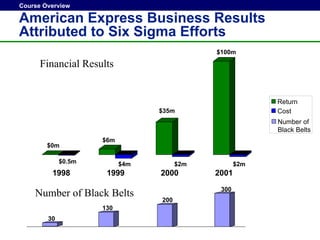
American Express Business Results
Attributed to Six Sigma Efforts
1998 1999 2000 2001
30
$0.5m
$0m
130
$4m
$6m
200
$35m
300
$2m
$100m
Return
Cost
$2m $2m
Number of
Black Belts
Financial Results
Number of Black Belts
Course Overview
Porque el actual interes en Six Sigma?
• Permite rastrear en forma de medidas la mejora.
• Crea un enfoque del proceso.
• Fuerza un enfoque en clientes a través de dirigirse en los
defectos.
• Aumenta muchos beneficios alineando los procesos con
clientes.
Six Sigma la Metodologia
Course Overview
Claves de la Metodologia Six Sigma
Para lograr seis sigma, un negocio debe estar excelente en el
manejo de los procesos existentes, mejorando los procesos
existentes, y diseñar los nuevos procesos.
Process
Management
Design
Improvement
Course Overview
Enfoque de los Procesos
A
A B
B C
C D
D E
E
L1
L2
L3
Customer Customer
DA DB DC DD DE
Course Overview
La apreciación global del Proceso y Dirección
del Método
Process Management
Process
Improvement/
Design
Planning
Develop Process
Management System
Use Process
Management System
2. Identify
Processes/
Requirements
Level 2
5. Change
Needed?
Yes
1. Set
Direction
Level 1
3.
Build
Monitoring
Plan
4. Monitor/
Control
6. Standardize
Strategic
Planning
7. Act
La dirección del proceso involucra la documentación, midiendo, supervisando,
y controlando los procesos para asegurar que los clientes que ' necesita para la
actuación del proceso eficaz y que el negocio necesitan para la eficacia está
simultáneamente satisfecho de la manera mejor posible.
No
Course Overview
Process Management
Voice
of
the
Customer
Process
Measurement
Roles
and
Responsibilities
Process
Review
Linking
and
Leveraging
Los 6 Pilares para administrar los Procesos
• VOC
• Flujo Procesos
• Mediciones
• Roles y
responsibilidades
• Revision de
Procesos
• Union y
Nivelacion del
proceso
Course Overview
Overview de la mejora del proceso
(DMAIC)
1
2
3
4
5
DEFINE
MEASURE
ANALYZE
IMPROVE
CONTROL
Course Overview
Overview al diseño del proceso (DESGN)
1
2
3
4
5
Define
Project
Evaluate
Requirements
Select
Concept
Generate
Design
ImplemeNt
Design
Six Sigma
Performance Metric
Course Overview
Entendiendo las metricas del proceso Six
Sigma.
¿Cuál es una medida del sigma?
Sigma es un indicador de la actuación que describe la capacidad
de un producto, servicio, proceso, y/o entrada de la actual forma
consistente o no y el futuro para definir los requisitos o
expectativas.
Course Overview
Que es Six Sigma?
• Sigma ( ) es un concepto
estadístico que representa
cuánta variación hay en un
proceso relativo a las
especificaciones del cliente
Too much variation Hard to produce output
within customer
requirements
(specifications)
Low sigma values (0–2)
Moderate variation Most output meets
customer requirements
Middle sigma values
(2–4.5)
Very little variation Virtually all output meets
customer requirements
High
(4.5–6)
sigma values
Course Overview
Al Aumentar un sigma del proceso nivelado, usted tiene que disminuir la variación.
Menos variación proporciona:
La previsibilidad mayor en el proceso
Menos desecho y rework que baja los costos
Los productos y servicios se realizan bien y duran más mucho tiempo
Los clientes más felices
Defects Defects
Too early Too late
Delivery Time
Reduce
variation
Delivery Time
Too early Too late
Spread of variation
too wide compared
to specifications
Spread of variation
narrow compared to
specifications
Importancia de Reducir la Variacion
Course Overview
Sigma DPMO YIELD Sigma DPMO YIELD
6 3.4 99.99966% 2.9 81,000 91.9%
5.9 5.4 99.99946% 2.8 97,000 90.3%
5.8 8.5 99.99915% 2.7 120,000 88.0%
5.7 13 99.99866% 2.6 140,000 86.0%
5.6 21 99.9979% 2.5 160,000 84.0%
5.5 32 99.9968% 2.4 180,000 82.0%
5.4 48 99.9952% 2.3 210,000 79.0%
5.3 72 99.9928% 2.2 240,000 76.0%
5.2 108 99.9892% 2.1 270,000 73.0%
Table del Proceso Sigma
Una porción del Proceso Sigma, Tabla:
Course Overview
¿Sigma real o Proporción de Mejora?
¿Cuál es mas importante, los sigma reales o la proporción de
mejora en el sigma?
El nivel de sigma de proceso calculado se influencia por como
usted define una “oportunidad”— las cuales pueden estar sujeto a
mucho debate.
A menudo, una medida más enfocada de dirección se ve cómo
proceso el sigma está cambiando:
Se reflejarán enfoque del cliente y mejora del proceso con un
aumento en el sigma del proceso.
Un sigma del proceso que sube por una unidad todos los años es
mucho más indicativo de un enfoque del cliente que un sigma del
proceso que están constante.
Course Overview
Champions
(Senior Leaders)
Six Sigma Infrastructura directiva
Process Management Teams Improvement/Design Projects
Black Belt
Members
Sponsor
MBB
or
BB
MBB
L2
Process Owner
Process Owner
Members
Members
L3
L4
L5
Process Owner
Members
Process Owner
Course Overview
El Champion - Rol
• Establece la dirección estratégica.
• Selecciona las áreas de enfoque de proceso importantes.
• Selecciona proyectos de mejora unidos a las necesidades del
negocio en las áreas de enfoque claves.
• Identifica el resposable para el equipo de mejora.
• Identifica al dueño del proceso y asegura su envolvimiento
apropiado y apoyo.
• Maneja el área del enfoque.
• Aprueba y pone al día asignación de recursos.
• Da las coordenadas e integra actividades y proyectos.
Course Overview
El Champion - Rol, cont.
• Realiza el progreso de las mejoras.
• Aprueba los cambios recomendados y proporciona el fondo de
recursos.
• Asegura que los sistemas de dirección pueden mantener las
ganancias por el negocio.
• Reconoce y comunica los esfuerzos.
Course Overview
Expert Resources Roles
Black Belts act as Team Leaders Master Black Belts act as Coaches
• Full-time project responsibility
• Focused on 1–2 teams
• Selection often dictated by projects
• Team leadership skills
• Project management skills
• Problem-solving skills
• Deliver Results
• Responsible for project’s
progress, planning team’s work,
link to management team
• Develop measures & controls
(data collection plans, process
control charts)
• May also be assigned to process
management team
• Full-time position
• Supports multiple teams
• Develop into expert resource
• Cross-functional experience
• Analytical/technical skills
• Coaching, mentoring, teaching
process skills
• Help assure Black Belts deliver results
• Develop Black Belts, facilitate team
successes, provide process
improvement and statistical/
technical expertise and training
• May also be assigned to process
management team
Description
Skills
Responsibilities
Course Overview
Resumen
• Sigma ( ) es un concepto estadístico que representa cuánta
variación hay en un proceso con respecto a las
especificaciones del cliente.
• Seis sigma es un acercamiento estratégico del negocio
enfocado en mejorar el desempeño continuamente y
relacionada a las especificaciones del cliente.
• Seis sigma incluye tres metodologías relacionadas: procesos
dirección, mejora del proceso, y plan del proceso
• La aplicación de Seis Sigma requiere roles específicos y
responsabilidades.
Overview
DMAIC—The Process
Improvement Method
Course Overview
Metas
• Podrán identificar los pasos y su sucesión en DMAIC.
• Podrán emparejar cada uno de los pasos con sus rendimientos.
• Será consciente de las herramientas y conceptos útil en cada
paso.
Course Overview
Porque usar metodos de mejoras?
• Proporciona una protección al
procesos.
• Proporciona el idioma común.
• Proporciona una lista de
control para prevenir saltos en
los pasos críticos.
• Le permite mejorar según
cómo usted mejora.
Course Overview
Overview of DMAIC
1
2
3
4
5
DEFINE
MEASURE
ANALYZE
IMPROVE
CONTROL
DMAIC
Course Overview
1
2
3
4
5
DEFINE
MEASURE
ANALYZE
IMPROVE
CONTROL
DEFINE: Define the Project
Meta
• Defina el propósito del proyecto
y alcance y consigue la
retroalimentación
en el proceso y cliente
Resultado
• Una declaración clara de la mejora intencional y cómo será medido
• Un mapa nivelado alto del proceso
• Una traducción de “la Voz del Cliente” y “Crítico A la Calidad”
Course Overview
Understand the
Voice of the Customer
Develop charter
Map the process
DEFINE, cont.
Approach
Course Overview
DEFINE, cont.
Herramientas
• Charter
• SIPOC analysis
diagramado de los
componentes
mayores de su
proceso.
S
U
P
P
L
I
E
R
S
C
U
S
T
O
M
E
R
S
Outputs
Inputs Process
Charter
Purpose:
Importance:
Resources:
Scope:
Schedule:
____
____
____
Course Overview
DEFINE, cont.
Herramientas
• Investigacion del
cliente, Entrevistas,
such as interviews,
encuestas, etc
• Pareto chart(s) dibujo
del porque el proyecto
es importante para el
cliente.
Pareto Chart of
Customer Priorities
10
20
30
40
50
60
70
80
Correct
information
Timely
Response
Friendly
staff
Price Other
#
of
problems
90
100
110
120
130
140
150
Course Overview
MEASURE: Medicion de la situacion actual
Meta
• Enfoque en la mejora
para conseguir mas
informacion de la situacion
Actual.
1
2
3
4
5
DEFINE
MEASURE
ANALYZE
IMPROVE
CONTROL
Course Overview
MEASURE, cont.
Resultado
• Datos que apuntan con precisión a la situación del problema u
ocurrencia.
• El dato básico en que el proceso se encuentra y que el cliente
necesita (para determinar el sigma del proceso actual)
• Entendiendo de cómo el proceso actual opera.
• Una declaración del problema más enfocada.
Course Overview
MEASURE, cont.
Herramientas
• Control charts o time
plots le ayudara a
oservar los patrones
sore el tiempo en las
variaciones
• Estratificacion
frequency plots revela
las diferencias y que tan
frecuente ocurren en el
proceso.
0
1000
-1000
10 20 30
UCL
X
LCL
Manufacturing
Service
Government
Course Overview
MEASURE, cont.
Herramientas
• Pareto charts
usado para
estratificar los
indicadores con
mayor
contriucion. A C D
Components of
the problem
A1 A2 A3 A4
La Declaración del
problema
“Nosotros hemos
apuntado con precisión
donde un específico
problema ocurre la
mayoría a menudo.
Subcomponents of
Problem A
B
Course Overview
MEASURE, cont.
Herremientas
• Process sigma
calculations este descrie la
actual capacidad del
proceso.
• Flowcharts Es un diujo
que muestra el flujo del
proceso (asi como los
pasos que no añaden valor)
1. Determine number of defect opportunities O =
per unit
2. Determine number of units processed N =
3. Determine total number of defects D =
made (include defects made and later fixed)
4. Calculate Defects Per Opportunity DPO= =
5. Calculate Yield Yield = (1-DPO) x 100 =
6. Look up Sigma in the Process Sigma Table
Process Sigma =
D
N x O
1
5000
250
.05
95%
3.2
Value-Added Cost-Added Only
Course Overview
ANALYZE: Analizar para identificar las causas
Meta
• Identificar las causas
raices y confirmarlas con
la data coletada.
Resultado
• En teoria, son las pruebas
y confirmaciones.
1
2
3
4
5
DEFINE
MEASURE
ANALYZE
IMPROVE
CONTROL
Course Overview
ANALYZE, cont.
Herramientas
• Cause-and-effect
diagrams nos muestran las
causas potenciales
• Diagrama de Arbol
Problem Statement
“Here is a clear,
specific problem.”
“Effect”
Cause
Cause
Verify
Root
Causes
Experiment
Trial implement
Collect additional data
Receivers are
out of office
for lunch
Back-up’s
don’t know
job well
Why?
Why?
Policy to only do
phones at lunch as
back-ups
Why?
Job training not a
priority; seen as a
cost
Why?
Why?
Back-up’s
take longer
to make
connections
No lunch
coverage policy
Receivers are
out of office
Less practice
No job aids
No job aids
High Turnover
No training
No job aids in
administration
areas
No job aids in
administration
areas
No lunch
coverage policy
Newest
employees
get this job
No recognition
of training needs
No training for
managers in process
improvement
Assume coverage
not needed
No system to ID
training needs
Perceive the job
as simple
No one likes the job
No job flexibility plan
Job training not a
priority; seen as a
cost
Job training not a
priority; seen as a
cost
Serving customers
not a priority
Management
doesn’t know job
Difficult, stressful job
Job training and
development not
a priority
Too long
to connect
calls during
lunch hour
No training for
managers in process
improvement
AH-011
Course Overview
ANALYZE, cont.
Herramientas
• Scatter plots muestra la
relacion que hay entre 2
variales pueden ayudar a
verificar la causa que esta
relacionada.
• Stratified frequency plots
Tamien puede confirmar los
modelos.
Y
X
Time With Customer
(in minutes)
Made the Sale
Did Not Make the Sale
5 10 15 20 25 30 35 40 45 50 55 60 >60
5 10 15 20 25 30 35 40 45 50 55 60 >60
Made the sale
Did not make the sale
Course Overview
IMPROVE: Implement Solutions &
Evaluate Results
Meta
• Desarrollos, pruebas, y soluciones del
instrumento que dirigen las causas raíz.
• Use los datos para evaluar las soluciones y
los planes los llevaba a cabo.
Resultado
• Plantación, acciones probadas que
eliminan o reducen el impacto de las
causas raíz identificadas.
• Antes de y Después de análisis de los datos
que muestra cuánto del hueco inicial estaba
cerrado.
• Una comparación del plan a la aplicación
real.
1
2
3
4
5
DEFINE
MEASURE
ANALYZE
IMPROVE
CONTROL
Course Overview
IMPROVE, cont.
Herramientas
• Matrix de
Prioritizacion
• Cuadro de
Responsibilidad
What Outcome Who When
1
3
2
4
5
Problem
Root
Cause
Counter-
measure
Potential Im
provem
ent
Ease
to
Im
plem
ent
Probability
of S
uccess
Total score
Action
Course Overview
IMPROVE, cont.
Herramientas
Gantt chart
Reduce Call Transfers
Update extension lists
ID
1
2
3
4
5
6
7
8
9
Dept supv. update job responsibility lists
Mark responsibilities on phone ext. list
Update names and extension numbers
Revise auto-attendant
Assemble team
Examine data
Decide what options should be given
Pilot and test new language
Task Name 5/31 6/7 6/14 6/21
MAY JUNE
6/28
Calvin, Max, Sheryl
Maria
Maria
Calvin
Team, TBD
Team, TBD
Course Overview
IMPROVE, cont.
Tools
• Control charts or
time plots Muestra el
pasado y el presente de
los indicadores de
desempeño.
• Pareto chart de las
medidas que confirma
la reduccion de la
causa raiz.
} Improvement
Before After
A1 A2 A3 A4 A2 A1 A3 A4
Before After
Changes
implemented
}Improvement
Target
} Remaining Gap
Good
Time
Course Overview
IMPROVE, cont.
Herramienta
• Revision del Process sigma calculations mostrando nuevos capacidades del proceso.
1. Determine number of defect opportunities O =
per unit
2. Determine number of units processed N =
3. Determine total number of defects D =
made (include defects made and later fixed)
4. Calculate Defects Per Opportunity DPO= =
5. Calculate Yield Yield = (1-DPO) x 100 =
6. Look up Sigma in the Process Sigma Table
Process Sigma =
D
N x O
1
5000
250
.05
95%
3.2
Old New
1
5500
103
.02
98%
3.6
Course Overview
CONTROL: Estandarizacion y desarrollo
de planes futuros.
Meta
• Mantener las ganancias regularizando
métodos de trabajo o procesos.
• Anticipar las mejoras futuras y
conservar las lecciones de este esfuerzo.
Resultado
• La documentación del nuevo método.
• Entrenamiento en el nuevo método.
• Un sistema por supervisar el uso consistente y por verificar los resultados.
• La documentación completada y comunicación de resultados, aprendizajes,
y recomendaciones.
1
2
3
4
5
DEFINE
MEASURE
ANALYZE
IMPROVE
CONTROL
Course Overview
CONTROL, cont.
Herramientas
• Administracion del Proceso
• “Normas Eminentes” que hacen
los nuevos metodos mas ovios.
Act Standard-
ize
Check Do
Training
Curriculum
Training
Manual
Fill to here
Warning
System
• Training
Course Overview
CONTROL, cont.
Tools
• Administracion del
Proceso
• Self-Audit
Work
Instructions
Control/Check Points Response to Abnormality
Notes
Code #
Charac-
teristics
Control
Limits Method Who
Immediate
Fix
Permanent
Fix
Who
Flowchart
2
12
Product Name
Process Name
Process Code #
Date of Issue: Issued by: Approved by:
Revision Date Reason Signature
1
Question:
Knowledge/Understanding
No
(Never)
Mostly
No
Some-
times
Mostly
Yes
Yes
(Always)
1. Have the performers seen the written
procedure?
2. Are the performers literate in the
language of the procedure?
3. Do the performers have a common
understanding of the words in the
procedure?
Course Overview
CONTROL, cont.
Herramientas
• Report
Plan
Do
Check
Act
Storyboard
Learnings
Recommendations
Results
•
•
•
next
• PDCA
Course Overview
Course Overview
Customer Complaints for Last Six Months
5
10
15
20
25
30
35
40
45
50
DEFINE: Define the Project
Charter
Reduce credit voucher
turnaround to about 10
days by June 1st (two
months). Use a cross-
sectional team of five
members. No
expenditures anticipated
other than time. Report to
Accounts Manager.
Course Overview
DEFINE, cont.
Setting the specification:
Set specification before
satisfaction drastically falls off
Time to Receive Credit Voucher
%
Who
Would
Be
Delighted
With
This
Level
of
Service
0 10 20 30
Days
0
25
50
75
100
Course Overview
DEFINE, cont.
Suppliers Inputs Process Outputs Customers
Customers
Returned product
Request for credit
Customer
returns product;
requests credit
Receiving
initiates credit
process
Cust. Service
and Tech
Service evaluate
request
Accounting
approves and
registers credit
Customer
service
processes credit
and closes files
Credited
amount on
customer’s
account
Accurate
computer
records
Customers
Cust. Service
Tech Service
Accounting
SIPOC Analysis for Credit Voucher Process
Course Overview
MEASURE: Measure the Current
Situation
Number of working days
to process vouchers
0
1
2
3
4
5
6
7
8
0–9
10–19
20–29
30–39
40–49
50–59
60–69
70–79
80–89
90–99
100+
110+
120+
130+
140+
150+
160+
170+
Days to Process
Count
Customer Requirement =
Less than 10 working days
Hands-on Time for Each Process Step
0
10
20
30
40
50
60
1 2 3 4 5 6 7 8 9 10 11 12
Process Step
Time
(mins.)
= time for that step
= cumulative time
Defect: Took longer than
10 days to complete
Process Sigma  0.1
 7.5%
40
3
Yield 
Course Overview
MEASURE, cont.
Records amt
returned
Files return
authorization
Copy of form to
receiving
Requests credit
Receive goods;
match authorzxn
Is credit needed?
Must goods be
returned?
Fill out form and
log information
Give cust.
authorization #
Sends returns to
company
Form and bill of
lading to CS
Calculates amt,
& updates log
Deployment Flowchart of Credit Vouchers Process
(first 12 steps only)
Step
Who
Sales
Customer
Services Receiving Accounting
Customer
Technical
Services
1
2
3
4
5
6
7
8
9
10
11
12
No
Yes
No
Yes
Course Overview
ANALYZE: Analyze to Identify Causes
Too long to
process
vouchers
I
n
f
o
r
m
a
t
i
o
n
n
o
t
c
e
n
t
r
a
l
i
z
e
d
T
h
r
e
e
l
e
v
e
l
s
o
f
a
p
p
r
o
v
a
l
n
e
e
d
e
d
Unclear who is approving what
S
t
a
f
f
c
a
n
’
t
t
e
l
l
w
h
y
v
o
u
c
h
e
r
s
a
r
e
r
e
q
u
e
s
t
e
d
Vouchers go through
unnecessary steps
*Unclear which vouchers
require which approvals
U
n
c
l
e
a
r
d
i
v
i
s
i
o
n
o
f
r
e
s
p
o
n
s
i
b
i
l
i
t
i
e
s
Multiple databases
Duplicate efforts in
processing vouchers
Voucher information
incomplete
*Information entered several times
Staff incorrectly fill out
voucher request form
Customer doesn’t or
can’t provide
complete information
I
n
v
o
i
c
e
c
a
l
c
u
l
a
t
i
o
n
s
i
n
c
o
r
r
e
c
t
I
n
v
o
i
c
e
d
o
e
s
n
’
t
m
a
t
c
h
w
h
a
t
w
a
s
s
h
i
p
p
e
d
Original invoice incorrect or
incomplete
C
u
s
t
o
m
e
r
m
i
s
p
l
a
c
e
s
o
r
i
g
i
n
a
l
i
n
v
o
i
c
e
P
u
r
c
h
a
s
i
n
g
a
g
e
n
t
d
o
e
s
n
’
t
h
a
v
e
i
n
v
o
i
c
e
Reason for return not indicated
Have to recreate
original order
I
n
f
o
r
m
a
t
i
o
n
i
n
c
o
m
p
u
t
e
r
f
i
l
e
s
i
n
c
o
r
r
e
c
t
Lack of priority
* = potential causes the team focused on
Course Overview
IMPROVE: Implement Solutions &
Evaluate Results
After evaluation, the team decided to try the following solutions:
• Eliminate unnecessary approval steps; clarifying which
vouchers needed approval/signatures
• Categorize vouchers based on the type of
information/approval needed
• Change the mindset from process vouchers “as time permits”
to “do it today”
• Create a single database for tracking vouchers
They worked first on clarifying what types of approval were
needed, then did a test for one week where they coded vouchers
accordingly. The results were successful, so they continued with
full-scale implementation.
Course Overview
3.0
Sigma
Process
93.5%
77
72
Yield



0
2
4
6
8
10
12
1 1 2 3 4 5 6 7 8 9 10 11 12 13
Days
Count
Customer Requirement
Time to Process Vouchers
0
1
2
3
4
5
6
7
8
0–9
10–19
20–29
30–39
40–49
50–59
60–69
70–79
80–89
90–99
100+
110+
120+
130+
140+
150+
160+
170+
Count
BEFORE
0–9
10–19
20–29
30–39
40–49
50–59
60–69
70–79
80–89
90–99
100+
110+
120+
130+
140+
150+
160+
170+
Count
AFTER
0
1
2
3
4
5
6
7
8
9
10
20
70
71
72
73
72
5
{
14
CONTROL: Standardize & Make Future
Plans
Course Overview
CONTROL, cont.
• New flowchart created
• Decision making clarified
• New shared database put in place and training provided to all
users
• Customer Service manager to maintain current data on “time
to resolve credits” and take appropriate actions as necessary
Course Overview
CONTROL, cont.
Communicating Results
• The team made a presentation to the managers and staff from all
departments involved
• A brief summary was printed in the company newsletter
Number of Vouchers per Month
Month
Number
of
Vouchers
0
50
100
150
200
250
July
Aug
Sept
Oct
Nov
Dec
Jan
Feb
Mar
Apr
May
June
July
Aug
Sept
Oct
median=85
1995 1996
Nov
Dec
Future Plans
• If appropriate, this team
would like to collaborate
with the other team assigned
to reduce the number of
vouchers
Course Overview
DMAIC Review
1
2
3
4
5
DEFINE
MEASURE
ANALYZE
IMPROVE
CONTROL
Module 1.1
Starting Your Project
Course Overview
Estamos Aqui
Understand the
Voice of the Customer
Develop charter
Map the process
Course Overview
Metas
• Podrán escribir una declaración del problema para su proyecto
Seis sigma usando el criterio de selección de proyecto.
• Podrán escribir una carta-Charter del equipo para su proyecto
Seis sigma incorporando los seis elementos básicos: el
propósito, importancia, alcance, entregas, medidas y recursos
• Podrán identificar las áreas en que sus proyectos Seis sigma
tendrán un impacto en el negocio y proporcionará una
estimación áspera del nivel de impacto
Course Overview
Contexto Organizacional para el Proceso del
proyecto Seis Sigma
Sponsor(s)
Coach
Leader
Members
Sigma
Team
AA-522.9
Executive Leadership Team
TEAM 3
TEAM 1 TEAM 2
Course Overview
Como este trabajo se hace?
Sponsor/
Leadership Team
Coach
(MBB)
Team Leader
(BB)
Team
Members
Draft charter
Discuss/revise charter
Review &
approve charter
Select project
Revision del Charter
Course Overview
Importancia del Charter del equipo
Una carta- Charter del equipo es un acuerdo entre la dirección y
el equipo, sobre lo que se espera.
El charter:
• Clarifica lo que se espera del equipo
• Mantiene el equipo enfocado
• Mantiene al equipo alineado con las prioridades de la
organización
• Trasfiere el proyecto del equipo de dirección y responsables al
equipo del proyecto
Course Overview
Revision de los elementos del charter del
equipo
• Proposito
• Importancia
• Alcance (focus)
• Alcance
• Mediciones (indicators)
• Recursos accesibles al equipo
Course Overview
Identificando los jugadores claves
Hay cuatro posiciones
mayores que necesitan ser
llenadas para que un
proyecto sea exitoso.
• El Líder del equipo
• Los Miembros del equipo
• Coach o Consejero
• Responsable (s) o Guía del
Equipo
Course Overview
Roles y Responsibilidades
Antes del Proyecto Durante el Proyecto Despues del Proyecto
Team
Leader
• Revisar el draft charter
con los Patrocinadores
• Desarrollar el charter
• Ayudar a seleccionar los
miembros del equipo
• Manejar los Programas
• Liderear las reuniones
• Coordinar lo que se va a
comunicar
• Servir como enlase entre
los resp.y los
patrocinadores del team
• Almacenar los records
• Hacer que el equipo
funcine
• Oservar que
documentacion es
completada.
• Monitorear si la
implementacion es
apropiada
• Usar metodos de mejora
Team
Members
• Participar en la reuniones
• Ejecutar las asignaciones
• Ayudar con las las tareas
y logistica del equipo
• Contribuir al
conocimiento y
expectatuvas del
proyecto
• Aprender los
conocimientos
• Use improved methods
Course Overview
Coach/
Advisor
• Asistir al Team Leader
• Ayudar en la creacion del
draft charter
• Proveer las guias y
ayudas a los miembros
• Ayudar al equipo a
interpretar la data
colectada
• Ayudar al Responsable
del equipo a preparar las
revisiones
Sponsor(s)
or Guidance
Team
• Identificar las metas
• Seleccionar el lider del
equipoy los Miembros
• Asignar a Soporte
• Realizar el charter junto
al lider
• Proveer las directrices y
guias
• Revisar el progreso del
equipo
• Oservar las interferencias
• Controlar el presupuesto
• Proveer suporte para la
implementacion
• Asegurar el monitoreo
• Preservar las lecciones
aprendidad
• Proveer las guias
necesarias.
Roles y Responsibilidades
Antes del Proyecto Durante el Proyecto Despues del Proyecto
Course Overview
Refinando la Definicion del proyecto
• La mayoría de los proyectos evoluciona. Algunos se lanzan al
precipicio desde el principio.
• En cada paso, usted aprenderá más sobre lo que realmente es.
• Esté abierto a revisar el
alcance, definición, y
propósito del proyecto.
• Verifique con su gerente
antes de hacer cualquier
cambio substantivo.
Module 1.2
Process Basics
Course Overview
Estamos Aqui
Understand the
Voice of the Customer
Develop charter
Map the process
Course Overview
Metas
• Podrá identificar el proceso de su trabajo y describir cómo
encaja con por lo menos tres de otros procesos como parte de
un sistema más grande.
• Podrá identificar a los proveedores, sus entregas,
rendimientos, y clientes de su proceso.
Course Overview
El trabajo como un sistema
Es Hacer Mejoras que nos exigen que veamos el trabajo como el
resultado de una serie de funciones interactivas, los
funcionamientos y métodos llamados sistemas o procesos.
Marketing Sales
Order Delivery Service
Customer
Products
Production
Production
Planning
Research
Product
Design
Raw Materials
& Supplies
Market Research
AA-023
Course Overview
Calidad, Sistemas y Procesos
• La calidad es juzgada por los clientes basados en el rendimiento
de un sistema o proceso.
• Enfocando el trabajo del obrero individual se no llegará a la
calidad grandemente mejorada.
• Al Mejorar la calidad, los sistema y procesos deben mejorarse.
• Simplemente enfocarse o definir un proceso no nos conduce a la
mejora tenemos que hacer los cambios y usar los datos para
mostrar el cambio, eso es la mejora.
Course Overview
• #2: Cuando combinamos el
valor del pensamiento en
terminos de procesos,
algunas personas se resisten
a eso.
• #3:La palabra “proceso”
genera miedo y resistencia.
Procesos
Toda actividad tiene lugar en los términos que se refiere a un proceso.
La calidad del proceso determina la calidad del rendimiento
Las lecciones a aprender.
#1: la mayoría de las personas no piensan por lo que se refiere a los
procesos. Ellos piensan más bien por lo que se refiere a los eventos
aislados.
Course Overview
El trabajo como un Proceso
• Aplica a todo lo que es trabajo, si es repetitivo en la naturaleza.
• Es cuando se tiene una vista nivelada del proceso .
• Define los límites del proyecto (empezando y acabando)
• Describe dónde coleccionar los datos.
S
U
P
P
L
I
E
R
S
C
U
S
T
O
M
E
R
S
Outputs
Inputs Process
AB-588.2
Course Overview
SIPOC: Inputs
Labor
Material
Ideas
Information
Environment
Process
Course Overview
SIPOC: High-Level vista del Proceso
• Una vision mas alta nos muestra un mejor alcance de mejoras
Step 1:
Check in
Step 2:
Preparation
Step 3:
Processing
Step 4:
Packaging/
Billing
Process
Course Overview
SIPOC: Outputs
Physical products
Documents
Information
Services
Decisions
Process
Course Overview
Preguntas que ayudan a entender el SIPOC
El propósito
¿Por qué este proceso existe?
¿Cuál es el propósito de este
proceso?
¿Cuál es el resultado?
Los rendimientos
¿Qué producto hace este proceso?
¿Cuáles son los rendimientos de
este proceso?
¿En qué punto este proceso acaba?
Clientes
¿Quién usa los productos de este
proceso?
¿Quiénes son los clientes de este
proceso?
Entradas / Proveedores
¿Dónde usa usted la información o
material que usted trabaja?
¿Quiénes son sus proveedores?
¿Qué ellos proporcionan?
¿Dónde ellos afectan el flujo del
proceso?
¿Qué efecto ellos tienen en el
proceso y en el resultado?
Los pasos del proceso
¿Qué pasa a cada entrada?
¿Qué actividades de la conversión
tienen lugar?
Course Overview
SIPOC Ejemplo
Making a photocopy
Original
Yourself
Office Supply
Company
Copies
Copier Setup
AB-588
Suppliers Inputs Process Outputs Customers
Put original
on glass
Close lid
Adjust
settings
Press
START
Remove
originals
and copies
You
File
Others
Paper
Course Overview
Project Worksheet #3, cont.
Suppliers Inputs Process Outputs Customers
Module 1.3
Entendiendo la
Voz del Cliente
Course Overview
Estamos Aqui
Understand the
Voice of the Customer
Develop charter
Map the process
Course Overview
Metas
• Podrán identificar a los clientes principales que usan su producto o servicio
y por lo menos dos segmentos del mercado que podrían ser relevantes a su
proyecto.
• Podrán escribir por lo menos seis puntos claves o preguntas abiertas para
ayudarle a aprender lo que es importante a sus clientes.
• Podrán identificar tres fuentes reactivas de datos y tres fuentes proactivas
de datos por lo menos para su proyecto.
• Podrán crear un plan preliminar para coleccionar sus datos de VOC.
• Podrán trabajar con otros miembros del equipo crear y un diagrama de
afinidad.
• Podrán clasificar a sus clientes, sus necesita y las tres categorías en un
diagrama de Kano.
• Podran usar un diagrama de árbol para identificar los CTQ - Crítico A la
Calidad y por lo menos una necesidad del cliente y las especificaciones
ellos.
Course Overview
Que es la Voz del Cliente?
La término Voz del
Cliente (VOC) se usa
para describir al
clientes, sus
necesidades y sus
percepciones de su
producto o servicio.
Course Overview
Porque el VOC es Critico?
El datos de VOC ayuda a la organización a:
• Decidir qué productos y servicios van a ofrecer.
• Identificar los rasgos críticos para esos productos y
servicios.
• Decidir dónde enfocar los esfuerzos de mejora.
• Consiguir una medida básica de satisfacción del cliente para
medir la mejora.
• Identificar las claves que manejan la satisfacción del cliente.
Course Overview
El Proceso VOC
Los resultados
• Una lista de clientes y segmentos del cliente.
• La identificación relevante de las fuentes reactivas y proactivas
de los datos.
• Verbal (o numérico), datos que identifican las necesidades del
cliente.
• Queda Definido lo Crítico A la Calidad.
• Las especificaciones para cada CTQ.
2.
Collect and
analyze
reactive
system data
then fill gaps
with proactive
approaches
3.
Analyze data
to generate a
key list of
customer
needs in their
language
4.
Translate the
customer
language into
CTQs
5.
Set
specifications
for CTQs
1.
Identify
customers and
determine
what you need
to know
Course Overview
Paso 1: Identificar los clientes y determinar que
usted Necesita saber de ellos
Meta:
• Identificar sus clientes
• Decidir que usted necesita saer acerca de sus necesidades
• Decidir cuando y como usted conseguira esta informacion
2.
Collect and
analyze
reactive
system data
then fill gaps
with proactive
approaches
3.
Analyze data
to generate a
key list of
customer
needs in their
language
4.
Translate the
customer
language into
CTQs
5.
Set
specifications
for CTQs
1.
Identify
customers
and
determine
what you
need to know
Course Overview
Quienes son Sus Clientes?
• ¿Cuáles son los rendimientos de su proceso? ¿Quiénes son los
clientes de ese rendimiento?
• ¿Hay grupos particulares de clientes cuyas necesidades son
especialmente importantes a su organización?
S
U
P
P
L
I
E
R
S
C
U
S
T
O
M
E
R
S
Outputs
Inputs Process
AB-588.2
Course Overview
Segmentacion de Clientes & Mercados
• Hay a menudo no hay una sola voz
del cliente. Diferentes Clientes o
tipos de clientes normalmente
tienen necesidades diferentes y
prioridades.
• Usted debe incluir una variedad
amplia de clientes en su
investigación inicial de clientes.
• Los diferentes tipos de clientes son
a menudo llamados segmentos del
mercado.
Customers
Course Overview
Segmentos Comunes del Mercado
• Estatus del cliente: Ex-clientes, los clientes actuales, clientes
de competidores, clientes suplentes.
• Donde ellos están en “la cadena del cliente”
¿Ex-usuario interior? ¿Distribuidor? O El usuario terminal.
• Tipo de producto o Servicios que ellos compran de usted.
• El volumen de compras: alto, elemento, bajo
• La geografía.
• Razón para comprar.
• La industria, división o sección.
• Demografia, como el género o Edad.
Course Overview
Decidiendo Que y Porque
• ¿Vuelva a Revisar su Charter – Cual es el propósito de su proyecto?
• ¿Cómo su propósito se relaciona a las necesidades del cliente?
• ¿Qué usted necesita
para saber sobre las
necesidades de los
clientes, usted ha
identificado las claves
para asegurar su
propósito del
proyecto?
Course Overview
Paso 2: Collectar y Analizar las datas
Reactivas y Proactivas
2.
Collect and
analyze
reactive
system data
then fill gaps
with proactive
approaches
3.
Analyze data
to generate a
key list of
customer
needs in their
language
4.
Translate the
customer
language into
CTQs
5.
Set
specifications
for CTQs
1.
Identify
customers and
determine
what you need
to know
Course Overview
Sistemas Basicos del VOC
1. Sistema Reactive
• La información viene a
usted si usted toma la
acción o no.
2. Sistema Proactive
• Usted necesita poner el
esfuerzo en recoger la
información.
Course Overview
Sistema Reactivo Tipico del VOC
• Las quejas del cliente (teléfono
o escrito)
• Las llamadas de asistencia
técnica.
• Las demandas, los créditos, los
pagos disputados.
• La información de retorno de
producto, recall.
• Problema o servicio las líneas
calientes
• Las llamadas de servicio de cliente
• Los Reportes de ventas.
• Las demandas de la garantía.
• Las actividades de páginas Web.
Los sistemas reactivos generalmente recogen los datos desde:
• Problemas del cliente actuales y anteriores.
• Los clientes actuales y anteriores en base a las necesidades.
• Los clientes actuales y anteriores interesados en los productos o
servicios en particular.
Course Overview
Sistema Proactivo Tipico del VOC
• Observación directa del cliente.
• Entrevistas.
• Enfoque en los grupos.
• Estudios de los clientes.
• Tarjetas de comentarios.
• Datos que se recogen durante visitas de las ventas o llamadas.
• La investigación del mercado, monitoreo del mercado.
• Benchmarking.
Course Overview
Reaccionando a los prolemas de los
clientes: Nivel de mejoras
AC-849
System
How to
Produce it
Process
Inputs
Measurements Machines
Methods People Environment
Produce it
Policies
Fix
Product
Store
Product
Customer
Output
LEVEL 1: FIX THE OUTPUT
LEVEL 2: FIX THE PROCESS
LEVEL 3: FIX THE SYSTEM
What to
Produce
Course Overview
Paso 3:
Analizando la Data del cliente.
• La meta es generar una lista de necesidades importantes del
cliente en su idioma.
• Muchos de los datos que usted recaudó en los pasos anteriores
será de datos verbales. Es útil resumir esta información de una
manera significante, quizás usando un diagrama de afinidad.
specifications
2.
Collect and
analyze
reactive
system data
then fill gaps
with proactive
approaches
3.
Analyze data
to generate a
key list of
customer
needs in their
language
4.
Translate the
customer
language into
CTQs
5.
Set
for CTQs
1.
Identify
customers and
determine
what you need
to know
Course Overview
Un diagrama de
afinidad es una
herramienta que
organiza los datos en
el idioma relacionado
a los grupos.
Diagram de Afinidad
Theme 1
Need 1 Need 2
Theme 2
Need 3 Need 4
Need 5
Theme 3
Need 7
Need 8
Course Overview
Uso del Diagrama de Afinidad
• Ayuda a entender los problemas muy grandes o complejos.
• Revela los diferentes tipos de pensamiento del proceso.
• Encuentra los problemas en las montañas de datos.
• Organiza las ideas, los problemas, las opiniones, etc.
Course Overview
paso 4: Definiendo los CTQs
Un CTQ útil tendrá las características siguientes:
1. Es verdaderamente crítico a la percepción del cliente de
calidad.
2. Puede medirse.
3. Una especificación puede ponerse para decir
Si o No el CTQ se ha logrado.
2.
Collect and
analyze
reactive
system data
then fill gaps
with proactive
approaches
3.
Analyze data
to generate a
key list of
customer
needs in their
language
4.
Translate the
customer
language into
CTQs
5.
Set
specifications
for CTQs
1.
Identify
customers and
determine
what you need
to know
Course Overview
Transladando el VOC hacia CTQs
(CTQ = Critical To Quality)
need
VOC CTQ Tree
I want
CTQ
CTQ
CTQ
CTQ
CTQ
CTQ
CTQ
CTQ
Course Overview
Ejemplo: Arbol del CTQ
General Specific
Hard to measure Easy to measure
Good
Customer
Service
Conocedor
reps
Las respuestas son correctas
Repuestas pueden ser respondidas
Sin necesidad de investigarlas
Investidacion de la informacion
De manera rapida
Amistoso en las reps El cliente saluda con su nomre
No interrumpe al cliente
Esperas cortas Tiempo de espera
Trasnfiere al cliente
A otra persona en caso de ayuda
Need Drivers CTQs
Course Overview
Paso 5: Seteo de las Especificaciones
specifications
2.
Collect and
analyze
reactive
system data
then fill gaps
with proactive
approaches
3.
Analyze data
to generate a
key list of
customer
needs in their
language
4.
Translate the
customer
language into
CTQs
5.
Set
for CTQs
1.
Identify
customers and
determine
what you need
to know
Course Overview
Room temperature (°F)
%
satisfied
100%
0%
68° 69° 70° 72° 74°
73° 75° 76°
69°
67°
66° 71°
Set lower
specification here
Set upper
specification here
Set specification
here
Time to Answer Phone Call
%
satisfied
0 5 10 15 20 25 30
Time (secs)
0
25
50
75
100
Especificaciones para CTQs
• En manufactura, los límites
de la especificación vienen
a menudo de los requisitos
técnicos o mecánicos y nos
dan una visión de que tan
bien o mal se esta de
alcanzar los objetivos.

Modulo de six sigma-Introductions and Expectations

  • 2.
    Course Overview Introductions andExpectations Introducion del equipo de trabajo: • Nomres • Trabajo • Expectativas del modulo
  • 3.
    Course Overview Objectivos Este cursoayudará a la mejora del sigma y de los miembros que hacen las mejoras en su proceso usando el método de DMAIC. Al final de esta sesión, los participantes serán capaces de: • Poder explicar las condiciones en general de lo que el “seis sigma” se refiere y por qué es pertinente procesar la mejora. • Podrá identificar los pasos y la secuencia del DMAIC junto con el rendimiento y herramientas en cada paso • Podrá DEFINIR el propósito de un proyecto y alcance y conseguir la retroalimentación del cliente. • Podra enfocar sus esfuerzos de mejora en la MEDIDA recogiendo la información sobre la situación actual.
  • 4.
    Course Overview Objectivos (cont.) •Podrá identificar las causas raíz en ANALIZAR y confírmar con los datos. • Podrá desarrollar, probrar y solucionar con el instrumento MEJORA esa causa de raíz y usar los datos para evaluar sus soluciones y los planes a llevar a cabo. • Podra CONTROLAR el proceso y mantener las ganancias regularizando métodos de trabajo o procesos, mientras anticipa las mejoras futuras y conserva las lecciones de su proyecto.
  • 5.
  • 6.
    Course Overview Que esSix Sigma? • Acercamiento • Filosofía • visión • Métricas de desempeño • Referencia • Meta • Infraestructura de mejora • Las herramientas • Disciplina y Actitud
  • 7.
    Course Overview Historia deSix Sigma • Frederick W. Taylor en los 1890s y temprano 1900s: • El estudio sistemático de Taylor del uso de tiempo y movimiento de obreros, prefiguró la aplicación de Walter Shewhart de métodos estadísticos al mando de fabricar la calidad en los años veinte. • El Segunda Guerra Mundial: • La aplicación de matemática a los problemas de producción y mando de calidad ayudados y disminucion de la proporción de fracaso. • La dirección se interesó y continuo los programas de mando de calidad después de la guerra. • W.E. Deming y Joseph Juran tomaron el mando de calidad en Japón en 1953 y los años sesenta vio una ola en el crecimiento de calidad en Japón. • En los años ochenta el NBC el Papel Blanco “Si Japón puede…Porque no Podemos Nosotros?” estimuló un interés aumentado la Calidad y Dirección de Calidad de Total.
  • 8.
    Course Overview GE’s Journeyto Six Sigma Quality Time Work-Out Town Meetings: Empowerment, Bureaucracy Busting Productivity/Best Practices: Looking Outside GE Change Acceleration Process: Increase Success and Accelerate Change Process Improvement: Continuous Improvement, Reengineering Key Strategic Initiatives: QMI, NPI, OTR, SM, Productivity, Globalization Six Sigma Quality: The Road to Customer Impact 1990 Low Intens ity High 1997
  • 9.
    Course Overview American ExpressBusiness Results Attributed to Six Sigma Efforts 1998 1999 2000 2001 30 $0.5m $0m 130 $4m $6m 200 $35m 300 $2m $100m Return Cost $2m $2m Number of Black Belts Financial Results Number of Black Belts
  • 10.
    Course Overview Porque elactual interes en Six Sigma? • Permite rastrear en forma de medidas la mejora. • Crea un enfoque del proceso. • Fuerza un enfoque en clientes a través de dirigirse en los defectos. • Aumenta muchos beneficios alineando los procesos con clientes.
  • 11.
    Six Sigma laMetodologia
  • 12.
    Course Overview Claves dela Metodologia Six Sigma Para lograr seis sigma, un negocio debe estar excelente en el manejo de los procesos existentes, mejorando los procesos existentes, y diseñar los nuevos procesos. Process Management Design Improvement
  • 13.
    Course Overview Enfoque delos Procesos A A B B C C D D E E L1 L2 L3 Customer Customer DA DB DC DD DE
  • 14.
    Course Overview La apreciaciónglobal del Proceso y Dirección del Método Process Management Process Improvement/ Design Planning Develop Process Management System Use Process Management System 2. Identify Processes/ Requirements Level 2 5. Change Needed? Yes 1. Set Direction Level 1 3. Build Monitoring Plan 4. Monitor/ Control 6. Standardize Strategic Planning 7. Act La dirección del proceso involucra la documentación, midiendo, supervisando, y controlando los procesos para asegurar que los clientes que ' necesita para la actuación del proceso eficaz y que el negocio necesitan para la eficacia está simultáneamente satisfecho de la manera mejor posible. No
  • 15.
    Course Overview Process Management Voice of the Customer Process Measurement Roles and Responsibilities Process Review Linking and Leveraging Los6 Pilares para administrar los Procesos • VOC • Flujo Procesos • Mediciones • Roles y responsibilidades • Revision de Procesos • Union y Nivelacion del proceso
  • 16.
    Course Overview Overview dela mejora del proceso (DMAIC) 1 2 3 4 5 DEFINE MEASURE ANALYZE IMPROVE CONTROL
  • 17.
    Course Overview Overview aldiseño del proceso (DESGN) 1 2 3 4 5 Define Project Evaluate Requirements Select Concept Generate Design ImplemeNt Design
  • 18.
  • 19.
    Course Overview Entendiendo lasmetricas del proceso Six Sigma. ¿Cuál es una medida del sigma? Sigma es un indicador de la actuación que describe la capacidad de un producto, servicio, proceso, y/o entrada de la actual forma consistente o no y el futuro para definir los requisitos o expectativas.
  • 20.
    Course Overview Que esSix Sigma? • Sigma ( ) es un concepto estadístico que representa cuánta variación hay en un proceso relativo a las especificaciones del cliente Too much variation Hard to produce output within customer requirements (specifications) Low sigma values (0–2) Moderate variation Most output meets customer requirements Middle sigma values (2–4.5) Very little variation Virtually all output meets customer requirements High (4.5–6) sigma values
  • 21.
    Course Overview Al Aumentarun sigma del proceso nivelado, usted tiene que disminuir la variación. Menos variación proporciona: La previsibilidad mayor en el proceso Menos desecho y rework que baja los costos Los productos y servicios se realizan bien y duran más mucho tiempo Los clientes más felices Defects Defects Too early Too late Delivery Time Reduce variation Delivery Time Too early Too late Spread of variation too wide compared to specifications Spread of variation narrow compared to specifications Importancia de Reducir la Variacion
  • 22.
    Course Overview Sigma DPMOYIELD Sigma DPMO YIELD 6 3.4 99.99966% 2.9 81,000 91.9% 5.9 5.4 99.99946% 2.8 97,000 90.3% 5.8 8.5 99.99915% 2.7 120,000 88.0% 5.7 13 99.99866% 2.6 140,000 86.0% 5.6 21 99.9979% 2.5 160,000 84.0% 5.5 32 99.9968% 2.4 180,000 82.0% 5.4 48 99.9952% 2.3 210,000 79.0% 5.3 72 99.9928% 2.2 240,000 76.0% 5.2 108 99.9892% 2.1 270,000 73.0% Table del Proceso Sigma Una porción del Proceso Sigma, Tabla:
  • 23.
    Course Overview ¿Sigma realo Proporción de Mejora? ¿Cuál es mas importante, los sigma reales o la proporción de mejora en el sigma? El nivel de sigma de proceso calculado se influencia por como usted define una “oportunidad”— las cuales pueden estar sujeto a mucho debate. A menudo, una medida más enfocada de dirección se ve cómo proceso el sigma está cambiando: Se reflejarán enfoque del cliente y mejora del proceso con un aumento en el sigma del proceso. Un sigma del proceso que sube por una unidad todos los años es mucho más indicativo de un enfoque del cliente que un sigma del proceso que están constante.
  • 24.
    Course Overview Champions (Senior Leaders) SixSigma Infrastructura directiva Process Management Teams Improvement/Design Projects Black Belt Members Sponsor MBB or BB MBB L2 Process Owner Process Owner Members Members L3 L4 L5 Process Owner Members Process Owner
  • 25.
    Course Overview El Champion- Rol • Establece la dirección estratégica. • Selecciona las áreas de enfoque de proceso importantes. • Selecciona proyectos de mejora unidos a las necesidades del negocio en las áreas de enfoque claves. • Identifica el resposable para el equipo de mejora. • Identifica al dueño del proceso y asegura su envolvimiento apropiado y apoyo. • Maneja el área del enfoque. • Aprueba y pone al día asignación de recursos. • Da las coordenadas e integra actividades y proyectos.
  • 26.
    Course Overview El Champion- Rol, cont. • Realiza el progreso de las mejoras. • Aprueba los cambios recomendados y proporciona el fondo de recursos. • Asegura que los sistemas de dirección pueden mantener las ganancias por el negocio. • Reconoce y comunica los esfuerzos.
  • 27.
    Course Overview Expert ResourcesRoles Black Belts act as Team Leaders Master Black Belts act as Coaches • Full-time project responsibility • Focused on 1–2 teams • Selection often dictated by projects • Team leadership skills • Project management skills • Problem-solving skills • Deliver Results • Responsible for project’s progress, planning team’s work, link to management team • Develop measures & controls (data collection plans, process control charts) • May also be assigned to process management team • Full-time position • Supports multiple teams • Develop into expert resource • Cross-functional experience • Analytical/technical skills • Coaching, mentoring, teaching process skills • Help assure Black Belts deliver results • Develop Black Belts, facilitate team successes, provide process improvement and statistical/ technical expertise and training • May also be assigned to process management team Description Skills Responsibilities
  • 28.
    Course Overview Resumen • Sigma( ) es un concepto estadístico que representa cuánta variación hay en un proceso con respecto a las especificaciones del cliente. • Seis sigma es un acercamiento estratégico del negocio enfocado en mejorar el desempeño continuamente y relacionada a las especificaciones del cliente. • Seis sigma incluye tres metodologías relacionadas: procesos dirección, mejora del proceso, y plan del proceso • La aplicación de Seis Sigma requiere roles específicos y responsabilidades.
  • 29.
  • 30.
    Course Overview Metas • Podránidentificar los pasos y su sucesión en DMAIC. • Podrán emparejar cada uno de los pasos con sus rendimientos. • Será consciente de las herramientas y conceptos útil en cada paso.
  • 31.
    Course Overview Porque usarmetodos de mejoras? • Proporciona una protección al procesos. • Proporciona el idioma común. • Proporciona una lista de control para prevenir saltos en los pasos críticos. • Le permite mejorar según cómo usted mejora.
  • 32.
    Course Overview Overview ofDMAIC 1 2 3 4 5 DEFINE MEASURE ANALYZE IMPROVE CONTROL
  • 33.
  • 34.
    Course Overview 1 2 3 4 5 DEFINE MEASURE ANALYZE IMPROVE CONTROL DEFINE: Definethe Project Meta • Defina el propósito del proyecto y alcance y consigue la retroalimentación en el proceso y cliente Resultado • Una declaración clara de la mejora intencional y cómo será medido • Un mapa nivelado alto del proceso • Una traducción de “la Voz del Cliente” y “Crítico A la Calidad”
  • 35.
    Course Overview Understand the Voiceof the Customer Develop charter Map the process DEFINE, cont. Approach
  • 36.
    Course Overview DEFINE, cont. Herramientas •Charter • SIPOC analysis diagramado de los componentes mayores de su proceso. S U P P L I E R S C U S T O M E R S Outputs Inputs Process Charter Purpose: Importance: Resources: Scope: Schedule: ____ ____ ____
  • 37.
    Course Overview DEFINE, cont. Herramientas •Investigacion del cliente, Entrevistas, such as interviews, encuestas, etc • Pareto chart(s) dibujo del porque el proyecto es importante para el cliente. Pareto Chart of Customer Priorities 10 20 30 40 50 60 70 80 Correct information Timely Response Friendly staff Price Other # of problems 90 100 110 120 130 140 150
  • 38.
    Course Overview MEASURE: Medicionde la situacion actual Meta • Enfoque en la mejora para conseguir mas informacion de la situacion Actual. 1 2 3 4 5 DEFINE MEASURE ANALYZE IMPROVE CONTROL
  • 39.
    Course Overview MEASURE, cont. Resultado •Datos que apuntan con precisión a la situación del problema u ocurrencia. • El dato básico en que el proceso se encuentra y que el cliente necesita (para determinar el sigma del proceso actual) • Entendiendo de cómo el proceso actual opera. • Una declaración del problema más enfocada.
  • 40.
    Course Overview MEASURE, cont. Herramientas •Control charts o time plots le ayudara a oservar los patrones sore el tiempo en las variaciones • Estratificacion frequency plots revela las diferencias y que tan frecuente ocurren en el proceso. 0 1000 -1000 10 20 30 UCL X LCL Manufacturing Service Government
  • 41.
    Course Overview MEASURE, cont. Herramientas •Pareto charts usado para estratificar los indicadores con mayor contriucion. A C D Components of the problem A1 A2 A3 A4 La Declaración del problema “Nosotros hemos apuntado con precisión donde un específico problema ocurre la mayoría a menudo. Subcomponents of Problem A B
  • 42.
    Course Overview MEASURE, cont. Herremientas •Process sigma calculations este descrie la actual capacidad del proceso. • Flowcharts Es un diujo que muestra el flujo del proceso (asi como los pasos que no añaden valor) 1. Determine number of defect opportunities O = per unit 2. Determine number of units processed N = 3. Determine total number of defects D = made (include defects made and later fixed) 4. Calculate Defects Per Opportunity DPO= = 5. Calculate Yield Yield = (1-DPO) x 100 = 6. Look up Sigma in the Process Sigma Table Process Sigma = D N x O 1 5000 250 .05 95% 3.2 Value-Added Cost-Added Only
  • 43.
    Course Overview ANALYZE: Analizarpara identificar las causas Meta • Identificar las causas raices y confirmarlas con la data coletada. Resultado • En teoria, son las pruebas y confirmaciones. 1 2 3 4 5 DEFINE MEASURE ANALYZE IMPROVE CONTROL
  • 44.
    Course Overview ANALYZE, cont. Herramientas •Cause-and-effect diagrams nos muestran las causas potenciales • Diagrama de Arbol Problem Statement “Here is a clear, specific problem.” “Effect” Cause Cause Verify Root Causes Experiment Trial implement Collect additional data Receivers are out of office for lunch Back-up’s don’t know job well Why? Why? Policy to only do phones at lunch as back-ups Why? Job training not a priority; seen as a cost Why? Why? Back-up’s take longer to make connections No lunch coverage policy Receivers are out of office Less practice No job aids No job aids High Turnover No training No job aids in administration areas No job aids in administration areas No lunch coverage policy Newest employees get this job No recognition of training needs No training for managers in process improvement Assume coverage not needed No system to ID training needs Perceive the job as simple No one likes the job No job flexibility plan Job training not a priority; seen as a cost Job training not a priority; seen as a cost Serving customers not a priority Management doesn’t know job Difficult, stressful job Job training and development not a priority Too long to connect calls during lunch hour No training for managers in process improvement AH-011
  • 45.
    Course Overview ANALYZE, cont. Herramientas •Scatter plots muestra la relacion que hay entre 2 variales pueden ayudar a verificar la causa que esta relacionada. • Stratified frequency plots Tamien puede confirmar los modelos. Y X Time With Customer (in minutes) Made the Sale Did Not Make the Sale 5 10 15 20 25 30 35 40 45 50 55 60 >60 5 10 15 20 25 30 35 40 45 50 55 60 >60 Made the sale Did not make the sale
  • 46.
    Course Overview IMPROVE: ImplementSolutions & Evaluate Results Meta • Desarrollos, pruebas, y soluciones del instrumento que dirigen las causas raíz. • Use los datos para evaluar las soluciones y los planes los llevaba a cabo. Resultado • Plantación, acciones probadas que eliminan o reducen el impacto de las causas raíz identificadas. • Antes de y Después de análisis de los datos que muestra cuánto del hueco inicial estaba cerrado. • Una comparación del plan a la aplicación real. 1 2 3 4 5 DEFINE MEASURE ANALYZE IMPROVE CONTROL
  • 47.
    Course Overview IMPROVE, cont. Herramientas •Matrix de Prioritizacion • Cuadro de Responsibilidad What Outcome Who When 1 3 2 4 5 Problem Root Cause Counter- measure Potential Im provem ent Ease to Im plem ent Probability of S uccess Total score Action
  • 48.
    Course Overview IMPROVE, cont. Herramientas Ganttchart Reduce Call Transfers Update extension lists ID 1 2 3 4 5 6 7 8 9 Dept supv. update job responsibility lists Mark responsibilities on phone ext. list Update names and extension numbers Revise auto-attendant Assemble team Examine data Decide what options should be given Pilot and test new language Task Name 5/31 6/7 6/14 6/21 MAY JUNE 6/28 Calvin, Max, Sheryl Maria Maria Calvin Team, TBD Team, TBD
  • 49.
    Course Overview IMPROVE, cont. Tools •Control charts or time plots Muestra el pasado y el presente de los indicadores de desempeño. • Pareto chart de las medidas que confirma la reduccion de la causa raiz. } Improvement Before After A1 A2 A3 A4 A2 A1 A3 A4 Before After Changes implemented }Improvement Target } Remaining Gap Good Time
  • 50.
    Course Overview IMPROVE, cont. Herramienta •Revision del Process sigma calculations mostrando nuevos capacidades del proceso. 1. Determine number of defect opportunities O = per unit 2. Determine number of units processed N = 3. Determine total number of defects D = made (include defects made and later fixed) 4. Calculate Defects Per Opportunity DPO= = 5. Calculate Yield Yield = (1-DPO) x 100 = 6. Look up Sigma in the Process Sigma Table Process Sigma = D N x O 1 5000 250 .05 95% 3.2 Old New 1 5500 103 .02 98% 3.6
  • 51.
    Course Overview CONTROL: Estandarizaciony desarrollo de planes futuros. Meta • Mantener las ganancias regularizando métodos de trabajo o procesos. • Anticipar las mejoras futuras y conservar las lecciones de este esfuerzo. Resultado • La documentación del nuevo método. • Entrenamiento en el nuevo método. • Un sistema por supervisar el uso consistente y por verificar los resultados. • La documentación completada y comunicación de resultados, aprendizajes, y recomendaciones. 1 2 3 4 5 DEFINE MEASURE ANALYZE IMPROVE CONTROL
  • 52.
    Course Overview CONTROL, cont. Herramientas •Administracion del Proceso • “Normas Eminentes” que hacen los nuevos metodos mas ovios. Act Standard- ize Check Do Training Curriculum Training Manual Fill to here Warning System • Training
  • 53.
    Course Overview CONTROL, cont. Tools •Administracion del Proceso • Self-Audit Work Instructions Control/Check Points Response to Abnormality Notes Code # Charac- teristics Control Limits Method Who Immediate Fix Permanent Fix Who Flowchart 2 12 Product Name Process Name Process Code # Date of Issue: Issued by: Approved by: Revision Date Reason Signature 1 Question: Knowledge/Understanding No (Never) Mostly No Some- times Mostly Yes Yes (Always) 1. Have the performers seen the written procedure? 2. Are the performers literate in the language of the procedure? 3. Do the performers have a common understanding of the words in the procedure?
  • 54.
    Course Overview CONTROL, cont. Herramientas •Report Plan Do Check Act Storyboard Learnings Recommendations Results • • • next • PDCA
  • 55.
  • 56.
    Course Overview Customer Complaintsfor Last Six Months 5 10 15 20 25 30 35 40 45 50 DEFINE: Define the Project Charter Reduce credit voucher turnaround to about 10 days by June 1st (two months). Use a cross- sectional team of five members. No expenditures anticipated other than time. Report to Accounts Manager.
  • 57.
    Course Overview DEFINE, cont. Settingthe specification: Set specification before satisfaction drastically falls off Time to Receive Credit Voucher % Who Would Be Delighted With This Level of Service 0 10 20 30 Days 0 25 50 75 100
  • 58.
    Course Overview DEFINE, cont. SuppliersInputs Process Outputs Customers Customers Returned product Request for credit Customer returns product; requests credit Receiving initiates credit process Cust. Service and Tech Service evaluate request Accounting approves and registers credit Customer service processes credit and closes files Credited amount on customer’s account Accurate computer records Customers Cust. Service Tech Service Accounting SIPOC Analysis for Credit Voucher Process
  • 59.
    Course Overview MEASURE: Measurethe Current Situation Number of working days to process vouchers 0 1 2 3 4 5 6 7 8 0–9 10–19 20–29 30–39 40–49 50–59 60–69 70–79 80–89 90–99 100+ 110+ 120+ 130+ 140+ 150+ 160+ 170+ Days to Process Count Customer Requirement = Less than 10 working days Hands-on Time for Each Process Step 0 10 20 30 40 50 60 1 2 3 4 5 6 7 8 9 10 11 12 Process Step Time (mins.) = time for that step = cumulative time Defect: Took longer than 10 days to complete Process Sigma  0.1  7.5% 40 3 Yield 
  • 60.
    Course Overview MEASURE, cont. Recordsamt returned Files return authorization Copy of form to receiving Requests credit Receive goods; match authorzxn Is credit needed? Must goods be returned? Fill out form and log information Give cust. authorization # Sends returns to company Form and bill of lading to CS Calculates amt, & updates log Deployment Flowchart of Credit Vouchers Process (first 12 steps only) Step Who Sales Customer Services Receiving Accounting Customer Technical Services 1 2 3 4 5 6 7 8 9 10 11 12 No Yes No Yes
  • 61.
    Course Overview ANALYZE: Analyzeto Identify Causes Too long to process vouchers I n f o r m a t i o n n o t c e n t r a l i z e d T h r e e l e v e l s o f a p p r o v a l n e e d e d Unclear who is approving what S t a f f c a n ’ t t e l l w h y v o u c h e r s a r e r e q u e s t e d Vouchers go through unnecessary steps *Unclear which vouchers require which approvals U n c l e a r d i v i s i o n o f r e s p o n s i b i l i t i e s Multiple databases Duplicate efforts in processing vouchers Voucher information incomplete *Information entered several times Staff incorrectly fill out voucher request form Customer doesn’t or can’t provide complete information I n v o i c e c a l c u l a t i o n s i n c o r r e c t I n v o i c e d o e s n ’ t m a t c h w h a t w a s s h i p p e d Original invoice incorrect or incomplete C u s t o m e r m i s p l a c e s o r i g i n a l i n v o i c e P u r c h a s i n g a g e n t d o e s n ’ t h a v e i n v o i c e Reason for return not indicated Have to recreate original order I n f o r m a t i o n i n c o m p u t e r f i l e s i n c o r r e c t Lack of priority * = potential causes the team focused on
  • 62.
    Course Overview IMPROVE: ImplementSolutions & Evaluate Results After evaluation, the team decided to try the following solutions: • Eliminate unnecessary approval steps; clarifying which vouchers needed approval/signatures • Categorize vouchers based on the type of information/approval needed • Change the mindset from process vouchers “as time permits” to “do it today” • Create a single database for tracking vouchers They worked first on clarifying what types of approval were needed, then did a test for one week where they coded vouchers accordingly. The results were successful, so they continued with full-scale implementation.
  • 63.
    Course Overview 3.0 Sigma Process 93.5% 77 72 Yield    0 2 4 6 8 10 12 1 12 3 4 5 6 7 8 9 10 11 12 13 Days Count Customer Requirement Time to Process Vouchers 0 1 2 3 4 5 6 7 8 0–9 10–19 20–29 30–39 40–49 50–59 60–69 70–79 80–89 90–99 100+ 110+ 120+ 130+ 140+ 150+ 160+ 170+ Count BEFORE 0–9 10–19 20–29 30–39 40–49 50–59 60–69 70–79 80–89 90–99 100+ 110+ 120+ 130+ 140+ 150+ 160+ 170+ Count AFTER 0 1 2 3 4 5 6 7 8 9 10 20 70 71 72 73 72 5 { 14 CONTROL: Standardize & Make Future Plans
  • 64.
    Course Overview CONTROL, cont. •New flowchart created • Decision making clarified • New shared database put in place and training provided to all users • Customer Service manager to maintain current data on “time to resolve credits” and take appropriate actions as necessary
  • 65.
    Course Overview CONTROL, cont. CommunicatingResults • The team made a presentation to the managers and staff from all departments involved • A brief summary was printed in the company newsletter Number of Vouchers per Month Month Number of Vouchers 0 50 100 150 200 250 July Aug Sept Oct Nov Dec Jan Feb Mar Apr May June July Aug Sept Oct median=85 1995 1996 Nov Dec Future Plans • If appropriate, this team would like to collaborate with the other team assigned to reduce the number of vouchers
  • 66.
  • 67.
  • 68.
    Course Overview Estamos Aqui Understandthe Voice of the Customer Develop charter Map the process
  • 69.
    Course Overview Metas • Podránescribir una declaración del problema para su proyecto Seis sigma usando el criterio de selección de proyecto. • Podrán escribir una carta-Charter del equipo para su proyecto Seis sigma incorporando los seis elementos básicos: el propósito, importancia, alcance, entregas, medidas y recursos • Podrán identificar las áreas en que sus proyectos Seis sigma tendrán un impacto en el negocio y proporcionará una estimación áspera del nivel de impacto
  • 70.
    Course Overview Contexto Organizacionalpara el Proceso del proyecto Seis Sigma Sponsor(s) Coach Leader Members Sigma Team AA-522.9 Executive Leadership Team TEAM 3 TEAM 1 TEAM 2
  • 71.
    Course Overview Como estetrabajo se hace? Sponsor/ Leadership Team Coach (MBB) Team Leader (BB) Team Members Draft charter Discuss/revise charter Review & approve charter Select project
  • 72.
  • 73.
    Course Overview Importancia delCharter del equipo Una carta- Charter del equipo es un acuerdo entre la dirección y el equipo, sobre lo que se espera. El charter: • Clarifica lo que se espera del equipo • Mantiene el equipo enfocado • Mantiene al equipo alineado con las prioridades de la organización • Trasfiere el proyecto del equipo de dirección y responsables al equipo del proyecto
  • 74.
    Course Overview Revision delos elementos del charter del equipo • Proposito • Importancia • Alcance (focus) • Alcance • Mediciones (indicators) • Recursos accesibles al equipo
  • 75.
    Course Overview Identificando losjugadores claves Hay cuatro posiciones mayores que necesitan ser llenadas para que un proyecto sea exitoso. • El Líder del equipo • Los Miembros del equipo • Coach o Consejero • Responsable (s) o Guía del Equipo
  • 76.
    Course Overview Roles yResponsibilidades Antes del Proyecto Durante el Proyecto Despues del Proyecto Team Leader • Revisar el draft charter con los Patrocinadores • Desarrollar el charter • Ayudar a seleccionar los miembros del equipo • Manejar los Programas • Liderear las reuniones • Coordinar lo que se va a comunicar • Servir como enlase entre los resp.y los patrocinadores del team • Almacenar los records • Hacer que el equipo funcine • Oservar que documentacion es completada. • Monitorear si la implementacion es apropiada • Usar metodos de mejora Team Members • Participar en la reuniones • Ejecutar las asignaciones • Ayudar con las las tareas y logistica del equipo • Contribuir al conocimiento y expectatuvas del proyecto • Aprender los conocimientos • Use improved methods
  • 77.
    Course Overview Coach/ Advisor • Asistiral Team Leader • Ayudar en la creacion del draft charter • Proveer las guias y ayudas a los miembros • Ayudar al equipo a interpretar la data colectada • Ayudar al Responsable del equipo a preparar las revisiones Sponsor(s) or Guidance Team • Identificar las metas • Seleccionar el lider del equipoy los Miembros • Asignar a Soporte • Realizar el charter junto al lider • Proveer las directrices y guias • Revisar el progreso del equipo • Oservar las interferencias • Controlar el presupuesto • Proveer suporte para la implementacion • Asegurar el monitoreo • Preservar las lecciones aprendidad • Proveer las guias necesarias. Roles y Responsibilidades Antes del Proyecto Durante el Proyecto Despues del Proyecto
  • 78.
    Course Overview Refinando laDefinicion del proyecto • La mayoría de los proyectos evoluciona. Algunos se lanzan al precipicio desde el principio. • En cada paso, usted aprenderá más sobre lo que realmente es. • Esté abierto a revisar el alcance, definición, y propósito del proyecto. • Verifique con su gerente antes de hacer cualquier cambio substantivo.
  • 79.
  • 80.
    Course Overview Estamos Aqui Understandthe Voice of the Customer Develop charter Map the process
  • 81.
    Course Overview Metas • Podráidentificar el proceso de su trabajo y describir cómo encaja con por lo menos tres de otros procesos como parte de un sistema más grande. • Podrá identificar a los proveedores, sus entregas, rendimientos, y clientes de su proceso.
  • 82.
    Course Overview El trabajocomo un sistema Es Hacer Mejoras que nos exigen que veamos el trabajo como el resultado de una serie de funciones interactivas, los funcionamientos y métodos llamados sistemas o procesos. Marketing Sales Order Delivery Service Customer Products Production Production Planning Research Product Design Raw Materials & Supplies Market Research AA-023
  • 83.
    Course Overview Calidad, Sistemasy Procesos • La calidad es juzgada por los clientes basados en el rendimiento de un sistema o proceso. • Enfocando el trabajo del obrero individual se no llegará a la calidad grandemente mejorada. • Al Mejorar la calidad, los sistema y procesos deben mejorarse. • Simplemente enfocarse o definir un proceso no nos conduce a la mejora tenemos que hacer los cambios y usar los datos para mostrar el cambio, eso es la mejora.
  • 84.
    Course Overview • #2:Cuando combinamos el valor del pensamiento en terminos de procesos, algunas personas se resisten a eso. • #3:La palabra “proceso” genera miedo y resistencia. Procesos Toda actividad tiene lugar en los términos que se refiere a un proceso. La calidad del proceso determina la calidad del rendimiento Las lecciones a aprender. #1: la mayoría de las personas no piensan por lo que se refiere a los procesos. Ellos piensan más bien por lo que se refiere a los eventos aislados.
  • 85.
    Course Overview El trabajocomo un Proceso • Aplica a todo lo que es trabajo, si es repetitivo en la naturaleza. • Es cuando se tiene una vista nivelada del proceso . • Define los límites del proyecto (empezando y acabando) • Describe dónde coleccionar los datos. S U P P L I E R S C U S T O M E R S Outputs Inputs Process AB-588.2
  • 86.
  • 87.
    Course Overview SIPOC: High-Levelvista del Proceso • Una vision mas alta nos muestra un mejor alcance de mejoras Step 1: Check in Step 2: Preparation Step 3: Processing Step 4: Packaging/ Billing Process
  • 88.
    Course Overview SIPOC: Outputs Physicalproducts Documents Information Services Decisions Process
  • 89.
    Course Overview Preguntas queayudan a entender el SIPOC El propósito ¿Por qué este proceso existe? ¿Cuál es el propósito de este proceso? ¿Cuál es el resultado? Los rendimientos ¿Qué producto hace este proceso? ¿Cuáles son los rendimientos de este proceso? ¿En qué punto este proceso acaba? Clientes ¿Quién usa los productos de este proceso? ¿Quiénes son los clientes de este proceso? Entradas / Proveedores ¿Dónde usa usted la información o material que usted trabaja? ¿Quiénes son sus proveedores? ¿Qué ellos proporcionan? ¿Dónde ellos afectan el flujo del proceso? ¿Qué efecto ellos tienen en el proceso y en el resultado? Los pasos del proceso ¿Qué pasa a cada entrada? ¿Qué actividades de la conversión tienen lugar?
  • 90.
    Course Overview SIPOC Ejemplo Makinga photocopy Original Yourself Office Supply Company Copies Copier Setup AB-588 Suppliers Inputs Process Outputs Customers Put original on glass Close lid Adjust settings Press START Remove originals and copies You File Others Paper
  • 91.
    Course Overview Project Worksheet#3, cont. Suppliers Inputs Process Outputs Customers
  • 92.
  • 93.
    Course Overview Estamos Aqui Understandthe Voice of the Customer Develop charter Map the process
  • 94.
    Course Overview Metas • Podránidentificar a los clientes principales que usan su producto o servicio y por lo menos dos segmentos del mercado que podrían ser relevantes a su proyecto. • Podrán escribir por lo menos seis puntos claves o preguntas abiertas para ayudarle a aprender lo que es importante a sus clientes. • Podrán identificar tres fuentes reactivas de datos y tres fuentes proactivas de datos por lo menos para su proyecto. • Podrán crear un plan preliminar para coleccionar sus datos de VOC. • Podrán trabajar con otros miembros del equipo crear y un diagrama de afinidad. • Podrán clasificar a sus clientes, sus necesita y las tres categorías en un diagrama de Kano. • Podran usar un diagrama de árbol para identificar los CTQ - Crítico A la Calidad y por lo menos una necesidad del cliente y las especificaciones ellos.
  • 95.
    Course Overview Que esla Voz del Cliente? La término Voz del Cliente (VOC) se usa para describir al clientes, sus necesidades y sus percepciones de su producto o servicio.
  • 96.
    Course Overview Porque elVOC es Critico? El datos de VOC ayuda a la organización a: • Decidir qué productos y servicios van a ofrecer. • Identificar los rasgos críticos para esos productos y servicios. • Decidir dónde enfocar los esfuerzos de mejora. • Consiguir una medida básica de satisfacción del cliente para medir la mejora. • Identificar las claves que manejan la satisfacción del cliente.
  • 97.
    Course Overview El ProcesoVOC Los resultados • Una lista de clientes y segmentos del cliente. • La identificación relevante de las fuentes reactivas y proactivas de los datos. • Verbal (o numérico), datos que identifican las necesidades del cliente. • Queda Definido lo Crítico A la Calidad. • Las especificaciones para cada CTQ. 2. Collect and analyze reactive system data then fill gaps with proactive approaches 3. Analyze data to generate a key list of customer needs in their language 4. Translate the customer language into CTQs 5. Set specifications for CTQs 1. Identify customers and determine what you need to know
  • 98.
    Course Overview Paso 1:Identificar los clientes y determinar que usted Necesita saber de ellos Meta: • Identificar sus clientes • Decidir que usted necesita saer acerca de sus necesidades • Decidir cuando y como usted conseguira esta informacion 2. Collect and analyze reactive system data then fill gaps with proactive approaches 3. Analyze data to generate a key list of customer needs in their language 4. Translate the customer language into CTQs 5. Set specifications for CTQs 1. Identify customers and determine what you need to know
  • 99.
    Course Overview Quienes sonSus Clientes? • ¿Cuáles son los rendimientos de su proceso? ¿Quiénes son los clientes de ese rendimiento? • ¿Hay grupos particulares de clientes cuyas necesidades son especialmente importantes a su organización? S U P P L I E R S C U S T O M E R S Outputs Inputs Process AB-588.2
  • 100.
    Course Overview Segmentacion deClientes & Mercados • Hay a menudo no hay una sola voz del cliente. Diferentes Clientes o tipos de clientes normalmente tienen necesidades diferentes y prioridades. • Usted debe incluir una variedad amplia de clientes en su investigación inicial de clientes. • Los diferentes tipos de clientes son a menudo llamados segmentos del mercado. Customers
  • 101.
    Course Overview Segmentos Comunesdel Mercado • Estatus del cliente: Ex-clientes, los clientes actuales, clientes de competidores, clientes suplentes. • Donde ellos están en “la cadena del cliente” ¿Ex-usuario interior? ¿Distribuidor? O El usuario terminal. • Tipo de producto o Servicios que ellos compran de usted. • El volumen de compras: alto, elemento, bajo • La geografía. • Razón para comprar. • La industria, división o sección. • Demografia, como el género o Edad.
  • 102.
    Course Overview Decidiendo Quey Porque • ¿Vuelva a Revisar su Charter – Cual es el propósito de su proyecto? • ¿Cómo su propósito se relaciona a las necesidades del cliente? • ¿Qué usted necesita para saber sobre las necesidades de los clientes, usted ha identificado las claves para asegurar su propósito del proyecto?
  • 103.
    Course Overview Paso 2:Collectar y Analizar las datas Reactivas y Proactivas 2. Collect and analyze reactive system data then fill gaps with proactive approaches 3. Analyze data to generate a key list of customer needs in their language 4. Translate the customer language into CTQs 5. Set specifications for CTQs 1. Identify customers and determine what you need to know
  • 104.
    Course Overview Sistemas Basicosdel VOC 1. Sistema Reactive • La información viene a usted si usted toma la acción o no. 2. Sistema Proactive • Usted necesita poner el esfuerzo en recoger la información.
  • 105.
    Course Overview Sistema ReactivoTipico del VOC • Las quejas del cliente (teléfono o escrito) • Las llamadas de asistencia técnica. • Las demandas, los créditos, los pagos disputados. • La información de retorno de producto, recall. • Problema o servicio las líneas calientes • Las llamadas de servicio de cliente • Los Reportes de ventas. • Las demandas de la garantía. • Las actividades de páginas Web. Los sistemas reactivos generalmente recogen los datos desde: • Problemas del cliente actuales y anteriores. • Los clientes actuales y anteriores en base a las necesidades. • Los clientes actuales y anteriores interesados en los productos o servicios en particular.
  • 106.
    Course Overview Sistema ProactivoTipico del VOC • Observación directa del cliente. • Entrevistas. • Enfoque en los grupos. • Estudios de los clientes. • Tarjetas de comentarios. • Datos que se recogen durante visitas de las ventas o llamadas. • La investigación del mercado, monitoreo del mercado. • Benchmarking.
  • 107.
    Course Overview Reaccionando alos prolemas de los clientes: Nivel de mejoras AC-849 System How to Produce it Process Inputs Measurements Machines Methods People Environment Produce it Policies Fix Product Store Product Customer Output LEVEL 1: FIX THE OUTPUT LEVEL 2: FIX THE PROCESS LEVEL 3: FIX THE SYSTEM What to Produce
  • 108.
    Course Overview Paso 3: Analizandola Data del cliente. • La meta es generar una lista de necesidades importantes del cliente en su idioma. • Muchos de los datos que usted recaudó en los pasos anteriores será de datos verbales. Es útil resumir esta información de una manera significante, quizás usando un diagrama de afinidad. specifications 2. Collect and analyze reactive system data then fill gaps with proactive approaches 3. Analyze data to generate a key list of customer needs in their language 4. Translate the customer language into CTQs 5. Set for CTQs 1. Identify customers and determine what you need to know
  • 109.
    Course Overview Un diagramade afinidad es una herramienta que organiza los datos en el idioma relacionado a los grupos. Diagram de Afinidad Theme 1 Need 1 Need 2 Theme 2 Need 3 Need 4 Need 5 Theme 3 Need 7 Need 8
  • 110.
    Course Overview Uso delDiagrama de Afinidad • Ayuda a entender los problemas muy grandes o complejos. • Revela los diferentes tipos de pensamiento del proceso. • Encuentra los problemas en las montañas de datos. • Organiza las ideas, los problemas, las opiniones, etc.
  • 111.
    Course Overview paso 4:Definiendo los CTQs Un CTQ útil tendrá las características siguientes: 1. Es verdaderamente crítico a la percepción del cliente de calidad. 2. Puede medirse. 3. Una especificación puede ponerse para decir Si o No el CTQ se ha logrado. 2. Collect and analyze reactive system data then fill gaps with proactive approaches 3. Analyze data to generate a key list of customer needs in their language 4. Translate the customer language into CTQs 5. Set specifications for CTQs 1. Identify customers and determine what you need to know
  • 112.
    Course Overview Transladando elVOC hacia CTQs (CTQ = Critical To Quality) need VOC CTQ Tree I want CTQ CTQ CTQ CTQ CTQ CTQ CTQ CTQ
  • 113.
    Course Overview Ejemplo: Arboldel CTQ General Specific Hard to measure Easy to measure Good Customer Service Conocedor reps Las respuestas son correctas Repuestas pueden ser respondidas Sin necesidad de investigarlas Investidacion de la informacion De manera rapida Amistoso en las reps El cliente saluda con su nomre No interrumpe al cliente Esperas cortas Tiempo de espera Trasnfiere al cliente A otra persona en caso de ayuda Need Drivers CTQs
  • 114.
    Course Overview Paso 5:Seteo de las Especificaciones specifications 2. Collect and analyze reactive system data then fill gaps with proactive approaches 3. Analyze data to generate a key list of customer needs in their language 4. Translate the customer language into CTQs 5. Set for CTQs 1. Identify customers and determine what you need to know
  • 115.
    Course Overview Room temperature(°F) % satisfied 100% 0% 68° 69° 70° 72° 74° 73° 75° 76° 69° 67° 66° 71° Set lower specification here Set upper specification here Set specification here Time to Answer Phone Call % satisfied 0 5 10 15 20 25 30 Time (secs) 0 25 50 75 100 Especificaciones para CTQs • En manufactura, los límites de la especificación vienen a menudo de los requisitos técnicos o mecánicos y nos dan una visión de que tan bien o mal se esta de alcanzar los objetivos.

Notas del editor

  • #9 Note: Costs shown above do not include personnel expenses such as Black Belt salaries.
  • #10 Measurable tracking lets you know what changes are and are not working. It can also speed up real improvement. A process focus lets you define defects and calculate sigma levels. A defect is anything that does not meet customer requirements. Aligning a process with customers can result in greater loyalty and retention. Also, by being in touch with customers and their needs, you can get new ideas for improvements and enhancements to your services and products.
  • #12 Ongoing process management is both a source for new improvement and design projects, and the system which supports and maintains the projects’ solutions. This system is needed to sustain and improve the new design once it is fully implemented. The improvement methodology is used to incrementally improve existing products, services, and processes. The design methodology is used when a new process, product, or service is needed, or when an existing process, product, or service needs such significant change that the improvement process is inadequate. To be most effective, the three six sigma methodologies need to be mutually linked.
  • #13 One of the concepts of process management and six sigma is a process focus—understanding the organization as levels of processes. A process is a group of tasks that are directed at accomplishing some particular outcomes. Processes often cut across many business functions. Examples are the steps in producing a product, hiring a new employee or filling an order. There are thousands of processes in organizations. These processes can be structured as levels of processes as shown in the graphic above. In this course, the highest level is referred to as Level 1. Each Level 1 process (A through E) can be broken down further into steps indicated by Level 2 and so on. The concept of viewing work as a process and process levels will be explained in more detail in subsequent sections.
  • #14 The process management method is a general framework that helps you put the process management system in place and use it to maximize the overall benefits under the six sigma initiative. Because of the critical connection to process improvement and process design, the Act step is shown as an extension of the process management method. 1. SET DIRECTION LEVEL 1: Define the prioritization for where to build the process management system in the organization by identifying and gathering data on key business measures, identifying the core processes in the organization, calculating core process performance against customer requirements using sigma, and finally selecting Level 2 core processes as areas of focus. 2. IDENTIFY PROCESSES/REQUIREMENTS LEVEL 2: The core processes prioritized in Step 1: Set Direction Level 1 are mapped, Voice of the Customer data (VOC) is collected and analyzed, CTQs are identified, process sigma is recalculated, and detailed processes are prioritized for further definition. 3. BUILD MONITORING PLAN: Build monitoring plans (process management charts and dashboards) for Level 1 and Level 2. Develop lower level process maps with related measures and monitoring plans for Level 3 and below. 4. MONITOR/CONTROL: Use the monitoring plans to review process data and measures and to recognize patterns in the data. This includes reviewing data from a single process as well as across processes and levels. 5. CHANGES NEEDED?: Based on Step 4: Monitor/Control, determine what changes if any are needed. 6. STANDARDIZE: If no changes are needed, the process is standardized across the organization. 7. ACT: If changes are needed, the team determines whether process improvement or process design is required, and appropriate methods are undertaken. Changes and results are integrated back into the process management system.
  • #15 In order to effectively develop and use the process management system, managers need expertise in the following six areas: VOC—How to interpret the Voice of the Customer and link their wants and desires to the process goals and measures. Process—How to map, analyze, and streamline a process. Measurement—How to determine, collect and chart data on the overall business goals (Big Y’s). How to determine, collect and chart data on key process (x) and result (y) measures. How to display process results on dashboards. Roles and responsibilities—How to use process management, standardization, improvement and design methodology in conjunction with the roles of project teams, process owners, champions, sponsors, Master Black Belts, Black Belts, and Green Belts. Process review—How to drive the process. Linking and leveraging—How to link the above activities to the strategic direction and goals of the business and to align the organizational environment (e.g., recognition and rewards) with the key desired results.
  • #16 The improvement approach is a general improvement framework that helps you make significant, but not necessarily radical, improvement to processes that aren’t performing up to customer desires. DEFINE: Define the project’s purpose and scope and get background on the process and customer. Tools include charters, VOC analysis and SIPOC process maps. MEASURE: Focus the improvement effort by gathering information on the current situation. Tools include data collection, timeplots, control charts, Pareto charts, histograms, and sigma calculations. ANALYZE: Identify root causes and confirm them with data. Tools include cause-and- effect diagrams, scatter plots, process flowcharts, process analysis and designed experiments. IMPROVE: Develop, try out, and implement solutions that address root causes. Then use data to evaluate both the solutions and the plans used to carry them out. Tools include prioritization matrices, Gantt Charts, responsibility diagrams, piloting, tree diagrams, control charts, and Pareto charts. CONTROL: Maintain the gains by standardizing work methods or processes. Anticipate future improvements and preserve the lessons from this effort. Tools include standardization, training, process management charts, and control charts.
  • #17 The DESGN approach is a general improvement framework that helps you make radical, step function improvements to processes that are not performing up to customer desires on many different measures, or ones that have already been improved to a degree that no further improvement is possible. Define Project: In this step the project is defined and a charter is written. Tools in this step include charters, change management tools, and project planning tools. Evaluate Requirements: The second step focuses on defining and understanding the Voice of the Customer. This step integrates information from customer research, benchmarking, and technical research to arrive at a prioritized set of CTQs which the design must address. Tools in this section include VOC research and analysis methods, benchmarking, QFD, and the platform management matrix. Select Concept: In this step innovative concepts for a new design are generated. These concepts are then evaluated and the best concept is chosen for development. Tools in this section include various creativity techniques and the Pugh matrix. Generate Design: In this step, several design sub-teams often work in parallel to develop and test a high level paper design, then make necessary modifications before developing and testing detailed real designs. Tools in this section can include QFD, simulations, process modeling and EMEA/FMEA. ImplemeNt Design: In this step the team prepares to transition the new product/service/process to process owners for full roll-out, implementation, ongoing maintenance and control. Tools in this step include: planning tools, work documentation, and process management charts.
  • #19 No matter which methodology an organization begins with, a standard performance metric will be required. Organizations usually select either “sigma” or “yield” as the performance metric to express process performance in relation to the customer requirements. This session will use sigma as the standard metric.
  • #20 A process variation no greater than 6 sigma is equivalent to 99.9997% defect free You may see six sigma written as 6 or 6 sigma or 6s The term “six sigma” refers to both the statistical measure of variation and an associated improvement methodology
  • #21 Greater predictability has numerous beneficial side effects, such as making forecasts more reliable, increasing ability to meet schedules, etc.
  • #23 Remember, it is important that the definitions of defects remain constant throughout your improvement effort.
  • #32 This module provides a quick tour through all steps of DMAIC. Later modules explore each step in depth. DEFINE: Define the Project Define the project’s purpose and scope and get background on the process and customer MEASURE: Measure the Current Situation Focus the improvement effort by gathering information on the current situation ANALYZE: Analyze to Identify Causes Identify root causes and confirm them with data IMPROVE: Implement Solutions & Evaluate Results Develop, try out, and implement solutions that address root causes Use data to evaluate both the solutions and the plans used to carry them out CONTROL: Standardize & Make Future Plans Maintain the gains by standardizing work methods or processes Anticipate future improvements and preserve the lessons from this effort
  • #35 To fully define the scope and purpose of your project, you will need to understand the boundaries of the process you’re trying to improve and the needs of the customers of that process. This information will be captured in your team charter, which will also include other information such as expected resource needs and projected timeline. In practice, there is usually some back-and-forth between these activities as you work to define a project that is both important and doable.
  • #36 A project charter documents what the project is supposed to achieve and what resources are available to you. A written charter is an important communication and reference tool. A SIPOC analysis (Suppliers, Inputs, Process, Outputs, Customers) helps you understand the key elements of your process and define the boundaries and scope for your project. Note: We’ll give a brief overview of the tools here. They will all be covered in greater depth later in the course, so don’t worry about memorizing them now.
  • #37 Data from customers will help you understand what’s important about your project and set priorities if the project needs to be narrowed in scope. A Pareto chart helps you focus your effort on the problems that are causing the most trouble—helping you identify the areas where your efforts will have the biggest payback. Note: Depending on what kinds of data you are already collecting, you may also be able to use other data tools that help you quantify the opportunity or gap. For instance, if you have time plots or control charts, you can mark the goal or customer criteria on those charts.
  • #40 Control charts help you quantify the current capability of your process and identify when special events interrupt usual operations Stratified frequency plots help you identify process characteristics that may provide clues on the potential causes of problems
  • #41 As in DEFINE, Pareto charts help you focus your attention and develop a detailed problem statement.
  • #42 Calculating a baseline process sigma level provides a gauge for you to evaluate your progress Flowcharts will help you identify problems in the process that are contributing to waste and defects
  • #44 Cause-and-effect diagrams and tree diagrams are perhaps the most common tools used to depict the links between root causes and their effects on an identified problem. Laying out potential causes in this way helps you make sure you haven’t overlooked important causes, and encourages you to dive deep into underlying causes. The deeper you can push for causes, the more likely your solutions will be long-lasting. Other tools you can use to depict potential cause relationships include relations diagrams and affinity diagrams.
  • #45 Scatter plots are one of the few data tools that let you examine two measurable characteristics at the same time—and therefore see the relationship between the two. Stratified frequency plots are created from data on one characteristic or outcome (such as “time with customer,” shown above) that has been sorted into categories. As with scatter plots, they help you understand relationships that can confirm underlying causes of problems.
  • #47 A prioritization matrix is a tool that helps you objectively evaluate alternative solutions. The key is reaching consensus on the relative importance of different criteria first, then scoring the alternatives against those criteria. Responsibility charts and Gantt charts help you keep track of your implementation plans.
  • #49 Since time plots and control charts show plots of results as time passes, they are excellent tools for seeing whether a solution has had any real, lasting effect on your process Comparing Before and After Pareto charts is another way to objectively see how much progress has been made
  • #50 The true gauge of the effectiveness of any solution will show up in the new process sigma level.
  • #52 Many tools help you monitor and control processes. Simply thinking in terms of Plan-Do-Check-Act (PDCA)—or in this case, SDCA (Standardize-Do-Check-Act)—creates a mentality of constantly checking the effectiveness of current methods. Training ensures consistency of application, as do “conspicuous standards” that make it easy for people to do the job correctly.
  • #53 Process Management charts document your PDCA—the Plan for Doing the work, how to Check the results, and how to Act if something undesirable or unexpected shows up A self-audit is a tool for checking how well and how consistently the new standards are being applied
  • #54 Any kind of documentation that helps you communicate effectively with the rest of the organization can be used in CONTROL. Typical documents include a succinct final report and a completed “storyboard” that captures the project in graphics. The PDCA wheel is simply a reminder to think of improvement as continuous: where can you go next to make the process even better?
  • #55 Any kind of documentation that helps you communicate effectively with the rest of the organization can be used in CONTROL. Typical documents include a succinct final report and a completed “storyboard” that captures the project in graphics. The PDCA wheel is simply a reminder to think of improvement as continuous: where can you go next to make the process even better?
  • #57 The team used responses from 100 customers to determine a turnaround time that would be acceptable to most customers. By and large, most customers would be happy if the credit voucher were processed within 10 working days.
  • #59 Median turnaround time is 55 days, even though the actual hands-on time needed to process a voucher is about 60 minutes.
  • #60 A more detailed flowchart of the process, done as a deployment flowchart, revealed many decision points in the process that led to lots of confusion. Everyone had different ideas about which types of vouchers should follow which pathway. Summary: From this analysis, the team developed the following focused problem statement: “Confusion about procedures and errors in the voucher process make the process take too long.”
  • #61 The team realized there were many possible causes that would add unnecessary time to processing a voucher. Their knowledge and experience allowed them to focus on what they thought were the most likely potential causes. Though in many cases you will need to collect new data to verify theories, in this case the team decided that they would simply check the existing data to see if it bore out their suspicions about likely causes (for example, they compared cycle times for vouchers where it was clear what type of approval was needed with cycle times for vouchers that were less clear).
  • #62 The first three ideas were all easy and inexpensive to do. Approval was received to work with Information Systems on developing the shared database. The departmental managers came up with strategies for creating a mindset of “do it today.” Actions included: Holding a cross-departmental meeting to explain the changes Holding weekly departmental meetings to see what work had to slide to accommodate the processing of vouchers, and coming up with strategies for dealing with that work
  • #63 The new methods led to a median processing time of less than 3 days, well within the customer requirement of 10 days and far exceeding the initial goal of “reduce processing time by 50%.”
  • #64 The goal of CONTROL is to make sure the newer, more effective methods stay in place and are used.
  • #66 DEFINE: Define the Project • Define the project’s purpose and scope and get background on the process and customer MEASURE: Measure the Current Situation • Focus the improvement effort by gathering information on the current situation ANALYZE: Analyze to Identify Causes • Identify root causes and confirm them with data IMPROVE: Implement Solutions & Evaluate Results • Develop, try out, and implement solutions that address root causes • Use data to evaluate both the solutions and the plans used to carry them out CONTROL: Standardize & Make Future Plans • Maintain the gains by standardizing work methods or processes • Anticipate future improvements and preserve the lessons from this effort
  • #70 Early on in a sigma project, it’s important to clarify your relationship with your sponsor(s)—the supervisors, managers, or executives who have the power to allocate resources to the project, who can provide guidance around priorities, and who will make sure the project fits into the organization’s business needs. Ongoing support and review by management is critical for success, so part of the project plan should include activities such as weekly communication between the team leader and sponsor, and periodic reviews with the entire team. You will likely also need technical support from a coach—an expert in process sigma improvement, a person who has applied the many tools and concepts in practice. (Such a person is often called a “Master Black Belt” or MBB by companies using Six Sigma.) By completing this course, you will be able to lead a process sigma improvement team (a “Black Belt” or BB role).
  • #71 In some organizations, a manager or group of managers will select a project and draft an initial charter, perhaps with input from an improvement coach and even the team leader assigned to the project. The manager(s), acting as a sponsor or guidance team, will draft the initial charter, specifying goals, desired timelines, allocated resources, etc. The team then discusses the charter, noting any revisions they think necessary given their understanding of the process, its boundaries, and its customers. The revised charter is submitted to the sponsor for further review and approval, discussions that usually include the team’s leader and coach. Throughout the process, the team coach acts as an advisor. In other organizations, a team drafts its own charter based on general guidelines it has been given and then submits it to a sponsor or guidance team. This module covers the information commonly used to select projects and write charters; you can use it either to select a project and draft a charter from scratch or to check a project or charter you are given by management.
  • #76 Source: Scholtes, Peter R. et al. The Team Handbook Second Edition. Madison, WI: Oriel Incorporated. 1996. Reprinted with permission.
  • #84 Any word ending with “…ing” (a gerund) can be described in process form: a series of interrelated steps leading to some conclusion.
  • #85 Examples: Making an engine block Going on a sales call Filling a position Completing a purchase order Making a repair
  • #86 To help you identify process inputs, try to think of what actually flows through your process, what it is that’s being transformed. Is it a physical part or raw materials? a form? documentation a sample? Most processes will have input primarily in the form of materials and information.
  • #87 With top-level flowcharts, the focus is on main steps, not details. Here, you are NOT concerned with loops or errors. List 5–7 key steps that capture the main action that takes place in the process Optionally, add sub-steps below each major step
  • #89 This list is reprinted on Reference Page 70.
  • #90 As this example shows, some suppliers can supply more than one input. Often there will also be more than one output. When doing a SIPOC analysis such as this, keep the “Process” to no more than 5–7 steps. You want to portray an overall picture of the major actions that occur in the process, not delve into details.
  • #95 Studying the VOC helps you improve market share and profits by understanding the relationship between business activities and the customer’s perceived value from those activities.
  • #96 The purpose of VOC activities is to identify the key business drivers of customer satisfaction. It is only through understanding the customer’s thought process while they are making their purchasing decision and while they are using your product or service that you can effectively design, deliver and improve products and services. Understanding the VOC will be necessary in order to focus the improvement project properly and to develop the right measures.
  • #97 The major purpose of understanding the VOC at this stage of improvement is to translate what we are hearing about what the customer wants into a list of their Critical To Quality (CTQs).
  • #99 In a SIPOC context, a customer is anyone who uses or benefits from the output of your process. Your customer = the next step in the process Only the customer can define what a defect is In a marketing context, however, the term customer is usually restricted to the people and groups outside your organization who purchase and/or use your company’s products and services. You will need to decide which definition of customer makes more sense for your project. In many cases, you may want to use both definitions—that is, work primarily with the people in the next process step, but check to make sure what they tell you about their needs is consistent with what the final customer needs. Keep in mind: The final customer, or end user, may be far removed from your particular job, but their needs are still important to your organization You may have multiple customers Especially if you work on administrative processes, your customers may also be your suppliers (for instance, your boss may supply you with information that you incorporate into a report for him/her) As you work to identify your customers, check with your sponsor(s) and your marketing staff to see if there are large or influential customers whom you should make sure not to overlook.
  • #100 Most organizations have a mix of customers who have different needs. When collecting the Voice of the Customers, you want to make sure you don’t react only to one group of customers whose needs may represent only a fraction of your total customer base. Thinking in terms of segments can help you identify characteristics you think may influence a customer’s perception of your products and services. (For example, “frequent customers” will have different needs than “occasional customers.”) Through your research, you’ll discover whether these characteristics really do have an impact. If yes, data from the different segments should be analyzed separately; if no, you can ignore the segments in your analysis. (If it turned out that frequent customers do NOT have different needs form occasional customers, you can treat them all the same.) Note: Though the term “market segmentation” usually implies external customers, the notion of segmentation is also useful for internal customers.
  • #101 Sometimes a special effort must be made to ensure the needs of all customers are considered. Segmentation can help you ensure that small but important customer segments are represented in your analysis, and help you identify important differences that could affect the purpose or focus of the improvement effort. For example, to see if the needs of high-volume customers differ from those of low-volume customers, analyze the data for the two groups separately. Sometimes different methods will be required to get information on different market segments. For example, you may be able to use customer surveys to understand current customers, but may instead want to interview former or potential customers in order to get a clearer idea of their precise issues. Substitute Customers are those who use a competing solution to meet a need that could be met with your product or service (for example, Greyhound and Trailways bus riders are substitute customers for the airlines).
  • #104 1. Reactive systems Initiated by the customer Examples: complaints, returns, credits, warranty claims Start with reactive data because it is usually easiest to get and can give you a basic understanding of customer concerns—allowing you to better focus your proactive work 2. Proactive systems Not initiated by the customer Examples: market research, customer interviews, surveys Follow up on this information to better expand your understanding of customer needs, and to quantify the importance they place on various characteristics
  • #105 Reactive systems: Sometimes customers will communicate with you when they have a problem, but other times their behavior does the talking. In addition, often customers don’t think of a problem they have as a problem that your organization can solve. They either blame themselves for the product/service not working right, think they have the wrong product/service, or simply take their business elsewhere. The reactives systems help you capture all the ways in which customers communicate their needs. Most businesses have repeated daily contact with their customers during which customers share their opinions about what is important to them. Generally this contact information is used to solve customers’ immediate needs. It is important to explore this often underused source of information before attempting to gather new information. Much more can be learned about improving existing products and services if extra effort is put into categorizing and analyzing the data from these sources, and reviewing them periodically to identify patterns, trends and other opportunities. Feedback from customers is easily lost. Extra effort must be made to preserve as much of this information as possible.
  • #106 Proactive Systems: Proactive systems are those in which you initiate the contact with customers. Ideally, there will be some face-to-face interviews or customer visits, but typically you will also use telephone interviews/surveys and/or questionnaires that customers fill out and return to your organization. You will likely have to design and initiate targeted customer contact to gather information specifically related to your project. Also look for ways to integrate your effort with ongoing customer contact in your organization. For example, request that customer service or marketing staff ask additional questions during regular contact with customers, or see if customers will allow you to observe their workplace during a scheduled visit.
  • #107 In the course of your contact with customers, both direct and indirect, you will undoubtedly have the opportunity to fix problems that have been irritating customers. To attack these problems, you need to use three distinct approaches, called Levels of Fix: Level 1: Fix the particular problem for that particular customer—do what you need to do to make that customer happy. (Be cautious, however; you don’t want to set their expectations too high by promising more than you can deliver. They’ll just end up more unhappy.) Level 2: Fix the process that made the problem in the first place. Level 3: Fix the supporting systems—hiring system, training system, quality assurance system, rewards and policies, etc.—that contributed to the process problem. The improvement process you are learning in this course will help you achieve Level 2 and perhaps Level 3 fixes to problems you identify. You should do any Level 1 fixes that you can or pass along the information to someone who has the authority to address the problem so your organization doesn’t lose a customer.
  • #109 Unlike other data tools, the creation of an affinity diagram stresses creative or intuitive thinking more than logical thinking.
  • #110 Organizing language data to find patterns is just as important as organizing numerical data. The more data you have, or the more complex the problem, the more important it is to organize it in a meaningful way. When you read unsorted statements, it is easy to create meaning by filtering the data through your own biases. By sorting the statements you get a more objective view of themes and patterns. The affinity diagram process involves the whole group, which helps to increase buy-in from individual group members. More importantly, the group process helps to cancel out individual biases.
  • #112 Once you have identified customer needs, you must identify what they consider to be Critical To Quality—features by which they evaluate the quality of your service or product. A tree diagram can help you move from a Need to a CTQ. In some cases, you will be able to go directly from the Need to the CTQ, while in other cases you may need to drive down through several levels of the tree in order to discover the underlying CTQs.
  • #113 For each need, determine what that would mean to a customer. The answer becomes a driver towards the CTQ. Keep asking the same question—“what would that mean”—until you reach a level where it would be absurd to continue. That is the CTQ. Example: “Good service” means “knowledgeable representatives” “Knowledgeable reps” means the answers they give are correct It would be absurd to ask what “correct answers” mean, so stop at “correct answers” as a CTQ
  • #115 A key step in process improvement is deciding what will be considered a defect. In sigma projects, we use specification limits to define the boundaries beyond which something is considered a defect. In manufacturing, specifications are often determined by physical or mechanical requirements (e.g., a part needs to fit into another part). In other situations, you need to be more creative about setting specs. In the telephone case, for example, service representatives asked customers at the end of the transaction how satisfied they were with how quickly the phone had been answered. It is often difficult to gather data on customer satisfaction to the degree necessary to create graphs like those above—but the concept presented in the graphs is still useful. The idea is to relate directly to customer wishes. Specifications can be either one-sided or two sided. If there is a single value that the process output shouldn’t go above or below, it is a single sided specification If you can define both a lower and upper boundary, you have two-sided specifications