PAST SIMPLE TENSE
Darwin Ramírez
C.I: 24.893.525
PAST SIMPLE TENSE
Se usa para referirse a acciones que
se realizaron en el pasado y que ya
han finalizado
 I studied English yesterday
Yo estudie ingles ayer
 We played football last week
Nosotros jugamos al futbol la semana
pasada
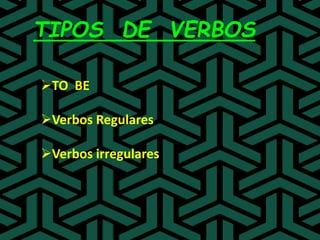
TIPOS DE VERBOS
TO BE
Verbos Regulares
Verbos irregulares
TO BE (ser o estar)
TO BE (ser o estar)
I
He
She
It
WAS / WASN’T
We
You
They
WERE / WEREN’T
THERE WAS / THERE WERE
THERE WAS es el pasado de THERE IS,
usándose para el singular:
 There was a student in the room.
Había un estudiante en el aula.
THERE WERE es el pasado de THERE
ARE, usándose para plural:
 There were many students in the
room.
Habían muchos estudiantes en el aula
VERBOS REGULARES
Los verbos regulares forman
el pasado añadiendo ed:
He played the guitar yesterday
El toco la guitarra ayer (play)
VERBOS REGULARES
Si el verbo termina en “e”, solo
añadimos “d”:
Like Liked (gustar)
Arrive Arrived (llegar)
Si el verbo tiene una silaba y termina
en VOCAL + CONSONANTE, se dobla la
consonante y se añade “ed”
Stop Stopped (parar)
Rob Robbed (robar)
VERBOS REGULARES
Si el verbo termina en “y”, tenemos
que mirar la letra que va delante:
Si es una vocal, se añade “ed”
Play Played (jugar, tocar)
Stay Stayed (quedarse)
Si es una consonante, la “y” se elimina y
se añade “ied”
Study Studied (estudiar)
Cry Cried (llorar, gritar)
VERBOS IRREGULARES
Hay muchos verbos que no añaden
“ed” porque toman una forma nueva.
En español también hay
irregularidades.
Por ejemplo, el verbo SABER en
pasado Por ejemplo, el verbo SABER
en pasado sería “supe” y no “sabí*” ni
nada parecido.
VERBOS IRREGULARES
Ejemplo 1
PRESENTE
BREAK
CAN
DO
DRINK
DRIVE
EAT
FIND
FLY
HAVE
GIVE
PAS/PASADO
BROKE
COULD
DID
DRANK
DROVE
ATE
FOUND
FLEW
HAD
GAVE
TRANSLATION
Romper
Poder
Hacer+auxiliar
Beber
Conducir
Comer
Encontrar
Volar
Tener
Dar
VERBOS IRREGULARES
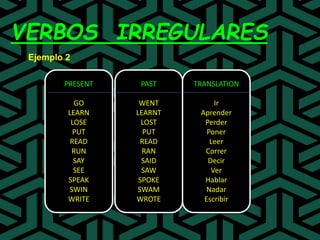
Ejemplo 2
PRESENT
GO
LEARN
LOSE
PUT
READ
RUN
SAY
SEE
SPEAK
SWIN
WRITE
PAST
WENT
LEARNT
LOST
PUT
READ
RAN
SAID
SAW
SPOKE
SWAM
WROTE
TRANSLATION
Ir
Aprender
Perder
Poner
Leer
Correr
Decir
Ver
Hablar
Nadar
Escribir
VERBOS IRREGULARES
Ejemplo 3
PRESENT
BUILD
BECOME
BLOW
BRING
BUY
DRAW
FORGET
KNOW
PAY
TAKE
PAST
BUILT
BECAME
BLEW
BROUGHT
BOUGHT
DREW
FORGOT
KNEW
PAID
TOOK
TRANSLATION
Construir
Llegar a ser
Soplar
Traer
Comprar
Dibujar
Olvidar
Saber, conocer
Pagar
Tomar, llevar
NEGATIVA
Para formar la negativa de todos los
verbos se utiliza el auxiliar DID + infinitivo:
Ejemplos:
He didn’t go to paris.
El no fue a paris.
I didn’t break the window!
¡Yo no rompí la ventana!
INTERROGATIVA
En la interrogativa utilizamos DID
delante del sujeto y detrás del sujeto
se usa el infinitivo:
Did you study English?
¿Estudiaste ingles?
Did she write the letter?
¿Escribió ella la carta?
NEGATIVA E INTERROGATIVA
Como ves, las formas negativas e interrogativa son
similares a las formas de la tercera persona de
singular en presente simple:
PRESENT SIMPLE
 He studies English He doesn’t study English
Does he study English?
PAST SIMPLE
He went to Paris He didn’t go to Paris.
Did he go to Paris?
He studied English (reg) He didn’t study English.
Did he study English?
(Se quitan las formas pasadas y se ponen los infinitivos)
EXPRESIONES CON PASADO
SIMPLE
EXPRESSION TRANSLATION
Yesterday Ayer
Last Week La semana pasada
Last year El año pasado
Last month El mes pasado
Two days ago Hace dos dias
Two months ago Hace dos meses
Two weeks ago Hace dos semanas
In 2010 En 2010
In September En Septiembre
On Monday El lunes
Darwin Ramírez
C.I: 24.893.525
THANK YOU

Past simple tense