THE VERBS IRREGULARS
ConCEpTo:
• Se denominan verbos
irregulares aquellos en
que, al ser conjugados,
se operan
modificaciones sea en la
raíz, sea en alguna de las
terminaciones que
correspondería aplicar
en base al modo y
tiempo; sea en ambas
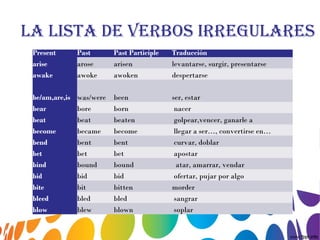
LA LISTA dE VERBoS IRREGULARES
Present Past Past Participle Traducción
arise arose arisen levantarse, surgir, presentarse
awake awoke awoken despertarse
be/am,are,is was/were been ser, estar
bear bore born nacer
beat beat beaten golpear,vencer, ganarle a
become became become llegar a ser…, convertirse en…
bend bent bent curvar, doblar
bet bet bet apostar
bind bound bound atar, amarrar, vendar
bid bid bid ofertar, pujar por algo
bite bit bitten morder
bleed bled bled sangrar
blow blew blown soplar
break broke broken romper, partir  quebrar
breed bred bred criar (animales)
bring brought brought traer
build built built construir, edificar
burn burnt burnt quemar, arder, incendiar
burst burst burst reventar, estallar, abrir de golpe
buy bought bought comprar
cast cast cast lanzar, arrojar, tirar, echar
catch caught caught coger, agarrar, atrapar
come came come venir
cost cost cost costar
cut cut cut cortar,
choose chose chosen elegir, escoger
• Pronunciamos la terminación "-ed"
de forma diferente dependiendo de
la letra que va al final del infinitivo.
En general la "e" es muda.
 
• Con los infinitivos que terminan en
"p", "f", "k" o "s" (consonantes
sordas, excepto "t") pronunciamos la
terminación" "-ed" como una "t".
– Ejemplos:
• looked 
• [lukt]
• kissed 
• [kisst]
• Con los infinitivos que terminan en
"b", "g", "l", "m", "n", "v", "z"
(consonantes sonoras, excepto "d") o
una vocal, pronunciamos sólo la "d".
Ejemplos:
• yelled 
• [jeld]
• cleaned 
•  [klind]
• Con los infinitivos que terminan en
"d" o "t", pronunciamos la "e" como
una "i".
Ejemplos:
• ended 
• [endid]
 
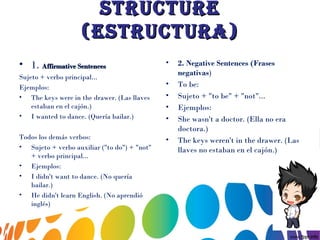
StructureStructure
(eStructura)(eStructura)
• 1. Affirmative SentencesAffirmative Sentences
Sujeto + verbo principal...
Ejemplos:
• The keys were in the drawer. (Las llaves
estaban en el cajón.)
• I wanted to dance. (Quería bailar.)
Todos los demás verbos:
• Sujeto + verbo auxiliar ("to do") + "not"
+ verbo principal...
• Ejemplos:
• I didn't want to dance. (No quería
bailar.)
• He didn't learn English. (No aprendió
inglés)
• 2.  Negative Sentences (Frases
negativas)
• To be:
• Sujeto + "to be" + "not"...
• Ejemplos:
• She wasn't a doctor. (Ella no era
doctora.)
• The keys weren't in the drawer. (Las
llaves no estaban en el cajón.)
Interrogative Sentences (Frases interrogativas)
“To be" + sujeto...?
Ejemplos:
•Was she a doctor? (¿Ella era
doctora?)
•Were the keys in the
drawer? (¿Estaban las llaves en el
cajón?)
•Todos los verbos demás:
•Verbo auxiliar ("to do") + sujeto +
verbo principal...?
Did” +sujeto+ verbo…?
•Ejemplos:
•Did you want to dance? (¿Querías
bailar?)
•Did he learn English? (¿Aprendió
inglés?)
•Did they believe him? (¿Le
creíste?)
uSeS (uSoS)
. En este caso equivale al pretérito
indefinido español. Generalmente, lo
usamos con adverbios de tiempo como
"last year", "yesterday", "last night"...
•Ejemplos:
•Tom stayed at home last night. (Tom
se quedó en casa anoche.)
•Kate worked last Saturday. (Kate
trabajó el sábado pasado.)
•I didn't go to the party yesterday. (No
fui a la fiesta ayer.)
Se usa el pasado simple para un serie de
acciones en el pasado.
Ejemplos:
•I received the good news and
immediately called my
husband. (Recibí la buena noticia y
llamé de inmediato a mi marido.)
También lo usamos para acciones
repetidas o habituales en el pasado,
como se usa el pretérito imperfecto
español.
Ejemplos:
•We always traveled to Cancun for
vacation when we were young. (Siempre
viajábamos a Cancun durante las
vacaciones cuando éramos jóvenes.)
Lo usamos para narraciones o
acciones de períodos de largo tiempo
en el pasado, como el pretérito
imperfecto español.
Ejemplos:
•I worked for many years in a
museum. (Trabajaba en un museo
durante muchos años.)
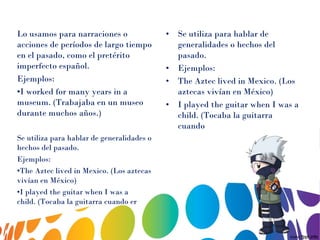
Se utiliza para hablar de generalidades o
hechos del pasado.
Ejemplos:
•The Aztec lived in Mexico. (Los aztecas
vivían en México)
•I played the guitar when I was a
child. (Tocaba la guitarra cuando er
• Se utiliza para hablar de
generalidades o hechos del
pasado.
• Ejemplos:
• The Aztec lived in Mexico. (Los
aztecas vivían en México)
• I played the guitar when I was a
child. (Tocaba la guitarra
cuando
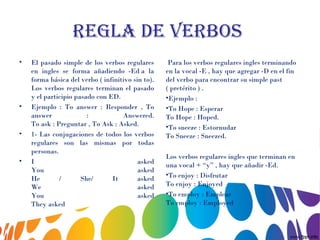
Regla de veRbos
• El pasado simple de los verbos regulares
en ingles se forma añadiendo -Ed a la
forma básica del verbo ( infinitivo sin to).
Los verbos regulares terminan el pasado
y el participio pasado con ED.
• Ejemplo : To answer : Responder , To
answer : Answered.
To ask : Preguntar , To Ask : Asked.
• 1- Las conjugaciones de todos los verbos
regulares son las mismas por todas
personas.
• I asked
You asked
He / She/ It asked
We asked
You asked
They asked
Para los verbos regulares ingles terminando
en la vocal -E , hay que agregar -D en el fin
del verbo para encontrar su simple past
( pretérito ) .
•Ejemplo :
•To Hope : Esperar
To Hope : Hoped.
•To sneeze : Estornudar
To Sneeze : Sneezed.
Los verbos regulares ingles que terminan en
una vocal + “y” , hay que añadir -Ed.
•To enjoy : Disfrutar
To enjoy : Enjoyed
•To employ : Emplear
To employ : Employed
• Para verbos regulares terminando en una
consonante + ” y ” , hay que cambiar la
-y por -i y agregar el -Ed.
• To copy : Copiar
To copy : Copied
• To cry : Gritar / Llorar
To cry : Cried
• To rely : Confiar
To rely : Relied
• Ps : To Fly : Flew es un verbo irregular
de ingles
Para los verbos regulares que terminan en
una vocal corta seguida por una consonante,
hay que duplicar la consonante antes de
añadir el -Ed.
•To fit : Caber / Encajar
To fit : Fitted
•To drop : Dejar caer / Caerse
To drop : Dropped
•To ban : Prohibir
To Ban : Banned
Concepto de verbos regulares en
ingles Americano, cuando el verbo tiene más
de una sílaba y la última sílaba se pronuncia,
la consonante final se duplica.
•To regret : Lamentarse
To regret : Regretted.
PRogRessive Past
What were you doing? ¿Qué estabas (estuviste) haciendo?
subject + was/were + 1 >ing
1 2 3
go went gone
...ing (...ando, ...endo)
Affirmative Negative Interrogative
I was going I was not going Was I going ?
You were going You were not going Were you going ?
He was going He was not going Was he going ?
She was going She was not going Was she going ?
It was going It was not going Was it going ?
We were going We were not going Were we going ?
Affirmative subject + was/were + 1 > "ing"
I was going to New York - Estaba (estuve) yendo a New York
You were going to New York - Ud. estaba (estuvo) yendo a New York
Negative subject + was/were + not + 1 > "ing"
I was not going to New York - No estaba (estuve) yendo a New York
You were not going to New York - Ud. no estaba (estuvo) yendo a New York
Interrogative Was/Were + subject + 1 > "ing" ?
Was I going to New York ? - ¿Estaba (estuve) yendo a New York ?
Were you going to New York ? - ¿Estaba (estuvo) Ud. yendo a New York ?
Simple Future
What will you do? ¿Qué harás?
subject + will + 1
1 2 3
go went gone
Affirmative Negative Interrogative
I will go I won't go Will I go ?
You will go You won't go Will you go ?
He will go He won't go Will he go ?
She will go She won't go Will she go ?
It will go It won't go Will it go ?
We will go We won't go Will we go ?
You will go You won't go Will you go ?
They will go They won't go Will they go ?
Affirmative subject + will + 1
I will go to New York - Iré a New York
He will go to New York - El irá a New York
Negative subject + won't (will not) + 1
I won't go to New York - No iré a New York
He won't go to New York - El no irá a New York
Interrogative Will + subject + 1 ?
Will I go to New York ? - ¿Iré a New York ?
Will he go to New York ? - ¿Irá él a New York ?
tHANS YOu

Los Verbos Irregulares

  • 1.
  • 2.
    ConCEpTo: • Se denominan verbos irregulares aquellosen que, al ser conjugados, se operan modificaciones sea en la raíz, sea en alguna de las terminaciones que correspondería aplicar en base al modo y tiempo; sea en ambas
  • 3.
    LA LISTA dEVERBoS IRREGULARES Present Past Past Participle Traducción arise arose arisen levantarse, surgir, presentarse awake awoke awoken despertarse be/am,are,is was/were been ser, estar bear bore born nacer beat beat beaten golpear,vencer, ganarle a become became become llegar a ser…, convertirse en… bend bent bent curvar, doblar bet bet bet apostar bind bound bound atar, amarrar, vendar bid bid bid ofertar, pujar por algo bite bit bitten morder bleed bled bled sangrar blow blew blown soplar
  • 4.
    break broke brokenromper, partir  quebrar breed bred bred criar (animales) bring brought brought traer build built built construir, edificar burn burnt burnt quemar, arder, incendiar burst burst burst reventar, estallar, abrir de golpe buy bought bought comprar cast cast cast lanzar, arrojar, tirar, echar catch caught caught coger, agarrar, atrapar come came come venir cost cost cost costar cut cut cut cortar, choose chose chosen elegir, escoger
  • 5.
    • Pronunciamos laterminación "-ed" de forma diferente dependiendo de la letra que va al final del infinitivo. En general la "e" es muda.   • Con los infinitivos que terminan en "p", "f", "k" o "s" (consonantes sordas, excepto "t") pronunciamos la terminación" "-ed" como una "t". – Ejemplos: • looked  • [lukt] • kissed  • [kisst] • Con los infinitivos que terminan en "b", "g", "l", "m", "n", "v", "z" (consonantes sonoras, excepto "d") o una vocal, pronunciamos sólo la "d". Ejemplos: • yelled  • [jeld] • cleaned  •  [klind] • Con los infinitivos que terminan en "d" o "t", pronunciamos la "e" como una "i". Ejemplos: • ended  • [endid]  
  • 6.
    StructureStructure (eStructura)(eStructura) • 1. Affirmative SentencesAffirmativeSentences Sujeto + verbo principal... Ejemplos: • The keys were in the drawer. (Las llaves estaban en el cajón.) • I wanted to dance. (Quería bailar.) Todos los demás verbos: • Sujeto + verbo auxiliar ("to do") + "not" + verbo principal... • Ejemplos: • I didn't want to dance. (No quería bailar.) • He didn't learn English. (No aprendió inglés) • 2.  Negative Sentences (Frases negativas) • To be: • Sujeto + "to be" + "not"... • Ejemplos: • She wasn't a doctor. (Ella no era doctora.) • The keys weren't in the drawer. (Las llaves no estaban en el cajón.)
  • 7.
    Interrogative Sentences (Frasesinterrogativas) “To be" + sujeto...? Ejemplos: •Was she a doctor? (¿Ella era doctora?) •Were the keys in the drawer? (¿Estaban las llaves en el cajón?) •Todos los verbos demás: •Verbo auxiliar ("to do") + sujeto + verbo principal...? Did” +sujeto+ verbo…? •Ejemplos: •Did you want to dance? (¿Querías bailar?) •Did he learn English? (¿Aprendió inglés?) •Did they believe him? (¿Le creíste?)
  • 8.
    uSeS (uSoS) . En estecaso equivale al pretérito indefinido español. Generalmente, lo usamos con adverbios de tiempo como "last year", "yesterday", "last night"... •Ejemplos: •Tom stayed at home last night. (Tom se quedó en casa anoche.) •Kate worked last Saturday. (Kate trabajó el sábado pasado.) •I didn't go to the party yesterday. (No fui a la fiesta ayer.) Se usa el pasado simple para un serie de acciones en el pasado. Ejemplos: •I received the good news and immediately called my husband. (Recibí la buena noticia y llamé de inmediato a mi marido.) También lo usamos para acciones repetidas o habituales en el pasado, como se usa el pretérito imperfecto español. Ejemplos: •We always traveled to Cancun for vacation when we were young. (Siempre viajábamos a Cancun durante las vacaciones cuando éramos jóvenes.)
  • 9.
    Lo usamos paranarraciones o acciones de períodos de largo tiempo en el pasado, como el pretérito imperfecto español. Ejemplos: •I worked for many years in a museum. (Trabajaba en un museo durante muchos años.) Se utiliza para hablar de generalidades o hechos del pasado. Ejemplos: •The Aztec lived in Mexico. (Los aztecas vivían en México) •I played the guitar when I was a child. (Tocaba la guitarra cuando er • Se utiliza para hablar de generalidades o hechos del pasado. • Ejemplos: • The Aztec lived in Mexico. (Los aztecas vivían en México) • I played the guitar when I was a child. (Tocaba la guitarra cuando
  • 10.
    Regla de veRbos •El pasado simple de los verbos regulares en ingles se forma añadiendo -Ed a la forma básica del verbo ( infinitivo sin to). Los verbos regulares terminan el pasado y el participio pasado con ED. • Ejemplo : To answer : Responder , To answer : Answered. To ask : Preguntar , To Ask : Asked. • 1- Las conjugaciones de todos los verbos regulares son las mismas por todas personas. • I asked You asked He / She/ It asked We asked You asked They asked Para los verbos regulares ingles terminando en la vocal -E , hay que agregar -D en el fin del verbo para encontrar su simple past ( pretérito ) . •Ejemplo : •To Hope : Esperar To Hope : Hoped. •To sneeze : Estornudar To Sneeze : Sneezed. Los verbos regulares ingles que terminan en una vocal + “y” , hay que añadir -Ed. •To enjoy : Disfrutar To enjoy : Enjoyed •To employ : Emplear To employ : Employed
  • 11.
    • Para verbosregulares terminando en una consonante + ” y ” , hay que cambiar la -y por -i y agregar el -Ed. • To copy : Copiar To copy : Copied • To cry : Gritar / Llorar To cry : Cried • To rely : Confiar To rely : Relied • Ps : To Fly : Flew es un verbo irregular de ingles Para los verbos regulares que terminan en una vocal corta seguida por una consonante, hay que duplicar la consonante antes de añadir el -Ed. •To fit : Caber / Encajar To fit : Fitted •To drop : Dejar caer / Caerse To drop : Dropped •To ban : Prohibir To Ban : Banned Concepto de verbos regulares en ingles Americano, cuando el verbo tiene más de una sílaba y la última sílaba se pronuncia, la consonante final se duplica. •To regret : Lamentarse To regret : Regretted.
  • 12.
    PRogRessive Past What wereyou doing? ¿Qué estabas (estuviste) haciendo? subject + was/were + 1 >ing 1 2 3 go went gone ...ing (...ando, ...endo) Affirmative Negative Interrogative I was going I was not going Was I going ? You were going You were not going Were you going ? He was going He was not going Was he going ? She was going She was not going Was she going ? It was going It was not going Was it going ? We were going We were not going Were we going ?
  • 13.
    Affirmative subject +was/were + 1 > "ing" I was going to New York - Estaba (estuve) yendo a New York You were going to New York - Ud. estaba (estuvo) yendo a New York Negative subject + was/were + not + 1 > "ing" I was not going to New York - No estaba (estuve) yendo a New York You were not going to New York - Ud. no estaba (estuvo) yendo a New York Interrogative Was/Were + subject + 1 > "ing" ? Was I going to New York ? - ¿Estaba (estuve) yendo a New York ? Were you going to New York ? - ¿Estaba (estuvo) Ud. yendo a New York ?
  • 14.
    Simple Future What willyou do? ¿Qué harás? subject + will + 1 1 2 3 go went gone Affirmative Negative Interrogative I will go I won't go Will I go ? You will go You won't go Will you go ? He will go He won't go Will he go ? She will go She won't go Will she go ? It will go It won't go Will it go ? We will go We won't go Will we go ? You will go You won't go Will you go ? They will go They won't go Will they go ?
  • 15.
    Affirmative subject +will + 1 I will go to New York - Iré a New York He will go to New York - El irá a New York Negative subject + won't (will not) + 1 I won't go to New York - No iré a New York He won't go to New York - El no irá a New York Interrogative Will + subject + 1 ? Will I go to New York ? - ¿Iré a New York ? Will he go to New York ? - ¿Irá él a New York ?
  • 16.