PRESENTE CONTINUO
Luis Felipe Henao Arboleda
ÍNDICE
Forma Negativa
Forma Interrogativa
Participio Presente
Bibliografía
FORMA NEGATIVA
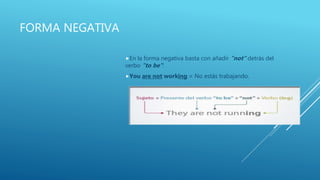
En la forma negativa basta con añadir "not" detrás del
verbo "to be":
You are not working = No estás trabajando.
FORMA INTERROGATIVA
En las preguntas debemos poner el verbo "to be" al
principio:
Is Mary cooking? = ¿Mary está cocinando?
PARTICIPIO PRESENTE
La forma verbo + ing se llama participio de presente.
¿Cómo se forma el participio de presente? Basta
con añadir "ing" al verbo.
Talk = talking.
Mix = mixing.
Play = playing.
PARTICIPIO PRESENTE
Si el verbo acaba en consonante + vocal acentuada + consonante,
debemos duplicar la consonante final antes de añadir el
sufijo "ing".
Stop = stopping.
Run = runnig.
Begin = beginning.
PARTICIPIO PRESENTE
Los verbos que acaban en vocal + consonante + "e" muda pierden la "e" final antes
de añadir el sufijo "ing".
Dance = dancing.
Bake = baking.
Close = closing.
Pero, los verbos que acaban en doble "e" la mantienen antes de añadir el
sufijo "ing".
Agree = agreeing.
PARTICIPIO
PRESENTE
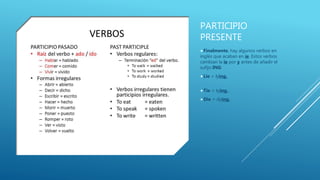
Finalmente, hay algunos verbos en
inglés que acaban en ie. Estos verbos
cambian la ie por y antes de añadir el
sufijo ING:
Lie = lying.
Tie = tying.
Die = dying.
BIBLIOGRAFÍA
• https://www.gcfaprendelibre.org/ingles/curso/ingles_intermedio/presente_continuo_-
_present_continuous/2.do
• https://www.google.com.co/url?sa=i&rct=j&q=&esrc=s&source=images&cd=&cad=rja&uact=8
&ved=0ahUKEwi2ran3s-_SAhUFbiYKHXj-
CTwQjRwIBw&url=http%3A%2F%2Fslideplayer.es%2Fslide%2F1836730%2F&psig=AFQjCNFogH
M2P9etXyVtZee1Py8ZrBkEGQ&ust=1490453957512920

Presente continuo