Presente del verbo TENER
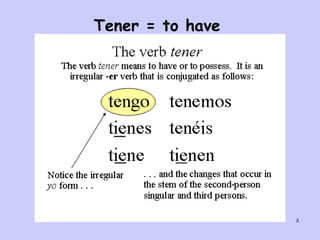
Tener = to have
I have two brothers. They have a sister. Do you  (3 ways)  have a cat? Does she have a dog?   We don’t have  a lot of  money. ¿Cómo se dice?
(Yo)  Tengo dos hermanos. Ellos tienen una hermana. ¿Tienes  (tú)  un gato?  ¿Tiene  Ud.  un gato?  ¿Tienen  Uds. un gato? ¿Tiene ella un perro? Nosotros no tenemos mucho dinero. ¿Cómo se dice?
¿Tiene tu familia una casa o un apartamento? ¿Cuántas personas hay en tu familia?  Sobre tu familia
The verb  tener  +  que  + infinitive One of the special, idiomatic uses of  tener  is with the relator  que  plus  an infinitive  to express the idea of  to have to  (do something).
The verb  tener  +  que  + infinitive tengo tienes tiene tenemos tenéis tienen We start with an appropriate person and number of  tener que . . . add the little word  que  . . . and then add any infinitive. estudiar escrib ir habl ar escuch ar le er com er aprend er decid ir para el examen de español. Tengo I have to study for the Spanish exam . tengo que estudi ar
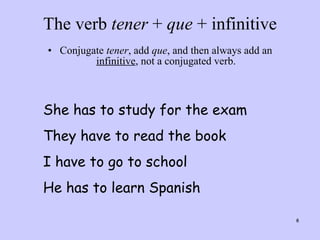
The verb  tener  +  que  + infinitive Conjugate  tener , add  que , and then always add an  infinitive , not a conjugated verb. She has to study for the exam They have to read the book I have to go to school He has to learn Spanish
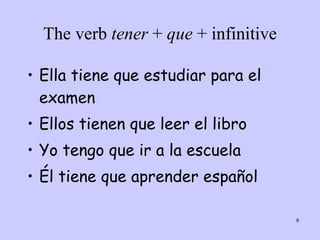
The verb  tener  +  que  + infinitive Ella tiene que estudiar para el examen Ellos tienen que leer el libro Yo tengo que ir a la escuela Él tiene que aprender español
Ella ___________ mucho dinero. ¿____________ tú una mascota? Mi familia __________ un perro. Los Pérez ____________ un gato. Ana y yo ___________ unos CD’s. Yo ___________ diecisiete años. Uds. ________ una familia grande. Completa
¿Cuántos años tienes (tú)? ¿Tienes una familia grande? ¿Cuántos hermanos tienes? ¿Tienes un gato? ¿Tienes un perro? ¿Tienes muchos amigos? ¿Tienes un carro? Habla sobre ti

Presente del verbo TENER

  • 1.
  • 2.
  • 3.
    I have twobrothers. They have a sister. Do you (3 ways) have a cat? Does she have a dog? We don’t have a lot of money. ¿Cómo se dice?
  • 4.
    (Yo) Tengodos hermanos. Ellos tienen una hermana. ¿Tienes (tú) un gato? ¿Tiene Ud. un gato? ¿Tienen Uds. un gato? ¿Tiene ella un perro? Nosotros no tenemos mucho dinero. ¿Cómo se dice?
  • 5.
    ¿Tiene tu familiauna casa o un apartamento? ¿Cuántas personas hay en tu familia? Sobre tu familia
  • 6.
    The verb tener + que + infinitive One of the special, idiomatic uses of tener is with the relator que plus an infinitive to express the idea of to have to (do something).
  • 7.
    The verb tener + que + infinitive tengo tienes tiene tenemos tenéis tienen We start with an appropriate person and number of tener que . . . add the little word que . . . and then add any infinitive. estudiar escrib ir habl ar escuch ar le er com er aprend er decid ir para el examen de español. Tengo I have to study for the Spanish exam . tengo que estudi ar
  • 8.
    The verb tener + que + infinitive Conjugate tener , add que , and then always add an infinitive , not a conjugated verb. She has to study for the exam They have to read the book I have to go to school He has to learn Spanish
  • 9.
    The verb tener + que + infinitive Ella tiene que estudiar para el examen Ellos tienen que leer el libro Yo tengo que ir a la escuela Él tiene que aprender español
  • 10.
    Ella ___________ muchodinero. ¿____________ tú una mascota? Mi familia __________ un perro. Los Pérez ____________ un gato. Ana y yo ___________ unos CD’s. Yo ___________ diecisiete años. Uds. ________ una familia grande. Completa
  • 11.
    ¿Cuántos años tienes(tú)? ¿Tienes una familia grande? ¿Cuántos hermanos tienes? ¿Tienes un gato? ¿Tienes un perro? ¿Tienes muchos amigos? ¿Tienes un carro? Habla sobre ti