THE PRETERITE TENSE
A simple past tense in Spanish
What is the
preterite
tense?
The preterite is a
simple past tense in
Spanish.
It is used for:
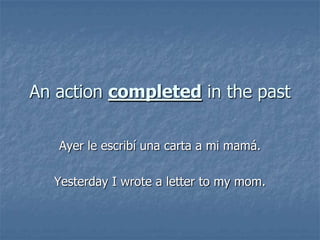
An action completed in the past
Ayer le escribí una carta a mi mamá.
Yesterday I wrote a letter to my mom.
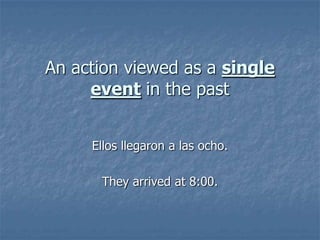
An action viewed as a single
event in the past
Ellos llegaron a las ocho.
They arrived at 8:00.
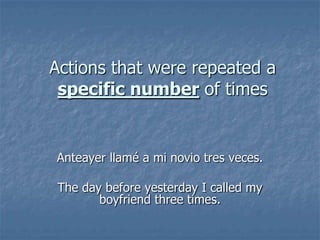
Actions that were repeated a
specific number of times

Anteayer llamé a mi novio tres veces.

The day before yesterday I called my
boyfriend three times.
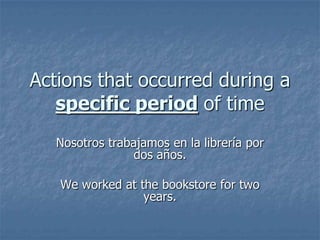
Actions that occurred during a
specific period of time
Nosotros trabajamos en la librería por
dos años.
We worked at the bookstore for two
years.
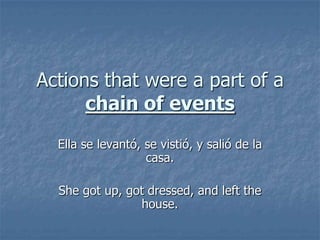
Actions that were a part of a
chain of events
Ella se levantó, se vistió, y salió de la
casa.

She got up, got dressed, and left the
house.
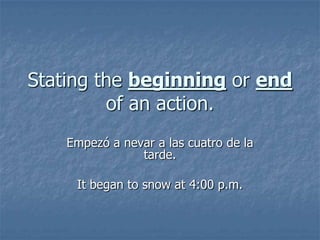
Stating the beginning or end
of an action.
Empezó a nevar a las cuatro de la
tarde.
It began to snow at 4:00 p.m.
How is the
preterite
formed?
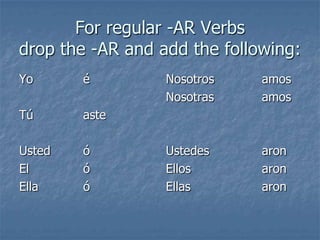
For regular -AR Verbs
drop the -AR and add the following:
Yo

é

Tú

aste

Usted
El
Ella

ó
ó
ó

Nosotros
Nosotras

amos
amos

Ustedes
Ellos
Ellas

aron
aron
aron
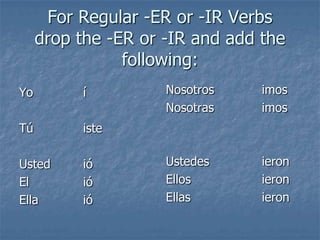
For Regular -ER or -IR Verbs
drop the -ER or -IR and add the
following:
Yo

í

Tú

ió
ió
ió

imos
imos

Ustedes
Ellos
Ellas

ieron
ieron
ieron

iste

Usted
El
Ella

Nosotros
Nosotras
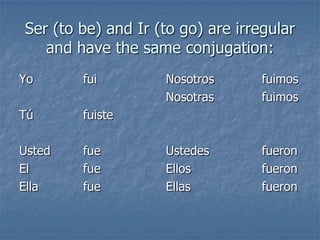
Ser (to be) and Ir (to go) are irregular
and have the same conjugation:
Yo

fui

Tú

fuiste

Usted
El
Ella

fue
fue
fue

Nosotros
Nosotras

fuimos
fuimos

Ustedes
Ellos
Ellas

fueron
fueron
fueron
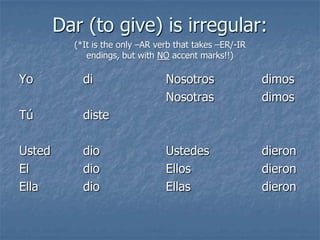
Dar (to give) is irregular:
(*It is the only –AR verb that takes –ER/-IR
endings, but with NO accent marks!!)

Yo

di

Tú

diste

Usted
El
Ella

dio
dio
dio

Nosotros
Nosotras

dimos
dimos

Ustedes
Ellos
Ellas

dieron
dieron
dieron
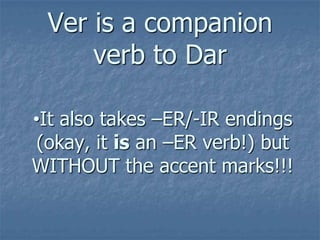
Ver is a companion
verb to Dar
•It also takes –ER/-IR endings
(okay, it is an –ER verb!) but
WITHOUT the accent marks!!!
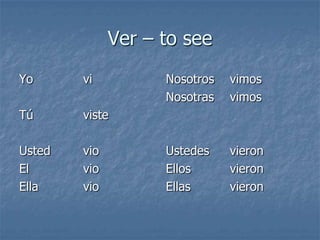
Ver – to see
Yo

vi

Tú

viste

Usted
El
Ella

vio
vio
vio

Nosotros
Nosotras

vimos
vimos

Ustedes
Ellos
Ellas

vieron
vieron
vieron
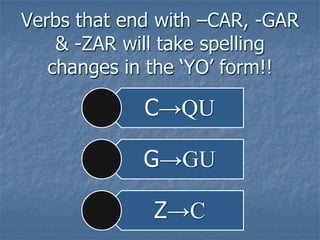
Verbs that end with –CAR, -GAR
& -ZAR will take spelling
changes in the ‘YO’ form!!

C→QU
G→GU
Z→C
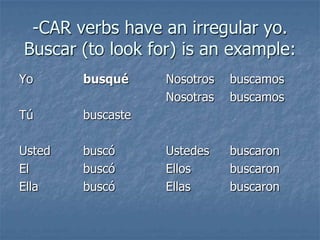
-CAR verbs have an irregular yo.
Buscar (to look for) is an example:
Yo

busqué

Tú

buscaste

Usted
El
Ella

buscó
buscó
buscó

Nosotros
Nosotras

buscamos
buscamos

Ustedes
Ellos
Ellas

buscaron
buscaron
buscaron
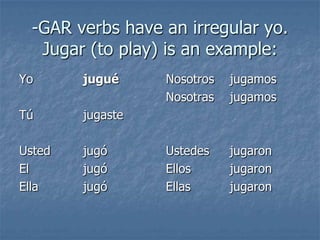
-GAR verbs have an irregular yo.
Jugar (to play) is an example:
Yo

jugué

Tú

jugaste

Usted
El
Ella

jugó
jugó
jugó

Nosotros
Nosotras

jugamos
jugamos

Ustedes
Ellos
Ellas

jugaron
jugaron
jugaron
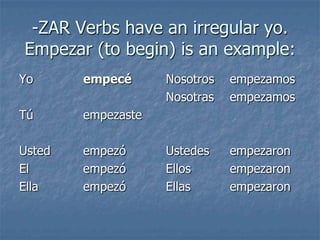
-ZAR Verbs have an irregular yo.
Empezar (to begin) is an example:
Yo

empecé

Tú

empezaste

Usted
El
Ella

empezó
empezó
empezó

Nosotros
Nosotras

empezamos
empezamos

Ustedes
Ellos
Ellas

empezaron
empezaron
empezaron
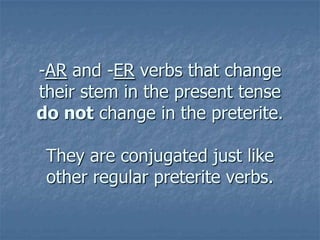
-AR and -ER verbs that change
their stem in the present tense
do not change in the preterite.
They are conjugated just like
other regular preterite verbs.
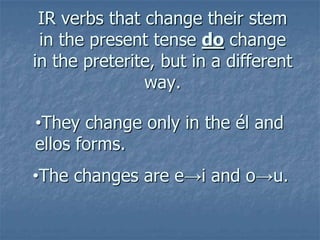
IR verbs that change their stem
in the present tense do change
in the preterite, but in a different
way.
•They change only in the él and
ellos forms.
•The changes are e→i and o→u.
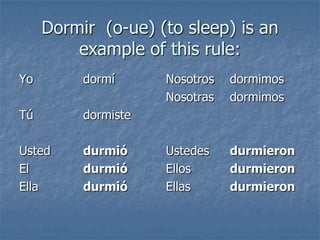
Dormir (o-ue) (to sleep) is an
example of this rule:
Yo

dormí

Tú

dormiste

Usted
El
Ella

durmió
durmió
durmió

Nosotros
Nosotras

dormimos
dormimos

Ustedes
Ellos
Ellas

durmieron
durmieron
durmieron
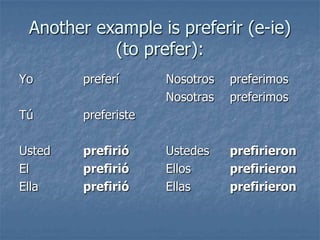
Another example is preferir (e-ie)
(to prefer):
Yo

preferí

Tú

preferiste

Usted
El
Ella

prefirió
prefirió
prefirió

Nosotros
Nosotras

preferimos
preferimos

Ustedes
Ellos
Ellas

prefirieron
prefirieron
prefirieron
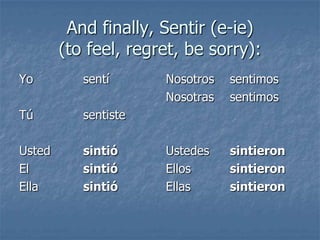
And finally, Sentir (e-ie)
(to feel, regret, be sorry):
Yo

sentí

Tú

sentiste

Usted
El
Ella

sintió
sintió
sintió

Nosotros
Nosotras

sentimos
sentimos

Ustedes
Ellos
Ellas

sintieron
sintieron
sintieron
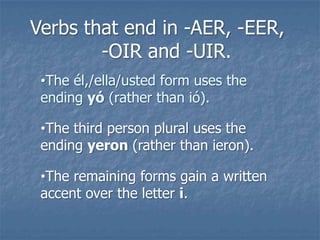
Verbs that end in -AER, -EER,
-OIR and -UIR.
•The él,/ella/usted form uses the
ending yó (rather than ió).
•The third person plural uses the
ending yeron (rather than ieron).
•The remaining forms gain a written
accent over the letter i.
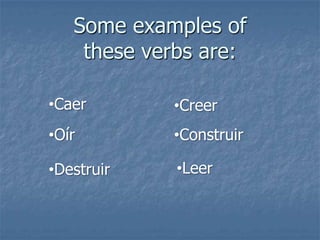
Some examples of
these verbs are:
•Caer

•Creer

•Oír

•Construir

•Destruir

•Leer
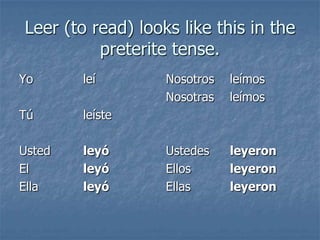
Leer (to read) looks like this in the
preterite tense.
Yo

leí

Tú

leíste

Usted
El
Ella

leyó
leyó
leyó

Nosotros
Nosotras

leímos
leímos

Ustedes
Ellos
Ellas

leyeron
leyeron
leyeron
El Fin

Preterite tense mine

  • 1.
    THE PRETERITE TENSE Asimple past tense in Spanish
  • 2.
  • 3.
    The preterite isa simple past tense in Spanish. It is used for:
  • 4.
    An action completedin the past Ayer le escribí una carta a mi mamá. Yesterday I wrote a letter to my mom.
  • 5.
    An action viewedas a single event in the past Ellos llegaron a las ocho. They arrived at 8:00.
  • 6.
    Actions that wererepeated a specific number of times Anteayer llamé a mi novio tres veces. The day before yesterday I called my boyfriend three times.
  • 7.
    Actions that occurredduring a specific period of time Nosotros trabajamos en la librería por dos años. We worked at the bookstore for two years.
  • 8.
    Actions that werea part of a chain of events Ella se levantó, se vistió, y salió de la casa. She got up, got dressed, and left the house.
  • 9.
    Stating the beginningor end of an action. Empezó a nevar a las cuatro de la tarde. It began to snow at 4:00 p.m.
  • 10.
  • 11.
    For regular -ARVerbs drop the -AR and add the following: Yo é Tú aste Usted El Ella ó ó ó Nosotros Nosotras amos amos Ustedes Ellos Ellas aron aron aron
  • 12.
    For Regular -ERor -IR Verbs drop the -ER or -IR and add the following: Yo í Tú ió ió ió imos imos Ustedes Ellos Ellas ieron ieron ieron iste Usted El Ella Nosotros Nosotras
  • 13.
    Ser (to be)and Ir (to go) are irregular and have the same conjugation: Yo fui Tú fuiste Usted El Ella fue fue fue Nosotros Nosotras fuimos fuimos Ustedes Ellos Ellas fueron fueron fueron
  • 14.
    Dar (to give)is irregular: (*It is the only –AR verb that takes –ER/-IR endings, but with NO accent marks!!) Yo di Tú diste Usted El Ella dio dio dio Nosotros Nosotras dimos dimos Ustedes Ellos Ellas dieron dieron dieron
  • 15.
    Ver is acompanion verb to Dar •It also takes –ER/-IR endings (okay, it is an –ER verb!) but WITHOUT the accent marks!!!
  • 16.
    Ver – tosee Yo vi Tú viste Usted El Ella vio vio vio Nosotros Nosotras vimos vimos Ustedes Ellos Ellas vieron vieron vieron
  • 17.
    Verbs that endwith –CAR, -GAR & -ZAR will take spelling changes in the ‘YO’ form!! C→QU G→GU Z→C
  • 18.
    -CAR verbs havean irregular yo. Buscar (to look for) is an example: Yo busqué Tú buscaste Usted El Ella buscó buscó buscó Nosotros Nosotras buscamos buscamos Ustedes Ellos Ellas buscaron buscaron buscaron
  • 19.
    -GAR verbs havean irregular yo. Jugar (to play) is an example: Yo jugué Tú jugaste Usted El Ella jugó jugó jugó Nosotros Nosotras jugamos jugamos Ustedes Ellos Ellas jugaron jugaron jugaron
  • 20.
    -ZAR Verbs havean irregular yo. Empezar (to begin) is an example: Yo empecé Tú empezaste Usted El Ella empezó empezó empezó Nosotros Nosotras empezamos empezamos Ustedes Ellos Ellas empezaron empezaron empezaron
  • 21.
    -AR and -ERverbs that change their stem in the present tense do not change in the preterite. They are conjugated just like other regular preterite verbs.
  • 22.
    IR verbs thatchange their stem in the present tense do change in the preterite, but in a different way. •They change only in the él and ellos forms. •The changes are e→i and o→u.
  • 23.
    Dormir (o-ue) (tosleep) is an example of this rule: Yo dormí Tú dormiste Usted El Ella durmió durmió durmió Nosotros Nosotras dormimos dormimos Ustedes Ellos Ellas durmieron durmieron durmieron
  • 24.
    Another example ispreferir (e-ie) (to prefer): Yo preferí Tú preferiste Usted El Ella prefirió prefirió prefirió Nosotros Nosotras preferimos preferimos Ustedes Ellos Ellas prefirieron prefirieron prefirieron
  • 25.
    And finally, Sentir(e-ie) (to feel, regret, be sorry): Yo sentí Tú sentiste Usted El Ella sintió sintió sintió Nosotros Nosotras sentimos sentimos Ustedes Ellos Ellas sintieron sintieron sintieron
  • 26.
    Verbs that endin -AER, -EER, -OIR and -UIR. •The él,/ella/usted form uses the ending yó (rather than ió). •The third person plural uses the ending yeron (rather than ieron). •The remaining forms gain a written accent over the letter i.
  • 27.
    Some examples of theseverbs are: •Caer •Creer •Oír •Construir •Destruir •Leer
  • 28.
    Leer (to read)looks like this in the preterite tense. Yo leí Tú leíste Usted El Ella leyó leyó leyó Nosotros Nosotras leímos leímos Ustedes Ellos Ellas leyeron leyeron leyeron
  • 29.