The Preterit Tense
The Preterite tense The preterite tense describes an action that began and ended at a definite time in the past. Ex. Ellos fueron a Florida ayer. Ex.  Fueron a Miami.
AR Verbs in the preterite Yo-  é Tú-  aste Él -    ó Ella -  ó Usted -  ó Nosotros,as-  amos Vosotros,as-  asteis Ellos-  aron Ellas-  aron Ustedes-  aron
Er and IR verbs in the preterite Nosotros,as-  imos Vosotros,as-  isteis Ellos-  ieron Ellas-  ieron Ustedes-  ieron Yo-  í Tú-  iste Él -    i ó Ella -  i ó Usted - i ó
Some Irregular Verbs-  Ir and Ser  Nosotros,as- fu imos Vosotros,as- fu isteis Ellos-  fueron Ellas-  fueron Ustedes-  fueron Yo-  fui Tú-  fu iste Él -    fue Ella -  fue Usted - fue See the list of irregular verbs on page 36 of your textbook.
More Irregular Verbs-  Dar- di diste dio dimos disteis dieron Ver- vi viste vio vimos visteis vieron Spelling Changes- Remember that spelling changes with verbs that end in –car , -gar, -zar. (ONLY IN YO) Buscar-  busqué bucaste buscó  buscamos buscasteis buscaron Jugar-  jugué jugaste jugó  jugamos jugasteis jugaron Empezar-  empecé empezaste empezó empezamos empezasteis empezaron
Common Time Expressions  Ayer  - Yesterday Anoche - Last night Ayer por la tarde-  Yesterday afternoon Ayer por la mañana-  Yesterday morning El año (mes) pasado-  Last year (month) La semana pasada-  Last week Hace una semana (un año)-  One week ago (year) En el siglo ocho-  In the eighth century
Stem-Changing in the Preterite
Stem-Changing Rules In the preterite verbs only stem change in the he/she form (él, ella, usted) and the they form (ellos, ellas, ustedes).
E:I stem changers Pedir – to ask for Servir – to serve Fre í r – to fry Medir – to measure Repetir – to repeat Seguir – to follow, to continue Sonre í r – to smile Sentir –to feel, perceive, sense Preferir – to prefer Sugerir – to suggest
O:U stem-changers Dormir- to sleep Morir – to die
You try a few… Yo – dormir Él - preferir Ellos- morir Nosotros- seguir Ella- pedir Usted- medir
Answers… Yo – dormir  dorm í Él – preferir  prefiri ó Ellos- morir murieron Nosotros- seguir  seguimos Ella- pedir pidi ó Usted- medir midi ó
The Imperfect
The Imperfect The imperfect is the other past tense. The imperfect is used to describe habitual or repeated actions in the past.  There is no stem-changing in the imperfect tense.  
Regular Endings AR Yo- aba Tú- abas Él,Ella, Ud. – aba Nosotros(as) – ábamos Vosotros(as)- abais Ellos (as), Uds.- aban ER, IR Yo- ía Tú- ías Él,Ella, Ud. – ía Nosotros(as) – íamos Vosotros(as)- íais  Ellos (as), Uds.- ían
Irregular Verbs- only 3! Ir iba ibas iba íbamos ibais iban Ver veía veías veía veíamos veíais veían Ser era eras era éramos erais eran
Common Time Expressions  Siempre  - always A menudo - often Con frecuencia-  With frecuency, frequently Muchas veces-  Many times Cada (día, viernes, semana, año)  –Each (day, Friday, week, year) En la época precolombiana  – In the precolombian age (era)- Durante el Renacimiento-  During the rebirth (Renaissance)
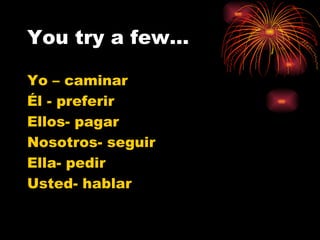
You try a few… Yo – caminar Él - preferir Ellos- pagar Nosotros- seguir Ella- pedir Usted- hablar
Answers… Yo – caminar  caminaba Él – preferir  prefer ía Ellos- pagar pagaban Nosotros- seguir  segu íamos Ella- pedir ped ía Usted- hablar hablaba
Difference between preterite and imperfect...
The difference is  in the past… The  preterite  is used to express actions or events that began and ended at a specific time in the past. The  imperfect  is used to talk about continuous , habitual or repeated past action.  The exact moment when the action began or ended is not important.
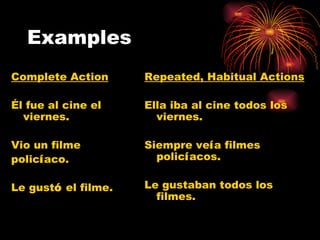
Examples Complete Action Él fue al cine el viernes. Vio un filme  polic í aco. Le gust ó  el filme. Repeated, Habitual Actions Ella iba al cine todos los viernes. Siempre ve í a filmes polic í acos. Le gustaban todos los filmes.
One more note… You most often use the imperfect with verbs such as querer, saber, pensar, desear, sentir, poder, and creer that describe a state of mind or a feeling. Él sab í a donde estaba la iglesia. La quer í a visitar. Sent í a mucho no poder verla.
Two actions in one sentence
Two actions in one sentence.  A sentence in the past will frequently have two verbs.  Both may be in the same tense or each one in a different tense.
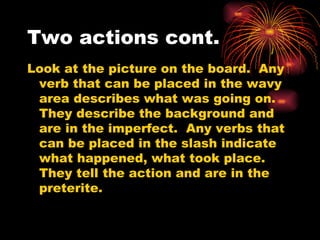
Two actions cont. Look at the picture on the board.  Any verb that can be placed in the wavy area describes what was going on.  They describe the background and are in the imperfect.  Any verbs that can be placed in the slash indicate what happened, what took place.  They tell the action and are in the preterite.
Two actions cont. Now try these.  I  was talking  on the phone when my mom  entered . Last  year we  went  to Florida and  swam . When I  was  a child, we always  rented  a house that  was  on beach and  swam  in the ocean. Would they be in the wavy area or the slash? Now translate to Spanish.
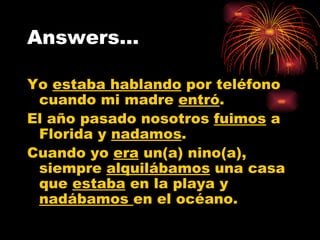
Answers… Yo  estaba hablando  por teléfono cuando mi madre  entró . El año pasado nosotros  fuimos  a Florida y  nadamos . Cuando yo  era  un(a) nino(a), siempre  alquilábamos  una casa que  estaba  en la playa y  nadábamos  en el océano.

Preterite Verbs

  • 1.
  • 2.
    The Preterite tenseThe preterite tense describes an action that began and ended at a definite time in the past. Ex. Ellos fueron a Florida ayer. Ex. Fueron a Miami.
  • 3.
    AR Verbs inthe preterite Yo- é Tú- aste Él - ó Ella - ó Usted - ó Nosotros,as- amos Vosotros,as- asteis Ellos- aron Ellas- aron Ustedes- aron
  • 4.
    Er and IRverbs in the preterite Nosotros,as- imos Vosotros,as- isteis Ellos- ieron Ellas- ieron Ustedes- ieron Yo- í Tú- iste Él - i ó Ella - i ó Usted - i ó
  • 5.
    Some Irregular Verbs- Ir and Ser Nosotros,as- fu imos Vosotros,as- fu isteis Ellos- fueron Ellas- fueron Ustedes- fueron Yo- fui Tú- fu iste Él - fue Ella - fue Usted - fue See the list of irregular verbs on page 36 of your textbook.
  • 6.
    More Irregular Verbs- Dar- di diste dio dimos disteis dieron Ver- vi viste vio vimos visteis vieron Spelling Changes- Remember that spelling changes with verbs that end in –car , -gar, -zar. (ONLY IN YO) Buscar- busqué bucaste buscó buscamos buscasteis buscaron Jugar- jugué jugaste jugó jugamos jugasteis jugaron Empezar- empecé empezaste empezó empezamos empezasteis empezaron
  • 7.
    Common Time Expressions Ayer - Yesterday Anoche - Last night Ayer por la tarde- Yesterday afternoon Ayer por la mañana- Yesterday morning El año (mes) pasado- Last year (month) La semana pasada- Last week Hace una semana (un año)- One week ago (year) En el siglo ocho- In the eighth century
  • 8.
  • 9.
    Stem-Changing Rules Inthe preterite verbs only stem change in the he/she form (él, ella, usted) and the they form (ellos, ellas, ustedes).
  • 10.
    E:I stem changersPedir – to ask for Servir – to serve Fre í r – to fry Medir – to measure Repetir – to repeat Seguir – to follow, to continue Sonre í r – to smile Sentir –to feel, perceive, sense Preferir – to prefer Sugerir – to suggest
  • 11.
    O:U stem-changers Dormir-to sleep Morir – to die
  • 12.
    You try afew… Yo – dormir Él - preferir Ellos- morir Nosotros- seguir Ella- pedir Usted- medir
  • 13.
    Answers… Yo –dormir dorm í Él – preferir prefiri ó Ellos- morir murieron Nosotros- seguir seguimos Ella- pedir pidi ó Usted- medir midi ó
  • 14.
  • 15.
    The Imperfect Theimperfect is the other past tense. The imperfect is used to describe habitual or repeated actions in the past. There is no stem-changing in the imperfect tense. 
  • 16.
    Regular Endings ARYo- aba Tú- abas Él,Ella, Ud. – aba Nosotros(as) – ábamos Vosotros(as)- abais Ellos (as), Uds.- aban ER, IR Yo- ía Tú- ías Él,Ella, Ud. – ía Nosotros(as) – íamos Vosotros(as)- íais Ellos (as), Uds.- ían
  • 17.
    Irregular Verbs- only3! Ir iba ibas iba íbamos ibais iban Ver veía veías veía veíamos veíais veían Ser era eras era éramos erais eran
  • 18.
    Common Time Expressions Siempre - always A menudo - often Con frecuencia- With frecuency, frequently Muchas veces- Many times Cada (día, viernes, semana, año) –Each (day, Friday, week, year) En la época precolombiana – In the precolombian age (era)- Durante el Renacimiento- During the rebirth (Renaissance)
  • 19.
    You try afew… Yo – caminar Él - preferir Ellos- pagar Nosotros- seguir Ella- pedir Usted- hablar
  • 20.
    Answers… Yo –caminar caminaba Él – preferir prefer ía Ellos- pagar pagaban Nosotros- seguir segu íamos Ella- pedir ped ía Usted- hablar hablaba
  • 21.
  • 22.
    The difference is in the past… The preterite is used to express actions or events that began and ended at a specific time in the past. The imperfect is used to talk about continuous , habitual or repeated past action. The exact moment when the action began or ended is not important.
  • 23.
    Examples Complete ActionÉl fue al cine el viernes. Vio un filme polic í aco. Le gust ó el filme. Repeated, Habitual Actions Ella iba al cine todos los viernes. Siempre ve í a filmes polic í acos. Le gustaban todos los filmes.
  • 24.
    One more note…You most often use the imperfect with verbs such as querer, saber, pensar, desear, sentir, poder, and creer that describe a state of mind or a feeling. Él sab í a donde estaba la iglesia. La quer í a visitar. Sent í a mucho no poder verla.
  • 25.
    Two actions inone sentence
  • 26.
    Two actions inone sentence. A sentence in the past will frequently have two verbs. Both may be in the same tense or each one in a different tense.
  • 27.
    Two actions cont.Look at the picture on the board. Any verb that can be placed in the wavy area describes what was going on. They describe the background and are in the imperfect. Any verbs that can be placed in the slash indicate what happened, what took place. They tell the action and are in the preterite.
  • 28.
    Two actions cont.Now try these. I was talking on the phone when my mom entered . Last year we went to Florida and swam . When I was a child, we always rented a house that was on beach and swam in the ocean. Would they be in the wavy area or the slash? Now translate to Spanish.
  • 29.
    Answers… Yo estaba hablando por teléfono cuando mi madre entró . El año pasado nosotros fuimos a Florida y nadamos . Cuando yo era un(a) nino(a), siempre alquilábamos una casa que estaba en la playa y nadábamos en el océano.