El Pretérito y El Imperfecto
Cuando se usa los tiempos del pasado
El Pretérito
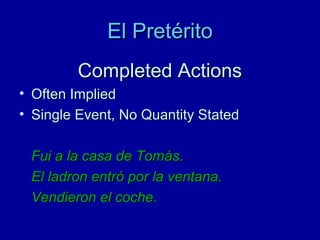
El Pretérito
Completed Actions
• Often Implied
• Single Event, No Quantity Stated
Fui a la casa de Tomás.
El ladron entró por la ventana.
Vendieron el coche.
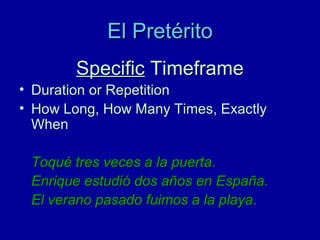
El Pretérito
Specific Timeframe
• Duration or Repetition
• How Long, How Many Times, Exactly
When
Toqué tres veces a la puerta.
Enrique estudió dos años en España.
El verano pasado fuimos a la playa.
El Pretérito
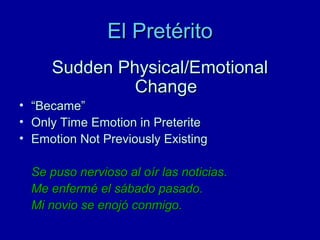
Sudden Physical/Emotional
Change
•
•
•

“Became”
Only Time Emotion in Preterite
Emotion Not Previously Existing
Se puso nervioso al oír las noticias.
Me enfermé el sábado pasado.
Mi novio se enojó conmigo.
El Pretérito
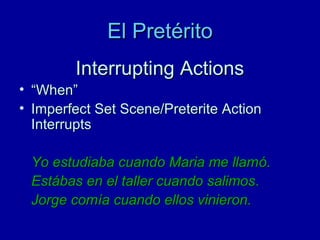
Interrupting Actions
• “When”
• Imperfect Set Scene/Preterite Action
Interrupts
Yo estudiaba cuando Maria me llamó.
Estábas en el taller cuando salimos.
Jorge comía cuando ellos vinieron.
El Pretérito
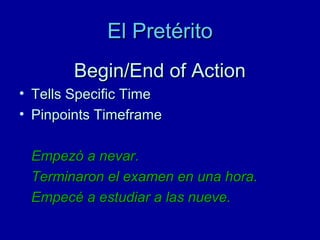
Begin/End of Action
• Tells Specific Time
• Pinpoints Timeframe
Empezó a nevar.
Terminaron el examen en una hora.
Empecé a estudiar a las nueve.
El Pretérito
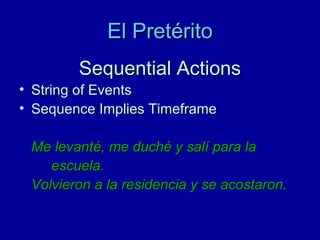
Sequential Actions
• String of Events
• Sequence Implies Timeframe
Me levanté, me duché y salí para la
escuela.
Volvieron a la residencia y se acostaron.
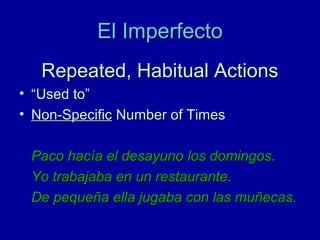
El Imperfecto
El Imperfecto
Repeated, Habitual Actions
• “Used to”
• Non-Specific Number of Times
Paco hacía el desayuno los domingos.
Yo trabajaba en un restaurante.
De pequeña ella jugaba con las muñecas.
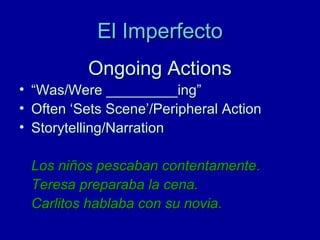
El Imperfecto
Ongoing Actions
•
•
•

“Was/Were _________ing”
Often ‘Sets Scene’/Peripheral Action
Storytelling/Narration
Los niños pescaban contentamente.
Teresa preparaba la cena.
Carlitos hablaba con su novia.
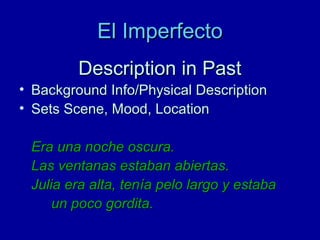
El Imperfecto
Description in Past
• Background Info/Physical Description
• Sets Scene, Mood, Location
Era una noche oscura.
Las ventanas estaban abiertas.
Julia era alta, tenía pelo largo y estaba
un poco gordita.
El Imperfecto
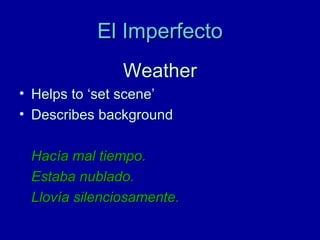
Weather
• Helps to ‘set scene’
• Describes background
Hacía mal tiempo.
Estaba nublado.
Llovía silenciosamente.
El Imperfecto
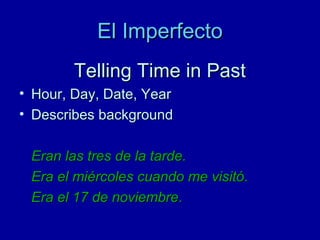
Telling Time in Past
• Hour, Day, Date, Year
• Describes background
Eran las tres de la tarde.
Era el miércoles cuando me visitó.
Era el 17 de noviembre.
El Imperfecto
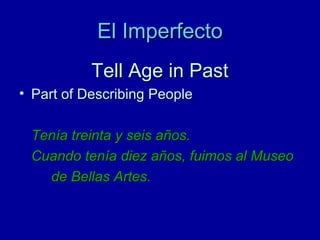
Tell Age in Past
• Part of Describing People
Tenía treinta y seis años.
Cuando tenía diez años, fuimos al Museo
de Bellas Artes.
El Imperfecto
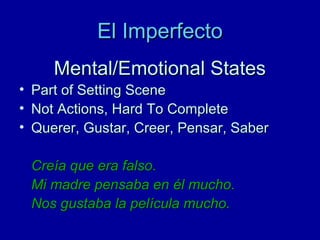
Mental/Emotional States
•
•
•

Part of Setting Scene
Not Actions, Hard To Complete
Querer, Gustar, Creer, Pensar, Saber
Creía que era falso.
Mi madre pensaba en él mucho.
Nos gustaba la película mucho.
El Imperfecto
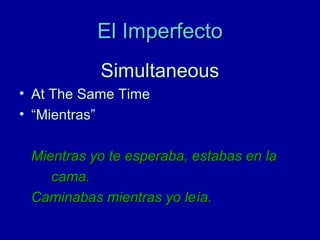
Simultaneous
• At The Same Time
• “Mientras”
Mientras yo te esperaba, estabas en la
cama.
Caminabas mientras yo leía.
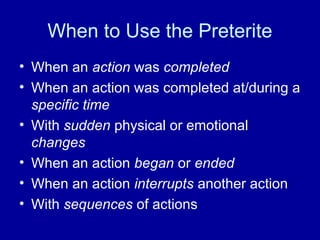
When to Use the Preterite
• When an action was completed
• When an action was completed at/during a
specific time
• With sudden physical or emotional
changes
• When an action began or ended
• When an action interrupts another action
• With sequences of actions
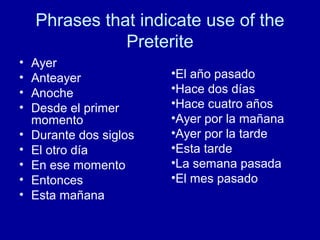
Phrases that indicate use of the
Preterite
•
•
•
•
•
•
•
•
•

Ayer
Anteayer
Anoche
Desde el primer
momento
Durante dos siglos
El otro día
En ese momento
Entonces
Esta mañana

•El año pasado
•Hace dos días
•Hace cuatro años
•Ayer por la mañana
•Ayer por la tarde
•Esta tarde
•La semana pasada
•El mes pasado
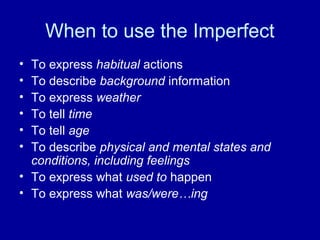
When to use the Imperfect
•
•
•
•
•
•

To express habitual actions
To describe background information
To express weather
To tell time
To tell age
To describe physical and mental states and
conditions, including feelings
• To express what used to happen
• To express what was/were…ing
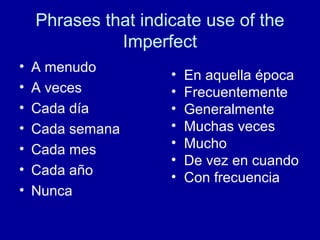
Phrases that indicate use of the
Imperfect
•
•
•
•
•
•
•

A menudo
A veces
Cada día
Cada semana
Cada mes
Cada año
Nunca

•
•
•
•
•
•
•

En aquella época
Frecuentemente
Generalmente
Muchas veces
Mucho
De vez en cuando
Con frecuencia
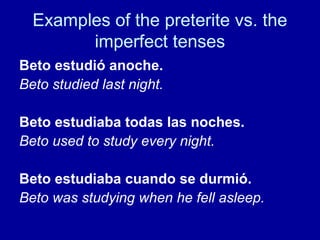
Examples of the preterite vs. the
imperfect tenses
Beto estudió anoche.
Beto studied last night.
Beto estudiaba todas las noches.
Beto used to study every night.
Beto estudiaba cuando se durmió.
Beto was studying when he fell asleep.
¡OJO!

• Some verbs change meaning depending
on whether they are in the preterite or in
the imperfect…
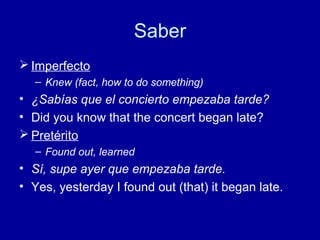
Saber
 Imperfecto
– Knew (fact, how to do something)

• ¿Sabías que el concierto empezaba tarde?
• Did you know that the concert began late?
 Pretérito
– Found out, learned

• Sí, supe ayer que empezaba tarde.
• Yes, yesterday I found out (that) it began late.
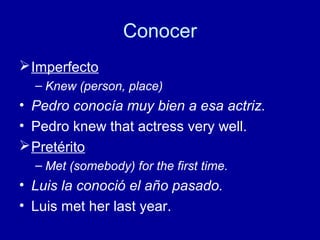
Conocer
 Imperfecto
– Knew (person, place)

• Pedro conocía muy bien a esa actriz.
• Pedro knew that actress very well.
 Pretérito
– Met (somebody) for the first time.

• Luis la conoció el año pasado.
• Luis met her last year.
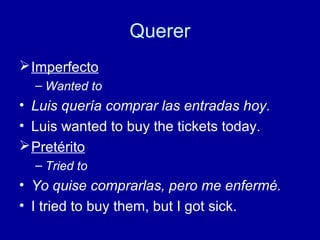
Querer
 Imperfecto
– Wanted to

• Luis quería comprar las entradas hoy.
• Luis wanted to buy the tickets today.
 Pretérito
– Tried to

• Yo quise comprarlas, pero me enfermé.
• I tried to buy them, but I got sick.
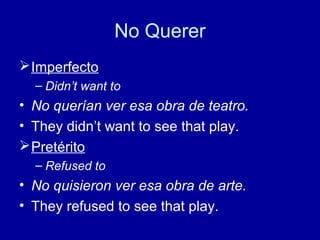
No Querer
 Imperfecto
– Didn’t want to

• No querían ver esa obra de teatro.
• They didn’t want to see that play.
 Pretérito
– Refused to

• No quisieron ver esa obra de arte.
• They refused to see that play.
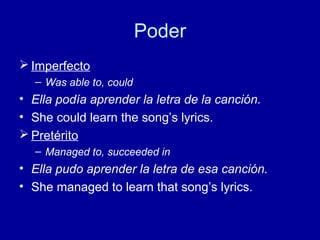
Poder
 Imperfecto
– Was able to, could

• Ella podía aprender la letra de la canción.
• She could learn the song’s lyrics.
 Pretérito
– Managed to, succeeded in

• Ella pudo aprender la letra de esa canción.
• She managed to learn that song’s lyrics.
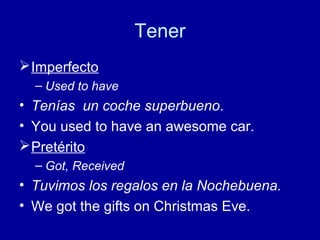
Tener
 Imperfecto
– Used to have

• Tenías un coche superbueno.
• You used to have an awesome car.
 Pretérito
– Got, Received

• Tuvimos los regalos en la Nochebuena.
• We got the gifts on Christmas Eve.

El pret y el imp

  • 1.
    El Pretérito yEl Imperfecto Cuando se usa los tiempos del pasado
  • 2.
  • 3.
    El Pretérito Completed Actions •Often Implied • Single Event, No Quantity Stated Fui a la casa de Tomás. El ladron entró por la ventana. Vendieron el coche.
  • 4.
    El Pretérito Specific Timeframe •Duration or Repetition • How Long, How Many Times, Exactly When Toqué tres veces a la puerta. Enrique estudió dos años en España. El verano pasado fuimos a la playa.
  • 5.
    El Pretérito Sudden Physical/Emotional Change • • • “Became” OnlyTime Emotion in Preterite Emotion Not Previously Existing Se puso nervioso al oír las noticias. Me enfermé el sábado pasado. Mi novio se enojó conmigo.
  • 6.
    El Pretérito Interrupting Actions •“When” • Imperfect Set Scene/Preterite Action Interrupts Yo estudiaba cuando Maria me llamó. Estábas en el taller cuando salimos. Jorge comía cuando ellos vinieron.
  • 7.
    El Pretérito Begin/End ofAction • Tells Specific Time • Pinpoints Timeframe Empezó a nevar. Terminaron el examen en una hora. Empecé a estudiar a las nueve.
  • 8.
    El Pretérito Sequential Actions •String of Events • Sequence Implies Timeframe Me levanté, me duché y salí para la escuela. Volvieron a la residencia y se acostaron.
  • 9.
  • 10.
    El Imperfecto Repeated, HabitualActions • “Used to” • Non-Specific Number of Times Paco hacía el desayuno los domingos. Yo trabajaba en un restaurante. De pequeña ella jugaba con las muñecas.
  • 11.
    El Imperfecto Ongoing Actions • • • “Was/Were_________ing” Often ‘Sets Scene’/Peripheral Action Storytelling/Narration Los niños pescaban contentamente. Teresa preparaba la cena. Carlitos hablaba con su novia.
  • 12.
    El Imperfecto Description inPast • Background Info/Physical Description • Sets Scene, Mood, Location Era una noche oscura. Las ventanas estaban abiertas. Julia era alta, tenía pelo largo y estaba un poco gordita.
  • 13.
    El Imperfecto Weather • Helpsto ‘set scene’ • Describes background Hacía mal tiempo. Estaba nublado. Llovía silenciosamente.
  • 14.
    El Imperfecto Telling Timein Past • Hour, Day, Date, Year • Describes background Eran las tres de la tarde. Era el miércoles cuando me visitó. Era el 17 de noviembre.
  • 15.
    El Imperfecto Tell Agein Past • Part of Describing People Tenía treinta y seis años. Cuando tenía diez años, fuimos al Museo de Bellas Artes.
  • 16.
    El Imperfecto Mental/Emotional States • • • Partof Setting Scene Not Actions, Hard To Complete Querer, Gustar, Creer, Pensar, Saber Creía que era falso. Mi madre pensaba en él mucho. Nos gustaba la película mucho.
  • 17.
    El Imperfecto Simultaneous • AtThe Same Time • “Mientras” Mientras yo te esperaba, estabas en la cama. Caminabas mientras yo leía.
  • 18.
    When to Usethe Preterite • When an action was completed • When an action was completed at/during a specific time • With sudden physical or emotional changes • When an action began or ended • When an action interrupts another action • With sequences of actions
  • 19.
    Phrases that indicateuse of the Preterite • • • • • • • • • Ayer Anteayer Anoche Desde el primer momento Durante dos siglos El otro día En ese momento Entonces Esta mañana •El año pasado •Hace dos días •Hace cuatro años •Ayer por la mañana •Ayer por la tarde •Esta tarde •La semana pasada •El mes pasado
  • 20.
    When to usethe Imperfect • • • • • • To express habitual actions To describe background information To express weather To tell time To tell age To describe physical and mental states and conditions, including feelings • To express what used to happen • To express what was/were…ing
  • 21.
    Phrases that indicateuse of the Imperfect • • • • • • • A menudo A veces Cada día Cada semana Cada mes Cada año Nunca • • • • • • • En aquella época Frecuentemente Generalmente Muchas veces Mucho De vez en cuando Con frecuencia
  • 22.
    Examples of thepreterite vs. the imperfect tenses Beto estudió anoche. Beto studied last night. Beto estudiaba todas las noches. Beto used to study every night. Beto estudiaba cuando se durmió. Beto was studying when he fell asleep.
  • 23.
    ¡OJO! • Some verbschange meaning depending on whether they are in the preterite or in the imperfect…
  • 24.
    Saber  Imperfecto – Knew(fact, how to do something) • ¿Sabías que el concierto empezaba tarde? • Did you know that the concert began late?  Pretérito – Found out, learned • Sí, supe ayer que empezaba tarde. • Yes, yesterday I found out (that) it began late.
  • 25.
    Conocer  Imperfecto – Knew(person, place) • Pedro conocía muy bien a esa actriz. • Pedro knew that actress very well.  Pretérito – Met (somebody) for the first time. • Luis la conoció el año pasado. • Luis met her last year.
  • 26.
    Querer  Imperfecto – Wantedto • Luis quería comprar las entradas hoy. • Luis wanted to buy the tickets today.  Pretérito – Tried to • Yo quise comprarlas, pero me enfermé. • I tried to buy them, but I got sick.
  • 27.
    No Querer  Imperfecto –Didn’t want to • No querían ver esa obra de teatro. • They didn’t want to see that play.  Pretérito – Refused to • No quisieron ver esa obra de arte. • They refused to see that play.
  • 28.
    Poder  Imperfecto – Wasable to, could • Ella podía aprender la letra de la canción. • She could learn the song’s lyrics.  Pretérito – Managed to, succeeded in • Ella pudo aprender la letra de esa canción. • She managed to learn that song’s lyrics.
  • 29.
    Tener  Imperfecto – Usedto have • Tenías un coche superbueno. • You used to have an awesome car.  Pretérito – Got, Received • Tuvimos los regalos en la Nochebuena. • We got the gifts on Christmas Eve.