The Imperfect
vs.
The Preterit
In Spanish you use the
preterit and the imperfect
tenses to say what
happened in the past.
El Pretérito
The
Preterit
Remember that the endings for REGULAR preterit
verbs are:
Yo é Nosotros/as amos
Tú aste Vosotros/as asteis
Ud. ó Ustedes aron
Él/ella ó Ellos/as aron
Verbs ending in AR
Yo í Nosotros/as imos
Tú iste Vosotros/as isteis
Ud. ió Ustedes ieron
Él/ella ió Ellos/as ieron
Verbs ending in ER and IR
You use the preterit to talk about a
completed action in the past that
happened only once.
Ellas ganaron el partido ayer.
FEl autobús llegó a
a las siete.
It’s like marking an “X” on a
time line.
X
Tuve un examen
por la tarde.
FFui de compras con
mis amigas a las dos.
X X X
Me acosté
temprano anoche.
You use the preterit to talk about
an action that repeated a certain
number of times in the past.
Te llamé cuatro veces anoche.
Vimos la película Harry Potter tres veces.
Lavó al perro sucio dos veces ayer.
With the preterit the actions
ocurred during a specifc time in
the past.
Carlos viajó por Europa por dos meses.
Ana hizo ejercicio
todos los días por un año.
Tomás leyó su novela cada
noche por una semana.
FPedro se levantó
temprano,
X
se arregló en el
baño,
Fy salió a pasar el día
en la feria con su
familia.
X X
You use the preterit to talk about
actions that are part
of a chain of events.
You use the preterit to say the
beginning or the end of an action.
La clase empezó a
las doce hoy.
You use el preterit to say the
beginning or the end of an action.
El almuerzo terminó a
las once y media.
Era una noche despejada y
romántica. Los novios
llegaron al parque y se
sentaron a ver los fuegos
artificiales.
You also use the preterit to
narrate the beginning actions of a
story.
Era una noche despejada y
romántica. Los novios
llegaron al parque y se
sentaron a ver los fuegos
artificiales.De repente corrieron dos perros
delante de ellos y la novia se
asustó.
You also use the preterit to
narrate the beginning actions of a
story.
El Presente El Pretérito
conocer to know to meet Ayer, yo conocí a Alfredo.
Yesterday I met Alfredo.
saber to know to find out ¿Cuándo supieron la verdad
When did they find out the truth
querer to want to try Mi papa quiso pagar la cuenta
My dad tried to pay the bill.
no querer to not want to refuse No quiso hacerlo.
He refused to do it.
poder to be able to to manage to Pudiste encontrar la tarea.
ifinally You (finally) managed to find the homework.
no poder to not be able to to fail No pudimos correr las cinco millas.
Certain verbs like conocer, saber, querer, poder and
tener change meaning according to the tense of the
verb.
Finally, certain
expressions
indicate the use of
the preterit.
For the preterit some are...
Anoche-last night
El año pasado-last year
Ayer-yesterday
Anteayer-day before yesterday
Hace un día/mes/año-a day/month/year ago
El otro día-the other day
El mes pasado-last month
La semana pasada-last week
A las dos/tres/cuatro etc.-at 2/3/4 ˚clock
Hace tiempo/un rato-awhile ago
El Imperfecto
The Imperfect
Remember that the endings for regular
imperfect verbs are:
Yo aba Nosotros/as ábamos
Tú abas Vosotros/as abais
Ud. aba Ustedes aban
Él/ella aba Ellos/as aban
Verbs that end in AR
Yo ía Nosotros/as íamos
Tú ías Vosotros/as íais
Ud. ía Ustedes ían
Él/ella ía Ellos/as ían
Verbs that end in ER or IR
You use the imperfect to talk about
actions in the past that HAVE NO clear
beginning or ending.
Él tenía mucho pelo cuando era joven.
The imperfect expresses
actions in the past.
repeated
continual
or habitual
Cada mañana yo
tomaba un café.
Samuel siempre
estudiaba mucho para
los exámenes.
Pedro caminaba por el
parque los sábados.
You use the imperfect to
“set the stage” for a story.
Era una noche despejada y
romántica. La luna y las
estrellas brillaban en el cielo.
No había ni una sola nube. Los
novios llegaron al parque y se
sentaron a ver los fuegos
artificiales.
You use the imperfect to tell the
time
and the age of someone or
something in the past.
Eran las diez
y diez.
Tenía tres años.
You use the imperfect to describe
the mental and emotional state of
someone in the past.
Jorge se sentía muy
emocionado cuando le
contaron que ganó la
lotería.
Jorge estaba furioso
cuando le contaron que
solo ganó cinco dólares .
You use the imperfect to describe
the mental and emotional state of
someone in the past.
You use the imperfect to describe the
physical state of a person.
Mi abuelo estaba muy mal. Tenía
fiebre, tos y dolor de garganta.
You use the imperfect to
describe the characteristcs of
people , things or conditons
in the past.
Mi abuelo tenía
mucho pelo negro.
Era alto y guapo y
tenía ojos azules.
You use the imperfect to describe the
attitudes and desires of a person in the
past.
Ana estaba
deprimida.
Elena quería
encontrar empleo.
You use the imperfect to say what
the date was in the past.
Era el cinco
de mayo.
Era el cuatro de julio
cuando llegamos.
You use the imperfect to describe
the location of something or someone in
the past.
Paco estaba en casa.
Paco estaba en la escuela.
Paco estaba en la biblioteca.
You use the imperfect to describe
the weather in the past.
Hacía sol.
Llovía mucho.
Creía que no iba a llover.
Jorge se alegraba de estar aquí.
Temía que no saliéramos
bien en el examen.
The imperfect is generally used
with verbs of thought and emotion.
You use the imperfect to say what
someone “was going to________”.
Gerardo iba a comprar un coche
pero no tenía el dinero.
Ángela iba a comprar un vestido
nuevo pero no tenía tiempo.
You use the imperfect in stories to say
“Once upon a time”.
Érase una vez…
Había una vez…
Finally, certain
expressions indicate the
use of the imperfect.
For the imperfect some are...
Siempre-always
Cada día, todos los días-every day
Frecuentemente, con frecuencia-frequently
Generalmente-generally
Todos los lunes, martes. etc.-
Every Monday, Tuesday.etc.
A menudo-often
Cada semana, todas las semanas-Every week
A veces, de vez en cuando-sometimes
Varias veces-several times
The Imperfect
or the Preterit
When there are two
verbs in a sentence
Imperfect/Imperfect
You use the imperfect with both verbs
when you have two actions that happen
simultaneously.
Mientras yo cantaba ella
tocaba la guitarra.
Preterit/Preterit
You use the preterit with both verbs when
you have two COMPLETED actions in the
past.
Juan entró y Mario salió.
Imperfect/Preterit
Normally, in sentences that use the word
“cuando”, the verb that is the continual
action is in the imperfect tense and the
action that interrupts it is in the preterit.
Continual action
Action that
interrupts it
Los niños miraban la tele cuando llegó su amiga.
Continual action
Action that
interrupts it
Daba un paseo cuando empezó a llover
Continual action
Action that
interrupts it
Él se bañaba cuando sonó el teléfono.
Practice
HABLAR
YO
___________________ con mi amigo
en la biblioteca ayer.
Hablé
COMER
Ellas
Generalmente ___________________ en
la cafetería.
comían
VIVIR
Nosotros
___________________ en Chicago cuando
yo era niña.
Vivíamos
COMER
Nosotros
Siempre_____________________ en
la cafetería con nuestros amigos.
comíamos
CANTAR
Él
Normalmente___________________
en la ducha.
cantaba
TRABAJAR/ESCUCHAR
Tú
Esta tarde___________________
y__________________ dos
canciones de ZZ Top.
trabajabaste
escuchaste
VER
Ellos
Todos los domingos___________________
a sus abuelos.
veían
CANTAR
Él
___________________ muy bien en
el concierto anoche.
Cantó
COMER
Ella
_________________ en la cafetería con su
novio ayer.
Comió
Ir
Nosotros
De costumbre___________________
al cine los sábados.
íbamos
SER
___________________ las cinco de la tarde.Eran
Esquiar
Vosotros
De vez en cuando___________________
en Vermont.
esquiabais
TENER AÑOS
Usted
Usted___________________ treinta años en
2001.
tenía
LEER
Ustedes
Ustedes siempre___________________
muchos libros en vacaciones.
leían
LEER y ESCRIBIR
Nosotros/Ella
Mientras ___________________
ella ________________.
leíamos
escribía
VER
Ellas
Hace una semana___________________
a sus abuelos.
vieron
Ir
Nosotros
Hace dos días___________________
al cine con nuestros amigos.
fuimos
Esquiar
Nosotros
Hoy___________________ en Vermont.esquiamos
TOCAR y BAILAR
El padre/La madre
Mi padre___________________ la guitarra
mientras que mi madre ________________.
tocaba
bailaba
SALIR
YO
Siempre___________________ temprano
a desayunar con mis amigos.
salía
COCINAR/SONAR
Yo/el teléfono
Yo_____________ la cena
cuando el teléfono___________.
cocinaba
sonó
LEER
Ellas
___________________ cinco libros
en vacaciones este año.
Leyeron
TOCAR y EMPEZAR
Paco y Julia
A las cinco Paco_______________ la guitarra
y Julia ________________ a bailar.
tocó
empezó
BAILAR/CAERSE
Ellos/Pablo
Ellos_____________ cuando
Pablo___________.
bailaban
se cayó
LLEGAR
Yo
El lunes___________________ tarde
a la clase de español.
llegué
DORMIR/CERRAR
Mateo/Sara
Mateo_____________ profundamente
cuando Sara___________ la puerta
muy duro.
dormía
cerró
SER
___________________ el cinco de mayo.Era
HABLAR
YO
Siempre ___________________ con mi amigo
en la biblioteca.
hablaba
Vosotros
¿___________________ a España el año
pasado?
Viajasteis
VIAJAR
SALIR
YO
Hoy___________ temprano a desayunar
con mis amigos.
salí
LLEVAR
El niño
El jueves___________________ un suéter
para dar un paseo por el parque.
llevó
Nosotros
___________________ mucho dinero durante
los veranos trabajando en el balneario.
Ganábamos
GANAR
SER
___________________ la una de la mañana.Era
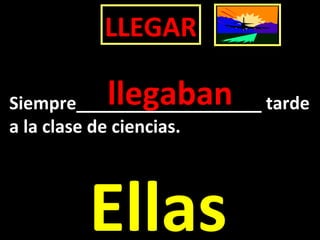
LLEGAR
Ellas
Siempre___________________ tarde
a la clase de ciencias.
llegaban
Yo
Yo___________________ la tarea todos
los días.
hacía
HACER (la tarea)
Vosotros
___________________ mucho cuando
erais jóvenes.
Viajabais
VIAJAR
LLEVAR
Él
Siempre___________________ un suéter
para dar paseos en la playa.
llevaba
Los alumnos
___________________ un ensayo
largo para la clase de literatura
la semana pasada.
Escribieron
ESCRIBIR
Yo
Anteayer no___________________ la
tarea.
hice
HACER (la tarea)
Ellos
Con frecuencia___________________
ensayos en la clase de literatura.
escribían
ESCRIBIR
Mi madre
_________mucho dinero anoche en el casino
Mohegan Sun.
Ganó
GANAR

Preterite vs. imperfect interactive