Bienvenidos!
Live Class- Semana 12
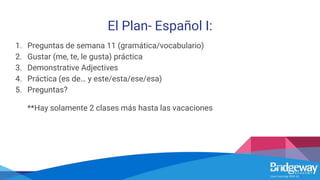
El Plan- Español I:
1. Preguntas de semana 11 (gramática/vocabulario)
2. Gustar (me, te, le gusta) práctica
3. Demonstrative Adjectives
4. Práctica (es de… y este/esta/ese/esa)
5. Preguntas?
**Hay solamente 2 clases más hasta las vacaciones
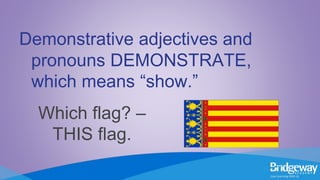
Which flag? –
THIS flag.
Demonstrative adjectives and
pronouns DEMONSTRATE,
which means “show.”
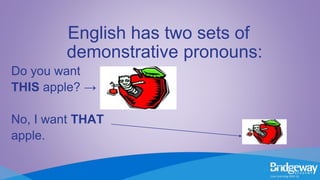
English has two sets of
demonstrative pronouns:
Do you want
THIS apple? →
No, I want THAT
apple.
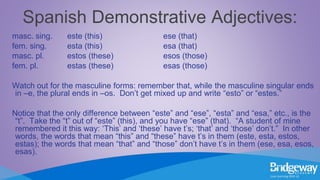
Spanish Demonstrative Adjectives:
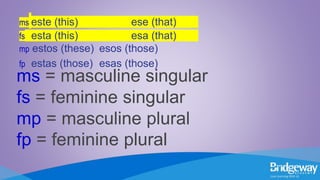
masc. sing. este (this) ese (that)
fem. sing. esta (this) esa (that)
masc. pl. estos (these) esos (those)
fem. pl. estas (these) esas (those)
Watch out for the masculine forms: remember that, while the masculine singular ends
in –e, the plural ends in –os. Don’t get mixed up and write “esto” or “estes.”
Notice that the only difference between “este” and “ese”, “esta” and “esa,” etc., is the
“t”. Take the “t” out of “este” (this), and you have “ese” (that). “A student of mine
remembered it this way: ‘This’ and ‘these’ have t’s; ‘that’ and ‘those’ don’t.” In other
words, the words that mean “this” and “these” have t’s in them (este, esta, estos,
estas); the words that mean “that” and “those” don’t have t’s in them (ese, esa, esos,
esas).
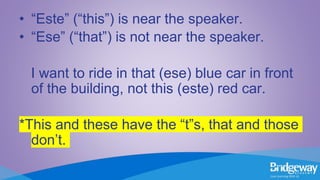
• “Este” (“this”) is near the speaker.
• “Ese” (“that”) is not near the speaker.
I want to ride in that (ese) blue car in front
of the building, not this (este) red car.
*This and these have the “t”s, that and those
don’t.
ms = masculine singular
fs = feminine singular
mp = masculine plural
fp = feminine plural
ms este (this) ese (that)
fs esta (this) esa (that)
mp estos (these) esos (those)
fp estas (those) esas (those)
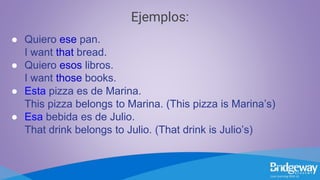
Ejemplos:
● Quiero ese pan.
I want that bread.
● Quiero esos libros.
I want those books.
● Esta pizza es de Marina.
This pizza belongs to Marina. (This pizza is Marina’s)
● Esa bebida es de Julio.
That drink belongs to Julio. (That drink is Julio’s)
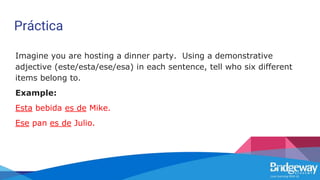
Práctica
Imagine you are hosting a dinner party. Using a demonstrative
adjective (este/esta/ese/esa) in each sentence, tell who six different
items belong to.
Example:
Esta bebida es de Mike.
Ese pan es de Julio.
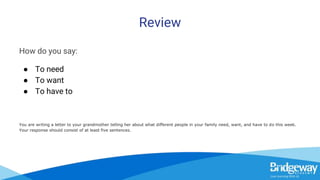
Review
How do you say:
● To need
● To want
● To have to
You are writing a letter to your grandmother telling her about what different people in your family need, want, and have to do this week.
Your response should consist of at least five sentences.
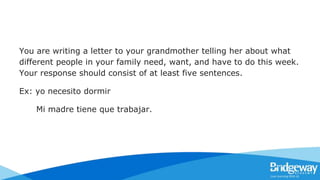
You are writing a letter to your grandmother telling her about what
different people in your family need, want, and have to do this week.
Your response should consist of at least five sentences.
Ex: yo necesito dormir
Mi madre tiene que trabajar.
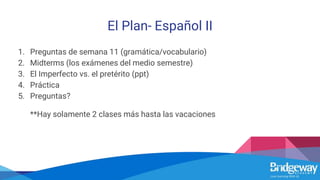
El Plan- Español II
1. Preguntas de semana 11 (gramática/vocabulario)
2. Midterms (los exámenes del medio semestre)
3. El Imperfecto vs. el pretérito (ppt)
4. Práctica
5. Preguntas?
**Hay solamente 2 clases más hasta las vacaciones
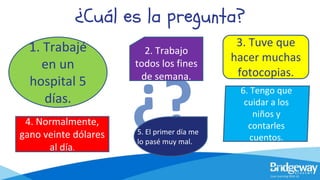
¿Cuál es la pregunta?
¿?
1. Trabajé
en un
hospital 5
días.
3. Tuve que
hacer muchas
fotocopias.
4. Normalmente,
gano veinte dólares
al día.
6. Tengo que
cuidar a los
niños y
contarles
cuentos.
5. El primer día me
lo pasé muy mal.
2. Trabajo
todos los fines
de semana.
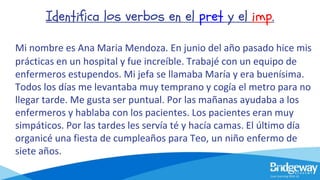
Identifica los verbos en el pret y el imp.
Mi nombre es Ana Maria Mendoza. En junio del año pasado hice mis
prácticas en un hospital y fue increíble. Trabajé con un equipo de
enfermeros estupendos. Mi jefa se llamaba María y era buenísima.
Todos los días me levantaba muy temprano y cogía el metro para no
llegar tarde. Me gusta ser puntual. Por las mañanas ayudaba a los
enfermeros y hablaba con los pacientes. Los pacientes eran muy
simpáticos. Por las tardes les servía té y hacía camas. El último día
organicé una fiesta de cumpleaños para Teo, un niño enfermo de
siete años.
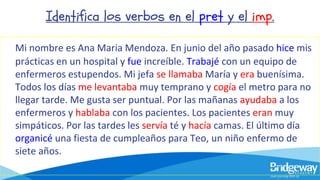
Identifica los verbos en el pret y el imp.
Mi nombre es Ana Maria Mendoza. En junio del año pasado hice mis
prácticas en un hospital y fue increíble. Trabajé con un equipo de
enfermeros estupendos. Mi jefa se llamaba María y era buenísima.
Todos los días me levantaba muy temprano y cogía el metro para no
llegar tarde. Me gusta ser puntual. Por las mañanas ayudaba a los
enfermeros y hablaba con los pacientes. Los pacientes eran muy
simpáticos. Por las tardes les servía té y hacía camas. El último día
organicé una fiesta de cumpleaños para Teo, un niño enfermo de
siete años.
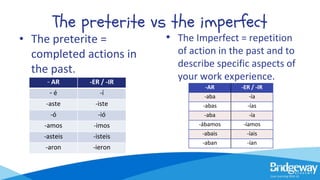
The preterite vs the imperfect
• The preterite =
completed actions in
the past.
• The Imperfect = repetition
of action in the past and to
describe specific aspects of
your work experience.- AR -ER / -IR
- é -í
-aste -iste
-ó -ió
-amos -imos
-asteis -isteis
-aron -ieron
-AR -ER / -IR
-aba -ía
-abas -ías
-aba -ía
-ábamos -íamos
-abais -íais
-aban -ían
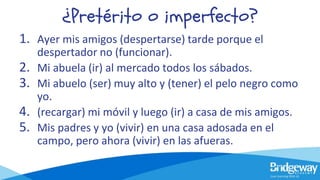
¿Pretérito o imperfecto?
1. Ayer mis amigos (despertarse) tarde porque el
despertador no (funcionar).
2. Mi abuela (ir) al mercado todos los sábados.
3. Mi abuelo (ser) muy alto y (tener) el pelo negro como
yo.
4. (recargar) mi móvil y luego (ir) a casa de mis amigos.
5. Mis padres y yo (vivir) en una casa adosada en el
campo, pero ahora (vivir) en las afueras.
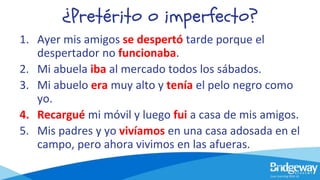
¿Pretérito o imperfecto?
1. Ayer mis amigos se despertó tarde porque el
despertador no funcionaba.
2. Mi abuela iba al mercado todos los sábados.
3. Mi abuelo era muy alto y tenía el pelo negro como
yo.
4. Recargué mi móvil y luego fui a casa de mis amigos.
5. Mis padres y yo vivíamos en una casa adosada en el
campo, pero ahora vivimos en las afueras.
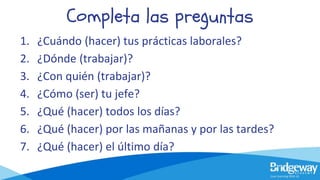
Completa las preguntas
1. ¿Cuándo (hacer) tus prácticas laborales?
2. ¿Dónde (trabajar)?
3. ¿Con quién (trabajar)?
4. ¿Cómo (ser) tu jefe?
5. ¿Qué (hacer) todos los días?
6. ¿Qué (hacer) por las mañanas y por las tardes?
7. ¿Qué (hacer) el último día?
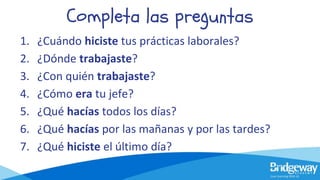
Completa las preguntas
1. ¿Cuándo hiciste tus prácticas laborales?
2. ¿Dónde trabajaste?
3. ¿Con quién trabajaste?
4. ¿Cómo era tu jefe?
5. ¿Qué hacías todos los días?
6. ¿Qué hacías por las mañanas y por las tardes?
7. ¿Qué hiciste el último día?
Caperucita Roja
https://docs.google.com/document/d/1tQXzEwMZgq_ap9VAk5vGWg2GEgGp
6hmJn4xQTk4x9IA/edit
Español II-
What qualities do you think make a good friend? What things does a
good friend do? Write 5-6 sentences in Spanish answering these
questions.
Un(a) buen(a) amigo/a…
El/ella es...

Spanish 1 Class 12

  • 1.
  • 2.
    El Plan- EspañolI: 1. Preguntas de semana 11 (gramática/vocabulario) 2. Gustar (me, te, le gusta) práctica 3. Demonstrative Adjectives 4. Práctica (es de… y este/esta/ese/esa) 5. Preguntas? **Hay solamente 2 clases más hasta las vacaciones
  • 3.
    Which flag? – THISflag. Demonstrative adjectives and pronouns DEMONSTRATE, which means “show.”
  • 4.
    English has twosets of demonstrative pronouns: Do you want THIS apple? → No, I want THAT apple.
  • 5.
    Spanish Demonstrative Adjectives: masc.sing. este (this) ese (that) fem. sing. esta (this) esa (that) masc. pl. estos (these) esos (those) fem. pl. estas (these) esas (those) Watch out for the masculine forms: remember that, while the masculine singular ends in –e, the plural ends in –os. Don’t get mixed up and write “esto” or “estes.” Notice that the only difference between “este” and “ese”, “esta” and “esa,” etc., is the “t”. Take the “t” out of “este” (this), and you have “ese” (that). “A student of mine remembered it this way: ‘This’ and ‘these’ have t’s; ‘that’ and ‘those’ don’t.” In other words, the words that mean “this” and “these” have t’s in them (este, esta, estos, estas); the words that mean “that” and “those” don’t have t’s in them (ese, esa, esos, esas).
  • 6.
    • “Este” (“this”)is near the speaker. • “Ese” (“that”) is not near the speaker. I want to ride in that (ese) blue car in front of the building, not this (este) red car. *This and these have the “t”s, that and those don’t.
  • 7.
    ms = masculinesingular fs = feminine singular mp = masculine plural fp = feminine plural ms este (this) ese (that) fs esta (this) esa (that) mp estos (these) esos (those) fp estas (those) esas (those)
  • 8.
    Ejemplos: ● Quiero esepan. I want that bread. ● Quiero esos libros. I want those books. ● Esta pizza es de Marina. This pizza belongs to Marina. (This pizza is Marina’s) ● Esa bebida es de Julio. That drink belongs to Julio. (That drink is Julio’s)
  • 9.
    Práctica Imagine you arehosting a dinner party. Using a demonstrative adjective (este/esta/ese/esa) in each sentence, tell who six different items belong to. Example: Esta bebida es de Mike. Ese pan es de Julio.
  • 10.
    Review How do yousay: ● To need ● To want ● To have to You are writing a letter to your grandmother telling her about what different people in your family need, want, and have to do this week. Your response should consist of at least five sentences.
  • 11.
    You are writinga letter to your grandmother telling her about what different people in your family need, want, and have to do this week. Your response should consist of at least five sentences. Ex: yo necesito dormir Mi madre tiene que trabajar.
  • 12.
    El Plan- EspañolII 1. Preguntas de semana 11 (gramática/vocabulario) 2. Midterms (los exámenes del medio semestre) 3. El Imperfecto vs. el pretérito (ppt) 4. Práctica 5. Preguntas? **Hay solamente 2 clases más hasta las vacaciones
  • 13.
    ¿Cuál es lapregunta? ¿? 1. Trabajé en un hospital 5 días. 3. Tuve que hacer muchas fotocopias. 4. Normalmente, gano veinte dólares al día. 6. Tengo que cuidar a los niños y contarles cuentos. 5. El primer día me lo pasé muy mal. 2. Trabajo todos los fines de semana.
  • 14.
    Identifica los verbosen el pret y el imp. Mi nombre es Ana Maria Mendoza. En junio del año pasado hice mis prácticas en un hospital y fue increíble. Trabajé con un equipo de enfermeros estupendos. Mi jefa se llamaba María y era buenísima. Todos los días me levantaba muy temprano y cogía el metro para no llegar tarde. Me gusta ser puntual. Por las mañanas ayudaba a los enfermeros y hablaba con los pacientes. Los pacientes eran muy simpáticos. Por las tardes les servía té y hacía camas. El último día organicé una fiesta de cumpleaños para Teo, un niño enfermo de siete años.
  • 15.
    Identifica los verbosen el pret y el imp. Mi nombre es Ana Maria Mendoza. En junio del año pasado hice mis prácticas en un hospital y fue increíble. Trabajé con un equipo de enfermeros estupendos. Mi jefa se llamaba María y era buenísima. Todos los días me levantaba muy temprano y cogía el metro para no llegar tarde. Me gusta ser puntual. Por las mañanas ayudaba a los enfermeros y hablaba con los pacientes. Los pacientes eran muy simpáticos. Por las tardes les servía té y hacía camas. El último día organicé una fiesta de cumpleaños para Teo, un niño enfermo de siete años.
  • 16.
    The preterite vsthe imperfect • The preterite = completed actions in the past. • The Imperfect = repetition of action in the past and to describe specific aspects of your work experience.- AR -ER / -IR - é -í -aste -iste -ó -ió -amos -imos -asteis -isteis -aron -ieron -AR -ER / -IR -aba -ía -abas -ías -aba -ía -ábamos -íamos -abais -íais -aban -ían
  • 17.
    ¿Pretérito o imperfecto? 1.Ayer mis amigos (despertarse) tarde porque el despertador no (funcionar). 2. Mi abuela (ir) al mercado todos los sábados. 3. Mi abuelo (ser) muy alto y (tener) el pelo negro como yo. 4. (recargar) mi móvil y luego (ir) a casa de mis amigos. 5. Mis padres y yo (vivir) en una casa adosada en el campo, pero ahora (vivir) en las afueras.
  • 18.
    ¿Pretérito o imperfecto? 1.Ayer mis amigos se despertó tarde porque el despertador no funcionaba. 2. Mi abuela iba al mercado todos los sábados. 3. Mi abuelo era muy alto y tenía el pelo negro como yo. 4. Recargué mi móvil y luego fui a casa de mis amigos. 5. Mis padres y yo vivíamos en una casa adosada en el campo, pero ahora vivimos en las afueras.
  • 19.
    Completa las preguntas 1.¿Cuándo (hacer) tus prácticas laborales? 2. ¿Dónde (trabajar)? 3. ¿Con quién (trabajar)? 4. ¿Cómo (ser) tu jefe? 5. ¿Qué (hacer) todos los días? 6. ¿Qué (hacer) por las mañanas y por las tardes? 7. ¿Qué (hacer) el último día?
  • 20.
    Completa las preguntas 1.¿Cuándo hiciste tus prácticas laborales? 2. ¿Dónde trabajaste? 3. ¿Con quién trabajaste? 4. ¿Cómo era tu jefe? 5. ¿Qué hacías todos los días? 6. ¿Qué hacías por las mañanas y por las tardes? 7. ¿Qué hiciste el último día?
  • 21.
  • 22.
    Español II- What qualitiesdo you think make a good friend? What things does a good friend do? Write 5-6 sentences in Spanish answering these questions. Un(a) buen(a) amigo/a… El/ella es...