Lección 8
http://www.mcli.dist.maricopa.edu/ocotillo/retreat97/caminante.html
Los gestos ¿Los hispanos hablan con la voca y qué otra parte del cuerpo? ¿Por qué usan los gestos?
¡¡¡¡¡¡¡¡¡¡EL PASADO!!!!!!!!!!!!!!
El imperfecto y el preterito In Spanish we have two forms of the past. One is called the “imperfecto” and the other one is called the “preterito”.
A ver… He wanted to know. I arrived at    eight. I used to come a lot. He spoke to    me today. He had blue hair.    I lived there for    2 years.
El imperfecto We use the imperfect when we speak of something that does not really have a defined beginning or end and could still be going on.  They spoke english. (Los chicos hablaban íngles). He knew it. (El lo sabía)
Un poco más When use the imperfect when speaking of a series of repeated events. Sometimes these events can be seen as unfinished.  I went to his house all the time.  I used to go every day.
¿Cual es imperfecto? I stopped him. He used to come a a lot. She arrived at eight.  We learned it.  They had blue hair.
Más del imperfecto When use the imperfect when we are giving a description of a characteristic.  They had brown hair.  They people seemed nice.
El preterito We use the preterito when there seems to be a beginning and a end and the action is look at as being completed.  He called her.  She was sick for 3 days.
¿Imperfecto o Preterito? http://www.studyspanish.com/practice/pretimp1.htm
La mujer loca I used to go to  the mall every day. One time at the mall  I saw  a crazy lady. She  took her shoe off  and  threw it  at me. The shoe  was red  and and I  picked it up  and  gave it to  her. The woman  was  really crazy and  I asked her  what her name  was  and  she said  it  was  Lucky and that she  was  from Canada.  I told her  that sounded like a horses name and then  she hugged  me and  walked away .
Para mañana Favor de estudiar el imperfecto y el preterito.
ASPECTO One night, Sara, who  was supposed  to stay home,  decided  to sneak out the back door at about 8:00 PM.  Her parents  were  out of town and had asked her to baby-sit her younger sister, Jessica.  However, since Sara  knew  that Jessica usually  went  to sleep around 7:00 PM, she  was  sure that she would not be missed. At 8:05 PM, the back door  opened  and Sara  slipped  out.  She  glanced  nervously up at the darkened bedroom where Jessica  was sleeping  and, with a lump in her throat,  started  down the street towards the bus stop. She only  had  to wait about ten minutes before the bus  arrived .  She  got   on,  paid  her fare, and  sat  down in the first empty seat.  She  felt  a strange rush of emotion - a mixture of guilt, fear, and anticipation. The dance  was  in full swing when she  entered  the gym.  The group  was playing  a loud, raucous song that she  wasn’t  familiar with...
ASPECTO One night, Sara, who  was supposed  to stay home,  decided  to sneak out the back door at about 8:00 PM.  Her parents  were  out of town and had asked her to babysit her younger sister, Jessica.  However, since Sara  knew  that Jessica usually  went  to sleep around 7:00 PM, she  was  sure that she would not be missed. At 8:05 PM, the back door  opened  and Sara  slipped  out.  She  glanced  nervously up at the darkened bedroom where Jessica  was sleeping  and, with a lump in her throat,  started  down the street towards the bus stop. She only  had  to wait about ten minutes before the bus  arrived .  She  got   on,  paid  her fare, and  sat  down in the first empty seat.  She  felt  a strange rush of emotion - a mixture of guilt, fear, and anticipation. The dance  was  in full swing when she  entered  the gym.  The group  was playing  a loud, raucous song that she  wasn’t  familiar with... azul=imperfecto rojo=pretérito were knew was was supposed was sleeping was was playing had wasn’t went decided opened slipped glanced started arrived got paid sat entered felt
Aba, aba, aba There is a special way to conjugate the imperfect verbs and also a special way to conjugate the preterite verbs.  First, lets looks at the imperfect way for AR verbs.
Imperfecto (-a-) habl trabaj est cerr jug d aba - -s - -mos -is -n Lexical Meaning Grammatical Information Subject Indicator
Imperfecto (-a-) habl habl habl habl habl habl hablar aba abas aba ábamos abais aban
A ver… El habla íngles. Ellos están aquí. Yo cierro la puerta.
Mamá  ía Now let’s look at how we conjugate ER and IR verbs when they are imperfect.
Imperfecto (-e-/-i-) com hac pod quer dec escrib ped ía - -s - -mos -is -n Lexical Meaning Grammatical Information Subject Indicator
Imperfecto (-e-, -i-) dec dec dec dec dec dec decir ía ías ía íamos íais ían
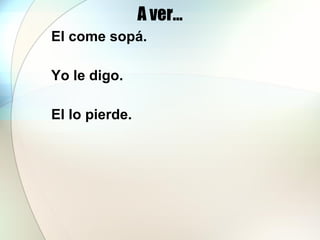
A ver… El come sopá. Yo le digo. El lo pierde.
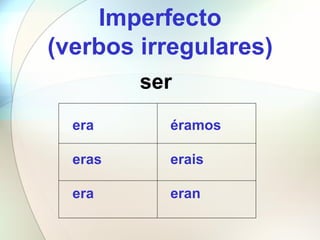
Imperfecto (verbos irregulares) era eras era éramos erais eran ser
Imperfecto (verbos irregulares) iba ibas iba íbamos ibais iban ir
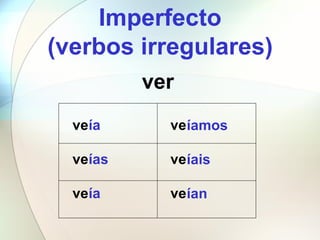
Imperfecto (verbos irregulares) ve ve ve ve ve ve ver ía ías ía íamos íais ían
Cuando eran jovenes Dile a tu compañero las actividades qué tu hacías cuando eran niños.
Mi vida de hoy y de antes UNO : ¿A qué hora te levantas ahora?  DOS : Me levanto a las 5:00 am. UNO : ¿A qué hora te levantabas hace 10 años? DOS: Me levantaba a las 8:00 am.   actualmente 2. ¿Qué haces después de  levantarte? 3. ¿A qué hora sales de casa?  ¿Adónde vas? 4. ¿Qué haces cuando llegas? 5. ¿Qué haces por la tarde/por la  noche? 6. ¿Qué te gusta comer? 7. ¿A qué hora te acuestas? hace diez años 2. ¿Qué hacías después de  levantarte? 3. ¿A qué hora salías de casa?  ¿Adónde ibas? 4. ¿Qué hacías cuando llegabas? 5. ¿Qué hacías por la tarde/por la  noche? 6. ¿Qué te gustaba comer? 7. ¿A qué hora te acostabas? Tu rutina diaria
Mi vida de hoy y de antes UNO : ¿A qué hora te levantas ahora?  DOS : Me levanto a las 5:00 am. UNO : ¿A qué hora te levantabas hace 10 años? DOS: Me levantaba a las 8:00 am.   hoy 1. ¿Cómo te diviertes? ¿Qué lees? ¿Qué música escuchas? ¿Bailas? ¿Tocas algún instrumento? ¿Qué deportes practicas? 2. ¿Tienes muchos amigos? ¿Cómo son? 3. ¿Ves a menudo a tus amigos? ¿En qué ocasiones? 4. ¿Adónde vas con tus amigos? ¿Qué hacen ustedes?  Tus diversiones y tus amigos   (en aquel) entonces 1. ¿Cómo te divertías? ¿Qué leías? ¿Qué música escuchabas? ¿Bailabas? ¿Tocabas algún instrumento? ¿Qué deportes hacías? 2. ¿Tenías muchos amigos? ¿Cómo eran? 3. ¿Veías a menudo a tus amigos? ¿En qué ocasiones? 4. ¿Adónde ibas con tus amigos? ¿Qué hacían ustedes?
Mi vida de hoy y de antes UNO : ¿A qué hora te levantas ahora?  DOS : Me levanto a las 5:00 am. UNO : ¿A qué hora te levantabas hace 10 años? DOS: Me levantaba a las 8:00 am.   ahora 1. ¿Vives ahora en una casa o  en un departamento? 2. ¿Cómo es tu casa  (departamento)?  3. ¿Qué cosas hay en tu cuarto? 4. ¿Cuál es tu cuarto favorito? Tu domicilio   antes 1. ¿Vivías antes en una casa o  un departamento? 2. ¿Cómo era tu casa (departamento)?  3. ¿Qué cosas había en tu cuarto? 4. ¿Cuál era tu cuarto favorito?
Mi vida de hoy y de antes UNO : ¿A qué hora te levantas ahora?  DOS : Me levanto a las 5:00 am. UNO : ¿A qué hora te levantabas hace 10 años? DOS: Me levantaba a las 8:00 am.   en este momento 1. ¿Qué estudias o qué piensas estudiar en este momento? 2. ¿Cuándo piensas graduarte? 3. ¿Qué quieres hacer después  de graduarte? 4. ¿Qué quieres ser al graduarte? 5. ¿Qué clase de persona esperas  ser? 6. ¿Crees que vas a tener mucho  dinero? 7. ¿Qué más quieres hacer o tener? Tus planes para el futuro   hace tres años 1. ¿Qué estudiabas o qué pensabas estudiar hace tres años? 2. ¿Cuándo pensabas graduarte? 3. ¿Qué querías hacer después  de graduarte? 4. ¿Qué querías ser al graduarte? 5. ¿Qué clase de persona esperabas  ser? 6. ¿Creías que ibas a tener mucho  dinero? 7. ¿Qué más querías hacer o tener?
Lo que hacía hace 5 años UNO : Hace cinco años, ¿con quién(es) vivías? DOS : Vivía con mi familia. UNO : ¿En qué escuela estudiabas? DOS : Estudiaba en __________.  …etc…   1. A qué hora se levantaba  2. Cuánto estudiaba 3. El lugar a donde salía los fines de semana 4. Qué cosas tenía 5. Qué tipo de estudiante era  Actividades Continúa preguntándole a tu compañero.  Usa las siguientes sugerencias. 6. Si hacía deportes … qué deportes. 7. Adónde iba después de terminar las clases. 8. Si trabajaba…dónde 9. A qué hora se acostaba 10. Qué le gustaba hacer más
La vida ¿Cuando eras bebe llorabas mucho? ¿Cuando eras niño o niña leías muchos libros? ¿Cuando tenías 16 años manejabas mucho?
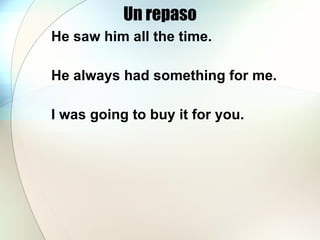
Un repaso He saw him all the time.  He always had something for me. I was going to buy it for you.
¿Cómo te sentías? UNO : ¿Cómo te sentías  anoche ?. DOS : Me sentía  (adjetivo)  .   Tenía ganas de  (verbo)  .  UNO : ¿Por qué te sentías así? DOS : Porque______________________.  anoche ayer por la tarde ayer al mediodía ayer por la mañana anteayer el domingo pasado la semana pasada confiado/a frustrado/a deprimido/a satisfecho/a nervioso/a alegre triste celebrar dejar la escuela descansar por unos días
Conjugando verbos (-a-) habl- -o -a- -a -a- -á- -a- - -s - -mos -is -n Lexical Meaning Grammatical Information Subject Indicator
Conjugando verbos (-e-) com- -o -e- -e -e- -é- -e- - -s - -mos -is -n Lexical Meaning Grammatical Information Subject Indicator
Conjugando verbos (-i-) viv- -o -e- -e -i- -í- -e- - -s - -mos -(i)s -n Lexical Meaning Grammatical Information Subject Indicator
FIN
¡Carlos! ¿Qué pasa con el esposo de doña Conchita? ¿Cómo es don García? ¿A quién se parece Antonio?
Enchufas ¿Sí quieres un empleo en el mundo hispano es importante tener qué? ¿Qué responsibilidad sienten los parientes? ¿Qué quiere decir el “personalismo”?
Los Deportes Cognados
básquetbol
vólibol
beísbol
jonrón
gol
tenis
raqueta
golf
tee
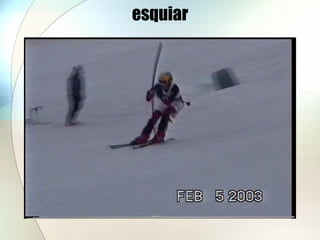
esquiar
esquíes
rugby
Present progressive Estoy hablando por teléfono.  El está gritando al perro. Nosotros cantamos mucho.
estar Imperfect progressive participio presente + hablando comiendo estudiando viendo comprando Estoy corriendo ahora mismo.  Están hablando en este momento.  ¿Estás hablando por teléfono?   estabas estaba estábamos estabais estaban estaba Estaba   corriendo  en ese entonces.  Estaban   hablando  en ese momento. ¿ Estabas   hablando  por teléfono?
¿Qué estabas haciendo…? ¿Qué estabas haciendo ayer a las 12:00? ¿Qué estabas haciendo el sabado pasado? ¿Qué estabas haciendo anoche?
Un repasito I called her. She would always avoid him. They went to the movies. What did he do?
Expresiones temporales anoche ayer por la tarde ayer al mediodía ayer por la mañana anteayer el domingo pasado la semana pasada cada día/todos los días a menudo a veces de vez en cuando rara vez nunca
La vida ¿Cuando eras bebe llorabas mucho? ¿Cuando eras niño o niña leías muchos libros? ¿Cuando tenías 16 años manejabas mucho?
He y Habia Recuerdan esto: Haber He Hemos Has Habeís Ha Han
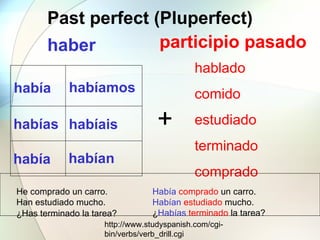
haber Past perfect (Pluperfect) participio pasado + hablado comido estudiado terminado comprado habías había habíamos habíais habían había He comprado un carro.  Han estudiado mucho.  ¿Has terminado la tarea?   Había   comprado  un carro.  Habían   estudiado  mucho. ¿ Habías   terminado  la tarea? http://www.studyspanish.com/cgi-bin/verbs/verb_drill.cgi
AR de preterito Yo é Tú aste El ó
pregunt é pregunt aste pregunt ó preguntar Pretérito (verbos regulares)
contest é contest aste contest ó contestar Pretérito (verbos regulares)
dij e dij iste dij o decir Pretérito (verbos irregulares)
I told him. He answered me. You taught me.
¿Qué le dijo Jorge a la mujer?
¿Qué hacías? MODELO :  anoche a las once UNO : ¿Qué  hacías   anoche a las once ? DOS :  Dormía. UNO : ¿Qué  estabas haciendo   ______ ? DOS :  (responde con el imperfecto progresivo) esta mañana a las cinco ayer a las dos de la tarde el domingo a las diez de la mañana anteayer al mediodía el lunes a la medianoche anoche a las ocho
¿Qué estabas haciendo? MODELO :  anoche a las diez UNO : ¿Qué  estabas haciendo   anoche a las diez ? DOS :  Estaba durmiendo . UNO : ¿Qué  estabas haciendo   ______ ? DOS :  (responde con el progresivo) el jueves a las once de la mañana el lunes a las ocho de la noche el jueves a la medianoche hoy a las cuatro
lavar  la ropa limpiar  la sala reparar  el tostador comprar  detergente planchar  las camisas trabajar  mucho contar  el cuento Pancho/Pancha ya la estaba limpiando. escribir  las cartas abrir  las ventantas barrer  el piso tender  la cama sacudir  la alfombra vender  la bicicleta ver  las noticias ¿Sabes si Pancho/Pancha ya  ha lavado la ropa ?   Creo que sí.  La última vez que lo/la vi, la/lo/los/las estaba lavando .
lavar  la ropa limpiar  la sala reparar  el tostador comprar  detergente planchar  las camisas trabajar  mucho contar  el cuento Pancho/Pancha ya había limpiado escribir  las cartas abrir  las ventantas barrer  el piso tender  la cama sacudir  la alfombra vender  la bicicleta ver  las noticias ¿Le preguntaste a Pancho/Pancha si ya había lavado la ropa ?   Sí.  Ya  la había lavado  cuando hablé con él/ella.
FIN
¿Qué dijo Luz? MODELO Luz:  Tengo que trabajar; no puedo ir. UNO : ¿Qué  dijo  Luz? DOS :  Dijo que  tenía que  trabajar y que no podía ir.  MODELO David:  Deseo visitar a Elena; voy a llevarle un presente. UNO : ¿Qué  dijo  David? DOS :  Dijo que   deseaba  visitar a Elena y que iba a llevarle un presente. 1. Piedad: Necesito estudiar. 2. Ángel: Voy a ayudar a mi papá. 3. Heriberto: Quiero arreglar mi coche. 4. Elba: Tengo que lavar la ropa. 5. Benito: Pienso ir.  ¿Puedo traer algo? 6. Amalia: No estoy segura pero espero poder ir. 7. Héctor: Voy a ir.  Hace dos días que estoy esperando la invitación. 8. Rogelio: No me gustan mucho las fiestas.  Prefiero ver la televisión. 9. Rosana: Un amigo acaba de invitarme a un partido.  Voy a ir con él. 10. Marilú: He recibido una invitación para cenar con mis tíos. 11. Hugo: Estoy trabajando mucho y no voy a tener tiempo.
La rutina del abuelo You are at a friend’s home waiting for him to get ready.  While you wait, you talk to one of his 90-year-old grandparents.  You are particularly interested in the contrast between his daily routine now and 50 years ago.  Find out the following: 1. What time he gets up now and used to get up. 2. What he does after getting up and used to do. 3. Where he goes and used to go. 4. What he does in the afternoon and used to do. 5. What he does in the evening and used to do. 6. What he likes to eat and used to like eating. 7. What time he goes to bed and used to go to bed.
Carlos… Imperfecto vs pretérito El imperfecto (-aba, -ía) Imperfecto irregulares (ser, ir, ver) Expresiones temporales (anoche, anteayer, etc.) Comparaciones (ahora y antes) Cognados - deportes Pretérito preguntar contestar  decir Situación  Comunicativa Repaso - capítulo 8

Boeing Lesson Part 1. 10-10-13

  • 1.
  • 2.
  • 3.
    Los gestos ¿Loshispanos hablan con la voca y qué otra parte del cuerpo? ¿Por qué usan los gestos?
  • 4.
  • 5.
    El imperfecto yel preterito In Spanish we have two forms of the past. One is called the “imperfecto” and the other one is called the “preterito”.
  • 6.
    A ver… Hewanted to know. I arrived at eight. I used to come a lot. He spoke to me today. He had blue hair. I lived there for 2 years.
  • 7.
    El imperfecto Weuse the imperfect when we speak of something that does not really have a defined beginning or end and could still be going on. They spoke english. (Los chicos hablaban íngles). He knew it. (El lo sabía)
  • 8.
    Un poco másWhen use the imperfect when speaking of a series of repeated events. Sometimes these events can be seen as unfinished. I went to his house all the time. I used to go every day.
  • 9.
    ¿Cual es imperfecto?I stopped him. He used to come a a lot. She arrived at eight. We learned it. They had blue hair.
  • 10.
    Más del imperfectoWhen use the imperfect when we are giving a description of a characteristic. They had brown hair. They people seemed nice.
  • 11.
    El preterito Weuse the preterito when there seems to be a beginning and a end and the action is look at as being completed. He called her. She was sick for 3 days.
  • 12.
    ¿Imperfecto o Preterito?http://www.studyspanish.com/practice/pretimp1.htm
  • 13.
    La mujer locaI used to go to the mall every day. One time at the mall I saw a crazy lady. She took her shoe off and threw it at me. The shoe was red and and I picked it up and gave it to her. The woman was really crazy and I asked her what her name was and she said it was Lucky and that she was from Canada. I told her that sounded like a horses name and then she hugged me and walked away .
  • 14.
    Para mañana Favorde estudiar el imperfecto y el preterito.
  • 15.
    ASPECTO One night,Sara, who was supposed to stay home, decided to sneak out the back door at about 8:00 PM. Her parents were out of town and had asked her to baby-sit her younger sister, Jessica. However, since Sara knew that Jessica usually went to sleep around 7:00 PM, she was sure that she would not be missed. At 8:05 PM, the back door opened and Sara slipped out. She glanced nervously up at the darkened bedroom where Jessica was sleeping and, with a lump in her throat, started down the street towards the bus stop. She only had to wait about ten minutes before the bus arrived . She got on, paid her fare, and sat down in the first empty seat. She felt a strange rush of emotion - a mixture of guilt, fear, and anticipation. The dance was in full swing when she entered the gym. The group was playing a loud, raucous song that she wasn’t familiar with...
  • 16.
    ASPECTO One night,Sara, who was supposed to stay home, decided to sneak out the back door at about 8:00 PM. Her parents were out of town and had asked her to babysit her younger sister, Jessica. However, since Sara knew that Jessica usually went to sleep around 7:00 PM, she was sure that she would not be missed. At 8:05 PM, the back door opened and Sara slipped out. She glanced nervously up at the darkened bedroom where Jessica was sleeping and, with a lump in her throat, started down the street towards the bus stop. She only had to wait about ten minutes before the bus arrived . She got on, paid her fare, and sat down in the first empty seat. She felt a strange rush of emotion - a mixture of guilt, fear, and anticipation. The dance was in full swing when she entered the gym. The group was playing a loud, raucous song that she wasn’t familiar with... azul=imperfecto rojo=pretérito were knew was was supposed was sleeping was was playing had wasn’t went decided opened slipped glanced started arrived got paid sat entered felt
  • 17.
    Aba, aba, abaThere is a special way to conjugate the imperfect verbs and also a special way to conjugate the preterite verbs. First, lets looks at the imperfect way for AR verbs.
  • 18.
    Imperfecto (-a-) habltrabaj est cerr jug d aba - -s - -mos -is -n Lexical Meaning Grammatical Information Subject Indicator
  • 19.
    Imperfecto (-a-) hablhabl habl habl habl habl hablar aba abas aba ábamos abais aban
  • 20.
    A ver… Elhabla íngles. Ellos están aquí. Yo cierro la puerta.
  • 21.
    Mamá íaNow let’s look at how we conjugate ER and IR verbs when they are imperfect.
  • 22.
    Imperfecto (-e-/-i-) comhac pod quer dec escrib ped ía - -s - -mos -is -n Lexical Meaning Grammatical Information Subject Indicator
  • 23.
    Imperfecto (-e-, -i-)dec dec dec dec dec dec decir ía ías ía íamos íais ían
  • 24.
    A ver… Elcome sopá. Yo le digo. El lo pierde.
  • 25.
    Imperfecto (verbos irregulares)era eras era éramos erais eran ser
  • 26.
    Imperfecto (verbos irregulares)iba ibas iba íbamos ibais iban ir
  • 27.
    Imperfecto (verbos irregulares)ve ve ve ve ve ve ver ía ías ía íamos íais ían
  • 28.
    Cuando eran jovenesDile a tu compañero las actividades qué tu hacías cuando eran niños.
  • 29.
    Mi vida dehoy y de antes UNO : ¿A qué hora te levantas ahora? DOS : Me levanto a las 5:00 am. UNO : ¿A qué hora te levantabas hace 10 años? DOS: Me levantaba a las 8:00 am. actualmente 2. ¿Qué haces después de levantarte? 3. ¿A qué hora sales de casa? ¿Adónde vas? 4. ¿Qué haces cuando llegas? 5. ¿Qué haces por la tarde/por la noche? 6. ¿Qué te gusta comer? 7. ¿A qué hora te acuestas? hace diez años 2. ¿Qué hacías después de levantarte? 3. ¿A qué hora salías de casa? ¿Adónde ibas? 4. ¿Qué hacías cuando llegabas? 5. ¿Qué hacías por la tarde/por la noche? 6. ¿Qué te gustaba comer? 7. ¿A qué hora te acostabas? Tu rutina diaria
  • 30.
    Mi vida dehoy y de antes UNO : ¿A qué hora te levantas ahora? DOS : Me levanto a las 5:00 am. UNO : ¿A qué hora te levantabas hace 10 años? DOS: Me levantaba a las 8:00 am. hoy 1. ¿Cómo te diviertes? ¿Qué lees? ¿Qué música escuchas? ¿Bailas? ¿Tocas algún instrumento? ¿Qué deportes practicas? 2. ¿Tienes muchos amigos? ¿Cómo son? 3. ¿Ves a menudo a tus amigos? ¿En qué ocasiones? 4. ¿Adónde vas con tus amigos? ¿Qué hacen ustedes? Tus diversiones y tus amigos (en aquel) entonces 1. ¿Cómo te divertías? ¿Qué leías? ¿Qué música escuchabas? ¿Bailabas? ¿Tocabas algún instrumento? ¿Qué deportes hacías? 2. ¿Tenías muchos amigos? ¿Cómo eran? 3. ¿Veías a menudo a tus amigos? ¿En qué ocasiones? 4. ¿Adónde ibas con tus amigos? ¿Qué hacían ustedes?
  • 31.
    Mi vida dehoy y de antes UNO : ¿A qué hora te levantas ahora? DOS : Me levanto a las 5:00 am. UNO : ¿A qué hora te levantabas hace 10 años? DOS: Me levantaba a las 8:00 am. ahora 1. ¿Vives ahora en una casa o en un departamento? 2. ¿Cómo es tu casa (departamento)? 3. ¿Qué cosas hay en tu cuarto? 4. ¿Cuál es tu cuarto favorito? Tu domicilio antes 1. ¿Vivías antes en una casa o un departamento? 2. ¿Cómo era tu casa (departamento)? 3. ¿Qué cosas había en tu cuarto? 4. ¿Cuál era tu cuarto favorito?
  • 32.
    Mi vida dehoy y de antes UNO : ¿A qué hora te levantas ahora? DOS : Me levanto a las 5:00 am. UNO : ¿A qué hora te levantabas hace 10 años? DOS: Me levantaba a las 8:00 am. en este momento 1. ¿Qué estudias o qué piensas estudiar en este momento? 2. ¿Cuándo piensas graduarte? 3. ¿Qué quieres hacer después de graduarte? 4. ¿Qué quieres ser al graduarte? 5. ¿Qué clase de persona esperas ser? 6. ¿Crees que vas a tener mucho dinero? 7. ¿Qué más quieres hacer o tener? Tus planes para el futuro hace tres años 1. ¿Qué estudiabas o qué pensabas estudiar hace tres años? 2. ¿Cuándo pensabas graduarte? 3. ¿Qué querías hacer después de graduarte? 4. ¿Qué querías ser al graduarte? 5. ¿Qué clase de persona esperabas ser? 6. ¿Creías que ibas a tener mucho dinero? 7. ¿Qué más querías hacer o tener?
  • 33.
    Lo que hacíahace 5 años UNO : Hace cinco años, ¿con quién(es) vivías? DOS : Vivía con mi familia. UNO : ¿En qué escuela estudiabas? DOS : Estudiaba en __________. …etc… 1. A qué hora se levantaba 2. Cuánto estudiaba 3. El lugar a donde salía los fines de semana 4. Qué cosas tenía 5. Qué tipo de estudiante era Actividades Continúa preguntándole a tu compañero. Usa las siguientes sugerencias. 6. Si hacía deportes … qué deportes. 7. Adónde iba después de terminar las clases. 8. Si trabajaba…dónde 9. A qué hora se acostaba 10. Qué le gustaba hacer más
  • 34.
    La vida ¿Cuandoeras bebe llorabas mucho? ¿Cuando eras niño o niña leías muchos libros? ¿Cuando tenías 16 años manejabas mucho?
  • 35.
    Un repaso Hesaw him all the time. He always had something for me. I was going to buy it for you.
  • 36.
    ¿Cómo te sentías?UNO : ¿Cómo te sentías anoche ?. DOS : Me sentía (adjetivo) . Tenía ganas de (verbo) . UNO : ¿Por qué te sentías así? DOS : Porque______________________. anoche ayer por la tarde ayer al mediodía ayer por la mañana anteayer el domingo pasado la semana pasada confiado/a frustrado/a deprimido/a satisfecho/a nervioso/a alegre triste celebrar dejar la escuela descansar por unos días
  • 37.
    Conjugando verbos (-a-)habl- -o -a- -a -a- -á- -a- - -s - -mos -is -n Lexical Meaning Grammatical Information Subject Indicator
  • 38.
    Conjugando verbos (-e-)com- -o -e- -e -e- -é- -e- - -s - -mos -is -n Lexical Meaning Grammatical Information Subject Indicator
  • 39.
    Conjugando verbos (-i-)viv- -o -e- -e -i- -í- -e- - -s - -mos -(i)s -n Lexical Meaning Grammatical Information Subject Indicator
  • 40.
  • 41.
    ¡Carlos! ¿Qué pasacon el esposo de doña Conchita? ¿Cómo es don García? ¿A quién se parece Antonio?
  • 42.
    Enchufas ¿Sí quieresun empleo en el mundo hispano es importante tener qué? ¿Qué responsibilidad sienten los parientes? ¿Qué quiere decir el “personalismo”?
  • 43.
  • 44.
  • 45.
  • 46.
  • 47.
  • 48.
  • 49.
  • 50.
  • 51.
  • 52.
  • 53.
  • 54.
  • 55.
  • 56.
    Present progressive Estoyhablando por teléfono. El está gritando al perro. Nosotros cantamos mucho.
  • 57.
    estar Imperfect progressiveparticipio presente + hablando comiendo estudiando viendo comprando Estoy corriendo ahora mismo. Están hablando en este momento. ¿Estás hablando por teléfono? estabas estaba estábamos estabais estaban estaba Estaba corriendo en ese entonces. Estaban hablando en ese momento. ¿ Estabas hablando por teléfono?
  • 58.
    ¿Qué estabas haciendo…?¿Qué estabas haciendo ayer a las 12:00? ¿Qué estabas haciendo el sabado pasado? ¿Qué estabas haciendo anoche?
  • 59.
    Un repasito Icalled her. She would always avoid him. They went to the movies. What did he do?
  • 60.
    Expresiones temporales anocheayer por la tarde ayer al mediodía ayer por la mañana anteayer el domingo pasado la semana pasada cada día/todos los días a menudo a veces de vez en cuando rara vez nunca
  • 61.
    La vida ¿Cuandoeras bebe llorabas mucho? ¿Cuando eras niño o niña leías muchos libros? ¿Cuando tenías 16 años manejabas mucho?
  • 62.
    He y HabiaRecuerdan esto: Haber He Hemos Has Habeís Ha Han
  • 63.
    haber Past perfect(Pluperfect) participio pasado + hablado comido estudiado terminado comprado habías había habíamos habíais habían había He comprado un carro. Han estudiado mucho. ¿Has terminado la tarea? Había comprado un carro. Habían estudiado mucho. ¿ Habías terminado la tarea? http://www.studyspanish.com/cgi-bin/verbs/verb_drill.cgi
  • 64.
    AR de preteritoYo é Tú aste El ó
  • 65.
    pregunt é preguntaste pregunt ó preguntar Pretérito (verbos regulares)
  • 66.
    contest é contestaste contest ó contestar Pretérito (verbos regulares)
  • 67.
    dij e dijiste dij o decir Pretérito (verbos irregulares)
  • 68.
    I told him.He answered me. You taught me.
  • 69.
    ¿Qué le dijoJorge a la mujer?
  • 70.
    ¿Qué hacías? MODELO: anoche a las once UNO : ¿Qué hacías anoche a las once ? DOS : Dormía. UNO : ¿Qué estabas haciendo ______ ? DOS : (responde con el imperfecto progresivo) esta mañana a las cinco ayer a las dos de la tarde el domingo a las diez de la mañana anteayer al mediodía el lunes a la medianoche anoche a las ocho
  • 71.
    ¿Qué estabas haciendo?MODELO : anoche a las diez UNO : ¿Qué estabas haciendo anoche a las diez ? DOS : Estaba durmiendo . UNO : ¿Qué estabas haciendo ______ ? DOS : (responde con el progresivo) el jueves a las once de la mañana el lunes a las ocho de la noche el jueves a la medianoche hoy a las cuatro
  • 72.
    lavar laropa limpiar la sala reparar el tostador comprar detergente planchar las camisas trabajar mucho contar el cuento Pancho/Pancha ya la estaba limpiando. escribir las cartas abrir las ventantas barrer el piso tender la cama sacudir la alfombra vender la bicicleta ver las noticias ¿Sabes si Pancho/Pancha ya ha lavado la ropa ? Creo que sí. La última vez que lo/la vi, la/lo/los/las estaba lavando .
  • 73.
    lavar laropa limpiar la sala reparar el tostador comprar detergente planchar las camisas trabajar mucho contar el cuento Pancho/Pancha ya había limpiado escribir las cartas abrir las ventantas barrer el piso tender la cama sacudir la alfombra vender la bicicleta ver las noticias ¿Le preguntaste a Pancho/Pancha si ya había lavado la ropa ? Sí. Ya la había lavado cuando hablé con él/ella.
  • 74.
  • 75.
    ¿Qué dijo Luz?MODELO Luz: Tengo que trabajar; no puedo ir. UNO : ¿Qué dijo Luz? DOS : Dijo que tenía que trabajar y que no podía ir. MODELO David: Deseo visitar a Elena; voy a llevarle un presente. UNO : ¿Qué dijo David? DOS : Dijo que deseaba visitar a Elena y que iba a llevarle un presente. 1. Piedad: Necesito estudiar. 2. Ángel: Voy a ayudar a mi papá. 3. Heriberto: Quiero arreglar mi coche. 4. Elba: Tengo que lavar la ropa. 5. Benito: Pienso ir. ¿Puedo traer algo? 6. Amalia: No estoy segura pero espero poder ir. 7. Héctor: Voy a ir. Hace dos días que estoy esperando la invitación. 8. Rogelio: No me gustan mucho las fiestas. Prefiero ver la televisión. 9. Rosana: Un amigo acaba de invitarme a un partido. Voy a ir con él. 10. Marilú: He recibido una invitación para cenar con mis tíos. 11. Hugo: Estoy trabajando mucho y no voy a tener tiempo.
  • 76.
    La rutina delabuelo You are at a friend’s home waiting for him to get ready. While you wait, you talk to one of his 90-year-old grandparents. You are particularly interested in the contrast between his daily routine now and 50 years ago. Find out the following: 1. What time he gets up now and used to get up. 2. What he does after getting up and used to do. 3. Where he goes and used to go. 4. What he does in the afternoon and used to do. 5. What he does in the evening and used to do. 6. What he likes to eat and used to like eating. 7. What time he goes to bed and used to go to bed.
  • 77.
    Carlos… Imperfecto vspretérito El imperfecto (-aba, -ía) Imperfecto irregulares (ser, ir, ver) Expresiones temporales (anoche, anteayer, etc.) Comparaciones (ahora y antes) Cognados - deportes Pretérito preguntar contestar decir Situación Comunicativa Repaso - capítulo 8