Español I – Sr. Johnston

martes, el treinta de octubre del 2012
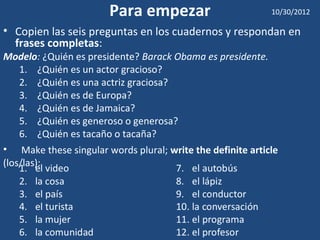
Para empezar                         10/30/2012

• Copien las seis preguntas en los cuadernos y respondan en
  frases completas:
Modelo: ¿Quién es presidente? Barack Obama es presidente.
    1. ¿Quién es un actor gracioso?
    2. ¿Quién es una actriz graciosa?
    3. ¿Quién es de Europa?
    4. ¿Quién es de Jamaica?
    5. ¿Quién es generoso o generosa?
    6. ¿Quién es tacaño o tacaña?
• Make these singular words plural; write the definite article
(los/las):
Indefinite articles                     *NOTAS


Spanish has four forms that are equivalent to the English indefinite
article, which according to context may mean a, an, or some. You use
indefinite articles to refer to unspecified persons or things.


In general, when a singular noun has an accent mark on the last
syllable, the accent is dropped from the plural form.
¿el, la, los o las?
Pick the correct definite article (can be more than one choice).
¿Un, una, unos o unas?
• p. 15, act. 1 ¿Singular or plural? If the word is
  singular, make it plural. If it is plural, make it
  singular.
• p. 15, act. 2 Identificar For each drawing,
  provide the noun with its corresponding
  definite and indefinite articles.
Ejercicio final
• Write down six singular and plural nouns,
  without their articles. Put the sheet in the box,
  pick a new one and write down the
  appropriate definite and indefinite articles for
  each item.

10 30 12 leccion

  • 1.
    Español I –Sr. Johnston martes, el treinta de octubre del 2012
  • 2.
    Para empezar 10/30/2012 • Copien las seis preguntas en los cuadernos y respondan en frases completas: Modelo: ¿Quién es presidente? Barack Obama es presidente. 1. ¿Quién es un actor gracioso? 2. ¿Quién es una actriz graciosa? 3. ¿Quién es de Europa? 4. ¿Quién es de Jamaica? 5. ¿Quién es generoso o generosa? 6. ¿Quién es tacaño o tacaña? • Make these singular words plural; write the definite article (los/las):
  • 3.
    Indefinite articles *NOTAS Spanish has four forms that are equivalent to the English indefinite article, which according to context may mean a, an, or some. You use indefinite articles to refer to unspecified persons or things. In general, when a singular noun has an accent mark on the last syllable, the accent is dropped from the plural form.
  • 4.
    ¿el, la, loso las? Pick the correct definite article (can be more than one choice).
  • 5.
  • 6.
    • p. 15,act. 1 ¿Singular or plural? If the word is singular, make it plural. If it is plural, make it singular. • p. 15, act. 2 Identificar For each drawing, provide the noun with its corresponding definite and indefinite articles.
  • 7.
    Ejercicio final • Writedown six singular and plural nouns, without their articles. Put the sheet in the box, pick a new one and write down the appropriate definite and indefinite articles for each item.