Amelia Olton
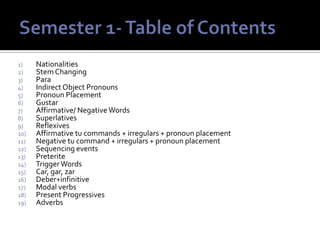
1) Nationalities
2) Stem Changing
3) Para
4) IndirectObject Pronouns
5) Pronoun Placement
6) Gustar
7) Affirmative/ Negative Words
8) Superlatives
9) Reflexives
10) Affirmative tu commands + irregulars + pronoun placement
11) Negative tu command + irregulars + pronoun placement
12) Sequencing events
13) Preterite
14) TriggerWords
15) Car, gar, zar
16) Deber+infinitive
17) Modal verbs
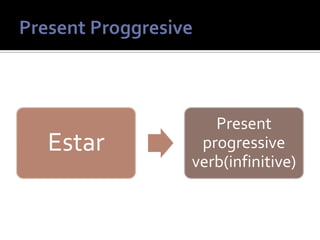
18) Present Progressives
19) Adverbs
 Boot verbs change only inside the boot.
 There are 4 kinds of boot verbs.
 o-ue
 e-ie
 e-i
 u-ue
 The endings remain the same for ar, er and ir
verbs.
 Nosotros and vosotros will not change in the
stem.
 Used for
 The purpose of/ in order to
▪ Para bailar la salsa…
 For the benefit of/ directed to
▪ Es para ello.
 In the direction of/ specific placce
▪ Voy para Georgia
 Specfic times
▪ Me despierto en la noche.
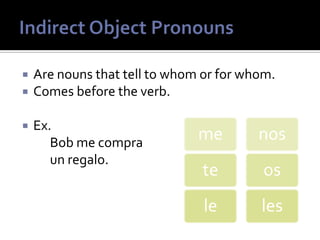
 Are nouns that tell to whom or for whom.
 Comes before the verb.
 Ex.
Bob me compra
un regalo.
le
te
me
les
os
nos
1) Attach the pronoun to the infinitive.
2) Attach the pronoun to a progressive tense.
3) Attach the pronoun to an affirmative
command.
4) Place the pronoun before a conjugated verb.
 The gusta is conjugated to the thing being
gusta-ed
 Me gustas tu.
Le gusta
• Te gusta
• Me gusta
Les gusta
• Os gusta
• Nos gusta
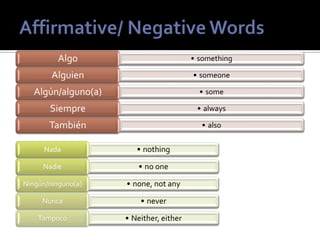
• somethingAlgo
• someoneAlguien
• someAlgún/alguno(a)
• alwaysSiempre
• alsoTambién
• nothingNada
• no oneNadie
• none, not anyNingún/ninguno(a)
• neverNunca
• Neither, eitherTampoco
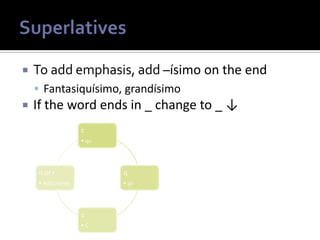
 To add emphasis, add –ísimo on the end
 Fantasiquísimo, grandísimo
 If the word ends in _ change to _ ↓
c
• qu
q
• gu
z
• C
n or r
• Add cisimo
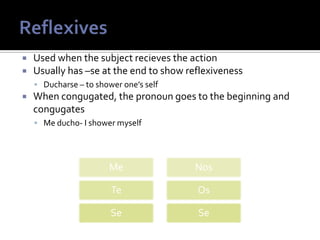
 Used when the subject recieves the action
 Usually has –se at the end to show reflexiveness
 Ducharse – to shower one’s self
 When congugated, the pronoun goes to the beginning and
congugates
 Me ducho- I shower myself
Se
Te
Me
Se
Os
Nos
 Drop the
“s”
Di
Haz
Ve
Pon
Sal
Sé
Ten
Ven
The pronoun goes after
the command
Eat it!
!Cómelo!
Have it!
!Tienelo!
1. Put into yo form
2. Change vowel
3. Add “s”
 The pronoun has to be put before the
command because it is not affirmative.
No tengas
No vengas
No dé/ digas
No voyas
No seas
No hagas
No estés
No sepas
Segundo
Primero
Second
First
Tercero Third
Entonces
Then
Luego/después
After
Antes de/ después de
Before/ after
Por fin
Finally
Por la mañana/ tarde/ noche
In/ during the …
Los lunes, etc.
On Monday, etc.
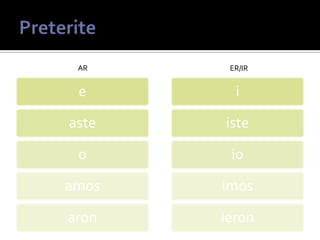
e
aste
o
amos
aron
i
iste
io
imos
ieron
AR ER/IR
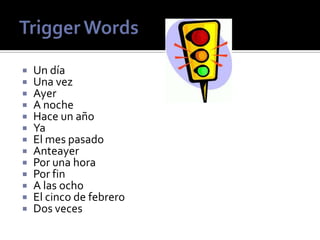
 Un día
 Una vez
 Ayer
 A noche
 Hace un año
 Ya
 El mes pasado
 Anteayer
 Por una hora
 Por fin
 A las ocho
 El cinco de febrero
 Dos veces
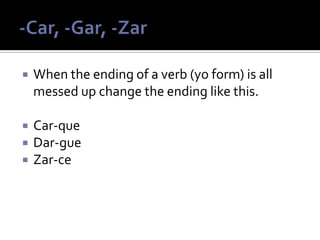
 When the ending of a verb (yo form) is all
messed up change the ending like this.
 Car-que
 Dar-gue
 Zar-ce
• Debes
• Debo
Debe
• -
• Debemos
Deben
should, ought to
add infinitive
after to say what
someone ought to do
 When verbs are used in modal verb
combinations, the 2nd verb is not conhugated,
but rather left in the infinitive form
 Deber, Desear(desire), necesitar, poder,
querer, saber, soler(usually,used to)
Estar
Present
progressive
verb(infinitive)
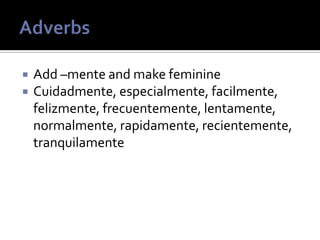
 Add –mente and make feminine
 Cuidadmente, especialmente, facilmente,
felizmente, frecuentemente, lentamente,
normalmente, rapidamente, recientemente,
tranquilamente
1) Preterite
2) Demonstratives w/ Pronouns
3) Ordinal Numbers
4) Prepositions
5) Future
6) Imperfect
7) Possessive Adjectives and Pronouns
8) Reflexives
Cucaracha
 Andar > anduv___
 Estar > estuv___
 Poder > pud___
 Poner > pus___
 Querer > quis___
 Saber > sup___
 Tener > tuv___
 Venir > vin___
 Conducir > conduj___
 Producir > produj___
 Traducir > traduj___
 Decir > dij___
 Traer > traj___
Car, Gar,
Zar
 When the ending of a
verb (yo form) is all
messed up change the
ending like this.
 Car-que
 Dar-gue
 Zar-ce
Trigger Words
 Un día
 Una vez
 Ayer
 A noche
 Hace un año
 Ya
 El mes pasado
 Anteayer
 Por una hora
 Por fin
 A las ocho
 El cinco de febrero
 Dos veces
SpockVerbs
 Hacer
• Hice
• Hiciste
• Hizo
• Hicimos
• Hicieron
 Dar/Ver
• d/v i
• d/v iste
• d/v io
• d/v imos
• d/v ieron
 Ir/Ser
• Fui
• Fuiste
• Fue
• Fuimos
• Fueron
Snake/Snakey
 Snake verbs change the
3rd person to the
conjugated form.
 Dormir
• Dormi
• Dormimos
• Dormiste
• Durmio
• Durmieron
 Snakey verbs change the
i to a y
 Leer
• Lei
• Leimos
• Leiste
• Leyo
• Leyeron
Adjectives Singular
Masculan
Plural
Masculan
Singular
Feminine
Plural
Feminine
Aqui Este Estos Esta Estas
Alli Ese Esos Esa Esas
Alla Aquel Aquellos Aquella Aquellas
 Put an accent on the first e to make a pronoun
 If it is an unknown gender, then change the e or a to an o
• This is called a neuter
 primero
first
 segundo
second
 tercero
third
 cuarto
fourth
 quinto
fifth
 sexto
sixth
 séptimo
seventh
 octavo
eighth
 noveno
ninth
 décimo
tenth
 Abajo
 Down
 Arriba
 Up
 Debajo de
 Beneath
 Dentro de
 Within
 Encima de
 Above
 Fuera de
 Outside
 Add on to the infinitive form
 -é
 -ás
 -á
 -emos
 -án.
caber
yo cabré
haber
yo habré
poder
yo podré
querer
yo querré
saber
yo sabréponer
yo pondré
salir
yo saldré
tener
yo tendré
valer
yo valdré
venir
yo vendrédecir
yo diré
hacer
yo haré
 aba
abas
aba
ába
mos
abai
s
aban
 ía
ías
ía
íam
os
íais
ían
ser ver ir
era
eras
era
éramos
erais
eran
veía
veías
veía
veíamos
veíais
veían
iba
ibas
iba
íbamos
ibais
iban
IRREGULAR
Shows a future that is not specific
 mine
el mío / la mía
los míos / las mías
 yours (familiar)
el tuyo / la tuya
los tuyos / las tuyas
 yours (formal)
el suyo / la suya
los suyos / las suyas
 ours
el nuestro / la nuestra
los nuestros / las nuestras
 yours (familiar)
el vuestro / la vuestra
los vuestros / las vuestras
 yours (formal)
el suyo / la suya
los suyos / las suyas
 mi(s)
my
 tu(s)
your (familiar)
 su(s)
his, her, your
(formal), their
 nuestro(-a, -os, -as)
our
 vuestro(-a, -os, -as)
your (fam. pl.)
 Used when the subject recieves the action
 Usually has –se at the end to show reflexiveness
 Ducharse – to shower one’s self
 When congugated, the pronoun goes to the beginning and
congugates
 Me ducho- I shower myself
Se
Te
Me
Se
Os
Nos

Grammar book 2

  • 1.
  • 2.
    1) Nationalities 2) StemChanging 3) Para 4) IndirectObject Pronouns 5) Pronoun Placement 6) Gustar 7) Affirmative/ Negative Words 8) Superlatives 9) Reflexives 10) Affirmative tu commands + irregulars + pronoun placement 11) Negative tu command + irregulars + pronoun placement 12) Sequencing events 13) Preterite 14) TriggerWords 15) Car, gar, zar 16) Deber+infinitive 17) Modal verbs 18) Present Progressives 19) Adverbs
  • 4.
     Boot verbschange only inside the boot.  There are 4 kinds of boot verbs.  o-ue  e-ie  e-i  u-ue  The endings remain the same for ar, er and ir verbs.  Nosotros and vosotros will not change in the stem.
  • 5.
     Used for The purpose of/ in order to ▪ Para bailar la salsa…  For the benefit of/ directed to ▪ Es para ello.  In the direction of/ specific placce ▪ Voy para Georgia  Specfic times ▪ Me despierto en la noche.
  • 6.
     Are nounsthat tell to whom or for whom.  Comes before the verb.  Ex. Bob me compra un regalo. le te me les os nos
  • 7.
    1) Attach thepronoun to the infinitive. 2) Attach the pronoun to a progressive tense. 3) Attach the pronoun to an affirmative command. 4) Place the pronoun before a conjugated verb.
  • 8.
     The gustais conjugated to the thing being gusta-ed  Me gustas tu. Le gusta • Te gusta • Me gusta Les gusta • Os gusta • Nos gusta
  • 9.
    • somethingAlgo • someoneAlguien •someAlgún/alguno(a) • alwaysSiempre • alsoTambién • nothingNada • no oneNadie • none, not anyNingún/ninguno(a) • neverNunca • Neither, eitherTampoco
  • 10.
     To addemphasis, add –ísimo on the end  Fantasiquísimo, grandísimo  If the word ends in _ change to _ ↓ c • qu q • gu z • C n or r • Add cisimo
  • 11.
     Used whenthe subject recieves the action  Usually has –se at the end to show reflexiveness  Ducharse – to shower one’s self  When congugated, the pronoun goes to the beginning and congugates  Me ducho- I shower myself Se Te Me Se Os Nos
  • 12.
     Drop the “s” Di Haz Ve Pon Sal Sé Ten Ven Thepronoun goes after the command Eat it! !Cómelo! Have it! !Tienelo!
  • 13.
    1. Put intoyo form 2. Change vowel 3. Add “s”  The pronoun has to be put before the command because it is not affirmative. No tengas No vengas No dé/ digas No voyas No seas No hagas No estés No sepas
  • 14.
    Segundo Primero Second First Tercero Third Entonces Then Luego/después After Antes de/después de Before/ after Por fin Finally Por la mañana/ tarde/ noche In/ during the … Los lunes, etc. On Monday, etc.
  • 15.
  • 16.
     Un día Una vez  Ayer  A noche  Hace un año  Ya  El mes pasado  Anteayer  Por una hora  Por fin  A las ocho  El cinco de febrero  Dos veces
  • 17.
     When theending of a verb (yo form) is all messed up change the ending like this.  Car-que  Dar-gue  Zar-ce
  • 18.
    • Debes • Debo Debe •- • Debemos Deben should, ought to add infinitive after to say what someone ought to do
  • 19.
     When verbsare used in modal verb combinations, the 2nd verb is not conhugated, but rather left in the infinitive form  Deber, Desear(desire), necesitar, poder, querer, saber, soler(usually,used to)
  • 20.
  • 21.
     Add –menteand make feminine  Cuidadmente, especialmente, facilmente, felizmente, frecuentemente, lentamente, normalmente, rapidamente, recientemente, tranquilamente
  • 22.
    1) Preterite 2) Demonstrativesw/ Pronouns 3) Ordinal Numbers 4) Prepositions 5) Future 6) Imperfect 7) Possessive Adjectives and Pronouns 8) Reflexives
  • 23.
    Cucaracha  Andar >anduv___  Estar > estuv___  Poder > pud___  Poner > pus___  Querer > quis___  Saber > sup___  Tener > tuv___  Venir > vin___  Conducir > conduj___  Producir > produj___  Traducir > traduj___  Decir > dij___  Traer > traj___ Car, Gar, Zar  When the ending of a verb (yo form) is all messed up change the ending like this.  Car-que  Dar-gue  Zar-ce Trigger Words  Un día  Una vez  Ayer  A noche  Hace un año  Ya  El mes pasado  Anteayer  Por una hora  Por fin  A las ocho  El cinco de febrero  Dos veces SpockVerbs  Hacer • Hice • Hiciste • Hizo • Hicimos • Hicieron  Dar/Ver • d/v i • d/v iste • d/v io • d/v imos • d/v ieron  Ir/Ser • Fui • Fuiste • Fue • Fuimos • Fueron Snake/Snakey  Snake verbs change the 3rd person to the conjugated form.  Dormir • Dormi • Dormimos • Dormiste • Durmio • Durmieron  Snakey verbs change the i to a y  Leer • Lei • Leimos • Leiste • Leyo • Leyeron
  • 24.
    Adjectives Singular Masculan Plural Masculan Singular Feminine Plural Feminine Aqui EsteEstos Esta Estas Alli Ese Esos Esa Esas Alla Aquel Aquellos Aquella Aquellas  Put an accent on the first e to make a pronoun  If it is an unknown gender, then change the e or a to an o • This is called a neuter
  • 25.
     primero first  segundo second tercero third  cuarto fourth  quinto fifth  sexto sixth  séptimo seventh  octavo eighth  noveno ninth  décimo tenth
  • 26.
     Abajo  Down Arriba  Up  Debajo de  Beneath  Dentro de  Within  Encima de  Above  Fuera de  Outside
  • 27.
     Add onto the infinitive form  -é  -ás  -á  -emos  -án. caber yo cabré haber yo habré poder yo podré querer yo querré saber yo sabréponer yo pondré salir yo saldré tener yo tendré valer yo valdré venir yo vendrédecir yo diré hacer yo haré
  • 28.
     aba abas aba ába mos abai s aban  ía ías ía íam os íais ían server ir era eras era éramos erais eran veía veías veía veíamos veíais veían iba ibas iba íbamos ibais iban IRREGULAR Shows a future that is not specific
  • 29.
     mine el mío/ la mía los míos / las mías  yours (familiar) el tuyo / la tuya los tuyos / las tuyas  yours (formal) el suyo / la suya los suyos / las suyas  ours el nuestro / la nuestra los nuestros / las nuestras  yours (familiar) el vuestro / la vuestra los vuestros / las vuestras  yours (formal) el suyo / la suya los suyos / las suyas  mi(s) my  tu(s) your (familiar)  su(s) his, her, your (formal), their  nuestro(-a, -os, -as) our  vuestro(-a, -os, -as) your (fam. pl.)
  • 30.
     Used whenthe subject recieves the action  Usually has –se at the end to show reflexiveness  Ducharse – to shower one’s self  When congugated, the pronoun goes to the beginning and congugates  Me ducho- I shower myself Se Te Me Se Os Nos