Ana Angalet

GRAMMAR BOOK
Table of Contents

 1. Title page          8. Imperfect
                         9. Triggers
 2. Table of Contents
                         10. Acabar de + infinitive
 3. Que vs. Cual        11. Hace expressions
                         12. Reflexive
 4. Ser
                         13. Tú Commands
 5. Estar               (affrimitive, irregluars,
                         negative)
 6. Gustar
                         14. DOP + placements
 7. Transitions         15. El preterito
Que vs. Cual

 Both mean “what”
 Qué is used for defintions and asking
  questions
 Ex: ¿ Qué significa “papas fritas”?


                    VS.
 Cual is used when asking choosing
  something or between two or more things.
 Ex: ¿Cuál es la capital de Argentina?
Ser- “DOCTORPED” (to be)
 D- description ¿Què es…?
 O- origins     ¿De donde es?
   C- character ¿Como es?
   T- time ¿Què hora es?
   O- occupation ¿Que hace?
   R- relationships ¿Quien es?
   P- possession ¿De quien es?
   E- events      ¿Quando/Donde es?
   D- dates     ¿Què dia?
Estar- “HELPING” (to be)

 Health    ¿Como estas?     Bien, mal, etc.

 Emotions    ¿Como estas?     Triste, enojado, etc…

 Locations   ¿Donde estas? En: la casa, etc…
 Present condition ¿Como esta? Cerrado,
  sucio,etc…

 I            Que estas
               haciendo?
                             ar- ando
                             er/ir- endo
 N            Ex: jugando
                             -yendo

 G            estudianto…
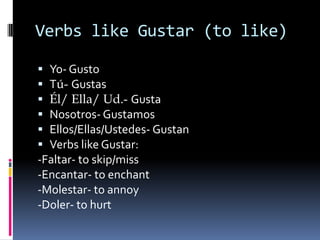
Verbs like Gustar (to like)

 Yo- Gusto
 Tú- Gustas
 Él/ Ella/ Ud.- Gusta
 Nosotros- Gustamos
 Ellos/Ellas/Ustedes- Gustan
 Verbs like Gustar:
-Faltar- to skip/miss
-Encantar- to enchant
-Molestar- to annoy
-Doler- to hurt
Transitions

 También- also
 Primero- first
                         Used to
 Entonces- so/then     transition
                         times or
 Y- and                  actions

 Después- after
 Ahora- now
 Finalmente- finally
Imperfect
USED FOR?
•Continuous or repeating action
•No definate beginning or ensd
•To interrupt
•Date or time
•Descrpition/feeling

PRONOUN               Ending in “ar”   Ending in “ir/er”
Yo                    aba              ia
Tú                    abas             ias
Él/Ella/Usted.        aba              ia
Nosotros              abamos           iamos
Ellos/Ellas/Ustedes   aban             ian
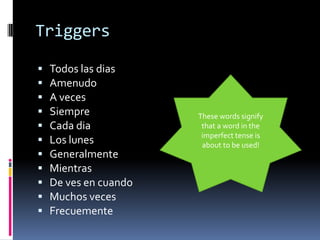
Triggers

   Todos las dias
   Amenudo
   A veces
   Siempre            These words signify
   Cada dia            that a word in the
                        imperfect tense is
   Los lunes           about to be used!
   Generalmente
   Mientras
   De ves en cuando
   Muchos veces
   Frecuemente
Acabar de + infinitive

 Acabar de means “to have just finished”
 Example: Acabo de comer unas papas fritas.

   PRONOUN               CONJUGATION
   Yo                    Acabo de
   Tú                    Acabas de
   Él/Ella/Usted.        Acaba de
   Nosotros              Acabamos de
   Ellos/Ellas/Ustedes   Acaban de
Hace expressions
 Hace+time+que+conj. Verb- How much you have
  been doing something.
~ Ex: Hace treinta y cinco minutos que Paula espera
  el autobús.
 Hay+que+infinitive- what needs to be done
  (impersonal).
~Ex: Hay que estudiar para sacar bunas notas
 Se prohibe+infinitve- prohibited
~Se prohibe fumar
 Ir+a+ininitive- tells what someone is going to do.
~Juan ya a hablar por telefeno con lisette.
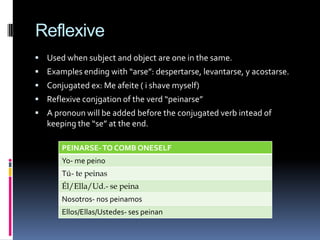
Reflexive
 Used when subject and object are one in the same.
 Examples ending with “arse”: despertarse, levantarse, y acostarse.
 Conjugated ex: Me afeite ( i shave myself)
 Reflexive conjgation of the verd “peinarse”
 A pronoun will be added before the conjugated verb intead of
   keeping the “se” at the end.

       PEINARSE- TO COMB ONESELF
       Yo- me peino
       Tú- te peinas
       Él/Ella/Ud.- se peina
       Nosotros- nos peinamos
       Ellos/Ellas/Ustedes- ses peinan
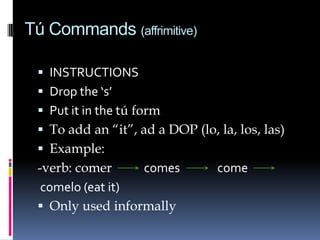
Tú Commands (affrimitive)

  INSTRUCTIONS
  Drop the ‘s’
  Put it in the tú form
  To add an “it”, ad a DOP (lo, la, los, las)
  Example:
 -verb: comer     comes          come
  comelo (eat it)
  Only used informally
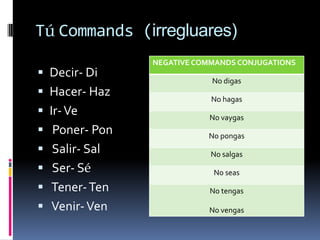
Tú Commands (irregluares)
               NEGATIVE COMMANDS CONJUGATIONS
 Decir- Di
                           No digas
 Hacer- Haz               No hagas
 Ir- Ve                  No vaygas
 Poner- Pon              No pongas
 Salir- Sal               No salgas
 Ser- Sé                  No seas

 Tener- Ten              No tengas

 Venir- Ven              No vengas
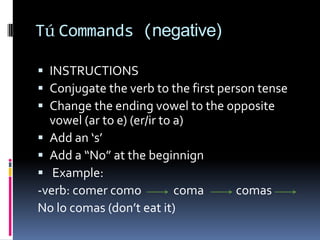
Tú Commands (negative)

 INSTRUCTIONS
 Conjugate the verb to the first person tense
 Change the ending vowel to the opposite
  vowel (ar to e) (er/ir to a)
 Add an ‘s’
 Add a “No” at the beginnign
 Example:
-verb: comer como           coma    comas
No lo comas (don’t eat it)
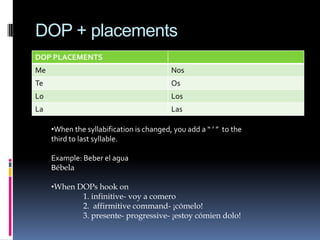
DOP + placements
DOP PLACEMENTS
Me                                        Nos
Te                                        Os
Lo                                        Los
La                                        Las

     •When the syllabification is changed, you add a “ ’ ” to the
     third to last syllable.

     Example: Beber el agua
     Bébela

     •When DOPs hook on
            1. infinitive- voy a comero
            2. affirmitive command- ¡cómelo!
            3. presente- progressive- ¡estoy cómien dolo!
Preterite

   Means a perfected action that occurred in the
    past.
   Endings:
PRONOUN         ENDING      PRONOUN         ENDING
(AR)                        (ER/IR)
Yo-             é           Yo-             í
Tú-             aste        Tú-             iste
Él/Ella/Ud-     Ó           Él/Ella/Ud-     ió
Nosotros-       amos        Nosotros-       imos
Ellos/Ellas/Uste aron       Ellos/Ellas/Uste Ieron
des-                        des-

Grammar book

  • 1.
  • 2.
    Table of Contents 1. Title page 8. Imperfect 9. Triggers  2. Table of Contents 10. Acabar de + infinitive  3. Que vs. Cual 11. Hace expressions 12. Reflexive  4. Ser 13. Tú Commands  5. Estar (affrimitive, irregluars, negative)  6. Gustar 14. DOP + placements  7. Transitions 15. El preterito
  • 3.
    Que vs. Cual Both mean “what”  Qué is used for defintions and asking questions  Ex: ¿ Qué significa “papas fritas”? VS.  Cual is used when asking choosing something or between two or more things.  Ex: ¿Cuál es la capital de Argentina?
  • 4.
    Ser- “DOCTORPED” (tobe)  D- description ¿Què es…?  O- origins ¿De donde es?  C- character ¿Como es?  T- time ¿Què hora es?  O- occupation ¿Que hace?  R- relationships ¿Quien es?  P- possession ¿De quien es?  E- events ¿Quando/Donde es?  D- dates ¿Què dia?
  • 5.
    Estar- “HELPING” (tobe)  Health ¿Como estas? Bien, mal, etc.  Emotions ¿Como estas? Triste, enojado, etc…  Locations ¿Donde estas? En: la casa, etc…  Present condition ¿Como esta? Cerrado, sucio,etc…  I Que estas haciendo? ar- ando er/ir- endo  N Ex: jugando -yendo  G estudianto…
  • 6.
    Verbs like Gustar(to like)  Yo- Gusto  Tú- Gustas  Él/ Ella/ Ud.- Gusta  Nosotros- Gustamos  Ellos/Ellas/Ustedes- Gustan  Verbs like Gustar: -Faltar- to skip/miss -Encantar- to enchant -Molestar- to annoy -Doler- to hurt
  • 7.
    Transitions  También- also Primero- first Used to  Entonces- so/then transition times or  Y- and actions  Después- after  Ahora- now  Finalmente- finally
  • 8.
    Imperfect USED FOR? •Continuous orrepeating action •No definate beginning or ensd •To interrupt •Date or time •Descrpition/feeling PRONOUN Ending in “ar” Ending in “ir/er” Yo aba ia Tú abas ias Él/Ella/Usted. aba ia Nosotros abamos iamos Ellos/Ellas/Ustedes aban ian
  • 9.
    Triggers  Todos las dias  Amenudo  A veces  Siempre These words signify  Cada dia that a word in the imperfect tense is  Los lunes about to be used!  Generalmente  Mientras  De ves en cuando  Muchos veces  Frecuemente
  • 10.
    Acabar de +infinitive  Acabar de means “to have just finished”  Example: Acabo de comer unas papas fritas. PRONOUN CONJUGATION Yo Acabo de Tú Acabas de Él/Ella/Usted. Acaba de Nosotros Acabamos de Ellos/Ellas/Ustedes Acaban de
  • 11.
    Hace expressions  Hace+time+que+conj.Verb- How much you have been doing something. ~ Ex: Hace treinta y cinco minutos que Paula espera el autobús.  Hay+que+infinitive- what needs to be done (impersonal). ~Ex: Hay que estudiar para sacar bunas notas  Se prohibe+infinitve- prohibited ~Se prohibe fumar  Ir+a+ininitive- tells what someone is going to do. ~Juan ya a hablar por telefeno con lisette.
  • 12.
    Reflexive  Used whensubject and object are one in the same.  Examples ending with “arse”: despertarse, levantarse, y acostarse.  Conjugated ex: Me afeite ( i shave myself)  Reflexive conjgation of the verd “peinarse”  A pronoun will be added before the conjugated verb intead of keeping the “se” at the end. PEINARSE- TO COMB ONESELF Yo- me peino Tú- te peinas Él/Ella/Ud.- se peina Nosotros- nos peinamos Ellos/Ellas/Ustedes- ses peinan
  • 13.
    Tú Commands (affrimitive)  INSTRUCTIONS  Drop the ‘s’  Put it in the tú form  To add an “it”, ad a DOP (lo, la, los, las)  Example: -verb: comer comes come comelo (eat it)  Only used informally
  • 14.
    Tú Commands (irregluares) NEGATIVE COMMANDS CONJUGATIONS  Decir- Di No digas  Hacer- Haz No hagas  Ir- Ve No vaygas  Poner- Pon No pongas  Salir- Sal No salgas  Ser- Sé No seas  Tener- Ten No tengas  Venir- Ven No vengas
  • 15.
    Tú Commands (negative) INSTRUCTIONS  Conjugate the verb to the first person tense  Change the ending vowel to the opposite vowel (ar to e) (er/ir to a)  Add an ‘s’  Add a “No” at the beginnign  Example: -verb: comer como coma comas No lo comas (don’t eat it)
  • 16.
    DOP + placements DOPPLACEMENTS Me Nos Te Os Lo Los La Las •When the syllabification is changed, you add a “ ’ ” to the third to last syllable. Example: Beber el agua Bébela •When DOPs hook on 1. infinitive- voy a comero 2. affirmitive command- ¡cómelo! 3. presente- progressive- ¡estoy cómien dolo!
  • 17.
    Preterite Means a perfected action that occurred in the past.  Endings: PRONOUN ENDING PRONOUN ENDING (AR) (ER/IR) Yo- é Yo- í Tú- aste Tú- iste Él/Ella/Ud- Ó Él/Ella/Ud- ió Nosotros- amos Nosotros- imos Ellos/Ellas/Uste aron Ellos/Ellas/Uste Ieron des- des-