
Los mandatosLos mandatos
MANDATOS FAMILIARESMANDATOS FAMILIARES
(INFORMAL TÚ)(INFORMAL TÚ)
AFIRMATIVOSAFIRMATIVOS
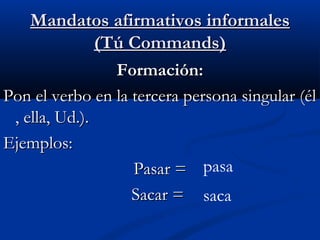
Mandatos afirmativos informalesMandatos afirmativos informales
(Tú Commands)(Tú Commands)
Formación:Formación:
Pon el verbo en la tercera persona singular (élPon el verbo en la tercera persona singular (él
, ella, Ud.)., ella, Ud.).
Ejemplos:Ejemplos:
Pasar =Pasar =
Sacar =Sacar =
pasa
saca
IrregularesIrregulares
Decir – diDecir – di
Hacer – hazHacer – haz
Poner – ponPoner – pon
Salir – salSalir – sal
Ser – séSer – sé
Tener – tenTener – ten
Ir – veIr – ve
Venir - venVenir - ven
Pronoun PlacementPronoun Placement
For affirmative tú commands the direct,For affirmative tú commands the direct,
indirect, and reflexive pronouns areindirect, and reflexive pronouns are
attached.attached.
AFFIRMATIVE = ATTACHAFFIRMATIVE = ATTACH
The order of the pronouns is:The order of the pronouns is:
1.1. ReflexiveReflexive
2.2. IndirectIndirect
3.3. DirectDirect
Por ejemplo:Por ejemplo:
Give me the homework = Dame la tarea.Give me the homework = Dame la tarea.
OrOr Dámela.Dámela.
Sit down = Siéntate.Sit down = Siéntate.
Stand up = Levántate.Stand up = Levántate.
Do it now = Hazlo ahora.Do it now = Hazlo ahora.
PracticamosPracticamos
1.1. HacerHacer
2.2. HablarHablar
3.3. CantarCantar
4.4. DecirDecir
5.5. VivirVivir
6.6. PonerPoner
7.7. VenirVenir
8.8. BailarBailar
9.9. MantenerMantener
10.10. limpiarlimpiar
haz
habla
canta
di
vive
pon
ven
baila
manten
limpia
NEGATIVOSNEGATIVOS
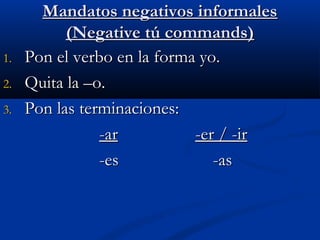
Mandatos negativos informalesMandatos negativos informales
(Negative tú commands)(Negative tú commands)
1.1. Pon el verbo en la forma yo.Pon el verbo en la forma yo.
2.2. Quita la –o.Quita la –o.
3.3. Pon las terminaciones:Pon las terminaciones:
-ar-ar -er / -ir-er / -ir
-es-es -as-as
Por ejemploPor ejemplo
dejardejar
yoyo dejdejoo
No dejesNo dejes
creercreer
yoyo crecreoo
No creasNo creas
Irregulares - NegativosIrregulares - Negativos
- car, -gar, -zar take their –car, -gar,car, -gar, -zar take their –car, -gar,
-zar endings:-zar endings:
sasacarcar = No sa= No saquesques
llellegargar = No lle= No lleguesgues
almoralmorzarzar = No almuer= No almuercesces
Irregulares - NegativosIrregulares - Negativos
D I S H E SD I S H E S
DDar = no desar = no des
IIr = no vayasr = no vayas
SSaber = no sepasaber = no sepas
HHaber = no hayasaber = no hayas
EEstar = no estésstar = no estés
SSer = no seaser = no seas
1.1. No darNo dar
2.2. No cantarNo cantar
3.3. No hablarNo hablar
4.4. No vivirNo vivir
5.5. No olvidarNo olvidar
6.6. No ponerNo poner
7.7. No salirNo salir
8.8. No irNo ir
9.9. No serNo ser
10.10. No hacerNo hacer
No des
No cantes
No hables
No vivas
No olvides
No pongas
No salgas
No vayas
No seas
No hagas
Pronoun PlacementPronoun Placement
When the command is negative theWhen the command is negative the
pronoun goespronoun goes BEFOREBEFORE the command.the command.
Por ejemplo:Por ejemplo:
No termines la tarea. =No termines la tarea. =
NoNo lala termines.termines.
No (levantarNo (levantarsese) temprano. =) temprano. =
NoNo tete levantes temprano.levantes temprano.
MANDATOSMANDATOS
FORMALESFORMALES
(UD. /UDS. COMMANDS)(UD. /UDS. COMMANDS)
Mandatos formales afirmativos(Ud.)Mandatos formales afirmativos(Ud.)
Para expresar cortesía:Para expresar cortesía:
1. Pon el verbo el la forma yo1. Pon el verbo el la forma yo
2. Quita la –o2. Quita la –o
3. Pon las terminaciones:3. Pon las terminaciones:
-ar-ar -er / -ir-er / -ir
-e-e -a-a
Por ejemplo:Por ejemplo:
sentarsentar
yo sientoyo siento
sientesiente
ComerComer
Yo comoYo como
comacoma
Mandatos formales afirmativos(Uds.)Mandatos formales afirmativos(Uds.)
Para expresar cortesía:Para expresar cortesía:
1. Pon el verbo el la forma yo1. Pon el verbo el la forma yo
2. Quita la –o2. Quita la –o
3. Pon las terminaciones:3. Pon las terminaciones:
-ar-ar -er / -ir-er / -ir
-en-en -an-an
Por ejemplo:Por ejemplo:
sentarsentar
yo sientoyo siento
sientensienten
ComerComer
Yo comoYo como
comancoman
IrregularesIrregulares
D I S H E SD I S H E S
dardar irir sabersaber haberhaber estarestar serser
dédé vayavaya sepa hayasepa haya esté seaesté sea
denden vayanvayan sepan hayansepan hayan esténestén seansean
-car, -gar, -zar
-car  -que, -quen
-gar  -gue, -guen
-zar  -ce, -cen
Pronoun PlacementPronoun Placement
AFFIRMATIVE = ATTACHAFFIRMATIVE = ATTACH
NEGATIVE = BEFORE THENEGATIVE = BEFORE THE
VERBVERB
Por ejemplo:Por ejemplo:
AfirmativoAfirmativo -- AAttach:ttach:
Por favor, escríbaPor favor, escríbanosnos su nombre.su nombre.
NegativoNegativo – Before the verb.– Before the verb.
No, noNo, no nosnos escriba su nombre.escriba su nombre.
NOSOTROSNOSOTROS
COMMANDSCOMMANDS
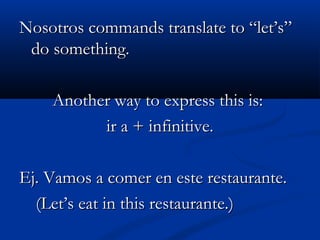
Nosotros commands translate to “let’s”Nosotros commands translate to “let’s”
do something.do something.
Another way to express this is:Another way to express this is:
ir a + infinitive.ir a + infinitive.
Ej. Vamos a comer en este restaurante.Ej. Vamos a comer en este restaurante.
(Let’s eat in this restaurante.)(Let’s eat in this restaurante.)
Nosotros CommandsNosotros Commands
1.1. Pon el verbo en la forma yo.Pon el verbo en la forma yo.
2.2. Quita la –o.Quita la –o.
3.3. Pon las terminaciones:Pon las terminaciones:
-ar-ar -er / -ir-er / -ir
-emos-emos -amos-amos
(Es la forma de nosotros del subjuntivo)(Es la forma de nosotros del subjuntivo)
Por ejemploPor ejemplo
ComerComer
Yo comoYo como
ComComamos, No comamosamos, No comamos
HablarHablar
yo habloyo hablo
HablHablemos, no hablemosemos, no hablemos
Irregulares – D I S H E SIrregulares – D I S H E S
DDar = demos, no demosar = demos, no demos
IIr = vamos, no vayamosr = vamos, no vayamos
SSaber = sepamos, no sepamosaber = sepamos, no sepamos
HHaber = hayamos, no hayamosaber = hayamos, no hayamos
EEstar = estemos, no estemosstar = estemos, no estemos
SSer = seamos, no seamoser = seamos, no seamos
(Es el subjuntivo)(Es el subjuntivo)
Stem-Changing VerbsStem-Changing Verbs
 Stem-changing –ar/-erStem-changing –ar/-er DO NOTDO NOT change.change.
Por ejemplo: Cerremos la puerta.Por ejemplo: Cerremos la puerta.
 Stem-changing –ir verbsStem-changing –ir verbs changechange e-i or o-u.e-i or o-u.
Por ejemplo: No durmamos.Por ejemplo: No durmamos.
Pidamos la cuenta.Pidamos la cuenta.
Stem-changing -ir verbsStem-changing -ir verbs
 DormirDormir
 PedirPedir
 RepetirRepetir
 SentirseSentirse
 CompetirCompetir
 MedirMedir
 ServirServir
 teñirteñir
 VestirVestir
 conseguirconseguir
-car, -gar, -zar-car, -gar, -zar
 -car-car  -quemos-quemos Saquemos, no saquemosSaquemos, no saquemos
 -gar,-gar,  -guemos-guemos Lleguemos, no lleguemosLleguemos, no lleguemos
 -zar-zar  - cemos- cemos almorcemos, no almorcemosalmorcemos, no almorcemos
Pronoun Placement (IOP/DOP)Pronoun Placement (IOP/DOP)
 Indirect and direct object pronouns areIndirect and direct object pronouns are attachedattached
to the end of affirmative commands.to the end of affirmative commands.
Ej: ComprémosEj: Comprémosloslos – Let’s buy them.– Let’s buy them.
 Indirect and direct object pronouns are placedIndirect and direct object pronouns are placed
beforebefore negative commands.negative commands.
Ej: No los compremos.- Let’s not buy them.Ej: No los compremos.- Let’s not buy them.
Pronoun Placement (Reflexives)Pronoun Placement (Reflexives)
 To add a reflexive verb to an affirmativeTo add a reflexive verb to an affirmative
command the “s” must be dropped beforecommand the “s” must be dropped before
“nos” is added.“nos” is added.
Ej. Let’s sit. = Sentémonos.Ej. Let’s sit. = Sentémonos.
 The reflexive pronoun goes before the verb in aThe reflexive pronoun goes before the verb in a
negative command.negative command.
Ej. Let’s not sit. = NoEj. Let’s not sit. = No nosnos sentemos.sentemos.
AccentsAccents
Accents are placed on the “e” of –emo(s) and theAccents are placed on the “e” of –emo(s) and the
““a” of amo(s) in an affirmative command whena” of amo(s) in an affirmative command when
one or two pronouns are attached.one or two pronouns are attached.
Ej. Let’s sell it to her. = Vendámoselo.Ej. Let’s sell it to her. = Vendámoselo.
Let’s put them on. = Pongámonoslos.Let’s put them on. = Pongámonoslos.
VOSOTROSVOSOTROS
COMMANDSCOMMANDS
Vosotros CommandsVosotros Commands
AffirmativeAffirmative
 Replace the final “r” of the infinitive with a “d”.Replace the final “r” of the infinitive with a “d”.
Ej. Hablar = habladEj. Hablar = hablad
Volver = volvedVolver = volved
ir = idir = id
comer = comedcomer = comed
NegativeNegative Vosotros CommandsVosotros Commands
 Pon el verbo en la forma yo.Pon el verbo en la forma yo.
 Quita la –oQuita la –o
 Pon las terminaciones:Pon las terminaciones:
-ar-ar -er/-ir-er/-ir
-éis-éis -áis-áis
Ej. No habléisEj. No habléis
No volváisNo volváis
No vengáisNo vengáis
EL
SUBJUNTIVO
Irregulares – D I S H E SIrregulares – D I S H E S
Dar = no deisDar = no deis
Ir = no vayáisIr = no vayáis
Saber = no sepáisSaber = no sepáis
Haber = no hayáisHaber = no hayáis
Estar = no estéisEstar = no estéis
Ser = no seáisSer = no seáis
Stem-changing verbsStem-changing verbs
 -ar / -er verbs-ar / -er verbs DO NOTDO NOT change.change.
Ej. Don’t close the door! = No cerréis la puerta!Ej. Don’t close the door! = No cerréis la puerta!
 -ir verbs-ir verbs CHANGECHANGE e-i or o-u.e-i or o-u.
Ej. Don’t sleep! = No dEj. Don’t sleep! = No duurmáis.rmáis.
-car, -gar, -zar-car, -gar, -zar
-car: -quéis-car: -quéis Ej. No toquéisEj. No toquéis
-gar: -guéis-gar: -guéis Ej. No lleguéisEj. No lleguéis
-zar: -céis-zar: -céis Ej. No almorcéisEj. No almorcéis
Pronoun PlacementPronoun Placement
 Indirect and direct object pronouns areIndirect and direct object pronouns are attachedattached
to the end of anto the end of an affirmativeaffirmative command.command.
Ej. Wash it! = LavadloEj. Wash it! = Lavadlo
 Accents are placed on –a(d), -e(d), or –i(d) of anAccents are placed on –a(d), -e(d), or –i(d) of an
affirmative command when there areaffirmative command when there are 22 pronouns.pronouns.
Ej. Put them on! = Ponéoslos.Ej. Put them on! = Ponéoslos. DádmeloDádmelo
 Indirect and direct object pronouns goIndirect and direct object pronouns go beforebefore
negative commands.negative commands.
Ej. Don’t wash it! = No lo lavéis.Ej. Don’t wash it! = No lo lavéis.
Pronoun Placement - ReflexivesPronoun Placement - Reflexives
 To add a reflexive pronoun to an affirmativeTo add a reflexive pronoun to an affirmative
command the “d” must be dropped before “os” iscommand the “d” must be dropped before “os” is
added. For –ir verbs, this also requires an accent markadded. For –ir verbs, this also requires an accent mark
over the “i”.over the “i”.
Ej.Ej.
Lie down! = AcostaosLie down! = Acostaos
Don’t lie down.= No os acostéisDon’t lie down.= No os acostéis
Get dressed = VestíosGet dressed = Vestíos
Don’t get dressed = No os vistáisDon’t get dressed = No os vistáis
Exception…Exception…
One exception is irse. For irse ‘d’ isOne exception is irse. For irse ‘d’ is
NOTNOT dropped.dropped.
irse = Idosirse = Idos
EL FINEL FIN

Mandatos

  • 1.
  • 2.
  • 3.
  • 4.
    Mandatos afirmativos informalesMandatosafirmativos informales (Tú Commands)(Tú Commands) Formación:Formación: Pon el verbo en la tercera persona singular (élPon el verbo en la tercera persona singular (él , ella, Ud.)., ella, Ud.). Ejemplos:Ejemplos: Pasar =Pasar = Sacar =Sacar = pasa saca
  • 5.
    IrregularesIrregulares Decir – diDecir– di Hacer – hazHacer – haz Poner – ponPoner – pon Salir – salSalir – sal Ser – séSer – sé Tener – tenTener – ten Ir – veIr – ve Venir - venVenir - ven
  • 6.
    Pronoun PlacementPronoun Placement Foraffirmative tú commands the direct,For affirmative tú commands the direct, indirect, and reflexive pronouns areindirect, and reflexive pronouns are attached.attached. AFFIRMATIVE = ATTACHAFFIRMATIVE = ATTACH The order of the pronouns is:The order of the pronouns is: 1.1. ReflexiveReflexive 2.2. IndirectIndirect 3.3. DirectDirect
  • 7.
    Por ejemplo:Por ejemplo: Giveme the homework = Dame la tarea.Give me the homework = Dame la tarea. OrOr Dámela.Dámela. Sit down = Siéntate.Sit down = Siéntate. Stand up = Levántate.Stand up = Levántate. Do it now = Hazlo ahora.Do it now = Hazlo ahora.
  • 8.
    PracticamosPracticamos 1.1. HacerHacer 2.2. HablarHablar 3.3.CantarCantar 4.4. DecirDecir 5.5. VivirVivir 6.6. PonerPoner 7.7. VenirVenir 8.8. BailarBailar 9.9. MantenerMantener 10.10. limpiarlimpiar haz habla canta di vive pon ven baila manten limpia
  • 9.
  • 10.
    Mandatos negativos informalesMandatosnegativos informales (Negative tú commands)(Negative tú commands) 1.1. Pon el verbo en la forma yo.Pon el verbo en la forma yo. 2.2. Quita la –o.Quita la –o. 3.3. Pon las terminaciones:Pon las terminaciones: -ar-ar -er / -ir-er / -ir -es-es -as-as
  • 11.
    Por ejemploPor ejemplo dejardejar yoyodejdejoo No dejesNo dejes creercreer yoyo crecreoo No creasNo creas
  • 12.
    Irregulares - NegativosIrregulares- Negativos - car, -gar, -zar take their –car, -gar,car, -gar, -zar take their –car, -gar, -zar endings:-zar endings: sasacarcar = No sa= No saquesques llellegargar = No lle= No lleguesgues almoralmorzarzar = No almuer= No almuercesces
  • 13.
    Irregulares - NegativosIrregulares- Negativos D I S H E SD I S H E S DDar = no desar = no des IIr = no vayasr = no vayas SSaber = no sepasaber = no sepas HHaber = no hayasaber = no hayas EEstar = no estésstar = no estés SSer = no seaser = no seas
  • 14.
    1.1. No darNodar 2.2. No cantarNo cantar 3.3. No hablarNo hablar 4.4. No vivirNo vivir 5.5. No olvidarNo olvidar 6.6. No ponerNo poner 7.7. No salirNo salir 8.8. No irNo ir 9.9. No serNo ser 10.10. No hacerNo hacer No des No cantes No hables No vivas No olvides No pongas No salgas No vayas No seas No hagas
  • 15.
    Pronoun PlacementPronoun Placement Whenthe command is negative theWhen the command is negative the pronoun goespronoun goes BEFOREBEFORE the command.the command. Por ejemplo:Por ejemplo: No termines la tarea. =No termines la tarea. = NoNo lala termines.termines. No (levantarNo (levantarsese) temprano. =) temprano. = NoNo tete levantes temprano.levantes temprano.
  • 16.
  • 17.
    Mandatos formales afirmativos(Ud.)Mandatosformales afirmativos(Ud.) Para expresar cortesía:Para expresar cortesía: 1. Pon el verbo el la forma yo1. Pon el verbo el la forma yo 2. Quita la –o2. Quita la –o 3. Pon las terminaciones:3. Pon las terminaciones: -ar-ar -er / -ir-er / -ir -e-e -a-a
  • 18.
    Por ejemplo:Por ejemplo: sentarsentar yosientoyo siento sientesiente ComerComer Yo comoYo como comacoma
  • 19.
    Mandatos formales afirmativos(Uds.)Mandatosformales afirmativos(Uds.) Para expresar cortesía:Para expresar cortesía: 1. Pon el verbo el la forma yo1. Pon el verbo el la forma yo 2. Quita la –o2. Quita la –o 3. Pon las terminaciones:3. Pon las terminaciones: -ar-ar -er / -ir-er / -ir -en-en -an-an
  • 20.
    Por ejemplo:Por ejemplo: sentarsentar yosientoyo siento sientensienten ComerComer Yo comoYo como comancoman
  • 21.
    IrregularesIrregulares D I SH E SD I S H E S dardar irir sabersaber haberhaber estarestar serser dédé vayavaya sepa hayasepa haya esté seaesté sea denden vayanvayan sepan hayansepan hayan esténestén seansean -car, -gar, -zar -car  -que, -quen -gar  -gue, -guen -zar  -ce, -cen
  • 22.
    Pronoun PlacementPronoun Placement AFFIRMATIVE= ATTACHAFFIRMATIVE = ATTACH NEGATIVE = BEFORE THENEGATIVE = BEFORE THE VERBVERB
  • 23.
    Por ejemplo:Por ejemplo: AfirmativoAfirmativo-- AAttach:ttach: Por favor, escríbaPor favor, escríbanosnos su nombre.su nombre. NegativoNegativo – Before the verb.– Before the verb. No, noNo, no nosnos escriba su nombre.escriba su nombre.
  • 24.
  • 25.
    Nosotros commands translateto “let’s”Nosotros commands translate to “let’s” do something.do something. Another way to express this is:Another way to express this is: ir a + infinitive.ir a + infinitive. Ej. Vamos a comer en este restaurante.Ej. Vamos a comer en este restaurante. (Let’s eat in this restaurante.)(Let’s eat in this restaurante.)
  • 26.
    Nosotros CommandsNosotros Commands 1.1.Pon el verbo en la forma yo.Pon el verbo en la forma yo. 2.2. Quita la –o.Quita la –o. 3.3. Pon las terminaciones:Pon las terminaciones: -ar-ar -er / -ir-er / -ir -emos-emos -amos-amos (Es la forma de nosotros del subjuntivo)(Es la forma de nosotros del subjuntivo)
  • 27.
    Por ejemploPor ejemplo ComerComer YocomoYo como ComComamos, No comamosamos, No comamos HablarHablar yo habloyo hablo HablHablemos, no hablemosemos, no hablemos
  • 28.
    Irregulares – DI S H E SIrregulares – D I S H E S DDar = demos, no demosar = demos, no demos IIr = vamos, no vayamosr = vamos, no vayamos SSaber = sepamos, no sepamosaber = sepamos, no sepamos HHaber = hayamos, no hayamosaber = hayamos, no hayamos EEstar = estemos, no estemosstar = estemos, no estemos SSer = seamos, no seamoser = seamos, no seamos (Es el subjuntivo)(Es el subjuntivo)
  • 29.
    Stem-Changing VerbsStem-Changing Verbs Stem-changing –ar/-erStem-changing –ar/-er DO NOTDO NOT change.change. Por ejemplo: Cerremos la puerta.Por ejemplo: Cerremos la puerta.  Stem-changing –ir verbsStem-changing –ir verbs changechange e-i or o-u.e-i or o-u. Por ejemplo: No durmamos.Por ejemplo: No durmamos. Pidamos la cuenta.Pidamos la cuenta.
  • 30.
    Stem-changing -ir verbsStem-changing-ir verbs  DormirDormir  PedirPedir  RepetirRepetir  SentirseSentirse  CompetirCompetir  MedirMedir  ServirServir  teñirteñir  VestirVestir  conseguirconseguir
  • 31.
    -car, -gar, -zar-car,-gar, -zar  -car-car  -quemos-quemos Saquemos, no saquemosSaquemos, no saquemos  -gar,-gar,  -guemos-guemos Lleguemos, no lleguemosLleguemos, no lleguemos  -zar-zar  - cemos- cemos almorcemos, no almorcemosalmorcemos, no almorcemos
  • 32.
    Pronoun Placement (IOP/DOP)PronounPlacement (IOP/DOP)  Indirect and direct object pronouns areIndirect and direct object pronouns are attachedattached to the end of affirmative commands.to the end of affirmative commands. Ej: ComprémosEj: Comprémosloslos – Let’s buy them.– Let’s buy them.  Indirect and direct object pronouns are placedIndirect and direct object pronouns are placed beforebefore negative commands.negative commands. Ej: No los compremos.- Let’s not buy them.Ej: No los compremos.- Let’s not buy them.
  • 33.
    Pronoun Placement (Reflexives)PronounPlacement (Reflexives)  To add a reflexive verb to an affirmativeTo add a reflexive verb to an affirmative command the “s” must be dropped beforecommand the “s” must be dropped before “nos” is added.“nos” is added. Ej. Let’s sit. = Sentémonos.Ej. Let’s sit. = Sentémonos.  The reflexive pronoun goes before the verb in aThe reflexive pronoun goes before the verb in a negative command.negative command. Ej. Let’s not sit. = NoEj. Let’s not sit. = No nosnos sentemos.sentemos.
  • 34.
    AccentsAccents Accents are placedon the “e” of –emo(s) and theAccents are placed on the “e” of –emo(s) and the ““a” of amo(s) in an affirmative command whena” of amo(s) in an affirmative command when one or two pronouns are attached.one or two pronouns are attached. Ej. Let’s sell it to her. = Vendámoselo.Ej. Let’s sell it to her. = Vendámoselo. Let’s put them on. = Pongámonoslos.Let’s put them on. = Pongámonoslos.
  • 35.
  • 36.
    Vosotros CommandsVosotros Commands AffirmativeAffirmative Replace the final “r” of the infinitive with a “d”.Replace the final “r” of the infinitive with a “d”. Ej. Hablar = habladEj. Hablar = hablad Volver = volvedVolver = volved ir = idir = id comer = comedcomer = comed
  • 37.
    NegativeNegative Vosotros CommandsVosotrosCommands  Pon el verbo en la forma yo.Pon el verbo en la forma yo.  Quita la –oQuita la –o  Pon las terminaciones:Pon las terminaciones: -ar-ar -er/-ir-er/-ir -éis-éis -áis-áis Ej. No habléisEj. No habléis No volváisNo volváis No vengáisNo vengáis EL SUBJUNTIVO
  • 38.
    Irregulares – DI S H E SIrregulares – D I S H E S Dar = no deisDar = no deis Ir = no vayáisIr = no vayáis Saber = no sepáisSaber = no sepáis Haber = no hayáisHaber = no hayáis Estar = no estéisEstar = no estéis Ser = no seáisSer = no seáis
  • 39.
    Stem-changing verbsStem-changing verbs -ar / -er verbs-ar / -er verbs DO NOTDO NOT change.change. Ej. Don’t close the door! = No cerréis la puerta!Ej. Don’t close the door! = No cerréis la puerta!  -ir verbs-ir verbs CHANGECHANGE e-i or o-u.e-i or o-u. Ej. Don’t sleep! = No dEj. Don’t sleep! = No duurmáis.rmáis.
  • 40.
    -car, -gar, -zar-car,-gar, -zar -car: -quéis-car: -quéis Ej. No toquéisEj. No toquéis -gar: -guéis-gar: -guéis Ej. No lleguéisEj. No lleguéis -zar: -céis-zar: -céis Ej. No almorcéisEj. No almorcéis
  • 41.
    Pronoun PlacementPronoun Placement Indirect and direct object pronouns areIndirect and direct object pronouns are attachedattached to the end of anto the end of an affirmativeaffirmative command.command. Ej. Wash it! = LavadloEj. Wash it! = Lavadlo  Accents are placed on –a(d), -e(d), or –i(d) of anAccents are placed on –a(d), -e(d), or –i(d) of an affirmative command when there areaffirmative command when there are 22 pronouns.pronouns. Ej. Put them on! = Ponéoslos.Ej. Put them on! = Ponéoslos. DádmeloDádmelo  Indirect and direct object pronouns goIndirect and direct object pronouns go beforebefore negative commands.negative commands. Ej. Don’t wash it! = No lo lavéis.Ej. Don’t wash it! = No lo lavéis.
  • 42.
    Pronoun Placement -ReflexivesPronoun Placement - Reflexives  To add a reflexive pronoun to an affirmativeTo add a reflexive pronoun to an affirmative command the “d” must be dropped before “os” iscommand the “d” must be dropped before “os” is added. For –ir verbs, this also requires an accent markadded. For –ir verbs, this also requires an accent mark over the “i”.over the “i”. Ej.Ej. Lie down! = AcostaosLie down! = Acostaos Don’t lie down.= No os acostéisDon’t lie down.= No os acostéis Get dressed = VestíosGet dressed = Vestíos Don’t get dressed = No os vistáisDon’t get dressed = No os vistáis
  • 43.
    Exception…Exception… One exception isirse. For irse ‘d’ isOne exception is irse. For irse ‘d’ is NOTNOT dropped.dropped. irse = Idosirse = Idos
  • 44.