El repaso del Español I This review will help you prepare for the final exam.  Remember,  no one  will be allowed to exempt the oral portion of the exam.
An Overview Conversación básica Vocabulario Palabras interrogativas (question words) Verbos regulares e irregulares Verbos de cambio de raíz (stem changes) Los adjetivos posesivos El verbo gustar El muchacho pastor La ropa, la casa, la comida Los colores, los dias/meses, la familia
Conversación básica Be able to ask about and answer the following: Names Ages Dates Classes Weather Favorite things (movie, class, etc) Likes and dislikes
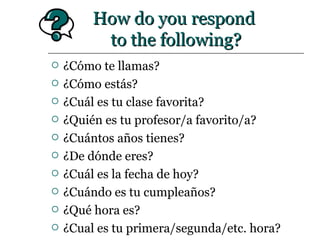
How do you respond  to the following? ¿Cómo te llamas? ¿Cómo estás? ¿Cuál es tu clase favorita? ¿Quién es tu profesor/a favorito/a? ¿Cuántos años tienes? ¿De dónde eres? ¿Cuál es la fecha de hoy? ¿Cuándo es tu cumpleaños? ¿Qué hora es? ¿Cual es tu primera/segunda/etc. hora?
Los números y los colores Complete the following number patterns: dos, cuatro, ____, ocho, ____, doce diez, veinte, treinta,______, cuarenta _____, diez, quince, veinte, _____ ¿Cómo se dice…….?
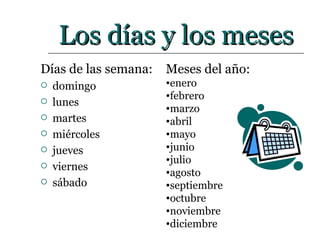
Los días y los meses Días de las semana: domingo lunes martes miércoles jueves viernes sábado Meses del año: enero febrero marzo abril mayo junio julio agosto septiembre octubre noviembre diciembre
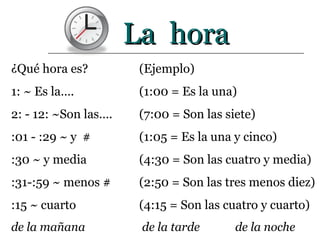
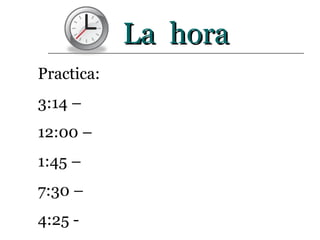
La  hora ¿Qué hora es? (Ejemplo) 1: ~ Es la…. (1:00 = Es la una) 2: - 12: ~Son las…. (7:00 = Son las siete) :01 - :29 ~ y  # (1:05 = Es la una y cinco) :30 ~ y media (4:30 = Son las cuatro y media) :31-:59 ~ menos # (2:50 = Son las tres menos diez) :15 ~ cuarto (4:15 = Son las cuatro y cuarto) de la mañana   de la tarde  de la noche
La  hora Practica: 3:14 –  12:00 –  1:45 –  7:30 –  4:25 -
Vocabulario de la familia La madre de mi madre es mi ___ . El hermano de mi padre es mi __ . Mi ________ es la hija de mi tío. Yo soy el/la ____ de mis abuelos. Preguntas personales : ¿Tienes una familia grande? ¿Cuántos hermanos(as)  tienes? ¿Dónde vive tu familia?
Vocabulario de la escuela ¿Cómo se dice…..?
Vocabulario de la casa
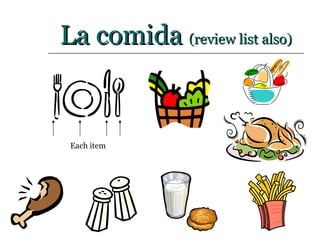
La comida  (review list also) Each item
Correct the following sentences (be sure to look for agreement of verbs, adjectives and nouns) Ella lleva una blusa rojo. Yo soy un chico inteligento. Me gusta leer los libros interesante. La leche está frio. Mis clases es muy aburridos. Yo quiero un zapatos negros.
Palabras interrogativas ¿Cuándo?  (when)  - ¿Cuándo es tu cumpleaños? ¿Cuánto?  (how many)  - ¿Cuántos años tienes? ¿Quién?  (who)  - ¿Quién es tu mejor amigo? ¿Qué?  (what)  - ¿Qué te gusta leer? ¿Cómo?  (how)  - ¿Cómo estás? ¿Dónde?  (where)  - ¿De dónde eres? ¿Por qué?  (why)  - ¿Por qué estás tan cansado? ¿Cuál?  (which)  - ¿Cuál es tu favorito?
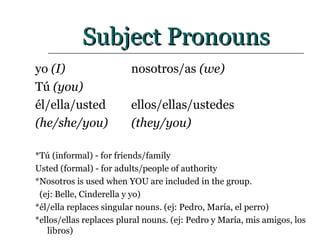
Subject Pronouns yo  (I) nosotros/as  (we) Tú  (you) él/ella/usted ellos/ellas/ustedes (he/she/you) (they/you) *Tú (informal) - for friends/family Usted (formal) - for adults/people of authority *Nosotros is used when YOU are included in the group.  (ej: Belle, Cinderella y yo) *él/ella replaces singular nouns. (ej: Pedro, María, el perro) *ellos/ellas replaces plural nouns. (ej: Pedro y María, mis amigos, los libros)
Verbos regulares Verbs end in either  -ar ,  -er ,  or  –ir and conjugate with the following endings. verbos de -ar o amos as --- a an verbos de -er o emos es --- e en verbos de -ir o imos es --- e en
Verbos de –ar : hablar, cocinar, mirar  Verbos de –er : comer, beber, vender  Verbos de –ir : vivir, escribir, aplaudir Verbos regulares
Verbos regulares Drop the infinitive ending and add the correct conjugation ending for subject-verb agreement. Hablar –   Yo habl o Comer –  Ella com e Vivir –  Nosotros viv imos
Verbos regulares Practica: Ella ___ unos zapatos blancos. (llevar) Mi familia y yo _____ tacos. (comer) Paco y Pedro ____ en Harlem.(vivir) ¿____ tú mucho? (estudiar) Yo ____ limonada en el verano. (beber) lleva comemos viven estudias bebo
Verbos irregulares There are  many  irregular verbs.  We categorize them for easy memorization.  This does not cover all irregular verbs! -oy verbs -go verbs These verbs have irregularities in the first person singular (yo) form Ser Estar Ir Dar Tener Hacer Poner Salir
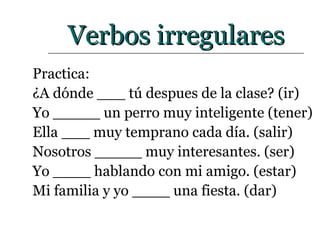
Verbos irregulares Practica: ¿A dónde ___ tú despues de la clase? (ir)  Yo _____ un perro muy inteligente (tener) Ella ___ muy temprano cada día. (salir) Nosotros _____ muy interesantes. (ser) Yo ____ hablando con mi amigo. (estar) Mi familia y yo ____ una fiesta. (dar)
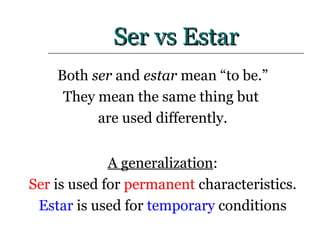
Ser vs Estar Both  ser  and  estar  mean “to be.” They mean the same thing but  are used differently. A generalization : Ser  is used for  permanent  characteristics. Estar  is used for  temporary  conditions
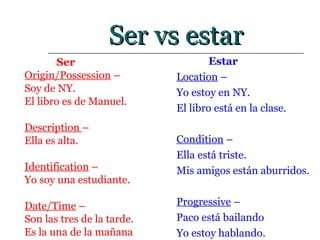
Ser vs estar Ser Origin/Possession  –  Soy de NY.  El libro es de Manuel. Description  –  Ella es alta. Identification  –  Yo soy una estudiante. Date/Time  –  Son las tres de la tarde.  Es la una de la mañana Estar Location  –  Yo estoy en NY. El libro está en la clase. Condition  –  Ella está triste. Mis amigos están aburridos. Progressive  –  Paco está bailando Yo estoy hablando.
Ser vs Estar Practica: ______ las dos de la tarde. Ella ______ practicando. Nuestra familia ______ en Argentina. ¿De dónde ________? Mi madre _______ muy triste. El carro rojo ____ de Dora.
El verbo gustar To express likes and dislike  we use verbs like “gustar”.  These verbs are  not  used like other  –ar verbs. Ej: We  NEVER  say “Yo gusto el chocolate.” but we do say, “Me gusta el chocolate” los verbos gustar disgustar encantar interesar aburrir faltar molestar
El verbo gustar me nos te le les + gusta = for singular nouns or verbs or gustan = for plural nouns The following are used for added clarification: a mí a nosotros a tí a él /ella  a ellos/ellas A mí me gusta el brócoli. A ellas les disgusta estudiar. A Paco le gustan las cebollas. A nosotros nos gustan los tacos.
Stem Changers These are exactly what they sound like: verbs with changes in the stem.  There are 4 categories of stem changes o-ue e-ie u-ue e-i dormir contar encontrar pedir servir vestir querer entender comenzar jugar We do  NOT  stem change  N O S O T R O S
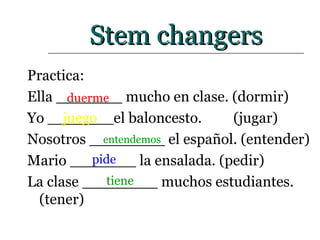
Stem changers Practica: Ella _______ mucho en clase. (dormir) Yo _______el baloncesto.    (jugar) Nosotros ________ el español. (entender) Mario _______ la ensalada. (pedir) La clase ________ muchos estudiantes. (tener) duerme tiene entendemos juego pide
El progresivo The Spanish “-ing” The progressive is made up of  two  parts: estar  +  participle estoy estamos estás está están + -ando (-ar verbs) -iendo (-er/-ir verbs) -yendo (dble vowel verbs) Yo  estoy  habl ando  en español. Paco  está  jug ando  al fútbol. Ellos  están  com iendo  la cena. ¿ Estás  escrib iendo  una carta? Nosotros  estamos  le yendo  el libro. Pepe y Juan  están  toc ando  el piano.
Los adjetivos posesivos Showing possession: mi  (my) nuestro/a*  (our) tu  (your) su  (his/her) su  (their) *nuestro/a is the only one that must reflect the gender of the noun. All must reflect number. Mi amigo Nuestr o  carr o Tu s  libro s Tu perro Nuestr a  cas a Nuestr as  amig as Su s  zapato s Mi s  clase s Su hermano
Los adjetivos demonstrativos Demonstrative adjectives describe the noun in relation to it’s distance from you. Ejemplo: These books Those books Those books way over there! Yo
Los adjetivos demonstrativos Remember: This & these keep the t’s That & those, out they go. este  estos esta  estas ese  esos esa  esas aquel  aquellos aquella aquellas Yo aquí allí allá Ejemplos: Yo quiero  este  libro aquí. Ella quiere  esa  mochila allí. Nosotros queremos  aquellos  libros allá.
¡El fin! If you take the time to review this powerpoint and practice, you will do great on the exam.  This is big test and you will not be able to review the night before.  Please take time here and there to study your notes and this review. We will continue to practice reading and speaking in class! ¡Buena Suerte!

Repaso del espanol 1

  • 1.
    El repaso delEspañol I This review will help you prepare for the final exam. Remember, no one will be allowed to exempt the oral portion of the exam.
  • 2.
    An Overview Conversaciónbásica Vocabulario Palabras interrogativas (question words) Verbos regulares e irregulares Verbos de cambio de raíz (stem changes) Los adjetivos posesivos El verbo gustar El muchacho pastor La ropa, la casa, la comida Los colores, los dias/meses, la familia
  • 3.
    Conversación básica Beable to ask about and answer the following: Names Ages Dates Classes Weather Favorite things (movie, class, etc) Likes and dislikes
  • 4.
    How do yourespond to the following? ¿Cómo te llamas? ¿Cómo estás? ¿Cuál es tu clase favorita? ¿Quién es tu profesor/a favorito/a? ¿Cuántos años tienes? ¿De dónde eres? ¿Cuál es la fecha de hoy? ¿Cuándo es tu cumpleaños? ¿Qué hora es? ¿Cual es tu primera/segunda/etc. hora?
  • 5.
    Los números ylos colores Complete the following number patterns: dos, cuatro, ____, ocho, ____, doce diez, veinte, treinta,______, cuarenta _____, diez, quince, veinte, _____ ¿Cómo se dice…….?
  • 6.
    Los días ylos meses Días de las semana: domingo lunes martes miércoles jueves viernes sábado Meses del año: enero febrero marzo abril mayo junio julio agosto septiembre octubre noviembre diciembre
  • 7.
    La hora¿Qué hora es? (Ejemplo) 1: ~ Es la…. (1:00 = Es la una) 2: - 12: ~Son las…. (7:00 = Son las siete) :01 - :29 ~ y # (1:05 = Es la una y cinco) :30 ~ y media (4:30 = Son las cuatro y media) :31-:59 ~ menos # (2:50 = Son las tres menos diez) :15 ~ cuarto (4:15 = Son las cuatro y cuarto) de la mañana de la tarde de la noche
  • 8.
    La horaPractica: 3:14 – 12:00 – 1:45 – 7:30 – 4:25 -
  • 9.
    Vocabulario de lafamilia La madre de mi madre es mi ___ . El hermano de mi padre es mi __ . Mi ________ es la hija de mi tío. Yo soy el/la ____ de mis abuelos. Preguntas personales : ¿Tienes una familia grande? ¿Cuántos hermanos(as) tienes? ¿Dónde vive tu familia?
  • 10.
    Vocabulario de laescuela ¿Cómo se dice…..?
  • 11.
  • 12.
    La comida (review list also) Each item
  • 13.
    Correct the followingsentences (be sure to look for agreement of verbs, adjectives and nouns) Ella lleva una blusa rojo. Yo soy un chico inteligento. Me gusta leer los libros interesante. La leche está frio. Mis clases es muy aburridos. Yo quiero un zapatos negros.
  • 14.
    Palabras interrogativas ¿Cuándo? (when) - ¿Cuándo es tu cumpleaños? ¿Cuánto? (how many) - ¿Cuántos años tienes? ¿Quién? (who) - ¿Quién es tu mejor amigo? ¿Qué? (what) - ¿Qué te gusta leer? ¿Cómo? (how) - ¿Cómo estás? ¿Dónde? (where) - ¿De dónde eres? ¿Por qué? (why) - ¿Por qué estás tan cansado? ¿Cuál? (which) - ¿Cuál es tu favorito?
  • 15.
    Subject Pronouns yo (I) nosotros/as (we) Tú (you) él/ella/usted ellos/ellas/ustedes (he/she/you) (they/you) *Tú (informal) - for friends/family Usted (formal) - for adults/people of authority *Nosotros is used when YOU are included in the group. (ej: Belle, Cinderella y yo) *él/ella replaces singular nouns. (ej: Pedro, María, el perro) *ellos/ellas replaces plural nouns. (ej: Pedro y María, mis amigos, los libros)
  • 16.
    Verbos regulares Verbsend in either -ar , -er , or –ir and conjugate with the following endings. verbos de -ar o amos as --- a an verbos de -er o emos es --- e en verbos de -ir o imos es --- e en
  • 17.
    Verbos de –ar: hablar, cocinar, mirar Verbos de –er : comer, beber, vender Verbos de –ir : vivir, escribir, aplaudir Verbos regulares
  • 18.
    Verbos regulares Dropthe infinitive ending and add the correct conjugation ending for subject-verb agreement. Hablar – Yo habl o Comer – Ella com e Vivir – Nosotros viv imos
  • 19.
    Verbos regulares Practica:Ella ___ unos zapatos blancos. (llevar) Mi familia y yo _____ tacos. (comer) Paco y Pedro ____ en Harlem.(vivir) ¿____ tú mucho? (estudiar) Yo ____ limonada en el verano. (beber) lleva comemos viven estudias bebo
  • 20.
    Verbos irregulares Thereare many irregular verbs. We categorize them for easy memorization. This does not cover all irregular verbs! -oy verbs -go verbs These verbs have irregularities in the first person singular (yo) form Ser Estar Ir Dar Tener Hacer Poner Salir
  • 21.
    Verbos irregulares Practica:¿A dónde ___ tú despues de la clase? (ir) Yo _____ un perro muy inteligente (tener) Ella ___ muy temprano cada día. (salir) Nosotros _____ muy interesantes. (ser) Yo ____ hablando con mi amigo. (estar) Mi familia y yo ____ una fiesta. (dar)
  • 22.
    Ser vs EstarBoth ser and estar mean “to be.” They mean the same thing but are used differently. A generalization : Ser is used for permanent characteristics. Estar is used for temporary conditions
  • 23.
    Ser vs estarSer Origin/Possession – Soy de NY. El libro es de Manuel. Description – Ella es alta. Identification – Yo soy una estudiante. Date/Time – Son las tres de la tarde. Es la una de la mañana Estar Location – Yo estoy en NY. El libro está en la clase. Condition – Ella está triste. Mis amigos están aburridos. Progressive – Paco está bailando Yo estoy hablando.
  • 24.
    Ser vs EstarPractica: ______ las dos de la tarde. Ella ______ practicando. Nuestra familia ______ en Argentina. ¿De dónde ________? Mi madre _______ muy triste. El carro rojo ____ de Dora.
  • 25.
    El verbo gustarTo express likes and dislike we use verbs like “gustar”. These verbs are not used like other –ar verbs. Ej: We NEVER say “Yo gusto el chocolate.” but we do say, “Me gusta el chocolate” los verbos gustar disgustar encantar interesar aburrir faltar molestar
  • 26.
    El verbo gustarme nos te le les + gusta = for singular nouns or verbs or gustan = for plural nouns The following are used for added clarification: a mí a nosotros a tí a él /ella a ellos/ellas A mí me gusta el brócoli. A ellas les disgusta estudiar. A Paco le gustan las cebollas. A nosotros nos gustan los tacos.
  • 27.
    Stem Changers Theseare exactly what they sound like: verbs with changes in the stem. There are 4 categories of stem changes o-ue e-ie u-ue e-i dormir contar encontrar pedir servir vestir querer entender comenzar jugar We do NOT stem change N O S O T R O S
  • 28.
    Stem changers Practica:Ella _______ mucho en clase. (dormir) Yo _______el baloncesto. (jugar) Nosotros ________ el español. (entender) Mario _______ la ensalada. (pedir) La clase ________ muchos estudiantes. (tener) duerme tiene entendemos juego pide
  • 29.
    El progresivo TheSpanish “-ing” The progressive is made up of two parts: estar + participle estoy estamos estás está están + -ando (-ar verbs) -iendo (-er/-ir verbs) -yendo (dble vowel verbs) Yo estoy habl ando en español. Paco está jug ando al fútbol. Ellos están com iendo la cena. ¿ Estás escrib iendo una carta? Nosotros estamos le yendo el libro. Pepe y Juan están toc ando el piano.
  • 30.
    Los adjetivos posesivosShowing possession: mi (my) nuestro/a* (our) tu (your) su (his/her) su (their) *nuestro/a is the only one that must reflect the gender of the noun. All must reflect number. Mi amigo Nuestr o carr o Tu s libro s Tu perro Nuestr a cas a Nuestr as amig as Su s zapato s Mi s clase s Su hermano
  • 31.
    Los adjetivos demonstrativosDemonstrative adjectives describe the noun in relation to it’s distance from you. Ejemplo: These books Those books Those books way over there! Yo
  • 32.
    Los adjetivos demonstrativosRemember: This & these keep the t’s That & those, out they go. este estos esta estas ese esos esa esas aquel aquellos aquella aquellas Yo aquí allí allá Ejemplos: Yo quiero este libro aquí. Ella quiere esa mochila allí. Nosotros queremos aquellos libros allá.
  • 33.
    ¡El fin! Ifyou take the time to review this powerpoint and practice, you will do great on the exam. This is big test and you will not be able to review the night before. Please take time here and there to study your notes and this review. We will continue to practice reading and speaking in class! ¡Buena Suerte!