Sí, Tony conoce a alguien de la oficina. En el diálogo, Tony le pregunta a Julia si es Helen Longman, lo que significa que Tony ya conoce previamente a Helen de la oficina.
Inglés
Iniciación
Ministerio de Educación y Ciencia
Centro nacional de Información y Comunicación Educativa
2.
Autores:
Dolores Martín Catalán
Margarita Pujals Resalí
Javier Cerame Pérez
Coordinación pedagógica: Carmen Fernández Herráez
Edición y Maquetación: Verónica López de Frutos
Diseño de portada: Lidia Ballano Lozano
Ministerio de Educación y Ciencia
Secretaría General de Educación
Dirección General de Educación Formación Profesional e Innovación Educativa
Centro Nacional de Información y Comunicación Educativa
I.S.B.N.: 84-369-4115-2
N.I.P.O.: 651-05-276-0
Depósito Legal: M-47102-2005
Imprime: Reprografía Langayo
Tfno. 91.435.79.31
www.langayo.com
Impreso en España. Reservados todos los derechos
Madrid, Diciembre de 2005
Índice
Módulo I
Unidad 1-.Saludos y presentaciones
Unidad 2-. Relaciones
Unidad 3-. La familia
Unidad 4-. En la ciudad
Unidad 5-. En el hotel
Unidad 6-. ¡Disfrute la comida!
Unidad 7-. En el probador
Módulo II
Unidad 1-. En la estación
Unidad 2-. Visitando una ciudad
Unidad 3-. Llega una au-pair
Unidad 4-. Matricularse en un curso
Unidad 5-. Buscando un empleo
Unidad 6-. Hacer la compra
Unidad 7-. Describir personas
Módulo III
Unidad 1-. Estoy enfermo
Unidad 2-. Nos Mudamos
Unidad 3-. Invitaciones
Unidad 4-. Regreso de vacaciones
Unidad 5-. En la universidad
Unidad 6-. En el hospital
Unidad 7-. Nos vamos de viaje
7.
Módulo 1
Contenidos
Usos del Inglés Vocabulario
Comunicativos
- Saludar. - Presente del verbo be. - Good morning/afternoon.
Saludos y Presentaciones
- Presentarse. - Pronombres personales I y - Good evening/night.
- Preguntar el nombre y you. - Name.
contestar. - Pronombre interrogativo - Double.
Unidad 1
- Saludar a alguien que acabas what. - Alfabeto.
de conocer. - Posesivos my – your. - Excuse me, please, thank
- Comprobar la identidad de you.
alguien y contestar
(afirmando o negando).
- Deletrear.
- Contestar y preguntar sobre - Presente simple. - Profesiones.
el lugar de residencia y el - Pronombres personales we, - Países y nacionalidades.
Relacionarse
Unidad 2
lugar de trabajo. you, they. - Verbos: live, work, know,
- Expresar interés o sorpresa. - Artículo indeterminado a /an. do.
- Hablar de nacionalidades y - Pronombre demostrativo this. - Fine / Very well / And you?
países. - Pronombre interrogativo Really.
- Dar y pedir un número de where. - Goodbye / bye/ see you
teléfono. - Preposiciones in, from y for. soon, etc.
- Despedirse. - Números.
- Dar y pedir información (oral - El verbo have got. - La familia.
y escrita) de tipo personal y - El uso del presente simple en - Profesiones.
En Familia
Unidad 3
sobre terceras personas. inglés. - Idiomas y nacionalidades.
- Hablar, preguntar y escribir - El plural de los sustantivos.
sobre la familia. - Los adjetivos posesivos.
- Dar y pedir información sobre
el trabajo, profesión, idiomas
propias y sobre terceras
personas.
- Preguntar la localización de - Preposiciones de lugar: - La ciudad: edificios, lugares.
un sitio y responder. opposite, next to, near, - Verbos: say, turn.
- Pedir y dar indicaciones para next to, by, past, etc. - Adverbios: again, then, here,
En la Ciudad
Unidad 4
llegar a un sitio. - Imperativo go, turn. etc.
- Dar las gracias. - Adverbios y locuciones
- Indicar que no se entiende adverbiales straight ahead,
algo. on the left/right,over there.
- Números ordinales.
- Uso de one.
- Can you + infinitivo?
- There is one... / is there...?
- Preguntar si hay habitación - Verbo have got (repaso). - Name, surname, to spell.
en un hotel y responder. - Interrogativos How much/ etc.
En el hotel
Unidad 5
- Preguntar sobre precios. many? - Números.
- Preguntar sobre servicios y - Preposiciones for y a. - Dinero.
ventajas del hotel. - Can you + verbo? - Comidas.
- Aceptar o rechazar. - Palabras relacionadas con
- Escribir cartas formales. hoteles y sus servicios.
- Night, weekend, just.
1
8.
- Preguntar aalguien lo que - Can ...? (para pedir algo) - Menu: roast beef, chicken
¡Disfrute de su comida!
desea y responder. - Would like y I´d like. salad etc.
- Formular una petición. - Artículo determinado e - Platos: starter, main course
- Expresar lo que queremos. indeterminado. etc.
Unidad 6
- Expresar una opinión sobre la - Uso atributivo del nombre - Bebidas: wine, beer, etc.
comida. - Preposiciones for, with, of - Utensilios de la mesa: fork,
- Some + sustantivos no con knife etc.
tables. - Verbos : drink, order, have
- Adjetivos: forma y posición. etc.
- Adverbio too. - Adjetivos: delicious,
excellent.
- Ofrecer ayuda. - Demostrativos these /those. - Grandes almacenes.
- Preguntar dónde está una - Adverbios here /there. - Prendas de vestir.
sección. - Uso de some / any. - Verbos: help, buy, see.
En el probador
- Preguntar si hay un artículo. - Presente del verbo like. - Adjetivos: long, short, tight,
Unidad 7
- Designar un objeto. - Uso de Too+ adjetivo. nice, pretty etc.
- Expresar una opinión. - Pronombres demostrativos - Colores.
- Preguntar si una prenda (this/that one etc). - Size.
sienta bien y responder. - Uso de very. - By credit card.
- Pedir algo educadamente.
- Preguntar el precio y la forma
de pago.
- Indicar que se quiere comprar
algo.
2
9.
Unidad 1: Saludosy Presentaciones
Ejercicios
Ejercicio 1
¿Qué dirías para saludar a las siguientes horas?
1 2 3 4 5 6
08:30 14:00 16:30 20:00 11:15 22:30
1 Good morning
2
3
4
5
6
Ejercicio 2
Completa estas frases con la forma correspondiente del verbo to be.
1. Are am
Módulo 1
you Tony? Yes, I .
2. __________ she Linda? Yes, she __________.
3. __________ he Paul? No, he __________. He __________ David.
4. __________ you Sarah? No, I __________. I __________ Maria.
5. __________ he Mr. Edmonds? No, he __________. He _________ Mr. Lester.
Unidad 1 3
10.
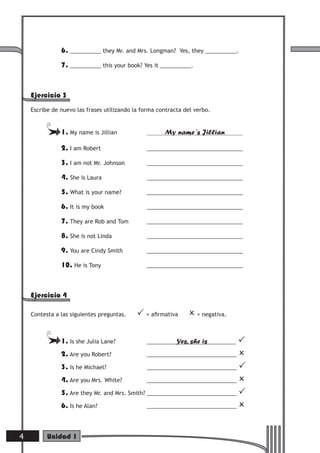
6. __________ theyMr. and Mrs. Longman? Yes, they __________.
7. __________ this your book? Yes it __________.
Ejercicio 3
Escribe de nuevo las frases utilizando la forma contracta del verbo.
1. My name is Jillian My name´s Jillian
2. I am Robert _______________________________
3. I am not Mr. Johnson _______________________________
4. She is Laura _______________________________
5. What is your name? _______________________________
6. It is my book _______________________________
7. They are Rob and Tom _______________________________
8. She is not Linda _______________________________
9. You are Cindy Smith _______________________________
10. He is Tony _______________________________
Ejercicio 4
Contesta a las siguientes preguntas. = afirmativa = negativa.
1. Is she Julia Lane? Yes, she is
2. Are you Robert? _____________________________
3. Is he Michael? _____________________________
4. Are you Mrs. White? _____________________________
5. Are they Mr. and Mrs. Smith? _____________________________
6. Is he Alan? _____________________________
4 Unidad 1
11.
Ejercicio 5
Completa loshuecos con la palabra correcta. Algunas las tendrás que utilizar más de una
vez.
my your you me he she
1. Excuse me !
2. What is __________ name?
3. __________ is Linda.
4. How do __________ do?
5. Is __________ Tony?
6. __________ is Mr. Ortiz.
7. Nice to meet __________!
8. __________ name´s Juan Pérez.
Ejercicio 6
Ordena las palabras para formar frases correctas.
1. not - am – Miss Lane – I I am not Miss Lane.
2. you – are - Mr. Allen - me, - Excuse - ?______________________________
3. you - How - do - do - ? _______________________________
4. Pleased - you – meet - to - ! _______________________________
5. No, - isn´t - Mrs. Longman - she _______________________________
6. he - Tony Patterson - Is - ? _______________________________
Módulo 1
Unidad 1 5
12.
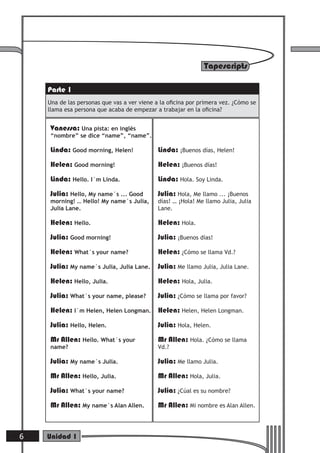
Tapescripts
Parte 1
Una de las personas que vas a ver viene a la oficina por primera vez. ¿Cómo se
llama esa persona que acaba de empezar a trabajar en la oficina?
Vanessa: Una pista: en inglés
“nombre” se dice “name”, “name”.
Linda: Good morning, Helen! Linda: ¡Buenos días, Helen!
Helen: Good morning! Helen: ¡Buenos días!
Linda: Hello. I´m Linda. Linda: Hola. Soy Linda.
Julia: Hello, My name´s ... Good Julia: Hola, Me llamo ... ¡Buenos
morning! … Hello! My name´s Julia, días! … ¡Hola! Me llamo Julia, Julia
Julia Lane. Lane.
Helen: Hello. Helen: Hola.
Julia: Good morning! Julia: ¡Buenos días!
Helen: What´s your name? Helen: ¿Cómo se llama Vd.?
Julia: My name´s Julia, Julia Lane. Julia: Me llamo Julia, Julia Lane.
Helen: Hello, Julia. Helen: Hola, Julia.
Julia: What´s your name, please? Julia: ¿Cómo se llama por favor?
Helen: I´m Helen, Helen Longman. Helen: Helen, Helen Longman.
Julia: Hello, Helen. Julia: Hola, Helen.
Mr Allen: Hello. What´s your Mr Allen: Hola. ¿Cómo se llama
name? Vd.?
Julia: My name´s Julia. Julia: Me llamo Julia.
Mr Allen: Hello, Julia. Mr Allen: Hola, Julia.
Julia: What´s your name? Julia: ¿Cúal es su nombre?
Mr Allen: My name´s Alan Allen. Mr Allen: Mi nombre es Alan Allen.
6 Unidad 1
13.
Julia: Alan Allen? Julia: ¿Alan Allen?
Mr Allen: Alan - A-L-A-N Allen - A- Mr Allen: Alan - A-L-A-N Allen - A-
double L-E-N doble L-E-N
(Voice over): Mr Allen! Voz: ¡Sr. Allen!
Mr Allen: Good morning, Mr Paul Mr Allen: Buenos días, Sr. Paul
Neil: Good morning! Neil: ¡Buenos días!
Julia: Good morning! Julia: ¡Buenos días!
Neil: Good morning, Helen! Neil: ¡Buenos días, Helen!
Helen: Hello, Neil. Helen: Hola, Neil.
Neil: I´m Neil Hillman. … What´s Neil: Soy Neil Hillman. … ¿Cómo se
your name? llama Vd.?
Julia: Julia. J-U-L-I-A. Julia: Julia. J-U-L-I-A.
Neil: Julia? Neil: ¿Julia?
Julia: Julia Lane. L-A-N-E Julia: Julia Lane. L-A-N-E
Neil: Julia Lane. Neil: Julia Lane.
Mr Allen: Good morning, Mr Hill- Mr Allen: Buenos días,
man. Sr. Hillman.
Neil: Hi, Mr Allen. Neil: Hola, Sr Allen.
Alan: Julia Lane. Ese es el nombre Alan: Julia Lane. Ese es el nombre
por el que preguntábamos. Así se por el que preguntábamos. Así se
llama la persona que ha empezado a llama la persona que ha empezado a
trabajar en la oficina. trabajar en la oficina.
Módulo 1
Unidad 1 7
14.
Parte 2
Alan: Mientras sigues el episodio, Alan: Mientras sigues el episodio,
queremos que respondas a una pre- queremos que respondas a una pre-
gunta. Vamos a ver a un fotógrafo gunta. Vamos a ver a un fotógrafo
que se llama Tony. La pregunta es: que se llama Tony. La pregunta es:
¿Conoce Tony a alguien de la ¿Conoce Tony a alguien de la
oficina? oficina?
Tony: Hi! I’m Tony Patterson. Tony: ¡Hola! Soy Tony Patterson.
Neil: Hello! Neil: ¡Hola!
Tony: What’s your name? Tony: ¿Cómo se llama Vd.?
Neil: Neil. My name’s Neil. Neil Neil: Neil. Me llamo Neil. Neil Hill-
Hillman. How do you do? man. Encantado de conocerle.
Tony: How do you do? … Excuse Tony: Mucho gusto. Perdone, ¿Es
me, are you Helen Longman? Vd. Helen Longman?
Julia: No, I’m not. I’m Julia. Julia: No. Soy Julia.
Tony: Are you Helen Longman? Tony: ¿Es Vd. Helen Longman?
Helen: Yes, I am. Helen: Sí.
Tony: Hi! Hi! I’m Tony. Tony: ¡Hola! ¡Hola! Yo soy Tony.
Helen: Tony? Helen: ¿Tony?
Tony: Yes. Tony: Sí.
Helen: Tony, Tony Patterson! Helen: Tony, ¡Tony Patterson!
Tony: Hello. What’s your name? Tony: Hola. ¿Cómo se llama?
Julia: My name’s … Julia: Mi nombre es …
Helen: ...Julia Lane. Helen: ...Julia Lane.
Julia: My name’s Julia Lane. Julia: Me llamo Julia Lane.
Tony: Julia Lane. Hello, Julia. Tony: Julia Lane. Hola, Julia.
Mr Allen: Good morning, Julia. Are Mr Allen: Buenos días, Julia. ¿Es
you David Hamilton? Vd. David Hamilton?
Tony: No, I’m not. I’m Tony Patter- Tony: No. Soy Tony Patterson.
son. ... Hi, Linda! ... ¡Hola, Linda!
8 Unidad 1
15.
Linda: Hello, MrPatterson. Linda: Hola Sr. Patterson.
Tony: Is she Helen? Tony: ¿Es Helen?
Neil: No, she’s Julia Lane. Neil: No. Es Julia Lane.
Tony: Oh, thank you. Is he Neil Tony: Oh, gracias. ¿Es Neil
Hillman? Hillman?
Neil: No, I’m Neil Hillman. He’s Mr Neil: No. Yo soy Neil Hillman. Él es
Allen. ... No, no. A-double L-E-N. el Sr. Allen. ... No, no. A-doble L-E-N.
Tony: A-double L-E-N. Tony: A-doble L-E-N.
Alan: ¡A ver! ¿Qué hay de lo que Alan: ¡A ver! ¿Qué hay de lo que
preguntábamos? ¿Conoce Tony a preguntábamos? ¿Conoce Tony a al-
alguien en la oficina? guien en la oficina?
Vanessa: Bueno, a la mayoría no Vanessa: Bueno, a la mayoría no
los conocía, pero había alguien a los conocía, pero había alguien a
quien sí conocía. Era Linda, que quien sí conocía. Era Linda, que apa-
apareció justo al final. reció justo al final.
Módulo 1
Unidad 1 9
16.
Ejercicio 1.
1. Good morning
2. Good afternoon
3. Good afternoon
4. Good evening
5. Good morning
6. Good evening/night
Ejercicio 2.
1. Are you Tony? Yes, I am.
2. Is she Linda? Yes, she is.
3. Is he Paul? No, he isn´t. He is David.
4. Are you Sarah? No, I am not. I am Maria.
5. Is he Mr. Edmonds? No, he isn´t. He is Mr. Lester.
6. Are they Mr. and Mrs. Longman? Yes, they are.
7. Is this your book? Yes it is.
Ejercicio 3.
1. My name´s Jillian.
2. I´m Robert.
3. I´m not Mr. Johnson.
4. She´s Laura.
5. What´s your name?
6. It´s my book.
7. They´re Rob and Tom
8. She isn´t Linda.
9. You´re Cindy Smith.
10. He´s Tony.
Ejercicio 4.
1. Is she Julia Lane? Yes, she is.
2. Are you Robert? No I´m not / No, I am not.
3. Is he Michael Yes, he is.
4. Are you Mrs. White? No, I´m not.
5. Are they Mr. and Mrs. Smith? Yes, they are.
6. Is he Alan? No, he isn´t.
Soluciones
Ejercicio 5.
1. Excuse me !
2. What is your name?
3. She is Linda.
4. How do you do?
5. Is he Tony?
6. He is Mr. Ortiz.
10 Unidad 1
17.
7. Nice tomeet you !
8. My name´s Juan Pérez.
Ejercicio 6.
1. not - am – Miss Lane – I I am not Miss Lane.
2. you – are - Mr. Allen - me, - Excuse - ? Excuse me, are you Mr. Allen ?
3. you - How -do - do - ? How do you do ?
4. pleased - you – meet- to - ! Pleased to meet you !
5. No, - isn´t - Mrs. Longman – she No, she isn´t Mrs Longman
6. he - Tony Patterson - is - ? Is he Tony Patterson ?
Soluciones
Unidad 1 11
19.
Unidad 2: Relacionarse
Ejercicios
Ejercicio 1
Escribe el artículo indeterminado (a/an).
1. A teacher.
2. __________ name.
3. __________ afternoon.
4. __________ book.
5. __________ city.
6. __________ evening.
7. __________ actor.
8. __________ accountant.
9. __________ job.
10. __________ man.
Ejercicio 2
Ordena las siguientes frases para formar un diálogo.
A. Hello, I´m Tim. 1. A
B. No, I don´t. I live in Oxford. 2. __________
Módulo 1
C. Do you live in London? 3. __________
D. Yes, I do. 4. __________
E. What is your job? 5. __________
F. Do you work in Oxford? 6. __________
G. Hi! I´m Lorena. 7. __________
H. I am an English teacher. 8. __________
Unidad 2 13
20.
Ejercicio 3
Completa las frases con una de las siguientes palabras:
name job do for in live doctor fine
1. I live in Sheffield.
2. What __________ you do? I´m a personal assistant.
3. I work __________ BRITISH AIRWAYS.
4. What is your __________? Maria.
5. How are you? __________ Thank you.
6. I work in a hospital __________ Devon. I´m a __________.
7. What is your __________? I´m an electrician.
Ejercicio 4
Completa las siguientes conversaciones sobre gente famosa.
1. Is David Beckham American ? No, he isn´t . He is from
England.
2. Are the Spice girls French? No, they __________. They are __________
__________.
3. Is Julio Iglesias American? No, he __________. He is __________
__________.
4. Is Mel Gibson English? No, he __________. He is __________ __________.
5. Is Madonna English? No, She __________. She is __________ __________.
Ejercicio 5
Completa las siguientes frases con la palabra que falta.
1. Where is she from? She´s French.
14 Unidad 2
21.
2. __________ isyour job? I´m a P.A.
3. __________ is John? He´s fine.
4. __________ do you live? I live in London.
5. __________ do you do? I´m a doctor.
6. __________ do you do? How do you do?
7. __________ is your phone number? 747-88-90.
8. __________ are you ? Very well. Thank you.
Ejercicio 6
Ordena las siguientes palabras para formar frases correctas. Después tradúcelas al
español.
1. you - work - do - Where - ?
Where do you work ? ¿ Dónde trabajas ?
2. live - Where - you - do - ?
_______________________________ _______________________________
3. I - friend - know - don´t - your
_______________________________ _______________________________
4. Do - speak - you - English - ?
_______________________________ _______________________________
5. I - work - don´t - in - this - office
_______________________________ _______________________________
6. you - Do - work - for - British - Airways - ?
Módulo 1
_______________________________ _______________________________
Unidad 2 15
22.
Tapescripts
Parte 1
Vanessa: Mientras sigues el episo- Vanessa: Mientras sigues el episo-
dio de hoy, queremos que contestes dio de hoy, queremos que contestes
la pregunta siguiente: ¿cuántas de la pregunta siguiente: ¿cuántas de
las personas que aparecen viven en las personas que aparecen viven en
España? España?
Alan: Una pista: “España”, en in- Alan: Una pista: “España”, en in-
glés, se dice “Spain”, “Spain”. glés, se dice “Spain”, “Spain”.
Julia: Excuse me. My name´s Julia. Julia: Perdone. Me llamo Julia. …
… Hi! I´m Julia. ¡Hola! Soy Julia.
Helen: Hi! I´m Helen Logman. Helen: ¡Hola! Soy Helen Logman.
What´s your name? ¿Cómo se llama Vd?
Neil: Hello. I´m Neil. What´s your Neil: Hola. Soy Neil. ¿Cómo se
name? llama?
María: María. María: María.
Neil: Where do you live? Neil: ¿Dónde vive?
María: I live in Spain. And you? María: Vivo en España.¿Y Vd.?
Neil: I live in London. … What do Neil: Vivo en Londres. … ¿A qué se
you do? dedica?
María: I´m a teacher. María: Soy profesora.
Helen: John! Helen: ¡John!
John: Helen! John: ¡Helen!
Helen: How are you? Helen: ¿Cómo estás?
John: I´m fine. And you? John: Bien. ¿Y tú?
Helen: Very well, thank you. … Do Helen: Muy bien, gracias. …¿Cono-
you know Julia? ces a Julia?
John: No, I don´t. John: No.
Helen: John, this is Julia. Helen: John, ésta es Julia.
16 Unidad 2
23.
John: How doyou do? John: Encantado.
Julia: How do you do? Julia: Mucho gusto.
John: Do you live in London? John: ¿Vive en Londres?
Julia: Yes, I do. Julia: Sí.
John: Do you work in London? John: ¿Trabaja en Londres?
Julia: Yes, I do. Julia: Sí.
John: What do you do? John: ¿A qué se dedica?
Julia: I´m a P.A. Julia: Soy auxiliar administrativo. ¿Y
What´s your job? Vd. a qué se dedica?
John: I´m an engineer. I work for John: Soy ingeniero. Trabajo para
an oil company. una compañía de petróleo.
Neil: Thank you. Neil: Gracias.
María: Thank you. María: Gracias.
Neil: Ah, María. This is Helen Neil: Ah, María. Ésta es Helen
Longman. Longman.
Helen: How do you do? Helen: Encantada.
María: How do you do? María: Es un placer.
Neil: And this is Julia Lane. Neil: Y está es Julia Lane.
Julia: Hello! Julia: ¡Hola!
María: Hi! María: ¡Hola!
Neil: Excuse me. What´s your Neil: Perdone.
name? ¿Cómo se llama?
John: I´m John Milton. John: Soy John Milton.
Neil: John, this is María. María, Neil: John, ésta es María. María,
Módulo 1
this is John. éste es John.
John: María! Hello, María. John: ¡María! Hola, María.
María: Hello, John. María: Hola, John.
Helen: John, do you know María? Helen: John, ¿conoces a María?
Unidad 2 17
24.
John: Yes, I´mJohn Hilton and this John: Sí, soy John Hilton y ella es
is María Hilton. María Hilton.
Helen: Really? Helen: ¿De veras?
Vanessa: La respuesta es: hay una Vanessa: La respuesta es: hay una
sola persona que reside en España y sola persona que reside en España y
es María. es María.
Parte 2
Alan: Mientras sigues el episodio, Alan: Mientras sigues el episodio,
contesta una pregunta. contesta una pregunta.
Vanessa: Es muy sencilla. ¿De Vanessa: Es muy sencilla. ¿De
dónde son Peter y Jane? ¿De dónde dónde son Peter y Jane? ¿De dónde
son Peter y Jane? son Peter y Jane?
Julia: They aren´t English. Julia: No son ingleses.
Neil: No. Neil: No.
Julia: Are they Spanish? Julia: ¿Son españoles?
Helen: They´re American. Helen: Son americanos.
Julia: Yes, they´re American. Julia: Sí, son americanos.
Neil: No, María isn´t American. Neil: No, María no es americana.
Helen: Is she Spanish? Helen: ¿Es española?
Neil: Yes, she´s from Madrid. ... Neil: Sí, es de Madrid. ... John no es
John isn´t Spanish. español.
Julia: Where´s he from? Julia: ¿De dónde es?
Neil: He´s from England. Neil: De Inglaterra.
Helen: No, he isn´t. He´s from the Helen: No. Es de los Estados
United States. Unidos.
Neil: Oh, really? Neil: Oh, ¿de veras?
Helen: Yes. Helen: Sí.
18 Unidad 2
25.
Voice over: One,two, three, four, Voz en off: Uno, dos, tres, cuatro,
five, six ... cinco, seis ...
Neil: Are they Australian? Neil: ¿Son australianos?
Helen: No, they are not from Helen: No, no son de Australia.
Australia. Peter and Jane are from Peter y Jane son de
England. Inglaterra.
María: Do you know Helen? María: ¿Conoces a Helen?
John: Yes, I do. John: Sí.
María: Oh, really! María: Oh, ¿de veras?
Helen: Goodbye! Helen: ¡Adiós!
María: Goodbye! See you again! María: ¡Adiós! ¡Hasta luego!
Helen: Bye, John! Helen: ¡Adiós, John!
John: Bye, Helen! See you soon! John: ¡Adiós, Helen! ¡Hasta luego!
Helen: Bye! Helen: ¡Adiós!
Julia & Neil: Bye! Julia & Neil: ¡Adiós!
John: Where do you work? John: ¿Dónde trabajáis?
Neil: We work for Multinational Neil: Trabajamos en Multinational
Promotions. Promotions.
John: Really? Please! John: ¿De veras? ¡Por favor!
Julia: No. No! Julia: No. ¡No!
John: What´s your phone John: ¿Cuál es tu número de telé-
number? fono?
Julia: My phone number? Two, six, Julia: ¿Mi número de teléfono? Dos,
double one, oh, five. seis, dos, uno, uno, cero, cinco.
John: Two, six, double one, zero, John: Dos, seis, dos, uno, uno, cero,
Módulo 1
five. Two, six, double one, zero, cinco.Dos, seis, dos, uno, uno, cero,
five. Two, six, double one, zero, cinco. Dos, seis, dos, uno, uno, cero,
five. cinco.
Vanessa: La pregunta era: ¿de Vanessa: La pregunta era: ¿de
dónde son Peter y Jane? dónde son Peter y Jane?
Unidad 2 19
26.
Neil: Are theyAustralian? Neil: ¿Son australianos?
Helen: No, they are not from Helen: No, no son de Australia. Pe-
Australia. Peter and Jane are from ter y Jane son de Inglaterra.
England.
Alan: They are not from Australia. Alan: No son de Australia.
Vanessa: No, they are not from Vanessa: No, no son de Australia.
Australia. Peter and Jane are from Peter y Jane son de Inglaterra. Son
England. They´re from England. de Inglaterra.
20 Unidad 2
27.
Ejercicio 1.
1. A teacher.
2. A name.
3. An afternoon.
4. A book.
5. A city.
6. An evening.
7. An actor.
8. An accountant.
9. A job.
10. A man.
Ejercicio 2.
A. Hello, I´m Tim. 1. A
B. No, I don´t. I live in Oxford. 2. D
C. Do you live in London? 3. C
D. Yes, I do. 4. F
E. What is your job? 5. G
F. Do you work in Oxford? 6. E
G. Hi! I´m Lorena. 7. B
H. I am an English teacher. 8. H
Ejercicio 3.
1. I live in Sheffield.
2. What do you do? I´m a personal assistant.
3. I work for BRITISH AIRWAYS.
4. What is your name ? Maria.
5. How are you? Fine ,Thank you.
6. I work in a hospital in Devon. I´m a doctor.
7. What is your job ? I´m an electrician.
Ejercicio 4.
1. Is David Beckham American ? No, he isn´t. He is from England.
2. Are the Spice girls French? No, they aren´t. They are from England.
3. Is Julio Iglesias American? No, he isn´t. He is from Spain.
4. Is Mel Gibson English? No, he isn´t. He is from Australia.
Soluciones
5. Is Madonna English? No, She isn´t. She is from America/ the USA.
Ejercicio 5.
1. Where is she from? She´s French.
2. What is your job? I´m a P.A.
3. How is John? He´s fine.
4. Where do you live? I live in London.
5. What do you do? I´m a doctor.
Unidad 2 21
28.
6. How do you do? How do you do?
7. What is your phone number? 747-88-90.
8. How are you ? Very well. Thank you.
Ejercicio 6.
1. you - work - do - Where - ?
Where do you work ?
¿ Dónde trabajas ?
2. live - Where - you - do - ?
Where do you live?
¿Dónde vives? / ¿Dónde vive Vd.?
3. I - friend - know - don´t - your
I don´ t know your friend.
No conoczco a tu amigo/a
4. Do - speak - you - English - ?
Do you speak English?
¿Habla /hablas inglés?
5. I - work - don´t - in - this - office
I don´t work in this office
No trabajo en esta oficina.
6. you - Do - work - for - British Airways - ?
Do you work for British Airways?
¿Trabaja/trabajas para/en British Airways?
Soluciones
22 Unidad 2
29.
Unidad 3: La Familia
Ejercicios
Ejercicio 1
Sopa de letras. Localiza en la sopa de letras las siguientes palabras en inglés.
Hermano Primo Abuela Madre Padre
Hija Tía Hijo Hermana
R T Q Q H Z N S G Y G R
E Y F O O I D X U R J V
H Y M W S R J O A Z N S
T A J U L X A N Y D V Q
O R O N E R D L I H C E
R C E M O M F A T H E R
B O M T O S Y Q T S N U
Q O Z T H T F A I I W G
M K H A N G H Y Z S Q H
R E U V B D U E D T C L
Módulo 1
R N B S X V U A R E A O
T J T N E B D G D R L G
Unidad 3 23
30.
Ejercicio 2
Family Crossword.
2. your uncle’s children are your… 1. your father’s mother is your…
Across
Down
5. your mother’s daughter is your… 2. your son and daughter are your…
4. your sister’s son is your … 3. your father’s brother is your…
1
2
3
5
4
Ejercicio 3
Esta es la familia de SANDRA, completa los espacios en el texto fijándote en el árbol ge-
nealógico (family tree). Subraya en el texto los adjetivos posesivos y fíjate en su uso.
Alice Robert
Annie Sandra Allan John Liz
Bob Rose Jenny Mike
24 Unidad 3
31.
“Hello! This ismy family. Alice is my mother and Robert is my ________.
Alan is my __________ and Rose is our __________. John is my __________
and Liz is his __________. Mike and Jenny are their __________. Annie is my
__________ and Bob is her __________. Bye-bye”
Ejercicio 4
Completa cada frase con el adjetivo posesivo correspondiente.
1. My brother has got two daughters. Their names are Susan and Alice.
2. I am married. __________ husband is an electrician and __________
daughter is a dancer.
3. Susan is English, but __________ mother is French.
4. This is my friend, __________ name is Rodrigo.
5. Luis and Gustavo are brothers, __________ mother is a doctor.
6. Where are you from? What´s __________ nationality?
7. We are Spanish. __________ names are Carmen and Pepe.
8. Come here boys and clean __________ room.
Ejercicio 5
¿Cómo dices en inglés?
1. Tengo dos hermanos. I’ve got two brothers.
2. Tengo 20 años. _____________________________________
3. Pedro tiene cuatro gatos. _____________________________________
4. Mi abuela tiene 93 años. _____________________________________
Módulo 1
5. Raquel no tiene coche. _____________________________________
6. ¿Cuántos años tiene Manuel? _____________________________________
7. ¿Tienes bicicleta? _____________________________________
Unidad 3 25
32.
Ejercicio 6
Completa estas frases sobre la familia de Sandra. Puedes ver el árbol genealógico que
aparece en el ejercicio 3. Utiliza para ello la forma correcta de los siguientes verbos.
Algunos de ellos tendrás que utilizarlos varias veces en el ejercicio.
live travel speak work be have got
Annie is Sandra’s sister. She is single and she __________
32 years old. She __________ a teacher and __________ in a private
school. She __________ a son, Bob. Bob __________ ten years old.
John __________ a lot. He __________ an engineer. He __________ for
a multinational. He __________ to many countries. He ________ two
secretaries. Liz __________ his wife. She __________ for a French company.
She __________ a little French. They __________ a son and a daughter. They
__________ in London.
Ejercicio 7
Ahora contesta las siguientes preguntas según el texto anterior:
1. How old is Annie? She’s 32.
2. Where does she work? _____________________________________
3. What does John do? _____________________________________
4. Does he travel a lot? _____________________________________
5. Where does he live? _____________________________________
6. Does his wife speak French? _____________________________________
Tapescripts
Parte 1
Vanessa: Mientras sigues el episo- Vanessa: Mientras sigues el episo-
dio, trata de responder la pregunta dio, trata de responder la pregunta
siguiente: ¿de qué nacionalidad son siguiente: ¿de qué nacionalidad son
los padres de María? ¿De qué nacio- los padres de María? ¿De qué naciona-
nalidad son los padres de María? lidad son los padres de María?
26 Unidad 3
33.
Alan: Una pista:“madre”,en in- Alan: Una pista: “madre”, en inglés,
glés, se dice “mother”. Y “padre” se dice “mother”. Y “padre” se dice
se dice “father”. “father”.
María: How are you, Julia? María: ¿Como estás, Julia?
Julia: I´m fine, thanks. Julia: Bien, gracias.
María: What´s his name? María: ¿Cómo se llama?
Julia: His name´s Alex. Julia: Se llama Alex.
María: Where´s Alex from? María: ¿De dónde es Alex?
Julia: He´s from London. Julia: De Londres.
María: Is he married? María: ¿Está casado?
Julia: No, he isn´t. ... Who´s that? Julia: No. ... ¿Quién es ese?
María: That´s my husband. María: Es mi marido.
Julia: Really? That´s John? Julia: ¿De veras? ¿Es ese John?
María: Yes. María: Sí.
Julia: And that´s Tony. Julia: Y ese es Tony.
María: Do you know Tony? María: ¿Conoces a Tony?
Julia: He works for Multinational Julia: Trabaja en Multinational Pro-
Promotions. motions.
María: Do you work for Multina- María: ¿Trabajas en Multinational
tional Promotions? Promotions?
Julia: Yes, I´m a P.A. ... Have you Julia: Sí, soy auxiliar administrativa.
got any children? ... ¿Tienes hijos?
María: Yes, we´ve got three - two María: Sí, tenemos tres – dos chicos
boys and a girl. y una niña.
Julia: Ah! What are their names? Julia: ¡Ah! ¿Cómo se llaman?
Módulo 1
María: Their names are Nigel, María: Se llaman Nigel, Sarah y
Sarah and Paul. That´s Paul and Paul. Ese es Paul y esa mi hija
that´s my daughter Sarah. Sarah.
Julia: Who´s that? Julia: ¿Quién es ese?
Unidad 3 27
34.
María: That´s myfather. He´s María: Es mi padre. Es inglés. Mi
English. My mother is Spanish. madre es española.
Julia: Who´s that? Julia: ¿Quién es ese?
María: That´s Miguel. María: Es Miguel.
Julia: Miguel? Julia: ¿Miguel?
María: He´s my brother. María: Es mi hermano.
Julia: Oh, really! Julia: Oh, ¿en serio? ¿Cuántos años
How old is he? tiene?
María: He´s 26. María: 26.
Julia: Mmm... Miguel! Julia: Mmm... ¡Miguel!
María: One, two, three, four and María: uno, dos, tres, cuatro y uno,
one, two, three, four and one, two, dos, tres, cuatro y uno, dos, tres,
three, four and one, two, three ... cuatro y uno, dos, tres, cuatro y uno,
Excuse me! dos, tres… ¡Perdona!
Miguel: Hello, María. Miguel: Hola, María.
María: Miguel! María: ¡Miguel!
Alan: Who´s that? Alan: ¿Quién es ése?
Vanessa: That´s my father. That´s Vanessa: Es mi padre.
my father. Es mi padre.
Alan: He´s English. He´s English. Alan: Es inglés. Es inglés.
Vanessa: My mother is Spanish. My Vanessa: Mi madre es española. Mi
mother is Spanish. madre es española.
Alan: Ésa es la respuesta a nues- Alan: Ésa es la respuesta a nuestra
tra pregunta: el padre de María es pregunta: el padre de María es inglés
inglés y su madre, española. y su madre, española.
28 Unidad 3
35.
Parte 2
Vanessa: Mientrassigues el epi- Vanessa: Mientras sigues el episo-
sodio, responde a esta pregunta: ¿a dio, responde a esta pregunta:
qué países viaja María con frecuen- ¿a qué países viaja María con fre-
cia? cuencia?
María: One, two, three, four and María: uno, dos, tres, cuatro y uno,
one, two, three, four and one, two, dos, tres, cuatro y uno, dos, tres,
three, four and one, two, three ... cuatro y uno, dos, tres, cuatro y uno,
Excuse me! dos, tres… ¡Perdona!
Miguel: Hello, María. Miguel: Hola, María.
María: Miguel! María: ¡Miguel!
Miguel: Buenos días, ¿cómo estás? Miguel: Buenos días, ¿cómo estás?
María: Miguel, this is Julia. She María: Miguel, esta es Julia. No
doesn´t speak Spanish. habla español.
Miguel: Hello, Julia. How do you Miguel: Hola, Julia.
do? Encantado.
Julia: How do you do? Julia: Mucho gusto.
María: Oh, thank you! María: Oh, ¡gracias!
Miguel: This is my sister María. Miguel: Esta es mi hermana María.
Julia: Yes. Julia: Sí.
Miguel: Bye, María. See you soon. Miguel: Adiós María. Hasta luego.
María: Bye! ... One, two, three, María: ¡Adiós! ... uno, dos, tres,
four and one, two, three, four cuatro y uno, dos, tres, cuatro y uno,
and one, two, three, four and dos, tres, cuatro y uno, dos, tres,
one ... cuatro y uno…
Julia: What does Miguel do? Julia: ¿A qué se dedica Miguel?
María: He´s a businessman. He María: Es un hombre de negocios.
travels a lot. Viaja mucho.
Módulo 1
Julia: Where does he go? Julia: ¿Dónde va?
María: He goes to Europe and María: Va a Europa y América.
America. He speaks French, Span- Habla francés, español, inglés y algo
ish, English and a little Italian. de italiano.
Julia: Does he speak German? Julia: ¿Habla alemán?
Unidad 3 29
36.
María: He speaksa little. Do you María: Un poco.
speak German? ¿Hablas tu alemán?
Julia: Yes, I do, a little. Is Miguel Julia: Sí, un poco. ¿Está casado
married? Miguel?
María: No, he´s single. María: No, es soltero.
Julia: How old is he? Julia: ¿Cuántos años tiene?
María: He´s 26. Are you married, María: 26.
Julia? ¿Estas casada, Julia?
Julia: No, I´m single. ... Do you Julia: No, soy soltera. ... ¿Viajas
travel a lot? mucho?
María: Yes, I do. I go to Spain a lot María: Sí. Voy mucho a España y a
and to France. Francia.
Rafael: María! Rafael: ¡María!
María: Rafael! María: ¡Rafael!
Rafael: Happy birthday, María! Rafael: ¡Feliz cumpleaños, María!
María: Oh, thank you! Julia, this is María: ¡Oh, muchas gracias! Julia,
my uncle, uncle Rafael. Rafael, this este es mi tío, tío Rafael. Rafael,
is Julia. esta es Julia.
Julia: Hello! Julia: ¡Hola!
Rafael: Hello, Julia. Happy birth- Rafael: Hola, Julia. ¡Feliz cumplea-
day, María! ños, María!
Vanessa: ¿Averiguaste a qué Vanessa: ¿Averiguaste a qué países
países viaja María con frecuencia? viaja María con frecuencia?
Julia: Do you travel a lot? Julia: ¿Viajas mucho?
María: Yes, I do. I go to Spain a lot María: Sí. Voy mucho a España y a
and to France. Francia.
Vanessa: A lot. Mucho. A lot. Vanessa: A lot. Mucho. A lot.
Alan: Do you travel a lot? Alan: ¿Viajas mucho?
Vanessa: Yes, I do. Vanessa: Sí.
Alan: I go ... voy ... I go to Spain Alan: I go ... voy ... I go to Spain
a lot. Voy mucho a España. I go to a lot. Voy mucho a España. I go to
Spain a lot. Spain a lot.
30 Unidad 3
37.
Vanessa: And toFrance. Vanessa: Y a Francia.
Alan: Va mucho a España y a Alan: Va mucho a España y a
Francia. Francia.
Módulo 1
Unidad 3 31
38.
Ejercicio 1.
R T Q Q H Z N S G Y G R
E Y F O O I D X U R J V
H Y M W S R J O A Z N S
T A J U L X A N Y D V Q
O R O N E R D L I H C E
R C E M O M F A T H E R
B O M T O S Y Q T S N U
Q O Z T H T F A I I W G
M K H A N G H Y Z S Q H
R E U V B D U E D T C L
R N B S X V U A R E A O
T J T N E B D G D R L G
Ejercicio 2.
1
G
R
2
A C O U S I N S
N H
D I
3
M L U
O D N
5
S I S T E R C
H E L
4
E N E P H E W
R
Ejercicio 3.
“Hello! This is my family. Alice is my mother and Robert is my father. Alan is my
husband and Rose is our daughter. John is my brother and Liz is his wife.
Mike and Jenny are their children. Annie is my sister and Bob is her son.
Bye-bye”
Ejercicio 4.
1. My brother has got two daughters. Their names are Susan and Alice.
2. I am married. My husband is an electrician and our daughter is a dancer.
Soluciones
3. Susan is English, but her mother is French.
4. This is my friend, his name is Rodrigo.
5. Luis and Gustavo are brothers, their mother is a doctor.
6. Where are you from? What´s your nationality?
7. We are Spanish. Our names are Carmen and Pepe.
8. Come here boys and clean your room.
32 Unidad 3
39.
Ejercicio 5.
1. Tengodos hermanos. I’ve got two brothers.
2. Tengo 20 años. I’m 20.
3. Pedro tiene cuatro gatos. Pedro has got four cats.
4. Mi abuela tiene 93 años. My grandmother is 93.
5. Raquel no tiene coche. Raquel hasn’t got a car.
6. ¿Cuántos años tiene Manuel? How old is Manuel?
7. ¿Tienes bicicleta? Have you got a bicycle?
Ejercicio 6.
Annie is Sandra’s sister. She is single and she is
32 years old. She is a teacher and works in a private
school. She has got a son, Bob. Bob is ten years old.
John works a lot. He is an engineer. He works
for a multinational. He travels to many countries. He has got
two secretaries. Liz is his wife. She works for a
French company. She speaks a little French. They have got
a son and a daughter. They live in London.
Ejercicio 7.
1. How old is Annie? She’s 32.
2. Where does she work? (She works) in a private school.
3. What does John do? He’s an engineer.
4. Does he travel a lot? Yes, he does.
5. Where does he live? (He lives) in London.
6. Does his wife speak French? Yes, she does. / Yes, a little.
Soluciones
Módulo 1
Unidad 3 33
41.
Unidad 4: En la Ciudad
Ejercicios
Ejercicio 1
A) Completa las siguientes frases con el vocabulario estudiado anteriormente.
1. The letters(1) are at the post office
2. The money is at the ____________________.
3. There’s a good film on at the ____________________.
4. I get(2) the bus at the ____________________.
5. She eats at a ____________________ on Sundays.
6. He goes to the ____________________ to get books.
(1) letters = cartas (2) get= cojo
B) Busca en la siguiente sopa de letras 12 lugares que te han aparecido en esta unidad.
U N D E R G R O U N D
Y R A R B I L W T L H
W H C R U H C U O O K
C I N E M A W O T C R
M U S E U M H E F T A
B D D Z S C L R K X P
U Z B J S N S K D D M
Módulo 1
S U P E R M A R K E T
P O S T O F F I C E L
C R O S S R O A D S Z
T N A R U A T S E R T
Unidad 4 35
42.
Ejercicio 2
Mira el mapa del ejercicio y completa con las preposiciones y lugares que aparecen a
continuación.
Next to opposite café on the left
cinema Bus terminal bus stop on the right
This is Woodville, a little village. The school is in Elm Street opposite
the supermarket. The hospital is also in Elm Street __________ __________
__________.
There is a big park __________ __________ __________.Near the park
there’s a __________.
Opposite the post office and the __________ there is a __________ and
__________ the post office there’s a bank. There’s a __________
in Oak Street.
36 Unidad 4
43.
Ejercicio 3
Lee lassiguientes frases y sitúa en el dibujo los establecimientos.
1 The cinema is opposite the restaurant.
2 The post office is next to the cinema.
3 The supermarket is opposite the post office.
4 The railway station is opposite the bank.
5 The museum is next to the restaurant opposite the library.
Ejercicio 4
A continuación mira el mapa del ejercicio 2 y responde a las siguientes preguntas.
1. Where’s the Hospital? It’s in Elm Street, on the left.
2. Where’s the Post Office? _____________________________________
3. Where’s the cinema? _____________________________________
Módulo 1
4. Where’s the supermarket? _____________________________________
5. Where’s the café? _____________________________________
6. Where’s the bank? _____________________________________
Unidad 4 37
44.
Ejercicio 5
Escribe el correspondiente número ordinal en forma numérica o en letras.
1. 6th sixth
2. seventh __________
3. first __________
4. 5th __________
5. ninth __________
6. 2nd __________
7. 3rd __________
Ejercicio 6
Ordena las siguientes palabras para formar una frase.
1. a - near - here - There’s - bank
There’s a bank near here.
2. not - park - here - There - near - is - a
__________________________________________________
3. New Street - in - There’s - supermarket - a
__________________________________________________
4. street - church - in - a - there - this - Is - ?
__________________________________________________
5. bookshop - not - Elm Street - There - a - is - in
__________________________________________________
38 Unidad 4
45.
Tapescripts
Parte 1
Vanessa: Mientrassigues el episo- Vanessa: Mientras sigues el episo-
dio, contesta una pregunta. dio, contesta una pregunta.
Alan: Sí, es muy sencilla. Alguien Alan: Sí, es muy sencilla. Alguien
dice ser un estudiante. What’s his dice ser un estudiante. ¿Cómo se
name? llama el estudiante?
Vanesa: Una pista:“estudiante” en Vanesa: Una pista:“estudiante”
inglés se dice “student”, “student”. en inglés se dice “student”,
“student”.
Julia: How do I get to Leicester Julia: ¿Cómo se va a Leicester
Square? Square?
María: To Leicester Square….Take María: A Leicester Square….coge el
the number 12 bus. autobus 12.
Julia: Where’s the bus stop Julia: ¿Dónde está la parada, por
please? favor?
María: Go straight ahead. It’s on María: Sigue recto. Está a la
the left. It’s opposite the park. izquierda, enfrente del parque.
Julia: Thanks. Julia: Gracias.
María: See you soon, Julia. María: Hasta pronto, Julia.
Julia: Bye! Happy birthday, Julia: Adiós. ¡Feliz cumpleaños
María! María!
Neil: Excuse me. Where’s the Em- Neil: Perdone. ¿Dónde está el cine
pire Cinema? Empire?
Stranger: I think it’s in Oxford Stranger: Creo que está en Oxford
Street. Street.
Módulo 1
Neil: No, it’s in Leicester Square. Neil: No, está en Leicester Square.
Stranger: Oh, yes, the Empire Stranger: Ah, si, el Empire
Leicester Square. I think it’s next to Leicester Square. Creo que está al
the underground station.The under- lado de la estación de metro. El
ground station is over there and the metro está ahí y el cine está a la
cinema is on the left. izquierda.
No, it’s on the right. …..I think. No, a la derecha,… creo.
Unidad 4 39
46.
Mike: Hi! Mike: ¡Hola!
Pete: Hi! Are you American? Pete: ¡Hola! ¿Eres Americano?
Mike: Yes, I am. Where are you Mike: Si, lo soy.
from? ¿De dónde eres?
Pete: I’m from Cleveland, Ohio. Pete: Soy de Cleveland, Ohio.
What’s your name? ¿Cómo te llamas?
Mike: I’m Mike. Mike: Soy Mike.
Pete: Hi! My name’s Pete. What do Pete: ¡Hola! Me llamo Pete. ¿A qué
you do? te dedicas?
Mike: I’m a student. Mike: Soy estudiante.
Pete: Mmm! Pete: ¡Mmm!
Mike: Where’s Trafalgar Square? Mike: ¿Dónde está trafalgar Square?
Pete: Erm… I think it’s near Green Pete: Mmm... Creo que está cerca
Park. de Green Park.
Mike: Where’s Green Park. Mike: ¿Dónde está Green Park?
Pete: It’s over there. Pete: Está allí.
Mike: Excuse me! How do I get to Mike: Perdone, ¿Cómo se va a Tra-
Trafalgar Square? falgar Square?
Julia: I’m sorry. Julia: ¿Perdone?
Mike: Is it on the right? Mike: ¿Está a la derecha?
Julia: No, it isn’t. It’s... Neil. Julia: No. Está... Neil.
Neil: Who’s this? Neil: ¿Quién es este?
Mike: Hi, I’m Mike. Mike: Hola. Soy Mike.
Vanessa: ¿Sabes cómo se llama el Vanesa: ¿Sabes cómo se llama el
estudiante? Se llama Mike. Mike. estudiante? Se llama Mike. Mike.
40 Unidad 4
47.
Parte 2
Vanessa: Mientrassigues este Vanessa: Mientras sigues este
episodio, intenta contestar a esta episodio, intenta contestar a esta
pregunta: para ir al banco, ¿en que pregunta: para ir al banco, ¿en que
bocacalle debe girar a la izquierda? bocacalle debe girar a la izquierda?
¿En la tercera o en la cuarta? ¿En la tercera o en la cuarta?
Alan: Palabras clave: third- tercera Alan: Palabras clave: third- tercera
- third. - third.
Vanessa: Fourth – cuarta. Vanessa: Fourth – cuarta.
Alan: Turning – giro – turning. Alan: Turning – giro – turning.
Mike: Excuse me! Is there a bank Mike: Perdone. ¿Hay un banco por
near here? aquí?
Male recepcionist: Yes, there’s Conserje: Sí, hay uno en
one in New Road. New Road.
Mike: I’m sorry I don’t live in Lon- Mike: Lo siento, no vivo en Londres.
don. Where is New Road? ¿Dónde está New Road?
Male recepcionist: Erm... the Conserje: Mmm... el hotel está
hotel is here. The bank is in New aquí. El banco está en New Road…
Road…here. It’s next to the post aquí. Está al lado de correos.
office.
Mike: Where? Mike: ¿Dónde?
Male recepcionist: Here. Conserje: Aquí.
Mike: Ah! Mike: ¡Ah!
Male recepcionist: I think it’s Conserje: Creo que está aquí.
here.
Mike: Where are we? Mike: ¿Nosotros dónde estamos?
Male recepcionist: Ah! We are Conserje: Ah, estamos aquí.
here. The bank is over there. It’s El banco está ahí. Está al lado de
next to the post office. correos.
Módulo 1
Mike: Where’s the post office? Mike: ¿Dónde está correos?
Male recepcionist: Next to the Conserje: Al lado del banco.
bank. Ha ha ha! Sorry the bank is by ¡Ja,ja,ja! Perdone, el banco está
the supermarket. Yes. junto al supermercado. Sí, eso.
Unidad 4 41
48.
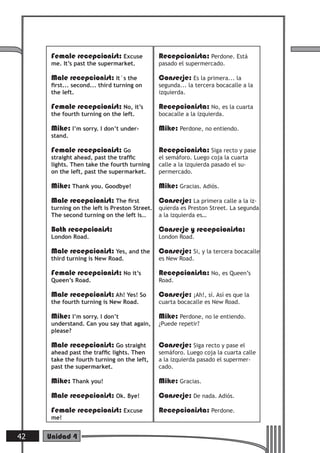
Female recepcionist: Excuse Recepcionista: Perdone. Está
me. It’s past the supermarket. pasado el supermercado.
Male recepcionist: It´s the Conserje: Es la primera... la
first... second... third turning on segunda... la tercera bocacalle a la
the left. izquierda.
Female recepcionist: No, it’s Recepcionista: No, es la cuarta
the fourth turning on the left. bocacalle a la izquierda.
Mike: I’m sorry. I don’t under- Mike: Perdone, no entiendo.
stand.
Female recepcionist: Go Recepcionista: Siga recto y pase
straight ahead, past the traffic el semáforo. Luego coja la cuarta
lights. Then take the fourth turning calle a la izquierda pasado el su-
on the left, past the supermarket. permercado.
Mike: Thank you. Goodbye! Mike: Gracias. Adiós.
Male recepcionist: The first Conserje: La primera calle a la iz-
turning on the left is Preston Street. quierda es Preston Street. La segunda
The second turning on the left is… a la izquierda es…
Both recepcionist: Conserje y recepcionista:
London Road. London Road.
Male recepcionist: Yes, and the Conserje: Si, y la tercera bocacalle
third turning is New Road. es New Road.
Female recepcionist: No it’s Recepcionista: No, es Queen’s
Queen’s Road. Road.
Male recepcionist: Ah! Yes! So Conserje: ¡Ah!, sí. Así es que la
the fourth turning is New Road. cuarta bocacalle es New Road.
Mike: I’m sorry. I don’t Mike: Perdone, no le entiendo.
understand. Can you say that again, ¿Puede repetir?
please?
Male recepcionist: Go straight Conserje: Siga recto y pase el
ahead past the traffic lights. Then semáforo. Luego coja la cuarta calle
take the fourth turning on the left, a la izquierda pasado el supermer-
past the supermarket. cado.
Mike: Thank you! Mike: Gracias.
Male recepcionist: Ok. Bye! Conserje: De nada. Adiós.
Female recepcionist: Excuse Recepcionista: Perdone.
me!
42 Unidad 4
49.
Mike: Yes? Mike: ¿Si?
Female recepcionist: The Recepcionista: El banco…
bank….
Mike: Yes? Mike: ¿Si?
Female recepcionist: It’s Recepcionista: Está cerrado.
closed!
Alan: Creo que ya tenemos claro Alan: Creo que ya tenemos claro
que bocacalle hay que girar para ir que bocacalle hay que girar para ir al
al banco , ¿no? banco, ¿no?
Male recepcionist: Ah! Yes! So Conserje: ¡Ah!,¡Sí! Así es que la
the fourth turning is New Road. cuarta bocacalle es New Road.
Mike: I’m sorry I don’t understand. Mike: Perdone, no le entiendo.
Vanessa: Bueno el portero está se- Vanessa: Bueno el portero está
guro de que es la cuarta bocacalle. seguro de que es la cuarta bocacalle.
Módulo 1
Unidad 4 43
50.
Ejercicio 1.
A)
1. The letters are at the post office.
2. The money is at the bank.
3. There’s a good film on at the cinema.
4. I get the bus at the bus stop.
5. She eats at a restaurant on Sundays.
6. He goes to the library to get books.
B)
U N D E R G R O U N D
Y R A R B I L W T L H
W H C R U H C U O O K
C I N E M A W O T C R
M U S E U M H E F T A
B D D Z S C L R K X P
U Z B J S N S K D D M
S U P E R M A R K E T
P O S T O F F I C E L
C R O S S R O A D S Z
T N A R U A T S E R T
Ejercicio 2.
This is Woodville a little village. The school is in Elm Streetopposite the
supermarket. The hospital is also in Elm Street on the left. There is a big park
on the right. Near the park there’s a bus stop. Opposite the post office and the
café there is a cinema and next to the post office there’s a bank. There’s a
bus terminal in Oak Street.
Ejercicio 3.
Soluciones
44 Unidad 4
51.
Ejercicio 4.
1. Where’sthe Hospital?
It’s in Elm Street, on the left.
2. Where’s the Post Office?
It’s in Pine Street, opposite the cinema / next to the bank/café.
3. Where’s the cinema?
It’s in Pine Street on the right / opposite the café or the post office.
4. Where’s the supermarket?
It’s in Elm Street on the left / opposite the school.
5. Where’s the café?
It’s in Pine street opposite the cinema / on the left / next to the post office.
6. Where’s the bank?
It’s in Pine Street next to the post office / on the left. / opposite the school.
Ejercicio 5.
1. 6th sixth
2. seventh 7th
3. first 1st
4. 5th fifth
5. ninth 9th
6. 2nd second
7. 3rd third
Ejercicio 6.
1. a - near - here - There’s - bank
There’s a bank near here.
2. not - park - here - There - near - is - a
There is not a park near here.
3. New Street - in - There’s - supermarket - a
There’s a supermarket in New Street.
4. street - church - in - a - there - this - Is - ?
Is there a church in this street?
Soluciones
5. bookshop - not - Elm Street - There - a - is - in
Módulo 1
There is not a bookshop in Elm Street.
Unidad 4 45
53.
Unidad 5: En el Hotel
Ejercicios
Ejercicio 1
Prepara la pregunta que corresponda a la respuesta dada.
1. You: Have you got any vacancies? ?
Recepcionist: No, I’m sorry. We haven’t got any vacancies.
2. You: __________________________________________________?
Recepcionist: Yes, we’ve got two double rooms.
3. You: __________________________________________________?
Recepcionist: No, I’m sorry. We haven’t got a single room.
4. You: __________________________________________________?
Recepcionist: Yes, we’ve got a room for two for the weekend.
Ejercicio 2
Contesta a las siguientes preguntas utilizando las pistas que te dan.
1. How many single rooms have you got?
We have got 20 (20)
Módulo 1
2. How many languages do you speak?
I _____________________________________ ( Spanish and French)
3. How many brothers have they got?
They _____________________________________ ( two brothers)
Unidad 5 47
54.
4. How manyrestaurants have you got?
I ____________________________________ ( 3 restaurants)
5. How many cousins has Peter got?
Peter __________________________________ ( 8 cousins)
Ejercicio 3
Esta vez te damos la respuesta y debes escribir la pregunta.
1. How many sisters have they got ?
They have got two sisters.
2. __________________________________________________ ?
Sorry, we haven’t got any single rooms.
3. __________________________________________________ ?
We have got twenty double rooms.
4. __________________________________________________ ?
I speak French and German.
5. __________________________________________________ ?
I have two. A son and a daughter.
Ejercicio 4
Escribe en letra los siguientes números.
1. 24 twenty- four.
2. 33 ____________________
3. 84 ____________________
4. 55 ____________________
5. 92 ____________________
6. 100 ____________________
48 Unidad 5
55.
7. 77 ____________________
8. 48 ____________________
9. 61 ____________________
10. 113 ____________________
Ejercicio 5
Completa las siguientes preguntas con how much o how many.
1. How much is a room for two nights, please?
2. ____________________ is a room for the weekend?
3. ____________________ nights?
4. ____________________ brothers have you got?
5. ____________________ rooms has the hotel got?
6. ____________________ is the evening meal, please?
Ejercicio 6
A continuación haz las siguientes preguntas sobre lo que tiene la habitación de un hotel y
respóndelas.
1. bathroom
Has it got a bathroom? Yes, it has
2. telephone
____________________________________________________
3. television
____________________________________________________
Módulo 1
4. bar
____________________________________________________
5. shower
____________________________________________________
Unidad 5 49
56.
Ejercicio 7
Completa la siguiente conversación con las preguntas que el recepcionista le hace al
cliente que llega al hotel.
1. What’s your first name, please ?
Susan.
2. __________________________________________________?
Jenkins.
3. __________________________________________________ ?
J-E-N-K-I-N-S
4. __________________________________________________ ?
46, Oak Street, London.
5. __________________________________________________ ?
My telephone number is 207 36 77 20.
6. __________________________________________________ ?
Two nights.
Tapescripts
Parte 1
Alan: Mientras sigues el episodio Alan: Mientras sigues el episodio de
de hoy, queremos que pienses en hoy, queremos que pienses en una
una pregunta. pregunta.
Vanessa: Sí, es muy sencilla. ¿Hay Vanessa: Sí, es muy sencilla. ¿Hay
habitaciones libres en el hotel? habitaciones libres en el hotel?
Mr Collins: Hello! Mr Collins: ¡Hola!
Female recepcionist: Good Recepcionista: Buenos días,
morning, sir! señor.
50 Unidad 5
57.
Mr Collins: We’vegot a reserva- Mr Collins: Tenemos una reserva.
tion.
Female recepcionist: What’s Recepcionista: ¿Cómo se llama,
your name, please? por favor?
Mr Collins: Collins. Mr Collins: Collins.
Female recepcionist: Collins... Recepcionist: Collins... Collins?
Collins? I’m sorry. We haven’t got a Lo siento. No tenemos una reserva a
reservation for Collins. nombre de Collins.
Mr Collins: What?... Excuse Mr Collins: ¿Cómo?... Perdone
me, have you got a room for two, ¿tiene una habitación doble, por
please? favor?
Female recepcionist: How many Recepcionista: ¿Para cuántas
nights? noches?
Mr Collins: It’s just for the Mr Collins: Sólo para el fin de
weekend. semana.
Female recepcionist: Double Recepcionista: ¿Una habitación
room? For the weekend? No, we doble? ¿Para el fin de semana? No, no
haven’t. No I’m sorry, sir. We tenemos. Lo siento señor. No tenemos
haven’t got any double rooms. ninguna habitación doble.
Mrs Collins: Hello. Have you got a Mrs Collins: Hola. ¿Tiene una
single room? habitación individual?
Female recepcionist: Yes, we Recepcionista: Sí. Tenemos una
have. We’ve got one single room. habitación individual. ¿Para cuántas
How many nights, madam? noches, señora?
Mrs Collins: Just two nights, Mrs Collins: Sólo dos noches por
please... How much is it? favor... ¿Cuánto cuesta?
Female recepcionist: It’s Recepcionista: Son 60 libras por
£60 a night, madam. That´s with noche con el desayuno.
breakfast.
Mrs Collins: Thank you, that’s Mrs Collins: Gracias. Está bien.
fine.
Módulo 1
Mr Collins: Fiona! Mr Collins: ¡Fiona!
Female recepcionist: What’s Recepcionista: ¿Cómo se llama
your name, please? por favor?
Mrs Collins: My name’s Fiona Mrs Collins: Me llamo Fiona
Collins. Collins.
Unidad 5 51
58.
Mr Collins: Fiona,please!... Mr Collins: ¡Fiona, por favor!...
Excuse me, have you got a single Perdone ¿Tiene una habitación indi-
room, please? vidual, por favor?
Male recepcionist: I´m sorry, Conserje: Lo siento señor. No
sir. We haven’t got any vacancies. tenemos ninguna habitación libre.
Mr Collins: Fiona, please!...Is Mr Collins: Fiona, por favor... ¿Hay
there a hotel near here? algún hotel cerca?
Male recepcionist: There’s one Conserje: Hay uno en King’s
in King’s Street, sir. Street, señor.
Mr Collins: How do I get to King’s Mr Collins: ¿Cómo se va a King’s
Street, please? Street, por favor?
Male recepcionist: Turn left. Go Conserje: Tuerza a la izquierda.
straight ahead at the traffic lights Siga recto hasta el semáforo y está a
and it’s on the right. la derecha.
Mr Collins: Thank you. Mr Collins: Gracias.
Female recepcionist: Room Recepcionista: Habitación 211.
211.
Mrs Collins: Thank you. Oh! How Mrs Collins: Gracias. Ah, ¿cuánto
much is the evening meal? es la cena?
Female recepcionist: We’ve got Recepcionista: Tenemos un menú
one menu at £17 and one at £32, a 17 libras y otro a 32, señora.
madam.
Mrs Collins: That’s fine. Thank Mrs Collins: Está bien, gracias.
you.
Vanessa: Está claro que no había Vanessa: Está claro que no había
reservado habitación. El caso es que reservado habitación. El caso es que
va a buscar otro hotel porque había va a buscar otro hotel porque había
sólo una habitación individual, y esa sólo una habitación individual, y esa
es la respuesta a la pregunta. es la respuesta a la pregunta.
52 Unidad 5
59.
Parte 2
Vanessa: Mientrassigues el episo- Vanessa: Mientras sigues el epi-
dio de hoy, queremos que prestes sodio de hoy, queremos que prestes
atención a lo siguiente: ¿Qué tienen atención a lo siguiente: ¿Qué tienen
en común el Sr Collins y el gerente en común el Sr Collins y el gerente
del hotel? del hotel?
Hotel manager: Hello! Gerente: ¡Hola!
Mr Collins: Have you got a single Mr Collins: ¿Tiene una habitación
room, please? individual, por favor?
Hotel manager: Yes, we have. Gerente: Sí, sí tenemos.
Mr Collins: Oh, good! Mr Collins: ¡Ah, qué bien!
Hotel manager: How many Gerente: ¿Para cuántas noches?
nights?
Mr Collins: It’s just for two Mr Collins: Es sólo para dos
nights. noches.
Hotel manager: Ok. Gerente: Bien.
Mr Collins: Ah! Has the room got Mr Collins: ¿Tiene baño la
a bathroom? habitación?
Hotel manager: No, it hasn’t. Gerente: No, no tiene.
Mr Collins: Ah! Has the room got Mr Collins: Ah, y ¿tiene teléfono la
a telephone? habitación?
Hotel manager: No, it hasn’t got Gerente: No, no tiene teléfono. El
a telephone. The telephone is over teléfono está allí.
there.
Mr Collins: Has the room got a Mr Collins: ¿Y tiene televisión la
television? habitación?
Hotel manager: No, the room Gerente: No, no tiene televisión.
hasn’t got a television.
Módulo 1
Mr Collins: How much is the Mr Collins: ¿Cuánto cuesta la
room? habitación?
Hotel manager: It’s £85. Gerente: Cuesta 85 libras.
Mr Collins: £85? Is that with Mr Collins: ¿85 libras? ¿Eso es con
breakfast? el desayuno?
Unidad 5 53
60.
Hotel manager: No. Gerente: No.
Mr Collins: Is there a restaurant Mr Collins: ¿Hay restaurante en el
in the hotel? hotel?
Hotel manager: A restaurant? Ha Gerente: ¿Restaurante? ¡Ja, ja, ja!
ha ha! No, there isn’t. No, no hay.
Mr Collins: Has the hotel got a Mr Collins: ¿El hotel tiene lavabo?
toilet?
Hotel manager: Yes, the hotel Gerente: Sí, sí tiene lavabo, de
has got a toilet – ladies and gen- damas y de caballeros…. Bien, ¿cómo
telmen. …Ok. What’s your name, se llama?
please?
Mr Collins: My name’s Collins. Mr Collins: Me llamo Collins.
Hotel manager: No, your first Gerente: No, su nombre.
name.
Mr Collins: Barry. Mr Collins: Barry.
Hotel manager: What’s your Gerente: ¿Cuál es su apellido?
surname?
Mr Collins: Collins. Mr Collins: Collins.
Hotel manager: What’s your Gerente: ¿Cuál es su dirección?
address?
Mr Collins: My address is 35, Bligh Mr Collins: Mi dirección es 35,Bligh
Street. Street.
Hotel manager: Can you spell Gerente: ¿Lo puede deletrear, por
that, please? favor?
Mr Collins: Yes, B-L-I-G-H, Bligh Mr Collins: Sí, B-L-I-G-H, Bligh.
Street, Newcastle, N-E-W….. Street, Newcastle, N-E-W…..
Hotel manager: Newcastle? Are Gerente: ¿Newcastle? ¿Eres de New-
you from Newcastle? castle?
Mr Collins: Yes, I’m from New- Mr Collins: Sí, soy de Newcastle,
castle, N-E-W-C-A…. N-E-W-C-A….
Hotel manager: My mother lives Gerente: Mi madre vive en New-
in Newcastle. castle.
Mr Collins: Really? Mr Collins: ¿De veras?
54 Unidad 5
61.
Hotel manager: AndI’ve got Gerente: Y allí tengo dos hermanos
two brothers there and a sister. Ah! y una hermana. ¡Ah! ¡Newcastle!...
Newcastle!... Room 12, Mr Collins. Habitación 12, señor Collins.
Mr Collins: Thank you. Mr Collins: Gracias.
Hotel manager: It’s got a televi- Gerente: Tiene televisión y tiene
sion and it’s got two telephones. dos teléfonos. Un teléfono en la
One telephone in the room and one habitación y un teléfono en el baño.
in the bathroom. It’s got a toilet in Tiene un váter en el baño. Y el desa-
the bathroom. And breakfast, lunch yuno, la comida y la cena son con-
and dinner are with me. migo.
Mr Collins: How much is room 12? Mr Collins: ¿Cuánto cuesta la
habitación 12?
Hotel manager: It’s £85. Gerente: Son 85 libras.
Alan: Y ahí está la respuesta a Alan: Y ahí está la respuesta a nues-
nuestra pregunta. Por supuesto, lo tra pregunta. Por supuesto, lo que
que Sr Collins y el gerente tienen en el Sr Collins y el gerente tienen en
común es Newcastle. común es Newcastle.
Vanesa: Mr Collins lives in Newcas- Vanesa: Mr Collins vive en New-
tle and the manager’s mother, sister castle y la madre, la hermana y los
and brothers live in Newcastle. hermanos del gerente viven en New-
castle.
Módulo 1
Unidad 5 55
62.
Ejercicio 1.
1. You: Have you got any vacancies?
Recepcionist: No, I’m sorry. We haven’t got any vacancies.
2. You: Have you got (any) double rooms?
Recepcionist: Yes, we’ve got two double rooms.
3. You: Have you got a single room ?
Recepcionist: No, I’m sorry. We haven’t got a single room.
4. You: Have you got a room for two for the weekend ?
Recepcionist: Yes, we’ve got a room for two for the weekend.
Ejercicio 2.
1. How many single rooms have you got?
We have got 20 (20)
2. How many languages do you speak?
I speak Spanish and French ( Spanish and French)
3. How many brothers have they got?
They have got two brothers ( two brothers)
4. How many restaurants have you got?
I have got three restaurants ( 3 restaurants)
5. How many cousins has Peter got?
Peter has got 8 cousins ( 8 cousins)
Ejercicio 3.
1. How many sisters have they got?
They have got two sisters.
2. Have you got a single room?/ How many single rooms have you got?
Sorry, we haven’t got any single rooms.
3. How many double rooms have you got?
We have got twenty double rooms.
4. How many languages do you speak?
I speak French and German.
5. How many children have you got?
Soluciones
I have two.A son and a daughter.
Ejercicio 4.
1. 24 twenty- four
2. 33 thirty-three
3. 84 eighty four
4. 55 fifty-five
56 Unidad 5
63.
5. 92 ninety-two
6. 100 one/a hundred
7. 77 seventy-seven
8. 48 forty- eight
9. 61 sixty-one
10. 13 one/a hundred and thirteen
Ejercicio 5.
1. How much is a room for two nights, please?
2. How much is a room for the weekend?
3. How many nights?
4. How many brothers have you got?
5. How many rooms has the hotel got?
6. How much is the evening meal, please?
Ejercicio 6.
1. bathroom Has it got a bathroom? Yes, it has.
2. telephone Has it got a telephone? Yes, it has.
3. televisión Has it got a television? No, it hasn’t.
4. bar Has it got a bar? Yes, it has.
5. shower Has it got a shower? No, it hasn’t
Ejercicio 7.
1. What’s your first name, please ?
Susan.
2. What’s your surname ?
Jenkins.
3. Can you spell that, please ?
J-E-N-K-I-N-S
Soluciones
4. What’s your address ?
Módulo 1
46, Oak Street, London.
5. What’s your telephone number, please ?
My telephone number is 207 36 77 20.
6. How many nights, sir ?
Two nights.
Unidad 5 57
65.
Unidad 6: ¡Disfrute de la comida!
Ejercicios
Ejercicio 1
Escribe junto a cada una de las palabras que se han presentado en el CD su significado.
1. orange naranja
2. chips
3. steak
4. beer
5. vegetables
6. bread
7. salad
8. soup
9. wine
10. juice
11. ice- cream
12. fish
13. tomato
14. roast beef
15. salt
16. water
Módulo 1
17. sugar
18. oil
19. chicken
20. chocolate
Unidad 6 59
66.
Ejercicio 2
Busca los seis términos que corresponden a las imágenes siguientes:
V Y E M X H E C R E O K
I E A W J Q H T E E T O
J N G Y X I O K W N A V
J Y O E C V E L V I M K
B I D K T B G U H Q O N
Y J E G U A R E S E T C
C N Z S N U B E B J K Z
E G N A R O D L A L M C
F B H U S A H J E D G M
W H H X B N H C E S N X
K A E T S W H B S H T N
T Z I D L R L R N U E H
Ejercicio 3
Práctica de vocabulario. Pon en orden las letras de la seis palabras siguientes.
1. LIO O i l
60 Unidad 6
67.
2. FIHS
3. COEFEF
4. CTOLHEACO
5. JIECU
6. LTSA
7. RAWET
8. BERE
Ejercicio 4
¿Cómo llamamos en inglés a las personas y cosas subrayadas en cada frase?
1. a school that starts in the evening. night school
2. a glass we drink wine from. _______________________________
3. a man from San Francisco. _______________________________
4. a friend from school. _______________________________
5. a spoon we use to eat dessert. _______________________________
6. paper we use when we go to
the toilet. _______________________________
7. juice made with tomatoes. _______________________________
8. a film about cowboys. _______________________________
Ejercicio 5
Módulo 1
Traduce al inglés.
1. guía de teléfonos. telephone book
2. hora del almuerzo. _______________________________
3. profesor de instituto. _______________________________
Unidad 6 61
68.
4. médico defamilia. _______________________________
5. coche de empresa. _______________________________
6. llaves de casa. _______________________________
7. periódico de la tarde. _______________________________
8. biblioteca de escuela. _______________________________
Ejercicio 6
Las imágenes siguientes ilustran las palabras que faltan en los huecos de las frases. Para
facilitarte las cosas te proporcionamos la letra inicial.
1. In Spain, we always make salads with fresh vegetables and olive
o_______________.
2. The Spanish word ‘bistec’ comes from ‘beef s_______________.
3. The first thing I do when I get up in the morning is drinking a glass of
fresh w_______________.
4. There are very good c_______________ in Spain now, Ferrán Adrià is one
of them.
5. Here’s a fast w_______________!
62 Unidad 6
69.
Ejercicio 7
Copia enorden cada una de las seis frases de la izquierda en las casillas de la derecha.
Son todas ellas frases que podrías escuchar en cualquier restaurante de un país de habla
inglesa.
1. ACN I HEAV TEH ILBL ?
C a n I h a v e t h e b i l l ?
2. HAWT LODWU UOY KELI TO NIKRD ?
?
3. SIHT SI A CEDIILUOS LEMA !
!
4. NCA WE ROEDR,SALPEE ?
, ?
5. I DOUWL LEKI A FOCFEE OOT, PELSEA
,
6. TAHW LUWOD OUY ILEK ROF TEH NMAI ROUSEC ?
? Módulo 1
Unidad 6 63
70.
Tapescripts
Parte 1
¡Disfrute de su comida!
Vanessa: Y mientras sigues el Vanessa: Y mientras sigues el epi-
episodio de hoy, intenta encontrar sodio de hoy, intenta encontrar la
la respuesta a esta pregunta: ¿Qué respuesta a esta pregunta: ¿Qué tipo
tipo de sopa aparece en la carta? El de sopa aparece en la carta? El ca-
camarero no se lo dirá. marero no se lo dirá.
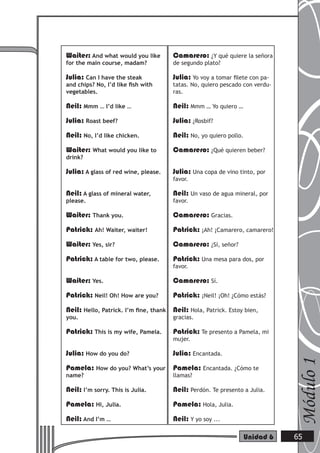
Waiter: Good evening, madam. Camarero: Buenas tardes, señora.
Julia: Thank you. Julia: Gracias.
Waiter: Good evening, sir. Camarero: Buenas tardes, señor.
Neil: Good evening. A table for Neil: Buenas tardes. Una mesa para
two. dos.
Waiter: Would you like this table? Camarero: ¿Le parece bien esta
mesa?
Neil: Can we have the table over Neil: ¿Podemos ponernos en aquella
there? de allí?
Waiter: Yes, sir. Camarero: Sí, señor.
Neil: Can I have the menu, please? Neil: ¿Me puede dar el menú, por
favor?
Neil: Thank you. Neil: Gracias.
Waiter: Madam... Camarero: Señora...
Julia: Thank you. Julia: Gracias.
Neil: Can we order, please? Neil: ¿Nos toma nota, por favor?
Waiter: Yes, sir. What would you Camarero: Sí, señor. ¿Qué quiere
like for a starter? de primer plato?
Neil: What would you like, Julia? Neil: ¿Qué quieres, Julia? ¿Te
Would you like the soup? It’s apetece la sopa?
vegetable soup. Es sopa de verduras.
Julia: I’d like a salad, please. A Julia: Quiero una ensalada, por fa-
tomato salad. vor. Una ensalada de tomate.
64 Unidad 6
71.
Waiter: And whatwould you like Camarero: ¿Y qué quiere la señora
for the main course, madam? de segundo plato?
Julia: Can I have the steak Julia: Yo voy a tomar filete con pa-
and chips? No, I’d like fish with tatas. No, quiero pescado con verdu-
vegetables. ras.
Neil: Mmm … I’d like … Neil: Mmm … Yo quiero …
Julia: Roast beef? Julia: ¿Rosbif?
Neil: No, I’d like chicken. Neil: No, yo quiero pollo.
Waiter: What would you like to Camarero: ¿Qué quieren beber?
drink?
Julia: A glass of red wine, please. Julia: Una copa de vino tinto, por
favor.
Neil: A glass of mineral water, Neil: Un vaso de agua mineral, por
please. favor.
Waiter: Thank you. Camarero: Gracias.
Patrick: Ah! Waiter, waiter! Patrick: ¡Ah! ¡Camarero, camarero!
Waiter: Yes, sir? Camarero: ¿Sí, señor?
Patrick: A table for two, please. Patrick: Una mesa para dos, por
favor.
Waiter: Yes. Camarero: Sí.
Patrick: Neil! Oh! How are you? Patrick: ¡Neil! ¡Oh! ¿Cómo estás?
Neil: Hello, Patrick. I’m fine, thank Neil: Hola, Patrick. Estoy bien,
you. gracias.
Patrick: This is my wife, Pamela. Patrick: Te presento a Pamela, mi
mujer.
Julia: How do you do? Julia: Encantada.
Módulo 1
Pamela: How do you? What’s your Pamela: Encantada. ¿Cómo te
name? llamas?
Neil: I’m sorry. This is Julia. Neil: Perdón. Te presento a Julia.
Pamela: Hi, Julia. Pamela: Hola, Julia.
Neil: And I’m … Neil: Y yo soy ...
Unidad 6 65
72.
Patrick: Waiter! Atable for four, Patrick: ¡Camarero! Una mesa para
please. The table over there … cuatro, por favor. La mesa de allí…
Please!... Julia and Neil work for ¡Por favor!... Julia y Neil trabajan en
Multinational Promotions. Multinational Promotions.
Pamela: Oh! Pamela: ¡Oh!
Patrick: Waiter, can I have the Patrick: Camarero, ¿me puede dar
menu? el menú?
Pamela: Thank you very much. Pamela: Muchas gracias.
Waiter: Would you like to order, Camarero: ¿Le tomo nota?
sir?
Patrick: Yes, please. Pamela, what Patrick: Sí, por favor. Pamela, ¿qué
would you like to have for a starter? quieres tomar de primero?
Pamela: Soup, please. Pamela: Sopa, por favor.
Waiter: And for your main course, Camarero: ¿Y de segundo, señora?
madam?
Pamela: Can I have fish and salad, Pamela: Voy a tomar pescado y
please? ensalada, por favor.
Patrick: I’d like the salad for the Patrick: Yo quiero la ensalada de
starter and roast beef with vegeta- primero y rosbif con verduras de
bles for the main course. segundo.
Waiter: Thank you very much. Camarero: Muchas gracias.
Vanessa: La respuesta a la pre- Vanessa: La respuesta a la pregun-
gunta “¿Qué tipo de sopa aparece ta “¿Qué tipo de sopa aparece en la
en la carta?” es: sopa de verduras, carta?” es: sopa de verduras,
“vegetable soup” “vegetable soup”
Parte 2
Vanessa: Mientras sigues la esce- Vanessa: Mientras sigues la escena,
na, intenta contestar a esta pre- intenta contestar a esta pregunta:
gunta: ¿Les gusta la comida a todos? ¿Les gusta la comida a todos? ¿Les
¿Les gusta la comida a todos? gusta la comida a todos?
66 Unidad 6
73.
Waiter: What wouldyou like to Camarero: ¿Que quiere beber,
drink, sir? señor?
Patrick: Ah! Julia, would you like Patrick: ¡Ah! ¿Julia, quieres tomar
some wine? vino?
Julia: No, thank you. Julia: No, gracias.
Patrick: Pamela? Patrick: ¿Pamela?
Pamela: I’d like a glass of red Pamela: Quiero una copa de vino
wine, please. tinto, por favor.
Patrick: Red wine? Yes, I’d like Patrick: ¿Vino tinto? Sí, yo también
some red wine, too. Some Spanish quiero vino tinto. Vino tinto español.
red wine. Neil? ¿Neil?
Neil: No, thank you. Neil: No, gracias.
Patrick: Can I have two glasses Patrick: ¿Puede traernos dos copas
of Spanish red wine and a bottle of de vino tinto y una botella de agua
mineral water? mineral?
Peter: There’s Pamela Freeman Peter: Ahí está Pamela Freeman con
and her husband, Patrick. su marido, Patrick.
Peter’s wife: Oh, no! Esposa de Peter: ¡Oh, no!
Peter: Oh, yes! Peter: ¡Oh, sí!
Neil: This is a delicious meal. Neil: Una comida deliciosa.
Julia: Yes, it’s excellent. Julia: Sí, es magnífica.
Peter’s wife: Does Patrick work Esposa de Peter: ¿Trabaja Peter
for Multinational Promotions? en Multinational Promotions?
Peter: Yes, he does. Is she Ameri- Peter: Sí. ¿Es ella americana?
can?
Peter’s wife: Yes, she is. Esposa de Peter: Sí.
Patrick: What would you like for Patrick: ¿Qué vas a tomar de
Módulo 1
dessert? Would you like some ice- postre? ¿Quieres helado?
cream?
Pamela: Yes, please. Pamela: Sí, por favor.
Patrick: Can I have the menu, Patrick: ¿Puede darme el menú,
please? por favor?
Unidad 6 67
74.
Pamela: I’d likesome apple-pie Pamela: Yo quiero tarta de manza-
with vanilla ice-cream, please. na con helado de vainilla, por favor.
Julia: I’d like some apple pie, too. Julia: Yo también quiero tarta de
manzana.
Neil: Can I have some chocolate Neil: Yo voy a tomar mousse de
mousse? chocolate.
Patrick: I’d like some apple-pie Patrick: Yo también quiero tarta de
too, please. manzana, por favor.
Waiter: That’s three apple-pies, Camarero: Son entonces tres tar-
one with vanilla ice-cream, and a tas de manzana, una con helado de
chocolate mousse. vainilla y una mousse de chocolate.
Peter: Excuse me, can we order? Peter: Perdone, ¿nos puede tomar
nota?
Neil: Can we have a cup of coffee, Neil: ¿Nos puede traer una taza de
please? café, por favor?
Pamela: I’d like a coffee too, Pamela: Yo también quiero un
please. café, por favor.
Patrick: And can I have the bill, Patrick: ¿Y nos puede traer la nota,
please? por favor?
Waiter: There you are, sir. Camarero: Aquí la tiene, señor.
Patrick: Thank you very much. Patrick: Muchas gracias. Es una
This is a very expensive meal. comida muy cara.
Pamela: This is a very good wine. Pamela: Es un vino muy bueno.
Patrick: It’s a very expensive Patrick: Es un vino muy caro.
wine.
Neil: A delicious meal. Thank you Neil: Una comida deliciosa. Muchas
very much, Patrick. gracias, Patrick.
Pamela: Patrick? Pamela: ¿Patrick?
Patrick: I’m sorry. Patrick: Lo siento.
Neil: This is a very expensive meal. Neil: Es una comida muy cara.
Julia: Yes, it’s very expensive. Julia: Sí, es muy cara.
Patrick: It’s excellent! Waiter, Patrick: ¡Es excelente! Camarero,
where’s the toilet? ¿dónde esta el lavabo?
68 Unidad 6
75.
Waiter: Ah! Gostraight ahead and Camarero: ¡Ah! Siga recto y está a
it’s on the left. la izquierda.
Patrick: Thank you. Excuse me … Patrick: Gracias. Perdone …. ¡Pe-
Peter! Hello! How are you? ter! ¡Hola! ¿Cómo estás?
Waiter: Thank you, madam. Camarero: Gracias, señora.
Vanessa: Bueno, nuestra pregunta Vanessa: Bueno, nuestra pregunta
era “¿Les gusta la comida a todos?” era “¿Les gusta la comida a todos?”
Las palabras que han utilizado para Las palabras que han utilizado para
dar su opinión han sido: “delicious” dar su opinión han sido: “delicious”
– delicioso, “delicious” – delicioso. – delicioso, “delicious” – delicioso.
Alan: “Excellent” – excelente Alan: “Excellent” – excelente – “ex-
– “excellent”. cellent”.
Vanesa: “Very good” – muy bueno Vanesa: “Very good” – muy bueno
– “very good” – “very good”.
Alan: “Expensive” – caro – “expen- Alan: “Expensive” – caro – “expen-
sive”. sive”.
Módulo 1
Unidad 6 69
76.
Ejercicio 1.
1. orange naranja 11. ice- cream helado
2. chips patatas fritas 12. fish pescado
3. steak filete 13. tomato tomate
4. beer cerveza 14. roast beef rosbif
5. vegetables verduras 15. salt sal
6. bread pan 16. water agua
7. salad ensalada 17. sugar azúcar
8. soup sopa 18. oil aceite
9. wine vino 19. chicken pollo
10. juice zumo 20. chocolate chocolate
Ejercicio 2.
V Y E M X H E C R E O K
I E A W J Q H T E E T O
J N G Y X I O K W N A V
J Y O E C V E L V I M K
B I D K T B G U H Q O N
Y J E G U A R E S E T C
C N Z S N U B E B J K Z
E G N A R O D L A L M C
F B H U S A H J E D G M
W H H X B N H C E S N X
K A E T S W H B S H T N
T Z I D L R L R N U E H
Ejercicio 3.
1. oil
2. fish
Soluciones
3. coffee
4. chocolate
5. juice
6. salt
7. water
8. beer
70 Unidad 6
77.
Ejercicio 4.
1. aschool that starts in the evening. night school
2. a glass we drink wine from. a wine glass
3. a man from San Francisco. a San Francisco man
4. a friend from school. a school friend
5. a spoon we use to eat dessert. a dessert spoon
6. paper we use when we go to the toilet. toilet paper
7. juice made with tomatoes. tomato juice
8. a film about cowboys. a cowboy film
Ejercicio 5.
1. guía de teléfonos. telephone book
2. hora del almuerzo. lunch hour
3. profesor de instituto. school teacher
4. médico de familia. family doctor
5. coche de empresa. company car
6. llaves de casa. house keys
7. periódico de la tarde. evening paper
8. biblioteca de escuela. school library
Ejercicio 6.
1. In Spain, we always make salads with fresh vegetables and olive oil.
2. The Spanish word ‘bistec’ comes from ‘beef steak.
3. The first thing I do when I get up in the morning is drinking a glass of fresh water.
4. There are very good cooks in Spain now, Ferrán Adrià is one of them.
5. Here’s a fast waiter!
Ejercicio 7.
1. ACN I HEAV TEH ILBL ? Can I have the bill?
2. HAWT LODWU UOY KELI TO NIKRD ? What would you like to drink?
3. SIHT SI A CEDIILUOS LEMA ! This is a delicious meal.
4. NCA WE ROEDR,SALPEE ? Can we order, please?
5. I DOUWL LEKI A FOCFEE OOT, PELSEA I would like a coffee too, please.
6. TAHW LUWOD OUY ILEK ROF TEH NMAI ROUSEC ? What would you like for the main
course?
Soluciones
Módulo 1
Unidad 6 71
79.
Unidad 7: En el probador
Ejercicios
Ejercicio 1
Ordena las siguientes letras y forma adjetivos utilizados para denominar colores.
1 ELPRPU purple
2. NEREG _______________________________
3. LUBE _______________________________
4. LWOELY _______________________________
5. KCLAB _______________________________
6. RYEG _______________________________
7. HEWTI _______________________________
8. NOBRW _______________________________
9. AROGEN _______________________________
10. DER _______________________________
Ejercicio 2
Escribe el significado junto a cada una de las palabras que se han presentado en el ejer-
cicio 3 del CD.
Módulo 1
1. jacket 2. shirt 3. tie 4. belt 5. trousers 6. shoes
7. shorts 8. socks 9. boots 10. T-shirt 11. cardigan 12. pants
Unidad 7 73
Ejercicio 4
Utiliza some, any o a / an para rellenar los espacios en blanco del diálogo siguiente:
Paul: What a beautiful day! Why don’t we have a picnic on the beach today?
Mary: We can take some sandwiches and _______________
fruit.
Paul: We haven’t got _______________ bread. Can you buy ______________?
Mary: All right. Have we got _______________ olive oil?
Paul: Yes, we’ve got _______________ . Are there _______________ toma-
toes in the fridge?
Mary: No, there aren’t _______________ . And there isn’t _______________
cheese or ham.
Paul: Is there _______________ orange juice in the fridge?
Mary: Yes, there’s _______________ . What about fruit? Have we got any?
Paul: There is _______________ apple and _______________ grapes.
Mary: OK. I can buy _______________ apples and _______________ melon
too. But I haven’t got _______________ money to do the shopping. Have you
got _______________ ?
Paul: Don’t worry I can give you _______________ .
Ejercicio 5
Completa las siguientes frases con: this, that, these o those.
( indica proximidad y indica lejanía)
This CD is really good!
1
2 __________ house is beautiful.
76 Unidad 7
83.
3 __________ chips are cold.
4 What are __________ birds?
5 __________ is my son.
Is __________ your coat?
6
7 Look at __________ beautiful flowers!
__________ apples are from my garden.
8
Ejercicio 6
Elige de entre los ejemplos de too + adjetivo del recuadro, el más adecuado para com-
pletar cada una de las frases siguientes que corresponden a la imagen del mismo número:
too too too too too too
Módulo 1
long short expensive tight long expensive
Neil thinks the Italian suit
1 is too expensive
Unidad 7 77
84.
The jacket’s ____________________
2
The trousers are ____________________
3
4 The shirt is ____________________
5 The sleeves are ____________________
Neil thinks the black shoes
6 are ____________________
Ejercicio 7
Completa los huecos con “a” “an” “some” o “any”.
1. I´d like some shoes, please.
2. I don´t like __________ of these shoes.
3. Have you got __________ cheap sweaters?
4. We´ve got __________ nice T-shirts.
5. Have you got __________ pink and purple dress?
6. Sorry. We haven´t got __________ pink and purple dresses at the moment.
7. I want __________ blue blouse for my mother.
8. Can I have __________ juice, please?
9. There are __________ clothes in that shop.
10. Look at the prizes! This is __________ expensive shop.
78 Unidad 7
85.
Ejercicio 8
Completa lasiguiente conversación.
Customer: Excuse me ...
Assistant 1: Yes, Can I _______________ you, madam?
Customer: Where´s the Women’s Clothes _______________ ? I´d like to buy
a dress.
Assistant 1: It´s over there. Next to the Women´s Shoe department.
Customer: Thank you.
Assistant 2: Good afternoon, _______________, madam?
Customer: Yes, please. _______________ this dress?
Assistant 2: It´s £ 500.
Customer: Oh! It´s a very _______________ dress. _______________ cheap
dresses.
Assistant 2: Yes, of course. These _______________ here are only ₤ 120.
Customer: Oh good!
Assistant 2: What _______________ are you?
Customer: _______________ 42 or... 44 perhaps.
Assistant 2: _______________ like this one? It´s very fashionable.
Customer: Yes, It´s very nice. Can I _______________ it on?
Assistant 2: Yes, the _______________ are over there. Try size 42 first.
Módulo 1
Customer: No, It´s _______________ . Can I try a 44, please?
Assistant 2: A 44... Here you are. Does it _______________ ?
Customer: Yes it does. Size 44 is fine. Can I pay by credit card?
Assistant 2: Yes, It´s ₤ 120.
Customer: Here´s my credit card.
Unidad 7 79
86.
Tapescripts
Parte 1
Alan: Mientras sigues a Julia y Neil Alan: Mientras sigues a Julia y Neil
intenta contestar esta pregunta: intenta contestar esta pregunta:
¿Cuánto cuestan los zapatos que le ¿Cuánto cuestan los zapatos que le
gustan a Julia? gustan a Julia?
Vanessa: Una pista para ayudaros: Vanessa: Una pista para ayudaros:
en inglés, zapatos se dice “shoes”, en inglés, zapatos se dice “shoes”,
“shoes”. “shoes”.
Julia: First floor – electrical goods; Julia: Primera planta – electrodo-
second floor – toy department... mésticos; segunda planta- sección de
juguetes...
Neil: What would you like to buy, Neil: ¿Qué quieres comprar, Julia?
Julia?
Julia: I’d like some shoes. Julia: Quiero unos zapatos.
Neil: Well, there aren’t any shoes Neil: Bueno, aquí no hay zapatos.
here. Ah! Excuse me. ¡Ah! Perdone.
Male Assistant: Yes? Can I help Vendedor: ¿Si? ¿En qué puedo
you, sir? ayudarle, señor?
Neil: Yes, we want to buy some Neil: Sí, queremos comprar unos
shoes. Where’s the women’s shoe zapatos. ¿Dónde está la sección de
department, please? calzado de señora?
Male assistant: It’s next to Vendedor: Está junto a Moda de
Women’s Fashion on the fourth Señora en la cuarta planta.
floor.
Neil: On the fourth floor? Neil: ¿En la cuarta planta?
Male assistant: Yes, go to the Vendedor: Sí, vaya a la planta
fourth floor, turn right and it’s cuarta, gire a la derecha y está
opposite the coat department. enfrente de la sección de abrigos.
Neil: Thank you, very much. Neil: Muchas gracias.
Male assistant: Thank you. Vendedor: Gracias a usted.
Female assistant: Can I help you, Vendedora: ¿Puedo ayudarla,
madam? señora?
Julia: How much are these shoes? Julia: ¿Cuánto valen estos zapatos?
80 Unidad 7
87.
Female assistant: Theyare ₤75. Vendedora: Valen 75 libras.
Neil: They are very expensive. Neil: Son muy caros.
Neil: Have you got any cheap Neil: ¿Tiene zapatos baratos?
shoes?
Female assistant: Yes, we’ve Vendedora: Sí, tenemos zapatos
got some cheap shoes. Over there, baratos. Allá junto al mostrador... Va-
next to the counter... They are ₤45. len 45 libras. Estos zapatos son muy
These shoes are very good. buenos.
Julia: Excuse me, can I see those Julia: Perdone, ¿puedo ver esos
shoes? zapatos?
Neil: Really? Those? Not these? Neil: ¿Ah sí? ¿Esos? ¿No estos?
Julia: No, these. Julia: No, estos.
Neil: They ‘re expensive. Neil: Son caros.
Julia: How much are these shoes? Julia: ¿Cuánto cuestan estos zapa-
tos?
Female assistant: They are good Vendedora: Son unos buenos zapa-
shoes, madam. Very good. tos, señora. Muy buenos.
Julia: Yes. How much are they? Julia: Sí. ¿Cuánto cuestan?
Female assistant: They are Vendedora: Cuestan 89,99 libras.
₤89.99.
Neil: They are very expensive. Neil: Son muy caros.
Julia: Neil, I’d like these shoes, Julia: Neil, quiero estos zapatos, por
please... What do you want Neil? favor... ¿Tú qué quieres Neil?
Neil: I haven’t got a coat. Neil: No tengo abrigo.
Julia: Would you like a coat? Julia: ¿Quieres un abrigo?
Neil: Yes. Neil: Sí.
Módulo 1
Julia: We’d like to buy a man’s Julia: Queremos comprar un abrigo
coat. de caballero.
Female assistant: Yes, madam. Vendedora: Sí señora. En la
In the men’s department, on the sección de caballeros, en la tercera
third floor, near the men’s suits. planta, cerca de los trajes de
caballero.
Unidad 7 81
88.
Julia: Thank you. Julia: Gracias.
Alan: ¿Te has fijado en el precio de Alan: ¿Te has fijado en el precio de
los zapatos? los zapatos?
Julia: Yes. How much are they? Julia: Sí. ¿Cuánto cuestan?
Female assistant: They are Vendedora: Cuestan 89,99 libras.
₤89.99.
Julia: How much are they? Julia: ¿Cuánto cuestan?
Female assistant: They are Vendedora: Cuestan 89,99 libras.
₤89.99.
Parte 2
Vanessa: Mientras sigues el episo- Vanessa: Mientras sigues el episo-
dio, piensa en esta pregunta: ¿Por dio, piensa en esta pregunta: ¿Por
qué no quiere comprar Neil el traje qué no quiere comprar Neil el traje
italiano? italiano?
Alan: En inglés, “traje italiano” se Alan: En inglés, “traje italiano” se
dice “Italian suit”. dice “Italian suit”.
Male assistant: Good afternoon, Vendedor: Buenas tardes,
sir. caballero.
Neil: Hello. Neil: Hola.
Male assistant: Can I help you? Vendedor: ¿En qué puedo ayudar-
le?
Neil: I’d like a suit, please. Neil: Quiero un traje, por favor.
Male assistant: We’ve got some Vendedor: Tenemos unos trajes
very nice suits. Your size... sir? muy bonitos. ¿Su talla, señor?
Neil: I’m size 44. Neil: Mi talla es la 44.
Male assistant: I’m sorry, sir. Vendedor: Lo siento señor. Su talla
You’re size 38. es la 38.
Julia: I like this red one. Do you Julia: Me gusta este rojo. ¿Te gusta
like this one? éste?
Neil: No, I don’t. Neil: No.
Julia: Does it fit? Julia: ¿Te queda bien?
82 Unidad 7
89.
Neil: It’s tootight. The sleeves are Neil: Es demasiado estrecho. Las
too long. mangas son demasiado largas.
Julia: That one’s nice. Julia: Ese es bonito.
Neil: The trousers are too short. Neil: Los pantalones son demasiado
cortos.
Julia: This one? Julia: ¿Este?
Neil: No, the jacket doesn’t fit. Neil: No, la chaqueta no me queda
bien.
Julia: I like this blue one. Julia: Me gusta este azul.
Neil: The jacket’s too short... the Neil: La chaqueta es demasiado
jacket’s too long. corta... la chaqueta es demasiado
larga.
Male assistant: Do you like this Vendedor: ¿Le gusta este?
one?
Neil: No. Neil: No.
Male assistant: That one? Vendedor: ¿Aquel?
Neil: No. Yes. Yes! I like this one. Neil: No. Sí. ¡Sí! Me gusta éste.
Julia: It isn’t too tight? Julia: ¿No te queda demasiado
ajustado?
Neil: No. Neil: No.
Julia: Does the jacket fit? Julia: ¿Te queda bien la chaqueta?
Neil: Yes, it does. Neil: Sí.
Julia: Do the trousers fit? Julia: ¿Te quedan bien los panta-
lones?
Neil: Yes, they do... Can I pay by Neil: Sí... ¿Puedo pagar con tarjeta
credit card? de crédito?
Módulo 1
Male assistant: Of course, sir. It’s Vendedor: Por supuesto, señor. Es
very nice. It’s an Italian suit. muy bonito. Es un traje italiano.
Neil: How much is it? Neil: ¿Cuánto cuesta?
Male assistant: It’s ₤399.95. Vendedor: 399,95 libras.
Unidad 7 83
90.
Neil: How much? Neil: ¿Cuánto?
Julia: It’s an excellent suit. Julia: Es un traje magnífico.
Neil: No, it’s too expensive. Neil: No, es demasiado caro.
Male assistant: It’s Italian. Vendedor: Es italiano.
Neil: Have you got any cheap suits? Neil: ¿Tiene trajes baratos?
Male assistant: Over there. Next Vendedor: Allá. Junto al mostra-
to the counter, sir. dor, señor.
Neil: Can I have this one, please? Neil: Quiero éste, por favor.
Male assistant: Thank you, sir. Vendedor: Gracias, señor.
Neil: Excuse me. I’d like a shirt. Neil: Perdone. Quiero una camisa.
Julia: No, Neal. Please! Julia: No, Neal. ¡Por favor!
Neil: Julia, please! I’d like a shirt. Neil: ¡Julia, por favor! Quiero una
And this one is too old. I’d like to camisa. Y ésta está demasiado vieja.
see the shirts, please. Quiero ver las camisas, por favor.
Male assistant: I’m sorry, sir. The Vendedor: Lo siento, señor. Las
shirts are in Men’s Fashion. camisas están en Moda de Caballero.
Vanessa: Pero, ¿qué le ha hecho Vanessa: Pero, ¿qué le ha hecho
decidirse a no comprar el traje decidirse a no comprar el traje
italiano? italiano?
Male assistant: It’s an Italian suit. Vendedor: Es un traje italiano.
Neil: How much is it? Neil: ¿Cuánto cuesta?
Male assistant: It’s ₤399.95. Vendedor: 399,95 libras.
Neil: How much? Neil: ¿Cuánto?
Julia: It’s an excellent suit! Julia: ¡Es un traje magnífico!
Neil: No, it’s too expensive. Neil: No, es demasiado caro.
Alan: Es demasiado caro. Por eso Alan: Es demasiado caro. Por eso
no ha querido comprarse el traje no ha querido comprarse el traje
Italiano. Italiano.
84 Unidad 7
91.
Ejercicio 1.
1. ELPRPU purple
2. NEREG green
3. LUBE blue
4. LWOELY yellow
5. KCLAB black
6. RYEG grey
7. HEWTI white
8. NOBRW brown
9. AROGEN orange
10. DER red
Ejercicio 2.
1. jacket: chaqueta 2. shirt: camisa
3. tie: corbata 4. belt: cinturón
5. trousers: pantalones 6. shoes: zapatos
Soluciones
Módulo 1
7. shorts: pantalones cortos 8. socks: calcetines
9. boots: botas 10. T-shirt: camiseta
11. cardigan: chaqueta de punto 12. pants: calzoncillos
Unidad 7 85
92.
1
Ejercicio 3. B
O
2
S O
3
O B E L T
4
P C L S
5 6
J A C K E T O
7 8
S T N S I U
9
H S K I R T G S
10 11
T I H E S S H O E S
12
- R O B T
13 14 15
S W E A T E R C D R E S S
H T A A
16
I T R O U S E R S
R D
T I
G
A
N
Ejercicio 4.
Paul: What a beautiful day! Why don’t we have a picnic on the beach today?
Mary: We can take some sandwiches and some fruit.
Paul: We haven’t got any bread. Can you buy some ?
Mary: All right. Have we got any olive oil?
Paul: Yes, we’ve got some. Are there any tomatoes in the fridge?
Mary: No, there aren’t any. And there isn’t any cheese or ham.
Paul: Is there any orange juice in the fridge?
Mary: Yes, there’s some. What about fruit? Have we got any?
Paul: There is an apple and some grapes.
Mary: OK. I can buy some apples and a melon
too. But I haven’t got any money to do the shopping. Have you
got any ?
Paul: Don’t worry I can give you some.
Ejercicio 5.
1 This CD is really good!
2 That house is beautiful.
3 These chips are cold.
Soluciones
4 What are those birds?
5 This is my son.
6 Is that your coat?
7 Look at those beautiful flowers!
8 These apples are from my garden
86 Unidad 7
93.
Ejercicio 6.
1 Neil thinks the Italian suit is too expensive
2 The jacket’s too long
3 The trousers are too short
4 The shirt is too tight
5 The sleeves are too long
6 Neil thinks the black shoes are too expensive
Ejercicio 7.
1. I´d like some shoes, please.
2. I don´t like any of these shoes.
3. Have you got any cheap sweaters?
4. We´ve got some nice T-shirts.
5. Have you got a pink and purple dress?
6. Sorry. We haven´t got any pink and purple dresses at the moment.
7. I want a blue blouse for my mother.
8. Can I have some juice, please?
9. There are some clothes in that shop.
10. Look at the prizes! This is an expensive shop.
Ejercicio 8.
Customer: Excuse me...
Assistant 1: Yes, Can I help you, madam?
Customer: Where´s the Women’s Clothes department ? I´d like to buy a dress.
Assistant 1: It´s over there. Next to the Women´s Shoe department.
Customer: Thank you.
Assistant 2: Good afternoon, Can I help you, madam?
Customer: Yes, please. How much is this dress?
Assistant 2: It´s £ 500.
Customer: Oh! It´s a very expensive dress. Have you got any cheap dresses?
Assistant 2: Yes, of course. These ones /dresses here are only ₤ 120.
Customer: Oh good!
Assistant 2: What size are you?
Customer: I´m size 42 or... 44 perhaps.
Assistant 2: Do you like this one? It´s very fashionable.
Customer: Yes, It´s very nice. Can I try it on?
Assistant 2: Yes, the changing rooms are over there. Try size 42 first.
Soluciones
Customer: No, It´s too small /tight. Can I try a 44, please?
Módulo 1
Assistant 2: A 44... Here you are. Does it fit ?
Customer: Yes it does. Size 44 is fine. Can I pay by credit card?
Assistant 2: Yes, It´s ₤ 120.
Customer: Here´s my credit card.
Unidad 7 87