Programa de Educación a Distancia
Secundario de jóvenes y Adultos
Área de
Interpretación
y Producción de Textos:
Lengua Extranjera
Inglés
129
ÁREADEINTERPRETACIÓNYPRODUCCIÓNDETEXTOS:LENGUAEXTRANJERA–
INGLÉS
Educación de Jóvenes y Adultos
En este capítulo de inglés, por un lado, reciclaremos todo lo aprendido en el módulo 1 y 2,
particularmente, continuaremos trabajando con los pronombres personales,adjetivos posesivos y
miembros de la familia.
Por otra parte, aprenderemos a:
 Describir y responder acerca de nuestra familia y posesiones y las familias y posesiones
de otras personas.
 Expresar y responder lo que somos o no capaces dehacer.
 Preguntar y describir lo que otros saben hacer.
Para lograr esto, revisaremos y veremos nuevo vocabulario:
 Miembros de la familia.
 Objetos personales.
 Verbos que expresan habilidades.
Del mismo modo, trabajaremos con el verbo “have got” (tener) para indicar posesión y el verbo
modal “can” para expresar habilidades.
¿ Empezamos?
130
ÁREADEINTERPRETACIÓNYPRODUCCIÓNDETEXTOS:LENGUAEXTRANJERA–
INGLÉS
Educación de Jóvenes y Adultos
FAMILY MEMBERS!
¡MIEMBROS DE LA FAMILIA!
En el módulo 1 trabajamos con los miembros de familia. ¿Veamos si los recordamos a todos?
Let’s work…
A trabajar…
Actividad 1.
a. LET´S READ AND WRITE!
¡LEAMOS Y ESCRIBAMOS!
Nora - Daniel
Ivan Mili
Look at the family tree and box and complete the sentences.
Mira el árbol familiar y el recuadro y completa lasoraciones.
Nora is Daniel´s ...........................................................................................
Daniel is Nora´s ...........................................................................................
Ivan is Daniel and Nora´s..................................................................................
Mili is Daniel and Nora´s ..................................................................................
Ivan is Mili´s ...............................................................................................
Mili is Ivan´s ...............................................................................................
son brother Husband daughter wife sister
131
ÁREADEINTERPRETACIÓNYPRODUCCIÓNDETEXTOS:LENGUAEXTRANJERA–
INGLÉSAula virtual: Encontraremos más actividades para practicar los miembros de la familia.
Educación de Jóvenes y Adultos
b. LET´S READ AND WRITE!
¡LEAMOS Y ESCRIBAMOS!
Write down the opposite.
Escribe el opuesto.
Daughter .................................................................................................
Aunt ......................................................................................................
Wife ......................................................................................................
Cousin ....................................................................................................
Mother ...................................................................................................
Niece ......................................................................................................
¿Los leímos? No eran tantos,¿no?
Recordarlos es necesario para poder avanzar ya que aprenderemos a describir nuestra familia y la de
otros.
¿Continuamos?
nephew father uncle cousin husband son
Educación de Jóvenes y Adultos
132
ÁREADEINTERPRETACIÓNYPRODUCCIÓNDETEXTOS:LENGUAEXTRANJERA–
INGLÉS
Track 1
https://www.youtube.com/watch?v=
E6qJgLa83dk&index=1&list=PLCAt1-
L8_Np8wEF_I30M4CWBRDWcakipH
I HAVE GOT A BIG FAMILY!
¡TENGO UNA FAMILIA GRANDE!
Unos de los objetivos de este material es que seamos capaces de interpretar y producir textos donde
describamos y respondamos acerca de nuestras familias y las familias de otras personas. Para ello, ya
revisamos los miembros de la familia. Ahora, veremos cómo y cuándo usar el verbo “have got” tener.
Todo ésto no ayudará a alcanzar nuestroobjetivo.
Let’s work…
A trabajar…
Actividad 2.
a. LET´S READ AND LISTEN
¡LEAMOS Y ESCUCHEMOS!
Read and listen to Andrea. She is describing herfamily.
Lee y escucha Andrea. Ella está describiendo su familia.
b. LET´S READ ANDWRITE!
¡LEAMOS Y ESCRIBAMOS!
Look at Andrea´s family description carefully.
Observa detenidamente la descripción de Andrea.
¿Qué verbos utiliza para indicar posesión?
............................................................................................................
¿Cuáles son las formas negativas de esos verbos?
............................................................................................................
Hello! This is my family. I have got a mother and two sisters, my mother´s name is Juana and my
sisters´ names are Catalina and Valentina. Catalina is single but Valenitna is married. Valentina has
got a daughter but she hasn’t got a son. So, I have got a niece but I haven’t got anephew.
This: esta
But: pero
So: entonces
Educación de Jóvenes y Adultos
133
ÁREADEINTERPRETACIÓNYPRODUCCIÓNDETEXTOS:LENGUAEXTRANJERA–
INGLÉS
HAVE GOT y HAS GOT se usan para expresar posesión (lo quetengo)
Significan “tener”
La diferencia entre uno y otro es que:
Have got se usa con I, YOU, WE,THEY
Has gotse usa con HE, SHE, IT
Ejemplos:
I have got a mother = Yo tengo mamá
You have got a brother= Tú tienes un hermano
She has got a daughter= Ella tiene una hija
La forma negativa de have got es have not got = haven´t got
La forma negativa de has got es has not got = hasn´tgot
En las oraciones afirmativas primero va el SUJETO+HAVE/HAS GOT+ MIEMBRO DE LAFAMILIA.
Ejemplo: I have got a daughter
She has got a son
En las oraciones negativas también va primero el SUJETO+ HAVEN´T/ HASN´T GOT+ MIEMBRO DE LA
FAMILIA:
Ejemplo: I haven´t got a son
She hasn´t got a daughter.
¿Nos quedó claro que verbo usar para describir nuestra familia o la familia de otros?
Ahora, veremos cómo preguntar y responder acerca de nuestra familia y la familia de otros.
Educación de Jóvenes y Adultos
134
ÁREADEINTERPRETACIÓNYPRODUCCIÓNDETEXTOS:LENGUAEXTRANJERA–
INGLÉS
Track 2
CONVERSATION
c. LET´S READ AND LISTEN
¡LEAMOS Y ESCUCHEMOS!
A Have you got a bigfamily?
B Yes, Ihave
A Have you gotsisters?
B Yes, Ihave
A Has your sister got a husband?
https://www.youtube.com/watch?v
=Wds4DqGI_Gg&list=PLCAt1-
L8_Np8wEF_I30M4CWBRDWcakipH
&index=2
B
A
Yes, she has
Has your sister got children?
B No, shehasn’t
A Have your brothers got children?
B Yes, theyhave
d. LET´S READ AND WRITE!
¡LEAMOS Y ESCRIBAMOS!
Read the dialogue again. Look at the questions carefully and circle “have got” and “has got” and
underline the subjects. Then answer the questions.
Lee el diálogo nuevamente. Observa detenidamente las preguntas y hace un circulo a “have got “y “has
got” y subraya los sujetos. Luego, responde las preguntas.
¿ Have got y has got están separados en laspreguntas?
............................................................................................................
¿Qué hay en el medio de have got y has got en laspreguntas?
............................................................................................................
135
ÁREADEINTERPRETACIÓNYPRODUCCIÓNDETEXTOS:LENGUAEXTRANJERA–
INGLÉS
Yes, I have No, I haven’t
Yes, youhave No, youhaven’t
Yes, we have No, we haven’t
Yes, theyhave No, they haven’t
Yes, she has No, she hasn’t
Yes, hehas No, hehasn’t
Yes, ithas No, it hasn’t
En las preguntas se invierte el orden de las oraciones afirmativas y se separa “got” de“have/has”:
Primero va “HAVE/HAS” + SUJETO+ GOT+ MIEMBRO DE LA FAMILIA
En las respuestas cortas:
Yes/No van seguido por el pronombre (I,you, he, she, it, we, they) que hace referencia al sujeto de
la pregunta + “have/has” (si es afirmativo) o “haven´t/ hasn´t” (si es negativo)
Educación de Jóvenes y Adultos
Now, Look at the short answers carefully.
Ahora, observa detenidamente las respuestas cortas.
¿Se usa “got” en las respuestas?
............................................................................................................
Educación de Jóvenes y Adultos
136
ÁREADEINTERPRETACIÓNYPRODUCCIÓNDETEXTOS:LENGUAEXTRANJERA–
INGLÉS
Para realizar las siguientes actividades
debemos mirar el vocabulario de los miembros de
la familia, los ejemplos y aclaraciones de cómo
usar have/has got en oraciones afirmativas,
negativas, preguntas y respuestas cortas.
Primero, trabajaremos con una familia de la ficción para luego trabajar con la propia.
Let’s work…
A trabajar…
Actividad 3.
a. LET´S WRITE!
¡ESCRIBAMOS!
Look at the picture of “Los Argento”. Complete the sentences.
Observa la foto de “Los Argento”. Completa las oraciones.
Ejemplos:
Pepe….. has got awife…….
Pepe……. hasn´t got two sons….
Pepe…………………………………
137
ÁREADEINTERPRETACIÓNYPRODUCCIÓNDETEXTOS:LENGUAEXTRANJERA–
INGLÉS
Educación de Jóvenes y Adultos
Pepe ………………………………. Two daughters.
Moni ………………………………………
Moni………………………………………
Moni………………………………………… two sons.
Paola and Coki………………………………………….
Paola…………………………………………
Paola…………………………………………two brothers.
Coki…………………………………………..
Coki…………………………………………..three sisters.
b. LET´S WRITE AND SPEAK!
¡ESCRIBAMOS Y HABLEMOS!
Draw your family tree.
Dibuja tu árbolfamiliar.
138
ÁREADEINTERPRETACIÓNYPRODUCCIÓNDETEXTOS:LENGUAEXTRANJERA–
INGLÉS
Educación de Jóvenes y Adultos
Write sentences describing it. Use the correct form of have got.
Escribe oraciones describiéndolo. Usa la forma correcta de have got.
Ejemplo: I have got a mother
............................................................................................................
............................................................................................................
............................................................................................................
............................................................................................................
............................................................................................................
............................................................................................................
............................................................................................................
c. NOW, DESCRIBE IT ORALLY TO YOUR ENGLISH TUTOR!
AHORA, DESCRÍBELO ORALMENTE A TU TUTOR/A DE INGLÉS
d. LET´S WRITE!
¡ESCRIBAMOS!
Look at the picture of “Los Argento” again and answer the following questions
Observa la imagen de “Los Argento” nuevamente y responde las siguientespreguntas
Has Pepe got a wife?
Ejemplo Yes, he has .......................................................................................
Has Pepe got two daughters?
............................................................................................................
Has Moni got a son?
............................................................................................................
Have Pepe and Moni got children?
............................................................................................................
139
ÁREADEINTERPRETACIÓNYPRODUCCIÓNDETEXTOS:LENGUAEXTRANJERA–
INGLÉS
Educación de Jóvenes y Adultos
Have Pepe and Moni got twosons?
............................................................................................................
e. LET´S READ AND WRITE!
¡LEAMOS Y ESCRIBAMOS!
Read about Juan´s family.
True or false? Underline the correct option
Lee acerca de la familia de Juan.
¿Verdadero o falso? Subraya la opción correcta
Juan has got parents True False
Juan has got twoaunts True False
Juan has got fiveuncles True False
Juan hasn’t got cousins True False
Juan and his family are from Córdoba, Argentina. Juan has got a beautiful family. He has
got a mother and a father. His mother has got two sisters and three brothers. Juan´s father has
got a brother but he hasn’t got any sisters. Juan has got ten cousins. He loves his family.
Beautiful: hermoso/a
140
ÁREADEINTERPRETACIÓNYPRODUCCIÓNDETEXTOS:LENGUAEXTRANJERA–
INGLÉS
Track 3
https://www.youtube.com/watch?v=A
jtXjoRXgb8&index=3&list=PLCAt1-
L8_Np8wEF_I30M4CWBRDWcakipH
Educación de Jóvenes y Adultos
f. LET´S READ AND LISTEN
¡LEAMOS Y ESCUCHEMOS!
Listen to Julio talking about his family. Underline the family members he
mentions
Escucha a Julio hablando acerca de su familia. Subraya los miembros de familia
que él menciona.
Mother father stepmother stepfather son daughter sister brother cousins
141
ÁREADEINTERPRETACIÓNYPRODUCCIÓNDETEXTOS:LENGUAEXTRANJERA–
INGLÉS
How many…? lo empleas para preguntar acerca de sustantivos plurales contables y significa
“cuantos…?”
Esta pregunta la podemos responder con una cantidad precisa: 1 one, 2 two,3 three, one
hundred, million, etc.
Educación de Jóvenes y Adultos
HOW MANY CHILDREN HAVE YOU GOT?
¿CUÁNTOS HIJOS TIENES?
Read the question and its translation.
Lee la pregunta del título y la traducción.
¿Qué significa “how many”?
............................................................................................................
Hasta ahora, hemos descripto nuestra familia y hemos preguntando acerca de otras familias pero
no hemos preguntado acerca de la cantidad de miembros de familia que tenemos o tienen otros.
Para poder hacer esta pregunta y responderla es necesario que sepamos algunas
particularidades de cómo formar el plural de los miembros de la familia.
En general, simplemente se agrega “s” al sustantivo. Porejemplo:
Singular Plural
Brother Brothers
Daughter Daughters
Sister Sisters
Educación de Jóvenes y Adultos
ÁREADEINTERPRETACIÓNYPRODUCCIÓNDETEXTOS:LENGUAEXTRANJERA–
INGLÉS
En otros casos el plural es irregular, es decir, no lo formamos agregando “s”.
Por ejemplo:
Singular Plural
Child (hijo/a) Children(hijos/as)
Woman (mujer) Women(mujeres)
Man (hombre) Men(hombres)
Person (persona) People (personas)
¿Hagamos algunas actividades para comprenderlo en su totalidad?
Let’s work…
A trabajar…
Actividad 4.
a. LET´S READ AND WRITE!
¡LEAMOS Y ESCRIBAMOS!
Answer the following questions. If you answer “yes” to the first question,
answer the second one,too.
Responde las siguientes preguntas. Si respondes “sí” a la primer pregunta, responde también la
segunda.
Have you got anybrothers?
............................................................................................................
How many brothers have you got?
............................................................................................................
Have you got anysisters?
............................................................................................................
How many sisters have you got?
............................................................................................................
142
Any: algún/na
143
ÁREADEINTERPRETACIÓNYPRODUCCIÓNDETEXTOS:LENGUAEXTRANJERA–
INGLÉS
Track 4
https://www.youtube.com/watch?v
=Uze-871-
NfE&index=4&list=PLCAt1-
L8_Np8wEF_I30M4CWBRDWcakipH
Educación de Jóvenes y Adultos
Have you got anychildren?
............................................................................................................
How many children have you got?
............................................................................................................
b. LET´S READ AND WRITE!
¡LEAMOS Y ESCRIBAMOS!
Look at the picture of “Los Argentos” again and answer the following questions.
Observa nuevamente la foto de “Los Argento” y responde las siguientes preguntas.
How many children have Pepe and Moni got?
............................................................................................................
How many brothers has Paola got?
............................................................................................................
How many sisters has Coki got?
............................................................................................................
Has Pepe got a wife?
............................................................................................................
Has Moni got three children?
............................................................................................................
c. LET´S READ AND LISTEN
¡LEAMOS Y ESCUCHEMOS!
Listen to Eugenia talking about her family.
Underline the correct option.
Escucha a Eugenia hablando acerca de su familia. Subraya la opción correcta.
How many sisters has she got? Two sisters three sisters
How many brothers has she got? One brother two brothers
How many cousins has she got? Five cousins seven cousins
144
ÁREADEINTERPRETACIÓNYPRODUCCIÓNDETEXTOS:LENGUAEXTRANJERA–
INGLÉS
Track 5
https://www.youtube.com/watch?v
=hcogQ-
ssp0U&index=5&list=PLCAt1-
L8_Np8wEF_I30M4CWBRDWcakipH
Educación de Jóvenes y Adultos
PERSONAL POSSESSIONS
OBJETOS PERSONALES
Las cosas que poseemos dependen de nuestros gustos personales y preferencias. Por ejemplo, si
nos gusta leer, tenemos libros en todos los rincones de la casa o si nos gusta la tecnología, tenemos el
celular más moderno, tablets, etc. Veamos algo de vocabulario el cual nos ayudará a hablar/escribir
acerca de los objetos favoritos que tenemos.
LET´S READ AND LISTEN!
¡LEAMOS Y ESCUCHEMOS!
PERSONAL POSSESSIONS
Television: Televisión Bicycle: Bicicleta
Mobile phone: Celular Skates: Patines
Laptop: Notebook Ball: Pelota
USB pen: Pendrive Tracksuit: Conjunto deportivo
GPS: GPS Cap: Gorra
Tablet: Tablet Sunglasses: Lentes de sol
Camera: Cámara de fotos Headphones: Auriculares
Trainers: Zapatillas Guitar: Guitarra
CD: CD MP3 player: Reproductor deMP3
DVD:DVD Speakers: Parlantes
DVD player: Reproductor de DVD Hi-Fi system: Equipo de música de alta
fidelidad
Poster of Singers: Pósters de cantantes
Educación de Jóvenes y Adultos
145
ÁREADEINTERPRETACIÓNYPRODUCCIÓNDETEXTOS:LENGUAEXTRANJERA–
INGLÉS
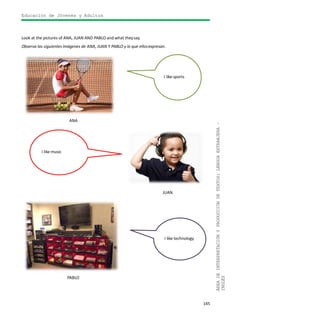
Look at the pictures of ANA, JUAN AND PABLO and what theysay.
Observa las siguientes imágenes de ANA, JUAN Y PABLO y lo que ellosexpresan.
ANA
JUAN
PABLO
I like music
I like technology
I like sports
146
ÁREADEINTERPRETACIÓNYPRODUCCIÓNDETEXTOS:LENGUAEXTRANJERA–
INGLÉS
Track 6
https://www.youtube.com/watch?v
=TISCHW4nSbU&index=6&list=PLCA
t1-
L8_Np8wEF_I30M4CWBRDWcakipH
Educación de Jóvenes y Adultos
Let’s work…
A trabajar…
Actividad 5.
a. LET´S READ ANDWRITE!
¡LEAMOS Y ESCRIBAMOS!
Read the vocabulary given.
Taking into account what Ana likes, Which favourite possessions do you think Ana has got?
Lee el vocabulario dado.
Teniendo en cuentalo lo que a Ana le gusta, ¿Qúe objetos favoritos crees que Anatiene?
............................................................................................................
............................................................................................................
............................................................................................................
b. LET´S READ AND LISTEN
¡LEAMOS Y ESCUCHEMOS!
What have theygot?
¿Qué tienen ellos?
Read and listen to Ana. She is telling us about her favourite possessions. Write the name (Ana) in the
right column.
Lee y escucha a Ana. Ella nos cuenta qué objetos favoritos tiene. Escribe el nombre (Ana) en la columna
correcta.
I have got three televisions I have got trainers I have got a guitar
I have got a mobilephone I have got a bicycle I have got a Hi-Fi system
I have got twolaptops I have got three balls I have got 100 CDs
I have got a USBpen I have got a tracksuit I have got a DVD
I have got a GPS I have got five caps I have got a DVDplayer
ÁREADEINTERPRETACIÓNYPRODUCCIÓNDETEXTOS:LENGUAEXTRANJERA–
INGLÉS
El verbo “have/has got” se usa para hablar de expresar una posesión (lo que poseo) Recordemos que el
verbo “have got” significa “tener”
Ejemplos:
I have got a house: Yo tengo una casa
You have got a car: Tú tienes un auto
She has got books: Ella tiene libros
Educación de Jóvenes y Adultos
Read the sentences of the previous chart again.
Lee las oraciones del cuadro anterior nuevamente.
¿Qué verbo utilizan para expresar lo que tienen / sus posesiones?
............................................................................................................
c. LET´S READ ANDWRITE!
¡LEAMOS YESCRIBAMOS!
Para realizar las siguientes actividades, observa el vocabulario, los ejemplos y aclaración. Si tus
posesiones/objetos favoritos no se encuentran en el vocabulario brindado busca el diccionario para
encontrarlos.
Write as many favourite possessions you have. Complete the sentences and add as many sentences as
you need.
Escribe tantos objetos favoritos como tengas. Completa las oraciones y agrega tantas oraciones como
necesites.
I have got ...........................................................................................
I have................................................................................................
I ....................................................................................................
I .....................................................................................................
......................................................................................................
......................................................................................................
......................................................................................................
147
Educación de Jóvenes y Adultos
148
ÁREADEINTERPRETACIÓNYPRODUCCIÓNDETEXTOS:LENGUAEXTRANJERA–
INGLÉS
d. LET´S SPEAK!
¡HABLEMOS!
Tell your English tutor about the favourite possessions you have
Contale al tutor/a de inglés acerca de los objetos favoritos quetengas.
e. LET´S READ AND WRITE!
¡LEAMOS Y ESCRIBAMOS!
Read about Ana, Juan and Pablo´s possessions in the activity B and answer the following questions.
Lee acerca de la posesiones de Ana, Juan y Pablo en la actividad B y responde las siguientes preguntas.
Ejemplo:
How many televisions has Juan got? = ¿Cuántos televisores tiene Juan ?
Juan has got three televisions
How many laptops has Pablo got?
............................................................................................................
How many balls has Ana got?
............................................................................................................
Has Ana got a bicycle?
............................................................................................................
How many caps has Ana got?
............................................................................................................
Has Juan got a guitar?
............................................................................................................
How many CDs has Juan got?
............................................................................................................
149
ÁREADEINTERPRETACIÓNYPRODUCCIÓNDETEXTOS:LENGUAEXTRANJERA–
INGLÉS
Track 7
https://www.youtube.com/watch?v
=v8r8_y79cAY&list=PLCAt1-
L8_Np8wEF_I30M4CWBRDWcakipH
&index=7
Educación de Jóvenes y Adultos
I CAN SPEAK ENGLISH!
¡PUEDO HABLAR INGLÉS!
Todos poseemos capacidades para realizar algo bien, muy bien o extraordinariamente bien. En el
siguiente diálogo podemos observar cómo preguntar, responder y afirmar si alguien tiene la capacidad
de hacer algo en particular.
Let’s work…
A trabajar…
Actividad 6.
CONVERSATION
a. LETS´S READ AND LISTEN
¡LEAMOS Y ESCUCHEMOS!
Read and listen to thefollowing.
Lee y escucha el siguiente diálogo.
A What can Tevez do?
B He can play football
A. Can he play football well?
B. Yes, he can
B Can he play basketball?
A No, he can’t.
Read the dialogue again and answer the following question:
Lee el diálogo nuevamente y responde la siguiente pregunta:
Que verbo se utilizó para expresar habilidad/ indicar que alguien sabe/puede hacer algo?
............................................................................................................
150
ÁREADEINTERPRETACIÓNYPRODUCCIÓNDETEXTOS:LENGUAEXTRANJERA–
INGLÉS
Educación de Jóvenes y Adultos
A continuación, veremos ejemplos de profesionales.
Look at the following pictures. What can they do?
Observa las siguientes imágenes. ¿Qué pueden/son capaces de hacer?
A fireman can put out fires (un bombero puede
apagar fuegos)
A mechanic can repair motor vehicles (un mecánico
puede reparar el motor de vehículos )
An artist can draw (un artista puedepintar)
Educación de Jóvenes y Adultos
151
ÁREADEINTERPRETACIÓNYPRODUCCIÓNDETEXTOS:LENGUAEXTRANJERA–
INGLÉS
A car race driver can drive fast (un corredor de
autos puede manejar rápido)
He can play the guitar (él puede tocar la
guitarra)
Para expresar, preguntar y responder sobre lo que podemos hacer o lo que otras personas
pueden hacer necesitamos ampliar nuestrovocabulario.
Well: bien
ÁREADEINTERPRETACIÓNYPRODUCCIÓNDETEXTOS:LENGUAEXTRANJERA–
INGLÉS
Track 8
Educación de Jóvenes y Adultos
b. LETS´S READ AND LISTEN
¡LEAMOS Y ESCUCHEMOS!
Read and listen to the following list of abilities.
Lee y escucha la siguiente lista de habilidades.
Indiscutiblemente somos talentosos y capaces de realizar las actividades mencionadas y muchas
más pero es probable que algunas de ellas NO.
152
ABILITIES: habilidades
Draw: Dibujar
Cook: Cocinar
Play a sport: Jugar un deporte
Play a musical instrument: Tocar un instrumento musical
Use a computer: Usar unacomputadora
Sing: Cantar
Speak another language: Hablar otro idioma
Drive: Manejar
Dance:Bailar
Swim:Nadar
Play cards: Jugar a las cartas
Ride a bike: Andar en bicicleta
Ride a horse: Andar a caballo
Ride a motorcycle: Andar en moto
Run fast: Correr rápido
Fish: Pescar
Tell good jokes: Contar Buenos chistes
https://www.youtube.com/watch?v=t
8veX4VlUHY&index=8&list=PLCAt1-
L8_Np8wEF_I30M4CWBRDWcakipH
153
ÁREADEINTERPRETACIÓNYPRODUCCIÓNDETEXTOS:LENGUAEXTRANJERA–
INGLÉS
Educación de Jóvenes y Adultos
Look at the following images. Can they do the following activities?
Observa las siguientes imágenes. ¿Pueden ellos realizar las siguientes actividades?
He can´t swim.
(no puede/sabenadar)
She can´t ride a bike
(no puede/sabe andar enbicicleta)
Look at the sentences again
Mira las dos oraciones nuevamente.
¿Qué verbo se usa para indicar que no sabemos hacer algo?
............................................................................................................
Educación de Jóvenes y Adultos
154
ÁREADEINTERPRETACIÓNYPRODUCCIÓNDETEXTOS:LENGUAEXTRANJERA–
INGLÉS
I can play football = Puedo/Se jugar tenis
I can´t play football = No puedo /Se jugar tenis
“Can” indica habilidades y significa “poder” “saber” (ser capaz de algo)
“Can´t” es la forma reducida de “cannot” significa “no poder”
“Can” siempre va seguido de un verbo
En las oraciones afirmativas primero va el SUJETO+CAN+VERBO
En las oraciones negativas primero va el SUJETO+ CANNOT (CAN´T)+VERBO
Aprender la estructura del verbo modal “can” es muy fácil ya que lo uso con todos los sujetos sin tener
que agregarle “s” con los sujetos “he”, “she”“It”
I can speak English.
She can speakEnglish
Para realizar las siguiente actividades debemos mirar nuevamente el listado de habilidades, los
ejemplos y aclaraciones de como usar “can” de la maneracorrecta.
c. LET´S READ AND WRITE!
¡LEAMOS Y ESCRIBAMOS!
Read again the list of abilities and mark with X those abilities you possess. Then, write them down. For
example, I can play football.
Lee nuevamente el listado de habilidades y marca con X aquellas habilidades que poseas. Luego,
escríbelas. Por ejemplo, I can play football
............................................................................................................
............................................................................................................
............................................................................................................
............................................................................................................
............................................................................................................
Educación de Jóvenes y Adultos
155
ÁREADEINTERPRETACIÓNYPRODUCCIÓNDETEXTOS:LENGUAEXTRANJERA–
INGLÉS
¡Una ayudita!
Si algunas de ellas no se
encuentra en el listado
dado, búscala en el
diccionario.
d. LET´SSPEAK!
¡HABLEMOS!
Tell your English tutor and/or English partners about your abilities.
Contale al tutor/a de inglés y/o a tus compañeros de inglés acerca de tus
habilidades.
e. LET´S WRITE!
¡ESCRIBAMOS!
Write those things you can´t do
Escribe aquellas cosas que no puedas/sepashacer.
Ejemplo
I can’t dance
......................................................................................................
......................................................................................................
......................................................................................................
......................................................................................................
f. LET´S SPEAK!
¡HABLEMOS!
Tell your English tutor and/or English partners about things you can´t do.
Contale al tutor/a de inglés y/o a tus compañeros de inglés acerca de las cosas que no puedes/sabes
hacer.
Hasta ahora, hemos visto lo que podemos hacer y lo que no podemos hacer por separado. Sin
embargo, podemos expresar lo que podemos y no hacer en una misma oración. Ahora bien, ¿Cómo
expresamos este contraste?
156
ÁREADEINTERPRETACIÓNYPRODUCCIÓNDETEXTOS:LENGUAEXTRANJERA–
INGLÉS
Educación de Jóvenes y Adultos
Look at the following sentences and answer the following question: Which word is used to express
contrast?
Observa las siguientes oraciones y responde la siguiente pregunta: ¿Qué palabra se usa para expresar
contraste?
......................................................................................................
I can speak English but I can´t speakItalian.
I can´t speak Italian but I can speakEnglish.
g. LET´S READ AND WRITE!
¡LEAMOS Y ESCRIBAMOS!
Read about Susana. Tick (✔) what she can do and cross (✘) what she can’tdo.
Lee acerca de Susana. Haces un tilde (✔) en lo que ella puede hacer y haces una cruz(✘) en lo que ella
no pueda.
Hi! I’m Susana. What can I
do? I can speak English and
I can play the piano, but I
can’t play the guitar. I can’t
sing but I can dance. I
can’t swim but I can ride a horse.
Educación de Jóvenes y Adultos
157
ÁREADEINTERPRETACIÓNYPRODUCCIÓNDETEXTOS:LENGUAEXTRANJERA–
INGLÉS
Susan You
Speak English
Playthe piano
Playthe guitar
Dance
Sing
Swim
Ridea horse
Now tick (✔) what you can do and cross (✘) what you can’tdo.
Ahora, haces un tilde (✔) en lo que puedas hacer y haces una cruz(✘) en lo que no puedas.
Write sentences about what you can or can’t do.
For example:
I can play the piano but I can’t play the guitar
Escribe oraciones acerca de lo que puedas y no puedas hacer.
Por ejemplo:
I can play the piano but I can’t play the guitar
............................................................................................................
............................................................................................................
............................................................................................................
............................................................................................................
............................................................................................................
Educación de Jóvenes y Adultos
158
ÁREADEINTERPRETACIÓNYPRODUCCIÓNDETEXTOS:LENGUAEXTRANJERA–
INGLÉS
CAN YOU…?
¿PUEDES…?
Let’s work…
A trabajar…
Actividad 7.
a. LET´S READ ANDWRITE!
¡LEAMOS Y ESCRIBAMOS!
Si volvemos a leer el diálogo de la página , podemos observar cómo preguntar y responder si
alguien tiene la capacidad para hacer algo en particular.
A What can Tevezdo?
B He can play football
A Can he play footballwell?
B Yes, hecan
A Can he playbasketball?
B No, he can’t
Look at the questions.
Observa las preguntas .
¿Qué lugar ocupa el vebo modal “can” en las preguntas? ¿Va detrás o después delsujeto?
............................................................................................................
Look at the answers.
Observa las respuestas.
¿ En las respuestas cortas se repite el verbo que expresa habilidad?
............................................................................................................
Educación de Jóvenes y Adultos
159
ÁREADEINTERPRETACIÓNYPRODUCCIÓNDETEXTOS:LENGUAEXTRANJERA–
INGLÉS
Can you play football ?= ¿Puedes/Sabes jugar fútbol?
Yes, I can = Sí, yo puedo
No, I can´t = No, no puedo
Can she sing?= ¿Puede/Sabe ellacantar?
Yes, she can = Sí, ella puede
No, she can´t = No, no puede
En las preguntas se invierte el orden de las oracionesafirmativas:
Primero va “can” luego el sujeto
En las respuestas cortas:
Yes/ No van seguido por el pronombre (I, he, she, it, they) que hace referencia al sujeto de la pregunta +
“can” (si es afirmativo) o “can´t” (si es negativo)
Para realizar las siguientes actividades debemos mirar nuevamente el listado de habilidades, el
diálogo y aclaración.
b. LET´S READ AND WRITE!
¡LEAMOS Y ESCRIBAMOS!
Circle the correct answers.
Encierra en un círculo a la opción correcta
Javier: Can/Can´t youdance?
José: No, I can/ can´t.
Javier: Can/can´t you play theguitar?
José: No, I can/can´t.
Javier: So, what can/can´t you do?
José: I can play the piano very well. Listen!
160
ÁREADEINTERPRETACIÓNYPRODUCCIÓNDETEXTOS:LENGUAEXTRANJERA–
INGLÉS
Educación de Jóvenes y Adultos
c. LET´S READ AND WRITE!
¡LEAMOS Y ESCRIBAMOS!
Complete the following dialogues.
Completa los siguiente diálogos.
A Can you sing?
B Yes, I ……………………………
A Can you dance?
B No, I ……………………………
A ………………….. he drive acar?
B Yes, he can
A Can she tell good jokes?
B Yes,……………………………….
A. What …………….they do?
B. They …………….. swim very well.
161
ÁREADEINTERPRETACIÓNYPRODUCCIÓNDETEXTOS:LENGUAEXTRANJERA–
INGLÉS
Educación de Jóvenes y Adultos
d. LET´S READ AND WRITE!
¡LEAMOS Y ESCRIBAMOS!
Read the e-mail and answer the following questions.
Lee el e-mail y responde las siguientes preguntas.
Can Ezequiel speak English?
............................................................................................................
Can he play the violin?
............................................................................................................
Can he play football?
............................................................................................................
Can he play tennis?
............................................................................................................
To: pierre@friends.fr
From: ezequiel@and.cba.ar
Subject:Contact
Dear Pierre,
Hello! My name is Ezequiel Rodriguez. I´m from Córdoba, Argentina. I can speak Spanish, English
and a little French. Can you speak Spanish? I can teach you somewords!
I love music. I can play the guitar and the violin. I can also play the piano and sing, but not very
well. Can you play anyinstruments?
I also like sports. I can play football and basketball, but I can´t play tennis. Can you play tennis?
Please write soon! I´m waiting for your first e-mail.
Your friend, Ezequiel
A little: unpoco
Teach: enseñar
Also: también
Soon: pronto
Waiting: esperando
162
ÁREADEINTERPRETACIÓNYPRODUCCIÓNDETEXTOS:LENGUAEXTRANJERA–
INGLÉS
Educación de Jóvenes y Adultos
e. LET´S READ AND WRITE!
¡LEAMOS Y ESCRIBAMOS!
Tomemos como modelo el e-mail de Ezequiel a Pierre y escribamos un e-mail para Ezequiel.
Aseguremosnos de responderle las preguntas. Utilicemos CAN, CAN´T y formulemos preguntas.
To:ezequiel@and.cba.ar
From: ...............................................................................
Subject:Contact
Dear Ezequiel,
............................................................................................................
............................................................................................................
............................................................................................................
............................................................................................................
............................................................................................................
............................................................................................................
............................................................................................................
............................................................................................................
Yourfriend
Educación de Jóvenes y Adultos
163
ÁREADEINTERPRETACIÓNYPRODUCCIÓNDETEXTOS:LENGUAEXTRANJERA–
INGLÉS
RESPUESTAS A LAS ACTIVIDADES
Actividad 1.a
Nora is Daniel´s wife
Daniel is Nora´s husband
Ivan is Daniel and Nora´s son
Mili is Daniel and Nora´s daughter
Ivan is Mili´s brother
Mili is Ivan´s sister
Actividad 1. b
Daughter son
Aunt uncle
Wife husband
Cousin cousin
Mother father
Niece nephew
Actividad 2 b
Have got y has got
Haven´t got y hasn´tgot
Actividad 2 d
Sí
El sujeto/ lapersona
No
164
ÁREADEINTERPRETACIÓNYPRODUCCIÓNDETEXTOS:LENGUAEXTRANJERA–
INGLÉS
Educación de Jóvenes y Adultos
Actividad 3 a
Pepe has got a daughter.
Pepe hasn´t got two daughters.
Moni has got a husband.
Moni has got a son.
Moni hasn´t got two sons.
Paola and Coki have gotparents.
Paola has got a brother.
Paola hasn´t got twobrothers.
Coki has got a sister.
Coki hasn´t got threesisters.
Actividad 3 d
No, he hasn´t
Yes, she has
Yes, theyhave
No, They haven´t
Actividad 3. e
Juan has got parents True False
Juan has got two aunts True False
Juan has got five uncles True False
Juan hasn’t got cousins True False
Actividad 3. f
Mother – son- sister-brother
Actividad 4
Cuántos
165
ÁREADEINTERPRETACIÓNYPRODUCCIÓNDETEXTOS:LENGUAEXTRANJERA–
INGLÉS
Educación de Jóvenes y Adultos
Actividad 4 b
They have got two children
Paola has got one brother
Coki has got onesister
Yes, he has
No, shehasn´t
Actividad 4 c
How many sisters has she got? Two sisters three sisters
How many brothers has she got? One brother two brothers
How many cousins has she got? Five cousins seven cousins
Actividad 5 a
Ana has got a Bicycle, Skates, a Ball, a Tracksuit, a Cap , trainers andsunglasses
Actividad 5 b
ANA
I have got three televisions I have got trainers I have got a guitar
I have got a mobile phone I have got a bicycle I have got a Hi-Fi system
I have got two laptops I have got three balls I have got 100 CDs
I have got a USB pen I have got a tracksuit I have got a DVD
I have got a GPS I have got five caps I have got a DVD player
Have got
166
ÁREADEINTERPRETACIÓNYPRODUCCIÓNDETEXTOS:LENGUAEXTRANJERA–
INGLÉS
Educación de Jóvenes y Adultos
Actividad 5 e
He has got two laptops
She has got three balls
Yes, she has
She has got five caps
Yes, he has
He has gt 100 CDs
Actividad 6. a
Can
Actividad 6. B
Can´t
Actividad 6. f
but
Actividad 6. g
Susan You
Speak English X
Playthe piano X
Playthe guitar
Dance X
Sing
Swim
Ridea horse X
167
ÁREADEINTERPRETACIÓNYPRODUCCIÓNDETEXTOS:LENGUAEXTRANJERA–
INGLÉS
Educación de Jóvenes y Adultos
Actividad 7.a
Detrás delsujeto
sí
Actividad 7. b
Can´t
Can
Can´t
Can
Can
Actividad 7. c
Can
Can´t
Can
Shecan
Can
Can
Actividad 7.d
Yes, hecan
Yes, hecan
Yes, he can
No, hecan´t
Educación de Jóvenes y Adultos
168
ÁREADEINTERPRETACIÓNYPRODUCCIÓNDETEXTOS:LENGUAEXTRANJERA–
INGLÉS
TRABAJO PRÁCTICO INTEGRADOR
a. LET´S WRITE AND SPEAK!
¡ESCRIBAMOS Y HABLEMOS!
Look at pictures. Describe what they can do. Then, tell your English tutor.
Observa las imágenes. Describe lo que las personas pueden hacer. Luego, cuentale al tutor/a de inglés.
Andrés ………………………………………
Pablo………………………………………
Analía ………………………………………
Actividad1
Educación de Jóvenes y Adultos
169
ÁREADEINTERPRETACIÓNYPRODUCCIÓNDETEXTOS:LENGUAEXTRANJERA–
INGLÉS
José ………………………………………
Julio ………………………………………
b. LET´S READ AND WRITE!
¡LEAMOS Y ESCRIBAMOS!
Look at the pictures again and answer the following questions.
Observa las imágenes nuevamente y responde las siguientespreguntas.
Can Andrés play the guitar?
............................................................................................................
Can Analía dance?
............................................................................................................
What can Julio do?
............................................................................................................
170
ÁREADEINTERPRETACIÓNYPRODUCCIÓNDETEXTOS:LENGUAEXTRANJERA–
INGLÉS
Educación de Jóvenes y Adultos
c. LET´S READ AND WRITE!
¡LEAMOS Y ESCRIBAMOS!
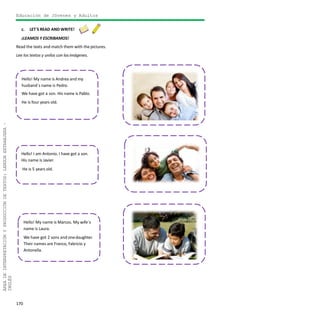
Read the texts and match them with the pictures.
Lee los textos y unilos con lasimágenes.
Hello! I am Antonio. I have got a son.
His name is Javier.
He is 5 years old.
Hello! My name is Marcos. My wife´s
name is Laura.
We have got 2 sons and onedaughter.
Their names are Franco, Fabricio y
Antonella.
Hello! My name is Andrea and my
husband´s name is Pedro.
We have got a son. His name is Pablo.
He is four years old.
171
ÁREADEINTERPRETACIÓNYPRODUCCIÓNDETEXTOS:LENGUAEXTRANJERA–
INGLÉS
Andrea Pedro
Roxana Sergio
Sabrina Milagros
Educación de Jóvenes y Adultos
d. LET´S READ AND WRITE!
¡LEAMOS Y ESCRIBAMOS!
Look at the family tree and describe it. For example, Andrea has got a husband.
Observa el árbol familiar de Andrea y decribelo. Por ejemplo: Andrea has got a husband.
............................................................................................................
............................................................................................................
............................................................................................................
............................................................................................................
............................................................................................................
............................................................................................................
............................................................................................................
............................................................................................................
............................................................................................................
............................................................................................................
172
ÁREADEINTERPRETACIÓNYPRODUCCIÓNDETEXTOS:LENGUAEXTRANJERA–
INGLÉS
Track 9
https://www.youtube.com/watch?v
=t8B_bZFpIf4&list=PLCAt1-
L8_Np8wEF_I30M4CWBRDWcakipH
&index=9
Educación de Jóvenes y Adultos
e. LETS´S READ AND LISTEN
¡LEAMOS Y ESCUCHEMOS!
Underline the favourite possessions Maria
mentions.
Subraya los objetos favoritos que María
menciona.
Television MP3 player Laptop
Cap Posters Trainers
Movile phone
IVANA
f. LET´S READ AND WRITE!
¡LEAMOS Y ESCRIBAMOS!
Read the text and complete Ivana´s family tree.
Lee el texto y completa el árbol familiar de Ivana.
My name is Ivana. I am from Sarmiento, Córdoba. I live with my family. I have got a mother and
a father. My father´s name is Alberto and my mother´s name is Teresa. I have got two brothers,
Julio and Armando. Julio has got a son. His name is Franco.
Educación de Jóvenes y Adultos
173
ÁREADEINTERPRETACIÓNYPRODUCCIÓNDETEXTOS:LENGUAEXTRANJERA–
INGLÉS
BIBLIOGRAFÍA
- Greenall, Simon: Reward Starter, Heinemann, English Language Teaching,1997
- Murphy, Raymond: Essential grammar in use, Cambridge University Press,1990
-Liz and John Soars: New Headway, fourth edition, elementary student´s book Oxford University
Press, 2011.
-Clive Oxenden, Christina Latham-Koenig, and Paul Seligson: English File, third edition, elementary
student´s book, Oxford University Press, 2013.
EducacióndeJóvenesyAdultos
174
ÁREA DE INTERPRETACIÓN Y PRODUCCIÓN DE TEXTOS: LENGUA EXTRANJERA –
INGLÉS

Módulo 3 de Inglés

  • 1.
    Programa de Educacióna Distancia Secundario de jóvenes y Adultos Área de Interpretación y Producción de Textos: Lengua Extranjera Inglés
  • 3.
    129 ÁREADEINTERPRETACIÓNYPRODUCCIÓNDETEXTOS:LENGUAEXTRANJERA– INGLÉS Educación de Jóvenesy Adultos En este capítulo de inglés, por un lado, reciclaremos todo lo aprendido en el módulo 1 y 2, particularmente, continuaremos trabajando con los pronombres personales,adjetivos posesivos y miembros de la familia. Por otra parte, aprenderemos a:  Describir y responder acerca de nuestra familia y posesiones y las familias y posesiones de otras personas.  Expresar y responder lo que somos o no capaces dehacer.  Preguntar y describir lo que otros saben hacer. Para lograr esto, revisaremos y veremos nuevo vocabulario:  Miembros de la familia.  Objetos personales.  Verbos que expresan habilidades. Del mismo modo, trabajaremos con el verbo “have got” (tener) para indicar posesión y el verbo modal “can” para expresar habilidades. ¿ Empezamos?
  • 4.
    130 ÁREADEINTERPRETACIÓNYPRODUCCIÓNDETEXTOS:LENGUAEXTRANJERA– INGLÉS Educación de Jóvenesy Adultos FAMILY MEMBERS! ¡MIEMBROS DE LA FAMILIA! En el módulo 1 trabajamos con los miembros de familia. ¿Veamos si los recordamos a todos? Let’s work… A trabajar… Actividad 1. a. LET´S READ AND WRITE! ¡LEAMOS Y ESCRIBAMOS! Nora - Daniel Ivan Mili Look at the family tree and box and complete the sentences. Mira el árbol familiar y el recuadro y completa lasoraciones. Nora is Daniel´s ........................................................................................... Daniel is Nora´s ........................................................................................... Ivan is Daniel and Nora´s.................................................................................. Mili is Daniel and Nora´s .................................................................................. Ivan is Mili´s ............................................................................................... Mili is Ivan´s ............................................................................................... son brother Husband daughter wife sister
  • 5.
    131 ÁREADEINTERPRETACIÓNYPRODUCCIÓNDETEXTOS:LENGUAEXTRANJERA– INGLÉSAula virtual: Encontraremosmás actividades para practicar los miembros de la familia. Educación de Jóvenes y Adultos b. LET´S READ AND WRITE! ¡LEAMOS Y ESCRIBAMOS! Write down the opposite. Escribe el opuesto. Daughter ................................................................................................. Aunt ...................................................................................................... Wife ...................................................................................................... Cousin .................................................................................................... Mother ................................................................................................... Niece ...................................................................................................... ¿Los leímos? No eran tantos,¿no? Recordarlos es necesario para poder avanzar ya que aprenderemos a describir nuestra familia y la de otros. ¿Continuamos? nephew father uncle cousin husband son
  • 6.
    Educación de Jóvenesy Adultos 132 ÁREADEINTERPRETACIÓNYPRODUCCIÓNDETEXTOS:LENGUAEXTRANJERA– INGLÉS Track 1 https://www.youtube.com/watch?v= E6qJgLa83dk&index=1&list=PLCAt1- L8_Np8wEF_I30M4CWBRDWcakipH I HAVE GOT A BIG FAMILY! ¡TENGO UNA FAMILIA GRANDE! Unos de los objetivos de este material es que seamos capaces de interpretar y producir textos donde describamos y respondamos acerca de nuestras familias y las familias de otras personas. Para ello, ya revisamos los miembros de la familia. Ahora, veremos cómo y cuándo usar el verbo “have got” tener. Todo ésto no ayudará a alcanzar nuestroobjetivo. Let’s work… A trabajar… Actividad 2. a. LET´S READ AND LISTEN ¡LEAMOS Y ESCUCHEMOS! Read and listen to Andrea. She is describing herfamily. Lee y escucha Andrea. Ella está describiendo su familia. b. LET´S READ ANDWRITE! ¡LEAMOS Y ESCRIBAMOS! Look at Andrea´s family description carefully. Observa detenidamente la descripción de Andrea. ¿Qué verbos utiliza para indicar posesión? ............................................................................................................ ¿Cuáles son las formas negativas de esos verbos? ............................................................................................................ Hello! This is my family. I have got a mother and two sisters, my mother´s name is Juana and my sisters´ names are Catalina and Valentina. Catalina is single but Valenitna is married. Valentina has got a daughter but she hasn’t got a son. So, I have got a niece but I haven’t got anephew. This: esta But: pero So: entonces
  • 7.
    Educación de Jóvenesy Adultos 133 ÁREADEINTERPRETACIÓNYPRODUCCIÓNDETEXTOS:LENGUAEXTRANJERA– INGLÉS HAVE GOT y HAS GOT se usan para expresar posesión (lo quetengo) Significan “tener” La diferencia entre uno y otro es que: Have got se usa con I, YOU, WE,THEY Has gotse usa con HE, SHE, IT Ejemplos: I have got a mother = Yo tengo mamá You have got a brother= Tú tienes un hermano She has got a daughter= Ella tiene una hija La forma negativa de have got es have not got = haven´t got La forma negativa de has got es has not got = hasn´tgot En las oraciones afirmativas primero va el SUJETO+HAVE/HAS GOT+ MIEMBRO DE LAFAMILIA. Ejemplo: I have got a daughter She has got a son En las oraciones negativas también va primero el SUJETO+ HAVEN´T/ HASN´T GOT+ MIEMBRO DE LA FAMILIA: Ejemplo: I haven´t got a son She hasn´t got a daughter. ¿Nos quedó claro que verbo usar para describir nuestra familia o la familia de otros? Ahora, veremos cómo preguntar y responder acerca de nuestra familia y la familia de otros.
  • 8.
    Educación de Jóvenesy Adultos 134 ÁREADEINTERPRETACIÓNYPRODUCCIÓNDETEXTOS:LENGUAEXTRANJERA– INGLÉS Track 2 CONVERSATION c. LET´S READ AND LISTEN ¡LEAMOS Y ESCUCHEMOS! A Have you got a bigfamily? B Yes, Ihave A Have you gotsisters? B Yes, Ihave A Has your sister got a husband? https://www.youtube.com/watch?v =Wds4DqGI_Gg&list=PLCAt1- L8_Np8wEF_I30M4CWBRDWcakipH &index=2 B A Yes, she has Has your sister got children? B No, shehasn’t A Have your brothers got children? B Yes, theyhave d. LET´S READ AND WRITE! ¡LEAMOS Y ESCRIBAMOS! Read the dialogue again. Look at the questions carefully and circle “have got” and “has got” and underline the subjects. Then answer the questions. Lee el diálogo nuevamente. Observa detenidamente las preguntas y hace un circulo a “have got “y “has got” y subraya los sujetos. Luego, responde las preguntas. ¿ Have got y has got están separados en laspreguntas? ............................................................................................................ ¿Qué hay en el medio de have got y has got en laspreguntas? ............................................................................................................
  • 9.
    135 ÁREADEINTERPRETACIÓNYPRODUCCIÓNDETEXTOS:LENGUAEXTRANJERA– INGLÉS Yes, I haveNo, I haven’t Yes, youhave No, youhaven’t Yes, we have No, we haven’t Yes, theyhave No, they haven’t Yes, she has No, she hasn’t Yes, hehas No, hehasn’t Yes, ithas No, it hasn’t En las preguntas se invierte el orden de las oraciones afirmativas y se separa “got” de“have/has”: Primero va “HAVE/HAS” + SUJETO+ GOT+ MIEMBRO DE LA FAMILIA En las respuestas cortas: Yes/No van seguido por el pronombre (I,you, he, she, it, we, they) que hace referencia al sujeto de la pregunta + “have/has” (si es afirmativo) o “haven´t/ hasn´t” (si es negativo) Educación de Jóvenes y Adultos Now, Look at the short answers carefully. Ahora, observa detenidamente las respuestas cortas. ¿Se usa “got” en las respuestas? ............................................................................................................
  • 10.
    Educación de Jóvenesy Adultos 136 ÁREADEINTERPRETACIÓNYPRODUCCIÓNDETEXTOS:LENGUAEXTRANJERA– INGLÉS Para realizar las siguientes actividades debemos mirar el vocabulario de los miembros de la familia, los ejemplos y aclaraciones de cómo usar have/has got en oraciones afirmativas, negativas, preguntas y respuestas cortas. Primero, trabajaremos con una familia de la ficción para luego trabajar con la propia. Let’s work… A trabajar… Actividad 3. a. LET´S WRITE! ¡ESCRIBAMOS! Look at the picture of “Los Argento”. Complete the sentences. Observa la foto de “Los Argento”. Completa las oraciones. Ejemplos: Pepe….. has got awife……. Pepe……. hasn´t got two sons…. Pepe…………………………………
  • 11.
    137 ÁREADEINTERPRETACIÓNYPRODUCCIÓNDETEXTOS:LENGUAEXTRANJERA– INGLÉS Educación de Jóvenesy Adultos Pepe ………………………………. Two daughters. Moni ……………………………………… Moni……………………………………… Moni………………………………………… two sons. Paola and Coki…………………………………………. Paola………………………………………… Paola…………………………………………two brothers. Coki………………………………………….. Coki…………………………………………..three sisters. b. LET´S WRITE AND SPEAK! ¡ESCRIBAMOS Y HABLEMOS! Draw your family tree. Dibuja tu árbolfamiliar.
  • 12.
    138 ÁREADEINTERPRETACIÓNYPRODUCCIÓNDETEXTOS:LENGUAEXTRANJERA– INGLÉS Educación de Jóvenesy Adultos Write sentences describing it. Use the correct form of have got. Escribe oraciones describiéndolo. Usa la forma correcta de have got. Ejemplo: I have got a mother ............................................................................................................ ............................................................................................................ ............................................................................................................ ............................................................................................................ ............................................................................................................ ............................................................................................................ ............................................................................................................ c. NOW, DESCRIBE IT ORALLY TO YOUR ENGLISH TUTOR! AHORA, DESCRÍBELO ORALMENTE A TU TUTOR/A DE INGLÉS d. LET´S WRITE! ¡ESCRIBAMOS! Look at the picture of “Los Argento” again and answer the following questions Observa la imagen de “Los Argento” nuevamente y responde las siguientespreguntas Has Pepe got a wife? Ejemplo Yes, he has ....................................................................................... Has Pepe got two daughters? ............................................................................................................ Has Moni got a son? ............................................................................................................ Have Pepe and Moni got children? ............................................................................................................
  • 13.
    139 ÁREADEINTERPRETACIÓNYPRODUCCIÓNDETEXTOS:LENGUAEXTRANJERA– INGLÉS Educación de Jóvenesy Adultos Have Pepe and Moni got twosons? ............................................................................................................ e. LET´S READ AND WRITE! ¡LEAMOS Y ESCRIBAMOS! Read about Juan´s family. True or false? Underline the correct option Lee acerca de la familia de Juan. ¿Verdadero o falso? Subraya la opción correcta Juan has got parents True False Juan has got twoaunts True False Juan has got fiveuncles True False Juan hasn’t got cousins True False Juan and his family are from Córdoba, Argentina. Juan has got a beautiful family. He has got a mother and a father. His mother has got two sisters and three brothers. Juan´s father has got a brother but he hasn’t got any sisters. Juan has got ten cousins. He loves his family. Beautiful: hermoso/a
  • 14.
    140 ÁREADEINTERPRETACIÓNYPRODUCCIÓNDETEXTOS:LENGUAEXTRANJERA– INGLÉS Track 3 https://www.youtube.com/watch?v=A jtXjoRXgb8&index=3&list=PLCAt1- L8_Np8wEF_I30M4CWBRDWcakipH Educación deJóvenes y Adultos f. LET´S READ AND LISTEN ¡LEAMOS Y ESCUCHEMOS! Listen to Julio talking about his family. Underline the family members he mentions Escucha a Julio hablando acerca de su familia. Subraya los miembros de familia que él menciona. Mother father stepmother stepfather son daughter sister brother cousins
  • 15.
    141 ÁREADEINTERPRETACIÓNYPRODUCCIÓNDETEXTOS:LENGUAEXTRANJERA– INGLÉS How many…? loempleas para preguntar acerca de sustantivos plurales contables y significa “cuantos…?” Esta pregunta la podemos responder con una cantidad precisa: 1 one, 2 two,3 three, one hundred, million, etc. Educación de Jóvenes y Adultos HOW MANY CHILDREN HAVE YOU GOT? ¿CUÁNTOS HIJOS TIENES? Read the question and its translation. Lee la pregunta del título y la traducción. ¿Qué significa “how many”? ............................................................................................................ Hasta ahora, hemos descripto nuestra familia y hemos preguntando acerca de otras familias pero no hemos preguntado acerca de la cantidad de miembros de familia que tenemos o tienen otros. Para poder hacer esta pregunta y responderla es necesario que sepamos algunas particularidades de cómo formar el plural de los miembros de la familia. En general, simplemente se agrega “s” al sustantivo. Porejemplo: Singular Plural Brother Brothers Daughter Daughters Sister Sisters
  • 16.
    Educación de Jóvenesy Adultos ÁREADEINTERPRETACIÓNYPRODUCCIÓNDETEXTOS:LENGUAEXTRANJERA– INGLÉS En otros casos el plural es irregular, es decir, no lo formamos agregando “s”. Por ejemplo: Singular Plural Child (hijo/a) Children(hijos/as) Woman (mujer) Women(mujeres) Man (hombre) Men(hombres) Person (persona) People (personas) ¿Hagamos algunas actividades para comprenderlo en su totalidad? Let’s work… A trabajar… Actividad 4. a. LET´S READ AND WRITE! ¡LEAMOS Y ESCRIBAMOS! Answer the following questions. If you answer “yes” to the first question, answer the second one,too. Responde las siguientes preguntas. Si respondes “sí” a la primer pregunta, responde también la segunda. Have you got anybrothers? ............................................................................................................ How many brothers have you got? ............................................................................................................ Have you got anysisters? ............................................................................................................ How many sisters have you got? ............................................................................................................ 142 Any: algún/na
  • 17.
    143 ÁREADEINTERPRETACIÓNYPRODUCCIÓNDETEXTOS:LENGUAEXTRANJERA– INGLÉS Track 4 https://www.youtube.com/watch?v =Uze-871- NfE&index=4&list=PLCAt1- L8_Np8wEF_I30M4CWBRDWcakipH Educación deJóvenes y Adultos Have you got anychildren? ............................................................................................................ How many children have you got? ............................................................................................................ b. LET´S READ AND WRITE! ¡LEAMOS Y ESCRIBAMOS! Look at the picture of “Los Argentos” again and answer the following questions. Observa nuevamente la foto de “Los Argento” y responde las siguientes preguntas. How many children have Pepe and Moni got? ............................................................................................................ How many brothers has Paola got? ............................................................................................................ How many sisters has Coki got? ............................................................................................................ Has Pepe got a wife? ............................................................................................................ Has Moni got three children? ............................................................................................................ c. LET´S READ AND LISTEN ¡LEAMOS Y ESCUCHEMOS! Listen to Eugenia talking about her family. Underline the correct option. Escucha a Eugenia hablando acerca de su familia. Subraya la opción correcta. How many sisters has she got? Two sisters three sisters How many brothers has she got? One brother two brothers How many cousins has she got? Five cousins seven cousins
  • 18.
    144 ÁREADEINTERPRETACIÓNYPRODUCCIÓNDETEXTOS:LENGUAEXTRANJERA– INGLÉS Track 5 https://www.youtube.com/watch?v =hcogQ- ssp0U&index=5&list=PLCAt1- L8_Np8wEF_I30M4CWBRDWcakipH Educación deJóvenes y Adultos PERSONAL POSSESSIONS OBJETOS PERSONALES Las cosas que poseemos dependen de nuestros gustos personales y preferencias. Por ejemplo, si nos gusta leer, tenemos libros en todos los rincones de la casa o si nos gusta la tecnología, tenemos el celular más moderno, tablets, etc. Veamos algo de vocabulario el cual nos ayudará a hablar/escribir acerca de los objetos favoritos que tenemos. LET´S READ AND LISTEN! ¡LEAMOS Y ESCUCHEMOS! PERSONAL POSSESSIONS Television: Televisión Bicycle: Bicicleta Mobile phone: Celular Skates: Patines Laptop: Notebook Ball: Pelota USB pen: Pendrive Tracksuit: Conjunto deportivo GPS: GPS Cap: Gorra Tablet: Tablet Sunglasses: Lentes de sol Camera: Cámara de fotos Headphones: Auriculares Trainers: Zapatillas Guitar: Guitarra CD: CD MP3 player: Reproductor deMP3 DVD:DVD Speakers: Parlantes DVD player: Reproductor de DVD Hi-Fi system: Equipo de música de alta fidelidad Poster of Singers: Pósters de cantantes
  • 19.
    Educación de Jóvenesy Adultos 145 ÁREADEINTERPRETACIÓNYPRODUCCIÓNDETEXTOS:LENGUAEXTRANJERA– INGLÉS Look at the pictures of ANA, JUAN AND PABLO and what theysay. Observa las siguientes imágenes de ANA, JUAN Y PABLO y lo que ellosexpresan. ANA JUAN PABLO I like music I like technology I like sports
  • 20.
    146 ÁREADEINTERPRETACIÓNYPRODUCCIÓNDETEXTOS:LENGUAEXTRANJERA– INGLÉS Track 6 https://www.youtube.com/watch?v =TISCHW4nSbU&index=6&list=PLCA t1- L8_Np8wEF_I30M4CWBRDWcakipH Educación deJóvenes y Adultos Let’s work… A trabajar… Actividad 5. a. LET´S READ ANDWRITE! ¡LEAMOS Y ESCRIBAMOS! Read the vocabulary given. Taking into account what Ana likes, Which favourite possessions do you think Ana has got? Lee el vocabulario dado. Teniendo en cuentalo lo que a Ana le gusta, ¿Qúe objetos favoritos crees que Anatiene? ............................................................................................................ ............................................................................................................ ............................................................................................................ b. LET´S READ AND LISTEN ¡LEAMOS Y ESCUCHEMOS! What have theygot? ¿Qué tienen ellos? Read and listen to Ana. She is telling us about her favourite possessions. Write the name (Ana) in the right column. Lee y escucha a Ana. Ella nos cuenta qué objetos favoritos tiene. Escribe el nombre (Ana) en la columna correcta. I have got three televisions I have got trainers I have got a guitar I have got a mobilephone I have got a bicycle I have got a Hi-Fi system I have got twolaptops I have got three balls I have got 100 CDs I have got a USBpen I have got a tracksuit I have got a DVD I have got a GPS I have got five caps I have got a DVDplayer
  • 21.
    ÁREADEINTERPRETACIÓNYPRODUCCIÓNDETEXTOS:LENGUAEXTRANJERA– INGLÉS El verbo “have/hasgot” se usa para hablar de expresar una posesión (lo que poseo) Recordemos que el verbo “have got” significa “tener” Ejemplos: I have got a house: Yo tengo una casa You have got a car: Tú tienes un auto She has got books: Ella tiene libros Educación de Jóvenes y Adultos Read the sentences of the previous chart again. Lee las oraciones del cuadro anterior nuevamente. ¿Qué verbo utilizan para expresar lo que tienen / sus posesiones? ............................................................................................................ c. LET´S READ ANDWRITE! ¡LEAMOS YESCRIBAMOS! Para realizar las siguientes actividades, observa el vocabulario, los ejemplos y aclaración. Si tus posesiones/objetos favoritos no se encuentran en el vocabulario brindado busca el diccionario para encontrarlos. Write as many favourite possessions you have. Complete the sentences and add as many sentences as you need. Escribe tantos objetos favoritos como tengas. Completa las oraciones y agrega tantas oraciones como necesites. I have got ........................................................................................... I have................................................................................................ I .................................................................................................... I ..................................................................................................... ...................................................................................................... ...................................................................................................... ...................................................................................................... 147
  • 22.
    Educación de Jóvenesy Adultos 148 ÁREADEINTERPRETACIÓNYPRODUCCIÓNDETEXTOS:LENGUAEXTRANJERA– INGLÉS d. LET´S SPEAK! ¡HABLEMOS! Tell your English tutor about the favourite possessions you have Contale al tutor/a de inglés acerca de los objetos favoritos quetengas. e. LET´S READ AND WRITE! ¡LEAMOS Y ESCRIBAMOS! Read about Ana, Juan and Pablo´s possessions in the activity B and answer the following questions. Lee acerca de la posesiones de Ana, Juan y Pablo en la actividad B y responde las siguientes preguntas. Ejemplo: How many televisions has Juan got? = ¿Cuántos televisores tiene Juan ? Juan has got three televisions How many laptops has Pablo got? ............................................................................................................ How many balls has Ana got? ............................................................................................................ Has Ana got a bicycle? ............................................................................................................ How many caps has Ana got? ............................................................................................................ Has Juan got a guitar? ............................................................................................................ How many CDs has Juan got? ............................................................................................................
  • 23.
    149 ÁREADEINTERPRETACIÓNYPRODUCCIÓNDETEXTOS:LENGUAEXTRANJERA– INGLÉS Track 7 https://www.youtube.com/watch?v =v8r8_y79cAY&list=PLCAt1- L8_Np8wEF_I30M4CWBRDWcakipH &index=7 Educación deJóvenes y Adultos I CAN SPEAK ENGLISH! ¡PUEDO HABLAR INGLÉS! Todos poseemos capacidades para realizar algo bien, muy bien o extraordinariamente bien. En el siguiente diálogo podemos observar cómo preguntar, responder y afirmar si alguien tiene la capacidad de hacer algo en particular. Let’s work… A trabajar… Actividad 6. CONVERSATION a. LETS´S READ AND LISTEN ¡LEAMOS Y ESCUCHEMOS! Read and listen to thefollowing. Lee y escucha el siguiente diálogo. A What can Tevez do? B He can play football A. Can he play football well? B. Yes, he can B Can he play basketball? A No, he can’t. Read the dialogue again and answer the following question: Lee el diálogo nuevamente y responde la siguiente pregunta: Que verbo se utilizó para expresar habilidad/ indicar que alguien sabe/puede hacer algo? ............................................................................................................
  • 24.
    150 ÁREADEINTERPRETACIÓNYPRODUCCIÓNDETEXTOS:LENGUAEXTRANJERA– INGLÉS Educación de Jóvenesy Adultos A continuación, veremos ejemplos de profesionales. Look at the following pictures. What can they do? Observa las siguientes imágenes. ¿Qué pueden/son capaces de hacer? A fireman can put out fires (un bombero puede apagar fuegos) A mechanic can repair motor vehicles (un mecánico puede reparar el motor de vehículos ) An artist can draw (un artista puedepintar)
  • 25.
    Educación de Jóvenesy Adultos 151 ÁREADEINTERPRETACIÓNYPRODUCCIÓNDETEXTOS:LENGUAEXTRANJERA– INGLÉS A car race driver can drive fast (un corredor de autos puede manejar rápido) He can play the guitar (él puede tocar la guitarra) Para expresar, preguntar y responder sobre lo que podemos hacer o lo que otras personas pueden hacer necesitamos ampliar nuestrovocabulario. Well: bien
  • 26.
    ÁREADEINTERPRETACIÓNYPRODUCCIÓNDETEXTOS:LENGUAEXTRANJERA– INGLÉS Track 8 Educación deJóvenes y Adultos b. LETS´S READ AND LISTEN ¡LEAMOS Y ESCUCHEMOS! Read and listen to the following list of abilities. Lee y escucha la siguiente lista de habilidades. Indiscutiblemente somos talentosos y capaces de realizar las actividades mencionadas y muchas más pero es probable que algunas de ellas NO. 152 ABILITIES: habilidades Draw: Dibujar Cook: Cocinar Play a sport: Jugar un deporte Play a musical instrument: Tocar un instrumento musical Use a computer: Usar unacomputadora Sing: Cantar Speak another language: Hablar otro idioma Drive: Manejar Dance:Bailar Swim:Nadar Play cards: Jugar a las cartas Ride a bike: Andar en bicicleta Ride a horse: Andar a caballo Ride a motorcycle: Andar en moto Run fast: Correr rápido Fish: Pescar Tell good jokes: Contar Buenos chistes https://www.youtube.com/watch?v=t 8veX4VlUHY&index=8&list=PLCAt1- L8_Np8wEF_I30M4CWBRDWcakipH
  • 27.
    153 ÁREADEINTERPRETACIÓNYPRODUCCIÓNDETEXTOS:LENGUAEXTRANJERA– INGLÉS Educación de Jóvenesy Adultos Look at the following images. Can they do the following activities? Observa las siguientes imágenes. ¿Pueden ellos realizar las siguientes actividades? He can´t swim. (no puede/sabenadar) She can´t ride a bike (no puede/sabe andar enbicicleta) Look at the sentences again Mira las dos oraciones nuevamente. ¿Qué verbo se usa para indicar que no sabemos hacer algo? ............................................................................................................
  • 28.
    Educación de Jóvenesy Adultos 154 ÁREADEINTERPRETACIÓNYPRODUCCIÓNDETEXTOS:LENGUAEXTRANJERA– INGLÉS I can play football = Puedo/Se jugar tenis I can´t play football = No puedo /Se jugar tenis “Can” indica habilidades y significa “poder” “saber” (ser capaz de algo) “Can´t” es la forma reducida de “cannot” significa “no poder” “Can” siempre va seguido de un verbo En las oraciones afirmativas primero va el SUJETO+CAN+VERBO En las oraciones negativas primero va el SUJETO+ CANNOT (CAN´T)+VERBO Aprender la estructura del verbo modal “can” es muy fácil ya que lo uso con todos los sujetos sin tener que agregarle “s” con los sujetos “he”, “she”“It” I can speak English. She can speakEnglish Para realizar las siguiente actividades debemos mirar nuevamente el listado de habilidades, los ejemplos y aclaraciones de como usar “can” de la maneracorrecta. c. LET´S READ AND WRITE! ¡LEAMOS Y ESCRIBAMOS! Read again the list of abilities and mark with X those abilities you possess. Then, write them down. For example, I can play football. Lee nuevamente el listado de habilidades y marca con X aquellas habilidades que poseas. Luego, escríbelas. Por ejemplo, I can play football ............................................................................................................ ............................................................................................................ ............................................................................................................ ............................................................................................................ ............................................................................................................
  • 29.
    Educación de Jóvenesy Adultos 155 ÁREADEINTERPRETACIÓNYPRODUCCIÓNDETEXTOS:LENGUAEXTRANJERA– INGLÉS ¡Una ayudita! Si algunas de ellas no se encuentra en el listado dado, búscala en el diccionario. d. LET´SSPEAK! ¡HABLEMOS! Tell your English tutor and/or English partners about your abilities. Contale al tutor/a de inglés y/o a tus compañeros de inglés acerca de tus habilidades. e. LET´S WRITE! ¡ESCRIBAMOS! Write those things you can´t do Escribe aquellas cosas que no puedas/sepashacer. Ejemplo I can’t dance ...................................................................................................... ...................................................................................................... ...................................................................................................... ...................................................................................................... f. LET´S SPEAK! ¡HABLEMOS! Tell your English tutor and/or English partners about things you can´t do. Contale al tutor/a de inglés y/o a tus compañeros de inglés acerca de las cosas que no puedes/sabes hacer. Hasta ahora, hemos visto lo que podemos hacer y lo que no podemos hacer por separado. Sin embargo, podemos expresar lo que podemos y no hacer en una misma oración. Ahora bien, ¿Cómo expresamos este contraste?
  • 30.
    156 ÁREADEINTERPRETACIÓNYPRODUCCIÓNDETEXTOS:LENGUAEXTRANJERA– INGLÉS Educación de Jóvenesy Adultos Look at the following sentences and answer the following question: Which word is used to express contrast? Observa las siguientes oraciones y responde la siguiente pregunta: ¿Qué palabra se usa para expresar contraste? ...................................................................................................... I can speak English but I can´t speakItalian. I can´t speak Italian but I can speakEnglish. g. LET´S READ AND WRITE! ¡LEAMOS Y ESCRIBAMOS! Read about Susana. Tick (✔) what she can do and cross (✘) what she can’tdo. Lee acerca de Susana. Haces un tilde (✔) en lo que ella puede hacer y haces una cruz(✘) en lo que ella no pueda. Hi! I’m Susana. What can I do? I can speak English and I can play the piano, but I can’t play the guitar. I can’t sing but I can dance. I can’t swim but I can ride a horse.
  • 31.
    Educación de Jóvenesy Adultos 157 ÁREADEINTERPRETACIÓNYPRODUCCIÓNDETEXTOS:LENGUAEXTRANJERA– INGLÉS Susan You Speak English Playthe piano Playthe guitar Dance Sing Swim Ridea horse Now tick (✔) what you can do and cross (✘) what you can’tdo. Ahora, haces un tilde (✔) en lo que puedas hacer y haces una cruz(✘) en lo que no puedas. Write sentences about what you can or can’t do. For example: I can play the piano but I can’t play the guitar Escribe oraciones acerca de lo que puedas y no puedas hacer. Por ejemplo: I can play the piano but I can’t play the guitar ............................................................................................................ ............................................................................................................ ............................................................................................................ ............................................................................................................ ............................................................................................................
  • 32.
    Educación de Jóvenesy Adultos 158 ÁREADEINTERPRETACIÓNYPRODUCCIÓNDETEXTOS:LENGUAEXTRANJERA– INGLÉS CAN YOU…? ¿PUEDES…? Let’s work… A trabajar… Actividad 7. a. LET´S READ ANDWRITE! ¡LEAMOS Y ESCRIBAMOS! Si volvemos a leer el diálogo de la página , podemos observar cómo preguntar y responder si alguien tiene la capacidad para hacer algo en particular. A What can Tevezdo? B He can play football A Can he play footballwell? B Yes, hecan A Can he playbasketball? B No, he can’t Look at the questions. Observa las preguntas . ¿Qué lugar ocupa el vebo modal “can” en las preguntas? ¿Va detrás o después delsujeto? ............................................................................................................ Look at the answers. Observa las respuestas. ¿ En las respuestas cortas se repite el verbo que expresa habilidad? ............................................................................................................
  • 33.
    Educación de Jóvenesy Adultos 159 ÁREADEINTERPRETACIÓNYPRODUCCIÓNDETEXTOS:LENGUAEXTRANJERA– INGLÉS Can you play football ?= ¿Puedes/Sabes jugar fútbol? Yes, I can = Sí, yo puedo No, I can´t = No, no puedo Can she sing?= ¿Puede/Sabe ellacantar? Yes, she can = Sí, ella puede No, she can´t = No, no puede En las preguntas se invierte el orden de las oracionesafirmativas: Primero va “can” luego el sujeto En las respuestas cortas: Yes/ No van seguido por el pronombre (I, he, she, it, they) que hace referencia al sujeto de la pregunta + “can” (si es afirmativo) o “can´t” (si es negativo) Para realizar las siguientes actividades debemos mirar nuevamente el listado de habilidades, el diálogo y aclaración. b. LET´S READ AND WRITE! ¡LEAMOS Y ESCRIBAMOS! Circle the correct answers. Encierra en un círculo a la opción correcta Javier: Can/Can´t youdance? José: No, I can/ can´t. Javier: Can/can´t you play theguitar? José: No, I can/can´t. Javier: So, what can/can´t you do? José: I can play the piano very well. Listen!
  • 34.
    160 ÁREADEINTERPRETACIÓNYPRODUCCIÓNDETEXTOS:LENGUAEXTRANJERA– INGLÉS Educación de Jóvenesy Adultos c. LET´S READ AND WRITE! ¡LEAMOS Y ESCRIBAMOS! Complete the following dialogues. Completa los siguiente diálogos. A Can you sing? B Yes, I …………………………… A Can you dance? B No, I …………………………… A ………………….. he drive acar? B Yes, he can A Can she tell good jokes? B Yes,………………………………. A. What …………….they do? B. They …………….. swim very well.
  • 35.
    161 ÁREADEINTERPRETACIÓNYPRODUCCIÓNDETEXTOS:LENGUAEXTRANJERA– INGLÉS Educación de Jóvenesy Adultos d. LET´S READ AND WRITE! ¡LEAMOS Y ESCRIBAMOS! Read the e-mail and answer the following questions. Lee el e-mail y responde las siguientes preguntas. Can Ezequiel speak English? ............................................................................................................ Can he play the violin? ............................................................................................................ Can he play football? ............................................................................................................ Can he play tennis? ............................................................................................................ To: pierre@friends.fr From: ezequiel@and.cba.ar Subject:Contact Dear Pierre, Hello! My name is Ezequiel Rodriguez. I´m from Córdoba, Argentina. I can speak Spanish, English and a little French. Can you speak Spanish? I can teach you somewords! I love music. I can play the guitar and the violin. I can also play the piano and sing, but not very well. Can you play anyinstruments? I also like sports. I can play football and basketball, but I can´t play tennis. Can you play tennis? Please write soon! I´m waiting for your first e-mail. Your friend, Ezequiel A little: unpoco Teach: enseñar Also: también Soon: pronto Waiting: esperando
  • 36.
    162 ÁREADEINTERPRETACIÓNYPRODUCCIÓNDETEXTOS:LENGUAEXTRANJERA– INGLÉS Educación de Jóvenesy Adultos e. LET´S READ AND WRITE! ¡LEAMOS Y ESCRIBAMOS! Tomemos como modelo el e-mail de Ezequiel a Pierre y escribamos un e-mail para Ezequiel. Aseguremosnos de responderle las preguntas. Utilicemos CAN, CAN´T y formulemos preguntas. To:ezequiel@and.cba.ar From: ............................................................................... Subject:Contact Dear Ezequiel, ............................................................................................................ ............................................................................................................ ............................................................................................................ ............................................................................................................ ............................................................................................................ ............................................................................................................ ............................................................................................................ ............................................................................................................ Yourfriend
  • 37.
    Educación de Jóvenesy Adultos 163 ÁREADEINTERPRETACIÓNYPRODUCCIÓNDETEXTOS:LENGUAEXTRANJERA– INGLÉS RESPUESTAS A LAS ACTIVIDADES Actividad 1.a Nora is Daniel´s wife Daniel is Nora´s husband Ivan is Daniel and Nora´s son Mili is Daniel and Nora´s daughter Ivan is Mili´s brother Mili is Ivan´s sister Actividad 1. b Daughter son Aunt uncle Wife husband Cousin cousin Mother father Niece nephew Actividad 2 b Have got y has got Haven´t got y hasn´tgot Actividad 2 d Sí El sujeto/ lapersona No
  • 38.
    164 ÁREADEINTERPRETACIÓNYPRODUCCIÓNDETEXTOS:LENGUAEXTRANJERA– INGLÉS Educación de Jóvenesy Adultos Actividad 3 a Pepe has got a daughter. Pepe hasn´t got two daughters. Moni has got a husband. Moni has got a son. Moni hasn´t got two sons. Paola and Coki have gotparents. Paola has got a brother. Paola hasn´t got twobrothers. Coki has got a sister. Coki hasn´t got threesisters. Actividad 3 d No, he hasn´t Yes, she has Yes, theyhave No, They haven´t Actividad 3. e Juan has got parents True False Juan has got two aunts True False Juan has got five uncles True False Juan hasn’t got cousins True False Actividad 3. f Mother – son- sister-brother Actividad 4 Cuántos
  • 39.
    165 ÁREADEINTERPRETACIÓNYPRODUCCIÓNDETEXTOS:LENGUAEXTRANJERA– INGLÉS Educación de Jóvenesy Adultos Actividad 4 b They have got two children Paola has got one brother Coki has got onesister Yes, he has No, shehasn´t Actividad 4 c How many sisters has she got? Two sisters three sisters How many brothers has she got? One brother two brothers How many cousins has she got? Five cousins seven cousins Actividad 5 a Ana has got a Bicycle, Skates, a Ball, a Tracksuit, a Cap , trainers andsunglasses Actividad 5 b ANA I have got three televisions I have got trainers I have got a guitar I have got a mobile phone I have got a bicycle I have got a Hi-Fi system I have got two laptops I have got three balls I have got 100 CDs I have got a USB pen I have got a tracksuit I have got a DVD I have got a GPS I have got five caps I have got a DVD player Have got
  • 40.
    166 ÁREADEINTERPRETACIÓNYPRODUCCIÓNDETEXTOS:LENGUAEXTRANJERA– INGLÉS Educación de Jóvenesy Adultos Actividad 5 e He has got two laptops She has got three balls Yes, she has She has got five caps Yes, he has He has gt 100 CDs Actividad 6. a Can Actividad 6. B Can´t Actividad 6. f but Actividad 6. g Susan You Speak English X Playthe piano X Playthe guitar Dance X Sing Swim Ridea horse X
  • 41.
    167 ÁREADEINTERPRETACIÓNYPRODUCCIÓNDETEXTOS:LENGUAEXTRANJERA– INGLÉS Educación de Jóvenesy Adultos Actividad 7.a Detrás delsujeto sí Actividad 7. b Can´t Can Can´t Can Can Actividad 7. c Can Can´t Can Shecan Can Can Actividad 7.d Yes, hecan Yes, hecan Yes, he can No, hecan´t
  • 42.
    Educación de Jóvenesy Adultos 168 ÁREADEINTERPRETACIÓNYPRODUCCIÓNDETEXTOS:LENGUAEXTRANJERA– INGLÉS TRABAJO PRÁCTICO INTEGRADOR a. LET´S WRITE AND SPEAK! ¡ESCRIBAMOS Y HABLEMOS! Look at pictures. Describe what they can do. Then, tell your English tutor. Observa las imágenes. Describe lo que las personas pueden hacer. Luego, cuentale al tutor/a de inglés. Andrés ……………………………………… Pablo……………………………………… Analía ……………………………………… Actividad1
  • 43.
    Educación de Jóvenesy Adultos 169 ÁREADEINTERPRETACIÓNYPRODUCCIÓNDETEXTOS:LENGUAEXTRANJERA– INGLÉS José ……………………………………… Julio ……………………………………… b. LET´S READ AND WRITE! ¡LEAMOS Y ESCRIBAMOS! Look at the pictures again and answer the following questions. Observa las imágenes nuevamente y responde las siguientespreguntas. Can Andrés play the guitar? ............................................................................................................ Can Analía dance? ............................................................................................................ What can Julio do? ............................................................................................................
  • 44.
    170 ÁREADEINTERPRETACIÓNYPRODUCCIÓNDETEXTOS:LENGUAEXTRANJERA– INGLÉS Educación de Jóvenesy Adultos c. LET´S READ AND WRITE! ¡LEAMOS Y ESCRIBAMOS! Read the texts and match them with the pictures. Lee los textos y unilos con lasimágenes. Hello! I am Antonio. I have got a son. His name is Javier. He is 5 years old. Hello! My name is Marcos. My wife´s name is Laura. We have got 2 sons and onedaughter. Their names are Franco, Fabricio y Antonella. Hello! My name is Andrea and my husband´s name is Pedro. We have got a son. His name is Pablo. He is four years old.
  • 45.
    171 ÁREADEINTERPRETACIÓNYPRODUCCIÓNDETEXTOS:LENGUAEXTRANJERA– INGLÉS Andrea Pedro Roxana Sergio SabrinaMilagros Educación de Jóvenes y Adultos d. LET´S READ AND WRITE! ¡LEAMOS Y ESCRIBAMOS! Look at the family tree and describe it. For example, Andrea has got a husband. Observa el árbol familiar de Andrea y decribelo. Por ejemplo: Andrea has got a husband. ............................................................................................................ ............................................................................................................ ............................................................................................................ ............................................................................................................ ............................................................................................................ ............................................................................................................ ............................................................................................................ ............................................................................................................ ............................................................................................................ ............................................................................................................
  • 46.
    172 ÁREADEINTERPRETACIÓNYPRODUCCIÓNDETEXTOS:LENGUAEXTRANJERA– INGLÉS Track 9 https://www.youtube.com/watch?v =t8B_bZFpIf4&list=PLCAt1- L8_Np8wEF_I30M4CWBRDWcakipH &index=9 Educación deJóvenes y Adultos e. LETS´S READ AND LISTEN ¡LEAMOS Y ESCUCHEMOS! Underline the favourite possessions Maria mentions. Subraya los objetos favoritos que María menciona. Television MP3 player Laptop Cap Posters Trainers Movile phone IVANA f. LET´S READ AND WRITE! ¡LEAMOS Y ESCRIBAMOS! Read the text and complete Ivana´s family tree. Lee el texto y completa el árbol familiar de Ivana. My name is Ivana. I am from Sarmiento, Córdoba. I live with my family. I have got a mother and a father. My father´s name is Alberto and my mother´s name is Teresa. I have got two brothers, Julio and Armando. Julio has got a son. His name is Franco.
  • 47.
    Educación de Jóvenesy Adultos 173 ÁREADEINTERPRETACIÓNYPRODUCCIÓNDETEXTOS:LENGUAEXTRANJERA– INGLÉS BIBLIOGRAFÍA - Greenall, Simon: Reward Starter, Heinemann, English Language Teaching,1997 - Murphy, Raymond: Essential grammar in use, Cambridge University Press,1990 -Liz and John Soars: New Headway, fourth edition, elementary student´s book Oxford University Press, 2011. -Clive Oxenden, Christina Latham-Koenig, and Paul Seligson: English File, third edition, elementary student´s book, Oxford University Press, 2013.
  • 48.
    EducacióndeJóvenesyAdultos 174 ÁREA DE INTERPRETACIÓNY PRODUCCIÓN DE TEXTOS: LENGUA EXTRANJERA – INGLÉS