Hola!. En esta ocasión tendrás la oportunidad de pedir y dar una
recomendación o sugerencia, también podrás advertir a las demás
personas sobre algo que es importante o que es mejor hacer de
inmediato antes de que haya una consecuencia severa, estos temas
que veras a continuación te ayudaran a expresar esto
Should and Had better
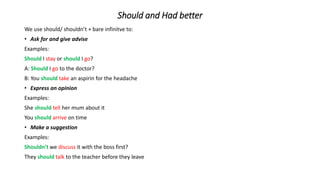
We use should/ shouldn’t + bare infinitve to:
• Ask for and give advise
Examples:
Should I stay or should I go?
A: Should I go to the doctor?
B: You should take an aspirin for the headache
• Express an opinion
Examples:
She should tell her mum about it
You should arrive on time
• Make a suggestion
Examples:
Shouldn’t we discuss it with the boss first?
They should talk to the teacher before they leave
Should and Had better
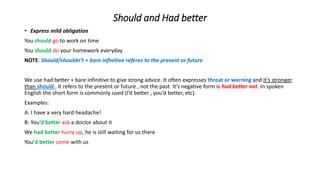
• Express mild obligation
You should go to work on time
You should do your homework everyday
NOTE: Should/shouldn’t + bare infinitive referes to the present or future
We use had better + bare infinitive to give strong advice. It often expresses threat or warning and it’s stronger
than should . It refers to the present or future , not the past. It’s negative form is had better not. In spoken
English the short form is commonly used (I’d better , you’d better, etc).
Examples:
A: I have a very hard headache!
B: You’d better ask a doctor about it
We had better hurry up, he is still waiting for us there
You’d better come with us
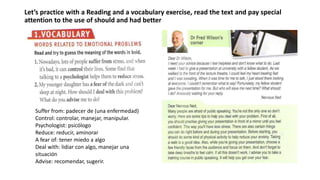
Let’s practice with a Reading and a vocabulary exercise, read the text and pay special
attention to the use of should and had better
Suffer from: padecer de (una enfermedad)
Control: controlar, manejar, manipular.
Psychologist: psicólogo
Reduce: reducir, aminorar
A fear of: tener miedo a algo
Deal with: lidiar con algo, manejar una
situación
Advise: recomendar, sugerir.
Esperamos que hayas disfrutado de este nuevo tema que es muy útil en el idioma
Inglés, como pudiste ver should es una palabra que en inglés se le llama modal o
modal verb o modal auxiliary al igual que had better, ambos nos sirven para
sugerir o recomendar, la diferencia es que should es menos fuerte que had better,
cuando alguien me da un recomendación con should yo tomo la decisión de hacer
o no hacer lo que se me esta recomendando, a diferencia de had better que es
mucho mas fuerte y es comúnmente una advertencia que no podemos pasar por
alto y hay que llevarla acabo algunas veces por obligación y otras por necesidad
Si tuviste alguna duda o algo no quedo claro recuerda que siempre puedes contar
con tu profesor a cargo del grupo quien con gusto te apoyara y resolverá cualquier
duda que pudiera surgir. Suerte en tu próxima lección !
TECNOLÓGICO DE ESTUDIOS SUPERIORES DE CUAUTITLAN
IZCALLI (TESCI)

Should and Had Better

  • 1.
    Hola!. En estaocasión tendrás la oportunidad de pedir y dar una recomendación o sugerencia, también podrás advertir a las demás personas sobre algo que es importante o que es mejor hacer de inmediato antes de que haya una consecuencia severa, estos temas que veras a continuación te ayudaran a expresar esto Should and Had better
  • 2.
    Should and Hadbetter We use should/ shouldn’t + bare infinitve to: • Ask for and give advise Examples: Should I stay or should I go? A: Should I go to the doctor? B: You should take an aspirin for the headache • Express an opinion Examples: She should tell her mum about it You should arrive on time • Make a suggestion Examples: Shouldn’t we discuss it with the boss first? They should talk to the teacher before they leave
  • 3.
    Should and Hadbetter • Express mild obligation You should go to work on time You should do your homework everyday NOTE: Should/shouldn’t + bare infinitive referes to the present or future We use had better + bare infinitive to give strong advice. It often expresses threat or warning and it’s stronger than should . It refers to the present or future , not the past. It’s negative form is had better not. In spoken English the short form is commonly used (I’d better , you’d better, etc). Examples: A: I have a very hard headache! B: You’d better ask a doctor about it We had better hurry up, he is still waiting for us there You’d better come with us
  • 4.
    Let’s practice witha Reading and a vocabulary exercise, read the text and pay special attention to the use of should and had better Suffer from: padecer de (una enfermedad) Control: controlar, manejar, manipular. Psychologist: psicólogo Reduce: reducir, aminorar A fear of: tener miedo a algo Deal with: lidiar con algo, manejar una situación Advise: recomendar, sugerir.
  • 5.
    Esperamos que hayasdisfrutado de este nuevo tema que es muy útil en el idioma Inglés, como pudiste ver should es una palabra que en inglés se le llama modal o modal verb o modal auxiliary al igual que had better, ambos nos sirven para sugerir o recomendar, la diferencia es que should es menos fuerte que had better, cuando alguien me da un recomendación con should yo tomo la decisión de hacer o no hacer lo que se me esta recomendando, a diferencia de had better que es mucho mas fuerte y es comúnmente una advertencia que no podemos pasar por alto y hay que llevarla acabo algunas veces por obligación y otras por necesidad Si tuviste alguna duda o algo no quedo claro recuerda que siempre puedes contar con tu profesor a cargo del grupo quien con gusto te apoyara y resolverá cualquier duda que pudiera surgir. Suerte en tu próxima lección !
  • 6.
    TECNOLÓGICO DE ESTUDIOSSUPERIORES DE CUAUTITLAN IZCALLI (TESCI)