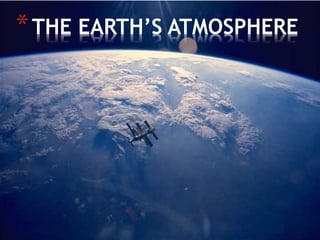
*THE EARTH’S ATMOSPHERE
*The Atmosphere is a mixture of gasses that sorrounds
the Earth and protects us by blocking out dangerous rays
from the Sun. It is around 800 Km thick.
*Is made up of gasses in different proportions:
*78% nitrogen.
*21% oxygen.
*1% other gasses: argon, carbon dioxide, water vapour,
ozone, etc.
*
*It contains the oxygen we breathe.
*It contains the carbon dioxide plants need to do photosynthesis.
*It blocks dangerous solar radiations.
*It keeps the Earth warm by absorbing heat.
*It takes part in the Water Cycle.
*Meteorites desintegrate when passing through it.
*
Podemos diferenciar cinco capas
en la atmósfera terrestre.
Para diferenciarlas nos basamos
en los cambios de temperatura
que encontramos conforme
ascendemos:
*Troposfera
*Estratosfera
*Mesosfera
*Termosfera
*Exosfera
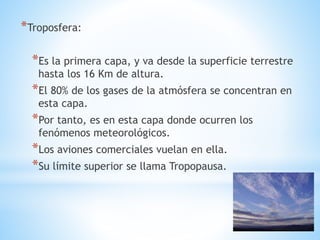
*Troposfera:
*Es la primera capa, y va desde la superficie terrestre
hasta los 16 Km de altura.
*El 80% de los gases de la atmósfera se concentran en
esta capa.
*Por tanto, es en esta capa donde ocurren los
fenómenos meteorológicos.
*Los aviones comerciales vuelan en ella.
*Su límite superior se llama Tropopausa.
*Estratosfera:
*Es la segunda capa, con unos 50 Km de altura.
*En ella encontramos una alta concentración de
moléculas de Ozono, concretamente en torno a los 30
Km de altura. A esta zona la llamamos Capa de Ozono.
*El Ozono es una gas que bloquea la radiación UV del
Sol, impidiendo que llegue a la superficie terrestre.
*Por ella vuelan los aviones supersónicos.
*Su límite superior se llama Estratopausa.
*
*Mesosfera:
*La tercera capa, con unos 90 Km de grosor.
*Tiene ya muy pocos gases (sólo el 1%) del total de la
atmósfera, y en ella se forman nubes de cristales de
hielo.
*Al atravesar la mesosfera, los meteoritos son
desintegrados, formándose las Estrellas Fugaces.
*Su límite superior se llama Mesopausa.
*Termosfera:
*Cuarta capa, con unos 600 Km de grosor.
*Es muy importante para las telecomunicaciones, pues
en esta capa rebotan las ondas de radio.
*En ella se forman las Auroras Boreales.
*Exosfera:
*Es la capa externa, donde poco a poco deja de haber
gases, hasta llegar al espacio exterior.
*THE WEATHER
*
*The weather describes the state of atmospheric
conditions at a certain place, over a short period of
time.
*Weather satellites orbit the Earth sending images to
do predictions.
*Weather conditions include:
*Wind: movements of air.
*Temperature: how hot or cold the air is.
*Precipitations: water that falls to the ground:
rain, snow and hail.
*Humidity: the concentration of water vapour in
the atmosphere.
*Clouds: formed when air gets cold and
condensates.
*Atmopsheric Pressure.
*
*Air has weight.
*The pressure it exerts on a surface is called Atmospheric
Pressure.
*Where is the pressure
going to be the highest?
*And lowest?
*CLOUDS AND
PRECIPITATION
*Clouds are formed when water vapour condenses to
form liquid drops.
*When drops are too heavy, they fall due to gravity, and
produce Rain.
*

The earth’s atmosphere2016

  • 1.
  • 2.
    *The Atmosphere isa mixture of gasses that sorrounds the Earth and protects us by blocking out dangerous rays from the Sun. It is around 800 Km thick. *Is made up of gasses in different proportions: *78% nitrogen. *21% oxygen. *1% other gasses: argon, carbon dioxide, water vapour, ozone, etc.
  • 3.
    * *It contains theoxygen we breathe. *It contains the carbon dioxide plants need to do photosynthesis. *It blocks dangerous solar radiations. *It keeps the Earth warm by absorbing heat. *It takes part in the Water Cycle. *Meteorites desintegrate when passing through it.
  • 4.
    * Podemos diferenciar cincocapas en la atmósfera terrestre. Para diferenciarlas nos basamos en los cambios de temperatura que encontramos conforme ascendemos: *Troposfera *Estratosfera *Mesosfera *Termosfera *Exosfera
  • 6.
    *Troposfera: *Es la primeracapa, y va desde la superficie terrestre hasta los 16 Km de altura. *El 80% de los gases de la atmósfera se concentran en esta capa. *Por tanto, es en esta capa donde ocurren los fenómenos meteorológicos. *Los aviones comerciales vuelan en ella. *Su límite superior se llama Tropopausa.
  • 7.
    *Estratosfera: *Es la segundacapa, con unos 50 Km de altura. *En ella encontramos una alta concentración de moléculas de Ozono, concretamente en torno a los 30 Km de altura. A esta zona la llamamos Capa de Ozono. *El Ozono es una gas que bloquea la radiación UV del Sol, impidiendo que llegue a la superficie terrestre. *Por ella vuelan los aviones supersónicos. *Su límite superior se llama Estratopausa.
  • 8.
  • 9.
    *Mesosfera: *La tercera capa,con unos 90 Km de grosor. *Tiene ya muy pocos gases (sólo el 1%) del total de la atmósfera, y en ella se forman nubes de cristales de hielo. *Al atravesar la mesosfera, los meteoritos son desintegrados, formándose las Estrellas Fugaces. *Su límite superior se llama Mesopausa.
  • 10.
    *Termosfera: *Cuarta capa, conunos 600 Km de grosor. *Es muy importante para las telecomunicaciones, pues en esta capa rebotan las ondas de radio. *En ella se forman las Auroras Boreales.
  • 11.
    *Exosfera: *Es la capaexterna, donde poco a poco deja de haber gases, hasta llegar al espacio exterior.
  • 12.
  • 13.
    * *The weather describesthe state of atmospheric conditions at a certain place, over a short period of time. *Weather satellites orbit the Earth sending images to do predictions. *Weather conditions include:
  • 14.
    *Wind: movements ofair. *Temperature: how hot or cold the air is. *Precipitations: water that falls to the ground: rain, snow and hail. *Humidity: the concentration of water vapour in the atmosphere. *Clouds: formed when air gets cold and condensates. *Atmopsheric Pressure.
  • 15.
    * *Air has weight. *Thepressure it exerts on a surface is called Atmospheric Pressure.
  • 16.
    *Where is thepressure going to be the highest? *And lowest?
  • 18.
  • 19.
    *Clouds are formedwhen water vapour condenses to form liquid drops. *When drops are too heavy, they fall due to gravity, and produce Rain.
  • 20.