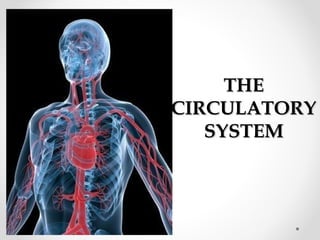
THE
CIRCULATORY
SYSTEM
LOS SISTEMAS CIRCULATORIOS

http://recursostic.educacion.es/secundaria/edad/3esobiologia/3quincena9/ventanas/organizacion_circulatorio.htm
The circulatory system transports nutrients and
oxygen around the organism, and, at the same
time, takes the cellular residues and carries them to
the organs responsible for their elimination.
COMPONENTS OF THE CIRCULATORY SYSTEM
• Blood.
• Blood Vessels.
• Heart.
THE BLOOD
WHAT IS IN THE BLOOD?
red blood cell

platelets

white blood cell

plasma
55% corresponds to blood plasma

In every 100 mL
of blood...

2% corresponds to white blood cells
43% corresponds to red blood cells

Blood Plasma is a yellowish
substance made up of:

Water
Mineral Salts
Proteins
Hormones
Nutrients
Waste products
BLOOD CELLS
Blood

Red Blood Cells

Platelets

White Blood Cells
Red Blood Cells
A biconcave disc, round and flat, without a nucleus.

Contain haemoglobin, a protein
specially designed to hold
oxygen and carry it to cells that
need it. It gives them their red
colour.

Can change shape to an amazing
extent, without breaking, as it
squeezes single file through the
capillaries.
White Blood Cells

There are many different types and all
contain a big nucleus.

They protect us and defend us from
infections and eliminate cell debris.

There can be between 5.000 and 9.000 per cubic mm.
Platelets
Platelets are bits of cell broken off larger cells. They don’t have a nucleous.

There are between 150.000 and 300.000 per
cubic mm.

Platelets produce tiny fibrinogen fibres to
form a net, and take part in blood
coagulation, preventing haemorrhages.
BLOOD FUNCTIONS
• Nutrition: transport nutrients from the digestive system to
the cells.
• Respiration: transport oxygen and carbon dioxide.
• Excretion: transport waste products from the cells to the
excretory system.
• Defensive: it contains defensive cells.
• Thermical Control: it takes part in controlling the body’s
temperature.
• It transport hormones.
BLOOD VESSELS
Ducts through which the blood circulates
to all the parts of the organism.
BLOOD VESSELS STRUCTURE
Arteries
Carry blood away
from the heart, to
the organs.

Veins
Take blood back to
the heart from the
organs.

Capillaries
Microscopic blood vessels
which connect arteries and
veins.
Arteries
• Transport the blood
from the heart to the
organs.
• They suffer a big
blood pressure.
• Their walls must be
thick and elastic.
• As they get further
away from the heart,
they
divide
into
smaller vessels called
arterioles.
Veins
• Transport the blood from the organs to the heart.
• Their walls are thinner and less elastic than arteries’.
• Inside them there are valves to prevent the blood backward
movement.
• They divide to form venules.
Capillaries
• Very small vessels that join arteries and veins endings.
• They have a very thin epitelial wall.
• Through their walls, substances exchange with the body
cells .
Intercambio de sustancias en el capilar
Desechos
CO2
Nutrientes
O2
Desechos

CO2

O2
Nutrientes

Una pequeña porción de plasma también sale de los
capilares, y va penetrando en el sistema linfático,
que posteriormente lo devuelve a la circulación.

Representación de la cantidad de
oxígeno que lleva la sangre a su paso
por los alvéolos pulmonares.
THE
HEART
• It is a muscular, hollow organ that pumps the blood through the
blood vessels.
• Its walls are made up of a muscular tissue called Myocardium.
• The inside is covered by a thin layer of cells, the Endocardium.
• The outside is covered by a double membrane, the Pericardium.
Heart Structure
Veins arrive to the atriums, and arteries leave from
ventricles.
Superior
Vena Cava

Aorta
Artery

Pulmonary
Artery
Pulmonary
Veins

Right
Atrium
Tricuspid
Valve
Right
Ventricle
Inferior
Vena Cava

Left
Atrium
Mitral
Valve
Left
Ventricle
Myocardium
Recorrido de la sangre en el corazón
Sangre rica en oxígeno

1

Sangre pobre en oxígeno

2

3

4
EL FUNCIONAMIENTO DEL
CORAZÓN
DIÁSTOLE AURICULAR

SÍSTOLE
VENTRICULAR

SÍSTOLE
AURICULAR
LA DOBLE CIRCULACIÓN SANGUÍNEA
Circuito general o mayor
Arterias
Circuito pulmonar
o menor

Circuito pulmonar
o menor

Venas

Vena

Circuito general
o mayor

Arteria
THE
LYMPHATI
C SYSTEM
It collects excess
interstitial plasma, and
returns it to the blood.
• It is made up of:
o Lymph Vessels.
o Lymph Capillaries.
o Lymph Nodes: located in
various parts of the body,
they release lymphocytes,
which protect us from
infections.
• The lymphatic system also:
o Maintains the fluid balance in the internal milieu.
o Collects the products of fat digestion from the small
intestine.
ENFERMEDADES DEL
APARATO
CIRCULATORIO
ARTERIOESCLEROSIS
Endurecimiento de las arterias por deposición
de placas de grasa y colesterol. A estas placas
se adhieren plaquetas y forman coágulos que
pueden obstruir la arteria.

Coágulo

Luz de la arteria

Tasa de mortalidad por enfermedad
cardiaca (por 1.000 habitantes)
16
12
8
6
5
4

Pared de la arteria
INFARTO DE MIOCARDIO

0
1,8

2
2,2
2,5 2,6
2,8
Tasa de colesterol en sangre (g/L)

El infarto se produce cuando un coágulo
tapona una arteria coronaria y una parte del
corazón deja de funcionar.
Enfermedades de la sangre
La mayoría de las enfermedades relacionadas con la
sangre, como la anemia o la leucemia, tienen su origen en
un mal funcionamiento de la médula ósea roja.
Médula ósea
roja

ANEMIA

• Sus principales síntomas son la fatiga y la pérdida de energía.
• La sangre contiene una baja cantidad de hemoglobina.
• La anemia más común se produce por la falta de hierro, un
componente esencial de la hemoglobina.
LEUCEMIA
• Es un cáncer que afecta a las células de la médula ósea.
• Se produce un aumento de glóbulos blancos incapaces de luchar contra
las infecciones, y disminuye el número de glóbulos rojos y plaquetas.
HEMOFILIA

• Se manifiesta por la aparición de hemorragias, debido a problemas de coagulación de la
sangre.
• Para que se produzca la coagulación se necesita la colaboración de doce sustancias
diferentes llamadas factores de coagulación. En el plasma de los hemofílicos falta alguno
de estos factores.
• Se debe inyectar a la persona el factor del que carece.

En la mayoría de los casos
en los hemofílicos, se dan
antecedentes familiares.
EXCRETORY SYSTEM
It is responsible for
eliminating waste products
produced by our cells.
• It is made up of the urinary system and other organs and
systems which contribute to the excretion of waste products:
o Respiratory System.
o Sweat Glands.
o Liver.
THE URINARY SYSTEM
• It has two parts: the Kidneys and the Urinary
Tracts.

http://www.bioygeo.info/Animaciones/Nefrona.swf
THE KIDNEYS
MEDULLA

Renal Vein
RENAL
PELVIS

Renal Arterie

Ureter
RENAL
CORTEX
• Each kidney is made up of nephrons, small tubes with one
open end sorrounded by a blood capillary.
• Nephrons filter the blood in the glomerulus, and produce
urine.
LA SALUD DEL APARATO
URINARIO
Para no sobrecargar de trabajo a nuestros riñones, debemos adquirir ciertos
hábitos que ayudan a mejorar su funcionamiento.
Ingerir cantidades moderadas de
ciertos alimentos que provocan la
formación de productos tóxicos,
como el marisco o la carne de caza.
Ingerir como mínimo
dos litros de agua al día.

Consumir con moderación
carnes y pescados, ricos en
sustancias nitrogenadas
cuya eliminación puede
alterar el funcionamiento
del riñón.
LA HEMODIÁLISIS

El riñón artificial

Los enfermos cuyos riñones no
funcionan, deben depurar regularmente
su sangre por medio de la hemodiálisis.

La sangre se pone en contacto con una solución similar al plasma
sanguíneo a través de una membrana semipermeable, que deja
escapar la urea y otros productos de desecho, pero impide el paso
a moléculas grandes y células sanguíneas.

Circexcr

  • 1.
  • 2.
  • 3.
    The circulatory systemtransports nutrients and oxygen around the organism, and, at the same time, takes the cellular residues and carries them to the organs responsible for their elimination.
  • 4.
    COMPONENTS OF THECIRCULATORY SYSTEM • Blood. • Blood Vessels. • Heart.
  • 5.
  • 6.
    WHAT IS INTHE BLOOD? red blood cell platelets white blood cell plasma
  • 7.
    55% corresponds toblood plasma In every 100 mL of blood... 2% corresponds to white blood cells 43% corresponds to red blood cells Blood Plasma is a yellowish substance made up of: Water Mineral Salts Proteins Hormones Nutrients Waste products
  • 8.
    BLOOD CELLS Blood Red BloodCells Platelets White Blood Cells
  • 9.
    Red Blood Cells Abiconcave disc, round and flat, without a nucleus. Contain haemoglobin, a protein specially designed to hold oxygen and carry it to cells that need it. It gives them their red colour. Can change shape to an amazing extent, without breaking, as it squeezes single file through the capillaries.
  • 10.
    White Blood Cells Thereare many different types and all contain a big nucleus. They protect us and defend us from infections and eliminate cell debris. There can be between 5.000 and 9.000 per cubic mm.
  • 11.
    Platelets Platelets are bitsof cell broken off larger cells. They don’t have a nucleous. There are between 150.000 and 300.000 per cubic mm. Platelets produce tiny fibrinogen fibres to form a net, and take part in blood coagulation, preventing haemorrhages.
  • 12.
    BLOOD FUNCTIONS • Nutrition:transport nutrients from the digestive system to the cells. • Respiration: transport oxygen and carbon dioxide. • Excretion: transport waste products from the cells to the excretory system. • Defensive: it contains defensive cells. • Thermical Control: it takes part in controlling the body’s temperature. • It transport hormones.
  • 13.
    BLOOD VESSELS Ducts throughwhich the blood circulates to all the parts of the organism.
  • 14.
  • 15.
    Arteries Carry blood away fromthe heart, to the organs. Veins Take blood back to the heart from the organs. Capillaries Microscopic blood vessels which connect arteries and veins.
  • 16.
    Arteries • Transport theblood from the heart to the organs. • They suffer a big blood pressure. • Their walls must be thick and elastic. • As they get further away from the heart, they divide into smaller vessels called arterioles.
  • 17.
    Veins • Transport theblood from the organs to the heart. • Their walls are thinner and less elastic than arteries’. • Inside them there are valves to prevent the blood backward movement. • They divide to form venules.
  • 18.
    Capillaries • Very smallvessels that join arteries and veins endings. • They have a very thin epitelial wall. • Through their walls, substances exchange with the body cells .
  • 19.
    Intercambio de sustanciasen el capilar Desechos CO2 Nutrientes O2 Desechos CO2 O2 Nutrientes Una pequeña porción de plasma también sale de los capilares, y va penetrando en el sistema linfático, que posteriormente lo devuelve a la circulación. Representación de la cantidad de oxígeno que lleva la sangre a su paso por los alvéolos pulmonares.
  • 20.
  • 21.
    • It isa muscular, hollow organ that pumps the blood through the blood vessels. • Its walls are made up of a muscular tissue called Myocardium. • The inside is covered by a thin layer of cells, the Endocardium. • The outside is covered by a double membrane, the Pericardium.
  • 22.
  • 23.
    Veins arrive tothe atriums, and arteries leave from ventricles. Superior Vena Cava Aorta Artery Pulmonary Artery Pulmonary Veins Right Atrium Tricuspid Valve Right Ventricle Inferior Vena Cava Left Atrium Mitral Valve Left Ventricle Myocardium
  • 24.
    Recorrido de lasangre en el corazón Sangre rica en oxígeno 1 Sangre pobre en oxígeno 2 3 4
  • 25.
    EL FUNCIONAMIENTO DEL CORAZÓN DIÁSTOLEAURICULAR SÍSTOLE VENTRICULAR SÍSTOLE AURICULAR
  • 27.
    LA DOBLE CIRCULACIÓNSANGUÍNEA Circuito general o mayor Arterias Circuito pulmonar o menor Circuito pulmonar o menor Venas Vena Circuito general o mayor Arteria
  • 28.
    THE LYMPHATI C SYSTEM It collectsexcess interstitial plasma, and returns it to the blood.
  • 30.
    • It ismade up of: o Lymph Vessels. o Lymph Capillaries. o Lymph Nodes: located in various parts of the body, they release lymphocytes, which protect us from infections.
  • 31.
    • The lymphaticsystem also: o Maintains the fluid balance in the internal milieu. o Collects the products of fat digestion from the small intestine.
  • 32.
  • 33.
    ARTERIOESCLEROSIS Endurecimiento de lasarterias por deposición de placas de grasa y colesterol. A estas placas se adhieren plaquetas y forman coágulos que pueden obstruir la arteria. Coágulo Luz de la arteria Tasa de mortalidad por enfermedad cardiaca (por 1.000 habitantes) 16 12 8 6 5 4 Pared de la arteria INFARTO DE MIOCARDIO 0 1,8 2 2,2 2,5 2,6 2,8 Tasa de colesterol en sangre (g/L) El infarto se produce cuando un coágulo tapona una arteria coronaria y una parte del corazón deja de funcionar.
  • 34.
    Enfermedades de lasangre La mayoría de las enfermedades relacionadas con la sangre, como la anemia o la leucemia, tienen su origen en un mal funcionamiento de la médula ósea roja. Médula ósea roja ANEMIA • Sus principales síntomas son la fatiga y la pérdida de energía. • La sangre contiene una baja cantidad de hemoglobina. • La anemia más común se produce por la falta de hierro, un componente esencial de la hemoglobina. LEUCEMIA • Es un cáncer que afecta a las células de la médula ósea. • Se produce un aumento de glóbulos blancos incapaces de luchar contra las infecciones, y disminuye el número de glóbulos rojos y plaquetas.
  • 35.
    HEMOFILIA • Se manifiestapor la aparición de hemorragias, debido a problemas de coagulación de la sangre. • Para que se produzca la coagulación se necesita la colaboración de doce sustancias diferentes llamadas factores de coagulación. En el plasma de los hemofílicos falta alguno de estos factores. • Se debe inyectar a la persona el factor del que carece. En la mayoría de los casos en los hemofílicos, se dan antecedentes familiares.
  • 36.
    EXCRETORY SYSTEM It isresponsible for eliminating waste products produced by our cells.
  • 37.
    • It ismade up of the urinary system and other organs and systems which contribute to the excretion of waste products: o Respiratory System. o Sweat Glands. o Liver.
  • 38.
    THE URINARY SYSTEM •It has two parts: the Kidneys and the Urinary Tracts. http://www.bioygeo.info/Animaciones/Nefrona.swf
  • 39.
  • 40.
    • Each kidneyis made up of nephrons, small tubes with one open end sorrounded by a blood capillary. • Nephrons filter the blood in the glomerulus, and produce urine.
  • 41.
    LA SALUD DELAPARATO URINARIO Para no sobrecargar de trabajo a nuestros riñones, debemos adquirir ciertos hábitos que ayudan a mejorar su funcionamiento. Ingerir cantidades moderadas de ciertos alimentos que provocan la formación de productos tóxicos, como el marisco o la carne de caza. Ingerir como mínimo dos litros de agua al día. Consumir con moderación carnes y pescados, ricos en sustancias nitrogenadas cuya eliminación puede alterar el funcionamiento del riñón.
  • 42.
    LA HEMODIÁLISIS El riñónartificial Los enfermos cuyos riñones no funcionan, deben depurar regularmente su sangre por medio de la hemodiálisis. La sangre se pone en contacto con una solución similar al plasma sanguíneo a través de una membrana semipermeable, que deja escapar la urea y otros productos de desecho, pero impide el paso a moléculas grandes y células sanguíneas.