Why
English?
Denomination
• Native
• Official
• Second Language
• Foreign Language
Importance
• Lingua Franca
• Global Language
• Books
• Newspapers
• Airports
• Aerial Traffic
• International Business
Importance
• Science
• Technology
• Publicity
• Movies
• Music
• Sports
• International Competences
Importance
• Government
• Human Resources
• Jobs
• Infrastructure
• Diplomacy
“English is the only way
that we can be competitive
in the international market”.
Leandro Tessler
Common European Framework
of Reference
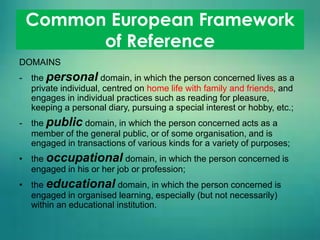
DOMAINS
- the personal domain, in which the person concerned lives as a
private individual, centred on home life with family and friends, and
engages in individual practices such as reading for pleasure,
keeping a personal diary, pursuing a special interest or hobby, etc.;
- the public domain, in which the person concerned acts as a
member of the general public, or of some organisation, and is
engaged in transactions of various kinds for a variety of purposes;
• the occupational domain, in which the person concerned is
engaged in his or her job or profession;
• the educational domain, in which the person concerned is
engaged in organised learning, especially (but not necessarily)
within an educational institution.
Situations CEFR
In each domain, the external situations which arise may be described
in terms of:
• the locations in which, and the times at which, they occur;
• the institutions or organisations – the structure and procedures of
which control much of what can normally occur;
• the persons involved, especially in their relevant social roles in
relation to the user/learner;
• the objects (animate and inanimate) in the environment;
• the events that take place;
• the operations performed by the persons involved;
• the texts encountered within the situation.
Domain Locations Institutions Persons
Personal Home: house,
rooms, garden
Own
of family
of friends
of strangers
The family
Social
networks
(Grand)Parents,
offspring,
siblings, aunts,
uncles,
cousins, in-laws,
spouses,
intimates, friends,
acquaintances
Domain Locations Institutions Persons
Public Public spaces:
street, square, park
Public transport
Shops (super)markets
Hospitals, surgeries,
clinics
Sports stadia, fields,
halls
Theatre, cinema,
entertainment,
Restaurant, pub,
hotel
Places of worship
Public authorities
Political bodies
The law
Public health
Services clubs
Societies
Political parties
Denominations
Members of the public
Officials
Shop personnel
Police, army, security
Drivers, conductors
Passengers
Players, fans, spectators
Actors, audiences
Waiters, barpersons
Receptionists
Priests, congregation
Domain Locations Institutions Persons
Occupational Offices
Factories
Workshops
Ports,
Railways
Farms
Airports
Stores, shops
Service industries
Hotels
Civil service
Firms
Multinational
corportations
Nationalised
industries
Trade unions
Employers/ees
Managers
Colleagues
Subordinates
Workmates
Customers
Receptionists, secretaries,
Cleaners
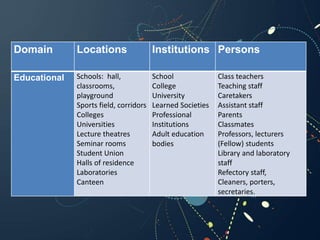
Domain Locations Institutions Persons
Educational Schools: hall,
classrooms,
playground
Sports field, corridors
Colleges
Universities
Lecture theatres
Seminar rooms
Student Union
Halls of residence
Laboratories
Canteen
School
College
University
Learned Societies
Professional
Institutions
Adult education
bodies
Class teachers
Teaching staff
Caretakers
Assistant staff
Parents
Classmates
Professors, lecturers
(Fellow) students
Library and laboratory
staff
Refectory staff,
Cleaners, porters,
secretaries.
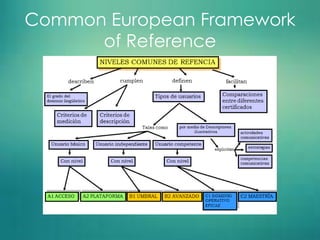
Common European Framework
of Reference
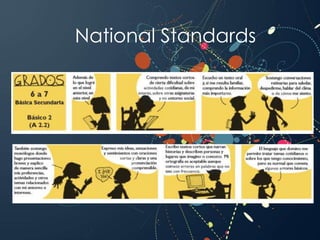
National Standards
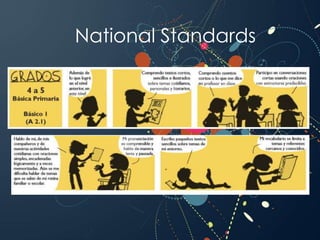
National Standards
National Standards
National Standards
National Standards
National Standards
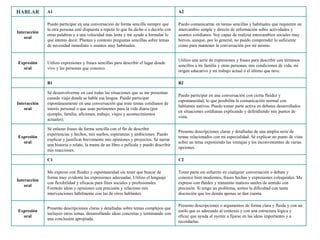
HABLAR A1 A2
Interacción
oral
Puedo participar en una conversación de forma sencilla siempre que
la otra persona esté dispuesta a repetir lo que ha dicho o a decirlo con
otras palabras y a una velocidad más lenta y me ayude a formular lo
que intento decir. Planteo y contesto preguntas sencillas sobre temas
de necesidad inmediata o asuntos muy habituales.
Puedo comunicarme en tareas sencillas y habituales que requieren un
intercambio simple y directo de información sobre actividades y
asuntos cotidianos. Soy capaz de realizar intercambios sociales muy
breves, aunque, por lo general, no puedo comprender lo suficiente
como para mantener la conversación por mí mismo.
Expresión
oral
Utilizo expresiones y frases sencillas para describir el lugar donde
vivo y las personas que conozco.
Utilizo una serie de expresiones y frases para describir con términos
sencillos a mi familia y otras personas, mis condiciones de vida, mi
origen educativo y mi trabajo actual o el último que tuve.
B1 B2
Interacción
oral
Sé desenvolverme en casi todas las situaciones que se me presentan
cuando viajo donde se habla esa lengua. Puedo participar
espontáneamente en una conversación que trate temas cotidianos de
interés personal o que sean pertinentes para la vida diaria (por
ejemplo, familia, aficiones, trabajo, viajes y acontecimientos
actuales).
Puedo participar en una conversación con cierta fluidez y
espontaneidad, lo que posibilita la comunicación normal con
hablantes nativos. Puedo tomar parte activa en debates desarrollados
en situaciones cotidianas explicando y defendiendo mis puntos de
vista.
Expresión
oral
Sé enlazar frases de forma sencilla con el fin de describir
experiencias y hechos, mis sueños, esperanzas y ambiciones. Puedo
explicar y justificar brevemente mis opiniones y proyectos. Sé narrar
una historia o relato, la trama de un libro o película y puedo describir
mis reacciones.
Presento descripciones claras y detalladas de una amplia serie de
temas relacionados con mi especialidad. Sé explicar un punto de vista
sobre un tema exponiendo las ventajas y los inconvenientes de varias
opciones.
C1 C2
Interacción
oral
Me expreso con fluidez y espontaneidad sin tener que buscar de
forma muy evidente las expresiones adecuadas. Utilizo el lenguaje
con flexibilidad y eficacia para fines sociales y profesionales.
Formulo ideas y opiniones con precisión y relaciono mis
intervenciones hábilmente con las de otros hablantes.
Tomo parte sin esfuerzo en cualquier conversación o debate y
conozco bien modismos, frases hechas y expresiones coloquiales. Me
expreso con fluidez y transmito matices sutiles de sentido con
precisión. Si tengo un problema, sorteo la dificultad con tanta
discreción que los demás apenas se dan cuenta.
Expresión
oral
Presento descripciones claras y detalladas sobre temas complejos que
incluyen otros temas, desarrollando ideas concretas y terminando con
una conclusión apropiada.
Presento descripciones o argumentos de forma clara y fluida y con un
estilo que es adecuado al contexto y con una estructura lógica y
eficaz que ayuda al oyente a fijarse en las ideas importantes y a
recordarlas.
Sites for you to explore
academic opportunities
• https://www.coursera.org/
• http://scholarship-positions.com/
• http://www.icetex.gov.co/dnnpro5/es-
co/becas/becasenelexterior/becasvig
entes.aspx
• https://www.edx.org/
Sites for you to learn English
• http://americanenglish.state.gov/
• https://www.duolingo.com/
• http://learnenglish.britishcouncil.org/en/
• www.livemocha.com
• www.sharedtalk.com
• https://uk.babbel.com/

Why English?

  • 1.
  • 3.
    Denomination • Native • Official •Second Language • Foreign Language
  • 4.
    Importance • Lingua Franca •Global Language • Books • Newspapers • Airports • Aerial Traffic • International Business
  • 5.
    Importance • Science • Technology •Publicity • Movies • Music • Sports • International Competences
  • 6.
    Importance • Government • HumanResources • Jobs • Infrastructure • Diplomacy
  • 7.
    “English is theonly way that we can be competitive in the international market”. Leandro Tessler
  • 9.
    Common European Framework ofReference DOMAINS - the personal domain, in which the person concerned lives as a private individual, centred on home life with family and friends, and engages in individual practices such as reading for pleasure, keeping a personal diary, pursuing a special interest or hobby, etc.; - the public domain, in which the person concerned acts as a member of the general public, or of some organisation, and is engaged in transactions of various kinds for a variety of purposes; • the occupational domain, in which the person concerned is engaged in his or her job or profession; • the educational domain, in which the person concerned is engaged in organised learning, especially (but not necessarily) within an educational institution.
  • 10.
    Situations CEFR In eachdomain, the external situations which arise may be described in terms of: • the locations in which, and the times at which, they occur; • the institutions or organisations – the structure and procedures of which control much of what can normally occur; • the persons involved, especially in their relevant social roles in relation to the user/learner; • the objects (animate and inanimate) in the environment; • the events that take place; • the operations performed by the persons involved; • the texts encountered within the situation.
  • 11.
    Domain Locations InstitutionsPersons Personal Home: house, rooms, garden Own of family of friends of strangers The family Social networks (Grand)Parents, offspring, siblings, aunts, uncles, cousins, in-laws, spouses, intimates, friends, acquaintances
  • 12.
    Domain Locations InstitutionsPersons Public Public spaces: street, square, park Public transport Shops (super)markets Hospitals, surgeries, clinics Sports stadia, fields, halls Theatre, cinema, entertainment, Restaurant, pub, hotel Places of worship Public authorities Political bodies The law Public health Services clubs Societies Political parties Denominations Members of the public Officials Shop personnel Police, army, security Drivers, conductors Passengers Players, fans, spectators Actors, audiences Waiters, barpersons Receptionists Priests, congregation
  • 13.
    Domain Locations InstitutionsPersons Occupational Offices Factories Workshops Ports, Railways Farms Airports Stores, shops Service industries Hotels Civil service Firms Multinational corportations Nationalised industries Trade unions Employers/ees Managers Colleagues Subordinates Workmates Customers Receptionists, secretaries, Cleaners
  • 14.
    Domain Locations InstitutionsPersons Educational Schools: hall, classrooms, playground Sports field, corridors Colleges Universities Lecture theatres Seminar rooms Student Union Halls of residence Laboratories Canteen School College University Learned Societies Professional Institutions Adult education bodies Class teachers Teaching staff Caretakers Assistant staff Parents Classmates Professors, lecturers (Fellow) students Library and laboratory staff Refectory staff, Cleaners, porters, secretaries.
  • 15.
  • 16.
  • 17.
  • 18.
  • 19.
  • 20.
  • 21.
  • 22.
    HABLAR A1 A2 Interacción oral Puedoparticipar en una conversación de forma sencilla siempre que la otra persona esté dispuesta a repetir lo que ha dicho o a decirlo con otras palabras y a una velocidad más lenta y me ayude a formular lo que intento decir. Planteo y contesto preguntas sencillas sobre temas de necesidad inmediata o asuntos muy habituales. Puedo comunicarme en tareas sencillas y habituales que requieren un intercambio simple y directo de información sobre actividades y asuntos cotidianos. Soy capaz de realizar intercambios sociales muy breves, aunque, por lo general, no puedo comprender lo suficiente como para mantener la conversación por mí mismo. Expresión oral Utilizo expresiones y frases sencillas para describir el lugar donde vivo y las personas que conozco. Utilizo una serie de expresiones y frases para describir con términos sencillos a mi familia y otras personas, mis condiciones de vida, mi origen educativo y mi trabajo actual o el último que tuve. B1 B2 Interacción oral Sé desenvolverme en casi todas las situaciones que se me presentan cuando viajo donde se habla esa lengua. Puedo participar espontáneamente en una conversación que trate temas cotidianos de interés personal o que sean pertinentes para la vida diaria (por ejemplo, familia, aficiones, trabajo, viajes y acontecimientos actuales). Puedo participar en una conversación con cierta fluidez y espontaneidad, lo que posibilita la comunicación normal con hablantes nativos. Puedo tomar parte activa en debates desarrollados en situaciones cotidianas explicando y defendiendo mis puntos de vista. Expresión oral Sé enlazar frases de forma sencilla con el fin de describir experiencias y hechos, mis sueños, esperanzas y ambiciones. Puedo explicar y justificar brevemente mis opiniones y proyectos. Sé narrar una historia o relato, la trama de un libro o película y puedo describir mis reacciones. Presento descripciones claras y detalladas de una amplia serie de temas relacionados con mi especialidad. Sé explicar un punto de vista sobre un tema exponiendo las ventajas y los inconvenientes de varias opciones. C1 C2 Interacción oral Me expreso con fluidez y espontaneidad sin tener que buscar de forma muy evidente las expresiones adecuadas. Utilizo el lenguaje con flexibilidad y eficacia para fines sociales y profesionales. Formulo ideas y opiniones con precisión y relaciono mis intervenciones hábilmente con las de otros hablantes. Tomo parte sin esfuerzo en cualquier conversación o debate y conozco bien modismos, frases hechas y expresiones coloquiales. Me expreso con fluidez y transmito matices sutiles de sentido con precisión. Si tengo un problema, sorteo la dificultad con tanta discreción que los demás apenas se dan cuenta. Expresión oral Presento descripciones claras y detalladas sobre temas complejos que incluyen otros temas, desarrollando ideas concretas y terminando con una conclusión apropiada. Presento descripciones o argumentos de forma clara y fluida y con un estilo que es adecuado al contexto y con una estructura lógica y eficaz que ayuda al oyente a fijarse en las ideas importantes y a recordarlas.
  • 25.
    Sites for youto explore academic opportunities • https://www.coursera.org/ • http://scholarship-positions.com/ • http://www.icetex.gov.co/dnnpro5/es- co/becas/becasenelexterior/becasvig entes.aspx • https://www.edx.org/
  • 26.
    Sites for youto learn English • http://americanenglish.state.gov/ • https://www.duolingo.com/ • http://learnenglish.britishcouncil.org/en/ • www.livemocha.com • www.sharedtalk.com • https://uk.babbel.com/