¡Bienvenidos a la clase de inglés! Welcome to English clase!
Instructora/ Teacher: Charla Young
Ayudantes/ Helpers: Heidi & Dustin Drussell
Cosas Administrativas:
• Comenzar con una oración
• 10 horas de práctica… ¿lo hiciste?
• Organización del tiempo hoy:
• 60 minutos: (Inglés) Instrucción/Lección/Práctica
• 30 minutos (Español) Mi Fundamento (no es mandatorio)
What time is it? (Qué hora es?)
It’s _______. (Es _______.)
Practice with a partner
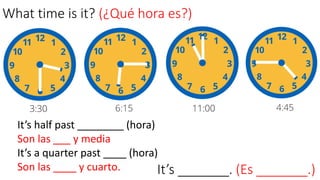
What time is it? (¿Qué hora es?)
It’s _______. (Es _______.)
It’s half past ________ (hora)
Son las ___ y media
It’s a quarter past ____ (hora)
Son las ____ y cuarto.
What day is it? (¿Cuál día es?)
B: Is it Friday? (¿Es Viernes?)
A: No.
B: Is it the twentieth? (¿Es el veinte?)
A: No.
B: Is it the nineteenth? (¿Es el diecinueve?)
A: Yes, it’s Monday the nineteenth.
Objetivos:
1.Aprenderé como describir el clima.
2.Aprenderé como hacer pronósticos sobre el clima.
How is the weather?
¿Cómo está el clima?
What is it?
¿Qué es esto?
Rain (La lluvia) Snow (La nieve)
What is it?
¿Qué es esto?
Wind (El viento) Fog (La niebla)
What is it?
¿Qué es esto?
Cold (El frio) Hot (El calor)
What is it?
¿Qué es esto?
The sun (El sol) Clouds (Las nubes)
Draw a line & Match the words and pictures.
(Dibuja una línea de las palabras a las imágenes correctas)
Write in your manual.
(Escribe en tu manual.)
Write in your manual.
(Escribe en tu manual.)
How is the weather?
¿Cómo está el clima?
It’s raining. (Está lloviendo.)
It’s rainy. (Llueve.)
It’s snowing. (Está nevando)
It’s snowy. (Nieva.)
How is the weather?
¿Cómo está el clima?
It’s windy. (Hace viento.) It’s foggy. (Hay niebla.)
How is the weather?
¿Cómo está el clima?
It’s cold. (Hace frio.) It’s hot. (Hace calor.)
How is the weather?
¿Cómo está el clima?
It’s sunny. (Hace sol.) It’s cloudy. (Está nublado.)
Say each phrase to your partner, take turns.
(Lee las frases con tu compañero, alternando)
Look in your manual.
(Mira tu manual.)
Sounds for i and y
(Sonidos de la i y la y)
 Sunny
 Cloudy
 Rainy
 Windy
 Snowy
 Happy
 Slowly
 Study
 Thirty
 Taxi
 Chili
 Broccoli
 Kiwi
 Messy
 Crazy
3 sounds for i & y (3 sonidos para la i y la y)
i (sonido que no
exist en español)
Wish
Split
Dish
Kick
i/y (el sonido igual
al español)
Tree
Crazy
Ski
Bee
i/y (suena como [ai])
Hi
Goodbye
Cry
Die
What will the weather be tomorrow?
¿Cómo será el clima mañana?
Will it rain tomorrow?
(¿Lloverá mañana?)
Will it snow tomorrow?
(¿Nevará mañana?)
What will the weather be tomorrow?
¿Cómo será el clima mañana?
Will it be windy tomorrow?
(¿Hará viento mañana?)
Will it be foggy tomorrow?
(¿Hará niebla mañana?)
What will the weather be tomorrow?
¿Cómo será el clima mañana?
Will it be cold tomorrow?
(¿Hará frio mañana?)
Will it be hot tomorrow?
(¿Hará calor mañana?)
What will the weather be tomorrow?
¿Cómo será el clima mañana?
Will it be sunny tomorrow?
(¿Hará sol mañana?)
Will it be cloudy tomorrow?
(¿Estará nublado mañana?)
What will the weather be tomorrow?
¿Cómo será el clima mañana?
Yes it will.
(Sí. Así será.)
I think it will.
(Pienso que sí.)
What will the weather be tomorrow?
¿Cómo será el clima mañana?
I’m not sure.
(No estoy esguro.)
No, it won’t
(No, no será así.)
Say each phrase to your partner, take turns.
(Lee las frases con tu compañero, alternando)
Look in your manual.
(Mira tu manual.)
Look in your manual.
(Mira tu manual.)
Look in your manual.
(Mira tu manual.)
A: How is the weather in __________ (city)?
¿Cómo está el clima en __________ (ciudad)?
Los Angeles
B: It’s cloudy. (Está nublado.)
A: What will the weather be tomorrow in ________?
¿Cómo será el clima mañana en _____ (ciudad)?
Los Angeles
B: It will be sunny. (Hará sol.)
What I learned (Lo que aprendí)
Ahora puedo…
1.… describir el clima.
2.… hacer pronósticos sobre el clima.
Invitacíon… o sea ¡Tarea!
Invitación: Durante la semana toma tiempo
para describir la clima en inglés.
How to Pray (Como orar)
• Father in Heaven
• We thank thee for…
• We ask thee for…
• In the name of Jesus Christ,
Amen.
• Padre Celestial
• Te damos gracias por…
• Te pedimos por…
• En el nombre de Jesucristo,
Amen.
1. Write down 2 things you are grateful for: (Escribe 2 cosas que le quieres
agradecer)
2. Write down 2 things you need: (Escribe 2 cosas que quieres pedirle)
I want to learn English… (quiero aprender inglés para…)
• To communicate better with others
• To help me at my job
• To develop a useful skill
• To make more friends
• To open up new opportunities
• To better serve the Lord
• Comunicarme mejor con otros
• Ayudarme con mi trabajo/empleo
• Desarrollar una habilidad útil
• Hacer nuevos amigos
• Abrir oportunidades nuevas
• Servir aún más al Señor
How is learning English a way to be self reliant?
(¿Cómo es el aprender inglés una manera de ser autosuficiente?)
• I can get better help when I go…
• To the doctor
• To the grocery store
• On vacation
• To apply for a new job
More ideas?
• Puedo obtener mejor ayuda cuando voy…
• Al doctor
• Al supermercado
• De vacaciones
• Para solicitor para un trabajo nuevo
¿Más ideas?
How to read in English when you’re learning the
language.
(Como leer en inglés cuando todavía estás aprendiendo el idioma.)
Now To Practice! (A practicar!)
1. Circle the cognates (Haz un círculo por las
palabras cognadas)
2. Underline words you understand
(Subraya las otras palabras conocidas)
3. Ignore words you don’t know. (Ignora
palabras no conocidas.)
4. Read the text out loud with a partner.
(Lee el texto en voz alta con un compañero.)
5. Tell your partner in Spanish what you
understand about the text.
(Dile a tu compañero en español lo que
entiendes del pasaje.)
Now To Practice! (A practicar!)
Questions (Preguntas)
1.What is one invitation from the First
Presidency?
¿Cuál es una invitación de la Primera
Presidencia?
2. What is one promised blessing?
¿Cuál es una de las bendicionces
prometidas?
3. What is the main point of the passage?
¿Qué es el punto clave del pasaje?
Other thoughts from this lesson:
(Otros pensamientos de esta lección)
Self-Reliance is a commandment.
(La Autosuficiencia es un mandamento.)
God can and will provide a way for His righteous children to become
self-reliant.
(Dios puede proporcionar, y proporcionará, una manera para que Sus
hijos rectos lleguen a ser autosuficientes.)
“I am come that they might have life, and that they might have it more
abundantly.” JOHN 10:10
“Yo he venido para que tengan vida, y para que la tengan en
abundancia”. JUAN 10:10
What is one way that being self-reliant has
allowed you to help another person?
¿Cuál es una manera en que ser autosuficiente te
permitió ayudar a otra persona?
Faith in Jesus Christ (la fe en jesucristo)
Read the Book of Mormon.
(Lee el Libro de Mormón.)
Go to church.
(Ve a la iglesia.)
Faith in Jesus Christ (la fe en jesucristo)
Pay tithing.
(Paga el diezmo.)
Keep the Sabbath day holy.
(Dedica los domingos al Señor.)
Faith is an action. (La fe es una acción.)
Connect 13 lesson

Connect 13 lesson

  • 1.
    ¡Bienvenidos a laclase de inglés! Welcome to English clase! Instructora/ Teacher: Charla Young Ayudantes/ Helpers: Heidi & Dustin Drussell
  • 2.
    Cosas Administrativas: • Comenzarcon una oración • 10 horas de práctica… ¿lo hiciste? • Organización del tiempo hoy: • 60 minutos: (Inglés) Instrucción/Lección/Práctica • 30 minutos (Español) Mi Fundamento (no es mandatorio)
  • 3.
    What time isit? (Qué hora es?) It’s _______. (Es _______.)
  • 5.
  • 6.
    What time isit? (¿Qué hora es?) It’s _______. (Es _______.) It’s half past ________ (hora) Son las ___ y media It’s a quarter past ____ (hora) Son las ____ y cuarto.
  • 7.
    What day isit? (¿Cuál día es?) B: Is it Friday? (¿Es Viernes?) A: No. B: Is it the twentieth? (¿Es el veinte?) A: No. B: Is it the nineteenth? (¿Es el diecinueve?) A: Yes, it’s Monday the nineteenth.
  • 8.
    Objetivos: 1.Aprenderé como describirel clima. 2.Aprenderé como hacer pronósticos sobre el clima.
  • 9.
    How is theweather? ¿Cómo está el clima?
  • 10.
    What is it? ¿Quées esto? Rain (La lluvia) Snow (La nieve)
  • 11.
    What is it? ¿Quées esto? Wind (El viento) Fog (La niebla)
  • 12.
    What is it? ¿Quées esto? Cold (El frio) Hot (El calor)
  • 13.
    What is it? ¿Quées esto? The sun (El sol) Clouds (Las nubes)
  • 14.
    Draw a line& Match the words and pictures. (Dibuja una línea de las palabras a las imágenes correctas) Write in your manual. (Escribe en tu manual.)
  • 15.
    Write in yourmanual. (Escribe en tu manual.)
  • 16.
    How is theweather? ¿Cómo está el clima? It’s raining. (Está lloviendo.) It’s rainy. (Llueve.) It’s snowing. (Está nevando) It’s snowy. (Nieva.)
  • 17.
    How is theweather? ¿Cómo está el clima? It’s windy. (Hace viento.) It’s foggy. (Hay niebla.)
  • 18.
    How is theweather? ¿Cómo está el clima? It’s cold. (Hace frio.) It’s hot. (Hace calor.)
  • 19.
    How is theweather? ¿Cómo está el clima? It’s sunny. (Hace sol.) It’s cloudy. (Está nublado.)
  • 20.
    Say each phraseto your partner, take turns. (Lee las frases con tu compañero, alternando) Look in your manual. (Mira tu manual.)
  • 21.
    Sounds for iand y (Sonidos de la i y la y)  Sunny  Cloudy  Rainy  Windy  Snowy  Happy  Slowly  Study  Thirty  Taxi  Chili  Broccoli  Kiwi  Messy  Crazy
  • 22.
    3 sounds fori & y (3 sonidos para la i y la y) i (sonido que no exist en español) Wish Split Dish Kick i/y (el sonido igual al español) Tree Crazy Ski Bee i/y (suena como [ai]) Hi Goodbye Cry Die
  • 23.
    What will theweather be tomorrow? ¿Cómo será el clima mañana? Will it rain tomorrow? (¿Lloverá mañana?) Will it snow tomorrow? (¿Nevará mañana?)
  • 24.
    What will theweather be tomorrow? ¿Cómo será el clima mañana? Will it be windy tomorrow? (¿Hará viento mañana?) Will it be foggy tomorrow? (¿Hará niebla mañana?)
  • 25.
    What will theweather be tomorrow? ¿Cómo será el clima mañana? Will it be cold tomorrow? (¿Hará frio mañana?) Will it be hot tomorrow? (¿Hará calor mañana?)
  • 26.
    What will theweather be tomorrow? ¿Cómo será el clima mañana? Will it be sunny tomorrow? (¿Hará sol mañana?) Will it be cloudy tomorrow? (¿Estará nublado mañana?)
  • 27.
    What will theweather be tomorrow? ¿Cómo será el clima mañana? Yes it will. (Sí. Así será.) I think it will. (Pienso que sí.)
  • 28.
    What will theweather be tomorrow? ¿Cómo será el clima mañana? I’m not sure. (No estoy esguro.) No, it won’t (No, no será así.)
  • 29.
    Say each phraseto your partner, take turns. (Lee las frases con tu compañero, alternando) Look in your manual. (Mira tu manual.)
  • 30.
    Look in yourmanual. (Mira tu manual.)
  • 31.
    Look in yourmanual. (Mira tu manual.)
  • 32.
    A: How isthe weather in __________ (city)? ¿Cómo está el clima en __________ (ciudad)? Los Angeles B: It’s cloudy. (Está nublado.)
  • 33.
    A: What willthe weather be tomorrow in ________? ¿Cómo será el clima mañana en _____ (ciudad)? Los Angeles B: It will be sunny. (Hará sol.)
  • 34.
    What I learned(Lo que aprendí) Ahora puedo… 1.… describir el clima. 2.… hacer pronósticos sobre el clima.
  • 35.
    Invitacíon… o sea¡Tarea! Invitación: Durante la semana toma tiempo para describir la clima en inglés.
  • 37.
    How to Pray(Como orar) • Father in Heaven • We thank thee for… • We ask thee for… • In the name of Jesus Christ, Amen. • Padre Celestial • Te damos gracias por… • Te pedimos por… • En el nombre de Jesucristo, Amen. 1. Write down 2 things you are grateful for: (Escribe 2 cosas que le quieres agradecer) 2. Write down 2 things you need: (Escribe 2 cosas que quieres pedirle)
  • 38.
    I want tolearn English… (quiero aprender inglés para…) • To communicate better with others • To help me at my job • To develop a useful skill • To make more friends • To open up new opportunities • To better serve the Lord • Comunicarme mejor con otros • Ayudarme con mi trabajo/empleo • Desarrollar una habilidad útil • Hacer nuevos amigos • Abrir oportunidades nuevas • Servir aún más al Señor
  • 39.
    How is learningEnglish a way to be self reliant? (¿Cómo es el aprender inglés una manera de ser autosuficiente?) • I can get better help when I go… • To the doctor • To the grocery store • On vacation • To apply for a new job More ideas? • Puedo obtener mejor ayuda cuando voy… • Al doctor • Al supermercado • De vacaciones • Para solicitor para un trabajo nuevo ¿Más ideas?
  • 40.
    How to readin English when you’re learning the language. (Como leer en inglés cuando todavía estás aprendiendo el idioma.)
  • 41.
    Now To Practice!(A practicar!) 1. Circle the cognates (Haz un círculo por las palabras cognadas) 2. Underline words you understand (Subraya las otras palabras conocidas) 3. Ignore words you don’t know. (Ignora palabras no conocidas.) 4. Read the text out loud with a partner. (Lee el texto en voz alta con un compañero.) 5. Tell your partner in Spanish what you understand about the text. (Dile a tu compañero en español lo que entiendes del pasaje.)
  • 42.
    Now To Practice!(A practicar!) Questions (Preguntas) 1.What is one invitation from the First Presidency? ¿Cuál es una invitación de la Primera Presidencia? 2. What is one promised blessing? ¿Cuál es una de las bendicionces prometidas? 3. What is the main point of the passage? ¿Qué es el punto clave del pasaje?
  • 43.
    Other thoughts fromthis lesson: (Otros pensamientos de esta lección) Self-Reliance is a commandment. (La Autosuficiencia es un mandamento.) God can and will provide a way for His righteous children to become self-reliant. (Dios puede proporcionar, y proporcionará, una manera para que Sus hijos rectos lleguen a ser autosuficientes.) “I am come that they might have life, and that they might have it more abundantly.” JOHN 10:10 “Yo he venido para que tengan vida, y para que la tengan en abundancia”. JUAN 10:10
  • 44.
    What is oneway that being self-reliant has allowed you to help another person? ¿Cuál es una manera en que ser autosuficiente te permitió ayudar a otra persona?
  • 45.
    Faith in JesusChrist (la fe en jesucristo) Read the Book of Mormon. (Lee el Libro de Mormón.) Go to church. (Ve a la iglesia.)
  • 46.
    Faith in JesusChrist (la fe en jesucristo) Pay tithing. (Paga el diezmo.) Keep the Sabbath day holy. (Dedica los domingos al Señor.)
  • 47.
    Faith is anaction. (La fe es una acción.)