Guía de diálogo intercultural para el turismo indígena
ÍNDICE
6		 Presentación del Ministro
Conociendo la Cultura Aymara
10		Introducción
12		 Características generales
14		Cosmovisión
18 		 Historia
22		 Territorio, sitios y símbolos 	
		 de significación cultural
24		 Jerarquía social clásica
26		 Salud y medicina tradicional
28		Ritos
32		Relatos
35		 Vestimenta tradicional
37		 Gastronomía tradicional
42		 Música tradicional
44		 Arquitectura tradicional
46		Artesanía
Aymar sarnaqat uñt’añani
50		Qalltawi
52		 Taqui uñtawi
53		Sarnaqawi
57		 Nayra sarnaqawi
61		 Uraqi uywir sarawinaka
62		 Taqpach patawinaka
64		 Suma qulla apnaqawi
66		Luqtañanaka
71		Uñjatanaka
74		 Aymar isinaka
76		 Aymar manq’anaka
80		 Aymar kirkiñanaka
81		Utachañanaka
83		 Ampari lurata
Knowing the Aymara Culture
88		Introduction
90		 General characteristics
91		 World view
95		History
99		 Territory, sites and symbols of 	
		 cultural significance
100		 Social hierarchy
102		 Health and traditional
		medicine
104		Rites
108		Tales
111		 Traditional clothing
113		 Traditional cuisine
117	 	 Traditional music
119		 Traditional architecture
121		Craft
122		Bibliografía
CONOCIENDO LA CULTURA AYMARA
Guía de diálogo intercultural para el turismo indígena
ISBN: 978-956-8327-90-3
© Consejo Nacional de la Cultura y las Artes
Registro de Propiedad Intelectual No
978-956-8327-90-3
Derechos reservados
Consejo Nacional de la Cultura y las Artes
Departamento de Ciudadanía y Cultura
Sección de Patrimonio Cultural
Plaza Sotomayor, 233, 3º piso,Valparaíso, Chile
Teléfono: (+56 32) 232 66 11
www.cultura.gob.cl
Ministro presidente: Luciano Cruz-Coke Carvallo
Subdirector nacional: Gonzalo Martin de Marco
Jefa Departamento de Ciudadanía y Cultura: Macarena Barros Jiménez
Jefe (s) Sección Patrimonio Cultural: Christian Báez Allende
Contenidos: Patrimonia Consultores
Textos en español: Paulina Soto Labbé
Asesoría de contenidos y fuentes: Aldo García Colque
Traducción al inglés: Gisela Frick Hassemberg
Traducción al aymara: Rolando Manzano Butron
Edición general: Miguel ÁngelViejoViejo
Supervisión de contenidos: Cristina Gálvez Gómez
Edición de textos (español): Mónica Muñoz Montoya
Difusión: Daniela Zamora Miranda
Dirección de Arte: Ignacio Poblete Castro
Supervisión de diseño: Soledad Poirot Oliva
Diseño y diagramación: Juan Carlos Berthelon y Ají Color
Ilustraciones: Pati Aguilera Álvarez
Impresión: Maval Ltda.
1ª
edición / Diciembre, 2011.Valparaíso, Chile.
Nuestras guías de diálogo intercultural trilingüe para el turismo in-
dígena tienen por objeto promover el respeto y las buenas prácticas
entre el turista nacional o extranjero y los pueblos originarios. Estas
guías sitúan al viajero, al “otro”, dentro del territorio físico y mental
de la cultura con que están entrando en contacto: allí encontrarán su
cosmovisión, costumbres, estructura social y formas de relacionarse,
entre otras valiosas informaciones que enriquecerán la experiencia y el
intercambio cultural.
Cada guía está diseñada para facilitar la comprensión y el sentido de
la comunicación intercultural desde un prisma cercano a las culturas
indígenas, en donde con frecuencia lo material no está divorciado de
lo inmaterial y se conjugan la realidad con la imaginería, lo posible
con lo imposible como parte de un todo. Estos grupos étnicos tienen
una visión particular tanto de su entorno, como de sí mismos, con una
fuerte raigambre con sus ancestros y al territorio que llaman hogar. El
reconocimiento a estos pueblos abre la posibilidad de acceder a la in-
comparable riqueza cognitiva que poseen sobre los lugares que pueblan,
que también son muchas veces atractivos destinos turísticos. Por otra
parte, estas visitas reportan beneficios económicos a estas comunida-
des, y no deben necesariamente comprometer la integridad del patri-
monio natural y cultural, sino enriquecerse mutuamente. Es vital que
la relación de mutuo beneficio entre visitantes y los pueblos originarios
sea por definición sustentable y releve lo valores de preservación, inter-
culturalidad. Ese es el objetivo que busca promover esta publicación y
el trabajo que realizamos como institución para fomentar un turismo
cultural sustentable.
El mayor desafío es lograr transmitir al usuario de estas guías una des-
cripción apropiada y efectiva de la cosmogonía de estos pueblos, de
modo que el acercamiento sea enriquecedor para las partes. Este deli-
cado balance debe considerar el hecho de que tradicionalmente los me-
canismos de transmisión de este tipo de conocimiento han sido orales
en lo fundamental, a través de cuentos, leyendas, narraciones, mitos
y canciones. Con esto, invitamos al visitante a vivir una singular ex-
periencia turística cultural, protagonizada por comunidades o familias
indígenas insertas dentro de su entorno natural, donde sus costumbres
y tradiciones ancestrales hallan una armoniosa simbiosis con su forma
de vida actual. Esperamos que este material sea una ayuda eficaz para
facilitar un encuentro y diálogo significativo entre culturas.
Luciano Cruz-Coke Carvallo
Ministro Presidente
Consejo Nacional de la Cultura y las Artes
GUÍAS DE DIÁLOGO INTERCULTURAL
PARA EL TURISMO INDÍGENA
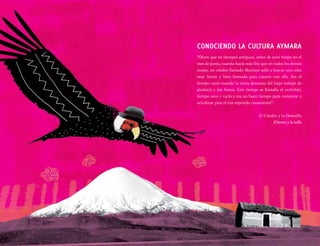
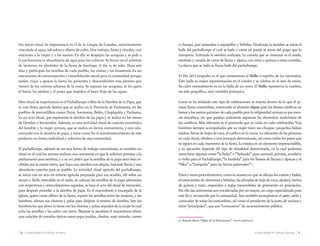
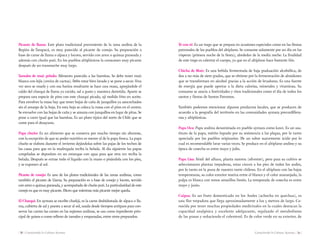
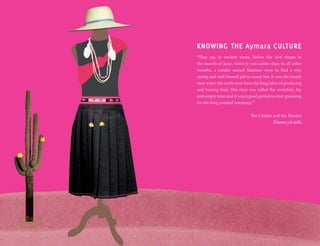
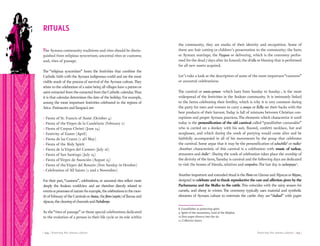
“Dicen que en tiempos antiguos, antes de awti timpo en el
mes de junio, cuando hacía más frío que en todos los demás
meses, un cóndor llamado Mariano salió a buscar una niña
muy fuerte y bien formada para casarse con ella. Era el
tiempo vacío cuando la tierra descansa del largo trabajo de
producir y dar frutos. Este tiempo se llamaba el awtichiri,
tiempo seco y vacío y era un buen tiempo para comenzar a
acicalarse para el tan esperado casamiento”.
El Cóndor y la Doncella
El kuntur y la imilla
CONOCIENDO LA CULTURA AYMARA
Conociendo la Cultura Aymara | 11 || 10 | Conociendo la Cultura Aymara
lutamente esencial que cualquier estrategia de turismo tenga repercusión y
apoyo local en base a valores comunes. Del mismo modo se debe reconocer
el bienestar más allá de lo económico que incluya el bienestar social, cul-
tural, psicológico, espiritual, emocional y físico, todos los cuales dependen
de un medio ambiente saludable. (...) Cualquier estrategia de turismo debe
tener un mensaje común: el patrimonio cultural y natural son indivisibles
y el bienestar y desarrollo de la población no es separable del bienestar y
sustento del medio ambiente”. 1
Este enfoque de integridad entre patrimonio natural y cultural, se correspon-
de con la cosmovisión indígena que hace convivir lo material con lo inmate-
rial, la realidad con la imaginería, lo posible con lo imposible. Son escasos los
instrumentos públicos interculturales que reflejan esta mirada pareciendo
ser los que mejor facilitan la comprensión y la comunicación que se desea
estimular. Esta guía pretende aportar a este desafío.
INTRODUCCIÓN
El turismo cultural se encuentra en fase de crecimiento y el
turismo indígena es parte de él. Se particulariza porque el
turista interesado desea sostener un estrecho contacto con las
poblaciones anfitrionas -comunidades o familias indígenas-,
para conocer sus costumbres presentes y ancestrales. Lo que
seduce de estos viajes es su promesa de paisaje y la oportu-
nidad de diálogo hacia otro tiempo y cultura. Esas experien-
cias nos conducen al propio planeta interior, al de la especie
humana y la riqueza que se adquiere en el turismo indígena,
radica en ese contacto con otras maneras posibles de perci-
bir y construir la realidad. Es un intercambio con grupos de
humanos que han devenido en subalternos en el mapa de las
tendencias dominantes del escenario global pero que poseen
una imaginería esencial, lúdica y cosmos-aldeana que se fun-
damenta en su contacto excepcional con la naturaleza.
La“Guía de diálogo intercultural para el turismo indígena” es
una iniciativa de la Sección de Patrimonio Cultural, Departa-
mento de Ciudadanía y Cultura, del Consejo Nacional de la
Cultura y las Artes, y está destinada a aportar al proceso de in-
tercambio que se genera entre visitantes y anfitriones, cuando
el destino de viaje elegido involucra un contacto entre seres
humanos que provienen de cosmovisiones muy diversas.
El turismo sostenible es una llave que contribuye al desa-
rrollo de realidades socio-económicas desaventajadas, pero
haciendo eco de los aprendizajes de los destinos turísticos
maduros que se han visto dañados por la falta de regulación,
en la actualidad éste se focaliza en la autogestión y la cus-
todia de valores compartidos, en manos de las propias co-
munidades y sus familias. “Para entregar bienestar es abso-
1. Robyn Bushell, Juan F. Salazar. 2009. Estudiodeprefactibilidad.TurismoIndígenaenSanPedrodeAtacama. Cen-
tro de Investigaciones Culturales, Universidad de Western Sydney, Australia. Página 42.
Conociendo la Cultura Aymara | 13 || 12 | Conociendo la Cultura Aymara
rias debieron ser nómades y centrarse en el trabajo de caza, recolección y sólo
más tarde, en el ganadero y de cultivos, que sumado al funcionamiento de
redes de tráfico caravanero y a la creación de manifestaciones artísticas como
el arte rupestre, trajeron al presente indicios de un sistema social complejo y
culturalmente diverso, a pesar de las agrestes condiciones del entorno.
CARACTERÍSTICAS GENERALES
La zona de asentamiento de la cultura aymara2
en el terri-
torio chileno se extiende de norte a sur, desde la frontera
con Perú y Bolivia y hasta el sur de Tarapacá. De oeste a
este (costa a cordillera), lo hace entre las cotas 0 y los 4500
metros de altura sobre el nivel del mar. La fuerte pendiente
de este declive es una característica esencial de su territo-
rio que además involucra la presencia de un paisaje inten-
samente desértico. En ambos extremos, una característica
común es que el agua y los recursos son escasos. Solo allí
donde están los bofedales, los oasis y los valles, están los
recursos y el agua.
En el segmento costero, de norte a sur, el paisaje sigue sien-
do muy árido y el tramo entre Arica y Pisagua alberga valles
y quebradas. Estas mismas características se extienden por
el norte más allá de la frontera peruana. Acá los ríos llegan al
mar, creando espacios en sus desembocaduras, con una gran
variedad de recursos vegetales y animales. En el siguiente
tramo, con la sola excepción de la desembocadura del Loa
-que desagua tenue y sinuosamente al Pacífico-, entre Pisa-
gua y Chañaral, no hay ríos que lleguen al mar. Por lo tanto,
las primeras poblaciones debieron aprovechar las aguadas
que son vertientes que provienen de los faldeos cordillera-
nos por debajo de la tierra, para lograr sobrevivir. En este
mismo segmento de territorio, desaparecen los valles bajos
y emergen los oasis que es el agua en forma de afloramiento.
Al sur de Tarapacá, están los de Pica y Matilla. Así el agua es
evidentemente un factor determinante para esta cultura.
En el paisaje de puna o altiplánico, las comunidades origina-
2. Para textos en castellano se aconseja no utilizar la grafía aymara porque no se
ajustan a las reglas ortográficas del español actual. http://buscon.rae.es/dpdI/
SrvltConsulta?lema=aymara
Conociendo la Cultura Aymara | 15 || 14 | Conociendo la Cultura Aymara
Para la visión aymara, el campo con toda su biodiversidad
tiene calidad y rango de cuerpo vivo: la Santa Madre Tierra,
Pachamama, es generadora de flora, fauna y humanos.
La marka, como centro del espacio aymara, forma una unidad
vital con su entorno. Centro habitacional, medio laboral agro-
pecuario y periferia silvestre conforman el akapacha,“este mun-
do nuestro”, que está a su vez ubicado entre el mundo de arriba
o arajpacha que comprende sol, luna, vía láctea, lucero y otras
estrellas, junto al cielo su corte de santos, ángeles y vírgenes. Y
el mundo de abajo o manqhapacha que comprende el espíritu de
las minas, diablos y condenados, por lo que se asocia a lo ne-
fasto, lo malo, la oscuridad y rebeldía. Mundos que encuentran
su punto de equilibrio o encuentro tenso y fértil llamado tinku.
La complementariedad dual es otro componente de la cos-
movisión aymara y se basa en la pareja divina como principio
fundamental. En este espacio, protegido por los cerros -como
guardianes divinos-, nace el equilibrio y la reciprocidad entre
el hombre, la mujer y su entorno.
Sus cultos se articulan en torno a tres divinidades claves que
representan esta centralidad de la naturaleza-vida-divinidad:
el Mallku (espíritu de las montañas que circundan sus pue-
blos); la Pachamama (madre tierra, cuyo culto se realiza en la
zona altiplánica) y, Amaru (la serpiente que se liga a la eco-
nomía de las aguas de los ríos y canales en la zona agrícola).
El culto a estas tres deidades representa la más antigua cele-
bración de los aymara de la actualidad y en la que el jefe de
familia, el más antiguo y depositario de la tradición, es el que
oficia de celebrante3
.
COSMOVISIÓN
Mallku se asocia a los cerros a los que adjudican cualidades de protección y de
castigo. Representa la fuente de la vida, pues de sus cumbres, en épocas de
deshielo, cae el agua tan preciada en este territorio.
Más abajo, en el altiplano mismo, el reino es de la Pachamama, la que suele rela-
cionarse con la fertilidad exuberante, los alimentos y la protección. Pachama-
ma sería una categoría cósmica de tiempo y espacio, que mantiene un vínculo
de correspondencia y reciprocidad con la sociedad aymara. En verano meri-
dional (enero o febrero), la fiesta del Floreo de los Llamos es un regocijo para
los corrales del ganado que reciben ofrendas que refuerzan el agradecimiento
a la deidad por el alimento. Desde el punto de vista iconográfico, el puma, el
lagarto o el sapo son los animales que indistintamente simbolizan este halago a
la naturaleza y sus otros habitantes. Los motivos principales de demanda para
esta divinidad se relacionan con la abundancia de la vida, el agua, la fertilidad
y la prosperidad del ganado.
Por su parte Amaru tiene que ver con el agua que corre por los ríos y vertientes
en la precordillera y que la hacen apta para la agricultura.
El pez y la serpiente son los animales que simbolizan a Amaru y su fiesta, en
el mes de agosto, consiste en la limpieza de los canales que se lleva a cabo en
los campos regados.
Así, los cultos a las divinidades tienen su expresión en la percepción del
espacio de los aymara: las altas cumbres, la cordillera para el pastoreo y su
agricultura de complemento y los valles y quebradas de la precordillera con
su agricultura de terrazas. Pero la mirada esté siempre en el oriente donde
ellos identifican que se origina todo, la luz y el nacimiento del agua que
brota de las montañas.
No existe en la concepción aymara la idea de un edén y de un paraíso final.
Es un mundo en el que la presencia de estas deidades participa diariamente
en la vida, una que es cíclica. “Partiendo de la idea de la eterna repetición
de los ciclos de la vida y la naturaleza, y de la eficacia de observar fielmente
3. Bernardo Guerrero en “El culto de los aymaras en el Norte de Chile. Extraído
en Agosto de 2011 de la página web: http://www.nuestro.cl/biblioteca/textos/
guerrero_aymara2.htm
| 16 | Conociendo la Cultura Aymara Conociendo la Cultura Aymara | 17 |
las fiestas y costumbres, el aymara pretende sostener ritualmente la con-
tinuidad del cosmos y de la comunidad; la prosperidad y la reproducción
permanente del ganado, la perpetuidad de la vegetación y la chacra, la
transición de verano a invierno y de invierno a verano y así asegurarse de
una existencia duradera y tranquila. Concibe el tiempo como un ciclo de
vida -la vida de la pachamama o madre tierra- y como un ciclo delicado,
frágil y detalladamente articulado”. El valor económico supremo es el Buen
Vivir o “Suma Qamaña”4
.
Existe una identificación socio-afectiva y empírica de los aymara migrantes a
las urbes con sus orígenes, dimensión que se actualiza a través de la celebración
religiosa de los santos patronos de los pueblos, donde muchos de los habi-
tantes urbanos suben al altiplano. Las festividades permiten renovar la apre-
ciación y vinculación material y simbólica con un paisaje sagrado, siendo las
peregrinaciones en torno a cerros sagrados y apachetas de precordillera, cordi-
llera y altiplano una de las manifestaciones más elocuentes de estos procesos.
Al mismo tiempo, lo rural –entendido ahora como agrícola-ganadero- continúa
cumpliendo funciones de producción y circulación económica que conecta a
los aymara con la macroregión norte de Chile, a la vez que ha permitido de-
sarrollar prácticas expresivas que han permitido ritualizar estas actividades en
la ciudad.
Por su parte en los valles y la costa, las momiasChinchorro nos sugieren una arraigada
creencia en otra vida y es una manifestación muy temprana de experiencia reli-
giosa y representación artística de las poblaciones pre cerámicas andinas. ”(...)
es un cuerpo donde se detuvo el proceso de putrefacción, los preparadores fune-
rarios remueven los órganos internos y agregan sustancias como sales o humo
para minimizar las actividades bacterianas. El esqueleto del individuo quedaba
al descubierto para luego reforzar con maderos a lo largo de sus piernas, bra-
zos y columna vertebral. El cuerpo en su superficie era remodelado con arcilla
en ocasiones revestido con la piel del mismo individuo u otro tipo de piel, por
ejemplo de aves marinas, para finalmente ser cubierto de pigmentos naturales.
El rostro era remodelado con una máscara de barro y sobre la cabeza se agregaba
una peluca confeccionada posiblemente con el mismo cabello del individuo”5
.
Esta práctica -abandonada hacia el 3.700 a.p.- fue reemplazada por un sistema
funerario de las poblaciones post–Chinchorro en la que los muertos eran enterra-
dos en una posición flectada y se momificaban naturalmente debido a la acción
desecante del desierto.
Las creencias de la población que baja desde el altiplano, va sumándose a las
creencias de los del valle. Los primeros vienen fuertemente influenciados por
la cultura Tiawanaku y una de sus huellas espirituales y artísticas para este
periodo de contacto, es Wiracocha oTunupa, descrito como un personaje dota-
do de poder sobrenatural, alto, de cabello corto, vestido a la usanza de los
sacerdotes y astrónomos con túnica y bonete de cuatro puntas. Vinculado a
sacrificios humanos, su imagen comienza a llegar primero en los tejidos. Por
lo tanto, la convivencia de pescadores-recolectores en pos de un proceso agrí-
cola, con población altiplánica, no sólo fue para lograr tener acceso a los pro-
ductos de los valles y la costa, e intercambiar tecnologías, sino que además
introdujo una nueva ideología, con otras creencias. La mixtura productiva y
espiritual es visible en los artefactos que acompañan las fosas mortuorias. En
el caso de los adultos las ofrendas son sus instrumentos de trabajo, muchas
pesas, arpones, anzuelos, chopes para extraer mariscos, bolsas y redes, y eso
devela que la economía de estas poblaciones seguía muy ligada a la pesca y
recolección marina. En otros casos aparecen en estos entierros objetos liga-
dos a la agricultura, palos cavadores, cuchillos y hachas líticas hechos de pie-
dra muchos productos agrícolas, maíz, pallar, pacae, papa, camote, calabaza,
mandioca, quínoa, como los más frecuentes; acompañan o sostienen estos
productos piezas de cerámica o cestería. En el caso de los niños, las ofrendas
son animales, adornos como collares y pulseras de fibra vegetal en las muñe-
cas y en los tobillos.
4. Juan van Kessel, 2006.
5. Catálogo de la exposición“Pescadores de la niebla. Los changos y sus ancestros”. 2008. Museo Chileno
de Arte Precolombino. Fundación Familia Larraín Echenique. Ilustre Municipalidad de Santiago.
Conociendo la Cultura Aymara | 19 || 18 | Conociendo la Cultura Aymara
Las evidencias de los primeros asentamientos humanos muestran;
pescadores en la costa y habitantes de campamentos en los valles.
Datan de 11.000 años y para entonces son nómades y viven de la
recolección, la pesca y caza. Entre los vestigios más antiguos, están
los de la quebrada de Acha, la que va a dar al valle de Azapa. Éste
es un importante sitio arqueológico que remite a 10.000 años de
antigüedad y sus huellas develan asentamientos con construccio-
nes que se caracterizaron por una planta circular y un fogón central
dondesepresumequecomían,preparabansuspuntasylanzaspara
la cacería y la pesca.Tenían postes para sostener la cubierta que les
daba un aspecto cónico a las casas. También se cree que hicieron
uso esporádico de estos recintos porque migrarían a campamentos
en la costa para complementar la dieta del valle. La experimenta-
ción agrícola en estas tierras comenzó recién hace tres mil años y se
mantuvieron las prácticas de la cacería, la recolección y la pesca. La
dieta que proveían los sectores cenagosos de los valles y las desem-
bocaduras de los ríos, eran semillas, raíces y frutos comestibles de
las plantas silvestres. También hay claros indicios de la producción
de maíz, yuca, camote, poroto y ají, entre otras especies. El inte-
rés que despertó esta nueva forma de obtener alimentos, provocó
un desplazamiento más estable de sus viviendas hacia los valles y
el inicio de una vida semi sedentaria, trasladando materiales de la
costa como huesos de mamíferos marinos, principalmente lobos de
mar y cachalotes. Estas nuevas viviendas estaban siempre próximas
a los cursos de agua; en Lluta, Azapa y Camarones. Esta nueva vida
les permitirá comenzar a experimentar con el tejido por medio del
uso de algunas especies como el junco, el junquillo, la totora y el
algodón con los que confeccionan cestas y esteras para descansar y
otros artefactos complementarios a la caza o incluso para sus indu-
mentarias y vestuario.
Estarelativaquietudlesotorgócondicionesparalaexperimentación
con la arcilla, la que les va a permitir cocer sus primeras piezas con
HISTORIA
cierto éxito y comenzar una fase alfarera. Esta tecnología va a ser complementaria a
la agricultura porque gracias a los cacharros podrán almacenar y transportar líquidos
y alimentos. Las familias se incorporan de lleno a las nuevas actividades, generando
herramientas como palos con puntas aguzadas que sirvieron para roturar la tierra y
hacen surcos de cultivo. Son, las primeras tecnologías para el trabajo agrícola.
A partir del 500 y hasta el 1000 d.C.. y con este estadio de desarrollo de consolidación
de la vida aldeana, se observa con claridad la llegada e influencia de culturaTiwanaku
proveniente del lagoTiticaca. Sus habitantes tomaron contacto con los del altiplano
y particularmente con los que habitaban en los valles cerca de la costa, como los de
Lluta, Azapa, Camarones, y con otros valles de la sierra o precordillera, como los de
Socoroma, Codpa, Tarapacá y el oasis de Pica. La red de intercambios intensificada
para la obtención e intercambio de recursos, persistió en el tiempo, generando una
complementariedad económica con otras zonas ecológicas permitiendo que cada
una de las comunidades establecidas en los diferentes pisos altitudinales, tuviera ac-
ceso a recursos que no producían en su medio ambiente. Se genera así una economía
mixta de productos agrícolas y del mar que traerá inevitable influencia cultural. Este
intercambio económico muestra niveles de afectación cultural mayores hacia el sur,
particularmente en el oasis de Pica donde se han encontrado cráneos deformados o
modelados, cerámica y textilería, keros (vasos ceremoniales), gorros de cuatro pun-
tas, cucharas de madera, entre otros, pero todos de clara influenciaTiwanaku.
A partir del 1000 d.C., el intenso intercambio permitió que la cultura aymara apren-
diera a hacer un uso eficiente de los recursos existentes en los distintos pisos ecológi-
cos.Enlosasentamientos,laagriculturafuemejoradacontecnologíascomolasterra-
zas, los canales de regadío y el uso de guano de aves marinas como abono.Todo este
tráfico de mercancías generó la necesidad de un conocimiento acabado del desierto.
Para los grandes desplazamientos se necesitaban señales que demarcaran sitios estra-
tégicosquecontabanconagua,refugioypastos.Éstosfueronseñalizadoscongeoglifos,
generándose una verdadera cartografía artística en los cerros, la que permitiría su
visualización a larga distancia.
Gracias a éste y a los otros conocimientos consuetudinarios sobre el vivir en el
desierto, cuando comienza la explotación del caliche, los primeros cateadores o
buscadores deben haber sido hombres de los valles de Tarapacá y Camiña porque
| 20 | Conociendo la Cultura Aymara Conociendo la Cultura Aymara | 21 |
conocían las bondades del caliche mucho antes de la explotación salitrera. De he-
cho, los agricultores de estos valles serranos raspaban el caliche para usarlo como
abono en sus cultivos; aún hoy, todavía es posible ver campesinos aymara que
bajan a las abandonadas salitreras a buscarlo para sus sembradíos. Una vez estable-
cidas las oficinas salitreras, parte de la población aymara se empleó en ellas -como
trabajadores temporales o permanentes, o como vendedores de sus productos agrí-
colas originados en los valles serranos.
A mediados del siglo XIX se crea el puerto de Iquique para la exportación
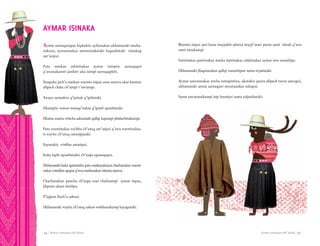
del salitre. El puerto y la pampa y sus oficinas salitreras, así como los valles
interiores, harán comunidad administrativa y económica, generando un polo
de atracción que irá vaciando paulatinamente los poblados del altiplano como
resultado de la notoria migración hacia los pueblos de la pampa. La incorpora-
ción al ciclo salitrero condujo a un ajuste estructural de la economía y sociedad
aymara, no tanto porque los cambios tecnológicos fueran muy profundos, sino
por la reorientación de la producción.
A fines del siglo XIX, un evento de orden geopolítico –aunque de origen eco-
nómico-, va ha incidir en la población aymara y sus territorios: la Guerra del
Pacífico (1879-1883). Hasta antes de ella, la zona que hemos descrito pertenecía
a la República del Perú. Las poblaciones indígenas de Arica y Tarapacá se man-
tuvieron al margen de esta guerra, pero al término de ella, su territorio quedó
dividido entre tres estados que se esforzaron por conformar 3 naciones cultura-
les diversas.“La chilenización dejó huellas en la identidad del aymara de Arica
y Tarapacá. Sin duda, esta ideología nacionalista fue asimilada, al menos en lo
formal, por la población indígena, y constituyó el sustento que legitimó las
fuerzas exógenas que desencadenaron las transformaciones que tuvieron lugar
en las primeras décadas, pero que luego de algunas generaciones, se asimila-
ron algunos elementos de la cosmovisión occidental”6
. Este proceso no estuvo
exento de abusos y enormes prejuicios racistas que están documentados.
Durante todo el siglo XX el territorio de los aymara se ha visto afectado cultural,
política, demográfica y económicamente. Pero son la transformación productiva y
la creación de nuevos asentamientos humanos asociados a ella, los factores que han
determinado los cambios en sus formas de vida tradicionales. Los hizo pasar de eco-
nomías domésticas a economías mixtas y en el lapso de apenas unas décadas, los
introduce en el uso de la moneda, el trabajo asalariado y la prestación de servicios
quenuncaanteshabíandesarrollado.Enlaactividadagrícoladelascomunidades,las
nuevasdemandasdeabastecimientoobligaronareorientarloscultivosyaaumentan
la producción de ciertas especies por sobre otras, en especial, las más demandadas
en los enclaves mineros y en los puertos. Estas formas de producción no tradicional,
condujeron a la competencia de dos sistemas económicos y de vida, muy diferentes
entre si y que conviven hasta la actualidad.
Es este cambio el que genera una des-ruralización de la vida aymara:“En la medida
que la economía aymara se acomodaba y transformaba según los avatares de los
procesos económicos y sociopolíticos regionales y, en la misma medida que su
población cambiaba los patrones de movilidad, inaugurando las migraciones defi-
nitivas al desierto y los centros urbanos costeros, la propia condición campesina de
esas economías se modificó”7
. Hoy se reconoce que la alta presencia andina urbana
ha generado un evidente cambio cultural que hace de los aymara un grupo humano
más complejo y heterogéneo y que no obstante, presenta importantes continuida-
des con sus tradiciones. Es por ello que los pueblos indígenas en la actualidad han
avanzado en reivindicaciones basadas en principios jurídicos multiculturales. Le
demandan al Estado de Chile, sus necesidades insatisfechas de servicios e infraes-
tructura, pero al mismo tiempo piden mayor respeto por su condición de pueblos
autónomos con cultura propia, el reconocimiento de los derechos colectivos y un
desarrollo con identidad.
7. Ídem. Volumen I, Primera parte: “Los pueblos indígenas del norte. El pueblo aymara. Comunidades
aymara, minería y reajustes en las economías tradicionales”.
6. Informe de la Comisión verdad histórica y nuevo trato. 2003. Volumen I, Primera parte: “Los pue-
blos indígenas del norte. El pueblo aymara. 5. La ocupación chilena en territorios aymara. 5.1. Las
primeras políticas del Estado chileno y la chilenización”.
Conociendo la Cultura Aymara | 23 || 22 | Conociendo la Cultura Aymara
En el 7.000 a.p. por su parte, grupos de pescadores desarrollaron para sus
muertos la sofisticada técnica de la momificaciónartificial que es otro de los sím-
bolos de la cultura aymara subyacente al territorio chileno actual. Ésta per-
duro por casi 4.000 años por lo cual la cultura Chinchorro cuenta con gran
cantidad de ellas diseminadas a lo largo del litoral del extremo norte y su foco
se habría iniciado en las desembocaduras de los valles de Azapa y Camarones.
TERRITORIO, SITIOS Y SÍMBOLOS
DE SIGNIFICACIÓN CULTURAL
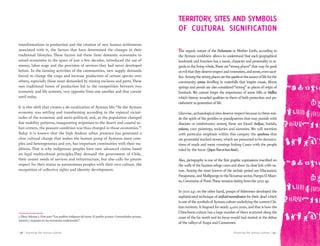
El carácter orgánico de la Pachamama o Madre Tierra, de
acuerdo a la Cosmovisión aymara permite comprender que
cada hito geográfico tenga nombre y función, su carácter
y personalidad respecto del conjunto vivo. Hay “lugares
fuertes” que pueden ser benéficos o maléficos que mere-
cen respeto y veneración, y algunos, sacrificio. Entre los
lugares fuertes se cuentan los uywiris o fuente de la vida
para la comunidad, serenos asentados en las caídas de agua
y que inspiran la música. Ríos, fuentes y lagunas también
son considerados “fuertes” por ser lugares de origen del ga-
nado. No se nos pueden olvidar la importancia de algunos
cerros o Mallkus que por su historia se les adjudica cualida-
des tanto de protección y castigo como de generación de
la vida.
Igualmente, los lugares arqueológicos merecen respeto por-
que se encuentra en ellos el espíritu de los gentiles o abuelos
que pueden castigar con enfermedades o desgracias; dentro
de estos encontramos chullpas, enterratorios, pukaras, pintu-
ras rupestres, roquedales y cumbres. Mencionaremos con
especial énfasis dentro de esta categoría a las apachetas que
son apilamientos piramidales de piedras, que se les presume
un uso de demarcación de caminos y ramales de la ruta que
unía el Cusco con las poblaciones gobernadas por los incas
(Qapac Ñan o Camino del Inca).
Asimismo, la pictografía es una de las primeras expresiones
gráficas inscritas en los muros de las cavernas de refugio de
cazadores y que muestran su estrecho vínculo con la natu-
raleza. Entre los sectores más conocidos del periodo arcaico
están: Vilacaurani, Patapatane, Mollipungo–sector de Tic-
namar, Pampa El Muerto–Comuna de Putre. Los vestigios
dataría del 5000 ap.
Conociendo la Cultura Aymara | 25 || 24 | Conociendo la Cultura Aymara
JERARQUÍA SOCIAL CLÁSICA
En la actualidad, la población indígena urbana no replica
las antiguas formas de representación local, dando espacio
a la institucionalidad moderna y común a cualquier orgánica
jerarquizada de carácter ciudadano. Por ejemplo, la de Presi-
dente de una Junta deVecinos o la orgánica de representación
que define la Ley Indígena que reconoce la figura jurídica de
la comunidad indígena pero no respeta las denominaciones
originarias de autoridades comunitarias tradicionales, ni se
abre a la posibilidad que se rescaten algunos de los roles que
aún tienen sentido y funcionalidad. Con el proceso de chile-
nización, la identidad cultural se ha visto resentida incluso
en las localidades rurales donde las autoridades tradicionales
prácticamente han desaparecido, salvo las asociadas a ritua-
les específicos.
De la lista de roles tradicionales de representación, autoridad
o responsabilidades sociales en la cultura aymara, sólo algunos
de ellos persisten y se pueden encontrar en las comunidades
rurales. Estos son:
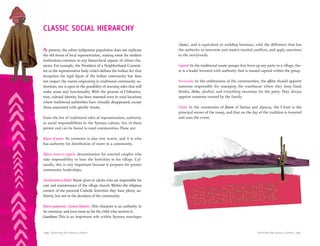
Alcalde de agua: Su existencia también es muy escasa, y es el que
tiene autoridad para el reparto del agua en una comunidad.
Alferez, pasante o capitán: Se le denomina así a los matrimonios
que asumen la responsabilidad de ser los anfitriones de las fies-
tas en su pueblo. Culturalmente, esto es muy importante porque
va preparando para los liderazgos comunitarios mayores.
Fabriquero o Mayordomo: Se le denomina así a los adultos que
son los encargados de cuidado y mantención de la Iglesia del
pueblo. Dentro del contexto religioso de las fiestas patronales
católicas tienen bastante autoridad, no así en las decisiones de
la comunidad.
Padrinos de corte de pelo (Bautizo Aymara): Este personaje es autoridad en
su fiesta y con mayor razón para el niño que recibe.
Tutores: Este es un rol importante dentro de los matrimonios aymara (Sarta),
es el equivalente a un padrino de matrimonio, con la diferencia que posee au-
toridad para intervenir y resolver conflictos matrimoniales, y aplicar sanciones
a los nuevos novios.
Caporal: En los grupos de música tradicional que amenizan toda fiesta en un
pueblo, existe un líder llamado caporal que se enviste de autoridad dentro
de su grupo.
Despenseros: En las fiestas de las comunidades, los alférez deben nombrar a
alguien encargado de administrar la bodega donde se encontrará los alimentos,
bebidas, chicha, alcohol, y todo lo necesario para la fiesta. Siempre se designa
a alguien de confianza de la familia.
Citani: En las ceremonias de floreos de llamas y alpacas, el Citani es el
dueño principal de la tropa, y que en el día de la tradición se enviste y
dirige el evento.
Conociendo la Cultura Aymara | 27 || 26 | Conociendo la Cultura Aymara
A diferencia de Bolivia, la chilenización redujo a la mar-
ginalidad las prácticas habituales de la medicina ancestral
aymara. Lo que se puede rescatar es la farmacopea herbo-
laria, tanto en zonas rurales como en las ciudades donde
se conserva un vínculo fluido con las comunidades rurales
y principalmente a través de los mercados de productos
naturales. Normalmente son las mujeres quienes portan
estos conocimientos.
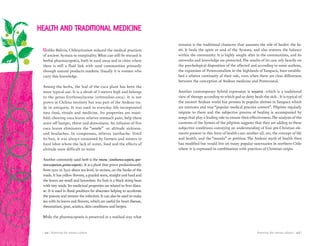
Entre las herbóreas, la hoja de la planta de coca ha sido
la de uso más característico. Es un arbusto de 3 metros de
altura y pertenece a la familia de las eritroxiláceas (eritroxi-
lon-coca). No se cultiva en territorio chileno pero formó
parte de los intercambios andinos en la antigüedad. Se
usaba en la vida cotidiana incorporada a la alimentación,
los rituales y la medicina. Sus propiedades son múltiples:
masticar hojas de coca calma el dolor de estómago, ayuda
a resistir el hambre, la sed y la somnolencia. Una infusión
de cinco hojas de coca elimina el “soroche” -o mal de
altura- así como el dolor de cabeza. En compresas, alivia
el dolor de muelas. Hasta su prohibición, desde siempre
fue consumida por campesinos y mineros en sus trabajos
difíciles para resistir la falta de agua, de comida y los
efectos de la altura.
Otra hierba de uso común es la retama (sorathamus scoparia,
spartium scoparium, genista scoparía). Es una planta que crece
predominantemente desde los 2500 a 3500 sobre nivel del
mar, en quebradas, a las orillas de los caminos. Tiene flores
amarillas, el tallo es nudoso, erguido y duro y las hojas son
pequeñas, lanceoladas. Su fruto es una vainita negra con
semilla diminuta. Sus propiedades medicinales se relacio-
nan con las enfermedades hepáticas. Se utiliza en forma de
cataplasmas florales para los abscesos ayudando acelerar el
SALUD Y MEDICINA TRADICIONAL
proceso y expulsar la infección. También se pueden hacer infusiones con
sus hojas y flores, las que son útiles para las enfermedades del corazón,
reumatismo, gota, ciática, afecciones a la piel y herpes.
Si bien la farmacopea se conserva de manera residual, lo que pervive es el
personaje tradicional que asume el rol de sanador: el Yatiri. Sana el espíritu
o el alma del aymara, y también restablece los equilibrios dentro de la
comunidad. Es muy buscado en las comunidades, sus redes y sus cono-
cimientos son resguardados. Los resultados de sus atenciones dependen
mucho de la disposición psicológica del afectado y según algunos autores,
la expansión del pentecostalismo en el altiplano de Tarapacá, ha permitido
establecer una relativa continuidad de su rol, aún cuando hay claras dife-
rencias entre la concepción de la medicina andina y la pentecostal.
Otra expresión híbrida contemporánea, es la teoyatría -que es una visión
tradicional de la terapia según la cual dios o la divinidad sana al enfermo-,
es propia de la antigua cosmovisión andina pero persiste en los santuarios
populares de Tarapacá que son mixturados y verdaderos “centros de prác-
tica médica popular”. Los peregrinos emigran regularmente hacia ellos y
el proceso subjetivo de sanación se acompaña de cantos que juegan un rol
protagónico para lograr su eficacia. El análisis del contenido de los him-
nos de los peregrinos sugiere que éstos incrementan estas condiciones sub-
jetivas transmitiendo la comprensión de cuatro elementos pre-cristianos
presentes en esta forma de cuidado de la salud: la madre-todo, el pecado,
el concepto de vida y salud, y la “manda”. El mito andino de la salud en-
tonces, se ha modificado, pero estaría vivo en muchos santuarios populares
del norte de Chile donde se expresa de manera combinada con prácticas de
origen cristiano.
Conociendo la Cultura Aymara | 29 || 28 | Conociendo la Cultura Aymara
Las tradiciones y ritos comunitarios aymara deben distinguirse entre
sincréticos religiosos; costumbres o ritos ancestrales y, ritos de pasaje.
El“sincretismo religioso” alberga las festividades que combinan la
fe católica con la cosmovisión indígena aymara, y son el resultado
más visible del proceso de sobrevivencia de la cultura aymara. Se
vinculan a la celebración de un santo ya que todos los pueblos
poseen un patrón o patrona extraído del santoral católico. De esta
manera es ese calendario el que determina la fecha de la festivi-
dad. Por ejemplo entre las festividades más importantes que se
celebran en las regiones de Arica – Parinacota yTarapacá tenemos:
• Fiesta de San Francisco de Asís (4 de Octubre)
• Fiesta de la Virgen de la Candelaria (2 de Febrero)
• Fiesta de Corpus Cristi (24 de Junio)
• Festividad de Semana Santa (Abril)
• Fiesta de las Cruces (1 al3 de Mayo)
• Fiesta de Espíritu Santo
• Fiesta de la Virgen del Carmen (16 de Julio)
• Festividad de San Santiago (25 de Julio)
• Festividad de la Virgen de Asunción (15 de Agosto)
• Fiesta de laVirgen del Rosario (Primer Domingo de Octubre)
• Celebración de Todos los Santos (1 y 2 de Noviembre)
Por su parte las“costumbres”, celebraciones o ritos ancestrales re-
flejan de manera más profunda la cosmovisión andina y por ello
están en directa relación con eventos o procesos de la naturaleza.
Por ejemplo, las celebraciones en el mes de febrero de los Carnavaleso
Anatas, elfloreo(wayñu)dellamasyalpacas,lalimpiadecanalesyelPachallampe.
En tanto, los“rituales de paso” o aquellas celebraciones particu-
lares dedicadas a la evolución de una persona en su ciclo vital o
en su rol dentro de la comunidad, van marcando su identidad y
reconocimiento. Algunos son, el Corte de pelo o presentación de
RITOS
niños a la comunidad; la Sarta o matrimonio aymara; la Paygasa, o Despacho que es
la ceremonia que se realiza a los difuntos 7 días después de su funeral; la ch’alla o
bendición que se realiza para todos los bienes nuevos que se adquieren.
Nos detendremos en la descripción de algunas de las más importantes “cos-
tumbres” o celebraciones ancestrales:
El carnaval o anataaymara -que dura de domingo a domingo-, es la más extendida de
las festividades en la comunidad andina. Está íntimamente ligada a las chacras ya
que se celebra su fertilidad, por este motivo es muy común que durante la fiesta los
hombres y las mujeres carguen un awayu o llicllla en sus espaldas con los mejores
productos de su cosecha. Actualmente se halla llena de concepciones cristianas mix-
turadas a las prácticas propiamente aymara. Los elementos que la caracterizan hasta
el día de hoy es la personificación del carnaval en un viejo llamado “abuelo carna-
valón” que es transportado en un burro con su terno, enharinado, challas al cuello,
sombrero y gafas, y que durante la semana de fiesta cobrará vida y será fielmente
acompañadoentodossusdesplazamientosporelgrupoquecelebraelcarnaval.Algu-
nos sostienen que puede ser la personificación de un achachilla 8
ómalku9
. Otro aspecto
característico de este carnaval es la celebración con música de tarkas, las serpentinas
y la challa10
. Durante la semana de festividad se realiza el culto de la divinidad de la
chacra, el martes es de carnaval y días siguientes se dedican para visitar las casas de
amigos, parientes y compadres. El último día es de cacharpaya11
.
Otro de los importantes y extendidos rituales es el Floreo de Llamas y Alpacas o
Wayñu, destinado a celebrar la reproducción y a agradecer el cuidado y cariño que
han tenido la pachamama y el Mallku hacia el ganado. Esto coincide con la época de
lluvias en los camélidos, y con el invierno en las ovejas. En la ceremonia se utilizan
normalmente elementos materiales y simbólicos de la cultura aymara para agasajar
al ganado: se les challa con papel y vino, se adornan los animales de acuerdo a su rol e
importancia dentro de la“tropa” con aretes que fabrican las mujeres el día anterior
y Ch’impu (Lana de color rojo).
8. Abuelo, como espíritu protector.
9. Espíritu de las montañas, señor de las alturas.
10. Papel picado que se lanza al aire.
11. Danza colectiva.
Conociendo la Cultura Aymara | 31 || 30 | Conociendo la Cultura Aymara
Un tercer ritual de importancia es el de la Limpia de Canales, estrechamente
vinculada al agua, salvadora y objeto de culto. Une trabajo, fiesta y rituales, con
oraciones a la virgen y a los santos. En ella se despejan las acequias y se pide a
la pachamama la abundancia de agua para los cultivos. Se hacen en el solsticio
de invierno, en alrededor de la fiesta de Santiago, el día 25 de julio. Dura seis
días y participan las familias de cada pueblo, las visitas y los forasteros. Es un
mecanismo de estructuración y consolidación social para la comunidad porque
suelen viajar a apoyar la faena los parientes y descendientes más jóvenes que
vienen de los centros urbanos de la costa. Se reparan las acequias, se les quita
el barro, las piedras y el pasto que impiden el buen flujo de las aguas.
Otro ritual de importancia es el Pachallampe o Rito de la Siembra de la Papa, que
es una fiesta agrícola festiva que se realiza en la Provincia de Parinacota, en los
pueblos de precordillera como: Putre, Socoroma, Belén, Chapiquiña y Pachama.
Es un acto ritual, que representa la siembra de las papa y se realiza en los meses
de Octubre o Noviembre. Además, es una actividad ritual de carácter económica
del hombre y la mujer aymara, que se realiza en forma comunitaria, y está rela-
cionando con la siembra de papa, y tiene como fin el autoabastecimiento de este
producto en forma individual y colectiva de una comunidad.
El pachallampe, además de ser una forma de trabajo comunitario, es también un
ritual en el cual los aymara realizan una ceremonia en que le solicitan permiso a la
pachamama para sembrar, y a su vez piden que la semillas de la papa sean bien re-
cibidas por la madre tierra, que haya una siembra con alegría, bastante lluvia y una
abundante cosecha para su pueblo. La actividad ritual agrícola del pachallampe,
se inicia con un acto en terreno agrícola preparado para esa ocasión, allí sobre un
awayo o lliclla extendida en el suelo, se colocan las semillas de la papa adornadas
con serpentinas y otros elementos sagrados, se hace el acto del ritual de iniciación,
para después proceder a la siembra de papa. Es el mayordomo o encargado de la
iglesia, quien como alférez de la fiesta, reparte las semillas entre las mujeres, y los
hombres, alistan sus chontas y palas para dirigirse al terreno de siembra. Son los
hombres los que abren la tierra con las chontas y palas, seguidos de la mujer la cual
echa las semillas y las cubre con tierra. Durante la siembras el mayordomo ofrece
una colación de comidas típicas como papa cocidas, chuños, maíz tostado, carnes
o charqui, pan amasados o sopaipillas y bebidas. Finalizada la siembra se inicia el
baile del pachallampe el cual se baila y canta en pareja al ritmo del grupo que lo
interpreta. Imitando la siembra realizada. La comida que se consume es el asado,
estofado y cazuela de carne de llama y alpaca, con arroz o quinua u otras comidas.
La danza que se baila se llama baile del pachallampe.
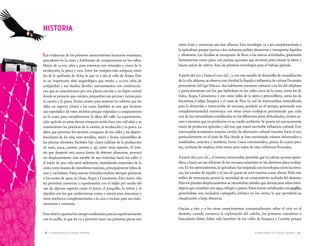
El Día del Compadre es el que conmemora al Mallku o espíritu de las montañas.
Éste halla su mejor representación en el cóndor y se celebra en el mes de enero.
Su culto normalmente es en la falda de un cerro. El Mallku representa la cumbre,
no sólo geográfica, sino también jerárquica.
Como se ha señalado este tipo de celebraciones se inserta dentro de lo que el ay-
mara llama costumbres, reservando el término religioso para las fiestas católicas en
honor a los santos patrones de cada pueblo pero la religiosidad aymara es por esen-
cia sincrética, sin que puedan realmente separarse los elementos autóctonos de
los católicos. Más relevante es el protocolo que se cuida en cada celebración:“Los
hombres siempre acompañados por su mujer traen sus chuspas (pequeños bolsos
tejidos) llenas de hojas de coca, al cuello o en la mano. La ubicación de las personas
en cada ritual, obedece a una jerarquía determinada, así como todos los pasos que
se siguen en cada momento de la fiesta. La música es un elemento imprescindible,
y su ejecución depende del tipo de ritualidad determinada, en la cual podemos
mencionar algunos como“laTarka” o“Tarkeada” para carnaval; guitarra, acordeón
o violín para el Pachallampe,“la bandola” para los floreos de llamas y alpacas y el
“Siku” o“Zampoña” para las fiestas patronales”12
.
Éstos y otros procedimientos, como la manera en que se ofician los cantos y bailes,
el intercambio de alimentos y bebidas, las ofrendas de hoja de coca, alcohol, harina
de quínoa y maíz, responden a reglas transmitidas de generación en generación.
Por ello las ceremonias son encabezadas por un mayor, un cargo especializado para
este fin y reconocido por la comunidad. Son también protagónicos el yatire, sabio y
conocedor de todas las costumbres, así como el presidente de la junta de vecinos y
otros“principales”, que son“comuneros” de reconocimiento público.
12. Rosario Mena.“Hijos de la Pachamama”. www.nuestro.cl
Conociendo la Cultura Aymara | 33 || 32 | Conociendo la Cultura Aymara
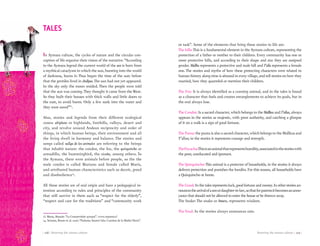
En la cultura aymara los ciclos de la naturaleza y la concepción
circular de la vida son los organizan su visión de la narrativa.
“De acuerdo a la leyenda aymara el actual mundo del sol nace de
un cataclismo mitológico, en el cual el sol, irrumpiendo en el
mundo de la oscuridad, lo incendió: Así comenzó el tiempo del
sol: antes había gentiles que vivían en chullpas. El sol todavía
no había aparecido. En el cielo estaba solamente la luna. Enton-
ces se dijo a la gente que el sol venía. Ellos pensaban que venía
del occidente. Entonces hacían sus casitas con muros gruesos
y puertitas chiquititas al oriente, para no quemarse. Sólo unos
pocos se hundieron en el agua y ellos se salvaron”13
.
Asimismo, sus cuentos y leyendas procedentes de sus diferen-
tes pisos ecológicos: altiplano, precordillera, valles, desierto
y ciudad, y giran en torno a la reciprocidad y orden andino
de las cosas, en el que el ser humano, su entorno y todo lo
vivo habitan en armonía y equilibrio. Los cuentos y canciones
denominadas sallqadelosanimales, están referidos a los seres que
pueblan la naturaleza: el cóndor, el zorro, el quirquincho, el
picaflor, la vicuña, entre otros. Para ellos los animales antes
fueron gentes, por ejemplo el cóndor macho se llama Mariano
y la hembra María, y se les atribuyen características humanas
tales como el engaño, la codicia, la desobediencia14
.
Todos estos relatos son de origen oral y tienen una intención pe-
dagógica de acuerdo a normas y principios comunitarios que aún
sobreviven en las comunidades como“el respeto por lo mayores”,
“respetoycuidadodelastradiciones”y“eltrabajoofaenacomunita-
ria”. Algunos de los elementos que dan vida a los relatos son:
Los cerros: Es un elemento fundamental en la cultura aymara,
representa la protección de un Padre o una Madre a sus hijos.
13. Mena, Rosario.“La Cosmovisión aymara”. www.nuestro.cl
14. Serrano, Bruno et al. 2006.“Parlama Amawt’aña. Cuentos de la MadreTierra”.
RELATOS
Toda comunidad posee uno o más cerros protectores, y de acuerdo a su forma y
tamaño se les asignan género. Mallku representa un cerro protector masculino y
T’alla representa uno femenino. Las historias y mitos de cómo estos personajes
protectores se relacionaron a alguna época de la historia humana abundan en
todos los pueblos, y se señalan historias de como contrajeron matrimonio,
como se pelearon o mencionan a sus hijos.
El Zorro: Siempre se identifica como un animal astuto, y en los relatos lo
encontramos como un personaje que engaña y crea enredos para conseguir
sus objetivos, pero que al final siempre pierde.
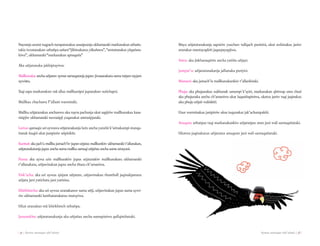
El Cóndor: Es un personaje sagrado, le pertenece a los Mallkus y T’allas, en
los relatos siempre aparece majestuoso, con mucha autoridad, y verlo en
algún paseo es señal de muy buena fortuna.
El Puma: El puma también es un personaje sagrado, que pertenece a los Ma-
llkus y T’allas, en los relatos el representa la valentía, la fuerza.
La Vizcacha: Este es un animal que representa la humildad, en los relatos se
asocia con la gente pobre, sin educación e ignorante.
El Quirquincho: Este es un animal protector de los hogares, en los relatos él
siempre entrega protección y castiga a los bandidos. Por esta razón, es de todos
los hogares tener un Quirquincho en la casa.
El Lagarto: Representa en los relatos la suerte, buena fortuna y el dinero. En otros rela-
tosanuncialallegadadeunyernoounanuera,porloqueparalospadressetransforma
en una molestia que no se debe dejar ingresar a las casas o botarlo.
La Culebra: La culebra o Amaru, representa la sabiduría.
El Sapo: En los relatos siempre anuncia lluvia.
El Halcón: También es un animal de los Mallkus o las T’allas.
Conociendo la Cultura Aymara | 35 || 34 | Conociendo la Cultura Aymara
Las vertientes: Las vertientes riegan lo bofedales, alimentan la agricultura
de los pueblos, son lugares de mucha energía y se les venera mucho a través
de ritos ancestrales, por esta razón en los relatos aparece como que solo está
permitido para ciertas personas y en determinados tiempos, y está prohibido
para otras. Por ejemplo las mujeres embarazadas no se pueden acercar a estos
lugares nunca.
El Perro: También esta presente en todas las comunidades, y se le asocia
con las malas costumbres impropias para la casa y la comunidad. Por esta
razón en los relatos no representa nada bueno cuando a alguien se le asocia
con el perro.
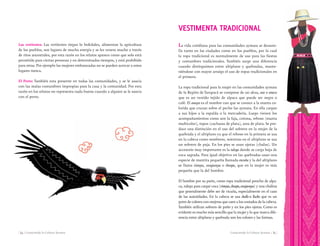
La vida cotidiana para las comunidades aymara se desarro-
lla tanto en las ciudades como en los pueblos, por lo cual
la ropa tradicional es normalmente de uso para las fiestas
y costumbres tradicionales. También surge una diferencia
cuando distinguimos entre altiplano y quebradas, mante-
niéndose con mayor arraigo el uso de ropas tradicionales en
el primero.
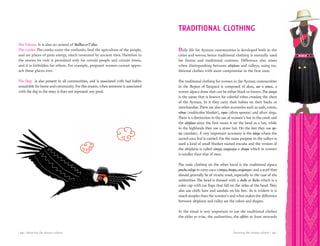
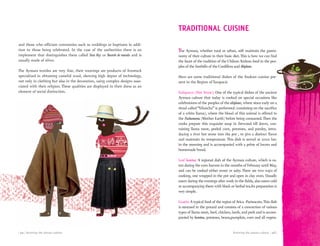
La ropa tradicional para la mujer en las comunidades aymara
de la Región de Tarapacá se compone de un aksu, axo o anacu
que es un vestido tejido de alpaca que puede ser negro o
café. El awayo es el nombre con que se conoce a la manta co-
lorida que cruzan sobre el pecho las aymara. En ella cargan
a sus hijos a la espalda o la mercadería. Luego vienen los
acompañamientos como son la faja, cotona, reboso (manta
multicolor), topos (cucharas de plata), aros de plata. Se pro-
duce una distinción en el uso del sobrero en la mujer de la
quebrada y el altiplano ya que el reboso en la primera se usa
en la cabeza como sombrero, mientras en el altiplano se usa
un sobrero de paja. En los pies se usan ojotas (chalas). Un
accesorio muy importante es la talega donde se carga hoja de
coca sagrada. Para igual objetivo en las quebradas usan una
especie de mantita pequeña llamada encuña y la del altiplano
se llama vistaya, cocajavaya o chuspa, que en la mujer es más
pequeña que la del hombre.
El hombre por su parte, como ropa tradicional poncho de alpa-
ca, talega para cargar coca (vistaya,chuspa,cocajavaya) y una chalina
que generalmente debe ser de vicuña, especialmente en el caso
de las autoridades. En la cabeza se usa chullo o llucho que es un
gorro de colores con orejeras que caen a los costados de la cabeza.
También utilizan sobrero de paño y en los pies ojotas. Como es
evidente es mucho más sencillo que la mujer y lo que marca dife-
rencia entre altiplano y quebrada son los colores y las formas.
VESTIMENTA TRADICIONAL
Conociendo la Cultura Aymara | 37 || 36 | Conociendo la Cultura Aymara
En los rituales es muy importante que tanto los mayores o sabios, las autori-
dades, los alféres o pasantes de fiestas y quienes ofician las ceremonias como
matrimonios o bautizos, además de los propios festejados usen sus ropas
tradicionales. En el caso de las autoridades existe un implemento que los
distingue llamado Tata Rey o Bastón de mando y generalmente es de plata.
La textilería aymara es muy fina, sus tejidos son producto de una actividad
ganadera especializada en la obtención de lana de camélidos, mostrando altos
grados tecnológicos, no sólo en la confección sino además en la decoración,
empleando diseños complejos asociados a su religiosidad. Estas cualidades se
exhiben en su vestuario como elemento de distinción social.
Los aymara, sean rurales o urbanos, aún mantienen en su ali-
mentación básica la gastronomía propia de su cultura. De esta
manera en los pueblos de la Precordillera y Altiplano se puede
encontrar el corazón de la tradición de la comida andina chilena.
A continuación se muestran algunos platos tradicionales de la
cocina andina presentes en la Región de Tarapacá:
Kalapurca (Piedra caliente): Es uno de los platos típicos ances-
trales de la cultura aymara que hoy en día se cocina en ocasiones
especiales como; en fiestas patronales de los pueblos del alti-
plano, donde desde muy temprano se realiza un ritual llamado
“Vilancha” (que es el sacrificio de una llama blanca), donde la
sangre de este animal es ofrecida a la Pachamama (MadreTierra)
antes de ser consumida. Luego las cocineras de desvelan prepa-
rando a leña esta exquisita sopa que contiene carne de llama,
maíz pelado, papas, cilantro, introduciendo una piedra caliente
de río en la olla, para darle un sabor distinto y mantener su tem-
peratura. Este plato se sirve a las 07:00 hrs. de la mañana y va
acompañado con un pebre de locoto y pan amasado.
Humitas en hoja: Es un plato regional de la cultura aymara, que
se come durante la cosecha de choclo en los meses de febrero has-
ta mayo, puede ser cocinado de forma dulce o salada. Existen dos
formas de cocción, una envuelta a la olla y otra abierta en horno a
barro. Generalmente se come durante las tardes después del trabajo
en la chacra, o también se comen frías acompañándolas con té o
agua de yerba. Su receta es muy simple.
Guatia: Es una comida típica de la Región de Arica – Parinacota. Este
plato es cocido al vapor bajo tierra y consiste en un cocimiento de va-
riostiposdecarnesdellama,vacuno,pollo,cordero,cerdoyseacom-
pañadehumitas,papas,habas,camotes,choclosytodaslasverduras
con piel que se cocinan entre las piedras calientes.
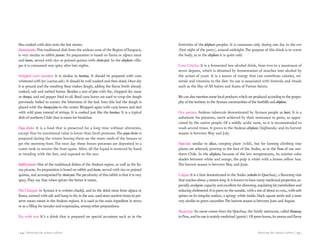
GASTRONOMÍA TRADICIONAL
Conociendo la Cultura Aymara | 39 || 38 | Conociendo la Cultura Aymara
Picante de llama: Este plato tradicional proveniente de la zona andina de la
Región de Tarapacá, es muy parecido al picante de conejo. Su preparación a
base de carne de llama o alpaca y locoto, servido con arroz o quinua graneada y
además con chuño puti. En los pueblos altiplánicos la consumen muy picante
después de un transnoche muy largo.
Tamales de maíz pelado: Alimento parecido a las humitas. Se debe tener maíz
blanco con lejía (ceniza de cactus). Debe estar bien lavado y se pone a secar. Una
vez seco se muele y con esa harina resultante se hace una masa, agregándole el
caldo del charqui de llama ya cocido, sal a gusto y manteca derretida. Aparte se
prepara una especie de pino con este charqui picado, ají molido frito en aceite.
Para envolver la masa hay que tener hojas de caña de junquillos ya sancochados
sin el amargo de la hoja. En esta hoja se coloca la masa con el pino en el centro.
Se envuelve con las hojas de caña y se amarra con junquillos en lugar de pitas. Se
pone a cocer igual que las humitas. Es un plato típico del norte de Chile que se
come para el desayuno.
Papa chuño: Es un alimento que se conserva por mucho tiempo sin alterarse,
con la excepción de que su poder nutritivo es menor al de la papa fresca. La papa
chuño se elabora durante el invierno dejándolas sobre las pajas de los techos de
las casas para que en la madrugada reciba la helada. Al día siguiente las papas
congeladas se depositan en un estanque con agua para que otra vez reciba la
helada. Después se extrae todo el líquido con la mano o pisándola con los pies,
y se exponen al sol.
Picante de conejo: Es uno de los platos tradicionales de las zonas andinas, como
también el picante de Llama. Su preparación es a base de conejo y locoto, servido
con arroz o quinua graneada, y acompañado de chuño puti. La particularidad de este
conejo es que es muy picante. Dicen que mientras más picante mejor queda.
El Charqui: En aymara se escribe charkji, es la carne deshidratada de alpaca o lla-
ma, cubierta de sal y puesta a secar al sol, usada desde tiempos antiguos para con-
servar las carnes las carnes en las regiones andinas, se usa como ingrediente prin-
cipal de guisos o como relleno de tamales y empanadas, entre otros preparados.
Té con té: Es un trago que se prepara en ocasiones especiales como en las fiestas
patronales de los pueblos del altiplano. Se consume solamente por un día en las
vísperas (primera noche de la fiesta), alrededor de la media noche. La finalidad
de este trago es calentar el cuerpo, ya que en el altiplano hace bastante frío.
Chicha de Maíz: Es una bebida fermentada de baja graduación alcohólica, de
dos a no más de siete grados, que se obtiene por la fermentación de almidones
que se transforman en alcohol gracias a la acción de levaduras. Es una fuente
de energía que puede aportar a la dieta calorías, minerales y vitaminas. Su
consumo se asocia a festividades y ritos tradicionales como el día de todos los
santos y fiestas de Santos Patronos.
También podemos mencionar algunos productos locales, que se producen de
acuerdo a la geografía del territorio en las comunidades aymara precordillera-
nas y altiplánicas.
Papa Oca: Papa andina denominada en pueblo aymara como kawi. Es un sus-
tituto de la papa, mérito logrado por su resistencia a las plagas, por lo tanto
apreciada por los pueblos originarios. De un sabor suavemente ácido por lo
cual es recomendable lavar varias veces. Se produce en el altiplano andino y su
época de cosecha es entre mayo y julio.
Papa Lisa: Símil del ulluco, planta rastrera (silvestre), pero para su cultivo se
seleccionaron plantas trepaderas, estas crecen a los pies de todos los andes,
por lo tanto en la puna de nuestro norte chileno. En el altiplano con las bajas
temperaturas, su color exterior matiza entre el blanco y el color anaranjado, la
pulpa es blanca con tonos amarillos limón. La temporada de cosecha es entre
mayo y junio.
Caigua: Es un fruto domesticado en los Andes (achocha en quechua), es
una flor trepadora que llega aproximadamente a los 5 metros de largo. Co-
nocida por tener muchas propiedades medicinales en la cuales destacan la
capacidad analgésica y excelente adelgazante, regulando el metabolismo
de las grasas y reduciendo el colesterol. Es de color verde en su exterior, de
Conociendo la Cultura Aymara | 41 || 40 | Conociendo la Cultura Aymara
un tamaño aproximado a los 20 cms., con suaves espinas en su irregular
superficie, en su interior esponjoso de color blanco, posee semillas negras y
cuadradas, de sabor muy similar al pepino verde. La temporada de cosecha
es entre Juni y Agosto.
Huacatay: Su nombre proviene del Quechua, de la familia de las asteráceas,
en Perú recibe el nombre de Huatacay, y su uso es principalmente medicinal
(gástrico), de hojas verdes, de aroma y sabor particularmente fuerte y sabroso.
La temporada de cosecha es durante todo el año.
Chachacoma: Es una yerba que crece en el altiplano, su nombre proviene del
quechua (chacha=hombre/coma=pobre) utilizada para disminuir la puna, y ade-
más es parte del milenario hervido de la Kalapurka. Su temporada de cosecha
es durante todo el año.
Quinua: Denominado como un seudo cereal, cultivada a lo largo de los an-
des, considerado el alimento del futuro por su alto contenido proteico, se
recomienda lavar muy bien para eliminar el amargo y si se va a consumir
graneada es conveniente tostar antes de lavar, también podemos encontrarla
en formato dulce, confitada. Su temporada de cosecha es entre septiembre
y noviembre.
Locoto: (del quechua Luqutu), su color característico es el rojo variando tam-
bién en amarillo y verde. Se puede encontrar en el comercio en polvo y en
pasta, es de semillas frescas y muy buen sabor y un intenso picor.
Tumbo: Planta trepadora tipo enredadora, crece muy bien en zonas con
altura hasta 4.000 (msnm). Se distribuye a lo largo de los Andes desde el
norte de Chile hasta Colombia. Esta se cultiva principalmente en las zonas
de Camiña y en las comunidades del Alto de Chusmiza, es un fruto ovalado
de corteza amarilla cuando está maduro y su pulpa es anaranjada y de pe-
queñas semillas negras; su sabor es suave, perfumado y ligeramente ácido,
tiene un símil con el maracuyá ya que pertenecen a la misma familia de las
pasifloras. Su temporada de cosecha es de enero a marzo.
Limón de Pica: Cítrico de la localidad de Pica, introducido por los españoles
(1536) y que gracias al microclima de la mencionada comuna logra propiedades
desarrolladas principalmente en su cáscara con su característico sabor y aroma
que marca la diferencia entre sus símiles principalmente de Perú. Cuenta con
denominación de origen. Se caracteriza por su pulpa jugosa, su corteza amarilla
y perfumada. Su temporada de cosecha es durante todo el año.
Aceituna de Azapa: Producto de la zona norte de Chile a punto de obtener
denominación de origen gracias a las cualidades que logra al salir al mercado,
de un color morado y un particular sabor amargo, y muy buenos calibres. La
temporada de cosecha es entre mayo y junio.
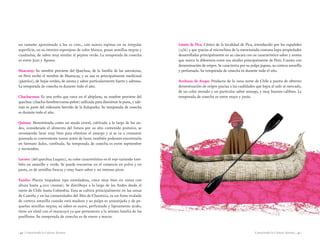
Conociendo la Cultura Aymara | 43 || 42 | Conociendo la Cultura Aymara
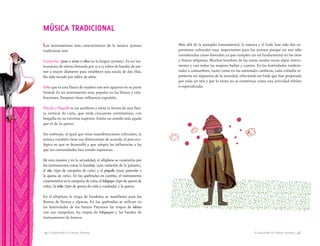
Los instrumentos más característicos de la música aymara
tradicional son:
Zampoñas (pusa o sicura o sikus en la lengua aymara). Es un ins-
trumento de viento formado por 12 a 15 tubos de bambú de me-
nor a mayor diámetro para establecer una escala de dos filas.
Ha sido tocado por miles de años.
Tarka que es una flauta de madera con seis agujeros en su parte
frontal. Es un instrumento muy popular en las fiestas y cele-
braciones. Tampoco tiene influencia española.
Pincullo o Pinquillo es un aerófono y tiene la forma de una flau-
ta vertical de caña, que mide cincuenta centímetros, con
boquilla en su extremo superior. Emite un sonido más agudo
que el de la quena.
Sin embargo, al igual que otras manifestaciones culturales, la
música también tiene sus distinciones de acuerdo al piso eco-
lógico en que se desarrolló y que adopta las influencias a las
que las comunidades han estado expuestas.
De esta manera y en la actualidad, el altiplano se caracteriza por
los instrumentos como la bandola (una variación de la guitarra),
el siku (tipo de zampoña de caña) y el pinguillo (muy parecido a
la quena de caña). En las quebradas en cambio, el instrumento
característico es la zampoña de caña, el lichiguayo (tipo de quena de
caña), la tarka (tipo de quena de caña y cuadrada) y la quena.
En el altiplano la tropa de bandolas se manifiesta para los
floreos de llamas y alpacas. En las quebradas se utilizan en
las festividades de los Santos Patronos las tropas de lakitas
con sus zampoñas, las tropas de lichiguayos y las bandas de
instrumentos de bronce.
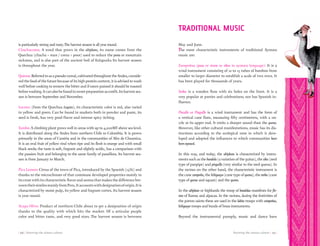
MÚSICA TRADICIONAL
Más allá de la panoplia instrumental, la música y el baile han sido dos ex-
presiones culturales muy importantes para los aymara porque no son sólo
consideradas como diversión ya que cumplen un rol fundamental en los ritos
y fiestas religiosas. Muchos hombres de las zonas rurales tocan algún instru-
mento y casi todas las mujeres bailan y cantan. En las festividades tradicio-
nales o costumbres, tanto como en los santorales católicos, cada cofradía re-
presenta un segmento de la sociedad, ofreciendo un baile que han preparado
por todo un año y por lo tanto no se constituye como una actividad elitista
o especializada.
Conociendo la Cultura Aymara | 45 || 44 | Conociendo la Cultura Aymara
Con el sedentarismo, se levantaron aldeas con viviendas agluti-
nadas y cada recinto tenía como soportes, los troncos de un árbol
frondoso, que servía para dar firmeza a la estructura y se cubría
de totora, tanto en el techo como en las paredes. Las evidencias
arqueológicas de este período se encuentran en la ladera sur del
valle de Azapa, en la terraza de Alto Ramírez, especialmente don-
de había vertientes, estos afloramientos de aguas subterráneas,
eran de aguas dulces provenientes de la cordillera.
En Azapa es donde también se encuentra uno de los vestigios
más importantes de la influenciaTiwanaku: la aldea de San Lo-
renzo. Emplazada en un lugar alto y estratégico en la ladera sur
del valle, para nivelar esta superficie se construyeron grandes
terrazas con cantos rodados y camadas vegetales que sacaban
desde la rivera del río. Sobre estas terrazas se levantaron las
viviendas con muros de caña y techos de totora.Tiene un sector
habitacional en el centro y un cementerio en cada extremo,
está situado cerca de vertientes por lo que había agua cerca sin
tener que bajar hasta el río para traerla hacia las casas.
Otro lugar importante de esta época es la aldea de Cerro Som-
brero, un lugar estratégico que une el valle de Azapa con la que-
brada de Acha, a unos diez kms. de la costa, y a varios metros
sobre el fondo del valle. Esta aldea se levanta sobre la ladera
del Cerro Sombrero, por eso los arqueólogos la llamaron de ese
modo, se construyó en ese lugar para protegerse de los mosqui-
tos y porque desde allí se divisaba muy bien hacia la costa y va-
lle arriba, era un lugar estratégico pues les permitía defenderse
en caso de conflicto. En él se han reconstruido pukaras .
Además de las casas, hay estructuras menores que pudieron
ser silos o depósitos de almacenaje, hay además espacios, en-
tre los recintos, como si hubiesen sido vías de circulación.
Junto a estas vías hay espacios amplios que semejan plazas
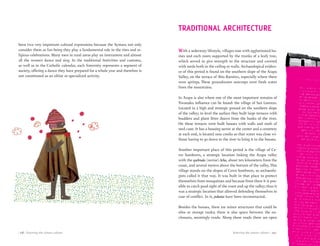
ARQUITECTURA TRADICIONAL
o patios de uso comunitario. Todos estos elementos de la arquitectura se en-
cuentran rodeados por un muro perimetral que permitía el amurallamiento
defensivo de la aldea.
La mirada de los aymara siempre tiene como su principal objetivo el orien-
te. Allí se genera la vida, en el nacimiento de las aguas. De ahí que sus casas
y templos siempre están mirando respetuosamente hacia los Mallkus. Las
casas no tienen un nombre característico tanto en el altiplano como en
las quebradas, pero hay diferencia de materiales de construcción y de las
técnicas arquitectónicas, que obedecen a la disponibilidad que les otorga
la geografía.
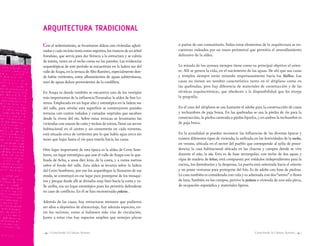
En el caso del altiplano se usa bastante el adobe para la construcción de casas
y techumbres de paja brava. En las quebradas se usa la piedra de río para la
construcción, la piedra canteada o piedra liparita, y en ambos la techumbre es
de paja brava.
En la actualidad se pueden reconocer las influencias de las diversas èpocas y
existen diferentes tipos de vivienda; la utilizada en las festividades de la marka,
en verano, ubicada en el sector del pueblo que corresponde al ayllu de proce-
dencia; la casa habitacional ubicada en las chacras y campos donde se vive
durante el año, la uta. Esta es de base rectangular, con techo de dos aguas y
vigas de madera de keñua; está compuesta por módulos independientes para la
cocina, los dormitorios y la despensa. La puerta está orientada hacia el oriente
y no posee ventanas para protegerse del frío. Es de adobe con base de piedras.
La casa también es considerada con vida y es adornada con dos“aretes” o flores
de lana.También en los campos, pervive la paskana o vivienda de una sola pieza,
de ocupación esporádica y materiales ligeros.
Conociendo la Cultura Aymara | 47 || 46 | Conociendo la Cultura Aymara
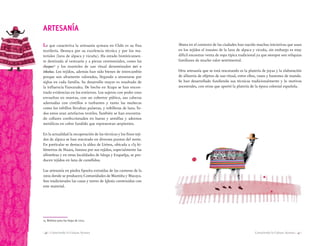
Lo que caracteriza la artesanía aymara en Chile es su fina
textilería. Destaca por su excelencia técnica y por los ma-
teriales (lana de alpaca y vicuña). Ha estado históricamen-
te destinada al vestuario y a piezas ceremoniales, como las
chuspas15
y los manteles de uso ritual denominados tari o
inkuñas. Los tejidos, además han sido bienes de intercambio
porque son altamente valorados, llegando a atesorarse por
siglos en cada familia. Su desarrollo mayor es resultado de
la influencia Tiawanaku. De hecho en Azapa se han encon-
trado evidencias en los entierros. Los sujetos con poder eran
envueltos en mantas, con un cobertor púbico, sus cabezas
adornadas con cintillos o turbantes y tanto las muñecas
como los tobillos llevaban pulseras, y tobilleras de lana. To-
dos estos eran artefactos textiles. También se han encontra-
do collares confeccionados en hueso y semillas y adornos
metálicos en cobre fundido que representan serpientes.
En la actualidad la recuperación de las técnicas y los finos teji-
dos de alpaca se han rescatado en diversos puntos del norte.
En particular se destaca la aldea de Lirima, ubicada a 135 ki-
lómetros de Huara, famosa por sus tejidos, especialmente las
alfombras y en otras localidades de Isluga y Enquelga, se pro-
ducen tejidos en lana de camélidos.
Las artesanía en piedra liparita extraídas de las canteras de la
zona donde se producen; Comunidades de Mamiña y Macaya.
Son tradicionales las casas y torres de Iglesia construidas con
este material.
ARTESANÍA
15. Bolsitas para las hojas de coca.
Ahora en el contexto de las ciudades han nacido muchas iniciativas que usan
en los tejidos el insumo de la lana de alpaca y vicuña, sin embargo es muy
difícil encontrar venta de ropa típica tradicional ya que siempre son reliquias
familiares de mucho valor sentimental.
Otra artesanía que se está rescatando es la platería de joyas y la elaboración
de alfarería de objetos de uso ritual, entre ellos, vasos y bastones de mando.
Se han desarrollado fundiendo sus técnicas tradicionalmente y lo motivos
ancestrales, con otras que aportó la platería de la época colonial española.
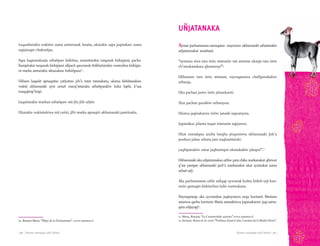
“Nayra pachan sapjirinwa mara t’aqa paxsix muspa
ancha thayapiniwa, Mariano sata mä kunturi
mallku, mistutayna mä suma imilla thaqhiri jupanpi
kasarasiñataki.
Pacha mamax manq’añanaka churistu ukatxa aka
pachanja samartiwa, Aka pachax awtipacha satawa,
suma pachaw kasarasiñataki.”
Kuntur malkku imillampi.
Aymar sarnaqat uñt’añani
Aymar sarnaqat uñt’añani | 51 || 50 | Aymar sarnaqat uñt’añani
Anchhichax jilaskiwa sarawinak uñjañataki ukhamaraki ayllu
jaqin lurt’awinaka.
Ukatxa jaqinakax jayanakat purinipxi aymar ayllu markanaka uñja-
ñataki ukhamaraki jaqinakpampi parlañataki, jupanakax uñt’añ mu-
napxi kunjams nayra pachan ukhamaraki aka pachan sarnaqapxi.
Uksa tuqu sarañ munatax suma jiwaki uraqinak uñjañataki
ukhamaraki nayra pacha jaqinak sarawinak parlañataki.
Uka jaqi ayllu luratanakat uñjayistuw jiwas manqharu, uka-
nakampiw nayraqatar sartañani.
Jilatanakampiw uñjañani kunas wakisispa jaqukipayaña aka
pachamana, kunanakas luratanaka aka alaxpachan ukhamarak
pachatampi.
Aka “ayllu jaqin aymar irpañataki”, amtiwa Consejo Nacional
de la Cultura y las Artes, Sección de patrimonio Cultural, De-
partamento de Ciudadanía y Cultura, akampiw jiwas jilatanaka
ukhamaraki jaya jilatanakat puriniri kuna suma sarakinakas
uñt’ayasipjani.
Uka ayllu jaqin suma irpatax nayapt’aniw suma utjañataki,
ukatakix yatiqañaw suma apnaqaña jani ñanqhachañataki suma
pacha mamaru, anchhichax uka suma uñjañax ayllunakaw lu-
rasiskapxi.
“kuna ayllu jaqin amtatanakas nayraqat wakisiwa ayllu uthirinakan nayapt’aña
sumaapnaqañataki.
Ukhamarakisumaqamañatakixjaniwqullqikiwwakiskitiukatakixuthañpaw suma
qamaña, ayllu jaqin saratapa, ajayunaka, suma kusisita, ukatakix pachamamaw
suma uthañpa (...) ukatxa kuna machaq amtatanakas ayllu jaqin uñt`añataki sa-
QALLTAWI
ñpaw jaqinakan luratapa pachamamampix mayakiwa ukhamaraki ayllunakax suma qamañanakampix
mayakirakiwapachamamarusumaapnaqañataki”.1
Aka uñjatat jaqin saratap pachamamampi mayakiñpawa, aymar jaqinakax utjayiwa
uñjatatanaka jani utjatanakampi ukhamaraki saratanaka jani saratanakampi.
Pisiw amtatanakax ayllu jaqin saratap suma uñjayir ukhamaraki uñtayiri. Juma-
nakatakiw aka amtat aymar irpiri.
1. Robyn Bushell, Juan F. Salazar. 2009. Estudio de prefactibilidad. Turismo Indígena en San Pedro de
Atacama. Centro de Investigaciones Culturales, Universidad de Western Sydney, Australia. Página 42.
Aymar sarnaqat uñt’añani | 53 || 52 | Aymar sarnaqat uñt’añani
Aka Chili markanja aymar sarawinakax qalltiw alax tuqut Peru Bo-
livia itu jaljata tukt’añataki Tarapaka aynach tuquru. Ukhamaraki
kalltarakiw jalanta tuqut jalsur tuqu tukuyuñataki(quta lakat qullu-
nakaru), purt’añataki 4500 mts. Quta patata.
Aka uraqinakax ancha qhatani ancha ch’allani - ukaw sumapin uñtayi.
Paypa tuqut umas ukhamaraki uraq yänak ancha pisipiniwa.
Uraq yänaka ukhamaraki umanakax uthaskiw juqhunakan
qhirwanakanpi.
Alax tuqut aynach tuquru quta thiyax ancha ch’allakiwa ukatxa Arik
markat Pisawa markarux uthiw qhirwanaka q’awanaka.
Ukam kipkakiw alax Peru marka tuquru.
Aksatuq jawiranakax qutar puripxi, uksa tuqunakanxa uthiwa
allux uraq yänaka ukhamaraki allux uywanaka.
Ukatxa Luwa jawirax qutaruw puriraki, ukhamaraki Pisawa
Chañaral markarux janiw jawiranakax qutar purkiti.
Ukatxa, nayra jaqinakax jakañatakix umapjiruw manqhapachan
umanaka.
Ukhamaraki aka markanakanxa, aynach qhirwanakax chhaxqiwa,
ukatxa uñstiw sapa jisk’a qhirwanaka uma tuquru.
Aynach tuqur uthaskiw Pika matilla markanaka, ukatakix umax
ancha suma munataw jaqi sarnakañpataki.
Aymar ayllunakax pata thayan uthapxiri, jupanakax jakañatakix nayraqa-
tan chawlla katupxatayna, ukat uywanak uywapxatayna ukhamaraki ya-
punak apnaqapxatayna, suma sarnakañatakix jupanakax yatiyapxatayna
k’achanchawinakaukhamarakiapanipxiwamäsumaamatatuthañataki.
TAQI UÑTAWI
Aymaranakatakix Pachamamax jakaskiwa, aka pachamamaw jiwasa-
nakar jakayistu, manqañanaka churistu, uywanakas jakayi.
Markax aymar pachan taypipawa, ukan jiwasax utjtan.
Jiwasanakax Akapachan utjtan, ukhamaraki uywanak uywastaja
qhirwaraki irnaqtan, alaxpachan uthaskiw tata inti, paxsi mama,
warawaranaka ukhamaraki alaxpachan uthaskirakiw santunaka, angila-
naka, virginanakampi.
Manqhapachansti uthaskirakiwa tiyunaka, supayanaka jupa-
nakax ch’amaqan uthaskapxi.
Kimspach pachanakax jikisipjiwa suma uthañataki, ukatxa
ukax tinku satawa.
Aymaranakax chacha warmi utjasipxi suma panpach yanapasi-
ñataki.
Aka pachansti mallkunakaw suma uywistani, ukatx chacha war-
mimp ayni uñstayapxi.
Jupanakax kimsa amtat qullänipjiwa, ajayu markan mallkunakpa-
ru, pachamamaru ukhamaraki jawir uma amarutaki.
Aka kimsa aymar amtatanakax yatiriw lurañpaxa.
Mallkunakax jiwasar suma uñjistu ukhamaraki jilaptasin janiw
suma uñjkistuti.
Ukhamaraki jiwas jakañataki thaya pachan suma uma churistu.
Aynach pata thaya markanakanxa, pachamamax ancha
manq’anak puquyi ukhamaraki suma uñjistu.
SARNAQAWI
| 54 | Aymar sarnaqat uñt’añani Aymar sarnaqat uñt’añani | 55 |
Pachamamax uthiwa akapachampi ukhamaraki alaxpachampi, ukatakix wakisiwa
ayni apnaqaña aymar markanakanxa.
Uywanakax chimpurañaw chinuqa anata paxsinja, ukatakix t’inkhanaka qawra-
nakar uskuña jupaw jiwasar manqañaka churistu.
Qullu qalanakanja amuy lurataw puma, jararankhumpi, jamp’atumpi akanakax
pachamamarux uñjayapxi.
Akanakampiw ancha jakaña mayisiñani ukhamaraki allux umanaka allux uywa-
naka uthañpataki.
Ukhamaraki amarumpi umanaka jawirinakaru sarayañani qhirwanakataki.
Chawllan asirumpix amarur uñanchayapxi, ukatxa wilanch paxsinja uma jawira-
nak pichhsuña qhirwanakataki.
Ukatxa, qullunakax, uraqi uywañanakax, ukhamaraki qhirwanakax yapuñax,
q’awanakax, aymar jaqinakatakix jakañ pachapawa.
Ukatxa jalsur tuqu uñtapxi, qullu taypinakat umax, willkas mistunipxi.
Aymaratakix janiw alax pachan mä suma qamañax utjkiti.
Aka pachan jaljawinakampiw sapur uthañaxa.
“Sapur jaljawin uthañ wakisi ukhamaraki pachamamampi, thuqhuñas antatanakas
suma uñjañawa, aymar jaqi markanakax alaxpach amtasipiniwa, uywanakas mira-
tatañpataki qhirwa yapun puquñpataki, ukatakix sartañaniw luphipachat jallupa-
charu ukhamaraki jallupachat luphipacharu.
Suma qamañatakix janiw qullqix wakistiki, suma qamañatakix pachamamaw
suma uñjaña suma apnaqaña”2
.
Aymar jaqi jach’a markan utjirin janiw ayllupat armaskiti, ukatakix sapa maraw
ayllupar sari santu patrun uñjiri.
Marka thuquñanakax uñjir sarasinj amtasiñaw qullunakat ukhamaraki apachi-
tanak nayra uthatata.
Ukhampachax, pata markanakan uthaskiw uywa uywañax ukhamaraki qhirwa ya-
puchaña, ukampiw aymaranakax apthapipxi aka jach’a alaxpacha Chili markata,
ukhamaraki nayra amtatanakax lurapxiw jach’a markana.
Ukatxa, chinchur nayra jaqinakax qhirwanakan uthjiri ukhamaraki thiya qutan,
sapjistuw mä pachan jakaskañaniw ukatakix aymar marka luratanakax amtasiñapi-
niwa. “(...) jaqi janchiñakax ñusatanpax sayt’ayataw, ukatakix jiwat apnaqirinakax
jiphillanak uñtayapxi ukatx jayunak jiq’imp apantapxi jani ñusañpataki. Jaqin
jaqi ch’akanakax uraq patar jaypatxi ukatx lawanakampiw charanakas, ampara-
nakas, atimpis suma thuriyatawa. Jaqin janchipax suma askichataw uraq patanja,
niq’inakamp ukhamaraki jupan janchipampi ukhamaraki yaqha jamach’ janchi-
nakamp ukatxa pachpa ñiqimp allintata. Ajanupax niq’impiw askichatax ukhama-
raki piq’ipan uskut mä ñikut ñikutapampi”3
.
Akaallintañaxarmataxiw3.700maraa.p.ukatxajaqimarkachinchurqunqurqunt’atallin-
tatapxi ukatxa lupi pampaw wañachayi.
Pata markan jaqinak ukhirinakax aka qhirwa tuqunsti ukhamaraki amuyata-
nakax luraskapxi.
Nayra jaqinakax jutapxiw tiwanaku sarnaqawipampi, ukatakix amtapxiw wiraqu-
chat tunupat mä jach’a jaqi jisqa ñik’utampi amawta isimp ist’ata jilaqat pusi ayllu
ch’amampi
Jaqi jiwatanakat amuyatax nayraqat uskutaw sawuñanakaru.
2. Juan van Kessel, 2006.
3.Catálogodelaexposición“Pescadoresdelaniebla.Loschangosysusancestros”.2008.MuseoChileno
de Arte Precolombino. Fundación Familia Larraín Echenique. Ilustre Municipalidad de Santiago.
Aymar sarnaqat uñt’añani | 57 || 56 | Aymar sarnaqat uñt’añani
Ukatxa, chawlla katurinak uthañpax wakisiw qhirwa pata marka yapuchirinakampi,
ukatakix janikiw wakikiti yapu quta manq’anak munañax wakisirakiw lurañ yänak
jaqukipayaña ukhamaraki machaq amtatanak yatiqaña.
Wallja manqanak ajayunak uñjataw jaqi jiwat allintatanakana.
Jach’a jilir jaqi jiwatanakarux chawlla apnaqasiñp apkataña, ukaw uñjayi aka
markan jaqinakpax quta manq’anakat jaqapxi.
Yaxanakansti jaq’ i jiwat qhirwa yapuchañanakampiw allintata, lawanakampi sañani,
kuchillunakampi, chuwa allux yapu manqanakampi, tunqunaka, ch’uqinaka, kamuti-
naka, kinwampinaka..
Yuqallaniranakansti, uywanakampiw ajuñax ukhamaraki qhirwa t’awranakampiw
amparanakax kayu muqumpi t’ikataja.
Chawlla quta katurinaka ukhamaraki qhirwan uthirinak jupa-
nakaw nayranakan akanakan uthapjanja.
Sapjiw 11.000 maranak alluxani jaqinaka aynaqiri ukatja chawlla
katusin jakapji.
Nayraamtatanakaxutjiwaachaq’awa,ukaxazapaqhirwaruwpuritayna.
Uksa tuqu sarnaqatanakax 10.000 nayra marata, utanakapanakax
muruq’unakanwa, phayañatakix mä qiriw taypin uthatayna ukan
chawlla katuñatak wakichayipxaraki.
Muruq’u uta añtañpatakix mä lawampiw tayt’ayapxi.
Ukhamaraki janiw sapüru uka utanakan utjapkiti, quta marka-
nakaruw saraqanipx uthañataki qhirwa puquñ manq’añataki.
Kimsa waranqa marakiw yapuñanak amatataxa, nayraqatanja
chawlla katuña, apthapiñankirakimwa manq’asiñataki.
Jathanakas, saphinakas, achu manq’añaka uthiw jawir niq’ i
q’awan lakanakana.
Ukhamaraki nayraqatanja tunqunaka, yukanaka, kamutinaka
puquyapxatayna.
Aka machaq manqa apthapiñax uñstataxa, jaqinakax qhirwanaka-
ruw sarjapxi ukatja qalltiw quntat uthaña, ukat qutat apapxi jach’a
chawlla ch’akhanaka.
Akamachaqutanakaxluratawllutanazapancamarunumajawirtuquta.
Aka machaq uthañax sawuñak qalltapxi ukatakix junkillunakamp
tuturamp lurapxi ukhamaraki qhiyanakampi ukanakampiw isi-
naka lurapjani suma ikiñataki uywa katuñatakiraki.
NAYRA SARNAQAWI
| 58 | Aymar sarnaqat uñt’añani Aymar sarnaqat uñt’añani | 59 |
Ukanak yatiqatampix jichax niq’i qhatiyapxi ukampiw phukhunak lurapjani.
Aka machaq lurañampix nayapt’aniw sawuñ apnaqataru uka phukhunakan manqa-
nak umanak imapjani ukhamaraki apapjani.
Wilamasinakax uka machaq apnaqatat aliñanak yapuñatak lurapxani.
Akanakaw nayraqat amtatanak yapuñ lurañ apsupxi.
phisqha patak waranqa mararaki D.C. sumaw ayllunak utjapxi, aksa tuqur titiqaqa
qutat saranaqawip purtani.
Jupanakax aksa tuqu pata jaqinakamp xikjaptapxi ukhamampiraki qhirwa quta
jak’a uthirinaka, lluta azapkamarun qhirwanaka sañani ukhamaraki yaqha taypi
qhirwanaka chukuruma cudpa tarapak pika sañani.
Manqañatakix taqi pacha purap markanak aljasipxi ukampiw yaqha markanakamp
nayapasijxi ukatwa jani yaput manq’anak manq’apxi.
Ukat yapu quta manq’añanakax apnaqapxi ukax puriyaniw mayja sarnaqaña.
Aka sarnaqañ aljasiñax aynach tuqur purt’atayna, pika sapa markan mayja piqi-
nak phukhunak q’irus uñjañapjatayna ukhamaraki pusi arin lluchhunaka akanakax
tiwanaku sarnaqat amtatawa.
Aka aljasiñax waranqa marat D.C. aymar sarnaqirix suma yatiqatayna sapa ya-
putanak aljasiña.
Suma yapuchañatakix araqinak askichapxi ukhamaraki suma uma irpañanaka uka-
txa quta jamach’ wanunak apnaqapxi.
Suma aljañatakix wakisiw suma uraqinak uñtaña.
Jayar sarañ aljañatakix wakisiw chimpuñax kawkichakan umax utji kawkichaqanqaraki
amtanakax ukhamaraki uywa manqañanakapa.
Aka chimputanakax geoglifo satawa ukat qullunakan suma apnaqatawa ukax jayat
uñjañataki.
Nayraqatuñt’ataxanchamunatawakauraqinuthañataki,ukatxatarapakkamiñaqhirwan
chacha uthirinakax jupanakaw kalich nayraqat apsuñ uñtapjatayna ukat qullpa apsupxi.
Jichax qhirwa aymar yapuchirinakax uka qullpampiw yapuchat uskupxi, ukata-
kix pampar aptir saraqanipxi.
Aymar markax uka qullpa irnaqir apnaqañataki mantapjiwa, ukhamaraki yapu-
tanak aljasiñataki.
Chikat tunka llatunkani patak maranxa, ikikin quta punku aptapxi ukatat qull-
pa jaya markanakar aljañataki.
Pata markanakat jaqinaqpax saraqanipxiw mä machaq marka aptañataki uka
markax aptataw quta pumkum uraq pampamp qullpa irnaqirim ukhamaraki
qhirwa jaqinakampi ukatxa pata markanax chusaptaskiwa.
Aymar markan qullqitapax mayjt’ataw aka qullpa apnaqatampix ukatxa suma
jakasiñatakix mayt’ayañaw yapu mirayañataki.
Tunka llatunkani patak mara tukt’ayasinja jacha markanakur nuwasipxi (1879-
1883) uka nuwasitax aymar uraqin markanakan mayjt’ayaniwa.
Uka nayra jach’a markanak nuwasipxix aka uraqinakax Peru markapataynawa.
AymarjaqinakaxArikaTarapacámarkankirixjaniwnuwasiñarmantapkiti,ukanuwasittuku-
taxakaaymaranuraqinakpaxkimsajach’amarkanakarujaljataynawa.
Aka Arika Tarapacá aymaran sarnaqawipax janiw suma uñjapkit aka Chile ma-
chaq marka sata. aymar jaqinakax qatuqapxix Chile markan amtatapa, uka
4. Informe de la Comisión verdad histórica y nuevo trato. 2003. Volumen I, Primera parte: “Los pue-
blos indígenas del norte. El pueblo aymara. 5. La ocupación chilena en territorios aymara. 5.1. Las
primeras políticas del Estado chileno y la chilenización”.
Aymar sarnaqat uñt’añani | 61 || 60 | Aymar sarnaqat uñt’añani
amtatanakampiw mayjt’ayapxi aymar jaqinakan sarnaqata, jaya pachat ayma-
ranakan sarnaqawip mayampi tumpata”4
.
Aka pacha utjatax anchapiniw uñisita aymar jaqinakax, ukhama siwa pankanakaxa.
Uka pacha Pä tunka pataka maranakanja uñisitaw aymaran uraqipasx sarnaqata-
pas amtatapas ukhamaraki qullqichañasa.
Uthañatakiq aka machaq markanakanja janiw nayrjam uthañakiti ukatakix
mayjt’ayañaw nayra sarnakakataxa.
Tunkamarapachanjasumauthatapax mayjt’ayiwmayjaruthañataki,ukhamarakiuñsta-
yiw kuna luratanakas qullqimpiw phuqhatawa.
Qullpa jach’a quta punku apnaqirinakax mayja manq’anak munapji, ukatakix yapu-
chirinakax yaqha achunak yapuchapxi ukhamaraki yapux allux achunak yapuyapxi.
Jichhakamaw uthañ wakisita nayramp jichhamp yapuñanak apnaqaña, ukamaw
jichhax uthastanja.
Aka patat sarnakawinakaw aymar jakañ mayjtayi “aymar jaqinakax uthañatakix sa-
raqanipxiw q’ara uraqinakaru ukhamaraki quta thiyan markanakaru ukanwa aymar
apnaqasiñax mayat wakist’ayapxi”5
.
Jichax uñt’ataw allux aymaranak quta thiya markanakan uthiri, ukan uthirinakax may-
janakaw janiw kipkakiti, ukhamas nayra sarnakatap amtatapiniwa.
Ukat jichhax nayra marka jaqinakax amtapxiw yatxasarnakataxa.
Anchhichax suma uthañatakiw pisiskiw ukat mayipxi aka Chile marka apnaqirinakaru,
ukhampach mayipjarakiw suma yäqañ aymar markat sarnaqatapa.
Aymar sarnaqaw jaqinakatakisti pachamamax sutiniw taqitu-
qux ukhamaraki jakañanak luratani.
Yaqip uraq tuqunakax “ancha ch’amaniwa” waliñatakis jani
waliñatakis ukatja suma uñtaña ukhamaraki kunanakas chu-
rañarakiwa.
Markanakatakix ancha ch’aman uraqinakax uywir satawa, uma
jalaqtkix sirinu satawa suma amtat kirkiñataki.
Uywan uthir uraqipanx satarakiwa“ch’amani” uksatuqun uywa-
nakax q’awanakan qutanakan umapxi.
Janiw mallkunakat armasiñakiti, jupaw uywistu jasutt’istu ukhama-
raki wawachayistu.
Ukhamaraki Nayra uthatanakax suma yäkañaw ukankaskiw jin-
tilinakan ajayupa jupanakax usunakamp chijinakam jassutt’iri
ukankaskiw chullpanakax pukaranakax mallkunakasa.
Ukhamaraki qalanakamp apachitanak aptapjatayna Qusqur
thakhi uñist’ayañataki
Ukhamaraki uywa katurinakan qala q’awanakanx sami pacha-
maman qillq’atanak utjatayna.
Wilaqawrani patapatani mullipunku tiknamar jiwat pampa aka-
tuqunakaw suma uñt’ataxa.
7.000A.P.maranxamayjaallintapjiritaynajaqijiwatanakchawllakaturi-
nakax ukax suma sarnaqat amtataw aka Chili markanxa.
Ukham allintatax pusi waranqa mara apnaqataw ukax sataw chin-
chur sarnaqata uka allintatanakax alaxtuqun allux utji azapan ka-
marunan qhirwan tukuyata.
5. Ídem. Volumen I, Primera parte: “Los pueblos indígenas del norte. El pueblo aymara. Comunidades
aymara, minería y reajustes en las economías tradicionales”.
URAQI UYWIR SARAWINAKA
Aymar sarnaqat uñt’añani | 63 || 62 | Aymar sarnaqat uñt’añani
Anchhichanja aymar jaqi quta thiya markan utjirinakax ja-
niw jilaqatanak nayrjam aptkapjiki, uka jilaqat aptatax jichha
amtat apnaqata.
Maya sañani, jichax jilir marka apnaqirinakax apsutapax janiw na-
yra markan jilaqanakjamax amtatakiti, jicha amtatanakax junta de
vicinu ukhamaraki Liy indiqina janirakiw kuna nayra lurañanakas
utt’atakiti.
Chili sarawinja aymar markanakan sarnaqatapax chhaxjiw ukhamara-
ki janiw jilaqatanax utjkiti pachamamarukiw amptapxi.
Aka pata markan pachanakansti nayra aymar sarnaqatapax janiw
utjkiti janirakiw jilaqatanakas utjkarakiti.
Akanakax:
Uma lakiri: jichhax uma lakirinakax janiw ancha utkit jupanakaw
uma markan lakiriwa.
Alfiris: ukham sataw chachax warmipampi thukhuñ amtat
markapanxa.
Aymar sarnaqawix siwa marka piq’inchiñatakix alfirisanak pasa-
ñawa.
Mayurdumu: ukham sataw jach’a tatanakan tatitun utap uñji-
rinakaxa.
Ukatxa, tatitun amtatapanja mayurdumux suma jilirjam uñt’ataw,
janiw ukham uñjatakit markanakanja.
Rutuñ ichutata: wawa qatuqañatakix ichutataw rutuñ
piq’inchiripaxa.
Uywirinaka: ichutatax uñjañpaw suma sartañapap machaq chacha warminja,
jupanakarux wakisiw suma iwjañanakax suma sarnaqañpataki.
Kapural: aymar marka kirkirinakanx uthiw mä jilir thuqiri jupax kapural satawa.
Imiri: alfiris marka kirkirinakax utxatayañpaw mä imiri kirkiñ uta, jupax utan
manq’anaq k’usanak umañanak kirkiñatak imañpaxa.
Utxatayatax wilamasinakan uñt’atañpawa.
Sitani: allpachunak kawranak t’ikhachañatakix sitaniw ukankañpa jupaw uka
amtatanak uñjañpa.
TAQPACH PATAWINAKA
Aymar sarnaqat uñt’añani | 65 || 64 | Aymar sarnaqat uñt’añani
Aka machaq Chili markanja janiw Bolivia marjam aymar qullax
apnaqatakiti ancha pisiwa.
Ayrunakakiw jichha pachan pata markan jach’a markanakans apna-
qaskapxi, uka ayrunakax qhatunakam alasiñax utji.
Warminakaw aka apnaqatax suma yatipxi.
Aka ayrunakanj kukaw ancha sumapin apnaqata.
Aka ayrux patatuqurux jilir ayrumasinakpax eritroxilo-kuka satawa.
Janiw Chili markan yupatakiti, aymar sarnaqatanj parapat aljasiñ
uthanw nayrapachanja.
Apnaqatpax akulliñataki qullañataki ukhamaraki suma sarnaqa-
ñatak mayisiñ uywirinkaruxa.
Anchaw qullatapax: kuka akulliñax puraq usutaki, jani manq’añ mu-
nañ umañ nayapti, ukhamaraki jani ikiniñataki.
Suruxchitakix phisqha laphi kuka umañawa ukhamaraki piq’i usutaki.
Apxatatax laka k’amaw waliptayi.
Nayrapachat kuka akullipxi qhuyan yapuchir apnaqirinakaxa,
suruxchitaki jani manqañataki umañataki
Retam ayrux ancha umatarakiwa.
Aka ayrux jiliriw q’awanakan thakhi thiyanakan 2500 – 3500
mts. Quta patata.
Q’illu panqaraniw chimpuniw khullupax laphinakpax jisk’anakakiwa.
Achuqapax mä chära sillpiw jisqa jathampi.
Suma qullarakiw K’iwchataki.
Panqar ñiq’jamaw uskuñ usu patar apsuñataki.
Laphinakap panqarapamp umañaw chuyma llixti ch’aka usutanakataki.
Qullanakax suma amtataskiwa, ukatxa yatiriw suma qullirix jupaw ajayunakas sarjata-
yi ukhamaraki ayllunak suma añjayi.
Jupax ancha thaqatuw ayllunakanja, ukhamaraki yatiñanak sarnaqapat ancha
suma imjatawa.
Suma waliptañatakix usutax waliptañ munañpa pintikustal qullañ Tarapakan manta-
tayna ukatxa aymar qullañax pintikustal qullañampix apnaqat qullañataki.
Mayja qullañ utharakiwa ukax sataw tiyuyatria ukampiw tatitux usutanakar qulliri, nayra
aymar suma sarnaqatax uthaskarakiw tarapaka tuqunja ukachanakax sataw suma qullaña-
naklurañataki.
Ukataw jayanakat jaqinakax purinipxi waliptañataki ukatakix wakisiw kirkiña-
nak suma waliptañataki.
uka kirkiñanakax sañpaw pusi uñjatanak amtasiñani suma sarnaqañataki, uka-
nakax sataw pachamama, juchanaka, suma qamaña amtatanakaraki.
Suma aymar qamañax mayjt’ataw ukatakix aka alax pacha Chili markanj apna-
qatarakiw cristianu qullanaka.
SUMA QULLA APNAQAWI
Aymar sarnaqat uñt’añani | 67 || 66 | Aymar sarnaqat uñt’añani
Uñjañaw aymar sarnaqaw luqtañanakax ukanakax sataw tatitu
amtat nayra luqtasiñanak ukhamaraki jiccha luqtasiñaraki.
Amtat yupaychawinakax lurataw tatitut amtat ukhamaraki ay-
mar uthaña, ukatxa aymar sarnaqawix jakaskiwa.
markanakam amtatanakax wakisiw santunak amtañaraki.
Ukatwa utiw aka Arik Parinaquta ukhamaraki Tarapak markanja
amtat amtañanaka:
• San francisco de asis jach’a urupa (pusi uru taypi sata paxsina)
• Virgen de la Candelaria jach’a urupa (Pä uru anata paxsina)
• Curpus Cristi jach’a urupa (Pätunk pusin uru mara t’aqana
paxsina)
• Semana santa jach’a urunaka (Q’asawi paxsi)
• Chakan jach’a urunaka (mayat tunka kimsan uru llamayu paxsina)
• Espiritu santo jach’a urupa
• Virgen del Carmen jach’a arupa (tunka suxtan uru willka kuti
paxsina)
• San Santiago jach’a urupa (tunka phisqhan uru willka kuti paxsina)
•Virgen de asunción jach’a urupa (tunka phisqhan wilanch paxsina)
• Virgen del rosario jach’a urupa (nayra willka uru taypi sata
pax sina)
• Alma ajayu amtata (pä uru qhipa sata paxsina)
Ukhamaraki nayra aymar sarnaqawix amtataw pacha mama-
nakar luqañataki.
Anat paxsin allpachur kawranakampir t’ikhachañ amtañani ukha-
maraki jawiranak pichsuñani pachallampirak lurañani.
Ukatxa jaqi ewjañax wakisiw jakawip markapan lurañax suma
uñt’asiñpataki ukhamaraki suma unt’añataki.
Ukatakix wakisiw markapan wawa rutuchaña, chacha warmi sartirinaka, jiwatankar
apayjaña, ch’allañ machaq alasitanaka.
Jichhasti nayra sarnaqawinak uñt’añani:
Anat amtatax wakisiw willka urut willka urukama.
Akampix amtataw suma yapuñapataki uywanakas mirañpataki, ukat chachanakas
warminakas thuqupxi away qipjarata suma yaphu apthapitampi.
Jicha pachax aka apnaqatanakax paypach cristiano aymar amtatanakampi khi-
tuñ lurataxiwa.
Jichhakam anat amtañatakix aptataw “awki anata” ch’utumpi, suma isintata,
jak’umpi, sirpintinamp kunkar uskuntata asnu patar sarnaqayapxi, kirkiñanakamp
willka urut willka arukama sarnaqix anat amtañataki.
Achachilach mallkuch6
sapxiriw yaxipanakaxa7
.
Maynin amtat carnaval uñjatax tarqanak kirkitapa sirpintinanak ukhamaraki
ch’allasiña8
.
Aka anatan yapuñanakar luqasiña wakisi, saxra uruw anat urupa yaxa uru-
nakan wilamasinakar uñt’atanak utapar uñjir sarañawa.
Xipa urux kacharpayan urupawa9
.
Allpach qawranak suma t’ikhachañax mirañpataki, ukanja pachamamar mallku-
nakar uywatpat luqasiña.
LUQTAÑANAKA
6. Achachila
7. Tata mallku
8. Ch’alla
9. Kacharpaya.
| 68 | Aymar sarnaqat uñt’añani Aymar sarnaqat uñt’añani | 69 |
Allpach qawramp t’ikhachasiñax jallu pachan ukhamaraki awti pachan uwija
t’ikhachasiña.
Uywanak t’ikhachasiñatakix uthañpaw ch’alla winu ukhamaraki warminakax nayraqat
wila tawra chimpunak lurapxi uywanakar jinchur uskuñataki.
Kimsa anat urupanja uma jawiranaw pichsuña suma uma sarañpataki.
Aka anata amtatax chikachayiw kirkiñanaka luqasiñanaka virjinanakaru santu-
nakaru.
Ukanwa jawir umanakax pichsutañpaw ukhamaraki pachamamar allux uma ma-
yisiñani yapuñanakataki.
Aka amtatax lurañaw thaya pachan San Santiago tuquru, pä tunka phisqhan
willka kuti paxsina.
Aka amtatax suxta uruw luratapax, purinipxiw marka wilamasinak ukhamaraki
yaqip jilatanaka.
Akax markanakan utt’awitakiw, ukatakix wayna wilamasinak jach’a marka-
nakat nayapañatak jutapxi.
Ukatakix jawir Amat ñiq’inak qalanak quranak apsupxi suma uma sarañpataki.
Yaqha amtatax utharakiw ukax pachallampi satawa, ch’uqin satañ kirkiñapawa,
phutiri, chukuruma, bilin, ch’apikiña pachaman lurapxi.
Aka ch’uqi satañ amtatax lurapxiw taypi paxsi qhipa phaxsiru.
Aka luratax aymar chacha warmi qullqichasiñatakiwa, ch’uqi amtañ satañax lurataw
ayllu ch’uqi manq’añpataki ukhamaraki jupanak manq’añpataki.
Pachallampi lurañatakix nayraqata pachamamar luqañ wakisi ukat satañataki, ukan
mayisiñanix suma jatha pachamamas qatuqpan ukhamarak allux jallu utjpan ukha-
mraki markataki allux yapuchat utjpana.
Pachallampi luqasiñax qalltañatakix nayraqata yapuña uraqix wakisitañpaw ukaru mä
awayu uskuñani ukaruraki ch’uqi jathanak apjatañani sirpintinakampi ukatxa satañ qa-
lltañani.
Uta tatit uñjirix jathanak warminakaru lakirpayi chachanakast chuntanak lampana-
qampi wakiyapxi uraq satañataki.
Chachanakax uraq chuntamp lampampi allipxi warminakasti jathanak iluyapxi
ukat ch’allampi allimtapxi.
Tata iñjirix yapuchantxa ch’uqi ch’uñu tunqujimp’i xatit aycha charkinakampi
supaypillampi manq’añataki churix umañatakix k’usaraki.
satañ tukuyatax pachallapimpiw panirat kirkiñax yapu yapuchat uñjasina.
Manqañatakix kawra allpach kankanak arusampi lurapxi aycha wallakimpí.
Kirkiña tuqhutax pachallampi satawa. Ichutatan urupax qullu mallkunakaw amta-
taxa. Kunturiw mallku lanti uñjatax chinuqa paxsinkiw amtatapaxa.
Aynach qullu thiyan luqasiñax wakisi.
Mallkux pata qullunkañpaw ukat suma uywistu.
Aka luqañawinakax aymar amatatanakpaw, uka phunchhawinakan santunak
amtatarakiw markanakanja jani aymar sarnakawip armasiñampi.
Aka amtatanakanja “chachanakax warmipampiniw sartañpax wistall kukampi
apt’asita”
Aymar sarnaqat uñt’añani | 71 || 70 | Aymar sarnaqat uñt’añani
Luqasiñatakix wakisiw suma amtatanak luraña, ukatakix sapa jaqinakaw suma
sapjatuqur chuktañpa.
Sapa luqatanakanja uthañpaw kirkiñax, anatañatakix tarqanak kirkipjani, pacha-
llampitakis tarqanak kirkipjani allpach qawranak thikhañatakix wantulina kirkipja-
ni marka amtatakix sikunakaw kirkiñpaxa10
.
Ukham luqasiñ apnaqañax yatiyataw jch’a tatat tatanakaru, ukatxa kirkiñanakaw
wakisi ukhamaraki ayni umañ manq’añanaka uthañparakiw kuka laphi, k’usa
tunqujimp’impi.
Luqañatakix markan uthañpaw mä jila jilir uñjiri.
Ukatakix wakisirakiwa mä yatiri, jilir marka apnaqiri ukhamaraki pasirinaka.
Aymar pachamaman sarnaqatax muytataw ukhamaraki uthañatakix
uñjatatanakat arusiñani.
“aymarax siwa tata intix mistuniw mä amtatat ukanja tata intix
ch’amakanakaru qhantutayi”:
Ukhamaw tata intix mistuni, nayraqatanxa chullpanakakiw
uthanja.
Uka pachan janiw intix jalsunkanti.
Alax pachan paxsikiw uthatayna.
Ukatxa jaqinakaruw intiw jutaski sapxatayna.
Jupanakax jalanta tuqut mistunin sapjanwa.
Ukat utanakpax ancha lanqhu pirqaninwa ukhamaraki jisk’a
punkun jalsur uñtata jani naqhasiñataki.
yaqhipanakiw umar jaqhuntapxi ukanakakiw jakapxi”.11
Ukhamaraki aka uñjatatanakax uthiw pata chika markanakat qhirwat
q’ara pampat ukhamaraki jach’a markanakat ukat ayninakat suma
uthañ utji.
Aka pachamaman uthir sallqap uywanak kuñtu kirkiñ utji kun-
turin qamaqin kirkinchun lulin warinakana.
Nayraqatanja aka uywanakas jaqitaynawa urqu kunturix Mariano
satanwa qachu kunturix Maria satarakinwa jupanakaruw jaqi sarna-
qata uñjayapj12
.
10. Rosario Mena.“Hijos de la Pachamama”. www.nuestro.cl
UÑJATANAKA
11. Mena, Rosario.“La Cosmovisión aymara”.www.nuestro.cl
12. Serrano, Bruno et al. 2006.“Parlama Amawt’aña. Cuentos de la MadreTierra”.
| 72 | Aymar sarnaqat uñt’añani Aymar sarnaqat uñt’añani | 73 |
Nayranja urutat taqpach tumpatanakax arusipxanja ukhamaraki markanakan uthaña-
takix iwxatanakaw uthañpa sañani“jilirinakarux yäkañawa”,“amtatanakax yäqañara-
kiwa”, ukhamaraki“markanakan apnaqaña”
Aka uñjatanaka jakkiptayiwa:
Mallkunaka: ancha uñjataw aymar sarnaqatanja jupaw jiwasanakaru suma tatjam tayjam
uywistu.
Taqi sapa markanakaw mä allux mallkunipxi jupanakaw sutichapxi.
Mallkux chachawa T’allasti warmiraki.
Mallku uñjatanakax anchanwa uka nayra pachanja ukat sapjiriw mallkunakax kasa-
risipjiw ukhamaraki nuwasipji yuqanakat amtasipjaraki.
Larixa: qamaqix uri uywawa uñjatanakanja larix ancha yaruñir k’arinakampi manqa-
ñanak ituqiri ukat janipiniw atipirikiti.
Kunturi: aka jach’a mallku jamach’iw jupan utjatax mallkunkiw ukhamaraki t’allanakan,
uñjatanakatanja jupax ancha suma mallku sarnaqi uñjañax ancha suma amuyani.
Puma: aka uywa urix mallkurakiw jupax utjatarakiw mallkunakaru ukhamaraki
t’allanakaru, uñjawinakan jupax ancha thuru ch’amaniwa.
Visk’acha: aka uri uywax ajnjam uñjataw, uñjawinakan thanthall jaqinakjamaru
uñjata jani yatichata jani yatisina.
Khirkhinchu: aka uri uywax utanakaruw suma uñji, uñjawinakan jupax suma uywi-
riw ukhamaraki lunthatanakarux mutuyiwa.
Ukat utanakan mä khirkhinch uthañpa.
Jararankhu: uñjatatanakanja aka uñjañax ancha sumapiniwa qullqiniñataki.
Maya uñjatatanakanja sapxiriw yuxchaw tullqach purinini, ukat awkinakax janiw
utanakar mantayapkiti jaqurpayapjiwa.
Asiru: aka jiskhanaqtirix ancha yatiña uñjayi.
Jampat’u: uñjatatanakanja jallunaka puriyiri.
Mamani: aka jamach’ix mallkunakankiw t’allankiraki.
Phuju: aka phujunakax xukhunak umampi k’ayiri, markanakan qhirwap uma churi
aka phujunaka ancha ch’amaniwa ukat luqasiñapiniwa, ukatxa janiw taqi jaqinakax
uka phuju uñjañ wakiskiti.
Usur warminakax janipiniw uksa tuqunakar jak’achampakiti.
Anuqara: uthatpax taqi markanakankiw uñjatatpax utan jani wali sarnaqañataki.
Ukatwa jaqinakarux uñjatatax anuqarar jani wali sarnaqañataki.
Aymar sarnaqat uñt’añani | 75 || 74 | Aymar sarnaqat uñt’añani
Aymar sarnaqatapax kipkakiw ayllunakan ukhamaraki marka-
nakana, aymaranakax amtatanakataki luqasiñataki isinakap
ust’asipxi.
Pata markan uthirinakax aymar isimpiw sarnaqapxi
q’awanakansti janikiw uka isimpi sarnaqapkiti.
Tarapaka jach’a markan warmin isipax axsu satawa ukat lurataw
allpach chära ch’umpi t’awrampi.
Awayu satarakiw q’ipinak q’ipiñataki.
Ukampiw wawas manqa’nakas q’ipisiñ apasiñataki.
Ukatxa manta wincha uskusiraki qullqi tupumpi phaluchinakampi.
Pata warminakax wichhu ch’utuq ust’asipxi q’awa warminakas-
ti wayita ch’utuq ustasipjaraki.
Kayutakix wiskhu ustasipxi.
Kuka laphi apasiñatakix ch’uspa upanaqapxi.
Ukhamaraki kuka apañatakix pata markanakanxa chachanakax warmi-
nakas wistallan apapxi q’awa markanakan inkuña satawa.
Chachanakan punchu ch’uspa wari chalinampi aymar isipax,
jilqatax ukam isisiñpa.
P’iqipan lluch’u uskusi.
Ukhamaraki wayita ch’utuq uskusi wiskhunakamp kayupataki.
Warmin isipax jani kuna mayjakiti ukatxa mayjt’ataw patan sami isinak q’awa
sami isinakampi
Yatirinakax pasirinakax marka irpirinakax uñjirinakax aymar isiw ustasiñpa.
Ukhamaraki jilaqatanakax qullqi waraniñpaw suma iwjañataki.
Aymar sawutanakax ancha sumapiniwa, ukatakix qawra allpach tawra sawupxi,
ukhamaraki amtat sarnaqawi sawutanakar uskupxi.
Suma sawutanakampi isip lurasipxi suma uñjasiñataki.
AYMAR ISINAKA
Aymar sarnaqat uñt’añani | 77 || 76 | Aymar sarnaqat uñt’añani
Aymar pata ayllu uthiri aka markan uthirinakax manq’ap
manq’asiskasipjapiniwa.
Ukatwa patans aka markans tumpañaniw aymar Chili
manq’anakapa.
Jichhasti Tarapaka manq’anak unt’añani:
Qalapurkha: akax aymaran manq’apaw, wakisiw luratapax wilan-
cha marka luqasiña ukatakix mä janq’u qawra khariñax wilparaki
pachamamaru churañaxa.
Ukatxa phayirinakaw alwatat qalapurka phayapxi ukatakix uthañpaw
qawraaycha, q’aratunqu,cilandru,phayatpaxpariqalanakawphukhur
apantaña suma musq’a mistuñpataki. Alwatat aka manqa’x lukutumpi
t’ant’ampi churañaxa.
Jumint’a: akax aymar manq’arakiwa, manq’atapax wakisiw chhuxllu
paxsi yapuchatana, jumint’a misk’im jayumpi phayataspawa.
Jumint’ax phayataspaw phukuru ukhamaraki niq’i qhiriruraki
Jayp’u yapuñ tukuyat manq’apxi junt’u umampi.
Lurañax janiw ch’amakiti.
Watia: Arika Parinquta suyu manq’apawa.
Akamanq’axuraqphutirmankhanphayatawukatakixuthañpawqawra
waka wallpa uwija khuchhi aychanak ukhamaraki apantañaw jumint’a
chuq’inak apillanak chaqallunak chhuxllunak taqi achunanaka.
Qawra chinchi: aka manq’ax Tarapak suyu tuqutawa, chinchi
wank’jamawa.
Lurañataqix uthañpaw qawra alpach aycha apxatañarakiw kinwa k’usu ch’uñu
phutimpi
Pata markanakanja aka chinchix arumaw manq’asiña.
Janq’u tunqu: jumint’amawa.
Ukatakix uthañpaw janq’u tunqu phasampi.
Nayraqatax suma jariña ukat wañayaña.
Suma wañatax piqañaw jak’u apsuñataki ukatxa jak’u nat’u lurañataki ukaruw
qawra ch’arki luxru yapt’añani ukhamaraki jayumpi lik’impi.
Mayjachaqan ch’arki wayk’a thiximpi lurañaxa.
Jak’u ñat’u llawuñatakix uthañpaw tuqur laphinak jani k’allk’umpi.
Aka laphin jak’u nat’uchat ch’arki thiximpi uskuchata.
Tuqur laphinakampiw llawuntañani ukhamaraki jukillumpi chinuñani ukat
jumint’jama payañani.
Aka manq’ax alwatan manq’añawa ukhamaraki amtat Chile alaxpacha
manq’apawa.
Ch’uñu: aka manq’ax jaya suma imañax walikiskiw, janiw ch’uqi ancha
ch’amanchañanikiti.
Ch’unux lurataw thaya pachan ukatakix uta wichhu patan jaytañax
ch’uñuruñpataki.
Jurürunja uka ch’uqinakax umaruw apantaña mayampi ch’uñuruñpataki.
Ukatxaumawch’uñutamparampikayumpiapsuña,ukatxalupimpiwlupirayaña.
Wank’u chinchi: aka manq’ax aymaran manq’apaw qawra chinchjama.
AYMAR MANQ’ANAKA
| 78 | Aymar sarnaqat uñt’añani Aymar sarnaqat uñt’añani | 79 |
Phayañatakixmäwank’uwlukutumpiuthañpaxukaruxapxatañawarusampikinwampi
ch’uñu phuthimpi. Aka wank’u chinchix ancha jaruwa. Ancha jarux ancha sumapiniwa
Ch’arkhi: qawra allpachu aycha wañatawa, jayumpi lupir wañachata ukatxa jaya
pacha suma imañataki ukampiw manq’anak phayañani.
Junt’u uma: pata markanakan amtatap umañataki. Uka chika arum phhun-
chhawi suyasiñ umañakiwa. Patan markan ancha thayaw utji ukatakiw jaqi jan-
chi junt’uptayañataki.
Tunqu k’usa: aka umañax tunqu k’usa juq’a alkulanikiw luratpax tunq’unak ñusa-
yata. aka k’usa umañax ancha ch’ama churistu. Umatapax wakisiw jiwat amtatanka
ukhamaraki luqasiña phuqachayañ satu markanakaru.
Ukhamaraki aka aymar markanakan yapu achunaka uñt’añani.
Apilla: aymar ch’uqi sataw aymar markanakanja.
Ch’uqi lantiw aka achuka phayañataki, janiw kuna sillaris mantiti ukat aymar
jaqinakax ancha munapxi. Phayañatakix walljaw jariñax k’allku apsuñataki Pata
aymar uraqinakan utji yapuñatapax wakisiw llamayu mara t’aqa paxsinakana.
UllukCh’uqi:akach’uqixjiliriwpataqulluthiyanakanakaChilialaxpachamarkanakan.An-
chathayapatanakanjilirisamipaxjanq’uwilaq’illumpiwamanq’añapaxjanq’uq’illumpiwa.
Llamaymarat’aqapaxsinakanyapuchañwakisi.
Kaywa: aka achux yänakataw aksa tuqunxa, aka panqarax ancha patar jiliriwa.
Uñt’atarakiw manqasin lik’i usunak qulliritayna. Uñjatatax ch’uxñaw jisk’a
ch’aphinakampi, manqhan janq’u juphukutapaja, ukhamaraki ch’ära jathani.
Yapuchañax wakisiw mara t’aqa wilancha paxsiru.
Wakatay:qichwawsutipaxPerumarkanjahuatacaysatawa,apnaqapxixusunakqullaña-
taki chuxñaw laphinakpaxa. Sapa maraw yapuchañ wakisi.
Chachakuma: pata uraqinakan alija, sutipax qichwawa, (chacha-kuma) suma waliw surux-
chitakiukhamarakiqalapurkawallaqayaña.Sapamarawyapuchañwakisi.
jupha: pata uraq tuqunakan yapuchañax utji aka maq’añax ancha suma
ch’amanchiri ukatakix nayraqata suma jariqaña ukat q’allquw mistuni jimpit
manq’añax nayraqata jariqañaw ukat jimpi musq’at utharakiwa. Sata qalltu qhipa
sata paxinakan yapuchan wakisi.
Luqutu: wila samiw uthatpax ukhamaraki q’illunaka chu’xñanakampi utjaraki.
Khatunakan alasiñ utji jathupax ancha jarapiniwa.
Tumpu: aka ayrux patar mistsuri, pata markanakan suma aliritana. Uthataynaw taqpa-
cha pata uraqin aka Chili markat Colombia markaru jiliritayna. Aksa tuqunsti camiña
markanakan jiliritayna ukhamaraki alto chuzmisa ayllunakana, achupax q’illunañpaw
manq’añatakix ukhamaraki achu manq’añax wila q’illuwa jathupasti ch’äraraki, janiw
ancha k’allkukiti maracuya akhamjamakiwa.
Chinuq achuqam yapuchañ wakisi.
Limundepika:ispañulanakawakalimunpikarapanipxi,akaqhirwasumapiniwlimun
satañataki ancha musq’aw sillp’ipax ukhamaraki mukhutapax ukaw mayjt’ayi Peru
marka limunanaka. Yapuchatapax uñjatawa. Umañapax ancha umaniwa sillp’ipax
q’illuwa ukhamaraki mukhutapax ancha sumawa
Sapa maraw yapuchañ wakisi.
Azapa asituna: aka achux aka Chili alax pacha markan jiliri ukatakix apsuskapxiw
kawkits yapuchatapax ukampiw yakha jach’a khatunakaru aljapxani, kulli sami-
nakaw q’allq’uraki ancha suma akch’anakawa.
Llamayu mara t’aqa paxsinakan yapuchañ wakisi.
| 80 | Aymar sarnaqat uñt’añani Aymar sarnaqat uñt’añani | 81 |
Akanakaw aymar kirkiñatakix:
Sikunaka. Aka sikux tunka mayan tunka phisqhan phusaniñpaw
ust’atarakiw jach’at jisk’arunaka. Allux waranqanak kirkitawa
Tarqax suxta p’iyamp mä lawar luratawa. Tuqhuñatakix tarkam-
pipiniw kirkiña. Janiw ispañulankiti.
Pinkillux qinachjamaw mä phusañanikiniw qalltat pata tuqunxa.
Ch’axmitapax pinkilljamawa. Kunjamanakas yaqip sarnakatax
ukhamarakiw sapa markanakan kirkiñanapaxa ukatx marka-
nakaw amtatanakpan aptapxi.
Ukatj jichast pata markanakax wanthulamp sikunakamp piki-
llump kirkipxi.
Q’awa markanakan sikunakamp tarkanakamp pinkillup kirkipjiwa.
Pata markanakanx qawranak t’ikhañan walthulanakampw kirkipxi.
Santu q’awan markanarux thuxuñatakix phusañ lakitanakamp
kirkipxi ukhamaraki wandanakampi.
Aymaranakatix tuqhuñax kirkiñax muspa suma amtatapiniw
ukhamarak pachamaman amtatap kusisiñpataki.
Pata chachanakax mä pinkill tarqa phusañ yatipjiwa ukhamaraki
taqpach warminakax thuquñ kirkiñs yatipkiwa.
Pachamaman sarnakawip amtataxa ukhamaraki santunak amta-
sinj wakisiw suma thuqhuñaw sapa marata.
Uthañanak utanakamp utjxirinakaw aptapxi ukatakix quqampiw
suma turt’ayapxi ukhamaraki tuturampiw pirqas utachata.
Akax utachañanakax uthaskiw aynach sirka tuqu azap qhirwata,
altu ramirez tuqunxa, ukan uthanw uma nayranaka, uka pata
marka manqha umax ancha musqanwa.
Azapan san lurinsu ayllun tiwanak suma sarnaqatax amuyapxatayna.
Uthataw aynach qhirwa irananxa, uraqinak kikpachañatakix uraqi-
nakaw jach’aptayapji ukatakix q’uwanak jawir thiyat apsunipxi.
Uka jach’an aptat uraqinakanja tuturanakampiw pirqanak uta
wayllas aptata.
Uka jach’a uraqinj taypipan utaw utji ukhamaraki paypach tuqunj
uthiw jaqi jiwat imaña, phuju umax jak’ankiwa utanakar apañataki.
Maysatuqunmayjaayllunakutharakiwukaxsatawch’utukqulluukax
manqhapan ipthapiw azapa qhirwanp acha q’awampi.
Akaayllusaptatawch’utukqulluiranana,ukatawnayrajaqijiwatthaqiri-
nakaxukamsapxatayna,ukachakanayllusayt’ayapxtaynachichillankat
imasiñataki ukhamaraki suma quta tuqur qhirwa tuqur uñt’añataki mä
khitis nuwasiñ munaspa.
Ukatwa uksatuqun pukaranaka aptapxi.
Uka ayllunakanxa utharakiw uta imañanaka, utharakiw ayllunxa
ch’usanak jaqin sarnaqañpataki.
Apxatatarakiw ayllurux jach’a uraq ch’usatanak jaqinakap sar-
naqañpataki.
AYMAR KIRKIÑANAKA UTACHAÑANAKA
Aymar sarnaqat uñt’añani | 83 || 82 | Aymar sarnaqat uñt’añani
Aka taqpach utachatarux mä jach’a pirqampiw arjatañatakix muyuntatawa.
Aymaranakax uñtapxiw jalsur tuquru uksatuqut jakañas umanakas mistuni.
Ukataw utanakax uñtatax mallkunakaru.
Utanakpax janiw patat q’awanakpat sutinikiti, utachatanakax janirakiw kipka-
kiti, kunay utachatañatakix utji uksatuqunakanja ukumaw utachapxi.
Uta patan utachañatakix aduwinakam wichhunakamp utanak wayllapxi.
Q’awanakansti utanakax qalanakapiw lurataxa, liparit qalampi wichhump wayllataxa.
Aka pachanj utachatanakax kuna pacha luratapax uñtsnawa, uta kirkiñataki, samar-
tañataki ukanakax markankiwa, ukat ayllunakat purinipxi, ukatxa utax utharakiw
qhirwa yapunakanja.
Aka utanakax pä wayllataniwa ukatakix qiwñampiw Murata, ukhamaraki utanakax
utjiwa päyañataki, ikiñataki, manqa imañataki.
Janiw p’iyanikiti jani thaya mantañpataki ukhamaraki punkupax jalsur tuqur uñta-
tawa, aduwimp qalamp luratawa. utax jakañatakiwa ukatxa t’awra sirsillunakamp
chimputa. Yaputuqunakansti utax mayakiwa ukat janiw sumapin luratakiti.
Aymar chili uñtaw sawuñatakax ancha sumapiniwa.
Amuyataw suma kawra wari t’awramp luratapa.
Nayranx isinakax uchasiñatakinwa ukhamaraki ch’uspas13
tari-
nakas pachamam amtañatak apnaqatanwa.
Sawunatakax nayraqatanj ancha suma munatanwa aljasiñataki,
ukatx wilamasinakax anchapiniw amapxatayna.
Ukatakix tiwanaku amtatap apnaqatawa. Ukataw qhirwa aza-
pan ukam allintatanak jiqhatata.
Ch’aman jiwat jaqinakax awayunakampiw allintapxi, piqinakpax
t’ikhanakampiw uskuntapxi ukhamaraki amparanakpax kayu
muqunakampix tawra t’ikhampiw uskupxatayna.
Taqpach akanakax sawutanakawa.
Ukatx ch’akha jatha wallqanak jikiñapxatayna ukhamaraki
asirjam t’ika kurukuru jikiñapjarakitaynawa.
Anchhichasti nayra suma sawuñ allpach t’awramp alaxpacha
amtapxataynawa.
Lirim ayllux utxataw 135 km. waratxa, uka ayllux suma sawuñ
jant’akunakat uñt’ata, ukhamaraki isluqan inqillqan allpach
kawramp tawramp sawuñanak lurapxi.
Mamiñanx ukhamaraki makayan apsupx Qala liparit
k’achanchawiñataki.
AMPARAMPI LURATA
13. Ch’uspa
| 84 | Aymar sarnaqat uñt’añani
Utanakax ukhamaraki tatitun utapax lurataw markat qala liparitampi.
Jichax ancha amtatanakaw alpach wari t’awramp sawuñ luraskapxi, ukatxa ja-
niw nayra aymar isinakax utjkiti uka isinakax suma imataw wilamasinakpata.
Yaqha k’achanchawinak qullqi luratanak amtaskapxi ukhamaraki yatir
q’irunak tuxru iwjañanak luraskapxi.
Uka kipka lurañatakix nayra amtat sarnaqawinakamp luraskapxi, ukat
amtatarakiw españolan qullqipa.
“They say in ancient times, before the awti timpo in
the month of June, when it was colder than in all other
months, a condor named Mariano went to find a very
strong and well formed girl to marry her. It was the empty
time when the earth rests from the long labor of producing
and bearing fruit. This time was called the awtichiri, dry
and empty time and it was a good period to start grooming
for the long awaited ceremony.”
The Cóndor and the Maiden
El kuntur y la imilla
KNOWING THE Aymara CULTURE
Knowing the aimara culture | 89 || 88 | Knowing the aimara culture
Cultural tourism is in a process of growth and indigenous
tourism is a part of it. It is particularized because the interested
tourist wants to maintain close contact with host populations
-indigenous communities or families-, to meet present and an-
cestral customs. What seduces from these trips is the promise of
landscape and the opportunity for dialogue with another time
and culture.These experiences lead us to own inner planet, that
of the human species; so the richness acquired in indigenous
tourism lies in the contact with other possible ways of perceiving
and constructing reality. It is an exchange with human groups
of who have been subordinated on the map of the dominant
trends of the global scenario. Nonetheless they have an essen-
tial, playful and provincial imagery that is based on its unique
contact with nature.
The“Guidetointerculturaldialogueforindigenoustourism”isan
initiativeoftheCulturalHeritageBranch,DepartmentofCitizen-
shipandCulture,oftheNationalCouncilforCultureandtheArts,
and is intended to contribute to the exchange that develops
between visitors and hosts, when the chosen travel destination
involves a contact between human beings who come from very
different worldviews.
Sustainable tourism is a key that contributes to socio-econo-
mically disadvantaged realities. While considering the lessons
of mature tourist destinations that have been damaged by a
lack of regulation, it now focuses on self-management and
custody of shared values, in the hands of the communities
themselves and their families. “In order to deliver welfare it
is absolutely essential that any given tourism strategy should
have an impact and local support on the basis of common
values. Similarly, welfare must be recognized beyond the eco-
nomic to include the social, cultural, psychological, spiritual,
emotional and physical, all of which depend on a healthy
INTRODUCTION
environment. (...) Whichever tourism strategy must have a common mes-
sage: the cultural and natural heritage is indivisible, and the welfare and
development of the people is inseparable from the welfare and sustenance
of the environment.”1
This integral approach between natural and cultural heritage, corresponds to
the indigenous worldview that combines the material with the immaterial,
reality with imagery, the possible with the impossible.There are few public in-
tercultural instruments that reflect this approach, and they are probably the
best to facilitate both the understanding and communication desired to sti-
mulate. This guide aims to contribute to this challenge.
1.RobynBushell,JuanF.Salazar.2009.Estudiodeprefactibilidad.TurismoIndígenaenSanPedrodeAtaca-
ma. Centro de Investigaciones Culturales, Universidad de Western Sydney, Australia. Page 42.
| 90 | Knowing the aimara culture Knowing the aimara culture | 91 |
GENERAL CHARACTERISTICS
The settlement area of the Aimar2
culture in Chilean territory ex-
tends from north to south, from the border with Peru and Bolivia
andtillthesouthofTarapacá.Fromwesttoeast(coasttocordillera),
it extends between the levels 0 and 4500 meters of altitude above
sea level.The steep slope of this decline is an essential feature of its
territory that also involves the presence of an intense desert lands-
cape. At both ends, a common feature is that water and resources
are scarce. Only where wetlands, oases and valleys are found, both
resources and water are available.
In the coastal segment, from north to south, the landscape is still
very dry and the land between Arica and Pisagua houses valleys and
ravines.These same characteristics extend to the north beyond the
Peruvianborder.Here,theriversreachthesea,creatingspaceintheir
mouths,witharichvarietyofplantandanimalresources.Inthefo-
llowingsegmentbetweenPisaguaandChañaral,withtheexception
ofthemouthoftheLoa,whichflowsdimandsinuouslyintothePaci-
ficOcean-,noriversreachthesea.Therefore,thefirstsettlementshad
tomakethemostoftheundergroundwatersthatcamefromtheAn-
deanfoothillsinordertosurvive.Inthissegmentofland,lowvalleys
disappear and instead water oases emerge, which is water in shape
ofoutcrop.SouthofTarapacá,arethoseofPicaandMatilla.Thusthe
water is clearly a relevant factor in this culture.
Inthelandscapeofpunaorhighlands,indigenouscommunitieshadto
benomadicandfocusonhunting,gatheringandonlylater,inthelives-
tockandcrops.That,addedtotheoperationofcaravantrafficnetworks
and the creation of artistic activities such as cave paintings, brought
indicationsofacomplexandculturallydiversesocialsystemtothepre-
sent,despitetheroughenvironmentalconditions.
2. When consulting Spanish texts it is advised not to use the Aymara spelling sin-
ce they do not fit into the orthographic rules of contemporary Spanish language.
http://buscon.rae.es/dpdI/SrvltConsulta?lema=aymara
For the Aymara world vision, the land and all its biodi-
versity have quality and range of a living body: the Holy
Mother Earth, Pachamama, is the generator of flora, fauna
and human beings.
The marka -as center of the Aymara space- forms a vital unity with
its surroundings. The housing center, the agricultural working en-
vironment and wild periphery conform the akapacha , “this, our
world”, which is in turn located between the world above or arajpa-
cha including Sun, Moon, Milky Way, comets and other stars, next
to heaven and its court of saints, angels and virgins. And the world
below or manqhapacha comprising the spirit of the mines, devils and
condemned, which is associated with the ominous, evil, darkness
and rebellion. Worlds that find their balance or tense and fertile
encounter called tinku.
The dual complementarity is another component of the Aymara
worldview, based on the fundamental principle of a divine couple.
In this space, protected by the mountains –as divine guardians-,
is born the balance and reciprocity between men, women, and
their environment.
Their cults are organized around three key deities representing the
centrality of nature-life-divinity: the Mallku (spirit of the moun-
tains surrounding its villages); the Pachamama (Mother Earth, who-
se worship is held in the high land zone); and Amaru (the serpent
linked to the economy of the waters of rivers and canals in the
agricultural area). The worship of these three deities is the oldest
celebration of the Aymara today, in which the head of household,
the oldest and repository of traditions, acts as celebrant3
.
3. Bernardo Guerrero in “El culto de los aymaras en el Norte de Chile. Extracted
in August 2011 from the web site: http://www.nuestro.cl/biblioteca/textos/guerre-
ro_aymara2.htm
WORLD VIEW
| 92 | Knowing the aimara culture Knowing the aimara culture | 93 |
Mallku: is associated with the hills to which protection and punishment quali-
ties are awarded. It represents the source of life, because from its summits, in
times of thaw, the precious water falls onto this territory.
Below, on the high land itself, the rule belongs to the Pachamama, which is
usually associated with exuberant fertility, food and protection. Pachamama
would be a category of cosmic time and space, which maintains a reciprocal
link with correspondence to the Aymara society. In the southern summer
(January or February), the celebration of the FloreodelosLlamosis held with joy
by cattle farms, receiving offerings that reinforce the gratitude to the deity
for food. From an iconographic point of view, the puma, lizard and frog
are the animals that indistinctly symbolize this compliment to nature and
its other inhabitants. The main demands for this divinity are related to the
abundance of life, water, fertility and cattle prosperity.
For its part Amaru has to do with the water flowing through rivers and streams
in the foothills of the cordillera that make it suitable for agriculture.The fish and
the snake are animals symbolizing Amaru and his celebration, in August, consists
of cleaning of the water channels, carried out in irrigated fields.
Thus, the cults of the gods are reflected in the Aymara perception of space: the
high peaks; the mountains for grazing and complementary agriculture; and
valleys and ravines of the foothills with agricultural terraces. But the focus is
always in the east which they identify as the origin of all, the light and the water
source that flows from the mountains.
In the Aymara conception the idea of a paradise and a final haven does not
exist. It is a world in which the presences of these deities are involved in daily
life, one that is cyclical.“Based on the idea of eternal repetition of the cycles of
life and nature, and the effectiveness of fine observation of the celebrations and
customs, the Aymara ritual intendes to maintain the continuity of the cosmos
and the community; the prosperity and permanent reproduction of cattle, the
perpetuity of the vegetation and the orchard, the transition from summer to
winter and winter to summer and so to ensure a lasting and peaceful existence.
This conceives time as a life-cycle –the life of the Pachamama or mother earth- and
as a delicate, fragile and detailed articulate cycle.”The highest economic value is
the Good Life, or“SummaQamaña.”4
There is a socio-emotional and empirical identification of Aymara urban mi-
grants to their origins, a dimension that is updated through the religious cele-
bration of the patron saints of villages, where many urban dwellers climb to the
altiplanic highlands. The festivities allow a renewed appreciation and material
and symbolic link with a sacred landscape, with the pilgrimage around sacred
mountains and cairns of foothills, mountains and highlands one of the most
eloquent of these processes. At the same time, the rural -now understood as
agricultural and farming- continues to perform functions of production and eco-
nomic circulation that connects the Aymara with the macro region in northern
Chile, while also has allowed developing expressive practices that have resulted
in ritualizing these activities in the city.
Also, in the valleys and the coast, Chinchorro mummies suggest a strong belief in
an afterlife being a very early manifestation of religious experience and artistic
representation of pre ceramic Andean populations. “(...) it was a body where
the process of putrefaction stopped; the mortuary arrangers removed the in-
ternal organs and added substances such as salts or smoke to minimize bac-
terial activity. The skeleton of the individual was exposed and then reinforced
with wood along the legs, arms and spine. The body surface was remodeled in
clay, sometimes covered with skin from the same individual or another type
of skin, such as seabirds, to be finally painted with natural pigments.The face,
remodeled with a clay mask and a wig over the head, possibly made with the
same hair of the individual.”5
This practice was abandoned by 3700 a.p, and
was replaced by the funeral system of the post-Chinchorro culture in which
the dead were buried in a flexed position and naturally mummified due to the
drying effects of the desert.
4. Juan van Kessel, 2006.
5.Exhibitioncatalogue“Pescadoresdelaniebla.Loschangosysusancestros”.2008.MuseoChilenodeArte
Precolombino. Fundación Familia Larraín Echenique. Ilustre Municipalidad de Santiago.
Knowing the aimara culture | 95 || 94 | Knowing the aimara culture
The beliefs of the people coming down from the altiplano (highlands), even-
tually added to the beliefs of the valley. The first are strongly influenced by
Tiwanaku culture, and one of its spiritual and artistic marks for this contact
period, is Wiracocha or Tunupa, described as a being endowed with supernatural
power, tall, short haired, dressed in the costume of the priests and astro-
nomers with a robe and cap of four points. Linked to human sacrifices, its
image appears first in textiles. Therefore, the coexistence of fisher-gatherers
in search of an agricultural process with altiplanic population was not only
to secure access to the products of the valleys and the coast, and exchange
technologies, but also introduced a new ideology, made of other beliefs. The
productive and spiritual mixture is visible in the artifacts accompanying bu-
rial pits. For adults, the offerings are their tools, weights, harpoons, hooks,
and sunfish to extract seafood, bags and nets. This reveals that the economy
of these towns was closely linked to sea fishing and gathering. In other cases,
the burial objects found are linked to agriculture: digging sticks, lithic knives
and axes made of stone; a variety of agricultural products such as corn, lima
beans, pacae, potato, sweet potato, pumpkin, cassava, quinoa, as the most
frequent; and accompanying or holding these products pottery or basketry.
In the case of children, the offerings are animals, ornaments such as neckla-
ces and bracelets of vegetable fiber in the wrists and ankles.
Evidence of the earliest human settlements shows coastal fis-
hing and camp inhabitants in the valleys. Dating back 11,000
years they were nomadic and lived in gathering, fishing and
hunting. Among the oldest remains are those of the Quebrada
de Acha, which connects to the Azapa Valley. This is an impor-
tant archaeological site of 10,000 years old and its ruins reveal
settlements with dwellings characterized by a circular base and
a central hearth where presumably the Aymara ate, prepared
their tips and spears for hunting and fishing. They had poles to
hold the roof which resulted in a conic look of the houses. It is
also believed that made occasional use of these housing because
they migrated to coastal camps to supplement the diet of the
valley. Agricultural experimentation in these lands began only
three thousand years ago while still keeping the hunting, gathe-
ring and fishing activities.The diet that provided by the swampy
areas of the valleys and river deltas, were seeds, roots and edible
fruits of wild plants. There are also clear indications of the pro-
duction of maize, cassava, yams, beans and chili, among other
species. The interest aroused by this new way of obtaining food,
caused a more stable displacement from their homes into the
valleys and the start of a semi sedentary life, moving materials
from the coast such as marine mammal bones, especially of sea
lions and whales. These new homes were always close to water
courses; in Lluta, Azapa and Camarones. This new way of living
allowed them to experiment with textiles through the use of
some species such as reed, slim reed, and cotton with which
they made baskets and rest mats and other artifacts that com-
plement hunting or even for garments and apparel.
These relative calm conditions made them experiment with
clay, which allowed them to cook their first pieces with some
success and start a pottery phase. This technology was com-
plementary to agriculture because pottery provided store and
transport for liquids and food. Families are incorporated fully
HISTORY
| 96 | Knowing the aimara culture Knowing the aimara culture | 97 |
into the new activities, generating tools such as sticks with sharpened points
used to plow the land and make rows of crops. These were their first techno-
logies for agricultural work.
From 500 and up to 1000 A.D. and the developmental stage of consolidation of
village life, the arrival and influence of Tiwanaku culture from Lake Titicaca is
clearly seen. Its inhabitants made contact with the people of the highlands or
altiplano and particularly the inhabitants of the valleys near the coast, such as
Lluta, Azapa, Camarones, and other valleys of the mountains or foothills, such
as Socoroma, Codpa, Tarapacá and the oasis of Pica. The exchange network was
enhanced for capturing and sharing of resources persisted over time, generating
an economic complementarity with other ecological zones allowing each of the
communities established in the different altitudes to have access to resources
that were not produced in their environment. This generated a mixed economy
of agricultural and sea products that will inevitably bring cultural influence.This
economic exchange shows higher levels of cultural involvement to the south,
particularly in the oasis of Pica where deformed or modeled skulls are found,
and also pottery, textiles, keros (ceremonial glasses), four-cornered hats, wooden
spoons, among others, but all clearly influenced by the Tiwanaku.
Since 1000 A.D., the intensive exchange allowed the Aymara culture to learn to
make efficient use of existing resources in different ecological zones. In the sett-
lements, agriculture was improved with technologies such as terraces, irrigation
canals and the use of seabird guano as fertilizer. All this trade generated the need
for a thorough knowledge of the desert. Signals were needed for large displa-
cements to demarcate strategic locations that had water, shelter and pasture.
These were marked with geoglyphs, generating a truly artistic cartography in the
hills, which allowed long-distance viewing.
Thanks to this and other customary knowledge on living in the desert is when
the caliche exploitation starts; the first prospectors and searchers must have
been the men of the valleys of Tarapacá and Camilla, because they knew the
benefits of caliche long before nitrate exploitation. In fact, farmers in these
mountain valleys scraped caliche for use as fertilizer on their crops; and even
today, it is still possible to see Aymara peasants who go down to the aban-
doned nitrate mining companies to gather for their crops. Once the nitrate
mining companies were established, part of the Aymara people was employed
in them, either as temporary or permanent workers, or as sellers of their agri-
cultural products originated in the mountain valleys.
In the mid-nineteenth century the port of Iquique was created for export of nitrate.
The port, the pampas, the mining companies and the inland valleys, would form an
administrative and economic community, creating an attraction pole that gradually
emptied the villages of the highlands as a result of the marked migration to the
towns of the Pampas. The incorporation of the nitrate cycle led to a structural ad-
justmentoftheAymaraeconomyandsociety,notbecauseofverydeeptechnological
changes, but rather by the reorientation of production.
In the late nineteenth century, a geopolitical event –though of economic origin-,
was going to affect the Aymara population and its territories: the War of the
Pacific Ocean (1879-1883). Before this event, the described the area belonged to
the Republic of Peru. The indigenous populations of Arica and Tarapacá stayed
out of this conflict, but at the end of it, its territory was divided between three
states that worked to form three different cultural nations.“The Chileanization
left traces in the Aymara identity of Arica andTarapacá. Undoubtedly, this natio-
nalist ideology was assimilated, at least formally, by the indigenous population,
and was the support that legitimized the exogenous forces that triggered the
transformations of the early decades, but after a few generations, some elements
of the Western worldview were assimilated.”6
This process was not free of racial prejudice and enormous abuses that
are documented.
Throughout the twentieth century the territory of the Aymara has been
affected, in the cultural, political, demographic and economic. But it is the
6. Report of the Commision of historic truth and new deal. 2003. Volume I, First part: “Los pueblos
indígenas del norte. El pueblo aymara. 5. La ocupación chilena en territorios aymara. 5.1. Las primeras
políticas del Estado chileno y la chilenización”.
Knowing the aimara culture | 99 || 98 | Knowing the aimara culture
transformations in production and the creation of new human settlements
associated with it, the factors that have determined the changes in their
traditional lifestyles. These factors led them from domestic economies to
mixed economies in the space of just a few decades, introduced the use of
money, labor wage and the provision of services they had never developed
before. In the farming activities of the communities, new supply demands
forced to change the crops and increase production of certain species over
others, especially those most demanded by mining enclaves and ports. These
non traditional forms of production led to the competition between two
economic and life systems, very opposite from one another and that coexist
until today.
It is this shift that creates a de-ruralization of Aymara life: “As the Aymara
economy was settling and transforming according to the regional vicissi-
tudes of the economic and socio-political; and, as the population changed
due mobility patterns, inaugurating migration to the desert and coastal ur-
ban centers, the peasant condition was thus changed in those economies.”7
Today it is known that the high Andean urban presence has generated a
clear cultural change that makes the human group of Aymaras more com-
plex and heterogeneous and yet, has important continuities with their tra-
ditions. That is why indigenous peoples have now advanced claims based
on legal multicultural principles.They demand the government of Chile,
their unmet needs of services and infrastructure, but also calls for greater
respect for their status as autonomous peoples with their own culture, the
recognition of collective rights and identity development.
The organic nature of the Pachamama or Mother Earth, according to
the Aymara worldview allows to understand that each geographical
landmark and function has a name, character and personality in re-
gards to the living whole.There are“strong places” that may be good
orevilthattheydeserverespectandveneration,andsome,evensacri-
fice.Amongthestrongplacesaretheuywirisorthesourceoflifeforthe
community, serenos dwelling in waterfalls that inspire music. Rivers
springs and ponds are also considered“strong” as places of origin of
livestock. We cannot forget the importance of some hills or Mallkus
which history awarded qualities to them of both protection and pu-
nishment as generation of life.
Likewise,archaeologicalsitesdeserverespectbecauseinthemresi-
de the spirit of the gentiles or grandparents that may punish with
diseases or misfortunes: among these are found chullpas, burials,
pukaras, cave paintings, rockeries and summits. We will mention
with particular emphasis within this category the apachetas that
are pyramidal stacked stones, which are presumed to be demarca-
tions of roads and route crossings linking Cusco with the people
ruled by the Incas (QapacÑanorIncaRoad).
Also, pictography is one of the first graphic expressions inscribed on
the walls of the hunters refuge caves and show its close link with na-
ture. Among the most known of the archaic period are:Vilacaurani,
Patapatane,andMollipungointheTicnamarsector,PampaElMuer-
to, Commune of Putre.These remains dating from the 5000 ap.
In 7000 a.p. on the other hand, groups of fishermen developed the
sophisticated technique of artificialmummification for their dead which
isoneofthesymbolsofAymaracultureunderlyingthecurrentChi-
lean territory. It lingered for nearly 4,000 years, and that is how the
Chinchorro culture has a large number of them scattered along the
coast of the far north and its focus would had started at the deltas
of the valleys of Azapa and Camarones.
TERRITORY, SITES AND SYMBOLS
OF CULTURAL SIGNIFICATION
7. Ídem.Volume I, First part:“Los pueblos indígenas del norte. El pueblo aymara. Comunidades aymara,
minería y reajustes en las economías tradicionales”.
Knowing the aimara culture | 101 || 100 | Knowing the aimara culture
At present, the urban indigenous population does not replicate
the old forms of local representation, making room for modern
institutions common to any hierarchical organic of citizen cha-
racter. For example, the President of a Neighborhood Commit-
tee or the representative body which defines the Indian Act that
recognizes the legal figure of the Indian community but does
not respect the names originating in traditional community au-
thorities, nor is open to the possibility of rescuing roles that still
make sense and functionality. With the process of Chileaniza-
tion, cultural identity has been resented even in rural locations
where traditional authorities have virtually disappeared, except
those associated with specific rituals.
From the list of traditional roles of representation, authority
or social responsibilities in the Aymara culture, few of them
persist and can be found in rural communities. These are:
Mayor of water: Its existence is also very scarce, and it is who
has authority for distribution of water in a community.
Alferez, intern or captain: denomination for married couples who
take responsibility to host the festivities in his village. Cul-
turally, this is very important because it prepares for greater
community leaderships.
ChurchwardenorButler: Name given to adults who are responsible for
care and maintenance of the village church. Within the religious
context of the patronal Catholic festivities they have plenty au-
thority, but not in the decisions of the community.
Haircut godparents (Aymara Baptism): This character is an authority in
its ceremony and even more so for the child who receives it.
Guardians: This is an important role within Aymara marriages
CLASSIC SOCIAL HIERARCHY
(Sarta), and is equivalent to wedding bestman, with the difference that has
the authority to intervene and resolve marital conflicts, and apply sanctions
to the newlyweds.
Caporal: In the traditional music groups that liven up any party in a village, the-
re is a leader invested with authority that is named caporal within the group.
Stewards: In the celebrations of the communities, the alférez should appoint
someone responsible for managing the warehouse where they keep food;
drinks, chicha, alcohol, and everything necessary for the party. They always
appoint someone trusted by the family.
Citani: In the ceremonies of floreos of llamas and alpacas, the Citani is the
principal owner of the troop, and that on the day of the tradition is invested
and runs the event.
Knowing the aimara culture | 103 || 102 | Knowing the aimara culture
Unlike Bolivia, Chileanization reduced the medical practices
of ancient Aymara to marginality. What can still be rescued is
herbal pharmacopoeia, both in rural areas and in cities where
there is still a fluid link with rural communities primarily
through natural products markets. Usually it is women who
carry this knowledge.
Among the herbs, the leaf of the coca plant has been the
most typical use. It is a shrub of 3 meters high and belongs
to the genus Erythroxylacene (eritroxilon-coca). It is not
grown in Chilean territory but was part of the Andean tra-
de in antiquity. It was used in everyday life incorporated
into food, rituals and medicine. Its properties are mani-
fold: chewing coca leaves relieves stomach pain, help them
stave off hunger, thirst and drowsiness. An infusion of five
coca leaves eliminates the “soroche” -or altitude sickness-
and headaches. In compresses, relieves toothache. Until
its ban, it was always consumed by farmers and miners in
hard labor where the lack of water, food and the effects of
altitude were difficult to resist
Another commonly used herb is the retama (sorathamusscoparia,spar-
tiumscoparium,genistascoparía). It is a plant that grows predominantly
from 2500 to 3500 above sea level, in ravines, on the banks of the
roads. It has yellow flowers, a gnarled stem, straight and hard and
the leaves are small and lanceolate. Its fruit is a black string bean
with tiny seeds. Its medicinal properties are related to liver disea-
se. It is used in floral poultices for abscesses helping to accelerate
the process and remove the infection. It can also be used to make
tea with its leaves and flowers, which are useful for heart disease,
rheumatism, gout, sciatica, skin conditions and herpes.
While the pharmacopoeia is preserved in a residual way what
HEALTH AND TRADITIONAL MEDICINE
remains is the traditional character that assumes the role of healer: the Ya-
tiri. It heals the spirit or soul of the Aymara, and also restores the balance
within the community. It is highly sought after in the communities, and its
networks and knowledge are protected. The results of its care rely heavily on
the psychological disposition of the affected and according to some authors,
the expansion of Pentecostalism in the highlands of Tarapacá, have establis-
hed a relative continuity of their role, even when there are clear differences
between the conception of Andean medicine and Pentecostal.
Another contemporary hybrid expression is teoyatría -which is a traditional
view of therapy according to which god or deity heals the sick-. It is typical of
the ancient Andean world but persists in popular shrines in Tarapacá which
are mixtures and true “popular medical practice centers”. Pilgrims regularly
migrate to them and the subjective process of healing is accompanied by
songs that play a leading role to ensure their effectiveness.The analysis of the
contents of the hymns of the pilgrims suggests that they are adding to these
subjective conditions conveying an understanding of four pre-Christian ele-
ments present in this form of health care: mother-all, sin, the concept of life
and health, and the “manda” or petition. The Andean myth of health then
has modified but would live on many popular sanctuaries in northern Chile
where it is expressed in combination with practices of Christian origin.
Knowing the aimara culture | 105 || 104 | Knowing the aimara culture
The Aymara community traditions and rites should be distin-
guished from religious syncretism; ancestral rites or customs;
and, rites of passage.
The “religious syncretism” hosts the festivities that combine the
Catholic faith with the Aymara indigenous world and are the most
visible result of the process of survival of the Aymara culture.They
relate to the celebration of a saint being all villages have a patron or
saint extracted from the extracted from the Catholic calendar.Thus
it is that calendar determines the date of the holiday. For example,
among the most important festivities celebrated in the regions of
Arica -Parinacota andTarapacá are:
• Fiesta of St. Francis of Assisi (October 4)
• Fiesta of the Virgen de la Candelaria (February 2)
• Fiesta of Corpus Christi (June 24)
• Festivity of Easter (April)
• Fiesta de las Cruces (1 al3 May)
• Fiesta of the Holy Spirit
• Fiesta de la Virgen del Carmen (July 16)
• Fiesta of San Santiago (July 25)
• Fiesta of Virgen de Asunción (August 15)
• Fiesta of the Virgen del Rosario (first Sunday in October)
• Celebration of All Saints (1 and 2 November)
For their part,“customs”, celebrations, or ancestral rites reflect more
deeply the Andean worldview and are therefore directly related to
eventsorprocessesofnature:forexample,thecelebrationsinthemon-
th of February of the Carnivals or Anatas, the floreo(wayñu) of llamas and
alpacas,thecleaningofchannelsandPachallampe.
As the“rites of passage” or those special celebrations dedicated
to the evolution of a person in their life cycle or its role within
RITUALS
the community, they are marks of their identity and recognition. Some of
them are: hair cutting or children’s presentation to the community; the Sarta
or Aymara marriage; the Paygasa or delivering, which is the ceremony perfor-
med for the dead 7 days after its funeral; the ch’alla or blessing that is performed
for all new assets acquired.
Let’s take a look at the description of some of the most important“customs”
or ancestral celebrations:
The carnival or anata aymara -which lasts from Sunday to Sunday-, is the most
widespread of the festivities in the Andean community. It is intimately linked
to the farms celebrating their fertility, which is why it is very common during
the party for men and women to carry a awayu or llicllla on their backs with the
best products of their harvest. Today is full of mixtures between Christian con-
ceptions and proper Aymara practices. The elements which characterize it until
today is the personification of the old carnival called “grandfather carnavalón”
who is carried on a donkey with his suit, floured, confetti necklace, hat and
sunglasses, and which during the week of partying would come alive and be
faithfully accompanied in all of his movements by the group that celebrates
the carnival. Some argue that it may be the personification of achachilla8
or malku9
.Another characteristic of this carnival is a celebration with music of tarkas,
streamers and challa10
. During the week of celebration takes place the worship of
the divinity of the farm,Tuesday is carnival and the following days are dedicated
to visit the homes of friends, relatives and compadres. The last day is cacharpaya11
.
Another important and extended ritual is the Floreo on Llamas and Alpacas or Waynu,
designed to celebrate and to thank reproductive the care and affection given by the
Pachamama and the Malku to the cattle. This coincides with the rainy season for
camels, and sheep in winter. The ceremony typically uses material and symbolic
elements of Aymara culture to entertain the cattle: they are “challaed” with paper
8. Grandfather as protecting spirit.
9. Spirit of the mountains, Lord of the Heights.
10.Torn paper thrown into the air.
11. Collective dance.
| 106 | Knowing the aimara culture Knowing the aimara culture | 107 |
and wine, animals are decorated according to their role and importance within the
“troops” with earrings made by women on the previous day and Ch’impu (red
wool).
A third important ritual is the Cleaning of Channels, which is closely linked to water,
savior and object of worship. It merges work, holidays and rituals, with prayers to the
Virginandthesaints.InittheditchesareclearedandPachamamaisaskedforabundance
ofwaterforcrops.Thisritualismadeinthewintersolstice,aroundthefeastofSantiago
on July 25th. It lasts six days and involves families in each village, visitors and foreig-
ners. It is a mechanism for social structuring and consolidation for the community
because younger relatives and descendants come from urban centers along the coast
to support the ritual. Ditches are repaired, taking away the mud, stones and grass that
impede the smooth flow of water.
Another important ritual is the Pachallampe or Rite of Seeding of the Potato,
which is an agricultural celebration festival that takes place in the Province of
Parinacota, in the foothill villages such as Putre, Socoroma, Belén, Chapiquiña
and Pachama. It is a ritual act, which represents the planting of the potatoes
that takes place either in October or November. It is also an economic ritual
activity of the Aymara men and women, which takes place in community,
related to potato planting, and aims at self-sufficiency of this product indivi-
dually and collectively in a community.
The pachallampe, besides being a form of community work, is also a ritual in which
the Aymara perform a ceremony in which permission is asked to the Pachamama
to plant, and in turn ask that the seed potatoes are well received by the mother
Earth: a seeding with joy, a lot of rain and a bountiful harvest for its people. The
Agricultural activity of pachallampe ritual begins with an act in agricultural land pre-
pared for the occasion, over an awayo or lliclla spread on the floor; and placing the
potato seeds decorated with streamers and other sacred elements the initiation
ritual takes place, and then proceeding to planting potatoes. It is the steward or
caretaker of the church, who, as alférez of the party, divides the seeds between wo-
men; and men prepare their chontas and shovels ready to go to the planting field. It
is men who open the ground with chontas and shovels, followed by the woman that
lays the seeds and cover them with soil. At planting, the alférez provides a collation
of typical food such as cooked potatoes, potato starch, roasted corn, meat and
dried beef, kneaded bread or sopaipillas and drinks. Once the planting is over starts
the pachallampe dance which is danced and sang in couples in the rhythm of the
group that performs the music, imitating the planting they done.The food that is
consumed is roast, stew and casserole llama and alpaca meat with rice, quinoa or
other foods.The dance that is performed is called BailedelCachallampe.
The Day of the Compadre commemorates the Mallku or spirit of the moun-
tains. This is best represented by the condor and is celebrated in the month of
January. Its cult is usually at the foot of a hill.The Mallku represents the summit
not only in geographical terms, but also hierarchical.
As noted, this type of celebrations are inserted what is called customs by the
Aymara, reserving the term religious for Catholic feasts in honor of the patron
saints of each village, even if Aymara religion is inherently syncretic, and
native elements may not really be separated of the Catholic. More relevant is
the careful protocol at every celebration: “Men always accompanied by their
wife bring their chuspas (small woven bags) filled with coca leaves, either in
the neck or hand. The location of people in each ritual is due to a particular
hierarchy, as all the steps followed in every moment of the party. Music
is an essential element, and its implementation depends on the particular
ritual, in which we can mention some as the “Tarka” or “Tarkeada” for the
carnival; guitar, accordion or violin for the Pachallampe, “the bandola” for the
floreos of llamas and alpacas and the “Siku” or “Zampoña” to the festivities
of the saints.”40
These and other procedures, such as the way they officiate the singing and
dancing, exchange of food and beverage, offerings of coca leaves, alcohol,
quinoa and corn flour, respond to rules handed down from generation to
generation. This is how the ceremonies are led by an elder, a specialized hie-
rarchy for this purpose and recognized by the community. Other protago-
nists are starring the yatire, wise and knowledgeable of all customs, as well as
the president of the board of neighbors and other “main people”, which are
“commoners” of public recognition.
Knowing the aimara culture | 109 || 108 | Knowing the aimara culture
In Aymara culture, the cycles of nature and the circular con-
ception of life organize their vision of the narrative.“According
to the Aymara legend the current world of the sun is born from
a mythical cataclysm in which the sun, bursting into the world
of darkness, burns it: Thus began the time of the sun: before
that the gentiles lived in chullpas.The sun had not yet appeared.
In the sky only the moon resided. Then the people were told
that the sun was coming. They thought it came from the West.
So they built their houses with thick walls and little doors to
the east, to avoid burns. Only a few sank into the water and
they were saved”13
.
Also, stories and legends from their different ecological
zones: altiplano or highlands, foothills, valleys, desert and
city, and revolve around Andean reciprocity and order of
things, in which human beings, their environment and all
the living dwell in harmony and balance. The stories and
songs called sallqa de los animales are referring to the beings
that inhabit nature: the condor, the fox, the quirquincho or
armadillo, the hummingbird, the vicuña, among others. To
the Aymara, there were animals before people, so the the
male condor is called Mariano and female called María,
and attributed human characteristics such as deceit, greed
and disobedience14
.
All these stories are of oral origin and have a pedagogical in-
tention according to rules and principles of the community
that still survive in them such as “respect for the elderly”,
“respect and care for the traditions” and “community work
TALES
13. Mena, Rosario.“La Cosmovisión aymara”. www.nuestro.cl
14. Serrano, Bruno et al. 2006.“Parlama Amawt’aña. Cuentos de la Madre Tierra”.
or task”. Some of the elements that bring these stories to life are:
The hills:This is a fundamental element in the Aymara culture, representing the
protection of a father or mother to their children. Every community has one or
more protective hills, and according to their shape and size they are assigned
gender. Mallku represents a protective and male hill and T’alla represents a female
one. The stories and myths of how these protecting characters were related to
human history along time is abound in every village, and tell stories on how they
married, how they quarreled or mention their children.
The Fox: It is always identified as a cunning animal, and in the tales is found
as a character that fools and creates entanglements to achieve its goals, but in
the end always lose.
The Condor: Is a sacred character, which belongs to the Mallkus and T’allas, always
appears in the stories as majestic, with great authority, and catching a glimpse
of it on a walk is a sign of good fortune.
The Puma: the puma is also a sacred character, which belongs to the Mallkus and
T’allas; in the stories it represents courage and strength.
TheVizcacha:Thisisananimalthatrepresentshumility,associatedinthestorieswith
the poor, uneducated and ignorant.
The Quirquincho:This animal is a protector of households, in the stories it always
delivers protection and punishes the bandits. For this reason, all households have
a Quirquincho at home.
The Lizard: In the tales represents luck, good fortune and money. In other stories an-
nouncesthearrivalofasonordaughter-in-law,sothatforparentsitbecomesananno-
yance that should not be allowed to enter the house or be thrown away.
The Snake: The snake or Amaru, represents wisdom.
The Toad: In the stories always announces rain.
Knowing the aimara culture | 111 || 110 | Knowing the aimara culture
The Falcon: It is also an animal of Mallkus orT’allas.
The creeks: The creeks water the wetlands, feed the agriculture of the people,
and are places of great energy, much venerated by ancient rites. Therefore in
the stories its visit is permitted only for certain people and certain times,
and it is forbidden for others. For example, pregnant women cannot appro-
ach these places ever.
The Dog: is also present in all communities, and is associated with bad habits
unsuitable for home and community. For this reason, when someone is associated
with the dog in the story it does not represent any good.
TRADITIONAL CLOTHING
Daily life for Aymara communities is developed both in the
cities and towns; hence traditional clothing is normally used
for fiestas and traditional customs. Difference also arises
when distinguishing between altiplano and valleys, using tra-
ditional clothes with more compromise in the first zone.
The traditional clothing for women in the Aymara communities
in the Region of Tarapacá is composed of aksu, axo o anacu, a
woven alpaca dress that can be either black or brown.The awayo
is the name that is known for colorful robes crossing the chest
of the Aymara. In it they carry their babies on their backs or
merchandise.There are also other accesories such as sash, coton,
reboso (multicolor blanket), topos (silver spoons) and silver rings.
There is a distinction in the use of women’s hat in the creek and
the altiplano since the first wears it on the head as a hat, while
in the highlands they use a straw hat. On the feet they use ojo-
tas (sandals). A very important accessory is the talega where the
sacred coca leaf is carried. For the same purpose in the valleys is
used a kind of small blanket named encuña and the version of
the altiplano is called vistaya,cocajavaya o chuspa which in women
is smaller than that of men.
The male clothing on the other hand is the traditional alpaca
poncho,talega to carry coca (vistaya,chuspa,cocajavaya) and a scarf that
should generally be of vicuña wool, especially in the case of the
authorities. The head is dressed with a chullo or llucho which is a
color cap with ear flaps that fall on the sides of the head. They
also use cloth hats and sandals on his feet. As is evident it is
much simpler than the women’s and what makes the difference
between altiplano and valley are the colors and shapes.
In the ritual is very important to use the traditional clothes
the elder or wise, the authorities, the alférez or feast stewards
Knowing the aimara culture | 113 || 112 | Knowing the aimara culture
and those who officiate ceremonies such as weddings or baptisms in addi-
tion to those being celebrated. In the case of the authorities there is an
implement that distinguishes them called Tata Rey or Bastón de mando and is
usually made of silver.
The Aymara textiles are very fine, their weavings are products of livestock
specialized in obtaining camelid wool, showing high degree of technology,
not only in clothing but also in the decoration, using complex designs asso-
ciated with their religion. These qualities are displayed in their dress as an
element of social distinction.
The Aymara, whether rural or urban, still maintain the gastro-
nomy of their culture in their basic diet. This is how we can find
the heart of the tradition of the Chilean Andean food in the peo-
ples of the foothills of the Cordillera and Altiplano.
Here are some traditional dishes of the Andean cuisine pre-
sent in the Region of Tarapacá:
Kalapurca (Hot Stone): One of the typical dishes of the ancient
Aymara culture that today is cooked on special occasions like
celebrations of the peoples of the altiplano, where since early on a
ritual called“Vilancha” is performed (consisting on the sacrifice
of a white llama), where the blood of this animal is offered to
the Pachamama (Mother Earth) before being consumed. Then the
cooks prepare this exquisite soup in firewood till dawn, con-
taining llama meat, peeled corn, potatoes, and parsley, intro-
ducing a river hot stone into the pot , to give a distinct flavor
and maintain its temperature. This dish is served at 07:00 hrs.
in the morning and is accompanied with a pebre of locoto and
homemade bread.
Leaf humitas: A regional dish of the Aymara culture, which is ea-
ten during the corn harvest in the months of February until May,
and can be cooked either sweet or salty. There are two ways of
cooking, one wrapped in the pot and open in clay oven. Usually
eaten during the evenings after work in the fields, also eaten cold
or accompanying them with black or herbal tea.Its preparation is
very simple.
Guatia: A typical food of the region of Arica -Parinacota.This dish
is steamed in the ground and consists of a concoction of various
types of llama meat, beef, chicken, lamb, and pork and is accom-
panied by humitas, potatoes, beans,pumpkin, corn and all vegeta-
TRADITIONAL CUISINE
| 114 | Knowing the aimara culture Knowing the aimara culture | 115 |
bles cooked with skin onto the hot stones.
Llamapicante:This traditional dish from the andean zone of the Region ofTarapacá,
is very similar to rabbit picante. Its preparation is based on llama or alpaca meat
and locoto, served with rice or grained quinoa with chuñoputi. In the altiplanic villa-
ges it is consumed very spicy after late nights.
Stripped corn tamales: It is similar to humitas. It should be prepared with corn
whitened with lye (cactus ash). It should be well washed and then dried. Once dry
it is ground and the resulting flour makes dough, adding the llama broth already
cooked, salt and melted butter. Besides a sort of pino with the, chopped dry meat
or charqui, and red pepper fried in oil. Reed cane leaves are used to wrap the dough
previously boiled to extract the bitterness of the leaf. Into this leaf the dough is
placed with the charquipino in the center. Wrapped again with cane leaves and tied
with wild grass instead of strings. It is cooked just like the humitas. It is a typical
dish of northern Chile that is eaten for breakfast.
Papa chuño: It is a food that is preserved for a long time without alteration,
except that its nutritional value is lower than fresh potatoes. The papachuño is
prepared during the winter leaving them on the straw roofs of the houses to
get the morning frost. The next day these frozen potatoes are deposited in a
water tank to receive the frost again. After, all the liquid is removed by hand
or treading with the feet, and exposed to the sun.
Rabbitpicante: One of the traditional dishes of the Andean region, as well as the lla-
ma picante. Its preparation is based on rabbit and locoto, served with rice or grained
quinoa, and accompanied by chuñoputi.The peculiarity of this rabbit is that it is very
spicy.They say that when spicier the better it tastes.
The Charqui: In Aymara it is written charkji, and its the dried meat from alpaca or
llama, covered with salt and hung to dry in the sun, used since ancient times to pre-
serve meats meats in the Andean regions. It is used as the main ingredient in stews
or as a filling for tamales and empanadas, among other preparations.
Tea with tea: It’s a drink that is prepared on special occasions such as in the
festivities of thealtiplanicpeoples. It is consumes only during one day in the eve
(first night of the party), around midnight.The purpose of this drink is to warm
the body, as in the altiplano it is quite cold.
Corn Chicha: It is a fermented low-alcohol drink, from two to a maximum of
seven degrees, which is obtained by fermentation of starches into alcohol by
the action of yeast. It is a source of energy that can contribute calories, mi-
nerals and vitamins to the diet. Its use is associated with festivals and rituals
such as the Day of All Saints and feasts of Patron Saints.
Wecanalsomentionsomelocalproductswhichareproducedaccordingtothegeogra-
phy of the territory in the Aymara communities of the foothills and altiplano.
Oca potato: Andean tubercule denominated by Aymara people as kawi. It is a
substitute for potatoes, merit achieved by their resistance to pests, so appre-
ciated by the native people. Of a mildly acidic taste, so it is recommended to
wash several times. It grows in the Andean altiplano (highlands) and its harvest
season is between May and July.
Papa lisa: similar to ulluco, creeping plant (wild), but for farming climbing vine
plants are selected; growing at the foot of the Andes, so in the Puna of our nor-
thern Chile. In the altiplano, because of the low temperatures, its exterior color
shades between white and orange, the pulp is white with a lemon yellow hue.
The harvest season is between May and June.
Caigua: It is a fruit domesticated in the Andes (achocha in Quechua), a flowering vine
that reaches about 5 meters long. It is known to have many medicinal properties, es-
peciallyanalgesiccapacityandexcellentforslimming,regulatingfatmetabolismand
reducingcholesterol.Itisgreenontheoutside,withasizeofabout20cms.,withsoft
spines on its irregular surface, a spongy white inside, black square seeds and a taste
very similar to green cucumber.The harvest season is between June and August.
Huacatay: Its name comes from the Quechua, the family asteraceae, called Huatacay
inPeru,anditsuseismainlymedicinal(gastric).Ofgreenleaves,itsaromaandflavor
Knowing the aimara culture | 117 || 116 | Knowing the aimara culture
is particularly strong and tasty.The harvest season is all year round.
Chachacoma: A weed that grows in the altiplano, its name comes from the
Quechua (chacha = man / coma = poor) used to reduce the puna or mountain
sickness, and is also part of the ancient boil of Kalapurka Its harvest season
is throughout the year.
Quinoa:Referredtoasapseudo-cereal,cultivatedthroughouttheAndes,conside-
redthe food of the future becauseofits highproteincontent,itisadvisedtowash
well before cooking to remove the bitter and if eaten grained it should be toasted
beforewashing.Itcanalsobefoundinsweetpreparationasconfit.Itsharvestsea-
son is between September and November.
Locoto: (from the Quechua Luqutu), its characteristic color is red, also varied
in yellow and green. Can be found in markets both in powder and paste, its
seed is fresh, has very good flavor and intense spicy itching.
Tumbo: A climbing plant grows well in areas with up to 4,000MT above sea level.
It is distributed along the Andes from northern Chile to Colombia. It is grown
primarily in the areas of Camiña and in the communities of Alto de Chusmiza.
It is an oval fruit of yellow rind when ripe and its flesh is orange and with small
black seeds; the taste is soft, fragrant and slightly acidic, has a comparison with
the passion fruit and belonging to the same family of passiflora. Its harvest sea-
son is from January to March.
Pica Lemon: Citrus of the town of Pica, introduced by the Spanish (1536) and
thanks to the microclimate of that commune developed properties mainly in
its crust with its characteristic flavor and aroma that makes the difference bet-
weentheirsimilesmainlyfromPeru.Itaccountswithdesignationoforigin.Itis
characterized by moist pulp, its yellow and fragrant cortex. Its harvest season
is year round.
Azapa Olive: Product of northern Chile about to get a designation of origin
thanks to the quality with which hits the market. Of a articular purple
color and bitter taste, and very good sizes. The harvest season is between
May and June.
The most characteristic instruments of traditional Aymara
music are:
Zampoñas (pusa or sicura or sikus in aymara language): It is a
wind instrument consisting of 12 to 15 tubes of bamboo from
smaller to larger diameter to establish a scale of two rows. It
has been played for thousands of years.
Tarka: is a wooden flute with six holes on the front. It is a
very popular at parties and celebrations; nor has Spanish in-
fluence.
Pincullo or Pinquillo is a wind instrument and has the form of
a vertical cane flute, measuring fifty centimeters, with a no-
zzle at its upper end. It emits a sharper sound than the quena.
However, like other cultural manifestations, music has its dis-
tinctions according to the ecological zone in which it deve-
loped and adopted the influences to which communities have
beenexposed.
In this way, and today, the altiplano is characterized by instru-
ments such as the bandola (a variation of the guitar), the siku (reed
type of panpipe) and pinguillo (very similar to the reed quena). In
the ravines on the other hand, the characteristic instrument is
the cane zampoña, the lichiguayo (cane type of quena), the tarka (cane
type of quena and square) and the quena.
In the altiplano or highlands the troop of bandolas manifests for flo-
reos of llamas and alpacas. In the ravines, during the festivities of
the patron saints these are used in the lakita troops with zampoñas,
lichiguayo troops and bands of brass instruments.
Beyond the instrumental panoply, music and dance have
TRADITIONAL MUSIC
Knowing the aimara culture | 119 || 118 | Knowing the aimara culture
been two very important cultural expressions because the Aymara not only
consider them as fun being they play a fundamental role in the rites and re-
ligious celebrations. Many men in rural areas play an instrument and almost
all the women dance and sing. In the traditional festivities and customs,
as well as in the Catholic calendar, each fraternity represents a segment of
society, offering a dance they have prepared for a whole year and therefore is
not constituted as an elitist or specialized activity.
With a sedentary lifestyle, villages rose with agglutinated ho-
mes and each room supported by the trunks of a leafy tree,
which served to give strength to the structure and covered
with reeds both in the ceiling or walls. Archaeological eviden-
ce of this period is found on the southern slope of the Azapa
Valley, on the terrace of Alto Ramírez, especially where there
were springs. These groundwater outcrops were fresh water
from the mountains.
In Azapa is also where one of the most important remains of
Tiwanaku influence can be found: the village of San Lorenzo.
Located in a high and strategic ground on the southern slope
of the valley; to level the surface they built large terraces with
boulders and plant litter drawn from the banks of the river.
On these terraces were built houses with walls and roofs of
reed cane. It has a housing sector at the center and a cemetery
at each end, is located near creeks so that water was close wi-
thout having to go down to the river to bring it to the houses.
Another important place of this period is the village of Ce-
rro Sombrero, a strategic location linking the Azapa valley
with the quebrada (ravine) Acha, about ten kilometers from the
coast, and several meters above the bottom of the valley. This
village stands on the slopes of Cerro Sombrero, so archaeolo-
gists called it that way. It was built in that place to protect
themselves from mosquitoes and because from there it is pos-
sible to catch good sight of the coast and up the valley; thus it
was a strategic location that allowed defending themselves in
case of conflict. In it, pukaras have been reconstructed.
Besides the houses, there are minor structures that could be
silos or storage tanks; there is also space between the en-
closures, seemingly roads. Along these roads there are open
TRADITIONAL ARCHITECTURE
Knowing the aimara culture | 121 || 120 | Knowing the aimara culture
spaces that look like squares and playgrounds for community use. All these
architectural elements are surrounded by a perimeter wall that allowed the
defensive walling of the village.
The Aymara focus always had the east as its main objective. There, life is ge-
nerated at the source of water. Hence, their houses and temples are always
looking towards Mallkus respectfully. The houses lack a distinctive name either
in the altiplano or in the valleys, but there is difference in building materials
and architectural techniques, which reflects the availability to them by the
geography.
In the case of the altiplano adobe is quite used for building houses and straw
roofs. In the valleys the river stones are used to build, edged stone or liparita
stone, and in both the roofs are made of straw.
Today one can recognize the influences of different times and there are di-
fferent types of housing: that used in the festivities of the marka, in summer,
located in the area of people denoted by the ayllu of origin; and the residential
home located in the farms and fields where they live during the year, the uta.
This has a rectangular base, with gable roof and wooden beams of keñua; it is
composed of independent modules for kitchens, bedrooms and storeroom.The
door is oriented toward the east and has no windows to keep out the cold. It is
built in adobe, based on stones. The house is also considered alive and is ador-
ned with two“earrings” or wool flowers. Also in the fields, survive the paskana
or one-room housing, of sporadic use and lightweight materials.
WhatmainlycharacterizestheAymaracraftsinChileisitsfinetex-
tiles, noted for its technical excellence and for its materials (alpaca
and vicuña wool). It has historically been intended for clothing and
ceremonial pieces, such as chuspas15
and ritual use tablecloths called
tari or inkuñas.The fabrics have also been exchanging goods because
they are highly valued, treasured for centuries within every family.
Its highest development is the result ofTiwanaku influence. In fact
evidence has been found in burials in Azapa. Powerful people were
wrapped in blankets, with a pubic cover, their heads adorned with
headbands or turbans and both wrists and ankles wore bracelets
and anklets of wool. All these were textile artifacts. Also, necklaces
in bone and seeds have been found and metal ornaments made in
molten copper representing snakes.
Nowadays, the recoveries of techniques and fine alpaca textiles
havebeenrescuedinvariouspartsofthenorth.ThevillageofLirima
stands out in particular, located 135 km from Huara, famous for its
textiles, especially carpets; and in other locations such as Isluga and
Enquelga, camelid wool fabrics are produced.
The craftsmanship in liparita stone extracted from quarries of the area
in the Communities of Mamiña and Macaya. Houses and church
towers built with this material are traditional of this zone.
Nowinthecontextofthecitiesmanyinitiativeshavebeenbornthat
use in the textiles the material of the alpaca and vicuña, however it
isverydifficulttofindtypicaltraditionalclothingforsaleastheyare
always heirlooms of high sentimental value.
Anothercraftthatisbeingrescuedisthesilverjewelryandmaking
of pottery objects for ritual purposes, including cups and batons.
These have been developed by fusing traditional techniques and
ancestral designs, with others provided by the silver jewelry from
the Spanish colonial era.
CRAFTS
15. Bags for coca leaves.
| 122 | Conociendo la Cultura Aymara Conociendo la Cultura Aymara | 123 |
Arévalo Hernández, Patricia Susana y Véliz Navarrete, Leslia N. (2008):
De Cazadores recolectores a pueblo aymara. Historia didáctica andina regional.
Arica, Chile.CONADI.
Castro, Victoria y Varinia Varela (editoras) (1994): Ceremonias deTierra y Agua.
Ritos milenarios andinos. Santiago, Fondart – Fundación Andes.
CONADI-MIDEPLAN. Arica-Parinacota. De Cazadores Recolectores a Pueblo
Aymara. Historia didáctica andina regional. DVD.
Gobierno de Chile. Comisión Presidencial (2003): Informe de la ComisiónVerdad
Histórica y NuevoTrato.Volumen I, Primera Parte. Los Pueblos Indígenas del
Norte - El Pueblo Aymara.
Hidalgo, Jorge (et. al.) (1996): Etnografía: sociedades indígenas contemporáneas y su
ideología. Santiago, Chile. Editorial Andrés Bello.
Kessel, Juan van y Guerrero Jiménez, Bernardo (1987) “Sanidad y salvación en
el Altiplano chileno: del yatiri al pastor”. Centro de Investigación de la Realidad
del Norte. IQUIQUE - CHILE: CREAR; Vol. 3; No 21.
Kessel, Juan van (1992): “Faith healing in the North Chilean Andes places of pilgri-
mage”. Exchange. LEIDEN - HOLANDA: Interuniversity Institute for
Missiological; Vol. 21; No 1.
Kessel, Juan (2006): “Economía bidimensional andina”. Revista de Ciencias So-
ciales, Nº 17. Iquique-Chile. Universidad Arturo Prat.
Pardo, Oriana y Pizarro, José Luis (2005): La Chicha en el Chile Precolombino.
Colección Chile Precolombino. Editorial Mare Nostrum.
Kessel, Juan Van (1977): La fiesta patronal, o fiesta del pueblo en la comunidad aymara.
Región de Tarapacá, Chile. Cultane.
BIBLIOGRAFÍA
Kessel, Juan Van (1980): Holocausto al Progreso. Los Aymaras de Tarapacá.
Amsterdam, CEDLA.
Kessel, Juan Van (2003): El concepto de Desarrollo. IECTA – Iquique. Cuaderno
de investigación en ciencia y tecnología andina.
Sitios web:
• Bruno Serrano, Heddy Navarro,Tania Muñoz (2006): Parlama
Amawt’aña. Cuentos de la Madre Tierra. Presentación. Cuentos digitales.
Extraído en Agosto de 2011 de la página web:
http://biblioteca.serindigena.org/libros_digitales/cuentos_aymara/cuen-
tos_aymaras.html
• Fernández, Fernando y Huiarachis, Teodocia. Comidas Típicas y Plantas
Medicinales. Tomo I. Localidad de Codpa. Citado en: www.serindigena.cl
• Gentile, Margarita. Un poco más acerca de la apachita andina. Investiga-
dor del Consejo Nacional de Investigaciones Científicas y Técnicas. Museo
de La Plata
• Instituto Universitario Nacional del Arte, Área Transpartamental de
Folklore. Extraído en agosto de 2011 de la página web:
http://www.ucm.es/info/especulo/numero29/apachita.html
• Mena, Rosario. “Hijos e la Pachamama”. Artículo extraído en Agosto de
2011 de la página web: http://www.nuestro.cl/notas/etnias/aymara_pacha-
mama1.htm
• Universidad Católica Boliviana San Pablo. Diccionario religioso aymara.
Extraído en Agosto de 2011 de la página web: http://www.ucb.edu.bo/
aymara/index.php?title=Achachila
• Sitio del Museo de Arte Precolombino. Los pueblos originarios de Chile.
Aymaras. Extraído en Agosto de 20011 del sitio web: http://www.preco-
lombino.cl/mods/culturas/etno.php?id=105

Cultura aymara

  • 1.
    Guía de diálogointercultural para el turismo indígena
  • 2.
    Guía de diálogointercultural para el turismo indígena
  • 3.
    ÍNDICE 6 Presentación delMinistro Conociendo la Cultura Aymara 10 Introducción 12 Características generales 14 Cosmovisión 18 Historia 22 Territorio, sitios y símbolos de significación cultural 24 Jerarquía social clásica 26 Salud y medicina tradicional 28 Ritos 32 Relatos 35 Vestimenta tradicional 37 Gastronomía tradicional 42 Música tradicional 44 Arquitectura tradicional 46 Artesanía Aymar sarnaqat uñt’añani 50 Qalltawi 52 Taqui uñtawi 53 Sarnaqawi 57 Nayra sarnaqawi 61 Uraqi uywir sarawinaka 62 Taqpach patawinaka 64 Suma qulla apnaqawi 66 Luqtañanaka 71 Uñjatanaka 74 Aymar isinaka 76 Aymar manq’anaka 80 Aymar kirkiñanaka 81 Utachañanaka 83 Ampari lurata Knowing the Aymara Culture 88 Introduction 90 General characteristics 91 World view 95 History 99 Territory, sites and symbols of cultural significance 100 Social hierarchy 102 Health and traditional medicine 104 Rites 108 Tales 111 Traditional clothing 113 Traditional cuisine 117 Traditional music 119 Traditional architecture 121 Craft 122 Bibliografía CONOCIENDO LA CULTURA AYMARA Guía de diálogo intercultural para el turismo indígena ISBN: 978-956-8327-90-3 © Consejo Nacional de la Cultura y las Artes Registro de Propiedad Intelectual No 978-956-8327-90-3 Derechos reservados Consejo Nacional de la Cultura y las Artes Departamento de Ciudadanía y Cultura Sección de Patrimonio Cultural Plaza Sotomayor, 233, 3º piso,Valparaíso, Chile Teléfono: (+56 32) 232 66 11 www.cultura.gob.cl Ministro presidente: Luciano Cruz-Coke Carvallo Subdirector nacional: Gonzalo Martin de Marco Jefa Departamento de Ciudadanía y Cultura: Macarena Barros Jiménez Jefe (s) Sección Patrimonio Cultural: Christian Báez Allende Contenidos: Patrimonia Consultores Textos en español: Paulina Soto Labbé Asesoría de contenidos y fuentes: Aldo García Colque Traducción al inglés: Gisela Frick Hassemberg Traducción al aymara: Rolando Manzano Butron Edición general: Miguel ÁngelViejoViejo Supervisión de contenidos: Cristina Gálvez Gómez Edición de textos (español): Mónica Muñoz Montoya Difusión: Daniela Zamora Miranda Dirección de Arte: Ignacio Poblete Castro Supervisión de diseño: Soledad Poirot Oliva Diseño y diagramación: Juan Carlos Berthelon y Ají Color Ilustraciones: Pati Aguilera Álvarez Impresión: Maval Ltda. 1ª edición / Diciembre, 2011.Valparaíso, Chile.
  • 4.
    Nuestras guías dediálogo intercultural trilingüe para el turismo in- dígena tienen por objeto promover el respeto y las buenas prácticas entre el turista nacional o extranjero y los pueblos originarios. Estas guías sitúan al viajero, al “otro”, dentro del territorio físico y mental de la cultura con que están entrando en contacto: allí encontrarán su cosmovisión, costumbres, estructura social y formas de relacionarse, entre otras valiosas informaciones que enriquecerán la experiencia y el intercambio cultural. Cada guía está diseñada para facilitar la comprensión y el sentido de la comunicación intercultural desde un prisma cercano a las culturas indígenas, en donde con frecuencia lo material no está divorciado de lo inmaterial y se conjugan la realidad con la imaginería, lo posible con lo imposible como parte de un todo. Estos grupos étnicos tienen una visión particular tanto de su entorno, como de sí mismos, con una fuerte raigambre con sus ancestros y al territorio que llaman hogar. El reconocimiento a estos pueblos abre la posibilidad de acceder a la in- comparable riqueza cognitiva que poseen sobre los lugares que pueblan, que también son muchas veces atractivos destinos turísticos. Por otra parte, estas visitas reportan beneficios económicos a estas comunida- des, y no deben necesariamente comprometer la integridad del patri- monio natural y cultural, sino enriquecerse mutuamente. Es vital que la relación de mutuo beneficio entre visitantes y los pueblos originarios sea por definición sustentable y releve lo valores de preservación, inter- culturalidad. Ese es el objetivo que busca promover esta publicación y el trabajo que realizamos como institución para fomentar un turismo cultural sustentable. El mayor desafío es lograr transmitir al usuario de estas guías una des- cripción apropiada y efectiva de la cosmogonía de estos pueblos, de modo que el acercamiento sea enriquecedor para las partes. Este deli- cado balance debe considerar el hecho de que tradicionalmente los me- canismos de transmisión de este tipo de conocimiento han sido orales en lo fundamental, a través de cuentos, leyendas, narraciones, mitos y canciones. Con esto, invitamos al visitante a vivir una singular ex- periencia turística cultural, protagonizada por comunidades o familias indígenas insertas dentro de su entorno natural, donde sus costumbres y tradiciones ancestrales hallan una armoniosa simbiosis con su forma de vida actual. Esperamos que este material sea una ayuda eficaz para facilitar un encuentro y diálogo significativo entre culturas. Luciano Cruz-Coke Carvallo Ministro Presidente Consejo Nacional de la Cultura y las Artes GUÍAS DE DIÁLOGO INTERCULTURAL PARA EL TURISMO INDÍGENA
  • 5.
    “Dicen que entiempos antiguos, antes de awti timpo en el mes de junio, cuando hacía más frío que en todos los demás meses, un cóndor llamado Mariano salió a buscar una niña muy fuerte y bien formada para casarse con ella. Era el tiempo vacío cuando la tierra descansa del largo trabajo de producir y dar frutos. Este tiempo se llamaba el awtichiri, tiempo seco y vacío y era un buen tiempo para comenzar a acicalarse para el tan esperado casamiento”. El Cóndor y la Doncella El kuntur y la imilla CONOCIENDO LA CULTURA AYMARA
  • 6.
    Conociendo la CulturaAymara | 11 || 10 | Conociendo la Cultura Aymara lutamente esencial que cualquier estrategia de turismo tenga repercusión y apoyo local en base a valores comunes. Del mismo modo se debe reconocer el bienestar más allá de lo económico que incluya el bienestar social, cul- tural, psicológico, espiritual, emocional y físico, todos los cuales dependen de un medio ambiente saludable. (...) Cualquier estrategia de turismo debe tener un mensaje común: el patrimonio cultural y natural son indivisibles y el bienestar y desarrollo de la población no es separable del bienestar y sustento del medio ambiente”. 1 Este enfoque de integridad entre patrimonio natural y cultural, se correspon- de con la cosmovisión indígena que hace convivir lo material con lo inmate- rial, la realidad con la imaginería, lo posible con lo imposible. Son escasos los instrumentos públicos interculturales que reflejan esta mirada pareciendo ser los que mejor facilitan la comprensión y la comunicación que se desea estimular. Esta guía pretende aportar a este desafío. INTRODUCCIÓN El turismo cultural se encuentra en fase de crecimiento y el turismo indígena es parte de él. Se particulariza porque el turista interesado desea sostener un estrecho contacto con las poblaciones anfitrionas -comunidades o familias indígenas-, para conocer sus costumbres presentes y ancestrales. Lo que seduce de estos viajes es su promesa de paisaje y la oportu- nidad de diálogo hacia otro tiempo y cultura. Esas experien- cias nos conducen al propio planeta interior, al de la especie humana y la riqueza que se adquiere en el turismo indígena, radica en ese contacto con otras maneras posibles de perci- bir y construir la realidad. Es un intercambio con grupos de humanos que han devenido en subalternos en el mapa de las tendencias dominantes del escenario global pero que poseen una imaginería esencial, lúdica y cosmos-aldeana que se fun- damenta en su contacto excepcional con la naturaleza. La“Guía de diálogo intercultural para el turismo indígena” es una iniciativa de la Sección de Patrimonio Cultural, Departa- mento de Ciudadanía y Cultura, del Consejo Nacional de la Cultura y las Artes, y está destinada a aportar al proceso de in- tercambio que se genera entre visitantes y anfitriones, cuando el destino de viaje elegido involucra un contacto entre seres humanos que provienen de cosmovisiones muy diversas. El turismo sostenible es una llave que contribuye al desa- rrollo de realidades socio-económicas desaventajadas, pero haciendo eco de los aprendizajes de los destinos turísticos maduros que se han visto dañados por la falta de regulación, en la actualidad éste se focaliza en la autogestión y la cus- todia de valores compartidos, en manos de las propias co- munidades y sus familias. “Para entregar bienestar es abso- 1. Robyn Bushell, Juan F. Salazar. 2009. Estudiodeprefactibilidad.TurismoIndígenaenSanPedrodeAtacama. Cen- tro de Investigaciones Culturales, Universidad de Western Sydney, Australia. Página 42.
  • 7.
    Conociendo la CulturaAymara | 13 || 12 | Conociendo la Cultura Aymara rias debieron ser nómades y centrarse en el trabajo de caza, recolección y sólo más tarde, en el ganadero y de cultivos, que sumado al funcionamiento de redes de tráfico caravanero y a la creación de manifestaciones artísticas como el arte rupestre, trajeron al presente indicios de un sistema social complejo y culturalmente diverso, a pesar de las agrestes condiciones del entorno. CARACTERÍSTICAS GENERALES La zona de asentamiento de la cultura aymara2 en el terri- torio chileno se extiende de norte a sur, desde la frontera con Perú y Bolivia y hasta el sur de Tarapacá. De oeste a este (costa a cordillera), lo hace entre las cotas 0 y los 4500 metros de altura sobre el nivel del mar. La fuerte pendiente de este declive es una característica esencial de su territo- rio que además involucra la presencia de un paisaje inten- samente desértico. En ambos extremos, una característica común es que el agua y los recursos son escasos. Solo allí donde están los bofedales, los oasis y los valles, están los recursos y el agua. En el segmento costero, de norte a sur, el paisaje sigue sien- do muy árido y el tramo entre Arica y Pisagua alberga valles y quebradas. Estas mismas características se extienden por el norte más allá de la frontera peruana. Acá los ríos llegan al mar, creando espacios en sus desembocaduras, con una gran variedad de recursos vegetales y animales. En el siguiente tramo, con la sola excepción de la desembocadura del Loa -que desagua tenue y sinuosamente al Pacífico-, entre Pisa- gua y Chañaral, no hay ríos que lleguen al mar. Por lo tanto, las primeras poblaciones debieron aprovechar las aguadas que son vertientes que provienen de los faldeos cordillera- nos por debajo de la tierra, para lograr sobrevivir. En este mismo segmento de territorio, desaparecen los valles bajos y emergen los oasis que es el agua en forma de afloramiento. Al sur de Tarapacá, están los de Pica y Matilla. Así el agua es evidentemente un factor determinante para esta cultura. En el paisaje de puna o altiplánico, las comunidades origina- 2. Para textos en castellano se aconseja no utilizar la grafía aymara porque no se ajustan a las reglas ortográficas del español actual. http://buscon.rae.es/dpdI/ SrvltConsulta?lema=aymara
  • 8.
    Conociendo la CulturaAymara | 15 || 14 | Conociendo la Cultura Aymara Para la visión aymara, el campo con toda su biodiversidad tiene calidad y rango de cuerpo vivo: la Santa Madre Tierra, Pachamama, es generadora de flora, fauna y humanos. La marka, como centro del espacio aymara, forma una unidad vital con su entorno. Centro habitacional, medio laboral agro- pecuario y periferia silvestre conforman el akapacha,“este mun- do nuestro”, que está a su vez ubicado entre el mundo de arriba o arajpacha que comprende sol, luna, vía láctea, lucero y otras estrellas, junto al cielo su corte de santos, ángeles y vírgenes. Y el mundo de abajo o manqhapacha que comprende el espíritu de las minas, diablos y condenados, por lo que se asocia a lo ne- fasto, lo malo, la oscuridad y rebeldía. Mundos que encuentran su punto de equilibrio o encuentro tenso y fértil llamado tinku. La complementariedad dual es otro componente de la cos- movisión aymara y se basa en la pareja divina como principio fundamental. En este espacio, protegido por los cerros -como guardianes divinos-, nace el equilibrio y la reciprocidad entre el hombre, la mujer y su entorno. Sus cultos se articulan en torno a tres divinidades claves que representan esta centralidad de la naturaleza-vida-divinidad: el Mallku (espíritu de las montañas que circundan sus pue- blos); la Pachamama (madre tierra, cuyo culto se realiza en la zona altiplánica) y, Amaru (la serpiente que se liga a la eco- nomía de las aguas de los ríos y canales en la zona agrícola). El culto a estas tres deidades representa la más antigua cele- bración de los aymara de la actualidad y en la que el jefe de familia, el más antiguo y depositario de la tradición, es el que oficia de celebrante3 . COSMOVISIÓN Mallku se asocia a los cerros a los que adjudican cualidades de protección y de castigo. Representa la fuente de la vida, pues de sus cumbres, en épocas de deshielo, cae el agua tan preciada en este territorio. Más abajo, en el altiplano mismo, el reino es de la Pachamama, la que suele rela- cionarse con la fertilidad exuberante, los alimentos y la protección. Pachama- ma sería una categoría cósmica de tiempo y espacio, que mantiene un vínculo de correspondencia y reciprocidad con la sociedad aymara. En verano meri- dional (enero o febrero), la fiesta del Floreo de los Llamos es un regocijo para los corrales del ganado que reciben ofrendas que refuerzan el agradecimiento a la deidad por el alimento. Desde el punto de vista iconográfico, el puma, el lagarto o el sapo son los animales que indistintamente simbolizan este halago a la naturaleza y sus otros habitantes. Los motivos principales de demanda para esta divinidad se relacionan con la abundancia de la vida, el agua, la fertilidad y la prosperidad del ganado. Por su parte Amaru tiene que ver con el agua que corre por los ríos y vertientes en la precordillera y que la hacen apta para la agricultura. El pez y la serpiente son los animales que simbolizan a Amaru y su fiesta, en el mes de agosto, consiste en la limpieza de los canales que se lleva a cabo en los campos regados. Así, los cultos a las divinidades tienen su expresión en la percepción del espacio de los aymara: las altas cumbres, la cordillera para el pastoreo y su agricultura de complemento y los valles y quebradas de la precordillera con su agricultura de terrazas. Pero la mirada esté siempre en el oriente donde ellos identifican que se origina todo, la luz y el nacimiento del agua que brota de las montañas. No existe en la concepción aymara la idea de un edén y de un paraíso final. Es un mundo en el que la presencia de estas deidades participa diariamente en la vida, una que es cíclica. “Partiendo de la idea de la eterna repetición de los ciclos de la vida y la naturaleza, y de la eficacia de observar fielmente 3. Bernardo Guerrero en “El culto de los aymaras en el Norte de Chile. Extraído en Agosto de 2011 de la página web: http://www.nuestro.cl/biblioteca/textos/ guerrero_aymara2.htm
  • 9.
    | 16 |Conociendo la Cultura Aymara Conociendo la Cultura Aymara | 17 | las fiestas y costumbres, el aymara pretende sostener ritualmente la con- tinuidad del cosmos y de la comunidad; la prosperidad y la reproducción permanente del ganado, la perpetuidad de la vegetación y la chacra, la transición de verano a invierno y de invierno a verano y así asegurarse de una existencia duradera y tranquila. Concibe el tiempo como un ciclo de vida -la vida de la pachamama o madre tierra- y como un ciclo delicado, frágil y detalladamente articulado”. El valor económico supremo es el Buen Vivir o “Suma Qamaña”4 . Existe una identificación socio-afectiva y empírica de los aymara migrantes a las urbes con sus orígenes, dimensión que se actualiza a través de la celebración religiosa de los santos patronos de los pueblos, donde muchos de los habi- tantes urbanos suben al altiplano. Las festividades permiten renovar la apre- ciación y vinculación material y simbólica con un paisaje sagrado, siendo las peregrinaciones en torno a cerros sagrados y apachetas de precordillera, cordi- llera y altiplano una de las manifestaciones más elocuentes de estos procesos. Al mismo tiempo, lo rural –entendido ahora como agrícola-ganadero- continúa cumpliendo funciones de producción y circulación económica que conecta a los aymara con la macroregión norte de Chile, a la vez que ha permitido de- sarrollar prácticas expresivas que han permitido ritualizar estas actividades en la ciudad. Por su parte en los valles y la costa, las momiasChinchorro nos sugieren una arraigada creencia en otra vida y es una manifestación muy temprana de experiencia reli- giosa y representación artística de las poblaciones pre cerámicas andinas. ”(...) es un cuerpo donde se detuvo el proceso de putrefacción, los preparadores fune- rarios remueven los órganos internos y agregan sustancias como sales o humo para minimizar las actividades bacterianas. El esqueleto del individuo quedaba al descubierto para luego reforzar con maderos a lo largo de sus piernas, bra- zos y columna vertebral. El cuerpo en su superficie era remodelado con arcilla en ocasiones revestido con la piel del mismo individuo u otro tipo de piel, por ejemplo de aves marinas, para finalmente ser cubierto de pigmentos naturales. El rostro era remodelado con una máscara de barro y sobre la cabeza se agregaba una peluca confeccionada posiblemente con el mismo cabello del individuo”5 . Esta práctica -abandonada hacia el 3.700 a.p.- fue reemplazada por un sistema funerario de las poblaciones post–Chinchorro en la que los muertos eran enterra- dos en una posición flectada y se momificaban naturalmente debido a la acción desecante del desierto. Las creencias de la población que baja desde el altiplano, va sumándose a las creencias de los del valle. Los primeros vienen fuertemente influenciados por la cultura Tiawanaku y una de sus huellas espirituales y artísticas para este periodo de contacto, es Wiracocha oTunupa, descrito como un personaje dota- do de poder sobrenatural, alto, de cabello corto, vestido a la usanza de los sacerdotes y astrónomos con túnica y bonete de cuatro puntas. Vinculado a sacrificios humanos, su imagen comienza a llegar primero en los tejidos. Por lo tanto, la convivencia de pescadores-recolectores en pos de un proceso agrí- cola, con población altiplánica, no sólo fue para lograr tener acceso a los pro- ductos de los valles y la costa, e intercambiar tecnologías, sino que además introdujo una nueva ideología, con otras creencias. La mixtura productiva y espiritual es visible en los artefactos que acompañan las fosas mortuorias. En el caso de los adultos las ofrendas son sus instrumentos de trabajo, muchas pesas, arpones, anzuelos, chopes para extraer mariscos, bolsas y redes, y eso devela que la economía de estas poblaciones seguía muy ligada a la pesca y recolección marina. En otros casos aparecen en estos entierros objetos liga- dos a la agricultura, palos cavadores, cuchillos y hachas líticas hechos de pie- dra muchos productos agrícolas, maíz, pallar, pacae, papa, camote, calabaza, mandioca, quínoa, como los más frecuentes; acompañan o sostienen estos productos piezas de cerámica o cestería. En el caso de los niños, las ofrendas son animales, adornos como collares y pulseras de fibra vegetal en las muñe- cas y en los tobillos. 4. Juan van Kessel, 2006. 5. Catálogo de la exposición“Pescadores de la niebla. Los changos y sus ancestros”. 2008. Museo Chileno de Arte Precolombino. Fundación Familia Larraín Echenique. Ilustre Municipalidad de Santiago.
  • 10.
    Conociendo la CulturaAymara | 19 || 18 | Conociendo la Cultura Aymara Las evidencias de los primeros asentamientos humanos muestran; pescadores en la costa y habitantes de campamentos en los valles. Datan de 11.000 años y para entonces son nómades y viven de la recolección, la pesca y caza. Entre los vestigios más antiguos, están los de la quebrada de Acha, la que va a dar al valle de Azapa. Éste es un importante sitio arqueológico que remite a 10.000 años de antigüedad y sus huellas develan asentamientos con construccio- nes que se caracterizaron por una planta circular y un fogón central dondesepresumequecomían,preparabansuspuntasylanzaspara la cacería y la pesca.Tenían postes para sostener la cubierta que les daba un aspecto cónico a las casas. También se cree que hicieron uso esporádico de estos recintos porque migrarían a campamentos en la costa para complementar la dieta del valle. La experimenta- ción agrícola en estas tierras comenzó recién hace tres mil años y se mantuvieron las prácticas de la cacería, la recolección y la pesca. La dieta que proveían los sectores cenagosos de los valles y las desem- bocaduras de los ríos, eran semillas, raíces y frutos comestibles de las plantas silvestres. También hay claros indicios de la producción de maíz, yuca, camote, poroto y ají, entre otras especies. El inte- rés que despertó esta nueva forma de obtener alimentos, provocó un desplazamiento más estable de sus viviendas hacia los valles y el inicio de una vida semi sedentaria, trasladando materiales de la costa como huesos de mamíferos marinos, principalmente lobos de mar y cachalotes. Estas nuevas viviendas estaban siempre próximas a los cursos de agua; en Lluta, Azapa y Camarones. Esta nueva vida les permitirá comenzar a experimentar con el tejido por medio del uso de algunas especies como el junco, el junquillo, la totora y el algodón con los que confeccionan cestas y esteras para descansar y otros artefactos complementarios a la caza o incluso para sus indu- mentarias y vestuario. Estarelativaquietudlesotorgócondicionesparalaexperimentación con la arcilla, la que les va a permitir cocer sus primeras piezas con HISTORIA cierto éxito y comenzar una fase alfarera. Esta tecnología va a ser complementaria a la agricultura porque gracias a los cacharros podrán almacenar y transportar líquidos y alimentos. Las familias se incorporan de lleno a las nuevas actividades, generando herramientas como palos con puntas aguzadas que sirvieron para roturar la tierra y hacen surcos de cultivo. Son, las primeras tecnologías para el trabajo agrícola. A partir del 500 y hasta el 1000 d.C.. y con este estadio de desarrollo de consolidación de la vida aldeana, se observa con claridad la llegada e influencia de culturaTiwanaku proveniente del lagoTiticaca. Sus habitantes tomaron contacto con los del altiplano y particularmente con los que habitaban en los valles cerca de la costa, como los de Lluta, Azapa, Camarones, y con otros valles de la sierra o precordillera, como los de Socoroma, Codpa, Tarapacá y el oasis de Pica. La red de intercambios intensificada para la obtención e intercambio de recursos, persistió en el tiempo, generando una complementariedad económica con otras zonas ecológicas permitiendo que cada una de las comunidades establecidas en los diferentes pisos altitudinales, tuviera ac- ceso a recursos que no producían en su medio ambiente. Se genera así una economía mixta de productos agrícolas y del mar que traerá inevitable influencia cultural. Este intercambio económico muestra niveles de afectación cultural mayores hacia el sur, particularmente en el oasis de Pica donde se han encontrado cráneos deformados o modelados, cerámica y textilería, keros (vasos ceremoniales), gorros de cuatro pun- tas, cucharas de madera, entre otros, pero todos de clara influenciaTiwanaku. A partir del 1000 d.C., el intenso intercambio permitió que la cultura aymara apren- diera a hacer un uso eficiente de los recursos existentes en los distintos pisos ecológi- cos.Enlosasentamientos,laagriculturafuemejoradacontecnologíascomolasterra- zas, los canales de regadío y el uso de guano de aves marinas como abono.Todo este tráfico de mercancías generó la necesidad de un conocimiento acabado del desierto. Para los grandes desplazamientos se necesitaban señales que demarcaran sitios estra- tégicosquecontabanconagua,refugioypastos.Éstosfueronseñalizadoscongeoglifos, generándose una verdadera cartografía artística en los cerros, la que permitiría su visualización a larga distancia. Gracias a éste y a los otros conocimientos consuetudinarios sobre el vivir en el desierto, cuando comienza la explotación del caliche, los primeros cateadores o buscadores deben haber sido hombres de los valles de Tarapacá y Camiña porque
  • 11.
    | 20 |Conociendo la Cultura Aymara Conociendo la Cultura Aymara | 21 | conocían las bondades del caliche mucho antes de la explotación salitrera. De he- cho, los agricultores de estos valles serranos raspaban el caliche para usarlo como abono en sus cultivos; aún hoy, todavía es posible ver campesinos aymara que bajan a las abandonadas salitreras a buscarlo para sus sembradíos. Una vez estable- cidas las oficinas salitreras, parte de la población aymara se empleó en ellas -como trabajadores temporales o permanentes, o como vendedores de sus productos agrí- colas originados en los valles serranos. A mediados del siglo XIX se crea el puerto de Iquique para la exportación del salitre. El puerto y la pampa y sus oficinas salitreras, así como los valles interiores, harán comunidad administrativa y económica, generando un polo de atracción que irá vaciando paulatinamente los poblados del altiplano como resultado de la notoria migración hacia los pueblos de la pampa. La incorpora- ción al ciclo salitrero condujo a un ajuste estructural de la economía y sociedad aymara, no tanto porque los cambios tecnológicos fueran muy profundos, sino por la reorientación de la producción. A fines del siglo XIX, un evento de orden geopolítico –aunque de origen eco- nómico-, va ha incidir en la población aymara y sus territorios: la Guerra del Pacífico (1879-1883). Hasta antes de ella, la zona que hemos descrito pertenecía a la República del Perú. Las poblaciones indígenas de Arica y Tarapacá se man- tuvieron al margen de esta guerra, pero al término de ella, su territorio quedó dividido entre tres estados que se esforzaron por conformar 3 naciones cultura- les diversas.“La chilenización dejó huellas en la identidad del aymara de Arica y Tarapacá. Sin duda, esta ideología nacionalista fue asimilada, al menos en lo formal, por la población indígena, y constituyó el sustento que legitimó las fuerzas exógenas que desencadenaron las transformaciones que tuvieron lugar en las primeras décadas, pero que luego de algunas generaciones, se asimila- ron algunos elementos de la cosmovisión occidental”6 . Este proceso no estuvo exento de abusos y enormes prejuicios racistas que están documentados. Durante todo el siglo XX el territorio de los aymara se ha visto afectado cultural, política, demográfica y económicamente. Pero son la transformación productiva y la creación de nuevos asentamientos humanos asociados a ella, los factores que han determinado los cambios en sus formas de vida tradicionales. Los hizo pasar de eco- nomías domésticas a economías mixtas y en el lapso de apenas unas décadas, los introduce en el uso de la moneda, el trabajo asalariado y la prestación de servicios quenuncaanteshabíandesarrollado.Enlaactividadagrícoladelascomunidades,las nuevasdemandasdeabastecimientoobligaronareorientarloscultivosyaaumentan la producción de ciertas especies por sobre otras, en especial, las más demandadas en los enclaves mineros y en los puertos. Estas formas de producción no tradicional, condujeron a la competencia de dos sistemas económicos y de vida, muy diferentes entre si y que conviven hasta la actualidad. Es este cambio el que genera una des-ruralización de la vida aymara:“En la medida que la economía aymara se acomodaba y transformaba según los avatares de los procesos económicos y sociopolíticos regionales y, en la misma medida que su población cambiaba los patrones de movilidad, inaugurando las migraciones defi- nitivas al desierto y los centros urbanos costeros, la propia condición campesina de esas economías se modificó”7 . Hoy se reconoce que la alta presencia andina urbana ha generado un evidente cambio cultural que hace de los aymara un grupo humano más complejo y heterogéneo y que no obstante, presenta importantes continuida- des con sus tradiciones. Es por ello que los pueblos indígenas en la actualidad han avanzado en reivindicaciones basadas en principios jurídicos multiculturales. Le demandan al Estado de Chile, sus necesidades insatisfechas de servicios e infraes- tructura, pero al mismo tiempo piden mayor respeto por su condición de pueblos autónomos con cultura propia, el reconocimiento de los derechos colectivos y un desarrollo con identidad. 7. Ídem. Volumen I, Primera parte: “Los pueblos indígenas del norte. El pueblo aymara. Comunidades aymara, minería y reajustes en las economías tradicionales”. 6. Informe de la Comisión verdad histórica y nuevo trato. 2003. Volumen I, Primera parte: “Los pue- blos indígenas del norte. El pueblo aymara. 5. La ocupación chilena en territorios aymara. 5.1. Las primeras políticas del Estado chileno y la chilenización”.
  • 12.
    Conociendo la CulturaAymara | 23 || 22 | Conociendo la Cultura Aymara En el 7.000 a.p. por su parte, grupos de pescadores desarrollaron para sus muertos la sofisticada técnica de la momificaciónartificial que es otro de los sím- bolos de la cultura aymara subyacente al territorio chileno actual. Ésta per- duro por casi 4.000 años por lo cual la cultura Chinchorro cuenta con gran cantidad de ellas diseminadas a lo largo del litoral del extremo norte y su foco se habría iniciado en las desembocaduras de los valles de Azapa y Camarones. TERRITORIO, SITIOS Y SÍMBOLOS DE SIGNIFICACIÓN CULTURAL El carácter orgánico de la Pachamama o Madre Tierra, de acuerdo a la Cosmovisión aymara permite comprender que cada hito geográfico tenga nombre y función, su carácter y personalidad respecto del conjunto vivo. Hay “lugares fuertes” que pueden ser benéficos o maléficos que mere- cen respeto y veneración, y algunos, sacrificio. Entre los lugares fuertes se cuentan los uywiris o fuente de la vida para la comunidad, serenos asentados en las caídas de agua y que inspiran la música. Ríos, fuentes y lagunas también son considerados “fuertes” por ser lugares de origen del ga- nado. No se nos pueden olvidar la importancia de algunos cerros o Mallkus que por su historia se les adjudica cualida- des tanto de protección y castigo como de generación de la vida. Igualmente, los lugares arqueológicos merecen respeto por- que se encuentra en ellos el espíritu de los gentiles o abuelos que pueden castigar con enfermedades o desgracias; dentro de estos encontramos chullpas, enterratorios, pukaras, pintu- ras rupestres, roquedales y cumbres. Mencionaremos con especial énfasis dentro de esta categoría a las apachetas que son apilamientos piramidales de piedras, que se les presume un uso de demarcación de caminos y ramales de la ruta que unía el Cusco con las poblaciones gobernadas por los incas (Qapac Ñan o Camino del Inca). Asimismo, la pictografía es una de las primeras expresiones gráficas inscritas en los muros de las cavernas de refugio de cazadores y que muestran su estrecho vínculo con la natu- raleza. Entre los sectores más conocidos del periodo arcaico están: Vilacaurani, Patapatane, Mollipungo–sector de Tic- namar, Pampa El Muerto–Comuna de Putre. Los vestigios dataría del 5000 ap.
  • 13.
    Conociendo la CulturaAymara | 25 || 24 | Conociendo la Cultura Aymara JERARQUÍA SOCIAL CLÁSICA En la actualidad, la población indígena urbana no replica las antiguas formas de representación local, dando espacio a la institucionalidad moderna y común a cualquier orgánica jerarquizada de carácter ciudadano. Por ejemplo, la de Presi- dente de una Junta deVecinos o la orgánica de representación que define la Ley Indígena que reconoce la figura jurídica de la comunidad indígena pero no respeta las denominaciones originarias de autoridades comunitarias tradicionales, ni se abre a la posibilidad que se rescaten algunos de los roles que aún tienen sentido y funcionalidad. Con el proceso de chile- nización, la identidad cultural se ha visto resentida incluso en las localidades rurales donde las autoridades tradicionales prácticamente han desaparecido, salvo las asociadas a ritua- les específicos. De la lista de roles tradicionales de representación, autoridad o responsabilidades sociales en la cultura aymara, sólo algunos de ellos persisten y se pueden encontrar en las comunidades rurales. Estos son: Alcalde de agua: Su existencia también es muy escasa, y es el que tiene autoridad para el reparto del agua en una comunidad. Alferez, pasante o capitán: Se le denomina así a los matrimonios que asumen la responsabilidad de ser los anfitriones de las fies- tas en su pueblo. Culturalmente, esto es muy importante porque va preparando para los liderazgos comunitarios mayores. Fabriquero o Mayordomo: Se le denomina así a los adultos que son los encargados de cuidado y mantención de la Iglesia del pueblo. Dentro del contexto religioso de las fiestas patronales católicas tienen bastante autoridad, no así en las decisiones de la comunidad. Padrinos de corte de pelo (Bautizo Aymara): Este personaje es autoridad en su fiesta y con mayor razón para el niño que recibe. Tutores: Este es un rol importante dentro de los matrimonios aymara (Sarta), es el equivalente a un padrino de matrimonio, con la diferencia que posee au- toridad para intervenir y resolver conflictos matrimoniales, y aplicar sanciones a los nuevos novios. Caporal: En los grupos de música tradicional que amenizan toda fiesta en un pueblo, existe un líder llamado caporal que se enviste de autoridad dentro de su grupo. Despenseros: En las fiestas de las comunidades, los alférez deben nombrar a alguien encargado de administrar la bodega donde se encontrará los alimentos, bebidas, chicha, alcohol, y todo lo necesario para la fiesta. Siempre se designa a alguien de confianza de la familia. Citani: En las ceremonias de floreos de llamas y alpacas, el Citani es el dueño principal de la tropa, y que en el día de la tradición se enviste y dirige el evento.
  • 14.
    Conociendo la CulturaAymara | 27 || 26 | Conociendo la Cultura Aymara A diferencia de Bolivia, la chilenización redujo a la mar- ginalidad las prácticas habituales de la medicina ancestral aymara. Lo que se puede rescatar es la farmacopea herbo- laria, tanto en zonas rurales como en las ciudades donde se conserva un vínculo fluido con las comunidades rurales y principalmente a través de los mercados de productos naturales. Normalmente son las mujeres quienes portan estos conocimientos. Entre las herbóreas, la hoja de la planta de coca ha sido la de uso más característico. Es un arbusto de 3 metros de altura y pertenece a la familia de las eritroxiláceas (eritroxi- lon-coca). No se cultiva en territorio chileno pero formó parte de los intercambios andinos en la antigüedad. Se usaba en la vida cotidiana incorporada a la alimentación, los rituales y la medicina. Sus propiedades son múltiples: masticar hojas de coca calma el dolor de estómago, ayuda a resistir el hambre, la sed y la somnolencia. Una infusión de cinco hojas de coca elimina el “soroche” -o mal de altura- así como el dolor de cabeza. En compresas, alivia el dolor de muelas. Hasta su prohibición, desde siempre fue consumida por campesinos y mineros en sus trabajos difíciles para resistir la falta de agua, de comida y los efectos de la altura. Otra hierba de uso común es la retama (sorathamus scoparia, spartium scoparium, genista scoparía). Es una planta que crece predominantemente desde los 2500 a 3500 sobre nivel del mar, en quebradas, a las orillas de los caminos. Tiene flores amarillas, el tallo es nudoso, erguido y duro y las hojas son pequeñas, lanceoladas. Su fruto es una vainita negra con semilla diminuta. Sus propiedades medicinales se relacio- nan con las enfermedades hepáticas. Se utiliza en forma de cataplasmas florales para los abscesos ayudando acelerar el SALUD Y MEDICINA TRADICIONAL proceso y expulsar la infección. También se pueden hacer infusiones con sus hojas y flores, las que son útiles para las enfermedades del corazón, reumatismo, gota, ciática, afecciones a la piel y herpes. Si bien la farmacopea se conserva de manera residual, lo que pervive es el personaje tradicional que asume el rol de sanador: el Yatiri. Sana el espíritu o el alma del aymara, y también restablece los equilibrios dentro de la comunidad. Es muy buscado en las comunidades, sus redes y sus cono- cimientos son resguardados. Los resultados de sus atenciones dependen mucho de la disposición psicológica del afectado y según algunos autores, la expansión del pentecostalismo en el altiplano de Tarapacá, ha permitido establecer una relativa continuidad de su rol, aún cuando hay claras dife- rencias entre la concepción de la medicina andina y la pentecostal. Otra expresión híbrida contemporánea, es la teoyatría -que es una visión tradicional de la terapia según la cual dios o la divinidad sana al enfermo-, es propia de la antigua cosmovisión andina pero persiste en los santuarios populares de Tarapacá que son mixturados y verdaderos “centros de prác- tica médica popular”. Los peregrinos emigran regularmente hacia ellos y el proceso subjetivo de sanación se acompaña de cantos que juegan un rol protagónico para lograr su eficacia. El análisis del contenido de los him- nos de los peregrinos sugiere que éstos incrementan estas condiciones sub- jetivas transmitiendo la comprensión de cuatro elementos pre-cristianos presentes en esta forma de cuidado de la salud: la madre-todo, el pecado, el concepto de vida y salud, y la “manda”. El mito andino de la salud en- tonces, se ha modificado, pero estaría vivo en muchos santuarios populares del norte de Chile donde se expresa de manera combinada con prácticas de origen cristiano.
  • 15.
    Conociendo la CulturaAymara | 29 || 28 | Conociendo la Cultura Aymara Las tradiciones y ritos comunitarios aymara deben distinguirse entre sincréticos religiosos; costumbres o ritos ancestrales y, ritos de pasaje. El“sincretismo religioso” alberga las festividades que combinan la fe católica con la cosmovisión indígena aymara, y son el resultado más visible del proceso de sobrevivencia de la cultura aymara. Se vinculan a la celebración de un santo ya que todos los pueblos poseen un patrón o patrona extraído del santoral católico. De esta manera es ese calendario el que determina la fecha de la festivi- dad. Por ejemplo entre las festividades más importantes que se celebran en las regiones de Arica – Parinacota yTarapacá tenemos: • Fiesta de San Francisco de Asís (4 de Octubre) • Fiesta de la Virgen de la Candelaria (2 de Febrero) • Fiesta de Corpus Cristi (24 de Junio) • Festividad de Semana Santa (Abril) • Fiesta de las Cruces (1 al3 de Mayo) • Fiesta de Espíritu Santo • Fiesta de la Virgen del Carmen (16 de Julio) • Festividad de San Santiago (25 de Julio) • Festividad de la Virgen de Asunción (15 de Agosto) • Fiesta de laVirgen del Rosario (Primer Domingo de Octubre) • Celebración de Todos los Santos (1 y 2 de Noviembre) Por su parte las“costumbres”, celebraciones o ritos ancestrales re- flejan de manera más profunda la cosmovisión andina y por ello están en directa relación con eventos o procesos de la naturaleza. Por ejemplo, las celebraciones en el mes de febrero de los Carnavaleso Anatas, elfloreo(wayñu)dellamasyalpacas,lalimpiadecanalesyelPachallampe. En tanto, los“rituales de paso” o aquellas celebraciones particu- lares dedicadas a la evolución de una persona en su ciclo vital o en su rol dentro de la comunidad, van marcando su identidad y reconocimiento. Algunos son, el Corte de pelo o presentación de RITOS niños a la comunidad; la Sarta o matrimonio aymara; la Paygasa, o Despacho que es la ceremonia que se realiza a los difuntos 7 días después de su funeral; la ch’alla o bendición que se realiza para todos los bienes nuevos que se adquieren. Nos detendremos en la descripción de algunas de las más importantes “cos- tumbres” o celebraciones ancestrales: El carnaval o anataaymara -que dura de domingo a domingo-, es la más extendida de las festividades en la comunidad andina. Está íntimamente ligada a las chacras ya que se celebra su fertilidad, por este motivo es muy común que durante la fiesta los hombres y las mujeres carguen un awayu o llicllla en sus espaldas con los mejores productos de su cosecha. Actualmente se halla llena de concepciones cristianas mix- turadas a las prácticas propiamente aymara. Los elementos que la caracterizan hasta el día de hoy es la personificación del carnaval en un viejo llamado “abuelo carna- valón” que es transportado en un burro con su terno, enharinado, challas al cuello, sombrero y gafas, y que durante la semana de fiesta cobrará vida y será fielmente acompañadoentodossusdesplazamientosporelgrupoquecelebraelcarnaval.Algu- nos sostienen que puede ser la personificación de un achachilla 8 ómalku9 . Otro aspecto característico de este carnaval es la celebración con música de tarkas, las serpentinas y la challa10 . Durante la semana de festividad se realiza el culto de la divinidad de la chacra, el martes es de carnaval y días siguientes se dedican para visitar las casas de amigos, parientes y compadres. El último día es de cacharpaya11 . Otro de los importantes y extendidos rituales es el Floreo de Llamas y Alpacas o Wayñu, destinado a celebrar la reproducción y a agradecer el cuidado y cariño que han tenido la pachamama y el Mallku hacia el ganado. Esto coincide con la época de lluvias en los camélidos, y con el invierno en las ovejas. En la ceremonia se utilizan normalmente elementos materiales y simbólicos de la cultura aymara para agasajar al ganado: se les challa con papel y vino, se adornan los animales de acuerdo a su rol e importancia dentro de la“tropa” con aretes que fabrican las mujeres el día anterior y Ch’impu (Lana de color rojo). 8. Abuelo, como espíritu protector. 9. Espíritu de las montañas, señor de las alturas. 10. Papel picado que se lanza al aire. 11. Danza colectiva.
  • 16.
    Conociendo la CulturaAymara | 31 || 30 | Conociendo la Cultura Aymara Un tercer ritual de importancia es el de la Limpia de Canales, estrechamente vinculada al agua, salvadora y objeto de culto. Une trabajo, fiesta y rituales, con oraciones a la virgen y a los santos. En ella se despejan las acequias y se pide a la pachamama la abundancia de agua para los cultivos. Se hacen en el solsticio de invierno, en alrededor de la fiesta de Santiago, el día 25 de julio. Dura seis días y participan las familias de cada pueblo, las visitas y los forasteros. Es un mecanismo de estructuración y consolidación social para la comunidad porque suelen viajar a apoyar la faena los parientes y descendientes más jóvenes que vienen de los centros urbanos de la costa. Se reparan las acequias, se les quita el barro, las piedras y el pasto que impiden el buen flujo de las aguas. Otro ritual de importancia es el Pachallampe o Rito de la Siembra de la Papa, que es una fiesta agrícola festiva que se realiza en la Provincia de Parinacota, en los pueblos de precordillera como: Putre, Socoroma, Belén, Chapiquiña y Pachama. Es un acto ritual, que representa la siembra de las papa y se realiza en los meses de Octubre o Noviembre. Además, es una actividad ritual de carácter económica del hombre y la mujer aymara, que se realiza en forma comunitaria, y está rela- cionando con la siembra de papa, y tiene como fin el autoabastecimiento de este producto en forma individual y colectiva de una comunidad. El pachallampe, además de ser una forma de trabajo comunitario, es también un ritual en el cual los aymara realizan una ceremonia en que le solicitan permiso a la pachamama para sembrar, y a su vez piden que la semillas de la papa sean bien re- cibidas por la madre tierra, que haya una siembra con alegría, bastante lluvia y una abundante cosecha para su pueblo. La actividad ritual agrícola del pachallampe, se inicia con un acto en terreno agrícola preparado para esa ocasión, allí sobre un awayo o lliclla extendida en el suelo, se colocan las semillas de la papa adornadas con serpentinas y otros elementos sagrados, se hace el acto del ritual de iniciación, para después proceder a la siembra de papa. Es el mayordomo o encargado de la iglesia, quien como alférez de la fiesta, reparte las semillas entre las mujeres, y los hombres, alistan sus chontas y palas para dirigirse al terreno de siembra. Son los hombres los que abren la tierra con las chontas y palas, seguidos de la mujer la cual echa las semillas y las cubre con tierra. Durante la siembras el mayordomo ofrece una colación de comidas típicas como papa cocidas, chuños, maíz tostado, carnes o charqui, pan amasados o sopaipillas y bebidas. Finalizada la siembra se inicia el baile del pachallampe el cual se baila y canta en pareja al ritmo del grupo que lo interpreta. Imitando la siembra realizada. La comida que se consume es el asado, estofado y cazuela de carne de llama y alpaca, con arroz o quinua u otras comidas. La danza que se baila se llama baile del pachallampe. El Día del Compadre es el que conmemora al Mallku o espíritu de las montañas. Éste halla su mejor representación en el cóndor y se celebra en el mes de enero. Su culto normalmente es en la falda de un cerro. El Mallku representa la cumbre, no sólo geográfica, sino también jerárquica. Como se ha señalado este tipo de celebraciones se inserta dentro de lo que el ay- mara llama costumbres, reservando el término religioso para las fiestas católicas en honor a los santos patrones de cada pueblo pero la religiosidad aymara es por esen- cia sincrética, sin que puedan realmente separarse los elementos autóctonos de los católicos. Más relevante es el protocolo que se cuida en cada celebración:“Los hombres siempre acompañados por su mujer traen sus chuspas (pequeños bolsos tejidos) llenas de hojas de coca, al cuello o en la mano. La ubicación de las personas en cada ritual, obedece a una jerarquía determinada, así como todos los pasos que se siguen en cada momento de la fiesta. La música es un elemento imprescindible, y su ejecución depende del tipo de ritualidad determinada, en la cual podemos mencionar algunos como“laTarka” o“Tarkeada” para carnaval; guitarra, acordeón o violín para el Pachallampe,“la bandola” para los floreos de llamas y alpacas y el “Siku” o“Zampoña” para las fiestas patronales”12 . Éstos y otros procedimientos, como la manera en que se ofician los cantos y bailes, el intercambio de alimentos y bebidas, las ofrendas de hoja de coca, alcohol, harina de quínoa y maíz, responden a reglas transmitidas de generación en generación. Por ello las ceremonias son encabezadas por un mayor, un cargo especializado para este fin y reconocido por la comunidad. Son también protagónicos el yatire, sabio y conocedor de todas las costumbres, así como el presidente de la junta de vecinos y otros“principales”, que son“comuneros” de reconocimiento público. 12. Rosario Mena.“Hijos de la Pachamama”. www.nuestro.cl
  • 17.
    Conociendo la CulturaAymara | 33 || 32 | Conociendo la Cultura Aymara En la cultura aymara los ciclos de la naturaleza y la concepción circular de la vida son los organizan su visión de la narrativa. “De acuerdo a la leyenda aymara el actual mundo del sol nace de un cataclismo mitológico, en el cual el sol, irrumpiendo en el mundo de la oscuridad, lo incendió: Así comenzó el tiempo del sol: antes había gentiles que vivían en chullpas. El sol todavía no había aparecido. En el cielo estaba solamente la luna. Enton- ces se dijo a la gente que el sol venía. Ellos pensaban que venía del occidente. Entonces hacían sus casitas con muros gruesos y puertitas chiquititas al oriente, para no quemarse. Sólo unos pocos se hundieron en el agua y ellos se salvaron”13 . Asimismo, sus cuentos y leyendas procedentes de sus diferen- tes pisos ecológicos: altiplano, precordillera, valles, desierto y ciudad, y giran en torno a la reciprocidad y orden andino de las cosas, en el que el ser humano, su entorno y todo lo vivo habitan en armonía y equilibrio. Los cuentos y canciones denominadas sallqadelosanimales, están referidos a los seres que pueblan la naturaleza: el cóndor, el zorro, el quirquincho, el picaflor, la vicuña, entre otros. Para ellos los animales antes fueron gentes, por ejemplo el cóndor macho se llama Mariano y la hembra María, y se les atribuyen características humanas tales como el engaño, la codicia, la desobediencia14 . Todos estos relatos son de origen oral y tienen una intención pe- dagógica de acuerdo a normas y principios comunitarios que aún sobreviven en las comunidades como“el respeto por lo mayores”, “respetoycuidadodelastradiciones”y“eltrabajoofaenacomunita- ria”. Algunos de los elementos que dan vida a los relatos son: Los cerros: Es un elemento fundamental en la cultura aymara, representa la protección de un Padre o una Madre a sus hijos. 13. Mena, Rosario.“La Cosmovisión aymara”. www.nuestro.cl 14. Serrano, Bruno et al. 2006.“Parlama Amawt’aña. Cuentos de la MadreTierra”. RELATOS Toda comunidad posee uno o más cerros protectores, y de acuerdo a su forma y tamaño se les asignan género. Mallku representa un cerro protector masculino y T’alla representa uno femenino. Las historias y mitos de cómo estos personajes protectores se relacionaron a alguna época de la historia humana abundan en todos los pueblos, y se señalan historias de como contrajeron matrimonio, como se pelearon o mencionan a sus hijos. El Zorro: Siempre se identifica como un animal astuto, y en los relatos lo encontramos como un personaje que engaña y crea enredos para conseguir sus objetivos, pero que al final siempre pierde. El Cóndor: Es un personaje sagrado, le pertenece a los Mallkus y T’allas, en los relatos siempre aparece majestuoso, con mucha autoridad, y verlo en algún paseo es señal de muy buena fortuna. El Puma: El puma también es un personaje sagrado, que pertenece a los Ma- llkus y T’allas, en los relatos el representa la valentía, la fuerza. La Vizcacha: Este es un animal que representa la humildad, en los relatos se asocia con la gente pobre, sin educación e ignorante. El Quirquincho: Este es un animal protector de los hogares, en los relatos él siempre entrega protección y castiga a los bandidos. Por esta razón, es de todos los hogares tener un Quirquincho en la casa. El Lagarto: Representa en los relatos la suerte, buena fortuna y el dinero. En otros rela- tosanuncialallegadadeunyernoounanuera,porloqueparalospadressetransforma en una molestia que no se debe dejar ingresar a las casas o botarlo. La Culebra: La culebra o Amaru, representa la sabiduría. El Sapo: En los relatos siempre anuncia lluvia. El Halcón: También es un animal de los Mallkus o las T’allas.
  • 18.
    Conociendo la CulturaAymara | 35 || 34 | Conociendo la Cultura Aymara Las vertientes: Las vertientes riegan lo bofedales, alimentan la agricultura de los pueblos, son lugares de mucha energía y se les venera mucho a través de ritos ancestrales, por esta razón en los relatos aparece como que solo está permitido para ciertas personas y en determinados tiempos, y está prohibido para otras. Por ejemplo las mujeres embarazadas no se pueden acercar a estos lugares nunca. El Perro: También esta presente en todas las comunidades, y se le asocia con las malas costumbres impropias para la casa y la comunidad. Por esta razón en los relatos no representa nada bueno cuando a alguien se le asocia con el perro. La vida cotidiana para las comunidades aymara se desarro- lla tanto en las ciudades como en los pueblos, por lo cual la ropa tradicional es normalmente de uso para las fiestas y costumbres tradicionales. También surge una diferencia cuando distinguimos entre altiplano y quebradas, mante- niéndose con mayor arraigo el uso de ropas tradicionales en el primero. La ropa tradicional para la mujer en las comunidades aymara de la Región de Tarapacá se compone de un aksu, axo o anacu que es un vestido tejido de alpaca que puede ser negro o café. El awayo es el nombre con que se conoce a la manta co- lorida que cruzan sobre el pecho las aymara. En ella cargan a sus hijos a la espalda o la mercadería. Luego vienen los acompañamientos como son la faja, cotona, reboso (manta multicolor), topos (cucharas de plata), aros de plata. Se pro- duce una distinción en el uso del sobrero en la mujer de la quebrada y el altiplano ya que el reboso en la primera se usa en la cabeza como sombrero, mientras en el altiplano se usa un sobrero de paja. En los pies se usan ojotas (chalas). Un accesorio muy importante es la talega donde se carga hoja de coca sagrada. Para igual objetivo en las quebradas usan una especie de mantita pequeña llamada encuña y la del altiplano se llama vistaya, cocajavaya o chuspa, que en la mujer es más pequeña que la del hombre. El hombre por su parte, como ropa tradicional poncho de alpa- ca, talega para cargar coca (vistaya,chuspa,cocajavaya) y una chalina que generalmente debe ser de vicuña, especialmente en el caso de las autoridades. En la cabeza se usa chullo o llucho que es un gorro de colores con orejeras que caen a los costados de la cabeza. También utilizan sobrero de paño y en los pies ojotas. Como es evidente es mucho más sencillo que la mujer y lo que marca dife- rencia entre altiplano y quebrada son los colores y las formas. VESTIMENTA TRADICIONAL
  • 19.
    Conociendo la CulturaAymara | 37 || 36 | Conociendo la Cultura Aymara En los rituales es muy importante que tanto los mayores o sabios, las autori- dades, los alféres o pasantes de fiestas y quienes ofician las ceremonias como matrimonios o bautizos, además de los propios festejados usen sus ropas tradicionales. En el caso de las autoridades existe un implemento que los distingue llamado Tata Rey o Bastón de mando y generalmente es de plata. La textilería aymara es muy fina, sus tejidos son producto de una actividad ganadera especializada en la obtención de lana de camélidos, mostrando altos grados tecnológicos, no sólo en la confección sino además en la decoración, empleando diseños complejos asociados a su religiosidad. Estas cualidades se exhiben en su vestuario como elemento de distinción social. Los aymara, sean rurales o urbanos, aún mantienen en su ali- mentación básica la gastronomía propia de su cultura. De esta manera en los pueblos de la Precordillera y Altiplano se puede encontrar el corazón de la tradición de la comida andina chilena. A continuación se muestran algunos platos tradicionales de la cocina andina presentes en la Región de Tarapacá: Kalapurca (Piedra caliente): Es uno de los platos típicos ances- trales de la cultura aymara que hoy en día se cocina en ocasiones especiales como; en fiestas patronales de los pueblos del alti- plano, donde desde muy temprano se realiza un ritual llamado “Vilancha” (que es el sacrificio de una llama blanca), donde la sangre de este animal es ofrecida a la Pachamama (MadreTierra) antes de ser consumida. Luego las cocineras de desvelan prepa- rando a leña esta exquisita sopa que contiene carne de llama, maíz pelado, papas, cilantro, introduciendo una piedra caliente de río en la olla, para darle un sabor distinto y mantener su tem- peratura. Este plato se sirve a las 07:00 hrs. de la mañana y va acompañado con un pebre de locoto y pan amasado. Humitas en hoja: Es un plato regional de la cultura aymara, que se come durante la cosecha de choclo en los meses de febrero has- ta mayo, puede ser cocinado de forma dulce o salada. Existen dos formas de cocción, una envuelta a la olla y otra abierta en horno a barro. Generalmente se come durante las tardes después del trabajo en la chacra, o también se comen frías acompañándolas con té o agua de yerba. Su receta es muy simple. Guatia: Es una comida típica de la Región de Arica – Parinacota. Este plato es cocido al vapor bajo tierra y consiste en un cocimiento de va- riostiposdecarnesdellama,vacuno,pollo,cordero,cerdoyseacom- pañadehumitas,papas,habas,camotes,choclosytodaslasverduras con piel que se cocinan entre las piedras calientes. GASTRONOMÍA TRADICIONAL
  • 20.
    Conociendo la CulturaAymara | 39 || 38 | Conociendo la Cultura Aymara Picante de llama: Este plato tradicional proveniente de la zona andina de la Región de Tarapacá, es muy parecido al picante de conejo. Su preparación a base de carne de llama o alpaca y locoto, servido con arroz o quinua graneada y además con chuño puti. En los pueblos altiplánicos la consumen muy picante después de un transnoche muy largo. Tamales de maíz pelado: Alimento parecido a las humitas. Se debe tener maíz blanco con lejía (ceniza de cactus). Debe estar bien lavado y se pone a secar. Una vez seco se muele y con esa harina resultante se hace una masa, agregándole el caldo del charqui de llama ya cocido, sal a gusto y manteca derretida. Aparte se prepara una especie de pino con este charqui picado, ají molido frito en aceite. Para envolver la masa hay que tener hojas de caña de junquillos ya sancochados sin el amargo de la hoja. En esta hoja se coloca la masa con el pino en el centro. Se envuelve con las hojas de caña y se amarra con junquillos en lugar de pitas. Se pone a cocer igual que las humitas. Es un plato típico del norte de Chile que se come para el desayuno. Papa chuño: Es un alimento que se conserva por mucho tiempo sin alterarse, con la excepción de que su poder nutritivo es menor al de la papa fresca. La papa chuño se elabora durante el invierno dejándolas sobre las pajas de los techos de las casas para que en la madrugada reciba la helada. Al día siguiente las papas congeladas se depositan en un estanque con agua para que otra vez reciba la helada. Después se extrae todo el líquido con la mano o pisándola con los pies, y se exponen al sol. Picante de conejo: Es uno de los platos tradicionales de las zonas andinas, como también el picante de Llama. Su preparación es a base de conejo y locoto, servido con arroz o quinua graneada, y acompañado de chuño puti. La particularidad de este conejo es que es muy picante. Dicen que mientras más picante mejor queda. El Charqui: En aymara se escribe charkji, es la carne deshidratada de alpaca o lla- ma, cubierta de sal y puesta a secar al sol, usada desde tiempos antiguos para con- servar las carnes las carnes en las regiones andinas, se usa como ingrediente prin- cipal de guisos o como relleno de tamales y empanadas, entre otros preparados. Té con té: Es un trago que se prepara en ocasiones especiales como en las fiestas patronales de los pueblos del altiplano. Se consume solamente por un día en las vísperas (primera noche de la fiesta), alrededor de la media noche. La finalidad de este trago es calentar el cuerpo, ya que en el altiplano hace bastante frío. Chicha de Maíz: Es una bebida fermentada de baja graduación alcohólica, de dos a no más de siete grados, que se obtiene por la fermentación de almidones que se transforman en alcohol gracias a la acción de levaduras. Es una fuente de energía que puede aportar a la dieta calorías, minerales y vitaminas. Su consumo se asocia a festividades y ritos tradicionales como el día de todos los santos y fiestas de Santos Patronos. También podemos mencionar algunos productos locales, que se producen de acuerdo a la geografía del territorio en las comunidades aymara precordillera- nas y altiplánicas. Papa Oca: Papa andina denominada en pueblo aymara como kawi. Es un sus- tituto de la papa, mérito logrado por su resistencia a las plagas, por lo tanto apreciada por los pueblos originarios. De un sabor suavemente ácido por lo cual es recomendable lavar varias veces. Se produce en el altiplano andino y su época de cosecha es entre mayo y julio. Papa Lisa: Símil del ulluco, planta rastrera (silvestre), pero para su cultivo se seleccionaron plantas trepaderas, estas crecen a los pies de todos los andes, por lo tanto en la puna de nuestro norte chileno. En el altiplano con las bajas temperaturas, su color exterior matiza entre el blanco y el color anaranjado, la pulpa es blanca con tonos amarillos limón. La temporada de cosecha es entre mayo y junio. Caigua: Es un fruto domesticado en los Andes (achocha en quechua), es una flor trepadora que llega aproximadamente a los 5 metros de largo. Co- nocida por tener muchas propiedades medicinales en la cuales destacan la capacidad analgésica y excelente adelgazante, regulando el metabolismo de las grasas y reduciendo el colesterol. Es de color verde en su exterior, de
  • 21.
    Conociendo la CulturaAymara | 41 || 40 | Conociendo la Cultura Aymara un tamaño aproximado a los 20 cms., con suaves espinas en su irregular superficie, en su interior esponjoso de color blanco, posee semillas negras y cuadradas, de sabor muy similar al pepino verde. La temporada de cosecha es entre Juni y Agosto. Huacatay: Su nombre proviene del Quechua, de la familia de las asteráceas, en Perú recibe el nombre de Huatacay, y su uso es principalmente medicinal (gástrico), de hojas verdes, de aroma y sabor particularmente fuerte y sabroso. La temporada de cosecha es durante todo el año. Chachacoma: Es una yerba que crece en el altiplano, su nombre proviene del quechua (chacha=hombre/coma=pobre) utilizada para disminuir la puna, y ade- más es parte del milenario hervido de la Kalapurka. Su temporada de cosecha es durante todo el año. Quinua: Denominado como un seudo cereal, cultivada a lo largo de los an- des, considerado el alimento del futuro por su alto contenido proteico, se recomienda lavar muy bien para eliminar el amargo y si se va a consumir graneada es conveniente tostar antes de lavar, también podemos encontrarla en formato dulce, confitada. Su temporada de cosecha es entre septiembre y noviembre. Locoto: (del quechua Luqutu), su color característico es el rojo variando tam- bién en amarillo y verde. Se puede encontrar en el comercio en polvo y en pasta, es de semillas frescas y muy buen sabor y un intenso picor. Tumbo: Planta trepadora tipo enredadora, crece muy bien en zonas con altura hasta 4.000 (msnm). Se distribuye a lo largo de los Andes desde el norte de Chile hasta Colombia. Esta se cultiva principalmente en las zonas de Camiña y en las comunidades del Alto de Chusmiza, es un fruto ovalado de corteza amarilla cuando está maduro y su pulpa es anaranjada y de pe- queñas semillas negras; su sabor es suave, perfumado y ligeramente ácido, tiene un símil con el maracuyá ya que pertenecen a la misma familia de las pasifloras. Su temporada de cosecha es de enero a marzo. Limón de Pica: Cítrico de la localidad de Pica, introducido por los españoles (1536) y que gracias al microclima de la mencionada comuna logra propiedades desarrolladas principalmente en su cáscara con su característico sabor y aroma que marca la diferencia entre sus símiles principalmente de Perú. Cuenta con denominación de origen. Se caracteriza por su pulpa jugosa, su corteza amarilla y perfumada. Su temporada de cosecha es durante todo el año. Aceituna de Azapa: Producto de la zona norte de Chile a punto de obtener denominación de origen gracias a las cualidades que logra al salir al mercado, de un color morado y un particular sabor amargo, y muy buenos calibres. La temporada de cosecha es entre mayo y junio.
  • 22.
    Conociendo la CulturaAymara | 43 || 42 | Conociendo la Cultura Aymara Los instrumentos más característicos de la música aymara tradicional son: Zampoñas (pusa o sicura o sikus en la lengua aymara). Es un ins- trumento de viento formado por 12 a 15 tubos de bambú de me- nor a mayor diámetro para establecer una escala de dos filas. Ha sido tocado por miles de años. Tarka que es una flauta de madera con seis agujeros en su parte frontal. Es un instrumento muy popular en las fiestas y cele- braciones. Tampoco tiene influencia española. Pincullo o Pinquillo es un aerófono y tiene la forma de una flau- ta vertical de caña, que mide cincuenta centímetros, con boquilla en su extremo superior. Emite un sonido más agudo que el de la quena. Sin embargo, al igual que otras manifestaciones culturales, la música también tiene sus distinciones de acuerdo al piso eco- lógico en que se desarrolló y que adopta las influencias a las que las comunidades han estado expuestas. De esta manera y en la actualidad, el altiplano se caracteriza por los instrumentos como la bandola (una variación de la guitarra), el siku (tipo de zampoña de caña) y el pinguillo (muy parecido a la quena de caña). En las quebradas en cambio, el instrumento característico es la zampoña de caña, el lichiguayo (tipo de quena de caña), la tarka (tipo de quena de caña y cuadrada) y la quena. En el altiplano la tropa de bandolas se manifiesta para los floreos de llamas y alpacas. En las quebradas se utilizan en las festividades de los Santos Patronos las tropas de lakitas con sus zampoñas, las tropas de lichiguayos y las bandas de instrumentos de bronce. MÚSICA TRADICIONAL Más allá de la panoplia instrumental, la música y el baile han sido dos ex- presiones culturales muy importantes para los aymara porque no son sólo consideradas como diversión ya que cumplen un rol fundamental en los ritos y fiestas religiosas. Muchos hombres de las zonas rurales tocan algún instru- mento y casi todas las mujeres bailan y cantan. En las festividades tradicio- nales o costumbres, tanto como en los santorales católicos, cada cofradía re- presenta un segmento de la sociedad, ofreciendo un baile que han preparado por todo un año y por lo tanto no se constituye como una actividad elitista o especializada.
  • 23.
    Conociendo la CulturaAymara | 45 || 44 | Conociendo la Cultura Aymara Con el sedentarismo, se levantaron aldeas con viviendas agluti- nadas y cada recinto tenía como soportes, los troncos de un árbol frondoso, que servía para dar firmeza a la estructura y se cubría de totora, tanto en el techo como en las paredes. Las evidencias arqueológicas de este período se encuentran en la ladera sur del valle de Azapa, en la terraza de Alto Ramírez, especialmente don- de había vertientes, estos afloramientos de aguas subterráneas, eran de aguas dulces provenientes de la cordillera. En Azapa es donde también se encuentra uno de los vestigios más importantes de la influenciaTiwanaku: la aldea de San Lo- renzo. Emplazada en un lugar alto y estratégico en la ladera sur del valle, para nivelar esta superficie se construyeron grandes terrazas con cantos rodados y camadas vegetales que sacaban desde la rivera del río. Sobre estas terrazas se levantaron las viviendas con muros de caña y techos de totora.Tiene un sector habitacional en el centro y un cementerio en cada extremo, está situado cerca de vertientes por lo que había agua cerca sin tener que bajar hasta el río para traerla hacia las casas. Otro lugar importante de esta época es la aldea de Cerro Som- brero, un lugar estratégico que une el valle de Azapa con la que- brada de Acha, a unos diez kms. de la costa, y a varios metros sobre el fondo del valle. Esta aldea se levanta sobre la ladera del Cerro Sombrero, por eso los arqueólogos la llamaron de ese modo, se construyó en ese lugar para protegerse de los mosqui- tos y porque desde allí se divisaba muy bien hacia la costa y va- lle arriba, era un lugar estratégico pues les permitía defenderse en caso de conflicto. En él se han reconstruido pukaras . Además de las casas, hay estructuras menores que pudieron ser silos o depósitos de almacenaje, hay además espacios, en- tre los recintos, como si hubiesen sido vías de circulación. Junto a estas vías hay espacios amplios que semejan plazas ARQUITECTURA TRADICIONAL o patios de uso comunitario. Todos estos elementos de la arquitectura se en- cuentran rodeados por un muro perimetral que permitía el amurallamiento defensivo de la aldea. La mirada de los aymara siempre tiene como su principal objetivo el orien- te. Allí se genera la vida, en el nacimiento de las aguas. De ahí que sus casas y templos siempre están mirando respetuosamente hacia los Mallkus. Las casas no tienen un nombre característico tanto en el altiplano como en las quebradas, pero hay diferencia de materiales de construcción y de las técnicas arquitectónicas, que obedecen a la disponibilidad que les otorga la geografía. En el caso del altiplano se usa bastante el adobe para la construcción de casas y techumbres de paja brava. En las quebradas se usa la piedra de río para la construcción, la piedra canteada o piedra liparita, y en ambos la techumbre es de paja brava. En la actualidad se pueden reconocer las influencias de las diversas èpocas y existen diferentes tipos de vivienda; la utilizada en las festividades de la marka, en verano, ubicada en el sector del pueblo que corresponde al ayllu de proce- dencia; la casa habitacional ubicada en las chacras y campos donde se vive durante el año, la uta. Esta es de base rectangular, con techo de dos aguas y vigas de madera de keñua; está compuesta por módulos independientes para la cocina, los dormitorios y la despensa. La puerta está orientada hacia el oriente y no posee ventanas para protegerse del frío. Es de adobe con base de piedras. La casa también es considerada con vida y es adornada con dos“aretes” o flores de lana.También en los campos, pervive la paskana o vivienda de una sola pieza, de ocupación esporádica y materiales ligeros.
  • 24.
    Conociendo la CulturaAymara | 47 || 46 | Conociendo la Cultura Aymara Lo que caracteriza la artesanía aymara en Chile es su fina textilería. Destaca por su excelencia técnica y por los ma- teriales (lana de alpaca y vicuña). Ha estado históricamen- te destinada al vestuario y a piezas ceremoniales, como las chuspas15 y los manteles de uso ritual denominados tari o inkuñas. Los tejidos, además han sido bienes de intercambio porque son altamente valorados, llegando a atesorarse por siglos en cada familia. Su desarrollo mayor es resultado de la influencia Tiawanaku. De hecho en Azapa se han encon- trado evidencias en los entierros. Los sujetos con poder eran envueltos en mantas, con un cobertor púbico, sus cabezas adornadas con cintillos o turbantes y tanto las muñecas como los tobillos llevaban pulseras, y tobilleras de lana. To- dos estos eran artefactos textiles. También se han encontra- do collares confeccionados en hueso y semillas y adornos metálicos en cobre fundido que representan serpientes. En la actualidad la recuperación de las técnicas y los finos teji- dos de alpaca se han rescatado en diversos puntos del norte. En particular se destaca la aldea de Lirima, ubicada a 135 ki- lómetros de Huara, famosa por sus tejidos, especialmente las alfombras y en otras localidades de Isluga y Enquelga, se pro- ducen tejidos en lana de camélidos. Las artesanía en piedra liparita extraídas de las canteras de la zona donde se producen; Comunidades de Mamiña y Macaya. Son tradicionales las casas y torres de Iglesia construidas con este material. ARTESANÍA 15. Bolsitas para las hojas de coca. Ahora en el contexto de las ciudades han nacido muchas iniciativas que usan en los tejidos el insumo de la lana de alpaca y vicuña, sin embargo es muy difícil encontrar venta de ropa típica tradicional ya que siempre son reliquias familiares de mucho valor sentimental. Otra artesanía que se está rescatando es la platería de joyas y la elaboración de alfarería de objetos de uso ritual, entre ellos, vasos y bastones de mando. Se han desarrollado fundiendo sus técnicas tradicionalmente y lo motivos ancestrales, con otras que aportó la platería de la época colonial española.
  • 25.
    “Nayra pachan sapjirinwamara t’aqa paxsix muspa ancha thayapiniwa, Mariano sata mä kunturi mallku, mistutayna mä suma imilla thaqhiri jupanpi kasarasiñataki. Pacha mamax manq’añanaka churistu ukatxa aka pachanja samartiwa, Aka pachax awtipacha satawa, suma pachaw kasarasiñataki.” Kuntur malkku imillampi. Aymar sarnaqat uñt’añani
  • 26.
    Aymar sarnaqat uñt’añani| 51 || 50 | Aymar sarnaqat uñt’añani Anchhichax jilaskiwa sarawinak uñjañataki ukhamaraki ayllu jaqin lurt’awinaka. Ukatxa jaqinakax jayanakat purinipxi aymar ayllu markanaka uñja- ñataki ukhamaraki jaqinakpampi parlañataki, jupanakax uñt’añ mu- napxi kunjams nayra pachan ukhamaraki aka pachan sarnaqapxi. Uksa tuqu sarañ munatax suma jiwaki uraqinak uñjañataki ukhamaraki nayra pacha jaqinak sarawinak parlañataki. Uka jaqi ayllu luratanakat uñjayistuw jiwas manqharu, uka- nakampiw nayraqatar sartañani. Jilatanakampiw uñjañani kunas wakisispa jaqukipayaña aka pachamana, kunanakas luratanaka aka alaxpachan ukhamarak pachatampi. Aka “ayllu jaqin aymar irpañataki”, amtiwa Consejo Nacional de la Cultura y las Artes, Sección de patrimonio Cultural, De- partamento de Ciudadanía y Cultura, akampiw jiwas jilatanaka ukhamaraki jaya jilatanakat puriniri kuna suma sarakinakas uñt’ayasipjani. Uka ayllu jaqin suma irpatax nayapt’aniw suma utjañataki, ukatakix yatiqañaw suma apnaqaña jani ñanqhachañataki suma pacha mamaru, anchhichax uka suma uñjañax ayllunakaw lu- rasiskapxi. “kuna ayllu jaqin amtatanakas nayraqat wakisiwa ayllu uthirinakan nayapt’aña sumaapnaqañataki. Ukhamarakisumaqamañatakixjaniwqullqikiwwakiskitiukatakixuthañpaw suma qamaña, ayllu jaqin saratapa, ajayunaka, suma kusisita, ukatakix pachamamaw suma uthañpa (...) ukatxa kuna machaq amtatanakas ayllu jaqin uñt`añataki sa- QALLTAWI ñpaw jaqinakan luratapa pachamamampix mayakiwa ukhamaraki ayllunakax suma qamañanakampix mayakirakiwapachamamarusumaapnaqañataki”.1 Aka uñjatat jaqin saratap pachamamampi mayakiñpawa, aymar jaqinakax utjayiwa uñjatatanaka jani utjatanakampi ukhamaraki saratanaka jani saratanakampi. Pisiw amtatanakax ayllu jaqin saratap suma uñjayir ukhamaraki uñtayiri. Juma- nakatakiw aka amtat aymar irpiri. 1. Robyn Bushell, Juan F. Salazar. 2009. Estudio de prefactibilidad. Turismo Indígena en San Pedro de Atacama. Centro de Investigaciones Culturales, Universidad de Western Sydney, Australia. Página 42.
  • 27.
    Aymar sarnaqat uñt’añani| 53 || 52 | Aymar sarnaqat uñt’añani Aka Chili markanja aymar sarawinakax qalltiw alax tuqut Peru Bo- livia itu jaljata tukt’añataki Tarapaka aynach tuquru. Ukhamaraki kalltarakiw jalanta tuqut jalsur tuqu tukuyuñataki(quta lakat qullu- nakaru), purt’añataki 4500 mts. Quta patata. Aka uraqinakax ancha qhatani ancha ch’allani - ukaw sumapin uñtayi. Paypa tuqut umas ukhamaraki uraq yänak ancha pisipiniwa. Uraq yänaka ukhamaraki umanakax uthaskiw juqhunakan qhirwanakanpi. Alax tuqut aynach tuquru quta thiyax ancha ch’allakiwa ukatxa Arik markat Pisawa markarux uthiw qhirwanaka q’awanaka. Ukam kipkakiw alax Peru marka tuquru. Aksatuq jawiranakax qutar puripxi, uksa tuqunakanxa uthiwa allux uraq yänaka ukhamaraki allux uywanaka. Ukatxa Luwa jawirax qutaruw puriraki, ukhamaraki Pisawa Chañaral markarux janiw jawiranakax qutar purkiti. Ukatxa, nayra jaqinakax jakañatakix umapjiruw manqhapachan umanaka. Ukhamaraki aka markanakanxa, aynach qhirwanakax chhaxqiwa, ukatxa uñstiw sapa jisk’a qhirwanaka uma tuquru. Aynach tuqur uthaskiw Pika matilla markanaka, ukatakix umax ancha suma munataw jaqi sarnakañpataki. Aymar ayllunakax pata thayan uthapxiri, jupanakax jakañatakix nayraqa- tan chawlla katupxatayna, ukat uywanak uywapxatayna ukhamaraki ya- punak apnaqapxatayna, suma sarnakañatakix jupanakax yatiyapxatayna k’achanchawinakaukhamarakiapanipxiwamäsumaamatatuthañataki. TAQI UÑTAWI Aymaranakatakix Pachamamax jakaskiwa, aka pachamamaw jiwasa- nakar jakayistu, manqañanaka churistu, uywanakas jakayi. Markax aymar pachan taypipawa, ukan jiwasax utjtan. Jiwasanakax Akapachan utjtan, ukhamaraki uywanak uywastaja qhirwaraki irnaqtan, alaxpachan uthaskiw tata inti, paxsi mama, warawaranaka ukhamaraki alaxpachan uthaskirakiw santunaka, angila- naka, virginanakampi. Manqhapachansti uthaskirakiwa tiyunaka, supayanaka jupa- nakax ch’amaqan uthaskapxi. Kimspach pachanakax jikisipjiwa suma uthañataki, ukatxa ukax tinku satawa. Aymaranakax chacha warmi utjasipxi suma panpach yanapasi- ñataki. Aka pachansti mallkunakaw suma uywistani, ukatx chacha war- mimp ayni uñstayapxi. Jupanakax kimsa amtat qullänipjiwa, ajayu markan mallkunakpa- ru, pachamamaru ukhamaraki jawir uma amarutaki. Aka kimsa aymar amtatanakax yatiriw lurañpaxa. Mallkunakax jiwasar suma uñjistu ukhamaraki jilaptasin janiw suma uñjkistuti. Ukhamaraki jiwas jakañataki thaya pachan suma uma churistu. Aynach pata thaya markanakanxa, pachamamax ancha manq’anak puquyi ukhamaraki suma uñjistu. SARNAQAWI
  • 28.
    | 54 |Aymar sarnaqat uñt’añani Aymar sarnaqat uñt’añani | 55 | Pachamamax uthiwa akapachampi ukhamaraki alaxpachampi, ukatakix wakisiwa ayni apnaqaña aymar markanakanxa. Uywanakax chimpurañaw chinuqa anata paxsinja, ukatakix t’inkhanaka qawra- nakar uskuña jupaw jiwasar manqañaka churistu. Qullu qalanakanja amuy lurataw puma, jararankhumpi, jamp’atumpi akanakax pachamamarux uñjayapxi. Akanakampiw ancha jakaña mayisiñani ukhamaraki allux umanaka allux uywa- naka uthañpataki. Ukhamaraki amarumpi umanaka jawirinakaru sarayañani qhirwanakataki. Chawllan asirumpix amarur uñanchayapxi, ukatxa wilanch paxsinja uma jawira- nak pichhsuña qhirwanakataki. Ukatxa, qullunakax, uraqi uywañanakax, ukhamaraki qhirwanakax yapuñax, q’awanakax, aymar jaqinakatakix jakañ pachapawa. Ukatxa jalsur tuqu uñtapxi, qullu taypinakat umax, willkas mistunipxi. Aymaratakix janiw alax pachan mä suma qamañax utjkiti. Aka pachan jaljawinakampiw sapur uthañaxa. “Sapur jaljawin uthañ wakisi ukhamaraki pachamamampi, thuqhuñas antatanakas suma uñjañawa, aymar jaqi markanakax alaxpach amtasipiniwa, uywanakas mira- tatañpataki qhirwa yapun puquñpataki, ukatakix sartañaniw luphipachat jallupa- charu ukhamaraki jallupachat luphipacharu. Suma qamañatakix janiw qullqix wakistiki, suma qamañatakix pachamamaw suma uñjaña suma apnaqaña”2 . Aymar jaqi jach’a markan utjirin janiw ayllupat armaskiti, ukatakix sapa maraw ayllupar sari santu patrun uñjiri. Marka thuquñanakax uñjir sarasinj amtasiñaw qullunakat ukhamaraki apachi- tanak nayra uthatata. Ukhampachax, pata markanakan uthaskiw uywa uywañax ukhamaraki qhirwa ya- puchaña, ukampiw aymaranakax apthapipxi aka jach’a alaxpacha Chili markata, ukhamaraki nayra amtatanakax lurapxiw jach’a markana. Ukatxa, chinchur nayra jaqinakax qhirwanakan uthjiri ukhamaraki thiya qutan, sapjistuw mä pachan jakaskañaniw ukatakix aymar marka luratanakax amtasiñapi- niwa. “(...) jaqi janchiñakax ñusatanpax sayt’ayataw, ukatakix jiwat apnaqirinakax jiphillanak uñtayapxi ukatx jayunak jiq’imp apantapxi jani ñusañpataki. Jaqin jaqi ch’akanakax uraq patar jaypatxi ukatx lawanakampiw charanakas, ampara- nakas, atimpis suma thuriyatawa. Jaqin janchipax suma askichataw uraq patanja, niq’inakamp ukhamaraki jupan janchipampi ukhamaraki yaqha jamach’ janchi- nakamp ukatxa pachpa ñiqimp allintata. Ajanupax niq’impiw askichatax ukhama- raki piq’ipan uskut mä ñikut ñikutapampi”3 . Akaallintañaxarmataxiw3.700maraa.p.ukatxajaqimarkachinchurqunqurqunt’atallin- tatapxi ukatxa lupi pampaw wañachayi. Pata markan jaqinak ukhirinakax aka qhirwa tuqunsti ukhamaraki amuyata- nakax luraskapxi. Nayra jaqinakax jutapxiw tiwanaku sarnaqawipampi, ukatakix amtapxiw wiraqu- chat tunupat mä jach’a jaqi jisqa ñik’utampi amawta isimp ist’ata jilaqat pusi ayllu ch’amampi Jaqi jiwatanakat amuyatax nayraqat uskutaw sawuñanakaru. 2. Juan van Kessel, 2006. 3.Catálogodelaexposición“Pescadoresdelaniebla.Loschangosysusancestros”.2008.MuseoChileno de Arte Precolombino. Fundación Familia Larraín Echenique. Ilustre Municipalidad de Santiago.
  • 29.
    Aymar sarnaqat uñt’añani| 57 || 56 | Aymar sarnaqat uñt’añani Ukatxa, chawlla katurinak uthañpax wakisiw qhirwa pata marka yapuchirinakampi, ukatakix janikiw wakikiti yapu quta manq’anak munañax wakisirakiw lurañ yänak jaqukipayaña ukhamaraki machaq amtatanak yatiqaña. Wallja manqanak ajayunak uñjataw jaqi jiwat allintatanakana. Jach’a jilir jaqi jiwatanakarux chawlla apnaqasiñp apkataña, ukaw uñjayi aka markan jaqinakpax quta manq’anakat jaqapxi. Yaxanakansti jaq’ i jiwat qhirwa yapuchañanakampiw allintata, lawanakampi sañani, kuchillunakampi, chuwa allux yapu manqanakampi, tunqunaka, ch’uqinaka, kamuti- naka, kinwampinaka.. Yuqallaniranakansti, uywanakampiw ajuñax ukhamaraki qhirwa t’awranakampiw amparanakax kayu muqumpi t’ikataja. Chawlla quta katurinaka ukhamaraki qhirwan uthirinak jupa- nakaw nayranakan akanakan uthapjanja. Sapjiw 11.000 maranak alluxani jaqinaka aynaqiri ukatja chawlla katusin jakapji. Nayraamtatanakaxutjiwaachaq’awa,ukaxazapaqhirwaruwpuritayna. Uksa tuqu sarnaqatanakax 10.000 nayra marata, utanakapanakax muruq’unakanwa, phayañatakix mä qiriw taypin uthatayna ukan chawlla katuñatak wakichayipxaraki. Muruq’u uta añtañpatakix mä lawampiw tayt’ayapxi. Ukhamaraki janiw sapüru uka utanakan utjapkiti, quta marka- nakaruw saraqanipx uthañataki qhirwa puquñ manq’añataki. Kimsa waranqa marakiw yapuñanak amatataxa, nayraqatanja chawlla katuña, apthapiñankirakimwa manq’asiñataki. Jathanakas, saphinakas, achu manq’añaka uthiw jawir niq’ i q’awan lakanakana. Ukhamaraki nayraqatanja tunqunaka, yukanaka, kamutinaka puquyapxatayna. Aka machaq manqa apthapiñax uñstataxa, jaqinakax qhirwanaka- ruw sarjapxi ukatja qalltiw quntat uthaña, ukat qutat apapxi jach’a chawlla ch’akhanaka. Akamachaqutanakaxluratawllutanazapancamarunumajawirtuquta. Aka machaq uthañax sawuñak qalltapxi ukatakix junkillunakamp tuturamp lurapxi ukhamaraki qhiyanakampi ukanakampiw isi- naka lurapjani suma ikiñataki uywa katuñatakiraki. NAYRA SARNAQAWI
  • 30.
    | 58 |Aymar sarnaqat uñt’añani Aymar sarnaqat uñt’añani | 59 | Ukanak yatiqatampix jichax niq’i qhatiyapxi ukampiw phukhunak lurapjani. Aka machaq lurañampix nayapt’aniw sawuñ apnaqataru uka phukhunakan manqa- nak umanak imapjani ukhamaraki apapjani. Wilamasinakax uka machaq apnaqatat aliñanak yapuñatak lurapxani. Akanakaw nayraqat amtatanak yapuñ lurañ apsupxi. phisqha patak waranqa mararaki D.C. sumaw ayllunak utjapxi, aksa tuqur titiqaqa qutat saranaqawip purtani. Jupanakax aksa tuqu pata jaqinakamp xikjaptapxi ukhamampiraki qhirwa quta jak’a uthirinaka, lluta azapkamarun qhirwanaka sañani ukhamaraki yaqha taypi qhirwanaka chukuruma cudpa tarapak pika sañani. Manqañatakix taqi pacha purap markanak aljasipxi ukampiw yaqha markanakamp nayapasijxi ukatwa jani yaput manq’anak manq’apxi. Ukat yapu quta manq’añanakax apnaqapxi ukax puriyaniw mayja sarnaqaña. Aka sarnaqañ aljasiñax aynach tuqur purt’atayna, pika sapa markan mayja piqi- nak phukhunak q’irus uñjañapjatayna ukhamaraki pusi arin lluchhunaka akanakax tiwanaku sarnaqat amtatawa. Aka aljasiñax waranqa marat D.C. aymar sarnaqirix suma yatiqatayna sapa ya- putanak aljasiña. Suma yapuchañatakix araqinak askichapxi ukhamaraki suma uma irpañanaka uka- txa quta jamach’ wanunak apnaqapxi. Suma aljañatakix wakisiw suma uraqinak uñtaña. Jayar sarañ aljañatakix wakisiw chimpuñax kawkichakan umax utji kawkichaqanqaraki amtanakax ukhamaraki uywa manqañanakapa. Aka chimputanakax geoglifo satawa ukat qullunakan suma apnaqatawa ukax jayat uñjañataki. Nayraqatuñt’ataxanchamunatawakauraqinuthañataki,ukatxatarapakkamiñaqhirwan chacha uthirinakax jupanakaw kalich nayraqat apsuñ uñtapjatayna ukat qullpa apsupxi. Jichax qhirwa aymar yapuchirinakax uka qullpampiw yapuchat uskupxi, ukata- kix pampar aptir saraqanipxi. Aymar markax uka qullpa irnaqir apnaqañataki mantapjiwa, ukhamaraki yapu- tanak aljasiñataki. Chikat tunka llatunkani patak maranxa, ikikin quta punku aptapxi ukatat qull- pa jaya markanakar aljañataki. Pata markanakat jaqinaqpax saraqanipxiw mä machaq marka aptañataki uka markax aptataw quta pumkum uraq pampamp qullpa irnaqirim ukhamaraki qhirwa jaqinakampi ukatxa pata markanax chusaptaskiwa. Aymar markan qullqitapax mayjt’ataw aka qullpa apnaqatampix ukatxa suma jakasiñatakix mayt’ayañaw yapu mirayañataki. Tunka llatunkani patak mara tukt’ayasinja jacha markanakur nuwasipxi (1879- 1883) uka nuwasitax aymar uraqin markanakan mayjt’ayaniwa. Uka nayra jach’a markanak nuwasipxix aka uraqinakax Peru markapataynawa. AymarjaqinakaxArikaTarapacámarkankirixjaniwnuwasiñarmantapkiti,ukanuwasittuku- taxakaaymaranuraqinakpaxkimsajach’amarkanakarujaljataynawa. Aka Arika Tarapacá aymaran sarnaqawipax janiw suma uñjapkit aka Chile ma- chaq marka sata. aymar jaqinakax qatuqapxix Chile markan amtatapa, uka 4. Informe de la Comisión verdad histórica y nuevo trato. 2003. Volumen I, Primera parte: “Los pue- blos indígenas del norte. El pueblo aymara. 5. La ocupación chilena en territorios aymara. 5.1. Las primeras políticas del Estado chileno y la chilenización”.
  • 31.
    Aymar sarnaqat uñt’añani| 61 || 60 | Aymar sarnaqat uñt’añani amtatanakampiw mayjt’ayapxi aymar jaqinakan sarnaqata, jaya pachat ayma- ranakan sarnaqawip mayampi tumpata”4 . Aka pacha utjatax anchapiniw uñisita aymar jaqinakax, ukhama siwa pankanakaxa. Uka pacha Pä tunka pataka maranakanja uñisitaw aymaran uraqipasx sarnaqata- pas amtatapas ukhamaraki qullqichañasa. Uthañatakiq aka machaq markanakanja janiw nayrjam uthañakiti ukatakix mayjt’ayañaw nayra sarnakakataxa. Tunkamarapachanjasumauthatapax mayjt’ayiwmayjaruthañataki,ukhamarakiuñsta- yiw kuna luratanakas qullqimpiw phuqhatawa. Qullpa jach’a quta punku apnaqirinakax mayja manq’anak munapji, ukatakix yapu- chirinakax yaqha achunak yapuchapxi ukhamaraki yapux allux achunak yapuyapxi. Jichhakamaw uthañ wakisita nayramp jichhamp yapuñanak apnaqaña, ukamaw jichhax uthastanja. Aka patat sarnakawinakaw aymar jakañ mayjtayi “aymar jaqinakax uthañatakix sa- raqanipxiw q’ara uraqinakaru ukhamaraki quta thiyan markanakaru ukanwa aymar apnaqasiñax mayat wakist’ayapxi”5 . Jichax uñt’ataw allux aymaranak quta thiya markanakan uthiri, ukan uthirinakax may- janakaw janiw kipkakiti, ukhamas nayra sarnakatap amtatapiniwa. Ukat jichhax nayra marka jaqinakax amtapxiw yatxasarnakataxa. Anchhichax suma uthañatakiw pisiskiw ukat mayipxi aka Chile marka apnaqirinakaru, ukhampach mayipjarakiw suma yäqañ aymar markat sarnaqatapa. Aymar sarnaqaw jaqinakatakisti pachamamax sutiniw taqitu- qux ukhamaraki jakañanak luratani. Yaqip uraq tuqunakax “ancha ch’amaniwa” waliñatakis jani waliñatakis ukatja suma uñtaña ukhamaraki kunanakas chu- rañarakiwa. Markanakatakix ancha ch’aman uraqinakax uywir satawa, uma jalaqtkix sirinu satawa suma amtat kirkiñataki. Uywan uthir uraqipanx satarakiwa“ch’amani” uksatuqun uywa- nakax q’awanakan qutanakan umapxi. Janiw mallkunakat armasiñakiti, jupaw uywistu jasutt’istu ukhama- raki wawachayistu. Ukhamaraki Nayra uthatanakax suma yäkañaw ukankaskiw jin- tilinakan ajayupa jupanakax usunakamp chijinakam jassutt’iri ukankaskiw chullpanakax pukaranakax mallkunakasa. Ukhamaraki qalanakamp apachitanak aptapjatayna Qusqur thakhi uñist’ayañataki Ukhamaraki uywa katurinakan qala q’awanakanx sami pacha- maman qillq’atanak utjatayna. Wilaqawrani patapatani mullipunku tiknamar jiwat pampa aka- tuqunakaw suma uñt’ataxa. 7.000A.P.maranxamayjaallintapjiritaynajaqijiwatanakchawllakaturi- nakax ukax suma sarnaqat amtataw aka Chili markanxa. Ukham allintatax pusi waranqa mara apnaqataw ukax sataw chin- chur sarnaqata uka allintatanakax alaxtuqun allux utji azapan ka- marunan qhirwan tukuyata. 5. Ídem. Volumen I, Primera parte: “Los pueblos indígenas del norte. El pueblo aymara. Comunidades aymara, minería y reajustes en las economías tradicionales”. URAQI UYWIR SARAWINAKA
  • 32.
    Aymar sarnaqat uñt’añani| 63 || 62 | Aymar sarnaqat uñt’añani Anchhichanja aymar jaqi quta thiya markan utjirinakax ja- niw jilaqatanak nayrjam aptkapjiki, uka jilaqat aptatax jichha amtat apnaqata. Maya sañani, jichax jilir marka apnaqirinakax apsutapax janiw na- yra markan jilaqanakjamax amtatakiti, jicha amtatanakax junta de vicinu ukhamaraki Liy indiqina janirakiw kuna nayra lurañanakas utt’atakiti. Chili sarawinja aymar markanakan sarnaqatapax chhaxjiw ukhamara- ki janiw jilaqatanax utjkiti pachamamarukiw amptapxi. Aka pata markan pachanakansti nayra aymar sarnaqatapax janiw utjkiti janirakiw jilaqatanakas utjkarakiti. Akanakax: Uma lakiri: jichhax uma lakirinakax janiw ancha utkit jupanakaw uma markan lakiriwa. Alfiris: ukham sataw chachax warmipampi thukhuñ amtat markapanxa. Aymar sarnaqawix siwa marka piq’inchiñatakix alfirisanak pasa- ñawa. Mayurdumu: ukham sataw jach’a tatanakan tatitun utap uñji- rinakaxa. Ukatxa, tatitun amtatapanja mayurdumux suma jilirjam uñt’ataw, janiw ukham uñjatakit markanakanja. Rutuñ ichutata: wawa qatuqañatakix ichutataw rutuñ piq’inchiripaxa. Uywirinaka: ichutatax uñjañpaw suma sartañapap machaq chacha warminja, jupanakarux wakisiw suma iwjañanakax suma sarnaqañpataki. Kapural: aymar marka kirkirinakanx uthiw mä jilir thuqiri jupax kapural satawa. Imiri: alfiris marka kirkirinakax utxatayañpaw mä imiri kirkiñ uta, jupax utan manq’anaq k’usanak umañanak kirkiñatak imañpaxa. Utxatayatax wilamasinakan uñt’atañpawa. Sitani: allpachunak kawranak t’ikhachañatakix sitaniw ukankañpa jupaw uka amtatanak uñjañpa. TAQPACH PATAWINAKA
  • 33.
    Aymar sarnaqat uñt’añani| 65 || 64 | Aymar sarnaqat uñt’añani Aka machaq Chili markanja janiw Bolivia marjam aymar qullax apnaqatakiti ancha pisiwa. Ayrunakakiw jichha pachan pata markan jach’a markanakans apna- qaskapxi, uka ayrunakax qhatunakam alasiñax utji. Warminakaw aka apnaqatax suma yatipxi. Aka ayrunakanj kukaw ancha sumapin apnaqata. Aka ayrux patatuqurux jilir ayrumasinakpax eritroxilo-kuka satawa. Janiw Chili markan yupatakiti, aymar sarnaqatanj parapat aljasiñ uthanw nayrapachanja. Apnaqatpax akulliñataki qullañataki ukhamaraki suma sarnaqa- ñatak mayisiñ uywirinkaruxa. Anchaw qullatapax: kuka akulliñax puraq usutaki, jani manq’añ mu- nañ umañ nayapti, ukhamaraki jani ikiniñataki. Suruxchitakix phisqha laphi kuka umañawa ukhamaraki piq’i usutaki. Apxatatax laka k’amaw waliptayi. Nayrapachat kuka akullipxi qhuyan yapuchir apnaqirinakaxa, suruxchitaki jani manqañataki umañataki Retam ayrux ancha umatarakiwa. Aka ayrux jiliriw q’awanakan thakhi thiyanakan 2500 – 3500 mts. Quta patata. Q’illu panqaraniw chimpuniw khullupax laphinakpax jisk’anakakiwa. Achuqapax mä chära sillpiw jisqa jathampi. Suma qullarakiw K’iwchataki. Panqar ñiq’jamaw uskuñ usu patar apsuñataki. Laphinakap panqarapamp umañaw chuyma llixti ch’aka usutanakataki. Qullanakax suma amtataskiwa, ukatxa yatiriw suma qullirix jupaw ajayunakas sarjata- yi ukhamaraki ayllunak suma añjayi. Jupax ancha thaqatuw ayllunakanja, ukhamaraki yatiñanak sarnaqapat ancha suma imjatawa. Suma waliptañatakix usutax waliptañ munañpa pintikustal qullañ Tarapakan manta- tayna ukatxa aymar qullañax pintikustal qullañampix apnaqat qullañataki. Mayja qullañ utharakiwa ukax sataw tiyuyatria ukampiw tatitux usutanakar qulliri, nayra aymar suma sarnaqatax uthaskarakiw tarapaka tuqunja ukachanakax sataw suma qullaña- naklurañataki. Ukataw jayanakat jaqinakax purinipxi waliptañataki ukatakix wakisiw kirkiña- nak suma waliptañataki. uka kirkiñanakax sañpaw pusi uñjatanak amtasiñani suma sarnaqañataki, uka- nakax sataw pachamama, juchanaka, suma qamaña amtatanakaraki. Suma aymar qamañax mayjt’ataw ukatakix aka alax pacha Chili markanj apna- qatarakiw cristianu qullanaka. SUMA QULLA APNAQAWI
  • 34.
    Aymar sarnaqat uñt’añani| 67 || 66 | Aymar sarnaqat uñt’añani Uñjañaw aymar sarnaqaw luqtañanakax ukanakax sataw tatitu amtat nayra luqtasiñanak ukhamaraki jiccha luqtasiñaraki. Amtat yupaychawinakax lurataw tatitut amtat ukhamaraki ay- mar uthaña, ukatxa aymar sarnaqawix jakaskiwa. markanakam amtatanakax wakisiw santunak amtañaraki. Ukatwa utiw aka Arik Parinaquta ukhamaraki Tarapak markanja amtat amtañanaka: • San francisco de asis jach’a urupa (pusi uru taypi sata paxsina) • Virgen de la Candelaria jach’a urupa (Pä uru anata paxsina) • Curpus Cristi jach’a urupa (Pätunk pusin uru mara t’aqana paxsina) • Semana santa jach’a urunaka (Q’asawi paxsi) • Chakan jach’a urunaka (mayat tunka kimsan uru llamayu paxsina) • Espiritu santo jach’a urupa • Virgen del Carmen jach’a arupa (tunka suxtan uru willka kuti paxsina) • San Santiago jach’a urupa (tunka phisqhan uru willka kuti paxsina) •Virgen de asunción jach’a urupa (tunka phisqhan wilanch paxsina) • Virgen del rosario jach’a urupa (nayra willka uru taypi sata pax sina) • Alma ajayu amtata (pä uru qhipa sata paxsina) Ukhamaraki nayra aymar sarnaqawix amtataw pacha mama- nakar luqañataki. Anat paxsin allpachur kawranakampir t’ikhachañ amtañani ukha- maraki jawiranak pichsuñani pachallampirak lurañani. Ukatxa jaqi ewjañax wakisiw jakawip markapan lurañax suma uñt’asiñpataki ukhamaraki suma unt’añataki. Ukatakix wakisiw markapan wawa rutuchaña, chacha warmi sartirinaka, jiwatankar apayjaña, ch’allañ machaq alasitanaka. Jichhasti nayra sarnaqawinak uñt’añani: Anat amtatax wakisiw willka urut willka urukama. Akampix amtataw suma yapuñapataki uywanakas mirañpataki, ukat chachanakas warminakas thuqupxi away qipjarata suma yaphu apthapitampi. Jicha pachax aka apnaqatanakax paypach cristiano aymar amtatanakampi khi- tuñ lurataxiwa. Jichhakam anat amtañatakix aptataw “awki anata” ch’utumpi, suma isintata, jak’umpi, sirpintinamp kunkar uskuntata asnu patar sarnaqayapxi, kirkiñanakamp willka urut willka arukama sarnaqix anat amtañataki. Achachilach mallkuch6 sapxiriw yaxipanakaxa7 . Maynin amtat carnaval uñjatax tarqanak kirkitapa sirpintinanak ukhamaraki ch’allasiña8 . Aka anatan yapuñanakar luqasiña wakisi, saxra uruw anat urupa yaxa uru- nakan wilamasinakar uñt’atanak utapar uñjir sarañawa. Xipa urux kacharpayan urupawa9 . Allpach qawranak suma t’ikhachañax mirañpataki, ukanja pachamamar mallku- nakar uywatpat luqasiña. LUQTAÑANAKA 6. Achachila 7. Tata mallku 8. Ch’alla 9. Kacharpaya.
  • 35.
    | 68 |Aymar sarnaqat uñt’añani Aymar sarnaqat uñt’añani | 69 | Allpach qawramp t’ikhachasiñax jallu pachan ukhamaraki awti pachan uwija t’ikhachasiña. Uywanak t’ikhachasiñatakix uthañpaw ch’alla winu ukhamaraki warminakax nayraqat wila tawra chimpunak lurapxi uywanakar jinchur uskuñataki. Kimsa anat urupanja uma jawiranaw pichsuña suma uma sarañpataki. Aka anata amtatax chikachayiw kirkiñanaka luqasiñanaka virjinanakaru santu- nakaru. Ukanwa jawir umanakax pichsutañpaw ukhamaraki pachamamar allux uma ma- yisiñani yapuñanakataki. Aka amtatax lurañaw thaya pachan San Santiago tuquru, pä tunka phisqhan willka kuti paxsina. Aka amtatax suxta uruw luratapax, purinipxiw marka wilamasinak ukhamaraki yaqip jilatanaka. Akax markanakan utt’awitakiw, ukatakix wayna wilamasinak jach’a marka- nakat nayapañatak jutapxi. Ukatakix jawir Amat ñiq’inak qalanak quranak apsupxi suma uma sarañpataki. Yaqha amtatax utharakiw ukax pachallampi satawa, ch’uqin satañ kirkiñapawa, phutiri, chukuruma, bilin, ch’apikiña pachaman lurapxi. Aka ch’uqi satañ amtatax lurapxiw taypi paxsi qhipa phaxsiru. Aka luratax aymar chacha warmi qullqichasiñatakiwa, ch’uqi amtañ satañax lurataw ayllu ch’uqi manq’añpataki ukhamaraki jupanak manq’añpataki. Pachallampi lurañatakix nayraqata pachamamar luqañ wakisi ukat satañataki, ukan mayisiñanix suma jatha pachamamas qatuqpan ukhamarak allux jallu utjpan ukha- mraki markataki allux yapuchat utjpana. Pachallampi luqasiñax qalltañatakix nayraqata yapuña uraqix wakisitañpaw ukaru mä awayu uskuñani ukaruraki ch’uqi jathanak apjatañani sirpintinakampi ukatxa satañ qa- lltañani. Uta tatit uñjirix jathanak warminakaru lakirpayi chachanakast chuntanak lampana- qampi wakiyapxi uraq satañataki. Chachanakax uraq chuntamp lampampi allipxi warminakasti jathanak iluyapxi ukat ch’allampi allimtapxi. Tata iñjirix yapuchantxa ch’uqi ch’uñu tunqujimp’i xatit aycha charkinakampi supaypillampi manq’añataki churix umañatakix k’usaraki. satañ tukuyatax pachallapimpiw panirat kirkiñax yapu yapuchat uñjasina. Manqañatakix kawra allpach kankanak arusampi lurapxi aycha wallakimpí. Kirkiña tuqhutax pachallampi satawa. Ichutatan urupax qullu mallkunakaw amta- taxa. Kunturiw mallku lanti uñjatax chinuqa paxsinkiw amtatapaxa. Aynach qullu thiyan luqasiñax wakisi. Mallkux pata qullunkañpaw ukat suma uywistu. Aka luqañawinakax aymar amatatanakpaw, uka phunchhawinakan santunak amtatarakiw markanakanja jani aymar sarnakawip armasiñampi. Aka amtatanakanja “chachanakax warmipampiniw sartañpax wistall kukampi apt’asita”
  • 36.
    Aymar sarnaqat uñt’añani| 71 || 70 | Aymar sarnaqat uñt’añani Luqasiñatakix wakisiw suma amtatanak luraña, ukatakix sapa jaqinakaw suma sapjatuqur chuktañpa. Sapa luqatanakanja uthañpaw kirkiñax, anatañatakix tarqanak kirkipjani, pacha- llampitakis tarqanak kirkipjani allpach qawranak thikhañatakix wantulina kirkipja- ni marka amtatakix sikunakaw kirkiñpaxa10 . Ukham luqasiñ apnaqañax yatiyataw jch’a tatat tatanakaru, ukatxa kirkiñanakaw wakisi ukhamaraki ayni umañ manq’añanaka uthañparakiw kuka laphi, k’usa tunqujimp’impi. Luqañatakix markan uthañpaw mä jila jilir uñjiri. Ukatakix wakisirakiwa mä yatiri, jilir marka apnaqiri ukhamaraki pasirinaka. Aymar pachamaman sarnaqatax muytataw ukhamaraki uthañatakix uñjatatanakat arusiñani. “aymarax siwa tata intix mistuniw mä amtatat ukanja tata intix ch’amakanakaru qhantutayi”: Ukhamaw tata intix mistuni, nayraqatanxa chullpanakakiw uthanja. Uka pachan janiw intix jalsunkanti. Alax pachan paxsikiw uthatayna. Ukatxa jaqinakaruw intiw jutaski sapxatayna. Jupanakax jalanta tuqut mistunin sapjanwa. Ukat utanakpax ancha lanqhu pirqaninwa ukhamaraki jisk’a punkun jalsur uñtata jani naqhasiñataki. yaqhipanakiw umar jaqhuntapxi ukanakakiw jakapxi”.11 Ukhamaraki aka uñjatatanakax uthiw pata chika markanakat qhirwat q’ara pampat ukhamaraki jach’a markanakat ukat ayninakat suma uthañ utji. Aka pachamaman uthir sallqap uywanak kuñtu kirkiñ utji kun- turin qamaqin kirkinchun lulin warinakana. Nayraqatanja aka uywanakas jaqitaynawa urqu kunturix Mariano satanwa qachu kunturix Maria satarakinwa jupanakaruw jaqi sarna- qata uñjayapj12 . 10. Rosario Mena.“Hijos de la Pachamama”. www.nuestro.cl UÑJATANAKA 11. Mena, Rosario.“La Cosmovisión aymara”.www.nuestro.cl 12. Serrano, Bruno et al. 2006.“Parlama Amawt’aña. Cuentos de la MadreTierra”.
  • 37.
    | 72 |Aymar sarnaqat uñt’añani Aymar sarnaqat uñt’añani | 73 | Nayranja urutat taqpach tumpatanakax arusipxanja ukhamaraki markanakan uthaña- takix iwxatanakaw uthañpa sañani“jilirinakarux yäkañawa”,“amtatanakax yäqañara- kiwa”, ukhamaraki“markanakan apnaqaña” Aka uñjatanaka jakkiptayiwa: Mallkunaka: ancha uñjataw aymar sarnaqatanja jupaw jiwasanakaru suma tatjam tayjam uywistu. Taqi sapa markanakaw mä allux mallkunipxi jupanakaw sutichapxi. Mallkux chachawa T’allasti warmiraki. Mallku uñjatanakax anchanwa uka nayra pachanja ukat sapjiriw mallkunakax kasa- risipjiw ukhamaraki nuwasipji yuqanakat amtasipjaraki. Larixa: qamaqix uri uywawa uñjatanakanja larix ancha yaruñir k’arinakampi manqa- ñanak ituqiri ukat janipiniw atipirikiti. Kunturi: aka jach’a mallku jamach’iw jupan utjatax mallkunkiw ukhamaraki t’allanakan, uñjatanakatanja jupax ancha suma mallku sarnaqi uñjañax ancha suma amuyani. Puma: aka uywa urix mallkurakiw jupax utjatarakiw mallkunakaru ukhamaraki t’allanakaru, uñjawinakan jupax ancha thuru ch’amaniwa. Visk’acha: aka uri uywax ajnjam uñjataw, uñjawinakan thanthall jaqinakjamaru uñjata jani yatichata jani yatisina. Khirkhinchu: aka uri uywax utanakaruw suma uñji, uñjawinakan jupax suma uywi- riw ukhamaraki lunthatanakarux mutuyiwa. Ukat utanakan mä khirkhinch uthañpa. Jararankhu: uñjatatanakanja aka uñjañax ancha sumapiniwa qullqiniñataki. Maya uñjatatanakanja sapxiriw yuxchaw tullqach purinini, ukat awkinakax janiw utanakar mantayapkiti jaqurpayapjiwa. Asiru: aka jiskhanaqtirix ancha yatiña uñjayi. Jampat’u: uñjatatanakanja jallunaka puriyiri. Mamani: aka jamach’ix mallkunakankiw t’allankiraki. Phuju: aka phujunakax xukhunak umampi k’ayiri, markanakan qhirwap uma churi aka phujunaka ancha ch’amaniwa ukat luqasiñapiniwa, ukatxa janiw taqi jaqinakax uka phuju uñjañ wakiskiti. Usur warminakax janipiniw uksa tuqunakar jak’achampakiti. Anuqara: uthatpax taqi markanakankiw uñjatatpax utan jani wali sarnaqañataki. Ukatwa jaqinakarux uñjatatax anuqarar jani wali sarnaqañataki.
  • 38.
    Aymar sarnaqat uñt’añani| 75 || 74 | Aymar sarnaqat uñt’añani Aymar sarnaqatapax kipkakiw ayllunakan ukhamaraki marka- nakana, aymaranakax amtatanakataki luqasiñataki isinakap ust’asipxi. Pata markan uthirinakax aymar isimpiw sarnaqapxi q’awanakansti janikiw uka isimpi sarnaqapkiti. Tarapaka jach’a markan warmin isipax axsu satawa ukat lurataw allpach chära ch’umpi t’awrampi. Awayu satarakiw q’ipinak q’ipiñataki. Ukampiw wawas manqa’nakas q’ipisiñ apasiñataki. Ukatxa manta wincha uskusiraki qullqi tupumpi phaluchinakampi. Pata warminakax wichhu ch’utuq ust’asipxi q’awa warminakas- ti wayita ch’utuq ustasipjaraki. Kayutakix wiskhu ustasipxi. Kuka laphi apasiñatakix ch’uspa upanaqapxi. Ukhamaraki kuka apañatakix pata markanakanxa chachanakax warmi- nakas wistallan apapxi q’awa markanakan inkuña satawa. Chachanakan punchu ch’uspa wari chalinampi aymar isipax, jilqatax ukam isisiñpa. P’iqipan lluch’u uskusi. Ukhamaraki wayita ch’utuq uskusi wiskhunakamp kayupataki. Warmin isipax jani kuna mayjakiti ukatxa mayjt’ataw patan sami isinak q’awa sami isinakampi Yatirinakax pasirinakax marka irpirinakax uñjirinakax aymar isiw ustasiñpa. Ukhamaraki jilaqatanakax qullqi waraniñpaw suma iwjañataki. Aymar sawutanakax ancha sumapiniwa, ukatakix qawra allpach tawra sawupxi, ukhamaraki amtat sarnaqawi sawutanakar uskupxi. Suma sawutanakampi isip lurasipxi suma uñjasiñataki. AYMAR ISINAKA
  • 39.
    Aymar sarnaqat uñt’añani| 77 || 76 | Aymar sarnaqat uñt’añani Aymar pata ayllu uthiri aka markan uthirinakax manq’ap manq’asiskasipjapiniwa. Ukatwa patans aka markans tumpañaniw aymar Chili manq’anakapa. Jichhasti Tarapaka manq’anak unt’añani: Qalapurkha: akax aymaran manq’apaw, wakisiw luratapax wilan- cha marka luqasiña ukatakix mä janq’u qawra khariñax wilparaki pachamamaru churañaxa. Ukatxa phayirinakaw alwatat qalapurka phayapxi ukatakix uthañpaw qawraaycha, q’aratunqu,cilandru,phayatpaxpariqalanakawphukhur apantaña suma musq’a mistuñpataki. Alwatat aka manqa’x lukutumpi t’ant’ampi churañaxa. Jumint’a: akax aymar manq’arakiwa, manq’atapax wakisiw chhuxllu paxsi yapuchatana, jumint’a misk’im jayumpi phayataspawa. Jumint’ax phayataspaw phukuru ukhamaraki niq’i qhiriruraki Jayp’u yapuñ tukuyat manq’apxi junt’u umampi. Lurañax janiw ch’amakiti. Watia: Arika Parinquta suyu manq’apawa. Akamanq’axuraqphutirmankhanphayatawukatakixuthañpawqawra waka wallpa uwija khuchhi aychanak ukhamaraki apantañaw jumint’a chuq’inak apillanak chaqallunak chhuxllunak taqi achunanaka. Qawra chinchi: aka manq’ax Tarapak suyu tuqutawa, chinchi wank’jamawa. Lurañataqix uthañpaw qawra alpach aycha apxatañarakiw kinwa k’usu ch’uñu phutimpi Pata markanakanja aka chinchix arumaw manq’asiña. Janq’u tunqu: jumint’amawa. Ukatakix uthañpaw janq’u tunqu phasampi. Nayraqatax suma jariña ukat wañayaña. Suma wañatax piqañaw jak’u apsuñataki ukatxa jak’u nat’u lurañataki ukaruw qawra ch’arki luxru yapt’añani ukhamaraki jayumpi lik’impi. Mayjachaqan ch’arki wayk’a thiximpi lurañaxa. Jak’u ñat’u llawuñatakix uthañpaw tuqur laphinak jani k’allk’umpi. Aka laphin jak’u nat’uchat ch’arki thiximpi uskuchata. Tuqur laphinakampiw llawuntañani ukhamaraki jukillumpi chinuñani ukat jumint’jama payañani. Aka manq’ax alwatan manq’añawa ukhamaraki amtat Chile alaxpacha manq’apawa. Ch’uñu: aka manq’ax jaya suma imañax walikiskiw, janiw ch’uqi ancha ch’amanchañanikiti. Ch’unux lurataw thaya pachan ukatakix uta wichhu patan jaytañax ch’uñuruñpataki. Jurürunja uka ch’uqinakax umaruw apantaña mayampi ch’uñuruñpataki. Ukatxaumawch’uñutamparampikayumpiapsuña,ukatxalupimpiwlupirayaña. Wank’u chinchi: aka manq’ax aymaran manq’apaw qawra chinchjama. AYMAR MANQ’ANAKA
  • 40.
    | 78 |Aymar sarnaqat uñt’añani Aymar sarnaqat uñt’añani | 79 | Phayañatakixmäwank’uwlukutumpiuthañpaxukaruxapxatañawarusampikinwampi ch’uñu phuthimpi. Aka wank’u chinchix ancha jaruwa. Ancha jarux ancha sumapiniwa Ch’arkhi: qawra allpachu aycha wañatawa, jayumpi lupir wañachata ukatxa jaya pacha suma imañataki ukampiw manq’anak phayañani. Junt’u uma: pata markanakan amtatap umañataki. Uka chika arum phhun- chhawi suyasiñ umañakiwa. Patan markan ancha thayaw utji ukatakiw jaqi jan- chi junt’uptayañataki. Tunqu k’usa: aka umañax tunqu k’usa juq’a alkulanikiw luratpax tunq’unak ñusa- yata. aka k’usa umañax ancha ch’ama churistu. Umatapax wakisiw jiwat amtatanka ukhamaraki luqasiña phuqachayañ satu markanakaru. Ukhamaraki aka aymar markanakan yapu achunaka uñt’añani. Apilla: aymar ch’uqi sataw aymar markanakanja. Ch’uqi lantiw aka achuka phayañataki, janiw kuna sillaris mantiti ukat aymar jaqinakax ancha munapxi. Phayañatakix walljaw jariñax k’allku apsuñataki Pata aymar uraqinakan utji yapuñatapax wakisiw llamayu mara t’aqa paxsinakana. UllukCh’uqi:akach’uqixjiliriwpataqulluthiyanakanakaChilialaxpachamarkanakan.An- chathayapatanakanjilirisamipaxjanq’uwilaq’illumpiwamanq’añapaxjanq’uq’illumpiwa. Llamaymarat’aqapaxsinakanyapuchañwakisi. Kaywa: aka achux yänakataw aksa tuqunxa, aka panqarax ancha patar jiliriwa. Uñt’atarakiw manqasin lik’i usunak qulliritayna. Uñjatatax ch’uxñaw jisk’a ch’aphinakampi, manqhan janq’u juphukutapaja, ukhamaraki ch’ära jathani. Yapuchañax wakisiw mara t’aqa wilancha paxsiru. Wakatay:qichwawsutipaxPerumarkanjahuatacaysatawa,apnaqapxixusunakqullaña- taki chuxñaw laphinakpaxa. Sapa maraw yapuchañ wakisi. Chachakuma: pata uraqinakan alija, sutipax qichwawa, (chacha-kuma) suma waliw surux- chitakiukhamarakiqalapurkawallaqayaña.Sapamarawyapuchañwakisi. jupha: pata uraq tuqunakan yapuchañax utji aka maq’añax ancha suma ch’amanchiri ukatakix nayraqata suma jariqaña ukat q’allquw mistuni jimpit manq’añax nayraqata jariqañaw ukat jimpi musq’at utharakiwa. Sata qalltu qhipa sata paxinakan yapuchan wakisi. Luqutu: wila samiw uthatpax ukhamaraki q’illunaka chu’xñanakampi utjaraki. Khatunakan alasiñ utji jathupax ancha jarapiniwa. Tumpu: aka ayrux patar mistsuri, pata markanakan suma aliritana. Uthataynaw taqpa- cha pata uraqin aka Chili markat Colombia markaru jiliritayna. Aksa tuqunsti camiña markanakan jiliritayna ukhamaraki alto chuzmisa ayllunakana, achupax q’illunañpaw manq’añatakix ukhamaraki achu manq’añax wila q’illuwa jathupasti ch’äraraki, janiw ancha k’allkukiti maracuya akhamjamakiwa. Chinuq achuqam yapuchañ wakisi. Limundepika:ispañulanakawakalimunpikarapanipxi,akaqhirwasumapiniwlimun satañataki ancha musq’aw sillp’ipax ukhamaraki mukhutapax ukaw mayjt’ayi Peru marka limunanaka. Yapuchatapax uñjatawa. Umañapax ancha umaniwa sillp’ipax q’illuwa ukhamaraki mukhutapax ancha sumawa Sapa maraw yapuchañ wakisi. Azapa asituna: aka achux aka Chili alax pacha markan jiliri ukatakix apsuskapxiw kawkits yapuchatapax ukampiw yakha jach’a khatunakaru aljapxani, kulli sami- nakaw q’allq’uraki ancha suma akch’anakawa. Llamayu mara t’aqa paxsinakan yapuchañ wakisi.
  • 41.
    | 80 |Aymar sarnaqat uñt’añani Aymar sarnaqat uñt’añani | 81 | Akanakaw aymar kirkiñatakix: Sikunaka. Aka sikux tunka mayan tunka phisqhan phusaniñpaw ust’atarakiw jach’at jisk’arunaka. Allux waranqanak kirkitawa Tarqax suxta p’iyamp mä lawar luratawa. Tuqhuñatakix tarkam- pipiniw kirkiña. Janiw ispañulankiti. Pinkillux qinachjamaw mä phusañanikiniw qalltat pata tuqunxa. Ch’axmitapax pinkilljamawa. Kunjamanakas yaqip sarnakatax ukhamarakiw sapa markanakan kirkiñanapaxa ukatx marka- nakaw amtatanakpan aptapxi. Ukatj jichast pata markanakax wanthulamp sikunakamp piki- llump kirkipxi. Q’awa markanakan sikunakamp tarkanakamp pinkillup kirkipjiwa. Pata markanakanx qawranak t’ikhañan walthulanakampw kirkipxi. Santu q’awan markanarux thuxuñatakix phusañ lakitanakamp kirkipxi ukhamaraki wandanakampi. Aymaranakatix tuqhuñax kirkiñax muspa suma amtatapiniw ukhamarak pachamaman amtatap kusisiñpataki. Pata chachanakax mä pinkill tarqa phusañ yatipjiwa ukhamaraki taqpach warminakax thuquñ kirkiñs yatipkiwa. Pachamaman sarnakawip amtataxa ukhamaraki santunak amta- sinj wakisiw suma thuqhuñaw sapa marata. Uthañanak utanakamp utjxirinakaw aptapxi ukatakix quqampiw suma turt’ayapxi ukhamaraki tuturampiw pirqas utachata. Akax utachañanakax uthaskiw aynach sirka tuqu azap qhirwata, altu ramirez tuqunxa, ukan uthanw uma nayranaka, uka pata marka manqha umax ancha musqanwa. Azapan san lurinsu ayllun tiwanak suma sarnaqatax amuyapxatayna. Uthataw aynach qhirwa irananxa, uraqinak kikpachañatakix uraqi- nakaw jach’aptayapji ukatakix q’uwanak jawir thiyat apsunipxi. Uka jach’an aptat uraqinakanja tuturanakampiw pirqanak uta wayllas aptata. Uka jach’a uraqinj taypipan utaw utji ukhamaraki paypach tuqunj uthiw jaqi jiwat imaña, phuju umax jak’ankiwa utanakar apañataki. Maysatuqunmayjaayllunakutharakiwukaxsatawch’utukqulluukax manqhapan ipthapiw azapa qhirwanp acha q’awampi. Akaayllusaptatawch’utukqulluiranana,ukatawnayrajaqijiwatthaqiri- nakaxukamsapxatayna,ukachakanayllusayt’ayapxtaynachichillankat imasiñataki ukhamaraki suma quta tuqur qhirwa tuqur uñt’añataki mä khitis nuwasiñ munaspa. Ukatwa uksatuqun pukaranaka aptapxi. Uka ayllunakanxa utharakiw uta imañanaka, utharakiw ayllunxa ch’usanak jaqin sarnaqañpataki. Apxatatarakiw ayllurux jach’a uraq ch’usatanak jaqinakap sar- naqañpataki. AYMAR KIRKIÑANAKA UTACHAÑANAKA
  • 42.
    Aymar sarnaqat uñt’añani| 83 || 82 | Aymar sarnaqat uñt’añani Aka taqpach utachatarux mä jach’a pirqampiw arjatañatakix muyuntatawa. Aymaranakax uñtapxiw jalsur tuquru uksatuqut jakañas umanakas mistuni. Ukataw utanakax uñtatax mallkunakaru. Utanakpax janiw patat q’awanakpat sutinikiti, utachatanakax janirakiw kipka- kiti, kunay utachatañatakix utji uksatuqunakanja ukumaw utachapxi. Uta patan utachañatakix aduwinakam wichhunakamp utanak wayllapxi. Q’awanakansti utanakax qalanakapiw lurataxa, liparit qalampi wichhump wayllataxa. Aka pachanj utachatanakax kuna pacha luratapax uñtsnawa, uta kirkiñataki, samar- tañataki ukanakax markankiwa, ukat ayllunakat purinipxi, ukatxa utax utharakiw qhirwa yapunakanja. Aka utanakax pä wayllataniwa ukatakix qiwñampiw Murata, ukhamaraki utanakax utjiwa päyañataki, ikiñataki, manqa imañataki. Janiw p’iyanikiti jani thaya mantañpataki ukhamaraki punkupax jalsur tuqur uñta- tawa, aduwimp qalamp luratawa. utax jakañatakiwa ukatxa t’awra sirsillunakamp chimputa. Yaputuqunakansti utax mayakiwa ukat janiw sumapin luratakiti. Aymar chili uñtaw sawuñatakax ancha sumapiniwa. Amuyataw suma kawra wari t’awramp luratapa. Nayranx isinakax uchasiñatakinwa ukhamaraki ch’uspas13 tari- nakas pachamam amtañatak apnaqatanwa. Sawunatakax nayraqatanj ancha suma munatanwa aljasiñataki, ukatx wilamasinakax anchapiniw amapxatayna. Ukatakix tiwanaku amtatap apnaqatawa. Ukataw qhirwa aza- pan ukam allintatanak jiqhatata. Ch’aman jiwat jaqinakax awayunakampiw allintapxi, piqinakpax t’ikhanakampiw uskuntapxi ukhamaraki amparanakpax kayu muqunakampix tawra t’ikhampiw uskupxatayna. Taqpach akanakax sawutanakawa. Ukatx ch’akha jatha wallqanak jikiñapxatayna ukhamaraki asirjam t’ika kurukuru jikiñapjarakitaynawa. Anchhichasti nayra suma sawuñ allpach t’awramp alaxpacha amtapxataynawa. Lirim ayllux utxataw 135 km. waratxa, uka ayllux suma sawuñ jant’akunakat uñt’ata, ukhamaraki isluqan inqillqan allpach kawramp tawramp sawuñanak lurapxi. Mamiñanx ukhamaraki makayan apsupx Qala liparit k’achanchawiñataki. AMPARAMPI LURATA 13. Ch’uspa
  • 43.
    | 84 |Aymar sarnaqat uñt’añani Utanakax ukhamaraki tatitun utapax lurataw markat qala liparitampi. Jichax ancha amtatanakaw alpach wari t’awramp sawuñ luraskapxi, ukatxa ja- niw nayra aymar isinakax utjkiti uka isinakax suma imataw wilamasinakpata. Yaqha k’achanchawinak qullqi luratanak amtaskapxi ukhamaraki yatir q’irunak tuxru iwjañanak luraskapxi. Uka kipka lurañatakix nayra amtat sarnaqawinakamp luraskapxi, ukat amtatarakiw españolan qullqipa.
  • 44.
    “They say inancient times, before the awti timpo in the month of June, when it was colder than in all other months, a condor named Mariano went to find a very strong and well formed girl to marry her. It was the empty time when the earth rests from the long labor of producing and bearing fruit. This time was called the awtichiri, dry and empty time and it was a good period to start grooming for the long awaited ceremony.” The Cóndor and the Maiden El kuntur y la imilla KNOWING THE Aymara CULTURE
  • 45.
    Knowing the aimara culture |89 || 88 | Knowing the aimara culture Cultural tourism is in a process of growth and indigenous tourism is a part of it. It is particularized because the interested tourist wants to maintain close contact with host populations -indigenous communities or families-, to meet present and an- cestral customs. What seduces from these trips is the promise of landscape and the opportunity for dialogue with another time and culture.These experiences lead us to own inner planet, that of the human species; so the richness acquired in indigenous tourism lies in the contact with other possible ways of perceiving and constructing reality. It is an exchange with human groups of who have been subordinated on the map of the dominant trends of the global scenario. Nonetheless they have an essen- tial, playful and provincial imagery that is based on its unique contact with nature. The“Guidetointerculturaldialogueforindigenoustourism”isan initiativeoftheCulturalHeritageBranch,DepartmentofCitizen- shipandCulture,oftheNationalCouncilforCultureandtheArts, and is intended to contribute to the exchange that develops between visitors and hosts, when the chosen travel destination involves a contact between human beings who come from very different worldviews. Sustainable tourism is a key that contributes to socio-econo- mically disadvantaged realities. While considering the lessons of mature tourist destinations that have been damaged by a lack of regulation, it now focuses on self-management and custody of shared values, in the hands of the communities themselves and their families. “In order to deliver welfare it is absolutely essential that any given tourism strategy should have an impact and local support on the basis of common values. Similarly, welfare must be recognized beyond the eco- nomic to include the social, cultural, psychological, spiritual, emotional and physical, all of which depend on a healthy INTRODUCTION environment. (...) Whichever tourism strategy must have a common mes- sage: the cultural and natural heritage is indivisible, and the welfare and development of the people is inseparable from the welfare and sustenance of the environment.”1 This integral approach between natural and cultural heritage, corresponds to the indigenous worldview that combines the material with the immaterial, reality with imagery, the possible with the impossible.There are few public in- tercultural instruments that reflect this approach, and they are probably the best to facilitate both the understanding and communication desired to sti- mulate. This guide aims to contribute to this challenge. 1.RobynBushell,JuanF.Salazar.2009.Estudiodeprefactibilidad.TurismoIndígenaenSanPedrodeAtaca- ma. Centro de Investigaciones Culturales, Universidad de Western Sydney, Australia. Page 42.
  • 46.
    | 90 |Knowing the aimara culture Knowing the aimara culture | 91 | GENERAL CHARACTERISTICS The settlement area of the Aimar2 culture in Chilean territory ex- tends from north to south, from the border with Peru and Bolivia andtillthesouthofTarapacá.Fromwesttoeast(coasttocordillera), it extends between the levels 0 and 4500 meters of altitude above sea level.The steep slope of this decline is an essential feature of its territory that also involves the presence of an intense desert lands- cape. At both ends, a common feature is that water and resources are scarce. Only where wetlands, oases and valleys are found, both resources and water are available. In the coastal segment, from north to south, the landscape is still very dry and the land between Arica and Pisagua houses valleys and ravines.These same characteristics extend to the north beyond the Peruvianborder.Here,theriversreachthesea,creatingspaceintheir mouths,witharichvarietyofplantandanimalresources.Inthefo- llowingsegmentbetweenPisaguaandChañaral,withtheexception ofthemouthoftheLoa,whichflowsdimandsinuouslyintothePaci- ficOcean-,noriversreachthesea.Therefore,thefirstsettlementshad tomakethemostoftheundergroundwatersthatcamefromtheAn- deanfoothillsinordertosurvive.Inthissegmentofland,lowvalleys disappear and instead water oases emerge, which is water in shape ofoutcrop.SouthofTarapacá,arethoseofPicaandMatilla.Thusthe water is clearly a relevant factor in this culture. Inthelandscapeofpunaorhighlands,indigenouscommunitieshadto benomadicandfocusonhunting,gatheringandonlylater,inthelives- tockandcrops.That,addedtotheoperationofcaravantrafficnetworks and the creation of artistic activities such as cave paintings, brought indicationsofacomplexandculturallydiversesocialsystemtothepre- sent,despitetheroughenvironmentalconditions. 2. When consulting Spanish texts it is advised not to use the Aymara spelling sin- ce they do not fit into the orthographic rules of contemporary Spanish language. http://buscon.rae.es/dpdI/SrvltConsulta?lema=aymara For the Aymara world vision, the land and all its biodi- versity have quality and range of a living body: the Holy Mother Earth, Pachamama, is the generator of flora, fauna and human beings. The marka -as center of the Aymara space- forms a vital unity with its surroundings. The housing center, the agricultural working en- vironment and wild periphery conform the akapacha , “this, our world”, which is in turn located between the world above or arajpa- cha including Sun, Moon, Milky Way, comets and other stars, next to heaven and its court of saints, angels and virgins. And the world below or manqhapacha comprising the spirit of the mines, devils and condemned, which is associated with the ominous, evil, darkness and rebellion. Worlds that find their balance or tense and fertile encounter called tinku. The dual complementarity is another component of the Aymara worldview, based on the fundamental principle of a divine couple. In this space, protected by the mountains –as divine guardians-, is born the balance and reciprocity between men, women, and their environment. Their cults are organized around three key deities representing the centrality of nature-life-divinity: the Mallku (spirit of the moun- tains surrounding its villages); the Pachamama (Mother Earth, who- se worship is held in the high land zone); and Amaru (the serpent linked to the economy of the waters of rivers and canals in the agricultural area). The worship of these three deities is the oldest celebration of the Aymara today, in which the head of household, the oldest and repository of traditions, acts as celebrant3 . 3. Bernardo Guerrero in “El culto de los aymaras en el Norte de Chile. Extracted in August 2011 from the web site: http://www.nuestro.cl/biblioteca/textos/guerre- ro_aymara2.htm WORLD VIEW
  • 47.
    | 92 |Knowing the aimara culture Knowing the aimara culture | 93 | Mallku: is associated with the hills to which protection and punishment quali- ties are awarded. It represents the source of life, because from its summits, in times of thaw, the precious water falls onto this territory. Below, on the high land itself, the rule belongs to the Pachamama, which is usually associated with exuberant fertility, food and protection. Pachamama would be a category of cosmic time and space, which maintains a reciprocal link with correspondence to the Aymara society. In the southern summer (January or February), the celebration of the FloreodelosLlamosis held with joy by cattle farms, receiving offerings that reinforce the gratitude to the deity for food. From an iconographic point of view, the puma, lizard and frog are the animals that indistinctly symbolize this compliment to nature and its other inhabitants. The main demands for this divinity are related to the abundance of life, water, fertility and cattle prosperity. For its part Amaru has to do with the water flowing through rivers and streams in the foothills of the cordillera that make it suitable for agriculture.The fish and the snake are animals symbolizing Amaru and his celebration, in August, consists of cleaning of the water channels, carried out in irrigated fields. Thus, the cults of the gods are reflected in the Aymara perception of space: the high peaks; the mountains for grazing and complementary agriculture; and valleys and ravines of the foothills with agricultural terraces. But the focus is always in the east which they identify as the origin of all, the light and the water source that flows from the mountains. In the Aymara conception the idea of a paradise and a final haven does not exist. It is a world in which the presences of these deities are involved in daily life, one that is cyclical.“Based on the idea of eternal repetition of the cycles of life and nature, and the effectiveness of fine observation of the celebrations and customs, the Aymara ritual intendes to maintain the continuity of the cosmos and the community; the prosperity and permanent reproduction of cattle, the perpetuity of the vegetation and the orchard, the transition from summer to winter and winter to summer and so to ensure a lasting and peaceful existence. This conceives time as a life-cycle –the life of the Pachamama or mother earth- and as a delicate, fragile and detailed articulate cycle.”The highest economic value is the Good Life, or“SummaQamaña.”4 There is a socio-emotional and empirical identification of Aymara urban mi- grants to their origins, a dimension that is updated through the religious cele- bration of the patron saints of villages, where many urban dwellers climb to the altiplanic highlands. The festivities allow a renewed appreciation and material and symbolic link with a sacred landscape, with the pilgrimage around sacred mountains and cairns of foothills, mountains and highlands one of the most eloquent of these processes. At the same time, the rural -now understood as agricultural and farming- continues to perform functions of production and eco- nomic circulation that connects the Aymara with the macro region in northern Chile, while also has allowed developing expressive practices that have resulted in ritualizing these activities in the city. Also, in the valleys and the coast, Chinchorro mummies suggest a strong belief in an afterlife being a very early manifestation of religious experience and artistic representation of pre ceramic Andean populations. “(...) it was a body where the process of putrefaction stopped; the mortuary arrangers removed the in- ternal organs and added substances such as salts or smoke to minimize bac- terial activity. The skeleton of the individual was exposed and then reinforced with wood along the legs, arms and spine. The body surface was remodeled in clay, sometimes covered with skin from the same individual or another type of skin, such as seabirds, to be finally painted with natural pigments.The face, remodeled with a clay mask and a wig over the head, possibly made with the same hair of the individual.”5 This practice was abandoned by 3700 a.p, and was replaced by the funeral system of the post-Chinchorro culture in which the dead were buried in a flexed position and naturally mummified due to the drying effects of the desert. 4. Juan van Kessel, 2006. 5.Exhibitioncatalogue“Pescadoresdelaniebla.Loschangosysusancestros”.2008.MuseoChilenodeArte Precolombino. Fundación Familia Larraín Echenique. Ilustre Municipalidad de Santiago.
  • 48.
    Knowing the aimara culture |95 || 94 | Knowing the aimara culture The beliefs of the people coming down from the altiplano (highlands), even- tually added to the beliefs of the valley. The first are strongly influenced by Tiwanaku culture, and one of its spiritual and artistic marks for this contact period, is Wiracocha or Tunupa, described as a being endowed with supernatural power, tall, short haired, dressed in the costume of the priests and astro- nomers with a robe and cap of four points. Linked to human sacrifices, its image appears first in textiles. Therefore, the coexistence of fisher-gatherers in search of an agricultural process with altiplanic population was not only to secure access to the products of the valleys and the coast, and exchange technologies, but also introduced a new ideology, made of other beliefs. The productive and spiritual mixture is visible in the artifacts accompanying bu- rial pits. For adults, the offerings are their tools, weights, harpoons, hooks, and sunfish to extract seafood, bags and nets. This reveals that the economy of these towns was closely linked to sea fishing and gathering. In other cases, the burial objects found are linked to agriculture: digging sticks, lithic knives and axes made of stone; a variety of agricultural products such as corn, lima beans, pacae, potato, sweet potato, pumpkin, cassava, quinoa, as the most frequent; and accompanying or holding these products pottery or basketry. In the case of children, the offerings are animals, ornaments such as neckla- ces and bracelets of vegetable fiber in the wrists and ankles. Evidence of the earliest human settlements shows coastal fis- hing and camp inhabitants in the valleys. Dating back 11,000 years they were nomadic and lived in gathering, fishing and hunting. Among the oldest remains are those of the Quebrada de Acha, which connects to the Azapa Valley. This is an impor- tant archaeological site of 10,000 years old and its ruins reveal settlements with dwellings characterized by a circular base and a central hearth where presumably the Aymara ate, prepared their tips and spears for hunting and fishing. They had poles to hold the roof which resulted in a conic look of the houses. It is also believed that made occasional use of these housing because they migrated to coastal camps to supplement the diet of the valley. Agricultural experimentation in these lands began only three thousand years ago while still keeping the hunting, gathe- ring and fishing activities.The diet that provided by the swampy areas of the valleys and river deltas, were seeds, roots and edible fruits of wild plants. There are also clear indications of the pro- duction of maize, cassava, yams, beans and chili, among other species. The interest aroused by this new way of obtaining food, caused a more stable displacement from their homes into the valleys and the start of a semi sedentary life, moving materials from the coast such as marine mammal bones, especially of sea lions and whales. These new homes were always close to water courses; in Lluta, Azapa and Camarones. This new way of living allowed them to experiment with textiles through the use of some species such as reed, slim reed, and cotton with which they made baskets and rest mats and other artifacts that com- plement hunting or even for garments and apparel. These relative calm conditions made them experiment with clay, which allowed them to cook their first pieces with some success and start a pottery phase. This technology was com- plementary to agriculture because pottery provided store and transport for liquids and food. Families are incorporated fully HISTORY
  • 49.
    | 96 |Knowing the aimara culture Knowing the aimara culture | 97 | into the new activities, generating tools such as sticks with sharpened points used to plow the land and make rows of crops. These were their first techno- logies for agricultural work. From 500 and up to 1000 A.D. and the developmental stage of consolidation of village life, the arrival and influence of Tiwanaku culture from Lake Titicaca is clearly seen. Its inhabitants made contact with the people of the highlands or altiplano and particularly the inhabitants of the valleys near the coast, such as Lluta, Azapa, Camarones, and other valleys of the mountains or foothills, such as Socoroma, Codpa, Tarapacá and the oasis of Pica. The exchange network was enhanced for capturing and sharing of resources persisted over time, generating an economic complementarity with other ecological zones allowing each of the communities established in the different altitudes to have access to resources that were not produced in their environment. This generated a mixed economy of agricultural and sea products that will inevitably bring cultural influence.This economic exchange shows higher levels of cultural involvement to the south, particularly in the oasis of Pica where deformed or modeled skulls are found, and also pottery, textiles, keros (ceremonial glasses), four-cornered hats, wooden spoons, among others, but all clearly influenced by the Tiwanaku. Since 1000 A.D., the intensive exchange allowed the Aymara culture to learn to make efficient use of existing resources in different ecological zones. In the sett- lements, agriculture was improved with technologies such as terraces, irrigation canals and the use of seabird guano as fertilizer. All this trade generated the need for a thorough knowledge of the desert. Signals were needed for large displa- cements to demarcate strategic locations that had water, shelter and pasture. These were marked with geoglyphs, generating a truly artistic cartography in the hills, which allowed long-distance viewing. Thanks to this and other customary knowledge on living in the desert is when the caliche exploitation starts; the first prospectors and searchers must have been the men of the valleys of Tarapacá and Camilla, because they knew the benefits of caliche long before nitrate exploitation. In fact, farmers in these mountain valleys scraped caliche for use as fertilizer on their crops; and even today, it is still possible to see Aymara peasants who go down to the aban- doned nitrate mining companies to gather for their crops. Once the nitrate mining companies were established, part of the Aymara people was employed in them, either as temporary or permanent workers, or as sellers of their agri- cultural products originated in the mountain valleys. In the mid-nineteenth century the port of Iquique was created for export of nitrate. The port, the pampas, the mining companies and the inland valleys, would form an administrative and economic community, creating an attraction pole that gradually emptied the villages of the highlands as a result of the marked migration to the towns of the Pampas. The incorporation of the nitrate cycle led to a structural ad- justmentoftheAymaraeconomyandsociety,notbecauseofverydeeptechnological changes, but rather by the reorientation of production. In the late nineteenth century, a geopolitical event –though of economic origin-, was going to affect the Aymara population and its territories: the War of the Pacific Ocean (1879-1883). Before this event, the described the area belonged to the Republic of Peru. The indigenous populations of Arica and Tarapacá stayed out of this conflict, but at the end of it, its territory was divided between three states that worked to form three different cultural nations.“The Chileanization left traces in the Aymara identity of Arica andTarapacá. Undoubtedly, this natio- nalist ideology was assimilated, at least formally, by the indigenous population, and was the support that legitimized the exogenous forces that triggered the transformations of the early decades, but after a few generations, some elements of the Western worldview were assimilated.”6 This process was not free of racial prejudice and enormous abuses that are documented. Throughout the twentieth century the territory of the Aymara has been affected, in the cultural, political, demographic and economic. But it is the 6. Report of the Commision of historic truth and new deal. 2003. Volume I, First part: “Los pueblos indígenas del norte. El pueblo aymara. 5. La ocupación chilena en territorios aymara. 5.1. Las primeras políticas del Estado chileno y la chilenización”.
  • 50.
    Knowing the aimara culture |99 || 98 | Knowing the aimara culture transformations in production and the creation of new human settlements associated with it, the factors that have determined the changes in their traditional lifestyles. These factors led them from domestic economies to mixed economies in the space of just a few decades, introduced the use of money, labor wage and the provision of services they had never developed before. In the farming activities of the communities, new supply demands forced to change the crops and increase production of certain species over others, especially those most demanded by mining enclaves and ports. These non traditional forms of production led to the competition between two economic and life systems, very opposite from one another and that coexist until today. It is this shift that creates a de-ruralization of Aymara life: “As the Aymara economy was settling and transforming according to the regional vicissi- tudes of the economic and socio-political; and, as the population changed due mobility patterns, inaugurating migration to the desert and coastal ur- ban centers, the peasant condition was thus changed in those economies.”7 Today it is known that the high Andean urban presence has generated a clear cultural change that makes the human group of Aymaras more com- plex and heterogeneous and yet, has important continuities with their tra- ditions. That is why indigenous peoples have now advanced claims based on legal multicultural principles.They demand the government of Chile, their unmet needs of services and infrastructure, but also calls for greater respect for their status as autonomous peoples with their own culture, the recognition of collective rights and identity development. The organic nature of the Pachamama or Mother Earth, according to the Aymara worldview allows to understand that each geographical landmark and function has a name, character and personality in re- gards to the living whole.There are“strong places” that may be good orevilthattheydeserverespectandveneration,andsome,evensacri- fice.Amongthestrongplacesaretheuywirisorthesourceoflifeforthe community, serenos dwelling in waterfalls that inspire music. Rivers springs and ponds are also considered“strong” as places of origin of livestock. We cannot forget the importance of some hills or Mallkus which history awarded qualities to them of both protection and pu- nishment as generation of life. Likewise,archaeologicalsitesdeserverespectbecauseinthemresi- de the spirit of the gentiles or grandparents that may punish with diseases or misfortunes: among these are found chullpas, burials, pukaras, cave paintings, rockeries and summits. We will mention with particular emphasis within this category the apachetas that are pyramidal stacked stones, which are presumed to be demarca- tions of roads and route crossings linking Cusco with the people ruled by the Incas (QapacÑanorIncaRoad). Also, pictography is one of the first graphic expressions inscribed on the walls of the hunters refuge caves and show its close link with na- ture. Among the most known of the archaic period are:Vilacaurani, Patapatane,andMollipungointheTicnamarsector,PampaElMuer- to, Commune of Putre.These remains dating from the 5000 ap. In 7000 a.p. on the other hand, groups of fishermen developed the sophisticated technique of artificialmummification for their dead which isoneofthesymbolsofAymaracultureunderlyingthecurrentChi- lean territory. It lingered for nearly 4,000 years, and that is how the Chinchorro culture has a large number of them scattered along the coast of the far north and its focus would had started at the deltas of the valleys of Azapa and Camarones. TERRITORY, SITES AND SYMBOLS OF CULTURAL SIGNIFICATION 7. Ídem.Volume I, First part:“Los pueblos indígenas del norte. El pueblo aymara. Comunidades aymara, minería y reajustes en las economías tradicionales”.
  • 51.
    Knowing the aimara culture |101 || 100 | Knowing the aimara culture At present, the urban indigenous population does not replicate the old forms of local representation, making room for modern institutions common to any hierarchical organic of citizen cha- racter. For example, the President of a Neighborhood Commit- tee or the representative body which defines the Indian Act that recognizes the legal figure of the Indian community but does not respect the names originating in traditional community au- thorities, nor is open to the possibility of rescuing roles that still make sense and functionality. With the process of Chileaniza- tion, cultural identity has been resented even in rural locations where traditional authorities have virtually disappeared, except those associated with specific rituals. From the list of traditional roles of representation, authority or social responsibilities in the Aymara culture, few of them persist and can be found in rural communities. These are: Mayor of water: Its existence is also very scarce, and it is who has authority for distribution of water in a community. Alferez, intern or captain: denomination for married couples who take responsibility to host the festivities in his village. Cul- turally, this is very important because it prepares for greater community leaderships. ChurchwardenorButler: Name given to adults who are responsible for care and maintenance of the village church. Within the religious context of the patronal Catholic festivities they have plenty au- thority, but not in the decisions of the community. Haircut godparents (Aymara Baptism): This character is an authority in its ceremony and even more so for the child who receives it. Guardians: This is an important role within Aymara marriages CLASSIC SOCIAL HIERARCHY (Sarta), and is equivalent to wedding bestman, with the difference that has the authority to intervene and resolve marital conflicts, and apply sanctions to the newlyweds. Caporal: In the traditional music groups that liven up any party in a village, the- re is a leader invested with authority that is named caporal within the group. Stewards: In the celebrations of the communities, the alférez should appoint someone responsible for managing the warehouse where they keep food; drinks, chicha, alcohol, and everything necessary for the party. They always appoint someone trusted by the family. Citani: In the ceremonies of floreos of llamas and alpacas, the Citani is the principal owner of the troop, and that on the day of the tradition is invested and runs the event.
  • 52.
    Knowing the aimara culture |103 || 102 | Knowing the aimara culture Unlike Bolivia, Chileanization reduced the medical practices of ancient Aymara to marginality. What can still be rescued is herbal pharmacopoeia, both in rural areas and in cities where there is still a fluid link with rural communities primarily through natural products markets. Usually it is women who carry this knowledge. Among the herbs, the leaf of the coca plant has been the most typical use. It is a shrub of 3 meters high and belongs to the genus Erythroxylacene (eritroxilon-coca). It is not grown in Chilean territory but was part of the Andean tra- de in antiquity. It was used in everyday life incorporated into food, rituals and medicine. Its properties are mani- fold: chewing coca leaves relieves stomach pain, help them stave off hunger, thirst and drowsiness. An infusion of five coca leaves eliminates the “soroche” -or altitude sickness- and headaches. In compresses, relieves toothache. Until its ban, it was always consumed by farmers and miners in hard labor where the lack of water, food and the effects of altitude were difficult to resist Another commonly used herb is the retama (sorathamusscoparia,spar- tiumscoparium,genistascoparía). It is a plant that grows predominantly from 2500 to 3500 above sea level, in ravines, on the banks of the roads. It has yellow flowers, a gnarled stem, straight and hard and the leaves are small and lanceolate. Its fruit is a black string bean with tiny seeds. Its medicinal properties are related to liver disea- se. It is used in floral poultices for abscesses helping to accelerate the process and remove the infection. It can also be used to make tea with its leaves and flowers, which are useful for heart disease, rheumatism, gout, sciatica, skin conditions and herpes. While the pharmacopoeia is preserved in a residual way what HEALTH AND TRADITIONAL MEDICINE remains is the traditional character that assumes the role of healer: the Ya- tiri. It heals the spirit or soul of the Aymara, and also restores the balance within the community. It is highly sought after in the communities, and its networks and knowledge are protected. The results of its care rely heavily on the psychological disposition of the affected and according to some authors, the expansion of Pentecostalism in the highlands of Tarapacá, have establis- hed a relative continuity of their role, even when there are clear differences between the conception of Andean medicine and Pentecostal. Another contemporary hybrid expression is teoyatría -which is a traditional view of therapy according to which god or deity heals the sick-. It is typical of the ancient Andean world but persists in popular shrines in Tarapacá which are mixtures and true “popular medical practice centers”. Pilgrims regularly migrate to them and the subjective process of healing is accompanied by songs that play a leading role to ensure their effectiveness.The analysis of the contents of the hymns of the pilgrims suggests that they are adding to these subjective conditions conveying an understanding of four pre-Christian ele- ments present in this form of health care: mother-all, sin, the concept of life and health, and the “manda” or petition. The Andean myth of health then has modified but would live on many popular sanctuaries in northern Chile where it is expressed in combination with practices of Christian origin.
  • 53.
    Knowing the aimara culture |105 || 104 | Knowing the aimara culture The Aymara community traditions and rites should be distin- guished from religious syncretism; ancestral rites or customs; and, rites of passage. The “religious syncretism” hosts the festivities that combine the Catholic faith with the Aymara indigenous world and are the most visible result of the process of survival of the Aymara culture.They relate to the celebration of a saint being all villages have a patron or saint extracted from the extracted from the Catholic calendar.Thus it is that calendar determines the date of the holiday. For example, among the most important festivities celebrated in the regions of Arica -Parinacota andTarapacá are: • Fiesta of St. Francis of Assisi (October 4) • Fiesta of the Virgen de la Candelaria (February 2) • Fiesta of Corpus Christi (June 24) • Festivity of Easter (April) • Fiesta de las Cruces (1 al3 May) • Fiesta of the Holy Spirit • Fiesta de la Virgen del Carmen (July 16) • Fiesta of San Santiago (July 25) • Fiesta of Virgen de Asunción (August 15) • Fiesta of the Virgen del Rosario (first Sunday in October) • Celebration of All Saints (1 and 2 November) For their part,“customs”, celebrations, or ancestral rites reflect more deeply the Andean worldview and are therefore directly related to eventsorprocessesofnature:forexample,thecelebrationsinthemon- th of February of the Carnivals or Anatas, the floreo(wayñu) of llamas and alpacas,thecleaningofchannelsandPachallampe. As the“rites of passage” or those special celebrations dedicated to the evolution of a person in their life cycle or its role within RITUALS the community, they are marks of their identity and recognition. Some of them are: hair cutting or children’s presentation to the community; the Sarta or Aymara marriage; the Paygasa or delivering, which is the ceremony perfor- med for the dead 7 days after its funeral; the ch’alla or blessing that is performed for all new assets acquired. Let’s take a look at the description of some of the most important“customs” or ancestral celebrations: The carnival or anata aymara -which lasts from Sunday to Sunday-, is the most widespread of the festivities in the Andean community. It is intimately linked to the farms celebrating their fertility, which is why it is very common during the party for men and women to carry a awayu or llicllla on their backs with the best products of their harvest. Today is full of mixtures between Christian con- ceptions and proper Aymara practices. The elements which characterize it until today is the personification of the old carnival called “grandfather carnavalón” who is carried on a donkey with his suit, floured, confetti necklace, hat and sunglasses, and which during the week of partying would come alive and be faithfully accompanied in all of his movements by the group that celebrates the carnival. Some argue that it may be the personification of achachilla8 or malku9 .Another characteristic of this carnival is a celebration with music of tarkas, streamers and challa10 . During the week of celebration takes place the worship of the divinity of the farm,Tuesday is carnival and the following days are dedicated to visit the homes of friends, relatives and compadres. The last day is cacharpaya11 . Another important and extended ritual is the Floreo on Llamas and Alpacas or Waynu, designed to celebrate and to thank reproductive the care and affection given by the Pachamama and the Malku to the cattle. This coincides with the rainy season for camels, and sheep in winter. The ceremony typically uses material and symbolic elements of Aymara culture to entertain the cattle: they are “challaed” with paper 8. Grandfather as protecting spirit. 9. Spirit of the mountains, Lord of the Heights. 10.Torn paper thrown into the air. 11. Collective dance.
  • 54.
    | 106 |Knowing the aimara culture Knowing the aimara culture | 107 | and wine, animals are decorated according to their role and importance within the “troops” with earrings made by women on the previous day and Ch’impu (red wool). A third important ritual is the Cleaning of Channels, which is closely linked to water, savior and object of worship. It merges work, holidays and rituals, with prayers to the Virginandthesaints.InittheditchesareclearedandPachamamaisaskedforabundance ofwaterforcrops.Thisritualismadeinthewintersolstice,aroundthefeastofSantiago on July 25th. It lasts six days and involves families in each village, visitors and foreig- ners. It is a mechanism for social structuring and consolidation for the community because younger relatives and descendants come from urban centers along the coast to support the ritual. Ditches are repaired, taking away the mud, stones and grass that impede the smooth flow of water. Another important ritual is the Pachallampe or Rite of Seeding of the Potato, which is an agricultural celebration festival that takes place in the Province of Parinacota, in the foothill villages such as Putre, Socoroma, Belén, Chapiquiña and Pachama. It is a ritual act, which represents the planting of the potatoes that takes place either in October or November. It is also an economic ritual activity of the Aymara men and women, which takes place in community, related to potato planting, and aims at self-sufficiency of this product indivi- dually and collectively in a community. The pachallampe, besides being a form of community work, is also a ritual in which the Aymara perform a ceremony in which permission is asked to the Pachamama to plant, and in turn ask that the seed potatoes are well received by the mother Earth: a seeding with joy, a lot of rain and a bountiful harvest for its people. The Agricultural activity of pachallampe ritual begins with an act in agricultural land pre- pared for the occasion, over an awayo or lliclla spread on the floor; and placing the potato seeds decorated with streamers and other sacred elements the initiation ritual takes place, and then proceeding to planting potatoes. It is the steward or caretaker of the church, who, as alférez of the party, divides the seeds between wo- men; and men prepare their chontas and shovels ready to go to the planting field. It is men who open the ground with chontas and shovels, followed by the woman that lays the seeds and cover them with soil. At planting, the alférez provides a collation of typical food such as cooked potatoes, potato starch, roasted corn, meat and dried beef, kneaded bread or sopaipillas and drinks. Once the planting is over starts the pachallampe dance which is danced and sang in couples in the rhythm of the group that performs the music, imitating the planting they done.The food that is consumed is roast, stew and casserole llama and alpaca meat with rice, quinoa or other foods.The dance that is performed is called BailedelCachallampe. The Day of the Compadre commemorates the Mallku or spirit of the moun- tains. This is best represented by the condor and is celebrated in the month of January. Its cult is usually at the foot of a hill.The Mallku represents the summit not only in geographical terms, but also hierarchical. As noted, this type of celebrations are inserted what is called customs by the Aymara, reserving the term religious for Catholic feasts in honor of the patron saints of each village, even if Aymara religion is inherently syncretic, and native elements may not really be separated of the Catholic. More relevant is the careful protocol at every celebration: “Men always accompanied by their wife bring their chuspas (small woven bags) filled with coca leaves, either in the neck or hand. The location of people in each ritual is due to a particular hierarchy, as all the steps followed in every moment of the party. Music is an essential element, and its implementation depends on the particular ritual, in which we can mention some as the “Tarka” or “Tarkeada” for the carnival; guitar, accordion or violin for the Pachallampe, “the bandola” for the floreos of llamas and alpacas and the “Siku” or “Zampoña” to the festivities of the saints.”40 These and other procedures, such as the way they officiate the singing and dancing, exchange of food and beverage, offerings of coca leaves, alcohol, quinoa and corn flour, respond to rules handed down from generation to generation. This is how the ceremonies are led by an elder, a specialized hie- rarchy for this purpose and recognized by the community. Other protago- nists are starring the yatire, wise and knowledgeable of all customs, as well as the president of the board of neighbors and other “main people”, which are “commoners” of public recognition.
  • 55.
    Knowing the aimara culture |109 || 108 | Knowing the aimara culture In Aymara culture, the cycles of nature and the circular con- ception of life organize their vision of the narrative.“According to the Aymara legend the current world of the sun is born from a mythical cataclysm in which the sun, bursting into the world of darkness, burns it: Thus began the time of the sun: before that the gentiles lived in chullpas.The sun had not yet appeared. In the sky only the moon resided. Then the people were told that the sun was coming. They thought it came from the West. So they built their houses with thick walls and little doors to the east, to avoid burns. Only a few sank into the water and they were saved”13 . Also, stories and legends from their different ecological zones: altiplano or highlands, foothills, valleys, desert and city, and revolve around Andean reciprocity and order of things, in which human beings, their environment and all the living dwell in harmony and balance. The stories and songs called sallqa de los animales are referring to the beings that inhabit nature: the condor, the fox, the quirquincho or armadillo, the hummingbird, the vicuña, among others. To the Aymara, there were animals before people, so the the male condor is called Mariano and female called María, and attributed human characteristics such as deceit, greed and disobedience14 . All these stories are of oral origin and have a pedagogical in- tention according to rules and principles of the community that still survive in them such as “respect for the elderly”, “respect and care for the traditions” and “community work TALES 13. Mena, Rosario.“La Cosmovisión aymara”. www.nuestro.cl 14. Serrano, Bruno et al. 2006.“Parlama Amawt’aña. Cuentos de la Madre Tierra”. or task”. Some of the elements that bring these stories to life are: The hills:This is a fundamental element in the Aymara culture, representing the protection of a father or mother to their children. Every community has one or more protective hills, and according to their shape and size they are assigned gender. Mallku represents a protective and male hill and T’alla represents a female one. The stories and myths of how these protecting characters were related to human history along time is abound in every village, and tell stories on how they married, how they quarreled or mention their children. The Fox: It is always identified as a cunning animal, and in the tales is found as a character that fools and creates entanglements to achieve its goals, but in the end always lose. The Condor: Is a sacred character, which belongs to the Mallkus and T’allas, always appears in the stories as majestic, with great authority, and catching a glimpse of it on a walk is a sign of good fortune. The Puma: the puma is also a sacred character, which belongs to the Mallkus and T’allas; in the stories it represents courage and strength. TheVizcacha:Thisisananimalthatrepresentshumility,associatedinthestorieswith the poor, uneducated and ignorant. The Quirquincho:This animal is a protector of households, in the stories it always delivers protection and punishes the bandits. For this reason, all households have a Quirquincho at home. The Lizard: In the tales represents luck, good fortune and money. In other stories an- nouncesthearrivalofasonordaughter-in-law,sothatforparentsitbecomesananno- yance that should not be allowed to enter the house or be thrown away. The Snake: The snake or Amaru, represents wisdom. The Toad: In the stories always announces rain.
  • 56.
    Knowing the aimara culture |111 || 110 | Knowing the aimara culture The Falcon: It is also an animal of Mallkus orT’allas. The creeks: The creeks water the wetlands, feed the agriculture of the people, and are places of great energy, much venerated by ancient rites. Therefore in the stories its visit is permitted only for certain people and certain times, and it is forbidden for others. For example, pregnant women cannot appro- ach these places ever. The Dog: is also present in all communities, and is associated with bad habits unsuitable for home and community. For this reason, when someone is associated with the dog in the story it does not represent any good. TRADITIONAL CLOTHING Daily life for Aymara communities is developed both in the cities and towns; hence traditional clothing is normally used for fiestas and traditional customs. Difference also arises when distinguishing between altiplano and valleys, using tra- ditional clothes with more compromise in the first zone. The traditional clothing for women in the Aymara communities in the Region of Tarapacá is composed of aksu, axo o anacu, a woven alpaca dress that can be either black or brown.The awayo is the name that is known for colorful robes crossing the chest of the Aymara. In it they carry their babies on their backs or merchandise.There are also other accesories such as sash, coton, reboso (multicolor blanket), topos (silver spoons) and silver rings. There is a distinction in the use of women’s hat in the creek and the altiplano since the first wears it on the head as a hat, while in the highlands they use a straw hat. On the feet they use ojo- tas (sandals). A very important accessory is the talega where the sacred coca leaf is carried. For the same purpose in the valleys is used a kind of small blanket named encuña and the version of the altiplano is called vistaya,cocajavaya o chuspa which in women is smaller than that of men. The male clothing on the other hand is the traditional alpaca poncho,talega to carry coca (vistaya,chuspa,cocajavaya) and a scarf that should generally be of vicuña wool, especially in the case of the authorities. The head is dressed with a chullo or llucho which is a color cap with ear flaps that fall on the sides of the head. They also use cloth hats and sandals on his feet. As is evident it is much simpler than the women’s and what makes the difference between altiplano and valley are the colors and shapes. In the ritual is very important to use the traditional clothes the elder or wise, the authorities, the alférez or feast stewards
  • 57.
    Knowing the aimara culture |113 || 112 | Knowing the aimara culture and those who officiate ceremonies such as weddings or baptisms in addi- tion to those being celebrated. In the case of the authorities there is an implement that distinguishes them called Tata Rey or Bastón de mando and is usually made of silver. The Aymara textiles are very fine, their weavings are products of livestock specialized in obtaining camelid wool, showing high degree of technology, not only in clothing but also in the decoration, using complex designs asso- ciated with their religion. These qualities are displayed in their dress as an element of social distinction. The Aymara, whether rural or urban, still maintain the gastro- nomy of their culture in their basic diet. This is how we can find the heart of the tradition of the Chilean Andean food in the peo- ples of the foothills of the Cordillera and Altiplano. Here are some traditional dishes of the Andean cuisine pre- sent in the Region of Tarapacá: Kalapurca (Hot Stone): One of the typical dishes of the ancient Aymara culture that today is cooked on special occasions like celebrations of the peoples of the altiplano, where since early on a ritual called“Vilancha” is performed (consisting on the sacrifice of a white llama), where the blood of this animal is offered to the Pachamama (Mother Earth) before being consumed. Then the cooks prepare this exquisite soup in firewood till dawn, con- taining llama meat, peeled corn, potatoes, and parsley, intro- ducing a river hot stone into the pot , to give a distinct flavor and maintain its temperature. This dish is served at 07:00 hrs. in the morning and is accompanied with a pebre of locoto and homemade bread. Leaf humitas: A regional dish of the Aymara culture, which is ea- ten during the corn harvest in the months of February until May, and can be cooked either sweet or salty. There are two ways of cooking, one wrapped in the pot and open in clay oven. Usually eaten during the evenings after work in the fields, also eaten cold or accompanying them with black or herbal tea.Its preparation is very simple. Guatia: A typical food of the region of Arica -Parinacota.This dish is steamed in the ground and consists of a concoction of various types of llama meat, beef, chicken, lamb, and pork and is accom- panied by humitas, potatoes, beans,pumpkin, corn and all vegeta- TRADITIONAL CUISINE
  • 58.
    | 114 |Knowing the aimara culture Knowing the aimara culture | 115 | bles cooked with skin onto the hot stones. Llamapicante:This traditional dish from the andean zone of the Region ofTarapacá, is very similar to rabbit picante. Its preparation is based on llama or alpaca meat and locoto, served with rice or grained quinoa with chuñoputi. In the altiplanic villa- ges it is consumed very spicy after late nights. Stripped corn tamales: It is similar to humitas. It should be prepared with corn whitened with lye (cactus ash). It should be well washed and then dried. Once dry it is ground and the resulting flour makes dough, adding the llama broth already cooked, salt and melted butter. Besides a sort of pino with the, chopped dry meat or charqui, and red pepper fried in oil. Reed cane leaves are used to wrap the dough previously boiled to extract the bitterness of the leaf. Into this leaf the dough is placed with the charquipino in the center. Wrapped again with cane leaves and tied with wild grass instead of strings. It is cooked just like the humitas. It is a typical dish of northern Chile that is eaten for breakfast. Papa chuño: It is a food that is preserved for a long time without alteration, except that its nutritional value is lower than fresh potatoes. The papachuño is prepared during the winter leaving them on the straw roofs of the houses to get the morning frost. The next day these frozen potatoes are deposited in a water tank to receive the frost again. After, all the liquid is removed by hand or treading with the feet, and exposed to the sun. Rabbitpicante: One of the traditional dishes of the Andean region, as well as the lla- ma picante. Its preparation is based on rabbit and locoto, served with rice or grained quinoa, and accompanied by chuñoputi.The peculiarity of this rabbit is that it is very spicy.They say that when spicier the better it tastes. The Charqui: In Aymara it is written charkji, and its the dried meat from alpaca or llama, covered with salt and hung to dry in the sun, used since ancient times to pre- serve meats meats in the Andean regions. It is used as the main ingredient in stews or as a filling for tamales and empanadas, among other preparations. Tea with tea: It’s a drink that is prepared on special occasions such as in the festivities of thealtiplanicpeoples. It is consumes only during one day in the eve (first night of the party), around midnight.The purpose of this drink is to warm the body, as in the altiplano it is quite cold. Corn Chicha: It is a fermented low-alcohol drink, from two to a maximum of seven degrees, which is obtained by fermentation of starches into alcohol by the action of yeast. It is a source of energy that can contribute calories, mi- nerals and vitamins to the diet. Its use is associated with festivals and rituals such as the Day of All Saints and feasts of Patron Saints. Wecanalsomentionsomelocalproductswhichareproducedaccordingtothegeogra- phy of the territory in the Aymara communities of the foothills and altiplano. Oca potato: Andean tubercule denominated by Aymara people as kawi. It is a substitute for potatoes, merit achieved by their resistance to pests, so appre- ciated by the native people. Of a mildly acidic taste, so it is recommended to wash several times. It grows in the Andean altiplano (highlands) and its harvest season is between May and July. Papa lisa: similar to ulluco, creeping plant (wild), but for farming climbing vine plants are selected; growing at the foot of the Andes, so in the Puna of our nor- thern Chile. In the altiplano, because of the low temperatures, its exterior color shades between white and orange, the pulp is white with a lemon yellow hue. The harvest season is between May and June. Caigua: It is a fruit domesticated in the Andes (achocha in Quechua), a flowering vine that reaches about 5 meters long. It is known to have many medicinal properties, es- peciallyanalgesiccapacityandexcellentforslimming,regulatingfatmetabolismand reducingcholesterol.Itisgreenontheoutside,withasizeofabout20cms.,withsoft spines on its irregular surface, a spongy white inside, black square seeds and a taste very similar to green cucumber.The harvest season is between June and August. Huacatay: Its name comes from the Quechua, the family asteraceae, called Huatacay inPeru,anditsuseismainlymedicinal(gastric).Ofgreenleaves,itsaromaandflavor
  • 59.
    Knowing the aimara culture |117 || 116 | Knowing the aimara culture is particularly strong and tasty.The harvest season is all year round. Chachacoma: A weed that grows in the altiplano, its name comes from the Quechua (chacha = man / coma = poor) used to reduce the puna or mountain sickness, and is also part of the ancient boil of Kalapurka Its harvest season is throughout the year. Quinoa:Referredtoasapseudo-cereal,cultivatedthroughouttheAndes,conside- redthe food of the future becauseofits highproteincontent,itisadvisedtowash well before cooking to remove the bitter and if eaten grained it should be toasted beforewashing.Itcanalsobefoundinsweetpreparationasconfit.Itsharvestsea- son is between September and November. Locoto: (from the Quechua Luqutu), its characteristic color is red, also varied in yellow and green. Can be found in markets both in powder and paste, its seed is fresh, has very good flavor and intense spicy itching. Tumbo: A climbing plant grows well in areas with up to 4,000MT above sea level. It is distributed along the Andes from northern Chile to Colombia. It is grown primarily in the areas of Camiña and in the communities of Alto de Chusmiza. It is an oval fruit of yellow rind when ripe and its flesh is orange and with small black seeds; the taste is soft, fragrant and slightly acidic, has a comparison with the passion fruit and belonging to the same family of passiflora. Its harvest sea- son is from January to March. Pica Lemon: Citrus of the town of Pica, introduced by the Spanish (1536) and thanks to the microclimate of that commune developed properties mainly in its crust with its characteristic flavor and aroma that makes the difference bet- weentheirsimilesmainlyfromPeru.Itaccountswithdesignationoforigin.Itis characterized by moist pulp, its yellow and fragrant cortex. Its harvest season is year round. Azapa Olive: Product of northern Chile about to get a designation of origin thanks to the quality with which hits the market. Of a articular purple color and bitter taste, and very good sizes. The harvest season is between May and June. The most characteristic instruments of traditional Aymara music are: Zampoñas (pusa or sicura or sikus in aymara language): It is a wind instrument consisting of 12 to 15 tubes of bamboo from smaller to larger diameter to establish a scale of two rows. It has been played for thousands of years. Tarka: is a wooden flute with six holes on the front. It is a very popular at parties and celebrations; nor has Spanish in- fluence. Pincullo or Pinquillo is a wind instrument and has the form of a vertical cane flute, measuring fifty centimeters, with a no- zzle at its upper end. It emits a sharper sound than the quena. However, like other cultural manifestations, music has its dis- tinctions according to the ecological zone in which it deve- loped and adopted the influences to which communities have beenexposed. In this way, and today, the altiplano is characterized by instru- ments such as the bandola (a variation of the guitar), the siku (reed type of panpipe) and pinguillo (very similar to the reed quena). In the ravines on the other hand, the characteristic instrument is the cane zampoña, the lichiguayo (cane type of quena), the tarka (cane type of quena and square) and the quena. In the altiplano or highlands the troop of bandolas manifests for flo- reos of llamas and alpacas. In the ravines, during the festivities of the patron saints these are used in the lakita troops with zampoñas, lichiguayo troops and bands of brass instruments. Beyond the instrumental panoply, music and dance have TRADITIONAL MUSIC
  • 60.
    Knowing the aimara culture |119 || 118 | Knowing the aimara culture been two very important cultural expressions because the Aymara not only consider them as fun being they play a fundamental role in the rites and re- ligious celebrations. Many men in rural areas play an instrument and almost all the women dance and sing. In the traditional festivities and customs, as well as in the Catholic calendar, each fraternity represents a segment of society, offering a dance they have prepared for a whole year and therefore is not constituted as an elitist or specialized activity. With a sedentary lifestyle, villages rose with agglutinated ho- mes and each room supported by the trunks of a leafy tree, which served to give strength to the structure and covered with reeds both in the ceiling or walls. Archaeological eviden- ce of this period is found on the southern slope of the Azapa Valley, on the terrace of Alto Ramírez, especially where there were springs. These groundwater outcrops were fresh water from the mountains. In Azapa is also where one of the most important remains of Tiwanaku influence can be found: the village of San Lorenzo. Located in a high and strategic ground on the southern slope of the valley; to level the surface they built large terraces with boulders and plant litter drawn from the banks of the river. On these terraces were built houses with walls and roofs of reed cane. It has a housing sector at the center and a cemetery at each end, is located near creeks so that water was close wi- thout having to go down to the river to bring it to the houses. Another important place of this period is the village of Ce- rro Sombrero, a strategic location linking the Azapa valley with the quebrada (ravine) Acha, about ten kilometers from the coast, and several meters above the bottom of the valley. This village stands on the slopes of Cerro Sombrero, so archaeolo- gists called it that way. It was built in that place to protect themselves from mosquitoes and because from there it is pos- sible to catch good sight of the coast and up the valley; thus it was a strategic location that allowed defending themselves in case of conflict. In it, pukaras have been reconstructed. Besides the houses, there are minor structures that could be silos or storage tanks; there is also space between the en- closures, seemingly roads. Along these roads there are open TRADITIONAL ARCHITECTURE
  • 61.
    Knowing the aimara culture |121 || 120 | Knowing the aimara culture spaces that look like squares and playgrounds for community use. All these architectural elements are surrounded by a perimeter wall that allowed the defensive walling of the village. The Aymara focus always had the east as its main objective. There, life is ge- nerated at the source of water. Hence, their houses and temples are always looking towards Mallkus respectfully. The houses lack a distinctive name either in the altiplano or in the valleys, but there is difference in building materials and architectural techniques, which reflects the availability to them by the geography. In the case of the altiplano adobe is quite used for building houses and straw roofs. In the valleys the river stones are used to build, edged stone or liparita stone, and in both the roofs are made of straw. Today one can recognize the influences of different times and there are di- fferent types of housing: that used in the festivities of the marka, in summer, located in the area of people denoted by the ayllu of origin; and the residential home located in the farms and fields where they live during the year, the uta. This has a rectangular base, with gable roof and wooden beams of keñua; it is composed of independent modules for kitchens, bedrooms and storeroom.The door is oriented toward the east and has no windows to keep out the cold. It is built in adobe, based on stones. The house is also considered alive and is ador- ned with two“earrings” or wool flowers. Also in the fields, survive the paskana or one-room housing, of sporadic use and lightweight materials. WhatmainlycharacterizestheAymaracraftsinChileisitsfinetex- tiles, noted for its technical excellence and for its materials (alpaca and vicuña wool). It has historically been intended for clothing and ceremonial pieces, such as chuspas15 and ritual use tablecloths called tari or inkuñas.The fabrics have also been exchanging goods because they are highly valued, treasured for centuries within every family. Its highest development is the result ofTiwanaku influence. In fact evidence has been found in burials in Azapa. Powerful people were wrapped in blankets, with a pubic cover, their heads adorned with headbands or turbans and both wrists and ankles wore bracelets and anklets of wool. All these were textile artifacts. Also, necklaces in bone and seeds have been found and metal ornaments made in molten copper representing snakes. Nowadays, the recoveries of techniques and fine alpaca textiles havebeenrescuedinvariouspartsofthenorth.ThevillageofLirima stands out in particular, located 135 km from Huara, famous for its textiles, especially carpets; and in other locations such as Isluga and Enquelga, camelid wool fabrics are produced. The craftsmanship in liparita stone extracted from quarries of the area in the Communities of Mamiña and Macaya. Houses and church towers built with this material are traditional of this zone. Nowinthecontextofthecitiesmanyinitiativeshavebeenbornthat use in the textiles the material of the alpaca and vicuña, however it isverydifficulttofindtypicaltraditionalclothingforsaleastheyare always heirlooms of high sentimental value. Anothercraftthatisbeingrescuedisthesilverjewelryandmaking of pottery objects for ritual purposes, including cups and batons. These have been developed by fusing traditional techniques and ancestral designs, with others provided by the silver jewelry from the Spanish colonial era. CRAFTS 15. Bags for coca leaves.
  • 62.
    | 122 |Conociendo la Cultura Aymara Conociendo la Cultura Aymara | 123 | Arévalo Hernández, Patricia Susana y Véliz Navarrete, Leslia N. (2008): De Cazadores recolectores a pueblo aymara. Historia didáctica andina regional. Arica, Chile.CONADI. Castro, Victoria y Varinia Varela (editoras) (1994): Ceremonias deTierra y Agua. Ritos milenarios andinos. Santiago, Fondart – Fundación Andes. CONADI-MIDEPLAN. Arica-Parinacota. De Cazadores Recolectores a Pueblo Aymara. Historia didáctica andina regional. DVD. Gobierno de Chile. Comisión Presidencial (2003): Informe de la ComisiónVerdad Histórica y NuevoTrato.Volumen I, Primera Parte. Los Pueblos Indígenas del Norte - El Pueblo Aymara. Hidalgo, Jorge (et. al.) (1996): Etnografía: sociedades indígenas contemporáneas y su ideología. Santiago, Chile. Editorial Andrés Bello. Kessel, Juan van y Guerrero Jiménez, Bernardo (1987) “Sanidad y salvación en el Altiplano chileno: del yatiri al pastor”. Centro de Investigación de la Realidad del Norte. IQUIQUE - CHILE: CREAR; Vol. 3; No 21. Kessel, Juan van (1992): “Faith healing in the North Chilean Andes places of pilgri- mage”. Exchange. LEIDEN - HOLANDA: Interuniversity Institute for Missiological; Vol. 21; No 1. Kessel, Juan (2006): “Economía bidimensional andina”. Revista de Ciencias So- ciales, Nº 17. Iquique-Chile. Universidad Arturo Prat. Pardo, Oriana y Pizarro, José Luis (2005): La Chicha en el Chile Precolombino. Colección Chile Precolombino. Editorial Mare Nostrum. Kessel, Juan Van (1977): La fiesta patronal, o fiesta del pueblo en la comunidad aymara. Región de Tarapacá, Chile. Cultane. BIBLIOGRAFÍA Kessel, Juan Van (1980): Holocausto al Progreso. Los Aymaras de Tarapacá. Amsterdam, CEDLA. Kessel, Juan Van (2003): El concepto de Desarrollo. IECTA – Iquique. Cuaderno de investigación en ciencia y tecnología andina. Sitios web: • Bruno Serrano, Heddy Navarro,Tania Muñoz (2006): Parlama Amawt’aña. Cuentos de la Madre Tierra. Presentación. Cuentos digitales. Extraído en Agosto de 2011 de la página web: http://biblioteca.serindigena.org/libros_digitales/cuentos_aymara/cuen- tos_aymaras.html • Fernández, Fernando y Huiarachis, Teodocia. Comidas Típicas y Plantas Medicinales. Tomo I. Localidad de Codpa. Citado en: www.serindigena.cl • Gentile, Margarita. Un poco más acerca de la apachita andina. Investiga- dor del Consejo Nacional de Investigaciones Científicas y Técnicas. Museo de La Plata • Instituto Universitario Nacional del Arte, Área Transpartamental de Folklore. Extraído en agosto de 2011 de la página web: http://www.ucm.es/info/especulo/numero29/apachita.html • Mena, Rosario. “Hijos e la Pachamama”. Artículo extraído en Agosto de 2011 de la página web: http://www.nuestro.cl/notas/etnias/aymara_pacha- mama1.htm • Universidad Católica Boliviana San Pablo. Diccionario religioso aymara. Extraído en Agosto de 2011 de la página web: http://www.ucb.edu.bo/ aymara/index.php?title=Achachila • Sitio del Museo de Arte Precolombino. Los pueblos originarios de Chile. Aymaras. Extraído en Agosto de 20011 del sitio web: http://www.preco- lombino.cl/mods/culturas/etno.php?id=105