Cid Gandolfo
   Que vs. Cual
   Ser (D.O.C.T.O.R.P.E.D.)
   Estar (H.E.L.P.I.N.G.)
   Gustar
   Transitions
   Imperfect
   Triggers
   Acabar de + infinitive
   Hace + time + que + verb
   Verbs like gustar
   Formulas
   Reflexive
   Tu commands
   DOP + Placement
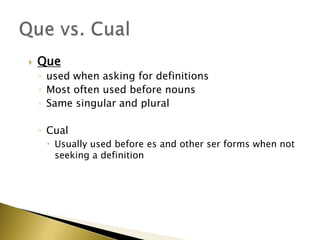
   Que
    ◦ used when asking for definitions
    ◦ Most often used before nouns
    ◦ Same singular and plural

    ◦ Cual
      Usually used before es and other ser forms when not
       seeking a definition
   Descriptions
   Origin
   Characteristics
   Time - ¿Que hora es?
   Occupation - ¿Que hace?
   Relationships - ¿Quien es?
   Possession - ¿De quien es?
   Events - ¿Cuando/Donde es?
   Dates - ¿Que dia es hoy?
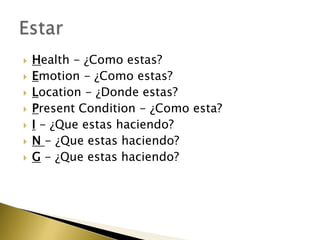
   Health - ¿Como estas?
   Emotion - ¿Como estas?
   Location - ¿Donde estas?
   Present Condition - ¿Como esta?
   I - ¿Que estas haciendo?
   N - ¿Que estas haciendo?
   G - ¿Que estas haciendo?
Me    It pleases me      Nos It pleases us
gusta                    gusta
Te    It pleases you     Os    It pleases ya’ll
gusta                    gusta
Le    It pleases him/her Les   It pleases them
gusta                    gusta
•“no” goes before me, te, le, nos, os, les
•A mi, a ti, a usted, etc. means more emphasis
   Tambien
   Ahora
   Primero
   Despues
   Ni-ni
   Pero
   Por-eso
   Asi-que
   Y
   Entonces
Iba (ir)   íbamos
   An imperfect action in the past                   Ibas       Ibais
   There is no beginning nor                         iba        Iban
    ending
   It is past tense
                                                  Era (ser) eramos
   Ongoing action
                                                  Eras           Erais
   It is repeated
                   escribía   escribíamos         era            Eran

                   escribías escribíais
                                              Veía (ver)     Veíamos
                   escribía   escribían
                                              Veías          Veíais

                     Comía     Comíamos       veía           veían

                     Comías    Comíais
                                            Hablaba         hablaban
                     comía     comían
                                            Hablabas        hablabais
                                            hablaba         hablábamos
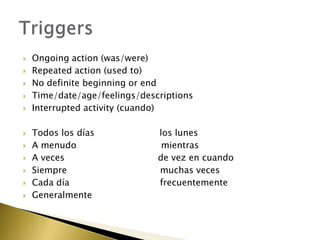
   Ongoing action (was/were)
   Repeated action (used to)
   No definite beginning or end
   Time/date/age/feelings/descriptions
   Interrupted activity (cuando)

   Todos los días             los lunes
   A menudo                    mientras
   A veces                    de vez en cuando
   Siempre                    muchas veces
   Cada día                   frecuentemente
   Generalmente
   To have just done something (in the very
    recent past)
   Example: Acabo de llevar a mi hermana a su
    casa.
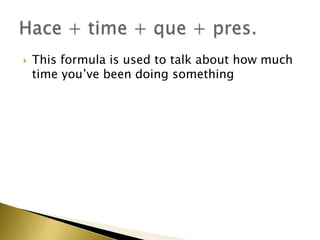
   This formula is used to talk about how much
    time you‟ve been doing something
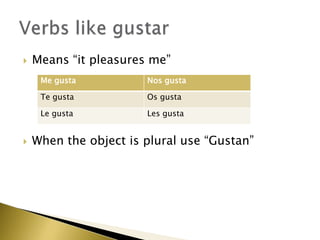
   Means “it pleasures me”
     Me gusta          Nos gusta

     Te gusta          Os gusta

     Le gusta          Les gusta


   When the object is plural use “Gustan”
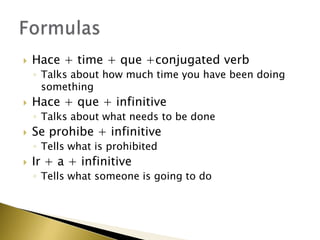
   Hace + time + que +conjugated verb
    ◦ Talks about how much time you have been doing
      something
   Hace + que + infinitive
    ◦ Talks about what needs to be done
   Se prohibe + infinitive
    ◦ Tells what is prohibited
   Ir + a + infinitive
    ◦ Tells what someone is going to do
   Do-er and the receiver are the same
   Add –arse or –irse
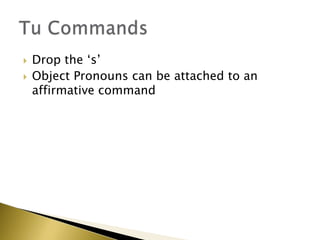
   Drop the „s‟
   Object Pronouns can be attached to an
    affirmative command
   Take the place of a noun
   Me, te, lo/la, nos, os, los/las
   When you change the syllabification of a
    verb, an accent mark is added to the 3rd to
    last syllable
   Attached to the infinitive
   In front of the conjugated verb

El libro de gramatica

  • 1.
  • 2.
    Que vs. Cual  Ser (D.O.C.T.O.R.P.E.D.)  Estar (H.E.L.P.I.N.G.)  Gustar  Transitions  Imperfect  Triggers  Acabar de + infinitive  Hace + time + que + verb  Verbs like gustar  Formulas  Reflexive  Tu commands  DOP + Placement
  • 3.
    Que ◦ used when asking for definitions ◦ Most often used before nouns ◦ Same singular and plural ◦ Cual  Usually used before es and other ser forms when not seeking a definition
  • 4.
    Descriptions  Origin  Characteristics  Time - ¿Que hora es?  Occupation - ¿Que hace?  Relationships - ¿Quien es?  Possession - ¿De quien es?  Events - ¿Cuando/Donde es?  Dates - ¿Que dia es hoy?
  • 5.
    Health - ¿Como estas?  Emotion - ¿Como estas?  Location - ¿Donde estas?  Present Condition - ¿Como esta?  I - ¿Que estas haciendo?  N - ¿Que estas haciendo?  G - ¿Que estas haciendo?
  • 6.
    Me It pleases me Nos It pleases us gusta gusta Te It pleases you Os It pleases ya’ll gusta gusta Le It pleases him/her Les It pleases them gusta gusta •“no” goes before me, te, le, nos, os, les •A mi, a ti, a usted, etc. means more emphasis
  • 7.
    Tambien  Ahora  Primero  Despues  Ni-ni  Pero  Por-eso  Asi-que  Y  Entonces
  • 8.
    Iba (ir) íbamos  An imperfect action in the past Ibas Ibais  There is no beginning nor iba Iban ending  It is past tense Era (ser) eramos  Ongoing action Eras Erais  It is repeated escribía escribíamos era Eran escribías escribíais Veía (ver) Veíamos escribía escribían Veías Veíais Comía Comíamos veía veían Comías Comíais Hablaba hablaban comía comían Hablabas hablabais hablaba hablábamos
  • 9.
    Ongoing action (was/were)  Repeated action (used to)  No definite beginning or end  Time/date/age/feelings/descriptions  Interrupted activity (cuando)  Todos los días los lunes  A menudo mientras  A veces de vez en cuando  Siempre muchas veces  Cada día frecuentemente  Generalmente
  • 10.
    To have just done something (in the very recent past)  Example: Acabo de llevar a mi hermana a su casa.
  • 11.
    This formula is used to talk about how much time you‟ve been doing something
  • 12.
    Means “it pleasures me” Me gusta Nos gusta Te gusta Os gusta Le gusta Les gusta  When the object is plural use “Gustan”
  • 13.
    Hace + time + que +conjugated verb ◦ Talks about how much time you have been doing something  Hace + que + infinitive ◦ Talks about what needs to be done  Se prohibe + infinitive ◦ Tells what is prohibited  Ir + a + infinitive ◦ Tells what someone is going to do
  • 14.
    Do-er and the receiver are the same  Add –arse or –irse
  • 15.
    Drop the „s‟  Object Pronouns can be attached to an affirmative command
  • 16.
    Take the place of a noun  Me, te, lo/la, nos, os, los/las  When you change the syllabification of a verb, an accent mark is added to the 3rd to last syllable  Attached to the infinitive  In front of the conjugated verb