Aplicaciones y Servicios Multimedia Joaquín Salvachúa Antonio Fumero
Guión Real-time Transport Protocol Session Initiation Protocol Mensajería SIP/SIMPLE Mensajería XMPP
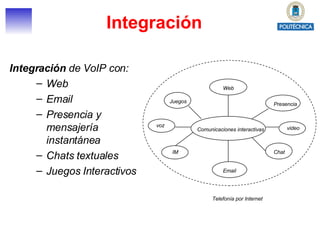
Integración Integración  de VoIP con: Web Email Presencia y mensajería instantánea  Chats textuales Juegos Interactivos Telefonía por Internet Comunicaciones interactivas Web Juegos Email Presencia IM Chat voz video
Necesidad Azar y necesidad: Aparecen redes de banda ancha por aplicaciones Aparecen nuevas aplicaciones que utilizan redes de banda ancha. Concepto de “ killer application ” superado: Killer Cocktail No hay aplicaciones que sustituyen totalmente a todas Teoria del  TAMBIÉN .
Real-time Transport Protocol (RTP)

Problemas TCP servía para todo excepto: Envío de audio Envío de vídeo Envío de información en tiempo real. Enfoque adaptativo no es suficiente
¿Un protocolo nuevo? TCP   necesita retransmisión Necesidad de vencimiento de temporizador Puede que la información retransmitida sea demasiado antigua. UDP  no tiene confirmación ni datos sobre el contenido: No existe concepto de calidad de servicio (QoS).
Dos protocolos RTP   Encapsulación de trafico en tiempo real RTCP Protocolo de reserva y garantía de calidad de servicio a determinados flujos RTP. Necesidad de garantías en todo el recorrido. Parte de un esquema mayor a nivel global.
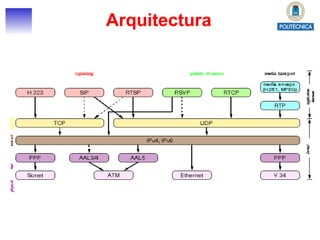
Arquitectura
Objetivos El protocolo No garantiza nada, solo ofrece las facilidades necesarias para hacerlo. No esta asociado con ninguna aplicación concreta. Necesidad de una descripción de : Perfil de tráfico. Formato de codificación.
Objetivos Ligero: Implementación simple. Flexible: No indica algoritmos Neutral frente transporte Escalable:  Unicast, multicast, broadcast Separación de datos y control Seguro: posibilidad de encriptación y autenticación.
Características Datos Temporización Detección de perdidas Etiquetado de contenidos Control Realimentación de QoS Estimación de miembros y detección de bucles.
Funcionalidad Segmentación realizada por UDP ó IP Re-secuenciación de paquetes. Detección de perdidas para estimación posterior. Sincronización entre media Sincronización labios y control de retrasos Realimentación de QOS y Velocidad Identificación de la fuente.
Posibles piezas  Mezcladores Un flujo a partir de múltiples. Reduce el ancho de banda. Aparece como una nueva fuente. Traducciones Codificación de un solo media. Puede ser translación de protocolo (firewall) Cambio de codificación (ancho de banda).
Cabecera RTP Payload type:  Tipo de media contenido   SSRC:  indicación de sincronización  sequence number:  ++ para detectar perdidas. P:  padding (for encryption)  M:  marker bit; Indica comienzo de frame para delay. CC:  content source count (for mixers) CSRC:  lista de identificadores en mezclas.
Temporización en RTP Incrementado en 1 por cada muestra  (e.g. 160 for 20 ms packets @ 8000 Hz) Comienzo aleatorio Velocidad constante para el audio  (e.g. 8000 Hz for PCM-law, 44100 Hz for linear, 16-bit,  90 kHz for video) Múltiples imágenes de vídeo pueden tener el mismo (en silencios).
Típico : UDP, sin puerto fijo; RTCP port = RTP port (par) + 1 Típicamente el paquete de  UDP esta limitado a unos cientos de bytes (OS, network, fragmentación) Necesidad de minimizar descarte y congestón. RTP en una red
RTCP ancho de banda Cada participante envía un paquete RTCP para que se sepa quienes están escuchando. Ancho de banda de la sesión: Audio N * flujos de video.
Sincronización entre flujos Necesidad de establecer sincronización entre múltiples flujos (vídeo, audio, transparencias). Necesidad de correlar los tics con tiempo real (depende de envío de temporizaciones aleatorias). Correlarlas con la generación de muestras.
RTCP Paquetes almacenables (similares a datos). sender report (SR): bytes enviados y velocidad. reports (RR): Jitter, Round-trip delay, perdidas. source description (SDES):  nombre, email, localización CNAME  (canonical name = user@host)  explicit leave (BYE): para conocer quienes estan. extensions (APP): definidos por la aplicación (aún ninguno)
Referencias RTP: A Transport Protocol for Real Time Applications  http://www.ietf.org.internet-drafts/draft-ietf-avt-rtp-new-02.txt RTP Profile for Audio and Video Conferences with Minimal Control  http://www.ietf.org.internet-drafts/draft-ietf-avt-profile-new-04.txt The RTP specification is a product of the Audio Video Transport (AVP)  http://www.ietf.org/html.charters/avt-charter.html . http://www.cs.columbia.edu/~hgs/rtp/faq.html
SIP como protocolo para los servicios multimedia del futuro
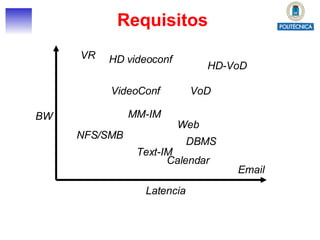
Requisitos Latencia BW VR NFS/SMB HD videoconf VideoConf MM-IM Text-IM Calendar DBMS Web VoD HD-VoD Email
Visión General H.323 MGCP/Megaco SDP TCP SIP UDP RTP RSVP RTSP Media encaps (H.261,MPEG) IPv4,IPv6 PPP Sonet AAL3/4 AAL5 ATM Ethernet PPP V.34 Physical  link  network  transport Signaling Quality of Service reservation Media transport kernel Application daemon
SIP, H.323 y MGCP RTCP RTP IP MGCP MEGACO Control de la llamada Señalización Flujos multimedia Media H.225 Q.931 H.323 TCP RAS UDP SIP H.245 Audio/ Video RTSP
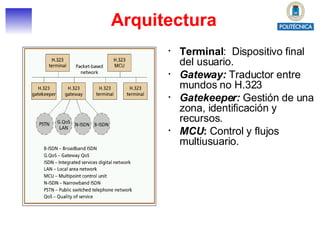
Arquitectura Terminal :  Dispositivo final del usuario. Gateway:   Traductor entre mundos no H.323 Gatekeeper:   Gestión de una zona, identificación y recursos. MCU :  Control y flujos multiusuario.
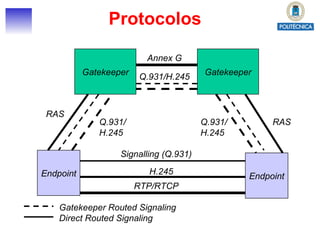
Protocolos Endpoint Gatekeeper Endpoint Gatekeeper RAS RAS Signalling (Q.931) H.245 RTP/RTCP Q.931/ H.245 Q.931/H.245 Q.931/ H.245 Annex G Gatekeeper Routed Signaling Direct Routed Signaling
Aplicaciones
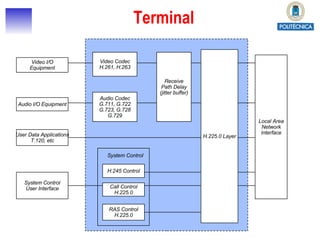
Terminal Video I/O Equipment Audio I/O Equipment User Data Applications T.120, etc System Control User Interface Video Codec H.261, H.263 Audio Codec G.711, G.722 G.723, G.728 G.729 Receive Path Delay (jitter buffer) H.225.0 Layer Local Area Network Interface Call Control H.225.0 H.245 Control RAS Control H.225.0 System Control
SIP: Session Initiation Protocol Estándar del IETF (RFC 3261) Protocolo genérico de establecimiento de sesiones multimedia.  Interoperabilidad con anteriores VoIP. Diseñado específicamente para IP e Internet: similar a HTTP.  Permitirá la aparición de nuevos servicios y aplicaciones Escalable y flexible Bajo coste de establecimiento de llamada.
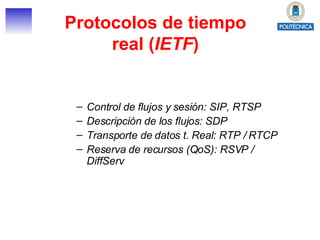
Protocolos de tiempo real ( IETF ) Control de flujos y sesión: SIP, RTSP Descripción de los flujos: SDP Transporte de datos t. Real: RTP / RTCP Reserva de recursos (QoS): RSVP / DiffServ
Direccionamientos @ La dirección SIP es similar a la de correo No tiene porque ser IP:  [email_address] .  Por ejemplo, son URL: sip:hostname@vovida.org sip:hostname@192.168.10.1 sip:14085551212@vovida.org
Componentes SIP Agentes de Usuario: Cliente que inicia las llamadas Mod o cliente y servidor. Servidores Proxy: Statefull : Con estado  Stateless : Sin estado. Redirect  Registration Proxy Server Redirect Server Registration Server Proxy Server UAS UAC
Es de Igual a Igual Peer-to-Peer SIP Components User Agent User Agent
Un  sistema típico Redirect Server Location Server Registrar Server User Agent Proxy Server Gateway PSTN SIP Components Proxy Server
Despliegue SIP SIP proxy, redirect server SQL database sipd e*phone sipc Software SIP  user agents Hardware  Internet (SIP) phones SIPH.323 convertor NetMeeting sip323 H.323 rtspd SIP/RTSP Unified  messaging  RTSP media  server  sipum Quicktime RTSP clients RTSP SIP  conference server sipconf T1/E1 RTP/SIP Telephone Cisco 2600 gateway Telephone switch Web based  configuration Web server
Similar a HTTP
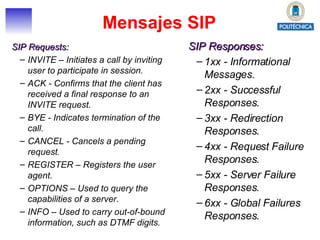
Mensajes SIP SIP Requests: INVITE – Initiates a call by inviting user to participate in session. ACK - Confirms that the client has received a final response to an INVITE request. BYE - Indicates termination of the call. CANCEL - Cancels a pending request. REGISTER – Registers the user agent. OPTIONS – Used to query the capabilities of a server. INFO – Used to carry out-of-bound information, such as DTMF digits. SIP Responses: 1xx - Informational Messages. 2xx - Successful Responses. 3xx - Redirection Responses. 4xx - Request Failure Responses. 5xx - Server Failure Responses. 6xx - Global Failures Responses.
SIP / SIMPLE  – Presencia  Nueva entidad: Presence Agent Entidad lógica  Conoce el estado del usuario Recibe peticiones  SUBSCRIBE  Genera respuestas NOTIFY Co-located with proxy/registrar or User Agent
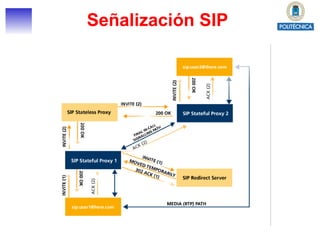
Señalización SIP
Jabber Protocolo abierto basado en XML Control de presencia Mensajería instantánea Extensible Seguro Distribuido Descentralizado
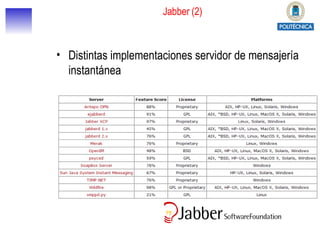
Jabber (2) Distintas implementaciones servidor de mensajería instantánea
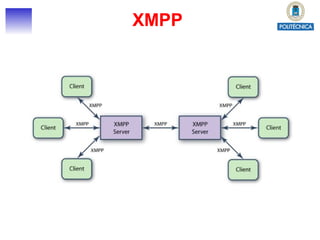
XMPP
Cluster XMPP
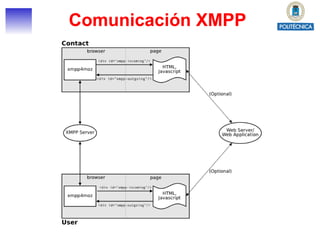
Comunicación XMPP
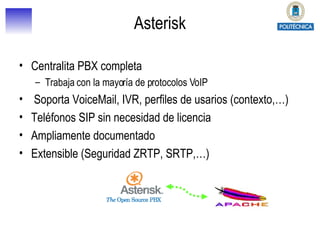
Asterisk Centralita PBX completa Trabaja con la mayoría de protocolos VoIP Soporta VoiceMail, IVR, perfiles de usarios (contexto,…) Teléfonos SIP sin necesidad de licencia Ampliamente documentado Extensible (Seguridad ZRTP, SRTP,…)
Flash Maquina virtual en cada navegador.  Similar a java. Mas especializado. Mayor integración con los SO. Flex : modelo C-S para app. distribuidas.
FLV Flash Video Format http://osflash.org/flv
RTMP
RTMP RTMP protocolo para enviar, en tiempo real, objetos, vídeo y audio usando una conexión TCP o HTTP. Es un contenedor de paquete de datos de AMF, audio o FLV.  Una conexión puede multiplexar diversos canales.  Similar al SIP-Trunking o IAX2.
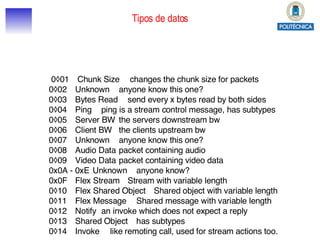
Tipos de datos 0×01   Chunk Size   changes the chunk size for packets 0×02  Unknown  anyone know this one? 0×03  Bytes Read  send every x bytes read by both sides 0×04  Ping  ping is a stream control message, has subtypes 0×05  Server BW  the servers downstream bw 0×06  Client BW  the clients upstream bw 0×07  Unknown  anyone know this one? 0×08  Audio Data  packet containing audio 0×09  Video Data  packet containing video data 0x0A - 0xE  Unknown  anyone know? 0x0F  Flex Stream  Stream with variable length 0×10  Flex Shared Object  Shared object with variable length 0×11  Flex Message  Shared message with variable length 0×12  Notify  an invoke which does not expect a reply 0×13  Shared Object  has subtypes 0×14  Invoke  like remoting call, used for stream actions too.
Conexión HTTP RTMPT basically is a HTTP wrapper  Usa POST de cliente a servidor.  RTMPT requires the clients to poll for updates periodically in order to get notified about events that are generated by the server or other clients.
Mundos virtuales
Cyberspacio Metaverso Del ciberespacio al metaverso 1984 1992
MATRIX ¿Cambio de metáfora?
Second first – Life is life
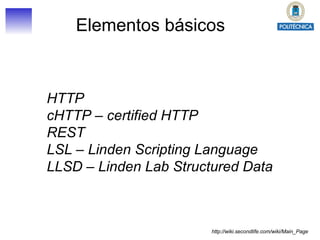
HTTP cHTTP – certified HTTP REST LSL – Linden Scripting Language LLSD – Linden Lab Structured Data Elementos básicos http://wiki.secondlife.com/wiki/Main_Page
Funcionamiento ..Each "sim" or simulator of a portion of the  virtual world  in Second Life is created on a server running  Debian   GNU/Linux ,  Apache ,  Squid  and  MySQL ; currently there are several thousand of these PC boxes. To allow for fast response times, the virtual world is sent not as pixels or even as a mesh, but as a series of 3D primitives - "prims". The Second Life client creates the world by converting the stream of information about prims and their position into a visual representation...
Arquitectura Grid http://wiki.secondlife.com/wiki/Main_Page
Dominios separados http://wiki.secondlife.com/wiki/Main_Page
Escalabilidad http://wiki.secondlife.com/wiki/Main_Page
Multiversos
Identidad
Laws of identity http://www.identityblog.com/stories/2004/12/09/thelaws.html User Control and Consent. Technical identity systems must only reveal information identifying a user with the user’s consent Minimal Disclosure for a Constrained Use. The solution that discloses the least amount of identifying information and best limits its use is the most stable long-term solution. Justifiable Parties. Digital identity systems must be designed so the disclosure of identifying information is limited to parties having a necessary and justifiable place in a given identity relationship. Directed Identity. A universal identity system must support both “omni-directional” identifiers for use by public entities and “unidirectional” identifiers for use by private entities, thus facilitating discovery while preventing unnecessary release of correlation handles. Pluralism of Operators and Technologies. A universal identity system must channel and enable the inter-working of multiple identity technologies run by multiple identity providers Human Integration. The universal identity metasystem must define the human user to be a component of the distributed system integrated through unambiguous human-machine communication mechanisms offering protection against identity attacks. Consistent Experience Across Contexts. The unifying identity metasystem must guarantee its users a simple, consistent experience while enabling separation of contexts through multiple operators and technologies.
mIDm http://www.downes.ca/cgi-bin/page.cgi?post=32667 A user tries to access a page on a service to which a login is required. The service obtains the user's mIDm server location from the user's browser header The service redirects the user to the user's mIDm server along with a secret code The user logs on to the mIDm server (typically using cookies) and stores the secret code on the mIDm server The mIDm server returns the user to the service The service then independently checks the mIDm server to see whether the code has been stored The mIDm server returns the code and requested user information to the service On receiving the code, the service is satisfied, and proceeds to log in the user
OpenID – ¿Qué es? OpenID es un mecanismo de SSO distribuido Es un URI antoniofumero.myopenid.com https://irss.dit.upm.es/move/users/amfumero
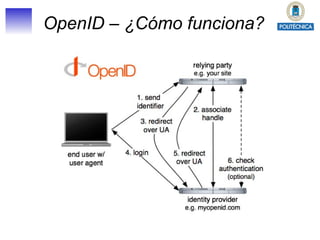
OpenID – Elementos Identity provider Relying party End user / user agent
OpenID – ¿Cómo funciona?
OpenID – Elementos Identity provider Relying party End user / user agent
I4U – Mobile 2.0


SPAIN IS DIFFERENT

Iba2008 Servicios

  • 1.
    Aplicaciones y ServiciosMultimedia Joaquín Salvachúa Antonio Fumero
  • 2.
    Guión Real-time TransportProtocol Session Initiation Protocol Mensajería SIP/SIMPLE Mensajería XMPP
  • 3.
    Integración Integración de VoIP con: Web Email Presencia y mensajería instantánea Chats textuales Juegos Interactivos Telefonía por Internet Comunicaciones interactivas Web Juegos Email Presencia IM Chat voz video
  • 4.
    Necesidad Azar ynecesidad: Aparecen redes de banda ancha por aplicaciones Aparecen nuevas aplicaciones que utilizan redes de banda ancha. Concepto de “ killer application ” superado: Killer Cocktail No hay aplicaciones que sustituyen totalmente a todas Teoria del TAMBIÉN .
  • 5.
  • 6.
    Problemas TCP servíapara todo excepto: Envío de audio Envío de vídeo Envío de información en tiempo real. Enfoque adaptativo no es suficiente
  • 7.
    ¿Un protocolo nuevo?TCP necesita retransmisión Necesidad de vencimiento de temporizador Puede que la información retransmitida sea demasiado antigua. UDP no tiene confirmación ni datos sobre el contenido: No existe concepto de calidad de servicio (QoS).
  • 8.
    Dos protocolos RTP Encapsulación de trafico en tiempo real RTCP Protocolo de reserva y garantía de calidad de servicio a determinados flujos RTP. Necesidad de garantías en todo el recorrido. Parte de un esquema mayor a nivel global.
  • 9.
  • 10.
    Objetivos El protocoloNo garantiza nada, solo ofrece las facilidades necesarias para hacerlo. No esta asociado con ninguna aplicación concreta. Necesidad de una descripción de : Perfil de tráfico. Formato de codificación.
  • 11.
    Objetivos Ligero: Implementaciónsimple. Flexible: No indica algoritmos Neutral frente transporte Escalable: Unicast, multicast, broadcast Separación de datos y control Seguro: posibilidad de encriptación y autenticación.
  • 12.
    Características Datos TemporizaciónDetección de perdidas Etiquetado de contenidos Control Realimentación de QoS Estimación de miembros y detección de bucles.
  • 13.
    Funcionalidad Segmentación realizadapor UDP ó IP Re-secuenciación de paquetes. Detección de perdidas para estimación posterior. Sincronización entre media Sincronización labios y control de retrasos Realimentación de QOS y Velocidad Identificación de la fuente.
  • 14.
    Posibles piezas Mezcladores Un flujo a partir de múltiples. Reduce el ancho de banda. Aparece como una nueva fuente. Traducciones Codificación de un solo media. Puede ser translación de protocolo (firewall) Cambio de codificación (ancho de banda).
  • 15.
    Cabecera RTP Payloadtype: Tipo de media contenido SSRC: indicación de sincronización sequence number: ++ para detectar perdidas. P: padding (for encryption) M: marker bit; Indica comienzo de frame para delay. CC: content source count (for mixers) CSRC: lista de identificadores en mezclas.
  • 16.
    Temporización en RTPIncrementado en 1 por cada muestra (e.g. 160 for 20 ms packets @ 8000 Hz) Comienzo aleatorio Velocidad constante para el audio (e.g. 8000 Hz for PCM-law, 44100 Hz for linear, 16-bit, 90 kHz for video) Múltiples imágenes de vídeo pueden tener el mismo (en silencios).
  • 17.
    Típico : UDP,sin puerto fijo; RTCP port = RTP port (par) + 1 Típicamente el paquete de UDP esta limitado a unos cientos de bytes (OS, network, fragmentación) Necesidad de minimizar descarte y congestón. RTP en una red
  • 18.
    RTCP ancho debanda Cada participante envía un paquete RTCP para que se sepa quienes están escuchando. Ancho de banda de la sesión: Audio N * flujos de video.
  • 19.
    Sincronización entre flujosNecesidad de establecer sincronización entre múltiples flujos (vídeo, audio, transparencias). Necesidad de correlar los tics con tiempo real (depende de envío de temporizaciones aleatorias). Correlarlas con la generación de muestras.
  • 20.
    RTCP Paquetes almacenables(similares a datos). sender report (SR): bytes enviados y velocidad. reports (RR): Jitter, Round-trip delay, perdidas. source description (SDES): nombre, email, localización CNAME (canonical name = user@host) explicit leave (BYE): para conocer quienes estan. extensions (APP): definidos por la aplicación (aún ninguno)
  • 21.
    Referencias RTP: ATransport Protocol for Real Time Applications http://www.ietf.org.internet-drafts/draft-ietf-avt-rtp-new-02.txt RTP Profile for Audio and Video Conferences with Minimal Control http://www.ietf.org.internet-drafts/draft-ietf-avt-profile-new-04.txt The RTP specification is a product of the Audio Video Transport (AVP) http://www.ietf.org/html.charters/avt-charter.html . http://www.cs.columbia.edu/~hgs/rtp/faq.html
  • 22.
    SIP como protocolopara los servicios multimedia del futuro
  • 23.
    Requisitos Latencia BWVR NFS/SMB HD videoconf VideoConf MM-IM Text-IM Calendar DBMS Web VoD HD-VoD Email
  • 24.
    Visión General H.323MGCP/Megaco SDP TCP SIP UDP RTP RSVP RTSP Media encaps (H.261,MPEG) IPv4,IPv6 PPP Sonet AAL3/4 AAL5 ATM Ethernet PPP V.34 Physical link network transport Signaling Quality of Service reservation Media transport kernel Application daemon
  • 25.
    SIP, H.323 yMGCP RTCP RTP IP MGCP MEGACO Control de la llamada Señalización Flujos multimedia Media H.225 Q.931 H.323 TCP RAS UDP SIP H.245 Audio/ Video RTSP
  • 26.
    Arquitectura Terminal : Dispositivo final del usuario. Gateway: Traductor entre mundos no H.323 Gatekeeper: Gestión de una zona, identificación y recursos. MCU : Control y flujos multiusuario.
  • 27.
    Protocolos Endpoint GatekeeperEndpoint Gatekeeper RAS RAS Signalling (Q.931) H.245 RTP/RTCP Q.931/ H.245 Q.931/H.245 Q.931/ H.245 Annex G Gatekeeper Routed Signaling Direct Routed Signaling
  • 28.
  • 29.
    Terminal Video I/OEquipment Audio I/O Equipment User Data Applications T.120, etc System Control User Interface Video Codec H.261, H.263 Audio Codec G.711, G.722 G.723, G.728 G.729 Receive Path Delay (jitter buffer) H.225.0 Layer Local Area Network Interface Call Control H.225.0 H.245 Control RAS Control H.225.0 System Control
  • 30.
    SIP: Session InitiationProtocol Estándar del IETF (RFC 3261) Protocolo genérico de establecimiento de sesiones multimedia. Interoperabilidad con anteriores VoIP. Diseñado específicamente para IP e Internet: similar a HTTP. Permitirá la aparición de nuevos servicios y aplicaciones Escalable y flexible Bajo coste de establecimiento de llamada.
  • 31.
    Protocolos de tiemporeal ( IETF ) Control de flujos y sesión: SIP, RTSP Descripción de los flujos: SDP Transporte de datos t. Real: RTP / RTCP Reserva de recursos (QoS): RSVP / DiffServ
  • 32.
    Direccionamientos @ Ladirección SIP es similar a la de correo No tiene porque ser IP: [email_address] . Por ejemplo, son URL: sip:hostname@vovida.org sip:hostname@192.168.10.1 sip:14085551212@vovida.org
  • 33.
    Componentes SIP Agentesde Usuario: Cliente que inicia las llamadas Mod o cliente y servidor. Servidores Proxy: Statefull : Con estado Stateless : Sin estado. Redirect Registration Proxy Server Redirect Server Registration Server Proxy Server UAS UAC
  • 34.
    Es de Iguala Igual Peer-to-Peer SIP Components User Agent User Agent
  • 35.
    Un sistematípico Redirect Server Location Server Registrar Server User Agent Proxy Server Gateway PSTN SIP Components Proxy Server
  • 36.
    Despliegue SIP SIPproxy, redirect server SQL database sipd e*phone sipc Software SIP user agents Hardware Internet (SIP) phones SIPH.323 convertor NetMeeting sip323 H.323 rtspd SIP/RTSP Unified messaging RTSP media server sipum Quicktime RTSP clients RTSP SIP conference server sipconf T1/E1 RTP/SIP Telephone Cisco 2600 gateway Telephone switch Web based configuration Web server
  • 37.
  • 38.
    Mensajes SIP SIPRequests: INVITE – Initiates a call by inviting user to participate in session. ACK - Confirms that the client has received a final response to an INVITE request. BYE - Indicates termination of the call. CANCEL - Cancels a pending request. REGISTER – Registers the user agent. OPTIONS – Used to query the capabilities of a server. INFO – Used to carry out-of-bound information, such as DTMF digits. SIP Responses: 1xx - Informational Messages. 2xx - Successful Responses. 3xx - Redirection Responses. 4xx - Request Failure Responses. 5xx - Server Failure Responses. 6xx - Global Failures Responses.
  • 39.
    SIP / SIMPLE – Presencia Nueva entidad: Presence Agent Entidad lógica Conoce el estado del usuario Recibe peticiones SUBSCRIBE Genera respuestas NOTIFY Co-located with proxy/registrar or User Agent
  • 40.
  • 41.
    Jabber Protocolo abiertobasado en XML Control de presencia Mensajería instantánea Extensible Seguro Distribuido Descentralizado
  • 42.
    Jabber (2) Distintasimplementaciones servidor de mensajería instantánea
  • 43.
  • 44.
  • 45.
  • 46.
    Asterisk Centralita PBXcompleta Trabaja con la mayoría de protocolos VoIP Soporta VoiceMail, IVR, perfiles de usarios (contexto,…) Teléfonos SIP sin necesidad de licencia Ampliamente documentado Extensible (Seguridad ZRTP, SRTP,…)
  • 47.
    Flash Maquina virtualen cada navegador. Similar a java. Mas especializado. Mayor integración con los SO. Flex : modelo C-S para app. distribuidas.
  • 48.
    FLV Flash VideoFormat http://osflash.org/flv
  • 49.
  • 50.
    RTMP RTMP protocolopara enviar, en tiempo real, objetos, vídeo y audio usando una conexión TCP o HTTP. Es un contenedor de paquete de datos de AMF, audio o FLV. Una conexión puede multiplexar diversos canales. Similar al SIP-Trunking o IAX2.
  • 51.
    Tipos de datos0×01 Chunk Size changes the chunk size for packets 0×02 Unknown anyone know this one? 0×03 Bytes Read send every x bytes read by both sides 0×04 Ping ping is a stream control message, has subtypes 0×05 Server BW the servers downstream bw 0×06 Client BW the clients upstream bw 0×07 Unknown anyone know this one? 0×08 Audio Data packet containing audio 0×09 Video Data packet containing video data 0x0A - 0xE Unknown anyone know? 0x0F Flex Stream Stream with variable length 0×10 Flex Shared Object Shared object with variable length 0×11 Flex Message Shared message with variable length 0×12 Notify an invoke which does not expect a reply 0×13 Shared Object has subtypes 0×14 Invoke like remoting call, used for stream actions too.
  • 52.
    Conexión HTTP RTMPTbasically is a HTTP wrapper Usa POST de cliente a servidor. RTMPT requires the clients to poll for updates periodically in order to get notified about events that are generated by the server or other clients.
  • 53.
  • 54.
    Cyberspacio Metaverso Delciberespacio al metaverso 1984 1992
  • 55.
  • 56.
    Second first –Life is life
  • 57.
    HTTP cHTTP –certified HTTP REST LSL – Linden Scripting Language LLSD – Linden Lab Structured Data Elementos básicos http://wiki.secondlife.com/wiki/Main_Page
  • 58.
    Funcionamiento ..Each "sim"or simulator of a portion of the virtual world in Second Life is created on a server running Debian GNU/Linux , Apache , Squid and MySQL ; currently there are several thousand of these PC boxes. To allow for fast response times, the virtual world is sent not as pixels or even as a mesh, but as a series of 3D primitives - "prims". The Second Life client creates the world by converting the stream of information about prims and their position into a visual representation...
  • 59.
  • 60.
  • 61.
  • 62.
  • 63.
  • 64.
    Laws of identityhttp://www.identityblog.com/stories/2004/12/09/thelaws.html User Control and Consent. Technical identity systems must only reveal information identifying a user with the user’s consent Minimal Disclosure for a Constrained Use. The solution that discloses the least amount of identifying information and best limits its use is the most stable long-term solution. Justifiable Parties. Digital identity systems must be designed so the disclosure of identifying information is limited to parties having a necessary and justifiable place in a given identity relationship. Directed Identity. A universal identity system must support both “omni-directional” identifiers for use by public entities and “unidirectional” identifiers for use by private entities, thus facilitating discovery while preventing unnecessary release of correlation handles. Pluralism of Operators and Technologies. A universal identity system must channel and enable the inter-working of multiple identity technologies run by multiple identity providers Human Integration. The universal identity metasystem must define the human user to be a component of the distributed system integrated through unambiguous human-machine communication mechanisms offering protection against identity attacks. Consistent Experience Across Contexts. The unifying identity metasystem must guarantee its users a simple, consistent experience while enabling separation of contexts through multiple operators and technologies.
  • 65.
    mIDm http://www.downes.ca/cgi-bin/page.cgi?post=32667 Auser tries to access a page on a service to which a login is required. The service obtains the user's mIDm server location from the user's browser header The service redirects the user to the user's mIDm server along with a secret code The user logs on to the mIDm server (typically using cookies) and stores the secret code on the mIDm server The mIDm server returns the user to the service The service then independently checks the mIDm server to see whether the code has been stored The mIDm server returns the code and requested user information to the service On receiving the code, the service is satisfied, and proceeds to log in the user
  • 66.
    OpenID – ¿Quées? OpenID es un mecanismo de SSO distribuido Es un URI antoniofumero.myopenid.com https://irss.dit.upm.es/move/users/amfumero
  • 67.
    OpenID – ElementosIdentity provider Relying party End user / user agent
  • 68.
  • 69.
    OpenID – ElementosIdentity provider Relying party End user / user agent
  • 70.
  • 71.
  • 72.
  • 73.
  • 74.
  • 75.