Playa Los Frailes

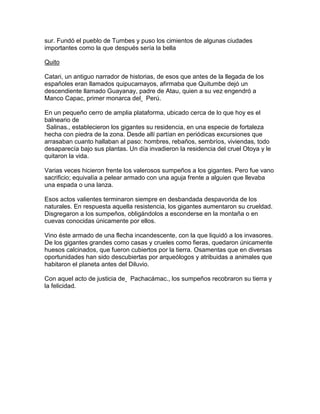
Los Frailes es una playa curva, en forma de ensenada, encarando al oeste,
con horizonte completamente despejado. Al oeste se encuentra rodeado de
colinas ligeramente montañosas y hacia el sector de la quebrada
correspondiente a la desembocadura del Río Las Pampas, las colinas se
retiran para la parte posterior.

La vegetación existente corresponde a formaciones vegetales primarias, las
mismas que al momento están desapareciendo en Manabí.
La arena de la Playa los Frailes es fina y contiene algas en su superficie, es
de color gris verdosa, con conchillas y zona de canto rodado en la orilla.

Esta playa se abre hacia el norte completamente despejado, hacia el sur
toda la zona elevada de acantilados está completamente dominada por la
ciudad y hacia el sur oeste el paisaje está dominado por la zona de
acantilados, hacia el oeste está completamente dominada por la presencia
del rompe olas portuario.


“Los Frailes” Beach
 “Los Frailes” beach is a curve-shaped cave, facing west, with
cloudless horizon. To the west is surrounded by mountains and hills
slightly to the section of the stream corresponding to the mouth of
the Pampas, the hills are removed to the rear.
The vegetation corresponds to primary vegetation, the same as at
the time are disappearing in Manabí.
The sandy beach is fine Friars containing algae on its surface, is
gray-green, with shells and pebbles near the shore.
This beach is opened completely clear north to the south across the
high cliff area is completely dominated by the city and south west
the landscape is dominated by the cliff area to the west is
completely dominated by the presence of port breakwaters.
UBICACIÓN

Los Frailes tiene una playa linda solitaria se encuentra ubicado en el
suroccidente de Portoviejo.

EXTENSIÓN
La Playa de “Los Frailes” tienen una extensión aproximada de 3 kilómetros, desde
Punta Cabuya hasta Punta Los Frailes.


CLIMA

El clima en Playa de Los Frailes es caluroso. Su temperatura varía entre los 25 y
29 grados centígrados.
FLORA

Entre las plantas nativas de esta zona encontramos: rastreras, ojo de buey,
pechiche marino, moyuyo, arrayán, verdolaga marina, cactus, salado, forra y
árboles de manzanillo, los cuales se pueden encontrar atrás de las dunas


FAUNA

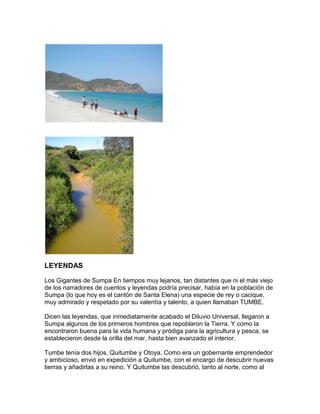
En los alrededores de esta playa se pueden encontrar pelícanos, gallinazos, garza
blanca, gaviota, caracoles, cangrejos, entre otras.
Especies Simbólicas: Entre las especies simbólicas de esta playa
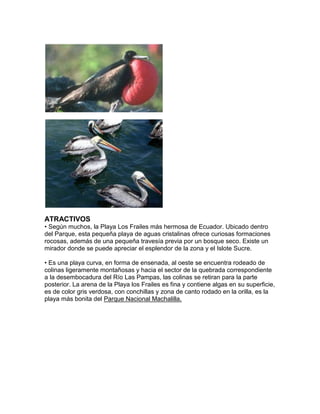
Patas azules, Fragatas y pelícanos.
ATRACTIVOS
• Según muchos, la Playa Los Frailes más hermosa de Ecuador. Ubicado dentro
del Parque, esta pequeña playa de aguas cristalinas ofrece curiosas formaciones
rocosas, además de una pequeña travesía previa por un bosque seco. Existe un
mirador donde se puede apreciar el esplendor de la zona y el Islote Sucre.

• Es una playa curva, en forma de ensenada, al oeste se encuentra rodeado de
colinas ligeramente montañosas y hacia el sector de la quebrada correspondiente
a la desembocadura del Río Las Pampas, las colinas se retiran para la parte
posterior. La arena de la Playa los Frailes es fina y contiene algas en su superficie,
es de color gris verdosa, con conchillas y zona de canto rodado en la orilla, es la
playa más bonita del Parque Nacional Machalilla.
LEYENDAS

Los Gigantes de Sumpa En tiempos muy lejanos, tan distantes que ni el más viejo
de los narradores de cuentos y leyendas podría precisar, había en la población de
Sumpa (lo que hoy es el cantón de Santa Elena) una especie de rey o cacique,
muy admirado y respetado por su valentía y talento, a quien llamaban TUMBE.

Dicen las leyendas, que inmediatamente acabado el Diluvio Universal, llegaron a
Sumpa algunos de los primeros hombres que repoblaron la Tierra. Y como la
encontraron buena para la vida humana y pródiga para la agricultura y pesca, se
establecieron desde la orilla del mar, hasta bien avanzado el interior.

Tumbe tenía dos hijos, Quitumbe y Otoya. Como era un gobernante emprendedor
y ambicioso, envió en expedición a Quitumbe, con el encargo de descubrir nuevas
tierras y añadirlas a su reino. Y Quitumbe las descubrió, tanto al norte, como al
sur. Fundó el pueblo de Tumbes y puso los cimientos de algunas ciudades
importantes como la que después sería la bella

Quito

Catari, un antiguo narrador de historias, de esos que antes de la llegada de los
españoles eran llamados quipucamayos, afirmaba que Quitumbe dejó un
descendiente llamado Guayanay, padre de Atau, quien a su vez engendró a
Manco Capac, primer monarca del Perú.

En un pequeño cerro de amplia plataforma, ubicado cerca de lo que hoy es el
balneario de
 Salinas., establecieron los gigantes su residencia, en una especie de fortaleza
hecha con piedra de la zona. Desde allí partían en periódicas excursiones que
arrasaban cuanto hallaban al paso: hombres, rebaños, sembríos, viviendas, todo
desaparecía bajo sus plantas. Un día invadieron la residencia del cruel Otoya y le
quitaron la vida.

Varias veces hicieron frente los valerosos sumpeños a los gigantes. Pero fue vano
sacrificio; equivalía a pelear armado con una aguja frente a alguien que llevaba
una espada o una lanza.

Esos actos valientes terminaron siempre en desbandada despavorida de los
naturales. En respuesta aquella resistencia, los gigantes aumentaron su crueldad.
Disgregaron a los sumpeños, obligándolos a esconderse en la montaña o en
cuevas conocidas únicamente por ellos.

Vino éste armado de una flecha incandescente, con la que liquidó a los invasores.
De los gigantes grandes como casas y crueles como fieras, quedaron únicamente
huesos calcinados, que fueron cubiertos por la tierra. Osamentas que en diversas
oportunidades han sido descubiertas por arqueólogos y atribuidas a animales que
habitaron el planeta antes del Diluvio.

Con aquel acto de justicia de Pachacámac., los sumpeños recobraron su tierra y
la felicidad.
“Los Frailes” Beach
June 6th, 2010
“Los Frailes” beach is a curve-shaped cove, facing west, with
cloudless horizon. To the west is surrounded by mountains and hills
slightly to the section of the stream corresponding to the mouth of
the Pampas, the hills are removed to the rear.
The vegetation corresponds to primary vegetation, the same as at
the time are disappearing in Manabí.
The sandy beach is fine Friars containing algae on its surface, is
gray-green, with shells and pebbles near the shore.
This beach is opened completely clear north to the south across the
high cliff area is completely dominated by the city and south west
the landscape is dominated by the cliff area to the west is
completely dominated by the presence of port breakwaters.


Which is the estension of the beach?
Where is located the beach the friars?
Which is the temperature?
What plants are there?
What animals are there?
Which are the attractions of the beach?
LOCATION
The Friars have a pretty lonely beach is located in southwestern de
Portoviejo.


EXTENSION
The beach of "Los Frailes" with an approximate size of 3 km from
Punta Cabuya to Punta Los Frailes.


CLIMATE
The weather in Playa de Los Frailes is hot. Its temperature varies
between 25 and 29 degrees Celsius.


FLORA
Among the plants native to this area are: creeping, porthole,
pechiche marine moyuyo, myrtle, sea purslane, cactus, salt, fodder
and trees of Manzanillo, which can be found behind the dunes


FAUNA
In the vicinity of this beach there are pelicans, vultures, egrets,
gulls, snails, crabs, among others.
Symbolic Species: The species symbolic of this beach
Blue-Footed frigates and pelicans.
ATTRACTIONS
• According to many the most beautiful beach of Los Frailes
Ecuador. Located within the Park, this small beach with crystal clear
water offers rock formations, along with a small crossing after a dry
forest. There is a viewpoint where you can appreciate the splendor
of the area and the Islet Sucre.


• The beach curved shaped cove, west is surrounded by mountains
and hills slightly to the section of the stream corresponding to the
mouth of the Pampas, the hills are removed to the rear. The sandy
beach is fine Friars containing algae on its surface, is gray-green,
with shells and pebbles near the shore, is the most beautiful beach
in Machalilla National Park.


LEGENDS
Giants Sumpa In very distant, so distant that neither the oldest of
storytellers and legends might require, had in the town of Sumpa
(what is now the canton of St. Helena) a kind of king or chief, much
admired and respected for his courage and talent, who was called
TIPPING.


Legend says that once finished the Flood came to Sumpa some of
the first men to repopulate the Earth. And found it good for human
life and to lavish agriculture and fisheries, were established from
the coast, well into the interior.


Lie had two sons, Quitumbe and Otoya. Being an enterprising and
ambitious ruler, sent Quitumbe expedition, with the task of
discovering new lands and add them to his kingdom. And Quitumbe
discovered them, both north and south. He founded the town of
Tumbes and laid the foundation of some major cities such as would
later be the beautiful


Quito


Katari, an old storyteller, the kind that before the arrival of the
Spanish were called quipucamayos, said that left a descendant
named Quitumbe Guayanay, Atau father, who in turn gave birth to
Manco Capac, first monarch of Peru.


In a small hill of broad platform, located near what is now the
resort of
 Salinas., Established giants residence in a fortress made of local
stone. From there on regular excursions departing as were razed to
the passage: men, cattle, crops, houses, everything disappeared
under their feet. One day invaded the residence of the cruel Otoya
and took his life.


Several times they faced the brave sumpeños the giants. But it was
vain sacrifice amounted to fight armed with a needle as opposed to
someone who had a sword or spear.


These courageous acts always ended in disarray in terror of the
natives. In response to that resistance, the Giants increased their
cruelty. The sumpeños disintegrated, forcing them to hide in the
mountains or in caves known only to them.


He came armed with a glowing arrow, with which the invaders
settled. Of the giants as big as houses and cruel as wild beasts,
leaving only charred bones, which were covered by earth. Bones
which at various times have been discovered by archaeologists and
attributed to animals that inhabited the planet before the Flood.


With that act of justice of Pachacamac., The sumpeños regained
their land and happiness.
Which is the estension of the beach?
Where is located the beach the friars?
Which is the temperature?
What plants are there?
What animals are there?
Which are the attractions of the beach?

Ingles playa los frailes

  • 1.
    Playa Los Frailes LosFrailes es una playa curva, en forma de ensenada, encarando al oeste, con horizonte completamente despejado. Al oeste se encuentra rodeado de colinas ligeramente montañosas y hacia el sector de la quebrada correspondiente a la desembocadura del Río Las Pampas, las colinas se retiran para la parte posterior. La vegetación existente corresponde a formaciones vegetales primarias, las mismas que al momento están desapareciendo en Manabí. La arena de la Playa los Frailes es fina y contiene algas en su superficie, es de color gris verdosa, con conchillas y zona de canto rodado en la orilla. Esta playa se abre hacia el norte completamente despejado, hacia el sur toda la zona elevada de acantilados está completamente dominada por la ciudad y hacia el sur oeste el paisaje está dominado por la zona de acantilados, hacia el oeste está completamente dominada por la presencia del rompe olas portuario. “Los Frailes” Beach “Los Frailes” beach is a curve-shaped cave, facing west, with cloudless horizon. To the west is surrounded by mountains and hills slightly to the section of the stream corresponding to the mouth of the Pampas, the hills are removed to the rear. The vegetation corresponds to primary vegetation, the same as at the time are disappearing in Manabí. The sandy beach is fine Friars containing algae on its surface, is gray-green, with shells and pebbles near the shore. This beach is opened completely clear north to the south across the high cliff area is completely dominated by the city and south west the landscape is dominated by the cliff area to the west is completely dominated by the presence of port breakwaters.
  • 2.
    UBICACIÓN Los Frailes tieneuna playa linda solitaria se encuentra ubicado en el suroccidente de Portoviejo. EXTENSIÓN La Playa de “Los Frailes” tienen una extensión aproximada de 3 kilómetros, desde Punta Cabuya hasta Punta Los Frailes. CLIMA El clima en Playa de Los Frailes es caluroso. Su temperatura varía entre los 25 y 29 grados centígrados.
  • 3.
    FLORA Entre las plantasnativas de esta zona encontramos: rastreras, ojo de buey, pechiche marino, moyuyo, arrayán, verdolaga marina, cactus, salado, forra y árboles de manzanillo, los cuales se pueden encontrar atrás de las dunas FAUNA En los alrededores de esta playa se pueden encontrar pelícanos, gallinazos, garza blanca, gaviota, caracoles, cangrejos, entre otras. Especies Simbólicas: Entre las especies simbólicas de esta playa Patas azules, Fragatas y pelícanos.
  • 4.
    ATRACTIVOS • Según muchos,la Playa Los Frailes más hermosa de Ecuador. Ubicado dentro del Parque, esta pequeña playa de aguas cristalinas ofrece curiosas formaciones rocosas, además de una pequeña travesía previa por un bosque seco. Existe un mirador donde se puede apreciar el esplendor de la zona y el Islote Sucre. • Es una playa curva, en forma de ensenada, al oeste se encuentra rodeado de colinas ligeramente montañosas y hacia el sector de la quebrada correspondiente a la desembocadura del Río Las Pampas, las colinas se retiran para la parte posterior. La arena de la Playa los Frailes es fina y contiene algas en su superficie, es de color gris verdosa, con conchillas y zona de canto rodado en la orilla, es la playa más bonita del Parque Nacional Machalilla.
  • 5.
    LEYENDAS Los Gigantes deSumpa En tiempos muy lejanos, tan distantes que ni el más viejo de los narradores de cuentos y leyendas podría precisar, había en la población de Sumpa (lo que hoy es el cantón de Santa Elena) una especie de rey o cacique, muy admirado y respetado por su valentía y talento, a quien llamaban TUMBE. Dicen las leyendas, que inmediatamente acabado el Diluvio Universal, llegaron a Sumpa algunos de los primeros hombres que repoblaron la Tierra. Y como la encontraron buena para la vida humana y pródiga para la agricultura y pesca, se establecieron desde la orilla del mar, hasta bien avanzado el interior. Tumbe tenía dos hijos, Quitumbe y Otoya. Como era un gobernante emprendedor y ambicioso, envió en expedición a Quitumbe, con el encargo de descubrir nuevas tierras y añadirlas a su reino. Y Quitumbe las descubrió, tanto al norte, como al
  • 6.
    sur. Fundó elpueblo de Tumbes y puso los cimientos de algunas ciudades importantes como la que después sería la bella Quito Catari, un antiguo narrador de historias, de esos que antes de la llegada de los españoles eran llamados quipucamayos, afirmaba que Quitumbe dejó un descendiente llamado Guayanay, padre de Atau, quien a su vez engendró a Manco Capac, primer monarca del Perú. En un pequeño cerro de amplia plataforma, ubicado cerca de lo que hoy es el balneario de Salinas., establecieron los gigantes su residencia, en una especie de fortaleza hecha con piedra de la zona. Desde allí partían en periódicas excursiones que arrasaban cuanto hallaban al paso: hombres, rebaños, sembríos, viviendas, todo desaparecía bajo sus plantas. Un día invadieron la residencia del cruel Otoya y le quitaron la vida. Varias veces hicieron frente los valerosos sumpeños a los gigantes. Pero fue vano sacrificio; equivalía a pelear armado con una aguja frente a alguien que llevaba una espada o una lanza. Esos actos valientes terminaron siempre en desbandada despavorida de los naturales. En respuesta aquella resistencia, los gigantes aumentaron su crueldad. Disgregaron a los sumpeños, obligándolos a esconderse en la montaña o en cuevas conocidas únicamente por ellos. Vino éste armado de una flecha incandescente, con la que liquidó a los invasores. De los gigantes grandes como casas y crueles como fieras, quedaron únicamente huesos calcinados, que fueron cubiertos por la tierra. Osamentas que en diversas oportunidades han sido descubiertas por arqueólogos y atribuidas a animales que habitaron el planeta antes del Diluvio. Con aquel acto de justicia de Pachacámac., los sumpeños recobraron su tierra y la felicidad.
  • 7.
    “Los Frailes” Beach June6th, 2010 “Los Frailes” beach is a curve-shaped cove, facing west, with cloudless horizon. To the west is surrounded by mountains and hills slightly to the section of the stream corresponding to the mouth of the Pampas, the hills are removed to the rear. The vegetation corresponds to primary vegetation, the same as at the time are disappearing in Manabí. The sandy beach is fine Friars containing algae on its surface, is gray-green, with shells and pebbles near the shore. This beach is opened completely clear north to the south across the high cliff area is completely dominated by the city and south west the landscape is dominated by the cliff area to the west is completely dominated by the presence of port breakwaters. Which is the estension of the beach? Where is located the beach the friars? Which is the temperature? What plants are there? What animals are there? Which are the attractions of the beach?
  • 8.
    LOCATION The Friars havea pretty lonely beach is located in southwestern de Portoviejo. EXTENSION The beach of "Los Frailes" with an approximate size of 3 km from Punta Cabuya to Punta Los Frailes. CLIMATE The weather in Playa de Los Frailes is hot. Its temperature varies between 25 and 29 degrees Celsius. FLORA Among the plants native to this area are: creeping, porthole, pechiche marine moyuyo, myrtle, sea purslane, cactus, salt, fodder and trees of Manzanillo, which can be found behind the dunes FAUNA In the vicinity of this beach there are pelicans, vultures, egrets, gulls, snails, crabs, among others. Symbolic Species: The species symbolic of this beach Blue-Footed frigates and pelicans.
  • 9.
    ATTRACTIONS • According tomany the most beautiful beach of Los Frailes Ecuador. Located within the Park, this small beach with crystal clear water offers rock formations, along with a small crossing after a dry forest. There is a viewpoint where you can appreciate the splendor of the area and the Islet Sucre. • The beach curved shaped cove, west is surrounded by mountains and hills slightly to the section of the stream corresponding to the mouth of the Pampas, the hills are removed to the rear. The sandy beach is fine Friars containing algae on its surface, is gray-green, with shells and pebbles near the shore, is the most beautiful beach in Machalilla National Park. LEGENDS Giants Sumpa In very distant, so distant that neither the oldest of storytellers and legends might require, had in the town of Sumpa (what is now the canton of St. Helena) a kind of king or chief, much admired and respected for his courage and talent, who was called TIPPING. Legend says that once finished the Flood came to Sumpa some of the first men to repopulate the Earth. And found it good for human life and to lavish agriculture and fisheries, were established from the coast, well into the interior. Lie had two sons, Quitumbe and Otoya. Being an enterprising and ambitious ruler, sent Quitumbe expedition, with the task of
  • 10.
    discovering new landsand add them to his kingdom. And Quitumbe discovered them, both north and south. He founded the town of Tumbes and laid the foundation of some major cities such as would later be the beautiful Quito Katari, an old storyteller, the kind that before the arrival of the Spanish were called quipucamayos, said that left a descendant named Quitumbe Guayanay, Atau father, who in turn gave birth to Manco Capac, first monarch of Peru. In a small hill of broad platform, located near what is now the resort of Salinas., Established giants residence in a fortress made of local stone. From there on regular excursions departing as were razed to the passage: men, cattle, crops, houses, everything disappeared under their feet. One day invaded the residence of the cruel Otoya and took his life. Several times they faced the brave sumpeños the giants. But it was vain sacrifice amounted to fight armed with a needle as opposed to someone who had a sword or spear. These courageous acts always ended in disarray in terror of the natives. In response to that resistance, the Giants increased their
  • 11.
    cruelty. The sumpeñosdisintegrated, forcing them to hide in the mountains or in caves known only to them. He came armed with a glowing arrow, with which the invaders settled. Of the giants as big as houses and cruel as wild beasts, leaving only charred bones, which were covered by earth. Bones which at various times have been discovered by archaeologists and attributed to animals that inhabited the planet before the Flood. With that act of justice of Pachacamac., The sumpeños regained their land and happiness.
  • 12.
    Which is theestension of the beach? Where is located the beach the friars? Which is the temperature? What plants are there? What animals are there? Which are the attractions of the beach?