¿QUE SON?
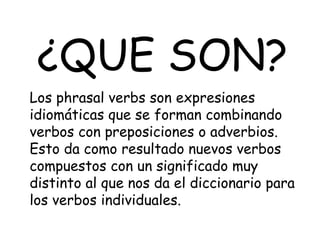
Los phrasal verbs son expresiones
idiomáticas que se forman combinando
verbos con preposiciones o adverbios.
Esto da como resultado nuevos verbos
compuestos con un significado muy
distinto al que nos da el diccionario para
los verbos individuales.
Phrasal Verbs with “to be”
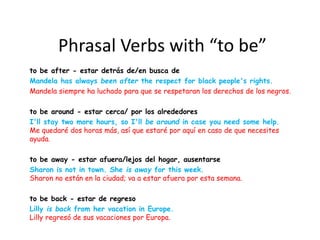
to be after - estar detrás de/en busca de
Mandela has always been after the respect for black people's rights.
Mandela siempre ha luchado para que se respetaran los derechos de los negros.
to be around - estar cerca/ por los alrededores
I'll stay two more hours, so I'll be around in case you need some help.
Me quedaré dos horas más, así que estaré por aquí en caso de que necesites
ayuda.
to be away - estar afuera/lejos del hogar, ausentarse
Sharon is not in town. She is away for this week.
Sharon no están en la ciudad; va a estar afuera por esta semana.
to be back - estar de regreso
Lilly is back from her vacation in Europe.
Lilly regresó de sus vacaciones por Europa.
Phrasal Verbs with “to break”
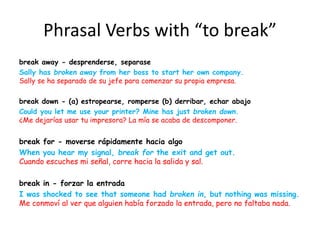
break away - desprenderse, separase
Sally has broken away from her boss to start her own company.
Sally se ha separado de su jefe para comenzar su propia empresa.
break down - (a) estropearse, romperse (b) derribar, echar abajo
Could you let me use your printer? Mine has just broken down.
¿Me dejarías usar tu impresora? La mía se acaba de descomponer.
break for - moverse rápidamente hacia algo
When you hear my signal, break for the exit and get out.
Cuando escuches mi señal, corre hacia la salida y sal.
break in - forzar la entrada
I was shocked to see that someone had broken in, but nothing was missing.
Me conmoví al ver que alguien había forzado la entrada, pero no faltaba nada.
Phrasal Verbs with “to call”
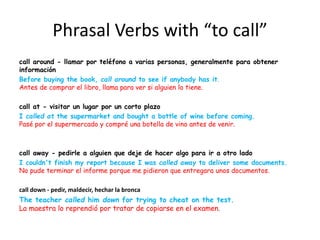
call around - llamar por teléfono a varias personas, generalmente para obtener
información
Before buying the book, call around to see if anybody has it.
Antes de comprar el libro, llama para ver si alguien lo tiene.
call at - visitar un lugar por un corto plazo
I called at the supermarket and bought a bottle of wine before coming.
Pasé por el supermercado y compré una botella de vino antes de venir.
call away - pedirle a alguien que deje de hacer algo para ir a otro lado
I couldn't finish my report because I was called away to deliver some documents.
No pude terminar el informe porque me pidieron que entregara unos documentos.
call down - pedir, maldecir, hechar la bronca
The teacher called him down for trying to cheat on the test.
La maestra lo reprendió por tratar de copiarse en el examen.
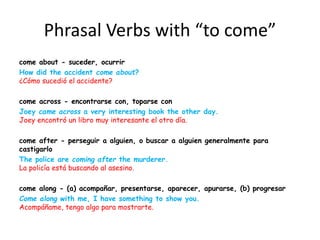
Phrasal Verbs with “to come”
come about - suceder, ocurrir
How did the accident come about?
¿Cómo sucedió el accidente?
come across - encontrarse con, toparse con
Joey came across a very interesting book the other day.
Joey encontró un libro muy interesante el otro día.
come after - perseguir a alguien, o buscar a alguien generalmente para
castigarlo
The police are coming after the murderer.
La policía está buscando al asesino.
come along - (a) acompañar, presentarse, aparecer, apurarse, (b) progresar
Come along with me, I have something to show you.
Acompáñame, tengo algo para mostrarte.
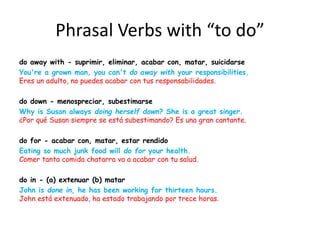
Phrasal Verbs with “to do”
do away with - suprimir, eliminar, acabar con, matar, suicidarse
You're a grown man, you can't do away with your responsibilities.
Eres un adulto, no puedes acabar con tus responsabilidades.
do down - menospreciar, subestimarse
Why is Susan always doing herself down? She is a great singer.
¿Por qué Susan siempre se está subestimando? Es una gran cantante.
do for - acabar con, matar, estar rendido
Eating so much junk food will do for your health.
Comer tanta comida chatarra va a acabar con tu salud.
do in - (a) extenuar (b) matar
John is done in, he has been working for thirteen hours.
John está extenuado, ha estado trabajando por trece horas.
Phrasal Verbs with “to go”
go across - cruzar, atravesar
The first team going across the river will win the championship.
El primer equipo en cruzar el río ganará el campeonato.
go along - (a) seguir, acompañar (b) suceder o desarrollarse de cierta forma (c)
with - apoyar una idea o estar de acuerdo con la opinión de alguien
Sam didn't expect such a party, but it all went along perfectly.
Sarah no esperaba semejante fiesta pero todo salió de maravilla.
go around - (a) haber suficiente para todos en un grupo de gente (b) visitar a
alguien en su casa o lugar de trabajo
There won't be enough ballons to go around with so many guests.
No va a haber suficientes globos para tantos invitados.
go at - arremeter contra, atacar
Alan thought John had stolen his watch and went at him.
Alan creyó que John le había robado su reloj y lo atacó.
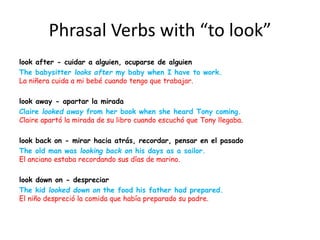
Phrasal Verbs with “to look”
look after - cuidar a alguien, ocuparse de alguien
The babysitter looks after my baby when I have to work.
La niñera cuida a mi bebé cuando tengo que trabajar.
look away - apartar la mirada
Claire looked away from her book when she heard Tony coming.
Claire apartó la mirada de su libro cuando escuchó que Tony llegaba.
look back on - mirar hacia atrás, recordar, pensar en el pasado
The old man was looking back on his days as a sailor.
El anciano estaba recordando sus días de marino.
look down on - despreciar
The kid looked down on the food his father had prepared.
El niño despreció la comida que había preparado su padre.
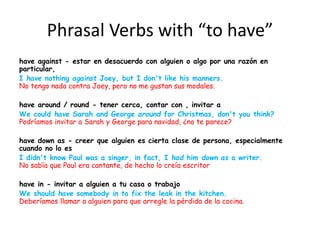
Phrasal Verbs with “to have”
have against - estar en desacuerdo con alguien o algo por una razón en
particular,
I have nothing against Joey, but I don't like his manners.
No tengo nada contra Joey, pero no me gustan sus modales.
have around / round - tener cerca, contar con , invitar a
We could have Sarah and George around for Christmas, don't you think?
Podríamos invitar a Sarah y George para navidad, ¿no te parece?
have down as - creer que alguien es cierta clase de persona, especialmente
cuando no lo es
I didn't know Paul was a singer, in fact, I had him down as a writer.
No sabía que Paul era cantante, de hecho lo creía escritor
have in - invitar a alguien a tu casa o trabajo
We should have somebody in to fix the leak in the kitchen.
Deberíamos llamar a alguien para que arregle la pérdida de la cocina.
Phrasal Verbs with “to run”
run across - tropezarse con, encontrarse con
I was doing the Christmas shopping when I ran across an old friend of mine.
Estaba haciendo las compras para Navidad cuando me encontré con un viejo amigo.
run after - perseguir, correr tras
The police was running after somebody suspected of murder.
La policía perseguía a alguien sospechoso de asesinato.
run away - escaparse, fugarse
The news report alerted that a tiger has ran away from the zoo.
El noticiero advirtió que un tigre se ha escapado del zoológico.
run by - repetir algo dicho
Could anyone run by what the journalist has just said?
¿Alguien podría repetir lo que acaba de decir el periodista?
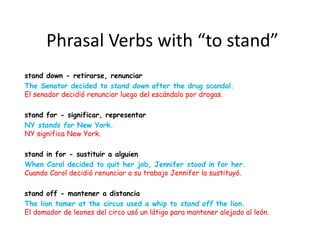
Phrasal Verbs with “to stand”
stand down - retirarse, renunciar
The Senator decided to stand down after the drug scandal.
El senador decidió renunciar luego del escándalo por drogas.
stand for - significar, representar
NY stands for New York.
NY significa New York.
stand in for - sustituir a alguien
When Carol decided to quit her job, Jennifer stood in for her.
Cuando Carol decidió renunciar a su trabajo Jennifer la sustituyó.
stand off - mantener a distancia
The lion tamer at the circus used a whip to stand off the lion.
El domador de leones del circo usó un látigo para mantener alejado al león.

Phrasal verbs

  • 2.
    ¿QUE SON? Los phrasalverbs son expresiones idiomáticas que se forman combinando verbos con preposiciones o adverbios. Esto da como resultado nuevos verbos compuestos con un significado muy distinto al que nos da el diccionario para los verbos individuales.
  • 3.
    Phrasal Verbs with“to be” to be after - estar detrás de/en busca de Mandela has always been after the respect for black people's rights. Mandela siempre ha luchado para que se respetaran los derechos de los negros. to be around - estar cerca/ por los alrededores I'll stay two more hours, so I'll be around in case you need some help. Me quedaré dos horas más, así que estaré por aquí en caso de que necesites ayuda. to be away - estar afuera/lejos del hogar, ausentarse Sharon is not in town. She is away for this week. Sharon no están en la ciudad; va a estar afuera por esta semana. to be back - estar de regreso Lilly is back from her vacation in Europe. Lilly regresó de sus vacaciones por Europa.
  • 4.
    Phrasal Verbs with“to break” break away - desprenderse, separase Sally has broken away from her boss to start her own company. Sally se ha separado de su jefe para comenzar su propia empresa. break down - (a) estropearse, romperse (b) derribar, echar abajo Could you let me use your printer? Mine has just broken down. ¿Me dejarías usar tu impresora? La mía se acaba de descomponer. break for - moverse rápidamente hacia algo When you hear my signal, break for the exit and get out. Cuando escuches mi señal, corre hacia la salida y sal. break in - forzar la entrada I was shocked to see that someone had broken in, but nothing was missing. Me conmoví al ver que alguien había forzado la entrada, pero no faltaba nada.
  • 5.
    Phrasal Verbs with“to call” call around - llamar por teléfono a varias personas, generalmente para obtener información Before buying the book, call around to see if anybody has it. Antes de comprar el libro, llama para ver si alguien lo tiene. call at - visitar un lugar por un corto plazo I called at the supermarket and bought a bottle of wine before coming. Pasé por el supermercado y compré una botella de vino antes de venir. call away - pedirle a alguien que deje de hacer algo para ir a otro lado I couldn't finish my report because I was called away to deliver some documents. No pude terminar el informe porque me pidieron que entregara unos documentos. call down - pedir, maldecir, hechar la bronca The teacher called him down for trying to cheat on the test. La maestra lo reprendió por tratar de copiarse en el examen.
  • 6.
    Phrasal Verbs with“to come” come about - suceder, ocurrir How did the accident come about? ¿Cómo sucedió el accidente? come across - encontrarse con, toparse con Joey came across a very interesting book the other day. Joey encontró un libro muy interesante el otro día. come after - perseguir a alguien, o buscar a alguien generalmente para castigarlo The police are coming after the murderer. La policía está buscando al asesino. come along - (a) acompañar, presentarse, aparecer, apurarse, (b) progresar Come along with me, I have something to show you. Acompáñame, tengo algo para mostrarte.
  • 7.
    Phrasal Verbs with“to do” do away with - suprimir, eliminar, acabar con, matar, suicidarse You're a grown man, you can't do away with your responsibilities. Eres un adulto, no puedes acabar con tus responsabilidades. do down - menospreciar, subestimarse Why is Susan always doing herself down? She is a great singer. ¿Por qué Susan siempre se está subestimando? Es una gran cantante. do for - acabar con, matar, estar rendido Eating so much junk food will do for your health. Comer tanta comida chatarra va a acabar con tu salud. do in - (a) extenuar (b) matar John is done in, he has been working for thirteen hours. John está extenuado, ha estado trabajando por trece horas.
  • 8.
    Phrasal Verbs with“to go” go across - cruzar, atravesar The first team going across the river will win the championship. El primer equipo en cruzar el río ganará el campeonato. go along - (a) seguir, acompañar (b) suceder o desarrollarse de cierta forma (c) with - apoyar una idea o estar de acuerdo con la opinión de alguien Sam didn't expect such a party, but it all went along perfectly. Sarah no esperaba semejante fiesta pero todo salió de maravilla. go around - (a) haber suficiente para todos en un grupo de gente (b) visitar a alguien en su casa o lugar de trabajo There won't be enough ballons to go around with so many guests. No va a haber suficientes globos para tantos invitados. go at - arremeter contra, atacar Alan thought John had stolen his watch and went at him. Alan creyó que John le había robado su reloj y lo atacó.
  • 9.
    Phrasal Verbs with“to look” look after - cuidar a alguien, ocuparse de alguien The babysitter looks after my baby when I have to work. La niñera cuida a mi bebé cuando tengo que trabajar. look away - apartar la mirada Claire looked away from her book when she heard Tony coming. Claire apartó la mirada de su libro cuando escuchó que Tony llegaba. look back on - mirar hacia atrás, recordar, pensar en el pasado The old man was looking back on his days as a sailor. El anciano estaba recordando sus días de marino. look down on - despreciar The kid looked down on the food his father had prepared. El niño despreció la comida que había preparado su padre.
  • 10.
    Phrasal Verbs with“to have” have against - estar en desacuerdo con alguien o algo por una razón en particular, I have nothing against Joey, but I don't like his manners. No tengo nada contra Joey, pero no me gustan sus modales. have around / round - tener cerca, contar con , invitar a We could have Sarah and George around for Christmas, don't you think? Podríamos invitar a Sarah y George para navidad, ¿no te parece? have down as - creer que alguien es cierta clase de persona, especialmente cuando no lo es I didn't know Paul was a singer, in fact, I had him down as a writer. No sabía que Paul era cantante, de hecho lo creía escritor have in - invitar a alguien a tu casa o trabajo We should have somebody in to fix the leak in the kitchen. Deberíamos llamar a alguien para que arregle la pérdida de la cocina.
  • 11.
    Phrasal Verbs with“to run” run across - tropezarse con, encontrarse con I was doing the Christmas shopping when I ran across an old friend of mine. Estaba haciendo las compras para Navidad cuando me encontré con un viejo amigo. run after - perseguir, correr tras The police was running after somebody suspected of murder. La policía perseguía a alguien sospechoso de asesinato. run away - escaparse, fugarse The news report alerted that a tiger has ran away from the zoo. El noticiero advirtió que un tigre se ha escapado del zoológico. run by - repetir algo dicho Could anyone run by what the journalist has just said? ¿Alguien podría repetir lo que acaba de decir el periodista?
  • 12.
    Phrasal Verbs with“to stand” stand down - retirarse, renunciar The Senator decided to stand down after the drug scandal. El senador decidió renunciar luego del escándalo por drogas. stand for - significar, representar NY stands for New York. NY significa New York. stand in for - sustituir a alguien When Carol decided to quit her job, Jennifer stood in for her. Cuando Carol decidió renunciar a su trabajo Jennifer la sustituyó. stand off - mantener a distancia The lion tamer at the circus used a whip to stand off the lion. El domador de leones del circo usó un látigo para mantener alejado al león.