The present progressive
(El presente progresivo)
Estoy h
En este momento / ahora mismo
(Right now)
Unlike English, Spanish may use the simple present tense to
express ongoing action:
To the native speaker, this statement may mean “I speak Spanish
on the phone” or “I am speaking Spanish on the phone right
now,” depending on context. To emphasize the “ongoingness”
aspect, Spanish often uses the present progressive, a combination
of the verb estar plus the present participle, very much as we do
in English, as expressed in the quote above: “I am speaking
Spanish . . . ” In Spanish, it looks like this:
abl español por teléfono.oH ando español por teléfono.
Hablo español por teléfono.
ando español por teléfono.
En este momento / ahora mismo
In Spanish, however, this structure can only express what is
happening right now; it is not used for habitual actions such as
“I speak Spanish every day,” nor can it be used to express
future actions the way we use the present progressive in
English to say something like “I am speaking at the conference
tomorrow.” This distinction is an important one.
Estoy habl
(Right now)
estoy
estás
está
estamos
estáis
están
Cómo se forma
(How it’s formed)An appropriate
person and number
of the verb estar in
the present tense
+
hablarando
beberiendo
escribiriendo
is linked directly to
a present participle, which
is formed by starting with
the infinitive, . . .
. . . dropping off the ending, . . .
. . . and iendo to er and ir verbs.
. . . and adding ando to ar verbs, . . .
Now let’s practice using the present progressive.
¿Qué están haciendo estas personas?
¿Qué está haciendo el señor?
(El verbo es cantar)
Está cantando.
AR verbs
¿Qué están haciendo estas personas?
¿Qué están haciendo los jóvenes?
(El verbo es mirar)
Están mirando una película de terror.
AR verbs
¿Qué están haciendo estas personas?
¿Qué está haciendo la estudiante?
(El verbo es caminar)
Está caminando.
AR verbs
¿Qué están haciendo estas personas?
¿Qué están haciendo los futbolistas?
(El verbo es jugar)
Están jugando fútbol.
AR verbs
¿Qué están haciendo estas personas?
¿Qué estamos haciendo en la biblioteca?
(El verbo es estudiar)
Estamos estudiando.
AR verbs
¿Qué están haciendo estas personas?
¿Qué están haciendo los novios?
(El verbo es bailar)
Están bailando.
AR verbs
¿Qué están haciendo estas personas?
¿Qué está haciendo el banquero?
(El verbo es contar)
Está contando su dinero.
AR verbs
¿Qué están haciendo estas personas?
(El verbo es pensar)
AR verbs
¿Qué estás
haciendo?
Estoy
pensando en
mi dieta.
¿Qué están haciendo estas personas?
¿Qué está haciendo el niño?
(El verbo es bañarse)
Está bañándose.
AR verbs
Se está bañando. or . . .
Reflexive pronouns can either
precede estar or be attached to the
end of the participle.
Add an accent on the stressed syllable when
the pronoun is attached to the participle.
¿Qué está haciendo la niña?
(El verbo es beber)
Está bebiendo leche.
¿Qué están haciendo estas personas?
ER verbs
¿Qué están haciendo estas personas?
¿Qué está haciendo la señorita?
(El verbo es escoger)
Está escogiendo un libro.
ER verbs
¿Qué están haciendo estas personas?
¿Qué está haciendo la cocinera?
(El verbo es hacer)
Está haciendo una pizza.
ER verbs
¿Qué están haciendo estas personas?
¿Qué están haciendo los muchachos?
(El verbo es comer)
Están comiendo en un café.
ER verbs
¿Qué están haciendo estas personas?
¿Qué está haciendo la muchacha?
(El verbo es ver)
Está viendo la televisión.
ER verbs
¿Qué están haciendo estas personas?
¿Qué está haciendo el vendedor?
(El verbo es vender)
Está vendiendo sombreros.
ER verbs
¿Qué están haciendo estas personas?
¿Qué está haciendo la señorita?
(El verbo es correr)
Está corriendo tras el autobús.
ER verbs
¿Qué están haciendo estas personas?
¿Qué está haciendo el joven?
(El verbo es escribir)
Está escribiendo una invitación.
IR verbs
¿Qué están haciendo estas personas?
¿Qué está haciendo el violinista?
(El verbo es subir)
Está subiendo la escalera.
IR verbs
¿Qué están haciendo estas personas?
¿Qué están haciendo los estudiantes?
(El verbo es discutir)
Están discutiendo.
IR verbs
¿Qué están haciendo estas personas?
¿Qué está haciendo el policía?
(El verbo es dirigir)
Está dirigiendo a la señorita.
IR verbs
traer
Juan y Marta están trayendo la comida.
leer
Estoy leyendo el cuento.
Algunos verbos irregulares
(Some irregular verbs)
We use the participial ending -yendo instead of -iendo
for er and ir verbs whose stem ends in a vowel:
oír
Estamos oyendo el CD de Rubén Blades.
¿Qué están haciendo estas personas?
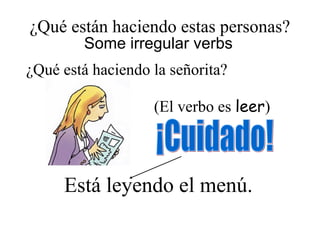
¿Qué está haciendo la señorita?
(El verbo es leer)
Está leyendo el menú.
Some irregular verbs
¿Qué están haciendo estas personas?
¿Qué está haciendo la señora?
(El verbo es traer)
Está trayendo la comida.
Some irregular verbs
¿Qué están haciendo estas personas?
¿Qué está haciendo el anciano?
(El verbo es oír)
Está oyendo música.
Some irregular verbs
Estamos pidiendo el dinero.
Otros verbos irregulares
pedir (i, i)
servir (i, i)
Papá está sirviendo la comida.
El niño está durmiendo tranquilamente.
dormir (ue, u)
(Other irregular verbs)
For certain ir verbs only, there are special changes in the stem
when the participle is formed. The changes will be indicated as
shown in parentheses:
Similar changes occur with all stem-changing ir verbs.
¿Qué están haciendo estas personas?
¿Qué está haciendo el joven?
(El verbo es dormir)
Está durmiendo.
Certain IR verbs only
¿Qué están haciendo estas personas?
¿Qué está haciendo el dependiente?
(El verbo es servir)
Está sirviendo al cliente.
Certain IR verbs only
¿Qué están haciendo estas personas?
¿Qué está haciendo la señorita?
(El verbo es pedir)
Está pidiendo la comida.
Certain IR verbs only
FIN

Present Progressive

  • 1.
    The present progressive (Elpresente progresivo)
  • 2.
    Estoy h En estemomento / ahora mismo (Right now) Unlike English, Spanish may use the simple present tense to express ongoing action: To the native speaker, this statement may mean “I speak Spanish on the phone” or “I am speaking Spanish on the phone right now,” depending on context. To emphasize the “ongoingness” aspect, Spanish often uses the present progressive, a combination of the verb estar plus the present participle, very much as we do in English, as expressed in the quote above: “I am speaking Spanish . . . ” In Spanish, it looks like this: abl español por teléfono.oH ando español por teléfono. Hablo español por teléfono.
  • 3.
    ando español porteléfono. En este momento / ahora mismo In Spanish, however, this structure can only express what is happening right now; it is not used for habitual actions such as “I speak Spanish every day,” nor can it be used to express future actions the way we use the present progressive in English to say something like “I am speaking at the conference tomorrow.” This distinction is an important one. Estoy habl (Right now)
  • 4.
    estoy estás está estamos estáis están Cómo se forma (Howit’s formed)An appropriate person and number of the verb estar in the present tense + hablarando beberiendo escribiriendo is linked directly to a present participle, which is formed by starting with the infinitive, . . . . . . dropping off the ending, . . . . . . and iendo to er and ir verbs. . . . and adding ando to ar verbs, . . . Now let’s practice using the present progressive.
  • 5.
    ¿Qué están haciendoestas personas? ¿Qué está haciendo el señor? (El verbo es cantar) Está cantando. AR verbs
  • 6.
    ¿Qué están haciendoestas personas? ¿Qué están haciendo los jóvenes? (El verbo es mirar) Están mirando una película de terror. AR verbs
  • 7.
    ¿Qué están haciendoestas personas? ¿Qué está haciendo la estudiante? (El verbo es caminar) Está caminando. AR verbs
  • 8.
    ¿Qué están haciendoestas personas? ¿Qué están haciendo los futbolistas? (El verbo es jugar) Están jugando fútbol. AR verbs
  • 9.
    ¿Qué están haciendoestas personas? ¿Qué estamos haciendo en la biblioteca? (El verbo es estudiar) Estamos estudiando. AR verbs
  • 10.
    ¿Qué están haciendoestas personas? ¿Qué están haciendo los novios? (El verbo es bailar) Están bailando. AR verbs
  • 11.
    ¿Qué están haciendoestas personas? ¿Qué está haciendo el banquero? (El verbo es contar) Está contando su dinero. AR verbs
  • 12.
    ¿Qué están haciendoestas personas? (El verbo es pensar) AR verbs ¿Qué estás haciendo? Estoy pensando en mi dieta.
  • 13.
    ¿Qué están haciendoestas personas? ¿Qué está haciendo el niño? (El verbo es bañarse) Está bañándose. AR verbs Se está bañando. or . . . Reflexive pronouns can either precede estar or be attached to the end of the participle. Add an accent on the stressed syllable when the pronoun is attached to the participle.
  • 14.
    ¿Qué está haciendola niña? (El verbo es beber) Está bebiendo leche. ¿Qué están haciendo estas personas? ER verbs
  • 15.
    ¿Qué están haciendoestas personas? ¿Qué está haciendo la señorita? (El verbo es escoger) Está escogiendo un libro. ER verbs
  • 16.
    ¿Qué están haciendoestas personas? ¿Qué está haciendo la cocinera? (El verbo es hacer) Está haciendo una pizza. ER verbs
  • 17.
    ¿Qué están haciendoestas personas? ¿Qué están haciendo los muchachos? (El verbo es comer) Están comiendo en un café. ER verbs
  • 18.
    ¿Qué están haciendoestas personas? ¿Qué está haciendo la muchacha? (El verbo es ver) Está viendo la televisión. ER verbs
  • 19.
    ¿Qué están haciendoestas personas? ¿Qué está haciendo el vendedor? (El verbo es vender) Está vendiendo sombreros. ER verbs
  • 20.
    ¿Qué están haciendoestas personas? ¿Qué está haciendo la señorita? (El verbo es correr) Está corriendo tras el autobús. ER verbs
  • 21.
    ¿Qué están haciendoestas personas? ¿Qué está haciendo el joven? (El verbo es escribir) Está escribiendo una invitación. IR verbs
  • 22.
    ¿Qué están haciendoestas personas? ¿Qué está haciendo el violinista? (El verbo es subir) Está subiendo la escalera. IR verbs
  • 23.
    ¿Qué están haciendoestas personas? ¿Qué están haciendo los estudiantes? (El verbo es discutir) Están discutiendo. IR verbs
  • 24.
    ¿Qué están haciendoestas personas? ¿Qué está haciendo el policía? (El verbo es dirigir) Está dirigiendo a la señorita. IR verbs
  • 25.
    traer Juan y Martaestán trayendo la comida. leer Estoy leyendo el cuento. Algunos verbos irregulares (Some irregular verbs) We use the participial ending -yendo instead of -iendo for er and ir verbs whose stem ends in a vowel: oír Estamos oyendo el CD de Rubén Blades.
  • 26.
    ¿Qué están haciendoestas personas? ¿Qué está haciendo la señorita? (El verbo es leer) Está leyendo el menú. Some irregular verbs
  • 27.
    ¿Qué están haciendoestas personas? ¿Qué está haciendo la señora? (El verbo es traer) Está trayendo la comida. Some irregular verbs
  • 28.
    ¿Qué están haciendoestas personas? ¿Qué está haciendo el anciano? (El verbo es oír) Está oyendo música. Some irregular verbs
  • 29.
    Estamos pidiendo eldinero. Otros verbos irregulares pedir (i, i) servir (i, i) Papá está sirviendo la comida. El niño está durmiendo tranquilamente. dormir (ue, u) (Other irregular verbs) For certain ir verbs only, there are special changes in the stem when the participle is formed. The changes will be indicated as shown in parentheses: Similar changes occur with all stem-changing ir verbs.
  • 30.
    ¿Qué están haciendoestas personas? ¿Qué está haciendo el joven? (El verbo es dormir) Está durmiendo. Certain IR verbs only
  • 31.
    ¿Qué están haciendoestas personas? ¿Qué está haciendo el dependiente? (El verbo es servir) Está sirviendo al cliente. Certain IR verbs only
  • 32.
    ¿Qué están haciendoestas personas? ¿Qué está haciendo la señorita? (El verbo es pedir) Está pidiendo la comida. Certain IR verbs only
  • 33.