El Presente Progresivo ¿Qué estás haciendo  ahora mismo ?
El Presente Progresivo hoy pasado futuro The  present progressive  describes an action that is in process  at the moment  we are talking. ¡ahora mismo!
¿Cómo lo  formamos ? -ar  =  -ando -er/-ir  =  -iendo Compound verb form 2 parts Present tense forms of  ESTAR Present Participle  of the main verb (gerund / gerundio) estoy estamos estás estáis está están +
Participio presente =  -ing hablar habl ando comer com iendo vivir viv iendo estudiar estudi ando pensar pens ando  * jugar jug ando  * encender encend iendo  * Infinitivo Participio
In English you would never say: “He walking.”  or  “She working.” You say:  He’s walking.   or   He is walking. She’s working.   or   She is working. El Presente Progresivo We do the same in Spanish: Never leave out the verb  ESTAR ESTAR + -ando  or  -iendo
ESTAR  y el  Participio He’s walking. El  está caminando . -ando -iendo yo  estoy tú  estás él, ella, Ud.  está nosotros  estamos vosotros  estáis ellos, ellas, Uds.  están +
ESTAR  y el  Participio She’s working. Ella  está trabajando . -ando -iendo yo  estoy tú  estás él, ella, Ud.  está nosotros  estamos vosotros  estáis ellos, ellas, Uds.  están +
¿En inglés o en español? In English you can say: I am working  right now   or  I am   working  tomorrow ***  In Spanish you  cannot  do this.  The progressive in Spanish is ONLY used to describe an action that is in process at the moment we are talking ( ahora mismo ). ***  In Spanish we can use the expression  IR  +  A  +  Infinitive  to refer to the near future ( tomorrow ). Estoy trabajando  ahora mismo. Voy a trabajar  mañana.
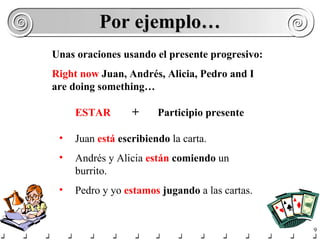
Por ejemplo… Juan  está   escribiendo  la carta. Andrés y Alicia  están   comiendo  un burrito. Pedro y yo  estamos   jugando  a las cartas. ESTAR   +   Participio presente Unas oraciones usando el presente progresivo: Right now  Juan, Andrés, Alicia, Pedro and I are doing something…
Más ejemplos…: Amanda y su bebé  están   durmiendo . Amalia  está   lavando  los platos. ¿Vosotros  estáis   estudiando ? Tú  estás   pensando  mucho en este examen. Mis amigos  están  llamando  por teléfono. ¿Quién  está  hablando  en clase? It is always necessary to use the verb  estar  and the  participle  ( –ando  /  –iendo)  of the main (action) verb
Completen las frases… ¿Qué ____  ________ tú? (hacer) estás  haciendo ¿Dónde ____  ________ Luis? (comer) está  comiendo Ellas ____  ________ en Madrid. (vivir) están  viviendo Yo ____  __________ deportes ahora. (practicar) estoy  practicando Nosotros ______  __________ cartas. (escribir) estamos  escribiendo ¿Vosotros _____  _________ ? (estudiar) estáis  estudiando ¿Quién ____  ________ al ajedrez? (jugar) está  jugando
Verbos irregulares… Pedir Decir Dormir Servir Leer Traer p i diendo d i ciendo d u rmiendo s i rviendo le y endo tra y endo
Ahora les toca a Uds… estamos viviendo están bailando estás jugando (al fútbol) nosotros ellos tú
Ahora les toca a Uds… (2) estoy hablando está comiendo estáis comprando yo Ud. vosotros

Progresivo

  • 1.
    El Presente Progresivo¿Qué estás haciendo ahora mismo ?
  • 2.
    El Presente Progresivohoy pasado futuro The present progressive describes an action that is in process at the moment we are talking. ¡ahora mismo!
  • 3.
    ¿Cómo lo formamos ? -ar = -ando -er/-ir = -iendo Compound verb form 2 parts Present tense forms of ESTAR Present Participle of the main verb (gerund / gerundio) estoy estamos estás estáis está están +
  • 4.
    Participio presente = -ing hablar habl ando comer com iendo vivir viv iendo estudiar estudi ando pensar pens ando * jugar jug ando * encender encend iendo * Infinitivo Participio
  • 5.
    In English youwould never say: “He walking.” or “She working.” You say: He’s walking. or He is walking. She’s working. or She is working. El Presente Progresivo We do the same in Spanish: Never leave out the verb ESTAR ESTAR + -ando or -iendo
  • 6.
    ESTAR yel Participio He’s walking. El está caminando . -ando -iendo yo estoy tú estás él, ella, Ud. está nosotros estamos vosotros estáis ellos, ellas, Uds. están +
  • 7.
    ESTAR yel Participio She’s working. Ella está trabajando . -ando -iendo yo estoy tú estás él, ella, Ud. está nosotros estamos vosotros estáis ellos, ellas, Uds. están +
  • 8.
    ¿En inglés oen español? In English you can say: I am working right now or I am working tomorrow *** In Spanish you cannot do this. The progressive in Spanish is ONLY used to describe an action that is in process at the moment we are talking ( ahora mismo ). *** In Spanish we can use the expression IR + A + Infinitive to refer to the near future ( tomorrow ). Estoy trabajando ahora mismo. Voy a trabajar mañana.
  • 9.
    Por ejemplo… Juan está escribiendo la carta. Andrés y Alicia están comiendo un burrito. Pedro y yo estamos jugando a las cartas. ESTAR + Participio presente Unas oraciones usando el presente progresivo: Right now Juan, Andrés, Alicia, Pedro and I are doing something…
  • 10.
    Más ejemplos…: Amanday su bebé están durmiendo . Amalia está lavando los platos. ¿Vosotros estáis estudiando ? Tú estás pensando mucho en este examen. Mis amigos están llamando por teléfono. ¿Quién está hablando en clase? It is always necessary to use the verb estar and the participle ( –ando / –iendo) of the main (action) verb
  • 11.
    Completen las frases…¿Qué ____ ________ tú? (hacer) estás haciendo ¿Dónde ____ ________ Luis? (comer) está comiendo Ellas ____ ________ en Madrid. (vivir) están viviendo Yo ____ __________ deportes ahora. (practicar) estoy practicando Nosotros ______ __________ cartas. (escribir) estamos escribiendo ¿Vosotros _____ _________ ? (estudiar) estáis estudiando ¿Quién ____ ________ al ajedrez? (jugar) está jugando
  • 12.
    Verbos irregulares… PedirDecir Dormir Servir Leer Traer p i diendo d i ciendo d u rmiendo s i rviendo le y endo tra y endo
  • 13.
    Ahora les tocaa Uds… estamos viviendo están bailando estás jugando (al fútbol) nosotros ellos tú
  • 14.
    Ahora les tocaa Uds… (2) estoy hablando está comiendo estáis comprando yo Ud. vosotros