UNIVERSIDAD CENTRAL DEL
        ECUADOR
FACULTAD DE FILOSOFIA, LETRAS Y
   CIENCIAS DE LA EDUCACION
CARRERA DE IDIOMAS
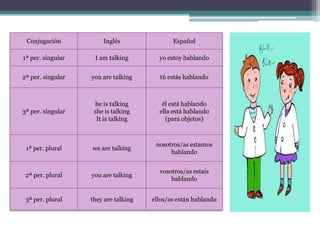
Conjugación           Inglés                Español

1ª per. singular    I am talking        yo estoy hablando


2ª per. singular   you are talking      tú estás hablando


                    he is talking        él está hablando
3ª per. singular    she is talking      ella está hablando
                     It is talking        (para objetos)


                                       nosotros/as estamos
 1ª per. plural    we are talking
                                            hablando


                                        vosotros/as estais
 2ª per. plural    you are talking
                                            hablando


 3ª per. plural    they are talking   ellos/as están hablando
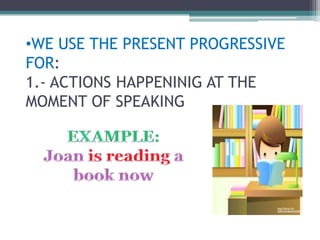
•WE USE THE PRESENT PROGRESSIVE
FOR:
1.- ACTIONS HAPPENINIG AT THE
MOMENT OF SPEAKING
2.- TEMPORARY SITUATIONS
3.- FUTURE PLANS
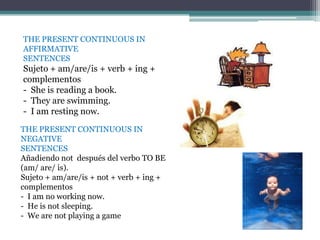
THE PRESENT CONTINUOUS IN
AFFIRMATIVE
SENTENCES
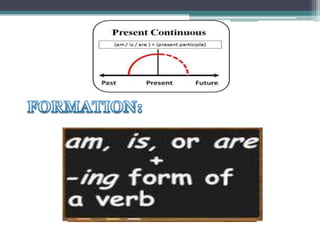
Sujeto + am/are/is + verb + ing +
complementos
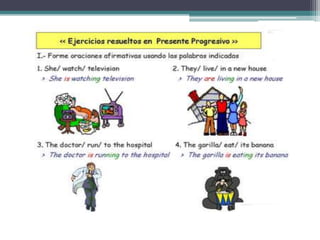
- She is reading a book.
- They are swimming.
- I am resting now.
THE PRESENT CONTINUOUS IN
NEGATIVE
SENTENCES
Añadiendo not después del verbo TO BE
(am/ are/ is).
Sujeto + am/are/is + not + verb + ing +
complementos
- I am no working now.
- He is not sleeping.
- We are not playing a game
THE PRESENT CONTINUOUS IN
WHQUESTIONS
Siguiente estructura:
Wh-word + am/are/is + sujeto + verb + ing
+
complementos?
-When is Alan taking Amy to school?
-Where are they playing football
THE PRESENT CONTINUOUS IN YES/NO
QUESTIONS
Sujeto se coloca detrás del
auxiliar be (am/are/is) y se pone un signo de
interrogación al final de la frase.
Am/are/is+ sujeto + verb + ing +
complementos?
Estas preguntas pueden contestarse con una
respuesta breve o larga.
Are you moving?
Yes, I am.
Yes, I am moving.
TIME EXPRESSIONS
Entre las expresiones de tiempo que
suelen
acompañar al presente continuo tenemos
NOW
(ahora), RIGHT NOW (ahora mismo), AT
THE
MOMENT (en este momento) y AT
PRESENT
(actualmente).   TODAY (hoy), THIS
WEEK (esta semana), TOMORROW
(mañana)
Las expresiones de tiempo se suelen
colocar al
final de la frase: George is watching
televisión now.
STATIVE VERBS
Algunos verbos no suelen usarse en la
forma
continua aunque vayan con expresiones
como
NOW, AT THE MOMENT … Estos verbos
expresan sentidos, pensamientos,
emociones,
relaciones, estados y mediciones. No
expresan
acontecimientos específicos o acciones.

                       •Sentidos .-Feel, hear, see, smell, sound,
                       taste
                       •Pensamientos.- Believe, doubt, forget, hope,
                       imagine, know, mean, prefer,
                       remember, think, understand
                       •Emociones .-Dislike, hate, like, love, need,
                       want
                       •Relaciones .-Belong to, depend on, own
                       •Estados.- Appear, seem
                       •Mediciones .-Cost, equal, measure, weigh
UCE-Idiomas Presente Progresivo Paulina Parra Vargas1987

UCE-Idiomas Presente Progresivo Paulina Parra Vargas1987

  • 1.
    UNIVERSIDAD CENTRAL DEL ECUADOR FACULTAD DE FILOSOFIA, LETRAS Y CIENCIAS DE LA EDUCACION
  • 2.
  • 5.
    Conjugación Inglés Español 1ª per. singular I am talking yo estoy hablando 2ª per. singular you are talking tú estás hablando he is talking él está hablando 3ª per. singular she is talking ella está hablando It is talking (para objetos) nosotros/as estamos 1ª per. plural we are talking hablando vosotros/as estais 2ª per. plural you are talking hablando 3ª per. plural they are talking ellos/as están hablando
  • 6.
    •WE USE THEPRESENT PROGRESSIVE FOR: 1.- ACTIONS HAPPENINIG AT THE MOMENT OF SPEAKING
  • 7.
  • 8.
  • 9.
    THE PRESENT CONTINUOUSIN AFFIRMATIVE SENTENCES Sujeto + am/are/is + verb + ing + complementos - She is reading a book. - They are swimming. - I am resting now. THE PRESENT CONTINUOUS IN NEGATIVE SENTENCES Añadiendo not después del verbo TO BE (am/ are/ is). Sujeto + am/are/is + not + verb + ing + complementos - I am no working now. - He is not sleeping. - We are not playing a game
  • 10.
    THE PRESENT CONTINUOUSIN WHQUESTIONS Siguiente estructura: Wh-word + am/are/is + sujeto + verb + ing + complementos? -When is Alan taking Amy to school? -Where are they playing football THE PRESENT CONTINUOUS IN YES/NO QUESTIONS Sujeto se coloca detrás del auxiliar be (am/are/is) y se pone un signo de interrogación al final de la frase. Am/are/is+ sujeto + verb + ing + complementos? Estas preguntas pueden contestarse con una respuesta breve o larga. Are you moving? Yes, I am. Yes, I am moving.
  • 11.
    TIME EXPRESSIONS Entre lasexpresiones de tiempo que suelen acompañar al presente continuo tenemos NOW (ahora), RIGHT NOW (ahora mismo), AT THE MOMENT (en este momento) y AT PRESENT (actualmente). TODAY (hoy), THIS WEEK (esta semana), TOMORROW (mañana) Las expresiones de tiempo se suelen colocar al final de la frase: George is watching televisión now.
  • 12.
    STATIVE VERBS Algunos verbosno suelen usarse en la forma continua aunque vayan con expresiones como NOW, AT THE MOMENT … Estos verbos expresan sentidos, pensamientos, emociones, relaciones, estados y mediciones. No expresan acontecimientos específicos o acciones. •Sentidos .-Feel, hear, see, smell, sound, taste •Pensamientos.- Believe, doubt, forget, hope, imagine, know, mean, prefer, remember, think, understand •Emociones .-Dislike, hate, like, love, need, want •Relaciones .-Belong to, depend on, own •Estados.- Appear, seem •Mediciones .-Cost, equal, measure, weigh