Sofia Vianey Hernández Garcia
SIMPLE PRESENT
Universidad Veracruzana
Dar a conocer acciones o estados permanentes
Comunicar acciones o estados que se repiten en el
tiempo
Transmitir rutinas, hechos continuos y que se repiten
de forma diaria o con periodicidad determinada.
El presente simple en inglés es el tiempo verbal indicado cuando
quieras expresar alguna de las siguientes condiciones:
Ejemplo: Guadalajara is the capital of Jalisco.
Ejemplo: Every four years is a leap year.
Ejemplo: I walk to my work.
¿Como se utiliza?
Dar instrucciones o indicaciones.
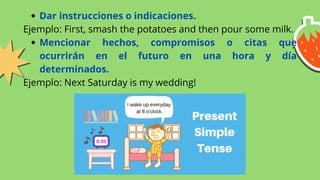
Mencionar hechos, compromisos o citas que
ocurrirán en el futuro en una hora y día
determinados.
Ejemplo: First, smash the potatoes and then pour some milk.
Ejemplo: Next Saturday is my wedding!
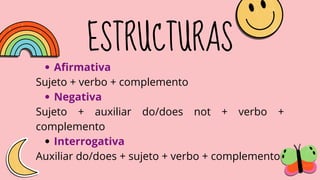
ESTRUCTURAS
Afirmativa
Negativa
Interrogativa
Sujeto + verbo + complemento
Sujeto + auxiliar do/does not + verbo +
complemento
Auxiliar do/does + sujeto + verbo + complemento
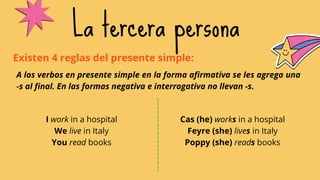
La tercera persona
Existen 4 reglas del presente simple:
A los verbos en presente simple en la forma afirmativa se les agrega una
-s al final. En las formas negativa e interrogativa no llevan -s.
I work in a hospital
We live in Italy
You read books
Cas (he) works in a hospital
Feyre (she) lives in Italy
Poppy (she) reads books
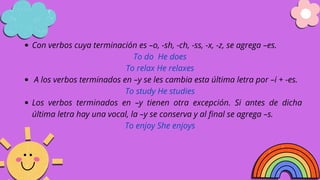
Con verbos cuya terminación es –o, -sh, -ch, -ss, -x, -z, se agrega –es.
A los verbos terminados en –y se les cambia esta última letra por –i + -es.
Los verbos terminados en –y tienen otra excepción. Si antes de dicha
última letra hay una vocal, la –y se conserva y al final se agrega –s.
To do He does
To relax He relaxes
To study He studies
To enjoy She enjoys
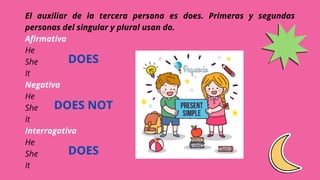
El auxiliar de la tercera persona es does. Primeras y segundas
personas del singular y plural usan do.
Afirmativa
He
She
It
Negativa
He
She
It
Interrogativa
He
She
It
DOES
DOES
DOES NOT
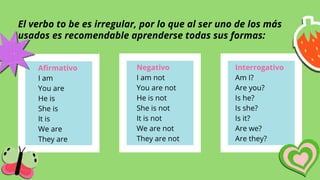
El verbo to be es irregular, por lo que al ser uno de los más
usados es recomendable aprenderse todas sus formas:
Negativo
I am not
You are not
He is not
She is not
It is not
We are not
They are not
Afirmativo
I am
You are
He is
She is
It is
We are
They are
Interrogativo
Am I?
Are you?
Is he?
Is she?
Is it?
Are we?
Are they?
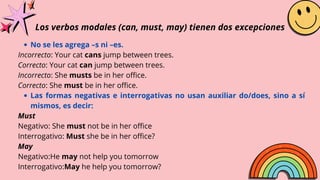
Los verbos modales (can, must, may) tienen dos excepciones
No se les agrega –s ni –es.
Las formas negativas e interrogativas no usan auxiliar do/does, sino a sí
mismos, es decir:
Incorrecto: Your cat cans jump between trees.
Correcto: Your cat can jump between trees.
Incorrecto: She musts be in her office.
Correcto: She must be in her office.
Must
Negativo: She must not be in her office
Interrogativo: Must she be in her office?
May
Negativo:He may not help you tomorrow
Interrogativo:May he help you tomorrow?
Gracias

Simple Present.pdf

  • 1.
    Sofia Vianey HernándezGarcia SIMPLE PRESENT Universidad Veracruzana
  • 2.
    Dar a conoceracciones o estados permanentes Comunicar acciones o estados que se repiten en el tiempo Transmitir rutinas, hechos continuos y que se repiten de forma diaria o con periodicidad determinada. El presente simple en inglés es el tiempo verbal indicado cuando quieras expresar alguna de las siguientes condiciones: Ejemplo: Guadalajara is the capital of Jalisco. Ejemplo: Every four years is a leap year. Ejemplo: I walk to my work. ¿Como se utiliza?
  • 3.
    Dar instrucciones oindicaciones. Mencionar hechos, compromisos o citas que ocurrirán en el futuro en una hora y día determinados. Ejemplo: First, smash the potatoes and then pour some milk. Ejemplo: Next Saturday is my wedding!
  • 4.
    ESTRUCTURAS Afirmativa Negativa Interrogativa Sujeto + verbo+ complemento Sujeto + auxiliar do/does not + verbo + complemento Auxiliar do/does + sujeto + verbo + complemento
  • 5.
    La tercera persona Existen4 reglas del presente simple: A los verbos en presente simple en la forma afirmativa se les agrega una -s al final. En las formas negativa e interrogativa no llevan -s. I work in a hospital We live in Italy You read books Cas (he) works in a hospital Feyre (she) lives in Italy Poppy (she) reads books
  • 6.
    Con verbos cuyaterminación es –o, -sh, -ch, -ss, -x, -z, se agrega –es. A los verbos terminados en –y se les cambia esta última letra por –i + -es. Los verbos terminados en –y tienen otra excepción. Si antes de dicha última letra hay una vocal, la –y se conserva y al final se agrega –s. To do He does To relax He relaxes To study He studies To enjoy She enjoys
  • 7.
    El auxiliar dela tercera persona es does. Primeras y segundas personas del singular y plural usan do. Afirmativa He She It Negativa He She It Interrogativa He She It DOES DOES DOES NOT
  • 8.
    El verbo tobe es irregular, por lo que al ser uno de los más usados es recomendable aprenderse todas sus formas: Negativo I am not You are not He is not She is not It is not We are not They are not Afirmativo I am You are He is She is It is We are They are Interrogativo Am I? Are you? Is he? Is she? Is it? Are we? Are they?
  • 9.
    Los verbos modales(can, must, may) tienen dos excepciones No se les agrega –s ni –es. Las formas negativas e interrogativas no usan auxiliar do/does, sino a sí mismos, es decir: Incorrecto: Your cat cans jump between trees. Correcto: Your cat can jump between trees. Incorrecto: She musts be in her office. Correcto: She must be in her office. Must Negativo: She must not be in her office Interrogativo: Must she be in her office? May Negativo:He may not help you tomorrow Interrogativo:May he help you tomorrow?
  • 10.