Por Alberto A. Vidal
Englishondemand.classonlive.com
PRESENT SIMPLE
1- Usamos el Presente Simple en Inglés para describir verdades
absolutas.
 Este tiempo verbal se forma con el verbo en 1ra. Columna o infinitivo
para todas las personas, salvo las 3ras, que llevan “S” o “ES” al final
del verbo.
 Conjuguemos el verbo speak (hablar)
Affirmative: Pronouns + Verb.
I speak Spanish (Yo hablo castellano)
You speak Spanish We speak Spanish
He speaks Spanish You speak Spanish
She speaks Spanish They speak Spanish
It speaks Spanish
PRESENT SIMPLE
 Agregamos ES a los verbos terminados en:
S: cross the street (cruzar la calle)
I cross the street It crosses the street
SH: wash the dishes (lavar la vajilla)
You wash the dishes He washes the dishes
CH: Watch TV (mirar TV)
I watch TV She watches TV
X: box (boxear)
I box He boxes
Consonant +y → ies:
I study (estudio) She studies I cry (lloro/grito) It cries
Go (ir): I go to school He goes to school
Do (hacer) I do sports She does sports
Have (tener/beber/comer/padecer/tomar) I have a brother
He has a brother
PRESENT SIMPLE
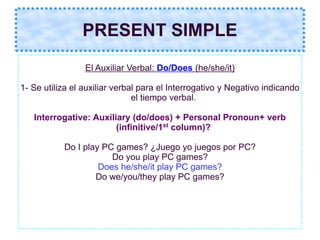
El Auxiliar Verbal: Do/Does (he/she/it)
1- Se utiliza el auxiliar verbal para el Interrogativo y Negativo indicando
el tiempo verbal.
Interrogative: Auxiliary (do/does) + Personal Pronoun+ verb
(infinitive/1st column)?
Do I play PC games? ¿Juego yo juegos por PC?
Do you play PC games?
Does he/she/it play PC games?
Do we/you/they play PC games?
PRESENT SIMPLE
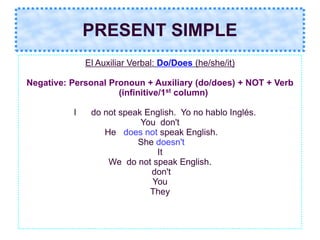
El Auxiliar Verbal: Do/Does (he/she/it)
Negative: Personal Pronoun + Auxiliary (do/does) + NOT + Verb
(infinitive/1st column)
I do not speak English. Yo no hablo Inglés.
You don't
He does not speak English.
She doesn't
It
We do not speak English.
don't
You
They
PRESENT SIMPLE
2- El Auxiliar verbal reemplaza a una oración.
Yes-No Question: Do you do sports? ¿Hacés deportes?
Auxiliary Verb
Yes, I do.
No, I don´t.
Wh-questions: Interrogative word + Aux + Pron. + Verb?
Where do you live? ¿En donde vives?
I live in Buenos Aires. Vivo en Buenos Aires.
PRESENT SIMPLE
Frequency Adverbs.
Los adverbios de frecuencia van detrás del verbo to be o delante de
cualquier otro verbo.
Always = siempre Usually = usualmente/por lo general.
Normally/generally = por lo general, normalmente.
Often/frequently = con frecuencia, frecuentemente.
Sometimes = algunas veces occasionally = ocasionalmente.
Seldom = pocas veces, rara vez.
Hardly ever/rarely = casi nunca. Raramente.
Never = nunca.
Susan is always early for school. = Susan siempre llega temprano a la
escuela. (detrás del verbo to be)
Tom usually watches Tv at home. = Tom siempre mira TV en su casa.
(delante del verbo)
PRESENT SIMPLE
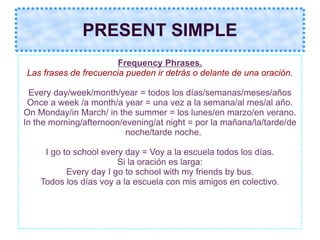
Frequency Phrases.
Las frases de frecuencia pueden ir detrás o delante de una oración.
Every day/week/month/year = todos los días/semanas/meses/años
Once a week /a month/a year = una vez a la semana/al mes/al año.
On Monday/in March/ in the summer = los lunes/en marzo/en verano.
In the morning/afternoon/evening/at night = por la mañana/la/tarde/de
noche/tarde noche.
I go to school every day = Voy a la escuela todos los días.
Si la oración es larga:
Every day I go to school with my friends by bus.
Todos los días voy a la escuela con mis amigos en colectivo.
PRESENT SIMPLE
3- El Presente Simple para horarios de transporte.
The plane leaves at 10:00 tomorrow.
El avión parte a las 10:00 mañana.
Our bus arrives at 8:00 p.m. Next Saturday.
Nuestro colectivo/autobus llega/arriva a las 8 p.m. El sábado próximo.
Extra: Personal Questions: No confundir
What do you do? ¿A que te dedicas? ¿Cual es tu ocupación?
I'm a teacher. I teach English. Soy docente. Enseño Inglés.
What do you do on Saturday? ¿Que haces todos los sábados?
I go out with my friends on Saturday.
Salgo con mis amigos/as los sábados.
PRESENT SIMPLE
THANKS FOR YOUR ATTENTION!!!
¡¡¡GRACIAS POR VUESTRA ATENCION!!!
englishondemand.classonlive.com
englishclassesondemand@gmail.com

Present simple

  • 1.
    Por Alberto A.Vidal Englishondemand.classonlive.com
  • 2.
    PRESENT SIMPLE 1- Usamosel Presente Simple en Inglés para describir verdades absolutas.  Este tiempo verbal se forma con el verbo en 1ra. Columna o infinitivo para todas las personas, salvo las 3ras, que llevan “S” o “ES” al final del verbo.  Conjuguemos el verbo speak (hablar) Affirmative: Pronouns + Verb. I speak Spanish (Yo hablo castellano) You speak Spanish We speak Spanish He speaks Spanish You speak Spanish She speaks Spanish They speak Spanish It speaks Spanish
  • 3.
    PRESENT SIMPLE  AgregamosES a los verbos terminados en: S: cross the street (cruzar la calle) I cross the street It crosses the street SH: wash the dishes (lavar la vajilla) You wash the dishes He washes the dishes CH: Watch TV (mirar TV) I watch TV She watches TV X: box (boxear) I box He boxes Consonant +y → ies: I study (estudio) She studies I cry (lloro/grito) It cries Go (ir): I go to school He goes to school Do (hacer) I do sports She does sports Have (tener/beber/comer/padecer/tomar) I have a brother He has a brother
  • 4.
    PRESENT SIMPLE El AuxiliarVerbal: Do/Does (he/she/it) 1- Se utiliza el auxiliar verbal para el Interrogativo y Negativo indicando el tiempo verbal. Interrogative: Auxiliary (do/does) + Personal Pronoun+ verb (infinitive/1st column)? Do I play PC games? ¿Juego yo juegos por PC? Do you play PC games? Does he/she/it play PC games? Do we/you/they play PC games?
  • 5.
    PRESENT SIMPLE El AuxiliarVerbal: Do/Does (he/she/it) Negative: Personal Pronoun + Auxiliary (do/does) + NOT + Verb (infinitive/1st column) I do not speak English. Yo no hablo Inglés. You don't He does not speak English. She doesn't It We do not speak English. don't You They
  • 6.
    PRESENT SIMPLE 2- ElAuxiliar verbal reemplaza a una oración. Yes-No Question: Do you do sports? ¿Hacés deportes? Auxiliary Verb Yes, I do. No, I don´t. Wh-questions: Interrogative word + Aux + Pron. + Verb? Where do you live? ¿En donde vives? I live in Buenos Aires. Vivo en Buenos Aires.
  • 7.
    PRESENT SIMPLE Frequency Adverbs. Losadverbios de frecuencia van detrás del verbo to be o delante de cualquier otro verbo. Always = siempre Usually = usualmente/por lo general. Normally/generally = por lo general, normalmente. Often/frequently = con frecuencia, frecuentemente. Sometimes = algunas veces occasionally = ocasionalmente. Seldom = pocas veces, rara vez. Hardly ever/rarely = casi nunca. Raramente. Never = nunca. Susan is always early for school. = Susan siempre llega temprano a la escuela. (detrás del verbo to be) Tom usually watches Tv at home. = Tom siempre mira TV en su casa. (delante del verbo)
  • 8.
    PRESENT SIMPLE Frequency Phrases. Lasfrases de frecuencia pueden ir detrás o delante de una oración. Every day/week/month/year = todos los días/semanas/meses/años Once a week /a month/a year = una vez a la semana/al mes/al año. On Monday/in March/ in the summer = los lunes/en marzo/en verano. In the morning/afternoon/evening/at night = por la mañana/la/tarde/de noche/tarde noche. I go to school every day = Voy a la escuela todos los días. Si la oración es larga: Every day I go to school with my friends by bus. Todos los días voy a la escuela con mis amigos en colectivo.
  • 9.
    PRESENT SIMPLE 3- ElPresente Simple para horarios de transporte. The plane leaves at 10:00 tomorrow. El avión parte a las 10:00 mañana. Our bus arrives at 8:00 p.m. Next Saturday. Nuestro colectivo/autobus llega/arriva a las 8 p.m. El sábado próximo. Extra: Personal Questions: No confundir What do you do? ¿A que te dedicas? ¿Cual es tu ocupación? I'm a teacher. I teach English. Soy docente. Enseño Inglés. What do you do on Saturday? ¿Que haces todos los sábados? I go out with my friends on Saturday. Salgo con mis amigos/as los sábados.
  • 10.
    PRESENT SIMPLE THANKS FORYOUR ATTENTION!!! ¡¡¡GRACIAS POR VUESTRA ATENCION!!! englishondemand.classonlive.com englishclassesondemand@gmail.com