CURSO: EASY ENGLISH
TEACHER ELENA URGILÉS
ASIGNATURA: INGLÉS


     EL PRESENTE SIMPLE


             El presente simple, es el tiempo
             verbal más simple del inglés.
             Se suele utilizar para hablar sobre
             hechos que constituyen hábitos o
             costumbres.
MODO AFIRMATIVO
                Como ves en el cuadro el verbo
                 se conjuga igual en todas las
                personas excepto con la tercera
                     persona del singular:


       Aumentamos una s en las personas:
        he, she, it

            He reads
            She walks

            It speaks
REGLAS PARA FORMAR
LA 3ª PERSONA DEL SINGULAR: HE, SHE, IT.

 1.- Como regla general, se le añade s:
      walk -> walks
 2.- Cuando el verbo acaba ya en s, o en un sonido
  parecido como sh, ch o x se le añade es:
      watch -> watches      wash -> washes
 Cuando el verbo acaba en o, también se añade es:

      go -> goes     do -> does
 3.- Cuando el verbo acaba en y, precedida por una
  consonante, tenemos que cambiar la y por i, para a
  continuación añadir es:
      fly -> flies   study -> studies
EN LOS MODOS INTERROGATIVO Y NEGATIVO SE UTILIZA
EL AUXILIAR DO.
PARA HE, SHE, IT SE USA EL AUXILIAR DOES Y SE LE
QUITA LA "S" AL VERBO.


 MODO NEGATIVO
 Se pone not con el auxiliar
 Ejemplos:
 I don´t play tennis. Yo no juego al tenis.
  He doesn´t work in an office. Él no trabaja en una
  oficina.
  They don´t travel to Madrid. Ellos no viajan a
  Madrid.
MODO INTERROGATIVO

   Para la forma interrogativa se coloca el auxiliar DO
    o DOES al principio de la oración y un signo de
    interrogación al final.


   Ejemplos:


 Do I play tennis?
 Does he work in an office?

 Do they travel to Madrid?
RESPUESTAS CORTAS
 Do you do your homework?
    Yes, I do.
 Does the horse eat fish?

    No, it doesn´t.
 Do the dogs chase the cat

    No, they don´t.
 Does the boy go to school?

    Yes, he does.
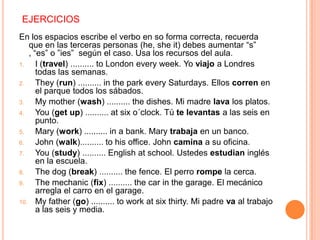
EJERCICIOS
En los espacios escribe el verbo en so forma correcta, recuerda
   que en las terceras personas (he, she it) debes aumentar “s”
   , “es” o ”ies” según el caso. Usa los recursos del aula.
1.    I (travel) .......... to London every week. Yo viajo a Londres
      todas las semanas.
2.    They (run) .......... in the park every Saturdays. Ellos corren en
      el parque todos los sábados.
3.    My mother (wash) .......... the dishes. Mi madre lava los platos.
4.    You (get up) .......... at six o´clock. Tú te levantas a las seis en
      punto.
5.    Mary (work) .......... in a bank. Mary trabaja en un banco.
6.    John (walk).......... to his office. John camina a su oficina.
7.    You (study) .......... English at school. Ustedes estudian inglés
      en la escuela.
8.    The dog (break) .......... the fence. El perro rompe la cerca.
9.    The mechanic (fix) .......... the car in the garage. El mecánico
      arregla el carro en el garage.
10. My father (go) .......... to work at six thirty. Mi padre va al trabajo
      a las seis y media.
Ahora escribe don´t o doesn´t más el verbo en paréntesis para
   formar el negativo.
1.   I (travel) .......... to London every week. Yo viajo a Londres
     todas las semanas.
2.   They (run) .......... in the park every Saturdays. Ellos corren en
     el parque todos los sábados.
3.   My mother (wash) .......... the dishes. Mi madre lava los platos.
4.   You (get up) .......... at six o´clock. Tú te levantas a las seis en
     punto.
5.   Mary (work) .......... in a bank. Mary trabaja en un banco.
6.   John (walk).......... to his office. John camina a su oficina.
7.   You (study) .......... English at school. Ustedes estudian inglés
     en la escuela.
8.   The dog (break) .......... the fence. El perro rompe la cerca.
9.   The mechanic (fix) .......... the car in the garage. El mecánico
     arregla el carro en el garage.
10. My father (go) .......... to work at six thirty. Mi padre va al
     trabajo a las seis y media.

The simple presente tense

  • 1.
    CURSO: EASY ENGLISH TEACHERELENA URGILÉS ASIGNATURA: INGLÉS EL PRESENTE SIMPLE El presente simple, es el tiempo verbal más simple del inglés. Se suele utilizar para hablar sobre hechos que constituyen hábitos o costumbres.
  • 3.
    MODO AFIRMATIVO Como ves en el cuadro el verbo se conjuga igual en todas las personas excepto con la tercera persona del singular:  Aumentamos una s en las personas: he, she, it  He reads  She walks  It speaks
  • 4.
    REGLAS PARA FORMAR LA3ª PERSONA DEL SINGULAR: HE, SHE, IT.  1.- Como regla general, se le añade s: walk -> walks  2.- Cuando el verbo acaba ya en s, o en un sonido parecido como sh, ch o x se le añade es: watch -> watches wash -> washes  Cuando el verbo acaba en o, también se añade es: go -> goes do -> does  3.- Cuando el verbo acaba en y, precedida por una consonante, tenemos que cambiar la y por i, para a continuación añadir es: fly -> flies study -> studies
  • 5.
    EN LOS MODOSINTERROGATIVO Y NEGATIVO SE UTILIZA EL AUXILIAR DO. PARA HE, SHE, IT SE USA EL AUXILIAR DOES Y SE LE QUITA LA "S" AL VERBO.  MODO NEGATIVO  Se pone not con el auxiliar  Ejemplos:  I don´t play tennis. Yo no juego al tenis. He doesn´t work in an office. Él no trabaja en una oficina. They don´t travel to Madrid. Ellos no viajan a Madrid.
  • 6.
    MODO INTERROGATIVO  Para la forma interrogativa se coloca el auxiliar DO o DOES al principio de la oración y un signo de interrogación al final.   Ejemplos:   Do I play tennis?  Does he work in an office?  Do they travel to Madrid?
  • 7.
    RESPUESTAS CORTAS  Doyou do your homework? Yes, I do.  Does the horse eat fish? No, it doesn´t.  Do the dogs chase the cat No, they don´t.  Does the boy go to school? Yes, he does.
  • 8.
    EJERCICIOS En los espaciosescribe el verbo en so forma correcta, recuerda que en las terceras personas (he, she it) debes aumentar “s” , “es” o ”ies” según el caso. Usa los recursos del aula. 1. I (travel) .......... to London every week. Yo viajo a Londres todas las semanas. 2. They (run) .......... in the park every Saturdays. Ellos corren en el parque todos los sábados. 3. My mother (wash) .......... the dishes. Mi madre lava los platos. 4. You (get up) .......... at six o´clock. Tú te levantas a las seis en punto. 5. Mary (work) .......... in a bank. Mary trabaja en un banco. 6. John (walk).......... to his office. John camina a su oficina. 7. You (study) .......... English at school. Ustedes estudian inglés en la escuela. 8. The dog (break) .......... the fence. El perro rompe la cerca. 9. The mechanic (fix) .......... the car in the garage. El mecánico arregla el carro en el garage. 10. My father (go) .......... to work at six thirty. Mi padre va al trabajo a las seis y media.
  • 9.
    Ahora escribe don´to doesn´t más el verbo en paréntesis para formar el negativo. 1. I (travel) .......... to London every week. Yo viajo a Londres todas las semanas. 2. They (run) .......... in the park every Saturdays. Ellos corren en el parque todos los sábados. 3. My mother (wash) .......... the dishes. Mi madre lava los platos. 4. You (get up) .......... at six o´clock. Tú te levantas a las seis en punto. 5. Mary (work) .......... in a bank. Mary trabaja en un banco. 6. John (walk).......... to his office. John camina a su oficina. 7. You (study) .......... English at school. Ustedes estudian inglés en la escuela. 8. The dog (break) .......... the fence. El perro rompe la cerca. 9. The mechanic (fix) .......... the car in the garage. El mecánico arregla el carro en el garage. 10. My father (go) .......... to work at six thirty. Mi padre va al trabajo a las seis y media.