UNIDAD 7 ¿Qué haces hoy?
¿Qué haces hoy? p. 60 Pedro:  ¿Qué haces hoy, Marta? Marta:  Nada especial. Estoy sola. Mis padres están de viaje. Pedro:  Entonces ¿comemos juntos? Marta: Es una buena idea.  ¿A qu é  hora nos vemos? Pedro: A las dos en punto. En el restaurante “La Casuela.” Pedro:  What are you doing today, Marta? Marta:  Nothing special. I am alone. My parents are on a trip. Pedro:  Then, shall we eat together? Marta:  It is a good idea. At what time shall we see each other? Pedro:  At two exactly. In the restaurant La Casuela. (Saucepan.)
¿Qué haces hoy? (cont) p. 60 Pedro:  ¡Hola, Marta! Son exactamente   las dos.   Eres   puntual .  Marta:  S í. Y ya tengo mucha hambre.   ¿Qué tal es el restaurante? Pedro:  Est á bien. Y tienen un menú   bueno y barato .  Pedro:  Hi, Marta! It is exactly two o’clock. You are punctual. Marta:  Yes. I am already hungry. How is the restaurant? Pedro:  It’s good. And they have a good and inexpensíve menu.
¿Qué haces hoy? (cont) p. 60 Pedro:  ¿Qué tomas? Hay dos menús. Marta:  Yo tomo el menú n ú mero uno. De primero ensalada. Y luego un filete de ternera con patatas. Pedro:  What will you have? There are two menus. Marta:  I take menu number one. First, salad. And then a veal steak with potatoes.
¿Qué haces hoy? (cont) p. 60 Pedro:  Hoy es miércoles. Y todos los miércoles hacen paella. Yo tomo paella. Marta:  ¿Y de segundo? Tienen pescado y carne. Pedro :   Pues yo de segundo tomo pescado. Pedro:  Today is Wednesday. And every Wednesday they make paella. I have paella. Marta : And for your second course? They have fish and meat. Pedro:  Well I take fish for second course.
¿Qué haces hoy? (cont) p. 60 Pedro:  ¿Qué tomamos para beber? ¿Te apetece vino, cerveza o agua?  Marta:  Me apetece un poco de vino con la carne. Y agua. Pedro : Yo también. ¿Y de postre? ¿Fruta o helado? Marta:  Yo fruta. Es muy buena para la salud. Pedro:  Estupendo. Llamamos al camarero. ¡Camarero, por favor! Pedro:  What will we have to drink? Would you like some wine, beer or water? Marta:  I would like a little wine with the meat. And water. Pedro:  Me too. And for dessert? Fruit or ice cream? Marta:  Me, fruit. It is very good for the health. Pedro:  Stupendous. Let’s call the waiter. Water, please!
Nuevo vocabulario p. 60 hoy today nada nothing especial special sola alone los padres the parents estar de viaje to be on a trip el viaje the trip entonces then una buena idea a good idea nos vemos we see each other
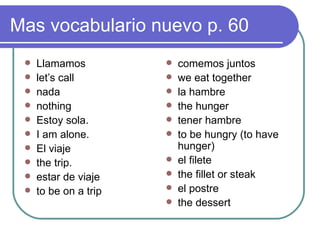
Mas vocabulario nuevo p.  60 a las dos en punto at exactly two o’clock la cazuela the saucepan puntual punctual tengo mucha hambre I am very hungry la hambre the hunger tengo I have segundo second ensalada salad tomar to take or drink comer to eat comemos we eat juntos together
Mas vocabulario nuevo p.  60 beber to drink la paella no translation—Spanish stew luego then/later la ternera the veal la fruta the fruit el helado the ice cream el pescado the fish (to eat) el pez the fish (swimming) exactamente exactly apetecer to like la patata the potato
Mas vocabulario nuevo p.  60 Llamamos let’s call nada nothing Estoy sola. I am alone. El viaje the trip. estar de viaje to be on a trip comemos juntos we eat together la hambre the hunger tener hambre to be hungry (to have hunger) el filete the fillet or steak el postre  the dessert
3.  Lee el di á logo y responde  p. 60 ¿Qué menú toma Marta?   Marta  toma el menú n ú mero uno. ¿A qu é  hora se ven Marta y Pedro para comer?  Marta y Pedro se ven para comer a las dos en punto.  Which menu will Marta take? Marta will take menu number one. At what time do Marta and Pedro see each other to eat? Marta and Pedro see each other to eat at two sharp.
3.  Lee el di á logo y responde  p. 60 ¿Qué menu hacen los miercoles en el restaurante? Hacen paella en el miercoles en el restaurante. ¿Qué toma Pedro para beber? Pedro toma un poco de vino y agua para beber.  Which menu do they make on Wednesday in the restaurant? They make paella on Wednesday in the restaurant. What does Pedro have to drink? Pedro has a little wine and water to drink.
3.  Lee el di á logo y responde  p. 60 ¿Qué toma Marta de postre? Marta  toma fruta de postre.  What does Marta have for dessert? Marta has fruit for dessert.
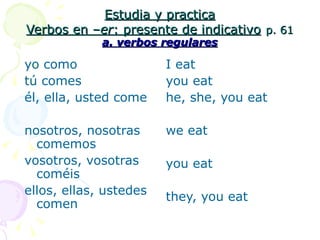
Estudia y practica Verbos en – er : presente de indicativo   p. 61 a. verbos regulares yo como tú comes él, ella, usted come nosotros, nosotras comemos vosotros, vosotras coméis ellos, ellas, ustedes comen I eat you eat he, she, you eat we eat you eat they, you eat
Estudia y practica Verbos en – er : presente de indicativo   p. 61 a. verbos irregulares HACER yo hago tú haces él, ella, usted hace nosotros, nosotras hacemos vosotros, vosotras hacéis ellos, ellas, ustedes hacen TO DO OR TO MAKE I do you do he does we do you do they do
verbos irregulares Ver  – to see p. 61 yo veo tú ves él, ella, usted ve nosotros, nosotras vemos vosotros, vosotras veis ellos, ellas, ustedes ven I see you see he, she, you see we see you see they, you see
Relaciona cada pronombre con la forma verbal que le corresponde. p. 61 tú ves haces ella come ve nosotros hacemos comemos vosotras veis coméis hacéis yo hago ellos comen  nosotros hacemos comemos vosotros veis coméis hacéis él come ve tú ves haces vosotras veis coméis hacéis nosotras hacemos comemos
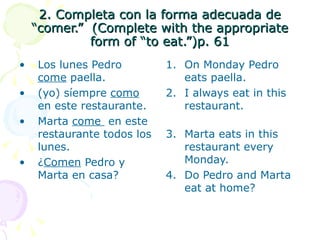
2.  Completa con la forma adecuada de “comer.”  (Complete with the appropriate form of “to eat.”)p. 61 Los lunes Pedro  come  paella. (yo) síempre  como  en este restaurante. Marta  come  en este restaurante todos los lunes. ¿ Comen  Pedro y Marta en casa? On Monday Pedro eats paella. I always eat in this restaurant. Marta eats in this restaurant every Monday. Do Pedro and Marta eat at home?
2.  Completa con la forma adecuada de “comer.”  (Complete with the appropriate form of “to eat.”)p. 61 5.  Los amigos de Isabel no  comen  en casa,  comen  en el restaurante. 6. Vosotros coméis en casa de María, pero yo como en casa de Juan. 7. ¿Dónde  coméis  vosotros el domingo? 5. Isabel’s friends don’t eat at home, they eat in the restaurant. 6. You eat in Maria’s house, but I eat in Juan’s house. 7. Where do you eat on Sunday?
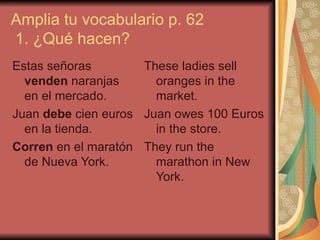
Amplia tu vocabulario  p. 62  1.  ¿Qué hacen? Estas señoras  venden  naranjas en el mercado. Juan  debe  cien euros en la tienda. Corren  en el maratón de Nueva York.  These ladies sell oranges in the market. Juan owes 100 Euros in the store. They run the marathon in New York.
1. ¿Qué hacen? P. 62 El niño no  comprende  el problema. Nunca  respondo  al teléfono. Hago  gimnasía todos los días.  The boy  does  not  understand  the problem. I  never  answer  the telephone. I   work out  every day.
1. ¿Qué hacen? p. 62 David  lee  un libro. Las niñas  aprenden  pronto la lección. Hacen  los deberes en casa. ¿ Bebéis  cerveza en las comidas?  David  reads  a book. The girls quickly  learn  the lesson. They  do  the homework at home. Do  you  drink  beer at meals?
Vocabulario nuevo –p. 62 vender to sell la naranja the orange el mercado the market deber to owe, to have to la tienda the store correr to run Nueva York New York comprender to understand el problema the problem nunca never
Vocabulario nuevo, p. 62 hago I do hacer gimnasía to work out todos los dias every day leer to read David lee David reads el libro the book aprender to learn la lección the lesson hacen  they do los deberes the homework beber to drink la comida the meal
2.  Mira los dibujos y responde . (Look at the drawings and respond.) p. 62 Los jóvenes  corren en el maratón de Nueva York. David  lee un libro. Juan  debe cien euros en la tienda. Nunca  respondo  al teléfono.  Hago  gimnasía todos los días.  The youths  run the New York Marathon. David  reads a book. Juan  owes 100 Euros in the store. I  never  answer  the telephone. I work out  every day.
Animate y habla p. 63 Use each of the following in a sentence.  ¿Qué hacen? el parque la televisíón el teléfono los libros el agua los deberes la gimnasía las corbatas ( neckties ) la paella la obra de teatro (script)
Observa , p. 64 Tengo un jugete. Yo quiero ese jugete.  I have a toy. I want that toy.
El verbo tener, p. 64 yo tengo tú tienes él, ella, usted tiene nosotros, nosotras tienen vosotros, vosotras tenéis ellos, ellas, ustedes tienen I have you have he, she, you have we have you have they, you have
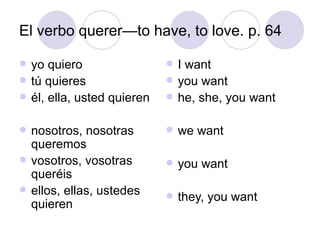
El verbo querer—to have, to love. p. 64 yo quiero tú quieres él, ella, usted quieren nosotros, nosotras queremos vosotros, vosotras queréis ellos, ellas, ustedes quieren I want you want he, she, you want we want you want they, you want
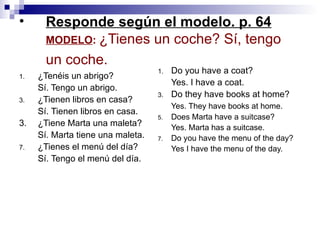
Responde según el modelo. p. 64 MODELO :  ¿Tienes un coche? S í, tengo un coche.   ¿Tenéis un abrigo? Sí. Tengo un abrigo . ¿Tienen libros en casa? Sí.   Tienen libros en casa. 3. ¿Tiene Marta una maleta? Sí. Marta tiene una maleta.  ¿Tienes el menú del día?  Sí.   Tengo   el menú del día . Do you have a coat? Yes. I have a coat. Do they have books at home? Yes. They have books at home. Does Marta have a suitcase? Yes. Marta has a suitcase. Do you have the menu of the day? Yes I have the menu of the day.
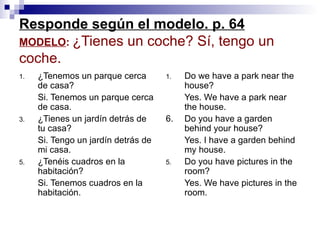
Responde según el modelo. p. 64 MODELO :  ¿Tienes un coche? S í, tengo un coche. ¿Tenemos un parque cerca de casa? Si. Tenemos un parque cerca de casa. ¿Tienes un jardín detrás de tu casa? Si. Tengo un jardín detrás de mi casa. ¿Tenéis cuadros en la habitación? Si. Tenemos cuadros en la habitación.  Do we have a park near the house? Yes. We have a park near the house. 6. Do you have a garden behind your house? Yes. I have a garden behind my house. Do you have pictures in the room? Yes. We have pictures in the room.
2.  Haz preguntas . (Make questions.) p. 64 De  primero quiero paella . ¿Quieres paella de primero? Quieren pescado de segundo.  ¿ Quieren pescado de segundo? De postre queremos fruta.   ¿Queréis fruta de postre? Quiere ver la televisión.   ¿Quiere ver la televisión?  For the 1 st  course I want paella. Do you want paella for the 1 st  course?  They want fish for the second course. Do they want fish for the second course. For dessert we want fruit. Do you want fruit for dessert. He wants to watch television.  Does he want to watch television?
2. Haz preguntas. p. 64

Unidad 7 e

  • 1.
    UNIDAD 7 ¿Quéhaces hoy?
  • 2.
    ¿Qué haces hoy?p. 60 Pedro: ¿Qué haces hoy, Marta? Marta: Nada especial. Estoy sola. Mis padres están de viaje. Pedro: Entonces ¿comemos juntos? Marta: Es una buena idea. ¿A qu é hora nos vemos? Pedro: A las dos en punto. En el restaurante “La Casuela.” Pedro: What are you doing today, Marta? Marta: Nothing special. I am alone. My parents are on a trip. Pedro: Then, shall we eat together? Marta: It is a good idea. At what time shall we see each other? Pedro: At two exactly. In the restaurant La Casuela. (Saucepan.)
  • 3.
    ¿Qué haces hoy?(cont) p. 60 Pedro: ¡Hola, Marta! Son exactamente las dos. Eres puntual . Marta: S í. Y ya tengo mucha hambre. ¿Qué tal es el restaurante? Pedro: Est á bien. Y tienen un menú bueno y barato . Pedro: Hi, Marta! It is exactly two o’clock. You are punctual. Marta: Yes. I am already hungry. How is the restaurant? Pedro: It’s good. And they have a good and inexpensíve menu.
  • 4.
    ¿Qué haces hoy?(cont) p. 60 Pedro: ¿Qué tomas? Hay dos menús. Marta: Yo tomo el menú n ú mero uno. De primero ensalada. Y luego un filete de ternera con patatas. Pedro: What will you have? There are two menus. Marta: I take menu number one. First, salad. And then a veal steak with potatoes.
  • 5.
    ¿Qué haces hoy?(cont) p. 60 Pedro: Hoy es miércoles. Y todos los miércoles hacen paella. Yo tomo paella. Marta: ¿Y de segundo? Tienen pescado y carne. Pedro : Pues yo de segundo tomo pescado. Pedro: Today is Wednesday. And every Wednesday they make paella. I have paella. Marta : And for your second course? They have fish and meat. Pedro: Well I take fish for second course.
  • 6.
    ¿Qué haces hoy?(cont) p. 60 Pedro: ¿Qué tomamos para beber? ¿Te apetece vino, cerveza o agua? Marta: Me apetece un poco de vino con la carne. Y agua. Pedro : Yo también. ¿Y de postre? ¿Fruta o helado? Marta: Yo fruta. Es muy buena para la salud. Pedro: Estupendo. Llamamos al camarero. ¡Camarero, por favor! Pedro: What will we have to drink? Would you like some wine, beer or water? Marta: I would like a little wine with the meat. And water. Pedro: Me too. And for dessert? Fruit or ice cream? Marta: Me, fruit. It is very good for the health. Pedro: Stupendous. Let’s call the waiter. Water, please!
  • 7.
    Nuevo vocabulario p.60 hoy today nada nothing especial special sola alone los padres the parents estar de viaje to be on a trip el viaje the trip entonces then una buena idea a good idea nos vemos we see each other
  • 8.
    Mas vocabulario nuevop. 60 a las dos en punto at exactly two o’clock la cazuela the saucepan puntual punctual tengo mucha hambre I am very hungry la hambre the hunger tengo I have segundo second ensalada salad tomar to take or drink comer to eat comemos we eat juntos together
  • 9.
    Mas vocabulario nuevop. 60 beber to drink la paella no translation—Spanish stew luego then/later la ternera the veal la fruta the fruit el helado the ice cream el pescado the fish (to eat) el pez the fish (swimming) exactamente exactly apetecer to like la patata the potato
  • 10.
    Mas vocabulario nuevop. 60 Llamamos let’s call nada nothing Estoy sola. I am alone. El viaje the trip. estar de viaje to be on a trip comemos juntos we eat together la hambre the hunger tener hambre to be hungry (to have hunger) el filete the fillet or steak el postre the dessert
  • 11.
    3. Leeel di á logo y responde p. 60 ¿Qué menú toma Marta? Marta toma el menú n ú mero uno. ¿A qu é hora se ven Marta y Pedro para comer? Marta y Pedro se ven para comer a las dos en punto. Which menu will Marta take? Marta will take menu number one. At what time do Marta and Pedro see each other to eat? Marta and Pedro see each other to eat at two sharp.
  • 12.
    3. Leeel di á logo y responde p. 60 ¿Qué menu hacen los miercoles en el restaurante? Hacen paella en el miercoles en el restaurante. ¿Qué toma Pedro para beber? Pedro toma un poco de vino y agua para beber. Which menu do they make on Wednesday in the restaurant? They make paella on Wednesday in the restaurant. What does Pedro have to drink? Pedro has a little wine and water to drink.
  • 13.
    3. Leeel di á logo y responde p. 60 ¿Qué toma Marta de postre? Marta toma fruta de postre. What does Marta have for dessert? Marta has fruit for dessert.
  • 14.
    Estudia y practicaVerbos en – er : presente de indicativo p. 61 a. verbos regulares yo como tú comes él, ella, usted come nosotros, nosotras comemos vosotros, vosotras coméis ellos, ellas, ustedes comen I eat you eat he, she, you eat we eat you eat they, you eat
  • 15.
    Estudia y practicaVerbos en – er : presente de indicativo p. 61 a. verbos irregulares HACER yo hago tú haces él, ella, usted hace nosotros, nosotras hacemos vosotros, vosotras hacéis ellos, ellas, ustedes hacen TO DO OR TO MAKE I do you do he does we do you do they do
  • 16.
    verbos irregulares Ver – to see p. 61 yo veo tú ves él, ella, usted ve nosotros, nosotras vemos vosotros, vosotras veis ellos, ellas, ustedes ven I see you see he, she, you see we see you see they, you see
  • 17.
    Relaciona cada pronombrecon la forma verbal que le corresponde. p. 61 tú ves haces ella come ve nosotros hacemos comemos vosotras veis coméis hacéis yo hago ellos comen nosotros hacemos comemos vosotros veis coméis hacéis él come ve tú ves haces vosotras veis coméis hacéis nosotras hacemos comemos
  • 18.
    2. Completacon la forma adecuada de “comer.” (Complete with the appropriate form of “to eat.”)p. 61 Los lunes Pedro come paella. (yo) síempre como en este restaurante. Marta come en este restaurante todos los lunes. ¿ Comen Pedro y Marta en casa? On Monday Pedro eats paella. I always eat in this restaurant. Marta eats in this restaurant every Monday. Do Pedro and Marta eat at home?
  • 19.
    2. Completacon la forma adecuada de “comer.” (Complete with the appropriate form of “to eat.”)p. 61 5. Los amigos de Isabel no comen en casa, comen en el restaurante. 6. Vosotros coméis en casa de María, pero yo como en casa de Juan. 7. ¿Dónde coméis vosotros el domingo? 5. Isabel’s friends don’t eat at home, they eat in the restaurant. 6. You eat in Maria’s house, but I eat in Juan’s house. 7. Where do you eat on Sunday?
  • 20.
    Amplia tu vocabulario p. 62 1. ¿Qué hacen? Estas señoras venden naranjas en el mercado. Juan debe cien euros en la tienda. Corren en el maratón de Nueva York. These ladies sell oranges in the market. Juan owes 100 Euros in the store. They run the marathon in New York.
  • 21.
    1. ¿Qué hacen?P. 62 El niño no comprende el problema. Nunca respondo al teléfono. Hago gimnasía todos los días. The boy does not understand the problem. I never answer the telephone. I work out every day.
  • 22.
    1. ¿Qué hacen?p. 62 David lee un libro. Las niñas aprenden pronto la lección. Hacen los deberes en casa. ¿ Bebéis cerveza en las comidas? David reads a book. The girls quickly learn the lesson. They do the homework at home. Do you drink beer at meals?
  • 23.
    Vocabulario nuevo –p.62 vender to sell la naranja the orange el mercado the market deber to owe, to have to la tienda the store correr to run Nueva York New York comprender to understand el problema the problem nunca never
  • 24.
    Vocabulario nuevo, p.62 hago I do hacer gimnasía to work out todos los dias every day leer to read David lee David reads el libro the book aprender to learn la lección the lesson hacen they do los deberes the homework beber to drink la comida the meal
  • 25.
    2. Miralos dibujos y responde . (Look at the drawings and respond.) p. 62 Los jóvenes corren en el maratón de Nueva York. David lee un libro. Juan debe cien euros en la tienda. Nunca respondo al teléfono. Hago gimnasía todos los días. The youths run the New York Marathon. David reads a book. Juan owes 100 Euros in the store. I never answer the telephone. I work out every day.
  • 26.
    Animate y hablap. 63 Use each of the following in a sentence. ¿Qué hacen? el parque la televisíón el teléfono los libros el agua los deberes la gimnasía las corbatas ( neckties ) la paella la obra de teatro (script)
  • 27.
    Observa , p.64 Tengo un jugete. Yo quiero ese jugete. I have a toy. I want that toy.
  • 28.
    El verbo tener,p. 64 yo tengo tú tienes él, ella, usted tiene nosotros, nosotras tienen vosotros, vosotras tenéis ellos, ellas, ustedes tienen I have you have he, she, you have we have you have they, you have
  • 29.
    El verbo querer—tohave, to love. p. 64 yo quiero tú quieres él, ella, usted quieren nosotros, nosotras queremos vosotros, vosotras queréis ellos, ellas, ustedes quieren I want you want he, she, you want we want you want they, you want
  • 30.
    Responde según elmodelo. p. 64 MODELO : ¿Tienes un coche? S í, tengo un coche. ¿Tenéis un abrigo? Sí. Tengo un abrigo . ¿Tienen libros en casa? Sí. Tienen libros en casa. 3. ¿Tiene Marta una maleta? Sí. Marta tiene una maleta. ¿Tienes el menú del día? Sí. Tengo el menú del día . Do you have a coat? Yes. I have a coat. Do they have books at home? Yes. They have books at home. Does Marta have a suitcase? Yes. Marta has a suitcase. Do you have the menu of the day? Yes I have the menu of the day.
  • 31.
    Responde según elmodelo. p. 64 MODELO : ¿Tienes un coche? S í, tengo un coche. ¿Tenemos un parque cerca de casa? Si. Tenemos un parque cerca de casa. ¿Tienes un jardín detrás de tu casa? Si. Tengo un jardín detrás de mi casa. ¿Tenéis cuadros en la habitación? Si. Tenemos cuadros en la habitación. Do we have a park near the house? Yes. We have a park near the house. 6. Do you have a garden behind your house? Yes. I have a garden behind my house. Do you have pictures in the room? Yes. We have pictures in the room.
  • 32.
    2. Hazpreguntas . (Make questions.) p. 64 De primero quiero paella . ¿Quieres paella de primero? Quieren pescado de segundo. ¿ Quieren pescado de segundo? De postre queremos fruta. ¿Queréis fruta de postre? Quiere ver la televisión. ¿Quiere ver la televisión? For the 1 st course I want paella. Do you want paella for the 1 st course? They want fish for the second course. Do they want fish for the second course. For dessert we want fruit. Do you want fruit for dessert. He wants to watch television. Does he want to watch television?
  • 33.