Español I – Sr. Johnston
   marte, el veintisiete de noviembre del 2012
Forming questions

What are three ways that we can form questions
in Spanish?

1.
     ejemplo:

2.
     ejemplo:

3.
     ejemplo:
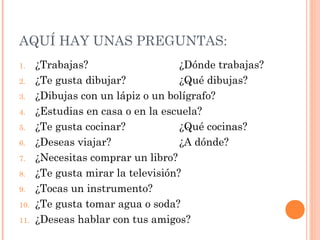
AQUÍ HAY UNAS PREGUNTAS:
1.    ¿Trabajas?                    ¿Dónde trabajas?
2.    ¿Te gusta dibujar?            ¿Qué dibujas?
3.    ¿Dibujas con un lápiz o un bolígrafo?
4.    ¿Estudias en casa o en la escuela?
5.    ¿Te gusta cocinar?            ¿Qué cocinas?
6.    ¿Deseas viajar?               ¿A dónde?
7.    ¿Necesitas comprar un libro?
8.    ¿Te gusta mirar la televisión?
9.    ¿Tocas un instrumento?
10.   ¿Te gusta tomar agua o soda?
11.   ¿Deseas hablar con tus amigos?
ACTIVIDAD: ¿QUÉ HACES? ¿QUÉ TE GUSTA
HACER? with a classmate and take turns asking each other if you
 Get together
    do different activities. Which activities does your partner like?
   Write down 6 original questions along with the answers in your
    notebook for the next notebook check (11/30/12)

Modelo:
Estudiante 1: ¿Tomas el autobús?
Estudiante 2: Sí, tomo el autobús, pero no me gusta.
           or: No, no tomo el autobús.
Possible topics:

    bailar merengue                      practicar el español

    mirar la televisión                  escuchar música hip-hop

    hablar con amigos                    viajar a Nueva York
NOW SWITCH PARTNERS!
   Ask your new partner the same six questions.

   Make sure to record
EL LIBRO DE VERBOS
 Create a picture book to help you learn the
  meaning of our 20 verbs.
 Each page should have:
    A  verb in the infinitive form
     An image to represent the verb
     The same verb conjugated to match the image.


   Do not write any English words in your book.

   SEE EXAMPLE!

This project is due tomorrow at the end of class.

11 27 12 leccion

  • 1.
    Español I –Sr. Johnston marte, el veintisiete de noviembre del 2012
  • 2.
    Forming questions What arethree ways that we can form questions in Spanish? 1. ejemplo: 2. ejemplo: 3. ejemplo:
  • 3.
    AQUÍ HAY UNASPREGUNTAS: 1. ¿Trabajas? ¿Dónde trabajas? 2. ¿Te gusta dibujar? ¿Qué dibujas? 3. ¿Dibujas con un lápiz o un bolígrafo? 4. ¿Estudias en casa o en la escuela? 5. ¿Te gusta cocinar? ¿Qué cocinas? 6. ¿Deseas viajar? ¿A dónde? 7. ¿Necesitas comprar un libro? 8. ¿Te gusta mirar la televisión? 9. ¿Tocas un instrumento? 10. ¿Te gusta tomar agua o soda? 11. ¿Deseas hablar con tus amigos?
  • 4.
    ACTIVIDAD: ¿QUÉ HACES?¿QUÉ TE GUSTA HACER? with a classmate and take turns asking each other if you  Get together do different activities. Which activities does your partner like?  Write down 6 original questions along with the answers in your notebook for the next notebook check (11/30/12) Modelo: Estudiante 1: ¿Tomas el autobús? Estudiante 2: Sí, tomo el autobús, pero no me gusta. or: No, no tomo el autobús. Possible topics: bailar merengue practicar el español mirar la televisión escuchar música hip-hop hablar con amigos viajar a Nueva York
  • 5.
    NOW SWITCH PARTNERS!  Ask your new partner the same six questions.  Make sure to record
  • 6.
    EL LIBRO DEVERBOS  Create a picture book to help you learn the meaning of our 20 verbs.  Each page should have: A verb in the infinitive form  An image to represent the verb  The same verb conjugated to match the image.  Do not write any English words in your book.  SEE EXAMPLE! This project is due tomorrow at the end of class.