Can
How to use it
In Colombian Spanish
CAN means:
 Saber hacer algo por tener la
capacidad, el talento o el
conocimiento
 Poder/ser capaz hacer algo porque
se tiene el entrenamiento o la
disposición
 Poder: Se usa para hacer
ofrecimientos o pedir ayuda
We only use CAN
in present and
past tenses
Case One
 Saber hacer algo por tener la
capacidad, el talento o el
conocimiento
He can play the
guitar
Camilo sabe tocar guitarra
They can dance
Ellos saben bailar
Luisa can drive a car
Luisa sabe manejar carro
They can swim
Ellos saben nadar
I
You
We
They
He
She
It
can
play soccer
speak in English
drive a car
use Powerpoint
ride a bike
play FortNite
dance tango
Case two
 Ser capaz de…
 Poder…
Cheetah can reach speed of 113
kilometers an hour
El chita puede alcanzar 113 kilómetros por hora
El chita es capaz de alcanzar 113 kilómetros por hora
Birds can fly
Los pájaros pueden volar
Los pájaros son capaces de volar
Caterine can jump 14
meters
Caterine puede saltar 14 metros
Caterine es capaz de saltar 14 metros
Chamaleon can change
Its skin color
El camaleón puede cambiar el color de la piel
El camaleón es capaz cambiar el color de la piel
Firemen can
extinguish fires
Los bomberos pueden apagar incendios
Los bomberos son capaces de apagar incendios
Case three
 Poder: Se usa para hacer
ofrecimientos o pedir ayuda o
consentimiento
Can you
help me?
¿Me puede ayudar?
Good morning,
how can I help
you?
Buenos días, ¿en que le puedo servir?
Can I go to the
toilet, please?
¿Puedo ir al baño?
Can you lend me two
thousand pesos?
¿Me puede prestar dos lukas?
Summary
In Colombian Spanish
CAN means:
 Saber hacer algo por tener la
capacidad, el talento o el
conocimiento
 Poder/ser capaz hacer algo porque
se tiene el entrenamiento o la
disposición
 Poder: Se usa para hacer ofrecimientos,
pedir ayuda o consentimiento
We use can for I, you, we, they, he, she or
it
When we have to make a question, we use can,
not auxiliaries.
The negative form of can is can’t or
cannot
The past of can is could
The negative of could is couldn’t
Messi can’t
speak in
English
Luisa can’t
play golf
Turtles can’t
walk fast
People can’t
live without a
cellphone
Can: Negative sentences
Messi no sabe hablar Inglés
Las tortugas no pueden andar rápido
Luisa no sabe jugar golf
La gente no puede vivir sin celular
Can’t=cannot
The past of
can=could
 Could: podía(n)(s), sabía(n)(s)
When my grandpa was young,
He could run fast
Cuando mi abuelito era/estaba joven podía correr rápido
In the sixties they could
watch only one channel
Colombia
En los sesenta ellos sólo podían ver un canal
My great-grandfather could speak
four languages
Mi bisabuelo sabía hablar cuatro idiomas
The negative form
of could is
couldn’t
My grandmother couldn’t speak
in English
Mi abuelita no sabía hablar Inglés
Before 1957 colombian women
couldn’t vote
Antes de 1957 la mujeres colombianas no podían votar
Questions
I
You
We
They
He
She
It
I
You
We
They
I
You
We
They
He
She
It
He
She
It
Messi can play
soccer
Can Messi play
soccer ?
Can Luisa read in English ?
Luisa can read in English
Pilots can visit many
places
Can pilots visit many
places ?
Can my grandpa run fast?
My grandpa can’t run fast
¿Usted sabe manejar moto?
no pude hablar con ella
¿su tío sabe tocar guitarra?
Luisa no pudo ir a cine ayer
Valeria no es capaz de ver
una película de terror
Sebas es capaz de jugar
Nintendo todo el día
Yo no pude arreglar el PC
¿Usted sabe nadar?
¿Usted sabe usar Phothoshop ?
¿La mujeres podían votar en 1940?
Can you drive a motorcycle?
Can your uncle play the guitar?
Can you swim?
Can you use a Photoshop?
Could women vote in 1940?
I couldn’t talk with her
Luisa couldn’t go to the
movies yesterday
Valeria can’t watch a horror
movie
Sebas can play Nintendo all
day long
I couldn’t fix the PC
¿Usted sabe hacer pizza?
no pude hacer la llamada
¿su tío pudo viajar ayer?
Carlos es capaz de comerse tres
hamburguesas
No pudimos ir a la fiesta
anoche
Mariana sabe manejar
carro
¿Me puede ayudar? (usted)
Mis papás no pudieron entrar al
estadio
Ella no pudo ayudarlo
Can you make pizza?
I couldn’t make the pone call
Could your uncle travel yesterday?
Carlos can eat three burgers
We couldn’t go to the party
last night
Mariana can drive a car
Can you help me?
My parents couldn’t to get
into the stadium
She couldn’t help him
Be able to…
In Colombian Spanish be
able to means:
 Poder, ser capaz de hacer
algo
 Temporary abilities or
inabilities
 We use be able to in
future events
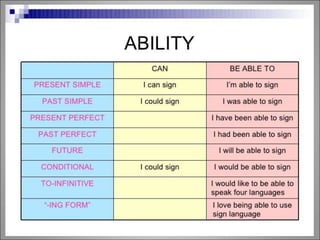
Can and be able to, are
almost the same, but…
 We use be able to in
present perfect tense
 We use be able to in infinitive
sentences
 Temporary abilities or
Inabilities:
 Poder, ser capaz de hacer
algo:
I want to be able to speak
English better
He is not able to swim
 In future events:
Will you be able to come with us to the
party?
 In present perfect tense:
I haven’t been able to finish it
 In infinitive sentences:
I want to be able to fly an airplane
Can
Can
Can

Can

  • 1.
  • 2.
    In Colombian Spanish CANmeans:  Saber hacer algo por tener la capacidad, el talento o el conocimiento  Poder/ser capaz hacer algo porque se tiene el entrenamiento o la disposición  Poder: Se usa para hacer ofrecimientos o pedir ayuda
  • 3.
    We only useCAN in present and past tenses
  • 4.
    Case One  Saberhacer algo por tener la capacidad, el talento o el conocimiento
  • 5.
    He can playthe guitar Camilo sabe tocar guitarra
  • 6.
  • 7.
    Luisa can drivea car Luisa sabe manejar carro
  • 8.
  • 9.
    I You We They He She It can play soccer speak inEnglish drive a car use Powerpoint ride a bike play FortNite dance tango
  • 10.
    Case two  Sercapaz de…  Poder…
  • 11.
    Cheetah can reachspeed of 113 kilometers an hour El chita puede alcanzar 113 kilómetros por hora El chita es capaz de alcanzar 113 kilómetros por hora
  • 12.
    Birds can fly Lospájaros pueden volar Los pájaros son capaces de volar
  • 13.
    Caterine can jump14 meters Caterine puede saltar 14 metros Caterine es capaz de saltar 14 metros
  • 14.
    Chamaleon can change Itsskin color El camaleón puede cambiar el color de la piel El camaleón es capaz cambiar el color de la piel
  • 15.
    Firemen can extinguish fires Losbomberos pueden apagar incendios Los bomberos son capaces de apagar incendios
  • 16.
    Case three  Poder:Se usa para hacer ofrecimientos o pedir ayuda o consentimiento
  • 17.
    Can you help me? ¿Mepuede ayudar?
  • 18.
    Good morning, how canI help you? Buenos días, ¿en que le puedo servir?
  • 19.
    Can I goto the toilet, please? ¿Puedo ir al baño?
  • 20.
    Can you lendme two thousand pesos? ¿Me puede prestar dos lukas?
  • 21.
  • 22.
    In Colombian Spanish CANmeans:  Saber hacer algo por tener la capacidad, el talento o el conocimiento  Poder/ser capaz hacer algo porque se tiene el entrenamiento o la disposición  Poder: Se usa para hacer ofrecimientos, pedir ayuda o consentimiento
  • 23.
    We use canfor I, you, we, they, he, she or it When we have to make a question, we use can, not auxiliaries. The negative form of can is can’t or cannot The past of can is could The negative of could is couldn’t
  • 24.
    Messi can’t speak in English Luisacan’t play golf Turtles can’t walk fast People can’t live without a cellphone Can: Negative sentences Messi no sabe hablar Inglés Las tortugas no pueden andar rápido Luisa no sabe jugar golf La gente no puede vivir sin celular Can’t=cannot
  • 26.
    The past of can=could Could: podía(n)(s), sabía(n)(s)
  • 27.
    When my grandpawas young, He could run fast Cuando mi abuelito era/estaba joven podía correr rápido
  • 28.
    In the sixtiesthey could watch only one channel Colombia En los sesenta ellos sólo podían ver un canal
  • 29.
    My great-grandfather couldspeak four languages Mi bisabuelo sabía hablar cuatro idiomas
  • 30.
    The negative form ofcould is couldn’t
  • 31.
    My grandmother couldn’tspeak in English Mi abuelita no sabía hablar Inglés
  • 32.
    Before 1957 colombianwomen couldn’t vote Antes de 1957 la mujeres colombianas no podían votar
  • 33.
  • 34.
  • 35.
    Messi can play soccer CanMessi play soccer ?
  • 36.
    Can Luisa readin English ? Luisa can read in English
  • 37.
    Pilots can visitmany places Can pilots visit many places ?
  • 38.
    Can my grandparun fast? My grandpa can’t run fast
  • 40.
    ¿Usted sabe manejarmoto? no pude hablar con ella ¿su tío sabe tocar guitarra? Luisa no pudo ir a cine ayer Valeria no es capaz de ver una película de terror Sebas es capaz de jugar Nintendo todo el día Yo no pude arreglar el PC ¿Usted sabe nadar? ¿Usted sabe usar Phothoshop ? ¿La mujeres podían votar en 1940? Can you drive a motorcycle? Can your uncle play the guitar? Can you swim? Can you use a Photoshop? Could women vote in 1940? I couldn’t talk with her Luisa couldn’t go to the movies yesterday Valeria can’t watch a horror movie Sebas can play Nintendo all day long I couldn’t fix the PC
  • 41.
    ¿Usted sabe hacerpizza? no pude hacer la llamada ¿su tío pudo viajar ayer? Carlos es capaz de comerse tres hamburguesas No pudimos ir a la fiesta anoche Mariana sabe manejar carro ¿Me puede ayudar? (usted) Mis papás no pudieron entrar al estadio Ella no pudo ayudarlo Can you make pizza? I couldn’t make the pone call Could your uncle travel yesterday? Carlos can eat three burgers We couldn’t go to the party last night Mariana can drive a car Can you help me? My parents couldn’t to get into the stadium She couldn’t help him
  • 42.
  • 43.
    In Colombian Spanishbe able to means:  Poder, ser capaz de hacer algo  Temporary abilities or inabilities
  • 44.
     We usebe able to in future events Can and be able to, are almost the same, but…  We use be able to in present perfect tense  We use be able to in infinitive sentences
  • 45.
     Temporary abilitiesor Inabilities:  Poder, ser capaz de hacer algo: I want to be able to speak English better He is not able to swim
  • 46.
     In futureevents: Will you be able to come with us to the party?  In present perfect tense: I haven’t been able to finish it  In infinitive sentences: I want to be able to fly an airplane