Capítulo 2
       Mis planes y preferencias
 Los planes (LG2.1)
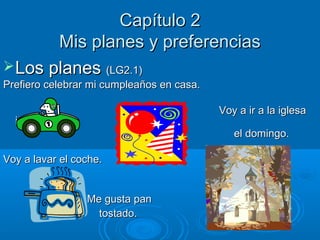
Prefiero celebrar mi cumpleaños en casa.

                                           Voy a ir a la iglesa
  iglesia
                                              el domingo.

Voy a lavar el coche.


                 Me gusta pan
                   tostado.
Los planes
Andrea Ruiz habla de los planes de su familia
para el fin de semana.
El sábado Pedro y las niñas van a lavar el
carro.

El sábado por la tarde, Pedro y yo vamos a dar
una fiesta.

También vamos a bailar en una discoteca.
Expressing Future Plans:
                   -ir + a + Infinitive
               ir (to go) irregular verb
(yo)                        voy            I am going; go
(tú)                        vas            you (inf. sing.) are going

(usted, él/ella)             va            you (pol. sing.) are
                                           going; he/she is going;
                                           go; goes

(nosotros/as)              vamos           we are going; go
(vosotros/as)               vais           you (inf. Pl. Spain)are
                                           going; go

(ustedes,                   van            you (pl.) are going; they
                                           are going; go
ellos/ellas)
Sequencing: Ordinal Adjectives
   2.2
 primero/a            sexto/a
 segundo/a            septimo/a
 tercero/a            octavo/a
 cuarto/a             noveno/a
 quinto/a             décimo/a
As with uno (one), the words primero y
tercero drop the final –o when used before
a masculine singular noun.
   Estoy en el primer (tercer) año.
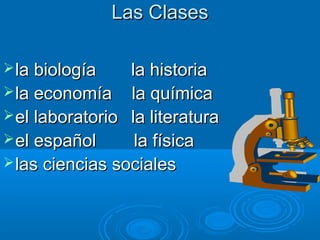
Las Clases

 la biología    la historia
 la economía la química
 el laboratorio la literatura
 el español      la física
 las ciencias sociales
2.3
      Las preferencias y los deseos
 Stating Preferences and Desires:
  preferir and querer + Infinitive
  Infinitives = verbs that are not conjugated
Preferir = to prefer, would rather
Querer = to want
¿Qué quieres hacer ahora?
  Quiero descansar.
¿Qué prefieres hacer?
  Prefiero comer ahora.
2.4-2.5
        El tiempo


nieva
2.4-2.5
         El tiempo


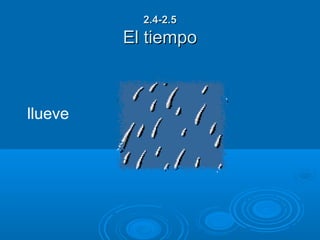
llueve
2.4-2.5
               El tiempo


Hay neblina.
2.4-2.5
                El tiempo


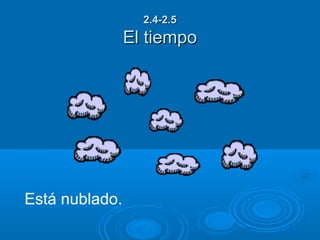
Está nublado.
2.4-2.5
     El tiempo


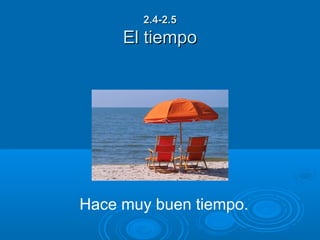
Hace muy buen tiempo.
2.4-2.5
                 El tiempo

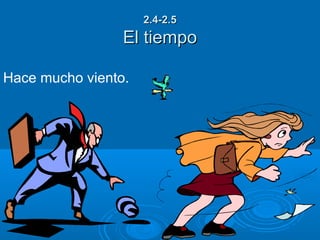
Hace mucho viento.
2.4-2.5
              El tiempo
 Hace sol.
2.4-2.5
             El tiempo
Common Expressions for
Describing the Weather:

If it can be felt use hacer.


If it can be seen use haber.
…if it can be felt use hacer
(good weather, heat, cold, wind)
Hace frío.
Hace calor.
Hace buen / mal tiempo.
Hace viento.
Hace sol.
If it can be seen use haber.
-Hay neblina por la cuesta.
   There is fog along the coast.
            -It’s foggy.
-Hay nubes hoy.
    There are clouds today.
            -It’s cloudy.
Use estar…

-Está nublado hoy.
   It’s cloudy today.

-Está soleado en las montañas.
    It’s sunny in the mountains.
To talk about rain & snow
…use only the corresponding verb of
 llover o nevar.

-Siempre llueve aquí por la tarde.
  It always rains here in the afternoon.

-Nieva mucho en Montana.
  It snows a lot in Montana.
2.4-2.5
            ¿Qué tiempo hace?
 Hace buen tiempo.
 Hace sol.
 Hace mucho calor.
 Hace mucho frío.
 Hace viento.
 Hace fresco.
 Está nublado.
 Nieva.
 Llueve.
Pointing Out People and Objects:
      Demonstrative Adjectives
 Normally used to point out nouns.


-Quiero terminar está lección primero.
     I want to finish this lesson first.
-Esos tres muchachos quieren andar en moto.
     Those three boys want to ride motorcycles.

Demonstrative Adj. go before the noun they modify
and must agree in gender & number with that noun.
Demonstrative Adjectives
 este /esta = this ( este libro; esta fotografia)
 estos /estas = these (estos cuadernos; estas
                                 tareas)
 ese / esa = that (ese cartel; esa silla)
 esos / esas = those (esos papeles; esas
                            chicas)
 esto / eso = this / that (unidentified object)
 Aquel / aquella = that (aquel edificio; aquella
                                 plaza)
 Aquellos / aquellas = those (aquellos árboles;
                                 aquellas puertas)
Capítulo 2 powerpoint

  • 1.
    Capítulo 2 Mis planes y preferencias  Los planes (LG2.1) Prefiero celebrar mi cumpleaños en casa. Voy a ir a la iglesa iglesia el domingo. Voy a lavar el coche. Me gusta pan tostado.
  • 2.
    Los planes Andrea Ruizhabla de los planes de su familia para el fin de semana. El sábado Pedro y las niñas van a lavar el carro. El sábado por la tarde, Pedro y yo vamos a dar una fiesta. También vamos a bailar en una discoteca.
  • 3.
    Expressing Future Plans: -ir + a + Infinitive ir (to go) irregular verb (yo) voy I am going; go (tú) vas you (inf. sing.) are going (usted, él/ella) va you (pol. sing.) are going; he/she is going; go; goes (nosotros/as) vamos we are going; go (vosotros/as) vais you (inf. Pl. Spain)are going; go (ustedes, van you (pl.) are going; they are going; go ellos/ellas)
  • 4.
    Sequencing: Ordinal Adjectives  2.2  primero/a sexto/a  segundo/a septimo/a  tercero/a octavo/a  cuarto/a noveno/a  quinto/a décimo/a As with uno (one), the words primero y tercero drop the final –o when used before a masculine singular noun.  Estoy en el primer (tercer) año.
  • 5.
    Las Clases  labiología la historia  la economía la química  el laboratorio la literatura  el español la física  las ciencias sociales
  • 6.
    2.3 Las preferencias y los deseos  Stating Preferences and Desires: preferir and querer + Infinitive Infinitives = verbs that are not conjugated Preferir = to prefer, would rather Querer = to want ¿Qué quieres hacer ahora? Quiero descansar. ¿Qué prefieres hacer? Prefiero comer ahora.
  • 7.
    2.4-2.5 El tiempo nieva
  • 8.
    2.4-2.5 El tiempo llueve
  • 9.
    2.4-2.5 El tiempo Hay neblina.
  • 10.
    2.4-2.5 El tiempo Está nublado.
  • 11.
    2.4-2.5 El tiempo Hace muy buen tiempo.
  • 12.
    2.4-2.5 El tiempo Hace mucho viento.
  • 13.
    2.4-2.5 El tiempo  Hace sol.
  • 14.
    2.4-2.5 El tiempo Common Expressions for Describing the Weather: If it can be felt use hacer. If it can be seen use haber.
  • 15.
    …if it canbe felt use hacer (good weather, heat, cold, wind) Hace frío. Hace calor. Hace buen / mal tiempo. Hace viento. Hace sol.
  • 16.
    If it canbe seen use haber. -Hay neblina por la cuesta. There is fog along the coast. -It’s foggy. -Hay nubes hoy. There are clouds today. -It’s cloudy.
  • 17.
    Use estar… -Está nubladohoy. It’s cloudy today. -Está soleado en las montañas. It’s sunny in the mountains.
  • 18.
    To talk aboutrain & snow …use only the corresponding verb of llover o nevar. -Siempre llueve aquí por la tarde. It always rains here in the afternoon. -Nieva mucho en Montana. It snows a lot in Montana.
  • 19.
    2.4-2.5 ¿Qué tiempo hace?  Hace buen tiempo.  Hace sol.  Hace mucho calor.  Hace mucho frío.  Hace viento.  Hace fresco.  Está nublado.  Nieva.  Llueve.
  • 20.
    Pointing Out Peopleand Objects: Demonstrative Adjectives  Normally used to point out nouns. -Quiero terminar está lección primero. I want to finish this lesson first. -Esos tres muchachos quieren andar en moto. Those three boys want to ride motorcycles. Demonstrative Adj. go before the noun they modify and must agree in gender & number with that noun.
  • 21.
    Demonstrative Adjectives  este/esta = this ( este libro; esta fotografia)  estos /estas = these (estos cuadernos; estas tareas)  ese / esa = that (ese cartel; esa silla)  esos / esas = those (esos papeles; esas chicas)  esto / eso = this / that (unidentified object)  Aquel / aquella = that (aquel edificio; aquella plaza)  Aquellos / aquellas = those (aquellos árboles; aquellas puertas)