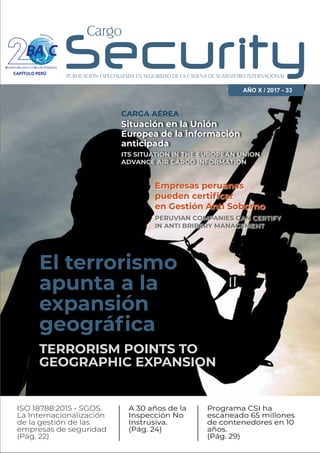
El terrorismo
apunta a la
expansión
geográfica
ISO 18788:2015 - SGOS.
La Internacionalización
de la gestión de las
empresas de seguridad
(Pág. 22)
A 30 años de la
Inspección No
Instrusiva.
(Pág. 24)
Programa CSI ha
escaneado 65 millones
de contenedores en 10
años.
(Pág. 29)
TERRORISM POINTS TO
GEOGRAPHIC EXPANSION
AÑO X / 2017 - 33
Aniversari
o
CAPÍTULO PERÚ
Situación en la Unión
Europea de la información
anticipada
CARGA AÉREA
ITS SITUATION IN THE EUROPEAN UNION
ADVANCE AIR CARGO INFORMATION
Empresas peruanas
pueden certificar
en Gestión Anti Soborno
PERUVIAN COMPANIES CAN CERTIFY
IN ANTI BRIBERY MANAGEMENT
siguientes sectores:
Exportadores
/Importadores
Agentes
de Aduana
Terminales
de
Almacenamiento
Transportes
de Carga
Terrestre
Servicios
Servicios
Aeroportuarios Servicios
Portuarios
de Vigilancia
y Seguridad
Privada
Operadores
Portuarios
/Agentes
de Estiba
Operadores
Logísticos
Terminales
Portuarios
Marítimos
o Fluviales
Transportistas
Aéreos
Transportistas
Marítimos
Zonas
Francas
Empresas
deServicios
Complementarios,
Portuarios y
Marítimos
Agentes
de Carga
/ Agentes
Marítimos
Empresas de
Servicios
Complementarios
Aeroportuarios
1
Cargo SECURITY AÑO X / 2017 Nº 33
CONTENIDO/CONTENT
Contenido
CONTENT
PALABRAS DEL PRESIDENTE / WORDS OF THE PRESIDENT
Satisfacción del deber cumplido
SENSE OF ACCOMPLISHMENT
BASC PERÚ 20 AÑOS / BASC PERU 20 YEARS
BASC PERÚ 20 años. Temas, Empresas, Instituciones y Autoridades
BASC PERÚ 20 YEARS. TOPICS, COMPANIES, INSTITUTIONS AND AUTHORITIES
CIBERSEGURIDAD / CYBERSECURITY
Perú incrementa su capacidad técnica en Ciberseguridad
CIBERSEGURIDAD / CIBERSECURITY PERU INCREASES ITS TECHNICAL CAPACITY ON CYBERSECURITY
Gestión de la Ciberseguridad según el ISO/IEC 27032:2012
CYBERSECURITY MANAGEMENT ACCORDING TO ISO/ IEC 27302:2012
PORTADA / COVER
El terrorismo está apuntando a la expansión geográfica
TERRORISM IS EXPANDING GEOGRAPHICALLY
NORMALIZACIÓN / STANDARIZATION
ISO 18788:2015 – SGOS. La Internacionalización de la gestión de
las empresas de seguridad privada
PRIVATE SECURITY COMPANIES MANAGEMENT GOING INTERNATIONAL
COMERCIO SEGURO / SECURE COMMERCE
A 30 años de la Inspección No Intrusiva
30 YEARS FROM NON-INTRUSIVE INSPECTION
El transporte aéreo mundial y la seguridad en el 2016
WORLD AIR TRANSPORT AND SECURITY IN 2016
INSPECCIÓN / SCREENING
Programa CSI ha escaneado 65 millones de contenedores en 10 años
65 MILLIONS OF CONTAINERS HAVE BEEN SCANNED BY THE CSI PROGRAM IN 10 YEARS
Situación en la Unión Europea de la información anticipada para la carga aérea
SITUATION IN THE EUROPEAN UNION OF ADVANCE AIR CARGO INFORMATION
EMPRESAS / COMPANIES
TALMA líder en servicios Aeroportuarios
TALMA – LEADER IN AIRPORT SERVICES
Corporación SEALERS inaugura nuevo laboratorio para precintos
SEALERS CORPORATION INAUGURATES NEW LABORATORY FOR SEALS
CORRUPCION / CORRUPTION
Empresas peruanas pueden certificar en Gestión Anti Soborno
PERUVIAN COMPANIES CAN CERTIFY IN ANTI BRIBERY MANAGEMENT
MUNDO BASC / WORLD BASC
ANAB realiza Auditoría Testificada a la auditoría de BASC PERÚ a
TALMA SERVICIOS AEROPORTUARIOS S.A.
ANAB CONDUCTS A WITNESS AUDIT TO THE AUDIT CARRIED OUT BY
BASC PERU TO TALMA SERVICIOS AEROPORTUARIOS S.A.
BASC PERÚ ponente principal en la Comisión de Alto Nivel Anti Corrupción (CAN)
BASC PERÚ MAIN PRESENTER AT THE HIGH LEVEL ANTI-CORRUPTION COMMISSION
Foro “Lavado de Activos”
FORUM ON MONEY LAUNDERING
2
5
24
26
Jirón Francisco Graña 335, Magdalena del Mar
Lima - Perú
Consejo Directivo / Directors Board
Presidente del Directorio
Sociedad Nacional de Industrias - S.N.I.
Raúl Saldías Haettenschweiler
Vicepresidente
Sociedad de Comercio Exterior - COMEX
Patricia Siles Álvarez
Director Tesorero
Cámara de Comercio Americana del Perú - AMCHAM
Aldo Defilippi Traverso
Director
Sociedad Nacional de Pesquería - SNP
Ricardo Bernales Parodi
Asociación de Agentes de Aduana del Perú - AAAP
Jaime Miró Quesada Pflucker
Asociación de Exportadores - ADEX
Rafael del Campo Quintana
Asociación Peruana de Agentes Marítimos - APAM
Sabino Zaconeta Torres
Past President
María del Carmen Masías
Director Secretario
Asociación de Servicios Aeroportuarios Privados - ASAEP
Arturo Cassinelli
Director
Asociación Peruana de Operadores Portuarios – ASPPOR
César Ballón Izquierdo
Director Vocal
Asociación Marítima del Perú - ASMARPE
Guillermo Acosta Rodríguez
Cámara de Comercio del Lima - C.C.L.
Juan A. Morales Bermúdez
Consejo Nacional de Usuarios de Distribución
Física Internacional de Mercancías – CONUDFI
Gerente General
César Venegas Núñez
Director
Director
Director
Director
Comité Editorial / Editorial Board
Raúl Saldías Haettenschweiler
Patricia Siles Álvarez
César Venegas Núñez
Director / Director
César Venegas Núñez
Edición / Redacción / Editor / Writer
Unices Montes Espinoza
Coordinación / Coordinator
Vanessa Alzamora
Suscripciones y Publicidad / Subscription & Advertising
Diagramación e Impresión / Design and Press
Grupo Visión Publicidad S.A.C. 11
14
29
31
33
38
35
vanessa.alzamora@bascperu.org
17
22
39
39
40
Cargo SECURITY AÑO X / 2017 Nº 33
2
Cargo SECURITY AÑO X / 2017 Nº 33
T
al como adelanté en nuestra edición anterior,
con la tristeza del alejamiento, pero con la gran
satisfacción de los logros alcanzados, ha llegado
el momento de dejar la presidencia del Consejo
Directivo de BASC PERÚ después de casi dos
décadas de haber compartido con diferentes señores
directores las decisiones que han guiado el accionar
de nuestra organización.
En febrero de 1998 inicié mi participación como
directivo de BASC PERÚ, habiendo ocupado desde
entonces los cargos de Vocal, Vicepresidente y luego
Presidente en tres periodos, dos veces representando
a la Sociedad Nacional de Industrias (SNI) y una
por el Consejo Nacional de Usuarios de Distribución
Física Internacional (CONUDFI), incluyendo el cargo
de Presidente del Consejo Directivo de la WBO (siglas
en inglés de Organización Mundial BASC) durante
dos mandatos de dos años cada uno, completando 04
años en tan honroso cargo.
Quien suscribe este editorial fue testigo del camino
recorrido por esta noble organización sin fines de
lucro que inició sus operaciones en condiciones muy
precarias: su primera “sede” quedaba en un espacio
(cedido en las oficinas de CONUDFI en el último piso
de la antigua sede de ADEX) apenas suficiente para
albergar un pequeño escritorio, una computadora y un
archivador de metal, prestados por la Embajada de los
Estados Unidos de América en Perú.
Su posterior crecimiento y desarrollo fue fruto
del esfuerzo y la dedicación compartida entre sus
directorios, el primero de ellos liderado por Carlos
Bruce y posteriormente, mi antecesor en el 2008,
nuestro recordado colega Carlos Lazarte Hoyle
(+), y los colaboradores que paulatinamente fueron
cambiando.
Como sabemos, los diversos directorios “Ad
honorem” que han dirigido los destinos de BASC
PERÚ durante estos 20 años, son integrados por
ejecutivos y funcionarios que representan a los
gremios empresariales relacionados al comercio
exterior peruano. Los fundadores fueron tres:
Asociación de Exportadores (ADEX), Cámara de
Comercio Americana del Perú (AmCham) y el Consejo
Nacional de Usuarios del Sistema de Distribución
Física Internacional (CONUDFI). Actualmente
nuestro Consejo Directivo está conformado también
por: Sociedad de Comercio Exterior (ComexPerú),
Asociación de Servicios Aeroportuarios Privados
(ASAEP), Sociedad Nacional de Pesquería (SNP),
Asociación Peruana de Operadores Portuarios
(ASSPOR),Asociación Marítima del Perú (ASMARPE),
Asociación de Agentes de Aduana del Perú (AAAP),
Asociación Peruana de Agentes Marítimos (APAM),
Satisfacción
del deber cumplido
SENSE OF ACCOMPLISHMENT
PALABRASDELPRESIDENTE/PRESIDENT´SWORDS
A
s I mentioned in our previous edition, I am sad to
be leaving, but glad for the goals accomplished.
It is time to leave the presidency of the Board of
Directors of BASC PERU after almost two decades of
having shared the decisions that have led the course of
our organization with other directors.
In February 1998, I became part of the senior
management team of BASC PERU, having served
before as Member of the Board, Vice-president and
then President in three periods, twice representing
the National Society of Industries (SNI in Spanish)
and one time representing the National Council
of Users of the International Physical Distribution
System (CONUDFI in Spanish), including the position
of President of the Board of Directors of the WORLD
BASC ORGANISATION (WBO) during two mandates
of two years each, completing a total of for years in
such distinguished position.
I have witnessed firsthand how far this notable non-
profit organization has come since it started operating
under very difficult conditions: its first “headquarter”
was in a space (in the offices of CONUDFI on the last
floor of the former office of ADEX), which was barely
enough to set up a small desk, a computer, and a
cabinet supplied by the Embassy of the United States
of America in Peru.
Its further growth and development was thanks to
the effort and dedication of its board of directors, the first
one lead by Carlos Bruce and then by my predecessor
in 2008, our dear colleague Carlos Lazarte Hoyle (+),
as well as all employees that changed gradually.
As we know, the different ad-honorem board of
directors that have led the destiny of BASC PERU
over the last 20 years, are formed by executives and
businessmen that represent the trade unions related
to Peruvian international trade. The founding members
were three: The Association of Exporters (ADEX), the
American Chamber of Commerce of Peru (AMCHAM)
and the National Council of Users of the International
Physical Distribution System (CONUDFI). Today, our
Board of Directors also includes the Association of
International Trade (COMEX PERU), the Association
of Private Airport Services (ASAEP), the National
Fishing Association (SNP), the Peruvian Association of
Port Operators (ASSPOR), the Marine Association of
Peru (ARMARPE), the Association of Customs Agents
of Peru (AAAP), the Peruvian Association of Maritime
Agents (APAM), the National Society of Industries SNI)
and the Chamber of Commerce of Lima (CCL).
This industry presence gives us an entry to the
private sector, which has been key to strengthen our
growth. Also, our permanent work with the authorities
has paved the way to expand out horizons by relating
3
Cargo SECURITY AÑO X / 2017 Nº 33
Sociedad Nacional de Industrias (SNI) y Cámara de
Comercio de Lima (CCL).
Esta representatividad que nos otorga el sector
privado ha sido clave para fortalecer nuestro
crecimiento, así como el trabajo permanente con las
autoridades allanó el camino para ampliar nuestros
horizontes al relacionarnos con importantes
entidades supranacionales y nacionales.
Mantenemos convenios con la Autoridad
Portuaria Nacional (APN), Cámara de Comercio
Americana del Perú (AMCHAM), Centro de
Información y Educación para la Prevención del
Abuso de Drogas (CEDRO), Comisión Nacional
para el Desarrollo y Vida sin Drogas (DEVIDA),
Dirección General de Capitanías y Guardacostas
(DICAPI), Ministerio del Interior con intervención
de la Policía Nacional del Perú (PNP), Ministerio
Público con intervención de la Fiscalía de la Nación,
Poder Judicial (PJ), Superintendencia de Banca,
Seguros y AFP (SBS) con intervención de la Unidad
de Inteligencia Financiera (UIF).
Así hemos cerrado el círculo con tres grupos de
Stakeholders: empresas, autoridades e instituciones;
cada uno de ellos pilares fundamentales de nuestra
organización y componentes de toda una comunidad
de comercio seguro a nivel mundial.
El reconocimiento de esta comunidad hacia
BASC PERÚ es producto de nuestra presencia
activa en los temas de interés para la seguridad
de la cadena de suministro, asuntos relacionados
al tejido de la red internacional de riesgos y
amenazas: narcotráfico, terrorismo, ciberataques,
lavado de activos, contrabando, corrupción, robos
sistemáticos, entre otros.
En los últimos diez años hubo logros importantes.
En el 2008, BASC PERÚ logró ser el primer capítulo
nacional BASC en obtener la certificación en la
Norma de Gestión de Calidad ISO 9001, salto que
reforzó su crecimiento y desarrollo.
En el 2009, por ejemplo, como consecuencia
de las gestiones iniciadas por BASC PERÚ en
Washington DC, con ocasión del IV Congreso
Mundial BASC, se promovió un acercamiento entre
la Oficina de las Naciones Unidas contra las Drogas
y el Crimen (UNODC por sus siglas en inglés) y
las autoridades peruanas para un proyecto, el cual
ahora es una realidad en el puerto del Callao: el
Programa Global de Control de Contenedores, cuya
operación está a cargo de la Autoridad Portuaria
Nacional (APN).
Asimismo, para apoyar el proceso de
implementación en el Perú del Programa OEA, en el
año 2010 se ejecutó un plan de apoyo a la SUNAT a
través de la capacitación a sus funcionarios, lo que
consideramos facilitó dicho proceso. Similar apoyo
se brindó a la Aduana Nacional de Bolivia con miras
a la creación de su propio programa OEA, lo cual
sucedió en 2013.
En el 2011, tras la decisión de nuestro Consejo
Directivo de contar con una sede institucional propia,
se decidió iniciar el proceso correspondiente, el
mismo que culminó con la inauguración de nuestra
funcional sede institucional en febrero de 2016.
Bajo la decisión de seguir desarrollando nuestra
us with important supranational and national
entities.
We maintain agreements with the National
Port Authority (APN), the American Chamber
of Commerce of Peru (AMCHAM), the Center
of Information and Education for Drug Abuse
Prevention (CEDRO in Spanish), the National
Commission for Life without Drugs (DEVIDA),
the General Directorate of Port Captaincy and
Safeguard (DICAPI), the Homeland Security
Department through the intervention of the
National Police Department of Peru (PNP), the
Public Ministry through the District Attorney
Office, the Judiciary Branch (PJ), the Banking,
Insurance and Retirement Pension Fund
Superintendence (SBS) with the intervention of
the Financial Intelligence Unit (UIF).
This way, we have come full circle with three
groups of stakeholders: companies, authorities
and institutions; each one represents a main
pillar for our organization and are elements for
a safe trade community at an international level.
The recognition of this community to
BASC PERU is thanks to our active presence
regarding issues of interest for a safe supply
chain, affairs related to the international network
of risks and threats: drug smuggling, terrorism,
cyberattacks, money laundering, smuggling,
corruption, systematic robberies, among other.
In the past 10 years, there were some major
achievements. In 2008, BASC PERU managed
to become the first national BASC chapter
to obtain the Quality Management Standard ISO
9001 certification, thereby reinforcing its growth
and development.
In 2009, for example, as a result of the
initiatives of BASC PERU in Washington DC, on
the occasion of the IV BASC World Congress,
an approach between the United Nations Office
of Drugs and Crime (UNODC) and the Peruvian
authorities was encouraged for a project,
which is now a reality in the Port of Callao: The
Global Program of Containers Control, which is
supervised by the National Port Authority (APN).
Also, to favor the implementation process
of the OEA Program in Peru, in 2010, we
executed a support plan to SUNAT by training
its employees, facilitating such process. We also
provided assistance to the National Customs
Authorities of Bolivia towards the creation of
its own OEA program, which was completed in
2013.
In 2011, after our Board of Directors agreed
it was necessary to have our own institutional
branch, it was decided to start the appropriate
process, which came to a conclusion with the
inauguration of our functional institutional
headquarter in February 2016.
Considering it was necessary to continue
fostering our continuous improvement, in 2015
it was decided to build up the skills of our own
auditors to become “Lead Auditor” for the ISO
9001 (Quality), ISO 28000(Security in the Supply
Chain) standards. In addition, they received
PALABRASDELPRESIDENTE/PRESIDENT´SWORDS
4
Cargo SECURITY AÑO X / 2017 Nº 33
mejora continua, en el 2015 se decide impulsar
la capacitación de nuestros auditores con las
competencias de “Auditor Líder” en las normas ISO
9001 (calidad), ISO 28000 (seguridad de la cadena
de suministro), adicionalmente se les capacitó en
las normas ISO 22301 (continuidad del negocio),
ISO 27001 (seguridad de la información), ISO 31000
(gestión de riesgos) e ISO 19600 (compliance) con la
prestigiosa Professional Evaluation and Certification
Board (PECB), organización certificadora con sede en
Canadá.
En esta misma senda, BASC PERÚ consigue
en 2016 la acreditación ante la ANSI-ASQ National
Accreditation Board (ANAB) como organismo
certificador y casa matriz de las normas ISO 9001:2015
(calidad) e ISO 28000:2007 (seguridad de la cadena
de suministro), convirtiéndose en el primer capítulo
BASC en brindar el servicio de certificación ISO a
nivel internacional. En ese mismo año se certificó a
las primeras empresas en ambas normas.
En febrero del presente año, BASC PERÚ se
convierte en el primer organismo certificador en
formar un equipo de auditores líderes en la norma
ISO 37001:2016 Sistema de Gestión Anti Soborno
(SGAS), y actualmente se encuentra en proceso
de acreditación a nivel de casa matriz para esta
certificación ante la organización acreditadora ANAB,
así como, adicionalmente, está en similar proceso de
acreditación en las normas ISO 9001 (calidad), ISO
14001 (medio ambiente) e ISO 18001 OHSAS (salud
y seguridad en el trabajo) ante INACAL.
En lo personal, acompañar a BASC PERÚ en esta
ruta de logros y crecimiento ha sido el resultado de
un compromiso de tomar en serio la lucha contra toda
actividad ilícita que ponga en riesgo la seguridad del
comercio peruano y de la cadena de suministro del
comercio internacional. Profesionalismo e integridad
hansidoelmotorpropulsoryeltimón,respectivamente,
que han orientado nuestra navegación en mares no
muy calmos durante estos años. ¿La recompensa?
Es tan sencilla como invalorable: la satisfacción del
deber cumplido.
Finalmente, mi reconocimiento a los ex presidentes
y miembros de directorio que me antecedieron
porque sin sus aportes no habría sido posible hacer
de BASC PERÚ lo que es hoy. Con igual énfasis mi
agradecimiento a nuestros colaboradores internos, de
manera particular a César Venegas Núñez, nuestro
gerente general, por el innegable profesionalismo y
calidad de su gestión, así como a nuestros auditores
externos que promueven con su labor un comercio
exterior más seguro.
Muchas gracias a las 844 empresas afiliadas a
BASC PERÚ, sin ellas no existiríamos ni tendríamos
razón de ser. A ellas nos debemos y servimos.
training on the ISO 22301 Standard (Business
Continuity), ISO 27001 (Information Security
Management), ISO 3100 (Risk Management)
and ISO 19600 (Compliance) at the prestigious
Professional Evaluation and Certification Board
(PECB), certifying body with headquarters in
Canada.
In 2016, following the same direction,
BASC PERU obtained the accreditation
before the ANSI-ASQ National Accreditation
Board (ANAB) as certifying body and parent
house of the ISO 9001:2015 (Quality) and ISO
28001:2007 (Security Management System for
the Supply Chain). This made us the first BASC
chapter to provide the ISO certification service
at an international level. That same year, we
certified the first companies in both standards.
In February this year, BASC PERU became
the first certifying body to create a team of lead
auditors in the ISO 37001:2016 Anti-Bribery
Management System (SGAS) Standard. In
fact, we are now going through an accreditation
process, at a parent company level for this
certification, before the certifying body, ANAB.
Also, under accreditation process before
the INCAL, are the ISO 9001 (Quality), ISO
14001 (Environment) and ISO 18001 OHSAS
(Occupational Health and Safety) Standards.
On a personal note, I would like to say that
accompanying BASC PERU along this course
of achievements and growth is the result of our
serious commitment about fighting all illegal
activities that jeopardize the security of the
Peruvian trade and the supply chain of the
international commerce. Our professionalism
and integrity have been the driving force
leading our way during difficult years. And, our
simple yet invaluable reward is the satisfaction
of having fulfilled our duty.
Finally, my recognition goes out to all
former presidents and members of the board
of directors because without their contribution
it would have been impossible for BASC
PERU to be what it is today. Also, my highest
gratitude to our internal employees, specially
Cesar Venegas Nuñez, our General Manager,
for his undeniable work ethic and outstanding
performance during its management, as well
as to our external auditors for fostering a more
secure international trade.
Thank you very much to all 844 companies
associated to BASC PERU, without you we
wouldn’t have a reason to be here. We exist
thanks to all of you and put ourselves at your
service.
Raúl Saldías Haettenschweiler
Presidente / President
BASC PERÚ
PALABRASDELPRESIDENTE/PRESIDENT´SWORDS
5
Cargo SECURITY AÑO X / 2017 Nº 33
5
Cargo SECURITY AÑO X / 2017 Nº 33
BASCPERÚ20AÑOS/BASCPERU20YEARS
BASC PERÚ 20 años
Temas, Empresas, Instituciones y Autoridades / TOPICS, COMPANIES, INSTITUTIONS AND AUTHORITIES
Finalizando nuestro homenaje a las dos décadas de existencia de nuestra
organización, presentamos algunos momentos que han marcado los cambios y los
desafíos que influyeron en el crecimiento y desarrollo de BASC PERÚ.
Cargo Security salió a la luz en el 2008, coincidiendo con la obtención de la
certificación en la Norma ISO 9001 Sistema de Gestión de la Calidad por parte de
BASC PERÚ.
“Tiene en sus manos el resultado de la experiencia de una organización con más
de 10 años de operaciones en el Perú desarrollando la nueva cultura empresarial
del comercio seguro. El desafío es (…) modificar el paradigma del concepto de
competitividad en la actividad de exportación en particular y del comercio exterior en
general.”, señalaba en la presentación de la primera edición, el entonces presidente
de BASC PERÚ, Raúl Saldías Haettenschweiler.
2008 A LA FECHA
INFORMACIÓN PARA LA CADENA DE SUMINISTRO
A través de INFORMATIVO BASC PERÚ, boletín creado en 2002
(en la vista, la edición 46 de enero 2008), dimos cuenta del inicio en
Europa del Marco Normativo para Asegurar y Facilitar el Comercio
Internacional (SAFE Framework of Standards en inglés) a partir de
enero de ese año. Actualmente este boletín circula vía on-line.
2008 EL PROGRAMA OEA
Una importante herramienta de concienciación utilizada por BASC PERÚ desde sus
inicios, es la difusión de afiches, los cuales son donados a las empresas certificadas
para que sean colocados en lugares estratégicos de sus instalaciones y oficinas.
1998 A LA FECHA
CONCIENCIANDO LA CADENA DE SUMINISTROS
Finalizing our tribute to our two decades of existence, we present some moments
that have marked the changes and challenges that influenced the growth and
development of BASC PERU.
Through INFORMATIVO BASC PERÚ, our bulletin created in 2002
(the image is the 46th edition of January 2008), we covered the start
in Europe of the SAFE Framework of Standards in January 2008.
Currently this newsletter circulates via online.
An important awareness tool used by BASC PERU since its inception, is the
dissemination of posters, which are donated to certified companies to be placed in
strategic locations of their facilities and offices.
Cargo Security came to light in 2008, coinciding with obtaining ISO 9001 Quality
Management System certification by BASC PERU.
“You have in your hands the result of the experience of an organization with more
than 10 years of operations developing the new business culture of secure trade in
Peru. The challenge is (...) to modify the paradigm of concept of competitiveness in
exports in particular and of foreign trade in general.” pointed out in the presentation of
the first edition, the then president of BASC PERÚ, Raúl Saldías Haettenschweiler.
BASC PERÚ 20 YEARS
INFORMATION FOR THE SUPPLY CHAIN
THE AEO PROGRAM
AWARENESSING THE SUPPLY CHAIN
6
Cargo SECURITY AÑO X / 2017 Nº 33
6
Cargo SECURITY AÑO X / 2017 Nº 33
En el 2006, cuando BASC PERÚ cumplía 9 años
de operaciones, la certificación BASC, tras 4 años
de creada, ya había logrado consolidarse como la
herramienta líder del comercio seguro.Así lo establecían
ejecutivos de empresas líderes.
2006
CAMBIO DE CULTURA EN LAS
EMPRESAS PERUANAS
A finales de 2006, bajo la presidencia del Ing. Carlos
Lazarte Hoyle (+), BASC PERÚ daba cuenta del giro
institucional para estar al tono de la tendencia en esos
momentos: el terrorismo se convertía en otro objetivo
que cambiaría el contenido de nuestras operaciones.
2006
EL TERRORISMO TAMBIÉN
La cooperación internacional ha sido un
soporte fundamental para el desarrollo de
BASC PERÚ. Ejemplo de ello ha sido el apoyo
recibido del US CBP a través del C-TPAT, cuyo
Comisionado, Ralph Basham, envió en marzo
de 2007, un Certificado de Reconocimiento a
nuestra institución.
1998 A LA FECHA
COOPERACIÓN INTERNACIONAL
BASCPERÚ20AÑOS/BASCPERU20YEARS
International cooperation has been a
fundamental support for the development of
BASC PERU. An example of this has been the
support received from the US CBP through
the C-TPAT, whose Commissioner, Ralph
Basham, sent us in March 2007, a Certificate
of Recognition.
At the end of 2006, under the presidency of Ing.
Carlos Lazarte Hoyle (+), BASC PERU announce the
institutional turn to be in tune with the trend at that time:
terrorism became another objective that would change
the content of our operations.
In 2006, when BASC PERÚ was celebrating 9 years
of operations, the BASC certification, after 4 years of
creation, had already consolidated its position as the
leading tool in secure commerce. This was recognized
by executives of leading companies.
CHANGE OF CULTURE IN PERUVIAN
COMPANIES
THE TERRORISM ALSO
INTERNATIONAL COOPERATION
7
Cargo SECURITY AÑO X / 2017 Nº 33
7
Cargo SECURITY AÑO X / 2017 Nº 33
Nuestra consolidación como entidad privada líder en comercio
seguro, ha merecido el reconocimiento de las autoridades
peruanas. Mercedes Araoz, actual presidenta del Consejo de
Ministros y segundo vicepresidente del Perú, quien a finales de
2007, en su condición de ministra de Comercio Exterior, revelaba
la influencia de BASC PERÚ en las negociaciones del tratado de
libre comercio entre el Perú y los Estados Unidos.
En su momento, otras altas autoridades han manifestado su
complacencia de nuestro apoyo a los grandes objetivos del país.
1998 A LA FECHA
INFLUENCIA EN POLITICAS DE GOBIERNO
Our consolidation as a private entity lead in secure commerce,
has earned the recognition of the Peruvian authorities. Mercedes
Araoz, current president of the Council of Ministers and second
vice president of Peru, who at the end of 2007, in her capacity as
Minister of Foreign Trade, revealed the influence of BASC PERÚ
in the negotiations of the free trade agreement between Peru and
the USA.
At its time, other high authorities have expressed their
satisfaction with our support for the country’s major objectives
BASCPERÚ20AÑOS/BASCPERU20YEARS
INFLUENCE ON GOVERNMENT POLICIES
8
Cargo SECURITY AÑO X / 2017 Nº 33
8
Cargo SECURITY AÑO X / 2017 Nº 33
La preocupación de BASC PERÚ por asegurar todos
los eslabones del comercio exterior peruano, fortaleció
la expansión de sus actividades en diferentes zonas del
país.
En el 2005 la zona sur fue destino de una serie
de actividades técnicas y de difusión, los cuales
posteriormente se multiplicaron a nivel nacional.
2005 A LA FECHA
COMERCIO SEGURO
DESCENTRALIZADO
A pesar de los esfuerzos, no solo en el Perú, el
narcotráfico se mantiene como una preocupación
central para el comercio seguro. BASC PERÚ realiza
diversas gestiones con la finalidad de desterrar este
problema.
2006…
NARCOTRAFICO SIGUE
PREOCUPANDO
Tras la vigencia del Código Internacional para
la Protección de Buques e Instalaciones Portuarias
(PBIP) desde julio de 2004, BASC PERÚ enfatizó la
certificación BASC de empresas peruanas, lo cual les
facilitó implementar dicho Código con más facilidad.
2007
CERTIFICACIÓN BASC FACILITÓ
IMPLEMENTACIÓN DEL CÓDIGO PBIP
BASCPERÚ20AÑOS/BASCPERU20YEARS
The concern of BASC PERU to secure all the links
of Peruvian foreign trade, strengthened the expansion
of its activities in different areas of the country.
In 2005, the southern area was the destination of a
series of technical and dissemination activities, which
subsequently multiplied nationwide.
Despite the efforts, not only in Peru, drug
trafficking remains a central concern for secure
commerce. BASC PERU does efforts in order to
eliminate this problem.
After the begin of the International Ship and Port
Facility Security Code (ISPS) in July 2004, BASC
PERU strengthen he BASC certification of Peruvian
companies, which made it easier for them to implement
this Code.
DECENTRALIZED SECURE
COMMERCE
DRUG TRAFFICKING STILL
CONCERN
BASC CERTIFICATION FACILITATE
IMPLEMENTATION OF ISPS CODE
9
Cargo SECURITY AÑO X / 2017 Nº 33
9
Cargo SECURITY AÑO X / 2017 Nº 33
BASC PERÚ fue creada por la empresa
privada y con sus líderes estamos siempre
trabajando con el interés mutuo de hacer más
competitivo el comercio exterior peruano.
1998…
LIDERAZGO EMPRESARIAL
COMPROMETIDO
BASCPERÚ20AÑOS/BASCPERU20YEARS
BASC PERU was created by the private
company and with its leaders we are always
working with the mutual interest of making to
Peruvian commerce more competitive.
COMMITTED BUSINESS
LEADERSHIP
10
Cargo SECURITY AÑO X / 2017 Nº 33
10
Cargo SECURITY AÑO X / 2017 Nº 33
10BASCPERÚ20AÑOS/BASCPERU20YEARS
BASC PERÚ llega al actual desafiante
escenario global con el claro propósito de ser
un jugador líder en el campo de la seguridad de
la cadena internacional de suministro.
Para ello, está potenciando progresivamente
su condición de entidad certificadora a la altura
de las necesidades globales de las empresas.
2002…
VITRINA MUNDIAL AUSPICIOSA
BASC PERU arrives to the current
challenging global scenario with the clear
purpose of being a leading player in the
international supply chain security field.
For this, it is progressively enhancing its
status as a certification entity that be at the
global needs of companies.
AUSPICIOUS WORLDWIDE
SHOWCASE
11
Cargo SECURITY AÑO X / 2017 Nº 33
E
n abril de 2017 el Comité Inter Americano Contra
el Terrorismo – CICTE (Inter-American Committee
Against Terrorism) de la Organización de
Estados Americanos (OEA) realizó su 17ava sesión en
Washington, Estados Unidos, y entre los temas tratados
estuvo la situación de la ciberseguridad en la región.
	 Como se sabe, desde el 2002 el CICTE ha
desarrollado una amplia gama de actividades de
asistencia técnica y de programas de fortalecimiento de
capacidades para apoyar a los Estados Miembros de la
OEA para prevenir, combatir y eliminar el terrorismo. Hoy,
cuenta con 10 programas divididos en seis amplias áreas:
controles fronterizos, controles financieros, protección de
infraestructura crítica, asistencia legislativa y consultas,
ejercicios de gestión de crisis, y desarrollo de políticas y
coordinación internacional.
Con el rápido desarrollo del Internet y la extensión de
su uso masivo en la región ha surgido la amenaza del
crimen cibernético, la cual es enfrentada en cooperación
con entidades nacionales y regionales de los sectores
público y privado. La OEA trabaja en el fortalecimiento
de las capacidades de seguridad cibernética entre sus
Estados Miembros brindando asistencia técnica a nivel
de políticas.
Durante la reunión señalada el pasado mes de abril,
se presentó el documento Summary of Cybersecurity
Activities Implemented by the CICTE Secretariat
(Recuento de actividades de seguridad cibernética
implementadas por la secretaria del CICTE) donde se
puede apreciar detalles de las actividades realizadas en
la región.
Según el informe, en el caso del Perú la entidad
de la OEA inició su apoyo en abril del 2006 cuando
representantes peruanos asistieron a un seminario sobre
seguridad cibernética en Miami. Este tipo de asistencia
a eventos técnicos prosiguió en diferentes destinos
hasta el 2009. En mayo del 2010 un equipo de un
proyecto de ciberseguridad de la OEA viajó a Lima en
calidad de misión de asistencia técnica con la finalidad
de desarrollar planes para la creación de un equipo de
respuesta para incidentes de seguridad computarizada
(Computer Security Incident Response Teams – CSIRT)
y de una estrategia nacional de ciberseguridad.
En general, el recuento de eventos hasta el 2016
alcanza una cifra aproximada de 50 y se refieren a
asistencias de técnicos peruanos a diversos tipos de
I
n April 2017, the Inter-American Anti-Terrorist
Committee–CICTE of the Organization of
American States (OEA) held its 17th session in
Washington, United States of America to discuss
issues on cybersecurity in the region, amongst
other.
As it is known, since 2002, the CICTE has
developed a wide range of activities on technical
assistance and capacities building programs to
support the Member States of the OEA to prevent,
combat and eradicate terrorism. Today, the CICTE
has 10 programs divided in six broad categories:
border controls, financial controls, critical
infrastructure protection, legislation assistance and
consulting, crisis management exercises, policy
making and international coordination.
The rapid development of internet and spread
of its mass use across the region has raised the
threat of cybercrimes, which poses a risk to national
and regional entities of the public and private
sectors. The OEA is making efforts to strengthen
the capacities on cybersecurity among its Member
States, providing technical assistance on policy-
making.
The Summary of Cybersecurity Activities
Implemented by the CICTE Secretariat, detailing
the activities held in the region was presented last
April.
According to this report, in the case of Peru,
the OEA started its support in April 2006 when
Peruvian representatives attended a seminar on
cybersecurity in Miami. This type of participation on
technical events repeated in different destinations
until 2009. In May 2010, a team from a cybersecurity
project of the OEA travelled to Lima as technical
assistance mission to work on plans for the
creation of a Computer Security Incident Response
Teams – CSIRT as well as a national strategy on
cybersecurity.
In general, the number of events held until
2016 amount to around 50 and they all refer to the
participation of Peruvian technicians in different
types of training courses, national and international,
including the ones mentioned herein below due to
their importance regarding the development of the
Peruvian technical capacity.
Gracias al CICTE de la OEA
Perú incrementa su capacidad
técnica en Ciberseguridad
CIBERSEGURIDAD/CIBERSECURITY
THANKS TO THE CICTE OF THE OEA
PERU INCREASES ITS TECHNICAL CAPACITY
ON CYBERSECURITY
12
Cargo SECURITY AÑO X / 2017 Nº 33
De acuerdo al CICTE, en el Perú el
organismo que asume la responsabilidad
en las iniciativas vinculadas con la
seguridad cibernética y el delito cibernético
es el PeCERT (Perú Coordinación de
Emergencias en Redes Teleinformáticas)
nombre del equipo peruano de respuesta a
incidentes de seguridad cibernéticos (CSIRT
por sus siglas en inglés), creado en 2009.
La asistencia técnica de la OEA
para desarrollar un marco de seguridad
cibernética para el país es asumida por la
Oficina Nacional de Gobierno Electrónico e
Informática (ONGEI). La investigación de los
delitos cibernéticos y las responsabilidades
correspondientes le competen a la División
de Investigación de Alta Tecnología
(DIVINDAT), comprendida en la Dirección
de Investigación Criminal (DIRINCRI) de la
Policía Nacional del Perú (PNP).
Si bien el PeCERT es un CSIRT operativo
con responsabilidades a nivel nacional, en la
actualidad se encuentra abocado a la tarea
de revisar y actualizar sus mecanismos,
procedimientos y políticas en materia de
respuesta ante incidentes. Perú no cuenta
con una estrategia o política nacional oficial
de seguridad cibernética, pero trabaja
actualmente en su elaboración.
En el aspecto legislativo, la aprobación de
tres leyes –la Ley que Incorpora los Delitos
Cibernéticos al Código Penal (Ley 27309),
la Ley de Protección de Datos Personales
(Ley 29733) y la Ley de Delitos Cibernéticos
(Ley 30096)– ha fortalecido el marco jurídico
con que cuenta el país para promover la
seguridad cibernética y combatir el delito
cibernético. Se encuentran en estudio otras
modificaciones de leyes en vigor.
La DIVINDAT presenta una limitada
capacidad técnica para el manejo de
evidencia electrónica en los tribunales y
la falta de una política de divulgación para
el sector privado. Además, mientras los
servicios de gobierno electrónico y comercio
electrónico continúan expandiéndose en el
Perú, la conciencia social de la seguridad
cibernética es generalmente baja.
Institucionalidad peruana para la seguridad cibernética
INSTITUTIONAL STRUCTURE OF PERU FOR CYBERSECURITY
Fuente / Source: Informe Ciberseguridad 2016, OEA – BID / Tendencias de seguridad cibernética en América Latina y El
Caribe, OEA, 2014
Cybersecurity Report 2016, OEA – BID/Trends on Cybersecurity in Latin America and the Caribbean, OEA, 2014.
According to the CICTE, in Peru, the
authority in charge of initiatives related
to security, cybersecurity and cybercrime
is the PeCERT (Peru Coordination
of Emergencies in Tele information
Networks), name of the Peruvian team of
cybersecurity incident response (CSIRT
by its acronym in English), created in
2009.
The technical assistance of the OEA
to develop a cybersecurity framework for
the country is undertaken by the National
Office of Electronic and Information
Government (ONGEI). The investigation
of cybersecurity crimes and the relevant
accountabilities are undertaken by the
Division of High Technology Investigation
(DIVINDAT in Spanish), which belongs
to the Criminal Investigation Department
(DIRINCRI in Spanish) of the National
Police Department of Peru (PNP).
Although PeCERT is an operating
CSIRT with accountabilities at a national
level, today it is focused on supervising
and updating its mechanisms, procedures
and policies regarding incident response
issues. Peru does not have a strategy or
national official policy on cybersecurity,
but its currently working on it.
Regarding legislation issues, the
approval of the three laws – the law that
incorporates Cybercrimes to the Judicial
Code (Act 27309), the Law to Protect
Personal Information (Act 29733) and the
Law of Cybersecurity Crimes (Act 30096)-
has strengthened the legal framework
of the country to promote cybersecurity
and tackle cybercrimes. Other legal
modifications are under consideration.
The DIVINDAT has limited technical
capacity to handle electronic evidence
in the court and lacks a disclosure policy
for the private sector. Also, while the
electronic government services and
the electronic commerce continues to
grow in Peru, the social awareness of
cybersecurity is usually low.
CIBERSEGURIDAD/CIBERSECURITY
13
Cargo SECURITY AÑO X / 2017 Nº 33
capacitación, nacionales e internacionales, incluyendo a
los que citaremos a continuación por su relevancia en el
desarrollo de la capacidad técnica peruana.
En mayo de 2011 oficiales peruanos y de otros
30 países participaron en una reunión hemisférica de
seguridad cibernética en Miami, donde se enfocaron en
el fortalecimiento de la coordinación y el intercambio de
información.Enjuniode2012oficialesperuanosparticiparon
en un ejercicio de manejo de crisis de seguridad cibernética
en Guatemala. Al siguiente mes, en Lima, un equipo de
la OEA realizó una misión de asistencia técnica CSIRT y
en julio los técnicos peruanos participaron en un evento
similar en Uruguay. A finales de ese mes Perú organizó
un curso de entrenamiento de manejo de incidentes y
luego en setiembre siguiente un equipo peruano viajó a
Canadá donde se realizó una mesa redonda para discutir
la elaboración de políticas en ciberseguridad. En el mes
siguiente Perú organizó una reunión de trabajo avanzado
sobre intrusiones en redes.
En setiembre de 2013 el gobierno peruano, junto con
la OEA, realizaron un ejercicio sobre manejo de crisis de
seguridad cibernética basado en pruebas de canales de
comunicación y la capacidad nacional del nivel de respuesta
a los ataques. A finales de 2014 Perú atendió una reunión
de trabajo sobre seguridad internacional y diplomacia en
Colombia.
En abril de 2015 integrantes de un proyecto de
ciberseguridad de la OEA realizaron una misión
técnica en Lima para desarrollar la estrategia nacional
de ciberseguridad con la contribución de entidades
gubernamentales, autoridades policiales y judiciales,
académicos y responsables de infraestructura crítica.
En marzo de 2016 cinco oficiales peruanos estuvieron
presentes en Miami en un entrenamiento sobre ciber-
crimen internacional en la preservación de evidencia digital
e investigaciones basadas en Internet, organizado por los
servicios secretos de EEUU y la OEA. A finales de ese mes,
en Washington, representantes peruanos participaron en
una discusión sobre el futuro de la gobernanza de Internet.
En ese mismo mes, OEA/CICTE condujo una misión
técnica en Perú para presentar consideraciones y
recomendaciones para el borrador de la estrategia nacional
sobre ciberseguridad y discutir los siguientes pasos para
concluir el proceso de la estrategia nacional. Posteriormente
la organización presentó el documento “Cyber Security
Considerations for a safer Peru” (Consideraciones de
ciberseguridad para un Perú más seguro) proveyendo
recomendaciones para la implementación segura de los
objetivos de la Agenda Digital, lo cual mereció por parte del
gobierno peruano que entregara al OEA/CICTE el marco
de seguridad cibernética para su revisión.
En setiembre de 2016 el Perú fue seleccionado como
beneficiario del proyecto Creating a Career Path in Digital
Security (Creando un camino profesional en seguridad
digital) una iniciativa desarrollada por el Programa de
Ciberseguridad de la OEA en cooperación con Young
AméricasBusinessTrustandtheCitiFoundation.Finalmente,
en noviembre OAS/CICTE apoyó la participación de un
oficial peruano en la conferencia Meridiano, un evento
realizado en México con el propósito de compartir las
mejores prácticas e intercambiar información sobre asuntos
de protección de información para infraestructura critica.
In May 2011, Peruvian officers and 30
from other countries attended a hemispheric
meeting on cybersecurity held in Miami, where
they focused on the strengthening coordination
and exchanging information. In June 2012,
Peruvian officers took part of a cybersecurity
crisis management exercise in Guatemala. The
following month, in Lima, a team of the OEA
carried out a technical assistance mission CSIRT
and in July, Peruvian technicians participated on
a similar event in Uruguay. At the end of that
month, Peru organized an incident management
training course and then, in September, a team
of Peruvians traveled to Canada for a round
table to discuss policy-making strategies on
cybersecurity. The next month, Peru arranged a
work meeting about intrusion in networks.
In September 2013, the Peruvian government,
together with the OEA, carried out an exercise
on cybersecurity crisis management based
on tests to communication channels and the
national capacity to response to attacks. By the
end of 2014, Peru attended a work meeting on
international security and diplomacy in Colombia.
In April 2015, members of a cybersecurity
Project by the OEA held a technical mission
in Lima to develop a national strategy on
cybersecurity with the help from government
entities, police and judiciary authorities, scholars
and parties responsible for critical infrastructure.
In march 2016, five Peruvian officers
attended a training session held in Miami
about international cybercrime as a way to
preserve digital evidence and internet-based
investigations, which was organized by the
secret services of the USA and the OEA. By
the end of that month, in Washington, Peruvian
representatives took place in a debate on the
future of governance in Internet.
That same month, the OEA/CICTE led a
technical mission in Peru to present some inputs
and recommendations for the draft of the national
strategyoncybersecurityanddiscussthefollowing
steps to complete the process of the national
strategy. Then, the organization submitted the
report “Cyber Security Considerations for a Safer
Peru”, making recommendations for the safe
implementation of the objectives of the Digital
Agenda, which Peru was supposed to present
to the OEA/CICTE as part of the cybersecurity
frameworks for its revision.
In September 2016, Peru was selected as
beneficiary of the project “Creating a Career
Path in Digital Security”, an initiative developed
by the Cybersecurity Program of the OEA in
cooperation with Young Americas Business Trust
and the Citi Foundation. Finally, in November
OAS/CICTE supported the participation of a
Peruvian official in the Meridian conference, an
event held in Mexico to share the best practices
and exchange information on the protection of
information for critical infrastructure.
Fuente / Source: OEA – CICTE / BID
CIBERSEGURIDAD/CIBERSECURITY
14
Cargo SECURITY AÑO X / 2017 Nº 33
14
Cargo SECURITY AÑO X / 2017 Nº 33
14
E
n la Actualidad es muy común escuchar el término
“Ciberseguridad” (Certificaciones, Postgrados,
Maestrías, consultoras, equipamiento, etc.), término
que ayuda a entender la importancia de la Seguridad y el
debido resguardo de la información e infraestructuras en el
ciberespacio. Pero este aspecto de la seguridad no es un
tema nuevo, esta arista se encuentra inmersa en el campo
de la seguridad informática y, en un ámbito más amplio,
en la Seguridad de la Información. La siguiente tabla
proporciona una visión general de algunas normas que
usan la definición de ciberseguridad:
T
oday, it is very common to listen to the term “cy-
bersecurity” (Certifications, Post-graduate cour-
ses, Masters, Consulting companies, equipment,
etc.), a word that helps understanding the importance
of Security and adequate safekeeping of the informa-
tion and infrastructures in the cyberspace. However, this
aspect of security is not a new, provided it is immersing
in the field on cybersecurity, and, in a larger scope, in
the Information Security. The following chart provides a
general vision of some standards used to define cyber-
security:
CYBERSECURITY MANAGEMENT ACCORDING
TO ISO/IEC 27302:2012
(Parte I)
Por: Gianncarlo Gómez Morales (*)
Gestión de la Ciberseguridad
según el ISO/IEC 27032:2012
CIBERSEGURIDAD/CIBERSECURITY
15
Cargo SECURITY AÑO X / 2017 Nº 33
15
Cargo SECURITY AÑO X / 2017 Nº 33
El ISO/IEC 27032:2012
La norma ISO/IEC 27032:2012 “Tecnología de la
información - Técnicas de seguridad - Directrices para la
Ciberseguridad” (publicada en julio del 2012) proporciona
un marco de orientación para mejorar el estado de la
Ciberseguridad, usando para ello los aspectos estratégicos
y técnicos relevantes para esa actividad y sus dependencias
con otros dominios de seguridad, en particular:
•	 Seguridad de la información (considerando que la
información es el activo más relevante de cualquier
organización),
•	 Seguridad en redes,
•	 Seguridad en el Internet, y
•	 La protección de infraestructuras críticas de
información.
ISO/IEC 27032:2012
The ISO/IEC 27032:2012 “Information Technology”
- Security Techniques – Guidelines for Cybersecurity”
(Published in July 2012) provides a framework of gui-
delines to improve the condition of the Cybersecurity,
using strategic and technical aspects that are relevant
to such activity and its dependency relationship with
other security areas, mainly:
•	 Information Security (considering information is
the most important asset of any organization)
•	 Network Safety
•	 Internet Safety and
•	 Protection of Critical Infrastructure of Information
Estructura de la Norma
La naturaleza de la Ciberseguridad
La siguiente figura explica la relación entre la Ciberseguridad
con otros ámbitos de seguridad, como la Seguridad de la
Información, Seguridad de Red, Seguridad en aplicaciones,
etc.
Nature of Cybersecurity
The following figure explains the relation between
Cybersecurity with other security fields such as Infor-
mation Security, Network Security, Application Security,
etc.
CIBERSEGURIDAD/CIBERSECURITY
16
Cargo SECURITY AÑO X / 2017 Nº 33
16
Cargo SECURITY AÑO X / 2017 Nº 33
16
Dominios de la Ciberseguridad
Los dominios de la Ciberseguridad son los diferentes
campos de las actividades económicas, sociales y políticas
donde se pueden presentar las amenazas. Como puede ser
apreciado en el cuadro respectivo, cada dominio enfrenta
diferentes tipos de amenaza.
Cybersecurity Domains
The domains of Cybersecurity are the different fields
of the economic, social and policy fields where threats
could arise. As shown in the chart, each domain faces
different types of threats.
Partes interesadas en el Ciberespacio
El Ciberespacio no pertenece a ninguna persona o
empresa, todo el mundo participa y tiene participación en
él, para los fines del ISO 27032 las partes interesadas en el
Ciberespacio se clasifican en los siguientes grupos:
•	 Los consumidores, incluyendo personas y
organizaciones privadas y públicas;
•	 Los proveedores, incluyendo, pero sin limitarse a los
proveedores de servicios de Internet, y los proveedores
de servicio de aplicaciones.
Activos en el Ciberespacio
Un activo se define como algo que tiene valor para la
organización. Hay muchos tipos de activos, incluyendo los
siguientes:
•	 La información,
•	 Software,
•	 Hardware, tal como un computador;
•	 Servicios, como la electricidad;
•	 Las personas, sus habilidades y experiencia, y
•	 Los activos intangibles, como la reputación y la imagen
ante los clientes.
Cyberspace Stakeholders
	
Cyberspace does not belong to any person or Com-
pany. In fact, the entire world participates and is invol-
ved in it. For ISO 27302 purposes, the stakeholders of
Cyberspace are classified as follows:
•	 Consumers, including natural persons and legal
entities private and public.
•	 Providers, including but not limiting to inter-
net service providers and application service
suppliers
Assets in the Cyberspace
An asset is defined as something valuable for the or-
ganization. There are several types of assets, including:
•	 Information
•	 Software
•	 Hardware, such as computer
•	 Services, such as electricity
•	 People, its skills and experience
•	 Intangible, such as reputation and image before
clients
(*) El señor Gómez posee las certificaciones CISO and CPO at OSIPTEL, LA ISO27001, ITIL, ISO 22301, ISO 31000, UNE 166002 / ggomez@esan.edu.pe
Mr. Gomez holds the CISO and CPO certifications at OSIPTEL, the ISO 27001, ITIL, ISO 22301, ISP 31000, UNE 166002/ ggomez@esan.edu.pe
CIBERSEGURIDAD/CIBERSECURITY
17
Cargo SECURITY AÑO X / 2017 Nº 33
17
Cargo SECURITY AÑO X / 2017 Nº 32
PORTADA/COVER
E
njuliode2017elDepartamentodeEstadodeEstados
Unidos de América (United States Department of
State) publicó su documento “Country Reports on
Terrorism 2016” (Reportes Nacionales de Terrorismo
2016), señalando que aunque los ataques terroristas y
las muertes por terrorismo disminuyeron globalmente por
segundo año consecutivo en 2016, los grupos terroristas
continuaron aprovechando territorios con gobiernos
débiles y conflictos en curso para expandir su alcance y
promover ataques alrededor del mundo.
Para este organismo estadounidense el Estado
Islámico de Irak y Siria (ISIS por sus siglas en Inglés) siguió
siendo la mayor amenaza terrorista para la seguridad
global, pese a haber sido expulsado de aproximadamente
una cuarta parte del territorio que tenía en Siria e Irak a
principios de año, gracias a los esfuerzos combinados de
las Fuerzas de Seguridad iraquíes y los grupos armados
sirios, habilitados y respaldados por los 73 miembros de
la Coalición Mundial para derrotar a ISIS.
Al mismo tiempo, los esfuerzos diplomáticos
contribuyeron a fortalecer una amplia gama de controles
de viaje que ayudaron a reducir el flujo de combatientes
terroristas extranjeros a territorios controlados por ISIS en
Irak y Siria. Así, junto con las muertes en el campo de
I
n July 2017, the United States Department of State
published its document “Country Reports on Terrorism
2016”, stating that although terrorists’ attacks and the
fatalities caused by it have decreased at a global level
for the second year in a row in 2016; some terrorists’
groups continued taking advantage of weak government
territories and conflicts in course to expand their scope
and execute attacks around the world.
For this American agency, the Islamic State of Iraq
and Syria (ISIS by its acronym in English) remains the
largest terrorist threat for international security, even
though it has been expelled of approximately a fourth
portion of the territory that it had in Syria and Iraq at the
beginning of the year, thanks to the joint efforts of the Se-
curity Authorities from Iraq and armed groups from Syria,
supported by the 73 member of the World Coalition to
defeat ISIS.
At the same time, the diplomatic efforts help stren-
gthen a wide range of travel control that help reducing
the flow of foreign terrorists to territories controlled by
ISIS in Iraq and Syria. Still, due to the deaths on the
battle field, the reduction of the flow of recruits left ISIS in
its lowest point since 2014. However, ISIS (like other te-
rrorists’ groups) uses as strategy an intense geographic
TERRORISM IS EXPANDING GEOGRAPHICALLY
El terrorismo está apuntando a
la expansión geográfica
18
Cargo SECURITY AÑO X / 2017 Nº 33
18
batalla, la reducción del flujo de reclutas dejó a ISIS en
su punto más bajo desde al menos 2014. Sin embargo,
ISIS (como otros grupos terroristas) utiliza como
estrategia un intenso flujo geográfico de sus integrantes,
por lo que explota los flujos de refugiados y migrantes
para camuflar el viaje de sus combatientes hacia países
de interés para sus objetivos.
Por otro lado, el reclutamiento de extremistas
violentos a través de las redes sociales siguió siendo
fundamental para ISIS, por lo que Estados Unidos y
sus socios trabajaron en estrecha colaboración con las
compañías de medios sociales y otros para contrarrestar
legalmente y restringir el uso de Internet con fines
terroristas.
Europa
De acuerdo al Departamento
de Estado de EEUU, Europa
sufrió amenazas terroristas
de diversas fuentes en 2016,
incluidas organizaciones
terroristas extranjeras que
operan desde Irak y Siria,
como ISIS y al-Nusrah Front
(filial de al-Qaeda en Siria) y
de combatientes terroristas
extranjeros europeos. Ante
el aumento de la presión
militar en 2016, ISIS realizó
ataques terroristas contra
objetivos simbólicos y espacios
públicos europeos. Varios
países miembros de la Unión
Europea (UE) informaron un
aumento en la tasa de retorno
de combatientes terroristas
extranjeros desde Siria e Irak.
América Latina
En relación a Latinoamérica
el documento “Country Reports
on Terrorism 2016” afirma que
las organizaciones delictivas
transnacionales siguieron
representando una amenaza
importante para la región,
y la mayoría de los países
se esforzó por investigar las
posibles conexiones entre las
organizaciones terroristas y la actividad delictiva.
Para la región los desafíos relacionados con la
delincuencia transnacional siguen siendo la principal
preocupación de seguridad. La corrupción, la debilidad
de las instituciones gubernamentales, la insuficiente
cooperación interinstitucional, la legislación débil o
inexistente y la falta de recursos siguieron siendo las
principales causas. “Sin embargo, algunos países,
como Brasil y Trinidad y Tobago, han logrado avances
significativos en sus esfuerzos antiterroristas” señala el
informe.
Asimismo, dice que el grupo terrorista Sendero
Luminoso de Perú se mantuvo activo, pero con menor
flow of its members, exploiting the flow of refugees
and immigrants to hide terrorists when they travel to
countries of interest for their target.
On the other hand, the recruiting of violent extre-
mists through social networks continues to be essen-
tial for ISIS. This is why the Unites States and its part-
ners are working closely with social media and other
parties to fight legally and restrict the use of internet
for terrorism purposes.
Europe
According to the Department of the United States of
America, Europe suffered terrorist’s attacks from diffe-
rent sources in 2016, including international terrorist’s
organizations that operate
from Iraq and Syria, such
as ISIS and al-Nusrah Front
(branch of al-Qaeda in Syria)
and European terrorists. Due
to the increase of military pre-
sence in 2016, ISIS execu-
ted terrorist’s attacks against
symbolic targets and public
European spaces. Several
countries member of the Eu-
ropean Union (EU) informed
of an increase in the rate of
return of international terro-
rists from Syria and Iraq.
Latin America
Regarding Latin America,
the “Country Reports on Te-
rrorism 2016” states that the
criminal organizational at an
international level continued
to represent an important
threat for the region and the
majority of the countries made
an effort to investigate the po-
tential connections between
the terrorist’s organizations
and criminal activities.
For the region, the cha-
llenges related to internatio-
nal crimes remain the biggest
security threat. Corruption,
weakness of government
bodies, lack of inter-institutional cooperation, weak
or lack of legislation and resources are still the main
causes. However, some countries, such as Brazil and
Trinidad and Tobago, have made significant progress
regarding anti-terrorist efforts”, states the report.
Also, it is said that the terrorist group from Peru,
Sendero Luminoso, remained active, but with less
strength, and focused mainly in criminal activities,
while the borders of Argentina, Brazil and Paraguay
remain an important regional connection of weapons,
narcotics, counterfeiting, human trafficking, counter-
feiting and money laundering, all of which are sources
for funding terrorism.
“Los grupos
terroristas con
base en el Medio
Oriente encuentran
algo de apoyo en
América Latina a
pesar de la distancia
geográfica...”
“Terrorists groups
based in the Middle
East find a little of
support in Latin
America despite
the long geographic
distance...”
PORTADA/COVER
19
Cargo SECURITY AÑO X / 2017 Nº 33
19
fuerza, y se centró principalmente en actividades
delictivas, en tanto que las áreas tri- fronterizas de
Argentina, Brasil y Paraguay siguieron siendo un
importante nexo regional de armas, narcóticos,
productos pirateados, tráfico de personas, falsificación
y lavado de dinero, todas fuentes potenciales de
financiamiento para organizaciones terroristas.
Llama la atención la afirmación siguiente: “Los
grupos terroristas con base en el Medio Oriente
encuentran algo de apoyo en América Latina a pesar
de la distancia geográfica. El llamado a combatir en
Irak o Siria atrajo a un número limitado de reclutas
de América Latina y partes del Caribe, que ofrecieron
áreas de apoyo financiero e ideológico para ISIS y
otros grupos terroristas en Medio Oriente y el sur de
Asia. Además, en 2016 Hizballah mantuvo algunos
partidarios financieros, facilitadores y simpatizantes en
la región que podrían solicitar apoyo para desarrollar y
expandir sus actividades allí.”
Perú
En relación a Sendero Luminoso (SL) la agencia
estadounidense considera que fue una amenaza
continua en 2016 para la seguridad interna de Perú
aunque constituida en una sola facción activa cuya
área de actividad e influencia se limitaba a la zona de
emergencia militar especial conocida como Apurímac,
Ene y el valle del río Mantaro (VRAEM), una región
remota y accidentada ligeramente más grande que
Suiza, que representa más de la mitad de la cocaína
producida en Perú.
Para mantenerse SL participa en todos los
aspectos logísticos del narcotráfico en su área de
influencia: recolecta “impuestos revolucionarios” de los
involucrados en el tráfico de drogas, y por un precio,
proporciona seguridad y transporta narcóticos a esas
organizaciones.
En materia de seguridad fronteriza, las autoridades
peruanas de inmigración recopilaron información
biométrica limitada de los visitantes. A los ciudadanos
de países vecinos se les permitió viajar al Perú por tierra
utilizando solo tarjetas de identificación nacionales.
No había requisitos de visa para los ciudadanos de
la mayoría de países de Europa Occidental, Central y
Oriental, así como de México.
El Gobierno peruano colaboró con la Oficina de
Aduanas y Protección de Fronteras de los Estados
Unidos (CBP) en el uso de la información del viajero
para mejorar la seguridad al determinar y mitigar el
riesgo del viajero antes de la llegada y la partida. En julio
(2016), el gobierno de Perú comenzó a emitir pasaportes
biométricos con medidas de seguridad mejoradas para
los ciudadanos peruanos.
En octubre de 2014, la policía peruana arrestó
a Muhammad Ghaleb Hamdar, ciudadano libanés
sospechoso de tener vínculos con Hizballah. Según
los informes, había residuos y restos de explosivos en
su departamento. En abril de 2016 un juez extendió
el período de detención preventiva de Hamdar otros
15 meses. En octubre, se solicitó una condena de 30
años de prisión para Hamdar por cargos de terrorismo
y falsificación de documentos. Hamdar permanecía en
prisión preventiva a fines de 2016.
The following statements are to be noted:
“Terrorists groups based in the Middle East
find a little of support in Latin America despi-
te the long geographic distance. The call to
fight Iraq and Syria attracted a limited num-
ber of recruits from Latin America and part of
the Caribbean, who offered financial support
areas for ISIS and other terrorists groups in
the Middle East and the south of Asia. Also,
in 2016, Hizballah kept financial supporters,
facilitators and supporters in the region that
could provide support to conduct and expand
their activities in that region.”
Peru
Regarding Sendero Luminoso (SL), the
American agency thinks that it was a conti-
nuous threat in 2016 for the internal security
of Peru, although it is formed in only one ac-
tive faction, which area of operation and in-
fluence is limited to the special military emer-
gency area known as Apurimac, Ene and
the valley of the Mantaro River (VRAEM), a
remote and rugged area slightly larger than
Switzerland, that represents more than half
the cocaine produced in Peru.
In order to financed itself, SL takes part
in all the logistic aspects of drug smuggling
in its area of influence: gathering “revolutio-
nary taxes” from the parties involved in drug
trafficking, providing security in exchange of
a payment and transporting drugs to these
organizations.
Regarding border security, Peruvian im-
migration authorities gathered biometric in-
formation limited to visitors. Citizens from
neighboring countries were allowed to travel
to Peru by ground transportation using only
national identity cards. There were no visa
requirements for most of the citizens from
Europe Occidental, Central and Oriental as
well as Mexico.
The Peruvian Government collaborated
with the Customs and Border Protection Offi-
ce of the United States in the use of the in-
formation of the traveler to improve security
when determining and mitigating the risk of
travelers before arriving and after the depar-
ture. In July 2016, the government of Peru
started issuing biometric passports with bet-
ter security measures for Peruvian citizens.
In October 2014, the Peruvian police
arrested Muhammad Ghaleb Hamdar, Leba-
nese citizen which was a suspect of maintai-
ning relation with Hizballah. According to the
reports, there were wastes of explosives in
his apartment. In April 2016, a judge exten-
ded the preventive prison period of Hamdar
for 15 months. In October, it was requested
a period of 30 years for Hamdar for terrorism
and falsification de documents. Hamdar re-
mained in preventive prison by the end of
2016.
PORTADA/COVER
20
Cargo SECURITY AÑO X / 2017 Nº 33
20
IMPACTO GLOBAL
DEL TERRORISMO
GLOBAL IMPACT OF TERRORISM
Fuerte impacto
del terrorismo
Muy bajo impacto
del terrorismo
No existe impacto
del terrorismo
NIVEL DE IMPACTO
DEL TERRORISMO
PORTADA/COVER
Fuente / Source: Global Terrorism Index 2016, The Institute for Economics and Peace (IEP)
21
Cargo SECURITY AÑO X / 2017 Nº 33
Fuente / Source: Global Terrorism Index 2016
El más reciente documento “Global
Terrorism Index 2016" (Índice de Terrorismo
Global 2016) que publica The Institute for
Economics and Peace (IEP) revela que en
2015 las cifra totales de atentados y muertes
por terrorismo descendieron en ambos
casos en un 10%. El informe revela que se ha
producido un cambio en el patrón de los
últimos cuatro años. En el 2015 el número
total de muertos descendió en un 10%, la
primera caída desde 2010. Sin embargo, la
expansión de las actividades de algunos
grupos terroristas a otros países está
planteando nuevas amenazas en otras
partes del mundo.
The latest document "Global Terrorism
Index 2016" published by the Institute for
Economics and Peace (IEP) showed that in
2015, the total figures of attacks and fatalities
due to terrorism decreased by 10% in both
scenarios.
The report stated that a change of pattern
over the last four years have occurred. In
2015, the total number of fatalities decreased
by 10%, the first plunge since 2010. However,
the expansion of activities of some terrorist's
groups to other countries represent a new
threat in other parts of the world.
PORTADA/COVER
22
Cargo SECURITY AÑO X / 2017 Nº 33
NORMALIZACION/STANDARDIZATION
P
or primera vez en la historia las empresas de
seguridad privada podrán establecer un marco
internacional de gestión que les permita establecer,
implementar, operar, monitorear, revisar, mantener y
mejorar la gestión de sus operaciones.
Es el comité técnico ISO/TC 292 el encargado de la
Seguridad y Resiliencia de la Sociedad, aquel que en su
excelente gestión se ha encargado de normalizar para la
seguridad de la cadena de suministro (Familia ISO 28000)
y la Continuidad del Negocio (Familia ISO 22301), el
que identificó la necesidad mundial de que las empresas
que prestan o contratan servicios de seguridad privada
presten sus servicios en un marco de cumplimiento legal
(Compliance) y respeto por los derechos humanos.
El entorno mundial actual nos deja entrever
claramente, que las empresas de seguridad privada no
realizan evaluación y gestión alguna sobre los efectos de
la ejecución de sus operaciones sobre las comunidades;
es por ello que la norma internacional ISO 18788 basa
sus requisitos en documentos internacionales que
siempre han salvaguardado estos principios, como son el
documento de Montreux el cual establece las obligaciones
jurídicas internacionales y buenas prácticas de los
estados relativas a las operaciones de empresas privadas
militares y de seguridad durante el conflicto armado; el
código internacional de conducta para los proveedores
de servicios de seguridad privada (ICoC) y los principios
rectores sobre empresas y derechos humanos de las
naciones unidas en pro de “proteger, respetar y remediar”.
Las empresas de seguridad privada que realmente
deseen contar con una gestión moderna en sus
operaciones, deben olvidar en su concepto estratégico
la concepción de constituirse únicamente para proteger
activos y la deben complementar con el respeto
(Compliance) que deben tener con sus partes interesadas
y la capacidad de remediar (Continuidad de negocio)
los efectos que generen el normal desarrollo de sus
actividades, en pro de proteger su imagen y reputación y
la de sus clientes.
F
or the first time in history, private security com-
panies will be able to establish an international
management framework that enables them to
establish, implement, operate, monitor, review, main-
tain and improve the management of their operations.
They will do this through the technical committee
ISO/TC 292 is responsible for the Security and Re-
silience of the Society. This Committee has been in
charge of establishing the standards for the security
of the supply chain (ISO 28000 Family) and Business
Continuity (ISO 22301 Family); it has also identified
the world’s need for companies to provide or hire pri-
vate security services within a legal compliance fra-
mework (Compliance) and respect for human rights.
The current world scenario allows us to clearly see
that the private security companies are not conduc-
ting any assessment or management on the effects of
the execution of their operation on the communities.
Therefore, the international ISO 18788 Standard ba-
ses its requirements in the international documents
that have always safeguarded these principles, such
as the Montreux, which establishes the international
legal obligations and good practices of the states re-
lated to the operations of military private companies
and security during the armed conflict; the interna-
tional code of conduct for the private security servi-
ces supplies (ICoC) and the regulation principles on
companies and human rights of the united nations to
“protect, respect and remediate”.
Private security companies that really want to
have a modern management of their operations must
leave behind their strategic concept of constituting
themselves only to protect assets and shall com-
plement it with the respect (Compliance) that their
stakeholders shall have and the capacity to reme-
diate (Business Continuity), the effects generated by
the normal development of their activities, in favor of
protecting their image and reputation and that of their
clients.
ISO 18788:2015 – SGOS
PRIVATE SECURITY COMPANIES
MANAGEMENT GOING INTERNATIONAL
La Internacionalización
de la gestión de las
empresas de seguridad
privada
Escribe: Ing. Miller Alexis Romero
Cárdenas (*)
23
Cargo SECURITY AÑO X / 2017 Nº 33
Una empresa de seguridad privada que implemente y
certifique el estándar ISO 18788:2015, podrá garantizar
a sus partes interesadas que los derechos humanos y
libertadesfundamentalessonrespetados,salvaguardando
vidas y bienes y previniendo actos ilegales, a través de
un Sistema de Gestión de Operaciones de Seguridad
Privada – SGOS – basado en la gestión de riesgos.Ahora,
las empresas de seguridad privada tienen la oportunidad
de mostrar y mejorar sus operaciones manteniendo su
seguridad y la de sus partes interesadas.
Se moderniza la gestión de operaciones de seguridad
al crearse la necesidad de que tanto empresas de
seguridadprivadacomosusclientes,estánenlaobligación
de realizar gestión de riesgos con la finalidad de prevenir
incidentes, mitigar y remediar sus consecuencias y evitar
su recurrencia.
Bajo la anterior premisa se crea la variable
diferenciadora que en adelante los clientes establecerán
a las empresas de seguridad como requisito para su
continuidad y ser competitivos en el sector.
Es satisfactorio ver hoy en día cómo la organización
mundial ISO ha venido trasladando al sector privado
principios y buenas prácticas que anteriormente, se
creía, correspondían únicamente al Estado, como es en
este caso la protección de los derechos humanos y en
otros similares la prevención del soborno/corrupción (ISO
37001).
Por primera vez una norma internacional ISO incluye
el derecho internacional humanitario (DIH) como un
requisito, derecho que puede ser violado en un contexto
donde la gobernanza puede ser débil y el estado de
derecho socavado.
Un sistema de gestión de operaciones de seguridad
privada – SGOS -, al igual que todos los sistemas de
gestión ISO, no asegura, pero incrementa la probabilidad
de realizar operaciones más profesionales para sus
clientes, proporcionando confianza a estos y a sus
demás partes interesadas; en un marco de compliance
(requisitos obligatorios/voluntarios) y respeto de los
derechos humanos.
Manteniendo la línea de la seguridad en la cadena
de suministro y la continuidad del negocio para la
seguridad y resiliencia de la sociedad difundidas por el
ISO/TC 292; esta norma basa su estructura de alto nivel
y enfoque PHVA en la gestión de riesgos por cadena
de suministro, componente infaltable de los sistemas
de gestión ISO 28000 (SGSCS) e ISO 22301(SGCN);
de ahí la importancia de la competencia en gestión de
riesgos por cadena de suministro para implementadores,
administradores y auditores/evaluadores de un sistema
de gestión de operaciones de seguridad – SGOS-.
Una norma ISO más que ratifica la eficacia del sistema
de gestión en la calidad y efectividad de su modelo de
gestión de riesgos; modelo que al adaptarse y apropiarse
por la organización establecerá la línea para implementar
los requisitos exigidos por la norma ISO 18788 y las
buenas prácticas definidas en sus anexos de orientación
para su uso.
Bienvenidas empresas de seguridad privada, a lo
que se constituye ya, como el modelo más moderno e
internacional para realizar operaciones de seguridad.
A private security company that implements
and certified the ISO 18788:2015 standard will
be able to ensure the respect to the human rights
and fundamental liberties of t heir stakeholders,
safeguarding lives and assets, thereby preventing
illegal activities through the Private Security Ope-
rations Management System – SGOS - base don
risk management. Today, private security compa-
nies have the chance to demonstrate and improve
their operations maintaining their security and that
of their stakeholders.
The operations management is renewed by
creating the need that both private security compa-
nies and their clients are obliged to manage their
risks to prevent incidents, mitigate and remediate
their consequences and prevent its recurrence.
Under the premise above, the differentiating
variable considering that from now on clients will
established the security companies as require-
ment for their continuity and be competitive in the
industry.
It is satisfactory to see today how the world
organization ISO has transferred to the private
sector principles and good practices that before
belonged only to the government, as in the case
of human rights protection and other similar to the
prevention of bribery/corruption (ISO 37001).
For the first time, an international ISO standard
includes the international humanitarian right (DIH)
as requirement, a right that can be violated in a
context where governance can be weak and the
state of right undermined.
A private security operating management sys-
tem – SGOS -, as other ISO management sys-
tems, does not assures, but increases the proba-
bility of conducting more professional operations
for its clients, providing trust to them and other
interested parties; in a compliance framework
(mandatory/voluntary requirements) and respect
for human rights.
Regarding security in the supply chain a busi-
ness continuity for the security and resilience of
the society published by ISO/TC 292; this stan-
dard bases its high level structure and PHVA ap-
proach in the risk management per supply chain,
key element of the ISO 28000 (SGSCS) and ISO
22301 (SGCN) Standards. Therefore, the impor-
tance of the competence in risk management per
supply chain for doers, administrators and audi-
tors/assessors of a security operating manage-
ment system-SGOS.
Another ISO standard that ratifies the effi-
ciency f the quality management system and the
efficiency of its model of risk management; which
when adapting to the organization will establish
a baseline to implement the requirements of the
ISO |8788 and the good practices defined on its
annexes.
Welcome private security companies, to what it
is already known as the most modern and interna-
tional model to conduct your security operations.
(*) Gerente General de CONSULTORES & AUDITORES EN GESTIÓN SAS. Partner y Entrenador Autorizado PECB para Latinoamérica https://www.
linkedin.com/in/ingmillerromero/
NORMALIZACION/STANDARDIZATION
24
Cargo SECURITY AÑO X / 2017 Nº 33
COMERCIOSEGURO/SECURECOMMERCE
H
istóricamente la usanza en el comercio
internacional ha sido la gestión del control de la
carga que ingresa al territorio de un país a través
de un examen físico por parte de la autoridad aduanera.
Esta operación cuya intención es verificar básicamente la
conformidad del tipo de bien y su cantidad transportada,
además de posibles productos de contrabando, continúa
hasta hoy, aunque con una intención adicional: verificar
si en el cargamento pudiesen estar escondidos armas
y materiales de destrucción masiva que obedezcan a
objetivos terroristas.
Actualmente, la misión antiterrorista de muchos
países industrializados no se limita al examen físico
de la carga cuando llega a sus puertos, sino también
adicionalmente están utilizando sistemas de inteligencia
de diversas fuentes para identificar envíos de alto riesgo
con la finalidad de concentrar sus recursos de inspección
en tales envíos.
En este marco, combinando políticas de facilitación
del comercio legítimo con sus propias reglamentaciones
de seguridad (restricciones y requisitos), estos países
aplican centenares de leyes propias con sus decenas de
agencias gubernamentales para mejorar sus posibilidades
de detección de carga peligrosa o de alto riesgo.
Asimismo, como apoyo adicional a estas actividades,
los países han emprendido iniciativas particulares como
el uso de tecnología de inspección no intrusiva (NII por
sus siglas en inglés), para aumentar la efectividad de la
revisión de la carga sin ralentizar el flujo comercial.
Tres décadas
De acuerdo a la Organización Mundial de Aduanas
(OMA) los primeros sistemas NII fueron instalados
a finales de la década de los 80 y hasta el 2008 en el
mundo había 1.150 escáneres de contenedores que eran
usados para controles aduaneros (300 en Norteamérica,
H
istorically, the tradition in international commerce
has been the management of the control of the car-
go entering the territory of a country trough physical
exam by customs. This operation which purpose is to ba-
sically verify compliance of the type of asset and the quan-
tity transported; plus, the potential counterfeiting products,
continues up to date, although it has an additional objecti-
ve: verify if the cargo is hiding weapons and mass destruc-
tion materials for terrorist’s purposes.
Today, the anti-terrorist mission of many industrialized
countries is not limited to the physical examination of the
cargo when it arrives to the ports, but also to use intelli-
gence systems of different sources to identify high risk shi-
pments to concentrate the inspection resources on such
shipments.
In this framework, combining the policies of legal com-
merce facilitation with its own security regulations (restric-
tions and requirements); these countries apply thousands
of own laws with many government bodies to improve their
possibility to detect hazardous or high risk cargo.
Also, as additional support to these activities, the coun-
tries have developed specific initiatives such as the use of
non-intrusive technology (NII) to increase the efficiency of
the revision to the cargo without delaying the commercial
flow.
Three Dec, ades
According to the World Customs Organization (WCO),
the first NII systems were implemented at the end of the
80’s and up to 2008, in the world, there were 1 150 contai-
ners scanners that were used for customs controls (300 in
North America, 100 in Latin America, 150 in Africa, 300 in
Europe, 100 in the Middle East and 200 in Asia).
According to the American Customs, today the United
States of America has 309 NII systems distributed across
its main entry ports, which enables to examine maritime
30 YEARS FROM NON-INTRUSIVE INSPECTION
A 30 años de la Inspección No Intrusiva
25
Cargo SECURITY AÑO X / 2017 Nº 33
COMERCIOSEGURO/SECURECOMMERCE
Latinoamérica 100, África 150, Europa 300,
Medio Este 100 y Asia 200).
Según la aduana estadounidense,
actualmente los Estados Unidos cuentan
con 309 de sistemas NII desplegados en
sus principales puertos de entrada, los
cuales les permiten examinar contenedores
marítimos, camiones comerciales y
vagones de ferrocarril, además de vehículos
privados. Para este país la detección de
radiación es un componente estratégico
de los sistemas de NII para combatir el
terrorismo nuclear y radiológico.
Entre los tipos de estos equipos de
detección que utilizan están el de Radiation
Portal Monitors (RPM), Radiation Isotope
Identification Devices (RIID) y los Personal
Radiation Detectors (PRD). EEUU tiene
actualmente desplegados 1.469 RPM,
2.811 RIID y 29.345 PRD en todo su
territorio.
Ejemplo en Sudamérica
	 La Organización Puerto Cartagena
(principal puerto de Colombia) emplea
herramientas de inspección no intrusiva
(NII) desde mediados del 2016 para apoyar
el trabajo de las autoridades con el objetivo
deincrementarlacompetitividad colombiana
mediante la reducción de tiempos y costos
de trámites aduaneros.
Según la empresa, las máquinas
garantizan la visión de imágenes en tiempo
real. En contenedores pueden revisar
hasta 80 vehículos de distintos tamaños
por hora y en la carga en pallets acelera la
revisión de cargas consolidadas, mientras
que el equipo de Trazas puede trabajar en
cualquier condición de iluminación e incluso
detecta la presencia de químicos tóxicos
industriales.
Con el uso de los escáneres los tiempos
de inspección física han pasado de 24 horas,
en promedio, a 15 minutos, reducción que
permite la baja de costos de almacenaje.
Asimismo, este nuevo sistema y la Nueva
Regulación Aduanera permitirán reducir las
operaciones marítimas de importación de
130 horas (estudio USAID 2016) a 48 horas.
El pasado enero de 2017 el gerente
general de la Sociedad Portuaria Regional
Cartagena afirmó en relación a este
equipamiento que “Todo lo que se ve aquí
en los sistemas de información hoy lo están
leyendo los sistemas en Washington, que
es lo que permite a la carga colombiana
cuando llega a los puertos de EE.UU.
para que obtengan un tránsito inmediato
evitando demora en los puertos”, sin duda
una considerable ventaja comercial. El
ejecutivo también señaló que la inversión
en instalación, equipo y entrenamiento de
personal, llegó a los 9 millones de dólares.
containers, commercial trucks and railway wagons, apart from private ve-
hicles. For this country, the detection of radiation is a strategic component
of the NII systems to fight nuclear and radiologic terrorism.
Among the types of these detection equipment, there is the Radiation
Portal Monitors (RPM), Radiation Isotope Identification Devices (RIID) and
Personal Radiation Detectors (PRD). The United States of America, cu-
rrently has 1469 RPM, 2811RIID and 28345 PRD across its entire territory.
Example in South America
The Cartagena Port Organization (main port of Colombia) uses non-
intrusive tools (NII) since mid-2015 to support the work of authorities to
increase the Colombian competiveness by reducing timeframes and cus-
toms proceedings costs.
According to the company, the equipment ensures the visualization of
images in real-time. In containers, they can examine up to 8 vehicles of
different sizes per hour and in the cargo on pallets, it expedites the exami-
nation of consolidated cargoes; while the equipment of Trazas can work
under any lighting condition and even detect the presence of industrial
chemical toxics.
Thanks to the use of scanners, the physical inspection timeframes
have gone from 24 hours, average, to 15 minutes; a reduction that also
lowers the storage costs. Likewise, this new system and the new Customs
Regulation allows to reduce maritime imports operations from 130 (USAID
2016 Study) to 48 hours.
Last January 2017, the general manager of the Regional Port Society
of Cartagena stated that regarding this equipment “Everything seen here
in the information systems is being read y the systems in Washington,
which enables the Colombian cargo to have an immediate transit when
it arrives to the ports of the United States of America, avoiding delays on
the ports”, which is a huge commercial advantage. He also noted that the
investment for the installation, equipment and staff training amounted to 9
million dollars.
Fuente / Source:OMA / US CBP / Prensa internacional
M C L Z 5 0 0
BLOQUEA
DOS PUERTAS
CON UN PRECINTO
LIBERACIÓN
MCLZ 500
COLOCACIÓN
26
Cargo SECURITY AÑO X / 2017 Nº 33
COMERCIOSEGURO/SECURECOMMERCE
P
ara la International Air Transport Association (IATA)
las medidas para seguir volando de manera segura
han evolucionado durante los 16 años transcurridos
desde el 11 de septiembre de 2001. Esta importante
organización señala que los desafíos continúan, siendo
que entre los retos más urgentes figuran la implementación
de estándares globales y el intercambio de datos entre los
gobiernos, las autoridades de supervisión y la industria.
Según refiere en su Memoria Anual 2017, lanzada
en junio pasado, actualmente uno de los principales
problemas que la industria aérea ve en el horizonte es la
prohibición de artículos electrónicos en la cabina del avión,
medida que se podría extender a otros países. Como se
sabe, esta prohibición obedece a medidas de prevención
establecidas por algunos países contra posibles acciones
terroristas.
Para enfrentar la amenaza del terrorismo en la industria
aeronáutica, en el 2016 la IATA pidió a los gobiernos
trabajar en asociación, entre ellos y con las líneas aéreas,
para contrarrestar estas amenazas, reconociendo en este
ámbito el papel crucial de la International Civil Aviation
Organization (ICAO u OACI por sus siglas en castellano).
También instó a comprometer todos los recursos posibles,
particularmente los recursos de inteligencia; y compartir
información para asegurar que tales medidas sean
apropiadas y efectivas.
En este escenario, los planes de seguridad de IATA
cubren cinco elementos principales: 1) Promover normas
mundiales, 2) Hacer frente a las amenazas emergentes,
3) Alentar una cultura de seguridad, 4) Promover el
intercambio de información relacionada con la seguridad y,
5) Promover el reconocimiento normativo de los sistemas
de gestión de seguridad y protección.
A
ccording to IATA (International Air Transport
Association) the measures to keep flying
safely have evolved during these 16 years
elapsed after September 11, 2001. This organiza-
tion points out that there are still challenges, and
one of the most urgent is the implementation of
global standards and exchange of data between
Governments, supervision authorities and the air-
line industry.
As per their 2017 Annual Review, published
last June, one of the main problems in the airline
industry is currently the aircraft cabin ban on Per-
sonal Electronic Devices, measure which might
be extended to other countries. It is well-known
that this ban was taken as a preventive measure
stated by other countries against potential terro-
rist attacks.
In 2016, IATA requested the Governments to
work together, between them and the airlines as
to confront terrorist attack threats in the airline
industry, acknowledging the crucial role of the
International Civil Aviation Organization (ICAO).
Likewise, IATA urged to use all the possible re-
sources, mainly intelligence resources and to
share information in order to assure such measu-
res are appropriate and effective.
In this scenario, the IATA security plans com-
prise five main elements: 1) Foster world stan-
dards, 2) Confront rising threats, 3) Encourage
a culture of security, 4) Boost exchange of data
related to security and 5) Promote acknowled-
gement of regulated security and protection sys-
tems.
WORLD AIR TRANSPORT AND SECURITY IN 2016
El transporte aéreo mundial
y la seguridad en el 2016
27
Cargo SECURITY AÑO X / 2017 Nº 33
COMERCIOSEGURO/SECURECOMMERCE
Nuevo plan de seguridad
Actualmente está en marcha el Plan Global para la
Seguridad de la Aviación GASeP (Gobal Aviation Security
Plan) que sustituye a la estrategia global de la OACI sobre
Seguridad de la Aviación ICASS (ICAO Comprehensive
Aviation Security Strategy). Es un plan en implementación
que reunirá a la OACI, Estados, Industria y otras partes
interesadas, para afrontar los problemas actuales y
emergentes de la seguridad de la aviación mundial; siendo
la seguridad un pilar fundamental para el crecimiento y la
sostenibilidad de la industria de la aviación mundial.
A new security plan
The GASeP (Global Aviation Security Plan) for Avia-
tion security is currently under way, which replaced the
ICASS (ICAO Comprehensive Aviation Security Strate-
gy), a global strategy from the OACI about Aviation Se-
curity. This is an ongoing implementation plan that will
reunite the OACI, Governments, Airline Industry and
other interested parties with the aim of confronting cu-
rrent and potential problems in the world aviation secu-
rity for which security will be the main key to growth and
sustainability of the world aviation industry.
En relación a la carga aérea, según IATA en 2016
las aerolíneas transportaron 53.9 millones de toneladas
métricas de mercancías, lo que representa alrededor
del 35% del comercio mundial por valor, lo que equivale
a 5.5 trillones de dólares en bienes al año, o 15.3 mil
millones de dólares en bienes cada día. El crecimiento
de la carga aérea se recuperó en 2016 luego de varios
años de estancamiento.
El objetivo actual de la industria es desarrollar
soluciones de cadena de suministro centradas en el
cliente que mejoren la calidad, brinden una mayor
visibilidad y permitan una mejor previsibilidad.
IATA está trabajando con transportistas, transitarios y
toda la cadena de valor de la carga aérea para promover
una agenda basada en la mejora de la digitalización de
la industria a través de la creciente adopción de la hoja
de porte electrónica y e-flete (e-AWB) y el desarrollo de
plataformas y herramientas mejoradas de intercambio de
datos; mejorar la seguridad, la protección y la eficiencia
mediante la implementación y aplicación de normas y
estándares internacionales, armonizando los objetivos y
midiendo el desempeño de la cadena de carga aérea
de extremo a extremo. Muchos programas en esta área
se agrupan bajo la iniciativa StB Cargo (Simplificar el
negocio de la carga aérea), que desde 2017 es el
paraguas de todas las iniciativas de transformación en
carga aérea.
Varios países, en particular, Canadá, Estados
Unidos y los países miembros de la Unión Europea,
están solicitando información anticipada de la carga
antes de cargar la aeronave. Esta información (Pre-
Loading Advance Cargo Information - PLACI), asegura
un escrutinio adicional para mitigar los riesgos de
seguridad.
IATA está trabajando con Canadá (programa Pre-
Load Air Cargo Targeting – PACT); los Estados Unidos
(Air Cargo Advance Screening – ACAS); y la Comisión
Europea (programa PRECISE) para desarrollar sistemas
de orientación electrónica que identifiquen la carga de
alto riesgo antes de su carga. En 2016, IATA y FIATA
(asociación de transportistas internacionales) acordaron
manejar un programa de carga aérea administrado
conjuntamente (Programa de Carga Aérea IATA-FIATA
– IFAPC) diseñado para modernizar la relación entre los
transportistas y las aerolíneas.
La carga aérea
AIR CARGO
Regarding air cargo, according to IATA in 2016,
airlines transported 53.9 million metric tons of
merchandise, representing around 35% of world
commerce per value, which is equivalent to $ 5.5
trillion in goods yearly, or $ 15.3 million in goods
daily. The cargo growth was recovered in 2016, after
several years of being stuck.
The airline industry’s mean goal is to develop
solutions of supply chain focused on the customers,
improving quality and providing a higher visibility as
well as allowing a better foreseeability.
The IATA is working along with carriers, freight
agents and all the value chain involved in the air
cargo industry in order to promote an agenda
based on an industry digitalization improvement
through the rising implementation of e-fright and
e-AWB and development of platforms and tools
improved for data exchange; as well as to improve
security, protection and efficiency by implementing
and applying international rules and standards,
determining objectives and measuring the air cargo
chain end to end. Several programs in this field
are grouped under the StB Cargo (Simplifying the
business cargo), which since 2017 is the umbrella
for all the initiatives of air cargo transformation.
Several countries, mainly Canada, USA and
member states EU member countries are requesting
advance cargo information before being loaded to
aircrafts. This information (Pre-Loading Advance
Cargo Information - PLACI) guarantees an additional
screening in order to mitigate security risks.
IATA is working together with Canada (Pre-
Load Air Cargo Targeting – PACT program), USA
(Air Cargo Advance Screening – ACAS) and the
European Commission (PRECISE program) for
developing electronic orientation systems, which
can identify high-risk cargo before loading. In 2016,
the IATA and FIATA (International Federation of
Freight Forwarders Associations) agreed to manage
jointly a program of air cargo (Air Cargo Program
IATA-FIATA – IFAPC) designed to modernize the
relation between carriers and airlines.
28
Cargo SECURITY AÑO X / 2017 Nº 33
28COMERCIOSEGURO/SECURECOMMERCE
Entre los temas más importantes en el campo de
seguridad que enfrenta la aviación comercial mundial se
encuentra el intercambio de información entre las autoridades
y los operadores aéreos. La IATA respalda plenamente una
enmienda al Anexo 17 de la OACI que requiere que las
naciones brinden información en apoyo de las evaluaciones
de riesgo de los operadores, un componente integral de los
sistemas de gestión de la seguridad (SeMS), pero las líneas
aéreas continúan teniendo dificultades para acceder a la
información de seguridad.
La seguridad cibernética
La naturaleza interconectada de la aviación civil requiere
un enfoque global, regional y local para abordar el creciente
riesgo de la amenaza cibernética. En noviembre de 2016
se produjo la Declaración de Bucarest, documento que
promueve la conciencia y la preparación para la seguridad
cibernética y contiene recomendaciones para el intercambio
de información sobre ciberseguridad.
IATA continúa asociándose con los cosignatarios del
Plan de Acción de Ciberseguridad de Aviación Civil: OACI,
Consejo Internacional de Aeropuertos (ACI), Organización
de Servicios de Navegación Aérea Civil (CANSO) y el
Consejo Internacional de Coordinación de Asociaciones de
Industrias Aeroespaciales (ICCAIA).
Seguridad inteligente
Smart Security (Seguridad Inteligente) es una iniciativa
conjunta de IATA y el Airport Council International – ACI
(Consejo Internacional de Aeropuertos) cuyo objetivo es un
futuro donde los pasajeros pasen por controles de seguridad
aeroportuaria con mínimos inconvenientes, donde los
recursos de seguridad sean asignados en función del riesgo
y donde se optimizan las instalaciones aeroportuarias. Los
elementos de Smart Security se están introduciendo por
etapas, comenzando con las innovaciones de procesos
y pasando a tecnologías de detección avanzadas y la
introducción de conceptos de seguridad basados en riesgos.
Smart Security no es una solución única para todos, y
los aeropuertos que implementan sus diversos elementos
están siendo asistidos con Smart Security Opportunity
Assessments (SSOA). IATA ha llevado a cabo SSOA en
26 aeropuertos del mundo. En 2016, el progreso de Smart
Security se realizó en América del Norte con la Autoridad
Canadiense de Seguridad del Transporte Aéreo (CATSA) y
la Administración de Seguridad del Transporte de EE. UU.
(TSA).
Prohibición de dispositivos electrónicos
En marzo de 2017, varios países implementaron la
prohibición de dispositivos electrónicos personales más
grandes que un teléfono celular, como computadoras
portátiles, tabletas y reproductores portátiles de DVD, en la
cabina de los vuelos internacionales a sus territorios. Esta
medida obedece al temor de que tales dispositivos pueden
ser usados usar para ocultar explosivos.
En mayo de 2017, IATA facilitó una cumbre de seguridad
para abordar las preocupaciones emergentes sobre las
restricciones a dichos dispositivos. La industria aérea está
trabajando con los gobiernos para encontrar una solución
aceptable a este problema de tal manera se minimice las
molestias a los pasajeros.
One the most important issues in the securi-
ty field, which world commercial aviation has to
deal with, is exchange of data between authorities
and airlines. IATA fully backs up an amendment to
ICAO’s Annex 17, which requires countries to provi-
de information for risks assessments of airlines, an
overall component of the SeMS (Security Manage-
ment Systems); however, the airlines keep finding
difficult to access this security information.
Cyber Security
The interconnected nature of civil aviation re-
quires a global, regional and local approach in or-
der to address the emerging risk of cyber security
threats. In November 2016, Bucharest Declaration
was proclaimed, document promoting awareness
and preparation for cyber security and containing
recommendations for data exchanging related to
cyber security.
The IATA keeps associating with the Civil Avia-
tion Cyber Security Action Plan signatories: ICAO,
Airport Council International (ACI), Civil Air Naviga-
tion Services Organization (CANSO) and the Inter-
national Coordinating Council of Aerospace Indus-
try Associations (ICCAIA).
Smart Security
Smart Security is an initiative together with IATA
and the ACI - Airport Council International aiming at
finding a future where passengers go through air-
port security screenings with minimal inconvenient,
where security resources are to be assigned accor-
ding to the risk and where airport facilities are opti-
mized. The elements of Smart Security are being
distributed by stages, starting from processes inno-
vation, then cutting edge detection technologies to
implementation of security concepts based on risks.
Smart Security is not an only one solution for
everybody; airports implementing its different ele-
ments are assisted by Smart Security Opportunity
Assessments (SSOA). The IATA has implemented
the SSOA in 26 airports across the world. In 2016,
Smart Security progressed in North America, a work
together with the CATSA - Canadian Air Transport
Security Authority and TSA – U.S.A. Transport Se-
curity Administration.
Ban on Personal Electronic Devices
In March 2017, several countries implemented
the measure of banning personal electronic devices
bigger than a mobile phone, such as laptops, tablets
and portable DVD players in aircraft cabins from in-
ternational flights to their territories. This measure
obeys to fear that such devices can be used to hide
explosive.
In May 2017, the IATA organized a security sum-
mit with the purpose of addressing all the emerging
concerns related to bans on such devices. The air-
line industry is working along with the Governments
as to find an acceptable solution to this problem
such that the inconvenient caused to the passen-
gers can be minimized.
29
Cargo SECURITY AÑO X / 2017 Nº 33
29
INSPECCION/SCREENING
Cargo SECURITY AÑO X / 2017 Nº 32
D
e acuerdo al World Shipping Council (WSC), la
organizaciónmundialqueagrupaalostransportistas
navieros, hasta el 2014 eran transportados a nivel
mundial 255.2 millones de contenedores TEU’s (todos
totalmente cargados) sumados los de exportación e
importación. Los dos principales países que mueven más
de estos contenedores son Estados Unidos y China.
En exportación China ocupa el primer lugar (ver
cuadro), habiendo registrado en dicho año 36 millones de
TEU’s frente a los 11.9 millones de TEU’s por los Estados
Unidos. En importación los papeles se revierten: el primer
lugar lo ocupó los Estados Unidos con 19.6 millones de
TEU’s y China el segundo puesto con 14.7 millones de
TEU’s. Respecto a la Unión Europea (UE), en el 2014 sus
exportaciones alcanzaron los 16.02 millones de TEU’s y
A
coording to the WSC - World Shipping Council,
global organization encompassing sea freights,
255.2 millions of TEUs containers (fully loaded)
were transported globally up to 2014, including export and
import containers. The two main countries transporting
most of these containers are the USA and China.
Regarding exports, China holds the first place
(see table below), having recorded during said year,
36 millions of TEUs containers, in comparison to 11.9
million of TEUs of the USA. When come to import the
role is inverted: The USA holds the first place with 19.6
million of TEUs and China in second place with 14.7
million of TEUs. Regarding the EU – European Union, its
exports reached 16.02 million of TEUs and export, 17.52
millions of TEUs in 2014. Overall, 90% of commerce is
65 MILLIONS OF CONTAINERS HAVE BEEN SCANNED
BY THE CSI PROGRAM IN 10 YEARS
Programa CSI ha escaneado
65 millones de contenedores
en 10 años
El programa Container Security Initiative (CSI), creado en 2006, opera en 60 puertos
ubicados en 35 países, desde los cuales provienen más del 85% de todos los
contenedores de carga con destino a puertos estadounidenses. Los puertos CSI se
ubican en el Norte, Sur y Centroamérica, Europa, Asia, África y el Oriente Medio.
The CSI - Container Security Initiative program, created in 2006, operates in 60 ports located in
35 countries, which more than 85% of all the cargo containers are coming from with destination
to American ports. The CSI ports are located in the North, South and Central America, Europe,
Asia, Africa and Middle East.
Fuente / Source: World Shipping Council
Exportadores top de carga contenerizada
En Millones de TEU’s
Top Cargo conteiner exporters in millions of TEUs
1
2
3
4
5
País
China
USA
South Korea
Japan
Indonesia
WORLD
EU Total
2014
36.00
11.90
5.93
5.28
4.00
127.60
16.02
2010
31.30
11.20
5.20
5.74
3.00
--
14.85
1
2
3
4
5
País
China
USA
South Korea
Japan
Indonesia
WORLD
EU Total
2014
19.6
14.70
6.55
5.09
3.17
127.60
17.52
2010
17.6
12.0
6.10
4.50
2.50
-------
16.78
Importadores top de carga contenerizada
En Millones de TEU’s
Top Cargo conteiner importers in millions of TEUs
30
Cargo SECURITY AÑO X / 2017 Nº 33
30
Cargo SECURITY AÑO X / 2017 Nº 33
sus importaciones 17.52 millones de TEU’s. A nivel global,
el 90% del comercio es transportado en contenedores.
Los 255 millones de contenedores TEU’s movilizados
anualmente implican un flujo diario de más de 700 mil
contenedores por los puertos del mundo y cada uno de ellos
representa un riesgo para fines de seguridad antiterrorista.
En octubre de 2006 los Estados Unidos, bajo el
marco de la Ley de Puerto SAFE (SAFE Port Act), creó el
programa de seguridad Container Security Initiative – CSI
(Iniciativa de Seguridad de Contenedores) a través del cual
la Aduana estadounidense (Custom and Border Protection
– CBP) colocó equipos de oficiales en puertos marítimos
extranjeros para trabajar junto a sus homólogos del gobierno
anfitrión estableciendo criterios de seguridad para identificar
contenedores de alto riesgo que podrían transportar armas
de destrucción masiva, químicos y otros.
En esos “puertos CSI” las administraciones aduaneras
utilizan rayos X y tecnología de detección de radiación para
revisar contenedores de alto riesgo antes de que sean
enviados a los puertos de los EEUU.
Según el CBP existen en la actualidad 60 puertos CSI
que están operativos en 35 países, los cuales logran pre
seleccionar aproximadamente el 80% de toda la carga
marítima en contenedores importada hacia los Estados
Unidos.
El SAFE Port Act exigía desde el inicio que toda la carga
en contenedores que entrará a los EEUU se examinará para
detectar cualquier radiación ilícita por lo que se estableció
el Programa Radiation Portal Monitor (RPM), dispositivos
pasivos de detección de radiación que pueden escanear
contenedores de carga y vehículos para detectar fuentes
de radiación ilícita.
Actualmente más de mil doscientos RPM están
desplegados en puertos de entrada estadounidenses, en
instalaciones de correo expreso, en puntos de sus fronteras
y en ciertas ubicaciones extranjeras. Según el CBP desde
el 2006 hasta octubre de 2016 los RPM han escaneado 67
millones de contenedores y medios de transporte.
transported in containers.
255 million of TEUs containers transported
annually involves a daily turnover of more than
700 thousand containers per port in the world,
each one represents a risk for anti-terrorism
security purposes.
In October 2006, the USA, under the
framework of the SAFE Port ACT, created a
security program, Container Security Initiative –
CSI, with which the American Customs (Customs
and Border Protection – CBP) assigned officer
teams in foreign sea ports in order to work
together with their pairs of the host country, as
to establish security criteria for identifying high-
risk containers which could transport massive
destruction weapons, chemicals among others.
In theses “CSI ports”, the customs
administration departments use X-ray and
radiation detection technology to check high-risk
containers before being sent to portS in the USA.
According to the CBP, there currently are 60
operational CSI ports working in 35 countries,
which are able of selecting 80% of all the
containerized sea cargo imported to the USA.
The SAFE Port Act demanded that all
containerized cargo entering to the USA from
the beginning shall be examined to detect any
radiation, thus the RPM - Radiation Portal Monitor
was established, which are passive detection
devices capable of screening cargo containers
and vehicles to detect illegal radiation sources.
More than 1,200 RPMs are currently installed in
American ports of entry, express courier facilities,
and borders spots and in certain foreign locations.
A per the CBP, from 2006 to October 2016, RPMs
have screened 67 millions of containers and
carriers.
¿Qué hace la CSI?
•	 Identifica contenedores de riesgo elevado. El US
CBP emplea tecnología automatizada para identificar
los contenedores que plantean un riesgo potencial
terrorista, basado en trabajo de inteligencia.
•	 Inspecciona y evalúa los contenedores antes de que
sean embarcados hacia EEUU. Los contenedores
son protegidos desde el inicio en la cadena de
suministro, en el puerto de salida.
•	 La tecnología empleada permite inspeccionar los
contenedores para asegurar que la selección puede
ser hecha rápidamente sin reducir la velocidad del
flujo del comercio. Esta tecnología incluye el rayo
X y máquinas de rayo gamma y dispositivos de
detección de radiación.
What does the CIS do?
•	 Identify high-risk containers. The US CBP
uses automated technology to identify
containers posing a potential terrorism
risk, which is based on intelligence work.
•	 Check and assess containers before
being shipped to the USA. Containers are
protected from the beginning of the supply
chain in the port of exit.
•	 This used technology allows the inspection
of containers to guarantee that when being
selected, this can be done fast without
affecting the commerce flow speed. This
technology includes X-ray, Gamma ray
machines and radiation detection devices.
Los puertos CSI en Centro y Sudamérica
Los puertos panameños de Colón, Manzanillo y Balboa;
Freeport (Bahamas), Caucedo (República Dominicana),
Kingston (Jamaica), Puerto Cortes (Honduras), Puerto
de Cartagena (Colombia), Santos (Brasil), y Buenos Aires
(Argentina), son los que cuentan con la implementación del
programa CSI.
CSI ports in Center and South America
The CSI program has been implemented in
Panama ports of Colon, Manzanillo and Balboa
Freeport (Bahamas), Caucedo (Dominic Republic),
Kingston (Jamaica), Puerto Cortes (Honduras),
Puerto de Cartagena (Colombia), Santos (Brazil),
and Buenos Aires (Argentina) ports.
Fuente / Source:US CBP
Fuente / Source:World Shipping Council / US CBP
INSPECCION/SCREENING
31
Cargo SECURITY AÑO X / 2017 Nº 33
31
INSPECCION/SCREENING
E
n 2016 la Unión Europea pretendía dar inicio al programa
“PREloading Consignment Information for Secure
Entry (PRECISE)” con lo cual habría sido obligatoria
la presentación anticipada de la información de las cargas
aéreas a partir del mes de junio de dicho año. Sin embargo,
el cumplimiento legal solo ocurrirá una vez que los sistemas
electrónicos requeridos estén listos, lo cual ocurrirá como
máximo el 31 de diciembre del 2020, fecha límite del proyecto
de implementación del programa PRECISE.
Este proyecto europeo inició su proceso de implementación
en el 2012 con la ejecución de proyectos piloto. Actualmente,
desde mayo 2016, está en periodo de reglamentación y su
implementación completa se ha fijado como plazo para el año
2020. La evaluación de riesgos que aplica consta de “7+1”
elementos obligatorios y en los proyectos piloto del proceso
de reglamentación en marcha están participando las aduanas
de 8 países miembros, 4 empresas de carga expresa, 10
aerolíneas y 8 transportadores logísticos, además de 8
operadores postales.
Como se señaló, actualmente la UE está elaborando
reglamentos preliminares basados en el requerimiento a los
proveedores de servicios de carga aérea el envío anticipado
a las aduanas de datos para el análisis de amenazas. En
este sentido, PRECISE es un ejercicio de investigación que
analiza qué datos deben enviarse con anticipación, cuándo y
por quién.
Este programa es similar al programa “Air Cargo Advance
Screening (ACAS)” de los Estados Unidos. ACAS, también
conocido como “US Importer Security Filing – ISF” o “ISF for
Air”, es un programa piloto en curso que trabaja en cooperación
con 39 aerolíneas y formará la base para exigir el envío
anticipado de datos de carga aérea para los vuelos entrantes.
En el caso del programa europeo PRECISE se sabe que
este buscará ocho elementos de datos conocidos como “7+1”
en todos los envíos de carga aérea antes de la carga. Habrá
siete elementos de datos sin procesar: nombre y dirección del
expedidor, nombre y dirección del destinatario, una descripción
de los productos, un conteo de piezas y peso del envío, más
un identificador de envío y el número de cuenta de la vía aérea
domiciliaria (HAWB).
I
n 2016 the European Union intended to start with
the “Preloading Consignment Information for
Secure Entry (PRECISE)” program, with which
it would have been compulsory to present the
advance air cargo information from June of said year.
However, the legal compliance will only happen once
the required electronic systems are ready. This will
happen on December 31, 2020 the latest, which is
the limit date for the implementation of PRECISE
program project.
This European Project started its implementation
process in 2012, executing pilot projects. Nowadays,
since May 2016, it is in regulation stage and its full
implementation is fixed to be done in 2020. The risk
assessment applied comprises “7+1” compulsory
elements and during the ongoing pilot projects of
regulation process, customs of 8 member countries, 4
express courier companies, 10 airlines and 8 logistic
carriers, besides 8 postal carriers are participating.
As stated above, the EU is currently elaborating
preliminary regulations based on the advance
information required to the air cargo services suppliers
by the Customs in order to assess threats. In this way
PRECISE is a research exercise that assesses which
data must be sent in advance, when and by whom.
This program is similar to the USA Air Cargo
Advance Screening (ACAS) program. ACAS, as well
known as US Importer Security Filing – ISF” or “ISF
for Air”, is one ongoing pilot program which works in
cooperation with 39 airlines and will form the base to
demand the air cargo information sent in advance for
the arriving flights.
In the case of the European program PRECISE, it
is understood that this will look for eight data elements
known as “7+1” in all the air cargo shipments before
loading. There will be seven elements without
processing: name, shipper address, consignee name
and address, product description, number of pieces,
weight, plus a shipment identifier and the account
number of the HAWB.
ITS SITUATION IN THE EUROPEAN UNION
ADVANCE AIR CARGO INFORMATION
Su situación en la Unión Europea
La información anticipada para la
carga aérea
32
Cargo SECURITY AÑO X / 2017 Nº 33
Se espera que la responsabilidad de proporcionar esa
información a las aduanas recaiga principalmente en los
Agentes de Carga (transitarios) y, en segundo lugar, en los
Transportistas. Estudios preliminares han determinado que
los agentes de carga son las que tienen acceso a gran parte
de los elementos de datos requeridos en un punto anterior del
ciclo de envío, una vez que se completa el HAWB.
Las aduanas quieren la mayor cantidad de datos de
precarga en un solo mensaje para realizar una primera capa
de análisis de riesgos de seguridad. Pero el estudio de la UE
reconoció que cierta información necesitaría ser actualizada,
tales como la descripción de los productos, por ejemplo, que
podría cambiar entre los momentos de la reserva y cuando la
carga se registra físicamente.
Una cosa a tener en cuenta es hasta qué punto antes de
cargar se requeriría la presentación de datos anticipados. El
estudio examinó los intervalos que oscilaron entre ocho horas
y menos de dos horas pero no fue concluyente sobre un
marco de tiempo necesario y razonable, y señaló que el último
tiempo de aceptación para el transporte aéreo varía entre los
operadores. Los operadores y transportistas aéreos operan
cada vez más en un entorno complejo. Una buena noticia
del programa PRECISE es que se coordinará estrechamente
con el programa estadounidense ACAS; por lo tanto, si una
empresa está en ACAS, estará por delante del juego cuando
la UE comience su programa.
Seguridad de la cadena de suministro
La Unión Europea (UE) sigue un enfoque de múltiples
niveles basado en el riesgo para la seguridad de las cadenas
de suministro, tema que es abordado de dos formas. La
primera es observar el flujo de la transacción en el envío de
un extremo a otro. Las medidas incluyen la presentación de
datos avanzados en formato electrónico, la evaluación de
riesgos y la mitigación de riesgos por parte de las aduanas.
La segunda forma está basado en el sistema, es decir si las
partes involucradas son entidades de confianza (programa
OEA o participantes de programas de otras autoridades
gubernamentales). La UE considera que la combinación de
estos dos enfoques pueden cerrarse en gran medida las
brechas de seguridad.
La seguridad incluye todos los modos de transporte que
cruzan la frontera hacia la UE. Las medidas para fortalecer la
seguridad de las cadenas de suministro tienen en cuenta las
particularidades de cada modo de transporte.
Una de las medidas que afecta a todos los modos de
transporte fue la introducción de “Entry Summary Declaration
– ENS” (Declaración sumaria de entrada) mediante los
reglamentos 648/2005 y 1875/2006. Los operadores deben
proporcionar información de carga anticipada para sus envíos
a la UE presentando una declaración electrónica. Este requisito
entró en vigor el 1 de enero de 2011. Para la presentación y
el procesamiento de la ENS se implementó el “Import Control
System – ICS” (Sistema de Control de Importaciones), un
sistema de TI (tecnología informática).
Debido a importantes deficiencias del concepto original de
ENS, en particular con respecto a la calidad de los datos y
la disponibilidad oportuna, se revisó en el Código aduanero
de la Unión y su Ley de aplicación. Los principales cambios
(opciones de presentación múltiple, por diferentes actores en
la cadena de suministro y en diferentes conjuntos de datos
en diferentes momentos) serán implementados cuando estén
disponibles todos los sistemas de TI necesarios.
It is expected that the responsibility, when providing
this information to customs departments, relies on the
forwarding agent (freight forwarder) and, secondly
in the carriers. Preliminary studies have determined
that forwarding agents can greatly access this data
elements required in a prior step of the shipping cycle,
once the HAWB is filled in.
Customs Departments requires as much quantity
as possible of pre-shipment information in only one
message in order to execute a first stage of security risk
assessment. However, the EU study states that certain
information would need to be updated, such as product
description, which might change when doing the
reservation and when the cargo is registered physically.
One thing to keep in mind is to up to what extend
before loading; this advance information presentation
would be required. The study examined the intervals
ranging between eight hours and less than two hours,
but it was not conclusive, regarding a time frame
necessary and reasonable, and it pointed out that the
last acceptance time for air transport varies among
the forwarding agents. The forwarding agents and
air carriers operate in a more increasing complex
environment. The good news about the PRECISE
program is that it will be closely coordinated with the
American ACAS program, thus if a company is already
registered in ACAS, it will be ahead when the EU starts
its program.
Security of the supply chain
The European Union (EU) follows a multiple-level
approach based on the risks on supply chain security;
this theme is address in two ways. Firstly, to observe
the transaction flow of a shipment from one end to the
other. The measures include presentation of advance
information in electronic format, risk assessment and
risk mitigation by Customs. Secondly, this way is
based on the system, i.e. if the involved parties are
trustworthy entities (OAS program or participants of
other governmental authorities programs). The EU
considers that these two approaches combined can
close the gaps in security to a large extent.
The security includes all the transport means
crossing the borders to the EU. The measures to
strengthen the supply chain security consider the
special features of each transport modality.
One of the measures affecting all the transport
modalities was the introduction of the “Entry Summary
Declaration – ENS” stated in the regulations 648/2005
and 1875/2006. The forwarding agents must provide all
the advance cargo information for their shipments to the
EU by presenting an e-filing. This requirement went into
effect on January 1, 2011. An “Import Control System”
– ICS was implemented for the ENS presentation and
processing, this is an IT system.
Due to major deficiencies in the original concept of
the ENS, mainly in the quality of information and timely
availability, this was revised in the Unions Customs
Code and its application Law. The main changes
(multiple presentation options, by different parties
involved in the supply chain and in different data sets
in different moments) will be implemented when all the
necessary IT systems are available.
Fuente / Source:Comisión Europea / Taxation and Customs Union
INSPECCION/SCREENING
33
Cargo SECURITY AÑO X / 2017 Nº 33
33
Cargo SECURITY AÑO X / 2017 Nº 33
EMPRESAS/COMPANIES
C
on más de 25 años ofreciendo soluciones
integrales, Talma brinda servicios aeroportuarios
seguros, rápidos y eficientes.
Con más de 5.200 colaboradores altamente
capacitados Talma opera en 20 aeropuertos del Perú,
3 ciudades de México y 7 aeropuertos del Ecuador,
atendiendo anualmente más de 140 mil vuelos y más de
225 mil toneladas métricas de carga aérea.
Una de las fortalezas de Talma es su moderno sistema
de seguridad con tecnología de avanzada, con más de
420 cámaras de video vigilancia que incluye 60 cámaras
inteligentes que aseguran la trazabilidad de la carga.
Este sistema permite monitorear todos los procesos
operativos y administrativos dentro y fuera del terminal de
almacenamiento. Además, Talma cuenta con 9 equipos de
rayos X de última generación, acorde con las exigencias
de la autoridad aeronáutica y de sus clientes, que se
encuentran certificados por la agencia estadounidense
Transportation Security Administration (TSA).
Talma tiene el compromiso de ofrecer servicios del
más alto nivel, cumpliendo con estándares nacionales
e internacionales que le permiten brindar la máxima
seguridad en sus procesos.
Certificaciones:
•	 ISO 9001
•	 ISO 14001
•	 OHSAS 18001
•	 ISO 28000
•	 BASC
•	 ISAGO
•	 IATA
W
ith more than 25 years offering integrated so-
lutions, Talma provides secure, quick and effi-
cient airport services.
Having more than 5200 highly skilled employees,
Talma operates in 20 airports in Peru, 3 cities in Mexico
and 7 airports in Ecuador; attending yearly more than
140 thousand flights and more than 225 thousand me-
tric tons in air cargo.
Owning a modern security system is one of the
strengths of Talma, with cutting edge technology of
more than 420 video security cameras, including 60
smart cameras that ensure cargo tracking.
This system allows monitoring all the operative and
administrative process inside and outside the storage
terminal. Moreover, Talma has 9 cutting edge X-ray
equipment, complying with the aviation authority re-
gulations and demands of their customers, which are
certified by the American agency TSA - Transportation
Security Administration.
Talma is committed to provide the highest level ser-
vices, complying with national and international stan-
dard that allows providing the maximum security during
its processes.
Certifications:
•	 ISO 9001
•	 ISO 14001
•	 OHSAS 18001
•	 ISO 28000
•	 BASC
•	 ISAGO
•	 IATA
TALMA – LEADER IN AIRPORT SERVICES
TALMA líder en servicios
aeroportuarios
34
Cargo SECURITY AÑO X / 2017 Nº 33
34
Cargo SECURITY AÑO X / 2017 Nº 33
3434
Servicios que ofrece Talma:
•	 Asistencia en tierra: servicios de rampa, servicios
al pasajero y operaciones de vuelo a aerolíneas
regulares y no regulares.
•	 Serviciosalacarga:Serviciosdealmacenamiento,
operaciones de carga, General Handling Agent
(GHA) y servicios de frío. Para ello, cuenta con
moderna infraestructura y tecnología de punta.
•	 Aviación ejecutiva (FBO): Servicio de Fixed Base
Operator (FBO) para vuelos charter y atención de
vuelos ejecutivos en los principales aeropuertos
del Perú, así como servicios personalizados de
primera clase para pasajeros y tripulaciones.
•	 Mantenimiento de aeronaves: Servicios de
mantenimiento en línea de aeronaves, para lo
cual cuenta con autorizaciones y certificaciones
de autoridades aeronáuticas como: DGAC Perú,
FAA de los Estados Unidos, DGAC Chile, DAC
Ecuador y Aerocivil Colombia.
•	 Talma Training School: Con más de 12 mil horas
anuales de instrucción, Talma Training School,
es el primer centro de capacitación del sector
aerocomercial en el Perú en obtener certificaciones
IATA. Además, es el primero en América Latina en
constituirse como socio regional de entrenamiento
RTP - IATA.
Nuevos horizontes
Este año Talma inició operaciones en siete (07) de los
principales aeropuertos del Ecuador, brindando servicios
de rampa, los mismos que se encuentran respaldados por
altos estándares internacionales de gestión de la calidad
como ISAGO e ISO 9001. Así, suma el tercer país donde
se encuentra presente la empresa, posicionándola como
referente en el rubro de servicios aeroportuarios en la
región.
Talma provides the following services:
•	 Ground handling services: ramp services,
passenger service and flight operations to re-
gular and non-regular airlines.
•	 Cargo handling services: storage services,
cargo operations, General Handling Agent
(GHA) and air cargo services. For this, Talma
has modern infrastructure and advanced tech-
nology.
•	 Executive aviation (FBO): Fixed Base Ope-
rator (FBO) for charter and executive flights
services to the main Peruvian airports. We
provide personalized first class services for
passengers and crew members.
•	 Aircraft maintenance: aircraft maintenance
services, for which we have authorizations and
certifications issued by aeronautical autho-
rities: Peru DGAC, USA FAA, DGAC Chile,
DAG Ecuador and Colombia Air civil.
•	 Talma Training School: With more than 12
thousand annual training hours, Talma Trai-
ning School is the first training center for the
air commercial sector in Peru in obtaining the
IATA certifications. Moreover, Talma is the first
in Latin America to become a regional partner
of training, RTP – IATA.
New horizons
This year, Talma has started operations in seven
(7) of the main airports of Ecuador, providing ramp
services, following the highest international standards
of quality management, such ISAGO and ISO 90001.
In that way, this is the third country where Talma is
operating, placing itself as a reference in the airport
services sector in the region.
EMPRESAS/COMPANIES
35
Cargo SECURITY AÑO X / 2017 Nº 33
35
CORRUPCIÓN/CORRUPTION
E
n octubre del 2016 la Organización Internacional
de Normalización (ISO por sus siglas en inglés)
publicó la Norma ISO 37001 Sistema de Gestión
Anti-Soborno (SGAS). El pasado 04 de abril del 2017 el
Instituto Nacional de Calidad – INACAL del Perú aprobó
la adopción internacional de dicha norma a través de la
“Norma Técnica Peruana PNTP-ISO 37001 Sistemas de
Gestión Anti-Soborno”, convirtiéndose así en el primer
país de América Latina en adoptar oficialmente esta
Norma.
LEGISLACIÓN ANTICORRUPCIÓN
La Ley N°30424 que regula la responsabilidad
administrativa de las personas jurídicas por el delito de
cohecho (delito que consiste en sobornar a una autoridad
mediante la solicitud de una dádiva a cambio de realizar
un acto inherente a su cargo) establece que, el modelo
de prevención Anti Soborno puede ser certificable por
terceros debidamente registrados y acreditados, como lo
es PERÚ CERTIFICATION.
La Persona Jurídica está exenta de la responsabilidad
administrativa si adopta o implementa con anterioridad al
delito un modelo de prevención, de acuerdo a su riesgo
con medidas de vigilancia y controles para prevenir el
delito o reducir el riesgo. El modelo de prevención debe
contener:
I
n October 2016, the International Organization for
Standardization (ISO) published the ISO 37001 Anti-
Bribery Management System (SGAS). Also, on April
04 of this year, the National Quality Institute - INACAL of
Peru approved the international adoption of this standard
through the “Peruvian Technical Standard NTP-ISO 37001
Anti-Bribery Management Systems”, becoming the first
Latin American country to officially adopt this Standard.
ANTICORRUPTION LEGISLATION
Law No. 30424 regulating the administrative liability
of legal persons for the crime of bribery (an offense of
bribing an authority by requesting a donation in exchange
for performing an act inherent to its position) establishes
that the Anti-bribery prevention model can be certifiable
by duly registered and accredited third parties.
BASC PERÚ trained in February of this year a group of
international auditors as “Leading Auditors of ISO 37001:
2016” before the Professional Evaluation and Certification
Board (PECB) of Canada.
The Legal Entity is exempt from administrative
responsibility if it adopts or implements prior to the crime a
model of prevention, according to its risk with surveillance
measures and controls to prevent crime or reduce risk.
The prevention model must contain:
PERUVIAN COMPANIES CAN CERTIFY IN ANTI BRIBERY
MANAGEMENT
Organizaciones peruanas pueden
certificar en Gestión Anti Soborno
Perú fue el primer país latinoamericano en adoptar la Norma ISO 37001
referida al Sistema de Gestión Anti Soborno
Peru was the first Latin American country to embrace the ISO 37001 standard
referred to Anti Bribery Management System
36
Cargo SECURITY AÑO X / 2017 Nº 33
3636
•	 Función de Auditoría interna de prevención
•	 Medidas preventivas frente a actividades que
generen o incrementen riesgos
•	 Establecer procedimientos
•	 Sistemas de denuncia
•	 Difusión y supervisión del modelo de prevención
REQUISITOS PARA LA CERTIFICACIÓN
Esta Norma Técnica Peruana (NTP) es aplicable a las
organizaciones pequeñas, medianas y grandes, ya sean
del sector público o privado, para que puedan identificar los
canales o procesos de riesgo dentro de su organización,
y así establecer mecanismos de control para prevenir y
tener trazabilidad, por ejemplo, de los recursos de una obra
específica y estos no se destinen a otra. A continuación un
resumen de los requisitos para poder certificar:
Objeto de la Norma. El documento especifica los
requisitos y proporciona una guía para establecer,
implementar, mantener, revisar y mejorar un Sistema de
Gestión Anti Soborno. El sistema puede ser independiente
o puede estar integrado en un Sistema de Gestión Global.
Contexto de la organización: La organización debe
determinar las cuestiones externas e internas que son
pertinentes para su propósito y que afectan a su capacidad
para lograr los objetivos previstos de su Sistema de Gestión
Anti Soborno.
Liderazgo: La organización debe contemplar el
liderazgo y compromiso, la política anti soborno y los roles,
responsabilidades y autoridades en la organización. Es
importante enfatizar que cuando la organización cuente
con un órgano de gobierno, este debe demostrar su
liderazgo y compromiso con respecto al sistema de gestión
anti soborno por ejemplo a través de:
•	 Aprobar la política anti sobornos de la organización.
•	 Asegurar que la estrategia de la organización y la
política anti soborno se encuentran alineadas.
Planificación: Al planificar el sistema de gestión anti
soborno, la organización debe considerar: Acciones para
tratar riesgos y oportunidades y objetivos anti sobornos y
planificación para lograrlos.
Apoyo: La organización debe determinar y proporcionar
los recursos necesarios para el establecimiento,
implementación, mantenimiento y mejora continua del
sistema de gestión anti soborno. Además, debe determinar
la competencia necesaria de las personas que realizan,
bajo su control, un trabajo que afecte el desempeño anti
soborno, enfocándose en los procesos de contratación.
Este capítulo también contempla la toma de conciencia y
formación, la comunicación y la información documentada.
Operación: La organización debe planificar,
implementar, revisar y controlar los procesos necesarios
para cumplir los requisitos del Sistema de Gestión Anti
Soborno y para implementar acciones. Para tal efecto la
organización debe contemplar lo siguiente:
•	 Planificación y control operacional.
•	 La debida diligencia, la organización debe evaluar
•	 Internal Audit Prevention function
•	 Preventive measures against activities that
generate or increase risks
•	 Establish procedures
•	 Reporting systems
•	 Dissemination and supervision of the prevention
model
REQUIREMENTS FOR CERTIFICATION
This Peruvian Technical Standard (NTP) is applicable
to small, medium and large organizations, whether in
the public or private sector, so that they can identify the
risk channels or processes within their organization, and
thus establish control mechanisms to prevent and have
traceability, for example, of the resources of a specific
work that are not intended for another. Below is a summary
of the requirements to be able to certify:
Object of the Standard: The document specifies
requirements and provides guidance for establishing,
implementing, maintaining, reviewing and improving
an Anti-Bribery Management System. The system
can be independent or can be integrated into a Global
Management System.
Context of the organization: The organization must
determine external and internal issues that are relevant to
its purpose and that affect its ability to achieve the intended
objectives of its Anti-Bribery Management System.
Leadership: The organization should consider
leadership and commitment, anti-bribery policy and the
roles, responsibilities and authorities in the organization. It
is important to emphasize that when the organization has
a governing body, it must demonstrate its leadership and
commitment to the anti-bribery management system, for
example through:
•	 Approval the organization’s anti-bribery policy.
•	 Ensuring that the organization’s strategy and anti-
bribery policy are aligned.
Planning: In planning the anti-bribery management
system, the organization should consider: Actions to
address risks and opportunities and anti-bribery objectives
and planning to achieve them.
Support: The organization must determine and
provide the necessary resources for the establishment,
implementation, maintenance and continuous
improvement of the anti-bribery management system. In
addition, it must determine the necessary competence
of the people who perform, under its control, a work that
affects the anti-bribery performance, focusing on the hiring
processes. This chapter also addresses awareness and
training, communication and documented information.
Operations: The organization must plan, implement,
review and control the processes necessary to comply
with the requirements of the Anti-Bribery Management
System and to implement actions. For this purpose, the
organization should consider the following:
•	 Operational Planning and Control.
CORRUPCIÓN/CORRUPTION
37
Cargo SECURITY AÑO X / 2017 Nº 33
37
la naturaleza y el alcance del riesgo de soborno
en operaciones, proyectos, actividades, socios de
negocios y personal pertinente.
•	 Los controles financieros y no financieros.
•	 La implementación de controles Anti Soborno por
organizaciones controladas y por socios de negocio.
•	 Los compromisos Anti Soborno.
•	 Los regalos, atenciones, donaciones y beneficios
similares.
Evaluación del desempeño: La organización debe
establecer:
•	 El seguimiento, medición, análisis y evaluación.
•	 La auditoría interna, asegurándose que los
resultados de las auditorías se informan a la
dirección pertinente.
Además, para asegurar la objetividad e imparcialidad
de esos programas de auditoría, la organización debe
asegurase que se efectúan por una función independiente o
una tercera parte apropiada.
•	 La revisión por la Dirección, y
•	 La revisión por la función de cumplimiento anti
soborno
Mejora: La organización debe reaccionar ante la no
conformidad e implementar acciones correctivas apropiadas
a los efectos de las no conformidades encontradas.Además,
debe mejorar continuamente la idoneidad, adecuación y
eficacia del Sistema de Gestión Anti Soborno (SGAS).
BENEFICIOS DE LA CERTIFICACIÓN:
Para la organización
•	 Genera confianza en sus stakeholders ya que se
implementan controles internacionales.
•	 Sirve como herramienta de defensa frente a los
fiscales y/o tribunales en caso de investigación,
mostrando evidencia de que la organización ha
tomado medidas para prevenir el soborno.
•	 Aporte al “Compliance” de la organización.
•	 Estandarización y mejor gestión de los procesos.
Para los clientes
•	 Permite identificar a aquellas organizaciones que
buscan desarrollar sus actividades en un escenario
en contra el soborno.
•	 Trabajar con proveedores no expuestos a riesgos
que puedan comprometer su imagen de marca.
•	 Menores riesgos al operar en mercados extranjeros
ya que son reglas aceptadas internacionalmente.
Para el mercado
•	 Organizaciones más comprometidas y
transparentes.
•	 Establecer reglas internacionales que impidan el
incremento de costos de hacer negocios.
•	 Genera confianza en las instituciones.
•	 Las auditorías externas permiten evidenciar el
cumplimiento.
•	 Due diligence, the organization should evaluate
the nature and extent of the risk of bribery in
operations, projects, activities, business partners
and relevant personnel.
•	 Financial and non-financial controls.
•	 The implementation of Anti-bribery controls by
supervised organizations and business partners.
•	 Anti-bribery commitments.
•	 Gifts, courtesies, donations and similar benefits.
Performance evaluation: The organization must
establish:
•	 Monitoring, measurement, analysis and evaluation.
•	 The internal audit, ensuring that the results of the
audits are reported to the relevant address.
In addition, to ensure the objectivity and impartiality of
such audit programs, the organization must ensure that
they are performed by an independent function or an
appropriate third party.
•	 Review by Management, and
•	 Review by anti-bribery compliance function
Improvement: The organization must react to non-
compliance and implement appropriate corrective actions
for the purposes of nonconformities encountered. In
addition, it must continuously improve the suitability,
adequacy and effectiveness of the anti-bribery
management system.
CERTIFICATION BENEFITS:
To the organization
•	 Generates trust in its stakeholders as international
controls are implemented.
•	 It serves as a defense tool against prosecutors
and/or courts in case of investigation, showing
evidence that the organization has taken steps to
prevent bribery.
•	 Contribution to the Compliance of the organization.
•	 Standardization and better management of
processes.
To the clients
•	 It identifies those organizations that seek to develop
their activities in a scenario against bribery.
•	 Work with suppliers not exposed to risks that may
compromise their brand image.
•	 Lower risks when operating in foreign markets as
they are internationally accepted rules.
To the market
•	 More committed and transparent organizations.
•	 Establish international rules that prevent increased
costs of doing business.
•	 Generates trust in institutions.
•	 External audits make it possible to demonstrate
compliance.
CORRUPCIÓN/CORRUPTION
38
Cargo SECURITY AÑO X / 2017 Nº 33
Corporación SEALERS inaugura nuevo
laboratorio mecánico para
sus precintos
Según la norma NTP-ISO 17712: 2015
los precintos deben pasar por diversos
ensayos, el laboratorio permite desarrollar
pruebas de tensión, corte, torsión, impacto
y en breve se desarrollarán pruebas de
baja temperatura con una nueva cámara
frigorífica.
El tener un laboratorio propio permite
complementar las pruebas de una
producción diaria y control de calidad
rápidamente, así mismo se puede evaluar
que los productos superen los requisitos
mínimos, también podemos proporcionar
al usuario un estándar que le garantiza la
compra de un mejor producto.
According to the NTP-ISO 17712:2015
standard, security seals must pass
different tests. The laboratory allows
conducting tension, cut, torsion and
impact tests, and soon, low temperature
tests will be developed in a new cooling
room.
Having a own laboratory allows
complementing daily production tests
and quality control quickly, as well
as assessing that products are not
exceeding the minimal requirements and
we can likewise provide the user with a
standard that guarantees a better product
acquisition.
SEALERS CORPORATION INAUGURATES NEW
MECHANICAL LABORATORY FOR ITS SECURITY SEALS
EMPRESAS/COMPANIES
39
Cargo SECURITY AÑO X / 2017 Nº 33
Entrelosdías13y18denoviembre se
realizó la Auditoría Testificada (llamada
también auditoría testigo, que es cuando
una entidad acreditadora observa in-situ
la auditoría que la entidad certificadora
realiza a una empresa certificada) de
ANAB (Ansi-ASQ National Accreditation
Board) a BASC PERÚ durante la
auditoría en la Norma ISO 37001:2016
(Sistema de Gestión Anti Soborno)
que este último desarrolló a TALMA
SERVICIOS AEROPORTUARIOS S.A.,
empresa que cuenta con la certificación
BASC y que a la vez se encuentra
en proceso de certificación en dicha
norma anti-soborno mediante PERÚ
CERTIFICATION.
La auditoría estuvo a cargo de
Carlos Reyes, Gerente de Operaciones
y Auditor Líder en la Norma ISO
37001, con la participación, en calidad
de observadora, de Kandy Escobar,
Gerente de Capacitaciones y Auditor
Líder en la Norma ISO 37001, ambos de
BASC PERÚ.
ANAB realiza Auditoría Testificada a la auditoría de BASC
PERÚ a TALMA SERVICIOS AEROPORTUARIOS S.A.
ANAB CONDUCTS A WITNESS AUDIT TO THE AUDIT CARRIED OUT BY
BASC PERU TO TALMA SERVICIOS AEROPORTUARIOS S.A.
Between the 13 and 18 of November, ANAB (ANSI-ASQ National
Accreditation Board) carried out a Witness Audit (also known as
testified audit, which is when the accrediting body conducts an in-
situ observation to the audit that the certifying body is conducting to
a certifying company) to BASC PERU during the audit of the ISO
37001:2016 (Anti-Bribery System) Standard, which BASC conducted
to TALMA SERVICIOS AEROPUORTUARIOS S.A., company BASC
certified and that at the same time is in process of obtaining the anti-
bribery certification through PERU CERTIFICATION.
The audit was in charge of Carlos Reyes, Operations Manager
and Lead Auditor of the ISO 37001 Standard, with the participation
of Kandy Escobar, Training Manager and Lead Auditor of the ISO
37001 Standard, as observer, both from BASC PERU.
BASC PERÚ estuvo presente
en el “Taller de Intercambio de
Experiencias en la Implementación de
la Norma Técnica Peruana ISO 37001”
realizado el pasado 27 de octubre. El
taller fue organizado por la Comisión
de Alto Nivel Anti Corrupción (CAN),
entidad que presentó en dicha ocasión
la Política Nacional de Integridad y
Lucha Contra la Corrupción.
La ponencia principal estuvo a
cargo de César Venegas Núñez,
Gerente General del BASC PERÚ,
quien expuso el tema “La Corrupción
en el Perú, la NTP 37001:2016,
sus beneficios y el proceso de
certificación”. La CAN está integrada
por instituciones públicas, privadas
y la sociedad civil con el objetivo de
articular esfuerzos, coordinar acciones
y proponer políticas dirigidas a prevenir
y combatir la corrupción en el Perú.
BASC PERU was present at the “Sharing Experiences on the
Peruvian Technical Standard ISO 37001 Workshop”, which was held
last October 27. The workshop was organized by the High Level
Commission of Anti-Corruption (CAN in Spanish), which in said event
presented the National Integrity and Anti-Corruption Policy.
The main presentation was in charge of Cesar Venegas Nuñez,
General Manager of BASC PERU, who talk about “Corruption in Peru,
the Peruvian Technical Standard - NTP 37001:2016, its benefits and
certification process”. The CAN is composed of public and private
institutions and civil society with the aim of coordinating efforts,
coordinating actions and proposing policies aimed at preventing and
combating corruption in Peru.
BASC PERÚ ponente principal en el “Taller de la NTP ISO 37001”,
organizado por la Comisión de alto nivel Anti Corrupción (CAN)
BASC PERÚ main presenter at the “Workshop of the NTP ISO 37001”, organized by
the High Level Anti-Corruption Commission (CAN)
MUNDOBASC/BASCWORLD
40
Cargo SECURITY AÑO X / 2017 Nº 33
El 17 de noviembre
pasado BASC PERÚ
realizó el foro Lavado de
Activos en la Cámara de
Comercio Americana del
Perú (AMCHAM) con el
objetivo de informar y dar
a conocer las medidas
preventivas que deben
tomar las organizaciones
para evitar ser víctimas
esta actividad ilícita.
BASC PERÚ agradece
a la Unidad de Inteligencia
Financiera (UIF) de la
Superintendencia de
Banca, Seguros y AFP
por la participación
de Fernanda García-
Yrigoyen, Intendente
del Departamento de
Prevención, Enlace y
Cooperación de dicha
Unidad, mediante su
exposición “Prevención
del lavado de activos y
del financiamiento del
terrorismo, exigencias
regulatoriasyestrategias”.
Foro “Lavado de Activos”
Last November 17th, BASC PERU conducted the Forum on Money
Laundering at the American Chamber of Commerce of Peru (AMCHAM)
with the purpose of informing and discussing about the preventive
measures that organizations shall take to avoid being victims of this
illegal activity.
BASC PERU expresses its gratitude to the Unit of Financial
Intelligence (UIF) of the Banking, Insurance and Retirement Funds
Superintendence (SBS in Spanish) for the participation of Fernanda
Garcia-Yrigoyen, Intendant of the Department of Prevention, Relation
and Cooperation of said Unit for her presentation “Prevention of Money
Laundering and Terrorism Financing, Regulatory Requirements and
Strategies”.
MUNDOBASC/BASCWORLD
FORUM ON MONEY LAUNDERING
41
Cargo SECURITY AÑO X / 2017 Nº 33
42
Cargo SECURITY AÑO X / 2017 Nº 33
CERTIFICADO DE AUDITORES

Cargo security n°33

  • 1.
    El terrorismo apunta ala expansión geográfica ISO 18788:2015 - SGOS. La Internacionalización de la gestión de las empresas de seguridad (Pág. 22) A 30 años de la Inspección No Instrusiva. (Pág. 24) Programa CSI ha escaneado 65 millones de contenedores en 10 años. (Pág. 29) TERRORISM POINTS TO GEOGRAPHIC EXPANSION AÑO X / 2017 - 33 Aniversari o CAPÍTULO PERÚ Situación en la Unión Europea de la información anticipada CARGA AÉREA ITS SITUATION IN THE EUROPEAN UNION ADVANCE AIR CARGO INFORMATION Empresas peruanas pueden certificar en Gestión Anti Soborno PERUVIAN COMPANIES CAN CERTIFY IN ANTI BRIBERY MANAGEMENT
  • 2.
    siguientes sectores: Exportadores /Importadores Agentes de Aduana Terminales de Almacenamiento Transportes deCarga Terrestre Servicios Servicios Aeroportuarios Servicios Portuarios de Vigilancia y Seguridad Privada Operadores Portuarios /Agentes de Estiba Operadores Logísticos Terminales Portuarios Marítimos o Fluviales Transportistas Aéreos Transportistas Marítimos Zonas Francas Empresas deServicios Complementarios, Portuarios y Marítimos Agentes de Carga / Agentes Marítimos Empresas de Servicios Complementarios Aeroportuarios
  • 3.
    1 Cargo SECURITY AÑOX / 2017 Nº 33 CONTENIDO/CONTENT Contenido CONTENT PALABRAS DEL PRESIDENTE / WORDS OF THE PRESIDENT Satisfacción del deber cumplido SENSE OF ACCOMPLISHMENT BASC PERÚ 20 AÑOS / BASC PERU 20 YEARS BASC PERÚ 20 años. Temas, Empresas, Instituciones y Autoridades BASC PERÚ 20 YEARS. TOPICS, COMPANIES, INSTITUTIONS AND AUTHORITIES CIBERSEGURIDAD / CYBERSECURITY Perú incrementa su capacidad técnica en Ciberseguridad CIBERSEGURIDAD / CIBERSECURITY PERU INCREASES ITS TECHNICAL CAPACITY ON CYBERSECURITY Gestión de la Ciberseguridad según el ISO/IEC 27032:2012 CYBERSECURITY MANAGEMENT ACCORDING TO ISO/ IEC 27302:2012 PORTADA / COVER El terrorismo está apuntando a la expansión geográfica TERRORISM IS EXPANDING GEOGRAPHICALLY NORMALIZACIÓN / STANDARIZATION ISO 18788:2015 – SGOS. La Internacionalización de la gestión de las empresas de seguridad privada PRIVATE SECURITY COMPANIES MANAGEMENT GOING INTERNATIONAL COMERCIO SEGURO / SECURE COMMERCE A 30 años de la Inspección No Intrusiva 30 YEARS FROM NON-INTRUSIVE INSPECTION El transporte aéreo mundial y la seguridad en el 2016 WORLD AIR TRANSPORT AND SECURITY IN 2016 INSPECCIÓN / SCREENING Programa CSI ha escaneado 65 millones de contenedores en 10 años 65 MILLIONS OF CONTAINERS HAVE BEEN SCANNED BY THE CSI PROGRAM IN 10 YEARS Situación en la Unión Europea de la información anticipada para la carga aérea SITUATION IN THE EUROPEAN UNION OF ADVANCE AIR CARGO INFORMATION EMPRESAS / COMPANIES TALMA líder en servicios Aeroportuarios TALMA – LEADER IN AIRPORT SERVICES Corporación SEALERS inaugura nuevo laboratorio para precintos SEALERS CORPORATION INAUGURATES NEW LABORATORY FOR SEALS CORRUPCION / CORRUPTION Empresas peruanas pueden certificar en Gestión Anti Soborno PERUVIAN COMPANIES CAN CERTIFY IN ANTI BRIBERY MANAGEMENT MUNDO BASC / WORLD BASC ANAB realiza Auditoría Testificada a la auditoría de BASC PERÚ a TALMA SERVICIOS AEROPORTUARIOS S.A. ANAB CONDUCTS A WITNESS AUDIT TO THE AUDIT CARRIED OUT BY BASC PERU TO TALMA SERVICIOS AEROPORTUARIOS S.A. BASC PERÚ ponente principal en la Comisión de Alto Nivel Anti Corrupción (CAN) BASC PERÚ MAIN PRESENTER AT THE HIGH LEVEL ANTI-CORRUPTION COMMISSION Foro “Lavado de Activos” FORUM ON MONEY LAUNDERING 2 5 24 26 Jirón Francisco Graña 335, Magdalena del Mar Lima - Perú Consejo Directivo / Directors Board Presidente del Directorio Sociedad Nacional de Industrias - S.N.I. Raúl Saldías Haettenschweiler Vicepresidente Sociedad de Comercio Exterior - COMEX Patricia Siles Álvarez Director Tesorero Cámara de Comercio Americana del Perú - AMCHAM Aldo Defilippi Traverso Director Sociedad Nacional de Pesquería - SNP Ricardo Bernales Parodi Asociación de Agentes de Aduana del Perú - AAAP Jaime Miró Quesada Pflucker Asociación de Exportadores - ADEX Rafael del Campo Quintana Asociación Peruana de Agentes Marítimos - APAM Sabino Zaconeta Torres Past President María del Carmen Masías Director Secretario Asociación de Servicios Aeroportuarios Privados - ASAEP Arturo Cassinelli Director Asociación Peruana de Operadores Portuarios – ASPPOR César Ballón Izquierdo Director Vocal Asociación Marítima del Perú - ASMARPE Guillermo Acosta Rodríguez Cámara de Comercio del Lima - C.C.L. Juan A. Morales Bermúdez Consejo Nacional de Usuarios de Distribución Física Internacional de Mercancías – CONUDFI Gerente General César Venegas Núñez Director Director Director Director Comité Editorial / Editorial Board Raúl Saldías Haettenschweiler Patricia Siles Álvarez César Venegas Núñez Director / Director César Venegas Núñez Edición / Redacción / Editor / Writer Unices Montes Espinoza Coordinación / Coordinator Vanessa Alzamora Suscripciones y Publicidad / Subscription & Advertising Diagramación e Impresión / Design and Press Grupo Visión Publicidad S.A.C. 11 14 29 31 33 38 35 vanessa.alzamora@bascperu.org 17 22 39 39 40 Cargo SECURITY AÑO X / 2017 Nº 33
  • 4.
    2 Cargo SECURITY AÑOX / 2017 Nº 33 T al como adelanté en nuestra edición anterior, con la tristeza del alejamiento, pero con la gran satisfacción de los logros alcanzados, ha llegado el momento de dejar la presidencia del Consejo Directivo de BASC PERÚ después de casi dos décadas de haber compartido con diferentes señores directores las decisiones que han guiado el accionar de nuestra organización. En febrero de 1998 inicié mi participación como directivo de BASC PERÚ, habiendo ocupado desde entonces los cargos de Vocal, Vicepresidente y luego Presidente en tres periodos, dos veces representando a la Sociedad Nacional de Industrias (SNI) y una por el Consejo Nacional de Usuarios de Distribución Física Internacional (CONUDFI), incluyendo el cargo de Presidente del Consejo Directivo de la WBO (siglas en inglés de Organización Mundial BASC) durante dos mandatos de dos años cada uno, completando 04 años en tan honroso cargo. Quien suscribe este editorial fue testigo del camino recorrido por esta noble organización sin fines de lucro que inició sus operaciones en condiciones muy precarias: su primera “sede” quedaba en un espacio (cedido en las oficinas de CONUDFI en el último piso de la antigua sede de ADEX) apenas suficiente para albergar un pequeño escritorio, una computadora y un archivador de metal, prestados por la Embajada de los Estados Unidos de América en Perú. Su posterior crecimiento y desarrollo fue fruto del esfuerzo y la dedicación compartida entre sus directorios, el primero de ellos liderado por Carlos Bruce y posteriormente, mi antecesor en el 2008, nuestro recordado colega Carlos Lazarte Hoyle (+), y los colaboradores que paulatinamente fueron cambiando. Como sabemos, los diversos directorios “Ad honorem” que han dirigido los destinos de BASC PERÚ durante estos 20 años, son integrados por ejecutivos y funcionarios que representan a los gremios empresariales relacionados al comercio exterior peruano. Los fundadores fueron tres: Asociación de Exportadores (ADEX), Cámara de Comercio Americana del Perú (AmCham) y el Consejo Nacional de Usuarios del Sistema de Distribución Física Internacional (CONUDFI). Actualmente nuestro Consejo Directivo está conformado también por: Sociedad de Comercio Exterior (ComexPerú), Asociación de Servicios Aeroportuarios Privados (ASAEP), Sociedad Nacional de Pesquería (SNP), Asociación Peruana de Operadores Portuarios (ASSPOR),Asociación Marítima del Perú (ASMARPE), Asociación de Agentes de Aduana del Perú (AAAP), Asociación Peruana de Agentes Marítimos (APAM), Satisfacción del deber cumplido SENSE OF ACCOMPLISHMENT PALABRASDELPRESIDENTE/PRESIDENT´SWORDS A s I mentioned in our previous edition, I am sad to be leaving, but glad for the goals accomplished. It is time to leave the presidency of the Board of Directors of BASC PERU after almost two decades of having shared the decisions that have led the course of our organization with other directors. In February 1998, I became part of the senior management team of BASC PERU, having served before as Member of the Board, Vice-president and then President in three periods, twice representing the National Society of Industries (SNI in Spanish) and one time representing the National Council of Users of the International Physical Distribution System (CONUDFI in Spanish), including the position of President of the Board of Directors of the WORLD BASC ORGANISATION (WBO) during two mandates of two years each, completing a total of for years in such distinguished position. I have witnessed firsthand how far this notable non- profit organization has come since it started operating under very difficult conditions: its first “headquarter” was in a space (in the offices of CONUDFI on the last floor of the former office of ADEX), which was barely enough to set up a small desk, a computer, and a cabinet supplied by the Embassy of the United States of America in Peru. Its further growth and development was thanks to the effort and dedication of its board of directors, the first one lead by Carlos Bruce and then by my predecessor in 2008, our dear colleague Carlos Lazarte Hoyle (+), as well as all employees that changed gradually. As we know, the different ad-honorem board of directors that have led the destiny of BASC PERU over the last 20 years, are formed by executives and businessmen that represent the trade unions related to Peruvian international trade. The founding members were three: The Association of Exporters (ADEX), the American Chamber of Commerce of Peru (AMCHAM) and the National Council of Users of the International Physical Distribution System (CONUDFI). Today, our Board of Directors also includes the Association of International Trade (COMEX PERU), the Association of Private Airport Services (ASAEP), the National Fishing Association (SNP), the Peruvian Association of Port Operators (ASSPOR), the Marine Association of Peru (ARMARPE), the Association of Customs Agents of Peru (AAAP), the Peruvian Association of Maritime Agents (APAM), the National Society of Industries SNI) and the Chamber of Commerce of Lima (CCL). This industry presence gives us an entry to the private sector, which has been key to strengthen our growth. Also, our permanent work with the authorities has paved the way to expand out horizons by relating
  • 5.
    3 Cargo SECURITY AÑOX / 2017 Nº 33 Sociedad Nacional de Industrias (SNI) y Cámara de Comercio de Lima (CCL). Esta representatividad que nos otorga el sector privado ha sido clave para fortalecer nuestro crecimiento, así como el trabajo permanente con las autoridades allanó el camino para ampliar nuestros horizontes al relacionarnos con importantes entidades supranacionales y nacionales. Mantenemos convenios con la Autoridad Portuaria Nacional (APN), Cámara de Comercio Americana del Perú (AMCHAM), Centro de Información y Educación para la Prevención del Abuso de Drogas (CEDRO), Comisión Nacional para el Desarrollo y Vida sin Drogas (DEVIDA), Dirección General de Capitanías y Guardacostas (DICAPI), Ministerio del Interior con intervención de la Policía Nacional del Perú (PNP), Ministerio Público con intervención de la Fiscalía de la Nación, Poder Judicial (PJ), Superintendencia de Banca, Seguros y AFP (SBS) con intervención de la Unidad de Inteligencia Financiera (UIF). Así hemos cerrado el círculo con tres grupos de Stakeholders: empresas, autoridades e instituciones; cada uno de ellos pilares fundamentales de nuestra organización y componentes de toda una comunidad de comercio seguro a nivel mundial. El reconocimiento de esta comunidad hacia BASC PERÚ es producto de nuestra presencia activa en los temas de interés para la seguridad de la cadena de suministro, asuntos relacionados al tejido de la red internacional de riesgos y amenazas: narcotráfico, terrorismo, ciberataques, lavado de activos, contrabando, corrupción, robos sistemáticos, entre otros. En los últimos diez años hubo logros importantes. En el 2008, BASC PERÚ logró ser el primer capítulo nacional BASC en obtener la certificación en la Norma de Gestión de Calidad ISO 9001, salto que reforzó su crecimiento y desarrollo. En el 2009, por ejemplo, como consecuencia de las gestiones iniciadas por BASC PERÚ en Washington DC, con ocasión del IV Congreso Mundial BASC, se promovió un acercamiento entre la Oficina de las Naciones Unidas contra las Drogas y el Crimen (UNODC por sus siglas en inglés) y las autoridades peruanas para un proyecto, el cual ahora es una realidad en el puerto del Callao: el Programa Global de Control de Contenedores, cuya operación está a cargo de la Autoridad Portuaria Nacional (APN). Asimismo, para apoyar el proceso de implementación en el Perú del Programa OEA, en el año 2010 se ejecutó un plan de apoyo a la SUNAT a través de la capacitación a sus funcionarios, lo que consideramos facilitó dicho proceso. Similar apoyo se brindó a la Aduana Nacional de Bolivia con miras a la creación de su propio programa OEA, lo cual sucedió en 2013. En el 2011, tras la decisión de nuestro Consejo Directivo de contar con una sede institucional propia, se decidió iniciar el proceso correspondiente, el mismo que culminó con la inauguración de nuestra funcional sede institucional en febrero de 2016. Bajo la decisión de seguir desarrollando nuestra us with important supranational and national entities. We maintain agreements with the National Port Authority (APN), the American Chamber of Commerce of Peru (AMCHAM), the Center of Information and Education for Drug Abuse Prevention (CEDRO in Spanish), the National Commission for Life without Drugs (DEVIDA), the General Directorate of Port Captaincy and Safeguard (DICAPI), the Homeland Security Department through the intervention of the National Police Department of Peru (PNP), the Public Ministry through the District Attorney Office, the Judiciary Branch (PJ), the Banking, Insurance and Retirement Pension Fund Superintendence (SBS) with the intervention of the Financial Intelligence Unit (UIF). This way, we have come full circle with three groups of stakeholders: companies, authorities and institutions; each one represents a main pillar for our organization and are elements for a safe trade community at an international level. The recognition of this community to BASC PERU is thanks to our active presence regarding issues of interest for a safe supply chain, affairs related to the international network of risks and threats: drug smuggling, terrorism, cyberattacks, money laundering, smuggling, corruption, systematic robberies, among other. In the past 10 years, there were some major achievements. In 2008, BASC PERU managed to become the first national BASC chapter to obtain the Quality Management Standard ISO 9001 certification, thereby reinforcing its growth and development. In 2009, for example, as a result of the initiatives of BASC PERU in Washington DC, on the occasion of the IV BASC World Congress, an approach between the United Nations Office of Drugs and Crime (UNODC) and the Peruvian authorities was encouraged for a project, which is now a reality in the Port of Callao: The Global Program of Containers Control, which is supervised by the National Port Authority (APN). Also, to favor the implementation process of the OEA Program in Peru, in 2010, we executed a support plan to SUNAT by training its employees, facilitating such process. We also provided assistance to the National Customs Authorities of Bolivia towards the creation of its own OEA program, which was completed in 2013. In 2011, after our Board of Directors agreed it was necessary to have our own institutional branch, it was decided to start the appropriate process, which came to a conclusion with the inauguration of our functional institutional headquarter in February 2016. Considering it was necessary to continue fostering our continuous improvement, in 2015 it was decided to build up the skills of our own auditors to become “Lead Auditor” for the ISO 9001 (Quality), ISO 28000(Security in the Supply Chain) standards. In addition, they received PALABRASDELPRESIDENTE/PRESIDENT´SWORDS
  • 6.
    4 Cargo SECURITY AÑOX / 2017 Nº 33 mejora continua, en el 2015 se decide impulsar la capacitación de nuestros auditores con las competencias de “Auditor Líder” en las normas ISO 9001 (calidad), ISO 28000 (seguridad de la cadena de suministro), adicionalmente se les capacitó en las normas ISO 22301 (continuidad del negocio), ISO 27001 (seguridad de la información), ISO 31000 (gestión de riesgos) e ISO 19600 (compliance) con la prestigiosa Professional Evaluation and Certification Board (PECB), organización certificadora con sede en Canadá. En esta misma senda, BASC PERÚ consigue en 2016 la acreditación ante la ANSI-ASQ National Accreditation Board (ANAB) como organismo certificador y casa matriz de las normas ISO 9001:2015 (calidad) e ISO 28000:2007 (seguridad de la cadena de suministro), convirtiéndose en el primer capítulo BASC en brindar el servicio de certificación ISO a nivel internacional. En ese mismo año se certificó a las primeras empresas en ambas normas. En febrero del presente año, BASC PERÚ se convierte en el primer organismo certificador en formar un equipo de auditores líderes en la norma ISO 37001:2016 Sistema de Gestión Anti Soborno (SGAS), y actualmente se encuentra en proceso de acreditación a nivel de casa matriz para esta certificación ante la organización acreditadora ANAB, así como, adicionalmente, está en similar proceso de acreditación en las normas ISO 9001 (calidad), ISO 14001 (medio ambiente) e ISO 18001 OHSAS (salud y seguridad en el trabajo) ante INACAL. En lo personal, acompañar a BASC PERÚ en esta ruta de logros y crecimiento ha sido el resultado de un compromiso de tomar en serio la lucha contra toda actividad ilícita que ponga en riesgo la seguridad del comercio peruano y de la cadena de suministro del comercio internacional. Profesionalismo e integridad hansidoelmotorpropulsoryeltimón,respectivamente, que han orientado nuestra navegación en mares no muy calmos durante estos años. ¿La recompensa? Es tan sencilla como invalorable: la satisfacción del deber cumplido. Finalmente, mi reconocimiento a los ex presidentes y miembros de directorio que me antecedieron porque sin sus aportes no habría sido posible hacer de BASC PERÚ lo que es hoy. Con igual énfasis mi agradecimiento a nuestros colaboradores internos, de manera particular a César Venegas Núñez, nuestro gerente general, por el innegable profesionalismo y calidad de su gestión, así como a nuestros auditores externos que promueven con su labor un comercio exterior más seguro. Muchas gracias a las 844 empresas afiliadas a BASC PERÚ, sin ellas no existiríamos ni tendríamos razón de ser. A ellas nos debemos y servimos. training on the ISO 22301 Standard (Business Continuity), ISO 27001 (Information Security Management), ISO 3100 (Risk Management) and ISO 19600 (Compliance) at the prestigious Professional Evaluation and Certification Board (PECB), certifying body with headquarters in Canada. In 2016, following the same direction, BASC PERU obtained the accreditation before the ANSI-ASQ National Accreditation Board (ANAB) as certifying body and parent house of the ISO 9001:2015 (Quality) and ISO 28001:2007 (Security Management System for the Supply Chain). This made us the first BASC chapter to provide the ISO certification service at an international level. That same year, we certified the first companies in both standards. In February this year, BASC PERU became the first certifying body to create a team of lead auditors in the ISO 37001:2016 Anti-Bribery Management System (SGAS) Standard. In fact, we are now going through an accreditation process, at a parent company level for this certification, before the certifying body, ANAB. Also, under accreditation process before the INCAL, are the ISO 9001 (Quality), ISO 14001 (Environment) and ISO 18001 OHSAS (Occupational Health and Safety) Standards. On a personal note, I would like to say that accompanying BASC PERU along this course of achievements and growth is the result of our serious commitment about fighting all illegal activities that jeopardize the security of the Peruvian trade and the supply chain of the international commerce. Our professionalism and integrity have been the driving force leading our way during difficult years. And, our simple yet invaluable reward is the satisfaction of having fulfilled our duty. Finally, my recognition goes out to all former presidents and members of the board of directors because without their contribution it would have been impossible for BASC PERU to be what it is today. Also, my highest gratitude to our internal employees, specially Cesar Venegas Nuñez, our General Manager, for his undeniable work ethic and outstanding performance during its management, as well as to our external auditors for fostering a more secure international trade. Thank you very much to all 844 companies associated to BASC PERU, without you we wouldn’t have a reason to be here. We exist thanks to all of you and put ourselves at your service. Raúl Saldías Haettenschweiler Presidente / President BASC PERÚ PALABRASDELPRESIDENTE/PRESIDENT´SWORDS
  • 7.
    5 Cargo SECURITY AÑOX / 2017 Nº 33 5 Cargo SECURITY AÑO X / 2017 Nº 33 BASCPERÚ20AÑOS/BASCPERU20YEARS BASC PERÚ 20 años Temas, Empresas, Instituciones y Autoridades / TOPICS, COMPANIES, INSTITUTIONS AND AUTHORITIES Finalizando nuestro homenaje a las dos décadas de existencia de nuestra organización, presentamos algunos momentos que han marcado los cambios y los desafíos que influyeron en el crecimiento y desarrollo de BASC PERÚ. Cargo Security salió a la luz en el 2008, coincidiendo con la obtención de la certificación en la Norma ISO 9001 Sistema de Gestión de la Calidad por parte de BASC PERÚ. “Tiene en sus manos el resultado de la experiencia de una organización con más de 10 años de operaciones en el Perú desarrollando la nueva cultura empresarial del comercio seguro. El desafío es (…) modificar el paradigma del concepto de competitividad en la actividad de exportación en particular y del comercio exterior en general.”, señalaba en la presentación de la primera edición, el entonces presidente de BASC PERÚ, Raúl Saldías Haettenschweiler. 2008 A LA FECHA INFORMACIÓN PARA LA CADENA DE SUMINISTRO A través de INFORMATIVO BASC PERÚ, boletín creado en 2002 (en la vista, la edición 46 de enero 2008), dimos cuenta del inicio en Europa del Marco Normativo para Asegurar y Facilitar el Comercio Internacional (SAFE Framework of Standards en inglés) a partir de enero de ese año. Actualmente este boletín circula vía on-line. 2008 EL PROGRAMA OEA Una importante herramienta de concienciación utilizada por BASC PERÚ desde sus inicios, es la difusión de afiches, los cuales son donados a las empresas certificadas para que sean colocados en lugares estratégicos de sus instalaciones y oficinas. 1998 A LA FECHA CONCIENCIANDO LA CADENA DE SUMINISTROS Finalizing our tribute to our two decades of existence, we present some moments that have marked the changes and challenges that influenced the growth and development of BASC PERU. Through INFORMATIVO BASC PERÚ, our bulletin created in 2002 (the image is the 46th edition of January 2008), we covered the start in Europe of the SAFE Framework of Standards in January 2008. Currently this newsletter circulates via online. An important awareness tool used by BASC PERU since its inception, is the dissemination of posters, which are donated to certified companies to be placed in strategic locations of their facilities and offices. Cargo Security came to light in 2008, coinciding with obtaining ISO 9001 Quality Management System certification by BASC PERU. “You have in your hands the result of the experience of an organization with more than 10 years of operations developing the new business culture of secure trade in Peru. The challenge is (...) to modify the paradigm of concept of competitiveness in exports in particular and of foreign trade in general.” pointed out in the presentation of the first edition, the then president of BASC PERÚ, Raúl Saldías Haettenschweiler. BASC PERÚ 20 YEARS INFORMATION FOR THE SUPPLY CHAIN THE AEO PROGRAM AWARENESSING THE SUPPLY CHAIN
  • 8.
    6 Cargo SECURITY AÑOX / 2017 Nº 33 6 Cargo SECURITY AÑO X / 2017 Nº 33 En el 2006, cuando BASC PERÚ cumplía 9 años de operaciones, la certificación BASC, tras 4 años de creada, ya había logrado consolidarse como la herramienta líder del comercio seguro.Así lo establecían ejecutivos de empresas líderes. 2006 CAMBIO DE CULTURA EN LAS EMPRESAS PERUANAS A finales de 2006, bajo la presidencia del Ing. Carlos Lazarte Hoyle (+), BASC PERÚ daba cuenta del giro institucional para estar al tono de la tendencia en esos momentos: el terrorismo se convertía en otro objetivo que cambiaría el contenido de nuestras operaciones. 2006 EL TERRORISMO TAMBIÉN La cooperación internacional ha sido un soporte fundamental para el desarrollo de BASC PERÚ. Ejemplo de ello ha sido el apoyo recibido del US CBP a través del C-TPAT, cuyo Comisionado, Ralph Basham, envió en marzo de 2007, un Certificado de Reconocimiento a nuestra institución. 1998 A LA FECHA COOPERACIÓN INTERNACIONAL BASCPERÚ20AÑOS/BASCPERU20YEARS International cooperation has been a fundamental support for the development of BASC PERU. An example of this has been the support received from the US CBP through the C-TPAT, whose Commissioner, Ralph Basham, sent us in March 2007, a Certificate of Recognition. At the end of 2006, under the presidency of Ing. Carlos Lazarte Hoyle (+), BASC PERU announce the institutional turn to be in tune with the trend at that time: terrorism became another objective that would change the content of our operations. In 2006, when BASC PERÚ was celebrating 9 years of operations, the BASC certification, after 4 years of creation, had already consolidated its position as the leading tool in secure commerce. This was recognized by executives of leading companies. CHANGE OF CULTURE IN PERUVIAN COMPANIES THE TERRORISM ALSO INTERNATIONAL COOPERATION
  • 9.
    7 Cargo SECURITY AÑOX / 2017 Nº 33 7 Cargo SECURITY AÑO X / 2017 Nº 33 Nuestra consolidación como entidad privada líder en comercio seguro, ha merecido el reconocimiento de las autoridades peruanas. Mercedes Araoz, actual presidenta del Consejo de Ministros y segundo vicepresidente del Perú, quien a finales de 2007, en su condición de ministra de Comercio Exterior, revelaba la influencia de BASC PERÚ en las negociaciones del tratado de libre comercio entre el Perú y los Estados Unidos. En su momento, otras altas autoridades han manifestado su complacencia de nuestro apoyo a los grandes objetivos del país. 1998 A LA FECHA INFLUENCIA EN POLITICAS DE GOBIERNO Our consolidation as a private entity lead in secure commerce, has earned the recognition of the Peruvian authorities. Mercedes Araoz, current president of the Council of Ministers and second vice president of Peru, who at the end of 2007, in her capacity as Minister of Foreign Trade, revealed the influence of BASC PERÚ in the negotiations of the free trade agreement between Peru and the USA. At its time, other high authorities have expressed their satisfaction with our support for the country’s major objectives BASCPERÚ20AÑOS/BASCPERU20YEARS INFLUENCE ON GOVERNMENT POLICIES
  • 10.
    8 Cargo SECURITY AÑOX / 2017 Nº 33 8 Cargo SECURITY AÑO X / 2017 Nº 33 La preocupación de BASC PERÚ por asegurar todos los eslabones del comercio exterior peruano, fortaleció la expansión de sus actividades en diferentes zonas del país. En el 2005 la zona sur fue destino de una serie de actividades técnicas y de difusión, los cuales posteriormente se multiplicaron a nivel nacional. 2005 A LA FECHA COMERCIO SEGURO DESCENTRALIZADO A pesar de los esfuerzos, no solo en el Perú, el narcotráfico se mantiene como una preocupación central para el comercio seguro. BASC PERÚ realiza diversas gestiones con la finalidad de desterrar este problema. 2006… NARCOTRAFICO SIGUE PREOCUPANDO Tras la vigencia del Código Internacional para la Protección de Buques e Instalaciones Portuarias (PBIP) desde julio de 2004, BASC PERÚ enfatizó la certificación BASC de empresas peruanas, lo cual les facilitó implementar dicho Código con más facilidad. 2007 CERTIFICACIÓN BASC FACILITÓ IMPLEMENTACIÓN DEL CÓDIGO PBIP BASCPERÚ20AÑOS/BASCPERU20YEARS The concern of BASC PERU to secure all the links of Peruvian foreign trade, strengthened the expansion of its activities in different areas of the country. In 2005, the southern area was the destination of a series of technical and dissemination activities, which subsequently multiplied nationwide. Despite the efforts, not only in Peru, drug trafficking remains a central concern for secure commerce. BASC PERU does efforts in order to eliminate this problem. After the begin of the International Ship and Port Facility Security Code (ISPS) in July 2004, BASC PERU strengthen he BASC certification of Peruvian companies, which made it easier for them to implement this Code. DECENTRALIZED SECURE COMMERCE DRUG TRAFFICKING STILL CONCERN BASC CERTIFICATION FACILITATE IMPLEMENTATION OF ISPS CODE
  • 11.
    9 Cargo SECURITY AÑOX / 2017 Nº 33 9 Cargo SECURITY AÑO X / 2017 Nº 33 BASC PERÚ fue creada por la empresa privada y con sus líderes estamos siempre trabajando con el interés mutuo de hacer más competitivo el comercio exterior peruano. 1998… LIDERAZGO EMPRESARIAL COMPROMETIDO BASCPERÚ20AÑOS/BASCPERU20YEARS BASC PERU was created by the private company and with its leaders we are always working with the mutual interest of making to Peruvian commerce more competitive. COMMITTED BUSINESS LEADERSHIP
  • 12.
    10 Cargo SECURITY AÑOX / 2017 Nº 33 10 Cargo SECURITY AÑO X / 2017 Nº 33 10BASCPERÚ20AÑOS/BASCPERU20YEARS BASC PERÚ llega al actual desafiante escenario global con el claro propósito de ser un jugador líder en el campo de la seguridad de la cadena internacional de suministro. Para ello, está potenciando progresivamente su condición de entidad certificadora a la altura de las necesidades globales de las empresas. 2002… VITRINA MUNDIAL AUSPICIOSA BASC PERU arrives to the current challenging global scenario with the clear purpose of being a leading player in the international supply chain security field. For this, it is progressively enhancing its status as a certification entity that be at the global needs of companies. AUSPICIOUS WORLDWIDE SHOWCASE
  • 13.
    11 Cargo SECURITY AÑOX / 2017 Nº 33 E n abril de 2017 el Comité Inter Americano Contra el Terrorismo – CICTE (Inter-American Committee Against Terrorism) de la Organización de Estados Americanos (OEA) realizó su 17ava sesión en Washington, Estados Unidos, y entre los temas tratados estuvo la situación de la ciberseguridad en la región. Como se sabe, desde el 2002 el CICTE ha desarrollado una amplia gama de actividades de asistencia técnica y de programas de fortalecimiento de capacidades para apoyar a los Estados Miembros de la OEA para prevenir, combatir y eliminar el terrorismo. Hoy, cuenta con 10 programas divididos en seis amplias áreas: controles fronterizos, controles financieros, protección de infraestructura crítica, asistencia legislativa y consultas, ejercicios de gestión de crisis, y desarrollo de políticas y coordinación internacional. Con el rápido desarrollo del Internet y la extensión de su uso masivo en la región ha surgido la amenaza del crimen cibernético, la cual es enfrentada en cooperación con entidades nacionales y regionales de los sectores público y privado. La OEA trabaja en el fortalecimiento de las capacidades de seguridad cibernética entre sus Estados Miembros brindando asistencia técnica a nivel de políticas. Durante la reunión señalada el pasado mes de abril, se presentó el documento Summary of Cybersecurity Activities Implemented by the CICTE Secretariat (Recuento de actividades de seguridad cibernética implementadas por la secretaria del CICTE) donde se puede apreciar detalles de las actividades realizadas en la región. Según el informe, en el caso del Perú la entidad de la OEA inició su apoyo en abril del 2006 cuando representantes peruanos asistieron a un seminario sobre seguridad cibernética en Miami. Este tipo de asistencia a eventos técnicos prosiguió en diferentes destinos hasta el 2009. En mayo del 2010 un equipo de un proyecto de ciberseguridad de la OEA viajó a Lima en calidad de misión de asistencia técnica con la finalidad de desarrollar planes para la creación de un equipo de respuesta para incidentes de seguridad computarizada (Computer Security Incident Response Teams – CSIRT) y de una estrategia nacional de ciberseguridad. En general, el recuento de eventos hasta el 2016 alcanza una cifra aproximada de 50 y se refieren a asistencias de técnicos peruanos a diversos tipos de I n April 2017, the Inter-American Anti-Terrorist Committee–CICTE of the Organization of American States (OEA) held its 17th session in Washington, United States of America to discuss issues on cybersecurity in the region, amongst other. As it is known, since 2002, the CICTE has developed a wide range of activities on technical assistance and capacities building programs to support the Member States of the OEA to prevent, combat and eradicate terrorism. Today, the CICTE has 10 programs divided in six broad categories: border controls, financial controls, critical infrastructure protection, legislation assistance and consulting, crisis management exercises, policy making and international coordination. The rapid development of internet and spread of its mass use across the region has raised the threat of cybercrimes, which poses a risk to national and regional entities of the public and private sectors. The OEA is making efforts to strengthen the capacities on cybersecurity among its Member States, providing technical assistance on policy- making. The Summary of Cybersecurity Activities Implemented by the CICTE Secretariat, detailing the activities held in the region was presented last April. According to this report, in the case of Peru, the OEA started its support in April 2006 when Peruvian representatives attended a seminar on cybersecurity in Miami. This type of participation on technical events repeated in different destinations until 2009. In May 2010, a team from a cybersecurity project of the OEA travelled to Lima as technical assistance mission to work on plans for the creation of a Computer Security Incident Response Teams – CSIRT as well as a national strategy on cybersecurity. In general, the number of events held until 2016 amount to around 50 and they all refer to the participation of Peruvian technicians in different types of training courses, national and international, including the ones mentioned herein below due to their importance regarding the development of the Peruvian technical capacity. Gracias al CICTE de la OEA Perú incrementa su capacidad técnica en Ciberseguridad CIBERSEGURIDAD/CIBERSECURITY THANKS TO THE CICTE OF THE OEA PERU INCREASES ITS TECHNICAL CAPACITY ON CYBERSECURITY
  • 14.
    12 Cargo SECURITY AÑOX / 2017 Nº 33 De acuerdo al CICTE, en el Perú el organismo que asume la responsabilidad en las iniciativas vinculadas con la seguridad cibernética y el delito cibernético es el PeCERT (Perú Coordinación de Emergencias en Redes Teleinformáticas) nombre del equipo peruano de respuesta a incidentes de seguridad cibernéticos (CSIRT por sus siglas en inglés), creado en 2009. La asistencia técnica de la OEA para desarrollar un marco de seguridad cibernética para el país es asumida por la Oficina Nacional de Gobierno Electrónico e Informática (ONGEI). La investigación de los delitos cibernéticos y las responsabilidades correspondientes le competen a la División de Investigación de Alta Tecnología (DIVINDAT), comprendida en la Dirección de Investigación Criminal (DIRINCRI) de la Policía Nacional del Perú (PNP). Si bien el PeCERT es un CSIRT operativo con responsabilidades a nivel nacional, en la actualidad se encuentra abocado a la tarea de revisar y actualizar sus mecanismos, procedimientos y políticas en materia de respuesta ante incidentes. Perú no cuenta con una estrategia o política nacional oficial de seguridad cibernética, pero trabaja actualmente en su elaboración. En el aspecto legislativo, la aprobación de tres leyes –la Ley que Incorpora los Delitos Cibernéticos al Código Penal (Ley 27309), la Ley de Protección de Datos Personales (Ley 29733) y la Ley de Delitos Cibernéticos (Ley 30096)– ha fortalecido el marco jurídico con que cuenta el país para promover la seguridad cibernética y combatir el delito cibernético. Se encuentran en estudio otras modificaciones de leyes en vigor. La DIVINDAT presenta una limitada capacidad técnica para el manejo de evidencia electrónica en los tribunales y la falta de una política de divulgación para el sector privado. Además, mientras los servicios de gobierno electrónico y comercio electrónico continúan expandiéndose en el Perú, la conciencia social de la seguridad cibernética es generalmente baja. Institucionalidad peruana para la seguridad cibernética INSTITUTIONAL STRUCTURE OF PERU FOR CYBERSECURITY Fuente / Source: Informe Ciberseguridad 2016, OEA – BID / Tendencias de seguridad cibernética en América Latina y El Caribe, OEA, 2014 Cybersecurity Report 2016, OEA – BID/Trends on Cybersecurity in Latin America and the Caribbean, OEA, 2014. According to the CICTE, in Peru, the authority in charge of initiatives related to security, cybersecurity and cybercrime is the PeCERT (Peru Coordination of Emergencies in Tele information Networks), name of the Peruvian team of cybersecurity incident response (CSIRT by its acronym in English), created in 2009. The technical assistance of the OEA to develop a cybersecurity framework for the country is undertaken by the National Office of Electronic and Information Government (ONGEI). The investigation of cybersecurity crimes and the relevant accountabilities are undertaken by the Division of High Technology Investigation (DIVINDAT in Spanish), which belongs to the Criminal Investigation Department (DIRINCRI in Spanish) of the National Police Department of Peru (PNP). Although PeCERT is an operating CSIRT with accountabilities at a national level, today it is focused on supervising and updating its mechanisms, procedures and policies regarding incident response issues. Peru does not have a strategy or national official policy on cybersecurity, but its currently working on it. Regarding legislation issues, the approval of the three laws – the law that incorporates Cybercrimes to the Judicial Code (Act 27309), the Law to Protect Personal Information (Act 29733) and the Law of Cybersecurity Crimes (Act 30096)- has strengthened the legal framework of the country to promote cybersecurity and tackle cybercrimes. Other legal modifications are under consideration. The DIVINDAT has limited technical capacity to handle electronic evidence in the court and lacks a disclosure policy for the private sector. Also, while the electronic government services and the electronic commerce continues to grow in Peru, the social awareness of cybersecurity is usually low. CIBERSEGURIDAD/CIBERSECURITY
  • 15.
    13 Cargo SECURITY AÑOX / 2017 Nº 33 capacitación, nacionales e internacionales, incluyendo a los que citaremos a continuación por su relevancia en el desarrollo de la capacidad técnica peruana. En mayo de 2011 oficiales peruanos y de otros 30 países participaron en una reunión hemisférica de seguridad cibernética en Miami, donde se enfocaron en el fortalecimiento de la coordinación y el intercambio de información.Enjuniode2012oficialesperuanosparticiparon en un ejercicio de manejo de crisis de seguridad cibernética en Guatemala. Al siguiente mes, en Lima, un equipo de la OEA realizó una misión de asistencia técnica CSIRT y en julio los técnicos peruanos participaron en un evento similar en Uruguay. A finales de ese mes Perú organizó un curso de entrenamiento de manejo de incidentes y luego en setiembre siguiente un equipo peruano viajó a Canadá donde se realizó una mesa redonda para discutir la elaboración de políticas en ciberseguridad. En el mes siguiente Perú organizó una reunión de trabajo avanzado sobre intrusiones en redes. En setiembre de 2013 el gobierno peruano, junto con la OEA, realizaron un ejercicio sobre manejo de crisis de seguridad cibernética basado en pruebas de canales de comunicación y la capacidad nacional del nivel de respuesta a los ataques. A finales de 2014 Perú atendió una reunión de trabajo sobre seguridad internacional y diplomacia en Colombia. En abril de 2015 integrantes de un proyecto de ciberseguridad de la OEA realizaron una misión técnica en Lima para desarrollar la estrategia nacional de ciberseguridad con la contribución de entidades gubernamentales, autoridades policiales y judiciales, académicos y responsables de infraestructura crítica. En marzo de 2016 cinco oficiales peruanos estuvieron presentes en Miami en un entrenamiento sobre ciber- crimen internacional en la preservación de evidencia digital e investigaciones basadas en Internet, organizado por los servicios secretos de EEUU y la OEA. A finales de ese mes, en Washington, representantes peruanos participaron en una discusión sobre el futuro de la gobernanza de Internet. En ese mismo mes, OEA/CICTE condujo una misión técnica en Perú para presentar consideraciones y recomendaciones para el borrador de la estrategia nacional sobre ciberseguridad y discutir los siguientes pasos para concluir el proceso de la estrategia nacional. Posteriormente la organización presentó el documento “Cyber Security Considerations for a safer Peru” (Consideraciones de ciberseguridad para un Perú más seguro) proveyendo recomendaciones para la implementación segura de los objetivos de la Agenda Digital, lo cual mereció por parte del gobierno peruano que entregara al OEA/CICTE el marco de seguridad cibernética para su revisión. En setiembre de 2016 el Perú fue seleccionado como beneficiario del proyecto Creating a Career Path in Digital Security (Creando un camino profesional en seguridad digital) una iniciativa desarrollada por el Programa de Ciberseguridad de la OEA en cooperación con Young AméricasBusinessTrustandtheCitiFoundation.Finalmente, en noviembre OAS/CICTE apoyó la participación de un oficial peruano en la conferencia Meridiano, un evento realizado en México con el propósito de compartir las mejores prácticas e intercambiar información sobre asuntos de protección de información para infraestructura critica. In May 2011, Peruvian officers and 30 from other countries attended a hemispheric meeting on cybersecurity held in Miami, where they focused on the strengthening coordination and exchanging information. In June 2012, Peruvian officers took part of a cybersecurity crisis management exercise in Guatemala. The following month, in Lima, a team of the OEA carried out a technical assistance mission CSIRT and in July, Peruvian technicians participated on a similar event in Uruguay. At the end of that month, Peru organized an incident management training course and then, in September, a team of Peruvians traveled to Canada for a round table to discuss policy-making strategies on cybersecurity. The next month, Peru arranged a work meeting about intrusion in networks. In September 2013, the Peruvian government, together with the OEA, carried out an exercise on cybersecurity crisis management based on tests to communication channels and the national capacity to response to attacks. By the end of 2014, Peru attended a work meeting on international security and diplomacy in Colombia. In April 2015, members of a cybersecurity Project by the OEA held a technical mission in Lima to develop a national strategy on cybersecurity with the help from government entities, police and judiciary authorities, scholars and parties responsible for critical infrastructure. In march 2016, five Peruvian officers attended a training session held in Miami about international cybercrime as a way to preserve digital evidence and internet-based investigations, which was organized by the secret services of the USA and the OEA. By the end of that month, in Washington, Peruvian representatives took place in a debate on the future of governance in Internet. That same month, the OEA/CICTE led a technical mission in Peru to present some inputs and recommendations for the draft of the national strategyoncybersecurityanddiscussthefollowing steps to complete the process of the national strategy. Then, the organization submitted the report “Cyber Security Considerations for a Safer Peru”, making recommendations for the safe implementation of the objectives of the Digital Agenda, which Peru was supposed to present to the OEA/CICTE as part of the cybersecurity frameworks for its revision. In September 2016, Peru was selected as beneficiary of the project “Creating a Career Path in Digital Security”, an initiative developed by the Cybersecurity Program of the OEA in cooperation with Young Americas Business Trust and the Citi Foundation. Finally, in November OAS/CICTE supported the participation of a Peruvian official in the Meridian conference, an event held in Mexico to share the best practices and exchange information on the protection of information for critical infrastructure. Fuente / Source: OEA – CICTE / BID CIBERSEGURIDAD/CIBERSECURITY
  • 16.
    14 Cargo SECURITY AÑOX / 2017 Nº 33 14 Cargo SECURITY AÑO X / 2017 Nº 33 14 E n la Actualidad es muy común escuchar el término “Ciberseguridad” (Certificaciones, Postgrados, Maestrías, consultoras, equipamiento, etc.), término que ayuda a entender la importancia de la Seguridad y el debido resguardo de la información e infraestructuras en el ciberespacio. Pero este aspecto de la seguridad no es un tema nuevo, esta arista se encuentra inmersa en el campo de la seguridad informática y, en un ámbito más amplio, en la Seguridad de la Información. La siguiente tabla proporciona una visión general de algunas normas que usan la definición de ciberseguridad: T oday, it is very common to listen to the term “cy- bersecurity” (Certifications, Post-graduate cour- ses, Masters, Consulting companies, equipment, etc.), a word that helps understanding the importance of Security and adequate safekeeping of the informa- tion and infrastructures in the cyberspace. However, this aspect of security is not a new, provided it is immersing in the field on cybersecurity, and, in a larger scope, in the Information Security. The following chart provides a general vision of some standards used to define cyber- security: CYBERSECURITY MANAGEMENT ACCORDING TO ISO/IEC 27302:2012 (Parte I) Por: Gianncarlo Gómez Morales (*) Gestión de la Ciberseguridad según el ISO/IEC 27032:2012 CIBERSEGURIDAD/CIBERSECURITY
  • 17.
    15 Cargo SECURITY AÑOX / 2017 Nº 33 15 Cargo SECURITY AÑO X / 2017 Nº 33 El ISO/IEC 27032:2012 La norma ISO/IEC 27032:2012 “Tecnología de la información - Técnicas de seguridad - Directrices para la Ciberseguridad” (publicada en julio del 2012) proporciona un marco de orientación para mejorar el estado de la Ciberseguridad, usando para ello los aspectos estratégicos y técnicos relevantes para esa actividad y sus dependencias con otros dominios de seguridad, en particular: • Seguridad de la información (considerando que la información es el activo más relevante de cualquier organización), • Seguridad en redes, • Seguridad en el Internet, y • La protección de infraestructuras críticas de información. ISO/IEC 27032:2012 The ISO/IEC 27032:2012 “Information Technology” - Security Techniques – Guidelines for Cybersecurity” (Published in July 2012) provides a framework of gui- delines to improve the condition of the Cybersecurity, using strategic and technical aspects that are relevant to such activity and its dependency relationship with other security areas, mainly: • Information Security (considering information is the most important asset of any organization) • Network Safety • Internet Safety and • Protection of Critical Infrastructure of Information Estructura de la Norma La naturaleza de la Ciberseguridad La siguiente figura explica la relación entre la Ciberseguridad con otros ámbitos de seguridad, como la Seguridad de la Información, Seguridad de Red, Seguridad en aplicaciones, etc. Nature of Cybersecurity The following figure explains the relation between Cybersecurity with other security fields such as Infor- mation Security, Network Security, Application Security, etc. CIBERSEGURIDAD/CIBERSECURITY
  • 18.
    16 Cargo SECURITY AÑOX / 2017 Nº 33 16 Cargo SECURITY AÑO X / 2017 Nº 33 16 Dominios de la Ciberseguridad Los dominios de la Ciberseguridad son los diferentes campos de las actividades económicas, sociales y políticas donde se pueden presentar las amenazas. Como puede ser apreciado en el cuadro respectivo, cada dominio enfrenta diferentes tipos de amenaza. Cybersecurity Domains The domains of Cybersecurity are the different fields of the economic, social and policy fields where threats could arise. As shown in the chart, each domain faces different types of threats. Partes interesadas en el Ciberespacio El Ciberespacio no pertenece a ninguna persona o empresa, todo el mundo participa y tiene participación en él, para los fines del ISO 27032 las partes interesadas en el Ciberespacio se clasifican en los siguientes grupos: • Los consumidores, incluyendo personas y organizaciones privadas y públicas; • Los proveedores, incluyendo, pero sin limitarse a los proveedores de servicios de Internet, y los proveedores de servicio de aplicaciones. Activos en el Ciberespacio Un activo se define como algo que tiene valor para la organización. Hay muchos tipos de activos, incluyendo los siguientes: • La información, • Software, • Hardware, tal como un computador; • Servicios, como la electricidad; • Las personas, sus habilidades y experiencia, y • Los activos intangibles, como la reputación y la imagen ante los clientes. Cyberspace Stakeholders Cyberspace does not belong to any person or Com- pany. In fact, the entire world participates and is invol- ved in it. For ISO 27302 purposes, the stakeholders of Cyberspace are classified as follows: • Consumers, including natural persons and legal entities private and public. • Providers, including but not limiting to inter- net service providers and application service suppliers Assets in the Cyberspace An asset is defined as something valuable for the or- ganization. There are several types of assets, including: • Information • Software • Hardware, such as computer • Services, such as electricity • People, its skills and experience • Intangible, such as reputation and image before clients (*) El señor Gómez posee las certificaciones CISO and CPO at OSIPTEL, LA ISO27001, ITIL, ISO 22301, ISO 31000, UNE 166002 / ggomez@esan.edu.pe Mr. Gomez holds the CISO and CPO certifications at OSIPTEL, the ISO 27001, ITIL, ISO 22301, ISP 31000, UNE 166002/ ggomez@esan.edu.pe CIBERSEGURIDAD/CIBERSECURITY
  • 19.
    17 Cargo SECURITY AÑOX / 2017 Nº 33 17 Cargo SECURITY AÑO X / 2017 Nº 32 PORTADA/COVER E njuliode2017elDepartamentodeEstadodeEstados Unidos de América (United States Department of State) publicó su documento “Country Reports on Terrorism 2016” (Reportes Nacionales de Terrorismo 2016), señalando que aunque los ataques terroristas y las muertes por terrorismo disminuyeron globalmente por segundo año consecutivo en 2016, los grupos terroristas continuaron aprovechando territorios con gobiernos débiles y conflictos en curso para expandir su alcance y promover ataques alrededor del mundo. Para este organismo estadounidense el Estado Islámico de Irak y Siria (ISIS por sus siglas en Inglés) siguió siendo la mayor amenaza terrorista para la seguridad global, pese a haber sido expulsado de aproximadamente una cuarta parte del territorio que tenía en Siria e Irak a principios de año, gracias a los esfuerzos combinados de las Fuerzas de Seguridad iraquíes y los grupos armados sirios, habilitados y respaldados por los 73 miembros de la Coalición Mundial para derrotar a ISIS. Al mismo tiempo, los esfuerzos diplomáticos contribuyeron a fortalecer una amplia gama de controles de viaje que ayudaron a reducir el flujo de combatientes terroristas extranjeros a territorios controlados por ISIS en Irak y Siria. Así, junto con las muertes en el campo de I n July 2017, the United States Department of State published its document “Country Reports on Terrorism 2016”, stating that although terrorists’ attacks and the fatalities caused by it have decreased at a global level for the second year in a row in 2016; some terrorists’ groups continued taking advantage of weak government territories and conflicts in course to expand their scope and execute attacks around the world. For this American agency, the Islamic State of Iraq and Syria (ISIS by its acronym in English) remains the largest terrorist threat for international security, even though it has been expelled of approximately a fourth portion of the territory that it had in Syria and Iraq at the beginning of the year, thanks to the joint efforts of the Se- curity Authorities from Iraq and armed groups from Syria, supported by the 73 member of the World Coalition to defeat ISIS. At the same time, the diplomatic efforts help stren- gthen a wide range of travel control that help reducing the flow of foreign terrorists to territories controlled by ISIS in Iraq and Syria. Still, due to the deaths on the battle field, the reduction of the flow of recruits left ISIS in its lowest point since 2014. However, ISIS (like other te- rrorists’ groups) uses as strategy an intense geographic TERRORISM IS EXPANDING GEOGRAPHICALLY El terrorismo está apuntando a la expansión geográfica
  • 20.
    18 Cargo SECURITY AÑOX / 2017 Nº 33 18 batalla, la reducción del flujo de reclutas dejó a ISIS en su punto más bajo desde al menos 2014. Sin embargo, ISIS (como otros grupos terroristas) utiliza como estrategia un intenso flujo geográfico de sus integrantes, por lo que explota los flujos de refugiados y migrantes para camuflar el viaje de sus combatientes hacia países de interés para sus objetivos. Por otro lado, el reclutamiento de extremistas violentos a través de las redes sociales siguió siendo fundamental para ISIS, por lo que Estados Unidos y sus socios trabajaron en estrecha colaboración con las compañías de medios sociales y otros para contrarrestar legalmente y restringir el uso de Internet con fines terroristas. Europa De acuerdo al Departamento de Estado de EEUU, Europa sufrió amenazas terroristas de diversas fuentes en 2016, incluidas organizaciones terroristas extranjeras que operan desde Irak y Siria, como ISIS y al-Nusrah Front (filial de al-Qaeda en Siria) y de combatientes terroristas extranjeros europeos. Ante el aumento de la presión militar en 2016, ISIS realizó ataques terroristas contra objetivos simbólicos y espacios públicos europeos. Varios países miembros de la Unión Europea (UE) informaron un aumento en la tasa de retorno de combatientes terroristas extranjeros desde Siria e Irak. América Latina En relación a Latinoamérica el documento “Country Reports on Terrorism 2016” afirma que las organizaciones delictivas transnacionales siguieron representando una amenaza importante para la región, y la mayoría de los países se esforzó por investigar las posibles conexiones entre las organizaciones terroristas y la actividad delictiva. Para la región los desafíos relacionados con la delincuencia transnacional siguen siendo la principal preocupación de seguridad. La corrupción, la debilidad de las instituciones gubernamentales, la insuficiente cooperación interinstitucional, la legislación débil o inexistente y la falta de recursos siguieron siendo las principales causas. “Sin embargo, algunos países, como Brasil y Trinidad y Tobago, han logrado avances significativos en sus esfuerzos antiterroristas” señala el informe. Asimismo, dice que el grupo terrorista Sendero Luminoso de Perú se mantuvo activo, pero con menor flow of its members, exploiting the flow of refugees and immigrants to hide terrorists when they travel to countries of interest for their target. On the other hand, the recruiting of violent extre- mists through social networks continues to be essen- tial for ISIS. This is why the Unites States and its part- ners are working closely with social media and other parties to fight legally and restrict the use of internet for terrorism purposes. Europe According to the Department of the United States of America, Europe suffered terrorist’s attacks from diffe- rent sources in 2016, including international terrorist’s organizations that operate from Iraq and Syria, such as ISIS and al-Nusrah Front (branch of al-Qaeda in Syria) and European terrorists. Due to the increase of military pre- sence in 2016, ISIS execu- ted terrorist’s attacks against symbolic targets and public European spaces. Several countries member of the Eu- ropean Union (EU) informed of an increase in the rate of return of international terro- rists from Syria and Iraq. Latin America Regarding Latin America, the “Country Reports on Te- rrorism 2016” states that the criminal organizational at an international level continued to represent an important threat for the region and the majority of the countries made an effort to investigate the po- tential connections between the terrorist’s organizations and criminal activities. For the region, the cha- llenges related to internatio- nal crimes remain the biggest security threat. Corruption, weakness of government bodies, lack of inter-institutional cooperation, weak or lack of legislation and resources are still the main causes. However, some countries, such as Brazil and Trinidad and Tobago, have made significant progress regarding anti-terrorist efforts”, states the report. Also, it is said that the terrorist group from Peru, Sendero Luminoso, remained active, but with less strength, and focused mainly in criminal activities, while the borders of Argentina, Brazil and Paraguay remain an important regional connection of weapons, narcotics, counterfeiting, human trafficking, counter- feiting and money laundering, all of which are sources for funding terrorism. “Los grupos terroristas con base en el Medio Oriente encuentran algo de apoyo en América Latina a pesar de la distancia geográfica...” “Terrorists groups based in the Middle East find a little of support in Latin America despite the long geographic distance...” PORTADA/COVER
  • 21.
    19 Cargo SECURITY AÑOX / 2017 Nº 33 19 fuerza, y se centró principalmente en actividades delictivas, en tanto que las áreas tri- fronterizas de Argentina, Brasil y Paraguay siguieron siendo un importante nexo regional de armas, narcóticos, productos pirateados, tráfico de personas, falsificación y lavado de dinero, todas fuentes potenciales de financiamiento para organizaciones terroristas. Llama la atención la afirmación siguiente: “Los grupos terroristas con base en el Medio Oriente encuentran algo de apoyo en América Latina a pesar de la distancia geográfica. El llamado a combatir en Irak o Siria atrajo a un número limitado de reclutas de América Latina y partes del Caribe, que ofrecieron áreas de apoyo financiero e ideológico para ISIS y otros grupos terroristas en Medio Oriente y el sur de Asia. Además, en 2016 Hizballah mantuvo algunos partidarios financieros, facilitadores y simpatizantes en la región que podrían solicitar apoyo para desarrollar y expandir sus actividades allí.” Perú En relación a Sendero Luminoso (SL) la agencia estadounidense considera que fue una amenaza continua en 2016 para la seguridad interna de Perú aunque constituida en una sola facción activa cuya área de actividad e influencia se limitaba a la zona de emergencia militar especial conocida como Apurímac, Ene y el valle del río Mantaro (VRAEM), una región remota y accidentada ligeramente más grande que Suiza, que representa más de la mitad de la cocaína producida en Perú. Para mantenerse SL participa en todos los aspectos logísticos del narcotráfico en su área de influencia: recolecta “impuestos revolucionarios” de los involucrados en el tráfico de drogas, y por un precio, proporciona seguridad y transporta narcóticos a esas organizaciones. En materia de seguridad fronteriza, las autoridades peruanas de inmigración recopilaron información biométrica limitada de los visitantes. A los ciudadanos de países vecinos se les permitió viajar al Perú por tierra utilizando solo tarjetas de identificación nacionales. No había requisitos de visa para los ciudadanos de la mayoría de países de Europa Occidental, Central y Oriental, así como de México. El Gobierno peruano colaboró con la Oficina de Aduanas y Protección de Fronteras de los Estados Unidos (CBP) en el uso de la información del viajero para mejorar la seguridad al determinar y mitigar el riesgo del viajero antes de la llegada y la partida. En julio (2016), el gobierno de Perú comenzó a emitir pasaportes biométricos con medidas de seguridad mejoradas para los ciudadanos peruanos. En octubre de 2014, la policía peruana arrestó a Muhammad Ghaleb Hamdar, ciudadano libanés sospechoso de tener vínculos con Hizballah. Según los informes, había residuos y restos de explosivos en su departamento. En abril de 2016 un juez extendió el período de detención preventiva de Hamdar otros 15 meses. En octubre, se solicitó una condena de 30 años de prisión para Hamdar por cargos de terrorismo y falsificación de documentos. Hamdar permanecía en prisión preventiva a fines de 2016. The following statements are to be noted: “Terrorists groups based in the Middle East find a little of support in Latin America despi- te the long geographic distance. The call to fight Iraq and Syria attracted a limited num- ber of recruits from Latin America and part of the Caribbean, who offered financial support areas for ISIS and other terrorists groups in the Middle East and the south of Asia. Also, in 2016, Hizballah kept financial supporters, facilitators and supporters in the region that could provide support to conduct and expand their activities in that region.” Peru Regarding Sendero Luminoso (SL), the American agency thinks that it was a conti- nuous threat in 2016 for the internal security of Peru, although it is formed in only one ac- tive faction, which area of operation and in- fluence is limited to the special military emer- gency area known as Apurimac, Ene and the valley of the Mantaro River (VRAEM), a remote and rugged area slightly larger than Switzerland, that represents more than half the cocaine produced in Peru. In order to financed itself, SL takes part in all the logistic aspects of drug smuggling in its area of influence: gathering “revolutio- nary taxes” from the parties involved in drug trafficking, providing security in exchange of a payment and transporting drugs to these organizations. Regarding border security, Peruvian im- migration authorities gathered biometric in- formation limited to visitors. Citizens from neighboring countries were allowed to travel to Peru by ground transportation using only national identity cards. There were no visa requirements for most of the citizens from Europe Occidental, Central and Oriental as well as Mexico. The Peruvian Government collaborated with the Customs and Border Protection Offi- ce of the United States in the use of the in- formation of the traveler to improve security when determining and mitigating the risk of travelers before arriving and after the depar- ture. In July 2016, the government of Peru started issuing biometric passports with bet- ter security measures for Peruvian citizens. In October 2014, the Peruvian police arrested Muhammad Ghaleb Hamdar, Leba- nese citizen which was a suspect of maintai- ning relation with Hizballah. According to the reports, there were wastes of explosives in his apartment. In April 2016, a judge exten- ded the preventive prison period of Hamdar for 15 months. In October, it was requested a period of 30 years for Hamdar for terrorism and falsification de documents. Hamdar re- mained in preventive prison by the end of 2016. PORTADA/COVER
  • 22.
    20 Cargo SECURITY AÑOX / 2017 Nº 33 20 IMPACTO GLOBAL DEL TERRORISMO GLOBAL IMPACT OF TERRORISM Fuerte impacto del terrorismo Muy bajo impacto del terrorismo No existe impacto del terrorismo NIVEL DE IMPACTO DEL TERRORISMO PORTADA/COVER Fuente / Source: Global Terrorism Index 2016, The Institute for Economics and Peace (IEP)
  • 23.
    21 Cargo SECURITY AÑOX / 2017 Nº 33 Fuente / Source: Global Terrorism Index 2016 El más reciente documento “Global Terrorism Index 2016" (Índice de Terrorismo Global 2016) que publica The Institute for Economics and Peace (IEP) revela que en 2015 las cifra totales de atentados y muertes por terrorismo descendieron en ambos casos en un 10%. El informe revela que se ha producido un cambio en el patrón de los últimos cuatro años. En el 2015 el número total de muertos descendió en un 10%, la primera caída desde 2010. Sin embargo, la expansión de las actividades de algunos grupos terroristas a otros países está planteando nuevas amenazas en otras partes del mundo. The latest document "Global Terrorism Index 2016" published by the Institute for Economics and Peace (IEP) showed that in 2015, the total figures of attacks and fatalities due to terrorism decreased by 10% in both scenarios. The report stated that a change of pattern over the last four years have occurred. In 2015, the total number of fatalities decreased by 10%, the first plunge since 2010. However, the expansion of activities of some terrorist's groups to other countries represent a new threat in other parts of the world. PORTADA/COVER
  • 24.
    22 Cargo SECURITY AÑOX / 2017 Nº 33 NORMALIZACION/STANDARDIZATION P or primera vez en la historia las empresas de seguridad privada podrán establecer un marco internacional de gestión que les permita establecer, implementar, operar, monitorear, revisar, mantener y mejorar la gestión de sus operaciones. Es el comité técnico ISO/TC 292 el encargado de la Seguridad y Resiliencia de la Sociedad, aquel que en su excelente gestión se ha encargado de normalizar para la seguridad de la cadena de suministro (Familia ISO 28000) y la Continuidad del Negocio (Familia ISO 22301), el que identificó la necesidad mundial de que las empresas que prestan o contratan servicios de seguridad privada presten sus servicios en un marco de cumplimiento legal (Compliance) y respeto por los derechos humanos. El entorno mundial actual nos deja entrever claramente, que las empresas de seguridad privada no realizan evaluación y gestión alguna sobre los efectos de la ejecución de sus operaciones sobre las comunidades; es por ello que la norma internacional ISO 18788 basa sus requisitos en documentos internacionales que siempre han salvaguardado estos principios, como son el documento de Montreux el cual establece las obligaciones jurídicas internacionales y buenas prácticas de los estados relativas a las operaciones de empresas privadas militares y de seguridad durante el conflicto armado; el código internacional de conducta para los proveedores de servicios de seguridad privada (ICoC) y los principios rectores sobre empresas y derechos humanos de las naciones unidas en pro de “proteger, respetar y remediar”. Las empresas de seguridad privada que realmente deseen contar con una gestión moderna en sus operaciones, deben olvidar en su concepto estratégico la concepción de constituirse únicamente para proteger activos y la deben complementar con el respeto (Compliance) que deben tener con sus partes interesadas y la capacidad de remediar (Continuidad de negocio) los efectos que generen el normal desarrollo de sus actividades, en pro de proteger su imagen y reputación y la de sus clientes. F or the first time in history, private security com- panies will be able to establish an international management framework that enables them to establish, implement, operate, monitor, review, main- tain and improve the management of their operations. They will do this through the technical committee ISO/TC 292 is responsible for the Security and Re- silience of the Society. This Committee has been in charge of establishing the standards for the security of the supply chain (ISO 28000 Family) and Business Continuity (ISO 22301 Family); it has also identified the world’s need for companies to provide or hire pri- vate security services within a legal compliance fra- mework (Compliance) and respect for human rights. The current world scenario allows us to clearly see that the private security companies are not conduc- ting any assessment or management on the effects of the execution of their operation on the communities. Therefore, the international ISO 18788 Standard ba- ses its requirements in the international documents that have always safeguarded these principles, such as the Montreux, which establishes the international legal obligations and good practices of the states re- lated to the operations of military private companies and security during the armed conflict; the interna- tional code of conduct for the private security servi- ces supplies (ICoC) and the regulation principles on companies and human rights of the united nations to “protect, respect and remediate”. Private security companies that really want to have a modern management of their operations must leave behind their strategic concept of constituting themselves only to protect assets and shall com- plement it with the respect (Compliance) that their stakeholders shall have and the capacity to reme- diate (Business Continuity), the effects generated by the normal development of their activities, in favor of protecting their image and reputation and that of their clients. ISO 18788:2015 – SGOS PRIVATE SECURITY COMPANIES MANAGEMENT GOING INTERNATIONAL La Internacionalización de la gestión de las empresas de seguridad privada Escribe: Ing. Miller Alexis Romero Cárdenas (*)
  • 25.
    23 Cargo SECURITY AÑOX / 2017 Nº 33 Una empresa de seguridad privada que implemente y certifique el estándar ISO 18788:2015, podrá garantizar a sus partes interesadas que los derechos humanos y libertadesfundamentalessonrespetados,salvaguardando vidas y bienes y previniendo actos ilegales, a través de un Sistema de Gestión de Operaciones de Seguridad Privada – SGOS – basado en la gestión de riesgos.Ahora, las empresas de seguridad privada tienen la oportunidad de mostrar y mejorar sus operaciones manteniendo su seguridad y la de sus partes interesadas. Se moderniza la gestión de operaciones de seguridad al crearse la necesidad de que tanto empresas de seguridadprivadacomosusclientes,estánenlaobligación de realizar gestión de riesgos con la finalidad de prevenir incidentes, mitigar y remediar sus consecuencias y evitar su recurrencia. Bajo la anterior premisa se crea la variable diferenciadora que en adelante los clientes establecerán a las empresas de seguridad como requisito para su continuidad y ser competitivos en el sector. Es satisfactorio ver hoy en día cómo la organización mundial ISO ha venido trasladando al sector privado principios y buenas prácticas que anteriormente, se creía, correspondían únicamente al Estado, como es en este caso la protección de los derechos humanos y en otros similares la prevención del soborno/corrupción (ISO 37001). Por primera vez una norma internacional ISO incluye el derecho internacional humanitario (DIH) como un requisito, derecho que puede ser violado en un contexto donde la gobernanza puede ser débil y el estado de derecho socavado. Un sistema de gestión de operaciones de seguridad privada – SGOS -, al igual que todos los sistemas de gestión ISO, no asegura, pero incrementa la probabilidad de realizar operaciones más profesionales para sus clientes, proporcionando confianza a estos y a sus demás partes interesadas; en un marco de compliance (requisitos obligatorios/voluntarios) y respeto de los derechos humanos. Manteniendo la línea de la seguridad en la cadena de suministro y la continuidad del negocio para la seguridad y resiliencia de la sociedad difundidas por el ISO/TC 292; esta norma basa su estructura de alto nivel y enfoque PHVA en la gestión de riesgos por cadena de suministro, componente infaltable de los sistemas de gestión ISO 28000 (SGSCS) e ISO 22301(SGCN); de ahí la importancia de la competencia en gestión de riesgos por cadena de suministro para implementadores, administradores y auditores/evaluadores de un sistema de gestión de operaciones de seguridad – SGOS-. Una norma ISO más que ratifica la eficacia del sistema de gestión en la calidad y efectividad de su modelo de gestión de riesgos; modelo que al adaptarse y apropiarse por la organización establecerá la línea para implementar los requisitos exigidos por la norma ISO 18788 y las buenas prácticas definidas en sus anexos de orientación para su uso. Bienvenidas empresas de seguridad privada, a lo que se constituye ya, como el modelo más moderno e internacional para realizar operaciones de seguridad. A private security company that implements and certified the ISO 18788:2015 standard will be able to ensure the respect to the human rights and fundamental liberties of t heir stakeholders, safeguarding lives and assets, thereby preventing illegal activities through the Private Security Ope- rations Management System – SGOS - base don risk management. Today, private security compa- nies have the chance to demonstrate and improve their operations maintaining their security and that of their stakeholders. The operations management is renewed by creating the need that both private security compa- nies and their clients are obliged to manage their risks to prevent incidents, mitigate and remediate their consequences and prevent its recurrence. Under the premise above, the differentiating variable considering that from now on clients will established the security companies as require- ment for their continuity and be competitive in the industry. It is satisfactory to see today how the world organization ISO has transferred to the private sector principles and good practices that before belonged only to the government, as in the case of human rights protection and other similar to the prevention of bribery/corruption (ISO 37001). For the first time, an international ISO standard includes the international humanitarian right (DIH) as requirement, a right that can be violated in a context where governance can be weak and the state of right undermined. A private security operating management sys- tem – SGOS -, as other ISO management sys- tems, does not assures, but increases the proba- bility of conducting more professional operations for its clients, providing trust to them and other interested parties; in a compliance framework (mandatory/voluntary requirements) and respect for human rights. Regarding security in the supply chain a busi- ness continuity for the security and resilience of the society published by ISO/TC 292; this stan- dard bases its high level structure and PHVA ap- proach in the risk management per supply chain, key element of the ISO 28000 (SGSCS) and ISO 22301 (SGCN) Standards. Therefore, the impor- tance of the competence in risk management per supply chain for doers, administrators and audi- tors/assessors of a security operating manage- ment system-SGOS. Another ISO standard that ratifies the effi- ciency f the quality management system and the efficiency of its model of risk management; which when adapting to the organization will establish a baseline to implement the requirements of the ISO |8788 and the good practices defined on its annexes. Welcome private security companies, to what it is already known as the most modern and interna- tional model to conduct your security operations. (*) Gerente General de CONSULTORES & AUDITORES EN GESTIÓN SAS. Partner y Entrenador Autorizado PECB para Latinoamérica https://www. linkedin.com/in/ingmillerromero/ NORMALIZACION/STANDARDIZATION
  • 26.
    24 Cargo SECURITY AÑOX / 2017 Nº 33 COMERCIOSEGURO/SECURECOMMERCE H istóricamente la usanza en el comercio internacional ha sido la gestión del control de la carga que ingresa al territorio de un país a través de un examen físico por parte de la autoridad aduanera. Esta operación cuya intención es verificar básicamente la conformidad del tipo de bien y su cantidad transportada, además de posibles productos de contrabando, continúa hasta hoy, aunque con una intención adicional: verificar si en el cargamento pudiesen estar escondidos armas y materiales de destrucción masiva que obedezcan a objetivos terroristas. Actualmente, la misión antiterrorista de muchos países industrializados no se limita al examen físico de la carga cuando llega a sus puertos, sino también adicionalmente están utilizando sistemas de inteligencia de diversas fuentes para identificar envíos de alto riesgo con la finalidad de concentrar sus recursos de inspección en tales envíos. En este marco, combinando políticas de facilitación del comercio legítimo con sus propias reglamentaciones de seguridad (restricciones y requisitos), estos países aplican centenares de leyes propias con sus decenas de agencias gubernamentales para mejorar sus posibilidades de detección de carga peligrosa o de alto riesgo. Asimismo, como apoyo adicional a estas actividades, los países han emprendido iniciativas particulares como el uso de tecnología de inspección no intrusiva (NII por sus siglas en inglés), para aumentar la efectividad de la revisión de la carga sin ralentizar el flujo comercial. Tres décadas De acuerdo a la Organización Mundial de Aduanas (OMA) los primeros sistemas NII fueron instalados a finales de la década de los 80 y hasta el 2008 en el mundo había 1.150 escáneres de contenedores que eran usados para controles aduaneros (300 en Norteamérica, H istorically, the tradition in international commerce has been the management of the control of the car- go entering the territory of a country trough physical exam by customs. This operation which purpose is to ba- sically verify compliance of the type of asset and the quan- tity transported; plus, the potential counterfeiting products, continues up to date, although it has an additional objecti- ve: verify if the cargo is hiding weapons and mass destruc- tion materials for terrorist’s purposes. Today, the anti-terrorist mission of many industrialized countries is not limited to the physical examination of the cargo when it arrives to the ports, but also to use intelli- gence systems of different sources to identify high risk shi- pments to concentrate the inspection resources on such shipments. In this framework, combining the policies of legal com- merce facilitation with its own security regulations (restric- tions and requirements); these countries apply thousands of own laws with many government bodies to improve their possibility to detect hazardous or high risk cargo. Also, as additional support to these activities, the coun- tries have developed specific initiatives such as the use of non-intrusive technology (NII) to increase the efficiency of the revision to the cargo without delaying the commercial flow. Three Dec, ades According to the World Customs Organization (WCO), the first NII systems were implemented at the end of the 80’s and up to 2008, in the world, there were 1 150 contai- ners scanners that were used for customs controls (300 in North America, 100 in Latin America, 150 in Africa, 300 in Europe, 100 in the Middle East and 200 in Asia). According to the American Customs, today the United States of America has 309 NII systems distributed across its main entry ports, which enables to examine maritime 30 YEARS FROM NON-INTRUSIVE INSPECTION A 30 años de la Inspección No Intrusiva
  • 27.
    25 Cargo SECURITY AÑOX / 2017 Nº 33 COMERCIOSEGURO/SECURECOMMERCE Latinoamérica 100, África 150, Europa 300, Medio Este 100 y Asia 200). Según la aduana estadounidense, actualmente los Estados Unidos cuentan con 309 de sistemas NII desplegados en sus principales puertos de entrada, los cuales les permiten examinar contenedores marítimos, camiones comerciales y vagones de ferrocarril, además de vehículos privados. Para este país la detección de radiación es un componente estratégico de los sistemas de NII para combatir el terrorismo nuclear y radiológico. Entre los tipos de estos equipos de detección que utilizan están el de Radiation Portal Monitors (RPM), Radiation Isotope Identification Devices (RIID) y los Personal Radiation Detectors (PRD). EEUU tiene actualmente desplegados 1.469 RPM, 2.811 RIID y 29.345 PRD en todo su territorio. Ejemplo en Sudamérica La Organización Puerto Cartagena (principal puerto de Colombia) emplea herramientas de inspección no intrusiva (NII) desde mediados del 2016 para apoyar el trabajo de las autoridades con el objetivo deincrementarlacompetitividad colombiana mediante la reducción de tiempos y costos de trámites aduaneros. Según la empresa, las máquinas garantizan la visión de imágenes en tiempo real. En contenedores pueden revisar hasta 80 vehículos de distintos tamaños por hora y en la carga en pallets acelera la revisión de cargas consolidadas, mientras que el equipo de Trazas puede trabajar en cualquier condición de iluminación e incluso detecta la presencia de químicos tóxicos industriales. Con el uso de los escáneres los tiempos de inspección física han pasado de 24 horas, en promedio, a 15 minutos, reducción que permite la baja de costos de almacenaje. Asimismo, este nuevo sistema y la Nueva Regulación Aduanera permitirán reducir las operaciones marítimas de importación de 130 horas (estudio USAID 2016) a 48 horas. El pasado enero de 2017 el gerente general de la Sociedad Portuaria Regional Cartagena afirmó en relación a este equipamiento que “Todo lo que se ve aquí en los sistemas de información hoy lo están leyendo los sistemas en Washington, que es lo que permite a la carga colombiana cuando llega a los puertos de EE.UU. para que obtengan un tránsito inmediato evitando demora en los puertos”, sin duda una considerable ventaja comercial. El ejecutivo también señaló que la inversión en instalación, equipo y entrenamiento de personal, llegó a los 9 millones de dólares. containers, commercial trucks and railway wagons, apart from private ve- hicles. For this country, the detection of radiation is a strategic component of the NII systems to fight nuclear and radiologic terrorism. Among the types of these detection equipment, there is the Radiation Portal Monitors (RPM), Radiation Isotope Identification Devices (RIID) and Personal Radiation Detectors (PRD). The United States of America, cu- rrently has 1469 RPM, 2811RIID and 28345 PRD across its entire territory. Example in South America The Cartagena Port Organization (main port of Colombia) uses non- intrusive tools (NII) since mid-2015 to support the work of authorities to increase the Colombian competiveness by reducing timeframes and cus- toms proceedings costs. According to the company, the equipment ensures the visualization of images in real-time. In containers, they can examine up to 8 vehicles of different sizes per hour and in the cargo on pallets, it expedites the exami- nation of consolidated cargoes; while the equipment of Trazas can work under any lighting condition and even detect the presence of industrial chemical toxics. Thanks to the use of scanners, the physical inspection timeframes have gone from 24 hours, average, to 15 minutes; a reduction that also lowers the storage costs. Likewise, this new system and the new Customs Regulation allows to reduce maritime imports operations from 130 (USAID 2016 Study) to 48 hours. Last January 2017, the general manager of the Regional Port Society of Cartagena stated that regarding this equipment “Everything seen here in the information systems is being read y the systems in Washington, which enables the Colombian cargo to have an immediate transit when it arrives to the ports of the United States of America, avoiding delays on the ports”, which is a huge commercial advantage. He also noted that the investment for the installation, equipment and staff training amounted to 9 million dollars. Fuente / Source:OMA / US CBP / Prensa internacional M C L Z 5 0 0 BLOQUEA DOS PUERTAS CON UN PRECINTO LIBERACIÓN MCLZ 500 COLOCACIÓN
  • 28.
    26 Cargo SECURITY AÑOX / 2017 Nº 33 COMERCIOSEGURO/SECURECOMMERCE P ara la International Air Transport Association (IATA) las medidas para seguir volando de manera segura han evolucionado durante los 16 años transcurridos desde el 11 de septiembre de 2001. Esta importante organización señala que los desafíos continúan, siendo que entre los retos más urgentes figuran la implementación de estándares globales y el intercambio de datos entre los gobiernos, las autoridades de supervisión y la industria. Según refiere en su Memoria Anual 2017, lanzada en junio pasado, actualmente uno de los principales problemas que la industria aérea ve en el horizonte es la prohibición de artículos electrónicos en la cabina del avión, medida que se podría extender a otros países. Como se sabe, esta prohibición obedece a medidas de prevención establecidas por algunos países contra posibles acciones terroristas. Para enfrentar la amenaza del terrorismo en la industria aeronáutica, en el 2016 la IATA pidió a los gobiernos trabajar en asociación, entre ellos y con las líneas aéreas, para contrarrestar estas amenazas, reconociendo en este ámbito el papel crucial de la International Civil Aviation Organization (ICAO u OACI por sus siglas en castellano). También instó a comprometer todos los recursos posibles, particularmente los recursos de inteligencia; y compartir información para asegurar que tales medidas sean apropiadas y efectivas. En este escenario, los planes de seguridad de IATA cubren cinco elementos principales: 1) Promover normas mundiales, 2) Hacer frente a las amenazas emergentes, 3) Alentar una cultura de seguridad, 4) Promover el intercambio de información relacionada con la seguridad y, 5) Promover el reconocimiento normativo de los sistemas de gestión de seguridad y protección. A ccording to IATA (International Air Transport Association) the measures to keep flying safely have evolved during these 16 years elapsed after September 11, 2001. This organiza- tion points out that there are still challenges, and one of the most urgent is the implementation of global standards and exchange of data between Governments, supervision authorities and the air- line industry. As per their 2017 Annual Review, published last June, one of the main problems in the airline industry is currently the aircraft cabin ban on Per- sonal Electronic Devices, measure which might be extended to other countries. It is well-known that this ban was taken as a preventive measure stated by other countries against potential terro- rist attacks. In 2016, IATA requested the Governments to work together, between them and the airlines as to confront terrorist attack threats in the airline industry, acknowledging the crucial role of the International Civil Aviation Organization (ICAO). Likewise, IATA urged to use all the possible re- sources, mainly intelligence resources and to share information in order to assure such measu- res are appropriate and effective. In this scenario, the IATA security plans com- prise five main elements: 1) Foster world stan- dards, 2) Confront rising threats, 3) Encourage a culture of security, 4) Boost exchange of data related to security and 5) Promote acknowled- gement of regulated security and protection sys- tems. WORLD AIR TRANSPORT AND SECURITY IN 2016 El transporte aéreo mundial y la seguridad en el 2016
  • 29.
    27 Cargo SECURITY AÑOX / 2017 Nº 33 COMERCIOSEGURO/SECURECOMMERCE Nuevo plan de seguridad Actualmente está en marcha el Plan Global para la Seguridad de la Aviación GASeP (Gobal Aviation Security Plan) que sustituye a la estrategia global de la OACI sobre Seguridad de la Aviación ICASS (ICAO Comprehensive Aviation Security Strategy). Es un plan en implementación que reunirá a la OACI, Estados, Industria y otras partes interesadas, para afrontar los problemas actuales y emergentes de la seguridad de la aviación mundial; siendo la seguridad un pilar fundamental para el crecimiento y la sostenibilidad de la industria de la aviación mundial. A new security plan The GASeP (Global Aviation Security Plan) for Avia- tion security is currently under way, which replaced the ICASS (ICAO Comprehensive Aviation Security Strate- gy), a global strategy from the OACI about Aviation Se- curity. This is an ongoing implementation plan that will reunite the OACI, Governments, Airline Industry and other interested parties with the aim of confronting cu- rrent and potential problems in the world aviation secu- rity for which security will be the main key to growth and sustainability of the world aviation industry. En relación a la carga aérea, según IATA en 2016 las aerolíneas transportaron 53.9 millones de toneladas métricas de mercancías, lo que representa alrededor del 35% del comercio mundial por valor, lo que equivale a 5.5 trillones de dólares en bienes al año, o 15.3 mil millones de dólares en bienes cada día. El crecimiento de la carga aérea se recuperó en 2016 luego de varios años de estancamiento. El objetivo actual de la industria es desarrollar soluciones de cadena de suministro centradas en el cliente que mejoren la calidad, brinden una mayor visibilidad y permitan una mejor previsibilidad. IATA está trabajando con transportistas, transitarios y toda la cadena de valor de la carga aérea para promover una agenda basada en la mejora de la digitalización de la industria a través de la creciente adopción de la hoja de porte electrónica y e-flete (e-AWB) y el desarrollo de plataformas y herramientas mejoradas de intercambio de datos; mejorar la seguridad, la protección y la eficiencia mediante la implementación y aplicación de normas y estándares internacionales, armonizando los objetivos y midiendo el desempeño de la cadena de carga aérea de extremo a extremo. Muchos programas en esta área se agrupan bajo la iniciativa StB Cargo (Simplificar el negocio de la carga aérea), que desde 2017 es el paraguas de todas las iniciativas de transformación en carga aérea. Varios países, en particular, Canadá, Estados Unidos y los países miembros de la Unión Europea, están solicitando información anticipada de la carga antes de cargar la aeronave. Esta información (Pre- Loading Advance Cargo Information - PLACI), asegura un escrutinio adicional para mitigar los riesgos de seguridad. IATA está trabajando con Canadá (programa Pre- Load Air Cargo Targeting – PACT); los Estados Unidos (Air Cargo Advance Screening – ACAS); y la Comisión Europea (programa PRECISE) para desarrollar sistemas de orientación electrónica que identifiquen la carga de alto riesgo antes de su carga. En 2016, IATA y FIATA (asociación de transportistas internacionales) acordaron manejar un programa de carga aérea administrado conjuntamente (Programa de Carga Aérea IATA-FIATA – IFAPC) diseñado para modernizar la relación entre los transportistas y las aerolíneas. La carga aérea AIR CARGO Regarding air cargo, according to IATA in 2016, airlines transported 53.9 million metric tons of merchandise, representing around 35% of world commerce per value, which is equivalent to $ 5.5 trillion in goods yearly, or $ 15.3 million in goods daily. The cargo growth was recovered in 2016, after several years of being stuck. The airline industry’s mean goal is to develop solutions of supply chain focused on the customers, improving quality and providing a higher visibility as well as allowing a better foreseeability. The IATA is working along with carriers, freight agents and all the value chain involved in the air cargo industry in order to promote an agenda based on an industry digitalization improvement through the rising implementation of e-fright and e-AWB and development of platforms and tools improved for data exchange; as well as to improve security, protection and efficiency by implementing and applying international rules and standards, determining objectives and measuring the air cargo chain end to end. Several programs in this field are grouped under the StB Cargo (Simplifying the business cargo), which since 2017 is the umbrella for all the initiatives of air cargo transformation. Several countries, mainly Canada, USA and member states EU member countries are requesting advance cargo information before being loaded to aircrafts. This information (Pre-Loading Advance Cargo Information - PLACI) guarantees an additional screening in order to mitigate security risks. IATA is working together with Canada (Pre- Load Air Cargo Targeting – PACT program), USA (Air Cargo Advance Screening – ACAS) and the European Commission (PRECISE program) for developing electronic orientation systems, which can identify high-risk cargo before loading. In 2016, the IATA and FIATA (International Federation of Freight Forwarders Associations) agreed to manage jointly a program of air cargo (Air Cargo Program IATA-FIATA – IFAPC) designed to modernize the relation between carriers and airlines.
  • 30.
    28 Cargo SECURITY AÑOX / 2017 Nº 33 28COMERCIOSEGURO/SECURECOMMERCE Entre los temas más importantes en el campo de seguridad que enfrenta la aviación comercial mundial se encuentra el intercambio de información entre las autoridades y los operadores aéreos. La IATA respalda plenamente una enmienda al Anexo 17 de la OACI que requiere que las naciones brinden información en apoyo de las evaluaciones de riesgo de los operadores, un componente integral de los sistemas de gestión de la seguridad (SeMS), pero las líneas aéreas continúan teniendo dificultades para acceder a la información de seguridad. La seguridad cibernética La naturaleza interconectada de la aviación civil requiere un enfoque global, regional y local para abordar el creciente riesgo de la amenaza cibernética. En noviembre de 2016 se produjo la Declaración de Bucarest, documento que promueve la conciencia y la preparación para la seguridad cibernética y contiene recomendaciones para el intercambio de información sobre ciberseguridad. IATA continúa asociándose con los cosignatarios del Plan de Acción de Ciberseguridad de Aviación Civil: OACI, Consejo Internacional de Aeropuertos (ACI), Organización de Servicios de Navegación Aérea Civil (CANSO) y el Consejo Internacional de Coordinación de Asociaciones de Industrias Aeroespaciales (ICCAIA). Seguridad inteligente Smart Security (Seguridad Inteligente) es una iniciativa conjunta de IATA y el Airport Council International – ACI (Consejo Internacional de Aeropuertos) cuyo objetivo es un futuro donde los pasajeros pasen por controles de seguridad aeroportuaria con mínimos inconvenientes, donde los recursos de seguridad sean asignados en función del riesgo y donde se optimizan las instalaciones aeroportuarias. Los elementos de Smart Security se están introduciendo por etapas, comenzando con las innovaciones de procesos y pasando a tecnologías de detección avanzadas y la introducción de conceptos de seguridad basados en riesgos. Smart Security no es una solución única para todos, y los aeropuertos que implementan sus diversos elementos están siendo asistidos con Smart Security Opportunity Assessments (SSOA). IATA ha llevado a cabo SSOA en 26 aeropuertos del mundo. En 2016, el progreso de Smart Security se realizó en América del Norte con la Autoridad Canadiense de Seguridad del Transporte Aéreo (CATSA) y la Administración de Seguridad del Transporte de EE. UU. (TSA). Prohibición de dispositivos electrónicos En marzo de 2017, varios países implementaron la prohibición de dispositivos electrónicos personales más grandes que un teléfono celular, como computadoras portátiles, tabletas y reproductores portátiles de DVD, en la cabina de los vuelos internacionales a sus territorios. Esta medida obedece al temor de que tales dispositivos pueden ser usados usar para ocultar explosivos. En mayo de 2017, IATA facilitó una cumbre de seguridad para abordar las preocupaciones emergentes sobre las restricciones a dichos dispositivos. La industria aérea está trabajando con los gobiernos para encontrar una solución aceptable a este problema de tal manera se minimice las molestias a los pasajeros. One the most important issues in the securi- ty field, which world commercial aviation has to deal with, is exchange of data between authorities and airlines. IATA fully backs up an amendment to ICAO’s Annex 17, which requires countries to provi- de information for risks assessments of airlines, an overall component of the SeMS (Security Manage- ment Systems); however, the airlines keep finding difficult to access this security information. Cyber Security The interconnected nature of civil aviation re- quires a global, regional and local approach in or- der to address the emerging risk of cyber security threats. In November 2016, Bucharest Declaration was proclaimed, document promoting awareness and preparation for cyber security and containing recommendations for data exchanging related to cyber security. The IATA keeps associating with the Civil Avia- tion Cyber Security Action Plan signatories: ICAO, Airport Council International (ACI), Civil Air Naviga- tion Services Organization (CANSO) and the Inter- national Coordinating Council of Aerospace Indus- try Associations (ICCAIA). Smart Security Smart Security is an initiative together with IATA and the ACI - Airport Council International aiming at finding a future where passengers go through air- port security screenings with minimal inconvenient, where security resources are to be assigned accor- ding to the risk and where airport facilities are opti- mized. The elements of Smart Security are being distributed by stages, starting from processes inno- vation, then cutting edge detection technologies to implementation of security concepts based on risks. Smart Security is not an only one solution for everybody; airports implementing its different ele- ments are assisted by Smart Security Opportunity Assessments (SSOA). The IATA has implemented the SSOA in 26 airports across the world. In 2016, Smart Security progressed in North America, a work together with the CATSA - Canadian Air Transport Security Authority and TSA – U.S.A. Transport Se- curity Administration. Ban on Personal Electronic Devices In March 2017, several countries implemented the measure of banning personal electronic devices bigger than a mobile phone, such as laptops, tablets and portable DVD players in aircraft cabins from in- ternational flights to their territories. This measure obeys to fear that such devices can be used to hide explosive. In May 2017, the IATA organized a security sum- mit with the purpose of addressing all the emerging concerns related to bans on such devices. The air- line industry is working along with the Governments as to find an acceptable solution to this problem such that the inconvenient caused to the passen- gers can be minimized.
  • 31.
    29 Cargo SECURITY AÑOX / 2017 Nº 33 29 INSPECCION/SCREENING Cargo SECURITY AÑO X / 2017 Nº 32 D e acuerdo al World Shipping Council (WSC), la organizaciónmundialqueagrupaalostransportistas navieros, hasta el 2014 eran transportados a nivel mundial 255.2 millones de contenedores TEU’s (todos totalmente cargados) sumados los de exportación e importación. Los dos principales países que mueven más de estos contenedores son Estados Unidos y China. En exportación China ocupa el primer lugar (ver cuadro), habiendo registrado en dicho año 36 millones de TEU’s frente a los 11.9 millones de TEU’s por los Estados Unidos. En importación los papeles se revierten: el primer lugar lo ocupó los Estados Unidos con 19.6 millones de TEU’s y China el segundo puesto con 14.7 millones de TEU’s. Respecto a la Unión Europea (UE), en el 2014 sus exportaciones alcanzaron los 16.02 millones de TEU’s y A coording to the WSC - World Shipping Council, global organization encompassing sea freights, 255.2 millions of TEUs containers (fully loaded) were transported globally up to 2014, including export and import containers. The two main countries transporting most of these containers are the USA and China. Regarding exports, China holds the first place (see table below), having recorded during said year, 36 millions of TEUs containers, in comparison to 11.9 million of TEUs of the USA. When come to import the role is inverted: The USA holds the first place with 19.6 million of TEUs and China in second place with 14.7 million of TEUs. Regarding the EU – European Union, its exports reached 16.02 million of TEUs and export, 17.52 millions of TEUs in 2014. Overall, 90% of commerce is 65 MILLIONS OF CONTAINERS HAVE BEEN SCANNED BY THE CSI PROGRAM IN 10 YEARS Programa CSI ha escaneado 65 millones de contenedores en 10 años El programa Container Security Initiative (CSI), creado en 2006, opera en 60 puertos ubicados en 35 países, desde los cuales provienen más del 85% de todos los contenedores de carga con destino a puertos estadounidenses. Los puertos CSI se ubican en el Norte, Sur y Centroamérica, Europa, Asia, África y el Oriente Medio. The CSI - Container Security Initiative program, created in 2006, operates in 60 ports located in 35 countries, which more than 85% of all the cargo containers are coming from with destination to American ports. The CSI ports are located in the North, South and Central America, Europe, Asia, Africa and Middle East. Fuente / Source: World Shipping Council Exportadores top de carga contenerizada En Millones de TEU’s Top Cargo conteiner exporters in millions of TEUs 1 2 3 4 5 País China USA South Korea Japan Indonesia WORLD EU Total 2014 36.00 11.90 5.93 5.28 4.00 127.60 16.02 2010 31.30 11.20 5.20 5.74 3.00 -- 14.85 1 2 3 4 5 País China USA South Korea Japan Indonesia WORLD EU Total 2014 19.6 14.70 6.55 5.09 3.17 127.60 17.52 2010 17.6 12.0 6.10 4.50 2.50 ------- 16.78 Importadores top de carga contenerizada En Millones de TEU’s Top Cargo conteiner importers in millions of TEUs
  • 32.
    30 Cargo SECURITY AÑOX / 2017 Nº 33 30 Cargo SECURITY AÑO X / 2017 Nº 33 sus importaciones 17.52 millones de TEU’s. A nivel global, el 90% del comercio es transportado en contenedores. Los 255 millones de contenedores TEU’s movilizados anualmente implican un flujo diario de más de 700 mil contenedores por los puertos del mundo y cada uno de ellos representa un riesgo para fines de seguridad antiterrorista. En octubre de 2006 los Estados Unidos, bajo el marco de la Ley de Puerto SAFE (SAFE Port Act), creó el programa de seguridad Container Security Initiative – CSI (Iniciativa de Seguridad de Contenedores) a través del cual la Aduana estadounidense (Custom and Border Protection – CBP) colocó equipos de oficiales en puertos marítimos extranjeros para trabajar junto a sus homólogos del gobierno anfitrión estableciendo criterios de seguridad para identificar contenedores de alto riesgo que podrían transportar armas de destrucción masiva, químicos y otros. En esos “puertos CSI” las administraciones aduaneras utilizan rayos X y tecnología de detección de radiación para revisar contenedores de alto riesgo antes de que sean enviados a los puertos de los EEUU. Según el CBP existen en la actualidad 60 puertos CSI que están operativos en 35 países, los cuales logran pre seleccionar aproximadamente el 80% de toda la carga marítima en contenedores importada hacia los Estados Unidos. El SAFE Port Act exigía desde el inicio que toda la carga en contenedores que entrará a los EEUU se examinará para detectar cualquier radiación ilícita por lo que se estableció el Programa Radiation Portal Monitor (RPM), dispositivos pasivos de detección de radiación que pueden escanear contenedores de carga y vehículos para detectar fuentes de radiación ilícita. Actualmente más de mil doscientos RPM están desplegados en puertos de entrada estadounidenses, en instalaciones de correo expreso, en puntos de sus fronteras y en ciertas ubicaciones extranjeras. Según el CBP desde el 2006 hasta octubre de 2016 los RPM han escaneado 67 millones de contenedores y medios de transporte. transported in containers. 255 million of TEUs containers transported annually involves a daily turnover of more than 700 thousand containers per port in the world, each one represents a risk for anti-terrorism security purposes. In October 2006, the USA, under the framework of the SAFE Port ACT, created a security program, Container Security Initiative – CSI, with which the American Customs (Customs and Border Protection – CBP) assigned officer teams in foreign sea ports in order to work together with their pairs of the host country, as to establish security criteria for identifying high- risk containers which could transport massive destruction weapons, chemicals among others. In theses “CSI ports”, the customs administration departments use X-ray and radiation detection technology to check high-risk containers before being sent to portS in the USA. According to the CBP, there currently are 60 operational CSI ports working in 35 countries, which are able of selecting 80% of all the containerized sea cargo imported to the USA. The SAFE Port Act demanded that all containerized cargo entering to the USA from the beginning shall be examined to detect any radiation, thus the RPM - Radiation Portal Monitor was established, which are passive detection devices capable of screening cargo containers and vehicles to detect illegal radiation sources. More than 1,200 RPMs are currently installed in American ports of entry, express courier facilities, and borders spots and in certain foreign locations. A per the CBP, from 2006 to October 2016, RPMs have screened 67 millions of containers and carriers. ¿Qué hace la CSI? • Identifica contenedores de riesgo elevado. El US CBP emplea tecnología automatizada para identificar los contenedores que plantean un riesgo potencial terrorista, basado en trabajo de inteligencia. • Inspecciona y evalúa los contenedores antes de que sean embarcados hacia EEUU. Los contenedores son protegidos desde el inicio en la cadena de suministro, en el puerto de salida. • La tecnología empleada permite inspeccionar los contenedores para asegurar que la selección puede ser hecha rápidamente sin reducir la velocidad del flujo del comercio. Esta tecnología incluye el rayo X y máquinas de rayo gamma y dispositivos de detección de radiación. What does the CIS do? • Identify high-risk containers. The US CBP uses automated technology to identify containers posing a potential terrorism risk, which is based on intelligence work. • Check and assess containers before being shipped to the USA. Containers are protected from the beginning of the supply chain in the port of exit. • This used technology allows the inspection of containers to guarantee that when being selected, this can be done fast without affecting the commerce flow speed. This technology includes X-ray, Gamma ray machines and radiation detection devices. Los puertos CSI en Centro y Sudamérica Los puertos panameños de Colón, Manzanillo y Balboa; Freeport (Bahamas), Caucedo (República Dominicana), Kingston (Jamaica), Puerto Cortes (Honduras), Puerto de Cartagena (Colombia), Santos (Brasil), y Buenos Aires (Argentina), son los que cuentan con la implementación del programa CSI. CSI ports in Center and South America The CSI program has been implemented in Panama ports of Colon, Manzanillo and Balboa Freeport (Bahamas), Caucedo (Dominic Republic), Kingston (Jamaica), Puerto Cortes (Honduras), Puerto de Cartagena (Colombia), Santos (Brazil), and Buenos Aires (Argentina) ports. Fuente / Source:US CBP Fuente / Source:World Shipping Council / US CBP INSPECCION/SCREENING
  • 33.
    31 Cargo SECURITY AÑOX / 2017 Nº 33 31 INSPECCION/SCREENING E n 2016 la Unión Europea pretendía dar inicio al programa “PREloading Consignment Information for Secure Entry (PRECISE)” con lo cual habría sido obligatoria la presentación anticipada de la información de las cargas aéreas a partir del mes de junio de dicho año. Sin embargo, el cumplimiento legal solo ocurrirá una vez que los sistemas electrónicos requeridos estén listos, lo cual ocurrirá como máximo el 31 de diciembre del 2020, fecha límite del proyecto de implementación del programa PRECISE. Este proyecto europeo inició su proceso de implementación en el 2012 con la ejecución de proyectos piloto. Actualmente, desde mayo 2016, está en periodo de reglamentación y su implementación completa se ha fijado como plazo para el año 2020. La evaluación de riesgos que aplica consta de “7+1” elementos obligatorios y en los proyectos piloto del proceso de reglamentación en marcha están participando las aduanas de 8 países miembros, 4 empresas de carga expresa, 10 aerolíneas y 8 transportadores logísticos, además de 8 operadores postales. Como se señaló, actualmente la UE está elaborando reglamentos preliminares basados en el requerimiento a los proveedores de servicios de carga aérea el envío anticipado a las aduanas de datos para el análisis de amenazas. En este sentido, PRECISE es un ejercicio de investigación que analiza qué datos deben enviarse con anticipación, cuándo y por quién. Este programa es similar al programa “Air Cargo Advance Screening (ACAS)” de los Estados Unidos. ACAS, también conocido como “US Importer Security Filing – ISF” o “ISF for Air”, es un programa piloto en curso que trabaja en cooperación con 39 aerolíneas y formará la base para exigir el envío anticipado de datos de carga aérea para los vuelos entrantes. En el caso del programa europeo PRECISE se sabe que este buscará ocho elementos de datos conocidos como “7+1” en todos los envíos de carga aérea antes de la carga. Habrá siete elementos de datos sin procesar: nombre y dirección del expedidor, nombre y dirección del destinatario, una descripción de los productos, un conteo de piezas y peso del envío, más un identificador de envío y el número de cuenta de la vía aérea domiciliaria (HAWB). I n 2016 the European Union intended to start with the “Preloading Consignment Information for Secure Entry (PRECISE)” program, with which it would have been compulsory to present the advance air cargo information from June of said year. However, the legal compliance will only happen once the required electronic systems are ready. This will happen on December 31, 2020 the latest, which is the limit date for the implementation of PRECISE program project. This European Project started its implementation process in 2012, executing pilot projects. Nowadays, since May 2016, it is in regulation stage and its full implementation is fixed to be done in 2020. The risk assessment applied comprises “7+1” compulsory elements and during the ongoing pilot projects of regulation process, customs of 8 member countries, 4 express courier companies, 10 airlines and 8 logistic carriers, besides 8 postal carriers are participating. As stated above, the EU is currently elaborating preliminary regulations based on the advance information required to the air cargo services suppliers by the Customs in order to assess threats. In this way PRECISE is a research exercise that assesses which data must be sent in advance, when and by whom. This program is similar to the USA Air Cargo Advance Screening (ACAS) program. ACAS, as well known as US Importer Security Filing – ISF” or “ISF for Air”, is one ongoing pilot program which works in cooperation with 39 airlines and will form the base to demand the air cargo information sent in advance for the arriving flights. In the case of the European program PRECISE, it is understood that this will look for eight data elements known as “7+1” in all the air cargo shipments before loading. There will be seven elements without processing: name, shipper address, consignee name and address, product description, number of pieces, weight, plus a shipment identifier and the account number of the HAWB. ITS SITUATION IN THE EUROPEAN UNION ADVANCE AIR CARGO INFORMATION Su situación en la Unión Europea La información anticipada para la carga aérea
  • 34.
    32 Cargo SECURITY AÑOX / 2017 Nº 33 Se espera que la responsabilidad de proporcionar esa información a las aduanas recaiga principalmente en los Agentes de Carga (transitarios) y, en segundo lugar, en los Transportistas. Estudios preliminares han determinado que los agentes de carga son las que tienen acceso a gran parte de los elementos de datos requeridos en un punto anterior del ciclo de envío, una vez que se completa el HAWB. Las aduanas quieren la mayor cantidad de datos de precarga en un solo mensaje para realizar una primera capa de análisis de riesgos de seguridad. Pero el estudio de la UE reconoció que cierta información necesitaría ser actualizada, tales como la descripción de los productos, por ejemplo, que podría cambiar entre los momentos de la reserva y cuando la carga se registra físicamente. Una cosa a tener en cuenta es hasta qué punto antes de cargar se requeriría la presentación de datos anticipados. El estudio examinó los intervalos que oscilaron entre ocho horas y menos de dos horas pero no fue concluyente sobre un marco de tiempo necesario y razonable, y señaló que el último tiempo de aceptación para el transporte aéreo varía entre los operadores. Los operadores y transportistas aéreos operan cada vez más en un entorno complejo. Una buena noticia del programa PRECISE es que se coordinará estrechamente con el programa estadounidense ACAS; por lo tanto, si una empresa está en ACAS, estará por delante del juego cuando la UE comience su programa. Seguridad de la cadena de suministro La Unión Europea (UE) sigue un enfoque de múltiples niveles basado en el riesgo para la seguridad de las cadenas de suministro, tema que es abordado de dos formas. La primera es observar el flujo de la transacción en el envío de un extremo a otro. Las medidas incluyen la presentación de datos avanzados en formato electrónico, la evaluación de riesgos y la mitigación de riesgos por parte de las aduanas. La segunda forma está basado en el sistema, es decir si las partes involucradas son entidades de confianza (programa OEA o participantes de programas de otras autoridades gubernamentales). La UE considera que la combinación de estos dos enfoques pueden cerrarse en gran medida las brechas de seguridad. La seguridad incluye todos los modos de transporte que cruzan la frontera hacia la UE. Las medidas para fortalecer la seguridad de las cadenas de suministro tienen en cuenta las particularidades de cada modo de transporte. Una de las medidas que afecta a todos los modos de transporte fue la introducción de “Entry Summary Declaration – ENS” (Declaración sumaria de entrada) mediante los reglamentos 648/2005 y 1875/2006. Los operadores deben proporcionar información de carga anticipada para sus envíos a la UE presentando una declaración electrónica. Este requisito entró en vigor el 1 de enero de 2011. Para la presentación y el procesamiento de la ENS se implementó el “Import Control System – ICS” (Sistema de Control de Importaciones), un sistema de TI (tecnología informática). Debido a importantes deficiencias del concepto original de ENS, en particular con respecto a la calidad de los datos y la disponibilidad oportuna, se revisó en el Código aduanero de la Unión y su Ley de aplicación. Los principales cambios (opciones de presentación múltiple, por diferentes actores en la cadena de suministro y en diferentes conjuntos de datos en diferentes momentos) serán implementados cuando estén disponibles todos los sistemas de TI necesarios. It is expected that the responsibility, when providing this information to customs departments, relies on the forwarding agent (freight forwarder) and, secondly in the carriers. Preliminary studies have determined that forwarding agents can greatly access this data elements required in a prior step of the shipping cycle, once the HAWB is filled in. Customs Departments requires as much quantity as possible of pre-shipment information in only one message in order to execute a first stage of security risk assessment. However, the EU study states that certain information would need to be updated, such as product description, which might change when doing the reservation and when the cargo is registered physically. One thing to keep in mind is to up to what extend before loading; this advance information presentation would be required. The study examined the intervals ranging between eight hours and less than two hours, but it was not conclusive, regarding a time frame necessary and reasonable, and it pointed out that the last acceptance time for air transport varies among the forwarding agents. The forwarding agents and air carriers operate in a more increasing complex environment. The good news about the PRECISE program is that it will be closely coordinated with the American ACAS program, thus if a company is already registered in ACAS, it will be ahead when the EU starts its program. Security of the supply chain The European Union (EU) follows a multiple-level approach based on the risks on supply chain security; this theme is address in two ways. Firstly, to observe the transaction flow of a shipment from one end to the other. The measures include presentation of advance information in electronic format, risk assessment and risk mitigation by Customs. Secondly, this way is based on the system, i.e. if the involved parties are trustworthy entities (OAS program or participants of other governmental authorities programs). The EU considers that these two approaches combined can close the gaps in security to a large extent. The security includes all the transport means crossing the borders to the EU. The measures to strengthen the supply chain security consider the special features of each transport modality. One of the measures affecting all the transport modalities was the introduction of the “Entry Summary Declaration – ENS” stated in the regulations 648/2005 and 1875/2006. The forwarding agents must provide all the advance cargo information for their shipments to the EU by presenting an e-filing. This requirement went into effect on January 1, 2011. An “Import Control System” – ICS was implemented for the ENS presentation and processing, this is an IT system. Due to major deficiencies in the original concept of the ENS, mainly in the quality of information and timely availability, this was revised in the Unions Customs Code and its application Law. The main changes (multiple presentation options, by different parties involved in the supply chain and in different data sets in different moments) will be implemented when all the necessary IT systems are available. Fuente / Source:Comisión Europea / Taxation and Customs Union INSPECCION/SCREENING
  • 35.
    33 Cargo SECURITY AÑOX / 2017 Nº 33 33 Cargo SECURITY AÑO X / 2017 Nº 33 EMPRESAS/COMPANIES C on más de 25 años ofreciendo soluciones integrales, Talma brinda servicios aeroportuarios seguros, rápidos y eficientes. Con más de 5.200 colaboradores altamente capacitados Talma opera en 20 aeropuertos del Perú, 3 ciudades de México y 7 aeropuertos del Ecuador, atendiendo anualmente más de 140 mil vuelos y más de 225 mil toneladas métricas de carga aérea. Una de las fortalezas de Talma es su moderno sistema de seguridad con tecnología de avanzada, con más de 420 cámaras de video vigilancia que incluye 60 cámaras inteligentes que aseguran la trazabilidad de la carga. Este sistema permite monitorear todos los procesos operativos y administrativos dentro y fuera del terminal de almacenamiento. Además, Talma cuenta con 9 equipos de rayos X de última generación, acorde con las exigencias de la autoridad aeronáutica y de sus clientes, que se encuentran certificados por la agencia estadounidense Transportation Security Administration (TSA). Talma tiene el compromiso de ofrecer servicios del más alto nivel, cumpliendo con estándares nacionales e internacionales que le permiten brindar la máxima seguridad en sus procesos. Certificaciones: • ISO 9001 • ISO 14001 • OHSAS 18001 • ISO 28000 • BASC • ISAGO • IATA W ith more than 25 years offering integrated so- lutions, Talma provides secure, quick and effi- cient airport services. Having more than 5200 highly skilled employees, Talma operates in 20 airports in Peru, 3 cities in Mexico and 7 airports in Ecuador; attending yearly more than 140 thousand flights and more than 225 thousand me- tric tons in air cargo. Owning a modern security system is one of the strengths of Talma, with cutting edge technology of more than 420 video security cameras, including 60 smart cameras that ensure cargo tracking. This system allows monitoring all the operative and administrative process inside and outside the storage terminal. Moreover, Talma has 9 cutting edge X-ray equipment, complying with the aviation authority re- gulations and demands of their customers, which are certified by the American agency TSA - Transportation Security Administration. Talma is committed to provide the highest level ser- vices, complying with national and international stan- dard that allows providing the maximum security during its processes. Certifications: • ISO 9001 • ISO 14001 • OHSAS 18001 • ISO 28000 • BASC • ISAGO • IATA TALMA – LEADER IN AIRPORT SERVICES TALMA líder en servicios aeroportuarios
  • 36.
    34 Cargo SECURITY AÑOX / 2017 Nº 33 34 Cargo SECURITY AÑO X / 2017 Nº 33 3434 Servicios que ofrece Talma: • Asistencia en tierra: servicios de rampa, servicios al pasajero y operaciones de vuelo a aerolíneas regulares y no regulares. • Serviciosalacarga:Serviciosdealmacenamiento, operaciones de carga, General Handling Agent (GHA) y servicios de frío. Para ello, cuenta con moderna infraestructura y tecnología de punta. • Aviación ejecutiva (FBO): Servicio de Fixed Base Operator (FBO) para vuelos charter y atención de vuelos ejecutivos en los principales aeropuertos del Perú, así como servicios personalizados de primera clase para pasajeros y tripulaciones. • Mantenimiento de aeronaves: Servicios de mantenimiento en línea de aeronaves, para lo cual cuenta con autorizaciones y certificaciones de autoridades aeronáuticas como: DGAC Perú, FAA de los Estados Unidos, DGAC Chile, DAC Ecuador y Aerocivil Colombia. • Talma Training School: Con más de 12 mil horas anuales de instrucción, Talma Training School, es el primer centro de capacitación del sector aerocomercial en el Perú en obtener certificaciones IATA. Además, es el primero en América Latina en constituirse como socio regional de entrenamiento RTP - IATA. Nuevos horizontes Este año Talma inició operaciones en siete (07) de los principales aeropuertos del Ecuador, brindando servicios de rampa, los mismos que se encuentran respaldados por altos estándares internacionales de gestión de la calidad como ISAGO e ISO 9001. Así, suma el tercer país donde se encuentra presente la empresa, posicionándola como referente en el rubro de servicios aeroportuarios en la región. Talma provides the following services: • Ground handling services: ramp services, passenger service and flight operations to re- gular and non-regular airlines. • Cargo handling services: storage services, cargo operations, General Handling Agent (GHA) and air cargo services. For this, Talma has modern infrastructure and advanced tech- nology. • Executive aviation (FBO): Fixed Base Ope- rator (FBO) for charter and executive flights services to the main Peruvian airports. We provide personalized first class services for passengers and crew members. • Aircraft maintenance: aircraft maintenance services, for which we have authorizations and certifications issued by aeronautical autho- rities: Peru DGAC, USA FAA, DGAC Chile, DAG Ecuador and Colombia Air civil. • Talma Training School: With more than 12 thousand annual training hours, Talma Trai- ning School is the first training center for the air commercial sector in Peru in obtaining the IATA certifications. Moreover, Talma is the first in Latin America to become a regional partner of training, RTP – IATA. New horizons This year, Talma has started operations in seven (7) of the main airports of Ecuador, providing ramp services, following the highest international standards of quality management, such ISAGO and ISO 90001. In that way, this is the third country where Talma is operating, placing itself as a reference in the airport services sector in the region. EMPRESAS/COMPANIES
  • 37.
    35 Cargo SECURITY AÑOX / 2017 Nº 33 35 CORRUPCIÓN/CORRUPTION E n octubre del 2016 la Organización Internacional de Normalización (ISO por sus siglas en inglés) publicó la Norma ISO 37001 Sistema de Gestión Anti-Soborno (SGAS). El pasado 04 de abril del 2017 el Instituto Nacional de Calidad – INACAL del Perú aprobó la adopción internacional de dicha norma a través de la “Norma Técnica Peruana PNTP-ISO 37001 Sistemas de Gestión Anti-Soborno”, convirtiéndose así en el primer país de América Latina en adoptar oficialmente esta Norma. LEGISLACIÓN ANTICORRUPCIÓN La Ley N°30424 que regula la responsabilidad administrativa de las personas jurídicas por el delito de cohecho (delito que consiste en sobornar a una autoridad mediante la solicitud de una dádiva a cambio de realizar un acto inherente a su cargo) establece que, el modelo de prevención Anti Soborno puede ser certificable por terceros debidamente registrados y acreditados, como lo es PERÚ CERTIFICATION. La Persona Jurídica está exenta de la responsabilidad administrativa si adopta o implementa con anterioridad al delito un modelo de prevención, de acuerdo a su riesgo con medidas de vigilancia y controles para prevenir el delito o reducir el riesgo. El modelo de prevención debe contener: I n October 2016, the International Organization for Standardization (ISO) published the ISO 37001 Anti- Bribery Management System (SGAS). Also, on April 04 of this year, the National Quality Institute - INACAL of Peru approved the international adoption of this standard through the “Peruvian Technical Standard NTP-ISO 37001 Anti-Bribery Management Systems”, becoming the first Latin American country to officially adopt this Standard. ANTICORRUPTION LEGISLATION Law No. 30424 regulating the administrative liability of legal persons for the crime of bribery (an offense of bribing an authority by requesting a donation in exchange for performing an act inherent to its position) establishes that the Anti-bribery prevention model can be certifiable by duly registered and accredited third parties. BASC PERÚ trained in February of this year a group of international auditors as “Leading Auditors of ISO 37001: 2016” before the Professional Evaluation and Certification Board (PECB) of Canada. The Legal Entity is exempt from administrative responsibility if it adopts or implements prior to the crime a model of prevention, according to its risk with surveillance measures and controls to prevent crime or reduce risk. The prevention model must contain: PERUVIAN COMPANIES CAN CERTIFY IN ANTI BRIBERY MANAGEMENT Organizaciones peruanas pueden certificar en Gestión Anti Soborno Perú fue el primer país latinoamericano en adoptar la Norma ISO 37001 referida al Sistema de Gestión Anti Soborno Peru was the first Latin American country to embrace the ISO 37001 standard referred to Anti Bribery Management System
  • 38.
    36 Cargo SECURITY AÑOX / 2017 Nº 33 3636 • Función de Auditoría interna de prevención • Medidas preventivas frente a actividades que generen o incrementen riesgos • Establecer procedimientos • Sistemas de denuncia • Difusión y supervisión del modelo de prevención REQUISITOS PARA LA CERTIFICACIÓN Esta Norma Técnica Peruana (NTP) es aplicable a las organizaciones pequeñas, medianas y grandes, ya sean del sector público o privado, para que puedan identificar los canales o procesos de riesgo dentro de su organización, y así establecer mecanismos de control para prevenir y tener trazabilidad, por ejemplo, de los recursos de una obra específica y estos no se destinen a otra. A continuación un resumen de los requisitos para poder certificar: Objeto de la Norma. El documento especifica los requisitos y proporciona una guía para establecer, implementar, mantener, revisar y mejorar un Sistema de Gestión Anti Soborno. El sistema puede ser independiente o puede estar integrado en un Sistema de Gestión Global. Contexto de la organización: La organización debe determinar las cuestiones externas e internas que son pertinentes para su propósito y que afectan a su capacidad para lograr los objetivos previstos de su Sistema de Gestión Anti Soborno. Liderazgo: La organización debe contemplar el liderazgo y compromiso, la política anti soborno y los roles, responsabilidades y autoridades en la organización. Es importante enfatizar que cuando la organización cuente con un órgano de gobierno, este debe demostrar su liderazgo y compromiso con respecto al sistema de gestión anti soborno por ejemplo a través de: • Aprobar la política anti sobornos de la organización. • Asegurar que la estrategia de la organización y la política anti soborno se encuentran alineadas. Planificación: Al planificar el sistema de gestión anti soborno, la organización debe considerar: Acciones para tratar riesgos y oportunidades y objetivos anti sobornos y planificación para lograrlos. Apoyo: La organización debe determinar y proporcionar los recursos necesarios para el establecimiento, implementación, mantenimiento y mejora continua del sistema de gestión anti soborno. Además, debe determinar la competencia necesaria de las personas que realizan, bajo su control, un trabajo que afecte el desempeño anti soborno, enfocándose en los procesos de contratación. Este capítulo también contempla la toma de conciencia y formación, la comunicación y la información documentada. Operación: La organización debe planificar, implementar, revisar y controlar los procesos necesarios para cumplir los requisitos del Sistema de Gestión Anti Soborno y para implementar acciones. Para tal efecto la organización debe contemplar lo siguiente: • Planificación y control operacional. • La debida diligencia, la organización debe evaluar • Internal Audit Prevention function • Preventive measures against activities that generate or increase risks • Establish procedures • Reporting systems • Dissemination and supervision of the prevention model REQUIREMENTS FOR CERTIFICATION This Peruvian Technical Standard (NTP) is applicable to small, medium and large organizations, whether in the public or private sector, so that they can identify the risk channels or processes within their organization, and thus establish control mechanisms to prevent and have traceability, for example, of the resources of a specific work that are not intended for another. Below is a summary of the requirements to be able to certify: Object of the Standard: The document specifies requirements and provides guidance for establishing, implementing, maintaining, reviewing and improving an Anti-Bribery Management System. The system can be independent or can be integrated into a Global Management System. Context of the organization: The organization must determine external and internal issues that are relevant to its purpose and that affect its ability to achieve the intended objectives of its Anti-Bribery Management System. Leadership: The organization should consider leadership and commitment, anti-bribery policy and the roles, responsibilities and authorities in the organization. It is important to emphasize that when the organization has a governing body, it must demonstrate its leadership and commitment to the anti-bribery management system, for example through: • Approval the organization’s anti-bribery policy. • Ensuring that the organization’s strategy and anti- bribery policy are aligned. Planning: In planning the anti-bribery management system, the organization should consider: Actions to address risks and opportunities and anti-bribery objectives and planning to achieve them. Support: The organization must determine and provide the necessary resources for the establishment, implementation, maintenance and continuous improvement of the anti-bribery management system. In addition, it must determine the necessary competence of the people who perform, under its control, a work that affects the anti-bribery performance, focusing on the hiring processes. This chapter also addresses awareness and training, communication and documented information. Operations: The organization must plan, implement, review and control the processes necessary to comply with the requirements of the Anti-Bribery Management System and to implement actions. For this purpose, the organization should consider the following: • Operational Planning and Control. CORRUPCIÓN/CORRUPTION
  • 39.
    37 Cargo SECURITY AÑOX / 2017 Nº 33 37 la naturaleza y el alcance del riesgo de soborno en operaciones, proyectos, actividades, socios de negocios y personal pertinente. • Los controles financieros y no financieros. • La implementación de controles Anti Soborno por organizaciones controladas y por socios de negocio. • Los compromisos Anti Soborno. • Los regalos, atenciones, donaciones y beneficios similares. Evaluación del desempeño: La organización debe establecer: • El seguimiento, medición, análisis y evaluación. • La auditoría interna, asegurándose que los resultados de las auditorías se informan a la dirección pertinente. Además, para asegurar la objetividad e imparcialidad de esos programas de auditoría, la organización debe asegurase que se efectúan por una función independiente o una tercera parte apropiada. • La revisión por la Dirección, y • La revisión por la función de cumplimiento anti soborno Mejora: La organización debe reaccionar ante la no conformidad e implementar acciones correctivas apropiadas a los efectos de las no conformidades encontradas.Además, debe mejorar continuamente la idoneidad, adecuación y eficacia del Sistema de Gestión Anti Soborno (SGAS). BENEFICIOS DE LA CERTIFICACIÓN: Para la organización • Genera confianza en sus stakeholders ya que se implementan controles internacionales. • Sirve como herramienta de defensa frente a los fiscales y/o tribunales en caso de investigación, mostrando evidencia de que la organización ha tomado medidas para prevenir el soborno. • Aporte al “Compliance” de la organización. • Estandarización y mejor gestión de los procesos. Para los clientes • Permite identificar a aquellas organizaciones que buscan desarrollar sus actividades en un escenario en contra el soborno. • Trabajar con proveedores no expuestos a riesgos que puedan comprometer su imagen de marca. • Menores riesgos al operar en mercados extranjeros ya que son reglas aceptadas internacionalmente. Para el mercado • Organizaciones más comprometidas y transparentes. • Establecer reglas internacionales que impidan el incremento de costos de hacer negocios. • Genera confianza en las instituciones. • Las auditorías externas permiten evidenciar el cumplimiento. • Due diligence, the organization should evaluate the nature and extent of the risk of bribery in operations, projects, activities, business partners and relevant personnel. • Financial and non-financial controls. • The implementation of Anti-bribery controls by supervised organizations and business partners. • Anti-bribery commitments. • Gifts, courtesies, donations and similar benefits. Performance evaluation: The organization must establish: • Monitoring, measurement, analysis and evaluation. • The internal audit, ensuring that the results of the audits are reported to the relevant address. In addition, to ensure the objectivity and impartiality of such audit programs, the organization must ensure that they are performed by an independent function or an appropriate third party. • Review by Management, and • Review by anti-bribery compliance function Improvement: The organization must react to non- compliance and implement appropriate corrective actions for the purposes of nonconformities encountered. In addition, it must continuously improve the suitability, adequacy and effectiveness of the anti-bribery management system. CERTIFICATION BENEFITS: To the organization • Generates trust in its stakeholders as international controls are implemented. • It serves as a defense tool against prosecutors and/or courts in case of investigation, showing evidence that the organization has taken steps to prevent bribery. • Contribution to the Compliance of the organization. • Standardization and better management of processes. To the clients • It identifies those organizations that seek to develop their activities in a scenario against bribery. • Work with suppliers not exposed to risks that may compromise their brand image. • Lower risks when operating in foreign markets as they are internationally accepted rules. To the market • More committed and transparent organizations. • Establish international rules that prevent increased costs of doing business. • Generates trust in institutions. • External audits make it possible to demonstrate compliance. CORRUPCIÓN/CORRUPTION
  • 40.
    38 Cargo SECURITY AÑOX / 2017 Nº 33 Corporación SEALERS inaugura nuevo laboratorio mecánico para sus precintos Según la norma NTP-ISO 17712: 2015 los precintos deben pasar por diversos ensayos, el laboratorio permite desarrollar pruebas de tensión, corte, torsión, impacto y en breve se desarrollarán pruebas de baja temperatura con una nueva cámara frigorífica. El tener un laboratorio propio permite complementar las pruebas de una producción diaria y control de calidad rápidamente, así mismo se puede evaluar que los productos superen los requisitos mínimos, también podemos proporcionar al usuario un estándar que le garantiza la compra de un mejor producto. According to the NTP-ISO 17712:2015 standard, security seals must pass different tests. The laboratory allows conducting tension, cut, torsion and impact tests, and soon, low temperature tests will be developed in a new cooling room. Having a own laboratory allows complementing daily production tests and quality control quickly, as well as assessing that products are not exceeding the minimal requirements and we can likewise provide the user with a standard that guarantees a better product acquisition. SEALERS CORPORATION INAUGURATES NEW MECHANICAL LABORATORY FOR ITS SECURITY SEALS EMPRESAS/COMPANIES
  • 41.
    39 Cargo SECURITY AÑOX / 2017 Nº 33 Entrelosdías13y18denoviembre se realizó la Auditoría Testificada (llamada también auditoría testigo, que es cuando una entidad acreditadora observa in-situ la auditoría que la entidad certificadora realiza a una empresa certificada) de ANAB (Ansi-ASQ National Accreditation Board) a BASC PERÚ durante la auditoría en la Norma ISO 37001:2016 (Sistema de Gestión Anti Soborno) que este último desarrolló a TALMA SERVICIOS AEROPORTUARIOS S.A., empresa que cuenta con la certificación BASC y que a la vez se encuentra en proceso de certificación en dicha norma anti-soborno mediante PERÚ CERTIFICATION. La auditoría estuvo a cargo de Carlos Reyes, Gerente de Operaciones y Auditor Líder en la Norma ISO 37001, con la participación, en calidad de observadora, de Kandy Escobar, Gerente de Capacitaciones y Auditor Líder en la Norma ISO 37001, ambos de BASC PERÚ. ANAB realiza Auditoría Testificada a la auditoría de BASC PERÚ a TALMA SERVICIOS AEROPORTUARIOS S.A. ANAB CONDUCTS A WITNESS AUDIT TO THE AUDIT CARRIED OUT BY BASC PERU TO TALMA SERVICIOS AEROPORTUARIOS S.A. Between the 13 and 18 of November, ANAB (ANSI-ASQ National Accreditation Board) carried out a Witness Audit (also known as testified audit, which is when the accrediting body conducts an in- situ observation to the audit that the certifying body is conducting to a certifying company) to BASC PERU during the audit of the ISO 37001:2016 (Anti-Bribery System) Standard, which BASC conducted to TALMA SERVICIOS AEROPUORTUARIOS S.A., company BASC certified and that at the same time is in process of obtaining the anti- bribery certification through PERU CERTIFICATION. The audit was in charge of Carlos Reyes, Operations Manager and Lead Auditor of the ISO 37001 Standard, with the participation of Kandy Escobar, Training Manager and Lead Auditor of the ISO 37001 Standard, as observer, both from BASC PERU. BASC PERÚ estuvo presente en el “Taller de Intercambio de Experiencias en la Implementación de la Norma Técnica Peruana ISO 37001” realizado el pasado 27 de octubre. El taller fue organizado por la Comisión de Alto Nivel Anti Corrupción (CAN), entidad que presentó en dicha ocasión la Política Nacional de Integridad y Lucha Contra la Corrupción. La ponencia principal estuvo a cargo de César Venegas Núñez, Gerente General del BASC PERÚ, quien expuso el tema “La Corrupción en el Perú, la NTP 37001:2016, sus beneficios y el proceso de certificación”. La CAN está integrada por instituciones públicas, privadas y la sociedad civil con el objetivo de articular esfuerzos, coordinar acciones y proponer políticas dirigidas a prevenir y combatir la corrupción en el Perú. BASC PERU was present at the “Sharing Experiences on the Peruvian Technical Standard ISO 37001 Workshop”, which was held last October 27. The workshop was organized by the High Level Commission of Anti-Corruption (CAN in Spanish), which in said event presented the National Integrity and Anti-Corruption Policy. The main presentation was in charge of Cesar Venegas Nuñez, General Manager of BASC PERU, who talk about “Corruption in Peru, the Peruvian Technical Standard - NTP 37001:2016, its benefits and certification process”. The CAN is composed of public and private institutions and civil society with the aim of coordinating efforts, coordinating actions and proposing policies aimed at preventing and combating corruption in Peru. BASC PERÚ ponente principal en el “Taller de la NTP ISO 37001”, organizado por la Comisión de alto nivel Anti Corrupción (CAN) BASC PERÚ main presenter at the “Workshop of the NTP ISO 37001”, organized by the High Level Anti-Corruption Commission (CAN) MUNDOBASC/BASCWORLD
  • 42.
    40 Cargo SECURITY AÑOX / 2017 Nº 33 El 17 de noviembre pasado BASC PERÚ realizó el foro Lavado de Activos en la Cámara de Comercio Americana del Perú (AMCHAM) con el objetivo de informar y dar a conocer las medidas preventivas que deben tomar las organizaciones para evitar ser víctimas esta actividad ilícita. BASC PERÚ agradece a la Unidad de Inteligencia Financiera (UIF) de la Superintendencia de Banca, Seguros y AFP por la participación de Fernanda García- Yrigoyen, Intendente del Departamento de Prevención, Enlace y Cooperación de dicha Unidad, mediante su exposición “Prevención del lavado de activos y del financiamiento del terrorismo, exigencias regulatoriasyestrategias”. Foro “Lavado de Activos” Last November 17th, BASC PERU conducted the Forum on Money Laundering at the American Chamber of Commerce of Peru (AMCHAM) with the purpose of informing and discussing about the preventive measures that organizations shall take to avoid being victims of this illegal activity. BASC PERU expresses its gratitude to the Unit of Financial Intelligence (UIF) of the Banking, Insurance and Retirement Funds Superintendence (SBS in Spanish) for the participation of Fernanda Garcia-Yrigoyen, Intendant of the Department of Prevention, Relation and Cooperation of said Unit for her presentation “Prevention of Money Laundering and Terrorism Financing, Regulatory Requirements and Strategies”. MUNDOBASC/BASCWORLD FORUM ON MONEY LAUNDERING
  • 43.
    41 Cargo SECURITY AÑOX / 2017 Nº 33
  • 44.
    42 Cargo SECURITY AÑOX / 2017 Nº 33 CERTIFICADO DE AUDITORES